



Lorem ipsum dolor sit amet, consectetur adipiscing elit. Suspendisse varius enim in eros elementum tristique. Duis cursus, mi quis viverra ornare, eros dolor interdum nulla, ut commodo diam libero vitae erat.
Nuestro Departamento de Diseño Residencial crea hogares donde la arquitectura y el bienestar se vuelven uno: villas bioclimáticas, edificios de apartamentos y comunidades residenciales moldeados por la luz natural, la ventilación cruzada y una vida que fluye entre interior y exterior. De residencias terminadas como Amura Villa en Cancún, VAN24 en Ciudad de México y 29ZEN en Denver, a comunidades como WOHA y Living The Noom en el Caribe Mexicano, Evolve Towers en Denver y los Alhambra Tourist Apartments en Murcia, nuestra arquitectura residencial abarca España, México, Estados Unidos, República Dominicana y Oriente Medio. Tu hogar se convierte en algo más que un lugar donde vivir: un santuario personal que cuida la salud, el confort y la conexión, y un activo residencial de valor duradero para desarrolladores y propietarios.
DISEÑO ARQUITECTÓNICO
Villas bioclimáticas, edificios de apartamentos y comunidades residenciales diseñados para el confort, la eficiencia y un valor que perdura.
DISEÑO INTERIOR
Espacios cálidos y llenos de luz donde materiales, texturas y naturaleza se unen para el bienestar cotidiano.
Un hogar bien diseñado no solo es hermoso: mejora de verdad tu forma de vivir. La buena arquitectura residencial favorece la salud, el confort y la eficiencia energética, a la vez que incrementa el valor de mercado a largo plazo: un argumento de venta más sólido para los desarrolladores y una vida diaria mejor para los propietarios. Cada detalle, de la orientación y la ventilación cruzada a los materiales y la luz natural, se estudia para que cada espacio se sienta tan bien como se ve.
Hemos diseñado +50 proyectos residenciales en todo el mundo: de villas privadas a comunidades residenciales completas.
A lo largo de los años hemos participado en numerosos proyectos en distintas etapas, desde la concepción hasta su conclusión. Algunos no pueden mostrarse en nuestro portafolio por confidencialidad con nuestros clientes, pero todos han enriquecido nuestra experiencia. A continuación encontrarás una lista de proyectos en los que hemos participado de diversas maneras.
• MANA 88, Akumal, México • Alhambra Tourist Apartments, Murcia, España • Living The Noom Miches, Miches, R. Dominicana • Ras Umm Leigi Beach Villa, Doha, Qatar • Bayt Al Qamar Palace, Riad, Arabia Saudita • Qasr Al-Noor Palace, Riad, Arabia Saudita • MA Villa, Riad, Arabia Saudita • Living The Noom, Cancún, México • Living The Gardens, Cancún, México • WOHA Lobby, Cancún, México • WOHA Apartments, Cancún, México • WOHA Amenities, Cancún, México • Estepona PJ, Estepona, España • Evolve Towers, Denver, EE.UU. • WOHA, Cancún, México • RRT Villa, Punta Cana, R. Dominicana • DECO35 Villa, Ciudad de México, México • Amura Villa, Cancún, México • 29ZEN, Denver, EE.UU. • VAN24 Villa, Ciudad de México, México • T&N Villa, Cancún, México • VAZ32 Villa, Ciudad de México, México • PLY Villa Expansion, Playa del Carmen, México • JSH Villa, Cancún, México • PLY Villa, Playa del Carmen, México • VSP+JUR Villa, Cancún, México • Coral Place, Riviera Maya, México • Al Rayyan Palace, Doha, Qatar • A Palace For Nature, Doha, Qatar • SDLV Villa, Isla Mujeres, México • Malecón Américas, Cancún, México • Cerritos Condominium Village, Baja California, México • MK Apartment, Miami, EE.UU. • TM58 Villa, Tossa de Mar, España • PSIP Villa, Barcelona, España • Cerdedeu Villa, Barcelona, España • S18 Villa, Sant Cugat, España • Sky Condos, Lima, Perú
Descubre la amplitud de nuestras capacidades y la profundidad de nuestra dedicación recorriendo nuestro Portafolio de Proyectos Publicados. Aquí no solo mostramos proyectos: te invitamos a conocer la pasión y la precisión que ponemos en cada diseño que creamos.
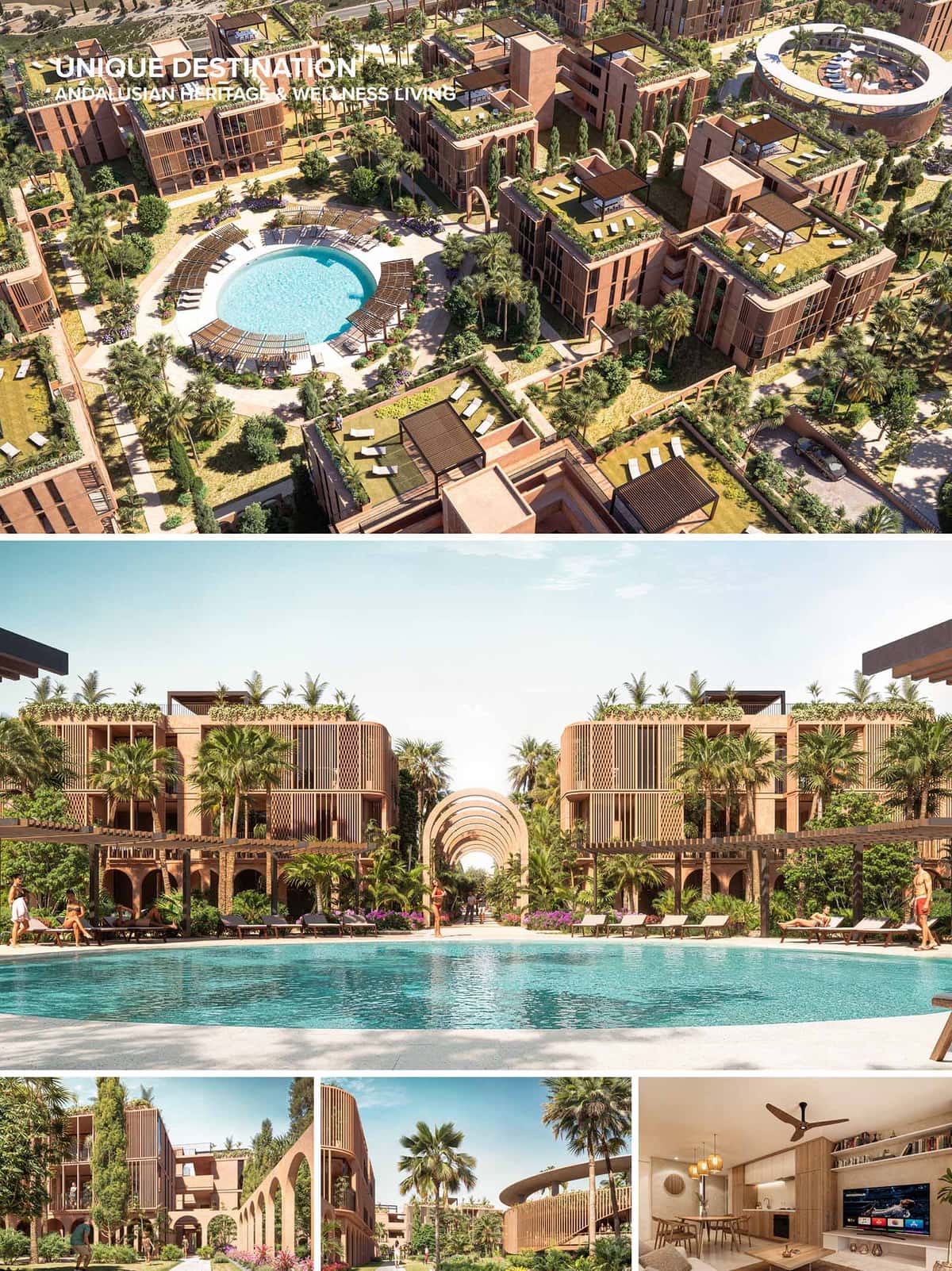
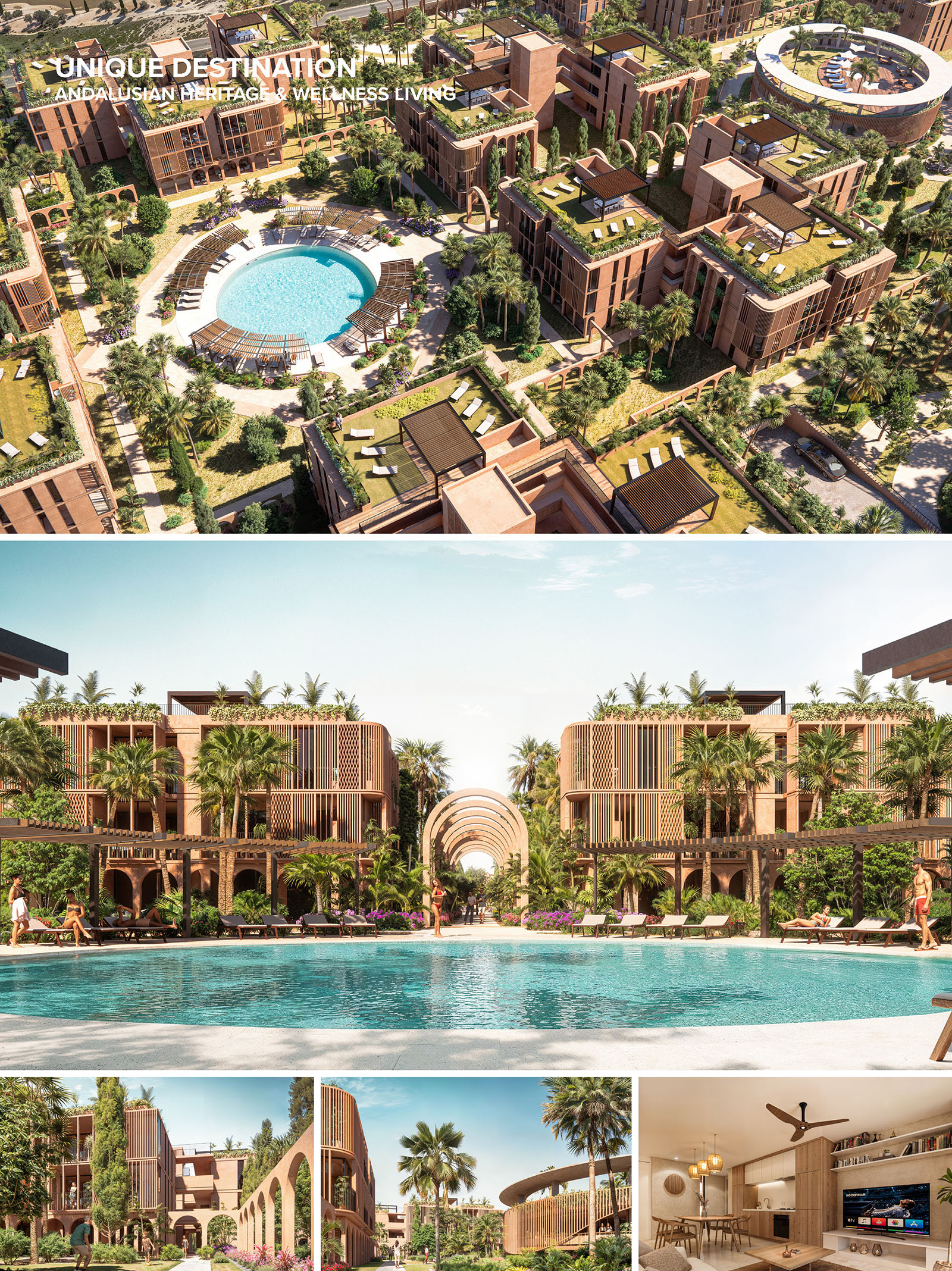
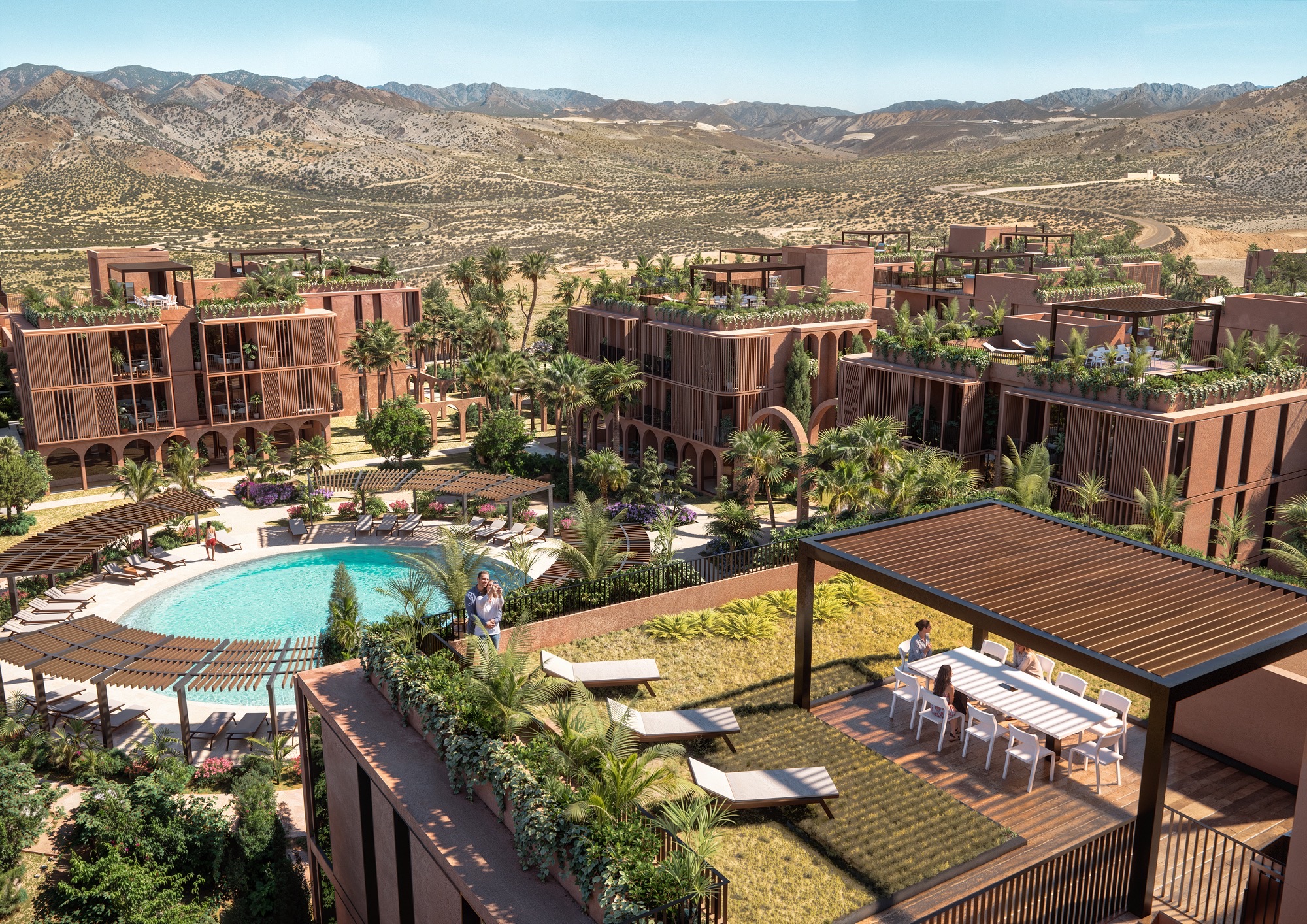
Alhambra Tourist Apartments is envisioned as a contemporary Mediterranean village that reinterprets tradition through a lens of wellness, sustainability, and experiential design. More than a collection of buildings, the project aspires to create a holistic environment where architecture, landscape, and human activity are intimately connected. Located in Murcia—an area steeped in natural beauty, Moorish heritage, and strong sunlight—the design draws inspiration from the poetic geometry and spatial richness of Islamic-Andalusian architecture. In particular, the visual language established by the Alhambra Wellness Hotel and Alhambra Residential is extended here, establishing a unified architectural identity across all three developments. These projects, though distinct in function, form a collective narrative centered on harmony, serenity, and timelessness.
At the core of the concept is the desire to craft a destination that operates on a human scale—walkable, immersive, and emotionally resonant. The masterplan replaces conventional urban grids with a soft, organic layout composed of sinuous walkways, shaded arcades, and landscaped gathering spaces. This design approach creates a sense of discovery, as residents and visitors move through a sequence of curated spatial experiences: quiet courtyards, communal gardens, open plazas, and tranquil water features. The resulting fabric encourages social interaction, introspection, and engagement with nature.
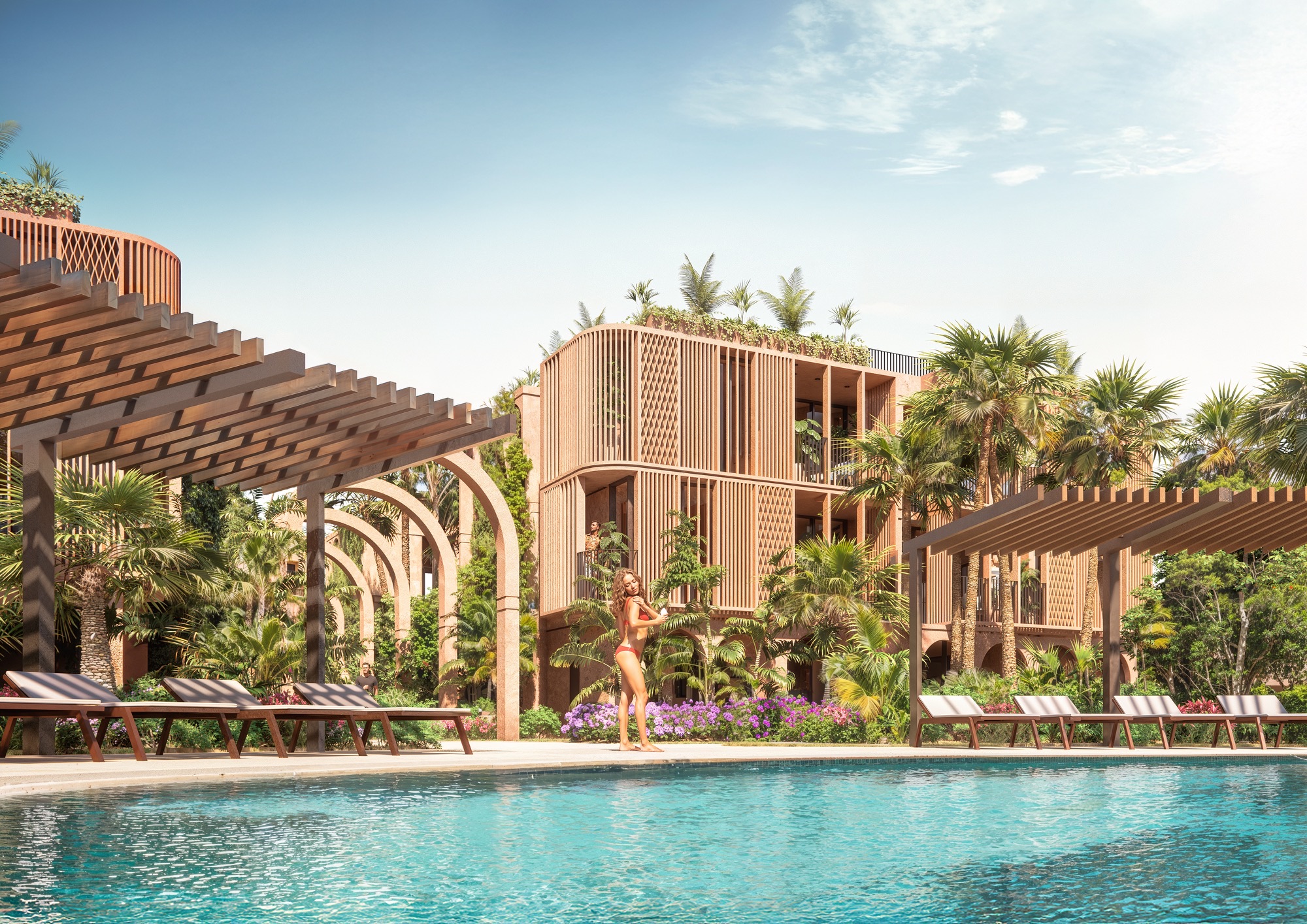
The architectural forms are deliberately restrained, defined by simplicity, repetition, and proportion. Their elegance lies not in ornamentation but in rhythm, balance, and material honesty. Inspired by vernacular Mediterranean construction, buildings are rendered in soft terracotta tones and finished in natural textures that reflect and absorb light differently throughout the day. These materials do not compete with the landscape—they belong to it. Volumes are articulated with vertical wooden screens and generous pergolas, creating an ever-changing interplay of light and shadow that adds depth and comfort.
Crucially, the design privileges the seamless flow between interior and exterior space. Each unit opens out to private terraces, shaded loggias, or rooftop gardens that become part of daily life. These outdoor rooms are not decorative—they are functional extensions of the home, encouraging open-air living and offering shelter from the sun. The layout ensures that nearly every room is cross-ventilated and naturally lit, enhancing comfort and well-being.
The identity of Alhambra Tourist Apartments is not defined solely by its aesthetics, but by its values. It reflects a Mediterranean philosophy of living: one that embraces slowness, rootedness, and intention. In a world increasingly shaped by speed and disconnection, this project offers an alternative—a place where time slows, where beauty is found in the ordinary, and where the architecture supports a life lived in balance with others and with nature. Through this design, we seek to redefine hospitality as something deeply human: immersive, grounding, and meaningful.
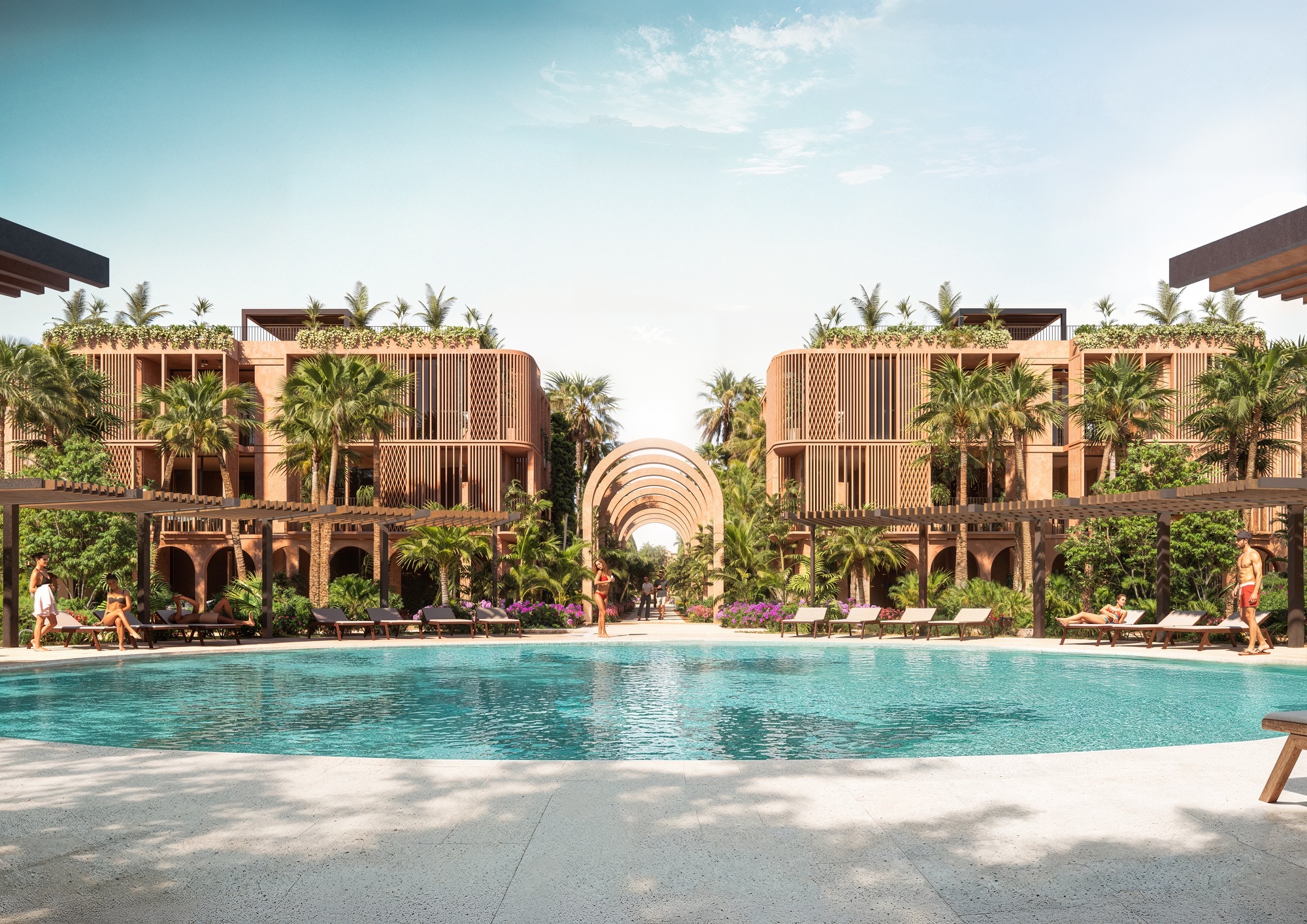
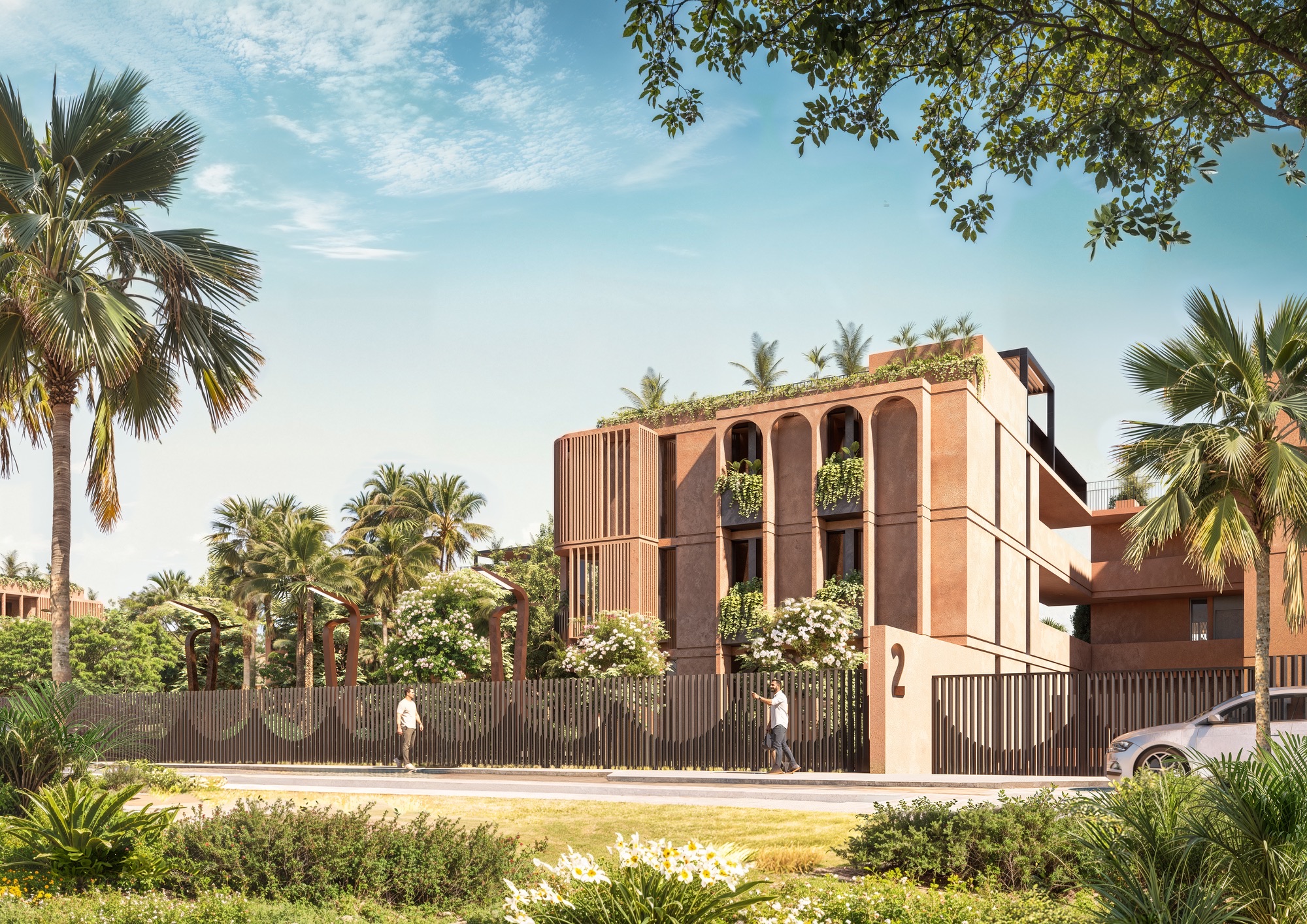
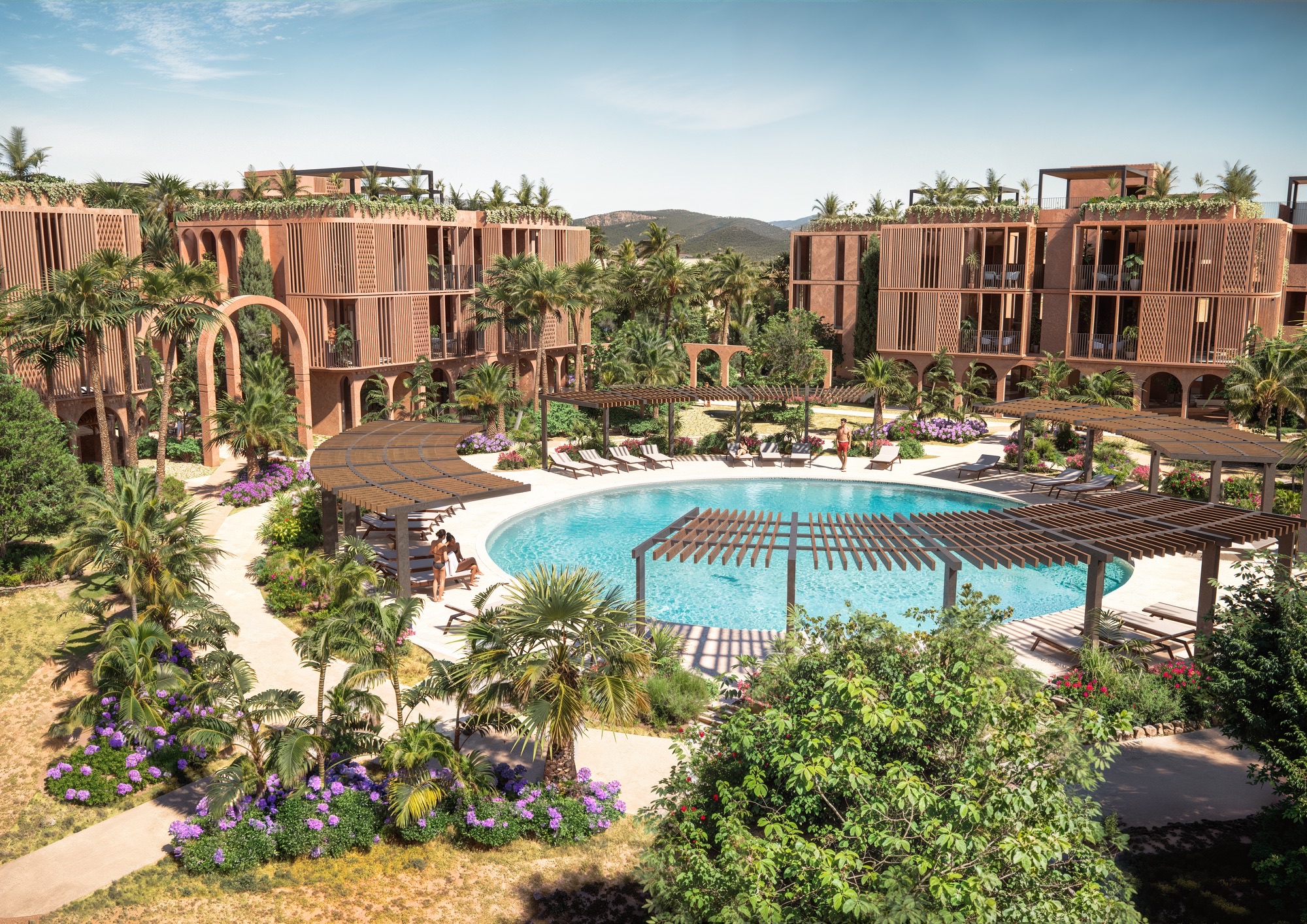
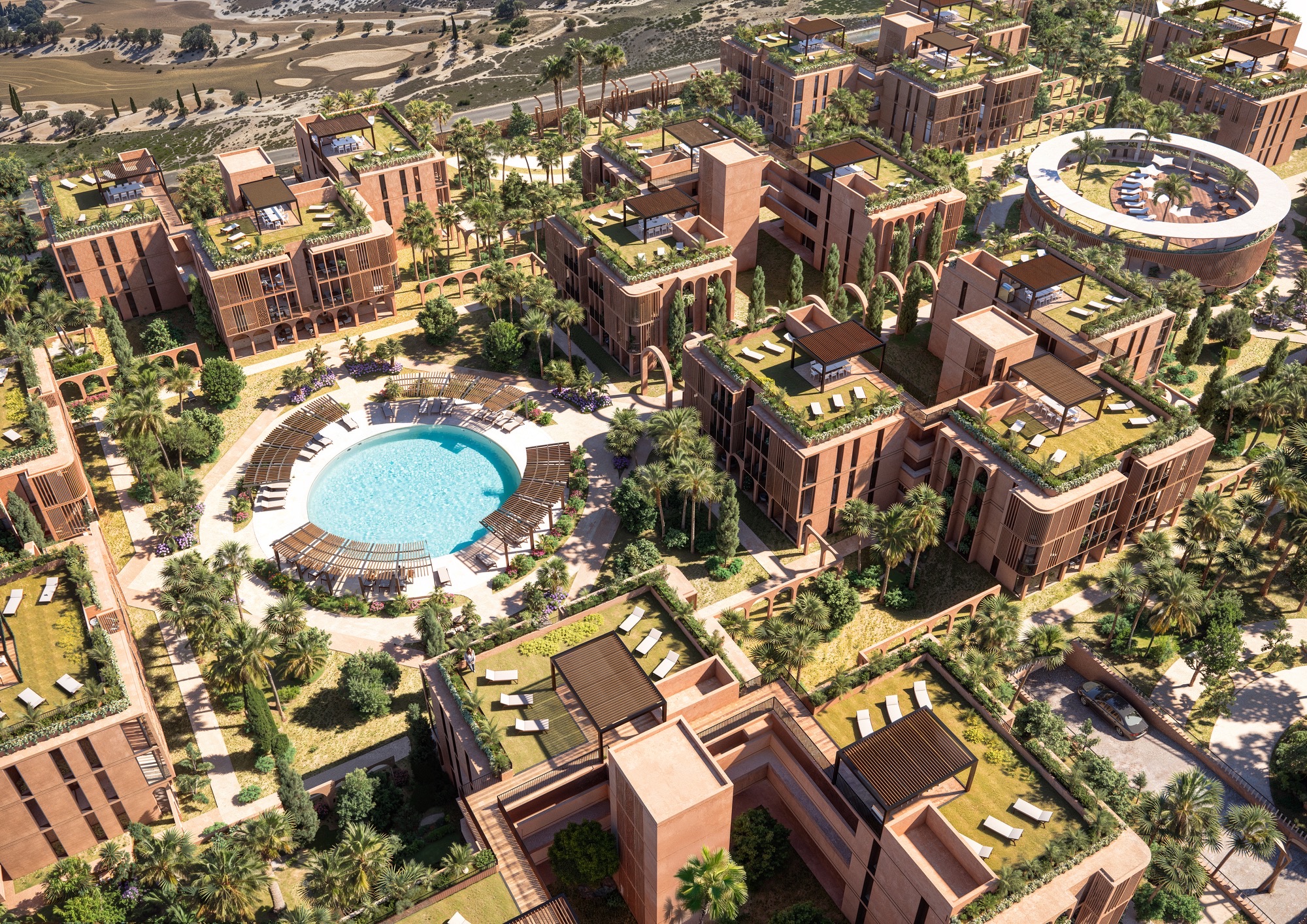
The buildings are organized as low-density clusters around communal courtyards and swimming pools, providing a balance of privacy and social interaction. Arches, arcades, and latticework reinterpret traditional motifs with a contemporary sensibility. Vertical wooden screens serve dual functions—providing solar protection while referencing mashrabiya elements, enhancing the dialogue between inside and outside. The rhythm of façades is carefully calibrated to create visual coherence, alternating between solid planes and permeable enclosures that filter natural light.
Volumes are modulated in warm, earthy tones with textures reminiscent of tadelakt and terracotta plaster, allowing the structures to blend seamlessly into the semi-arid landscape. Roof terraces, pergolas, and generous balconies become extensions of living spaces, encouraging open-air living in harmony with the region’s mild climate.
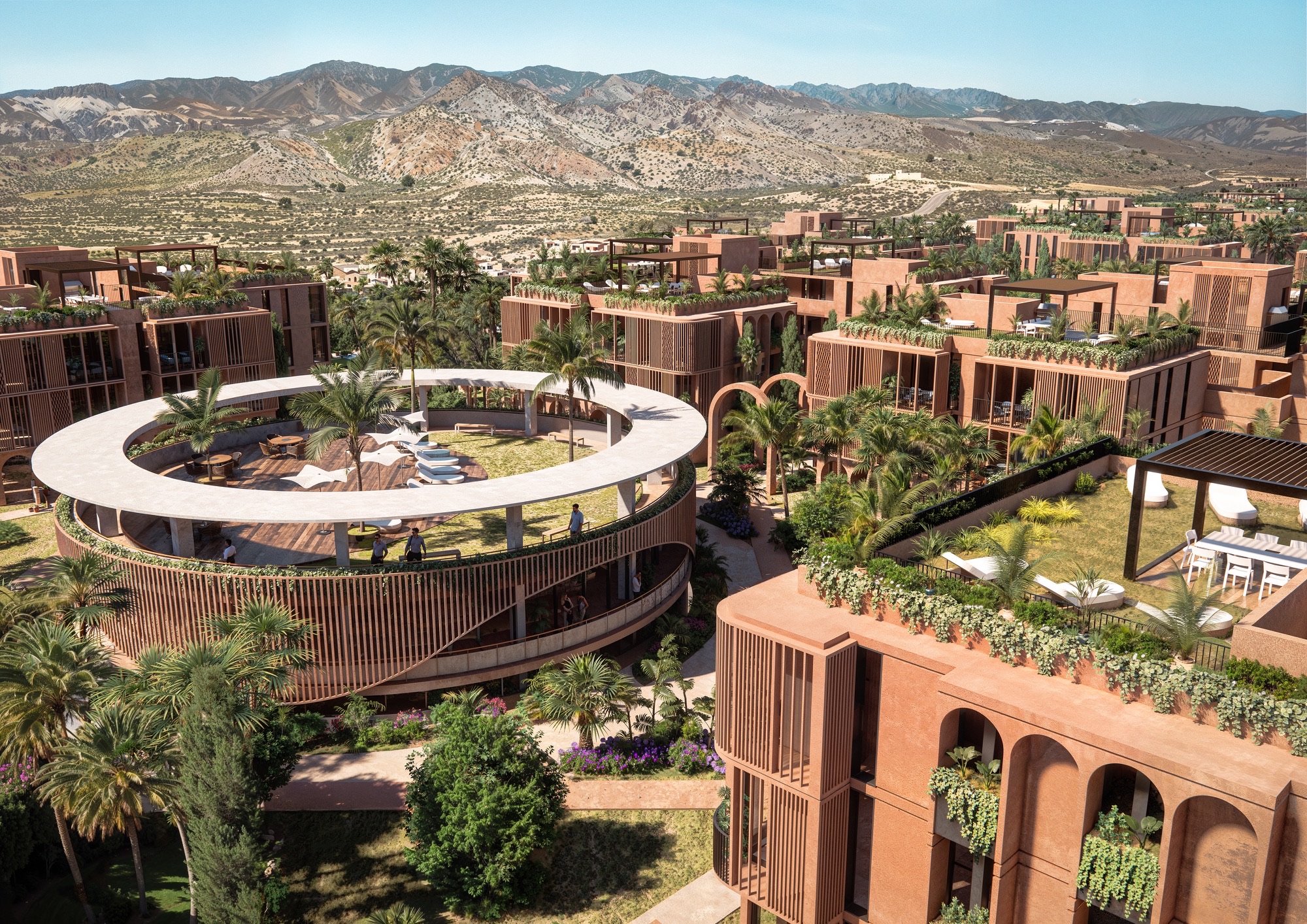
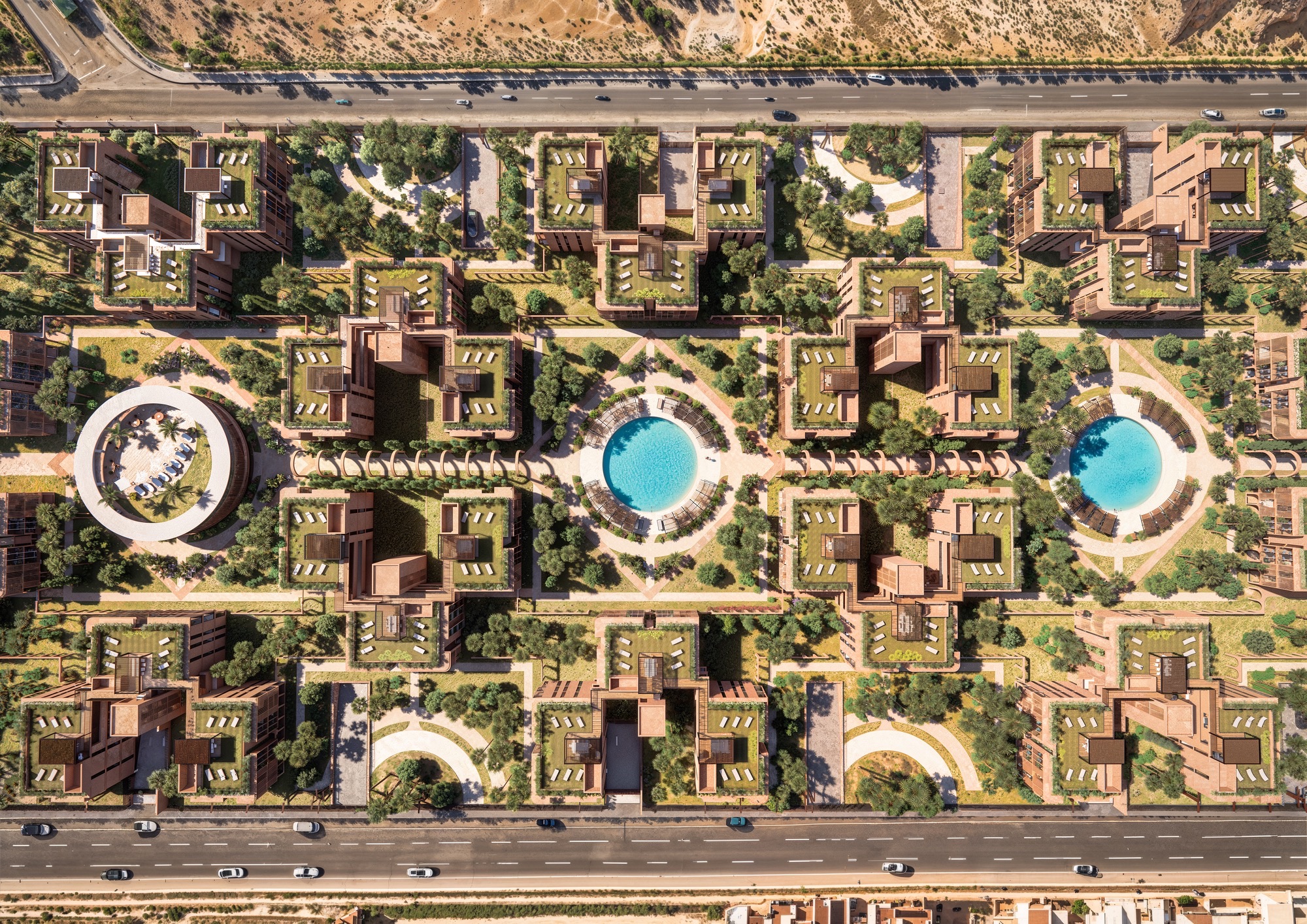
The urban layout of Alhambra Tourist Apartments is grounded in a precise geometric order inspired by traditional Islamic patterns—traces and grids that are not only ornamental, but structural tools for creating harmony, repetition, and spatial clarity. From the aerial perspective, the masterplan reveals itself as an intricate yet balanced composition: a modular arrangement of orthogonal blocks organized around interior patios and unified by a strong axial logic. This approach enables a readable, walkable environment where orientation, rhythm, and cohesion guide the user experience.
One of the defining qualities of the Alhambra Tourist Apartments is the seamless integration between interior and exterior environments. Ground-level units open directly to garden patios, while upper levels enjoy cross-ventilation and panoramic views of the surrounding landscape. Interiors are oriented to maximize daylight and natural airflow, eliminating the need for mechanical cooling for much of the year.
The architecture supports a biophilic lifestyle: residents are invited to engage with their surroundings, whether tending to a planter on a balcony, strolling through an olive grove, or gathering in the communal spaces under filtered shade.
Sustainability is embedded at every scale of the project. Bioclimatic design principles shape the orientation, form, and materiality of the buildings. Deep overhangs, vertical wooden slats, and thermal mass strategies work together to maintain interior comfort while minimizing energy demand.
The extensive use of native, drought-tolerant vegetation supports water conservation efforts and fosters local biodiversity. Greywater recycling systems and low-flow irrigation are integrated to optimize water use. At the infrastructural level, the incorporation of photovoltaic panels on rooftops and the potential for district-scale renewable energy systems contribute to a low-carbon operational footprint.
The design of the Alhambra Tourist Apartments exemplifies architecture as a holistic practice—merging beauty, tradition, and environmental stewardship into a harmonious, human-scaled living environment.
Explore our space through this immersive Virtual Tour: navigate freely, zoom in to discover details and move around by clicking the arrows or portals. Use the blue icons to teleport anywhere in the project, viewpoints or full‑screen mode, and feel free to switch to VR mode on VT Glasses for an even deeper experience! Sit back, take your time, and experience the environment as if you were really there—enjoy your journey
CRAFTED MASTER PLAN DESIGN
The entire complex is structured around a network of shaded pedestrian axes that link communal courtyards, swimming pools, plazas, and garden spaces. These pathways are defined by architectural elements such as rhythmic archways, pergolas, and arcades, which do more than mark circulation—they create a continuous canopy of shadow. In the hot Mediterranean climate of Murcia, shade is not a decorative gesture but an essential spatial strategy. It moderates temperature, softens light, and makes outdoor movement comfortable throughout the seasons.
Each cluster of buildings is arranged around an interior courtyard, as a social and climatic nucleus. These courtyards are conceived as lush, introverted gardens featuring water elements, native planting, and social seating areas. Circular pools and linear gardens act as climatic moderators, producing natural cooling through evapotranspiration while offering communal areas for leisure and connection.
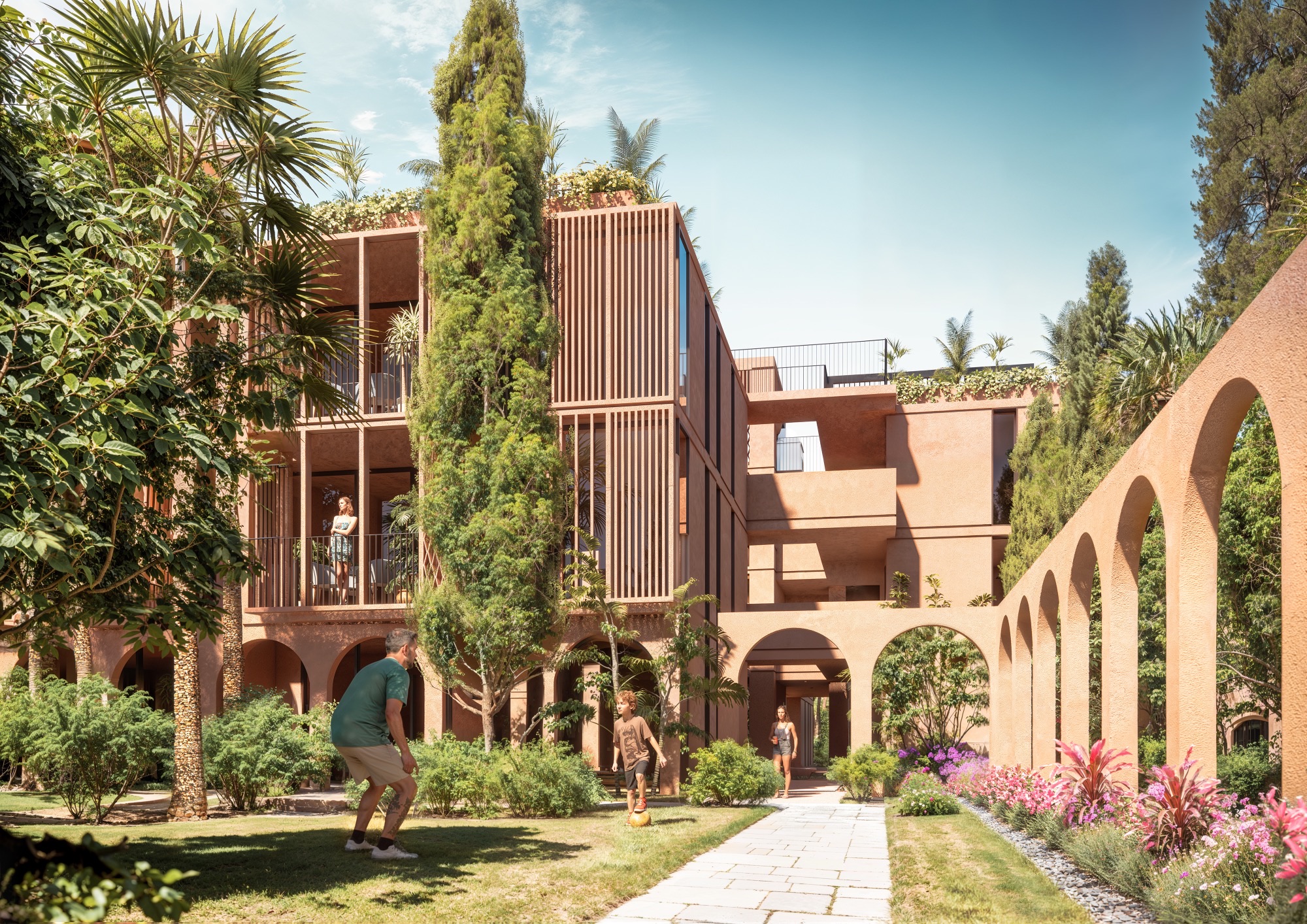
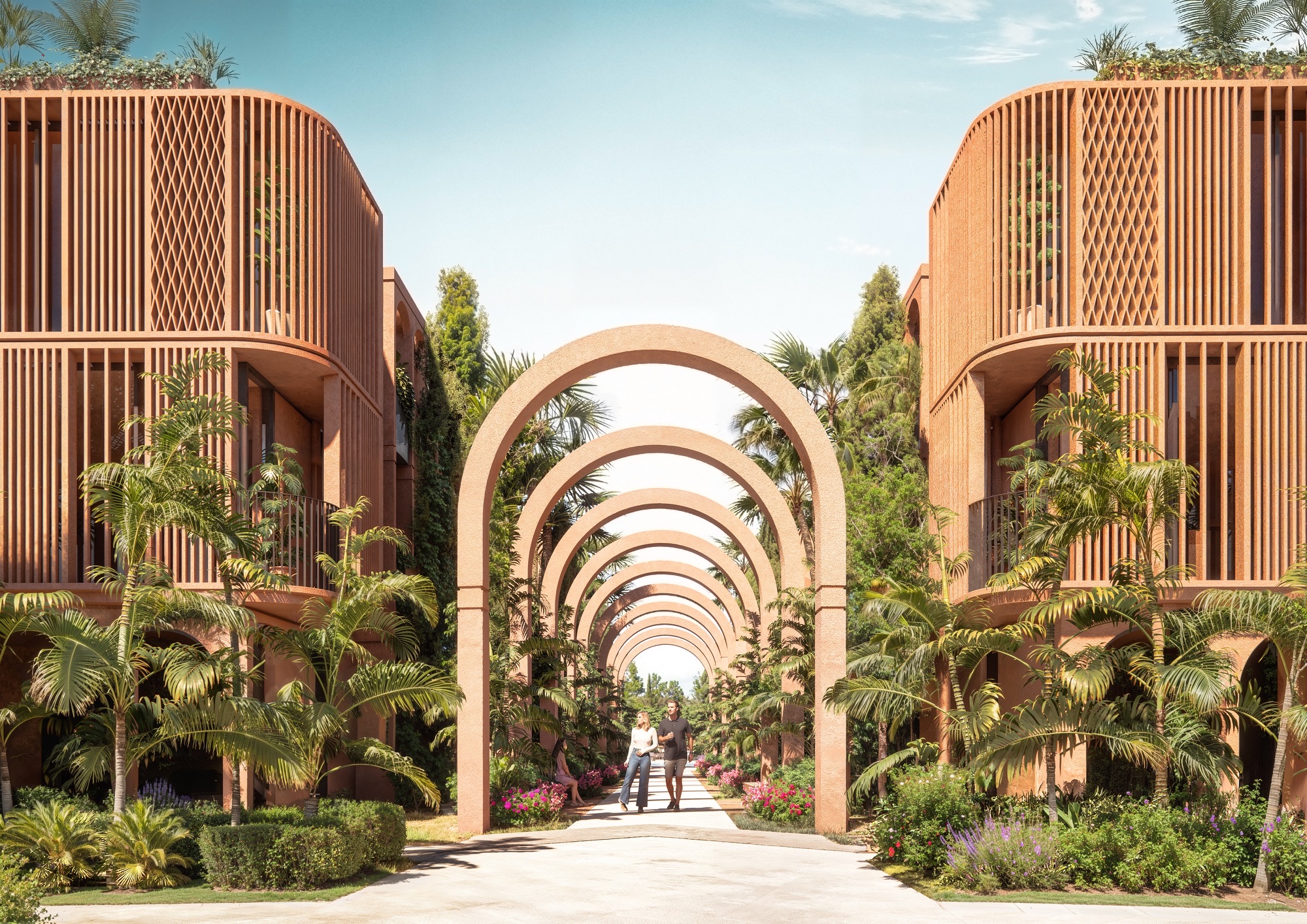
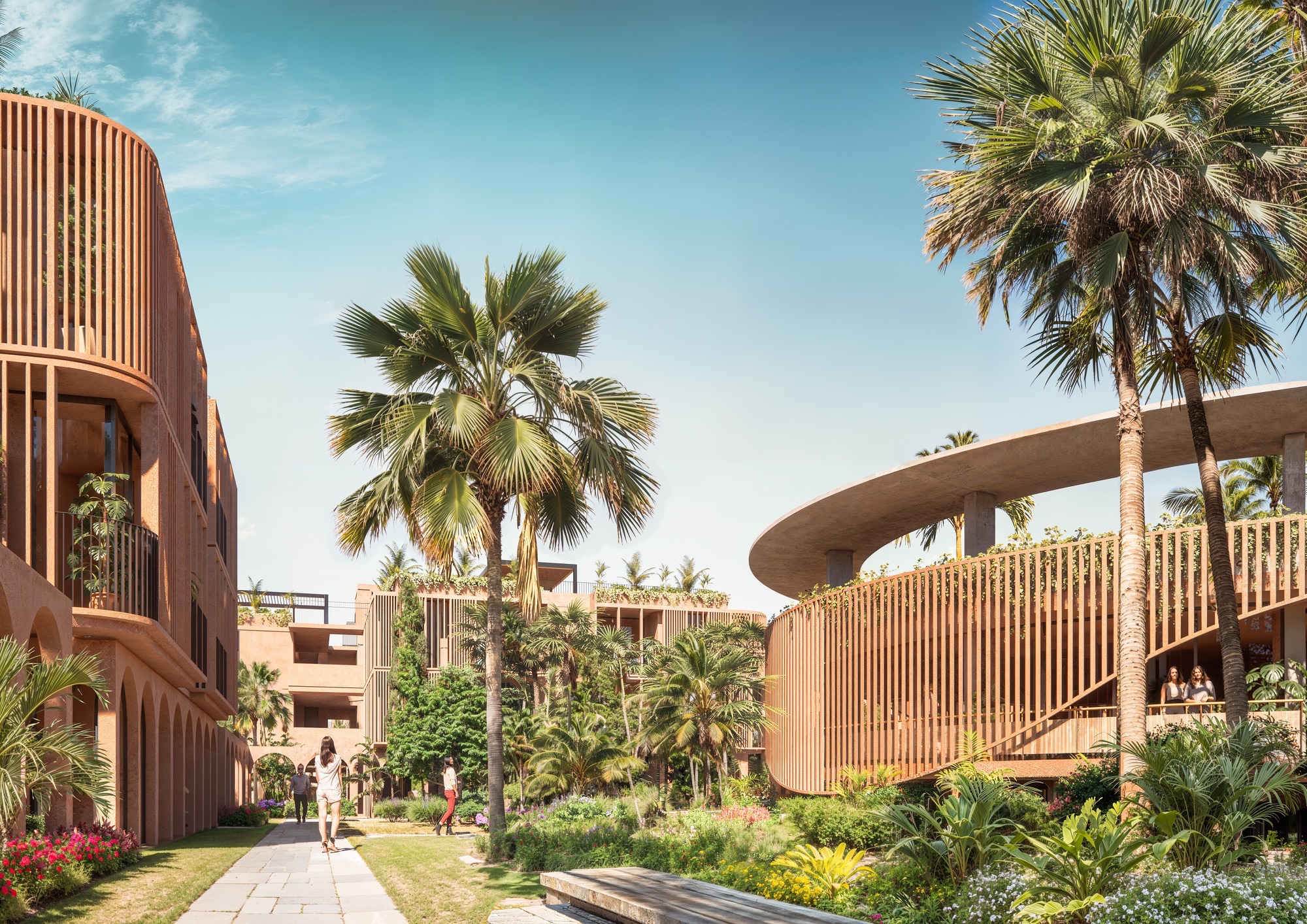
The planting strategy emphasizes Mediterranean and drought-tolerant species such as palm trees, cypresses, olive trees, and flowering shrubs—selected not only for their resilience but for their sensory richness. Ground-level paths are defined by stone paving, linear tree alignments, and structured garden beds that guide movement while softening the geometry of the built forms. Vegetation becomes a vital counterpoint to the architectural rigor, introducing texture, color, and seasonality.
The design follows a logic of proximity and intimacy, reinforcing the idea of a contemporary village. The low-rise typologies and repeated patio modules ensure that no space feels overwhelming or out of scale. Life happens in the in-between: in colonnaded walkways, garden corridors, quiet benches under pergolas, and the shaded thresholds between buildings and landscape. These interstitial zones encourage casual encounters, reflection, and slowness.
Ultimately, the landscape and urban structure serve as the unifying backbone of the project. Through the use of geometric harmony and carefully modulated shade, Alhambra Tourist Apartments offers not just legibility and comfort, but an emotional atmosphere—one rooted in cultural memory and elevated through contemporary spatial language.
The interiors of Alhambra Tourist Apartments are designed to echo the same principles that define the architecture and landscape: natural materiality, soft Mediterranean tones, and a deep connection between indoor and outdoor living. Every space is conceived as an extension of the serene, rooted lifestyle promoted by the project—calm, tactile, and intentional.
The design embraces a palette of warm neutrals and earthy textures that speak to the regional context and climate. Floors are finished in light-toned limestone or ceramic materials that reflect natural light and keep interiors cool. Walls are rendered in natural plasters, subtly textured to create visual warmth and depth. Custom carpentry in oak or ash wood introduces a layer of artisanal refinement, present in built-in cabinetry, shelving, and millwork.
Ventilation and light control are key strategies. Ceiling fans and cross-ventilation reduce the need for artificial cooling, while layered lighting schemes allow for flexible ambiance: indirect LED strips under cabinetry, warm pendant lights over dining tables, and recessed fixtures for focused illumination. The lighting is not merely functional, but curated to enhance the spatial mood throughout the day and night. The interior design aims to support a lifestyle that values simplicity, wellness, and sensory connection. Each unit is a sanctuary, carefully composed with natural materials, elegant details, and spatial clarity—creating a domestic environment that is both tranquil and deeply connected to the surrounding landscape.
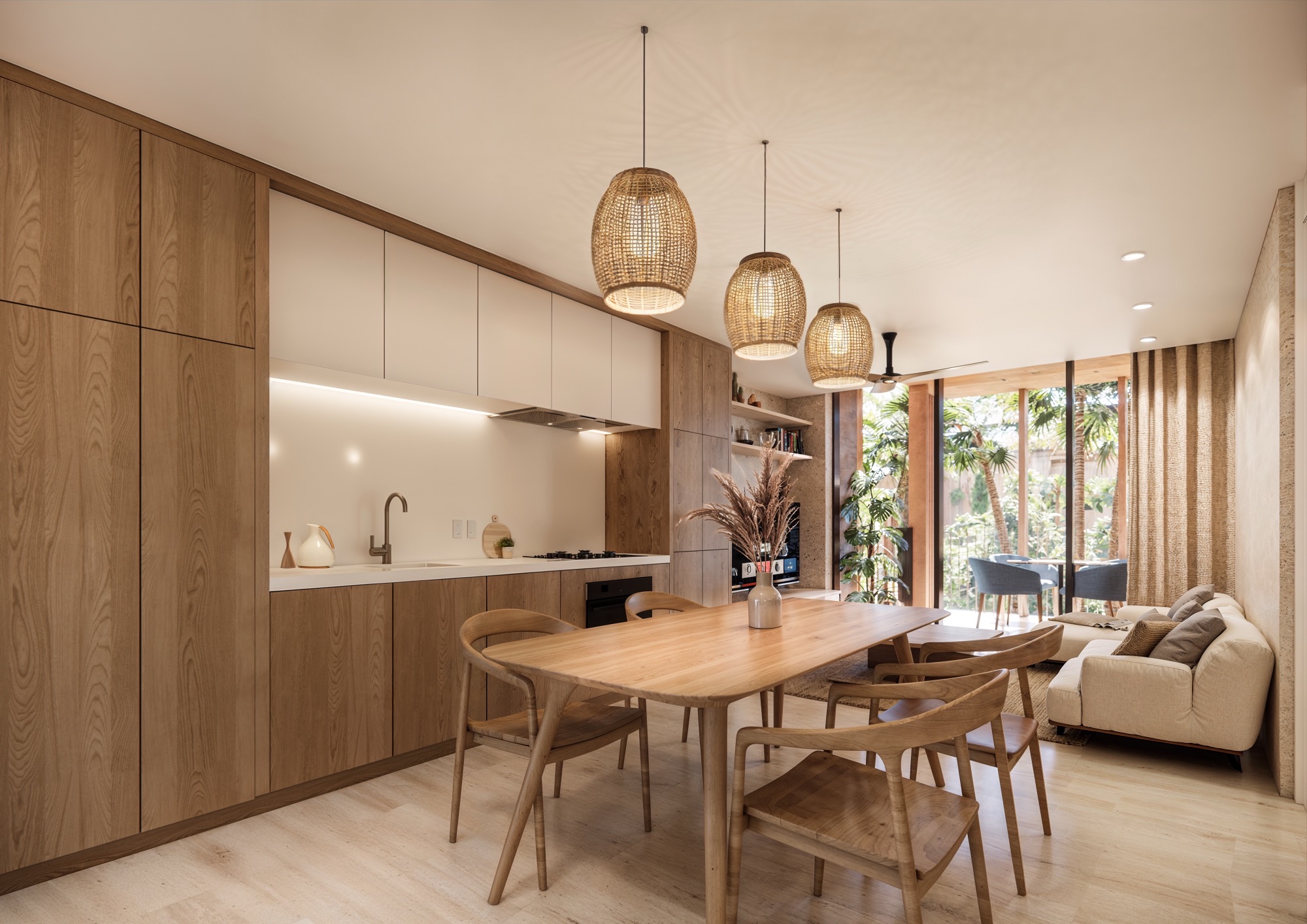
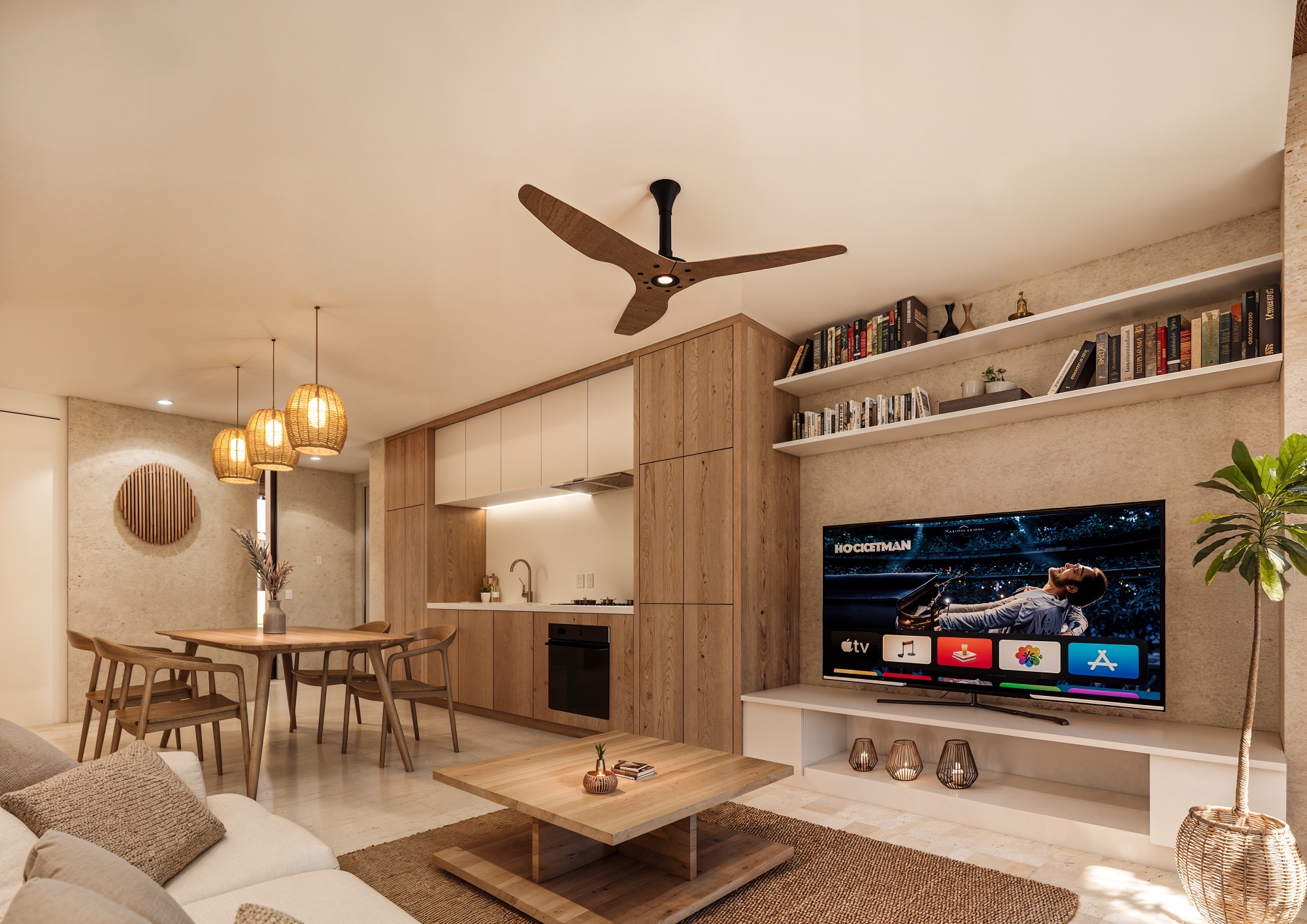
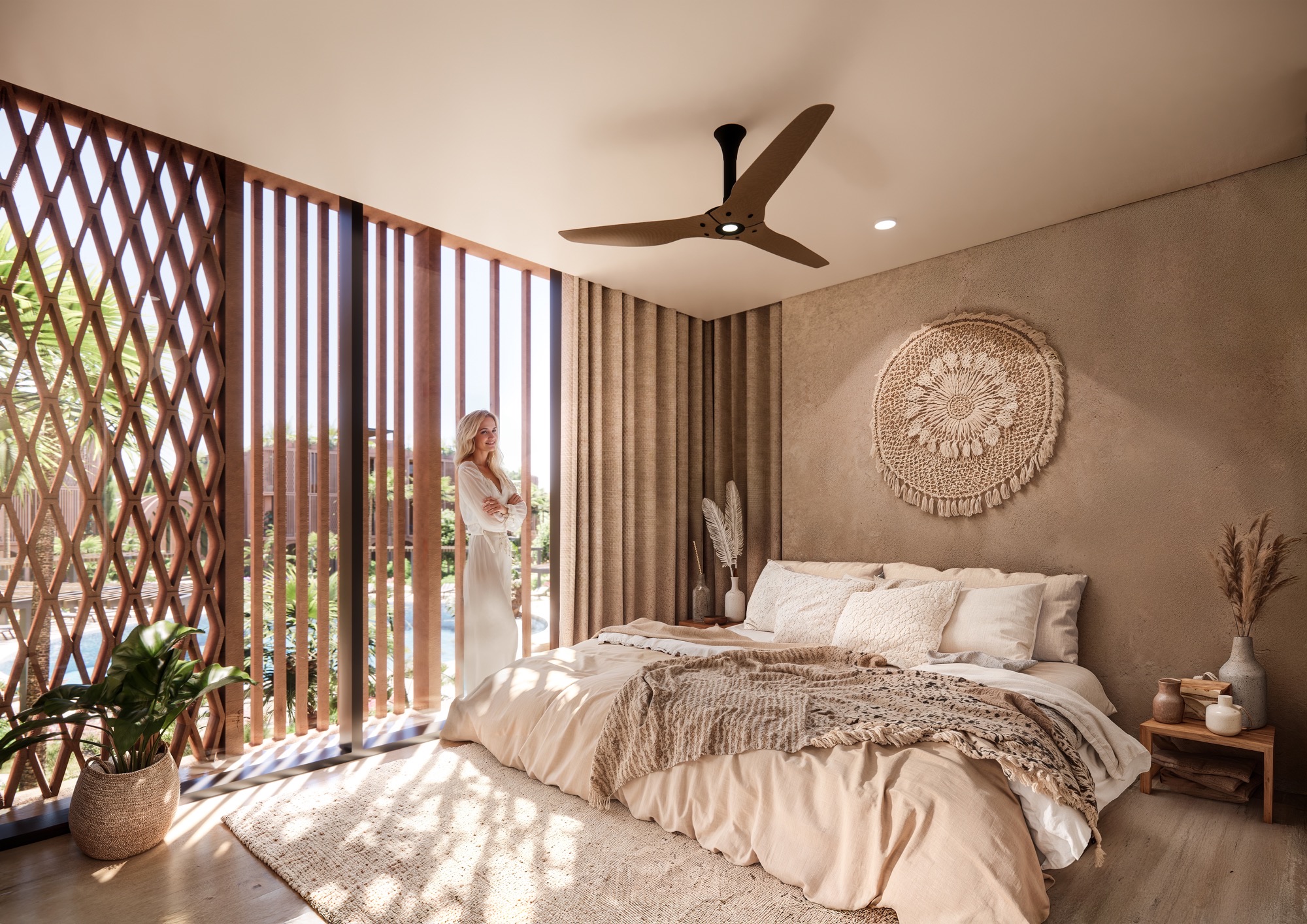
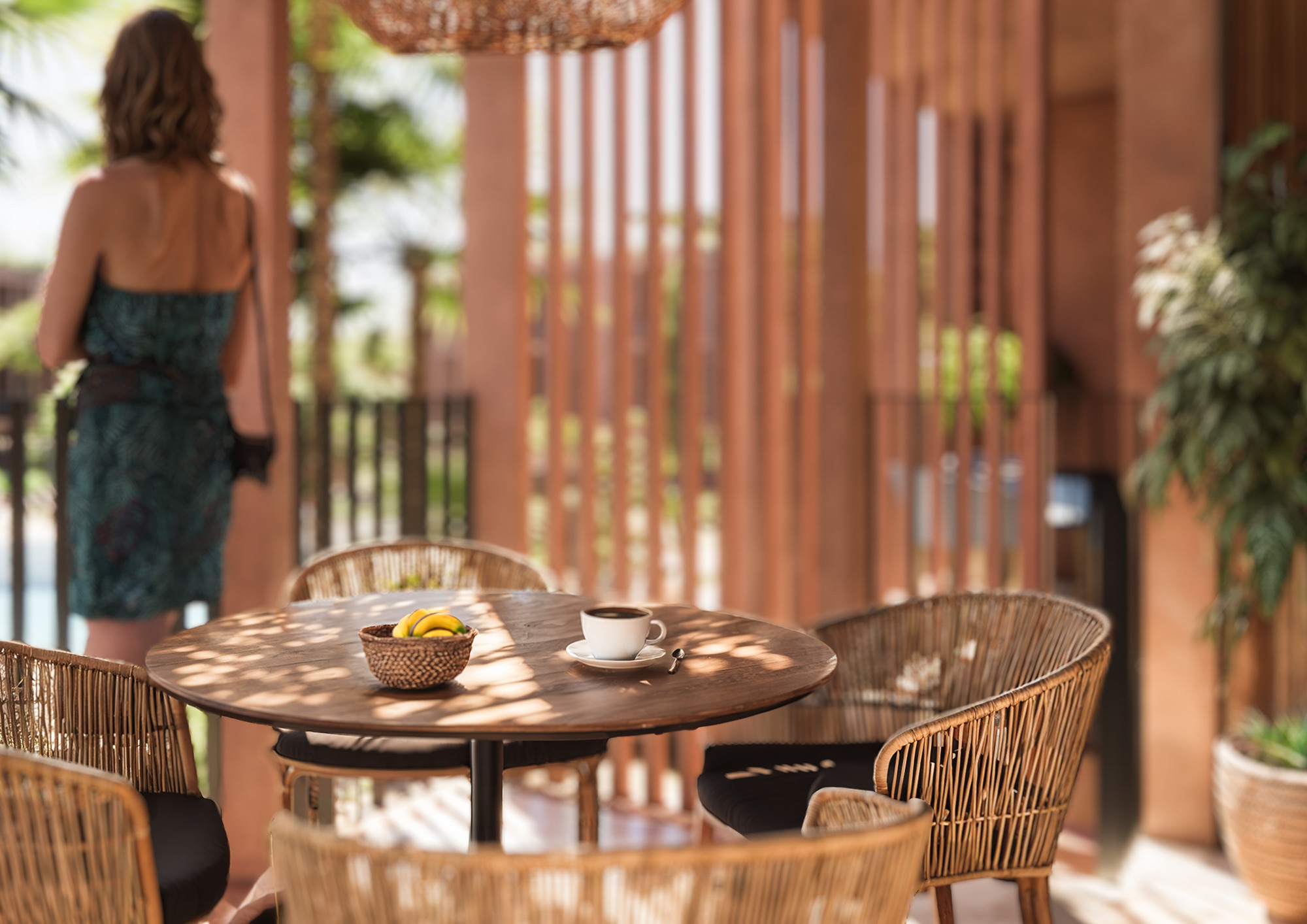
Alhambra Tourist Apartments is envisioned as a contemporary Mediterranean village that reinterprets tradition through a lens of wellness, sustainability, and experiential design. More than a collection of buildings, the project aspires to create a holistic environment where architecture, landscape, and human activity are intimately connected. Located in Murcia—an area steeped in natural beauty, Moorish heritage, and strong sunlight—the design draws inspiration from the poetic geometry and spatial richness of Islamic-Andalusian architecture. In particular, the visual language established by the Alhambra Wellness Hotel and Alhambra Residential is extended here, establishing a unified architectural identity across all three developments. These projects, though distinct in function, form a collective narrative centered on harmony, serenity, and timelessness.
At the core of the concept is the desire to craft a destination that operates on a human scale—walkable, immersive, and emotionally resonant. The masterplan replaces conventional urban grids with a soft, organic layout composed of sinuous walkways, shaded arcades, and landscaped gathering spaces. This design approach creates a sense of discovery, as residents and visitors move through a sequence of curated spatial experiences: quiet courtyards, communal gardens, open plazas, and tranquil water features. The resulting fabric encourages social interaction, introspection, and engagement with nature.
The architectural forms are deliberately restrained, defined by simplicity, repetition, and proportion. Their elegance lies not in ornamentation but in rhythm, balance, and material honesty. Inspired by vernacular Mediterranean construction, buildings are rendered in soft terracotta tones and finished in natural textures that reflect and absorb light differently throughout the day. These materials do not compete with the landscape—they belong to it. Volumes are articulated with vertical wooden screens and generous pergolas, creating an ever-changing interplay of light and shadow that adds depth and comfort.
Crucially, the design privileges the seamless flow between interior and exterior space. Each unit opens out to private terraces, shaded loggias, or rooftop gardens that become part of daily life. These outdoor rooms are not decorative—they are functional extensions of the home, encouraging open-air living and offering shelter from the sun. The layout ensures that nearly every room is cross-ventilated and naturally lit, enhancing comfort and well-being.
The identity of Alhambra Tourist Apartments is not defined solely by its aesthetics, but by its values. It reflects a Mediterranean philosophy of living: one that embraces slowness, rootedness, and intention. In a world increasingly shaped by speed and disconnection, this project offers an alternative—a place where time slows, where beauty is found in the ordinary, and where the architecture supports a life lived in balance with others and with nature. Through this design, we seek to redefine hospitality as something deeply human: immersive, grounding, and meaningful.
The buildings are organized as low-density clusters around communal courtyards and swimming pools, providing a balance of privacy and social interaction. Arches, arcades, and latticework reinterpret traditional motifs with a contemporary sensibility. Vertical wooden screens serve dual functions—providing solar protection while referencing mashrabiya elements, enhancing the dialogue between inside and outside. The rhythm of façades is carefully calibrated to create visual coherence, alternating between solid planes and permeable enclosures that filter natural light.
Volumes are modulated in warm, earthy tones with textures reminiscent of tadelakt and terracotta plaster, allowing the structures to blend seamlessly into the semi-arid landscape. Roof terraces, pergolas, and generous balconies become extensions of living spaces, encouraging open-air living in harmony with the region’s mild climate.
The urban layout of Alhambra Tourist Apartments is grounded in a precise geometric order inspired by traditional Islamic patterns—traces and grids that are not only ornamental, but structural tools for creating harmony, repetition, and spatial clarity. From the aerial perspective, the masterplan reveals itself as an intricate yet balanced composition: a modular arrangement of orthogonal blocks organized around interior patios and unified by a strong axial logic. This approach enables a readable, walkable environment where orientation, rhythm, and cohesion guide the user experience.
One of the defining qualities of the Alhambra Tourist Apartments is the seamless integration between interior and exterior environments. Ground-level units open directly to garden patios, while upper levels enjoy cross-ventilation and panoramic views of the surrounding landscape. Interiors are oriented to maximize daylight and natural airflow, eliminating the need for mechanical cooling for much of the year.
The architecture supports a biophilic lifestyle: residents are invited to engage with their surroundings, whether tending to a planter on a balcony, strolling through an olive grove, or gathering in the communal spaces under filtered shade.
Sustainability is embedded at every scale of the project. Bioclimatic design principles shape the orientation, form, and materiality of the buildings. Deep overhangs, vertical wooden slats, and thermal mass strategies work together to maintain interior comfort while minimizing energy demand.
The extensive use of native, drought-tolerant vegetation supports water conservation efforts and fosters local biodiversity. Greywater recycling systems and low-flow irrigation are integrated to optimize water use. At the infrastructural level, the incorporation of photovoltaic panels on rooftops and the potential for district-scale renewable energy systems contribute to a low-carbon operational footprint.
The design of the Alhambra Tourist Apartments exemplifies architecture as a holistic practice—merging beauty, tradition, and environmental stewardship into a harmonious, human-scaled living environment.
Explore our space through this immersive Virtual Tour: navigate freely, zoom in to discover details and move around by clicking the arrows or portals. Use the blue icons to teleport anywhere in the project, viewpoints or full‑screen mode, and feel free to switch to VR mode on VT Glasses for an even deeper experience! Sit back, take your time, and experience the environment as if you were really there—enjoy your journey
CRAFTED MASTER PLAN DESIGN
The entire complex is structured around a network of shaded pedestrian axes that link communal courtyards, swimming pools, plazas, and garden spaces. These pathways are defined by architectural elements such as rhythmic archways, pergolas, and arcades, which do more than mark circulation—they create a continuous canopy of shadow. In the hot Mediterranean climate of Murcia, shade is not a decorative gesture but an essential spatial strategy. It moderates temperature, softens light, and makes outdoor movement comfortable throughout the seasons.
Each cluster of buildings is arranged around an interior courtyard, as a social and climatic nucleus. These courtyards are conceived as lush, introverted gardens featuring water elements, native planting, and social seating areas. Circular pools and linear gardens act as climatic moderators, producing natural cooling through evapotranspiration while offering communal areas for leisure and connection.
The planting strategy emphasizes Mediterranean and drought-tolerant species such as palm trees, cypresses, olive trees, and flowering shrubs—selected not only for their resilience but for their sensory richness. Ground-level paths are defined by stone paving, linear tree alignments, and structured garden beds that guide movement while softening the geometry of the built forms. Vegetation becomes a vital counterpoint to the architectural rigor, introducing texture, color, and seasonality.
The design follows a logic of proximity and intimacy, reinforcing the idea of a contemporary village. The low-rise typologies and repeated patio modules ensure that no space feels overwhelming or out of scale. Life happens in the in-between: in colonnaded walkways, garden corridors, quiet benches under pergolas, and the shaded thresholds between buildings and landscape. These interstitial zones encourage casual encounters, reflection, and slowness.
Ultimately, the landscape and urban structure serve as the unifying backbone of the project. Through the use of geometric harmony and carefully modulated shade, Alhambra Tourist Apartments offers not just legibility and comfort, but an emotional atmosphere—one rooted in cultural memory and elevated through contemporary spatial language.
The interiors of Alhambra Tourist Apartments are designed to echo the same principles that define the architecture and landscape: natural materiality, soft Mediterranean tones, and a deep connection between indoor and outdoor living. Every space is conceived as an extension of the serene, rooted lifestyle promoted by the project—calm, tactile, and intentional.
The design embraces a palette of warm neutrals and earthy textures that speak to the regional context and climate. Floors are finished in light-toned limestone or ceramic materials that reflect natural light and keep interiors cool. Walls are rendered in natural plasters, subtly textured to create visual warmth and depth. Custom carpentry in oak or ash wood introduces a layer of artisanal refinement, present in built-in cabinetry, shelving, and millwork.
Ventilation and light control are key strategies. Ceiling fans and cross-ventilation reduce the need for artificial cooling, while layered lighting schemes allow for flexible ambiance: indirect LED strips under cabinetry, warm pendant lights over dining tables, and recessed fixtures for focused illumination. The lighting is not merely functional, but curated to enhance the spatial mood throughout the day and night. The interior design aims to support a lifestyle that values simplicity, wellness, and sensory connection. Each unit is a sanctuary, carefully composed with natural materials, elegant details, and spatial clarity—creating a domestic environment that is both tranquil and deeply connected to the surrounding landscape.
© 2021 by sanzpont [arquitectura] . Webpage by sanzpont [digital] . Innovative Digital Experiences
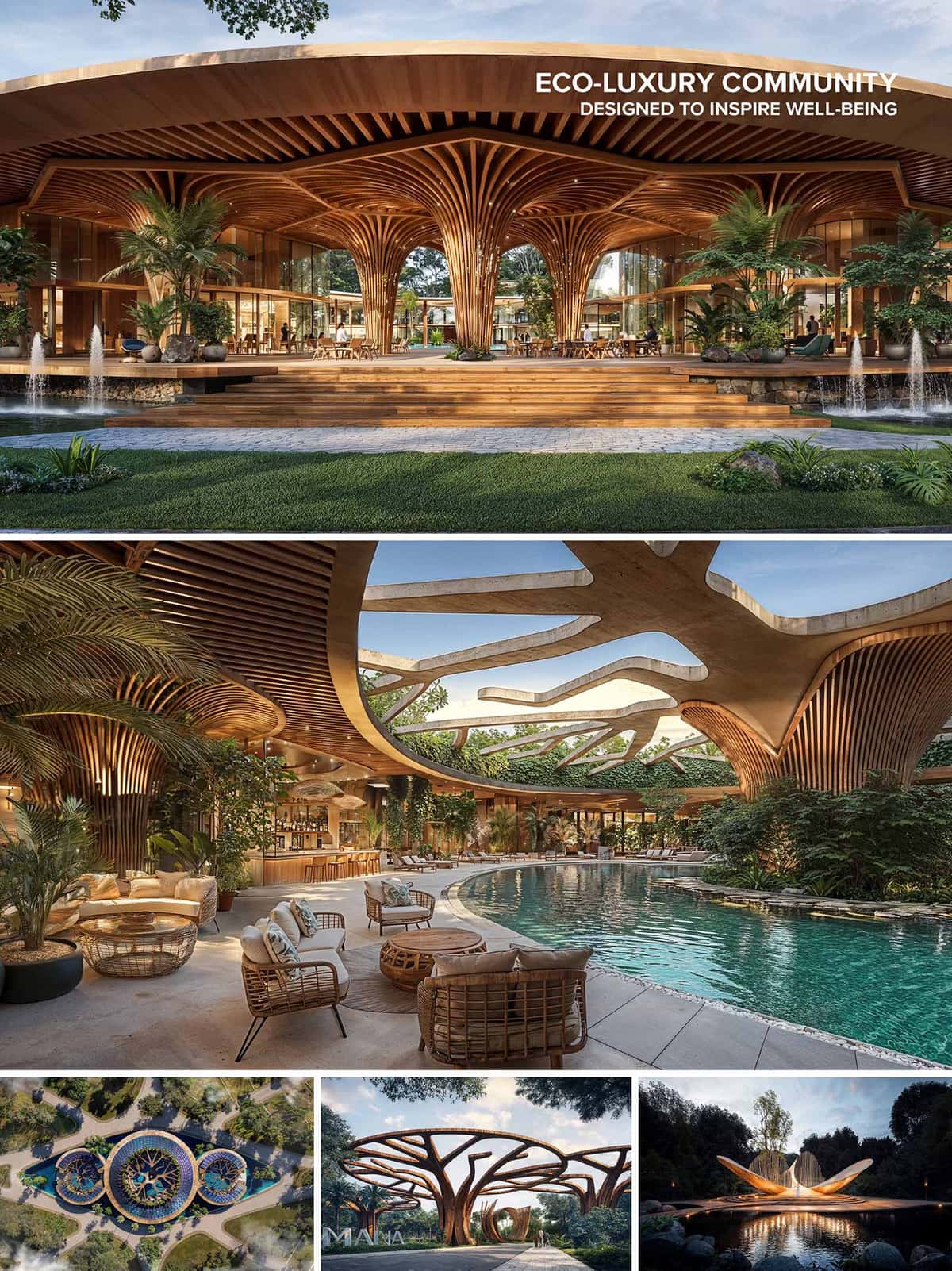
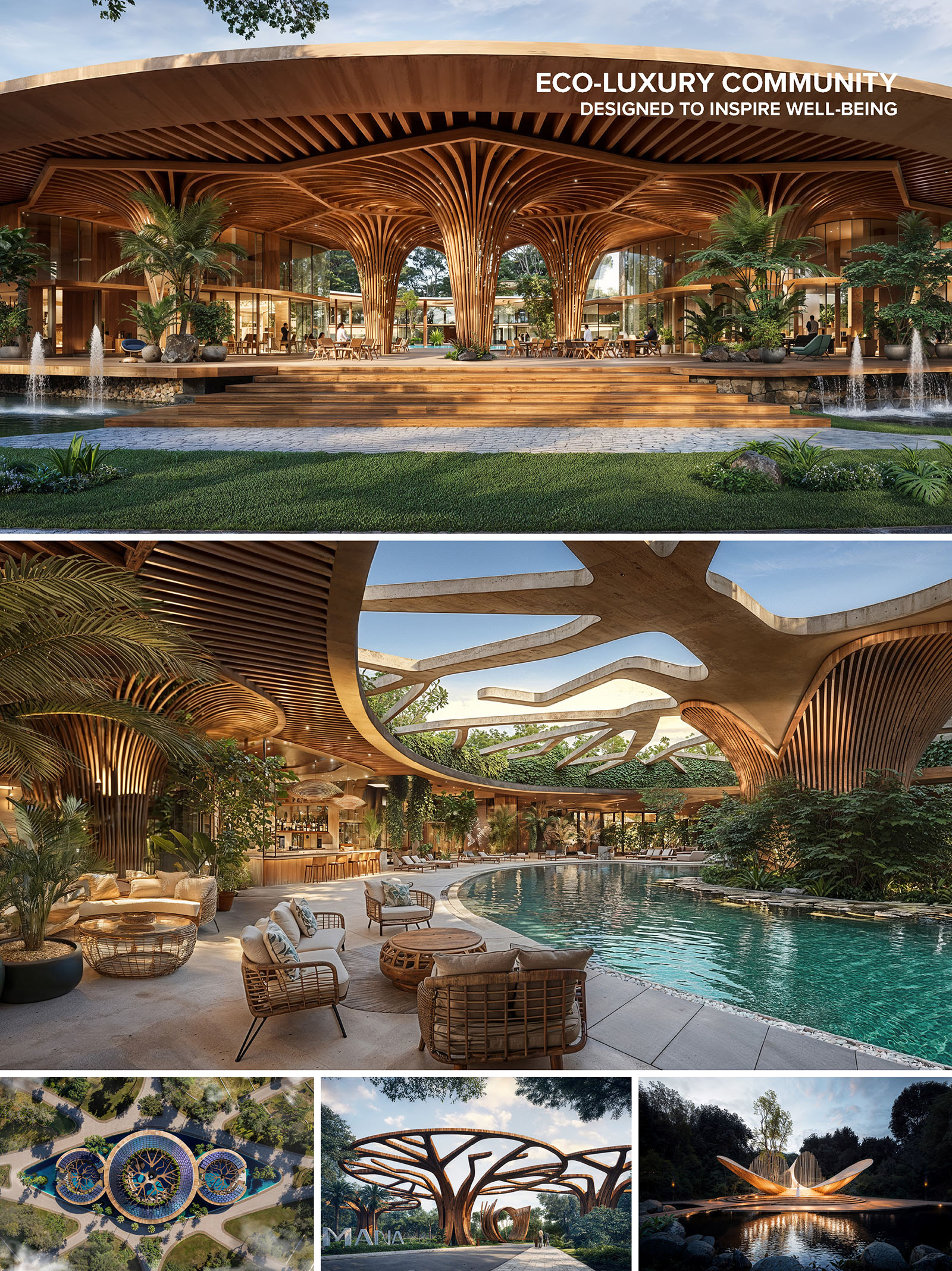
Deeply rooted in the cultural and ecological spirit of the Riviera Maya, MANA 88 is envisioned as a regenerative wellness community inspired by the sacred Alamo tree — guardian of the cenotes and symbol of protection, renewal, and connection between worlds.
Located in Akumal, Mexico, the project redefines the relationship between architecture and nature, creating a holistic environment where design, ecology, and human experience coexist in balance.
The master plan draws from the principles of sacred geometry and the Mayan cosmology of the three realms — the roots (underworld), trunk (earth), and branches (sky). These archetypes shape the spatial and symbolic organization of the entire development, guiding circulation, hierarchy, and visual alignment. The geometry unfolds as a living mandala: a network of paths, plazas, and gardens organized around the Wellness Center, the spiritual and social heart of the community
Within this circular sanctuary, water, light, and vegetation intertwine to create spaces of calm and renewal. The architecture becomes an instrument of balance — a dialogue between openness and refuge, between the elements and the human spirit. Around it, recreational amenities, meditation decks, and reflective gardens integrate seamlessly with clusters of villas designed for privacy, connection, and contemplation.
The architecture of MANA 88 expresses the harmony between material, landscape, and meaning. Inspired by the natural textures of limestone, bamboo, and rammed earth, the built language feels both timeless and rooted in place. Simple geometric forms emerge from the terrain as extensions of the landscape, blurring the line between built and natural.
Each villa prototype embodies the project’s regenerative philosophy — designed with passive systems for natural ventilation, solar orientation, and shading. The typologies respond to different micro-landscapes: jungle, cenote, and clearing, offering varied experiences of light, privacy, and connection to nature. Interiors are open and tactile, where stone, wood, and woven details evoke serenity and craft.
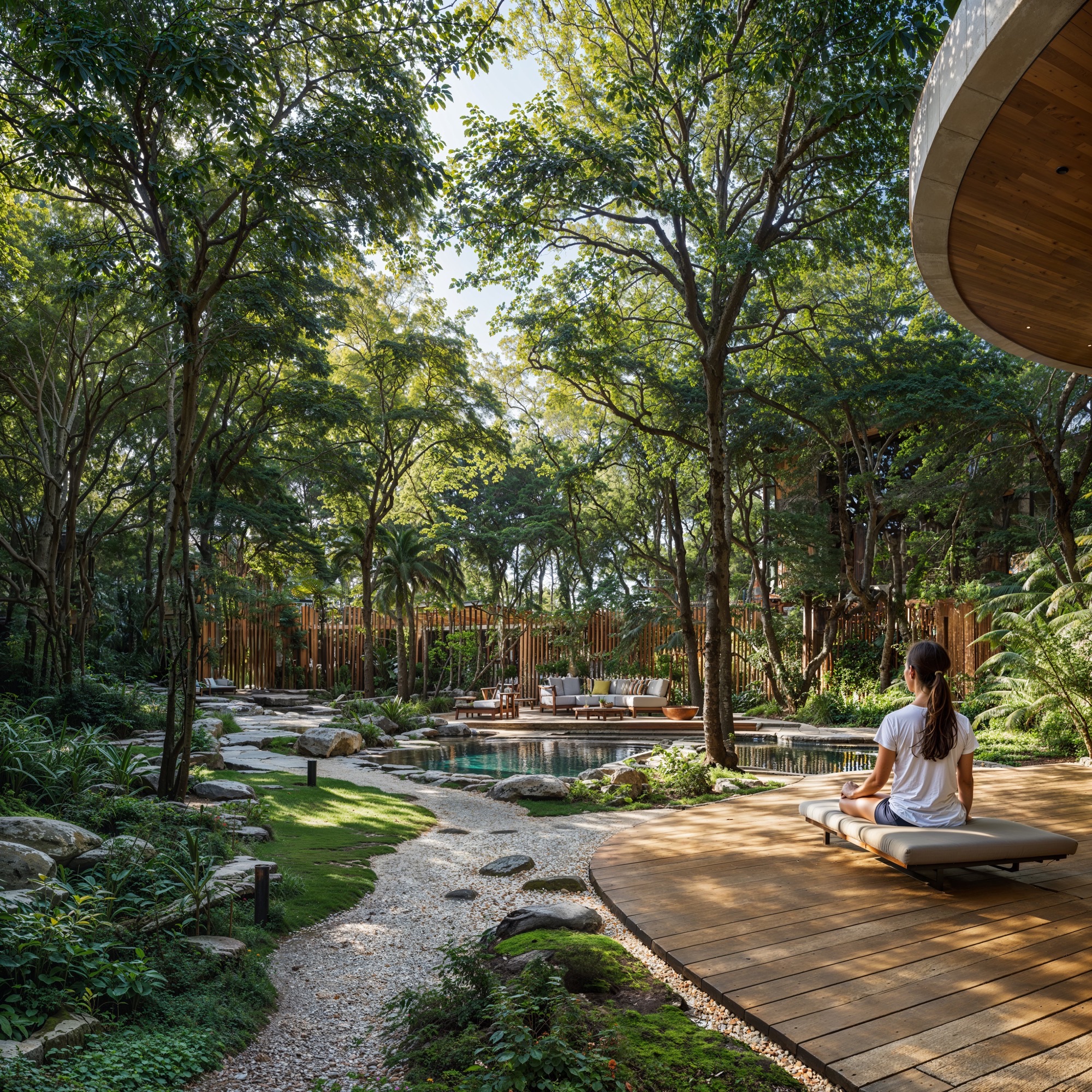
The Wellness Center, envisioned as a circular temple of wellbeing, anchors the entire composition. Its ring-shaped design embraces an inner oasis with thermal pools, shaded hammocks, and meditative gardens. The curved colonnade filters sunlight through bamboo lattices, casting ever-changing shadows that mirror the movement of water and wind.
In MANA 88, landscape is not the backdrop of architecture — it is the soul of the project. The master plan restores native ecosystems and weaves them into the spatial fabric of the community. A network of pathways connects the cenote lagoons, wellness zones, and recreational areas, encouraging slow movement, mindfulness, and discovery.
The vegetation palette prioritizes native and adaptive species — ceiba, chicozapote, palm, and endemic tropical flora — reinforcing biodiversity and resilience. Water is celebrated as a sacred element: shallow pools, reflective channels, and natural wetlands form a continuous hydrological network that cools the air, recharges the aquifer, and sustains the cenote ecology.
Every space is choreographed to awaken the senses — the texture of stone underfoot, the scent of wet earth, the sound of rustling bamboo. Community pavilions, fire-pit lounges, and yoga decks create social nodes that foster connection and belonging, while quiet corners invite solitude and reflection.
Sustainability in MANA 88 extends beyond environmental responsibility — it is a spiritual and cultural commitment to regeneration. The project integrates passive design strategies, solar collection, and rainwater harvesting to minimize its ecological footprint. Low-impact construction methods preserve existing topography and vegetation, while permeable materials maintain the site’s natural drainage and connection to the water table.
The architectural palette embraces local materials and craftsmanship: limestone from nearby quarries, bamboo harvested from sustainable sources, and artisanal finishes that celebrate Mayan traditions. Each structure is designed for long-term adaptability and minimal maintenance, ensuring resilience across generations.
More than a real-estate development, MANA 88 aspires to be a living organism — a model of regenerative living that harmonizes wellbeing, ecology, and culture. It embodies a vision of luxury as consciousness, where design becomes a vehicle for connection, restoration, and reverence for the natural world.
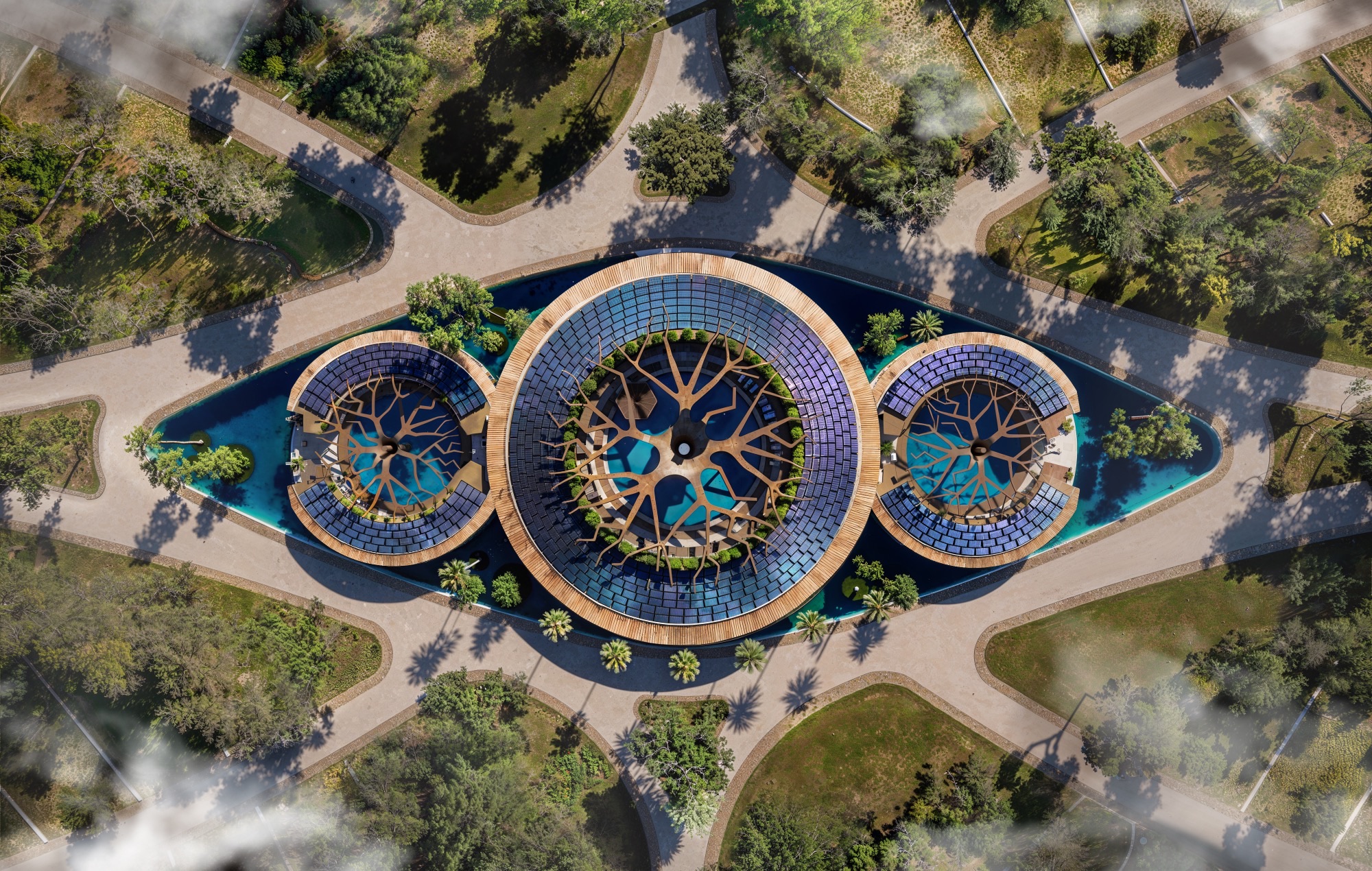
The master plan of MANA 88 unfolds as an infinite loop inspired by the sacred geometry of the Alamo tree—symbol of balance and regeneration. Designed as a living ecosystem, its organic layout connects villas, wellness spaces, and natural sanctuaries through a continuous flow of green corridors and pedestrian trails. At its heart lies the circular Wellness Center, surrounded by amenities dedicated to health, recreation, and community. Each area harmoniously integrates with the jungle, preserving native vegetation and celebrating the cenote landscape of Akumal.
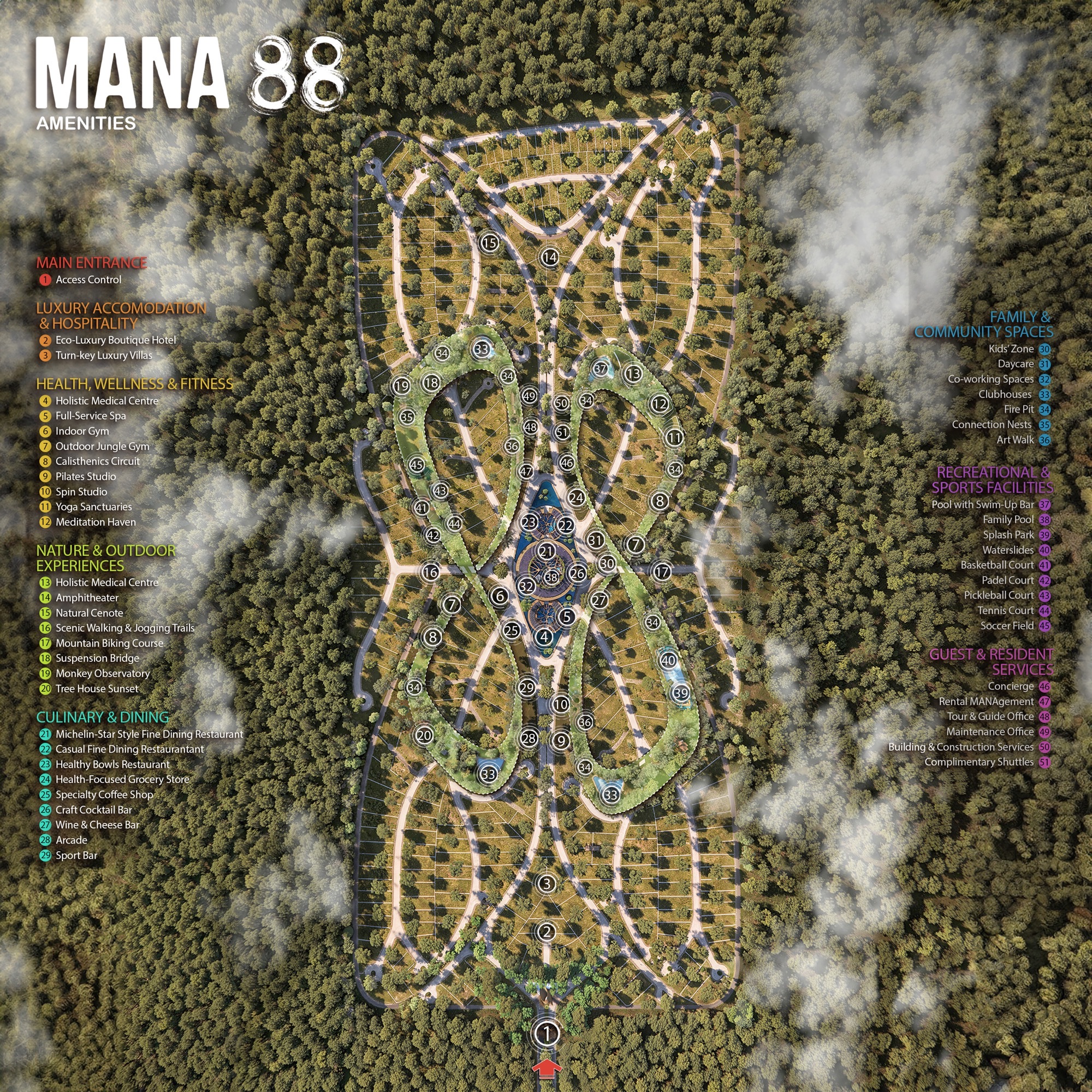
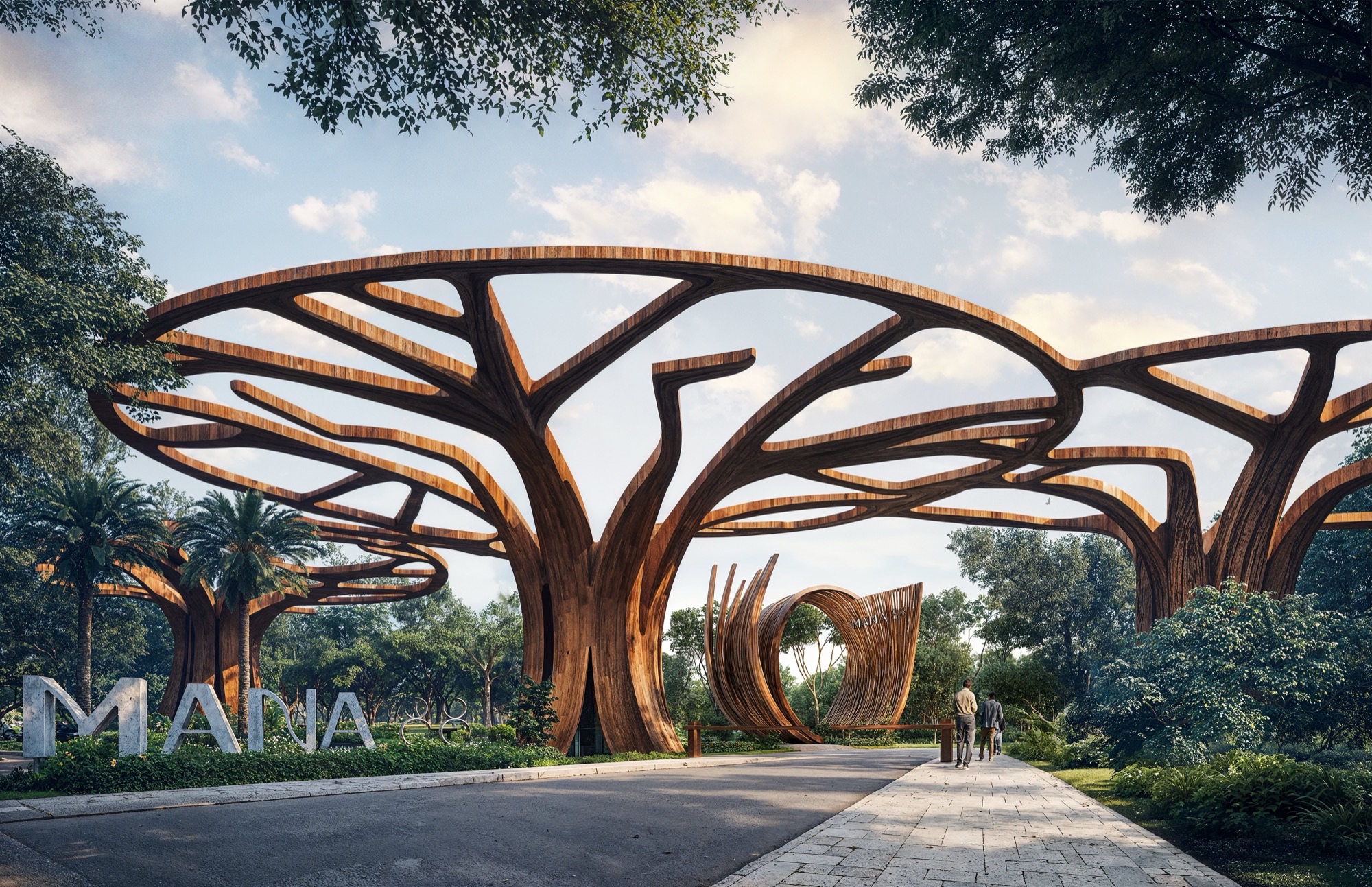
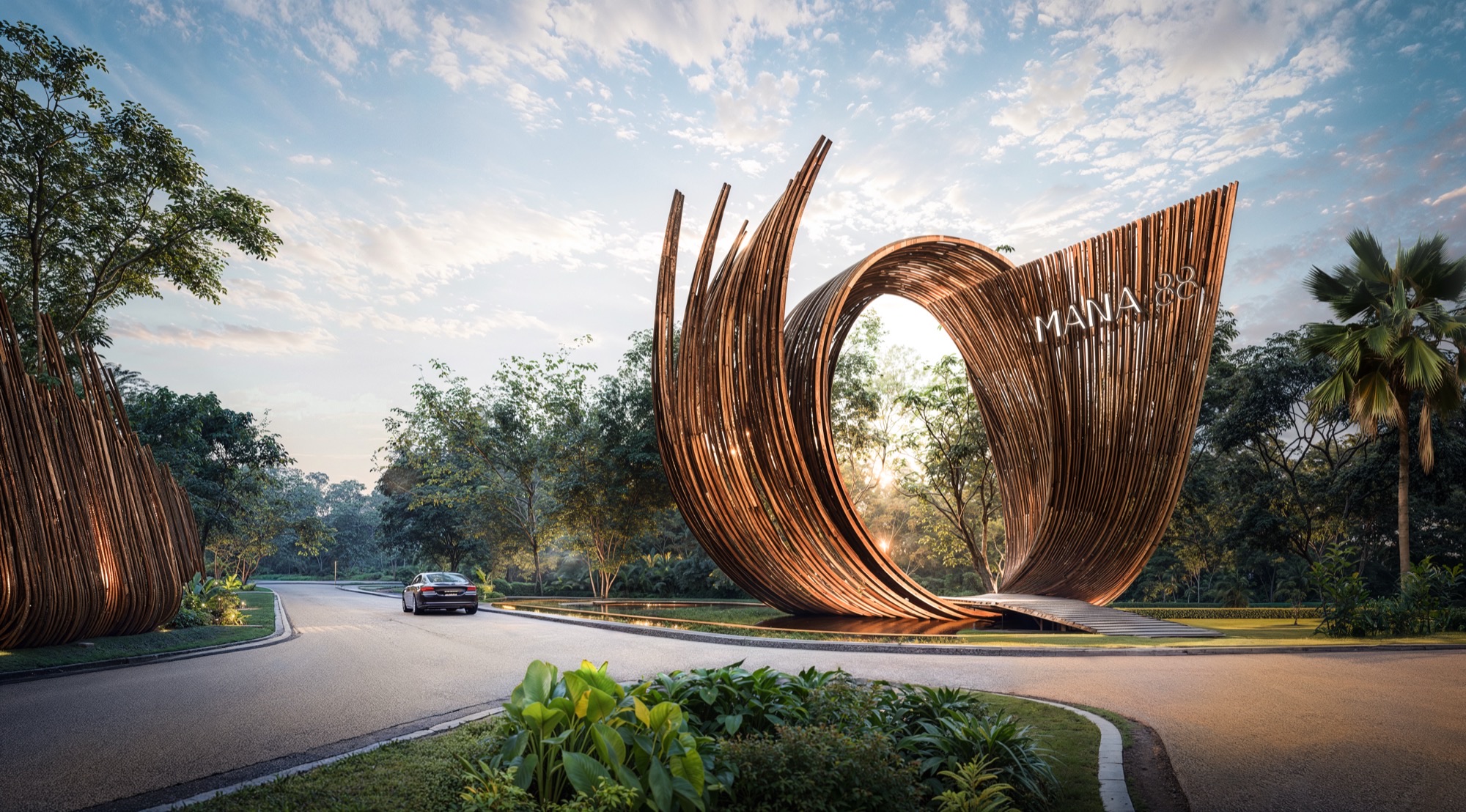
The Main Entrance of MANA 88 is conceived as a sculptural gateway that symbolizes the transition from the outside world into a realm of regeneration and serenity. Inspired by the organic movement of the Alamo tree, its flowing wooden forms rise like living roots embracing light and air. The structure’s curvature and openness evoke both strength and grace, welcoming visitors through an experience of harmony between architecture, nature, and spirit.
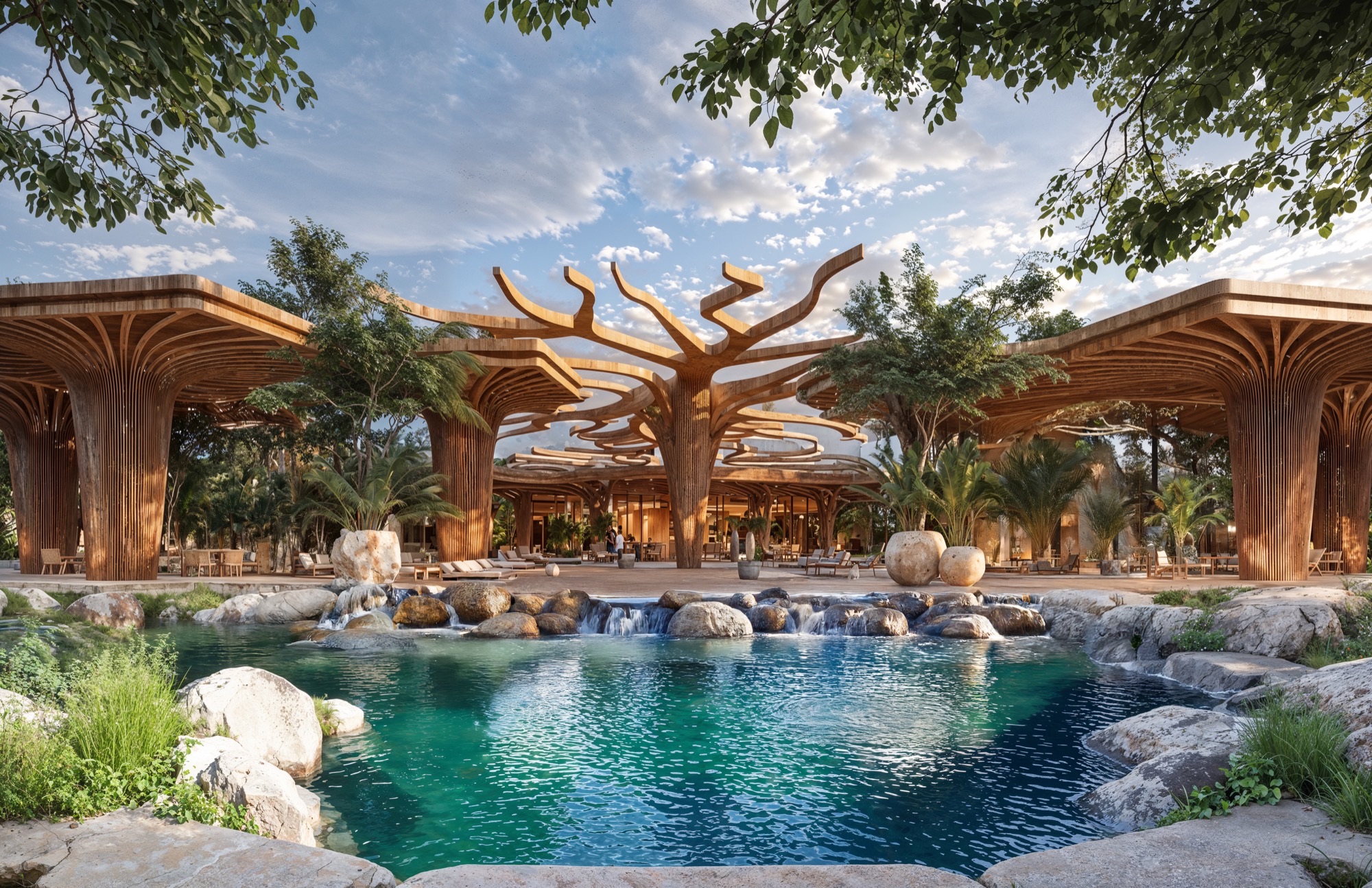
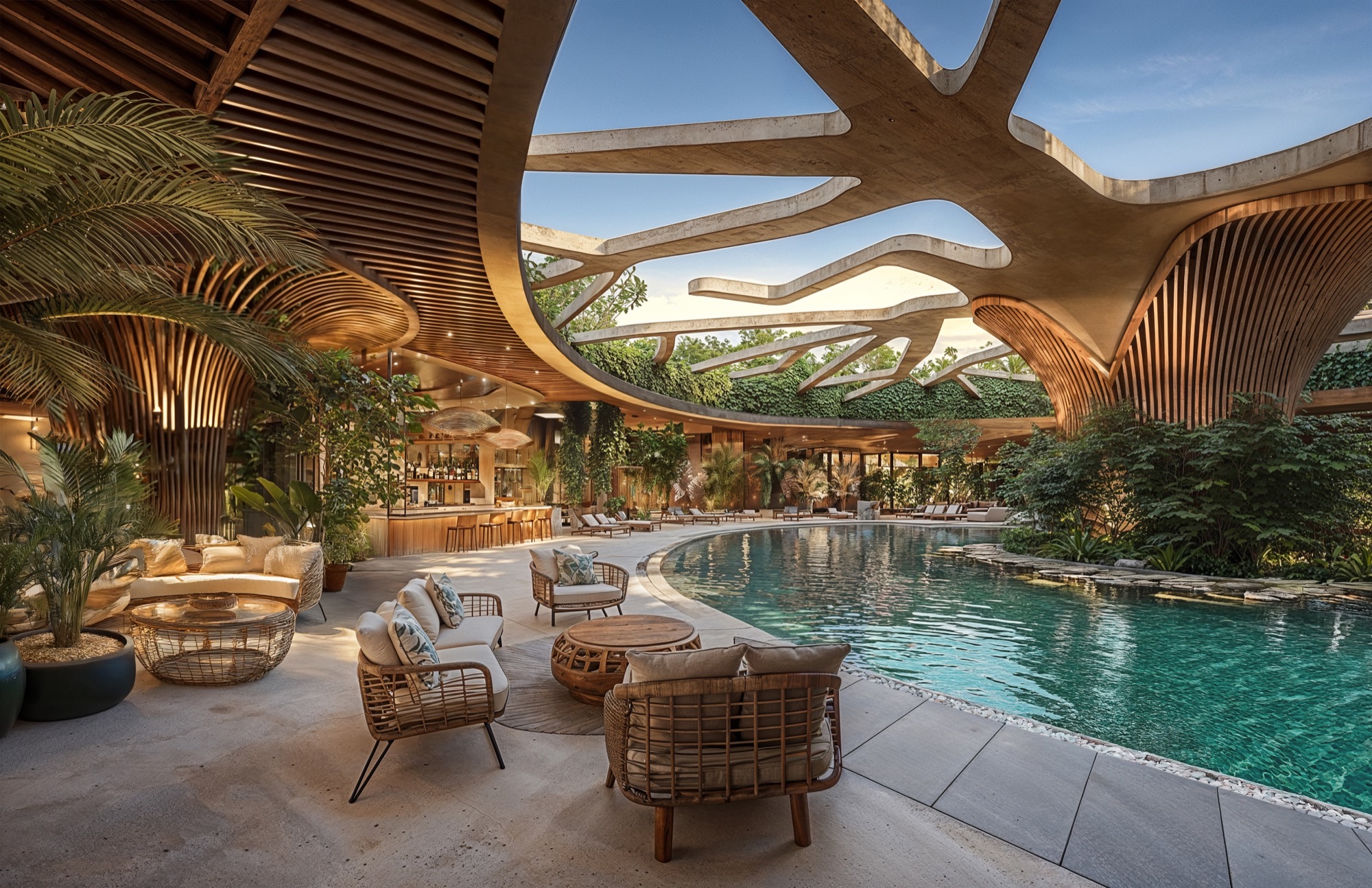
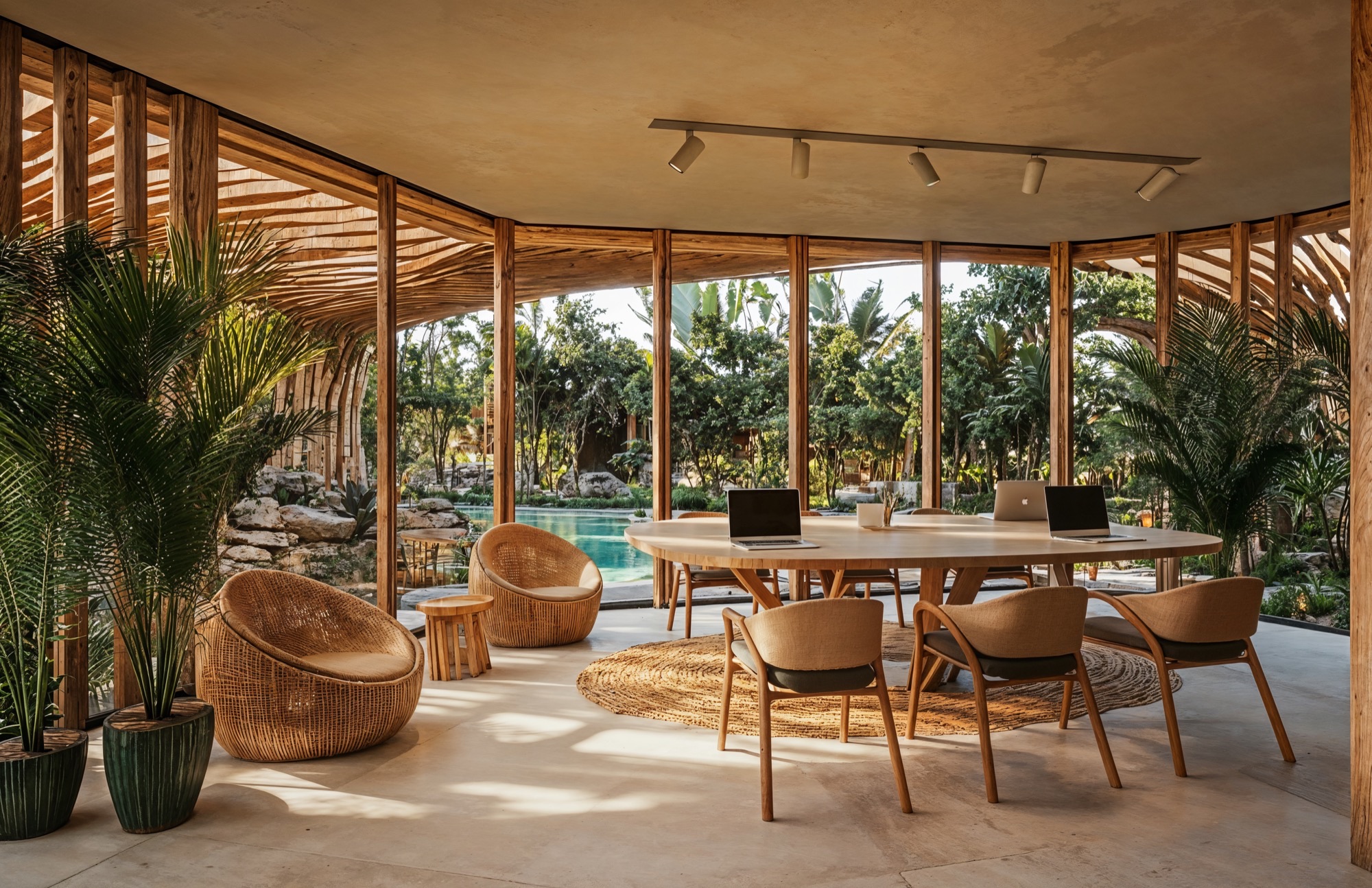
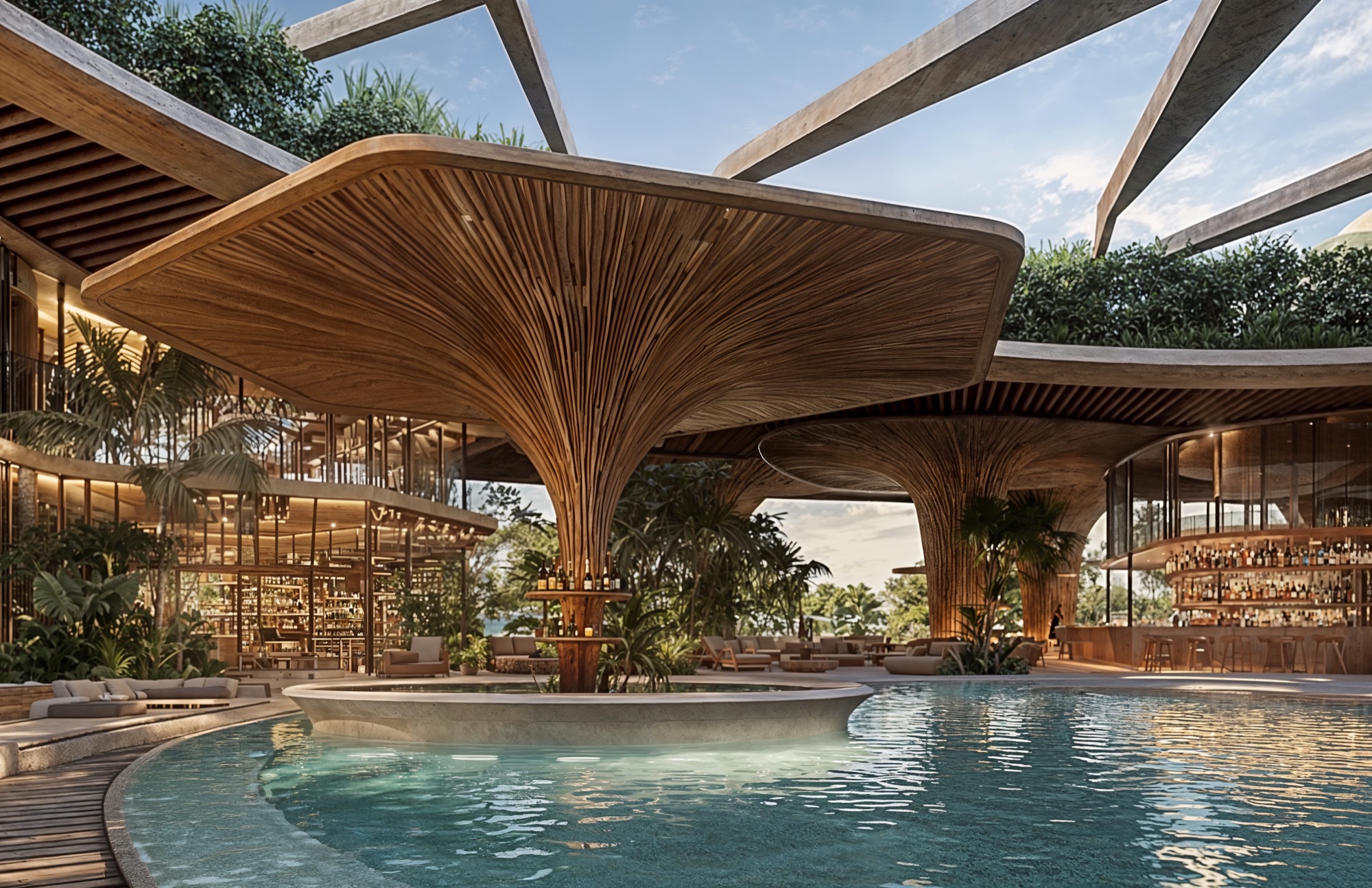
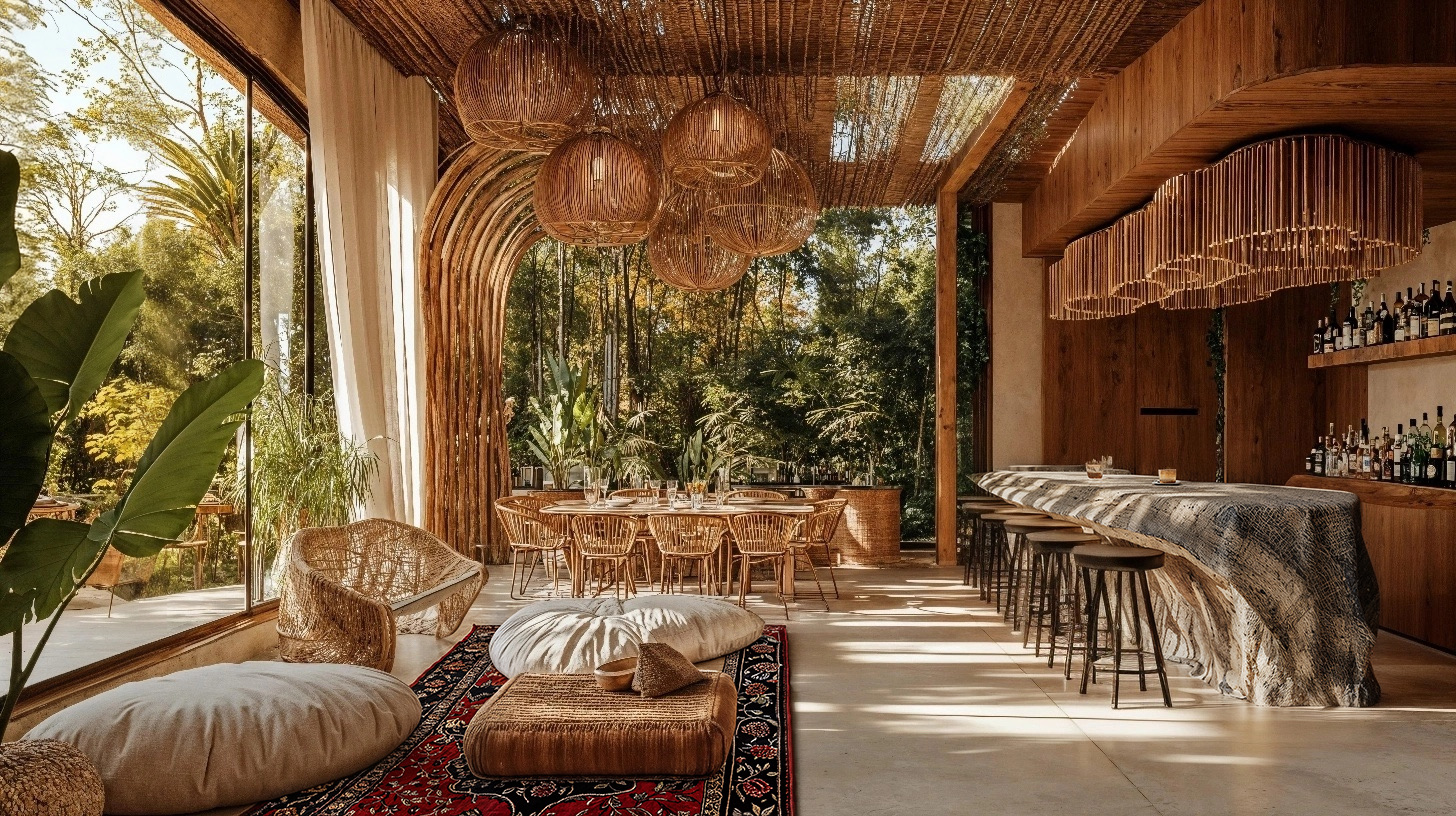
At the heart of MANA 88, the Clubhouse unfolds as an organic structure that celebrates connection and community. Its architecture, inspired by the branching forms of trees, merges wood, light, and water in a sculptural expression of harmony. The open design blurs boundaries between interior and nature—hosting lounges, co-working areas, and a poolside bar under a canopy of flowing timber beams. Surrounded by reflective ponds and lush greenery, it becomes a space for gathering, wellness, and renewal—a living symbol of balance within the resort’s regenerative vision.
_2k80.jpg)
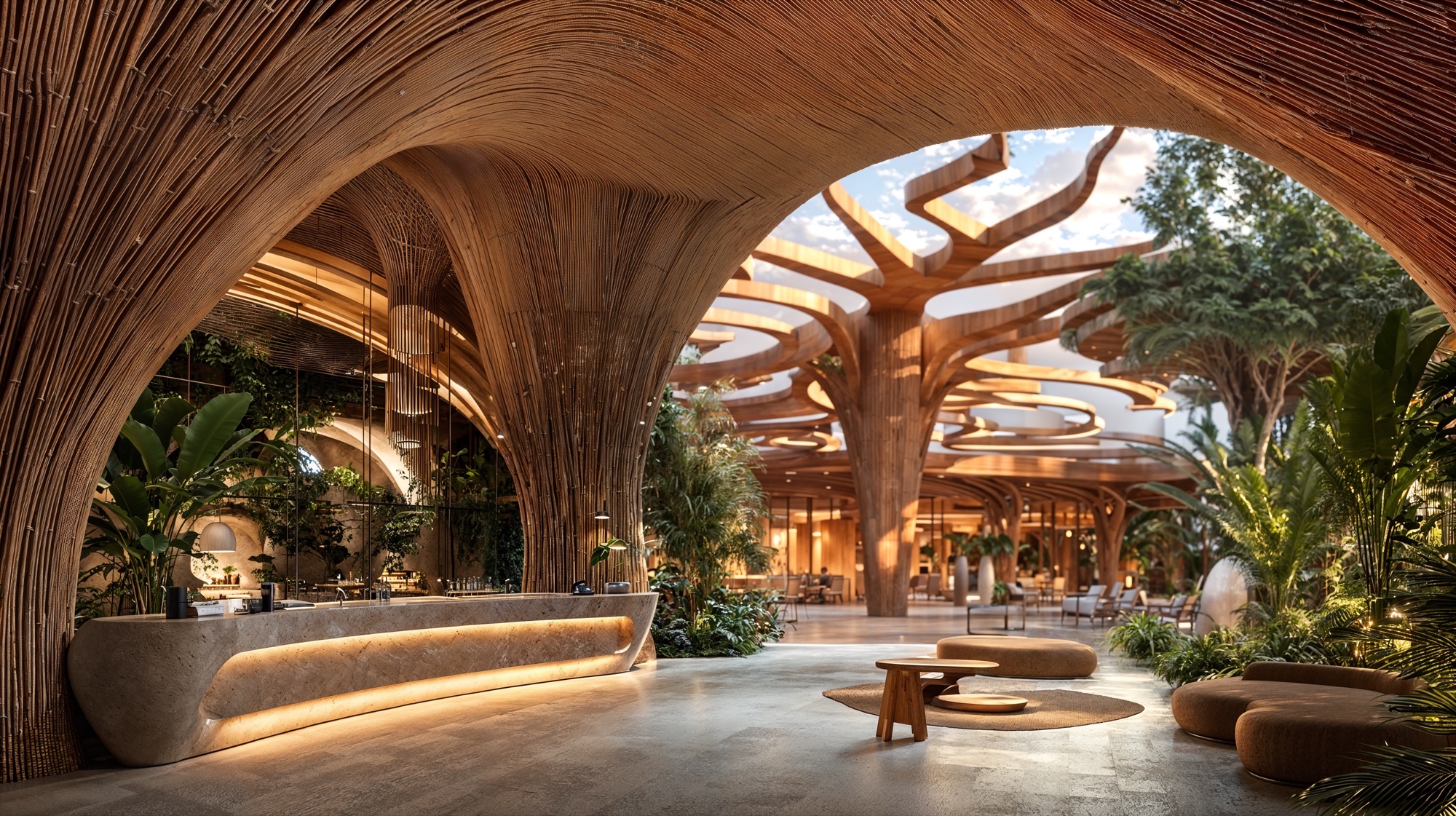
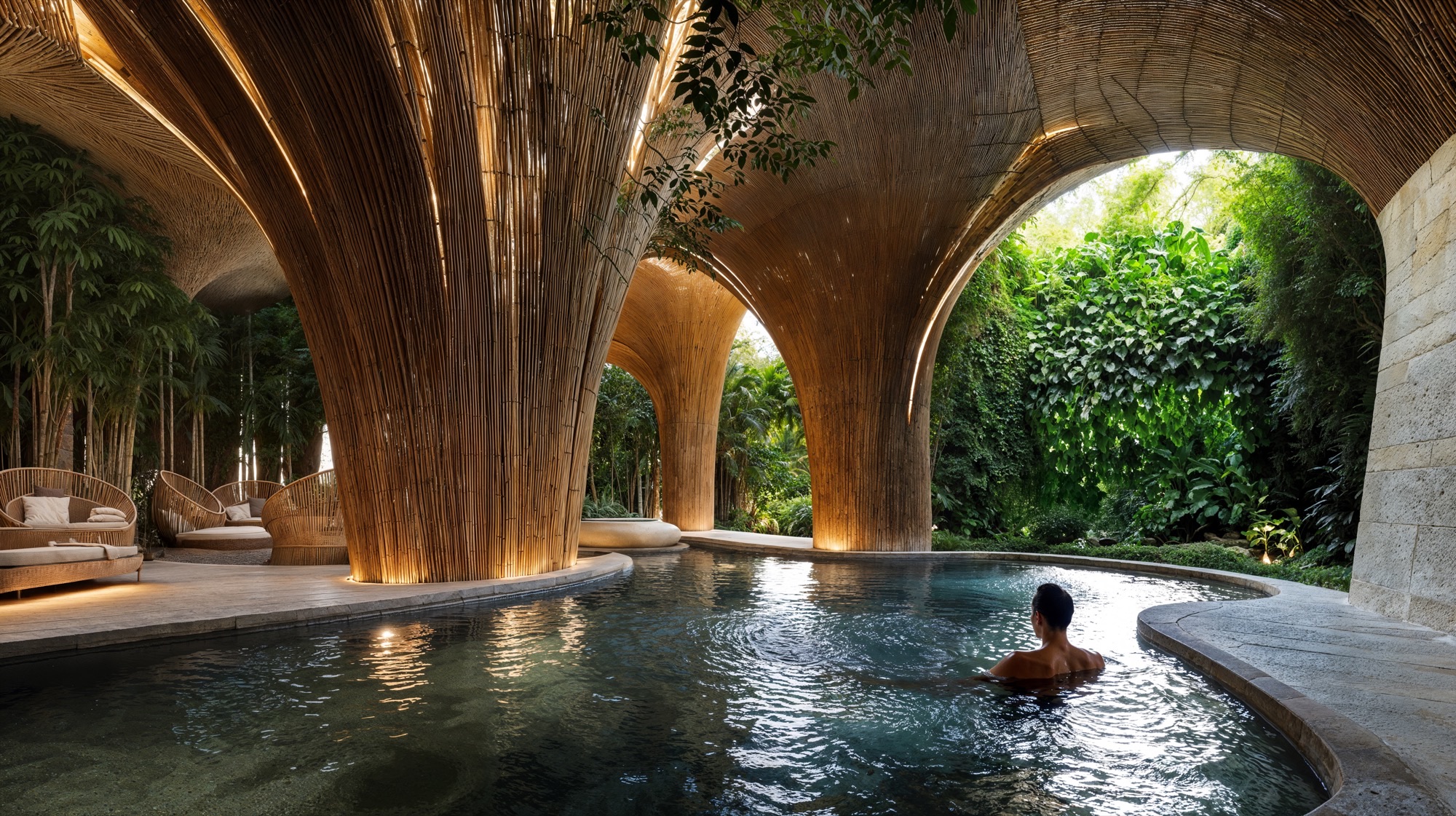
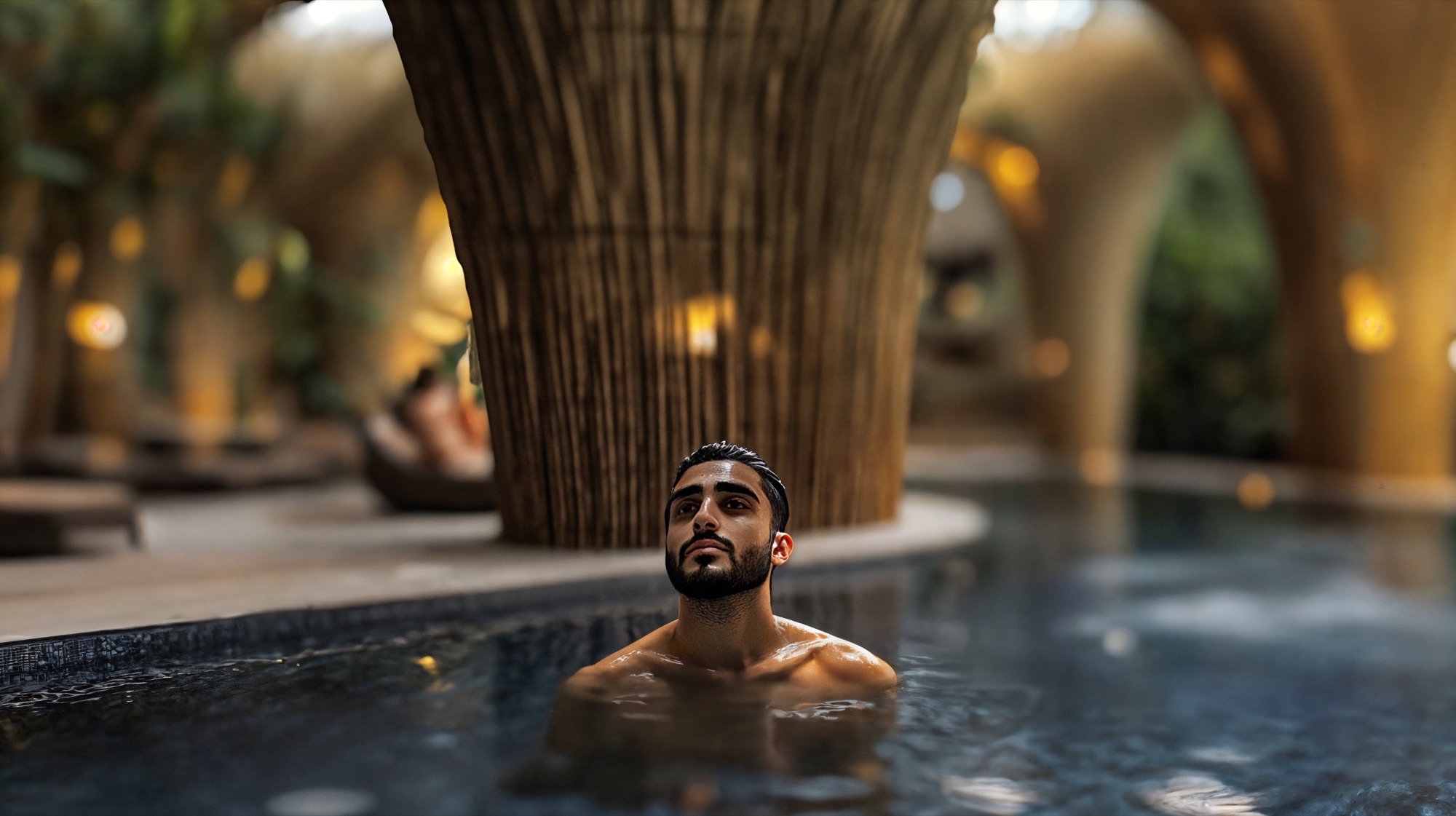
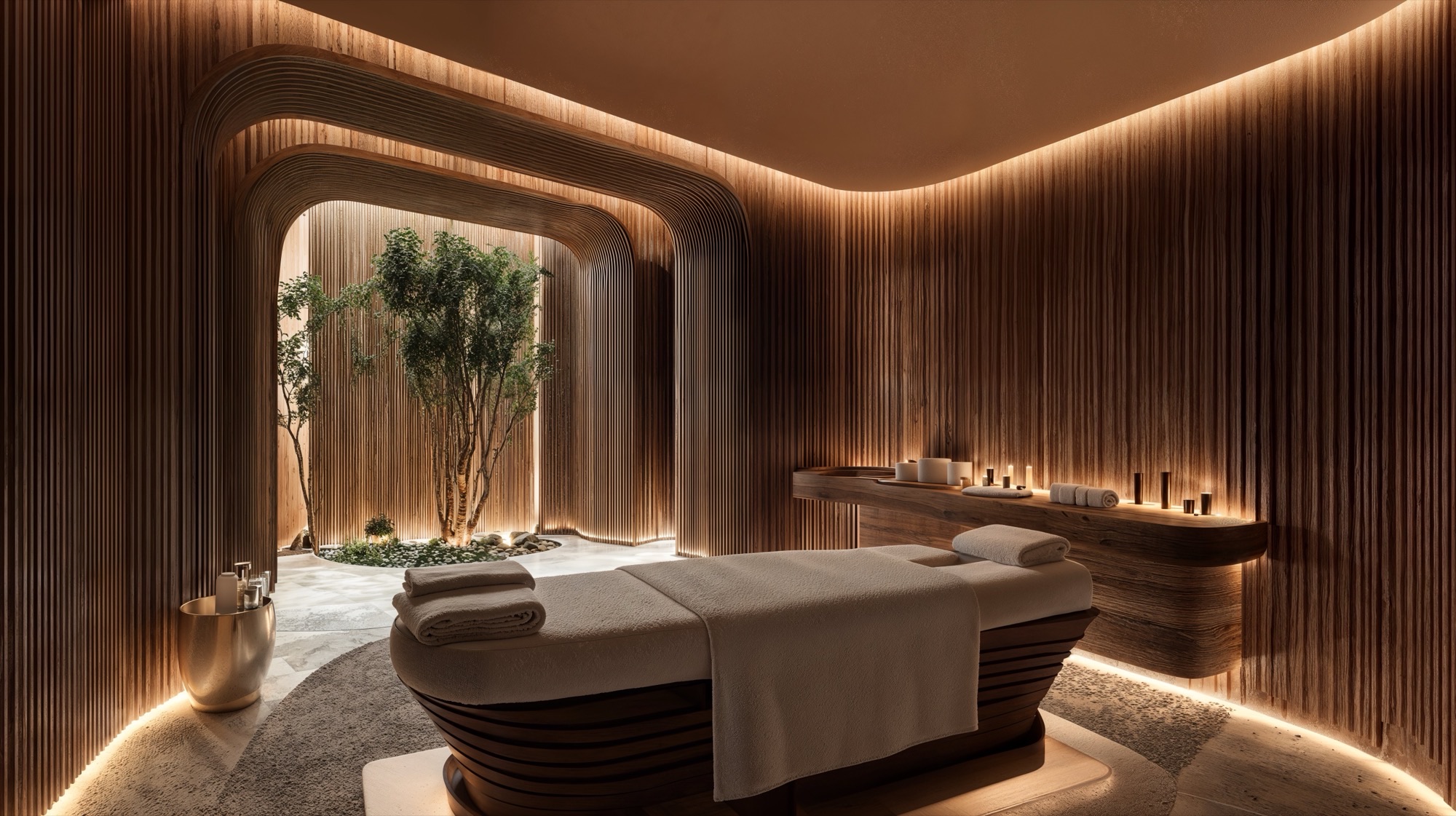
The Spa at MANA 88 is a sanctuary of tranquility where architecture and nature merge in a symphony of light, water, and texture. Nestled beneath bamboo vaults and surrounded by lush gardens, the design evokes the feeling of entering a sacred cavern. Soft curves, filtered sunlight, and the sound of flowing water create an atmosphere of deep calm. Each space — from thermal pools to private treatment rooms — is crafted to awaken the senses and restore inner harmony, embodying the regenerative essence of the project.
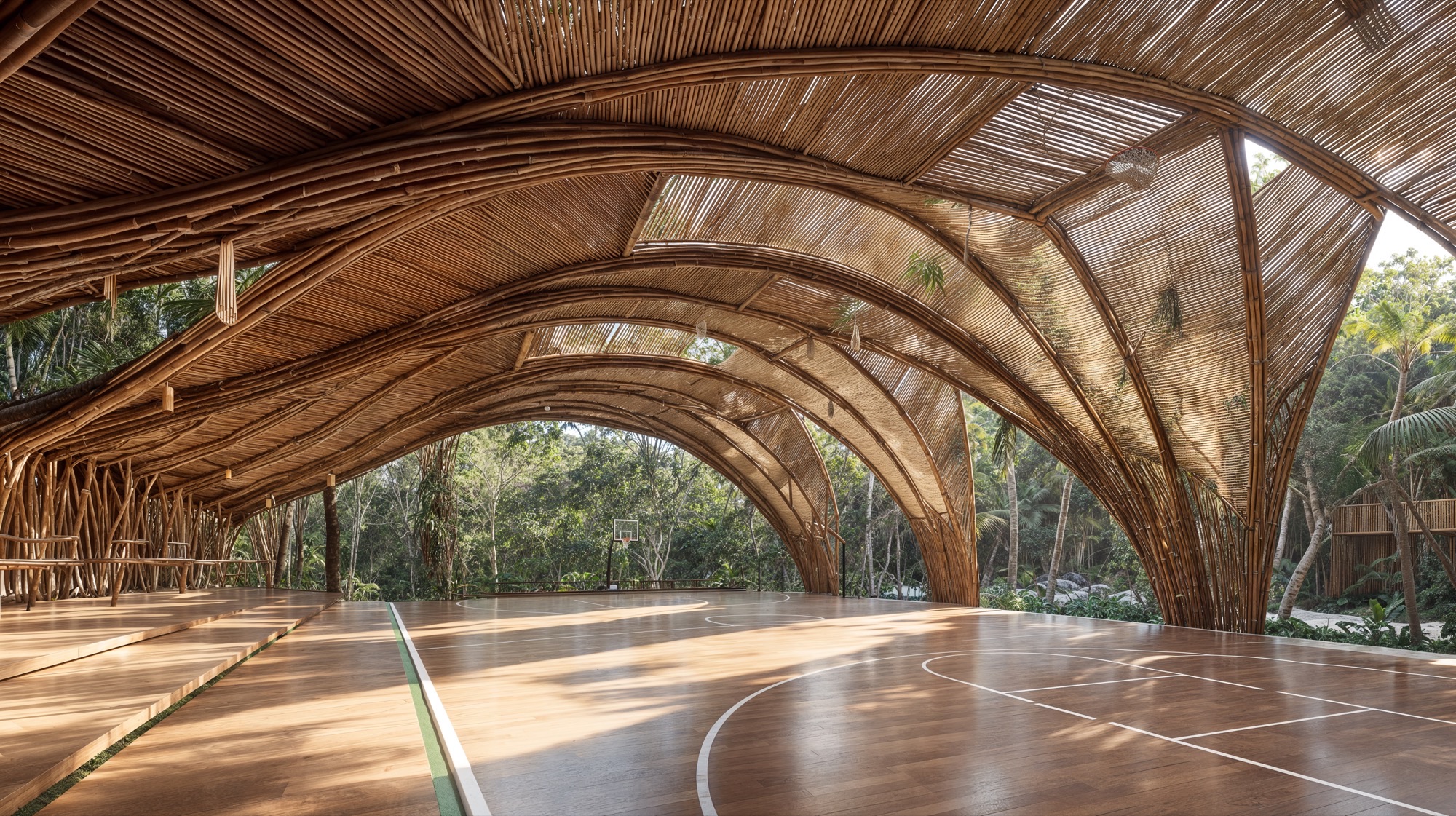
The Sports Complex at MANA 88 is designed as a natural pavilion that celebrates movement and vitality in harmony with the jungle. Its sculptural bamboo structure flows like a living canopy, filtering light and air to create a space that breathes with its surroundings. The organic design provides shelter for basketball, tennis, and multipurpose courts—transforming sport into an immersive experience of connection between body, nature, and architecture.
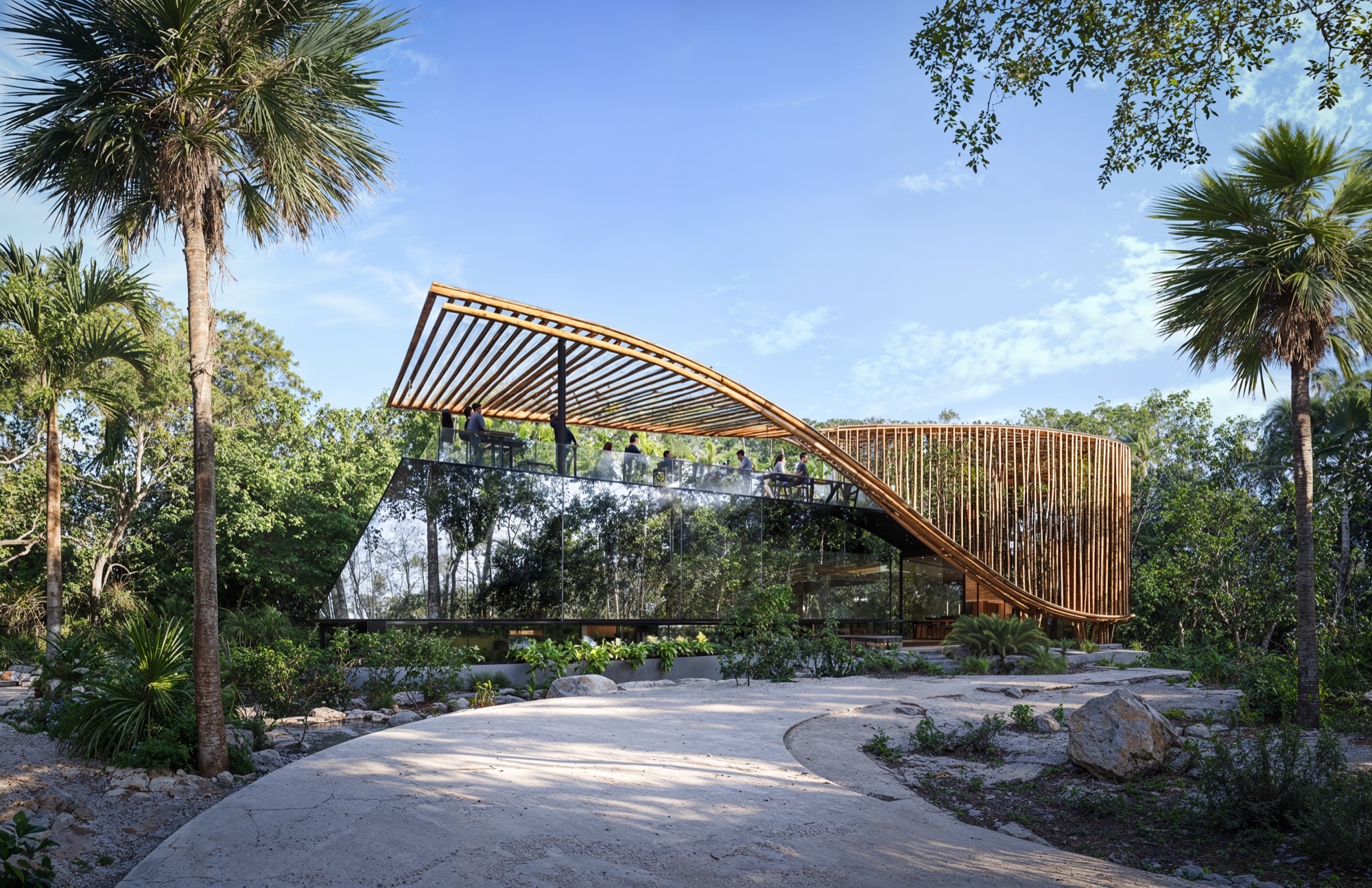
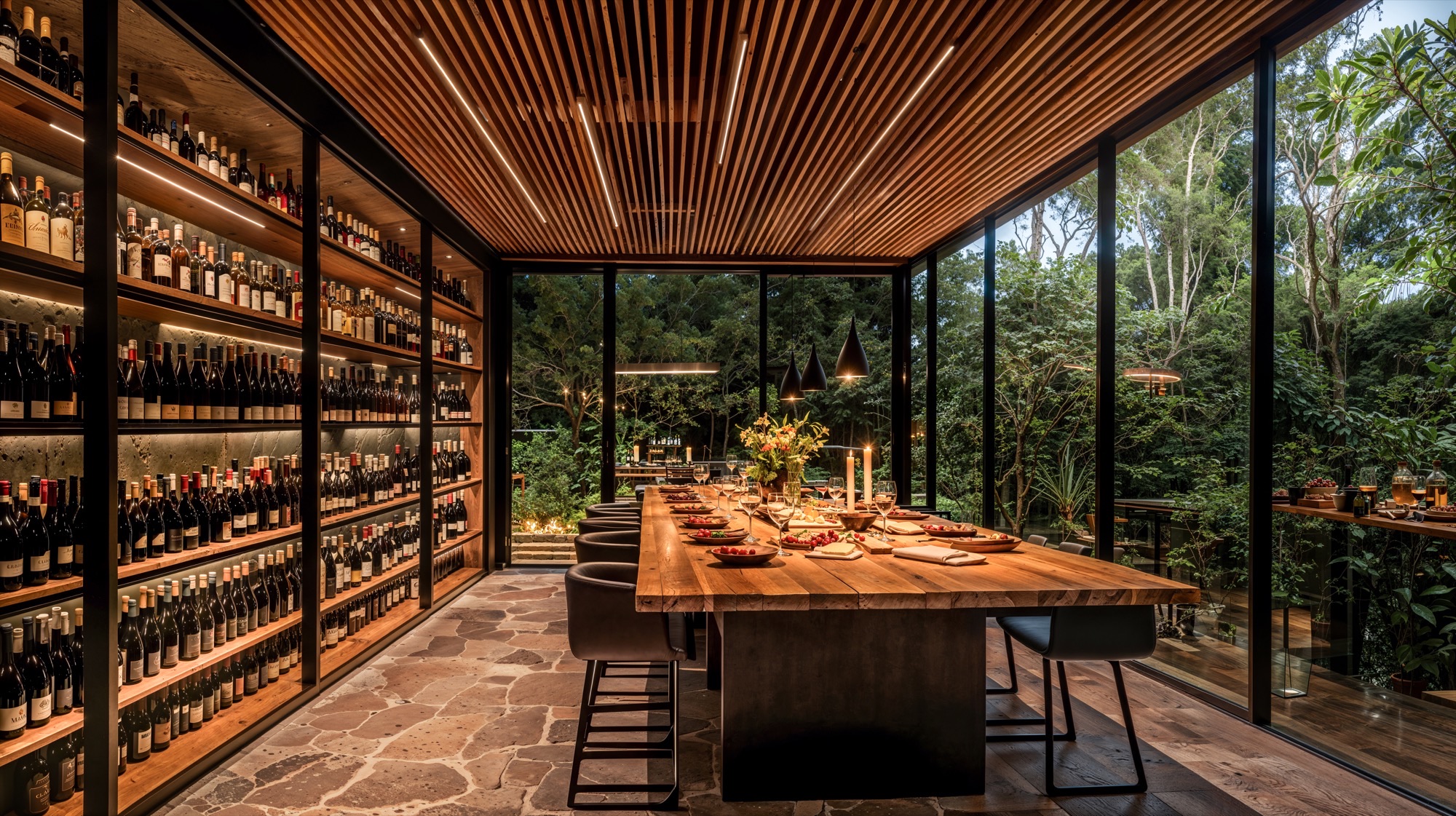
Perched among the trees, The Wine & Cheese Bar offers an elevated sensory experience where design and nature converge. Its sculptural wooden form opens to the jungle, while glass façades reflect the surrounding landscape. Inside, a curated collection of wines and artisanal cheeses is enjoyed in an atmosphere of warmth and sophistication. Natural materials, soft lighting, and panoramic views create an intimate retreat celebrating taste, texture, and connection.
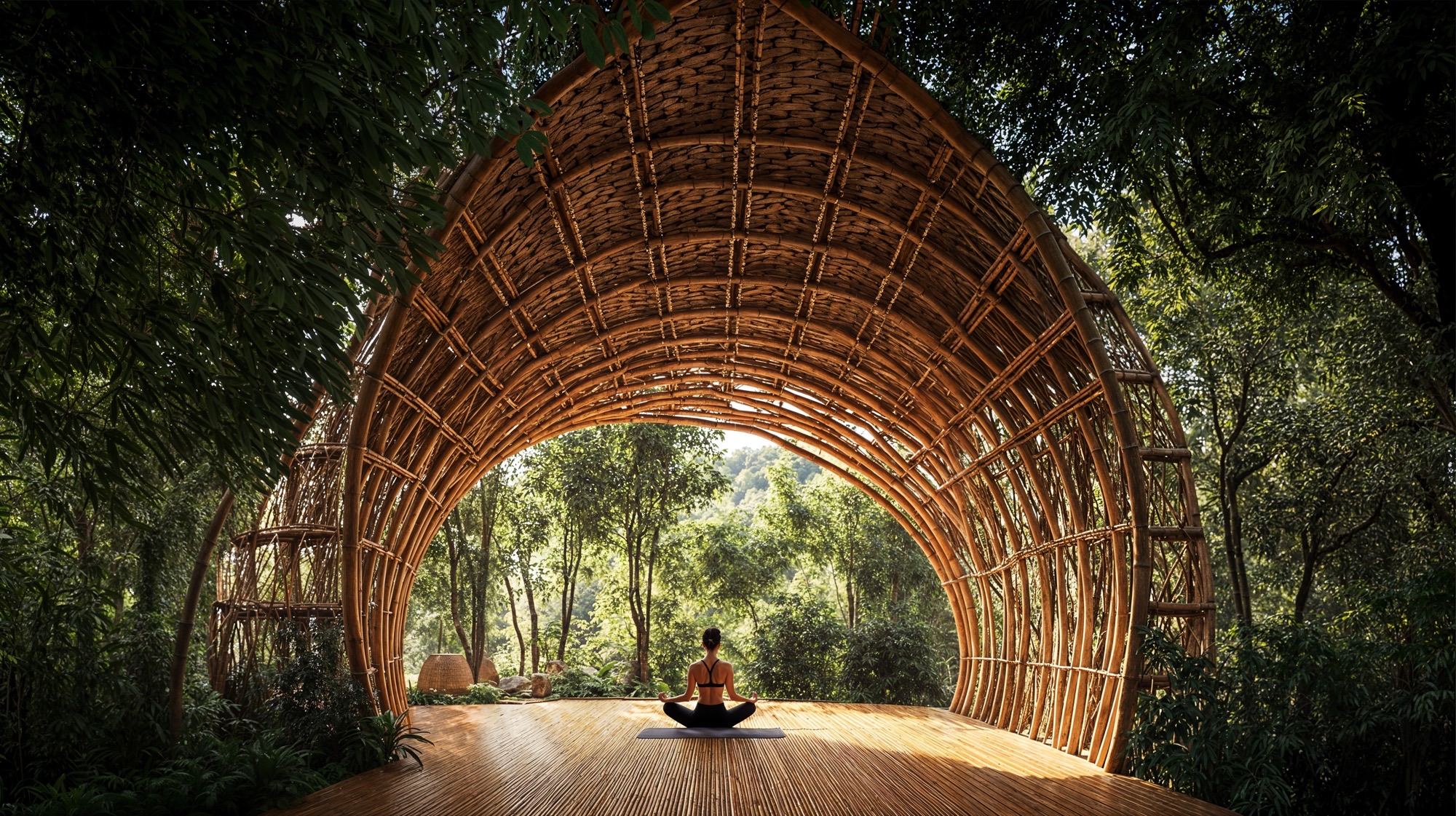
THE YOGA CENTER
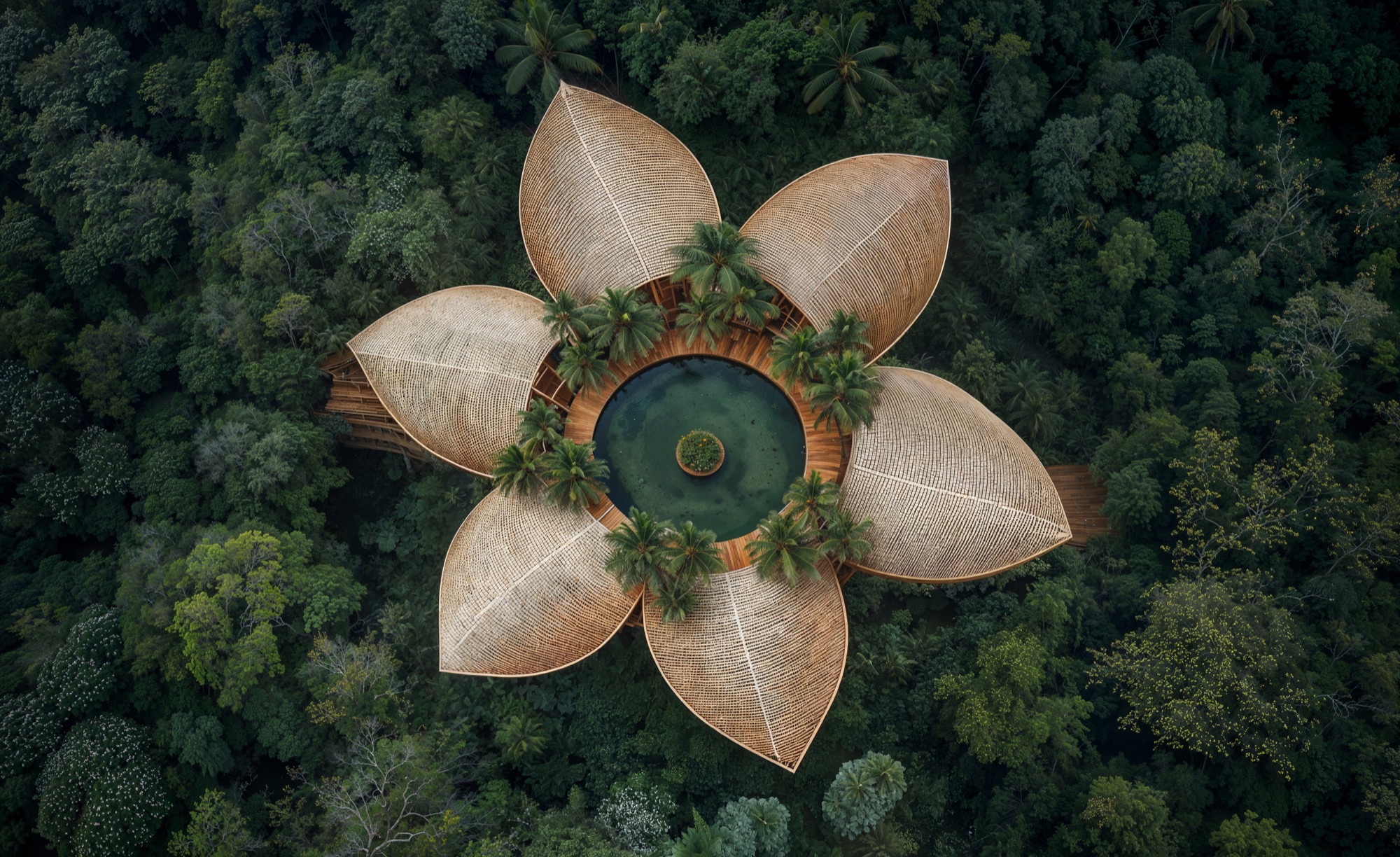
Shaped like a blossoming flower within the jungle canopy, The Yoga Center embodies serenity and balance. Its petal-inspired bamboo roofs open toward the sky, enclosing a circular lagoon that reflects the light and stillness of nature. Designed for mindfulness and connection, the space invites guests to breathe, move, and meditate in harmony with the rhythms of the earth — a sacred pavilion where architecture becomes a vessel for inner peace.
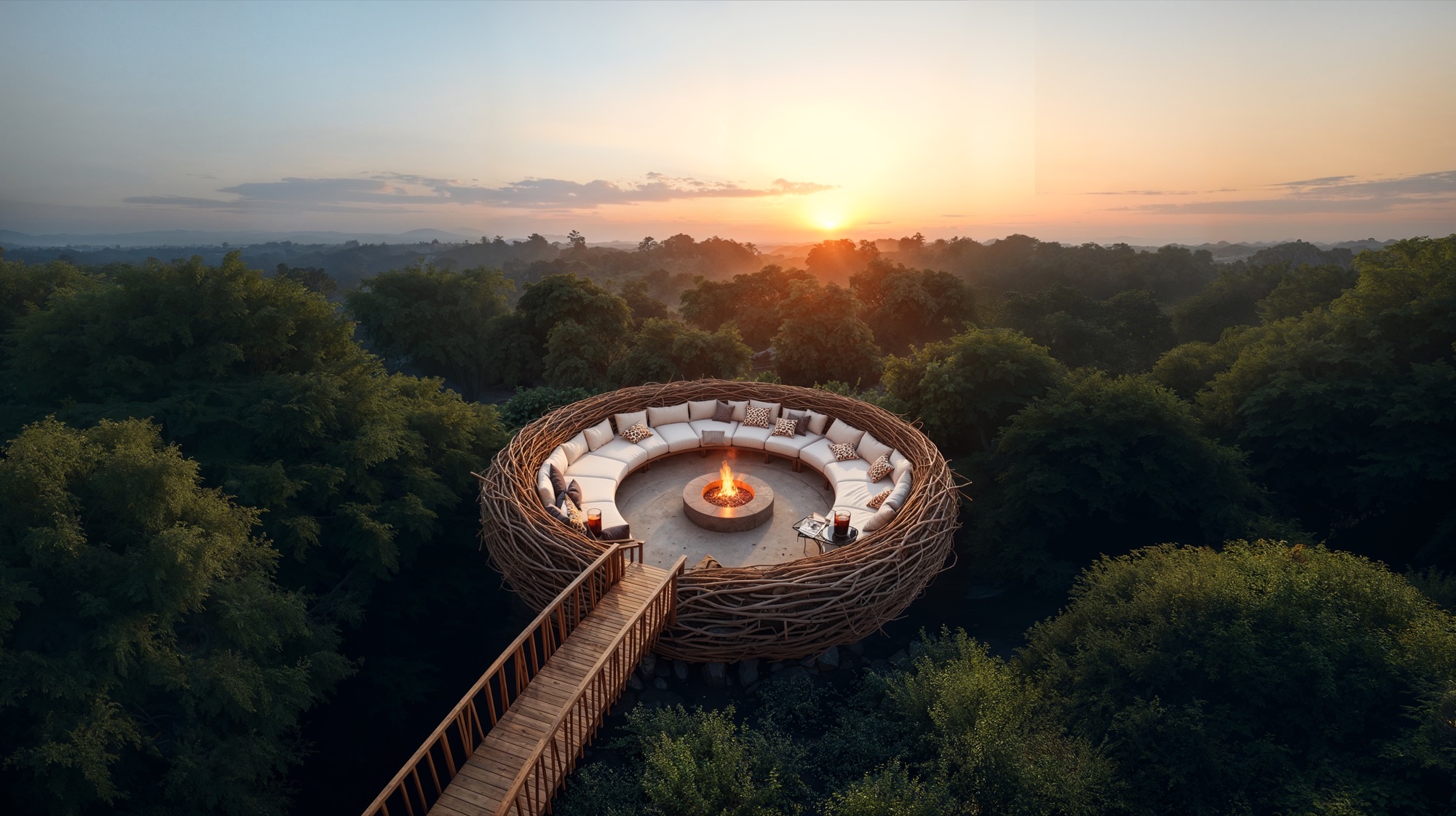
Suspended above the jungle canopy, The Nest is a circular lounge designed for connection, reflection, and wonder. Shaped like a woven sanctuary, it embraces guests around a central fire, opening to breathtaking sunsets and panoramic views of the forest. Blending natural materials with poetic form, it embodies the spirit of MANA 88 — harmony, community, and the quiet power of nature.
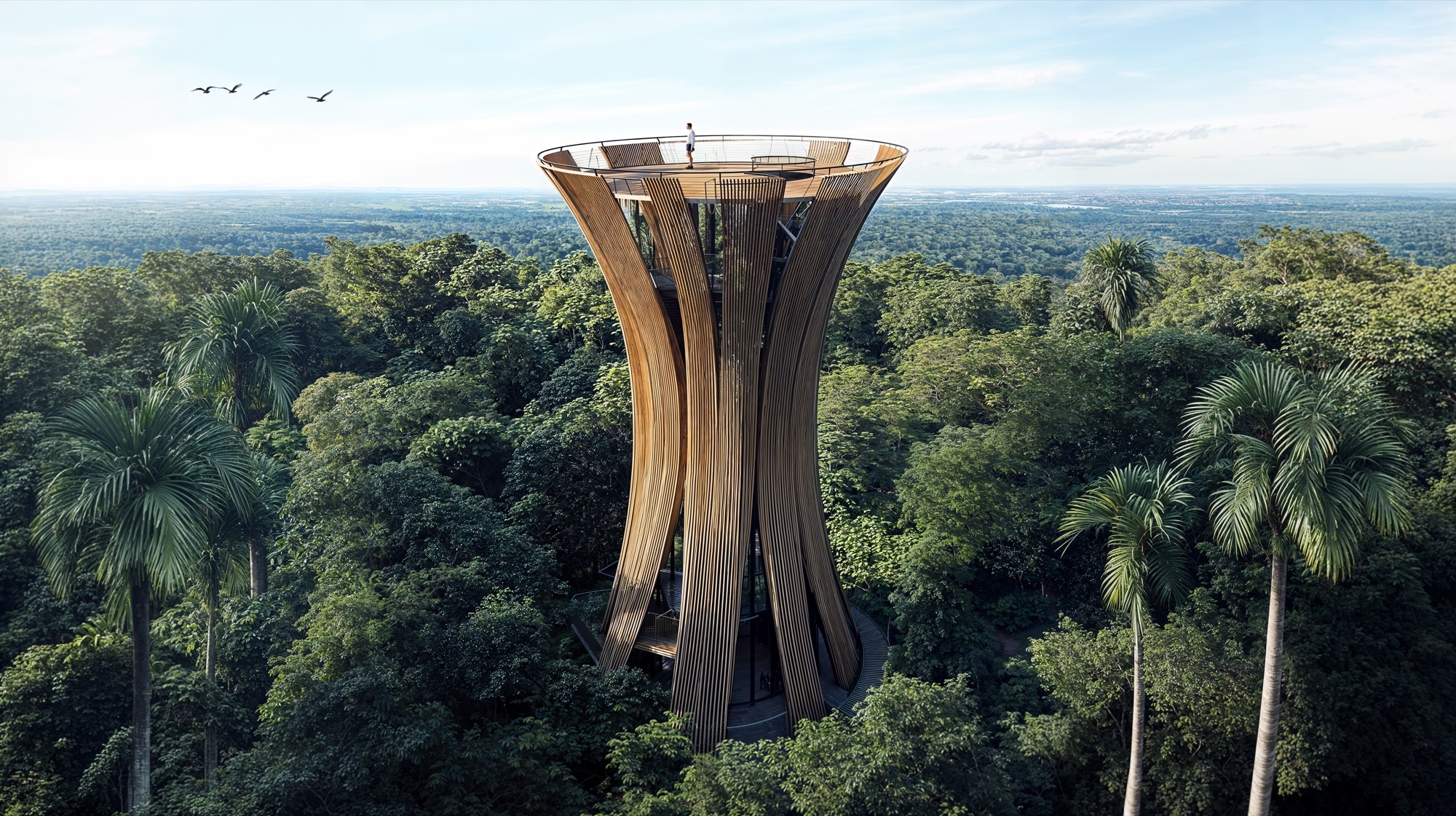
Rising above the jungle canopy, The Birds Tower offers a breathtaking 360° panorama of the surrounding landscape. Its fluid wooden structure mimics the elegance of unfolding wings, blending art and nature into one organic form. Designed as both an observatory and a contemplative retreat, it invites visitors to pause, breathe, and reconnect with the vastness of the horizon — a reminder of the harmony between humanity and the natural world.
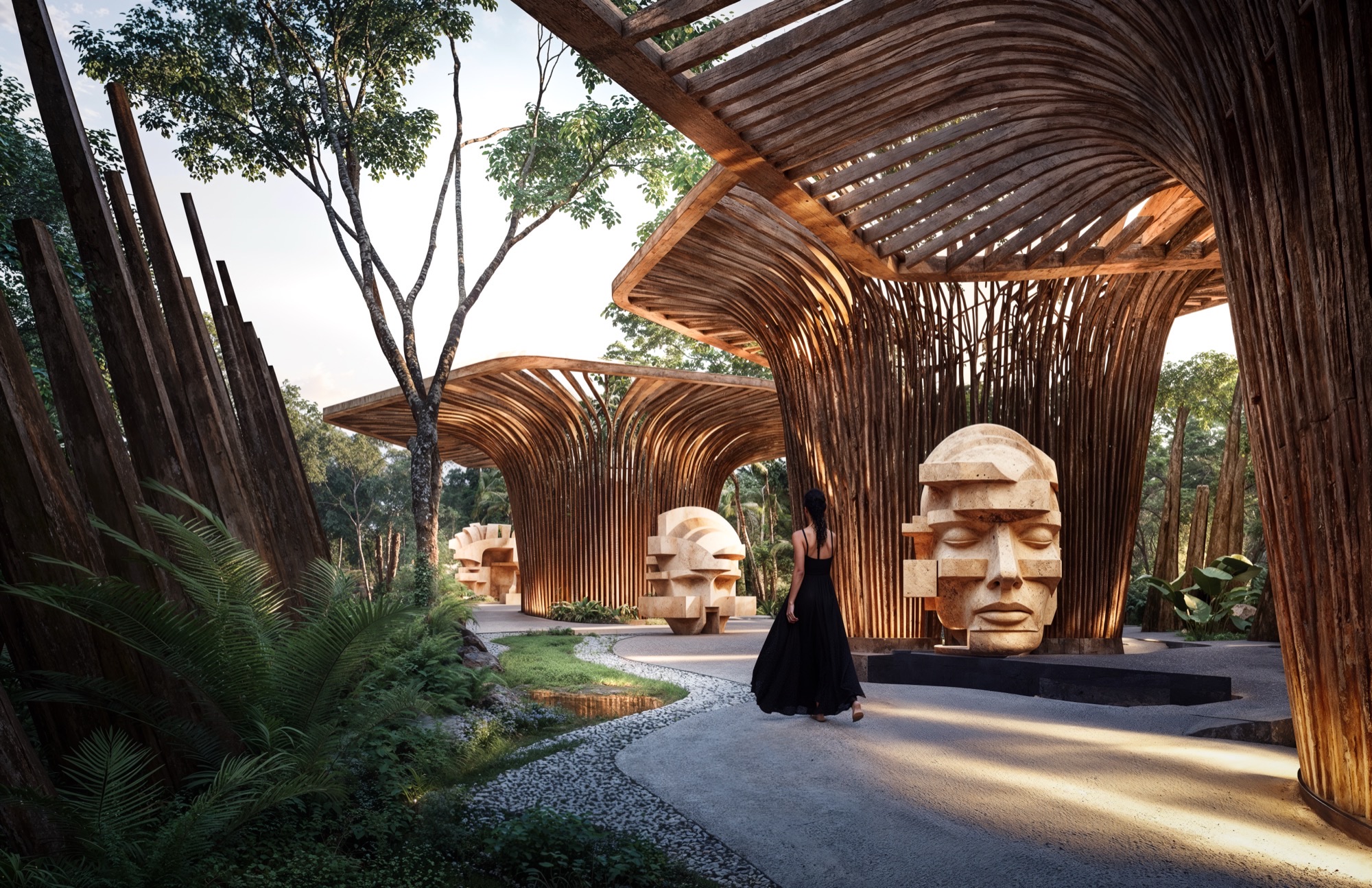
The Art Walk is a sculptural promenade that weaves art, architecture, and nature into one contemplative experience. Framed by organic timber structures, it showcases monumental stone artworks that echo ancestral Mayan forms and human introspection. Light filters through the wooden canopy, casting dynamic shadows that transform throughout the day — turning each step into a dialogue between culture, landscape, and spirit.
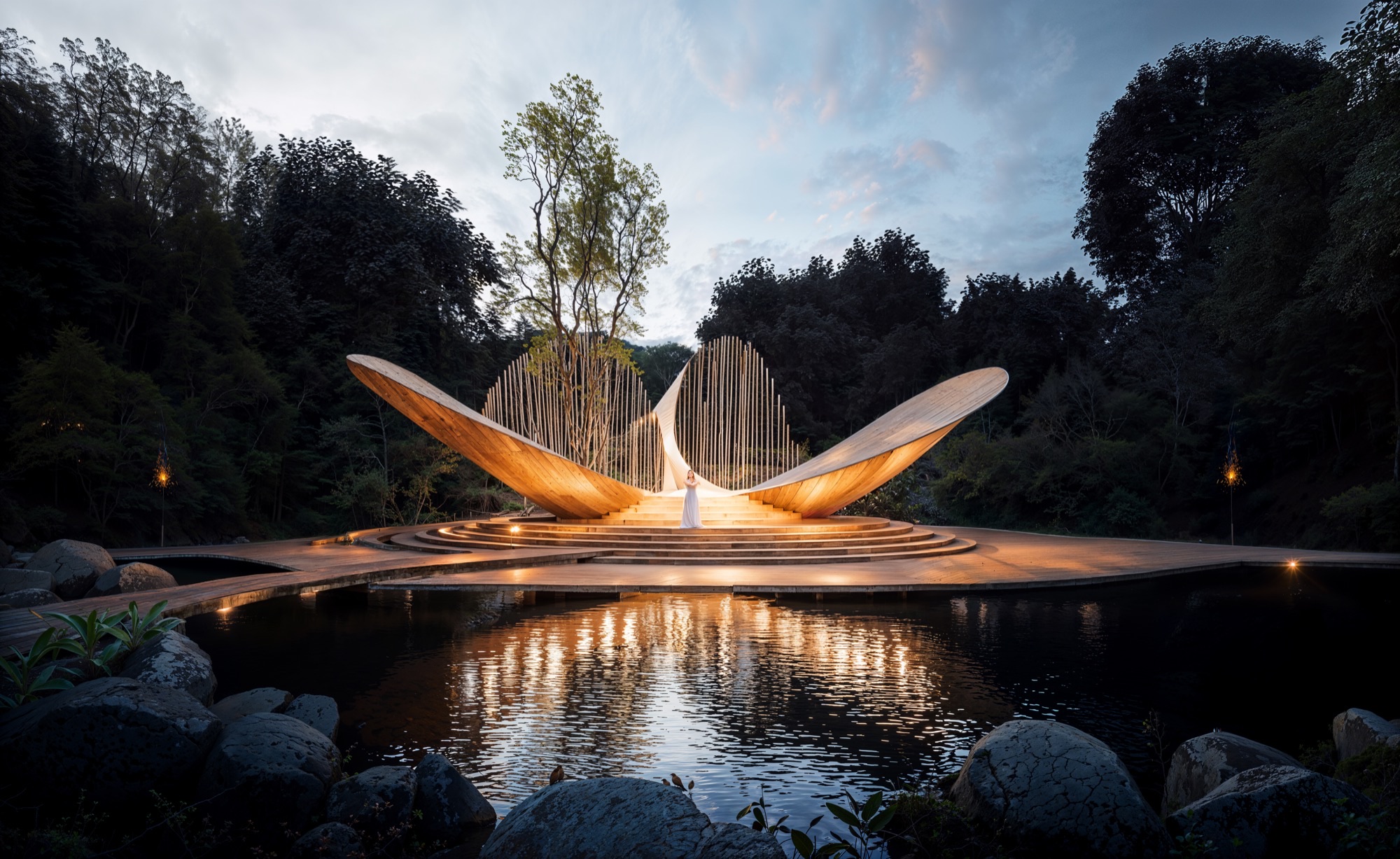
The Amphitheater stands as a sculptural stage for art, ceremony, and community. Inspired by the geometry of wings unfolding, its curved timber forms rise gracefully above a reflective lagoon. The design merges architecture and landscape in a poetic balance — where sound, light, and water converge to create an atmosphere of reverence and unity. It is both a performance space and a spiritual landmark, celebrating the essence of connection within nature.
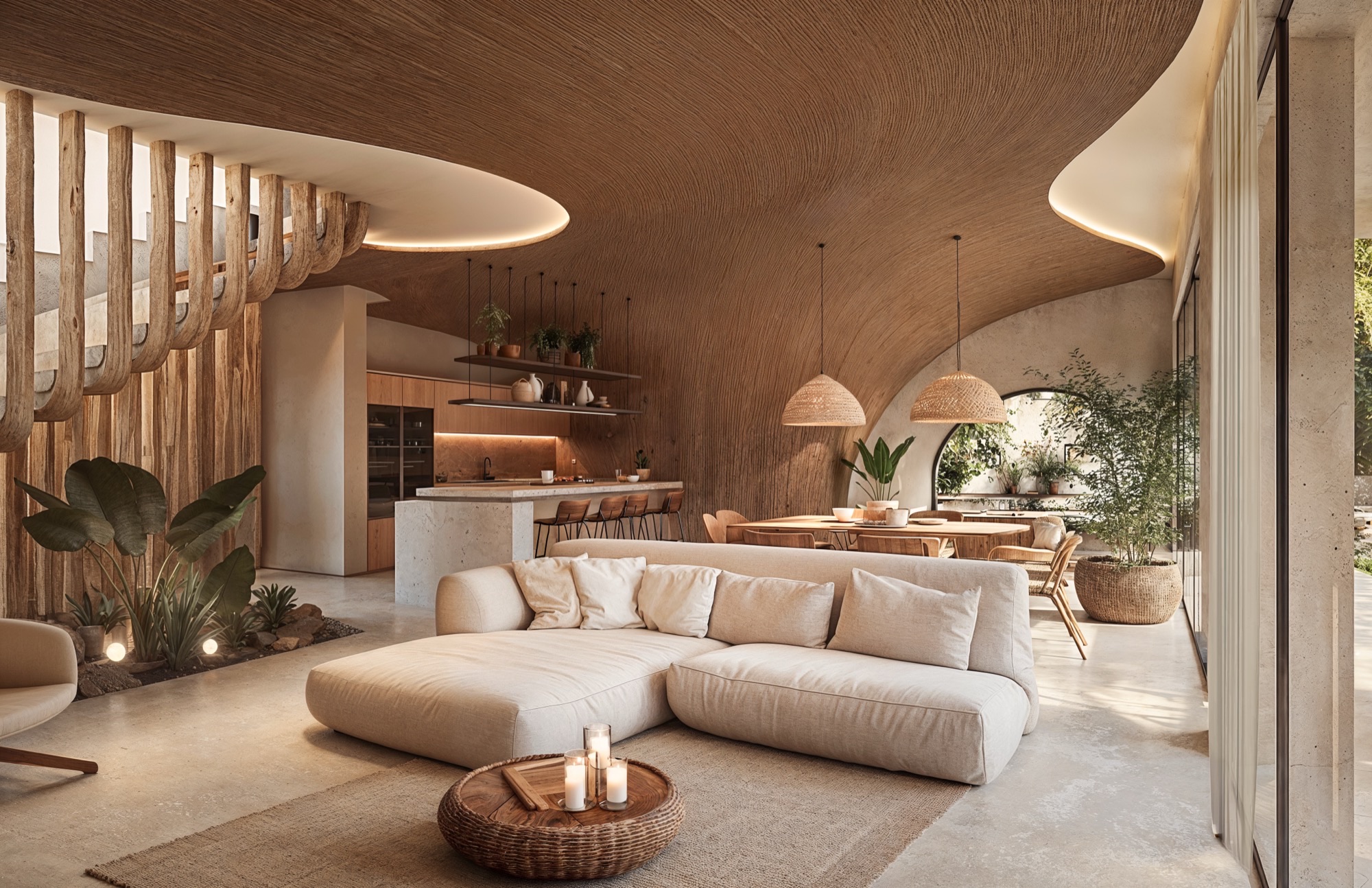
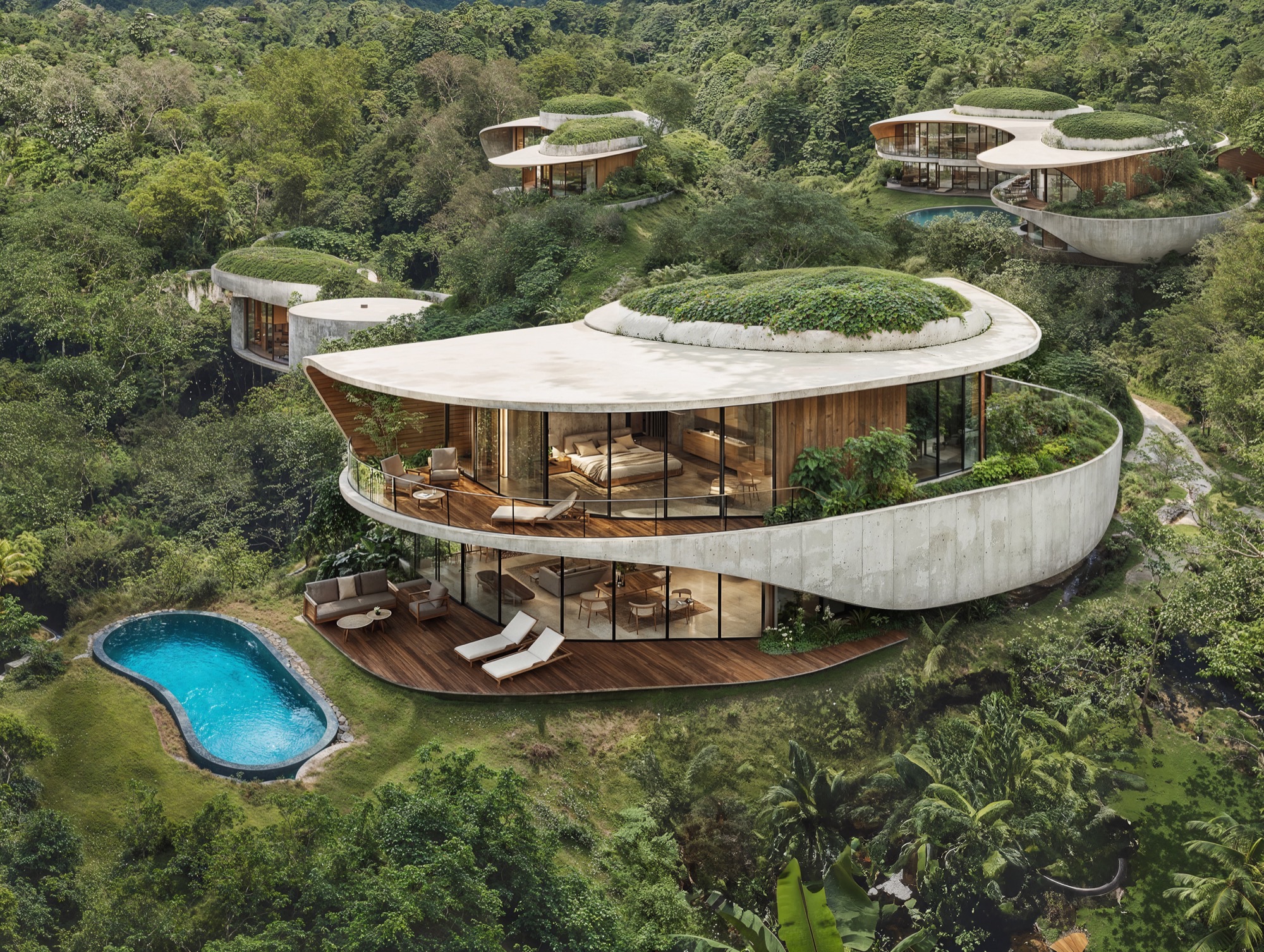
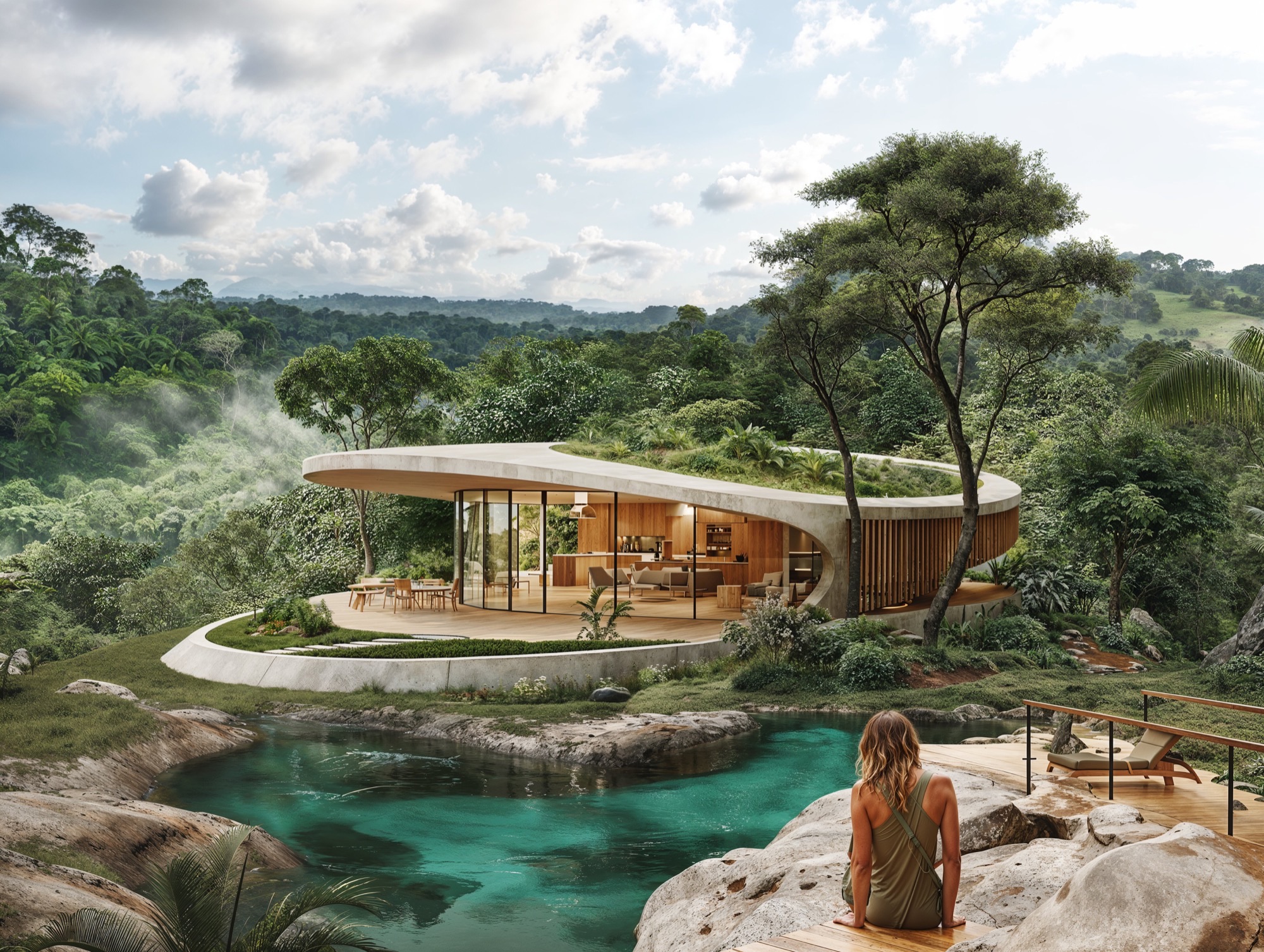
The Villas of MANA 88 are conceived as organic sanctuaries where architecture blends seamlessly with the landscape. Each residence embraces natural topography, opening to panoramic views of jungle and water. With fluid lines, warm materials, and passive design strategies, the villas invite light, air, and nature into every space. Interiors combine simplicity and craftsmanship — stone, wood, and soft textures — creating an atmosphere of calm luxury and regenerative living in harmony with the earth.


Deeply rooted in the cultural and ecological spirit of the Riviera Maya, MANA 88 is envisioned as a regenerative wellness community inspired by the sacred Alamo tree — guardian of the cenotes and symbol of protection, renewal, and connection between worlds.
Located in Akumal, Mexico, the project redefines the relationship between architecture and nature, creating a holistic environment where design, ecology, and human experience coexist in balance.
The master plan draws from the principles of sacred geometry and the Mayan cosmology of the three realms — the roots (underworld), trunk (earth), and branches (sky). These archetypes shape the spatial and symbolic organization of the entire development, guiding circulation, hierarchy, and visual alignment. The geometry unfolds as a living mandala: a network of paths, plazas, and gardens organized around the Wellness Center, the spiritual and social heart of the community
Within this circular sanctuary, water, light, and vegetation intertwine to create spaces of calm and renewal. The architecture becomes an instrument of balance — a dialogue between openness and refuge, between the elements and the human spirit. Around it, recreational amenities, meditation decks, and reflective gardens integrate seamlessly with clusters of villas designed for privacy, connection, and contemplation.
The architecture of MANA 88 expresses the harmony between material, landscape, and meaning. Inspired by the natural textures of limestone, bamboo, and rammed earth, the built language feels both timeless and rooted in place. Simple geometric forms emerge from the terrain as extensions of the landscape, blurring the line between built and natural.
Each villa prototype embodies the project’s regenerative philosophy — designed with passive systems for natural ventilation, solar orientation, and shading. The typologies respond to different micro-landscapes: jungle, cenote, and clearing, offering varied experiences of light, privacy, and connection to nature. Interiors are open and tactile, where stone, wood, and woven details evoke serenity and craft.
The Wellness Center, envisioned as a circular temple of wellbeing, anchors the entire composition. Its ring-shaped design embraces an inner oasis with thermal pools, shaded hammocks, and meditative gardens. The curved colonnade filters sunlight through bamboo lattices, casting ever-changing shadows that mirror the movement of water and wind.
In MANA 88, landscape is not the backdrop of architecture — it is the soul of the project. The master plan restores native ecosystems and weaves them into the spatial fabric of the community. A network of pathways connects the cenote lagoons, wellness zones, and recreational areas, encouraging slow movement, mindfulness, and discovery.
The vegetation palette prioritizes native and adaptive species — ceiba, chicozapote, palm, and endemic tropical flora — reinforcing biodiversity and resilience. Water is celebrated as a sacred element: shallow pools, reflective channels, and natural wetlands form a continuous hydrological network that cools the air, recharges the aquifer, and sustains the cenote ecology.
Every space is choreographed to awaken the senses — the texture of stone underfoot, the scent of wet earth, the sound of rustling bamboo. Community pavilions, fire-pit lounges, and yoga decks create social nodes that foster connection and belonging, while quiet corners invite solitude and reflection.
Sustainability in MANA 88 extends beyond environmental responsibility — it is a spiritual and cultural commitment to regeneration. The project integrates passive design strategies, solar collection, and rainwater harvesting to minimize its ecological footprint. Low-impact construction methods preserve existing topography and vegetation, while permeable materials maintain the site’s natural drainage and connection to the water table.
The architectural palette embraces local materials and craftsmanship: limestone from nearby quarries, bamboo harvested from sustainable sources, and artisanal finishes that celebrate Mayan traditions. Each structure is designed for long-term adaptability and minimal maintenance, ensuring resilience across generations.
More than a real-estate development, MANA 88 aspires to be a living organism — a model of regenerative living that harmonizes wellbeing, ecology, and culture. It embodies a vision of luxury as consciousness, where design becomes a vehicle for connection, restoration, and reverence for the natural world.
The master plan of MANA 88 unfolds as an infinite loop inspired by the sacred geometry of the Alamo tree—symbol of balance and regeneration. Designed as a living ecosystem, its organic layout connects villas, wellness spaces, and natural sanctuaries through a continuous flow of green corridors and pedestrian trails. At its heart lies the circular Wellness Center, surrounded by amenities dedicated to health, recreation, and community. Each area harmoniously integrates with the jungle, preserving native vegetation and celebrating the cenote landscape of Akumal.
The Main Entrance of MANA 88 is conceived as a sculptural gateway that symbolizes the transition from the outside world into a realm of regeneration and serenity. Inspired by the organic movement of the Alamo tree, its flowing wooden forms rise like living roots embracing light and air. The structure’s curvature and openness evoke both strength and grace, welcoming visitors through an experience of harmony between architecture, nature, and spirit.
At the heart of MANA 88, the Clubhouse unfolds as an organic structure that celebrates connection and community. Its architecture, inspired by the branching forms of trees, merges wood, light, and water in a sculptural expression of harmony. The open design blurs boundaries between interior and nature—hosting lounges, co-working areas, and a poolside bar under a canopy of flowing timber beams. Surrounded by reflective ponds and lush greenery, it becomes a space for gathering, wellness, and renewal—a living symbol of balance within the resort’s regenerative vision.
The Spa at MANA 88 is a sanctuary of tranquility where architecture and nature merge in a symphony of light, water, and texture. Nestled beneath bamboo vaults and surrounded by lush gardens, the design evokes the feeling of entering a sacred cavern. Soft curves, filtered sunlight, and the sound of flowing water create an atmosphere of deep calm. Each space — from thermal pools to private treatment rooms — is crafted to awaken the senses and restore inner harmony, embodying the regenerative essence of the project.
The Sports Complex at MANA 88 is designed as a natural pavilion that celebrates movement and vitality in harmony with the jungle. Its sculptural bamboo structure flows like a living canopy, filtering light and air to create a space that breathes with its surroundings. The organic design provides shelter for basketball, tennis, and multipurpose courts—transforming sport into an immersive experience of connection between body, nature, and architecture.
Perched among the trees, The Wine & Cheese Bar offers an elevated sensory experience where design and nature converge. Its sculptural wooden form opens to the jungle, while glass façades reflect the surrounding landscape. Inside, a curated collection of wines and artisanal cheeses is enjoyed in an atmosphere of warmth and sophistication. Natural materials, soft lighting, and panoramic views create an intimate retreat celebrating taste, texture, and connection.
THE YOGA CENTER
Shaped like a blossoming flower within the jungle canopy, The Yoga Center embodies serenity and balance. Its petal-inspired bamboo roofs open toward the sky, enclosing a circular lagoon that reflects the light and stillness of nature. Designed for mindfulness and connection, the space invites guests to breathe, move, and meditate in harmony with the rhythms of the earth — a sacred pavilion where architecture becomes a vessel for inner peace.
Suspended above the jungle canopy, The Nest is a circular lounge designed for connection, reflection, and wonder. Shaped like a woven sanctuary, it embraces guests around a central fire, opening to breathtaking sunsets and panoramic views of the forest. Blending natural materials with poetic form, it embodies the spirit of MANA 88 — harmony, community, and the quiet power of nature.
Rising above the jungle canopy, The Birds Tower offers a breathtaking 360° panorama of the surrounding landscape. Its fluid wooden structure mimics the elegance of unfolding wings, blending art and nature into one organic form. Designed as both an observatory and a contemplative retreat, it invites visitors to pause, breathe, and reconnect with the vastness of the horizon — a reminder of the harmony between humanity and the natural world.
The Art Walk is a sculptural promenade that weaves art, architecture, and nature into one contemplative experience. Framed by organic timber structures, it showcases monumental stone artworks that echo ancestral Mayan forms and human introspection. Light filters through the wooden canopy, casting dynamic shadows that transform throughout the day — turning each step into a dialogue between culture, landscape, and spirit.
The Amphitheater stands as a sculptural stage for art, ceremony, and community. Inspired by the geometry of wings unfolding, its curved timber forms rise gracefully above a reflective lagoon. The design merges architecture and landscape in a poetic balance — where sound, light, and water converge to create an atmosphere of reverence and unity. It is both a performance space and a spiritual landmark, celebrating the essence of connection within nature.
The Villas of MANA 88 are conceived as organic sanctuaries where architecture blends seamlessly with the landscape. Each residence embraces natural topography, opening to panoramic views of jungle and water. With fluid lines, warm materials, and passive design strategies, the villas invite light, air, and nature into every space. Interiors combine simplicity and craftsmanship — stone, wood, and soft textures — creating an atmosphere of calm luxury and regenerative living in harmony with the earth.
© 2021 by sanzpont [arquitectura] . Webpage by sanzpont [digital] . Innovative Digital Experiences

How would you like to live the rest of your life? We have asked ourselves the same question. Each one of us looks alike because we are human beings, but… we are truly different, we have different tastes, different needs… and above all a personality, each of us is “unique” in our own particular way. And this is where we have always asked ourselves: Why are all the homes for sale almost, all the same? Because almost all of them seem to be cut from the same mold? Do we all have the same personality? The same beliefs, or the same way of being? or the same tastes?
The reality is that on many occasions we let situations define us and we choose the least bad option.
IN HARMONY WITH THE SPIRIT
We are clear that living a full life, not only contemplates covering the basic physiological needs, also we must fill and satisfy the soul through stimuli that make us feel alive, we want to create a community that promotes Artistic Expression, invites to exercise, Yoga and Meditation, live with Nature every day at all times, promote a healthy diet, be designed for all family members through Pet Friendly spaces, but truly create a Community of people who share life with the same values.
Contact with nature transmits us tranquility, and provides us with a good dose of calm, and it can be the anti-stress oxygen that lowers the revolutions of the day, creating a bubble of peace that gives us mental health; with outdoor spaces for Exercise, Yoga and Meditation, as well as promoting healthy Eating through an Organic Garden and Hydroponic Cultivation.
PEACE “If you are sad, you are living in the past. Being anxious in some way means that you are living in the future. If you are at peace, you are living in the present ”Lao Tzu
We look for admirers of expressions, who through spaces surrounded by murals, installations, poetry and positive sentences written on the walls, floors and furniture, open us to experiment. We want to breathe art and expressions, and through workshops with local artists inspire us to create, to dream.
“Art is dreaming, it is living, it is feeling. Art sears your soul, moves you, transports you. It has a magical power in people if we open ourselves to experiment. And best of all, it invites us to express ourselves, to bring out the artist that we all carry inside ... Because art can be a great discovery. " Mercè López, The heART Ambassadors
We want to create a Pet Friendly community that provides a better life for all of our loved ones, because for many of us the love of our pets is as great as if they were our children.
Because it is difficult to live with people who do not share the same ideals and values, and society is very heterogeneous in ways of thinking, what is important for one may be trivial for others. We are convinced that in order to truly have a full life in society, community must be formed. The most important thing in real estate products should not be the business, but rather bring people who are like-minded closer to improving their quality of life, with tribal projects.
We care a lot about nature, we hate how people just eliminate and destroy everything in order to accommodate. Our duty should simply be to improve each place where we decide to build, we must simply coexist and have respect for the earth. That is the reason why we have decided to only occupy a maximum of 30% of the land, respecting the existing trees, in addition to providing even more green surface than we found, ultimately managing to increase the total green area by 130%.
The project promotes through passive and bioclimatic design the reduction of the use of resources, economic savings, with the aim of achieving a more sustainable and environmentally friendly housing product.
Passive design strategies are proposed to reduce energy consumption and increase the efficiency of the building, taking advantage of renewable energies for lighting, taking advantage of natural light, in addition to generating energy, through photovoltaic solar panels, located on the roof. Efficient installations are also very important, as well as the high-efficiency LED artificial lighting system.
1.- The interior spaces are illuminated throughout the day by natural lighting.
2.- Solar panels on the roof that generate energy.
3.- Cover with Thermal Insulation, to prevent thermal transmission.
4.- Natural green roof with grass as Thermal Insulation and social recreation area, in addition to cultivation area, for edible plants.
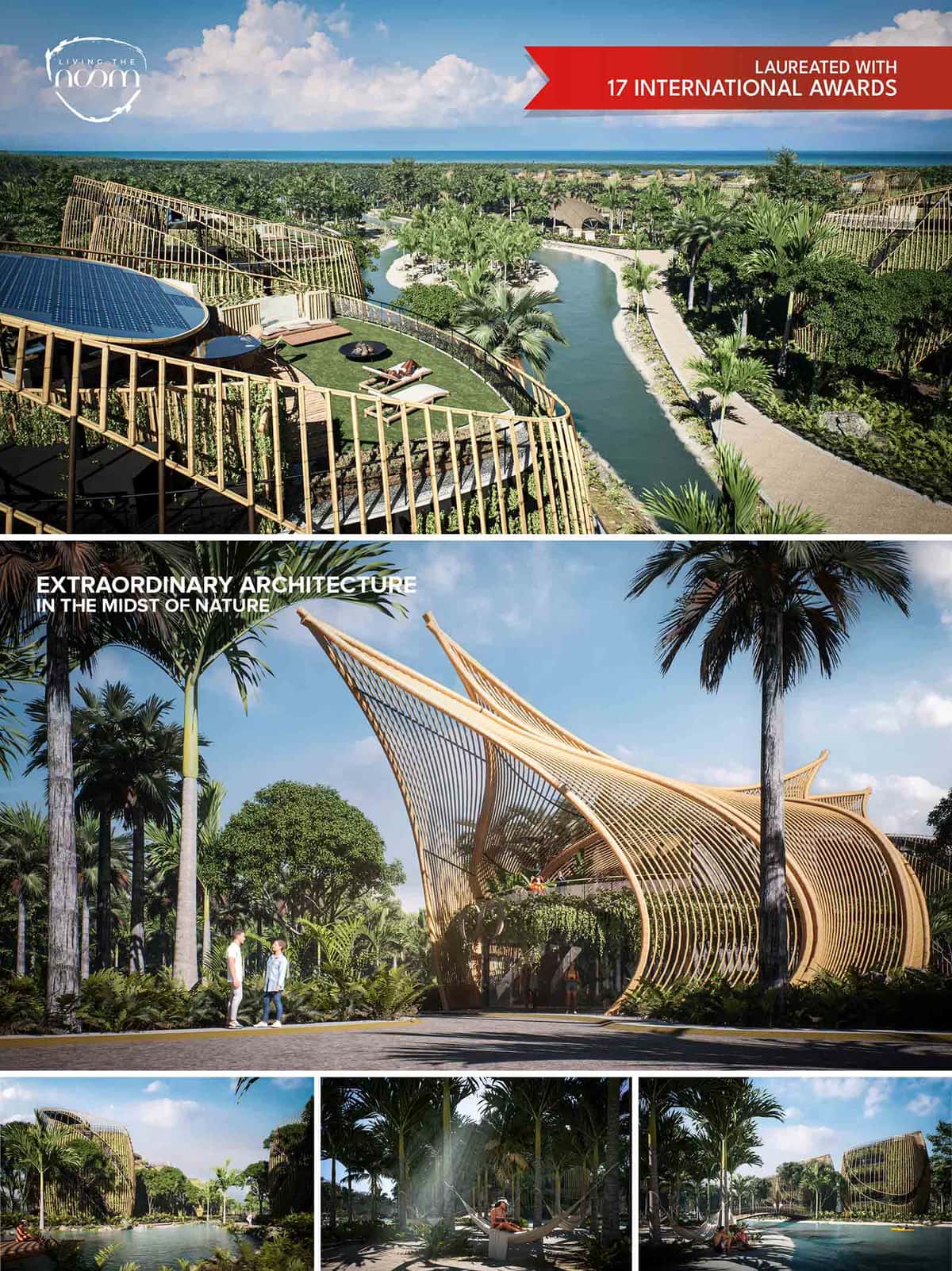
Natural lighting is achieved through the facades, where each unit has a single level taking advantage of 360 degrees of natural light. A bamboo and vegetation lattice is used to mitigate the overheating of the facades and to have a better control of the light and an adequate thermal environment in the interior spaces.
1.- All spaces have indirect natural light.
2.- The design of the house promotes natural ventilation to renew the indoor air and ensure an optimal level of comfort.
A more intelligent use of water is applied, both inside and outside the building, using technologies to reduce consumption, efficient installations, recycling water through the separation of gray water, then taking advantage of it for the irrigation of green areas, as well as its control and measurement.
The selection of responsible and local materials is proposed, in addition to minimizing the amount of waste in construction, as well as materials with recycled components and low environmental impact.
Although we know the human impact generated in nature by the settlement of people to live, we want to minimize it by preserving existing trees, also respecting natural life, trying to cohabit with squirrels, birds, iguanas and coatis that visit the land regularly, promoting a Low Ecological Footprint project
• LADI Awards, Latin American Real Estate Awards, Panamá : Best Disruptive Real State Product in Latin America : Living The Noom (2022)
• IDA Design Awards 2021 : Gold Medal : Living The Noom (2021)
• Global Future Design Awards 2021 : Winner : Living The Noom (2021)
• Golden Trezzini Awards 2021 : Best Project Residential : Living The Noom (2021)
• Tuvie Magazine : 2nd Best of the Best Design of the Year : Living The Noom (2021)
• The Architecture Community World Design Awards 2021 : Winner : Living The Noom (2021)
• Loop Design Awards : Architecture Concept Winner : Living The Noom (2021)
• The Plan Awards, Bologna, Italy : Honorable Mention in Future Housing : Living The Noom (2021)
• Top 20 A’ Architecture, Building And Structure Design Award, Milan, Italy: 2nd Best of the Best Design of the Year : Living The Noom (2020-2021)
• Novum Design Awards, Helsinki, Finland : Gold Award Winner : Living The Noom (2021)
• Architizer A+ Design Awards : 1st Place Jury Winner : Living The Noom (2021)
• Architizer A+ Design Awards : 1st Place Popular Choice Winner : Living The Noom (2021)
• APR Urban Design & Architecture Design Awards : 1st Place Winner : Living The Noom (2021)
• Rethinking The Future, New Delhi, India: Second Award - Housing (Upto 5 Floors) Concept : Living The Noom (2021)
• A’ Design Awards, Milan, Italy: Platinum Medal - Certificate Of Excellence in Architecture, Building and Structure Design Category: Living The Noom (2021)
• Muse Design Awards, New York, USA : Platinum Award - Conceptual Design of the Year : Living The Noom (2021)
• World Architecture Awards 10+5+X Honorary Members: Architecture - Designed Category, 36th Cycle : Living The Noom (2021)
sanzpont [arquitectura]
Pedrajo+Pedrajo Arquitectos
Grupo NX6 + Nader Enterprises


• LADI Awards, Latin American Real Estate Awards, Panamá : Best Disruptive Real State Product in Latin America : Living The Noom (2022)
• IDA Design Awards 2021 : Gold Medal : Living The Noom (2021)
• Global Future Design Awards 2021 : Winner : Living The Noom (2021)
• Golden Trezzini Awards 2021 : Best Project Residential : Living The Noom (2021)
• Tuvie Magazine : 2nd Best of the Best Design of the Year : Living The Noom (2021)
• The Architecture Community World Design Awards 2021 : Winner : Living The Noom (2021)
• Loop Design Awards : Architecture Concept Winner : Living The Noom (2021)
• The Plan Awards, Bologna, Italy : Honorable Mention in Future Housing : Living The Noom (2021)
• Top 20 A’ Architecture, Building And Structure Design Award, Milan, Italy: 2nd Best of the Best Design of the Year : Living The Noom (2020-2021)
• Novum Design Awards, Helsinki, Finland : Gold Award Winner : Living The Noom (2021)
• Architizer A+ Design Awards : 1st Place Jury Winner : Living The Noom (2021)
• Architizer A+ Design Awards : 1st Place Popular Choice Winner : Living The Noom (2021)
• APR Urban Design & Architecture Design Awards : 1st Place Winner : Living The Noom (2021)
• Rethinking The Future, New Delhi, India: Second Award - Housing (Upto 5 Floors) Concept : Living The Noom (2021)
• A’ Design Awards, Milan, Italy: Platinum Medal - Certificate Of Excellence in Architecture, Building and Structure Design Category: Living The Noom (2021)
• Muse Design Awards, New York, USA : Platinum Award - Conceptual Design of the Year : Living The Noom (2021)
• World Architecture Awards 10+5+X Honorary Members: Architecture - Designed Category, 36th Cycle : Living The Noom (2021)
sanzpont [arquitectura]
Pedrajo+Pedrajo Arquitectos
Grupo NX6 + Nader Enterprises
How would you like to live the rest of your life? We have asked ourselves the same question. Each one of us looks alike because we are human beings, but… we are truly different, we have different tastes, different needs… and above all a personality, each of us is “unique” in our own particular way. And this is where we have always asked ourselves: Why are all the homes for sale almost, all the same? Because almost all of them seem to be cut from the same mold? Do we all have the same personality? The same beliefs, or the same way of being? or the same tastes?
The reality is that on many occasions we let situations define us and we choose the least bad option.
IN HARMONY WITH THE SPIRIT
We are clear that living a full life, not only contemplates covering the basic physiological needs, also we must fill and satisfy the soul through stimuli that make us feel alive, we want to create a community that promotes Artistic Expression, invites to exercise, Yoga and Meditation, live with Nature every day at all times, promote a healthy diet, be designed for all family members through Pet Friendly spaces, but truly create a Community of people who share life with the same values.
Contact with nature transmits us tranquility, and provides us with a good dose of calm, and it can be the anti-stress oxygen that lowers the revolutions of the day, creating a bubble of peace that gives us mental health; with outdoor spaces for Exercise, Yoga and Meditation, as well as promoting healthy Eating through an Organic Garden and Hydroponic Cultivation.
PEACE “If you are sad, you are living in the past. Being anxious in some way means that you are living in the future. If you are at peace, you are living in the present ”Lao Tzu
We look for admirers of expressions, who through spaces surrounded by murals, installations, poetry and positive sentences written on the walls, floors and furniture, open us to experiment. We want to breathe art and expressions, and through workshops with local artists inspire us to create, to dream.
“Art is dreaming, it is living, it is feeling. Art sears your soul, moves you, transports you. It has a magical power in people if we open ourselves to experiment. And best of all, it invites us to express ourselves, to bring out the artist that we all carry inside ... Because art can be a great discovery. " Mercè López, The heART Ambassadors
We want to create a Pet Friendly community that provides a better life for all of our loved ones, because for many of us the love of our pets is as great as if they were our children.
Because it is difficult to live with people who do not share the same ideals and values, and society is very heterogeneous in ways of thinking, what is important for one may be trivial for others. We are convinced that in order to truly have a full life in society, community must be formed. The most important thing in real estate products should not be the business, but rather bring people who are like-minded closer to improving their quality of life, with tribal projects.
We care a lot about nature, we hate how people just eliminate and destroy everything in order to accommodate. Our duty should simply be to improve each place where we decide to build, we must simply coexist and have respect for the earth. That is the reason why we have decided to only occupy a maximum of 30% of the land, respecting the existing trees, in addition to providing even more green surface than we found, ultimately managing to increase the total green area by 130%.
The project promotes through passive and bioclimatic design the reduction of the use of resources, economic savings, with the aim of achieving a more sustainable and environmentally friendly housing product.
Passive design strategies are proposed to reduce energy consumption and increase the efficiency of the building, taking advantage of renewable energies for lighting, taking advantage of natural light, in addition to generating energy, through photovoltaic solar panels, located on the roof. Efficient installations are also very important, as well as the high-efficiency LED artificial lighting system.
1.- The interior spaces are illuminated throughout the day by natural lighting.
2.- Solar panels on the roof that generate energy.
3.- Cover with Thermal Insulation, to prevent thermal transmission.
4.- Natural green roof with grass as Thermal Insulation and social recreation area, in addition to cultivation area, for edible plants.
Natural lighting is achieved through the facades, where each unit has a single level taking advantage of 360 degrees of natural light. A bamboo and vegetation lattice is used to mitigate the overheating of the facades and to have a better control of the light and an adequate thermal environment in the interior spaces.
1.- All spaces have indirect natural light.
2.- The design of the house promotes natural ventilation to renew the indoor air and ensure an optimal level of comfort.
A more intelligent use of water is applied, both inside and outside the building, using technologies to reduce consumption, efficient installations, recycling water through the separation of gray water, then taking advantage of it for the irrigation of green areas, as well as its control and measurement.
The selection of responsible and local materials is proposed, in addition to minimizing the amount of waste in construction, as well as materials with recycled components and low environmental impact.
Although we know the human impact generated in nature by the settlement of people to live, we want to minimize it by preserving existing trees, also respecting natural life, trying to cohabit with squirrels, birds, iguanas and coatis that visit the land regularly, promoting a Low Ecological Footprint project
© 2021 by sanzpont [arquitectura] . Webpage by sanzpont [digital] . Innovative Digital Experiences
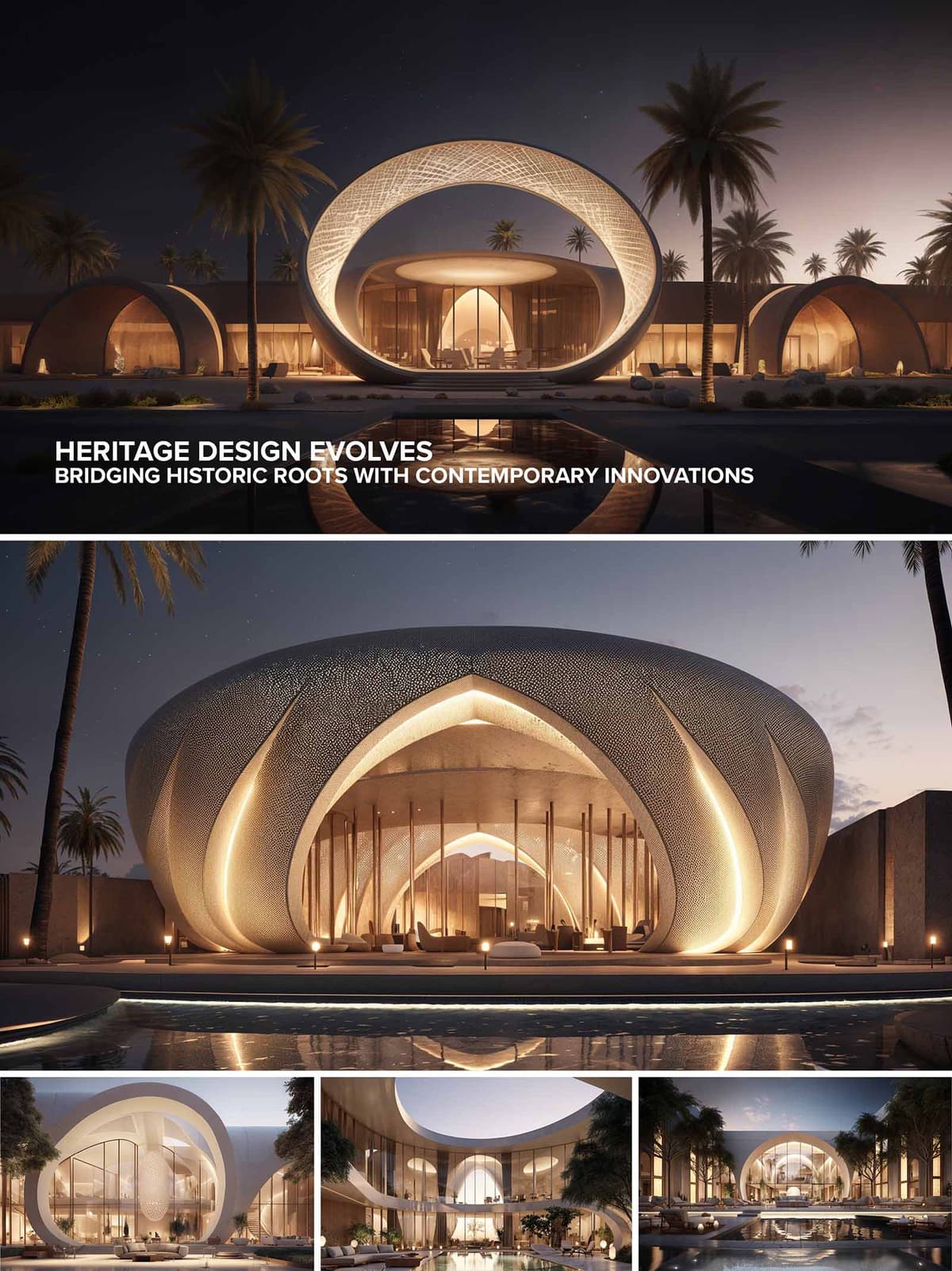

Bayt Al-Qamar Palace is conceived as a contemporary interpretation of the desert majlis, where the architecture becomes a lunar halo resting on the sand. The overarching circular ring and petal-like shells reference the full moon and its phases, a symbol deeply rooted in Arabian poetry and navigation. I worked with pure geometries—circle, arch and ellipse—to translate traditional Islamic motifs into a fluid, sculptural language. Rather than copying historical forms, the project abstracts them, creating an iconic silhouette that feels simultaneously ancestral and futuristic, and clearly legible against the vast Saudi night sky.
The palace sits low and wide, aligning itself with the horizontal character of the desert and the rhythm of palm trees. The central water axis reflects the main ring volume, visually doubling the form and anchoring the complex within its landscape. Perimeter walls and flanking barrel-vaulted wings create a sense of enclosure, echoing the introverted typology of traditional courtyard houses, while carefully framed openings preserve long views to the horizon. Vehicular access is kept discreet, allowing the arrival sequence to emphasize the ceremonial approach on foot along the reflecting pool.
The main hall is housed within the crescent-like shell, whose layered petals overlap to form deep portals. These portals articulate a gradation from public to intimate, guiding guests from open terrace to semi-public lounge and finally to more private reception areas. The circular ring overhead acts as a unifying canopy that organizes the plan around a central axis of water and light. Secondary functions—guest suites, spa, and service zones—occupy linear wings that embrace the central court, creating a protected micro-climate and ensuring that all principal spaces maintain a direct relationship with the pool and gardens.
The external skin employs a finely perforated, metallic-mineral finish inspired by traditional mashrabiya screens. By day, this shell reads as a monolithic, sand-tinted volume; by night, integrated linear LEDs emphasize the petals’ edges and reveal the intricate perforation as a glowing veil. Large, frameless glass panes behind the shell provide visual permeability while keeping the technical envelope clean. Interiors continue the soft, dune-like palette: warm stone flooring, light plaster, and timber accents that absorb and reflect the golden lighting strategy. The result is a gradation from bright exterior glow to warm, cocooned interiors.
From the outset, the design pursued passive environmental performance. The thick shell and ring elements act as thermal mass, buffering internal spaces from desert temperature swings, while their overhangs provide deep shade that minimizes direct solar gain on glass. The central water body assists evaporative cooling, working in tandem with cross-ventilation encouraged by carefully oriented openings. Primary materials are specified as locally sourced stone and high-recycled-content metal cladding to reduce embodied carbon. Roof surfaces are prepared to receive photovoltaic panels, and a grey-water system is integrated to reuse pool backwash and landscape runoff for irrigation of drought-tolerant planting.
Inside Bayt Al-Qamar, the spatial narrative is deliberately serene and ceremonial. Guests enter through a shaded, compressed threshold and emerge into a generous lounge that opens directly to the mirror-like pool, reinforcing the connection between architecture, sky, and water. Furnishings are kept low and minimal, allowing the eye to travel uninterrupted along the curved shells and up to the luminous ring above. Acoustic treatment is concealed within the sculpted ceilings to maintain intimacy even in large gatherings. Ultimately, the palace offers a sequence of spaces that support both grand receptions and quiet contemplation, always framed by the presence of the desert night and the metaphorical light of the moon.
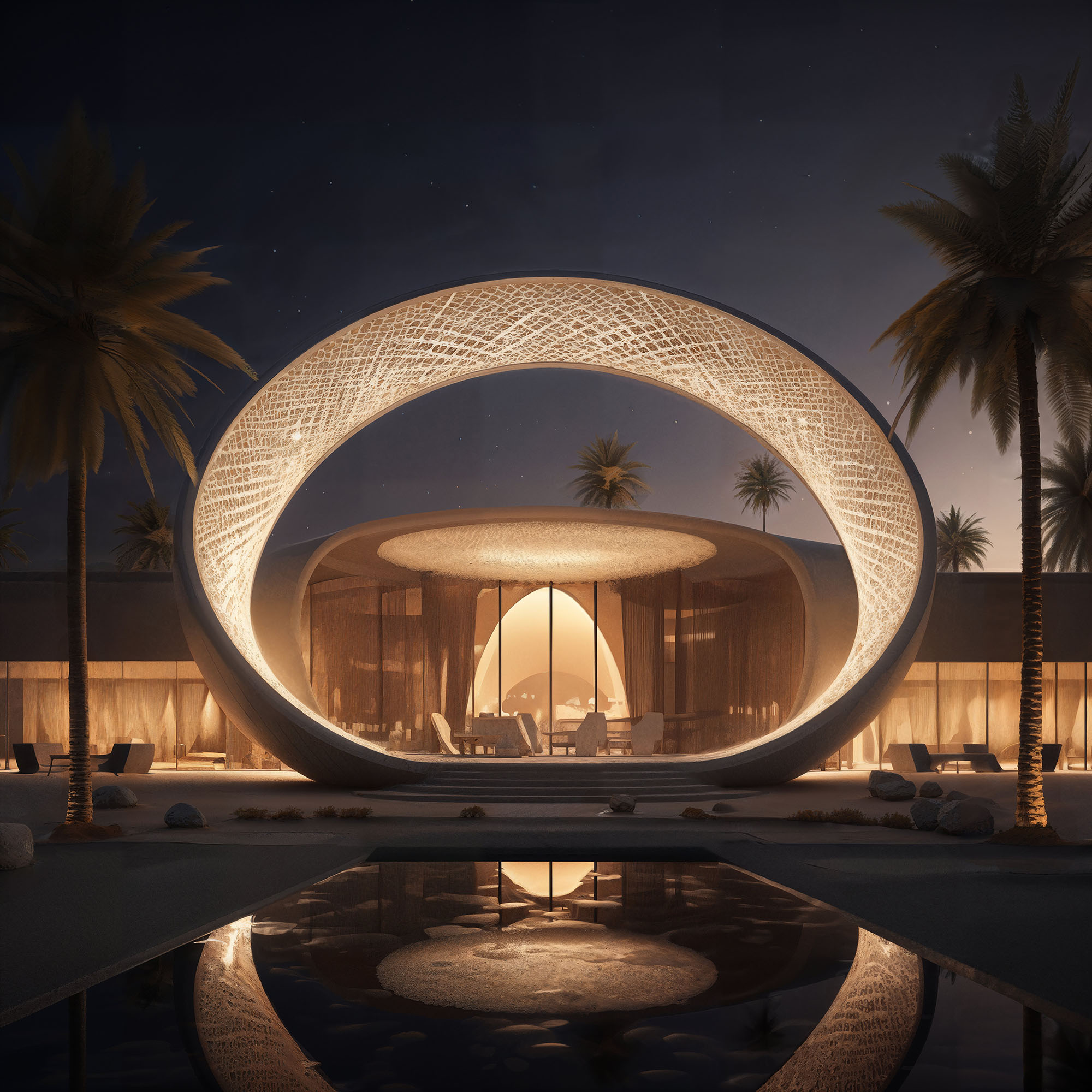
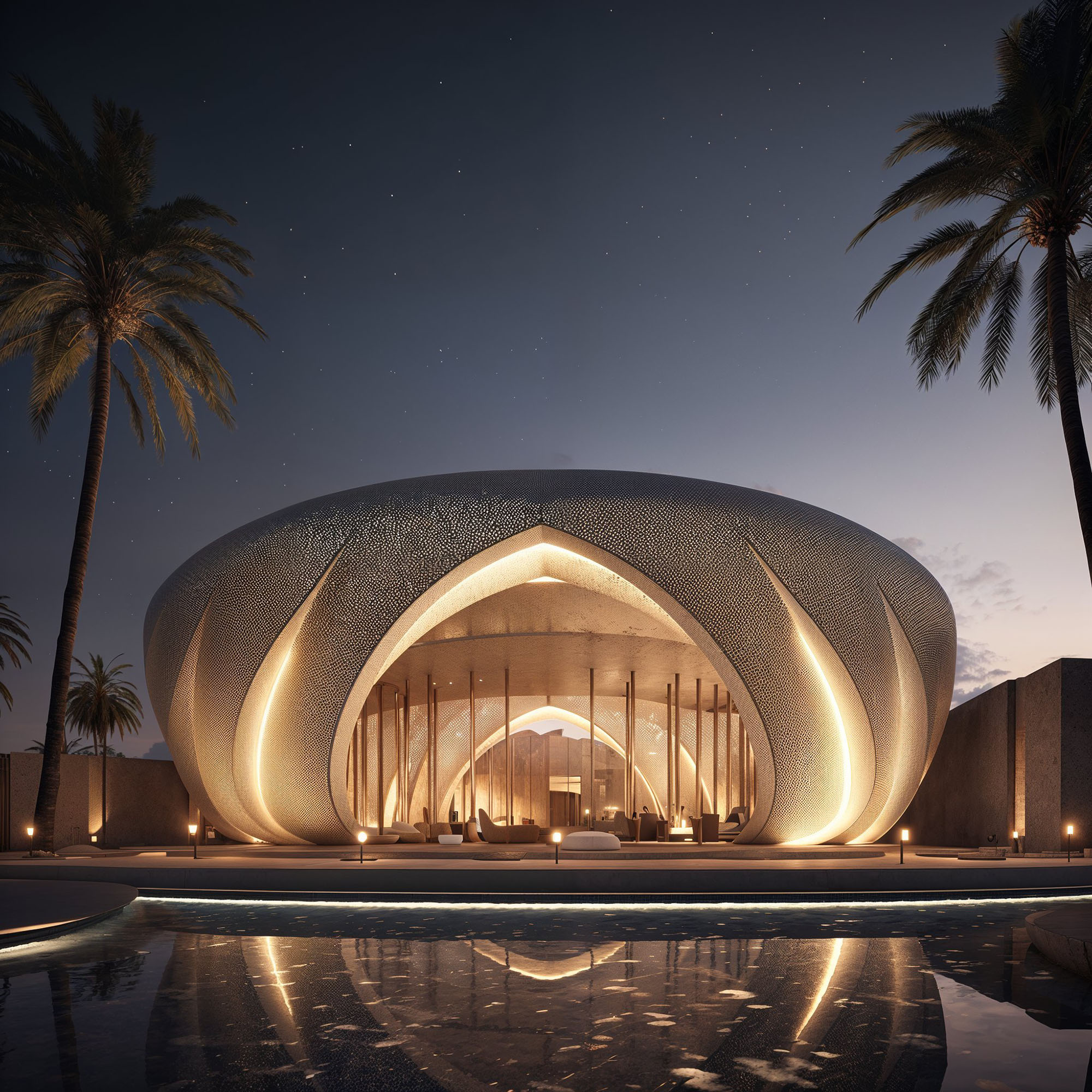
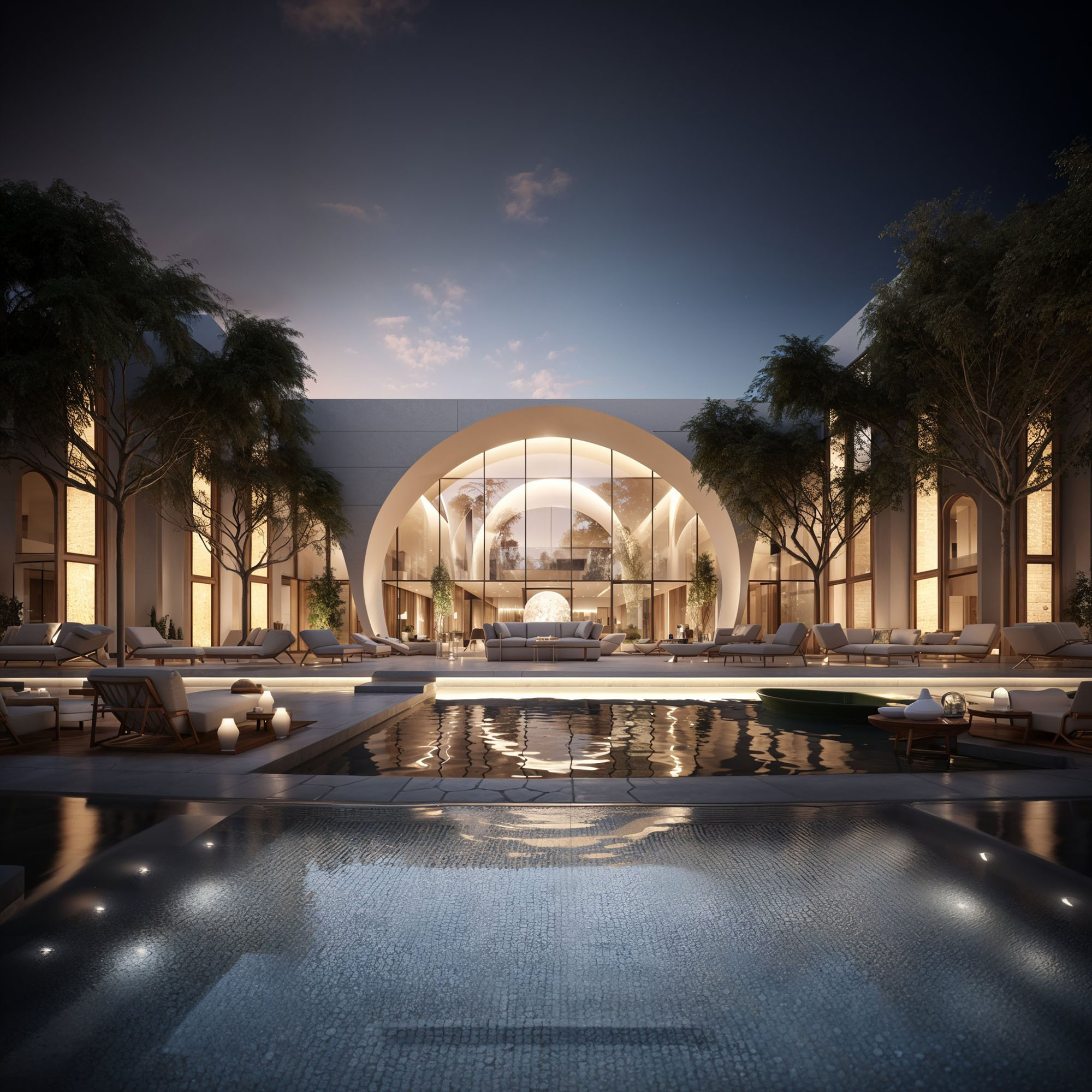
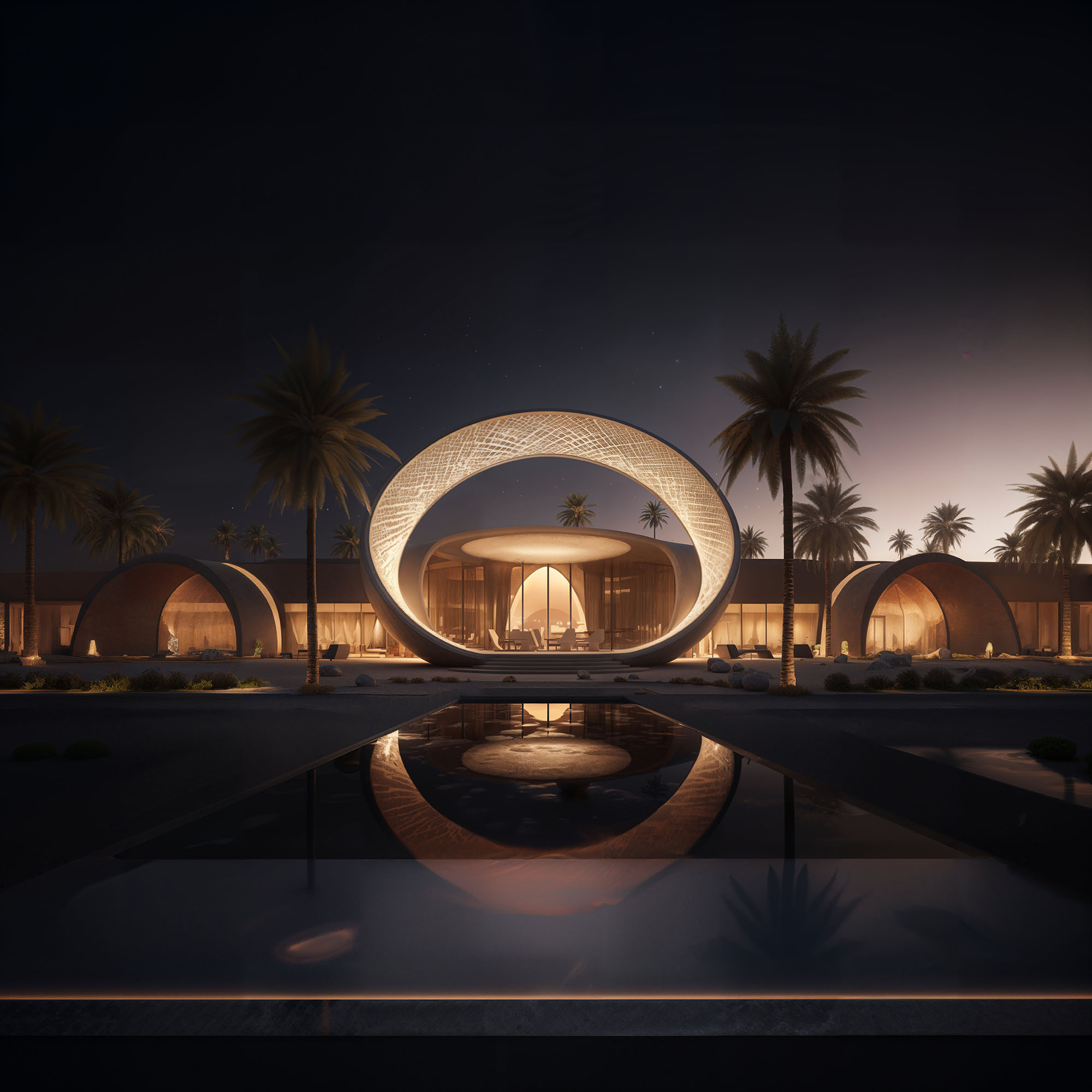
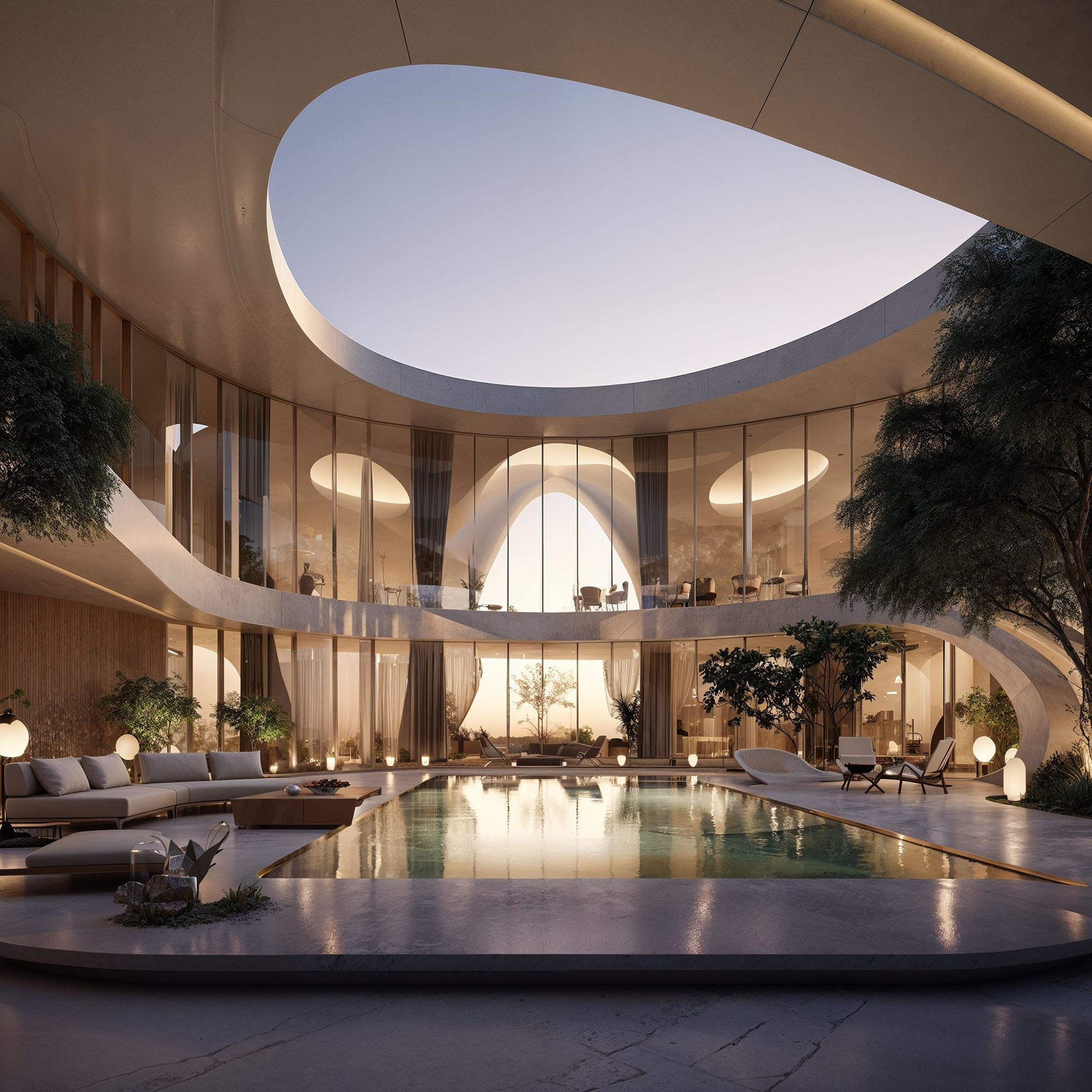
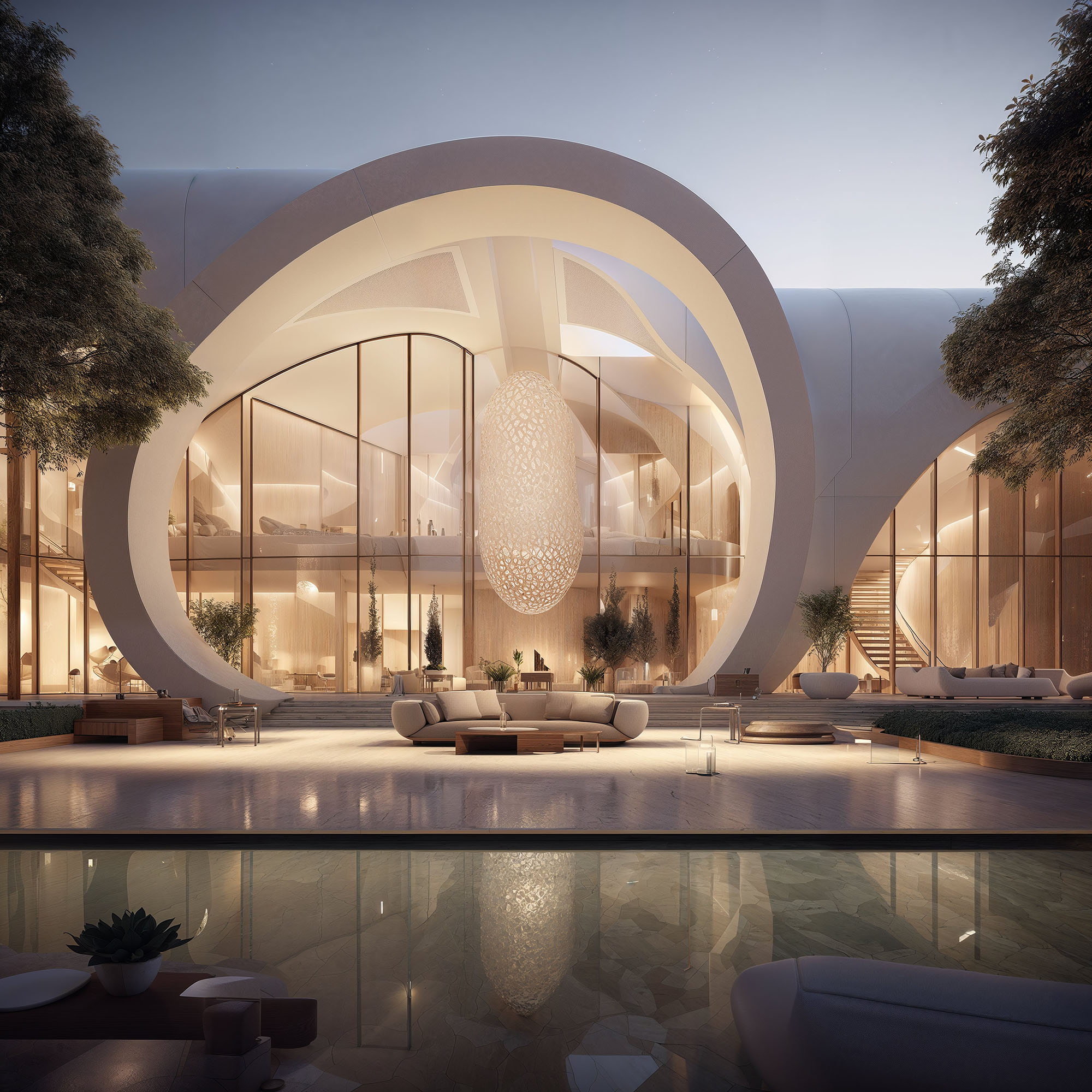
Bayt Al-Qamar Palace is conceived as a contemporary interpretation of the desert majlis, where the architecture becomes a lunar halo resting on the sand. The overarching circular ring and petal-like shells reference the full moon and its phases, a symbol deeply rooted in Arabian poetry and navigation. I worked with pure geometries—circle, arch and ellipse—to translate traditional Islamic motifs into a fluid, sculptural language. Rather than copying historical forms, the project abstracts them, creating an iconic silhouette that feels simultaneously ancestral and futuristic, and clearly legible against the vast Saudi night sky.
The palace sits low and wide, aligning itself with the horizontal character of the desert and the rhythm of palm trees. The central water axis reflects the main ring volume, visually doubling the form and anchoring the complex within its landscape. Perimeter walls and flanking barrel-vaulted wings create a sense of enclosure, echoing the introverted typology of traditional courtyard houses, while carefully framed openings preserve long views to the horizon. Vehicular access is kept discreet, allowing the arrival sequence to emphasize the ceremonial approach on foot along the reflecting pool.
The main hall is housed within the crescent-like shell, whose layered petals overlap to form deep portals. These portals articulate a gradation from public to intimate, guiding guests from open terrace to semi-public lounge and finally to more private reception areas. The circular ring overhead acts as a unifying canopy that organizes the plan around a central axis of water and light. Secondary functions—guest suites, spa, and service zones—occupy linear wings that embrace the central court, creating a protected micro-climate and ensuring that all principal spaces maintain a direct relationship with the pool and gardens.
The external skin employs a finely perforated, metallic-mineral finish inspired by traditional mashrabiya screens. By day, this shell reads as a monolithic, sand-tinted volume; by night, integrated linear LEDs emphasize the petals’ edges and reveal the intricate perforation as a glowing veil. Large, frameless glass panes behind the shell provide visual permeability while keeping the technical envelope clean. Interiors continue the soft, dune-like palette: warm stone flooring, light plaster, and timber accents that absorb and reflect the golden lighting strategy. The result is a gradation from bright exterior glow to warm, cocooned interiors.
From the outset, the design pursued passive environmental performance. The thick shell and ring elements act as thermal mass, buffering internal spaces from desert temperature swings, while their overhangs provide deep shade that minimizes direct solar gain on glass. The central water body assists evaporative cooling, working in tandem with cross-ventilation encouraged by carefully oriented openings. Primary materials are specified as locally sourced stone and high-recycled-content metal cladding to reduce embodied carbon. Roof surfaces are prepared to receive photovoltaic panels, and a grey-water system is integrated to reuse pool backwash and landscape runoff for irrigation of drought-tolerant planting.
Inside Bayt Al-Qamar, the spatial narrative is deliberately serene and ceremonial. Guests enter through a shaded, compressed threshold and emerge into a generous lounge that opens directly to the mirror-like pool, reinforcing the connection between architecture, sky, and water. Furnishings are kept low and minimal, allowing the eye to travel uninterrupted along the curved shells and up to the luminous ring above. Acoustic treatment is concealed within the sculpted ceilings to maintain intimacy even in large gatherings. Ultimately, the palace offers a sequence of spaces that support both grand receptions and quiet contemplation, always framed by the presence of the desert night and the metaphorical light of the moon.
© 2021 by sanzpont [arquitectura] . Webpage by sanzpont [digital] . Innovative Digital Experiences
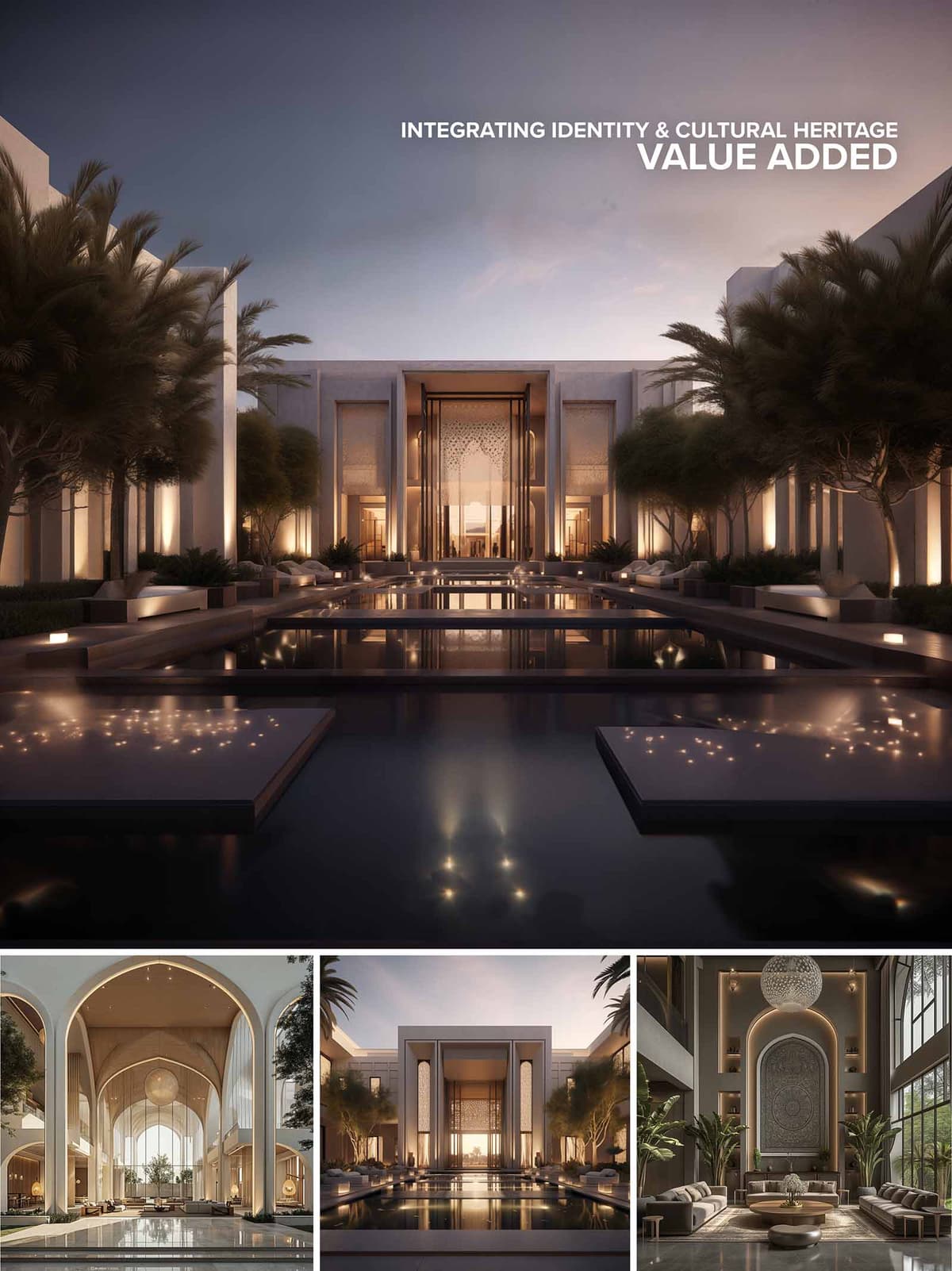
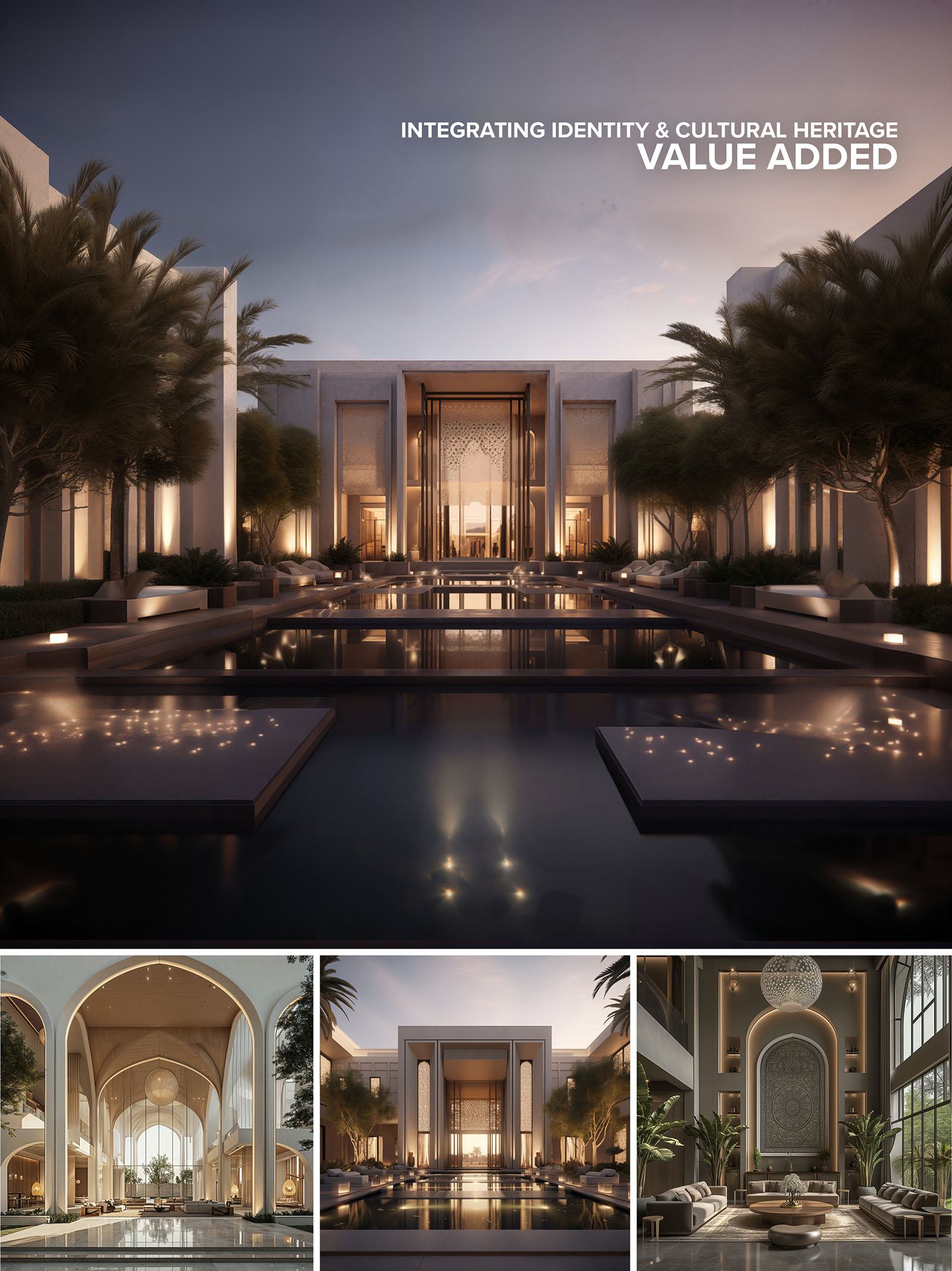
Qasr Al-Haya Palace is conceived as a contemporary interpretation of the desert palace, merging refined minimalism with the opulent spatial sequences of traditional Arab architecture. The design orchestrates a ceremonial journey from exterior to interior, using water, light, and shadow as primary compositional elements. A strong axial approach leads guests through layered thresholds, framing views and gradually revealing the richness of the inner world.
The architectural language is deliberately calm and monolithic on the outside, allowing the interiors and courtyards to express the emotional intensity of the palace life. Verticality, generous volumes, and finely worked details emphasize dignity and permanence, while soft, warm lighting underscores the palace’s residential and intimate vocation.
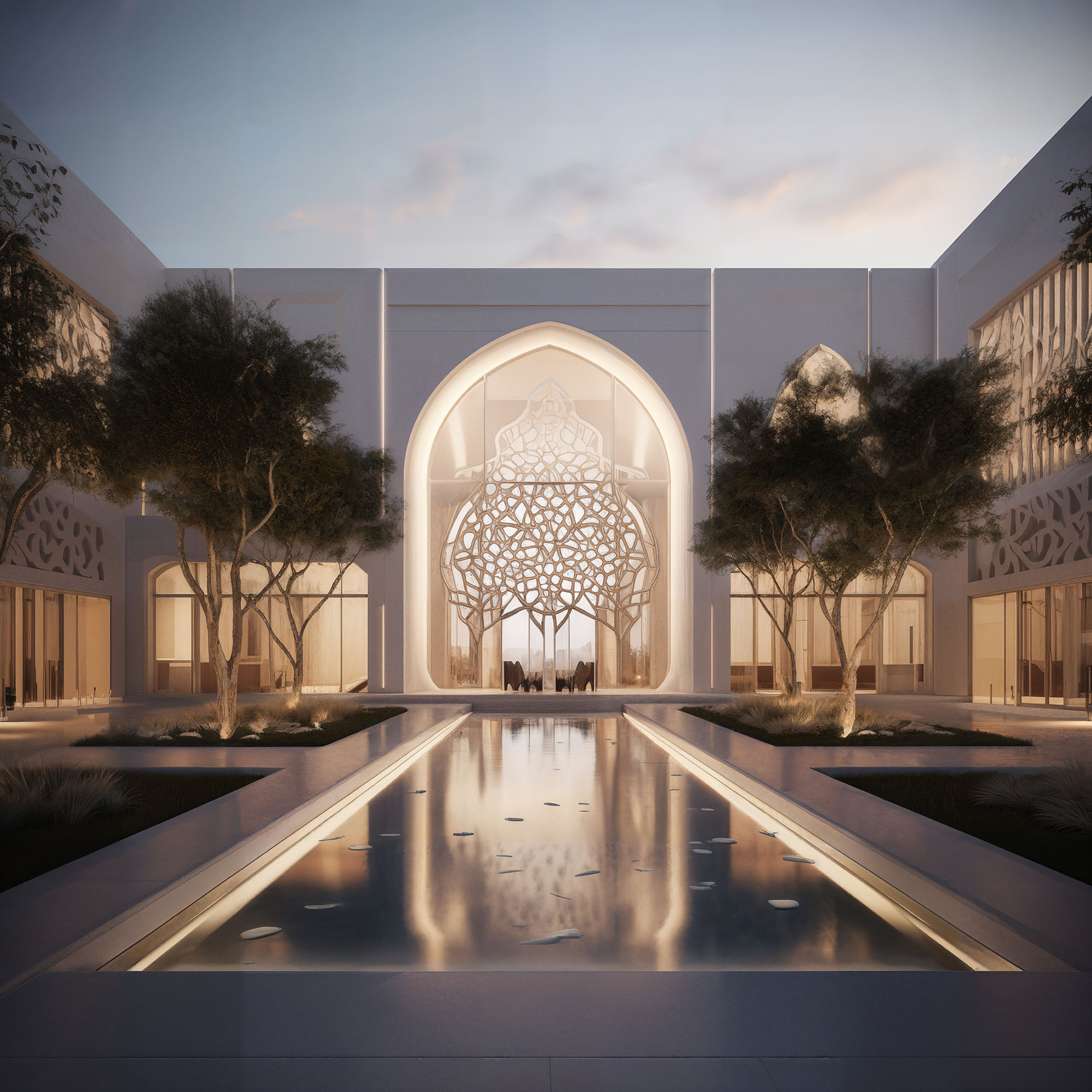
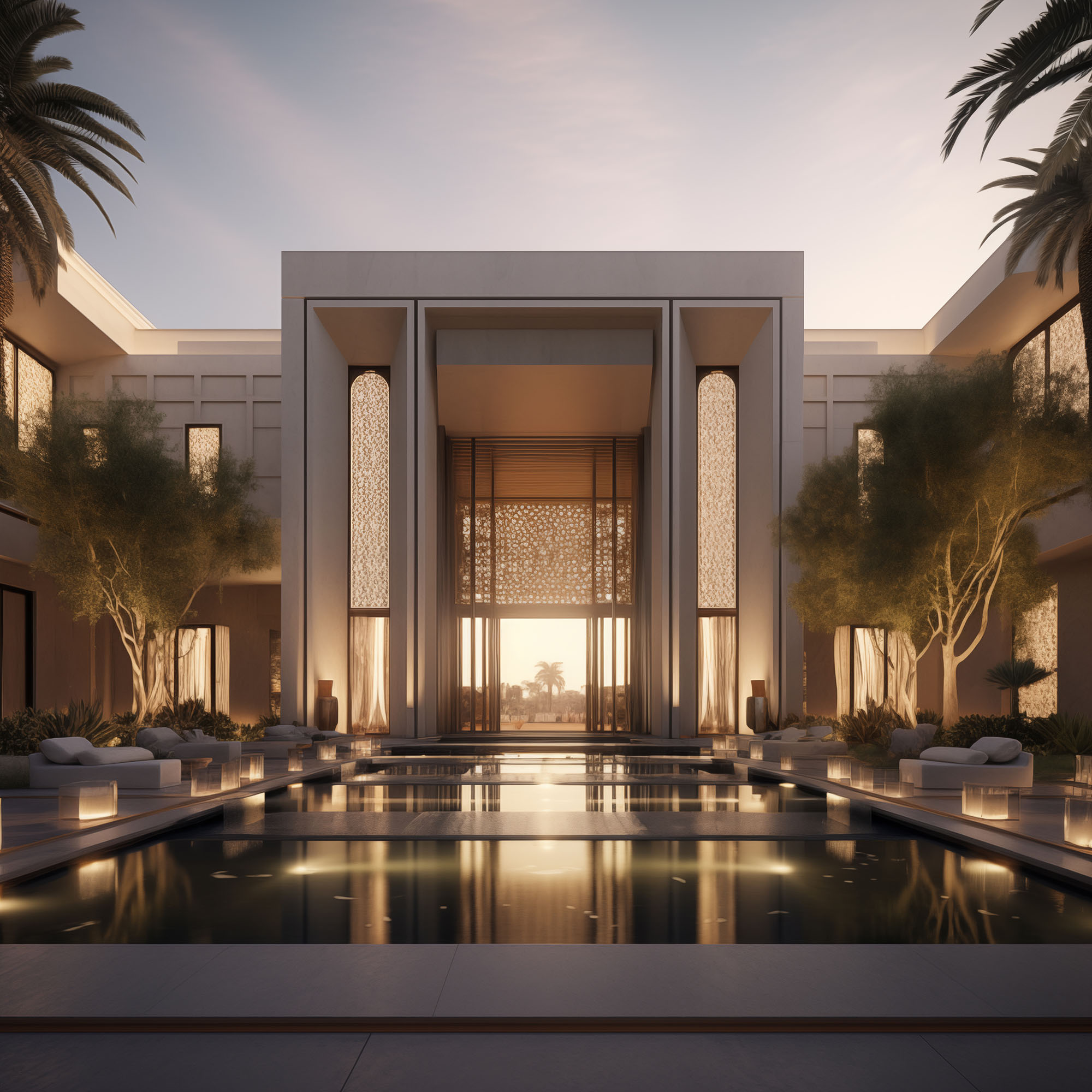
The palace is structured as a series of orthogonal volumes around a central water courtyard. Clean, rectilinear masses are articulated by deep reveals and tall portals, generating a rhythm of solids and voids. The main entrance façade is dominated by a grand propylaeum-like frame, within which a delicately perforated metal screen filters light and provides privacy. This large-scale mashrabiya becomes the symbolic “veil” of the palace.
Vertical pilasters and recessed bays create a sequence of shaded niches along the perimeter, reinforcing a sense of procession. The overall massing remains low and horizontal, echoing the horizon line of the desert landscape, while selective vertical accents—entrance portal, double-height arcades, and interior colonnades—mark important nodes in the spatial hierarchy.
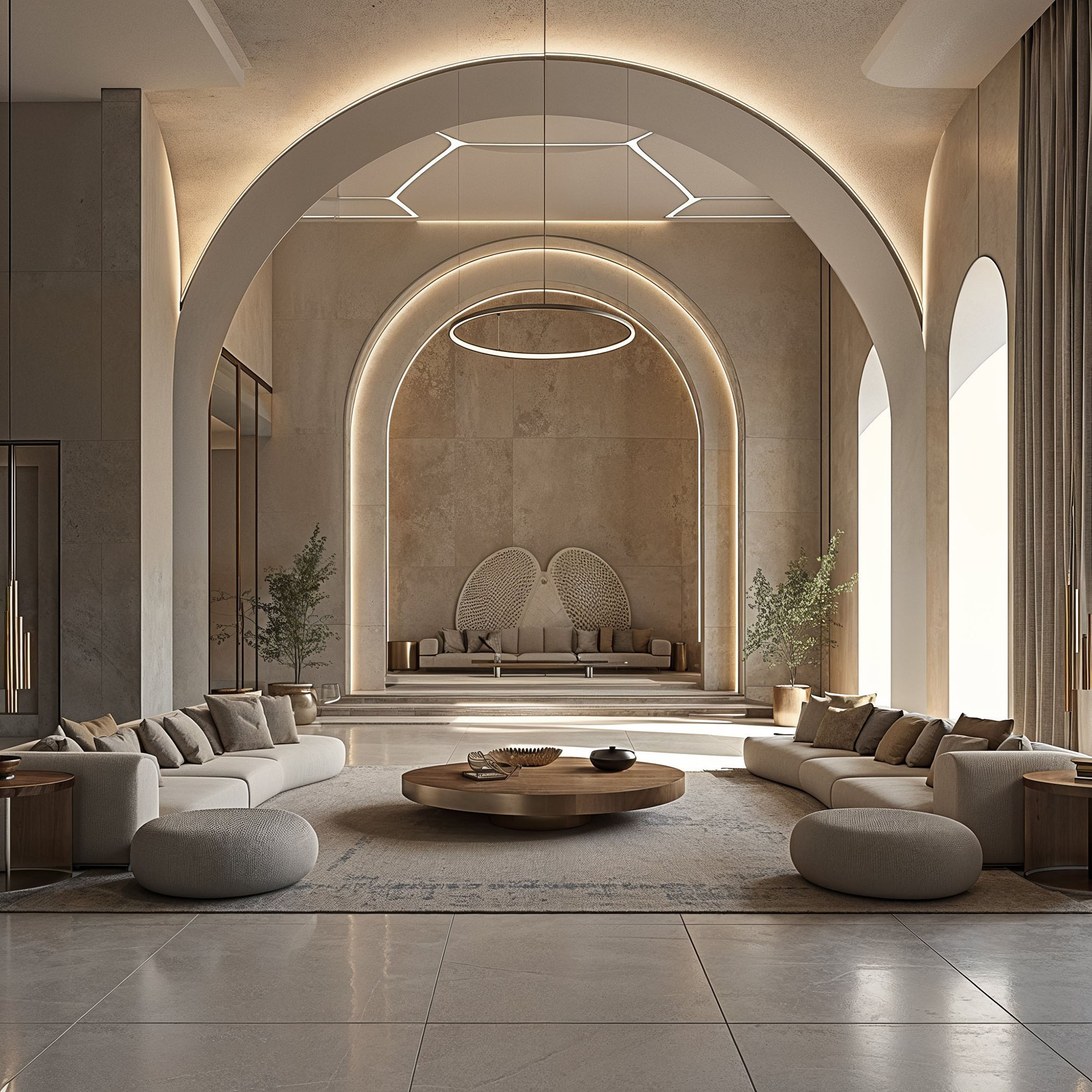
The interior spaces revolve around a monumental, double-height reception hall, defined by slender arches and a sweeping vaulted ceiling. Natural light enters through tall, glazed openings, softened by sheer layers and exterior shading devices. This creates a diffused, golden atmosphere that enhances the perception of height and depth. The hall connects visually to the central courtyard, dissolving the boundary between inside and outside.
Key interior walls are treated as sculpted surfaces: recessed panels, carved geometric patterns, and large-scale ornamental medallions act as focal points. Furnishings are arranged in generous conversation clusters, combining low modular seating reminiscent of majlis typologies with contemporary pieces in neutral textiles. The palette favors warm stone, bronze accents, and soft fabrics, enriched by greenery that introduces a subtle biophilic dimension.
The material strategy balances durability, tactility, and understated luxury. External façades use light-toned stone or high-performance stucco, chosen for its thermal inertia and ability to reflect harsh sunlight. Fine metalwork in bronze or champagne anodized aluminum defines doors, screens, and balustrades, providing a delicate contrast to the solid masonry volumes.
Internally, large-format stone flooring, timber ceilings, and finely textured plaster surfaces create a cohesive, timeless backdrop. The chromatic palette remains in the spectrum of sands, creams, and warm greys, punctuated by metallic highlights and the deep greens of planting. Lighting is layered: concealed linear LEDs accentuate cornices and arches, while sculptural pendants and chandeliers articulate key vertical spaces and emphasize the palace’s ceremonial character.
The landscape design extends the architecture through a sequence of reflecting pools, planted terraces, and shaded seating platforms. Linear water features aligned with the central axis not only create a powerful visual perspective, but also assist in microclimate regulation through evaporative cooling. Strategically placed palms and drought-tolerant native species provide shade, reduce heat gain on hard surfaces, and minimize irrigation demand.
Sustainability is embedded through passive and active strategies: deep overhangs, colonnades, and screens mitigate solar exposure; high-performance glazing and insulated envelopes improve thermal performance; and the central courtyard acts as a climatic buffer, encouraging cross-ventilation. Water-efficient fixtures, greywater reuse for irrigation, and energy-efficient LED lighting systems contribute to reduced operational consumption, ensuring that the palace’s sense of grandeur is aligned with contemporary environmental responsibility.
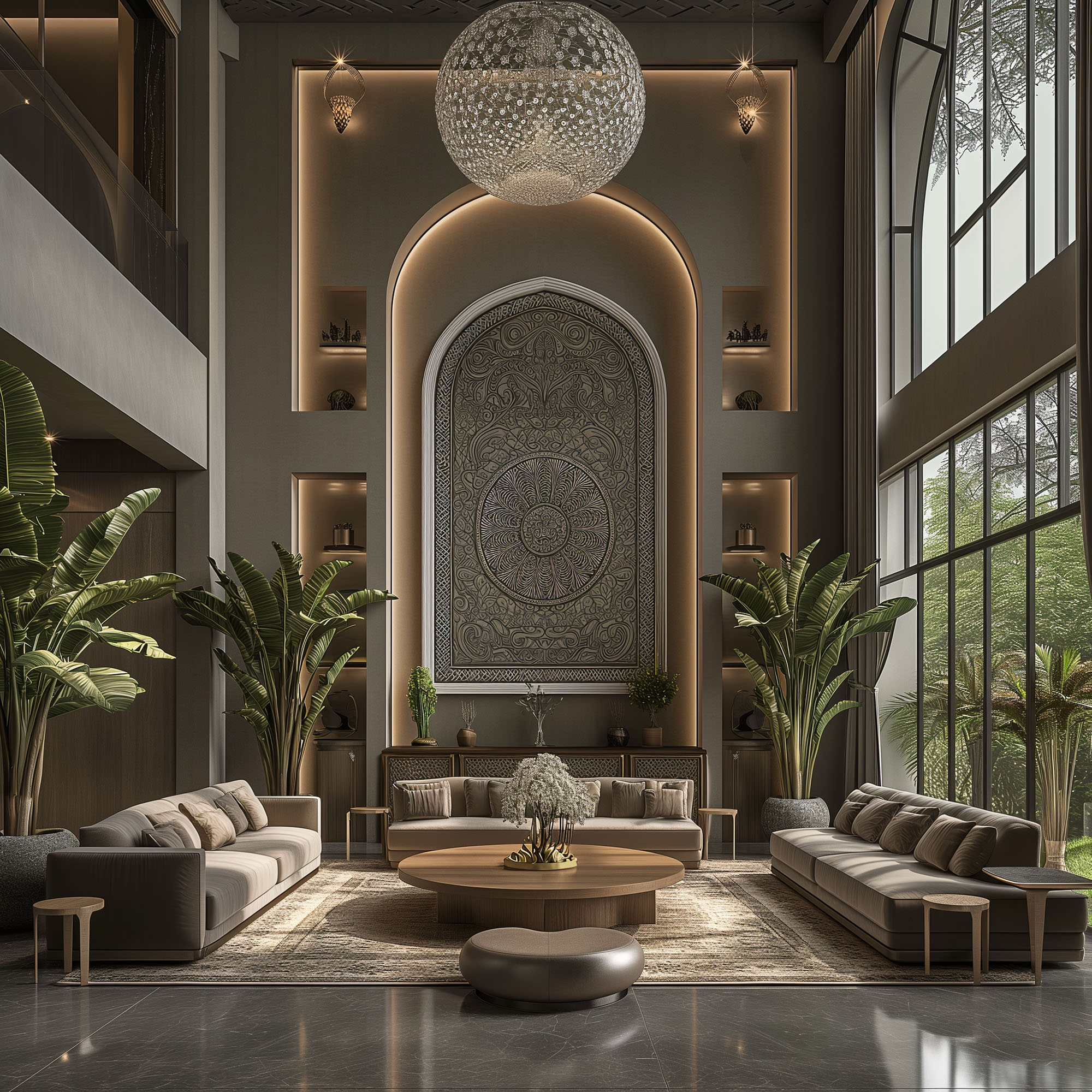
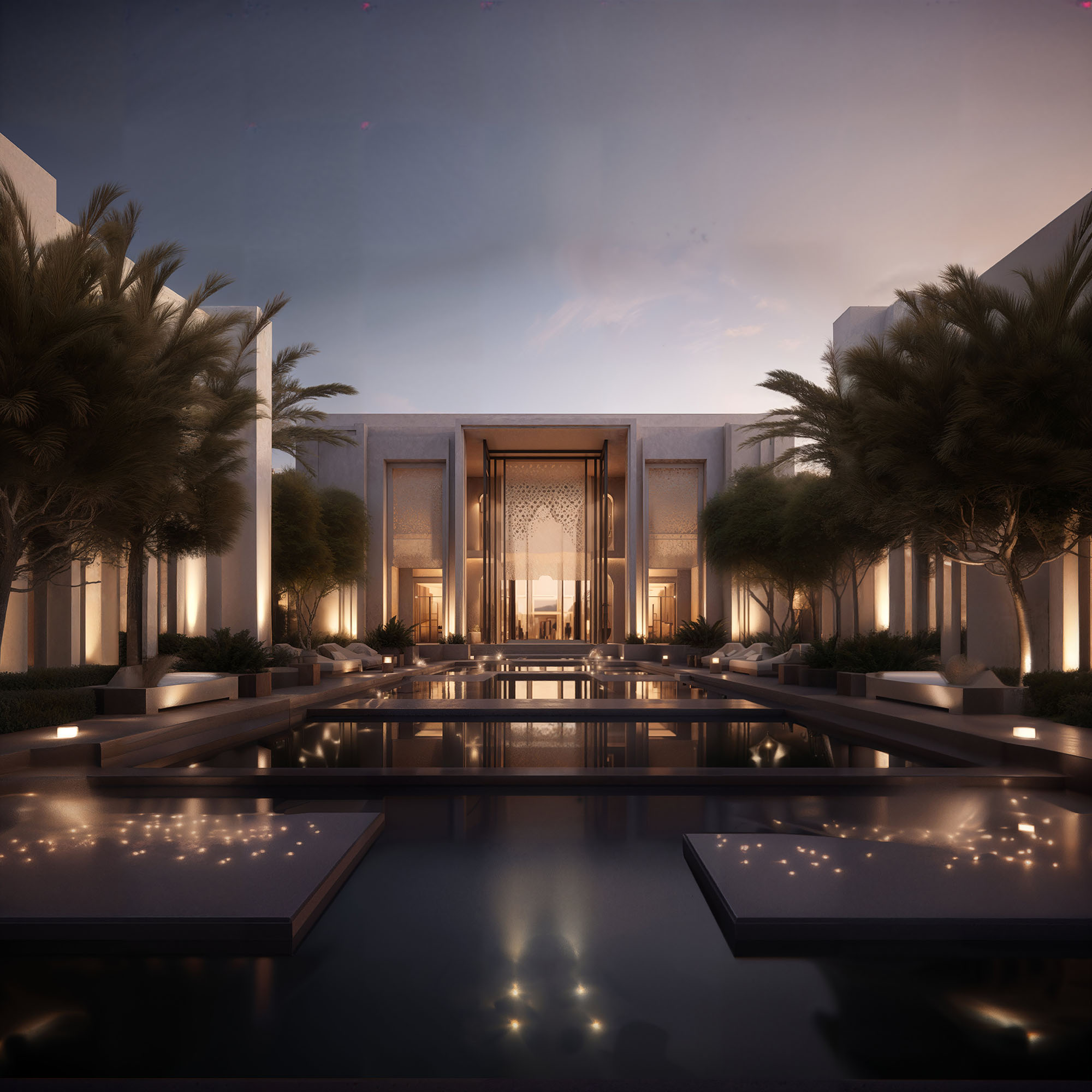

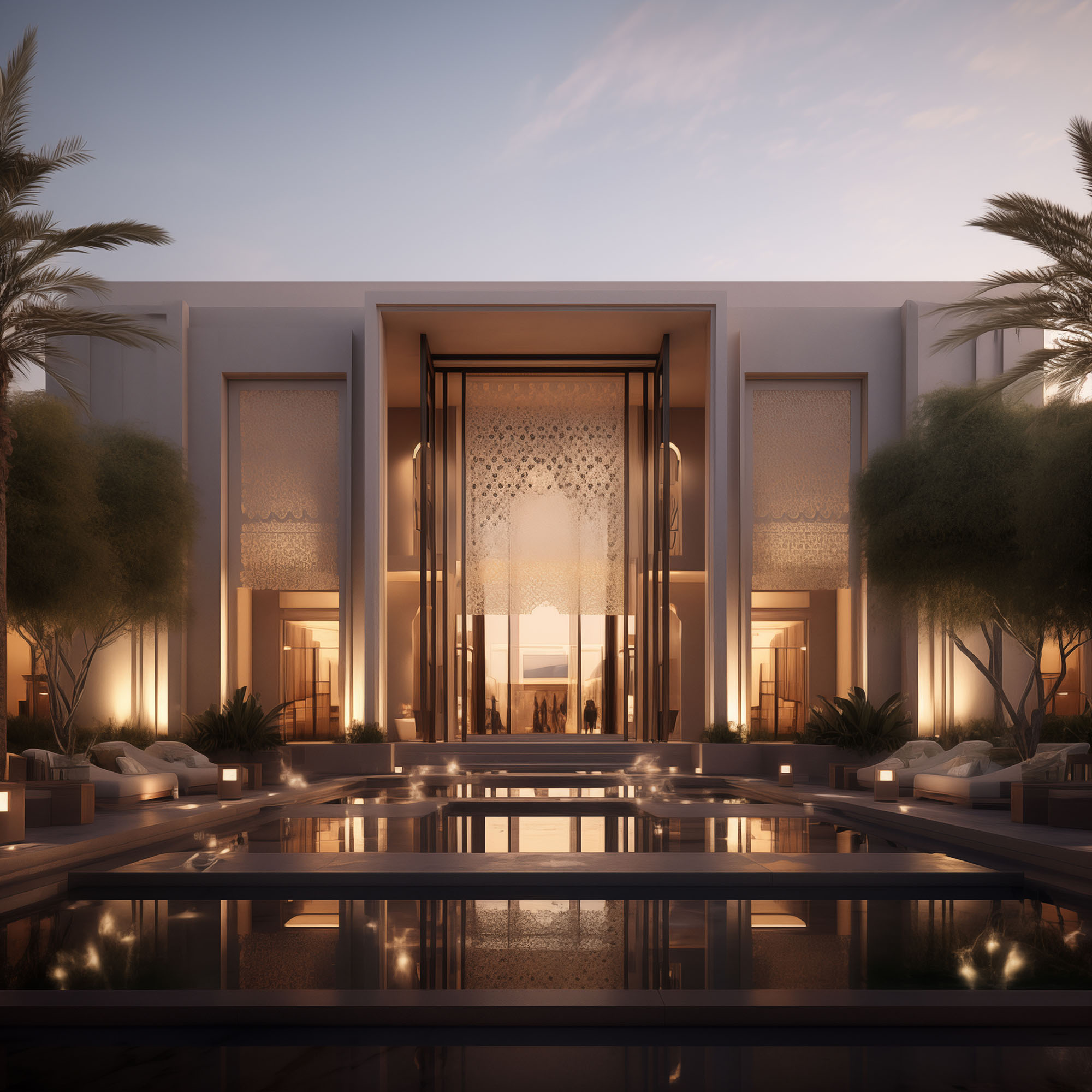
Qasr Al-Haya Palace is conceived as a contemporary interpretation of the desert palace, merging refined minimalism with the opulent spatial sequences of traditional Arab architecture. The design orchestrates a ceremonial journey from exterior to interior, using water, light, and shadow as primary compositional elements. A strong axial approach leads guests through layered thresholds, framing views and gradually revealing the richness of the inner world.
The architectural language is deliberately calm and monolithic on the outside, allowing the interiors and courtyards to express the emotional intensity of the palace life. Verticality, generous volumes, and finely worked details emphasize dignity and permanence, while soft, warm lighting underscores the palace’s residential and intimate vocation.
The palace is structured as a series of orthogonal volumes around a central water courtyard. Clean, rectilinear masses are articulated by deep reveals and tall portals, generating a rhythm of solids and voids. The main entrance façade is dominated by a grand propylaeum-like frame, within which a delicately perforated metal screen filters light and provides privacy. This large-scale mashrabiya becomes the symbolic “veil” of the palace.
Vertical pilasters and recessed bays create a sequence of shaded niches along the perimeter, reinforcing a sense of procession. The overall massing remains low and horizontal, echoing the horizon line of the desert landscape, while selective vertical accents—entrance portal, double-height arcades, and interior colonnades—mark important nodes in the spatial hierarchy.
The interior spaces revolve around a monumental, double-height reception hall, defined by slender arches and a sweeping vaulted ceiling. Natural light enters through tall, glazed openings, softened by sheer layers and exterior shading devices. This creates a diffused, golden atmosphere that enhances the perception of height and depth. The hall connects visually to the central courtyard, dissolving the boundary between inside and outside.
Key interior walls are treated as sculpted surfaces: recessed panels, carved geometric patterns, and large-scale ornamental medallions act as focal points. Furnishings are arranged in generous conversation clusters, combining low modular seating reminiscent of majlis typologies with contemporary pieces in neutral textiles. The palette favors warm stone, bronze accents, and soft fabrics, enriched by greenery that introduces a subtle biophilic dimension.
The material strategy balances durability, tactility, and understated luxury. External façades use light-toned stone or high-performance stucco, chosen for its thermal inertia and ability to reflect harsh sunlight. Fine metalwork in bronze or champagne anodized aluminum defines doors, screens, and balustrades, providing a delicate contrast to the solid masonry volumes.
Internally, large-format stone flooring, timber ceilings, and finely textured plaster surfaces create a cohesive, timeless backdrop. The chromatic palette remains in the spectrum of sands, creams, and warm greys, punctuated by metallic highlights and the deep greens of planting. Lighting is layered: concealed linear LEDs accentuate cornices and arches, while sculptural pendants and chandeliers articulate key vertical spaces and emphasize the palace’s ceremonial character.
The landscape design extends the architecture through a sequence of reflecting pools, planted terraces, and shaded seating platforms. Linear water features aligned with the central axis not only create a powerful visual perspective, but also assist in microclimate regulation through evaporative cooling. Strategically placed palms and drought-tolerant native species provide shade, reduce heat gain on hard surfaces, and minimize irrigation demand.
Sustainability is embedded through passive and active strategies: deep overhangs, colonnades, and screens mitigate solar exposure; high-performance glazing and insulated envelopes improve thermal performance; and the central courtyard acts as a climatic buffer, encouraging cross-ventilation. Water-efficient fixtures, greywater reuse for irrigation, and energy-efficient LED lighting systems contribute to reduced operational consumption, ensuring that the palace’s sense of grandeur is aligned with contemporary environmental responsibility.
© 2021 by sanzpont [arquitectura] . Webpage by sanzpont [digital] . Innovative Digital Experiences
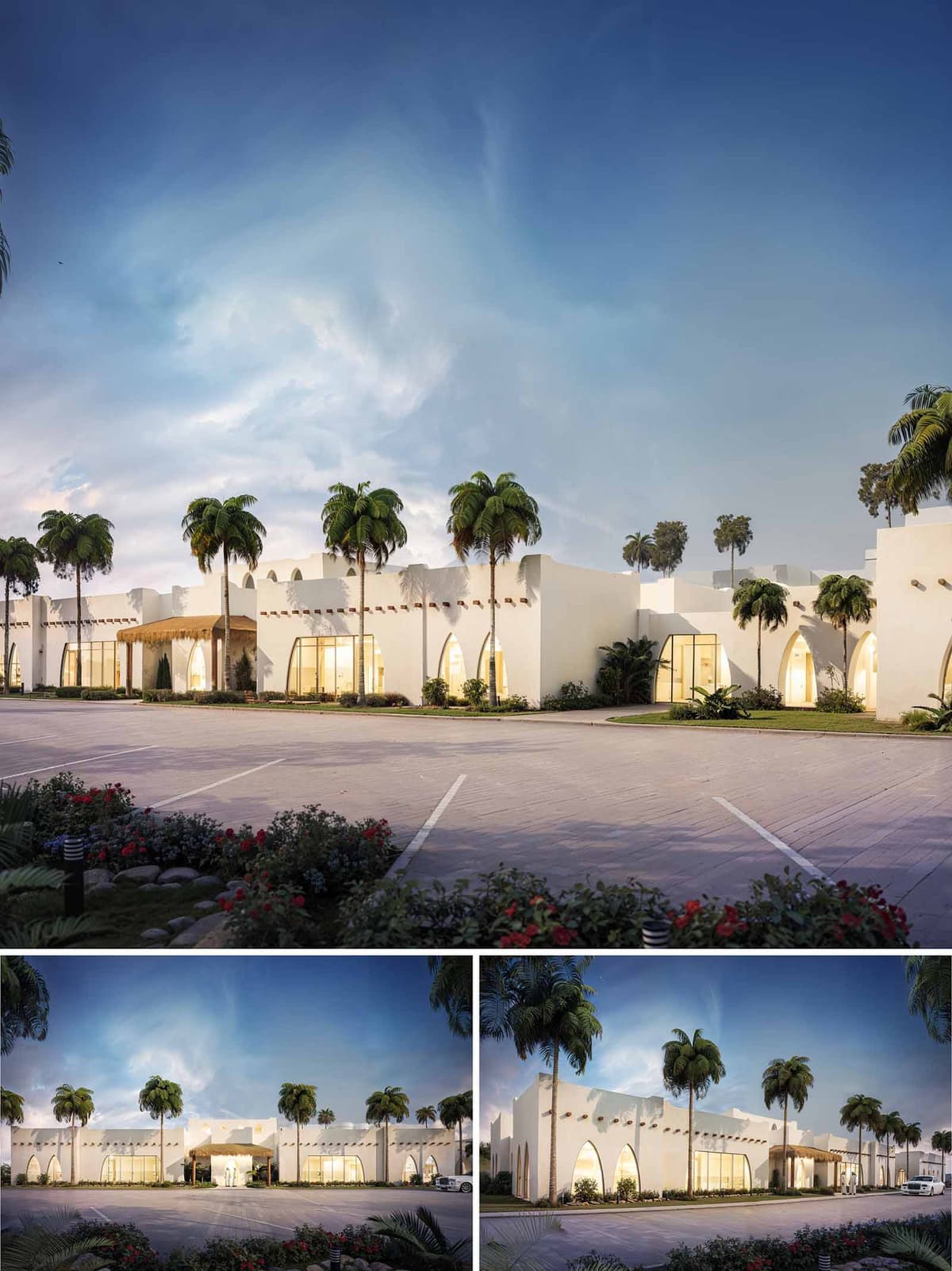
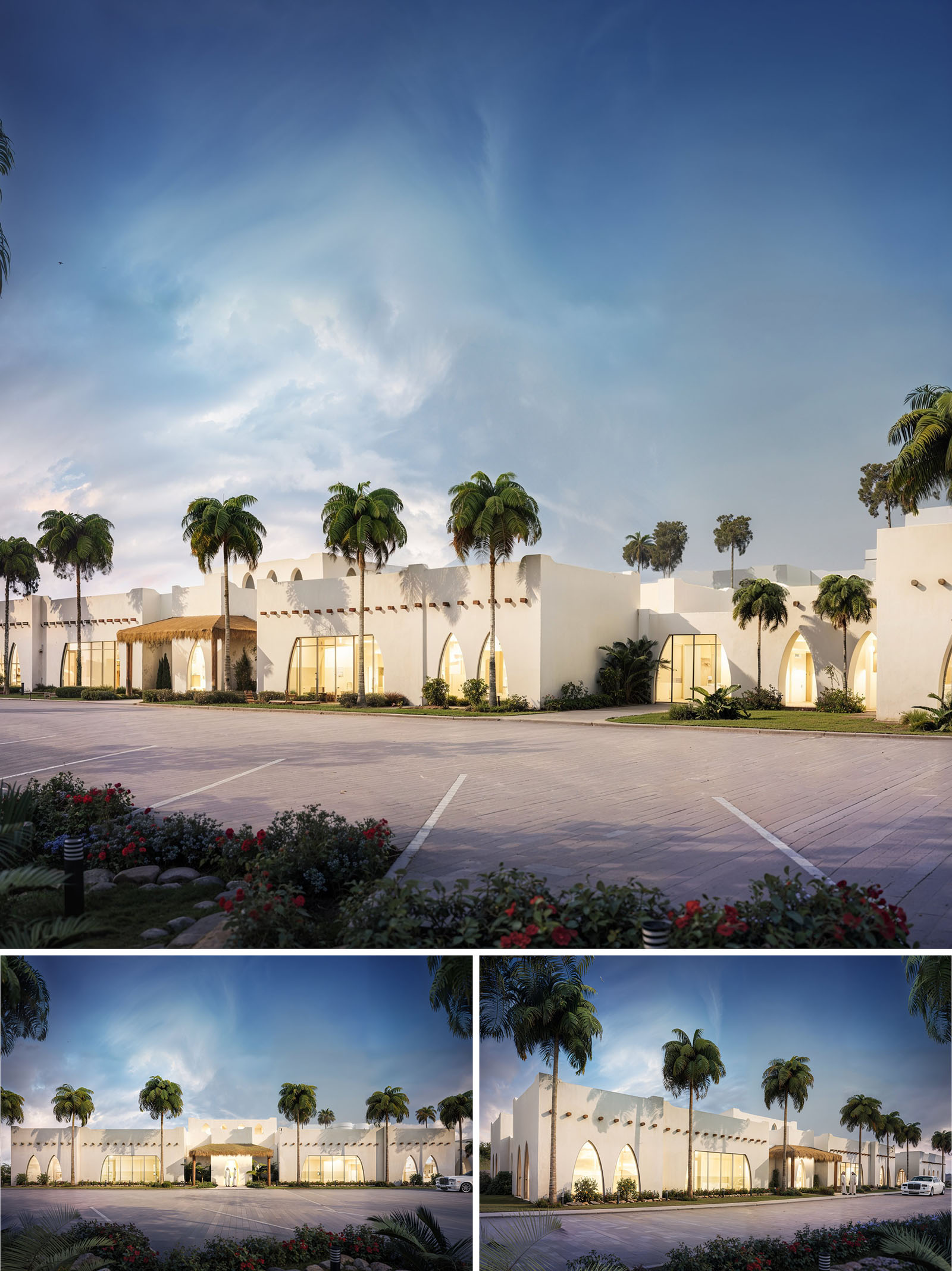
RAS Umm Leigi Beach Villa is conceived as a low-rise coastal retreat that fuses contemporary luxury with the quiet monumentality of vernacular Gulf architecture. The ensemble reads as a sculpted white village, stretching horizontally along the shoreline to maximize visual and physical connection with the sea. The architecture favors calm, continuous planes and softened edges that respond to the expansive desert-sky backdrop while creating a serene, resort-like ambience for residents and guests.
The concept celebrates thresholds: between inside and outside, light and shade, public arrival and intimate retreat. Repetitive arcades, deep reveals and carefully framed openings orchestrate these transitions, allowing the building to appear almost carved from a single, monolithic mass while remaining permeable and luminous at ground level. Palm trees and lush planting complete the image of an oasis, contrasting with the austere purity of the white volumes.
The architectural language is anchored in a restrained palette: white, planar walls, rhythmically punctured by tall, pointed-arch openings that reinterpret traditional Islamic and Qatari forms in a contemporary key. These arches, expressed as deep, vertical cuts in the façade, create a dynamic interplay of shadow and emphasize the building’s horizontality. The upper parapets are articulated with a crenellated profile and projecting timber-like elements, subtly recalling historic fortifications and wind towers without literal imitation.
Glazed curtain-wall panels are carefully recessed within the arches, reducing solar exposure while maintaining transparency. At the main entrance, the volume steps back to form a generous porch, highlighted by a warmer, textured canopy that marks the ceremonial drop-off. Nighttime illumination washes the façade, accentuating the sculptural qualities of the white surfaces and turning the sequence of arches into a luminous colonnade facing the parking forecourt.
The villa complex is organized as a linear bar parallel to the beach, with a strong arrival axis connecting the access road, parking zone and main entrance portico. This clear geometry ensures intuitive wayfinding and a dignified approach sequence, transitioning visitors from the urban edge to a protected, inward-looking oasis. The building’s relatively low height preserves human scale and maintains uninterrupted views toward the sea and the sky.
Primary functions are likely distributed along the façade line, with public and semi-public spaces occupying the more transparent front bays, while private suites and service zones nest behind a thicker, thermally insulated wall layer. Repetitive structural bays, expressed by the exterior arches, support flexible interior planning, allowing modular villa units or clusters of suites to be interconnected or separated according to functional needs and degrees of privacy.
The exterior is dominated by a smooth, high-reflectance plaster or stucco finish, optimized for the coastal context of Doha. This white skin reduces heat gain, reinforces the minimalist aesthetic and amplifies the changing tones of the sky throughout the day. Warm, low-iron glazing is used within the arch openings to maintain clarity while subtly filtering harsh daylight. The glass proportion is carefully balanced to ensure a sense of openness without compromising thermal comfort.
Soft, indirect lighting is integrated at the façade base and within the arch intrados, creating a layered night-time atmosphere. Light spills onto adjacent planting beds and walkways, emphasizing the interplay between architecture and landscape. The restrained palette of neutral walls, glass and natural textures from the entrance canopy and planting ensures that the setting feels both luxurious and timeless, avoiding visual clutter.
Landscape design plays a central role in environmental performance and user experience. Rows of mature palm trees align with the façade rhythm, providing vertical shading and helping to cool the microclimate through evapotranspiration. Low-height flowering shrubs and groundcovers define the parking edges, guiding movement while softening the hardscape. The generous setbacks between façade and driveways create buffer zones that reduce glare and reflected heat.
Sustainability strategies are embedded in the architectural form: compact building depth, limited height and continuous roof parapets support the integration of high-performance roof insulation and potential photovoltaic arrays. The deep façade recesses, pointed arches and recessed glazing significantly reduce direct solar gain while allowing ample daylight, lowering dependence on artificial lighting. Use of high-albedo exterior finishes, drought-tolerant planting and efficient irrigation systems is consistent with Qatar’s water and energy conservation priorities, aligning the luxury villa experience with responsible environmental stewardship.
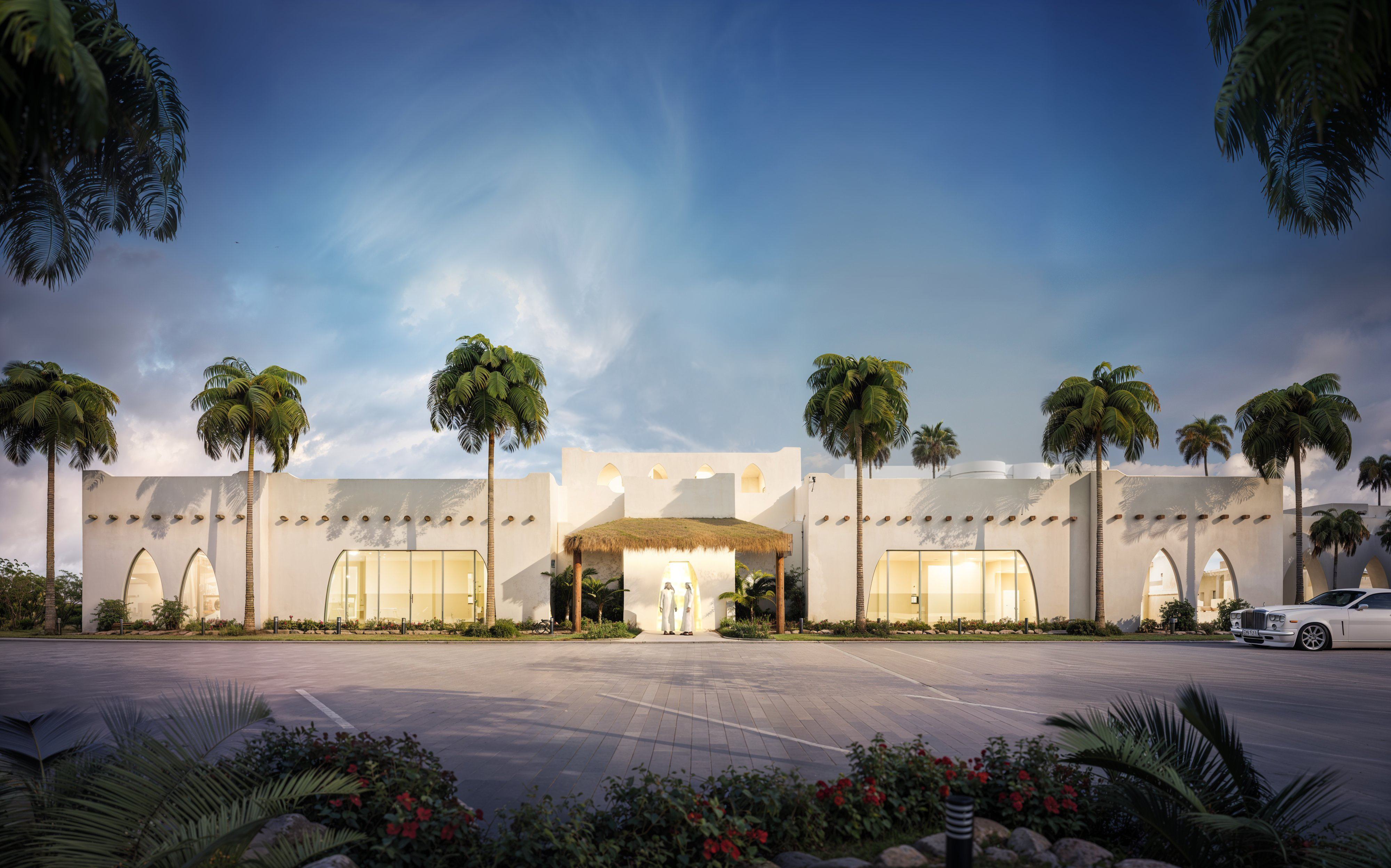
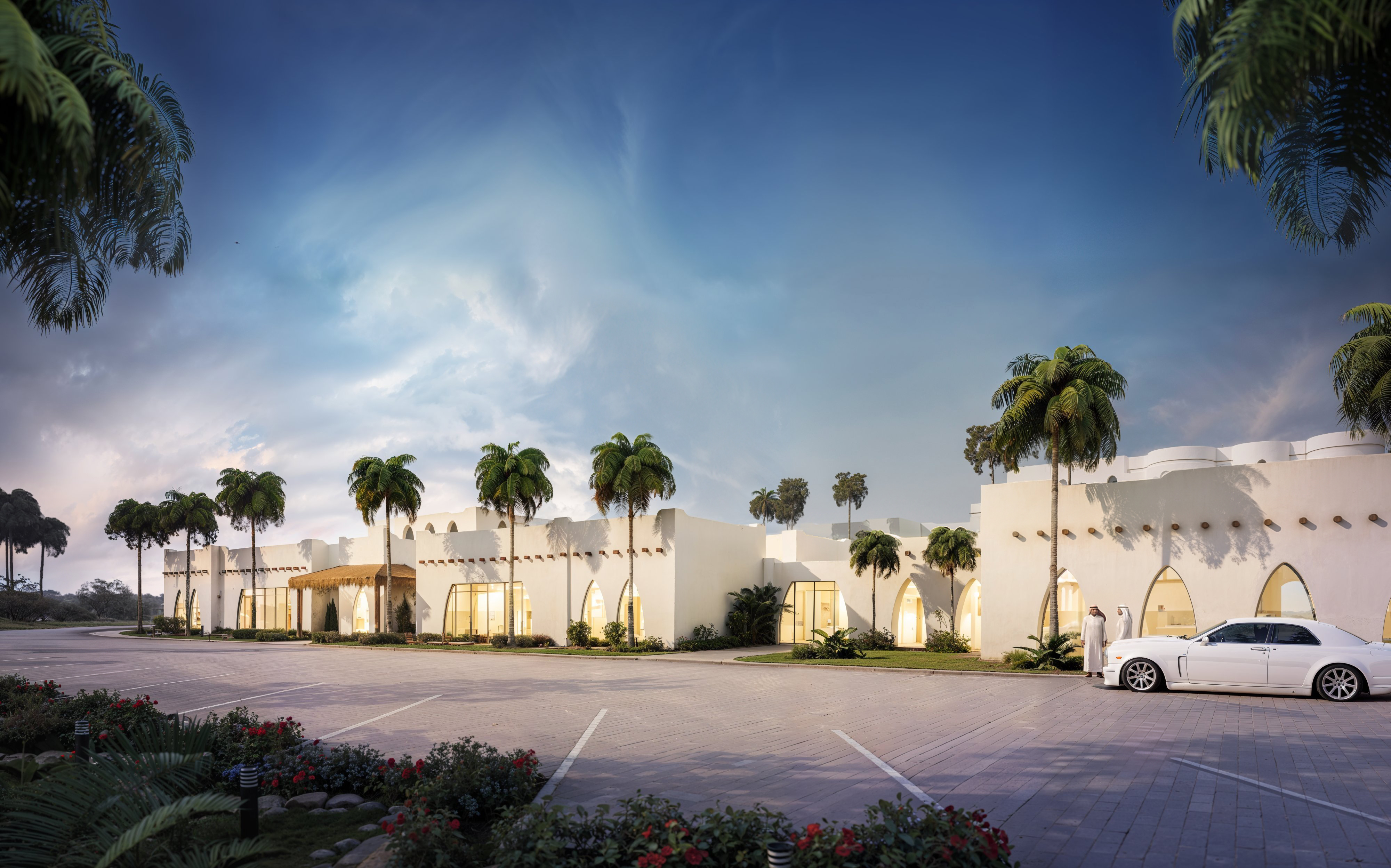
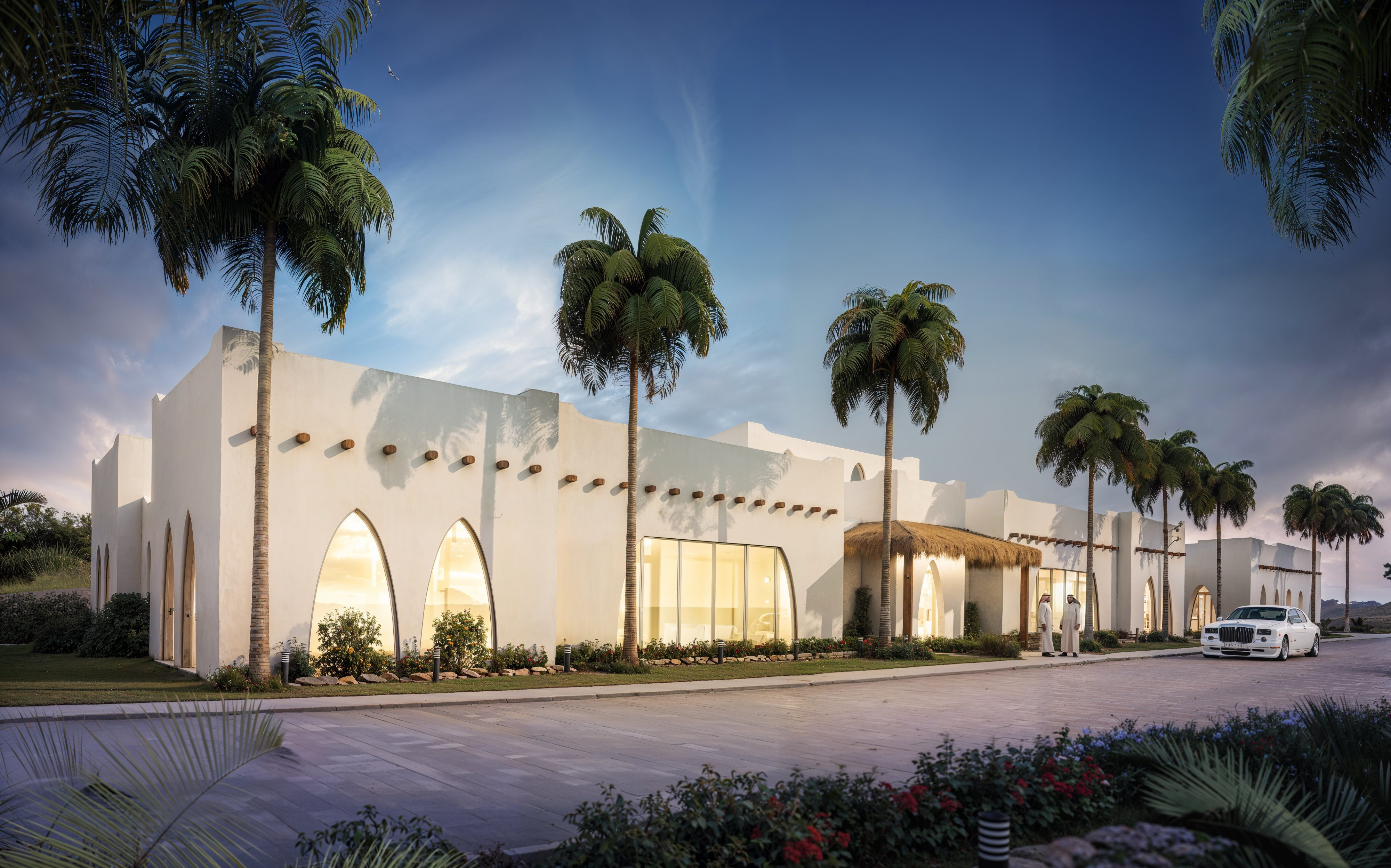
RAS Umm Leigi Beach Villa is conceived as a low-rise coastal retreat that fuses contemporary luxury with the quiet monumentality of vernacular Gulf architecture. The ensemble reads as a sculpted white village, stretching horizontally along the shoreline to maximize visual and physical connection with the sea. The architecture favors calm, continuous planes and softened edges that respond to the expansive desert-sky backdrop while creating a serene, resort-like ambience for residents and guests.
The concept celebrates thresholds: between inside and outside, light and shade, public arrival and intimate retreat. Repetitive arcades, deep reveals and carefully framed openings orchestrate these transitions, allowing the building to appear almost carved from a single, monolithic mass while remaining permeable and luminous at ground level. Palm trees and lush planting complete the image of an oasis, contrasting with the austere purity of the white volumes.
The architectural language is anchored in a restrained palette: white, planar walls, rhythmically punctured by tall, pointed-arch openings that reinterpret traditional Islamic and Qatari forms in a contemporary key. These arches, expressed as deep, vertical cuts in the façade, create a dynamic interplay of shadow and emphasize the building’s horizontality. The upper parapets are articulated with a crenellated profile and projecting timber-like elements, subtly recalling historic fortifications and wind towers without literal imitation.
Glazed curtain-wall panels are carefully recessed within the arches, reducing solar exposure while maintaining transparency. At the main entrance, the volume steps back to form a generous porch, highlighted by a warmer, textured canopy that marks the ceremonial drop-off. Nighttime illumination washes the façade, accentuating the sculptural qualities of the white surfaces and turning the sequence of arches into a luminous colonnade facing the parking forecourt.
The villa complex is organized as a linear bar parallel to the beach, with a strong arrival axis connecting the access road, parking zone and main entrance portico. This clear geometry ensures intuitive wayfinding and a dignified approach sequence, transitioning visitors from the urban edge to a protected, inward-looking oasis. The building’s relatively low height preserves human scale and maintains uninterrupted views toward the sea and the sky.
Primary functions are likely distributed along the façade line, with public and semi-public spaces occupying the more transparent front bays, while private suites and service zones nest behind a thicker, thermally insulated wall layer. Repetitive structural bays, expressed by the exterior arches, support flexible interior planning, allowing modular villa units or clusters of suites to be interconnected or separated according to functional needs and degrees of privacy.
The exterior is dominated by a smooth, high-reflectance plaster or stucco finish, optimized for the coastal context of Doha. This white skin reduces heat gain, reinforces the minimalist aesthetic and amplifies the changing tones of the sky throughout the day. Warm, low-iron glazing is used within the arch openings to maintain clarity while subtly filtering harsh daylight. The glass proportion is carefully balanced to ensure a sense of openness without compromising thermal comfort.
Soft, indirect lighting is integrated at the façade base and within the arch intrados, creating a layered night-time atmosphere. Light spills onto adjacent planting beds and walkways, emphasizing the interplay between architecture and landscape. The restrained palette of neutral walls, glass and natural textures from the entrance canopy and planting ensures that the setting feels both luxurious and timeless, avoiding visual clutter.
Landscape design plays a central role in environmental performance and user experience. Rows of mature palm trees align with the façade rhythm, providing vertical shading and helping to cool the microclimate through evapotranspiration. Low-height flowering shrubs and groundcovers define the parking edges, guiding movement while softening the hardscape. The generous setbacks between façade and driveways create buffer zones that reduce glare and reflected heat.
Sustainability strategies are embedded in the architectural form: compact building depth, limited height and continuous roof parapets support the integration of high-performance roof insulation and potential photovoltaic arrays. The deep façade recesses, pointed arches and recessed glazing significantly reduce direct solar gain while allowing ample daylight, lowering dependence on artificial lighting. Use of high-albedo exterior finishes, drought-tolerant planting and efficient irrigation systems is consistent with Qatar’s water and energy conservation priorities, aligning the luxury villa experience with responsible environmental stewardship.
© 2021 by sanzpont [arquitectura] . Webpage by sanzpont [digital] . Innovative Digital Experiences
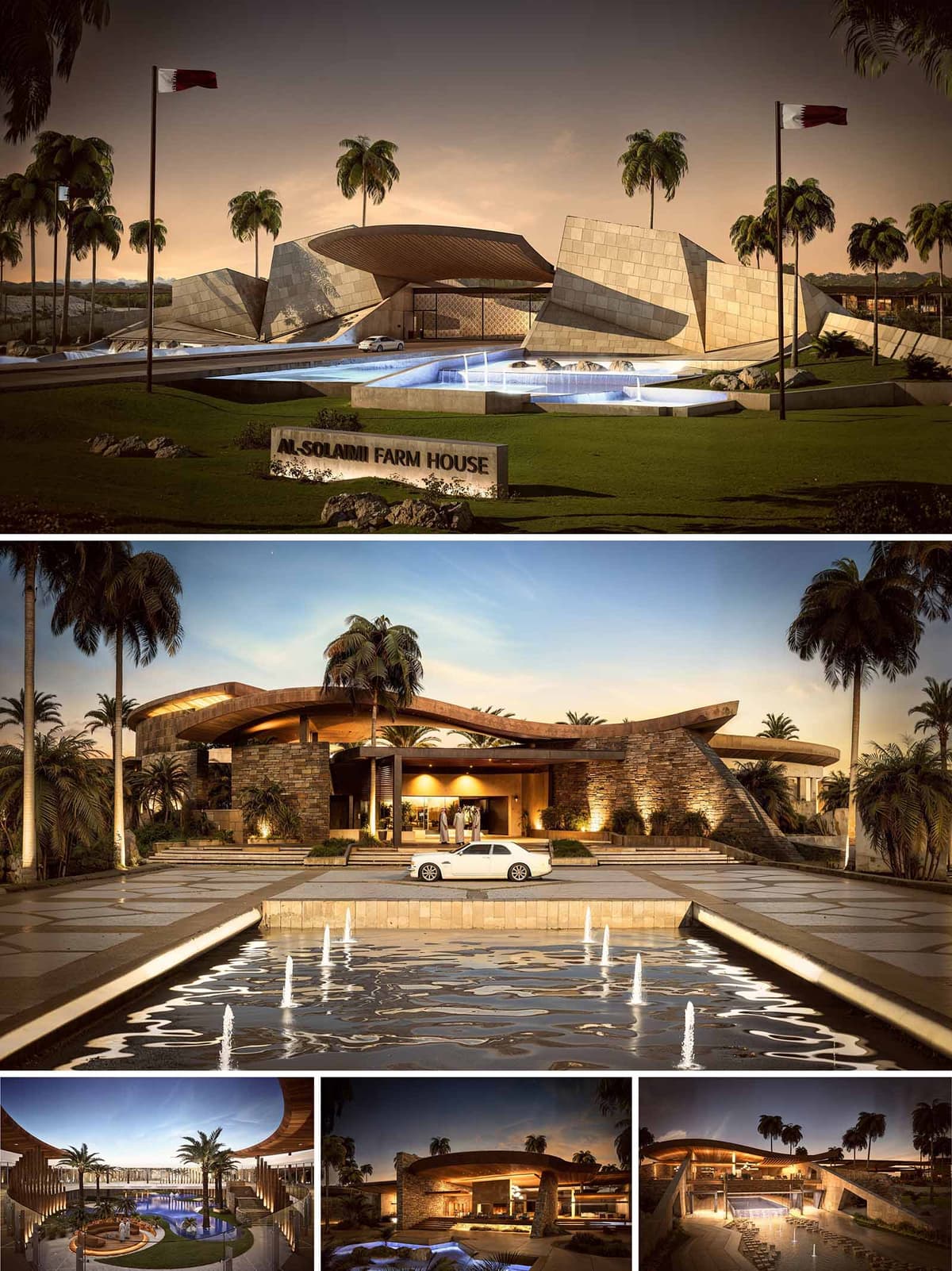
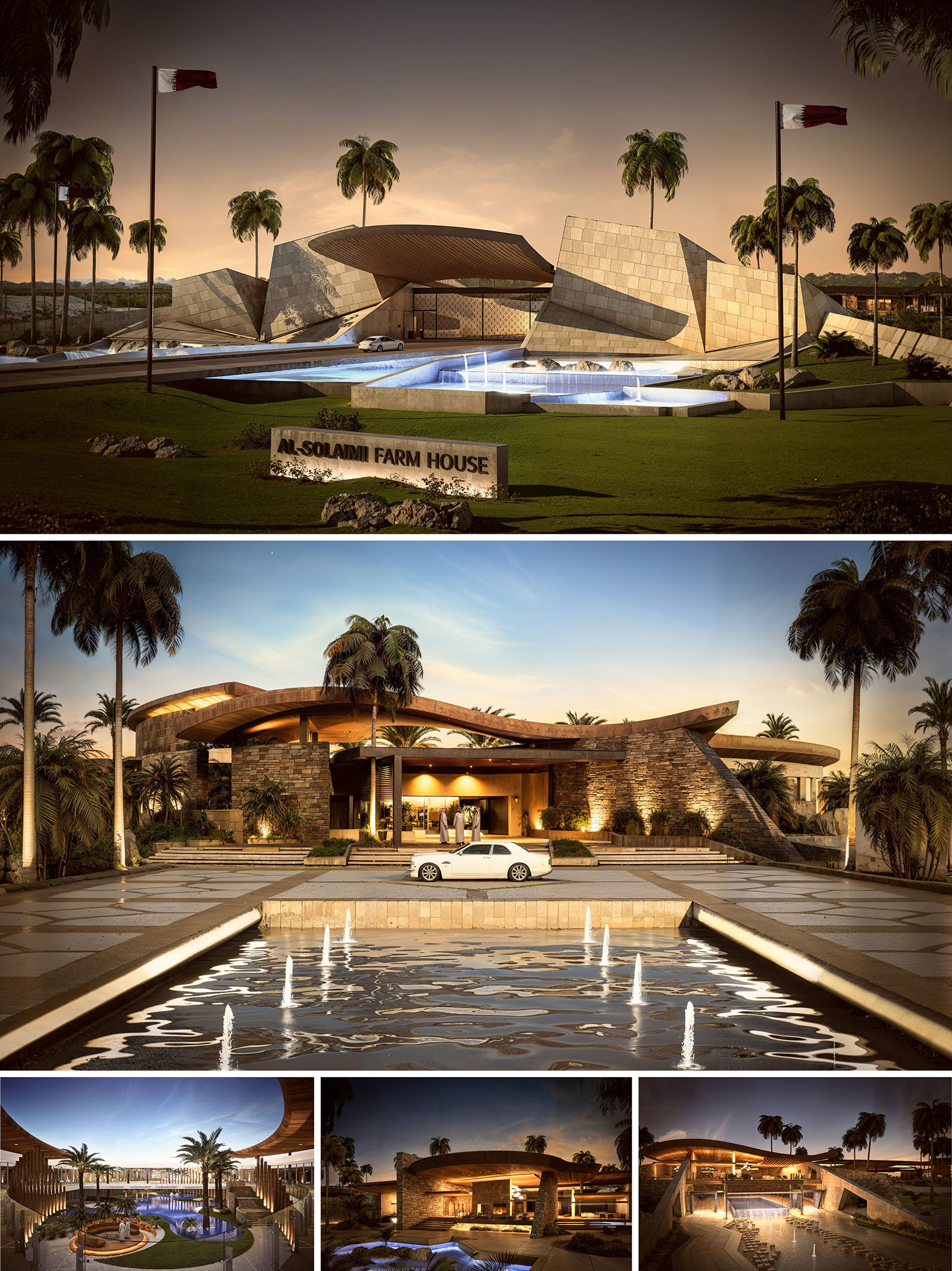
Al-Solaimi Farm House is conceived as a contemporary desert retreat that expresses both solidity and fluidity. The project translates the idea of “oasis” into architecture: protective stone masses sheltering generous, shaded voids animated by water and vegetation. The formal language moves between angular, tectonic planes at the entrance and soft, sweeping roofs around the main residence, reflecting the contrast between the harsh exterior landscape and the calm domestic interior. The farmhouse becomes a sculpted landmark within the agricultural setting, yet remains grounded in its rural function as a family gathering place.
Located within a palm-fringed farm in Qatar, the house is oriented to capture prevailing breezes and to frame long views across the cultivated land. The approach sequence is axial and ceremonial, crossing water and greenery before reaching the main porte-cochère. Slightly elevating the built mass above the surrounding fields protects it from irrigation flows while giving a clear visual hierarchy between landscape and architecture. The palm trees act as vertical markers and as climatic devices, shading outdoor circulation and reinforcing the oasis imagery.
At the front, faceted stone and concrete walls create a dynamic, almost geological entrance composition, suggesting protective layers opening toward the interior. Moving deeper into the house, the geometry relaxes into broad, curving roofs that hover above stacked-stone walls. Warm-toned stone cladding, timber soffits and earth-colored renders are chosen to resonate with local materials while offering durability in the desert climate. The thick envelope, recessed glazing and pronounced overhangs work together to reduce solar gain, while the sculptural form gives the farmhouse a strong, recognizable identity.
Water is a central design element, choreographing arrival and daily experience. Linear reflecting pools and shallow basins line the driveway, culminating in a larger water body in front of the entrance. Inside the compound, a central courtyard pool with integrated seating becomes the social heart, surrounded by soft landscaping and palms. These water elements cool the microclimate through evaporation, provide acoustic comfort, and visually link the various wings of the farmhouse. Hardscape patterns and stepped platforms manage level transitions while subtly guiding circulation.
The interiors are organized around open, interconnected social spaces that flow toward the courtyard and pool. Large glazed openings slide away to dissolve the boundary between inside and outside, turning terraces into extensions of the living areas. The main entrance lobby compresses the ceiling, then releases into double-height volumes under the sweeping roof, emphasizing the sense of arrival. Service spaces and private suites are discreetly embedded within the thicker stone masses, ensuring privacy and acoustic separation while maintaining direct visual connections to the landscape.
Artificial lighting is carefully integrated into the architecture, emphasizing the material texture and form. Warm, concealed linear lights wash stone walls and timber soffits, while recessed downlights define circulation paths. Exterior uplights highlight the vertical rhythm of palms and the sculptural roofs, giving the farmhouse a strong nocturnal presence without excessive glare. Water features are lit from within, creating reflections that animate adjacent ceilings and terraces, reinforcing the atmosphere of an inhabited oasis.
Sustainability is addressed through passive design and careful material selection rather than overt technological expression. Deep overhangs, shaded verandas and colonnades minimize direct solar exposure on glazing. The stone envelope provides thermal mass, moderating temperature fluctuations, while cross-ventilation paths are aligned with prevailing winds for natural cooling during milder months. Water bodies are strategically located to assist evaporative cooling in key outdoor living zones. Durable, low-maintenance finishes reduce lifecycle impacts, and the integration of landscaping with existing farm structures supports biodiversity and preserves the productive character of the land.
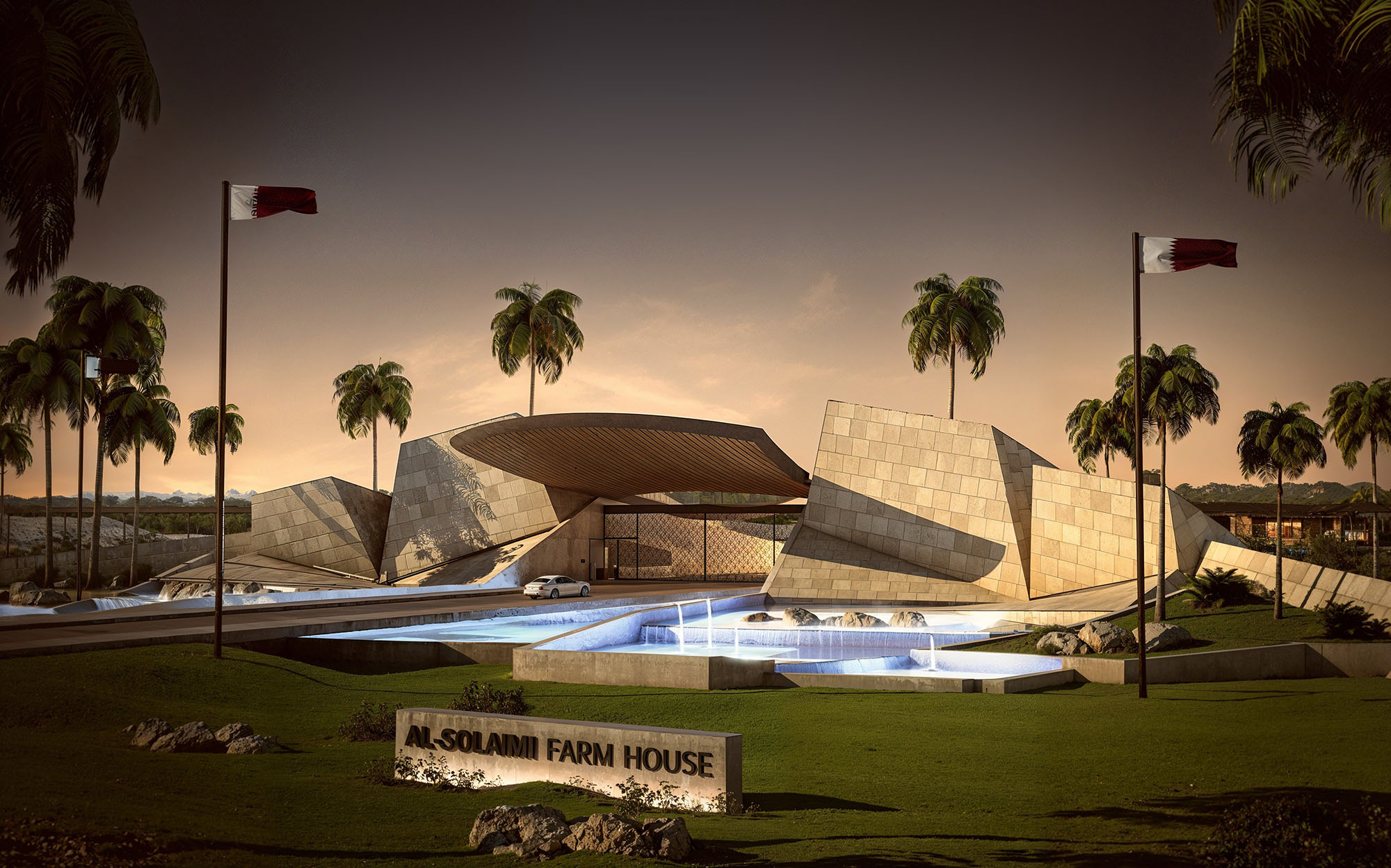
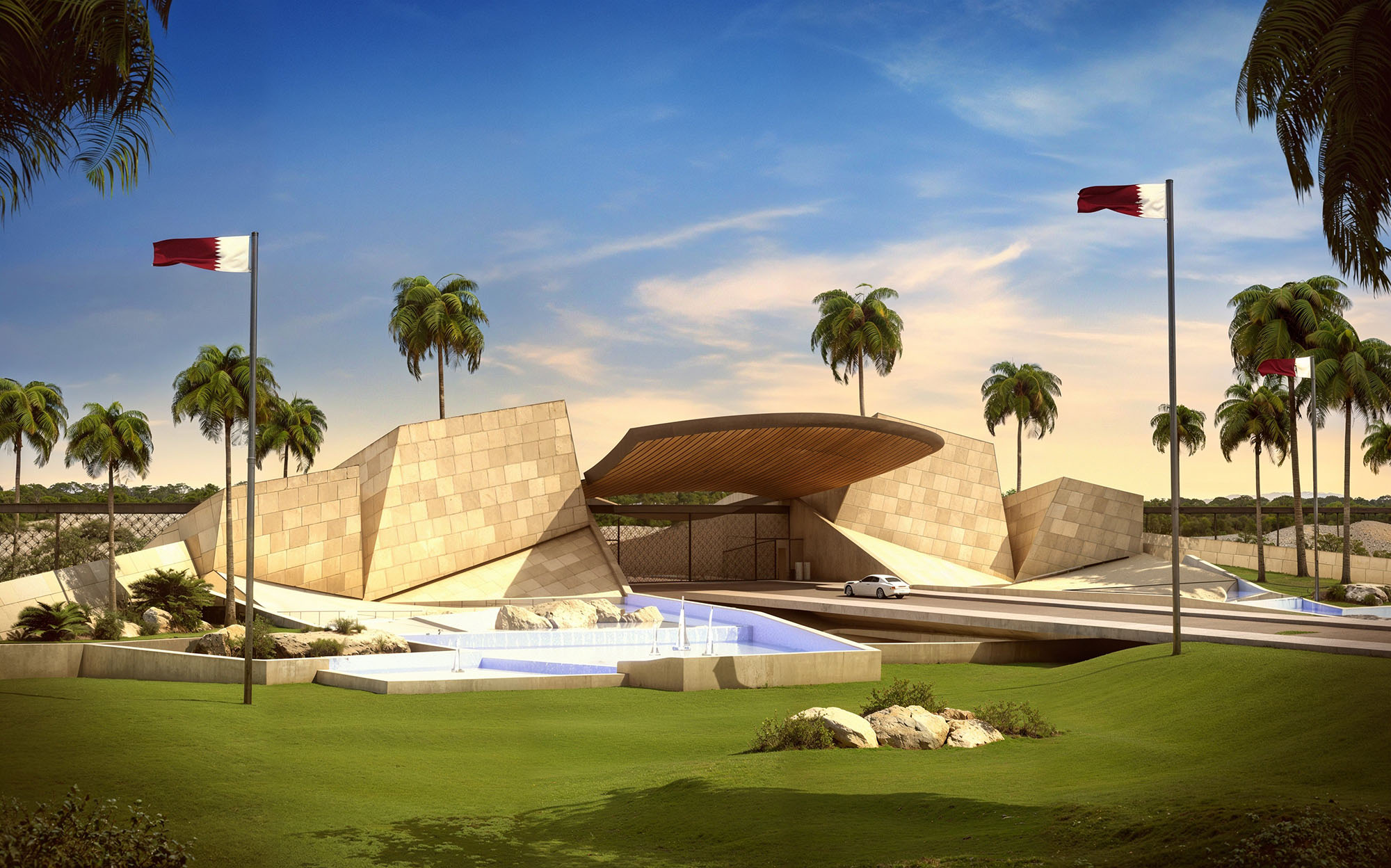
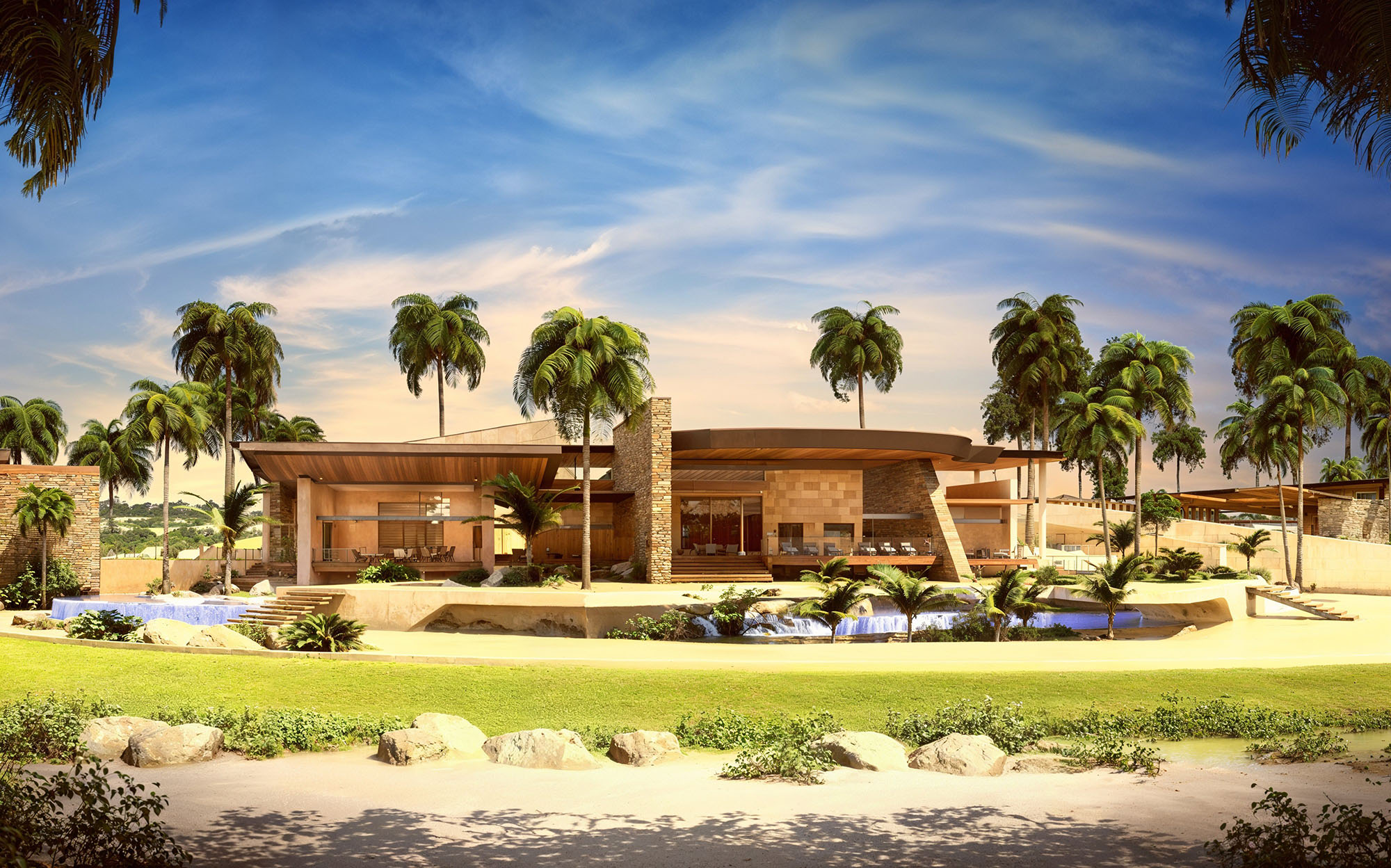
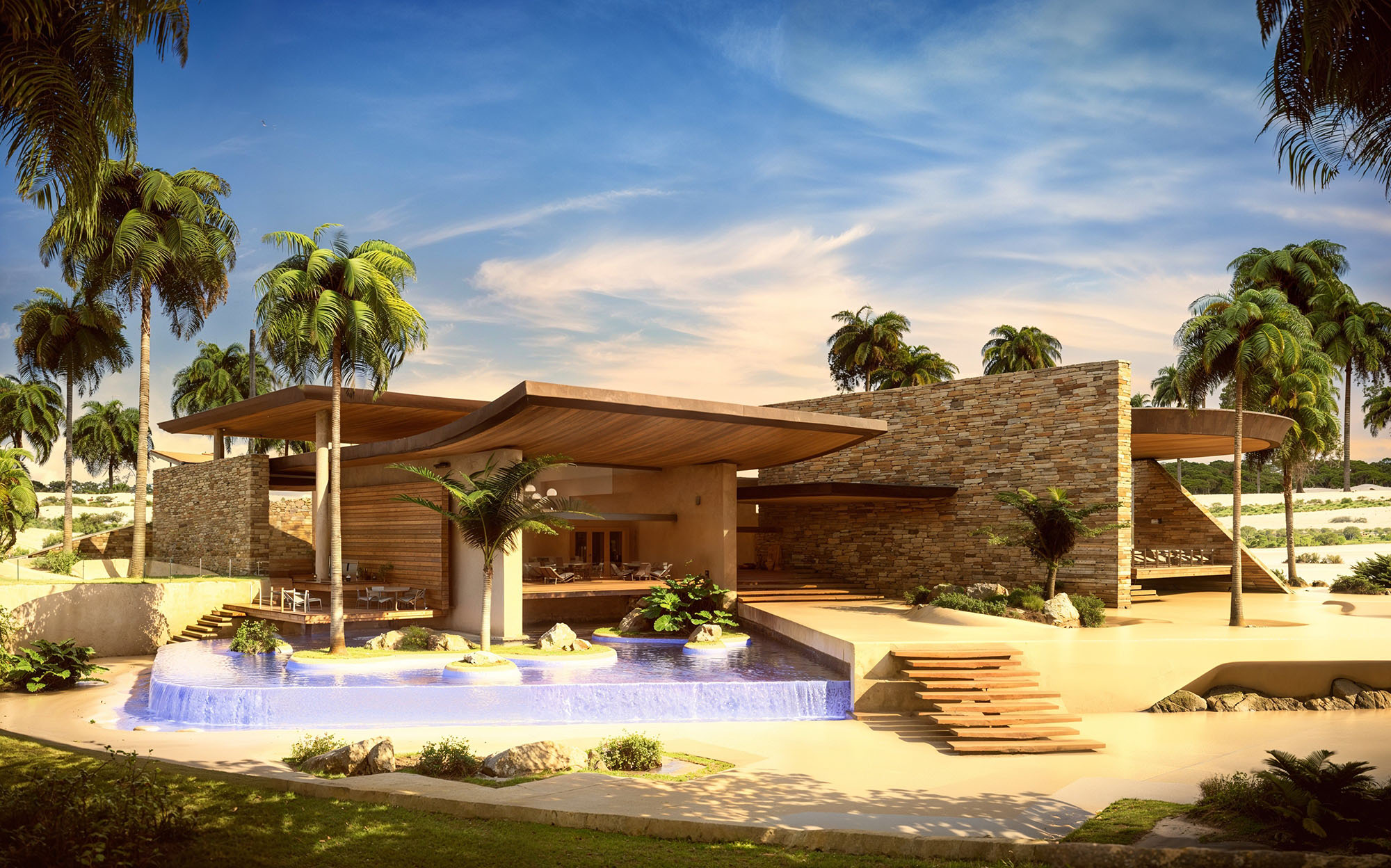
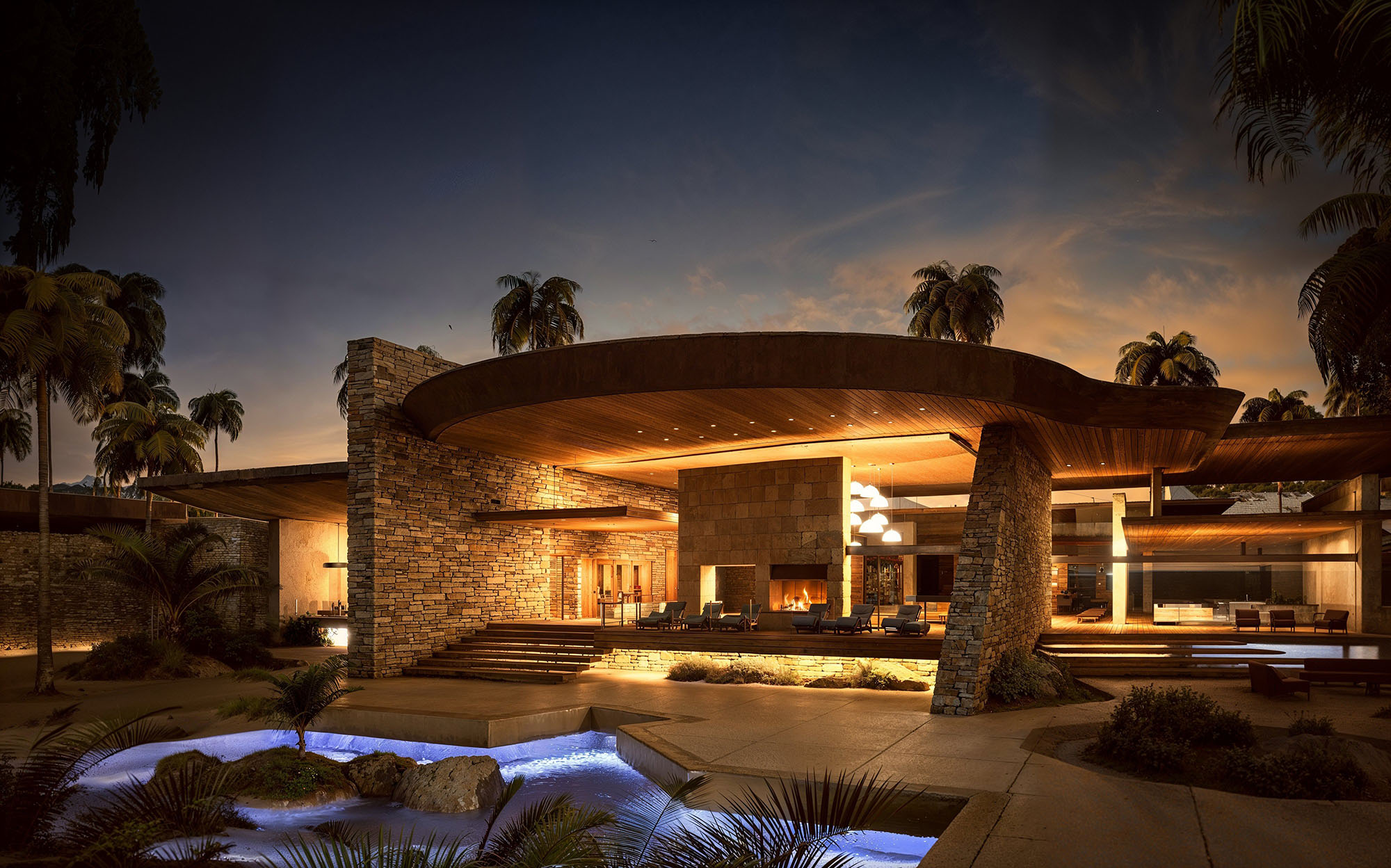
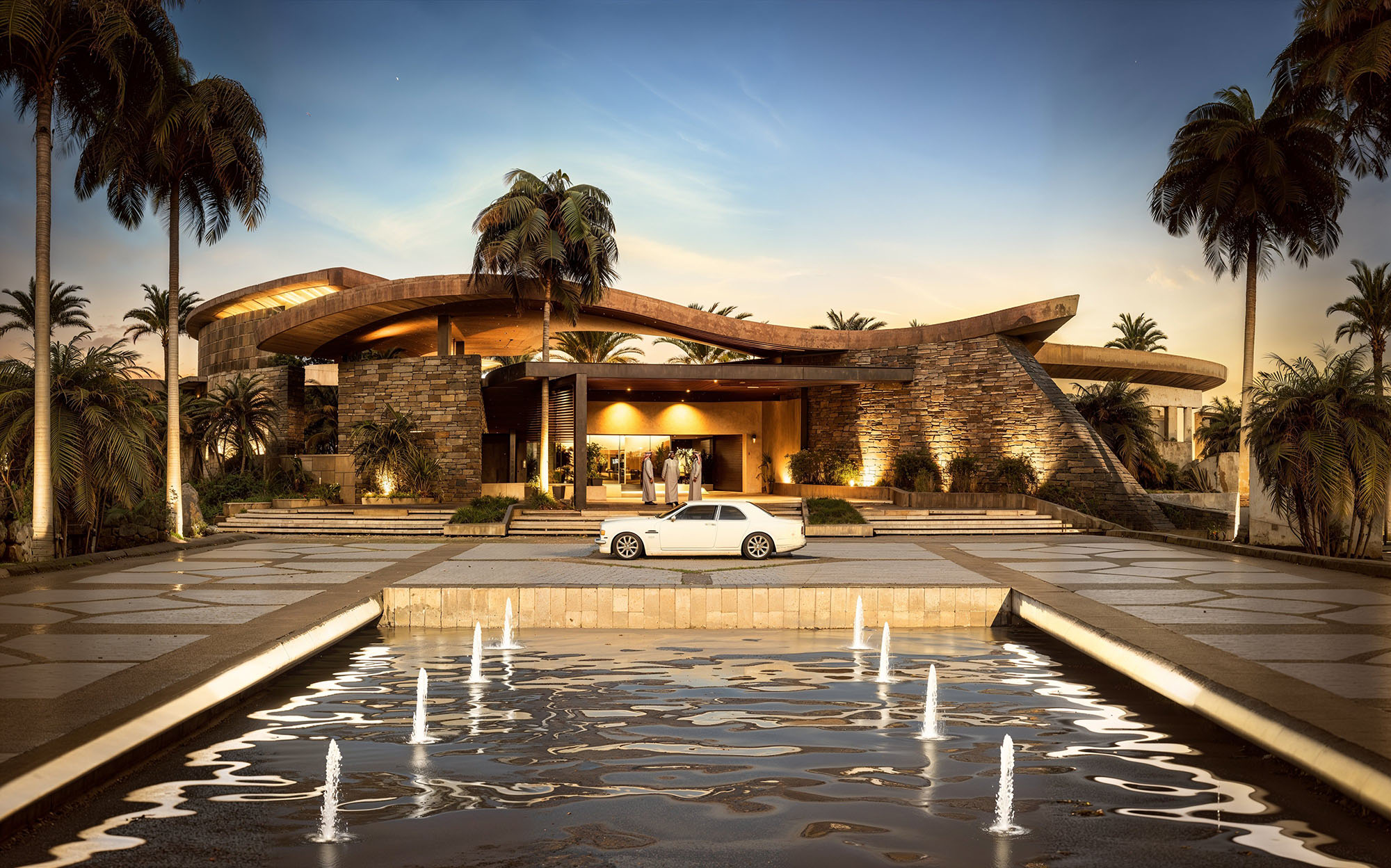
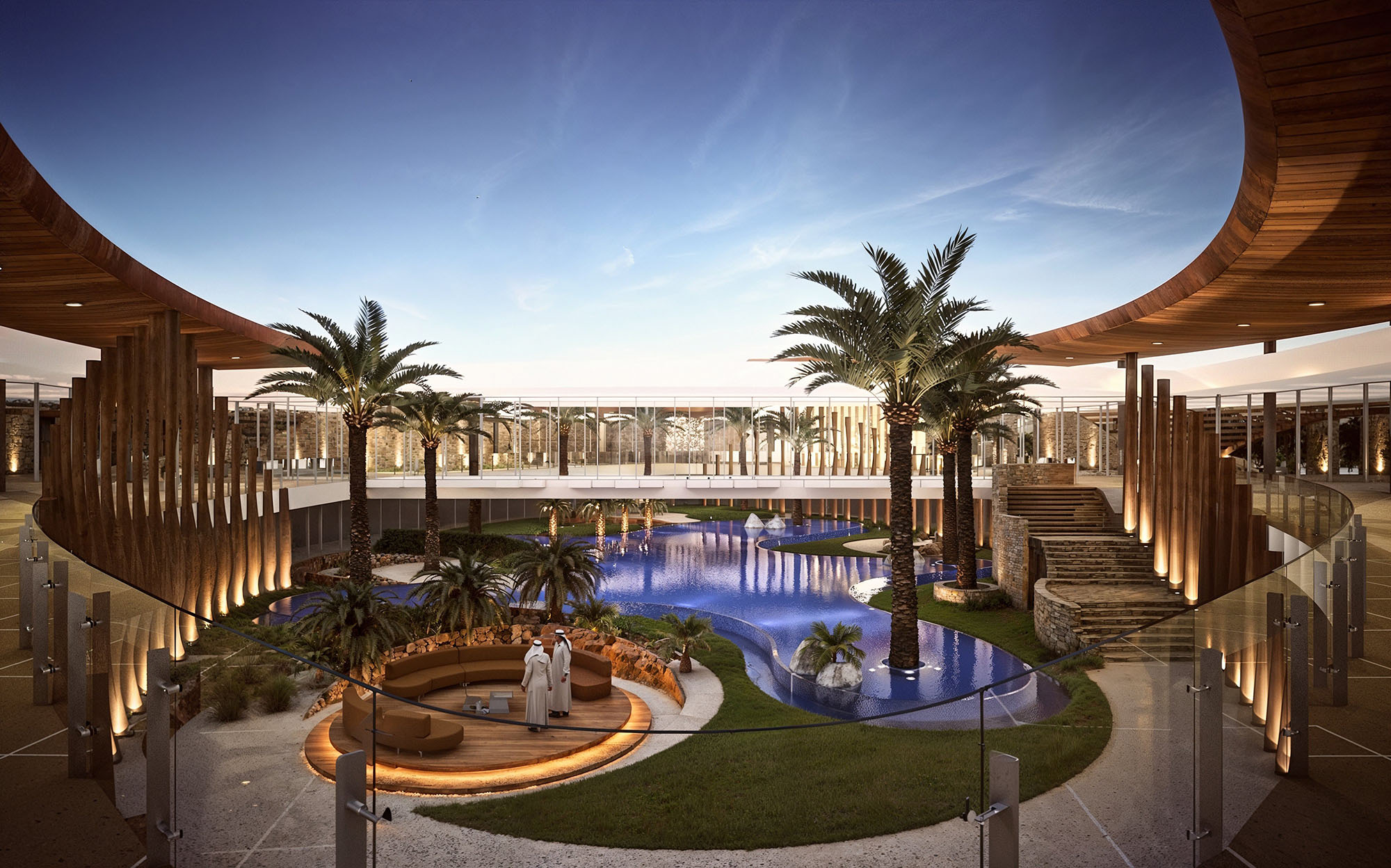
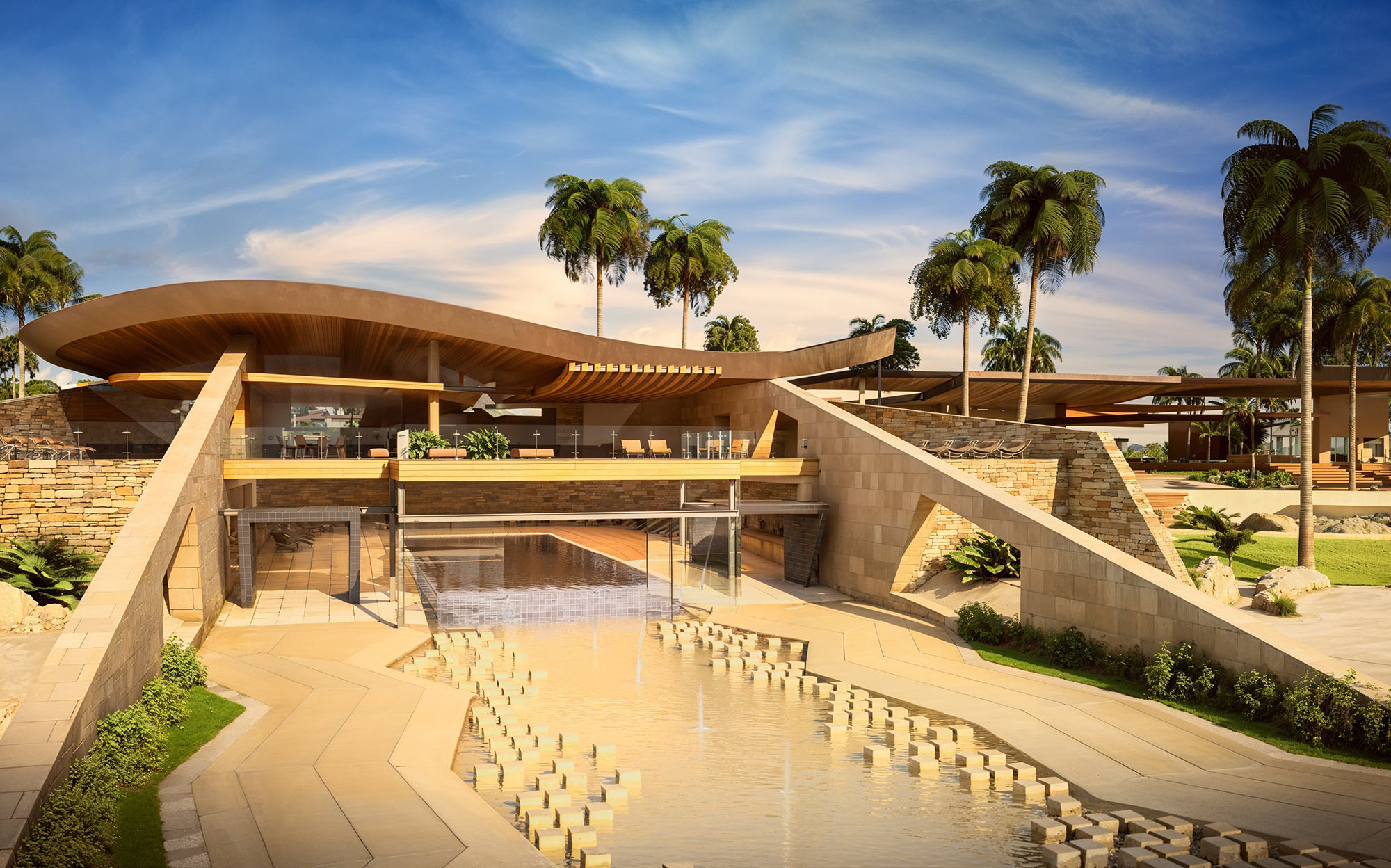
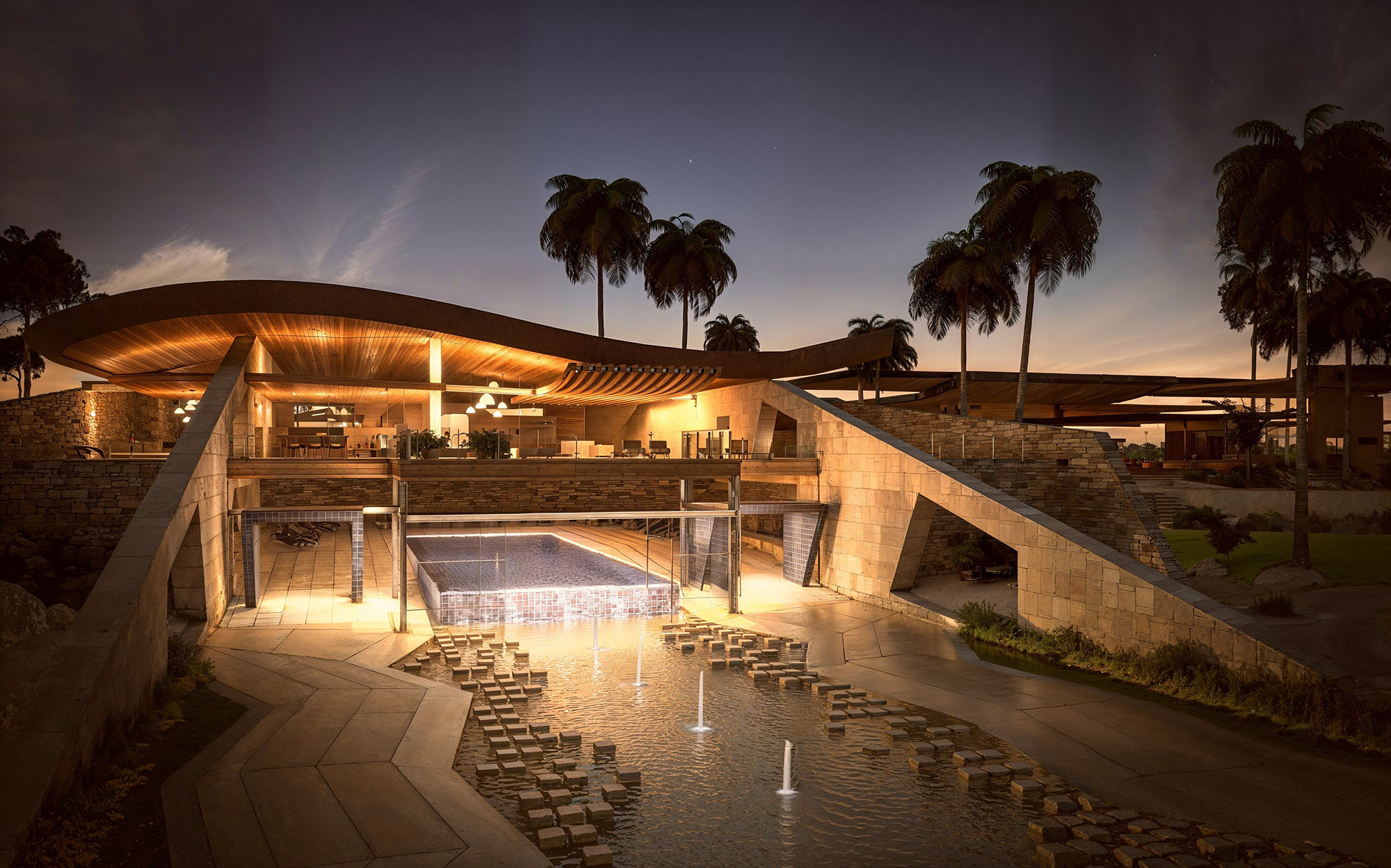
Al-Solaimi Farm House is conceived as a contemporary desert retreat that expresses both solidity and fluidity. The project translates the idea of “oasis” into architecture: protective stone masses sheltering generous, shaded voids animated by water and vegetation. The formal language moves between angular, tectonic planes at the entrance and soft, sweeping roofs around the main residence, reflecting the contrast between the harsh exterior landscape and the calm domestic interior. The farmhouse becomes a sculpted landmark within the agricultural setting, yet remains grounded in its rural function as a family gathering place.
Located within a palm-fringed farm in Qatar, the house is oriented to capture prevailing breezes and to frame long views across the cultivated land. The approach sequence is axial and ceremonial, crossing water and greenery before reaching the main porte-cochère. Slightly elevating the built mass above the surrounding fields protects it from irrigation flows while giving a clear visual hierarchy between landscape and architecture. The palm trees act as vertical markers and as climatic devices, shading outdoor circulation and reinforcing the oasis imagery.
At the front, faceted stone and concrete walls create a dynamic, almost geological entrance composition, suggesting protective layers opening toward the interior. Moving deeper into the house, the geometry relaxes into broad, curving roofs that hover above stacked-stone walls. Warm-toned stone cladding, timber soffits and earth-colored renders are chosen to resonate with local materials while offering durability in the desert climate. The thick envelope, recessed glazing and pronounced overhangs work together to reduce solar gain, while the sculptural form gives the farmhouse a strong, recognizable identity.
Water is a central design element, choreographing arrival and daily experience. Linear reflecting pools and shallow basins line the driveway, culminating in a larger water body in front of the entrance. Inside the compound, a central courtyard pool with integrated seating becomes the social heart, surrounded by soft landscaping and palms. These water elements cool the microclimate through evaporation, provide acoustic comfort, and visually link the various wings of the farmhouse. Hardscape patterns and stepped platforms manage level transitions while subtly guiding circulation.
The interiors are organized around open, interconnected social spaces that flow toward the courtyard and pool. Large glazed openings slide away to dissolve the boundary between inside and outside, turning terraces into extensions of the living areas. The main entrance lobby compresses the ceiling, then releases into double-height volumes under the sweeping roof, emphasizing the sense of arrival. Service spaces and private suites are discreetly embedded within the thicker stone masses, ensuring privacy and acoustic separation while maintaining direct visual connections to the landscape.
Artificial lighting is carefully integrated into the architecture, emphasizing the material texture and form. Warm, concealed linear lights wash stone walls and timber soffits, while recessed downlights define circulation paths. Exterior uplights highlight the vertical rhythm of palms and the sculptural roofs, giving the farmhouse a strong nocturnal presence without excessive glare. Water features are lit from within, creating reflections that animate adjacent ceilings and terraces, reinforcing the atmosphere of an inhabited oasis.
Sustainability is addressed through passive design and careful material selection rather than overt technological expression. Deep overhangs, shaded verandas and colonnades minimize direct solar exposure on glazing. The stone envelope provides thermal mass, moderating temperature fluctuations, while cross-ventilation paths are aligned with prevailing winds for natural cooling during milder months. Water bodies are strategically located to assist evaporative cooling in key outdoor living zones. Durable, low-maintenance finishes reduce lifecycle impacts, and the integration of landscaping with existing farm structures supports biodiversity and preserves the productive character of the land.
© 2021 by sanzpont [arquitectura] . Webpage by sanzpont [digital] . Innovative Digital Experiences
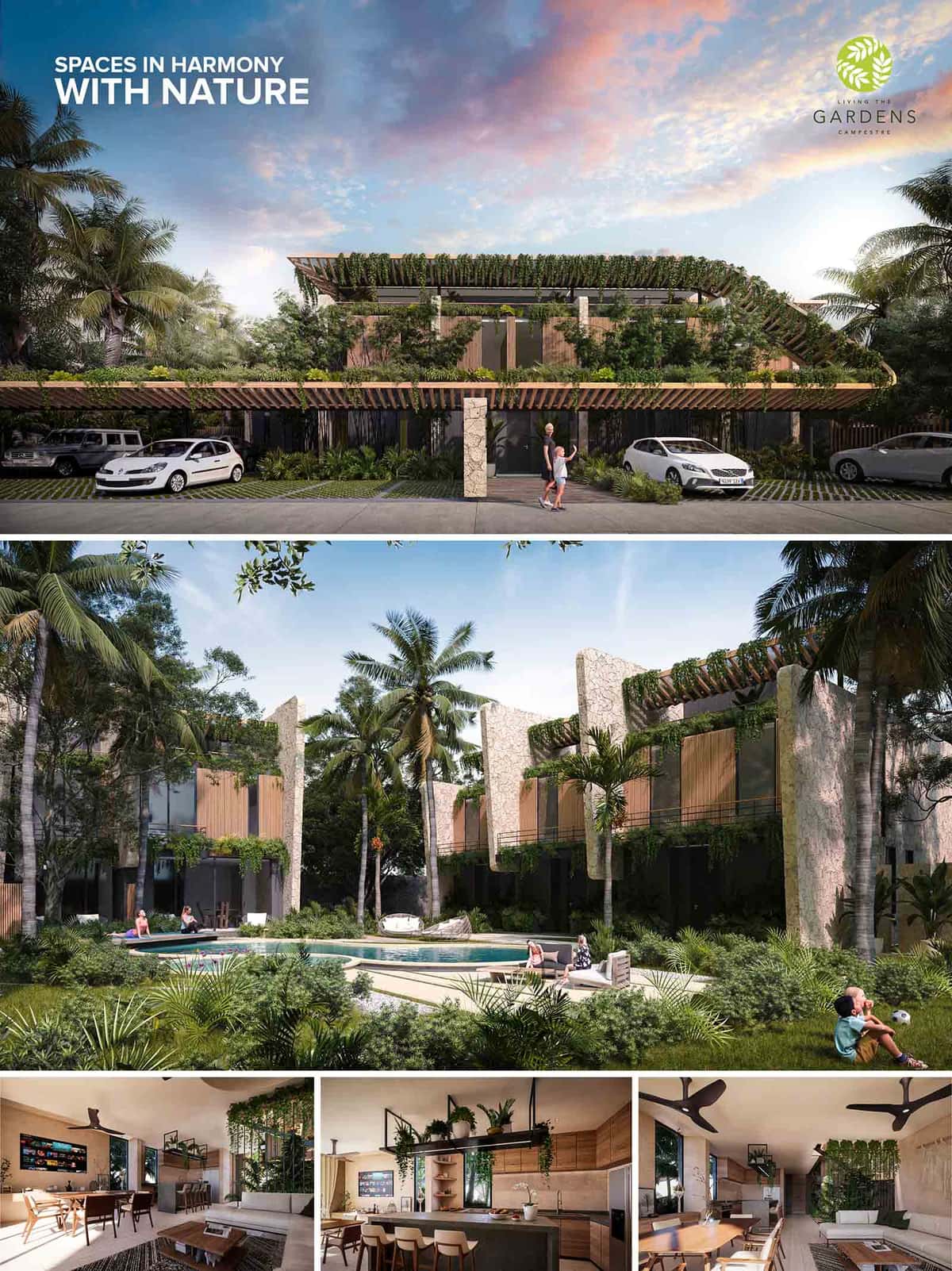

Living The Gardens development, is a complex of 9 villas in condominium regime, on a land of 2,373 m2 with a land use category H1C, the complex is located in the Residencial Campestre subdivision, Paseo del Mar street No. 64, in Cancun, Mexico. The villas are 3-level buildings, with a total of 216 to 275 m2 depending on the villa model.
The ground floor includes access, living room, dining room, kitchen, terrace, 1/2 bathroom and utility room, in addition to the vertical circulation integrated into an interior garden; with a total between 69 and 78 m2 depending on the villa model.
The first floor includes lobby and vertical circulation, master bedroom with bathroom, dressing room and balcony, as well as 2 secondary bedrooms with shared bathroom; with a total between 63 and 65 m2 depending on the villa model.
The roof floor includes lobby and vertical circulation, roof garden with pergola, outdoor kitchenette and flower boxes; with a total between 57 and 59 m2 depending on the villa model.
The complex, in addition to the park, has outdoor amenities, such as a pool, garden, children's area, picnic area, outdoor gym, yoga area, sun deck and pet area.
DEVELOPED AS
DIRSA
• APR Global Future Design Awards: Silver Award Winner : Living The Gardens (2022)
• APR Chinese Design Awards : Gold Award Winner : Living The Gardens (2022)
• A’ Design Awards, Milan, Italy : Iron Award - Certificate Of Excellence in Architecture, Building and Structure Design Category : Living The Gardens (2022)
• World Architecture Awards 10+5+X Honorary Members : Architecture - Designed Category, 40th Cycle : Living The Gardens (2022)
• Muse Design Awards, New York, USA : Platinum Award - Conceptual Design : Living The Gardens (2022)
• The Plan Awards, Bologna, Italy : Shortlisted in Future Housing : Living The Gardens (2022)
• London International Creative Competition : Shortlist : Living The Gardens (2021)


• APR Global Future Design Awards: Silver Award Winner : Living The Gardens (2022)
• APR Chinese Design Awards : Gold Award Winner : Living The Gardens (2022)
• A’ Design Awards, Milan, Italy : Iron Award - Certificate Of Excellence in Architecture, Building and Structure Design Category : Living The Gardens (2022)
• World Architecture Awards 10+5+X Honorary Members : Architecture - Designed Category, 40th Cycle : Living The Gardens (2022)
• Muse Design Awards, New York, USA : Platinum Award - Conceptual Design : Living The Gardens (2022)
• The Plan Awards, Bologna, Italy : Shortlisted in Future Housing : Living The Gardens (2022)
• London International Creative Competition : Shortlist : Living The Gardens (2021)
Living The Gardens development, is a complex of 9 villas in condominium regime, on a land of 2,373 m2 with a land use category H1C, the complex is located in the Residencial Campestre subdivision, Paseo del Mar street No. 64, in Cancun, Mexico. The villas are 3-level buildings, with a total of 216 to 275 m2 depending on the villa model.
The ground floor includes access, living room, dining room, kitchen, terrace, 1/2 bathroom and utility room, in addition to the vertical circulation integrated into an interior garden; with a total between 69 and 78 m2 depending on the villa model.
The first floor includes lobby and vertical circulation, master bedroom with bathroom, dressing room and balcony, as well as 2 secondary bedrooms with shared bathroom; with a total between 63 and 65 m2 depending on the villa model.
The roof floor includes lobby and vertical circulation, roof garden with pergola, outdoor kitchenette and flower boxes; with a total between 57 and 59 m2 depending on the villa model.
The complex, in addition to the park, has outdoor amenities, such as a pool, garden, children's area, picnic area, outdoor gym, yoga area, sun deck and pet area.
DEVELOPED AS
DIRSA
© 2021 by sanzpont [arquitectura] . Webpage by sanzpont [digital] . Innovative Digital Experiences
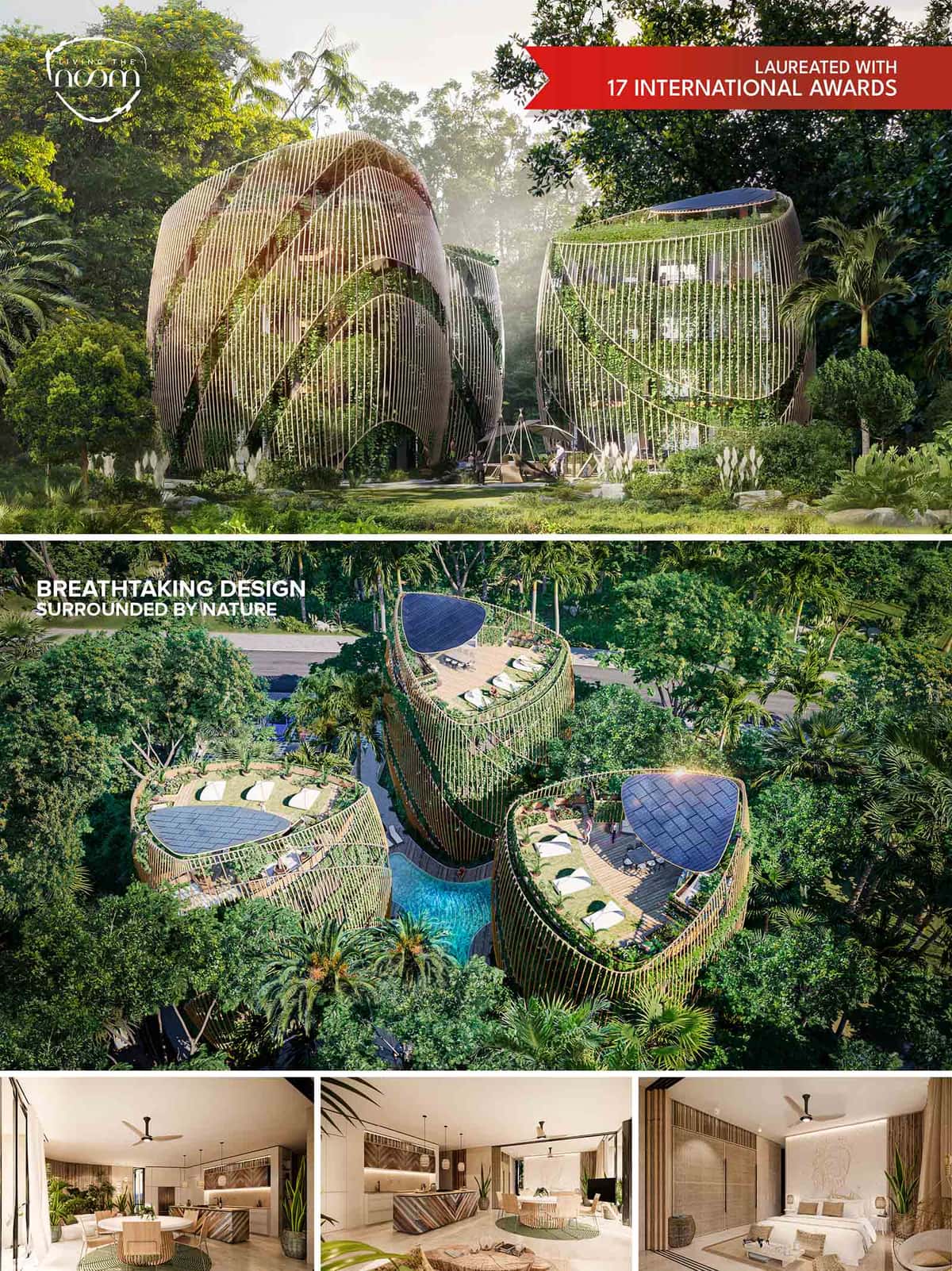

How would you like to live the rest of your life? We have asked ourselves the same question. Each one of us looks alike because we are human beings, but… we are truly different, we have different tastes, different needs… and above all a personality, each of us is “unique” in our own particular way. And this is where we have always asked ourselves: Why are all the homes for sale almost, all the same? Because almost all of them seem to be cut from the same mold? Do we all have the same personality? The same beliefs, or the same way of being? or the same tastes?
The reality is that on many occasions we let situations define us and we choose the least bad option.
IN HARMONY WITH THE SPIRIT
We are clear that living a full life, not only contemplates covering the basic physiological needs, also we must fill and satisfy the soul through stimuli that make us feel alive, we want to create a community that promotes Artistic Expression, invites to exercise, Yoga and Meditation, live with Nature every day at all times, promote a healthy diet, be designed for all family members through Pet Friendly spaces, but truly create a Community of people who share life with the same values.
Contact with nature transmits us tranquility, and provides us with a good dose of calm, and it can be the anti-stress oxygen that lowers the revolutions of the day, creating a bubble of peace that gives us mental health; with outdoor spaces for Exercise, Yoga and Meditation, as well as promoting healthy Eating through an Organic Garden and Hydroponic Cultivation.
PEACE “If you are sad, you are living in the past. Being anxious in some way means that you are living in the future. If you are at peace, you are living in the present ”Lao Tzu
We look for admirers of expressions, who through spaces surrounded by murals, installations, poetry and positive sentences written on the walls, floors and furniture, open us to experiment. We want to breathe art and expressions, and through workshops with local artists inspire us to create, to dream.
“Art is dreaming, it is living, it is feeling. Art sears your soul, moves you, transports you. It has a magical power in people if we open ourselves to experiment. And best of all, it invites us to express ourselves, to bring out the artist that we all carry inside ... Because art can be a great discovery. " Mercè López, The heART Ambassadors
We want to create a Pet Friendly community that provides a better life for all of our loved ones, because for many of us the love of our pets is as great as if they were our children.
Because it is difficult to live with people who do not share the same ideals and values, and society is very heterogeneous in ways of thinking, what is important for one may be trivial for others. We are convinced that in order to truly have a full life in society, community must be formed. The most important thing in real estate products should not be the business, but rather bring people who are like-minded closer to improving their quality of life, with tribal projects.
We care a lot about nature, we hate how people just eliminate and destroy everything in order to accommodate. Our duty should simply be to improve each place where we decide to build, we must simply coexist and have respect for the earth. That is the reason why we have decided to only occupy a maximum of 30% of the land, respecting the existing trees, in addition to providing even more green surface than we found, ultimately managing to increase the total green area by 130%.
The project promotes through passive and bioclimatic design the reduction of the use of resources, economic savings, with the aim of achieving a more sustainable and environmentally friendly housing product.
Passive design strategies are proposed to reduce energy consumption and increase the efficiency of the building, taking advantage of renewable energies for lighting, taking advantage of natural light, in addition to generating energy, through photovoltaic solar panels, located on the roof. Efficient installations are also very important, as well as the high-efficiency LED artificial lighting system.
1.- The interior spaces are illuminated throughout the day by natural lighting.
2.- Solar panels on the roof that generate energy.
3.- Cover with Thermal Insulation, to prevent thermal transmission.
4.- Natural green roof with grass as Thermal Insulation and social recreation area, in addition to cultivation area, for edible plants.
Natural lighting is achieved through the facades, where each unit has a single level taking advantage of 360 degrees of natural light. A bamboo and vegetation lattice is used to mitigate the overheating of the facades and to have a better control of the light and an adequate thermal environment in the interior spaces.
1.- All spaces have indirect natural light.
2.- The design of the house promotes natural ventilation to renew the indoor air and ensure an optimal level of comfort.
A more intelligent use of water is applied, both inside and outside the building, using technologies to reduce consumption, efficient installations, recycling water through the separation of gray water, then taking advantage of it for the irrigation of green areas, as well as its control and measurement.
The selection of responsible and local materials is proposed, in addition to minimizing the amount of waste in construction, as well as materials with recycled components and low environmental impact.
Although we know the human impact generated in nature by the settlement of people to live, we want to minimize it by preserving existing trees, also respecting natural life, trying to cohabit with squirrels, birds, iguanas and coatis that visit the land regularly, promoting a Low Ecological Footprint project
• LADI Awards, Latin American Real Estate Awards, Panamá : Best Disruptive Real State Product in Latin America : Living The Noom (2022)
• IDA Design Awards 2021 : Gold Medal : Living The Noom (2021)
• Global Future Design Awards 2021 : Winner : Living The Noom (2021)
• Golden Trezzini Awards 2021 : Best Project Residential : Living The Noom (2021)
• Tuvie Magazine : 2nd Best of the Best Design of the Year : Living The Noom (2021)
• The Architecture Community World Design Awards 2021 : Winner : Living The Noom (2021)
• Loop Design Awards : Architecture Concept Winner : Living The Noom (2021)
• The Plan Awards, Bologna, Italy : Honorable Mention in Future Housing : Living The Noom (2021)
• Top 20 A’ Architecture, Building And Structure Design Award, Milan, Italy: 2nd Best of the Best Design of the Year : Living The Noom (2020-2021)
• Novum Design Awards, Helsinki, Finland : Gold Award Winner : Living The Noom (2021)
• Architizer A+ Design Awards : 1st Place Jury Winner : Living The Noom (2021)
• Architizer A+ Design Awards : 1st Place Popular Choice Winner : Living The Noom (2021)
• APR Urban Design & Architecture Design Awards : 1st Place Winner : Living The Noom (2021)
• Rethinking The Future, New Delhi, India: Second Award - Housing (Upto 5 Floors) Concept : Living The Noom (2021)
• A’ Design Awards, Milan, Italy: Platinum Medal - Certificate Of Excellence in Architecture, Building and Structure Design Category: Living The Noom (2021)
• Muse Design Awards, New York, USA : Platinum Award - Conceptual Design of the Year : Living The Noom (2021)
• World Architecture Awards 10+5+X Honorary Members: Architecture - Designed Category, 36th Cycle : Living The Noom (2021)
sanzpont [arquitectura]
Pedrajo+Pedrajo Arquitectos
Grupo NX6
• LADI Awards, Latin American Real Estate Awards, Panamá : Best Disruptive Real State Product in Latin America : Living The Noom (2022)
• IDA Design Awards 2021 : Gold Medal : Living The Noom (2021)
• Global Future Design Awards 2021 : Winner : Living The Noom (2021)
• Golden Trezzini Awards 2021 : Best Project Residential : Living The Noom (2021)
• Tuvie Magazine : 2nd Best of the Best Design of the Year : Living The Noom (2021)
• The Architecture Community World Design Awards 2021 : Winner : Living The Noom (2021)
• Loop Design Awards : Architecture Concept Winner : Living The Noom (2021)
• The Plan Awards, Bologna, Italy : Honorable Mention in Future Housing : Living The Noom (2021)
• Top 20 A’ Architecture, Building And Structure Design Award, Milan, Italy: 2nd Best of the Best Design of the Year : Living The Noom (2020-2021)
• Novum Design Awards, Helsinki, Finland : Gold Award Winner : Living The Noom (2021)
• Architizer A+ Design Awards : 1st Place Jury Winner : Living The Noom (2021)
• Architizer A+ Design Awards : 1st Place Popular Choice Winner : Living The Noom (2021)
• APR Urban Design & Architecture Design Awards : 1st Place Winner : Living The Noom (2021)
• Rethinking The Future, New Delhi, India: Second Award - Housing (Upto 5 Floors) Concept : Living The Noom (2021)
• A’ Design Awards, Milan, Italy: Platinum Medal - Certificate Of Excellence in Architecture, Building and Structure Design Category: Living The Noom (2021)
• Muse Design Awards, New York, USA : Platinum Award - Conceptual Design of the Year : Living The Noom (2021)
• World Architecture Awards 10+5+X Honorary Members: Architecture - Designed Category, 36th Cycle : Living The Noom (2021)
sanzpont [arquitectura]
Pedrajo+Pedrajo Arquitectos
Grupo NX6
How would you like to live the rest of your life? We have asked ourselves the same question. Each one of us looks alike because we are human beings, but… we are truly different, we have different tastes, different needs… and above all a personality, each of us is “unique” in our own particular way. And this is where we have always asked ourselves: Why are all the homes for sale almost, all the same? Because almost all of them seem to be cut from the same mold? Do we all have the same personality? The same beliefs, or the same way of being? or the same tastes?
The reality is that on many occasions we let situations define us and we choose the least bad option.
IN HARMONY WITH THE SPIRIT
We are clear that living a full life, not only contemplates covering the basic physiological needs, also we must fill and satisfy the soul through stimuli that make us feel alive, we want to create a community that promotes Artistic Expression, invites to exercise, Yoga and Meditation, live with Nature every day at all times, promote a healthy diet, be designed for all family members through Pet Friendly spaces, but truly create a Community of people who share life with the same values.
Contact with nature transmits us tranquility, and provides us with a good dose of calm, and it can be the anti-stress oxygen that lowers the revolutions of the day, creating a bubble of peace that gives us mental health; with outdoor spaces for Exercise, Yoga and Meditation, as well as promoting healthy Eating through an Organic Garden and Hydroponic Cultivation.
PEACE “If you are sad, you are living in the past. Being anxious in some way means that you are living in the future. If you are at peace, you are living in the present ”Lao Tzu
We look for admirers of expressions, who through spaces surrounded by murals, installations, poetry and positive sentences written on the walls, floors and furniture, open us to experiment. We want to breathe art and expressions, and through workshops with local artists inspire us to create, to dream.
“Art is dreaming, it is living, it is feeling. Art sears your soul, moves you, transports you. It has a magical power in people if we open ourselves to experiment. And best of all, it invites us to express ourselves, to bring out the artist that we all carry inside ... Because art can be a great discovery. " Mercè López, The heART Ambassadors
We want to create a Pet Friendly community that provides a better life for all of our loved ones, because for many of us the love of our pets is as great as if they were our children.
Because it is difficult to live with people who do not share the same ideals and values, and society is very heterogeneous in ways of thinking, what is important for one may be trivial for others. We are convinced that in order to truly have a full life in society, community must be formed. The most important thing in real estate products should not be the business, but rather bring people who are like-minded closer to improving their quality of life, with tribal projects.
We care a lot about nature, we hate how people just eliminate and destroy everything in order to accommodate. Our duty should simply be to improve each place where we decide to build, we must simply coexist and have respect for the earth. That is the reason why we have decided to only occupy a maximum of 30% of the land, respecting the existing trees, in addition to providing even more green surface than we found, ultimately managing to increase the total green area by 130%.
The project promotes through passive and bioclimatic design the reduction of the use of resources, economic savings, with the aim of achieving a more sustainable and environmentally friendly housing product.
Passive design strategies are proposed to reduce energy consumption and increase the efficiency of the building, taking advantage of renewable energies for lighting, taking advantage of natural light, in addition to generating energy, through photovoltaic solar panels, located on the roof. Efficient installations are also very important, as well as the high-efficiency LED artificial lighting system.
1.- The interior spaces are illuminated throughout the day by natural lighting.
2.- Solar panels on the roof that generate energy.
3.- Cover with Thermal Insulation, to prevent thermal transmission.
4.- Natural green roof with grass as Thermal Insulation and social recreation area, in addition to cultivation area, for edible plants.
Natural lighting is achieved through the facades, where each unit has a single level taking advantage of 360 degrees of natural light. A bamboo and vegetation lattice is used to mitigate the overheating of the facades and to have a better control of the light and an adequate thermal environment in the interior spaces.
1.- All spaces have indirect natural light.
2.- The design of the house promotes natural ventilation to renew the indoor air and ensure an optimal level of comfort.
A more intelligent use of water is applied, both inside and outside the building, using technologies to reduce consumption, efficient installations, recycling water through the separation of gray water, then taking advantage of it for the irrigation of green areas, as well as its control and measurement.
The selection of responsible and local materials is proposed, in addition to minimizing the amount of waste in construction, as well as materials with recycled components and low environmental impact.
Although we know the human impact generated in nature by the settlement of people to live, we want to minimize it by preserving existing trees, also respecting natural life, trying to cohabit with squirrels, birds, iguanas and coatis that visit the land regularly, promoting a Low Ecological Footprint project
© 2021 by sanzpont [arquitectura] . Webpage by sanzpont [digital] . Innovative Digital Experiences
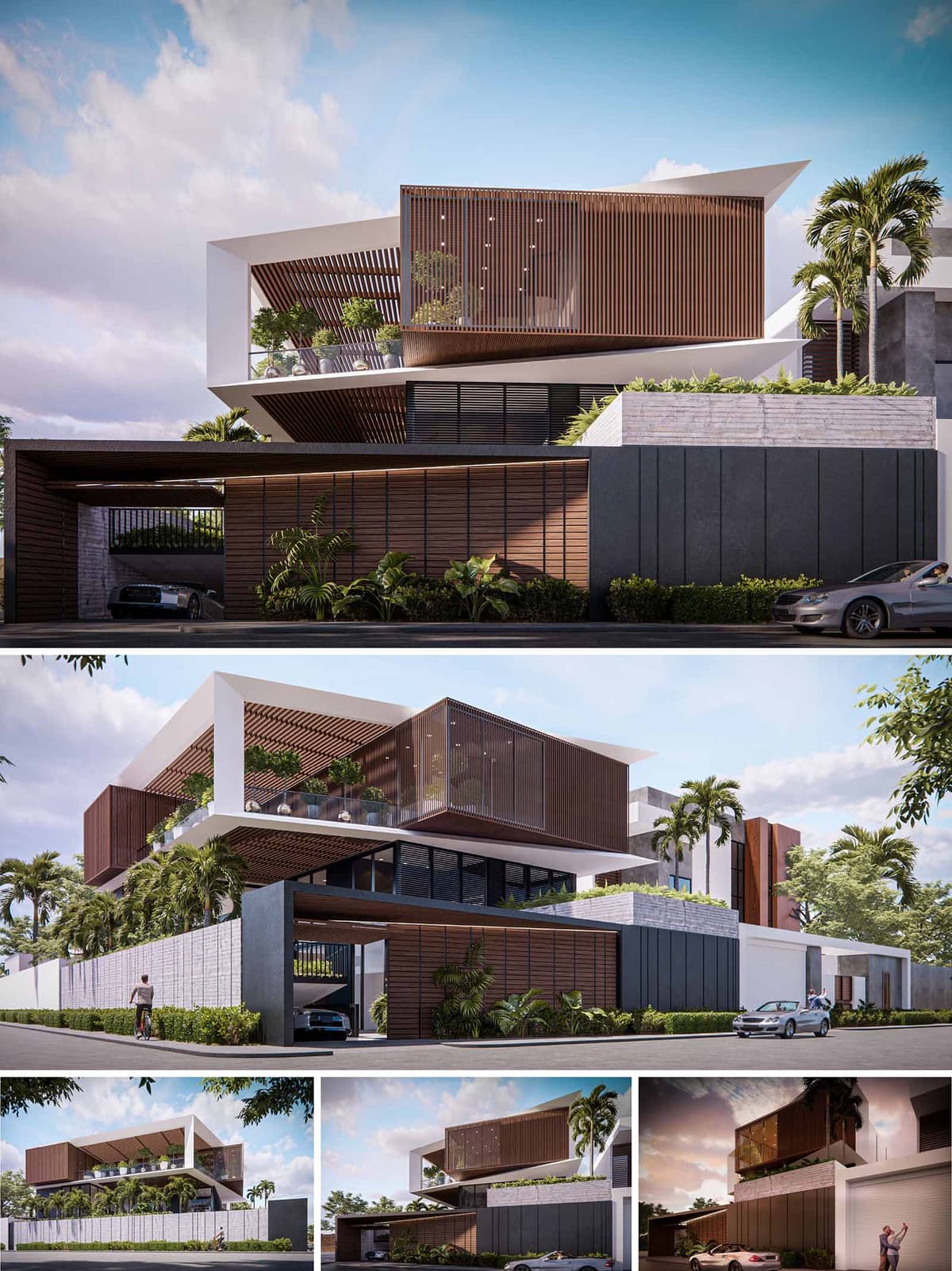

MA Villa is conceived as a contemporary reinterpretation of the traditional Riyadh courtyard house, combining strong geometric volumes with deep shaded terraces to ensure privacy and climatic comfort. The composition of interlocking white frames and warm timber screens generates a sense of floating masses, while the ground level remains visually permeable to connect the house with the street and garden. The villa is designed as an urban oasis, where architecture, vegetation and light orchestrate a calm domestic landscape.
The villa is located on a corner plot in a low-rise residential district of Riyadh, characterized by wide streets, generous setbacks and intense solar exposure. The design responds by presenting a controlled, almost introverted street frontage, while opening gradually towards internal patios and elevated gardens. The main vehicular access is emphasized by a deep, shaded porte-cochère, separating guest arrival from the more discreet family entrance and service access along the side.
The building is organized as stacked, offset volumes that create overhangs and double-height voids. A solid base anchors the project, above which the first-floor white frame projects outward, generating covered outdoor living areas. The upper volume, wrapped in vertical timber louvers, appears to float, producing a dynamic yet balanced composition. These shifts in massing are carefully calibrated to control views, produce shade, and articulate a hierarchy between public, semi-private and private zones of the villa.
The façade strategy contrasts three main materials: crisp white rendered frames, dark stone or composite panels at the base, and warm timber cladding and louvers at the upper levels. The vertical wooden fins reinterpret the regional mashrabiya, providing privacy and solar control while maintaining filtered outward views. Horizontal pergolas extend this language, casting patterned shadows over terraces and reinforcing the villa’s identity throughout the day. Glazing is recessed behind shading layers to reduce direct solar gain and glare.
Internally, living spaces are arranged around visual axes toward planted terraces and linear gardens. Large sliding glass panels allow the majlis and family living rooms to open fully to outdoor decks, transforming them into shaded semi-open salons during the cooler months. The offset slabs create double-height interfaces filled with greenery, so that upper-floor corridors and bedrooms overlook pockets of landscape rather than directly onto the street, enhancing privacy and spatial richness.
Landscape is woven into every level of the project: ground-floor planters soften the boundary wall, mid-level terraces accommodate container gardens and small trees, and the roofline is crowned with continuous planting beds. The front setback becomes a linear garden buffering the villa from the street, while the rear accommodates more intimate family outdoor areas. Climatically resilient species are selected for low water consumption, complemented by integrated planters along the carport and entrance, reinforcing the sense of arrival.
The architectural language directly supports environmental performance in Riyadh’s hot desert climate. Deep overhangs, recessed glazing and the timber louver system substantially reduce solar heat gain, decreasing cooling loads. The orientation prioritizes shaded facades and harnesses prevailing breezes through cross-ventilation where possible. High-performance glazing, insulated walls and light-colored external frames mitigate thermal absorption. Landscape irrigation is optimized through drip systems and drought-tolerant planting, while the extensive shading and greenery improve microclimate comfort for both indoor spaces and outdoor terraces.


MA Villa is conceived as a contemporary reinterpretation of the traditional Riyadh courtyard house, combining strong geometric volumes with deep shaded terraces to ensure privacy and climatic comfort. The composition of interlocking white frames and warm timber screens generates a sense of floating masses, while the ground level remains visually permeable to connect the house with the street and garden. The villa is designed as an urban oasis, where architecture, vegetation and light orchestrate a calm domestic landscape.
The villa is located on a corner plot in a low-rise residential district of Riyadh, characterized by wide streets, generous setbacks and intense solar exposure. The design responds by presenting a controlled, almost introverted street frontage, while opening gradually towards internal patios and elevated gardens. The main vehicular access is emphasized by a deep, shaded porte-cochère, separating guest arrival from the more discreet family entrance and service access along the side.
The building is organized as stacked, offset volumes that create overhangs and double-height voids. A solid base anchors the project, above which the first-floor white frame projects outward, generating covered outdoor living areas. The upper volume, wrapped in vertical timber louvers, appears to float, producing a dynamic yet balanced composition. These shifts in massing are carefully calibrated to control views, produce shade, and articulate a hierarchy between public, semi-private and private zones of the villa.
The façade strategy contrasts three main materials: crisp white rendered frames, dark stone or composite panels at the base, and warm timber cladding and louvers at the upper levels. The vertical wooden fins reinterpret the regional mashrabiya, providing privacy and solar control while maintaining filtered outward views. Horizontal pergolas extend this language, casting patterned shadows over terraces and reinforcing the villa’s identity throughout the day. Glazing is recessed behind shading layers to reduce direct solar gain and glare.
Internally, living spaces are arranged around visual axes toward planted terraces and linear gardens. Large sliding glass panels allow the majlis and family living rooms to open fully to outdoor decks, transforming them into shaded semi-open salons during the cooler months. The offset slabs create double-height interfaces filled with greenery, so that upper-floor corridors and bedrooms overlook pockets of landscape rather than directly onto the street, enhancing privacy and spatial richness.
Landscape is woven into every level of the project: ground-floor planters soften the boundary wall, mid-level terraces accommodate container gardens and small trees, and the roofline is crowned with continuous planting beds. The front setback becomes a linear garden buffering the villa from the street, while the rear accommodates more intimate family outdoor areas. Climatically resilient species are selected for low water consumption, complemented by integrated planters along the carport and entrance, reinforcing the sense of arrival.
The architectural language directly supports environmental performance in Riyadh’s hot desert climate. Deep overhangs, recessed glazing and the timber louver system substantially reduce solar heat gain, decreasing cooling loads. The orientation prioritizes shaded facades and harnesses prevailing breezes through cross-ventilation where possible. High-performance glazing, insulated walls and light-colored external frames mitigate thermal absorption. Landscape irrigation is optimized through drip systems and drought-tolerant planting, while the extensive shading and greenery improve microclimate comfort for both indoor spaces and outdoor terraces.
© 2021 by sanzpont [arquitectura] . Webpage by sanzpont [digital] . Innovative Digital Experiences
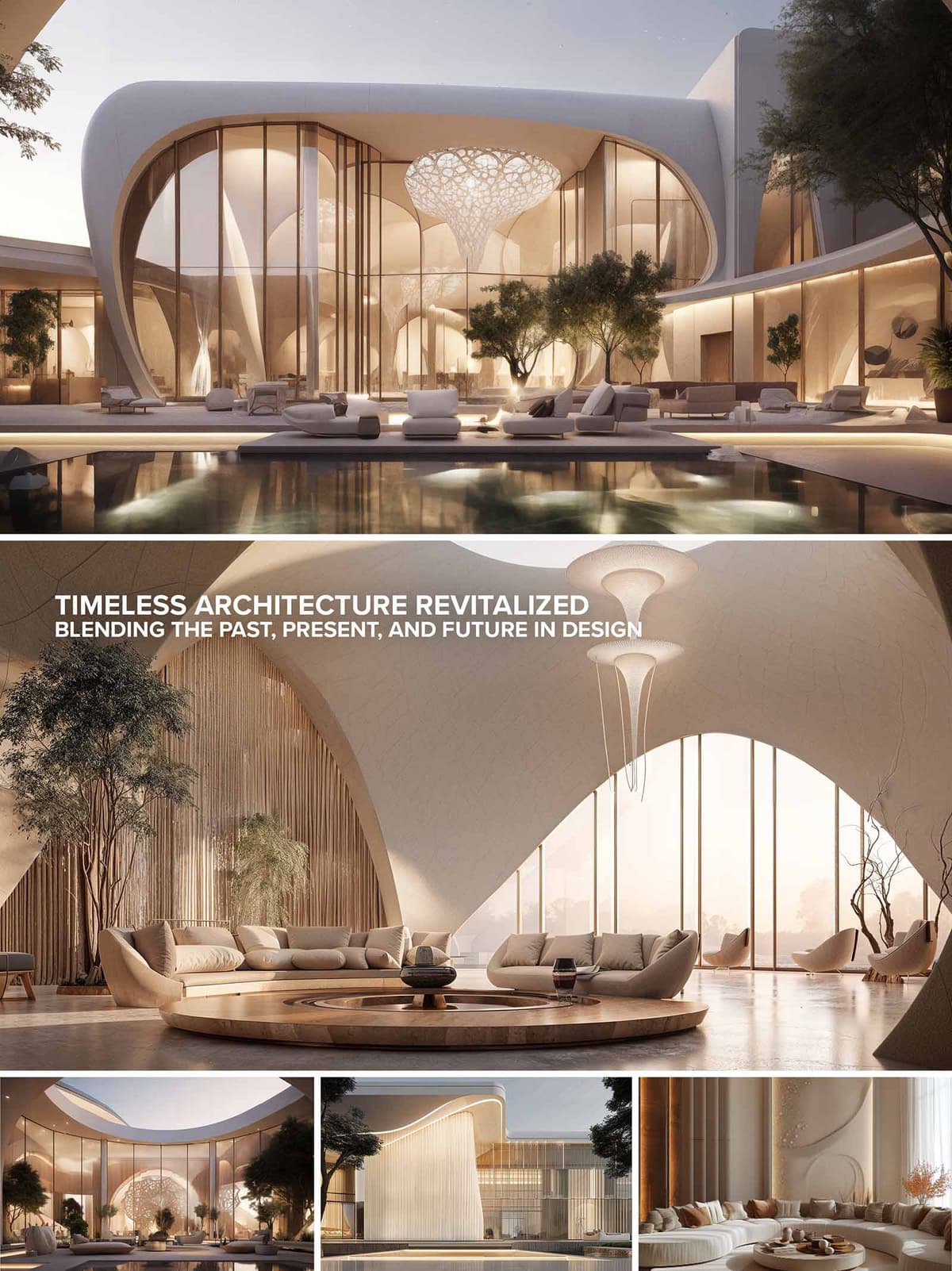

This palace embodies the pinnacle of sophisticated design, blending timeless architectural elements with modern innovations. The design concept revolves around creating an elegant yet sustainable environment that leverages natural light, ventilation, and cutting-edge materials. The palace features expansive spaces that seamlessly integrate indoor and outdoor living, emphasizing harmony with the natural surroundings.
The design exemplifies the fusion of luxury, elegance and sustainability, setting a new standard for high-end residential design. Through its thoughtful integration of natural light, ventilation, and sustainable practices, the palace not only provides an exquisite living experience but also demonstrates a commitment to environmental stewardship. The result is a timeless architectural masterpiece that offers both comfort and ecological responsibility.
The exterior is distinguished by its graceful curves and extensive use of glass, creating a transparent façade that blurs the lines between indoors and outdoors. The strategic placement of large windows follows the solar path, maximizing natural light while minimizing heat gain. Louvers and overhangs provide effective sun protection, ensuring comfort throughout the day. The exterior materials include reinforced concrete and high-performance glazing, ensuring durability and energy efficiency. Integrated landscaping, including mature trees and lush gardens, enhances the building’s organic aesthetic.
The interior design maintains the palace’s refined essence with spacious, light-filled rooms. The central living area features double-height ceilings adorned with custom sculptural light fixtures that mimic natural forms, such as blooming flowers, providing both illumination and visual interest. The layout promotes fluidity between spaces, with each area flowing seamlessly into the next.
The interior palette is dominated by natural, high-quality materials such as warm woods, polished stone, and rich textiles. The furnishings are designed for both comfort and elegance, featuring custom-made pieces that reflect the palace’s overall aesthetic. The color scheme consists of neutral tones, with accents of greenery and gold to enhance the refined feel.
Sustainability is a cornerstone of the palace’s design. The architecture incorporates advanced climate control systems and high-performance insulation, reducing energy consumption. Solar panels on the roof harness renewable energy, while efficient water systems, including rainwater harvesting, support conservation efforts. The design also emphasizes natural ventilation and lighting, significantly reducing reliance on artificial systems. Green spaces within and around the palace improve air quality and provide natural cooling.
The design strategically incorporates patios and courtyards to enhance natural sunlight and ventilation. These open spaces are thoughtfully placed to allow cross-ventilation, reducing the need for mechanical cooling. The patios serve as tranquil retreats, featuring water elements and native vegetation that create a serene ambiance while promoting environmental sustainability.
The landscape design mirrors the palace’s architectural elegance with a combination of formal and organic elements. Terraces, reflective pools, and lush gardens create a serene outdoor environment. The use of native plants ensures water efficiency and supports local biodiversity. The central courtyard, with its expansive water feature, acts as a focal point, offering a space for relaxation and reflection.
Lighting is meticulously planned to highlight the architectural features and enhance the palace’s sophisticated ambiance. Large windows and skylights are strategically positioned to maximize natural daylight, reducing the need for artificial lighting. At night, carefully placed LED fixtures illuminate the palace’s contours and materials, creating a captivating nighttime aesthetic while ensuring energy efficiency.


This palace embodies the pinnacle of sophisticated design, blending timeless architectural elements with modern innovations. The design concept revolves around creating an elegant yet sustainable environment that leverages natural light, ventilation, and cutting-edge materials. The palace features expansive spaces that seamlessly integrate indoor and outdoor living, emphasizing harmony with the natural surroundings.
The design exemplifies the fusion of luxury, elegance and sustainability, setting a new standard for high-end residential design. Through its thoughtful integration of natural light, ventilation, and sustainable practices, the palace not only provides an exquisite living experience but also demonstrates a commitment to environmental stewardship. The result is a timeless architectural masterpiece that offers both comfort and ecological responsibility.
The exterior is distinguished by its graceful curves and extensive use of glass, creating a transparent façade that blurs the lines between indoors and outdoors. The strategic placement of large windows follows the solar path, maximizing natural light while minimizing heat gain. Louvers and overhangs provide effective sun protection, ensuring comfort throughout the day. The exterior materials include reinforced concrete and high-performance glazing, ensuring durability and energy efficiency. Integrated landscaping, including mature trees and lush gardens, enhances the building’s organic aesthetic.
The interior design maintains the palace’s refined essence with spacious, light-filled rooms. The central living area features double-height ceilings adorned with custom sculptural light fixtures that mimic natural forms, such as blooming flowers, providing both illumination and visual interest. The layout promotes fluidity between spaces, with each area flowing seamlessly into the next.
The interior palette is dominated by natural, high-quality materials such as warm woods, polished stone, and rich textiles. The furnishings are designed for both comfort and elegance, featuring custom-made pieces that reflect the palace’s overall aesthetic. The color scheme consists of neutral tones, with accents of greenery and gold to enhance the refined feel.
Sustainability is a cornerstone of the palace’s design. The architecture incorporates advanced climate control systems and high-performance insulation, reducing energy consumption. Solar panels on the roof harness renewable energy, while efficient water systems, including rainwater harvesting, support conservation efforts. The design also emphasizes natural ventilation and lighting, significantly reducing reliance on artificial systems. Green spaces within and around the palace improve air quality and provide natural cooling.
The design strategically incorporates patios and courtyards to enhance natural sunlight and ventilation. These open spaces are thoughtfully placed to allow cross-ventilation, reducing the need for mechanical cooling. The patios serve as tranquil retreats, featuring water elements and native vegetation that create a serene ambiance while promoting environmental sustainability.
The landscape design mirrors the palace’s architectural elegance with a combination of formal and organic elements. Terraces, reflective pools, and lush gardens create a serene outdoor environment. The use of native plants ensures water efficiency and supports local biodiversity. The central courtyard, with its expansive water feature, acts as a focal point, offering a space for relaxation and reflection.
Lighting is meticulously planned to highlight the architectural features and enhance the palace’s sophisticated ambiance. Large windows and skylights are strategically positioned to maximize natural daylight, reducing the need for artificial lighting. At night, carefully placed LED fixtures illuminate the palace’s contours and materials, creating a captivating nighttime aesthetic while ensuring energy efficiency.
© 2021 by sanzpont [arquitectura] . Webpage by sanzpont [digital] . Innovative Digital Experiences
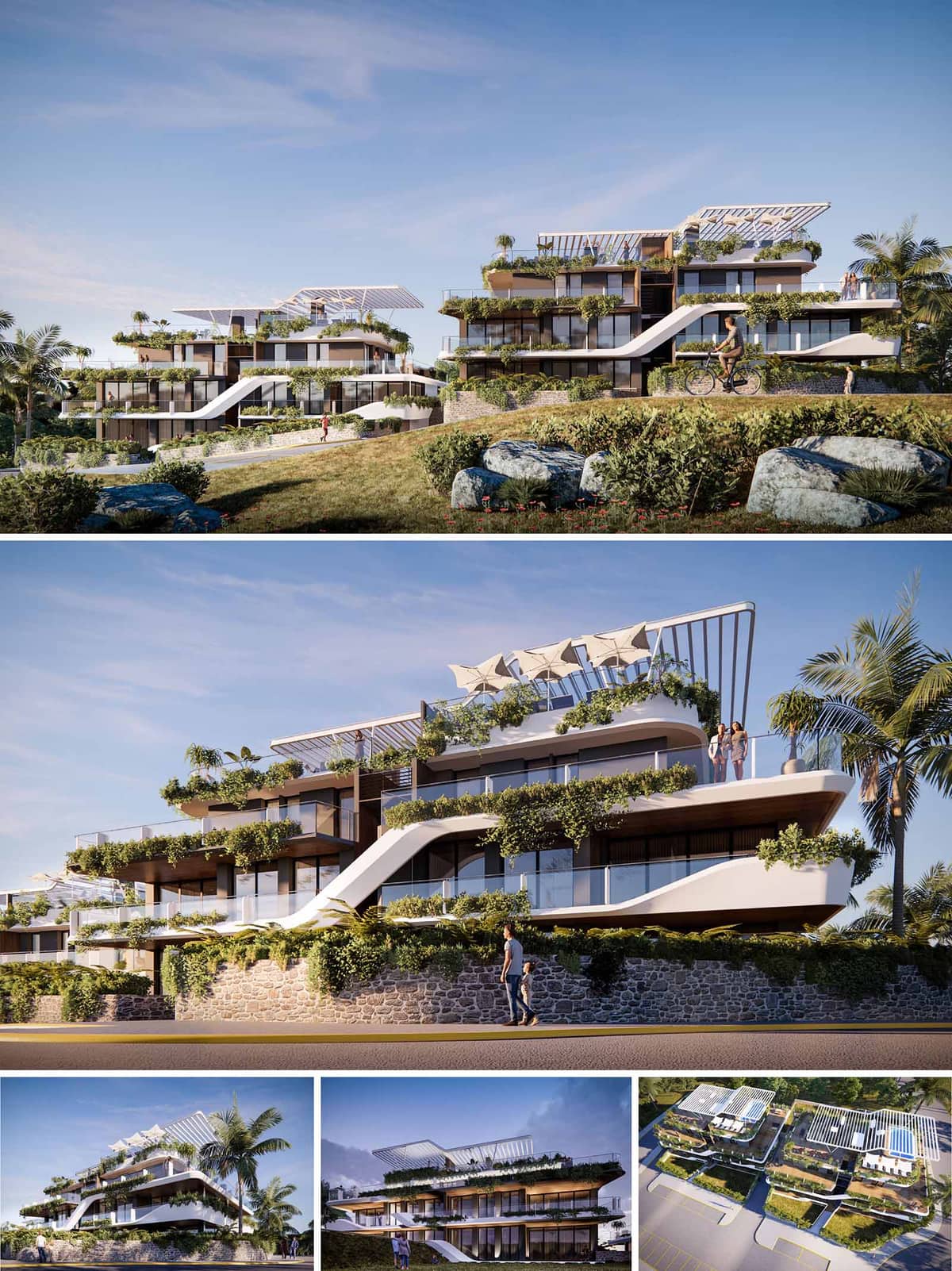

The project in Estepona is conceived as a terraced Mediterranean resort that dissolves the boundary between architecture and landscape. The buildings cascade gently along the natural slope, allowing each level to enjoy unobstructed sea views while creating a sequence of planted horizontal strata. The design prioritizes outdoor living, extending the domestic space onto generous balconies, roof gardens and intermediate terraces. Architecture here acts as a stepped topography in itself, offering multiple layers of shade, greenery and social interaction, tuned to the climate of the Costa del Sol.
The formal language combines fluid, white horizontal ribbons with more rectilinear glazed volumes. Continuous balconies wrap the façades, occasionally folding into sculptural exterior staircases that connect levels and activate the frontage. The upper roofs are crowned with light pergola structures and tensile shade elements, generating a distinctive skyline and controlling solar gain. Large floor-to-ceiling glazing reinforces the indoor–outdoor relationship, while the fragmented massing breaks down the apparent scale of the ensemble into smaller, human-scaled clusters.
A Mediterranean palette underpins the material strategy: smooth white render for the balcony ribbons, warm timber or wood-tone cladding around openings, and clear glass balustrades that maintain visual continuity to the horizon. The base of the building is anchored by a stone plinth in natural tones, linking the architecture to the terrain and providing textural contrast. The overall chromatic composition of whites, beiges and greens reflects the surrounding coastal landscape, with dark window frames adding depth and precision to the façade composition.
Vegetation is deployed as an essential architectural layer rather than a mere complement. Continuous planter bands along the balconies create a green edge to every level, softening the building contours and providing privacy filters between units. The ground plane is treated as a naturalized park with local shrubs, grasses and rocks that echo the existing topography. Roof terraces function as elevated gardens and community belvederes, reinforcing the perception of a building embedded within a lush hillside rather than an object placed on it.
Environmental performance is addressed through both passive and active measures. The deep balconies and pergolas provide effective solar shading, reducing cooling loads in the hot season while still admitting winter sun. Extensive greenery contributes to microclimatic comfort, evapotranspiration and improved air quality, while also offering additional insulation to the envelope. The roof structures can host photovoltaic panels aligned with the pergola geometry, optimizing solar capture without visual clutter. Water-efficient planting and potential rainwater harvesting support responsible irrigation, and the porosity of the layout encourages natural cross-ventilation through each dwelling.
The staggered configuration ensures that each apartment benefits from generous terraces oriented toward the views, with living spaces flowing directly onto outdoor rooms. Circulation is clearly expressed on the façades through external stairways and ramps, animating the elevations and facilitating intuitive wayfinding. Shared rooftop decks and intermediate communal terraces provide spaces for sunbathing, relaxation and social activities, always framed by greenery. Parking and service areas are discreetly placed at the perimeter, preserving the central landscape as a pedestrian-friendly environment.


The project in Estepona is conceived as a terraced Mediterranean resort that dissolves the boundary between architecture and landscape. The buildings cascade gently along the natural slope, allowing each level to enjoy unobstructed sea views while creating a sequence of planted horizontal strata. The design prioritizes outdoor living, extending the domestic space onto generous balconies, roof gardens and intermediate terraces. Architecture here acts as a stepped topography in itself, offering multiple layers of shade, greenery and social interaction, tuned to the climate of the Costa del Sol.
The formal language combines fluid, white horizontal ribbons with more rectilinear glazed volumes. Continuous balconies wrap the façades, occasionally folding into sculptural exterior staircases that connect levels and activate the frontage. The upper roofs are crowned with light pergola structures and tensile shade elements, generating a distinctive skyline and controlling solar gain. Large floor-to-ceiling glazing reinforces the indoor–outdoor relationship, while the fragmented massing breaks down the apparent scale of the ensemble into smaller, human-scaled clusters.
A Mediterranean palette underpins the material strategy: smooth white render for the balcony ribbons, warm timber or wood-tone cladding around openings, and clear glass balustrades that maintain visual continuity to the horizon. The base of the building is anchored by a stone plinth in natural tones, linking the architecture to the terrain and providing textural contrast. The overall chromatic composition of whites, beiges and greens reflects the surrounding coastal landscape, with dark window frames adding depth and precision to the façade composition.
Vegetation is deployed as an essential architectural layer rather than a mere complement. Continuous planter bands along the balconies create a green edge to every level, softening the building contours and providing privacy filters between units. The ground plane is treated as a naturalized park with local shrubs, grasses and rocks that echo the existing topography. Roof terraces function as elevated gardens and community belvederes, reinforcing the perception of a building embedded within a lush hillside rather than an object placed on it.
Environmental performance is addressed through both passive and active measures. The deep balconies and pergolas provide effective solar shading, reducing cooling loads in the hot season while still admitting winter sun. Extensive greenery contributes to microclimatic comfort, evapotranspiration and improved air quality, while also offering additional insulation to the envelope. The roof structures can host photovoltaic panels aligned with the pergola geometry, optimizing solar capture without visual clutter. Water-efficient planting and potential rainwater harvesting support responsible irrigation, and the porosity of the layout encourages natural cross-ventilation through each dwelling.
The staggered configuration ensures that each apartment benefits from generous terraces oriented toward the views, with living spaces flowing directly onto outdoor rooms. Circulation is clearly expressed on the façades through external stairways and ramps, animating the elevations and facilitating intuitive wayfinding. Shared rooftop decks and intermediate communal terraces provide spaces for sunbathing, relaxation and social activities, always framed by greenery. Parking and service areas are discreetly placed at the perimeter, preserving the central landscape as a pedestrian-friendly environment.
© 2021 by sanzpont [arquitectura] . Webpage by sanzpont [digital] . Innovative Digital Experiences
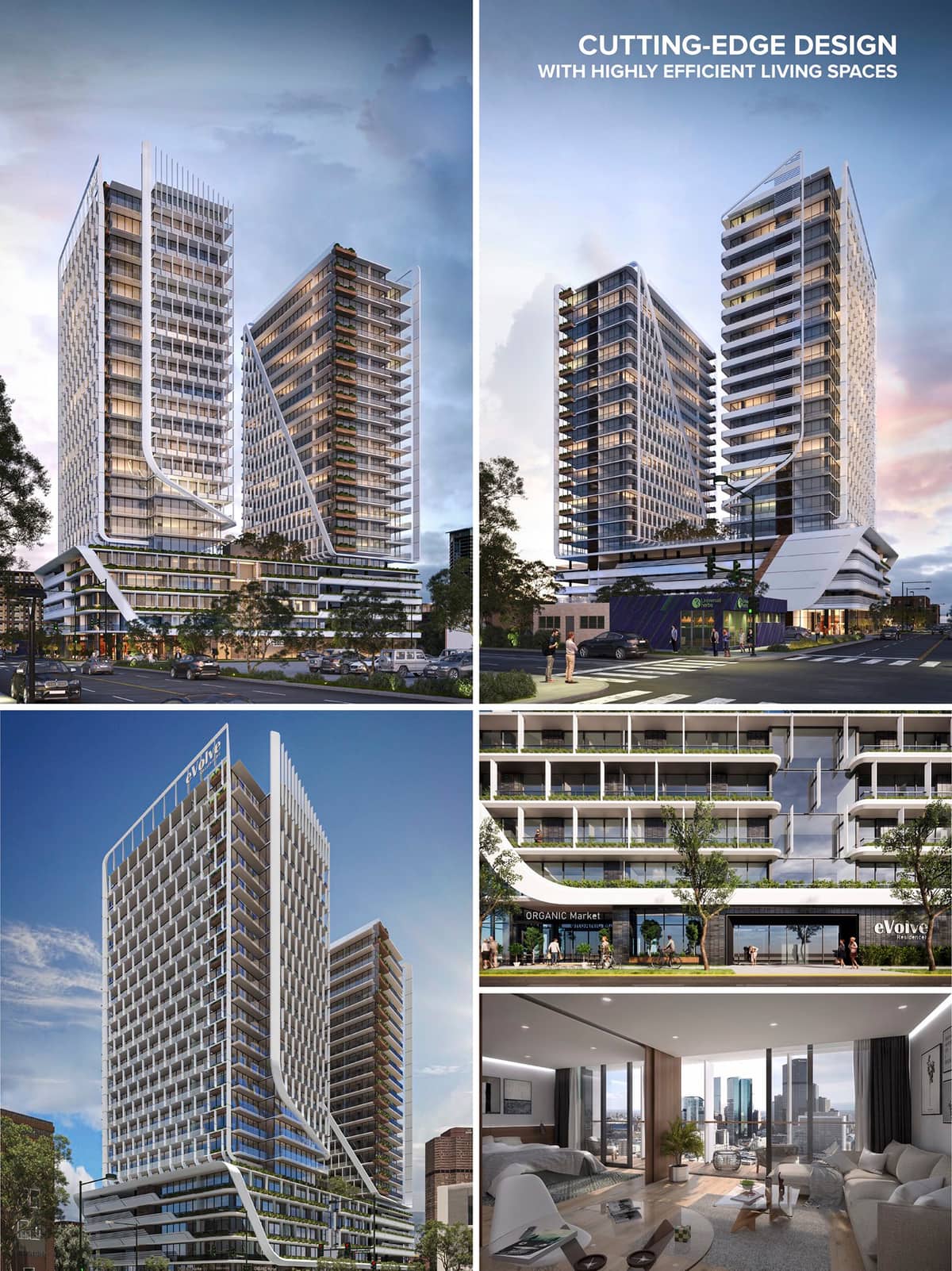

The architectural vision for this complex is an embodiment of fluid motion and human interaction, rendered through sweeping curves and modular forms. The structure's conceptual underpinning lies in fostering a symbiotic relationship between individuality and community. It employs a visual language that speaks to a rhythmic fluidity, juxtaposing the rectilinear rigidity of urban landscapes with organic shapes that allude to the ebb and flow of city life.
In its exterior, the building presents a facade that blends stark modern materials with dynamic design. The curvature, snaking its way up and around the towers, acts as a visual and functional connector, promoting a sense of continuity within the complex. Glass and steel dominate, arranged in a grid-like matrix that emphasizes verticality and order, while the infusion of wood elements disrupts this order, adding a touch of nature's unpredictability.
Balconies protrude from the facade in a regular pattern, offering residents their private outdoor sanctuaries and enhancing the facade's texture. These outdoor spaces serve not just for leisure but also as energy modulators, contributing to the building’s passive solar design by providing shade and reducing heat gain.
Material selection articulates a narrative of sustainability and aesthetic longevity. Glass, with its reflective and transparent qualities, facilitates an abundance of natural light within the interiors and acts as a mirror for the changing skies. Concrete and steel provide the necessary strength and durability, essential for high-density urban living. Timber elements introduce an organic touch, softening the modern edges with their inherent warmth.
The color palette is intentionally subdued, comprising mostly earth tones that visually anchor the building within its environment. These choices are not merely stylistic but also practical, aiming to reduce maintenance requirements and reflect the urban landscape’s hues.
Sustainability is woven into the very fabric of the complex. The building's design includes green roofs and living walls that serve to mitigate urban heat, filter pollutants, and reduce stormwater runoff. These features, combined with the strategic placement of balconies, improve the microclimate around the building, while also providing aesthetic green vistas for residents.
Communal spaces within the complex exude openness and connectivity. The ground floor merges seamlessly with the streetscape, inviting residents and the public into a shared experience. The ample use of glass here establishes a visual continuity with the outdoor environment. Upper-level common areas, including terraces and pool decks, offer a communal haven, fostering interactions among residents.
These spaces are adorned with minimalist, yet comfortable furniture, and interspersed with greenery, ensuring that the connection with nature is ever-present. The design of these areas indicates a clear intent to serve as social condensers, where organic interactions can flourish amidst the backdrop of city life.
In summary, this architectural endeavor is a celebration of modern living, where each design decision from macro to micro scale serves a dual purpose of utility and aesthetic. The complex stands as a testament to the possibilities of contemporary urban architecture - a space where community thrives within the embrace of sustainable design.


The architectural vision for this complex is an embodiment of fluid motion and human interaction, rendered through sweeping curves and modular forms. The structure's conceptual underpinning lies in fostering a symbiotic relationship between individuality and community. It employs a visual language that speaks to a rhythmic fluidity, juxtaposing the rectilinear rigidity of urban landscapes with organic shapes that allude to the ebb and flow of city life.
In its exterior, the building presents a facade that blends stark modern materials with dynamic design. The curvature, snaking its way up and around the towers, acts as a visual and functional connector, promoting a sense of continuity within the complex. Glass and steel dominate, arranged in a grid-like matrix that emphasizes verticality and order, while the infusion of wood elements disrupts this order, adding a touch of nature's unpredictability.
Balconies protrude from the facade in a regular pattern, offering residents their private outdoor sanctuaries and enhancing the facade's texture. These outdoor spaces serve not just for leisure but also as energy modulators, contributing to the building’s passive solar design by providing shade and reducing heat gain.
Material selection articulates a narrative of sustainability and aesthetic longevity. Glass, with its reflective and transparent qualities, facilitates an abundance of natural light within the interiors and acts as a mirror for the changing skies. Concrete and steel provide the necessary strength and durability, essential for high-density urban living. Timber elements introduce an organic touch, softening the modern edges with their inherent warmth.
The color palette is intentionally subdued, comprising mostly earth tones that visually anchor the building within its environment. These choices are not merely stylistic but also practical, aiming to reduce maintenance requirements and reflect the urban landscape’s hues.
Sustainability is woven into the very fabric of the complex. The building's design includes green roofs and living walls that serve to mitigate urban heat, filter pollutants, and reduce stormwater runoff. These features, combined with the strategic placement of balconies, improve the microclimate around the building, while also providing aesthetic green vistas for residents.
Communal spaces within the complex exude openness and connectivity. The ground floor merges seamlessly with the streetscape, inviting residents and the public into a shared experience. The ample use of glass here establishes a visual continuity with the outdoor environment. Upper-level common areas, including terraces and pool decks, offer a communal haven, fostering interactions among residents.
These spaces are adorned with minimalist, yet comfortable furniture, and interspersed with greenery, ensuring that the connection with nature is ever-present. The design of these areas indicates a clear intent to serve as social condensers, where organic interactions can flourish amidst the backdrop of city life.
In summary, this architectural endeavor is a celebration of modern living, where each design decision from macro to micro scale serves a dual purpose of utility and aesthetic. The complex stands as a testament to the possibilities of contemporary urban architecture - a space where community thrives within the embrace of sustainable design.
© 2021 by sanzpont [arquitectura] . Webpage by sanzpont [digital] . Innovative Digital Experiences
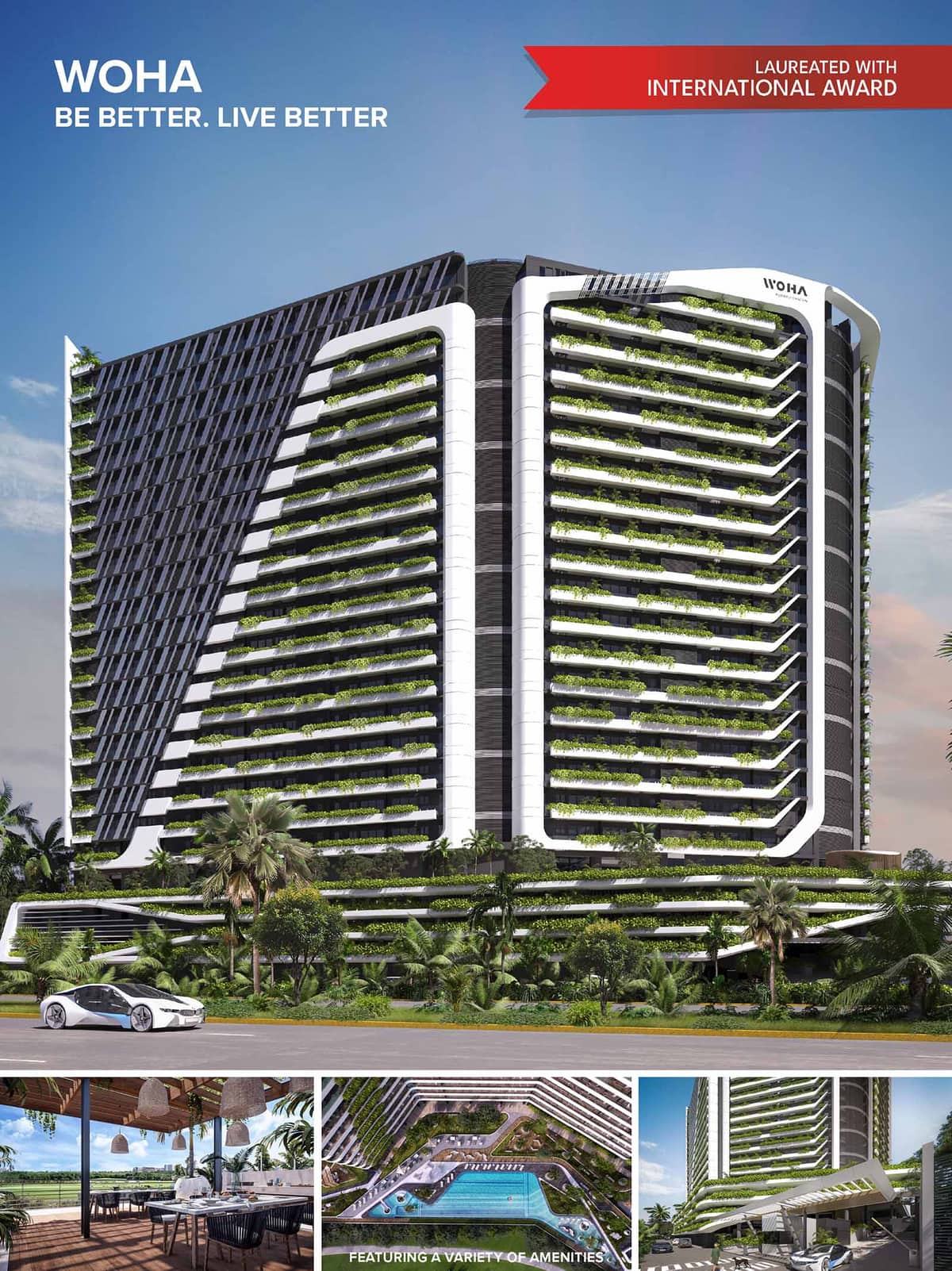
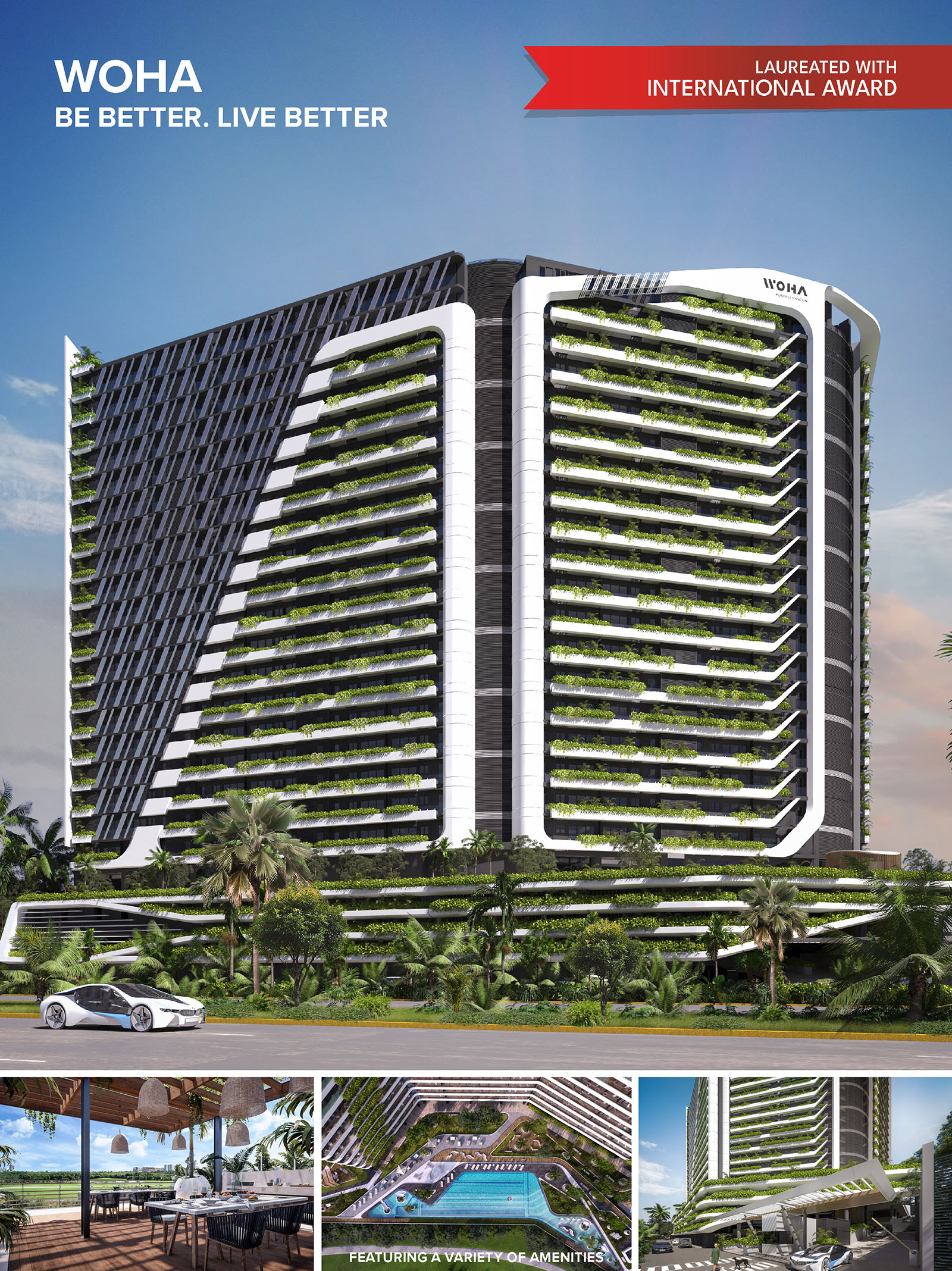
WOHA emerges as a high-rise residential development that redefines sustainable urban living in a tropical context. Rooted in three core design premises—functionality, universal sea views, and bioclimatic sustainability—the project synthesizes environmental consciousness with architectural elegance. Comprising 204 apartments distributed over 20 levels, including two subterranean parking levels and a roof-level energy zone, the tower promotes a lifestyle integrated with nature and wellness. The architecture embraces a modular approach to optimize spatial organization and user comfort, structured around a highly efficient 100 m² residential unit.
The massing of the tower is designed as an articulated, L-shaped volume that maximizes exposure to the Caribbean Sea, ensuring that every unit benefits from panoramic views. The tower is slightly tapered and sculpted to incorporate large horizontal terraces, which act as vegetated buffers. This strategy not only enhances the view corridors but also functions as passive solar protection. The form tilts dynamically, generating movement in the façade and emphasizing a vertical garden expression through continuous balcony planters.
At the heart of the architectural solution lies a highly rationalized floor plan. The 7.7m by 11m residential module avoids redundant circulation by removing internal corridors and enabling direct elevator access to each unit. The open-plan configuration promotes flow between kitchen, dining, and living spaces, orienting these social zones toward the sea. Conversely, service spaces and secondary bedrooms face the city side. The linear arrangement across a single bay ensures optimal cross-ventilation, vital for passive thermal regulation in tropical climates.
WOHA adopts a rigorous passive bioclimatic design tailored to the warm, sub-humid climate of the Caribbean. Continuous balconies double as sunshades and planting beds, reducing solar gain while contributing to urban biodiversity. Wind analysis determined optimal cross-ventilation strategies, while facade geometry and vertical greening support evaporative cooling and shading. During the warmer summer months—when natural ventilation becomes less effective—mechanical systems are discreetly integrated to maintain thermal comfort. The green terraces serve multiple environmental functions: mitigating the heat island effect, enhancing rainwater retention, and promoting the psychological benefits of biophilic design. The rooftop is designated for renewable energy generation, likely incorporating photovoltaic panels or wind turbines, signaling a move toward energy autonomy.
The architectural expression is defined by a restrained palette of high-performance materials: reflective glass, low-carbon concrete, and a façade system clad in a combination of white composite panels and dark louvers. The vegetated balconies punctuate the linear composition with lush greenery, transforming the building into a vertical garden. The interplay of white frames and green terraces conveys a clean, futuristic identity while maintaining a strong connection to the tropical landscape.
Beyond the residential component, WOHA provides an extensive range of shared amenities designed to foster a sense of community and wellness. These include rooftop lounges, an infinity-edge pool, outdoor dining terraces, and landscaped podium gardens. The amenities are seamlessly integrated with the architectural language of the project, ensuring continuity in form, material, and environmental performance.
WOHA is conceived not only as a residential project but as a catalyst for environmental awareness. By integrating energy-efficient systems, promoting resource reuse, and supporting low-impact lifestyles, it advocates for a conscious way of living. Its sustainable ethos is reinforced through waste recycling programs, water efficiency systems, and ecological landscaping, making it a benchmark for responsible design in coastal developments.
• The Architecture Community International Residential Architecture Awards 2022 : Winner : Woha (2022)


• The Architecture Community International Residential Architecture Awards 2022 : Winner : Woha (2022)
WOHA emerges as a high-rise residential development that redefines sustainable urban living in a tropical context. Rooted in three core design premises—functionality, universal sea views, and bioclimatic sustainability—the project synthesizes environmental consciousness with architectural elegance. Comprising 204 apartments distributed over 20 levels, including two subterranean parking levels and a roof-level energy zone, the tower promotes a lifestyle integrated with nature and wellness. The architecture embraces a modular approach to optimize spatial organization and user comfort, structured around a highly efficient 100 m² residential unit.
The massing of the tower is designed as an articulated, L-shaped volume that maximizes exposure to the Caribbean Sea, ensuring that every unit benefits from panoramic views. The tower is slightly tapered and sculpted to incorporate large horizontal terraces, which act as vegetated buffers. This strategy not only enhances the view corridors but also functions as passive solar protection. The form tilts dynamically, generating movement in the façade and emphasizing a vertical garden expression through continuous balcony planters.
At the heart of the architectural solution lies a highly rationalized floor plan. The 7.7m by 11m residential module avoids redundant circulation by removing internal corridors and enabling direct elevator access to each unit. The open-plan configuration promotes flow between kitchen, dining, and living spaces, orienting these social zones toward the sea. Conversely, service spaces and secondary bedrooms face the city side. The linear arrangement across a single bay ensures optimal cross-ventilation, vital for passive thermal regulation in tropical climates.
WOHA adopts a rigorous passive bioclimatic design tailored to the warm, sub-humid climate of the Caribbean. Continuous balconies double as sunshades and planting beds, reducing solar gain while contributing to urban biodiversity. Wind analysis determined optimal cross-ventilation strategies, while facade geometry and vertical greening support evaporative cooling and shading. During the warmer summer months—when natural ventilation becomes less effective—mechanical systems are discreetly integrated to maintain thermal comfort. The green terraces serve multiple environmental functions: mitigating the heat island effect, enhancing rainwater retention, and promoting the psychological benefits of biophilic design. The rooftop is designated for renewable energy generation, likely incorporating photovoltaic panels or wind turbines, signaling a move toward energy autonomy.
The architectural expression is defined by a restrained palette of high-performance materials: reflective glass, low-carbon concrete, and a façade system clad in a combination of white composite panels and dark louvers. The vegetated balconies punctuate the linear composition with lush greenery, transforming the building into a vertical garden. The interplay of white frames and green terraces conveys a clean, futuristic identity while maintaining a strong connection to the tropical landscape.
Beyond the residential component, WOHA provides an extensive range of shared amenities designed to foster a sense of community and wellness. These include rooftop lounges, an infinity-edge pool, outdoor dining terraces, and landscaped podium gardens. The amenities are seamlessly integrated with the architectural language of the project, ensuring continuity in form, material, and environmental performance.
WOHA is conceived not only as a residential project but as a catalyst for environmental awareness. By integrating energy-efficient systems, promoting resource reuse, and supporting low-impact lifestyles, it advocates for a conscious way of living. Its sustainable ethos is reinforced through waste recycling programs, water efficiency systems, and ecological landscaping, making it a benchmark for responsible design in coastal developments.
© 2021 by sanzpont [arquitectura] . Webpage by sanzpont [digital] . Innovative Digital Experiences
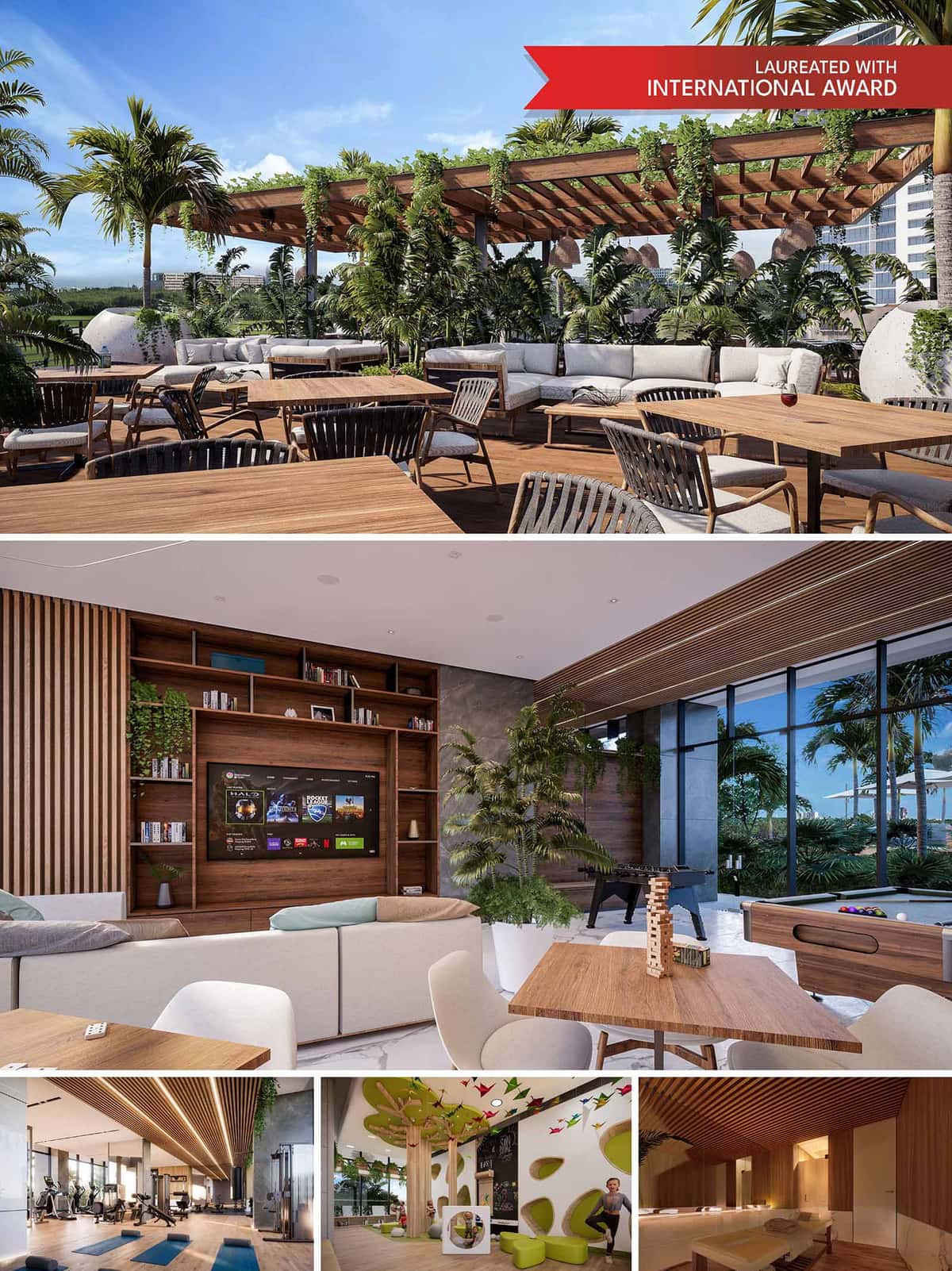
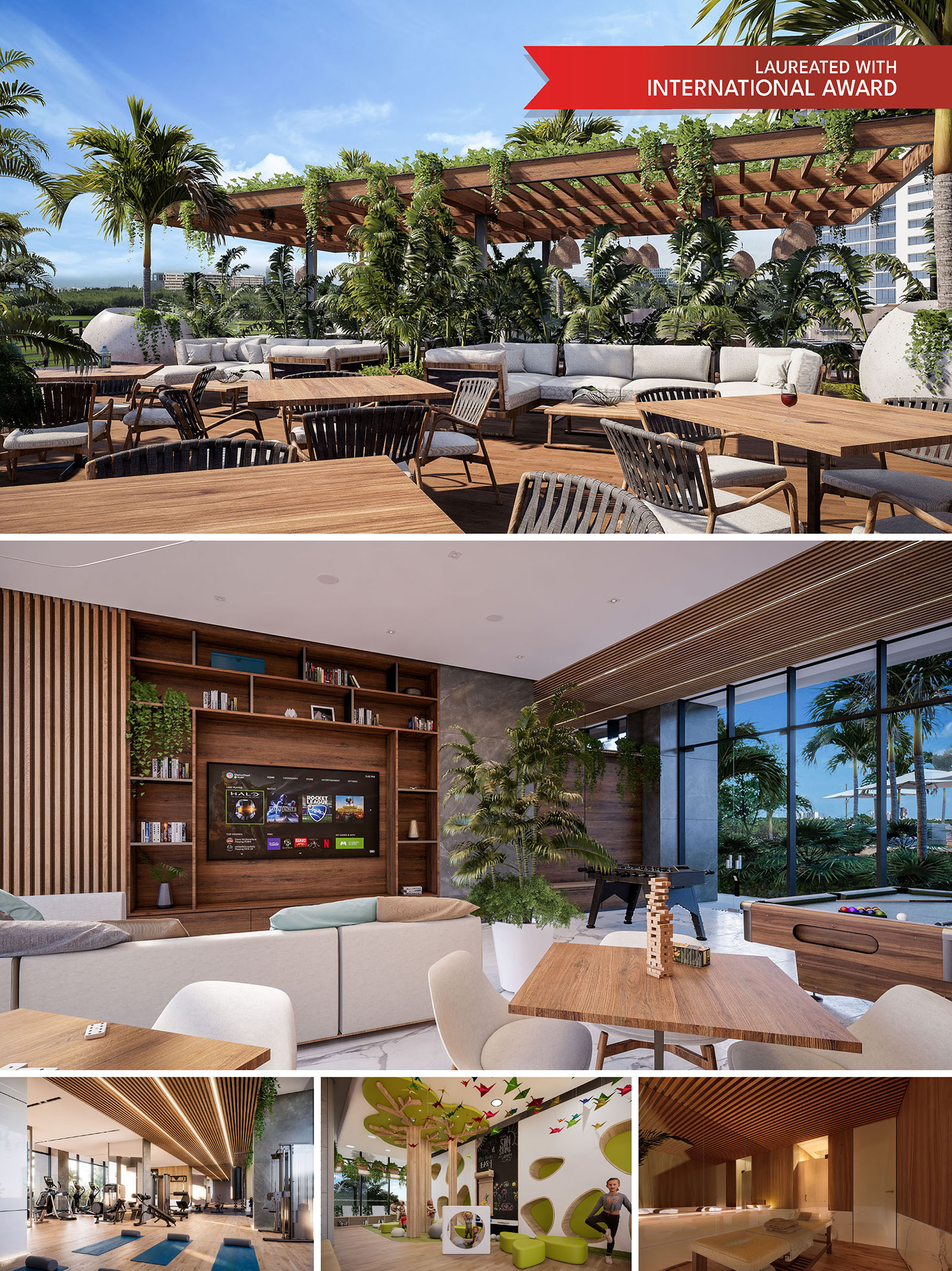
The amenities at WOHA are conceived as spatial extensions of the core residential philosophy: to live better by living in harmony with nature. The amenity areas are designed not only to serve the functional needs of residents but also to elevate their day-to-day experience through sensory, social, and wellness-focused programming. The architectural and interior language reflects tropical modernism, with a strong emphasis on biophilic integration, passive design strategies, and flexible use of space.
The crown of the amenity offering is the rooftop lounge—a lushly planted terrace shaded by a wood pergola structure. The design embraces an open-air concept that frames panoramic views while encouraging natural ventilation. Lightweight materials such as timber and woven fibers are used extensively in the furniture and ceiling treatments, reinforcing the connection to the natural surroundings. Cascading planters and integrated vegetation soften the edges of the structure, creating an immersive garden-like atmosphere. These terraces are designed as multifunctional spaces—supporting both daytime relaxation and evening social events.
At the heart of the amenity interiors is a double-height multipurpose lounge. This space combines a library, game zone, and digital entertainment hub, all articulated within a cohesive timber and stone palette. Custom millwork features integrated shelving and media units, paired with flexible seating configurations that promote community gathering and informal interaction. The use of large-format glass openings ensures a seamless dialogue with the landscaped exterior, while vertical planting and wooden ceiling baffles enhance acoustic comfort and natural aesthetics.
The gymnasium and wellness area are planned with precision to optimize daylight, spatial efficiency, and environmental control. Slatted timber ceilings with integrated lighting provide rhythm and warmth, while full-height glazing connects users to the lush outdoor vegetation. The gym accommodates a variety of physical activities—free weights, cardio, yoga—catering to different user profiles. The accompanying wellness suite, featuring a steam room and sauna, is articulated in warm wood tones and natural stone textures, offering a serene environment for relaxation and recovery.
WOHA also prioritizes younger residents through a highly curated indoor playroom. The space is defined by playful biomorphic elements—tree-like columns, climbing walls, and interactive installations—all rendered in soft, organic forms. A vibrant color palette, inspired by nature, creates a stimulating yet calming environment for children. The space is carefully designed to be safe, inclusive, and educational, encouraging cognitive and physical development through interaction and play.
Sustainability is a core value that transcends the entire amenity experience. Materials were selected for their low environmental impact, durability, and local sourcing. FSC-certified timber, low-VOC finishes, and recycled content furnishings are employed throughout. The extensive use of natural ventilation, daylighting strategies, and native vegetation significantly reduces the energy footprint of these communal areas. Indoor-outdoor transitions are seamless, reinforcing the idea of an architecture that breathes with its environment.
The amenity strategy at WOHA fosters a holistic lifestyle, enhancing residents' well-being across physical, mental, and social dimensions. Each space is crafted not merely as a utility but as an experience—encouraging interaction, contemplation, and community engagement. In doing so, WOHA positions itself not only as a residence but as a living system, thoughtfully aligned with the values of sustainability, health, and collective living.
• The Architecture Community International Residential Architecture Awards 2022 : Winner : Woha (2022)


• The Architecture Community International Residential Architecture Awards 2022 : Winner : Woha (2022)
The amenities at WOHA are conceived as spatial extensions of the core residential philosophy: to live better by living in harmony with nature. The amenity areas are designed not only to serve the functional needs of residents but also to elevate their day-to-day experience through sensory, social, and wellness-focused programming. The architectural and interior language reflects tropical modernism, with a strong emphasis on biophilic integration, passive design strategies, and flexible use of space.
The crown of the amenity offering is the rooftop lounge—a lushly planted terrace shaded by a wood pergola structure. The design embraces an open-air concept that frames panoramic views while encouraging natural ventilation. Lightweight materials such as timber and woven fibers are used extensively in the furniture and ceiling treatments, reinforcing the connection to the natural surroundings. Cascading planters and integrated vegetation soften the edges of the structure, creating an immersive garden-like atmosphere. These terraces are designed as multifunctional spaces—supporting both daytime relaxation and evening social events.
At the heart of the amenity interiors is a double-height multipurpose lounge. This space combines a library, game zone, and digital entertainment hub, all articulated within a cohesive timber and stone palette. Custom millwork features integrated shelving and media units, paired with flexible seating configurations that promote community gathering and informal interaction. The use of large-format glass openings ensures a seamless dialogue with the landscaped exterior, while vertical planting and wooden ceiling baffles enhance acoustic comfort and natural aesthetics.
The gymnasium and wellness area are planned with precision to optimize daylight, spatial efficiency, and environmental control. Slatted timber ceilings with integrated lighting provide rhythm and warmth, while full-height glazing connects users to the lush outdoor vegetation. The gym accommodates a variety of physical activities—free weights, cardio, yoga—catering to different user profiles. The accompanying wellness suite, featuring a steam room and sauna, is articulated in warm wood tones and natural stone textures, offering a serene environment for relaxation and recovery.
WOHA also prioritizes younger residents through a highly curated indoor playroom. The space is defined by playful biomorphic elements—tree-like columns, climbing walls, and interactive installations—all rendered in soft, organic forms. A vibrant color palette, inspired by nature, creates a stimulating yet calming environment for children. The space is carefully designed to be safe, inclusive, and educational, encouraging cognitive and physical development through interaction and play.
Sustainability is a core value that transcends the entire amenity experience. Materials were selected for their low environmental impact, durability, and local sourcing. FSC-certified timber, low-VOC finishes, and recycled content furnishings are employed throughout. The extensive use of natural ventilation, daylighting strategies, and native vegetation significantly reduces the energy footprint of these communal areas. Indoor-outdoor transitions are seamless, reinforcing the idea of an architecture that breathes with its environment.
The amenity strategy at WOHA fosters a holistic lifestyle, enhancing residents' well-being across physical, mental, and social dimensions. Each space is crafted not merely as a utility but as an experience—encouraging interaction, contemplation, and community engagement. In doing so, WOHA positions itself not only as a residence but as a living system, thoughtfully aligned with the values of sustainability, health, and collective living.
© 2021 by sanzpont [arquitectura] . Webpage by sanzpont [digital] . Innovative Digital Experiences
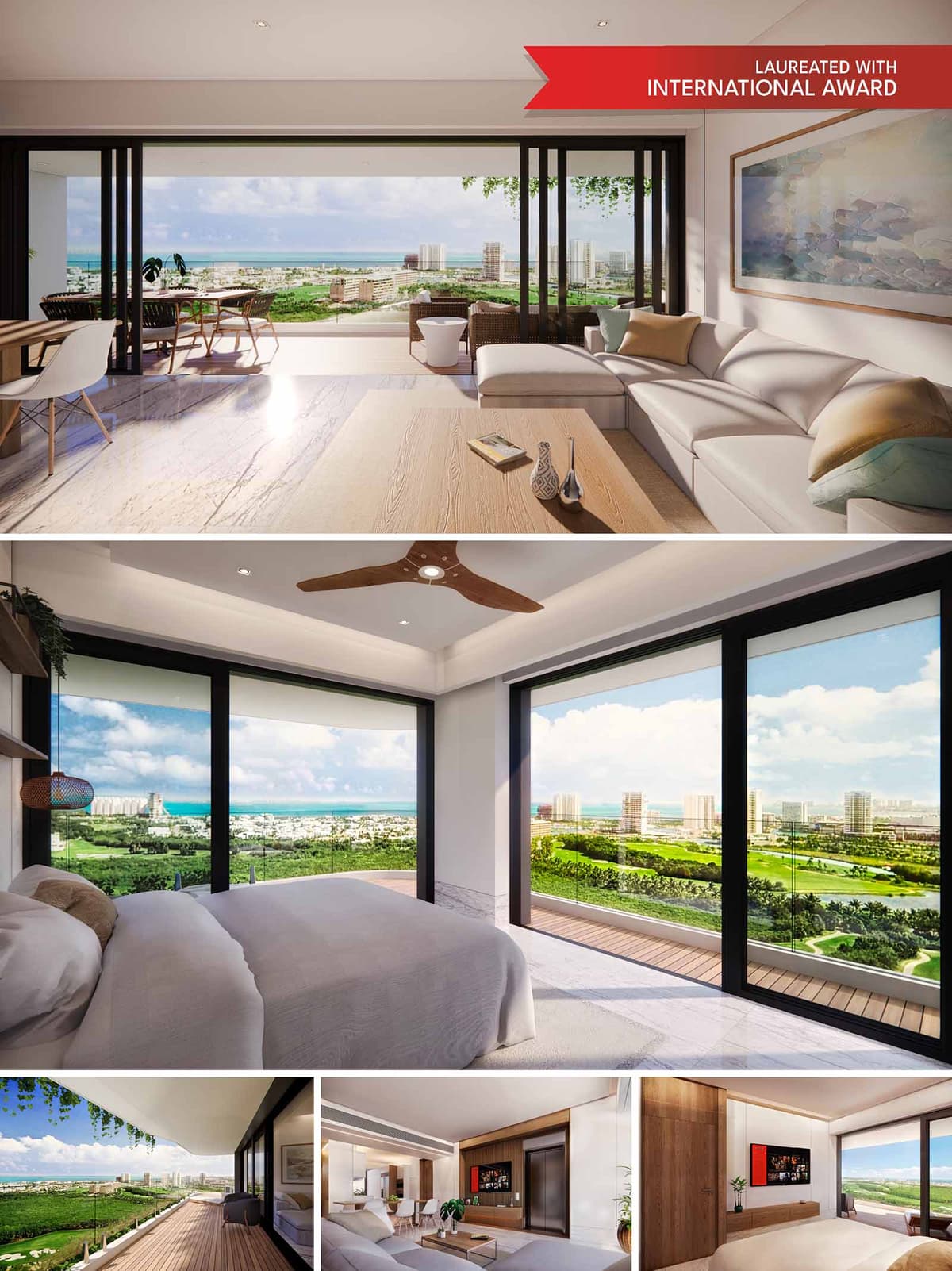
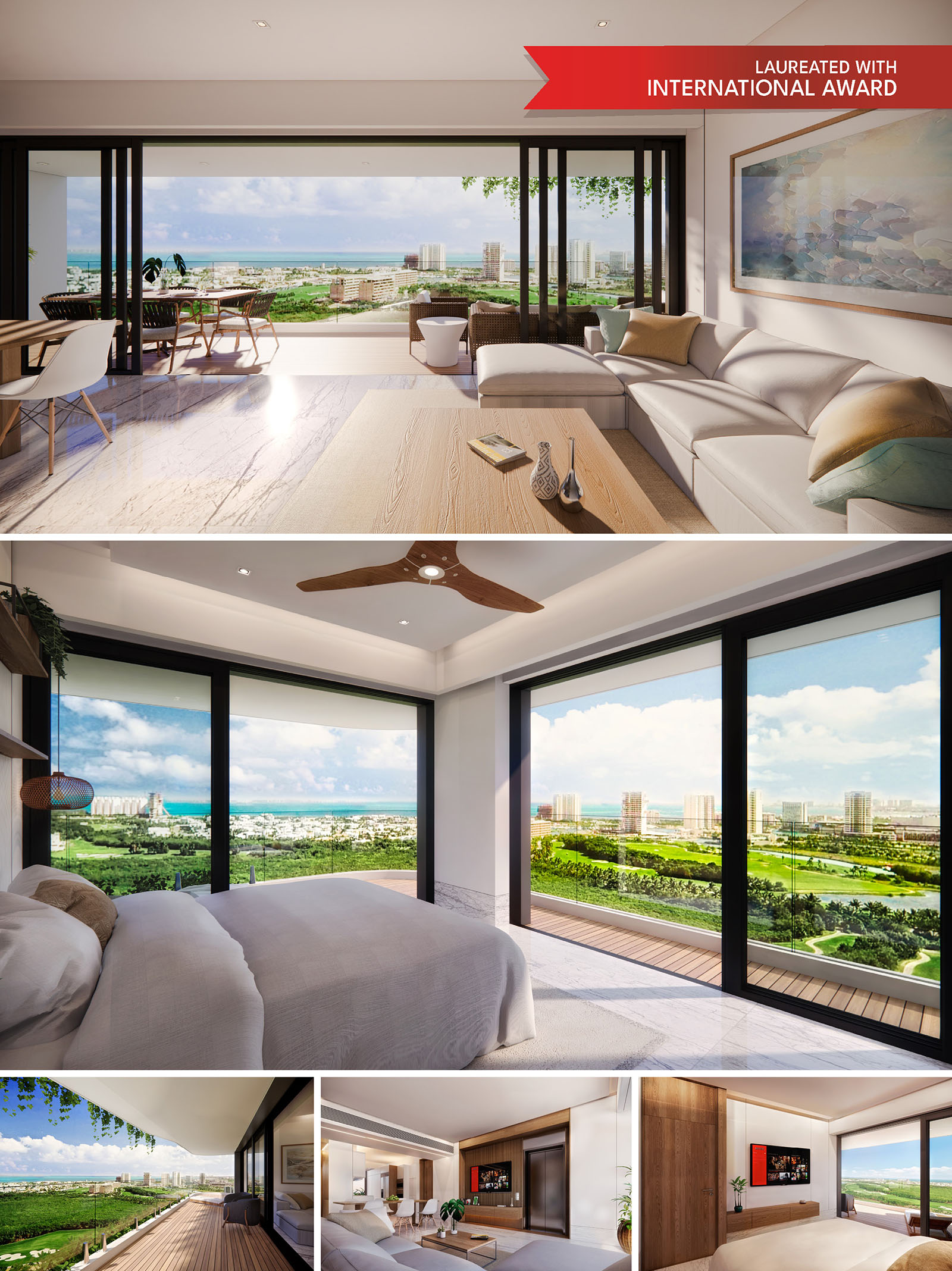
The apartment units at WOHA are envisioned as modern sanctuaries that harmonize architecture with the tropical environment. Based on a modular logic, each unit is designed to maximize spatial efficiency, natural illumination, and seamless visual connectivity to the Caribbean landscape. The concept focuses on comfort, functionality, and sustainability—providing residents with a refined lifestyle immersed in nature. Each apartment is a reflection of the project’s core values: livability, efficiency, and environmental consciousness.
Each 100 m² unit is organized within a 7.7m x 11m footprint, allowing for an exceptionally efficient use of space. The open-plan configuration strategically places the living, dining, and master bedroom areas facing the sea, while service spaces and secondary bedrooms are oriented toward the cityscape. This bi-directional orientation ensures that all interior spaces are naturally lit and well-ventilated. The absence of internal corridors enhances spatial clarity and flow, providing direct elevator access into the units—offering privacy and exclusivity. This eliminates shared hallways, reduces maintenance, and increases usable living area within each residence.
The interior material palette is warm, tactile, and rooted in natural textures. Floors are finished in polished stone with light veining, creating a luminous base that reflects the abundant natural light. Timber is used for built-in elements, ceiling treatments, and furnishings, imbuing the spaces with a sense of warmth and continuity. The combination of neutral tones and organic materials establishes a serene atmosphere that adapts effortlessly to the lush context visible through expansive openings. Large-format windows and floor-to-ceiling sliding glass doors dissolve the boundary between indoors and outdoors, inviting sea breezes and panoramic views into daily living. Finishes and detailing are kept minimal and refined, allowing the surrounding landscape to take visual precedence.
All units open onto generous private terraces that act as outdoor living rooms. These terraces are designed as continuous platforms wrapped with planter boxes that support native vegetation, providing privacy and sun protection while enhancing biodiversity. The uninterrupted sea views are the focal point of the residential experience, transforming every apartment into a front-row seat to the Caribbean. Outdoor dining and lounging areas extend the usability of the living spaces, encouraging a lifestyle that fully embraces the tropical climate. The terraces are an essential part of the project’s passive climate strategy, working as thermal buffers that reduce direct solar radiation on the glazed facades.
The apartment modules are carefully configured to promote cross ventilation, responding to the site's prevailing wind directions. This strategy ensures that interior spaces remain naturally cool for most of the year, minimizing the need for mechanical air conditioning. Ceiling fans, operable windows, and light-colored finishes complement the passive design strategies, contributing to thermal comfort and energy efficiency.
In line with WOHA’s sustainability ethos, the apartments incorporate resource-efficient features such as LED lighting, low-flow fixtures, and materials with low embodied energy. By designing each unit as an independent bioclimatic cell, the project minimizes energy consumption while maximizing comfort. The apartment design reflects a new way of urban living—conscious, efficient, and intimately connected to the environment. Through thoughtful spatial planning, integrated landscape, and responsive architecture, each unit at WOHA offers a refined and responsible residential experience.
• The Architecture Community International Residential Architecture Awards 2022 : Winner : Woha (2022)


• The Architecture Community International Residential Architecture Awards 2022 : Winner : Woha (2022)
The apartment units at WOHA are envisioned as modern sanctuaries that harmonize architecture with the tropical environment. Based on a modular logic, each unit is designed to maximize spatial efficiency, natural illumination, and seamless visual connectivity to the Caribbean landscape. The concept focuses on comfort, functionality, and sustainability—providing residents with a refined lifestyle immersed in nature. Each apartment is a reflection of the project’s core values: livability, efficiency, and environmental consciousness.
Each 100 m² unit is organized within a 7.7m x 11m footprint, allowing for an exceptionally efficient use of space. The open-plan configuration strategically places the living, dining, and master bedroom areas facing the sea, while service spaces and secondary bedrooms are oriented toward the cityscape. This bi-directional orientation ensures that all interior spaces are naturally lit and well-ventilated. The absence of internal corridors enhances spatial clarity and flow, providing direct elevator access into the units—offering privacy and exclusivity. This eliminates shared hallways, reduces maintenance, and increases usable living area within each residence.
The interior material palette is warm, tactile, and rooted in natural textures. Floors are finished in polished stone with light veining, creating a luminous base that reflects the abundant natural light. Timber is used for built-in elements, ceiling treatments, and furnishings, imbuing the spaces with a sense of warmth and continuity. The combination of neutral tones and organic materials establishes a serene atmosphere that adapts effortlessly to the lush context visible through expansive openings. Large-format windows and floor-to-ceiling sliding glass doors dissolve the boundary between indoors and outdoors, inviting sea breezes and panoramic views into daily living. Finishes and detailing are kept minimal and refined, allowing the surrounding landscape to take visual precedence.
All units open onto generous private terraces that act as outdoor living rooms. These terraces are designed as continuous platforms wrapped with planter boxes that support native vegetation, providing privacy and sun protection while enhancing biodiversity. The uninterrupted sea views are the focal point of the residential experience, transforming every apartment into a front-row seat to the Caribbean. Outdoor dining and lounging areas extend the usability of the living spaces, encouraging a lifestyle that fully embraces the tropical climate. The terraces are an essential part of the project’s passive climate strategy, working as thermal buffers that reduce direct solar radiation on the glazed facades.
The apartment modules are carefully configured to promote cross ventilation, responding to the site's prevailing wind directions. This strategy ensures that interior spaces remain naturally cool for most of the year, minimizing the need for mechanical air conditioning. Ceiling fans, operable windows, and light-colored finishes complement the passive design strategies, contributing to thermal comfort and energy efficiency.
In line with WOHA’s sustainability ethos, the apartments incorporate resource-efficient features such as LED lighting, low-flow fixtures, and materials with low embodied energy. By designing each unit as an independent bioclimatic cell, the project minimizes energy consumption while maximizing comfort. The apartment design reflects a new way of urban living—conscious, efficient, and intimately connected to the environment. Through thoughtful spatial planning, integrated landscape, and responsive architecture, each unit at WOHA offers a refined and responsible residential experience.
© 2021 by sanzpont [arquitectura] . Webpage by sanzpont [digital] . Innovative Digital Experiences
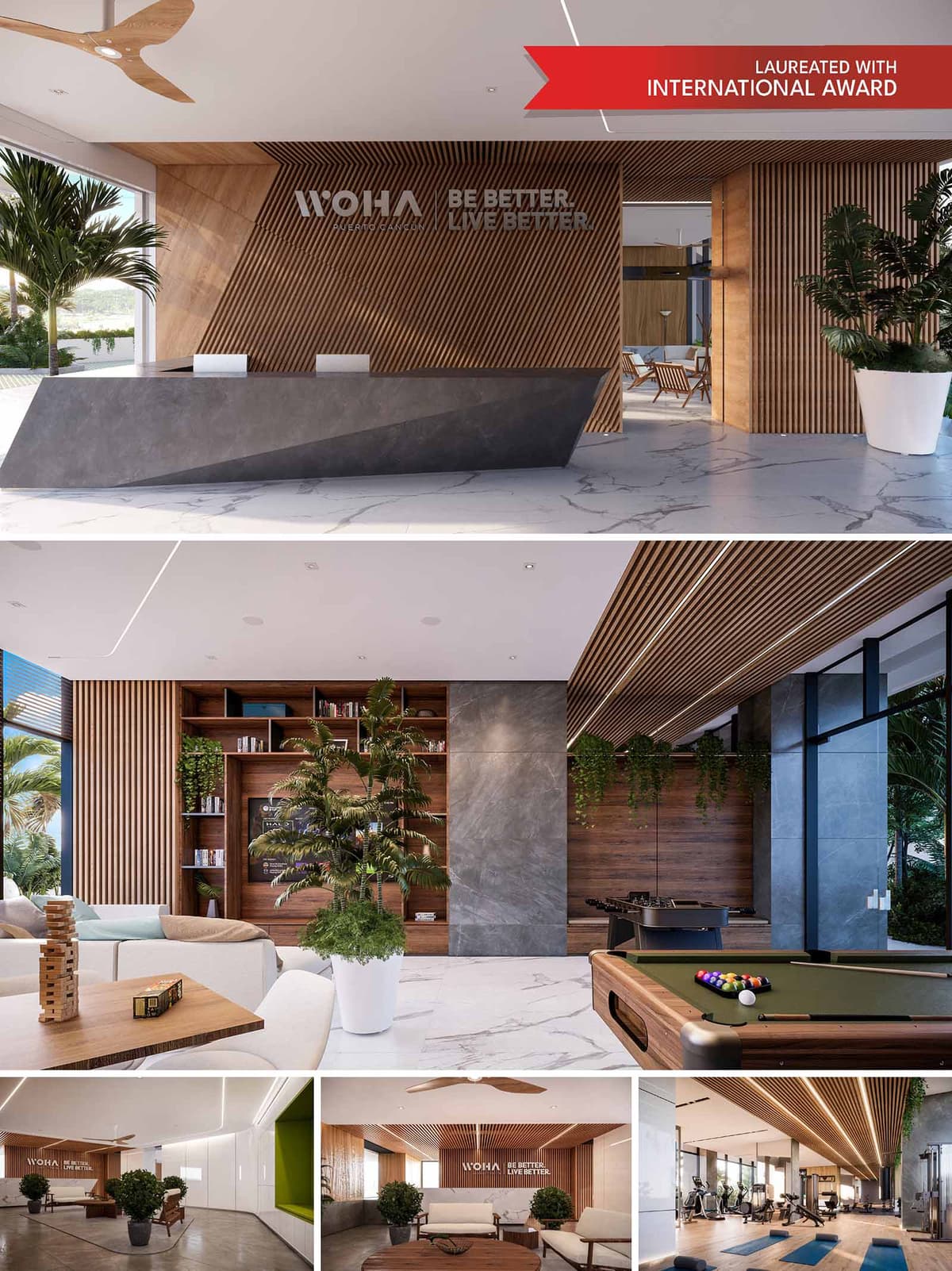
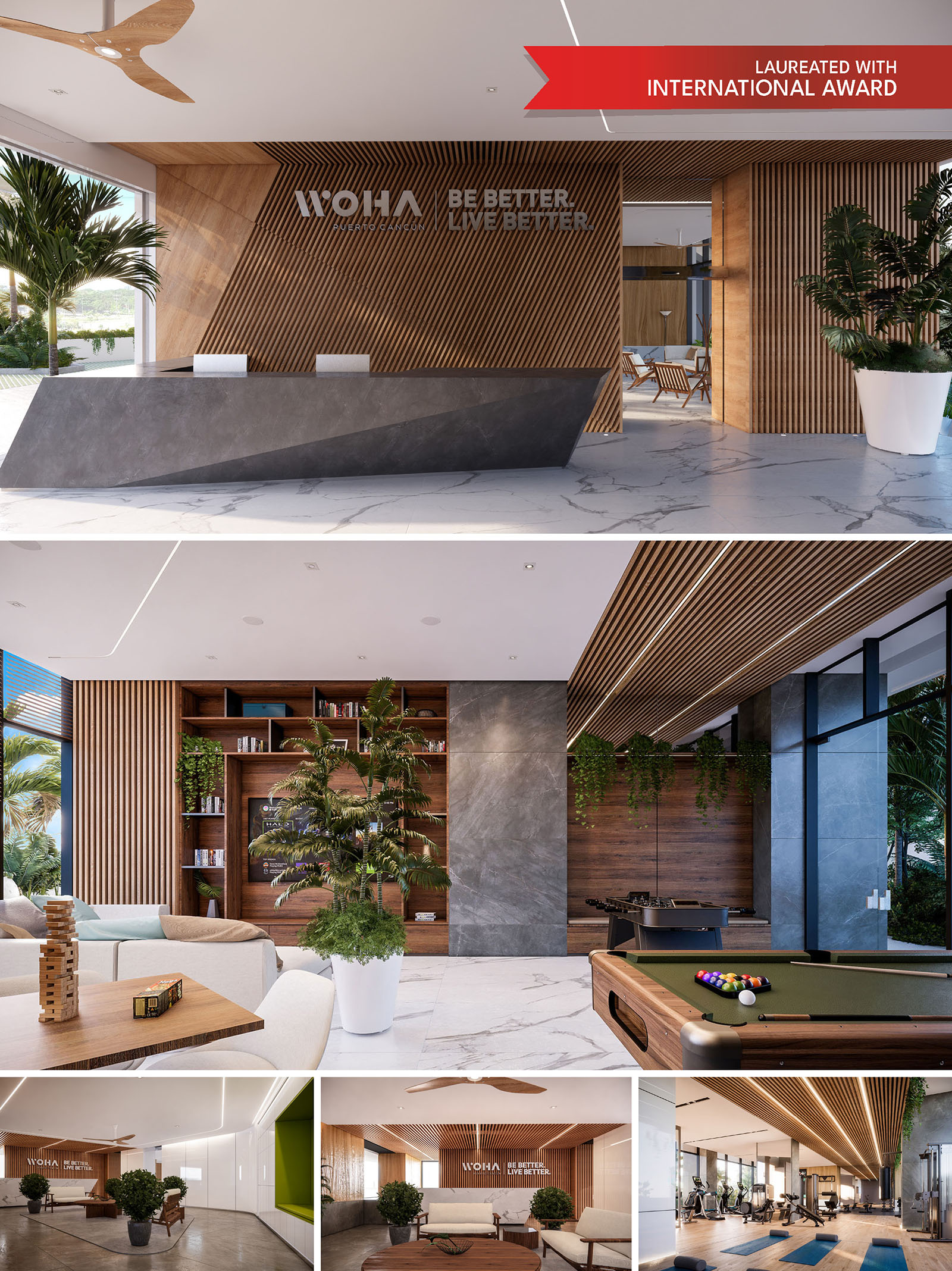
The lobby at WOHA serves as a threshold between urban life and the sanctuary of home, conceived as a spatial prologue to the sustainable living experience offered by the building. It is designed not simply as a reception area, but as an architectural statement—merging hospitality, wellness, and environmental consciousness into a singular, refined expression. The spatial composition emphasizes openness, natural materials, and a seamless integration with the tropical context of Puerto Cancún.
Upon entry, visitors are greeted by a double-height space that visually extends toward the lush landscape beyond. The reception desk is positioned as a sculptural anchor—a faceted monolith of dark stone that contrasts against the warm, vertical wooden slats behind it. Circulation paths are intuitively organized, guiding users toward social lounges, elevators, and landscaped courtyards. The layout ensures clear visual connectivity and efficient flow, eliminating clutter and prioritizing calm transitions. The spatial narrative is reinforced by the axial view from the reception desk to the exterior garden, underscoring the project's commitment to biophilic design and indoor-outdoor continuity.
The interior material palette combines contemporary finishes with natural warmth. Light marble-effect porcelain flooring extends across the lobby, offering both elegance and durability. Feature walls are clad in FSC-certified oak slats, providing rhythm, acoustic control, and texture. These vertical elements continue into the ceiling, visually unifying the space and emphasizing the height of the volume. Furniture pieces are crafted from solid wood and soft upholstery in neutral tones, arranged in informal clusters to foster interaction and relaxation. Potted tropical plants and integrated greenery enhance the ambiance, bringing nature into the heart of the building.
Expansive floor-to-ceiling glazing floods the lobby with daylight while framing views of the tropical landscaping outside. This design move reduces reliance on artificial lighting during the day and reinforces a connection to the natural setting. Overhead fans, strategically positioned, provide comfort in place of energy-intensive air conditioning during milder weather, aligning with passive ventilation strategies. The biophilic intent of the space is further emphasized by the inclusion of indoor planting niches and a curated selection of greenery placed at eye level—creating a living backdrop that evolves with the seasons.
Beyond its aesthetic function, the lobby is a multi-programmatic space. It includes a reading nook with integrated shelving, a business-style co-working corner with dedicated seating, and informal meeting areas. These inclusions ensure that the lobby is not just a transitory space but also a functional social hub where residents can work, relax, or engage with the community. The choice of materials and furnishings promotes acoustic comfort, visual softness, and thermal stability, creating an environment that is as serene as it is practical.
The lobby exemplifies WOHA’s sustainable ethos through its material choices, spatial efficiency, and environmental responsiveness. The use of locally sourced wood, energy-efficient lighting, and passive climate strategies such as solar orientation and natural ventilation all contribute to the project's reduced ecological footprint. By merging architecture and nature, the WOHA lobby becomes a place of encounter, reflection, and transition—elevating everyday experience while remaining deeply rooted in the principles of sustainable design.
• The Architecture Community International Residential Architecture Awards 2022 : Winner : Woha (2022)


• The Architecture Community International Residential Architecture Awards 2022 : Winner : Woha (2022)
The lobby at WOHA serves as a threshold between urban life and the sanctuary of home, conceived as a spatial prologue to the sustainable living experience offered by the building. It is designed not simply as a reception area, but as an architectural statement—merging hospitality, wellness, and environmental consciousness into a singular, refined expression. The spatial composition emphasizes openness, natural materials, and a seamless integration with the tropical context of Puerto Cancún.
Upon entry, visitors are greeted by a double-height space that visually extends toward the lush landscape beyond. The reception desk is positioned as a sculptural anchor—a faceted monolith of dark stone that contrasts against the warm, vertical wooden slats behind it. Circulation paths are intuitively organized, guiding users toward social lounges, elevators, and landscaped courtyards. The layout ensures clear visual connectivity and efficient flow, eliminating clutter and prioritizing calm transitions. The spatial narrative is reinforced by the axial view from the reception desk to the exterior garden, underscoring the project's commitment to biophilic design and indoor-outdoor continuity.
The interior material palette combines contemporary finishes with natural warmth. Light marble-effect porcelain flooring extends across the lobby, offering both elegance and durability. Feature walls are clad in FSC-certified oak slats, providing rhythm, acoustic control, and texture. These vertical elements continue into the ceiling, visually unifying the space and emphasizing the height of the volume. Furniture pieces are crafted from solid wood and soft upholstery in neutral tones, arranged in informal clusters to foster interaction and relaxation. Potted tropical plants and integrated greenery enhance the ambiance, bringing nature into the heart of the building.
Expansive floor-to-ceiling glazing floods the lobby with daylight while framing views of the tropical landscaping outside. This design move reduces reliance on artificial lighting during the day and reinforces a connection to the natural setting. Overhead fans, strategically positioned, provide comfort in place of energy-intensive air conditioning during milder weather, aligning with passive ventilation strategies. The biophilic intent of the space is further emphasized by the inclusion of indoor planting niches and a curated selection of greenery placed at eye level—creating a living backdrop that evolves with the seasons.
Beyond its aesthetic function, the lobby is a multi-programmatic space. It includes a reading nook with integrated shelving, a business-style co-working corner with dedicated seating, and informal meeting areas. These inclusions ensure that the lobby is not just a transitory space but also a functional social hub where residents can work, relax, or engage with the community. The choice of materials and furnishings promotes acoustic comfort, visual softness, and thermal stability, creating an environment that is as serene as it is practical.
The lobby exemplifies WOHA’s sustainable ethos through its material choices, spatial efficiency, and environmental responsiveness. The use of locally sourced wood, energy-efficient lighting, and passive climate strategies such as solar orientation and natural ventilation all contribute to the project's reduced ecological footprint. By merging architecture and nature, the WOHA lobby becomes a place of encounter, reflection, and transition—elevating everyday experience while remaining deeply rooted in the principles of sustainable design.
© 2021 by sanzpont [arquitectura] . Webpage by sanzpont [digital] . Innovative Digital Experiences
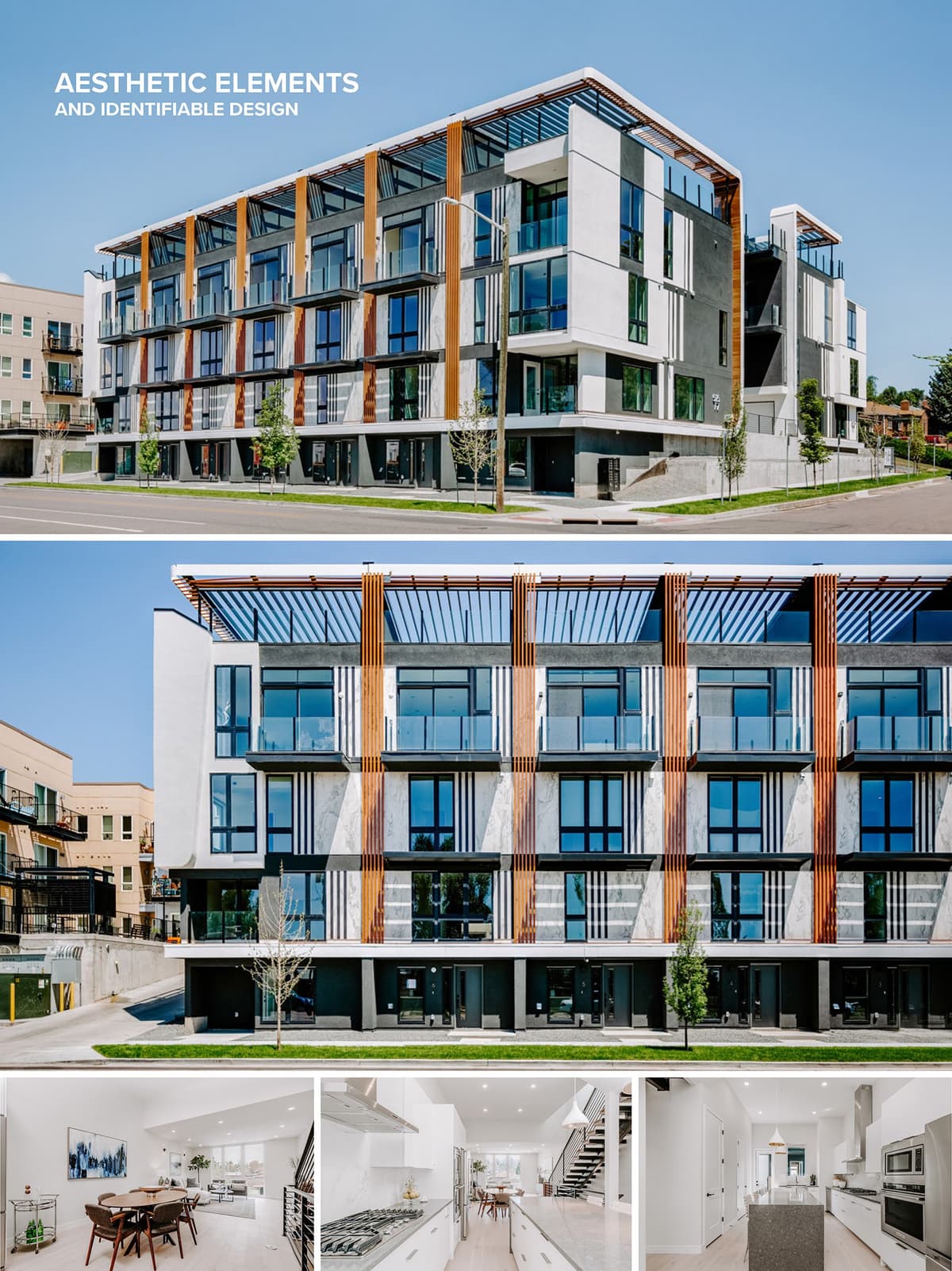

The challenge was to bring our contemporary design ideas to a very distinctive neighborhood, The Highlands, and to utilize a typical plan of two volumes of apartments divided by an alley. We accepted the challenge of creating our first residential architectural project in the US. Having previously completed several retail design projects in NY, TX, MD and FL, we were excited for this new creative opportunity! Thanks to the local architecture firm S-Arch for partnering with us to make 29ZEN a reality.
After visiting the site, its surroundings and several comparable properties in the area, we discovered a distinctive concept when designing townhomes in Denver; the repetition of the units with only a slight variation in the façade. We decided to preserve this concept while adding a building envelope that would wrap the volume and unify the units, so they are perceived as a continuous structure. We wanted to impart a sense of identity and uniqueness to the building, creating distinctive elements that will make it recognizable. We chose to emphasize the horizontality with long straight lines, creating the appearance of a longer building. The building envelope that wraps the structure becomes a pergola/canopy at the rooftop, creating the most identifiable characteristic of the design.
We were very clear from the beginning that the color palette of the façade should be clean and contemporary, with a touch of warmth that is necessary for any housing project. Inspired by the rocks of the snowy mountains of Denver, we chose to use an innovative Porcelanosa product, an ultra-thin, large-format, ventilated porcelain tile system. The texture of the white stony marble is inherent to Denver’s snowy winters. In addition, elements of wood texture provide necessary warmth and offer a subtly elegant appearance. The third component is stainless steel, which complements the other elements with an industrial edge.
The layout of the living spaces is not typical. The dining and living spaces are located on the third floor, with direct access to the rooftop. This promotes daily use of the outdoor spaces during the warmer months.


The challenge was to bring our contemporary design ideas to a very distinctive neighborhood, The Highlands, and to utilize a typical plan of two volumes of apartments divided by an alley. We accepted the challenge of creating our first residential architectural project in the US. Having previously completed several retail design projects in NY, TX, MD and FL, we were excited for this new creative opportunity! Thanks to the local architecture firm S-Arch for partnering with us to make 29ZEN a reality.
After visiting the site, its surroundings and several comparable properties in the area, we discovered a distinctive concept when designing townhomes in Denver; the repetition of the units with only a slight variation in the façade. We decided to preserve this concept while adding a building envelope that would wrap the volume and unify the units, so they are perceived as a continuous structure. We wanted to impart a sense of identity and uniqueness to the building, creating distinctive elements that will make it recognizable. We chose to emphasize the horizontality with long straight lines, creating the appearance of a longer building. The building envelope that wraps the structure becomes a pergola/canopy at the rooftop, creating the most identifiable characteristic of the design.
We were very clear from the beginning that the color palette of the façade should be clean and contemporary, with a touch of warmth that is necessary for any housing project. Inspired by the rocks of the snowy mountains of Denver, we chose to use an innovative Porcelanosa product, an ultra-thin, large-format, ventilated porcelain tile system. The texture of the white stony marble is inherent to Denver’s snowy winters. In addition, elements of wood texture provide necessary warmth and offer a subtly elegant appearance. The third component is stainless steel, which complements the other elements with an industrial edge.
The layout of the living spaces is not typical. The dining and living spaces are located on the third floor, with direct access to the rooftop. This promotes daily use of the outdoor spaces during the warmer months.
© 2021 by sanzpont [arquitectura] . Webpage by sanzpont [digital] . Innovative Digital Experiences
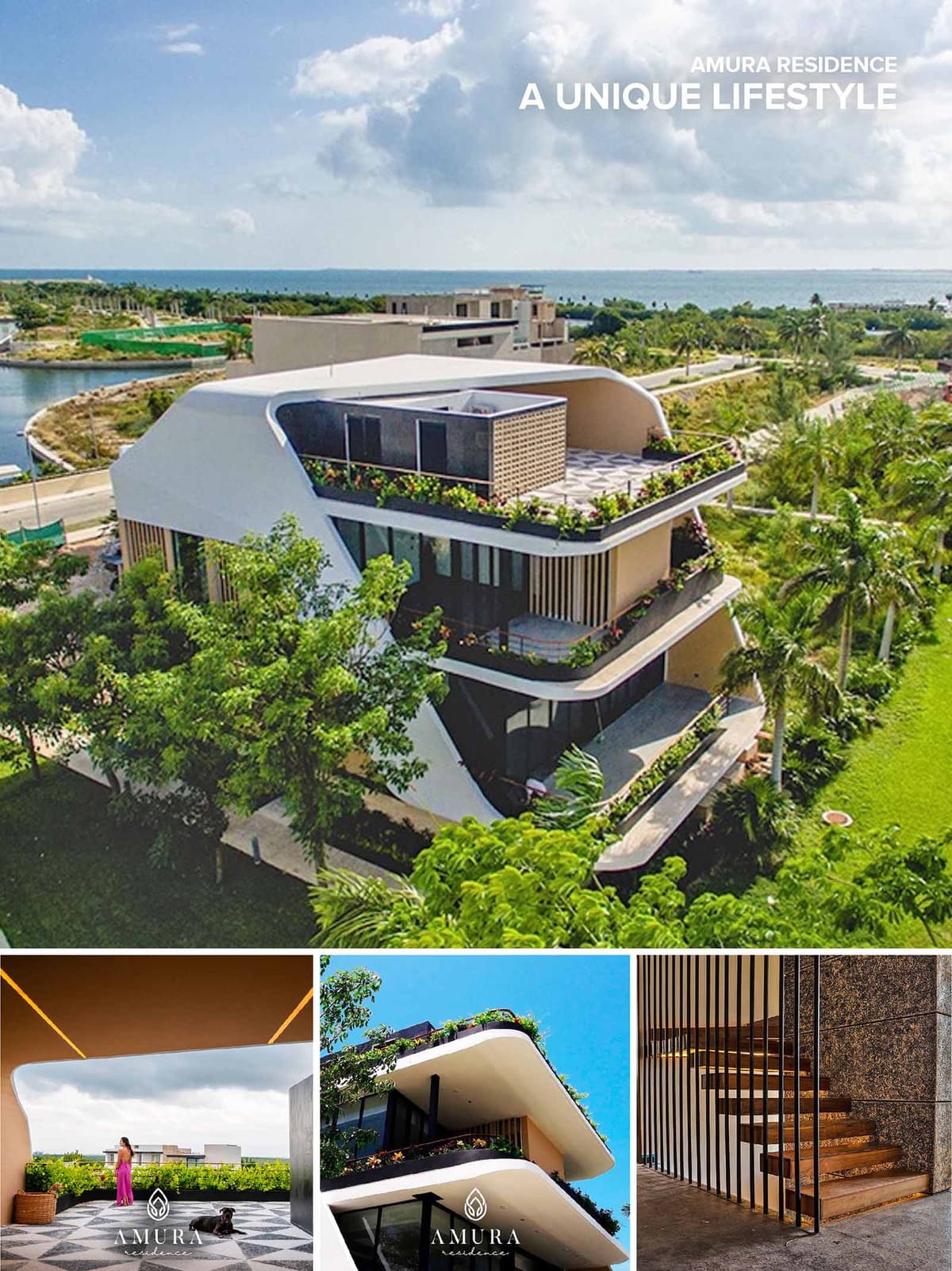

Amura Villa is conceived as a contemporary seaside sanctuary that translates the softness of waves and the horizontality of the Caribbean horizon into architecture. The project seeks to dissolve the boundary between interior and exterior through deep, vegetated terraces that function as habitable “contours” wrapping the building. Each level is designed as a continuous platform of living, where light, air and vegetation are the primary materials. The enveloping white shell unifies the volume, giving the residence a sculpted, monolithic character while framing views toward the lagoon and the sea.
Located in Cancún, the villa is positioned to capture prevailing breezes and long-distance views while maintaining privacy from the surrounding urbanization. The footprint is compact, freeing up the ground level for gardens and permeable surfaces. Orientation privileges shaded facades and extended overhangs to protect glazing from direct solar gain, essential in the tropical climate. The building opens toward the lush landscape, with generous setbacks that allow existing trees to be preserved and integrated into the design. Circulation is organized along the cooler, shaded sides of the plot, connecting all levels to exterior terraces and roof garden.
The architectural language is defined by fluid horizontal slabs with rounded corners, creating a dynamic profile that evokes nautical lines. These slabs project outward to form continuous balconies, simultaneously providing shade and outdoor living space. The white external shell acts as an exoskeleton, with carved openings that reveal darker, recessed glazing and timber accents. Vertical fins and lattice elements introduce rhythm to the facade, filtering light and offering controlled transparency toward the interior. The contrast between smooth white surfaces and warm, natural materials reinforces the dialogue between minimalism and tropical comfort.
Inside, the layout privileges open-plan social areas directly connected to the terraces, allowing daily life to extend outdoors. Floor-to-ceiling sliding panels create flexible boundaries, transforming living rooms into verandas. Materials are selected for their tactile quality and durability in a marine environment: large-format stone or porcelain floors, plastered walls in soft tones, and carpentry in tropical hardwoods. The staircase becomes a central sculptural element, combining floating timber treads with slender metal balustrades and integrated lighting that emphasizes its volumetric presence. The interior palette remains neutral, designed to frame the surrounding greenery and sky as the main decorative elements.
Vegetation is a fundamental layer of the project. Planters integrated into every terrace create hanging gardens that soften the geometry and improve microclimate. The rooftop is conceived as an elevated patio with patterned flooring, perimeter planters and generous seating zones, functioning as a private belvedere over Cancún. At ground level, pathways weave through existing trees, leading residents to shaded corners and contemplative spaces. The landscape design prioritizes native and low-maintenance species, reducing irrigation needs and fostering biodiversity in the residential environment.
From the outset, environmental performance guided the design decisions. The deep overhangs, vegetated terraces and vertical fins act as passive shading devices, significantly reducing heat gain on glazed surfaces. Cross-ventilation is maximized through aligned openings on opposite facades, minimizing reliance on mechanical cooling during temperate hours. The extensive use of greenery on all levels contributes to evaporative cooling and improves air quality. Durable, locally sourced materials limit maintenance and reduce the project’s embodied energy. Provision for rainwater collection and efficient irrigation supports the landscaping strategy, while the compact volume and permeable ground-level areas help manage stormwater in the coastal context.


Amura Villa is conceived as a contemporary seaside sanctuary that translates the softness of waves and the horizontality of the Caribbean horizon into architecture. The project seeks to dissolve the boundary between interior and exterior through deep, vegetated terraces that function as habitable “contours” wrapping the building. Each level is designed as a continuous platform of living, where light, air and vegetation are the primary materials. The enveloping white shell unifies the volume, giving the residence a sculpted, monolithic character while framing views toward the lagoon and the sea.
Located in Cancún, the villa is positioned to capture prevailing breezes and long-distance views while maintaining privacy from the surrounding urbanization. The footprint is compact, freeing up the ground level for gardens and permeable surfaces. Orientation privileges shaded facades and extended overhangs to protect glazing from direct solar gain, essential in the tropical climate. The building opens toward the lush landscape, with generous setbacks that allow existing trees to be preserved and integrated into the design. Circulation is organized along the cooler, shaded sides of the plot, connecting all levels to exterior terraces and roof garden.
The architectural language is defined by fluid horizontal slabs with rounded corners, creating a dynamic profile that evokes nautical lines. These slabs project outward to form continuous balconies, simultaneously providing shade and outdoor living space. The white external shell acts as an exoskeleton, with carved openings that reveal darker, recessed glazing and timber accents. Vertical fins and lattice elements introduce rhythm to the facade, filtering light and offering controlled transparency toward the interior. The contrast between smooth white surfaces and warm, natural materials reinforces the dialogue between minimalism and tropical comfort.
Inside, the layout privileges open-plan social areas directly connected to the terraces, allowing daily life to extend outdoors. Floor-to-ceiling sliding panels create flexible boundaries, transforming living rooms into verandas. Materials are selected for their tactile quality and durability in a marine environment: large-format stone or porcelain floors, plastered walls in soft tones, and carpentry in tropical hardwoods. The staircase becomes a central sculptural element, combining floating timber treads with slender metal balustrades and integrated lighting that emphasizes its volumetric presence. The interior palette remains neutral, designed to frame the surrounding greenery and sky as the main decorative elements.
Vegetation is a fundamental layer of the project. Planters integrated into every terrace create hanging gardens that soften the geometry and improve microclimate. The rooftop is conceived as an elevated patio with patterned flooring, perimeter planters and generous seating zones, functioning as a private belvedere over Cancún. At ground level, pathways weave through existing trees, leading residents to shaded corners and contemplative spaces. The landscape design prioritizes native and low-maintenance species, reducing irrigation needs and fostering biodiversity in the residential environment.
From the outset, environmental performance guided the design decisions. The deep overhangs, vegetated terraces and vertical fins act as passive shading devices, significantly reducing heat gain on glazed surfaces. Cross-ventilation is maximized through aligned openings on opposite facades, minimizing reliance on mechanical cooling during temperate hours. The extensive use of greenery on all levels contributes to evaporative cooling and improves air quality. Durable, locally sourced materials limit maintenance and reduce the project’s embodied energy. Provision for rainwater collection and efficient irrigation supports the landscaping strategy, while the compact volume and permeable ground-level areas help manage stormwater in the coastal context.
© 2021 by sanzpont [arquitectura] . Webpage by sanzpont [digital] . Innovative Digital Experiences
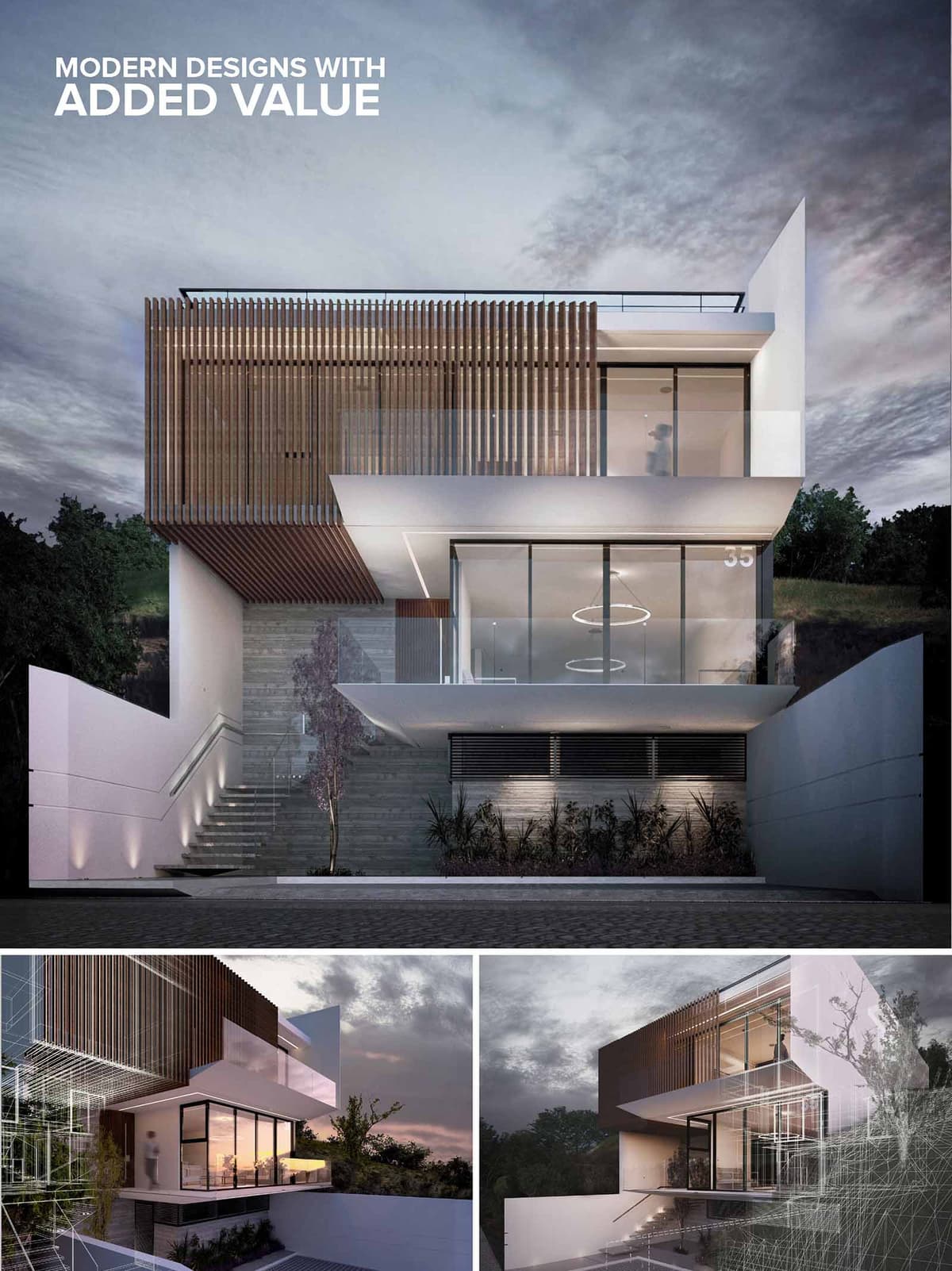

DECO35 Villa is conceived as a compact urban retreat that maximizes a narrow, sloping plot in Mexico City through a bold, volumetric composition. The design explores the interplay of solid and void, with cantilevered white planes that seem to float above a grounded base, creating a dynamic relationship between mass and lightness. The house is oriented to capture key views and sunsets, while protecting privacy from the street, resulting in a façade that is simultaneously open and introspective.
The architectural language is distinctly contemporary, defined by clean lines, large glazed surfaces, and a refined combination of materials. Horizontal slabs extend outward to form deep overhangs, emphasizing the villa’s layered composition and producing strong shadows that animate the façade throughout the day. This modern expression is balanced by warm, tactile elements that anchor the building to its natural context.
The villa negotiates a significant topographical difference between street level and the rear of the site. The main access is located at the lower level, where a recessed base integrates vehicle and pedestrian entry while maintaining a controlled, almost sculpted street presence. A linear stair along the side boundary, subtly illuminated, leads residents up through the site and sets the tone for the vertical journey inside.
The program is organized in stacked volumes: a robust, partially buried plinth containing services and parking; a transparent middle level for social and family life; and an upper, more private volume that hosts the bedrooms. Each level is slightly offset, creating strategic cantilevers that generate covered outdoor terraces and enhance the sense of levitation of the upper floors.
The façade is defined by the contrast between smooth white plaster planes, floor-to-ceiling glazing, and a vertical screen of wooden slats. This screen functions both as a brise-soleil and as a warm visual filter, softening the rigor of the geometry and providing depth to the elevation. At night, integrated linear lighting emphasizes these elements, turning the villa into a subtle lantern within the urban fabric.
The ground-level base employs darker, horizontally textured concrete or stone, generating a robust podium that visually supports the lighter upper volumes. Transparent balustrades at terraces preserve unobstructed views while reinforcing the minimalist aesthetic. Interior illumination, visible through the large panes, plays an important role in expressing the internal spatial hierarchy to the exterior.
The interior layout prioritizes fluidity and visual continuity. The living and dining areas on the main level are conceived as an open-plan space aligned with the terrace, extending daily activities outward and accentuating the connection with the landscape. Generous glazing frames the surrounding vegetation and distant skyline, while the extended roof slabs shield interiors from direct sunlight, ensuring comfort.
Vertical circulation is treated as an architectural event rather than a purely functional element. The staircase, visible from the façade, becomes a sculptural feature that guides movement between levels and reinforces the perception of layered planes. Minimalist finishes and integrated lighting highlight the clarity of the structural geometry while maintaining an atmosphere of calm sophistication.
Environmental performance is integral to the project’s conception. The pronounced overhangs and the wooden brise-soleil are designed to reduce solar gain on the most exposed façades, particularly important in Mexico City’s high-altitude climate. These passive shading strategies limit overheating and reduce reliance on mechanical cooling, while still allowing for ample natural daylight.
Cross-ventilation is encouraged through operable windows positioned on opposing façades and along the staircase void, enabling stack effect ventilation and consistent air renewal. The use of durable, low-maintenance materials—such as treated wood, exposed concrete, and high-performance glazing—extends the building’s life cycle and minimizes replacement needs. Landscape strips at the base and on terraces aid in microclimate regulation and offer opportunities for native planting, contributing to biodiversity and a more resilient urban environment.


DECO35 Villa is conceived as a compact urban retreat that maximizes a narrow, sloping plot in Mexico City through a bold, volumetric composition. The design explores the interplay of solid and void, with cantilevered white planes that seem to float above a grounded base, creating a dynamic relationship between mass and lightness. The house is oriented to capture key views and sunsets, while protecting privacy from the street, resulting in a façade that is simultaneously open and introspective.
The architectural language is distinctly contemporary, defined by clean lines, large glazed surfaces, and a refined combination of materials. Horizontal slabs extend outward to form deep overhangs, emphasizing the villa’s layered composition and producing strong shadows that animate the façade throughout the day. This modern expression is balanced by warm, tactile elements that anchor the building to its natural context.
The villa negotiates a significant topographical difference between street level and the rear of the site. The main access is located at the lower level, where a recessed base integrates vehicle and pedestrian entry while maintaining a controlled, almost sculpted street presence. A linear stair along the side boundary, subtly illuminated, leads residents up through the site and sets the tone for the vertical journey inside.
The program is organized in stacked volumes: a robust, partially buried plinth containing services and parking; a transparent middle level for social and family life; and an upper, more private volume that hosts the bedrooms. Each level is slightly offset, creating strategic cantilevers that generate covered outdoor terraces and enhance the sense of levitation of the upper floors.
The façade is defined by the contrast between smooth white plaster planes, floor-to-ceiling glazing, and a vertical screen of wooden slats. This screen functions both as a brise-soleil and as a warm visual filter, softening the rigor of the geometry and providing depth to the elevation. At night, integrated linear lighting emphasizes these elements, turning the villa into a subtle lantern within the urban fabric.
The ground-level base employs darker, horizontally textured concrete or stone, generating a robust podium that visually supports the lighter upper volumes. Transparent balustrades at terraces preserve unobstructed views while reinforcing the minimalist aesthetic. Interior illumination, visible through the large panes, plays an important role in expressing the internal spatial hierarchy to the exterior.
The interior layout prioritizes fluidity and visual continuity. The living and dining areas on the main level are conceived as an open-plan space aligned with the terrace, extending daily activities outward and accentuating the connection with the landscape. Generous glazing frames the surrounding vegetation and distant skyline, while the extended roof slabs shield interiors from direct sunlight, ensuring comfort.
Vertical circulation is treated as an architectural event rather than a purely functional element. The staircase, visible from the façade, becomes a sculptural feature that guides movement between levels and reinforces the perception of layered planes. Minimalist finishes and integrated lighting highlight the clarity of the structural geometry while maintaining an atmosphere of calm sophistication.
Environmental performance is integral to the project’s conception. The pronounced overhangs and the wooden brise-soleil are designed to reduce solar gain on the most exposed façades, particularly important in Mexico City’s high-altitude climate. These passive shading strategies limit overheating and reduce reliance on mechanical cooling, while still allowing for ample natural daylight.
Cross-ventilation is encouraged through operable windows positioned on opposing façades and along the staircase void, enabling stack effect ventilation and consistent air renewal. The use of durable, low-maintenance materials—such as treated wood, exposed concrete, and high-performance glazing—extends the building’s life cycle and minimizes replacement needs. Landscape strips at the base and on terraces aid in microclimate regulation and offer opportunities for native planting, contributing to biodiversity and a more resilient urban environment.
© 2021 by sanzpont [arquitectura] . Webpage by sanzpont [digital] . Innovative Digital Experiences
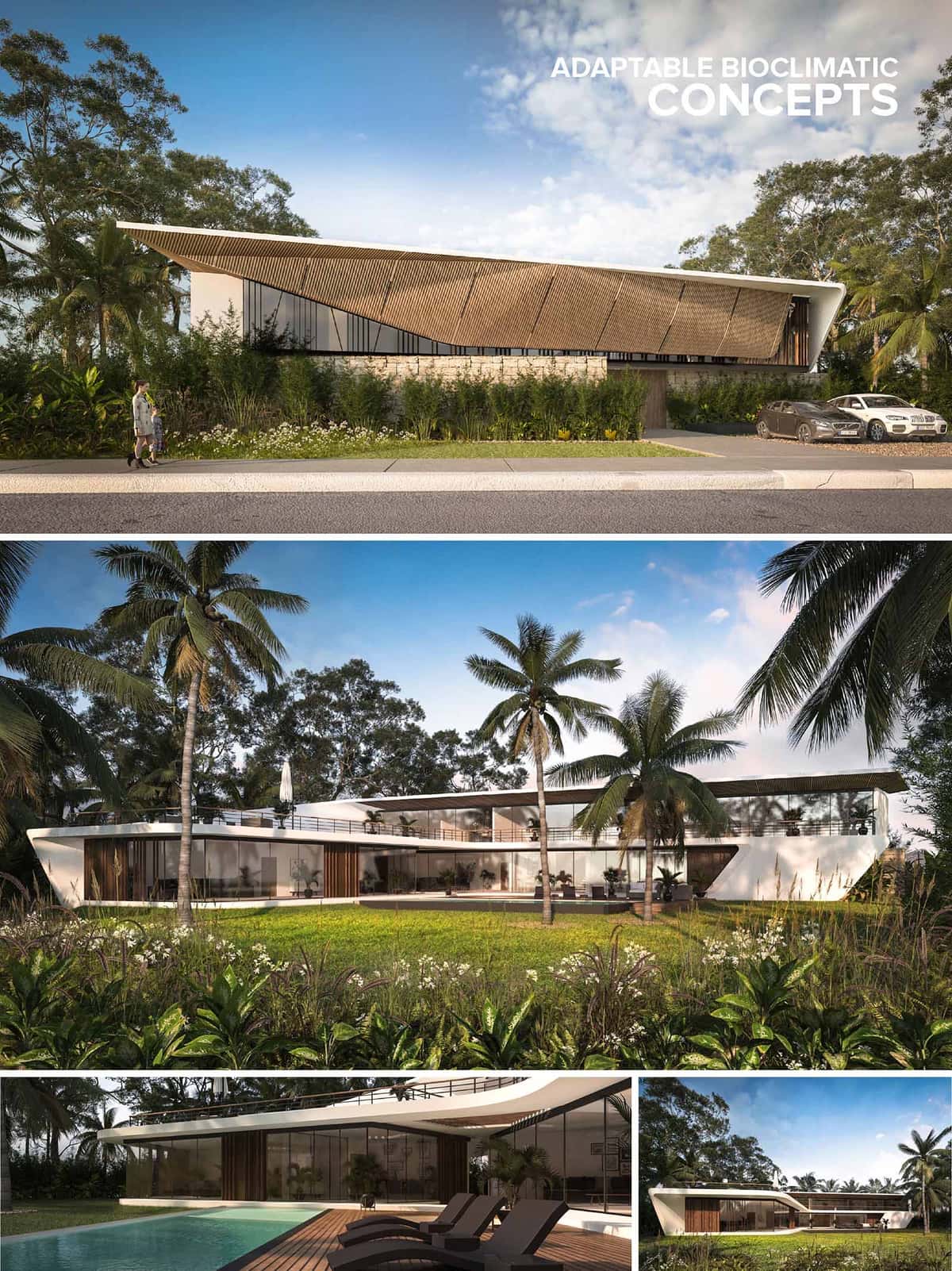

The RRT Villa in Punta Cana is conceived as an adaptable bioclimatic envelope rather than a closed object. The house stretches horizontally, embracing the landscape with a continuous, flowing roofline that folds down to form structural planes. Architecture, climate and lifestyle are integrated to create a resort-like home where shading, cross-ventilation and outdoor living drive every spatial decision. The composition balances privacy to the street with full openness to the garden and poolside life.
Located in a tropical coastal environment, the villa is oriented to capture prevailing breezes and frame long views across the garden. The street façade is more opaque and elevated, acting as a protective filter against heat, noise and visual exposure. Towards the interior of the plot, the building opens in a linear bar facing the lawn, water and palms, maximizing east–west light while controlling direct solar gain with deep overhangs and vertical fins.
The architectural expression is defined by a light, aerodynamically shaped white roof that hovers above glazed volumes. This roof wraps down at the ends, becoming a sculpted wall that anchors the composition. The overall language is minimal and horizontal, with continuous bands of glass, slender columns and recessed ground floor planes, giving the upper level a clear floating effect. The structure reads as a series of layered planes—roof, screen and glass—designed to modulate sun, views and privacy.
Living spaces are organized as a continuous indoor–outdoor sequence. Large sliding glass panels disappear into pockets, turning the main social areas into an open pavilion facing the pool. The upper floor enjoys a linear balcony and roof terrace, creating shaded outdoor lounges directly connected to bedrooms and family spaces. Visual permeability allows the landscape to be present from almost every room, while overhangs and screens ensure comfort without relying solely on mechanical cooling.
Materials are kept honest and tactile: smooth white rendered surfaces, warm vertical timber slats, clear and tinted glazing, and natural stone at the lower plinth. Timber elements function both as aesthetic accents and as operable shading devices. The pool deck is finished in timber to remain cool underfoot and to visually merge with the interior flooring. Junctions between roof and glazing are treated with thin reveals, emphasizing the lightness of the canopy and the precision of the modernist detailing.
The villa integrates passive design as its primary sustainability tool. Extended eaves, vertical wooden louvers and recessed façades reduce solar gain on the glass. Cross-ventilation corridors are established through the linear plan, allowing night flushing and natural cooling. The flat roof is designed to accommodate solar panels and potential green roof areas, reducing heat island effects. Local materials and tropical planting minimize environmental impact, while the shaded outdoor rooms and pool reduce dependence on air-conditioning by encouraging naturally ventilated living.
Landscape design reinforces the bioclimatic concept with dense, native vegetation forming a green buffer around the property. Palm trees punctuate the lawn, offering additional shade and anchoring the villa in its Caribbean context. The pool aligns with the main façade, acting as a climatic mirror that visually extends the interior and provides evaporative cooling. Low-maintenance, drought-tolerant species are prioritized to reduce irrigation demands, creating a cohesive, sustainable resort atmosphere for year-round troical living.


The RRT Villa in Punta Cana is conceived as an adaptable bioclimatic envelope rather than a closed object. The house stretches horizontally, embracing the landscape with a continuous, flowing roofline that folds down to form structural planes. Architecture, climate and lifestyle are integrated to create a resort-like home where shading, cross-ventilation and outdoor living drive every spatial decision. The composition balances privacy to the street with full openness to the garden and poolside life.
Located in a tropical coastal environment, the villa is oriented to capture prevailing breezes and frame long views across the garden. The street façade is more opaque and elevated, acting as a protective filter against heat, noise and visual exposure. Towards the interior of the plot, the building opens in a linear bar facing the lawn, water and palms, maximizing east–west light while controlling direct solar gain with deep overhangs and vertical fins.
The architectural expression is defined by a light, aerodynamically shaped white roof that hovers above glazed volumes. This roof wraps down at the ends, becoming a sculpted wall that anchors the composition. The overall language is minimal and horizontal, with continuous bands of glass, slender columns and recessed ground floor planes, giving the upper level a clear floating effect. The structure reads as a series of layered planes—roof, screen and glass—designed to modulate sun, views and privacy.
Living spaces are organized as a continuous indoor–outdoor sequence. Large sliding glass panels disappear into pockets, turning the main social areas into an open pavilion facing the pool. The upper floor enjoys a linear balcony and roof terrace, creating shaded outdoor lounges directly connected to bedrooms and family spaces. Visual permeability allows the landscape to be present from almost every room, while overhangs and screens ensure comfort without relying solely on mechanical cooling.
Materials are kept honest and tactile: smooth white rendered surfaces, warm vertical timber slats, clear and tinted glazing, and natural stone at the lower plinth. Timber elements function both as aesthetic accents and as operable shading devices. The pool deck is finished in timber to remain cool underfoot and to visually merge with the interior flooring. Junctions between roof and glazing are treated with thin reveals, emphasizing the lightness of the canopy and the precision of the modernist detailing.
The villa integrates passive design as its primary sustainability tool. Extended eaves, vertical wooden louvers and recessed façades reduce solar gain on the glass. Cross-ventilation corridors are established through the linear plan, allowing night flushing and natural cooling. The flat roof is designed to accommodate solar panels and potential green roof areas, reducing heat island effects. Local materials and tropical planting minimize environmental impact, while the shaded outdoor rooms and pool reduce dependence on air-conditioning by encouraging naturally ventilated living.
Landscape design reinforces the bioclimatic concept with dense, native vegetation forming a green buffer around the property. Palm trees punctuate the lawn, offering additional shade and anchoring the villa in its Caribbean context. The pool aligns with the main façade, acting as a climatic mirror that visually extends the interior and provides evaporative cooling. Low-maintenance, drought-tolerant species are prioritized to reduce irrigation demands, creating a cohesive, sustainable resort atmosphere for year-round troical living.
© 2021 by sanzpont [arquitectura] . Webpage by sanzpont [digital] . Innovative Digital Experiences
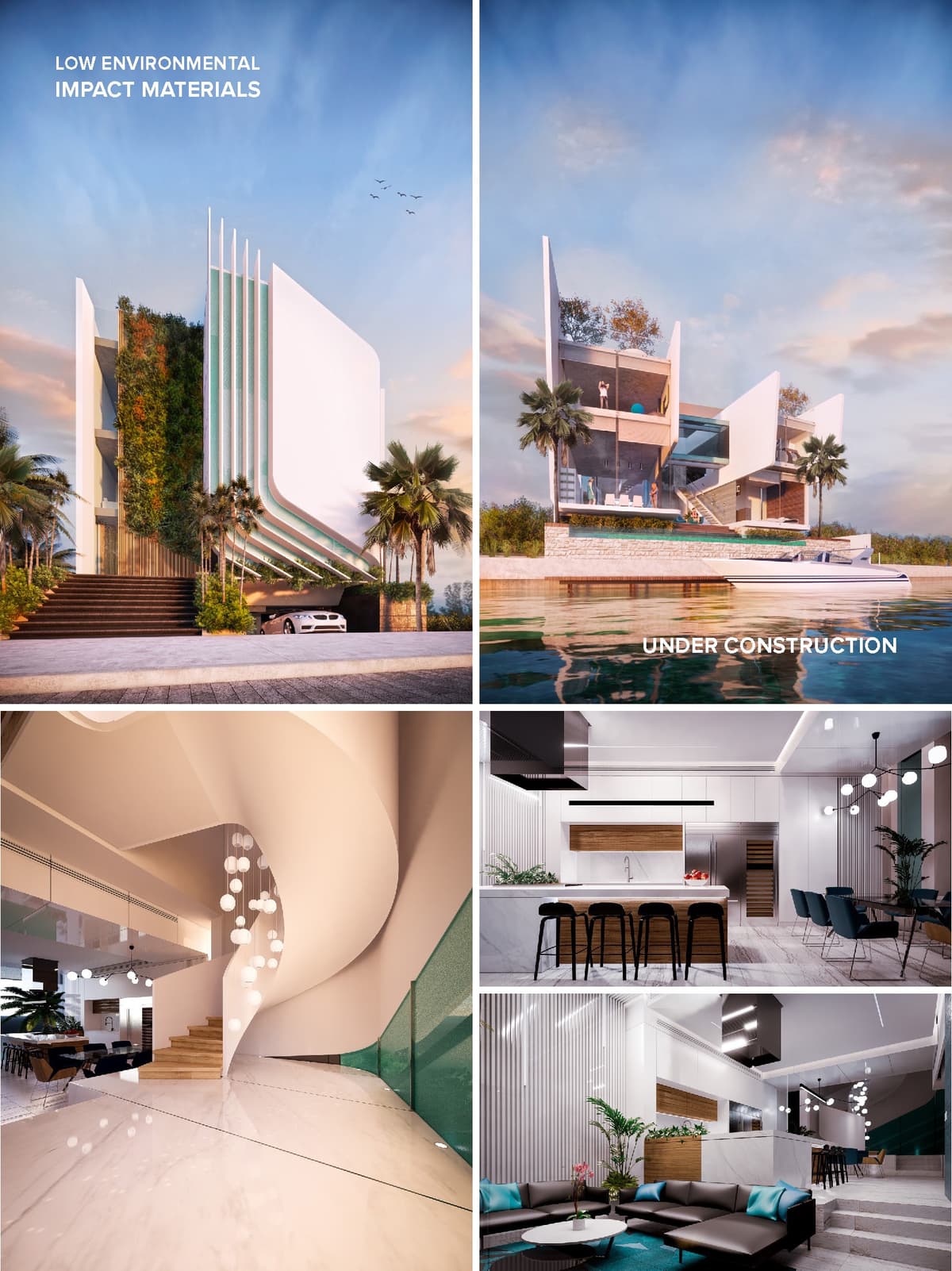

T&N Villa is conceived as a sculptural seaside residence that responds to the horizontality of Cancún’s coastline with a series of vertical, aerodynamic planes. The architectural language combines fluid curves and sharp fins, evoking the purity of nautical design and the lightness of sails catching the Caribbean breeze. The volume is fragmented into layered plates that open toward the water, creating framed views and deep shadows that emphasize the play of light throughout the day.
The project seeks to blur the threshold between interior and exterior, arranging the living areas as open platforms suspended between sky and water. Large double‑height spaces and generous terraces allow the tropical landscape to penetrate the house, while the expressive form provides privacy and climatic protection. The result is a contemporary villa that acts as a habitable landmark on the shoreline.
The villa is positioned on a waterfront plot with direct access to a private dock, reinforcing a strong connection with the lagoon. The main façade facing the street is more introverted and iconic, defined by tall white vertical blades and a dense green wall that mediates between the public realm and the domestic life within. A broad stair, lifted above the sidewalk, creates a ceremonial arrival and subtly separates the residence from the urban level.
Toward the water, the architecture opens dramatically. Cantilevered slabs project over the retaining wall, generating shaded outdoor lounges and a linear pool that visually merges with the lagoon. Palm trees and low vegetation soften the edges of the platform, while the building’s geometry is carefully oriented to capture breezes and frame sunsets over the water.
The composition is organized in stacked horizontal plates intersected by vertical fins that act simultaneously as structural elements, solar control devices, and formal signatures. These fins curve gently at their extremities, guiding views and directing circulation. Large glass panes in between create continuous visual contact with the surroundings while preserving the clarity of the structural grid.
Functionally, the lower level accommodates access, service areas, and recreational spaces close to the dock and pool. The main living floor is conceived as a free plan where living, dining, and kitchen areas flow without partitions, opening entirely to terraces on both the street and lagoon sides. Upper levels host private suites and balconies that benefit from elevated panoramas, while rooftop gardens crown the composition and extend the usable outdoor space.
The interior design follows the same fluid and refined language as the exterior shell. A sculptural helical staircase in soft off‑white tones becomes the heart of the house, connecting all levels with a continuous ribbon of solid surface and timber treads. A cloud of spherical pendant luminaires accentuates the verticality of the void, creating a dynamic light installation.
Finishes are intentionally restrained: large‑format marble‑like floors reflect light and amplify spatial depth, while white walls and ceilings form a neutral canvas for selective accents of warm wood and turquoise textiles that recall the sea. The open‑plan kitchen integrates minimalist white cabinetry with natural wood panels and a central island in stone, complemented by black bar stools and linear lighting. In the living area, modular sofas in neutral tones sit on turquoise rugs, reinforcing the coastal atmosphere without resorting to literal motifs.
The lighting strategy combines abundant natural light with carefully choreographed artificial illumination. Daylight is controlled by the deep overhangs and vertical fins, which limit direct solar gain while allowing soft, reflected light into the interiors. At night, a system of recessed linear fixtures and pendant lamps defines each zone, emphasizing spatial hierarchies and the sculptural qualities of the staircase and double‑height voids.
Thermal comfort is addressed through cross‑ventilation enabled by operable façade elements on opposite orientations, together with high ceilings that favor air circulation in the humid tropical climate. Interior acoustics benefit from the mix of hard reflective surfaces and softer elements such as upholstered furniture, area rugs, and vegetation that collectively reduce reverberation in the open spaces.
The villa integrates several strategies aimed at minimizing environmental impact while enhancing user comfort. The façade system of projecting fins and deep horizontal slabs acts as a passive shading device, significantly reducing cooling loads in Cancún’s hot climate. Glazed surfaces are specified with high‑performance coatings to limit heat gain while maintaining transparency and views.
Materials are selected for durability and reduced embodied energy, prioritizing locally available stone, certified timber, and finishes with low volatile organic compound emissions. The vegetated façades and rooftop gardens contribute to urban heat‑island mitigation, offer additional insulation, and support local biodiversity. Landscape design favors native and drought‑tolerant plant species, decreasing irrigation needs. Provisions for rainwater collection and greywater reuse, combined with efficient LED lighting and energy‑saving equipment, reinforce the project’s commitment to a low‑impact, contemporary coastal lifestyle.


T&N Villa is conceived as a sculptural seaside residence that responds to the horizontality of Cancún’s coastline with a series of vertical, aerodynamic planes. The architectural language combines fluid curves and sharp fins, evoking the purity of nautical design and the lightness of sails catching the Caribbean breeze. The volume is fragmented into layered plates that open toward the water, creating framed views and deep shadows that emphasize the play of light throughout the day.
The project seeks to blur the threshold between interior and exterior, arranging the living areas as open platforms suspended between sky and water. Large double‑height spaces and generous terraces allow the tropical landscape to penetrate the house, while the expressive form provides privacy and climatic protection. The result is a contemporary villa that acts as a habitable landmark on the shoreline.
The villa is positioned on a waterfront plot with direct access to a private dock, reinforcing a strong connection with the lagoon. The main façade facing the street is more introverted and iconic, defined by tall white vertical blades and a dense green wall that mediates between the public realm and the domestic life within. A broad stair, lifted above the sidewalk, creates a ceremonial arrival and subtly separates the residence from the urban level.
Toward the water, the architecture opens dramatically. Cantilevered slabs project over the retaining wall, generating shaded outdoor lounges and a linear pool that visually merges with the lagoon. Palm trees and low vegetation soften the edges of the platform, while the building’s geometry is carefully oriented to capture breezes and frame sunsets over the water.
The composition is organized in stacked horizontal plates intersected by vertical fins that act simultaneously as structural elements, solar control devices, and formal signatures. These fins curve gently at their extremities, guiding views and directing circulation. Large glass panes in between create continuous visual contact with the surroundings while preserving the clarity of the structural grid.
Functionally, the lower level accommodates access, service areas, and recreational spaces close to the dock and pool. The main living floor is conceived as a free plan where living, dining, and kitchen areas flow without partitions, opening entirely to terraces on both the street and lagoon sides. Upper levels host private suites and balconies that benefit from elevated panoramas, while rooftop gardens crown the composition and extend the usable outdoor space.
The interior design follows the same fluid and refined language as the exterior shell. A sculptural helical staircase in soft off‑white tones becomes the heart of the house, connecting all levels with a continuous ribbon of solid surface and timber treads. A cloud of spherical pendant luminaires accentuates the verticality of the void, creating a dynamic light installation.
Finishes are intentionally restrained: large‑format marble‑like floors reflect light and amplify spatial depth, while white walls and ceilings form a neutral canvas for selective accents of warm wood and turquoise textiles that recall the sea. The open‑plan kitchen integrates minimalist white cabinetry with natural wood panels and a central island in stone, complemented by black bar stools and linear lighting. In the living area, modular sofas in neutral tones sit on turquoise rugs, reinforcing the coastal atmosphere without resorting to literal motifs.
The lighting strategy combines abundant natural light with carefully choreographed artificial illumination. Daylight is controlled by the deep overhangs and vertical fins, which limit direct solar gain while allowing soft, reflected light into the interiors. At night, a system of recessed linear fixtures and pendant lamps defines each zone, emphasizing spatial hierarchies and the sculptural qualities of the staircase and double‑height voids.
Thermal comfort is addressed through cross‑ventilation enabled by operable façade elements on opposite orientations, together with high ceilings that favor air circulation in the humid tropical climate. Interior acoustics benefit from the mix of hard reflective surfaces and softer elements such as upholstered furniture, area rugs, and vegetation that collectively reduce reverberation in the open spaces.
The villa integrates several strategies aimed at minimizing environmental impact while enhancing user comfort. The façade system of projecting fins and deep horizontal slabs acts as a passive shading device, significantly reducing cooling loads in Cancún’s hot climate. Glazed surfaces are specified with high‑performance coatings to limit heat gain while maintaining transparency and views.
Materials are selected for durability and reduced embodied energy, prioritizing locally available stone, certified timber, and finishes with low volatile organic compound emissions. The vegetated façades and rooftop gardens contribute to urban heat‑island mitigation, offer additional insulation, and support local biodiversity. Landscape design favors native and drought‑tolerant plant species, decreasing irrigation needs. Provisions for rainwater collection and greywater reuse, combined with efficient LED lighting and energy‑saving equipment, reinforce the project’s commitment to a low‑impact, contemporary coastal lifestyle.
© 2021 by sanzpont [arquitectura] . Webpage by sanzpont [digital] . Innovative Digital Experiences
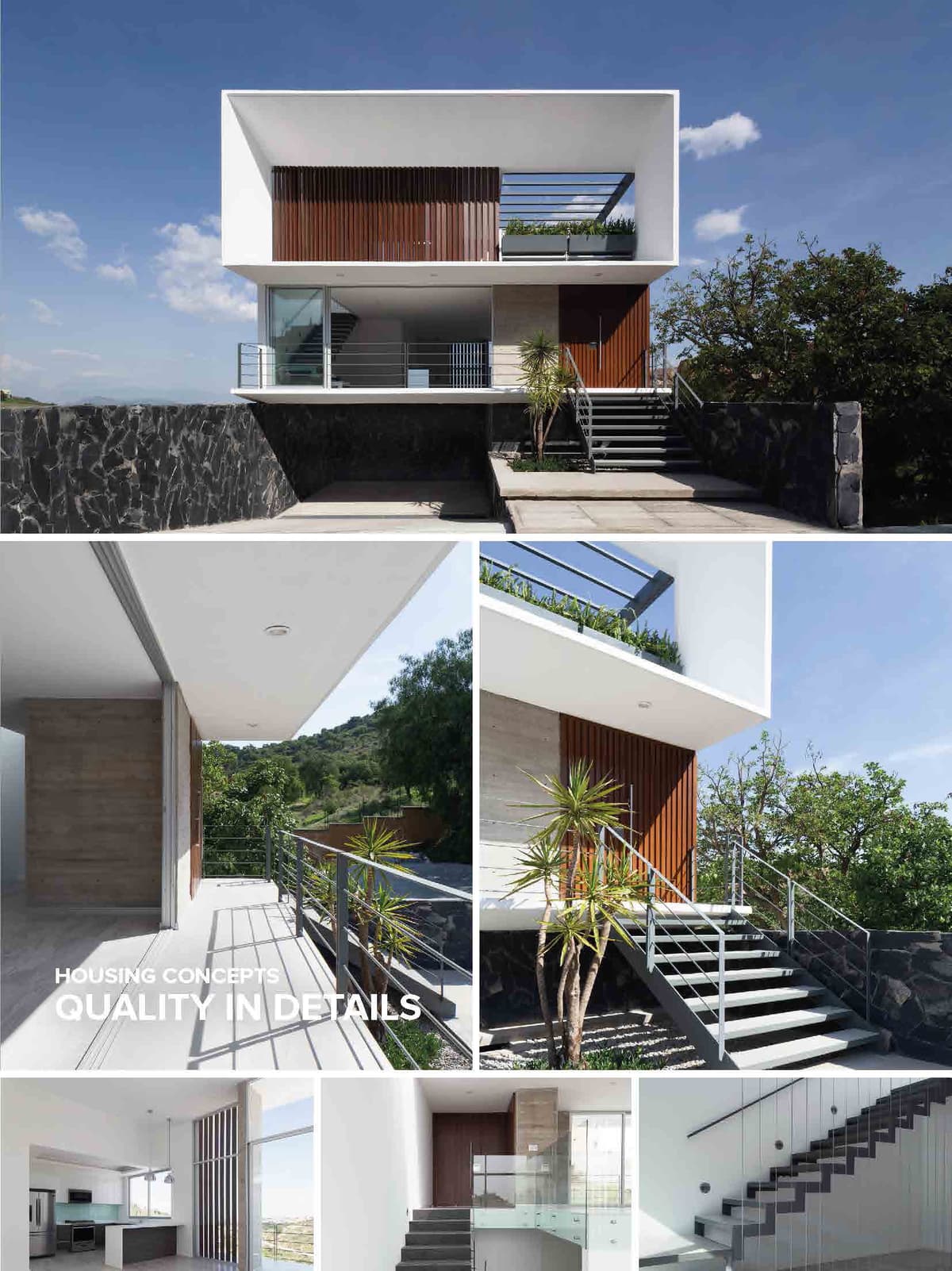

VAN24 house is located just north of Mexico City, in the hills near the Madin dam. This project was developed on a lot with excellent views of the city and of two volcanoes, Popocatépetl and Iztaccíhuatl. The view was a central aspect of the design process.
The land contains a pronounced downward slope, ending up at almost six meters /almost 20 ft. below street level. Taking advantage of the lot’s natural topography, the house was constructed at the lowest point, creating two underground levels. This layout offered the opportunity to give the two lower levels a sense of privacy and security that is perfect for the bedroom area.
There are two and a half levels above the street. The main entrance and living area are found one half level above the street, while you step down one half level to the kitchen and dining area. This creates a double height ceiling and ensures uninterrupted views from any vantage point within the main living space
A large four-panel sliding glass door in the living room opens onto a balcony that runs the entire length of the facade, creating a continuous experience between the interior and the exterior. This sense of continuity, combined with the double height ceiling, was essential in creating a spacious open floor plan for the main living space.
The focus remains on the incredible views of the city as we move to the highest level of the house, the roof garden. This space, consisting of a terrace and crowned by a light, white cover that opens to the sky like a screen, was designed as an ideal family gathering place and uses greenery to create an urban sanctuary. Wood louvers offer a sense of privacy from the outside, while admitting light and air into the space.
The concept of VAN24, a floating house, arose from the very use of the half levels. Having the main entrance a half level above the street and the covered parking a half level below, created a base. The treatment of this base was important since it had to provide a contrasting texture and color to encourage a much darker appearance that essentially disappears when in the shadows. For this reason, a slab stone was chosen from a nearby quarry that contrasts with the white of the two levels it supports. When these levels create shadow on the stone base it is possible to imagine that the house is levitating in the air, floating.


VAN24 house is located just north of Mexico City, in the hills near the Madin dam. This project was developed on a lot with excellent views of the city and of two volcanoes, Popocatépetl and Iztaccíhuatl. The view was a central aspect of the design process.
The land contains a pronounced downward slope, ending up at almost six meters /almost 20 ft. below street level. Taking advantage of the lot’s natural topography, the house was constructed at the lowest point, creating two underground levels. This layout offered the opportunity to give the two lower levels a sense of privacy and security that is perfect for the bedroom area.
There are two and a half levels above the street. The main entrance and living area are found one half level above the street, while you step down one half level to the kitchen and dining area. This creates a double height ceiling and ensures uninterrupted views from any vantage point within the main living space
A large four-panel sliding glass door in the living room opens onto a balcony that runs the entire length of the facade, creating a continuous experience between the interior and the exterior. This sense of continuity, combined with the double height ceiling, was essential in creating a spacious open floor plan for the main living space.
The focus remains on the incredible views of the city as we move to the highest level of the house, the roof garden. This space, consisting of a terrace and crowned by a light, white cover that opens to the sky like a screen, was designed as an ideal family gathering place and uses greenery to create an urban sanctuary. Wood louvers offer a sense of privacy from the outside, while admitting light and air into the space.
The concept of VAN24, a floating house, arose from the very use of the half levels. Having the main entrance a half level above the street and the covered parking a half level below, created a base. The treatment of this base was important since it had to provide a contrasting texture and color to encourage a much darker appearance that essentially disappears when in the shadows. For this reason, a slab stone was chosen from a nearby quarry that contrasts with the white of the two levels it supports. When these levels create shadow on the stone base it is possible to imagine that the house is levitating in the air, floating.
© 2021 by sanzpont [arquitectura] . Webpage by sanzpont [digital] . Innovative Digital Experiences
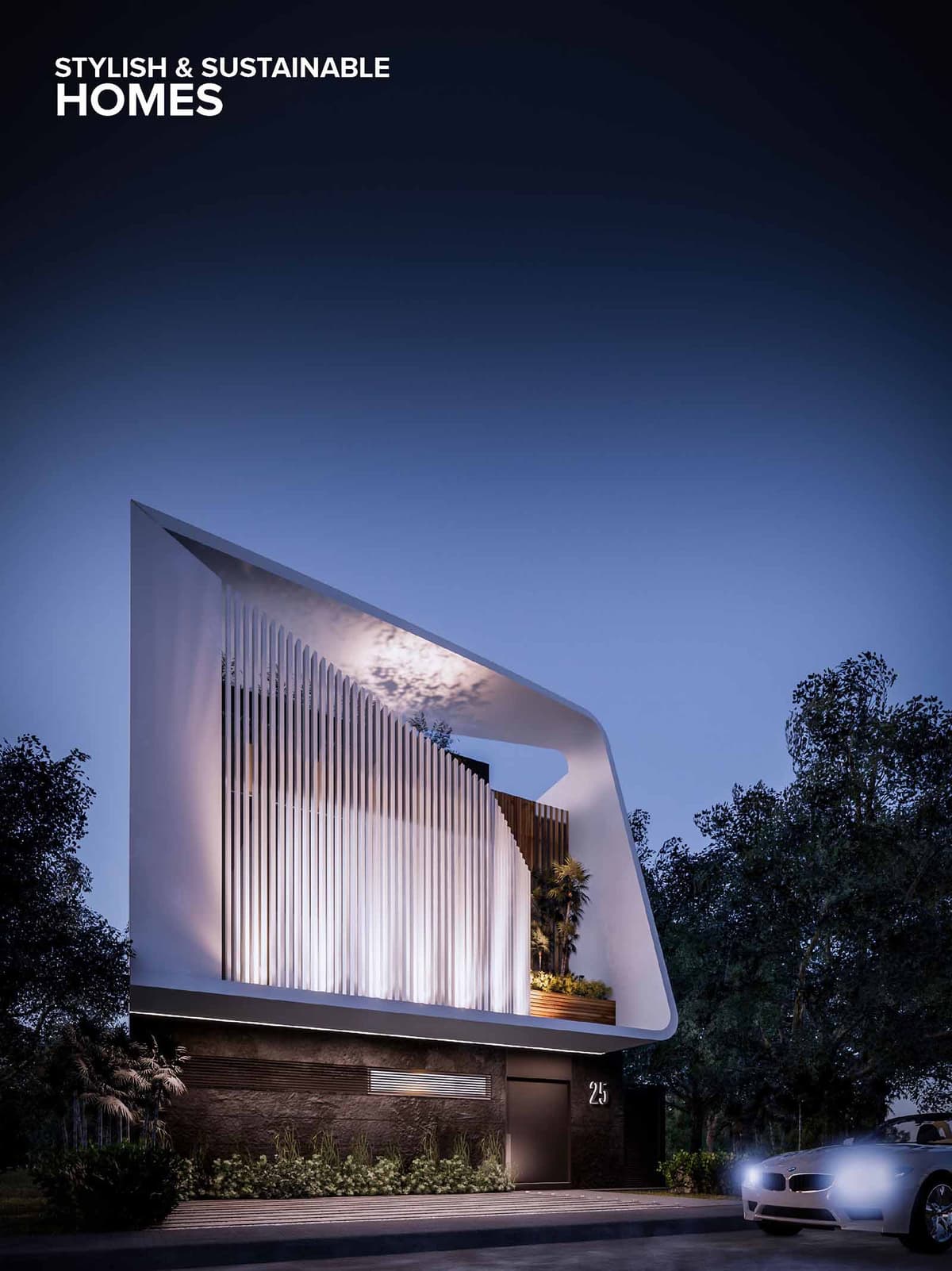

Arbolada Villa in Cancún is conceived as a compact urban oasis that filters the intense Caribbean climate through a sculptural architectural envelope. The project organizes domestic life behind a protective shell, using a dynamic interplay of solids and voids to balance privacy, openness, and environmental performance. The main gesture is a single continuous frame that folds around the upper levels, creating a clear, iconic silhouette while acting as a climatic visor. Within this protective outline, the house is layered with gardens, terraces and vertical filters that soften the transition between street and interior.
The volumetry is defined by a clean horizontal base and a sharply inclined upper frame. This frame is partially detached from the internal volume, generating a deep ventilated cavity where shadows, reflections and vegetation interact. A dense rhythm of vertical fins runs along the main elevation, gradually stepping down to reveal the interior garden. These slats control solar gain from the low western sun, while preserving outward views and a strong sense of lightness. At night, integrated uplighting transforms the façade into a softly glowing lantern within the neighborhood.
The dark, solid plinth houses the more private and service-oriented functions, buffering the living areas from the street. Above, the main social spaces open toward the internal patio and elevated garden, taking advantage of cross-ventilation created by carefully positioned openings behind the louvered screen. The uppermost level is conceived as an intimate retreat with direct access to roof landscaping, visually connected to the sky through the angular opening of the frame. Circulation is linear and legible, allowing fluid progression from the protected entrance to increasingly open and introspective spaces.
A deliberate contrast is established between the monolithic white frame and the darker, textured base. The plinth employs stone or concrete with a natural finish, grounding the villa and providing thermal mass. Warm-toned wood appears in balcony linings and planter edges, introducing tactility against the crisp white shell. Artificial lighting emphasizes the architectural geometry rather than individual fixtures: linear LEDs articulate the frame, while grazing lights enhance the vertical fins and vegetation. This layered lighting strategy ensures low glare, reduced energy consumption and a strong nighttime identity without excessive luminance spilling into the public realm.
Vegetation is not treated as an accessory but as a fundamental spatial layer. Dense planting at ground level softens the junction with the street and improves microclimate conditions along the façade. Elevated planters on the upper levels bring greenery directly into the living spaces, acting as visual filters and additional shading devices. The composition favors native or adapted species suitable for Cancún’s humid tropical climate, reducing irrigation needs and maintenance while encouraging biodiversity within the gated community context.
Sustainability is embedded in the form rather than applied as an afterthought. The vertical fins and deep frame significantly reduce direct solar radiation on glazing, lowering cooling loads in the hot, humid climate. The ventilated façade cavity and operable openings support natural cross-ventilation during milder periods, decreasing dependence on mechanical air conditioning. The compact footprint preserves permeable garden areas that aid stormwater absorption during intense rainfall. High-performance glazing, LED lighting and the potential integration of photovoltaic panels on the concealed roof surfaces complement these passive strategies, resulting in a stylish yet environmentally responsible villa for contemporary Cancún living.


Arbolada Villa in Cancún is conceived as a compact urban oasis that filters the intense Caribbean climate through a sculptural architectural envelope. The project organizes domestic life behind a protective shell, using a dynamic interplay of solids and voids to balance privacy, openness, and environmental performance. The main gesture is a single continuous frame that folds around the upper levels, creating a clear, iconic silhouette while acting as a climatic visor. Within this protective outline, the house is layered with gardens, terraces and vertical filters that soften the transition between street and interior.
The volumetry is defined by a clean horizontal base and a sharply inclined upper frame. This frame is partially detached from the internal volume, generating a deep ventilated cavity where shadows, reflections and vegetation interact. A dense rhythm of vertical fins runs along the main elevation, gradually stepping down to reveal the interior garden. These slats control solar gain from the low western sun, while preserving outward views and a strong sense of lightness. At night, integrated uplighting transforms the façade into a softly glowing lantern within the neighborhood.
The dark, solid plinth houses the more private and service-oriented functions, buffering the living areas from the street. Above, the main social spaces open toward the internal patio and elevated garden, taking advantage of cross-ventilation created by carefully positioned openings behind the louvered screen. The uppermost level is conceived as an intimate retreat with direct access to roof landscaping, visually connected to the sky through the angular opening of the frame. Circulation is linear and legible, allowing fluid progression from the protected entrance to increasingly open and introspective spaces.
A deliberate contrast is established between the monolithic white frame and the darker, textured base. The plinth employs stone or concrete with a natural finish, grounding the villa and providing thermal mass. Warm-toned wood appears in balcony linings and planter edges, introducing tactility against the crisp white shell. Artificial lighting emphasizes the architectural geometry rather than individual fixtures: linear LEDs articulate the frame, while grazing lights enhance the vertical fins and vegetation. This layered lighting strategy ensures low glare, reduced energy consumption and a strong nighttime identity without excessive luminance spilling into the public realm.
Vegetation is not treated as an accessory but as a fundamental spatial layer. Dense planting at ground level softens the junction with the street and improves microclimate conditions along the façade. Elevated planters on the upper levels bring greenery directly into the living spaces, acting as visual filters and additional shading devices. The composition favors native or adapted species suitable for Cancún’s humid tropical climate, reducing irrigation needs and maintenance while encouraging biodiversity within the gated community context.
Sustainability is embedded in the form rather than applied as an afterthought. The vertical fins and deep frame significantly reduce direct solar radiation on glazing, lowering cooling loads in the hot, humid climate. The ventilated façade cavity and operable openings support natural cross-ventilation during milder periods, decreasing dependence on mechanical air conditioning. The compact footprint preserves permeable garden areas that aid stormwater absorption during intense rainfall. High-performance glazing, LED lighting and the potential integration of photovoltaic panels on the concealed roof surfaces complement these passive strategies, resulting in a stylish yet environmentally responsible villa for contemporary Cancún living.
© 2021 by sanzpont [arquitectura] . Webpage by sanzpont [digital] . Innovative Digital Experiences
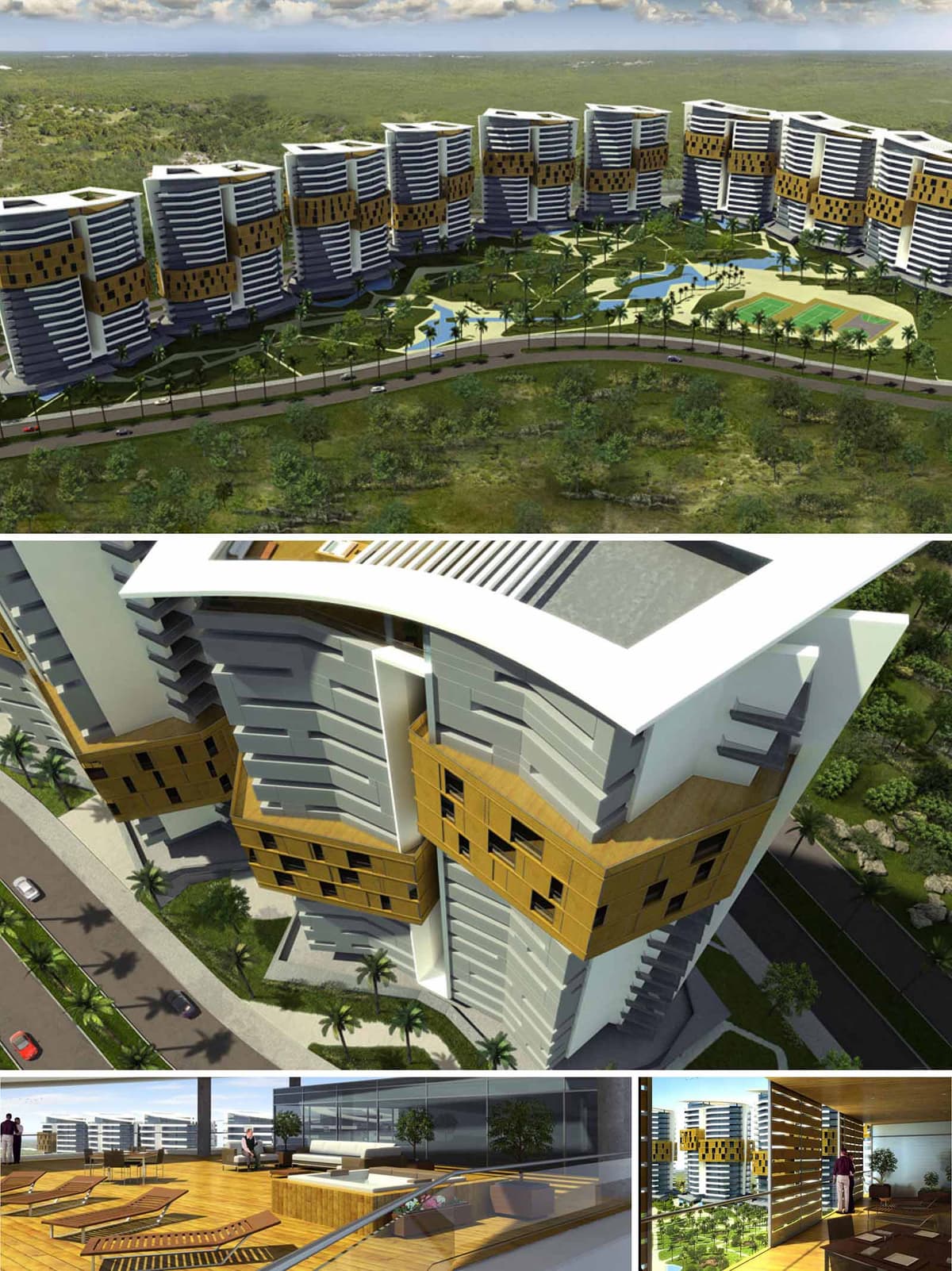
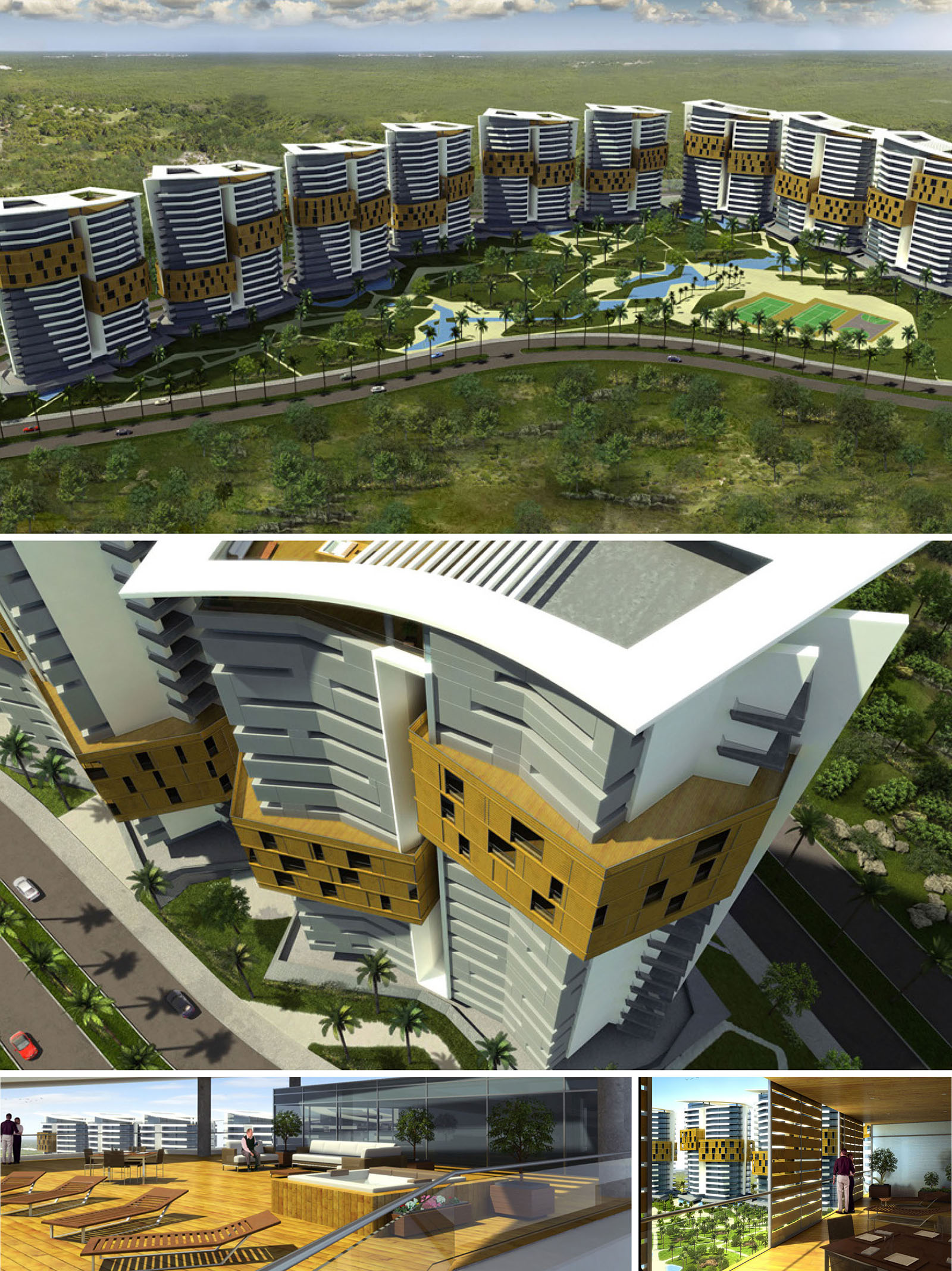
Lomas de Vista Hermosa is conceived as a contemporary residential enclave that embraces the tropical horizon of Cancún while generating a clear urban front towards the surrounding landscape. The masterplan arranges a sequence of slender towers in a gentle arc, framing a generous central park. This configuration produces a collective façade towards the city and, at the same time, opens the interior of the complex to natural light, ventilation and long-range views of the Mayan jungle.
The architectural language is based on the interplay of three elements: a white sculptural frame, recessed grey volumes with sinuous horizontal lines, and warm wooden bands that wrap the buildings at mid-height. Together, these components create a dynamic composition that emphasizes verticality while visually tying all towers into a unified, recognizable identity.
The towers are positioned along a curving access avenue, generating a continuous but permeable edge between the public road and the private interior landscape. Vehicular circulation is concentrated on the perimeter, allowing the heart of the complex to remain predominantly pedestrian and dedicated to recreation. This strategy enhances safety, acoustic comfort and a sense of community for residents.
The central garden acts as a shared living room at urban scale, integrating water features, a swimming zone, sports courts and shaded promenades under palm trees. The built mass is carefully staggered to avoid frontal collisions between façades, optimizing oblique views and ensuring that each unit enjoys visual connection either to the internal park or to the natural reserve beyond the site limits.
The towers are articulated as gently curving prisms, whose plans respond to both the arc of the masterplan and the desire to capture sea breezes. The façades combine horizontal balcony bands and recessed planes to create depth, shadows and a perception of lightness despite the height of the buildings. The white outer shell works as a continuous frame, emphasizing the silhouette against the sky and unifying the different towers.
At mid-level, a continuous wooden volume crosses each tower like a habitable belt. This element houses terraces, double-height social spaces and private outdoor rooms. The pattern of openings in this band is intentionally irregular, evoking a contemporary reinterpretation of traditional wooden screens while providing privacy, solar protection and controlled transparency from the exterior to the interior.
Residential units are organized to privilege corner living spaces and deep balconies, allowing residents to extend daily life outdoors. Large sliding glass panels blur the boundary between interior and exterior, creating cross-ventilation and maximizing natural light. The layout favors open-plan living-dining areas that visually connect to the landscape, with more private bedroom zones oriented towards quieter façades.
The roof levels of the towers incorporate communal terraces with solariums, lounge areas and jacuzzis, conceived as elevated observatories over the complex. On the ground floor, double-height lobbies and transparent façades maintain a visual continuity between the street, the internal garden and the interior circulation cores, reinforcing the idea of a vertical community integrated into its tropical environment.
The material palette is deliberately concise: white high-performance coatings to reflect solar radiation, grey elements to accentuate depth and shadow, and wood or wood-like cladding to introduce warmth and tactile quality. High-efficiency glazing, combined with generously cantilevered balconies and the wooden belt, provides effective solar control on the most exposed orientations, reducing cooling loads in Cancún’s warm climate.
Passive design strategies govern the project: tower orientation harnesses prevailing winds for natural cross-ventilation, while the arc-shaped disposition minimizes direct solar impact on large glass surfaces. The central green area acts as a microclimatic regulator, where vegetation, permeable surfaces and water features help mitigate the heat-island effect. Provision is made for rainwater collection for landscape irrigation, and the use of durable, low-maintenance materials contributes to long-term resource efficiency. Overall, the complex proposes a dense yet breathable residential model, aligned with sustainable growth in the Cancún region.
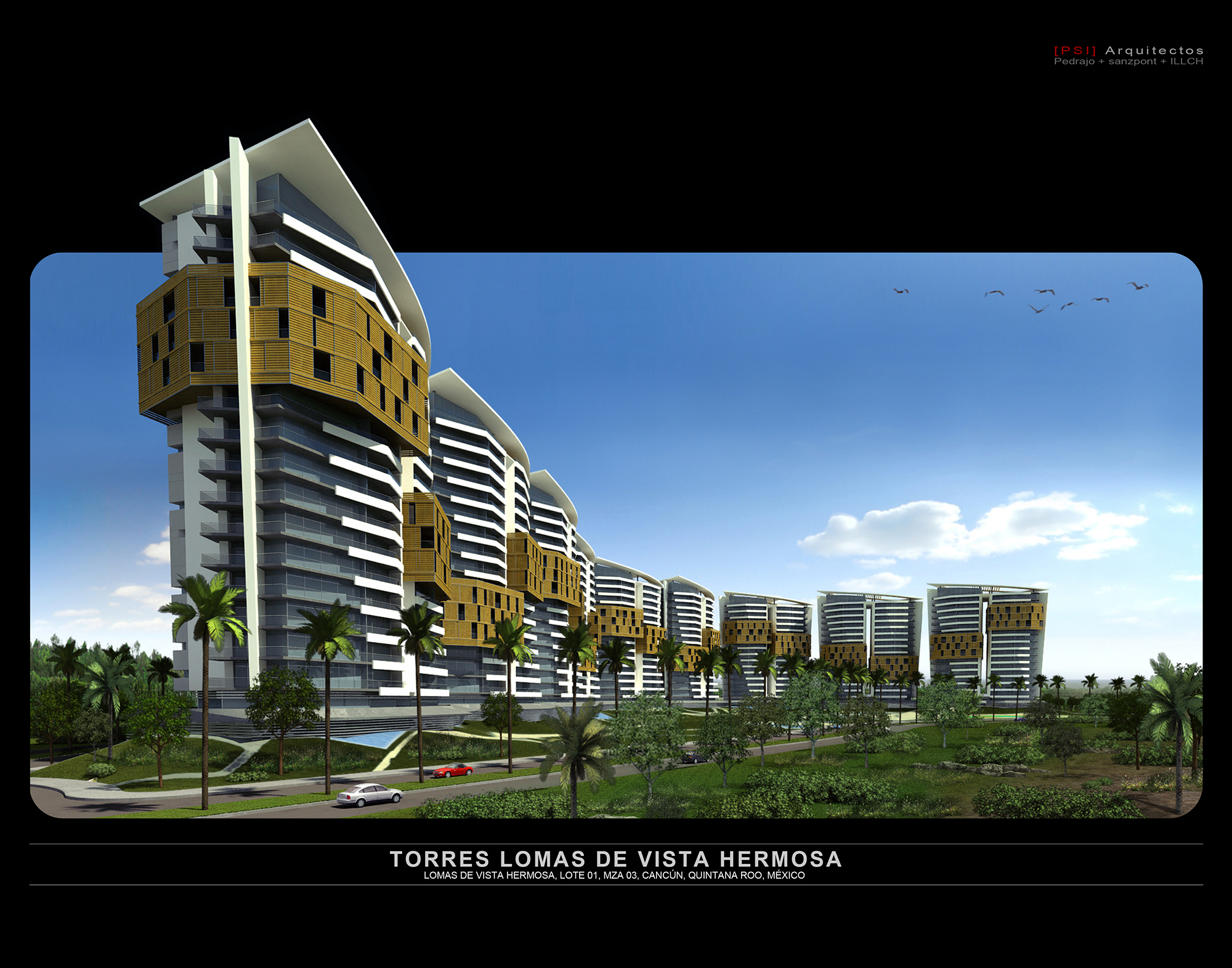
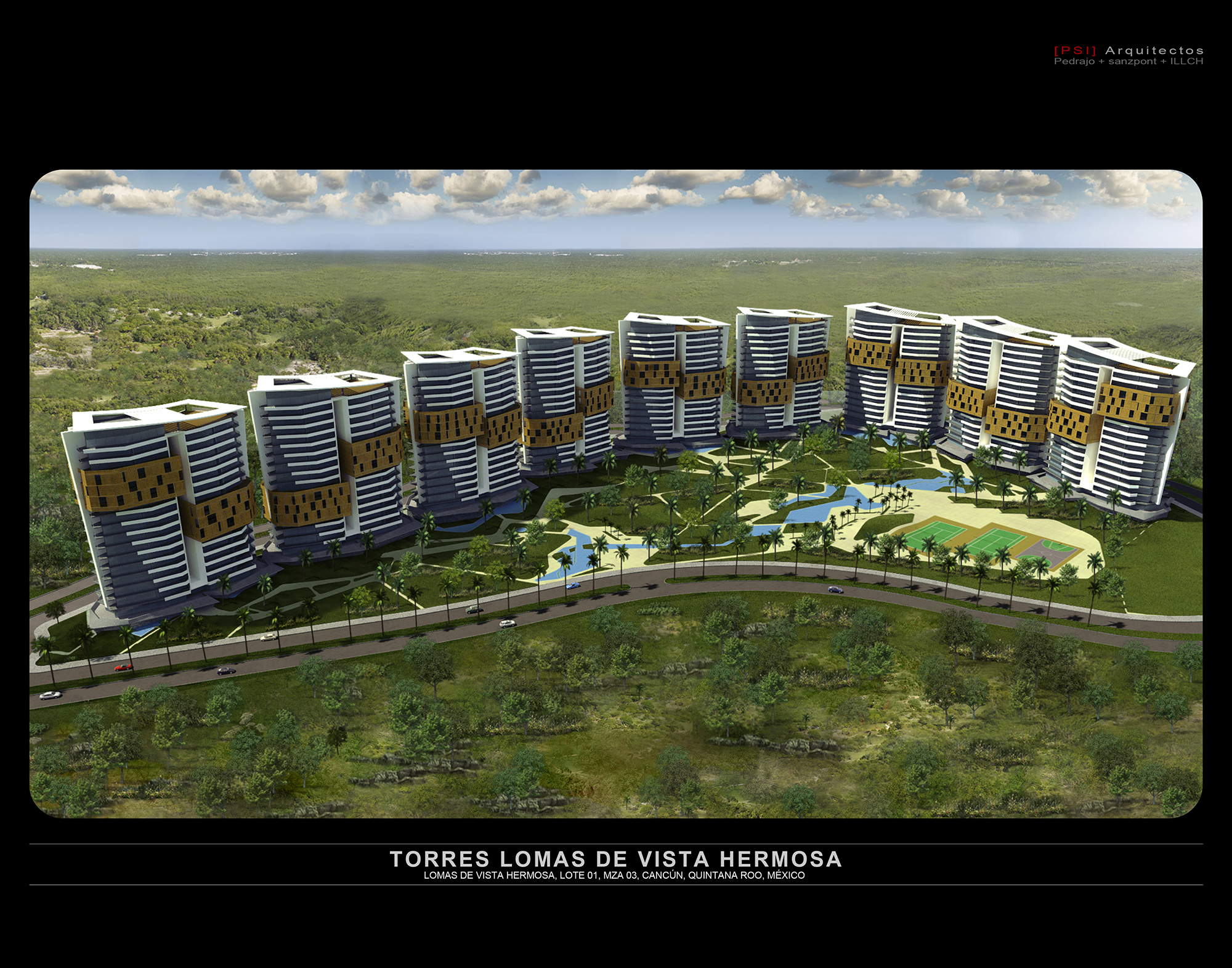
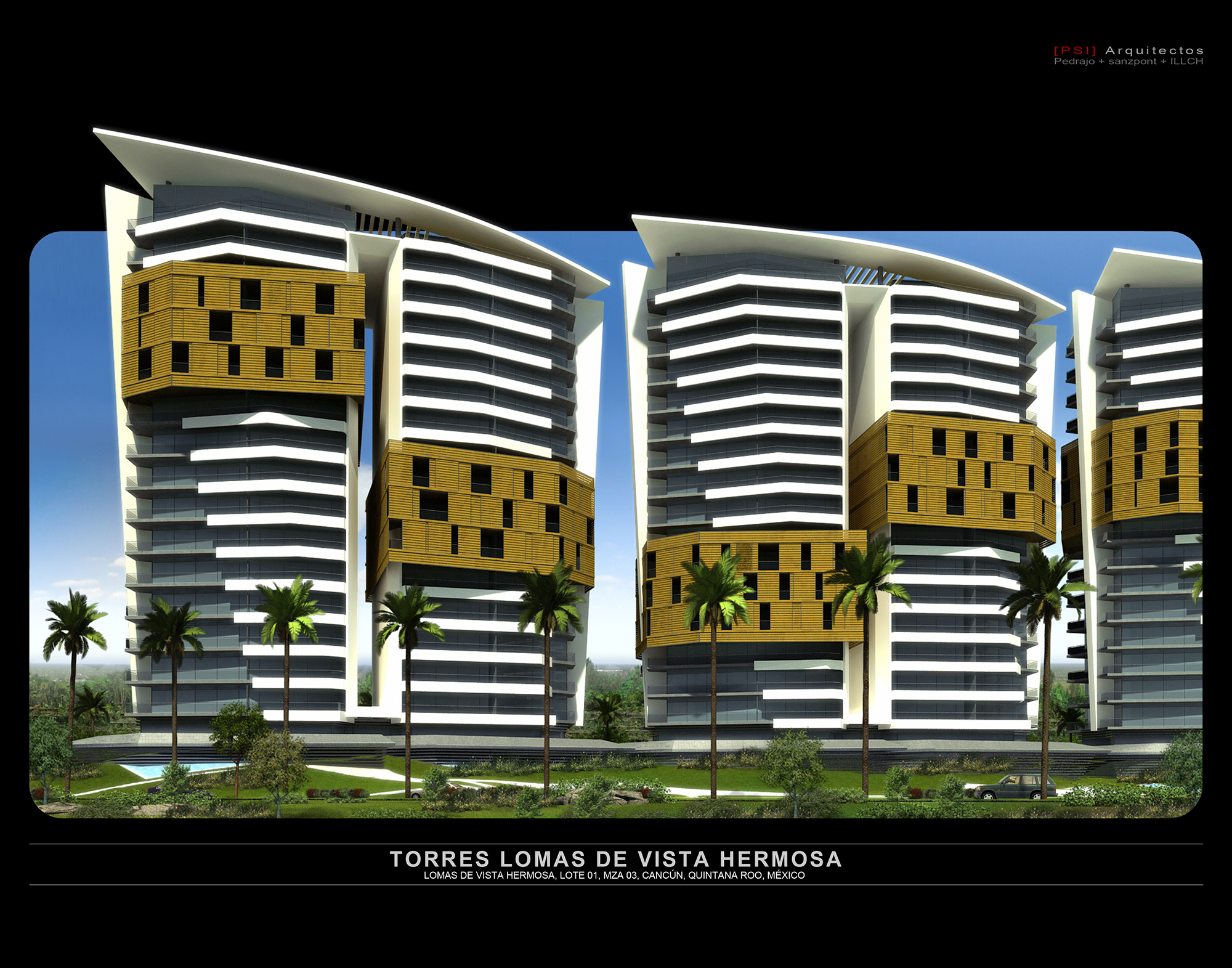
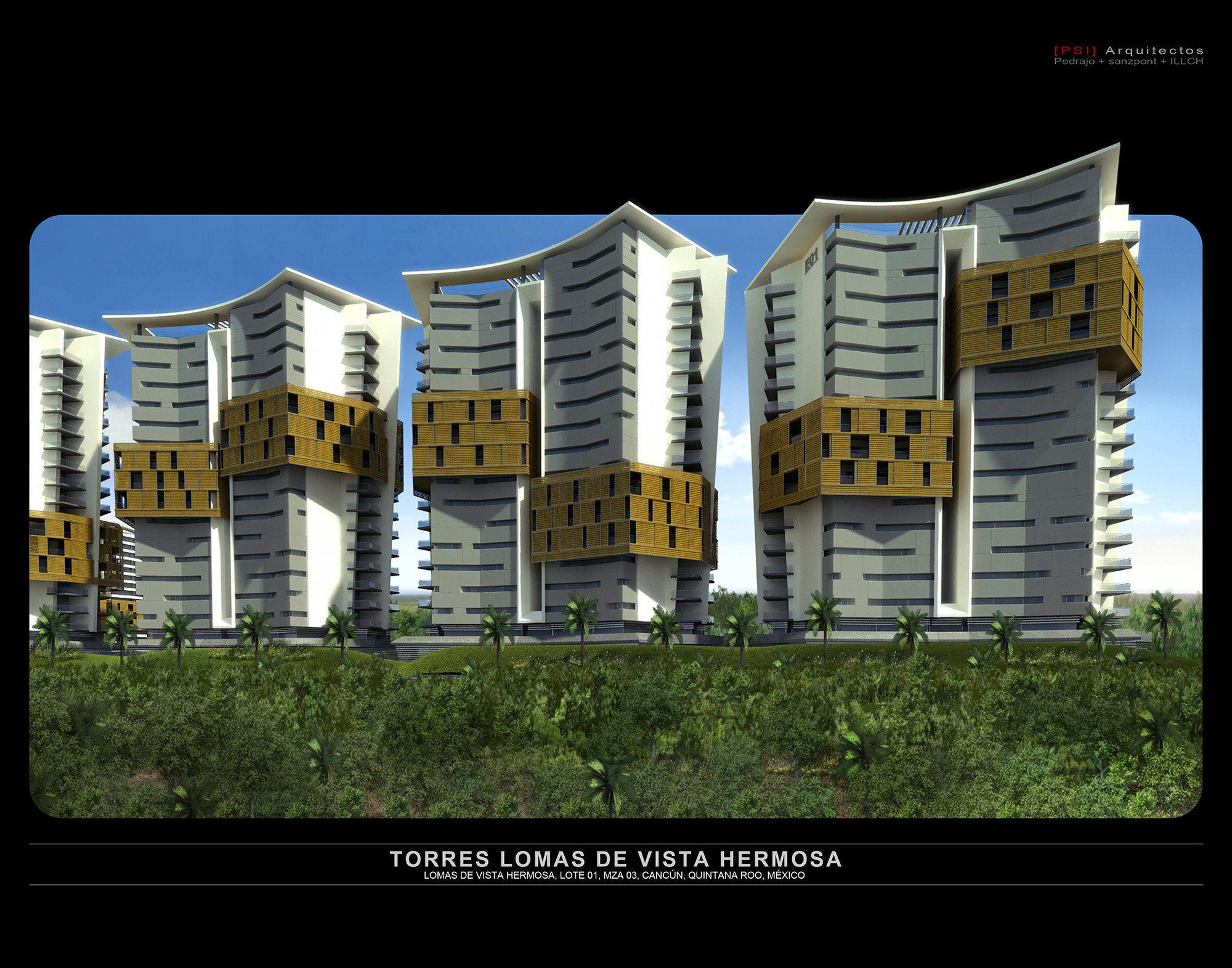
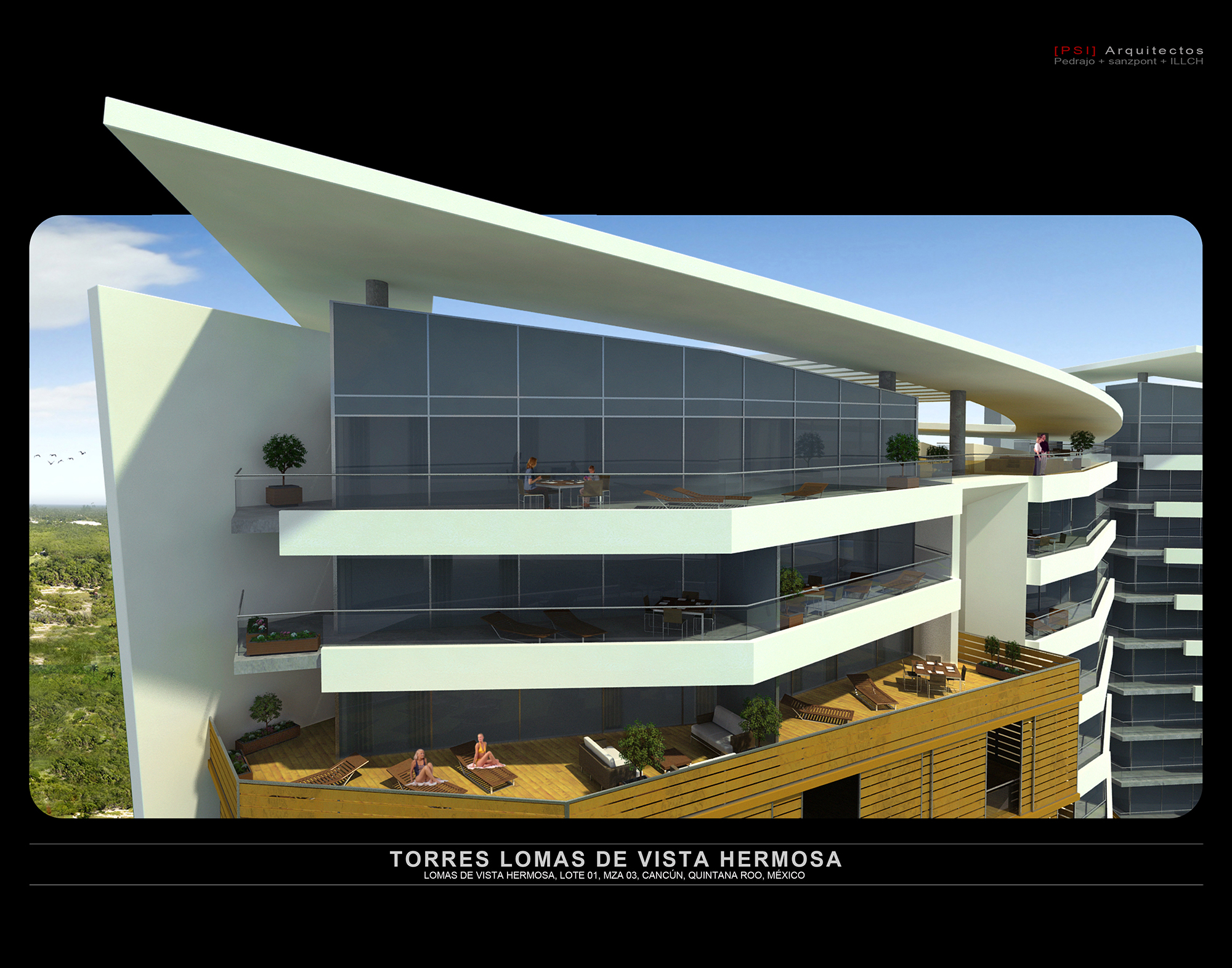
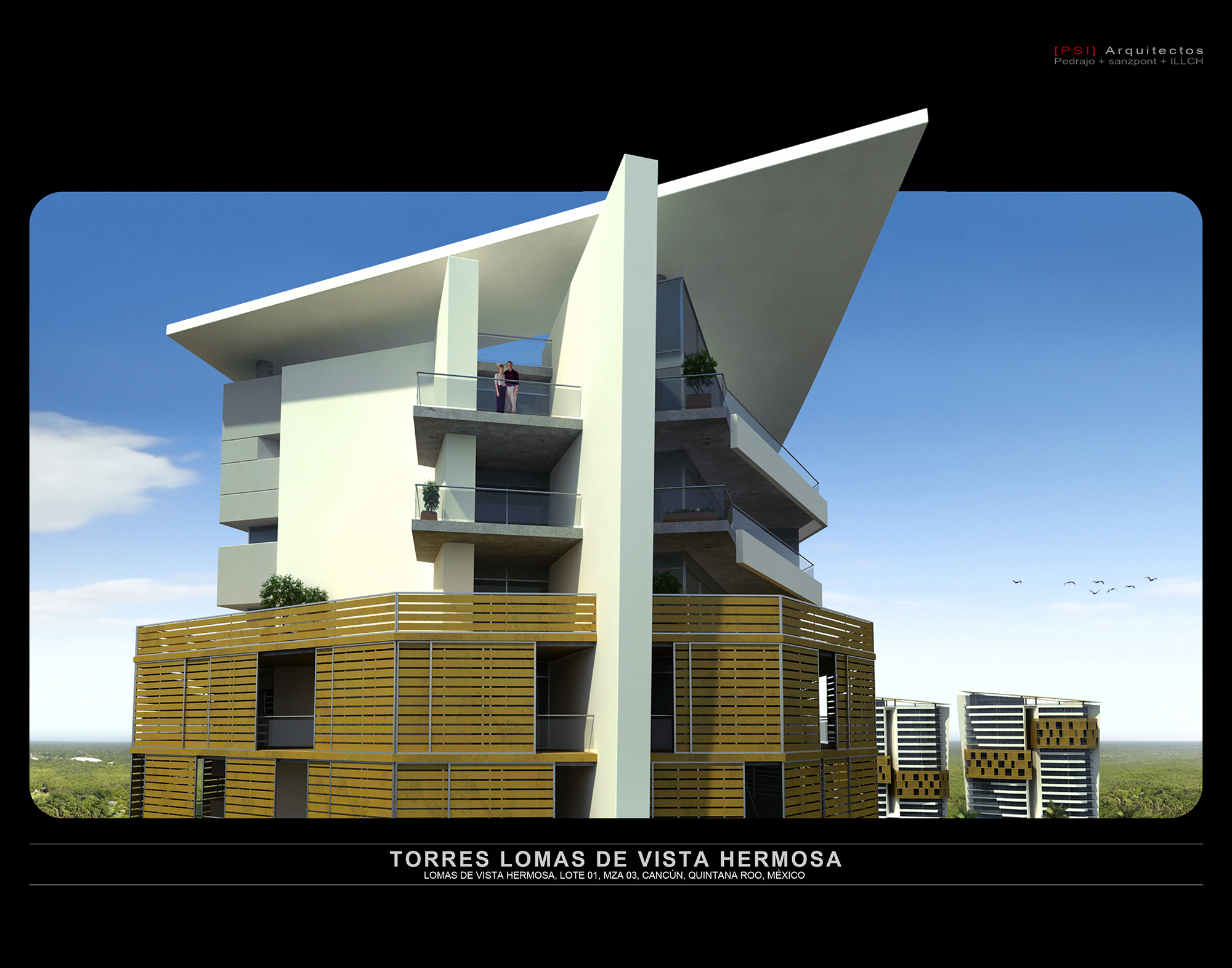
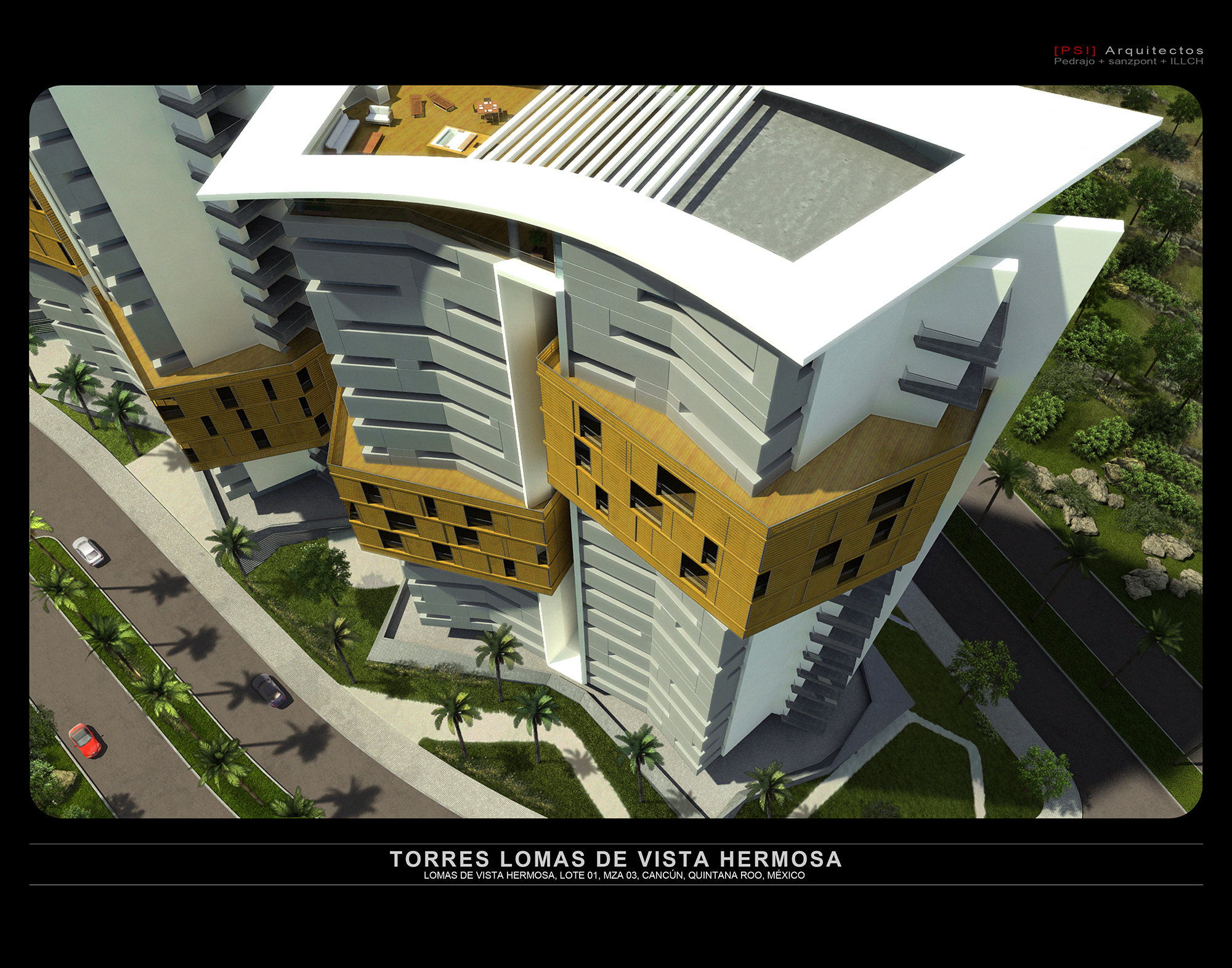
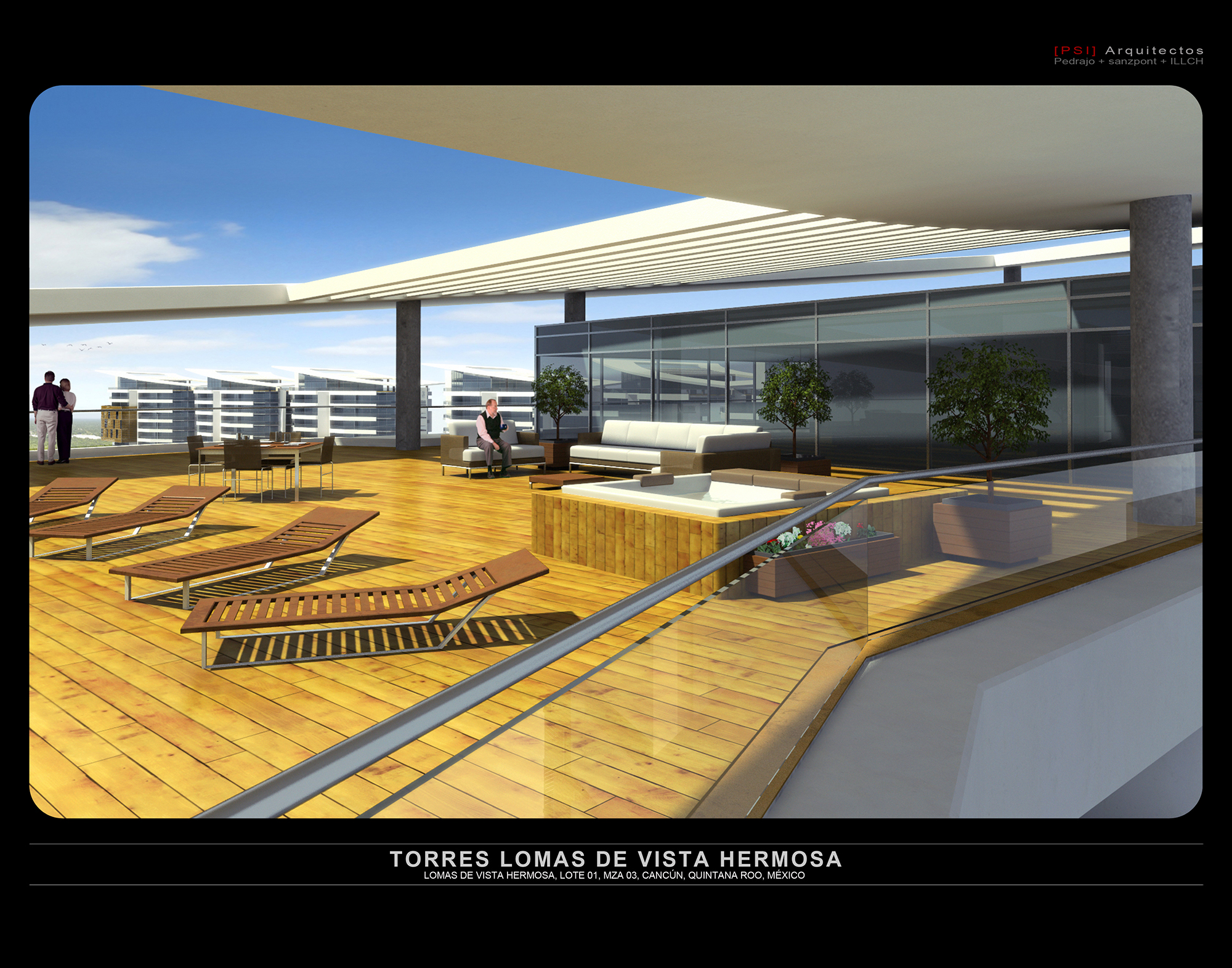
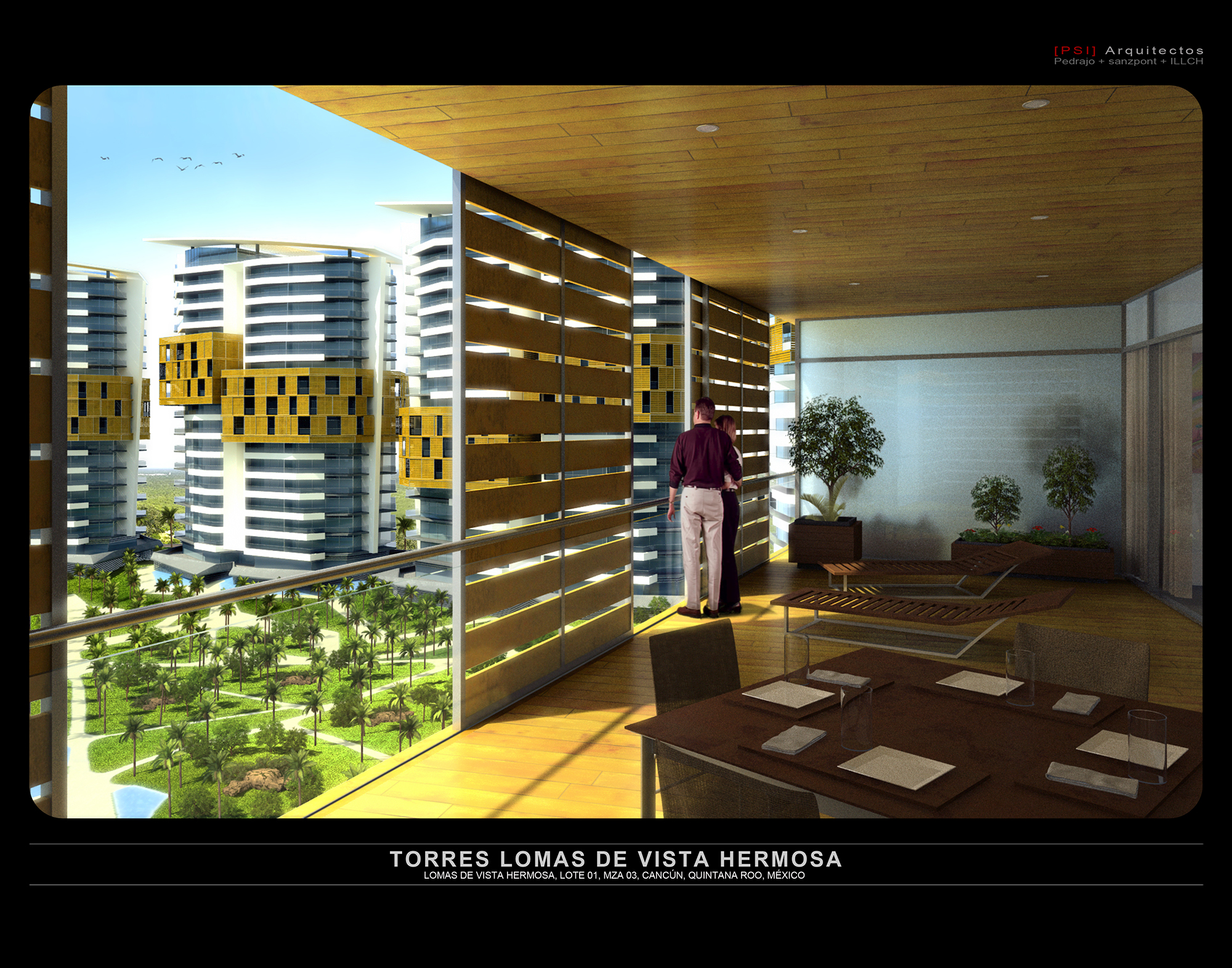
Lomas de Vista Hermosa is conceived as a contemporary residential enclave that embraces the tropical horizon of Cancún while generating a clear urban front towards the surrounding landscape. The masterplan arranges a sequence of slender towers in a gentle arc, framing a generous central park. This configuration produces a collective façade towards the city and, at the same time, opens the interior of the complex to natural light, ventilation and long-range views of the Mayan jungle.
The architectural language is based on the interplay of three elements: a white sculptural frame, recessed grey volumes with sinuous horizontal lines, and warm wooden bands that wrap the buildings at mid-height. Together, these components create a dynamic composition that emphasizes verticality while visually tying all towers into a unified, recognizable identity.
The towers are positioned along a curving access avenue, generating a continuous but permeable edge between the public road and the private interior landscape. Vehicular circulation is concentrated on the perimeter, allowing the heart of the complex to remain predominantly pedestrian and dedicated to recreation. This strategy enhances safety, acoustic comfort and a sense of community for residents.
The central garden acts as a shared living room at urban scale, integrating water features, a swimming zone, sports courts and shaded promenades under palm trees. The built mass is carefully staggered to avoid frontal collisions between façades, optimizing oblique views and ensuring that each unit enjoys visual connection either to the internal park or to the natural reserve beyond the site limits.
The towers are articulated as gently curving prisms, whose plans respond to both the arc of the masterplan and the desire to capture sea breezes. The façades combine horizontal balcony bands and recessed planes to create depth, shadows and a perception of lightness despite the height of the buildings. The white outer shell works as a continuous frame, emphasizing the silhouette against the sky and unifying the different towers.
At mid-level, a continuous wooden volume crosses each tower like a habitable belt. This element houses terraces, double-height social spaces and private outdoor rooms. The pattern of openings in this band is intentionally irregular, evoking a contemporary reinterpretation of traditional wooden screens while providing privacy, solar protection and controlled transparency from the exterior to the interior.
Residential units are organized to privilege corner living spaces and deep balconies, allowing residents to extend daily life outdoors. Large sliding glass panels blur the boundary between interior and exterior, creating cross-ventilation and maximizing natural light. The layout favors open-plan living-dining areas that visually connect to the landscape, with more private bedroom zones oriented towards quieter façades.
The roof levels of the towers incorporate communal terraces with solariums, lounge areas and jacuzzis, conceived as elevated observatories over the complex. On the ground floor, double-height lobbies and transparent façades maintain a visual continuity between the street, the internal garden and the interior circulation cores, reinforcing the idea of a vertical community integrated into its tropical environment.
The material palette is deliberately concise: white high-performance coatings to reflect solar radiation, grey elements to accentuate depth and shadow, and wood or wood-like cladding to introduce warmth and tactile quality. High-efficiency glazing, combined with generously cantilevered balconies and the wooden belt, provides effective solar control on the most exposed orientations, reducing cooling loads in Cancún’s warm climate.
Passive design strategies govern the project: tower orientation harnesses prevailing winds for natural cross-ventilation, while the arc-shaped disposition minimizes direct solar impact on large glass surfaces. The central green area acts as a microclimatic regulator, where vegetation, permeable surfaces and water features help mitigate the heat-island effect. Provision is made for rainwater collection for landscape irrigation, and the use of durable, low-maintenance materials contributes to long-term resource efficiency. Overall, the complex proposes a dense yet breathable residential model, aligned with sustainable growth in the Cancún region.
© 2021 by sanzpont [arquitectura] . Webpage by sanzpont [digital] . Innovative Digital Experiences
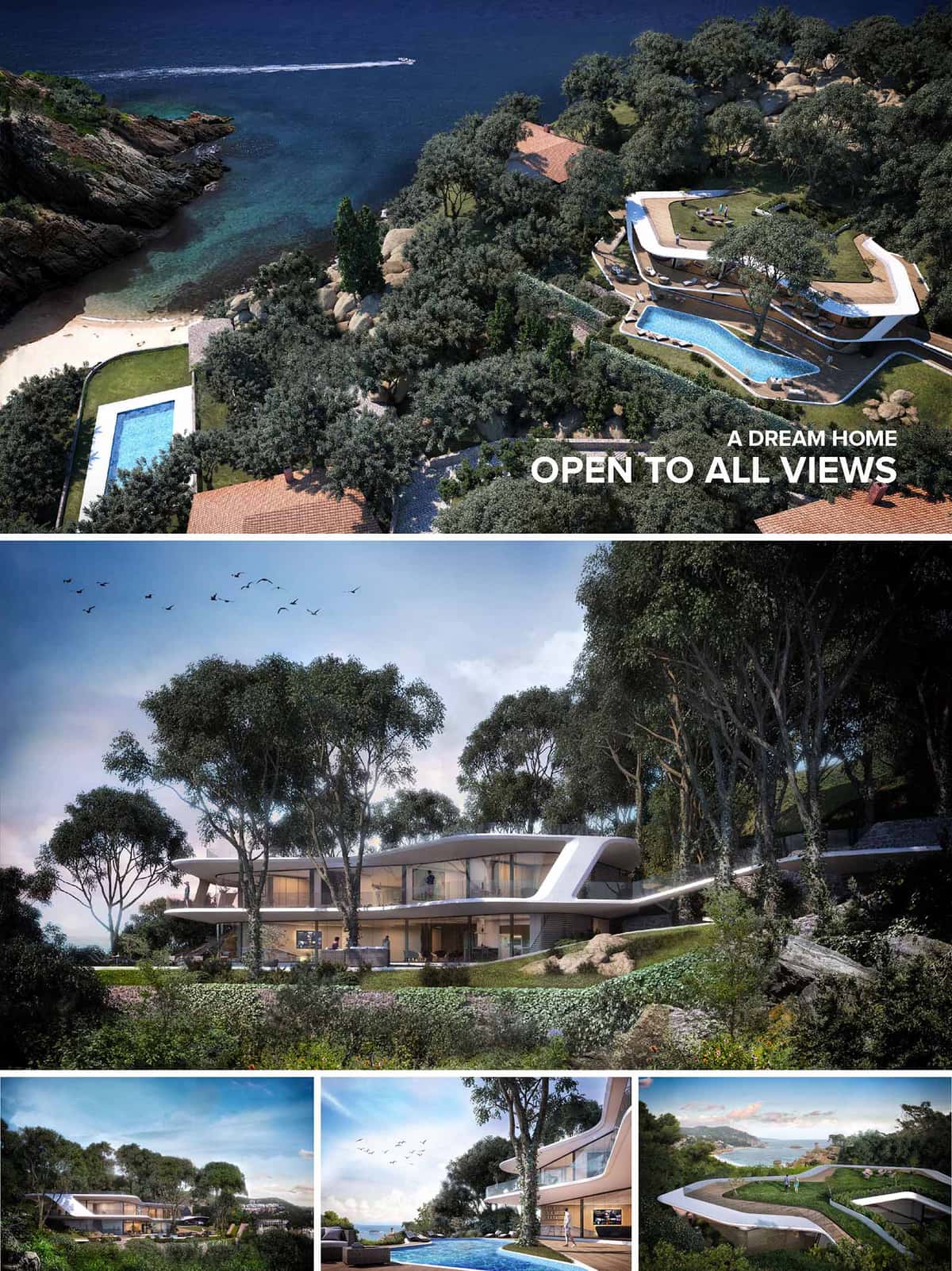

The TDM Villa is conceived as a coastal retreat that dissolves the boundary between architecture and Mediterranean landscape. The design responds to the steep topography of Tossa de Mar, unfolding as a series of fluid, terraced volumes that follow the natural contour lines. The villa orients every main space toward the sea, transforming the residence into a panoramic belvedere open to all views while remaining discreetly embedded within the pine and cork oak forest.
The architectural language is defined by soft, continuous curves and horizontal white bands that wrap façades, eaves, and terraces in a single gesture. This ribbon-like element emphasizes the villa’s horizontality, echoes the coastal cliffs, and frames wide glass surfaces that maximize daylight and visual connection with the bay. The result is a sculptural yet understated presence that privileges landscape over object.
The building is organized in stepped platforms, minimizing cut-and-fill and allowing direct access to the garden from multiple levels. The upper volume accommodates the most private functions, such as bedrooms and intimate lounges, while the intermediate and lower terraces host social spaces including living areas, kitchen, and outdoor leisure decks.
The plan follows a broken, elongated curve that opens like a fan toward the sea. This geometry creates a sequence of variable-depth terraces, offering both generous open decks and more sheltered outdoor rooms. Circulation is conceived as a promenade architecturale: covered walkways skim along the slope, linking interior and exterior spaces and providing shaded transitions between different programmatic areas.
The façades combine large-format glazing with slender structural elements and pronounced horizontal slabs. The continuous white bands function both as shading canopies and as structural diaphragms, reducing the need for intermediate supports and allowing panoramic openings. This structural clarity enhances transparency and ensures that the sea and forest remain the main protagonists.
Materially, the project juxtaposes warm tones and tactile surfaces against the crisp white envelope. Natural stone cladding anchors the base to the terrain, while timber accents bring domestic scale to terraces and soffits. High-performance glazing with selective coatings controls solar gain, and minimalist aluminum frames maintain the continuity of the exterior ribbon. The combination delivers a refined coastal character that is durable in a marine environment.
Interior spaces are designed as extensions of the surrounding landscape, with floor finishes and ceiling lines that flow virtually uninterrupted to the exterior decks. Open-plan living areas emphasize axial views toward the horizon, while curved partitions subtly guide movement and frame specific vistas of the rocky coves and open sea.
The color palette prioritizes neutral, sandy tones complemented by natural timber and stone surfaces, creating a calm, resort-like atmosphere. Built-in furniture and integrated storage follow the geometry of the outer shell, reinforcing the sense of continuity. Large sliding panels allow spaces to shift from fully open, breezy environments to more enclosed and intimate settings depending on season and time of day.
The garden strategy focuses on preserving and enhancing the existing Mediterranean ecosystem. Native trees and shrubs weave around the built volumes, softening edges and ensuring that the villa appears to emerge from the forest canopy. Terraced gardens with low retaining walls of local stone mediate between constructed platforms and natural rock outcrops.
Outdoor living areas are articulated around an infinity pool that visually merges with the sea. Sun decks, lounge platforms, and shaded pergolas are distributed along the main façade, providing a variety of microclimates for different times of day. Roof surfaces are treated as accessible green roofs, offering additional belvedere points and contributing to the perception of architecture as an elevated landscape rather than a discrete object.
Sustainability is addressed through both passive and active strategies carefully adapted to the Mediterranean climate. The curved orientation and generous overhangs optimize solar exposure in winter while providing effective shading in summer. Cross-ventilation is enabled by dual-aspect rooms and operable façades, reducing reliance on mechanical cooling during temperate months.
Green roofs increase thermal inertia, mitigate heat-island effect, and improve rainwater management, while native planting minimizes irrigation needs. High-performance insulation, low-emissivity glazing, and airtight detailing reduce energy consumption, making the villa compatible with high-efficiency HVAC and potential photovoltaic integration on less visible roof segments. Local materials and preserved vegetation limit the project’s ecological footprint, ensuring that the TDM Villa remains harmoniously integrated within the coastal landscape of Tossa de Mar.


The TDM Villa is conceived as a coastal retreat that dissolves the boundary between architecture and Mediterranean landscape. The design responds to the steep topography of Tossa de Mar, unfolding as a series of fluid, terraced volumes that follow the natural contour lines. The villa orients every main space toward the sea, transforming the residence into a panoramic belvedere open to all views while remaining discreetly embedded within the pine and cork oak forest.
The architectural language is defined by soft, continuous curves and horizontal white bands that wrap façades, eaves, and terraces in a single gesture. This ribbon-like element emphasizes the villa’s horizontality, echoes the coastal cliffs, and frames wide glass surfaces that maximize daylight and visual connection with the bay. The result is a sculptural yet understated presence that privileges landscape over object.
The building is organized in stepped platforms, minimizing cut-and-fill and allowing direct access to the garden from multiple levels. The upper volume accommodates the most private functions, such as bedrooms and intimate lounges, while the intermediate and lower terraces host social spaces including living areas, kitchen, and outdoor leisure decks.
The plan follows a broken, elongated curve that opens like a fan toward the sea. This geometry creates a sequence of variable-depth terraces, offering both generous open decks and more sheltered outdoor rooms. Circulation is conceived as a promenade architecturale: covered walkways skim along the slope, linking interior and exterior spaces and providing shaded transitions between different programmatic areas.
The façades combine large-format glazing with slender structural elements and pronounced horizontal slabs. The continuous white bands function both as shading canopies and as structural diaphragms, reducing the need for intermediate supports and allowing panoramic openings. This structural clarity enhances transparency and ensures that the sea and forest remain the main protagonists.
Materially, the project juxtaposes warm tones and tactile surfaces against the crisp white envelope. Natural stone cladding anchors the base to the terrain, while timber accents bring domestic scale to terraces and soffits. High-performance glazing with selective coatings controls solar gain, and minimalist aluminum frames maintain the continuity of the exterior ribbon. The combination delivers a refined coastal character that is durable in a marine environment.
Interior spaces are designed as extensions of the surrounding landscape, with floor finishes and ceiling lines that flow virtually uninterrupted to the exterior decks. Open-plan living areas emphasize axial views toward the horizon, while curved partitions subtly guide movement and frame specific vistas of the rocky coves and open sea.
The color palette prioritizes neutral, sandy tones complemented by natural timber and stone surfaces, creating a calm, resort-like atmosphere. Built-in furniture and integrated storage follow the geometry of the outer shell, reinforcing the sense of continuity. Large sliding panels allow spaces to shift from fully open, breezy environments to more enclosed and intimate settings depending on season and time of day.
The garden strategy focuses on preserving and enhancing the existing Mediterranean ecosystem. Native trees and shrubs weave around the built volumes, softening edges and ensuring that the villa appears to emerge from the forest canopy. Terraced gardens with low retaining walls of local stone mediate between constructed platforms and natural rock outcrops.
Outdoor living areas are articulated around an infinity pool that visually merges with the sea. Sun decks, lounge platforms, and shaded pergolas are distributed along the main façade, providing a variety of microclimates for different times of day. Roof surfaces are treated as accessible green roofs, offering additional belvedere points and contributing to the perception of architecture as an elevated landscape rather than a discrete object.
Sustainability is addressed through both passive and active strategies carefully adapted to the Mediterranean climate. The curved orientation and generous overhangs optimize solar exposure in winter while providing effective shading in summer. Cross-ventilation is enabled by dual-aspect rooms and operable façades, reducing reliance on mechanical cooling during temperate months.
Green roofs increase thermal inertia, mitigate heat-island effect, and improve rainwater management, while native planting minimizes irrigation needs. High-performance insulation, low-emissivity glazing, and airtight detailing reduce energy consumption, making the villa compatible with high-efficiency HVAC and potential photovoltaic integration on less visible roof segments. Local materials and preserved vegetation limit the project’s ecological footprint, ensuring that the TDM Villa remains harmoniously integrated within the coastal landscape of Tossa de Mar.
© 2021 by sanzpont [arquitectura] . Webpage by sanzpont [digital] . Innovative Digital Experiences
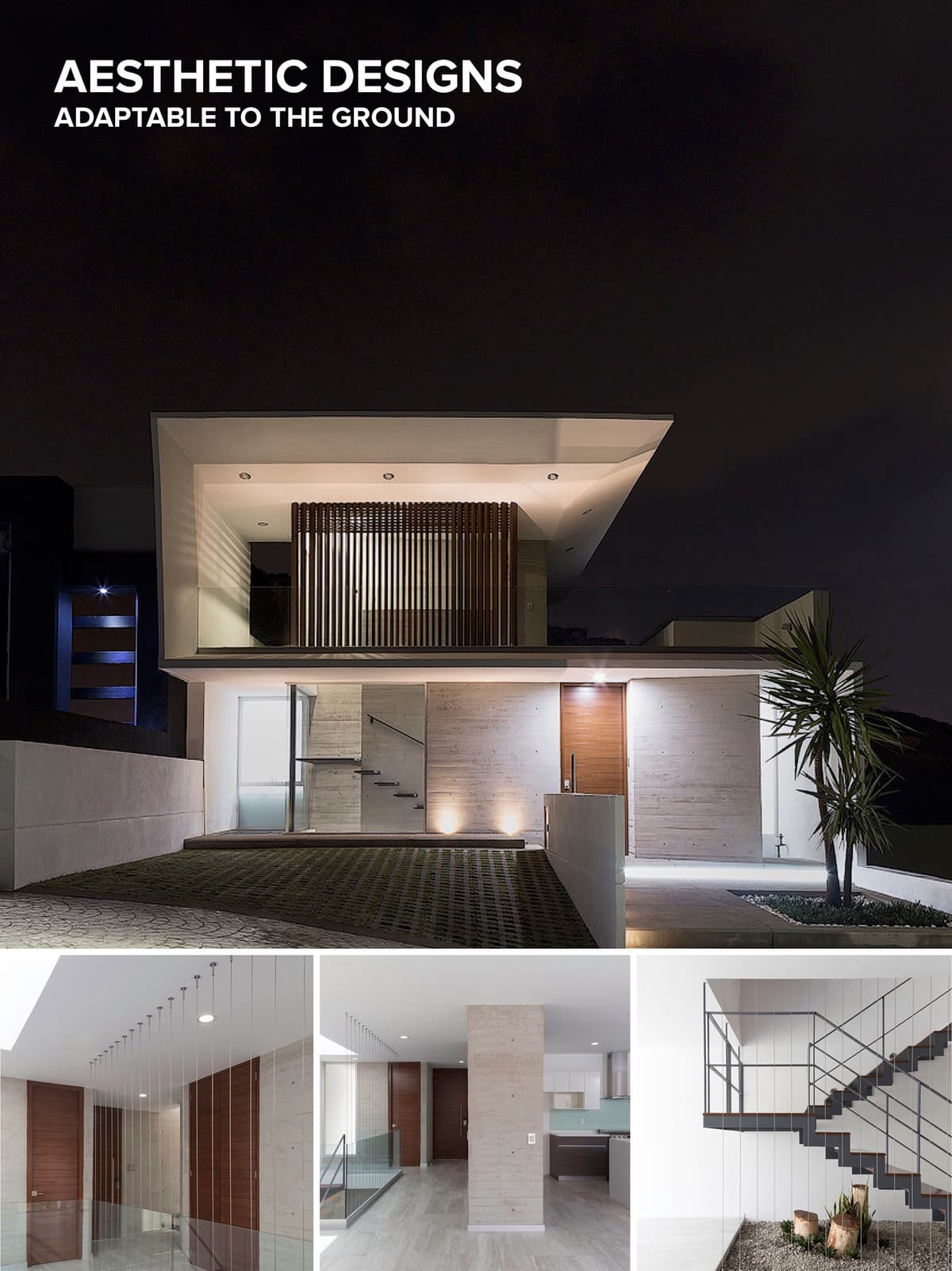

VAZ32 house in Mexico City was created to meet the needs of the client- a development company looking for a unique and contemporary product that could compete in the current real estate market of Mexico City. At the same time, the design is a result of the site and its unique building restrictions put in place by the subdivision- a 31-foot-wide by 63-foot-deep rectangular lot, with 10-foot setbacks in both the front and back, in close proximity to surrounding houses on three sides, and a steep slope down -34 feet from street level.
Taking advantage of the natural shape of the land, it was decided to design the private spaces below street level, creating a sense of security and privacy in the bedrooms while occupying most of the slope of the land. By cutting into the land and constructing with the site’s natural topography, we were able to save money by avoiding excessive filling costs. At the lowest level, where the master bedroom is located, the setback restrictions set forth by the subdivision were used to our advantage to create a private garden that is also accessed by the family room.
The public spaces were designed at street level and create the main façade of the house, which is crowned by a light, white cover that opens to the sky like a screen. This light cover becomes a building envelope that embraces the house and at the same time, creates contrast with the concrete walls.
This same building envelope transforms into a half wall that serves as division between the pedestrian access and the parking area. Conceptually, this feature represents a continuous line from roof, to façade, to the front of the property and continues infinitely.
A large retaining wall passes through the entire width of the house on all four levels, including the roof garden, and functions as the backbone of the project. In addition to its structural importance, this feature becomes an architectural aesthetic element as well. In the staircase, the natural light coming in from the skylight showcases the texture of the bare concrete which plays perfectly off the other textural elements- steel, wood and tempered glass.
The VAZ32 house achieves the goal of being a contemporary and unique project through its aesthetic value and use of current materials. Most importantly for the client, the house provides a thoughtful design at a competitive price for the location.
The VAZ32 house is aesthetically pleasing because of its functionality and context, as well as compliant with the sustainability guidelines that are the basis of sanzpont [arquitectura]


VAZ32 house in Mexico City was created to meet the needs of the client- a development company looking for a unique and contemporary product that could compete in the current real estate market of Mexico City. At the same time, the design is a result of the site and its unique building restrictions put in place by the subdivision- a 31-foot-wide by 63-foot-deep rectangular lot, with 10-foot setbacks in both the front and back, in close proximity to surrounding houses on three sides, and a steep slope down -34 feet from street level.
Taking advantage of the natural shape of the land, it was decided to design the private spaces below street level, creating a sense of security and privacy in the bedrooms while occupying most of the slope of the land. By cutting into the land and constructing with the site’s natural topography, we were able to save money by avoiding excessive filling costs. At the lowest level, where the master bedroom is located, the setback restrictions set forth by the subdivision were used to our advantage to create a private garden that is also accessed by the family room.
The public spaces were designed at street level and create the main façade of the house, which is crowned by a light, white cover that opens to the sky like a screen. This light cover becomes a building envelope that embraces the house and at the same time, creates contrast with the concrete walls.
This same building envelope transforms into a half wall that serves as division between the pedestrian access and the parking area. Conceptually, this feature represents a continuous line from roof, to façade, to the front of the property and continues infinitely.
A large retaining wall passes through the entire width of the house on all four levels, including the roof garden, and functions as the backbone of the project. In addition to its structural importance, this feature becomes an architectural aesthetic element as well. In the staircase, the natural light coming in from the skylight showcases the texture of the bare concrete which plays perfectly off the other textural elements- steel, wood and tempered glass.
The VAZ32 house achieves the goal of being a contemporary and unique project through its aesthetic value and use of current materials. Most importantly for the client, the house provides a thoughtful design at a competitive price for the location.
The VAZ32 house is aesthetically pleasing because of its functionality and context, as well as compliant with the sustainability guidelines that are the basis of sanzpont [arquitectura]
© 2021 by sanzpont [arquitectura] . Webpage by sanzpont [digital] . Innovative Digital Experiences
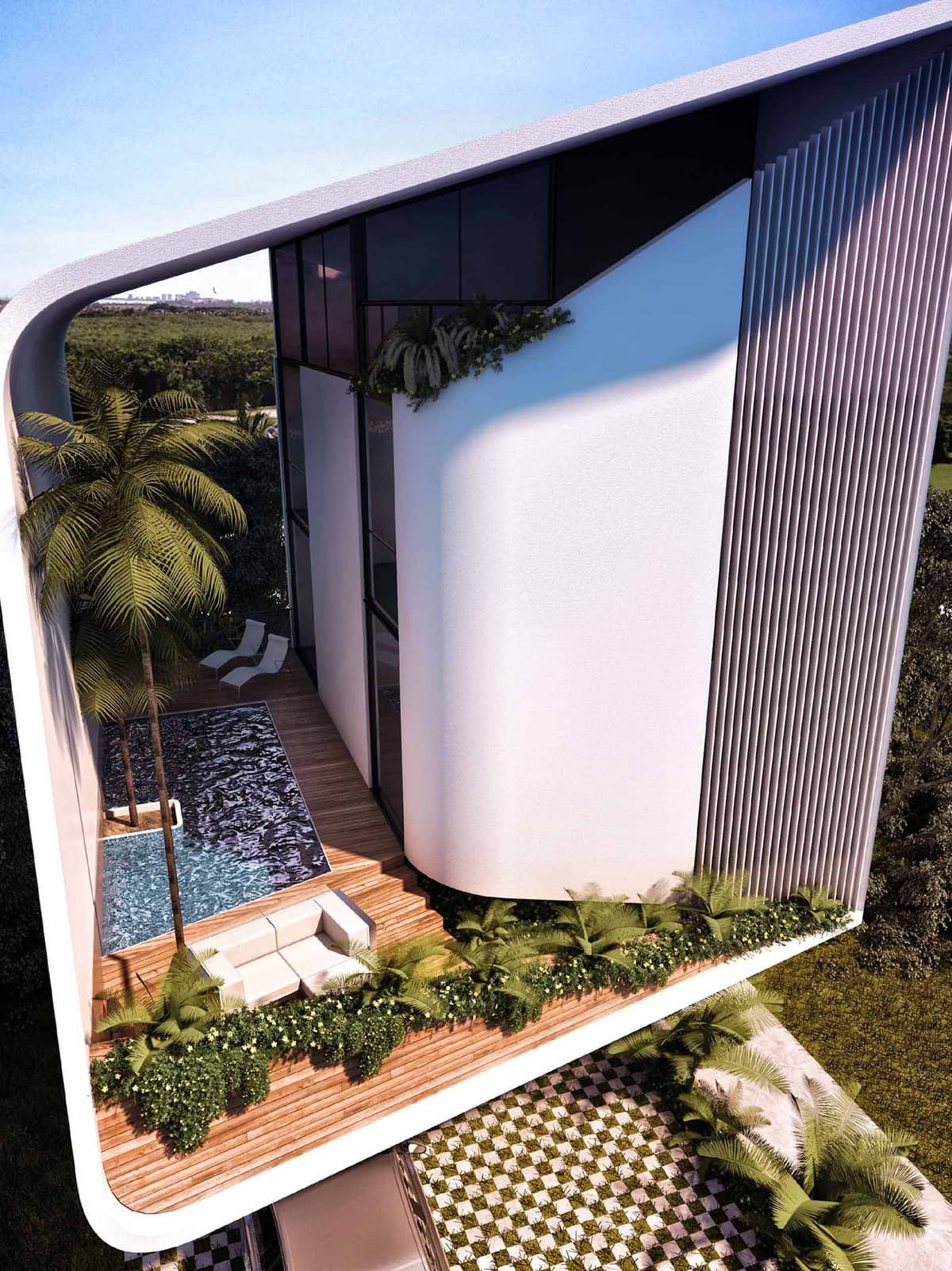

The JSH Villa is conceived as a sculptural tropical refuge, a compact urban villa that opens inward to its own elevated garden rather than to the street. The gesture is a continuous white shell that folds up from the ground, wraps the habitable volume and frames a generous open void where vegetation, water and light become the main protagonists. The architecture aims to express calm and lightness while providing strong climatic protection for the intense sun of Cancún.
The composition is based on two main elements: the outer shell and the inner prism. The outer shell, with its soft radiused corners, tilts forward and creates a deep canopy that shades the upper terrace and pool. Behind it, a pure vertical volume houses the main living spaces. The offset between these two geometries generates dynamic shadows and a sense of movement, making the house read as a single fluid object from the street while preserving a compact, efficient footprint.
The façade combines smooth white plastered surfaces with vertical aluminum fins and warm timber cladding. The continuous white skin provides a monolithic, almost carved appearance, whereas the slender fins introduce rhythm, privacy and solar control on the more exposed eastern side. The timber planter band softens the transition between architecture and landscape, anchoring the floating shell. Large glazed panels are recessed behind the envelope to reduce direct solar gain, while dark frames visually dissolve to highlight the sculptural massing.
The project organizes daily life around an elevated tropical terrace carved within the shell. Here, a linear pool, timber deck and lounge area become an outdoor living room suspended above the garden level. Double-height glazing stitches interior spaces to this terrace, enabling cross-views and natural ventilation. From the street, the house appears introspective; once inside, it opens fully to sky, water and vegetation, offering privacy from the neighborhood while maintaining an intense connection with the climate and landscape.
The inclined roof and deep overhangs function as an environmental device, reducing incident solar radiation on the glazed surfaces and creating a permanently shaded microclimate for the terrace. Vertical fins on the side façade act as a brise-soleil, filtering low-angle sun and allowing controlled airflow. The narrow floor plate favors cross-ventilation, reducing the need for mechanical cooling. The solid stair and service core are positioned toward the harsher solar orientations, protecting the more transparent living areas and bedrooms.
Vegetation is integrated as a continuous green layer that wraps the perimeter of the terrace and spills over the timber planter edge, visually merging the villa with the surrounding trees. Palm trees rise through openings in the deck and pool, reinforcing the sensation of inhabiting a suspended garden. This green buffer helps cool the envelope, retains rainwater in the soil substrate and improves local biodiversity. The combination of passive shading, cross-ventilation, reduced footprint and layered planting strategy contributes to a more sustainable, climate-responsive villa appropriate for the coastal context of Cancún.


The JSH Villa is conceived as a sculptural tropical refuge, a compact urban villa that opens inward to its own elevated garden rather than to the street. The gesture is a continuous white shell that folds up from the ground, wraps the habitable volume and frames a generous open void where vegetation, water and light become the main protagonists. The architecture aims to express calm and lightness while providing strong climatic protection for the intense sun of Cancún.
The composition is based on two main elements: the outer shell and the inner prism. The outer shell, with its soft radiused corners, tilts forward and creates a deep canopy that shades the upper terrace and pool. Behind it, a pure vertical volume houses the main living spaces. The offset between these two geometries generates dynamic shadows and a sense of movement, making the house read as a single fluid object from the street while preserving a compact, efficient footprint.
The façade combines smooth white plastered surfaces with vertical aluminum fins and warm timber cladding. The continuous white skin provides a monolithic, almost carved appearance, whereas the slender fins introduce rhythm, privacy and solar control on the more exposed eastern side. The timber planter band softens the transition between architecture and landscape, anchoring the floating shell. Large glazed panels are recessed behind the envelope to reduce direct solar gain, while dark frames visually dissolve to highlight the sculptural massing.
The project organizes daily life around an elevated tropical terrace carved within the shell. Here, a linear pool, timber deck and lounge area become an outdoor living room suspended above the garden level. Double-height glazing stitches interior spaces to this terrace, enabling cross-views and natural ventilation. From the street, the house appears introspective; once inside, it opens fully to sky, water and vegetation, offering privacy from the neighborhood while maintaining an intense connection with the climate and landscape.
The inclined roof and deep overhangs function as an environmental device, reducing incident solar radiation on the glazed surfaces and creating a permanently shaded microclimate for the terrace. Vertical fins on the side façade act as a brise-soleil, filtering low-angle sun and allowing controlled airflow. The narrow floor plate favors cross-ventilation, reducing the need for mechanical cooling. The solid stair and service core are positioned toward the harsher solar orientations, protecting the more transparent living areas and bedrooms.
Vegetation is integrated as a continuous green layer that wraps the perimeter of the terrace and spills over the timber planter edge, visually merging the villa with the surrounding trees. Palm trees rise through openings in the deck and pool, reinforcing the sensation of inhabiting a suspended garden. This green buffer helps cool the envelope, retains rainwater in the soil substrate and improves local biodiversity. The combination of passive shading, cross-ventilation, reduced footprint and layered planting strategy contributes to a more sustainable, climate-responsive villa appropriate for the coastal context of Cancún.
© 2021 by sanzpont [arquitectura] . Webpage by sanzpont [digital] . Innovative Digital Experiences
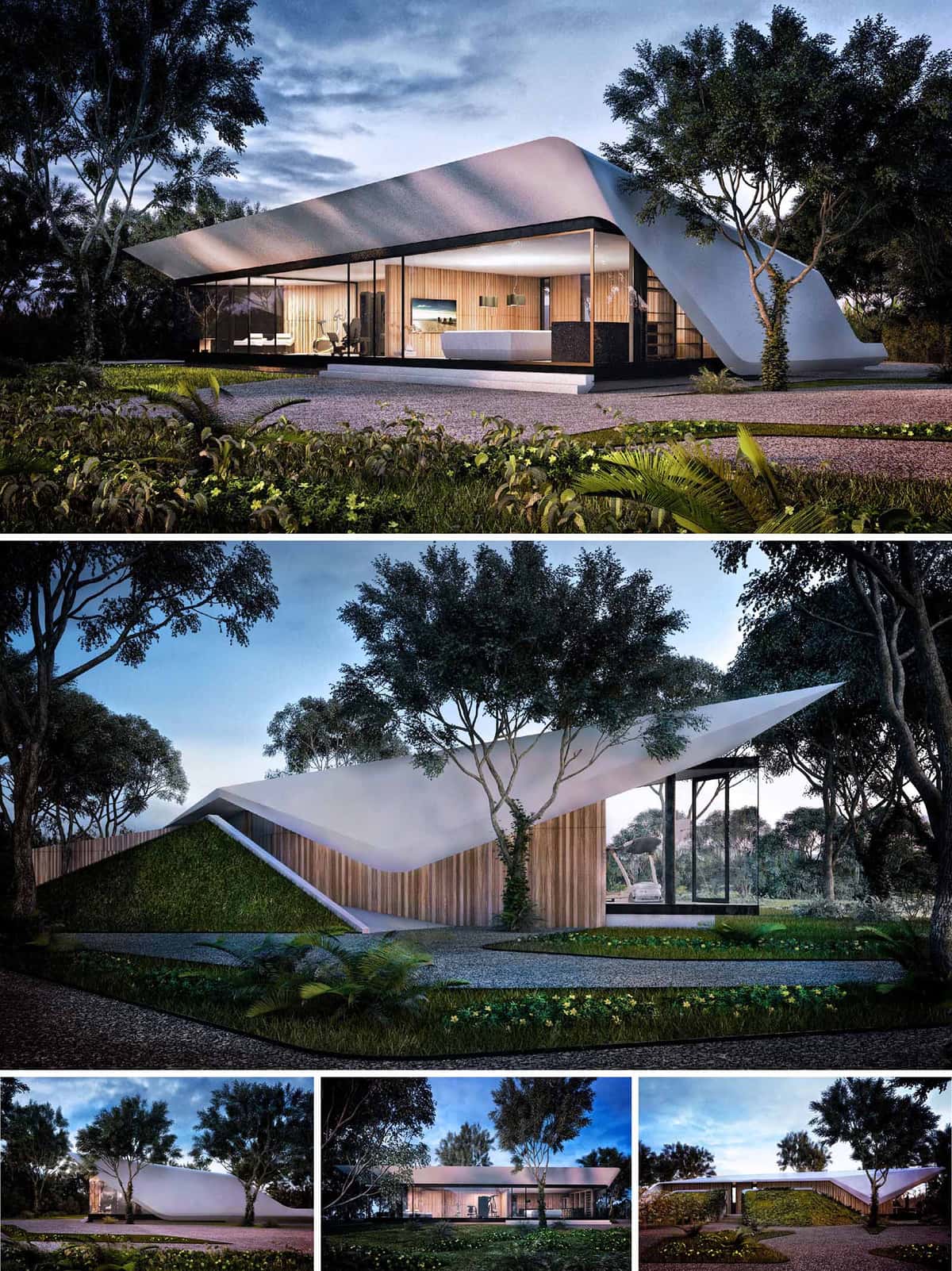

The PLY Villa Expansion is conceived as a light, sculptural pavilion dedicated to wellness, spa and fitness, extending the original villa’s idea of inhabitable landscape. The new volume acts as a calm sanctuary in the jungle, where architecture, body and nature are integrated. A continuous white shell wraps and protects transparent interiors, generating soft, indirect light and a sense of floating above the ground, ideal for relaxation and mindful exercise.
The expansion is positioned as a complementary wing to the first phase, connected through garden paths and visual alignments rather than heavy built links. While the main villa is embedded in the terrain with green roofs, this new piece hovers more visibly, reading as a refined object in the landscape. Both phases share materials, proportions and the language of topographic roofs, ensuring a coherent ensemble that can be perceived as a single compound.
The defining gesture is a continuous, folded roof-skin that rises from the ground, curves over the glazed perimeter and descends again to meet the landscape. This element unifies roof and walls into one fluid silhouette, protecting the program from sun and rain while opening strategic views toward the surrounding trees. The shell’s pointed and lifted corners create dynamic perspectives from every approach, reinforcing the impression of a gently tensioned canvas above a transparent base.
The lower band of the building is almost entirely glazed, framed by slender dark profiles that visually dematerialize the structure. Behind the glass, warm vertical timber panels establish a soft and tactile interior backdrop. The opaque shell is finished in a light, high-performance coating that reflects heat and subtly captures the changing sky tones throughout the day. On one flank, the roof folds down to meet a planted green slope, merging the pavilion back into the ground plane.
The interior is organized as a sequence of open and semi-open wellness spaces. A central gym area runs along the main façade, fully transparent to the garden, allowing exercise to take place in constant visual contact with nature. More intimate spa and treatment rooms are located toward the solid ends, benefiting from filtered light and controlled privacy. The layout encourages slow movement along a clear axis, with framed views, niches for stretching or meditation and direct exits to outdoor terraces.
The landscape around the expansion is designed as a soft buffer of native planting, low shrubs and permeable paths. Approaching the building, visitors read the green slope and planted roof as an extension of the existing villa’s topography. This green plane visually anchors the pavilion and provides an elevated, contemplative garden above the wellness spaces. Night lighting is discreet and warm, accentuating the folded roof and tree trunks while protecting the dark sky and surrounding fauna.
Sustainability is integrated through passive and active measures aligned with the spa’s health-oriented nature. The large overhangs of the shell and the preserved trees reduce direct solar gain on the glazing, significantly limiting cooling demand. Cross-ventilation can be enabled by opening opposite façades during mild periods, while the green slope and roof add thermal mass and stormwater retention. Materials prioritize low maintenance and regional sourcing, particularly timber cladding and local aggregates. Provision for solar thermal or photovoltaic systems on less visible surfaces supports renewable energy use, ensuring that the pursuit of wellness is inseparable from a responsible, low-impact architectural response.


The PLY Villa Expansion is conceived as a light, sculptural pavilion dedicated to wellness, spa and fitness, extending the original villa’s idea of inhabitable landscape. The new volume acts as a calm sanctuary in the jungle, where architecture, body and nature are integrated. A continuous white shell wraps and protects transparent interiors, generating soft, indirect light and a sense of floating above the ground, ideal for relaxation and mindful exercise.
The expansion is positioned as a complementary wing to the first phase, connected through garden paths and visual alignments rather than heavy built links. While the main villa is embedded in the terrain with green roofs, this new piece hovers more visibly, reading as a refined object in the landscape. Both phases share materials, proportions and the language of topographic roofs, ensuring a coherent ensemble that can be perceived as a single compound.
The defining gesture is a continuous, folded roof-skin that rises from the ground, curves over the glazed perimeter and descends again to meet the landscape. This element unifies roof and walls into one fluid silhouette, protecting the program from sun and rain while opening strategic views toward the surrounding trees. The shell’s pointed and lifted corners create dynamic perspectives from every approach, reinforcing the impression of a gently tensioned canvas above a transparent base.
The lower band of the building is almost entirely glazed, framed by slender dark profiles that visually dematerialize the structure. Behind the glass, warm vertical timber panels establish a soft and tactile interior backdrop. The opaque shell is finished in a light, high-performance coating that reflects heat and subtly captures the changing sky tones throughout the day. On one flank, the roof folds down to meet a planted green slope, merging the pavilion back into the ground plane.
The interior is organized as a sequence of open and semi-open wellness spaces. A central gym area runs along the main façade, fully transparent to the garden, allowing exercise to take place in constant visual contact with nature. More intimate spa and treatment rooms are located toward the solid ends, benefiting from filtered light and controlled privacy. The layout encourages slow movement along a clear axis, with framed views, niches for stretching or meditation and direct exits to outdoor terraces.
The landscape around the expansion is designed as a soft buffer of native planting, low shrubs and permeable paths. Approaching the building, visitors read the green slope and planted roof as an extension of the existing villa’s topography. This green plane visually anchors the pavilion and provides an elevated, contemplative garden above the wellness spaces. Night lighting is discreet and warm, accentuating the folded roof and tree trunks while protecting the dark sky and surrounding fauna.
Sustainability is integrated through passive and active measures aligned with the spa’s health-oriented nature. The large overhangs of the shell and the preserved trees reduce direct solar gain on the glazing, significantly limiting cooling demand. Cross-ventilation can be enabled by opening opposite façades during mild periods, while the green slope and roof add thermal mass and stormwater retention. Materials prioritize low maintenance and regional sourcing, particularly timber cladding and local aggregates. Provision for solar thermal or photovoltaic systems on less visible surfaces supports renewable energy use, ensuring that the pursuit of wellness is inseparable from a responsible, low-impact architectural response.
© 2021 by sanzpont [arquitectura] . Webpage by sanzpont [digital] . Innovative Digital Experiences
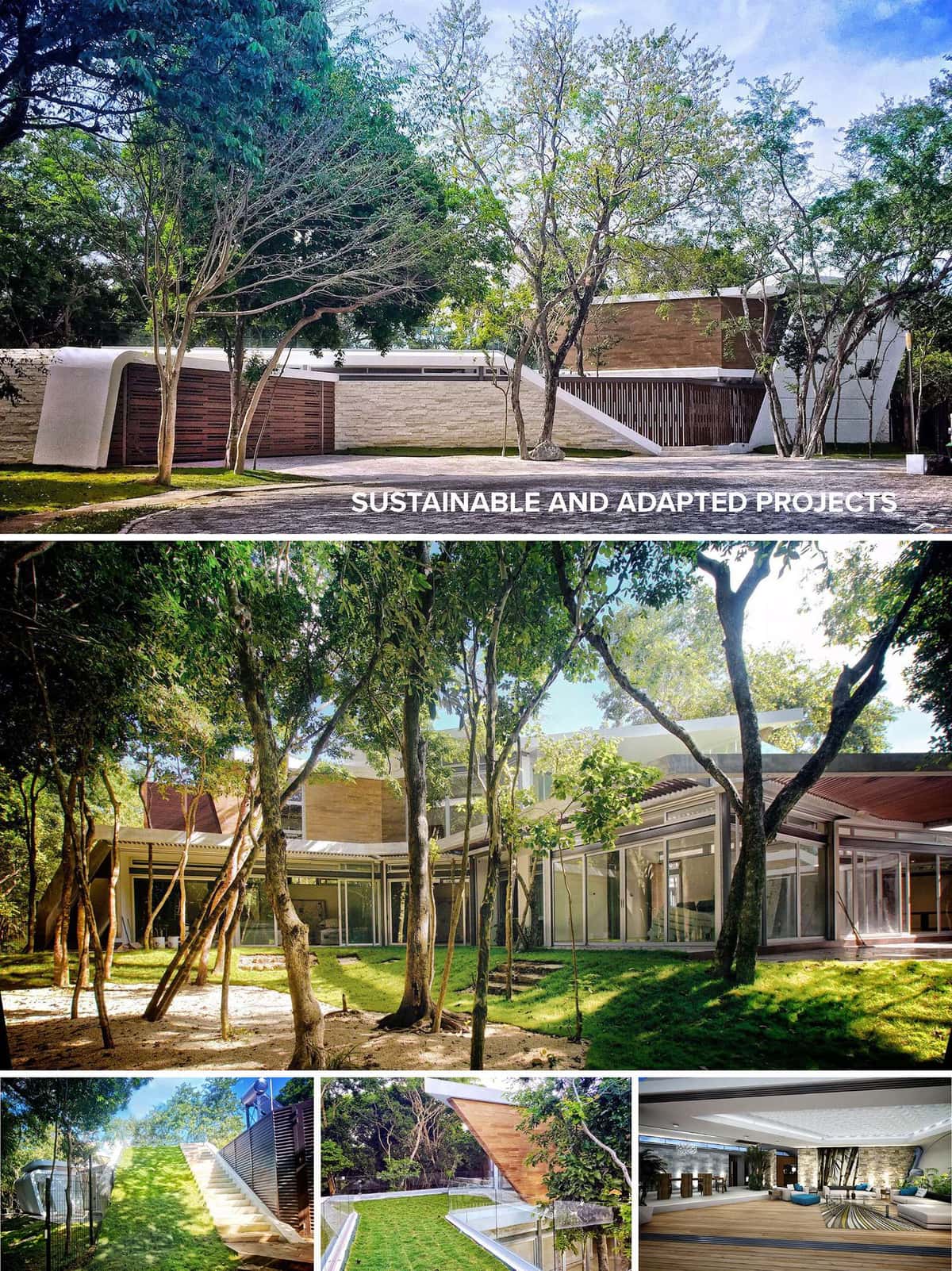

PLY Villa in Playa del Carmen is conceived as a low, elongated structure that merges with the surrounding jungle rather than dominating it. The central concept is to transform the house into an inhabitable piece of terrain, allowing the natural ground plane to rise and become a green roof. Architecture and landscape are treated as a single continuous system, enabling living spaces to extend fluidly between interior and exterior while remaining protected from the intense tropical climate.
The villa is located on a densely vegetated plot within the Riviera Maya, characterized by mature trees, filtered light and a relatively flat topography. The layout is drawn around existing trunks, creating patios and open courts that preserve native vegetation and the local ecosystem. This careful positioning maintains the natural shade structure of the site, stabilizes the microclimate and visually anchors the building to its forest context, giving the impression that the house has grown out of the terrain.
The project is composed of interlocking horizontal volumes with strategic double-height areas. These bodies slide beneath generous roof overhangs and form deep verandas that serve as climatic buffers. A key volumetric gesture is the grass-covered ramp that ascends from the garden to the roof, complemented by a sharply inclined wooden volume that cantilevers above the green surface. Together, these elements generate a dynamic silhouette and reinforce the idea of carved landscape rather than conventional built mass.
Material choices emphasize lightness and thermal performance. Smooth white envelopes frame the composition, reflecting solar radiation and creating soft, curved transitions between walls and roofs. Local stone is used as a robust base, providing thermal inertia and a tactile link to the region. Warm timber cladding defines the main cantilevered volume, while full-height glass panes open the interiors to the garden. Vertical wooden louvers and slatted fences modulate privacy and daylight, casting layered shadows that respond to the movement of the sun through the trees.
The interior organization follows a clear hierarchy: a central social spine houses living, dining and kitchen areas, all visually and physically connected to the garden through large sliding doors. Bedrooms and more private functions are distributed in lateral wings, each with direct access to terraces or patios. Circulation takes place along glazed galleries that act as transitional verandas, always maintaining visual contact with vegetation. Neutral flooring and restrained finishes allow natural light, greenery and timber ceilings to define a calm, resort-like atmosphere.
Landscape design forms the structural backbone of the project. The accessible green roof, reached by a planted ramp parallel to a sculpted stair, extends the garden onto the roof plane and functions as an elevated lookout and social platform. This vegetated surface restores permeable area, enhances biodiversity and becomes a visual continuation of the lawn below. Glass balustrades minimize visual interruption while ensuring safety, allowing the green plane to read as a continuous carpet framed by forest canopy and architectural volumes.
Sustainability is approached primarily through passive means. Building orientation, preserved trees and generous overhangs create deep shade, limiting solar gain on glazed surfaces. Cross-ventilation is promoted by operable windows on opposite façades and by open-ended galleries that behave as breezeways. The green roof improves thermal insulation, reduces heat island effect and aids in rainwater management. Local stone and regional timber reduce transportation impact and support local economies, while systems such as solar water heating further decrease operational energy demand, resulting in a climate-adapted, low-impact villa integrated with its environment.


PLY Villa in Playa del Carmen is conceived as a low, elongated structure that merges with the surrounding jungle rather than dominating it. The central concept is to transform the house into an inhabitable piece of terrain, allowing the natural ground plane to rise and become a green roof. Architecture and landscape are treated as a single continuous system, enabling living spaces to extend fluidly between interior and exterior while remaining protected from the intense tropical climate.
The villa is located on a densely vegetated plot within the Riviera Maya, characterized by mature trees, filtered light and a relatively flat topography. The layout is drawn around existing trunks, creating patios and open courts that preserve native vegetation and the local ecosystem. This careful positioning maintains the natural shade structure of the site, stabilizes the microclimate and visually anchors the building to its forest context, giving the impression that the house has grown out of the terrain.
The project is composed of interlocking horizontal volumes with strategic double-height areas. These bodies slide beneath generous roof overhangs and form deep verandas that serve as climatic buffers. A key volumetric gesture is the grass-covered ramp that ascends from the garden to the roof, complemented by a sharply inclined wooden volume that cantilevers above the green surface. Together, these elements generate a dynamic silhouette and reinforce the idea of carved landscape rather than conventional built mass.
Material choices emphasize lightness and thermal performance. Smooth white envelopes frame the composition, reflecting solar radiation and creating soft, curved transitions between walls and roofs. Local stone is used as a robust base, providing thermal inertia and a tactile link to the region. Warm timber cladding defines the main cantilevered volume, while full-height glass panes open the interiors to the garden. Vertical wooden louvers and slatted fences modulate privacy and daylight, casting layered shadows that respond to the movement of the sun through the trees.
The interior organization follows a clear hierarchy: a central social spine houses living, dining and kitchen areas, all visually and physically connected to the garden through large sliding doors. Bedrooms and more private functions are distributed in lateral wings, each with direct access to terraces or patios. Circulation takes place along glazed galleries that act as transitional verandas, always maintaining visual contact with vegetation. Neutral flooring and restrained finishes allow natural light, greenery and timber ceilings to define a calm, resort-like atmosphere.
Landscape design forms the structural backbone of the project. The accessible green roof, reached by a planted ramp parallel to a sculpted stair, extends the garden onto the roof plane and functions as an elevated lookout and social platform. This vegetated surface restores permeable area, enhances biodiversity and becomes a visual continuation of the lawn below. Glass balustrades minimize visual interruption while ensuring safety, allowing the green plane to read as a continuous carpet framed by forest canopy and architectural volumes.
Sustainability is approached primarily through passive means. Building orientation, preserved trees and generous overhangs create deep shade, limiting solar gain on glazed surfaces. Cross-ventilation is promoted by operable windows on opposite façades and by open-ended galleries that behave as breezeways. The green roof improves thermal insulation, reduces heat island effect and aids in rainwater management. Local stone and regional timber reduce transportation impact and support local economies, while systems such as solar water heating further decrease operational energy demand, resulting in a climate-adapted, low-impact villa integrated with its environment.
© 2021 by sanzpont [arquitectura] . Webpage by sanzpont [digital] . Innovative Digital Experiences
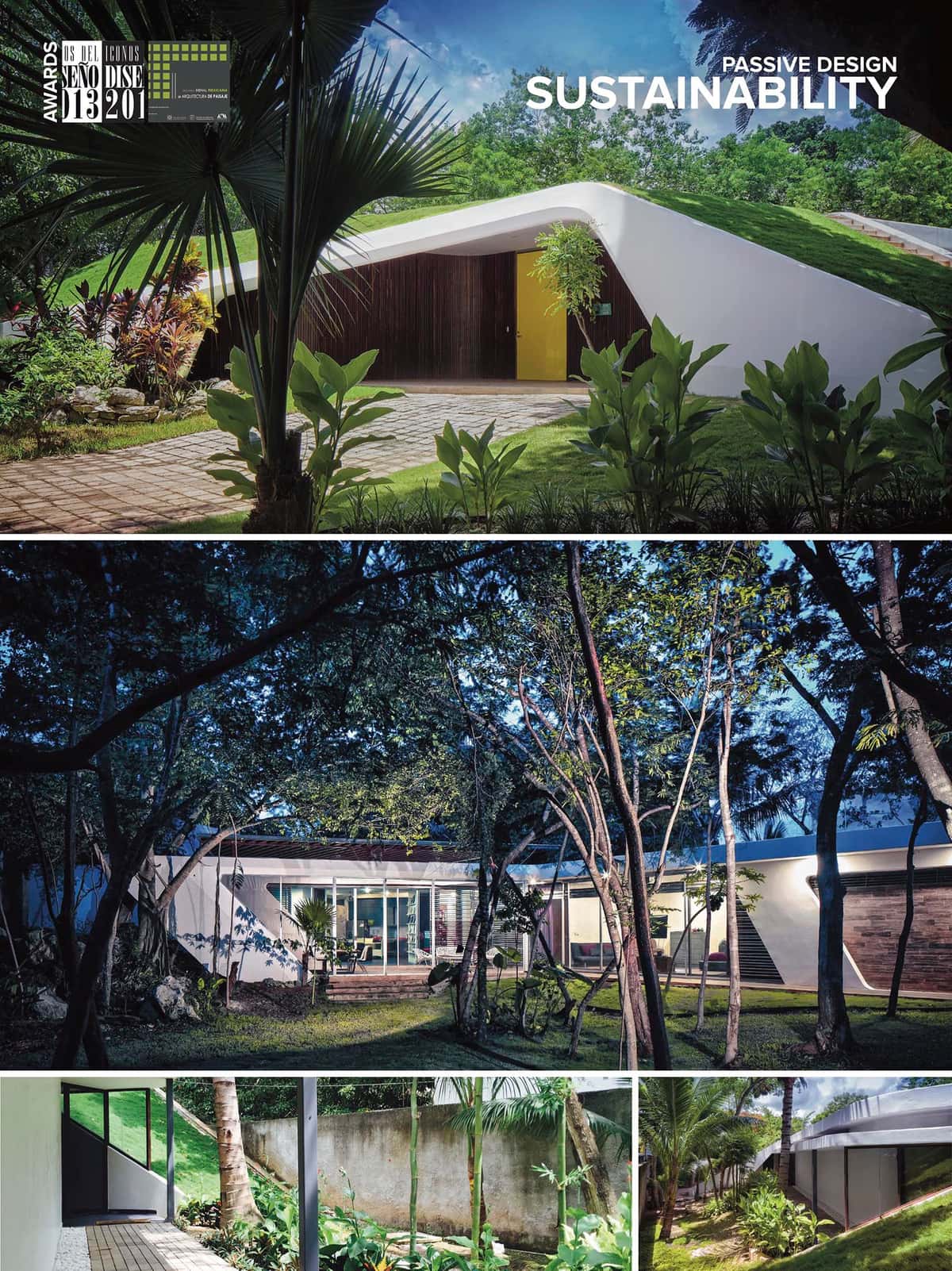

Conceptual Design: Natural Environment Integration. Small 1,000 sq. ft green house, built only with the needed space, set at the back of a 19,375 sq. ft property. This home is self-conscious of its natural environment and blends with its surroundings through its green roof. During the conceptual phase of the project, a debate about the controversy that architects have to stand out on every project arose, finally opting for a house concept that would become totally immersed on its natural environment, hidden by its surroundings. The house is situated at the back of the property for privacy purposes, placed on an area where no trees existed, transforming the daily coming and going to the house on a pleasant and relaxing walkway.
Open and Flexible Space. The house is designed as an open and flexible loft style space, based on the premise of organizing the different spaces in such a way that they can be visually connected to the exterior landscape. Its architectural program consists of a basic house program, optimizing mono-spacing and using just a small area of the property. Being self-conscious and using only the needed living space in harmony with the surrounding environment and its preservation is a way of optimizing resources and a sustainable way of living.
Bioclimatic Design: Energy Efficient Concept. The design is conceived through strict climate criteria, covering the comfort needs with the less possible energy consumption; this is achieved through a passive solar design that optimize natural renewable energy, energy used to generate comfort by means of sustainable design.
Green-Roofed House: Natural Thermal Insulation. Besides replacing the green space used for construction, the green roof helps retain dust and pollutants, improve the climate by reducing the “Heat Island” effect and conforming an excellent interior thermal insulation, providing more comfort to the user.
Sustainable Design: Smallest Footprint Possible. Passive Solar Design: How sunlight affects the facades was also taken into account into the design, using eaves and louvers for the windows, avoiding solar heat gain and saving energy.
Natural Cross Ventilation: Windows are designed facing each other and oriented to the prevailing winds, naturally refreshing the spaces without the use of air conditioning on a very hot climate.
Evaporative Cooling: Air temperature lowers as it passes through the evaporating water of the humid green roof just before entering through the window.
Solar Protection: The shadows generated by the “Perene” leaf trees are used to avoid solar west radiation. 26 to 33 ft tall trees of abundant foliage.
Reducing the “Heat Island” Effect: A green roof reduces heat absorption as far as 84%, relieving the urban “Heat Island” effect.
Natural Illumination: The house has big openings to optimize natural illumination, providing excellent daylight and reducing energy consumption.
Preserving Existing Vegetation: The house is integrated to the site preserving the existing trees to take advantage of the natural shadows they generate, being more ecologically conscious.
Waste Treatment: An ecological waste treatment is integrated to the design, using a biodigestor that converts 90% of treated water into an irrigation channel.
Compost: Compost is integrated to transform organic kitchen waste, dry leaves and mowed grass into usable soil for garden use.
Hurricane-proof Design: The house is designed 5 ft above the street level to prevent flooding and the closing mechanism of all windows is made of steel, preventing projectile risk during hurricanes.
Energy Saving . Energy Consumption: All the electric appliances and the low consumption light bulbs were carefully selected. The average monthly energy consumption is of 260 pesos, about 19 American dollars.


Conceptual Design: Natural Environment Integration. Small 1,000 sq. ft green house, built only with the needed space, set at the back of a 19,375 sq. ft property. This home is self-conscious of its natural environment and blends with its surroundings through its green roof. During the conceptual phase of the project, a debate about the controversy that architects have to stand out on every project arose, finally opting for a house concept that would become totally immersed on its natural environment, hidden by its surroundings. The house is situated at the back of the property for privacy purposes, placed on an area where no trees existed, transforming the daily coming and going to the house on a pleasant and relaxing walkway.
Open and Flexible Space. The house is designed as an open and flexible loft style space, based on the premise of organizing the different spaces in such a way that they can be visually connected to the exterior landscape. Its architectural program consists of a basic house program, optimizing mono-spacing and using just a small area of the property. Being self-conscious and using only the needed living space in harmony with the surrounding environment and its preservation is a way of optimizing resources and a sustainable way of living.
Bioclimatic Design: Energy Efficient Concept. The design is conceived through strict climate criteria, covering the comfort needs with the less possible energy consumption; this is achieved through a passive solar design that optimize natural renewable energy, energy used to generate comfort by means of sustainable design.
Green-Roofed House: Natural Thermal Insulation. Besides replacing the green space used for construction, the green roof helps retain dust and pollutants, improve the climate by reducing the “Heat Island” effect and conforming an excellent interior thermal insulation, providing more comfort to the user.
Sustainable Design: Smallest Footprint Possible. Passive Solar Design: How sunlight affects the facades was also taken into account into the design, using eaves and louvers for the windows, avoiding solar heat gain and saving energy.
Natural Cross Ventilation: Windows are designed facing each other and oriented to the prevailing winds, naturally refreshing the spaces without the use of air conditioning on a very hot climate.
Evaporative Cooling: Air temperature lowers as it passes through the evaporating water of the humid green roof just before entering through the window.
Solar Protection: The shadows generated by the “Perene” leaf trees are used to avoid solar west radiation. 26 to 33 ft tall trees of abundant foliage.
Reducing the “Heat Island” Effect: A green roof reduces heat absorption as far as 84%, relieving the urban “Heat Island” effect.
Natural Illumination: The house has big openings to optimize natural illumination, providing excellent daylight and reducing energy consumption.
Preserving Existing Vegetation: The house is integrated to the site preserving the existing trees to take advantage of the natural shadows they generate, being more ecologically conscious.
Waste Treatment: An ecological waste treatment is integrated to the design, using a biodigestor that converts 90% of treated water into an irrigation channel.
Compost: Compost is integrated to transform organic kitchen waste, dry leaves and mowed grass into usable soil for garden use.
Hurricane-proof Design: The house is designed 5 ft above the street level to prevent flooding and the closing mechanism of all windows is made of steel, preventing projectile risk during hurricanes.
Energy Saving . Energy Consumption: All the electric appliances and the low consumption light bulbs were carefully selected. The average monthly energy consumption is of 260 pesos, about 19 American dollars.
© 2021 by sanzpont [arquitectura] . Webpage by sanzpont [digital] . Innovative Digital Experiences
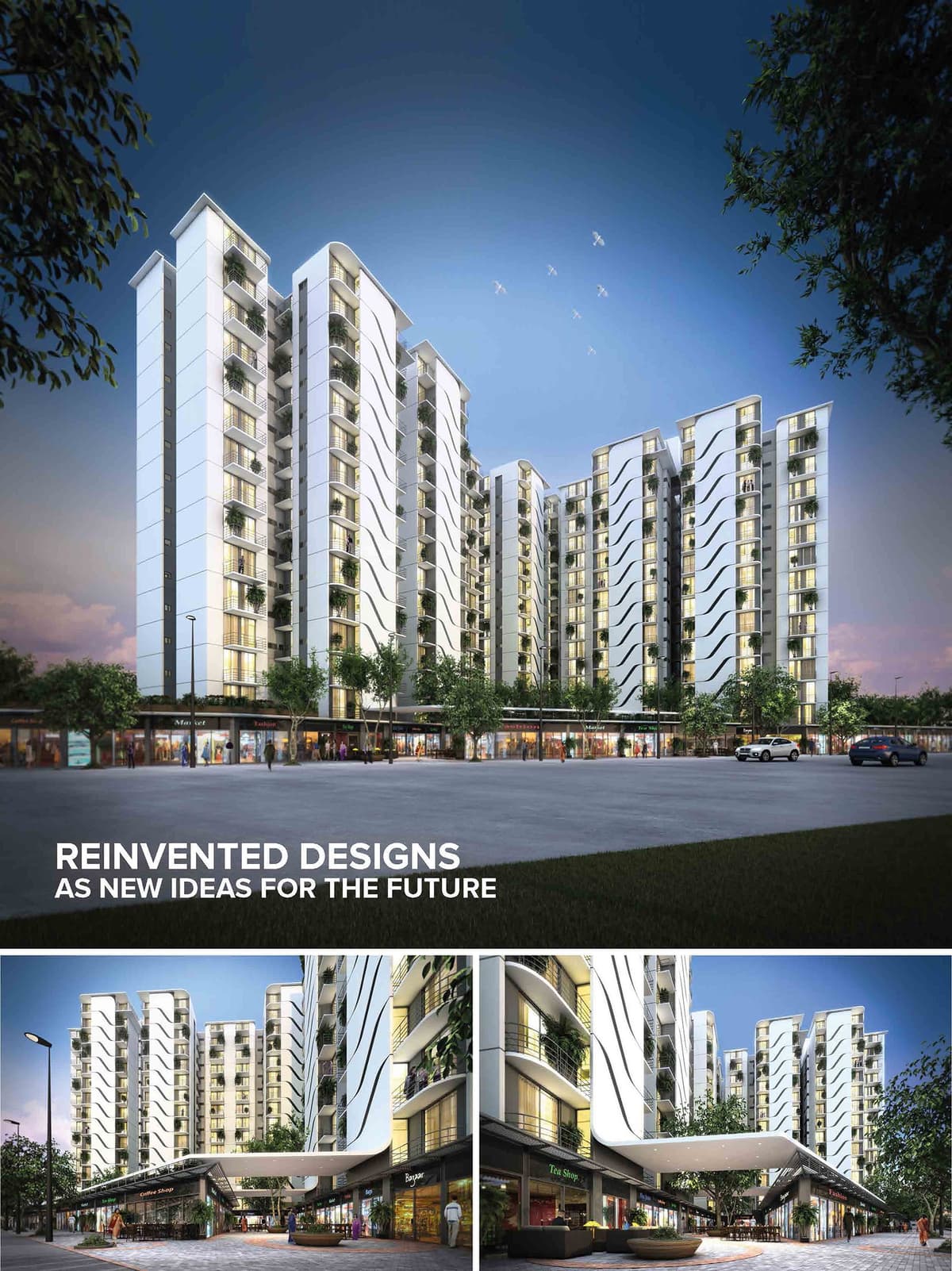

SKI Sector in Gurgaon is conceived as a contemporary mid-rise residential ensemble resting on an active commercial plinth. The architectural intention is to create a vertical neighborhood that merges urban vibrancy at ground level with calm, light-filled homes above. Curved facade lines and slender tower proportions soften the massing, ensuring the complex reads as a fluid, unified composition rather than a series of isolated blocks.
The design language is deliberately clean and minimal, using a restrained palette of light tones and linear elements to highlight volume, shadow, and rhythm. The towers frame a sequence of semi-urban courtyards and pedestrian passages, enabling residents to transition gradually from the public commercial realm to semi-public plazas and private residential zones.
The project is organized as a set of parallel towers rising from a continuous podium, establishing a strong urban edge along the street while opening internal vistas between the buildings. Verticality is emphasized through uninterrupted facade planes, recessed balcony bands, and corner glazing, giving the towers a slim, elegant profile against the skyline.
Gently undulating balcony fronts generate a wave-like pattern, animating the facade and breaking down the scale of the elevation. This rhythmic movement allows each tower to maintain an individual identity while remaining part of a coherent architectural family. Subtle step-backs at higher levels reduce visual bulk and improve access to daylight and views.
The envelope combines light-colored cladding with dark linear accents, producing a high-contrast yet refined aesthetic. Smooth, off-white panels form the primary surface, reflecting Gurgaon’s strong sunlight and moderating heat gain, while darker horizontal bands define balcony slabs and slab edges, reinforcing the building’s stratification.
Continuous glass balustrades and corner glazing panels enhance transparency, visually extending the living spaces outward. The wavy balcony fronts are expressed as thin, layered ribbons, providing both shading and a dynamic shadow play throughout the day. Integrated planter boxes at selected levels soften the vertical surfaces with greenery, subtly blurring the boundary between architecture and landscape.
The ground plane is activated by a continuous line of high-street retail, creating an animated frontage along the main access road. Generous canopies and soffits form sheltered walkways, protecting pedestrians from sun and rain while visually linking the various commercial units into a single urban arcade.
Double-height entrance zones and recessed lobbies mark the transition from public retail to residential circulation. Paving patterns, street furniture, and carefully positioned trees organize the pedestrian realm, guiding movement and encouraging lingering. The podium acts as a social condenser, offering everyday amenities at doorstep distance and contributing to a safer, lively streetscape.
Between the towers, landscaped courts and semi-covered plazas provide communal gathering areas that balance privacy with openness. These spaces are designed as extensions of the residential environment, featuring seating niches, soft planting, and shaded walkways that encourage informal interaction among residents.
Vertical landscaping on balconies and at podium edges complements ground-level planting, creating visual continuity from street to skyline. The arrangement of towers ensures view corridors to the surrounding cityscape while maintaining adequate buffer zones, resulting in a comfortable density that supports community life without overcrowding.
Sustainability in SKI Sector is approached through passive design, efficient building envelopes, and landscape-driven microclimate control. The light-toned facade reduces solar absorption, while the projecting balconies and wave-shaped ribbons act as horizontal brise-soleil, shading glass surfaces and reducing cooling demand. Deep overhangs at the commercial level further limit heat gain and glare for the shops and pedestrian areas.
Cross-ventilation is promoted through linear floor plates and strategically placed openings, enabling natural airflow across apartments and shared corridors. Integrated planters and tree-lined walkways help mitigate urban heat island effects and improve air quality. Space for potential rooftop solar installations and provisions for water-efficient landscaping and rainwater management support a holistic, future-ready sustainability framework aligned with the project’s tagline of “reinvented designs as new ideas for the future.”


SKI Sector in Gurgaon is conceived as a contemporary mid-rise residential ensemble resting on an active commercial plinth. The architectural intention is to create a vertical neighborhood that merges urban vibrancy at ground level with calm, light-filled homes above. Curved facade lines and slender tower proportions soften the massing, ensuring the complex reads as a fluid, unified composition rather than a series of isolated blocks.
The design language is deliberately clean and minimal, using a restrained palette of light tones and linear elements to highlight volume, shadow, and rhythm. The towers frame a sequence of semi-urban courtyards and pedestrian passages, enabling residents to transition gradually from the public commercial realm to semi-public plazas and private residential zones.
The project is organized as a set of parallel towers rising from a continuous podium, establishing a strong urban edge along the street while opening internal vistas between the buildings. Verticality is emphasized through uninterrupted facade planes, recessed balcony bands, and corner glazing, giving the towers a slim, elegant profile against the skyline.
Gently undulating balcony fronts generate a wave-like pattern, animating the facade and breaking down the scale of the elevation. This rhythmic movement allows each tower to maintain an individual identity while remaining part of a coherent architectural family. Subtle step-backs at higher levels reduce visual bulk and improve access to daylight and views.
The envelope combines light-colored cladding with dark linear accents, producing a high-contrast yet refined aesthetic. Smooth, off-white panels form the primary surface, reflecting Gurgaon’s strong sunlight and moderating heat gain, while darker horizontal bands define balcony slabs and slab edges, reinforcing the building’s stratification.
Continuous glass balustrades and corner glazing panels enhance transparency, visually extending the living spaces outward. The wavy balcony fronts are expressed as thin, layered ribbons, providing both shading and a dynamic shadow play throughout the day. Integrated planter boxes at selected levels soften the vertical surfaces with greenery, subtly blurring the boundary between architecture and landscape.
The ground plane is activated by a continuous line of high-street retail, creating an animated frontage along the main access road. Generous canopies and soffits form sheltered walkways, protecting pedestrians from sun and rain while visually linking the various commercial units into a single urban arcade.
Double-height entrance zones and recessed lobbies mark the transition from public retail to residential circulation. Paving patterns, street furniture, and carefully positioned trees organize the pedestrian realm, guiding movement and encouraging lingering. The podium acts as a social condenser, offering everyday amenities at doorstep distance and contributing to a safer, lively streetscape.
Between the towers, landscaped courts and semi-covered plazas provide communal gathering areas that balance privacy with openness. These spaces are designed as extensions of the residential environment, featuring seating niches, soft planting, and shaded walkways that encourage informal interaction among residents.
Vertical landscaping on balconies and at podium edges complements ground-level planting, creating visual continuity from street to skyline. The arrangement of towers ensures view corridors to the surrounding cityscape while maintaining adequate buffer zones, resulting in a comfortable density that supports community life without overcrowding.
Sustainability in SKI Sector is approached through passive design, efficient building envelopes, and landscape-driven microclimate control. The light-toned facade reduces solar absorption, while the projecting balconies and wave-shaped ribbons act as horizontal brise-soleil, shading glass surfaces and reducing cooling demand. Deep overhangs at the commercial level further limit heat gain and glare for the shops and pedestrian areas.
Cross-ventilation is promoted through linear floor plates and strategically placed openings, enabling natural airflow across apartments and shared corridors. Integrated planters and tree-lined walkways help mitigate urban heat island effects and improve air quality. Space for potential rooftop solar installations and provisions for water-efficient landscaping and rainwater management support a holistic, future-ready sustainability framework aligned with the project’s tagline of “reinvented designs as new ideas for the future.”
© 2021 by sanzpont [arquitectura] . Webpage by sanzpont [digital] . Innovative Digital Experiences
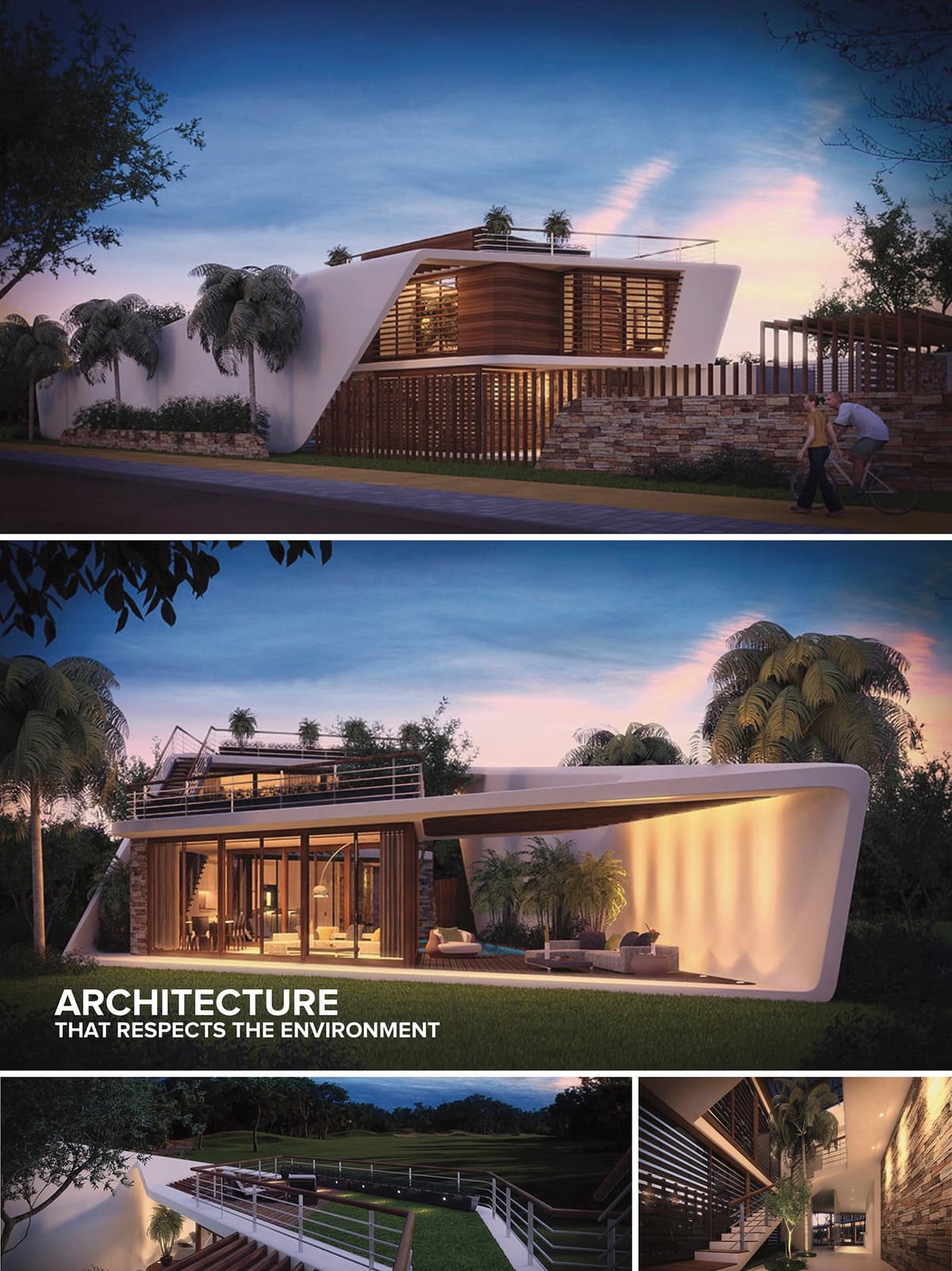

sanzpont [arquitectura] has recently won 1st Place in an International Private Competition to design a unique concept in residential development at the Riviera Maya surrounded by the Golf Course at Grand Coral. The challenge was to create a housing model to harmonize with the actual development of Grand Coral, but turning out as a new product in a set of 500m2 lots fronting the golf course, with contemporary design, adapted to the site and it´s natural context, which maximize the main views and to create an attractive and unique concept for the vacation home market.
Bioclimatic Design. The project takes Sustainability and Bioclimatic Design into account for the main design concept. The study of climate, weather comfort charts, geometry solar study and prevailing winds direction, suggest the use of sun protection, cross ventilation, passive solar design and main bioclimatic design strategy for maximum thermal comfort by natural means.
Concept / Architectural Scheme. The main idea is based on designing an opened home to the outside, as if it were a yacht concept, with a consecutive series of terraces, displacing the upper volume of the rooms backwards to generate views and outdoor areas to enjoy free and living together at different levels.
Main floor opens at the middle to locate the pool area creating an open courtyard living together among all surrounding areas: living room, kitchen and TV room.
Sustainable Design. All spaces are designed with natural cross ventilation. All covers are used as green roofs landscaped terraces resulting in a natural insulation and recovers rainwater for use in irrigation.


sanzpont [arquitectura] has recently won 1st Place in an International Private Competition to design a unique concept in residential development at the Riviera Maya surrounded by the Golf Course at Grand Coral. The challenge was to create a housing model to harmonize with the actual development of Grand Coral, but turning out as a new product in a set of 500m2 lots fronting the golf course, with contemporary design, adapted to the site and it´s natural context, which maximize the main views and to create an attractive and unique concept for the vacation home market.
Bioclimatic Design. The project takes Sustainability and Bioclimatic Design into account for the main design concept. The study of climate, weather comfort charts, geometry solar study and prevailing winds direction, suggest the use of sun protection, cross ventilation, passive solar design and main bioclimatic design strategy for maximum thermal comfort by natural means.
Concept / Architectural Scheme. The main idea is based on designing an opened home to the outside, as if it were a yacht concept, with a consecutive series of terraces, displacing the upper volume of the rooms backwards to generate views and outdoor areas to enjoy free and living together at different levels.
Main floor opens at the middle to locate the pool area creating an open courtyard living together among all surrounding areas: living room, kitchen and TV room.
Sustainable Design. All spaces are designed with natural cross ventilation. All covers are used as green roofs landscaped terraces resulting in a natural insulation and recovers rainwater for use in irrigation.
© 2021 by sanzpont [arquitectura] . Webpage by sanzpont [digital] . Innovative Digital Experiences
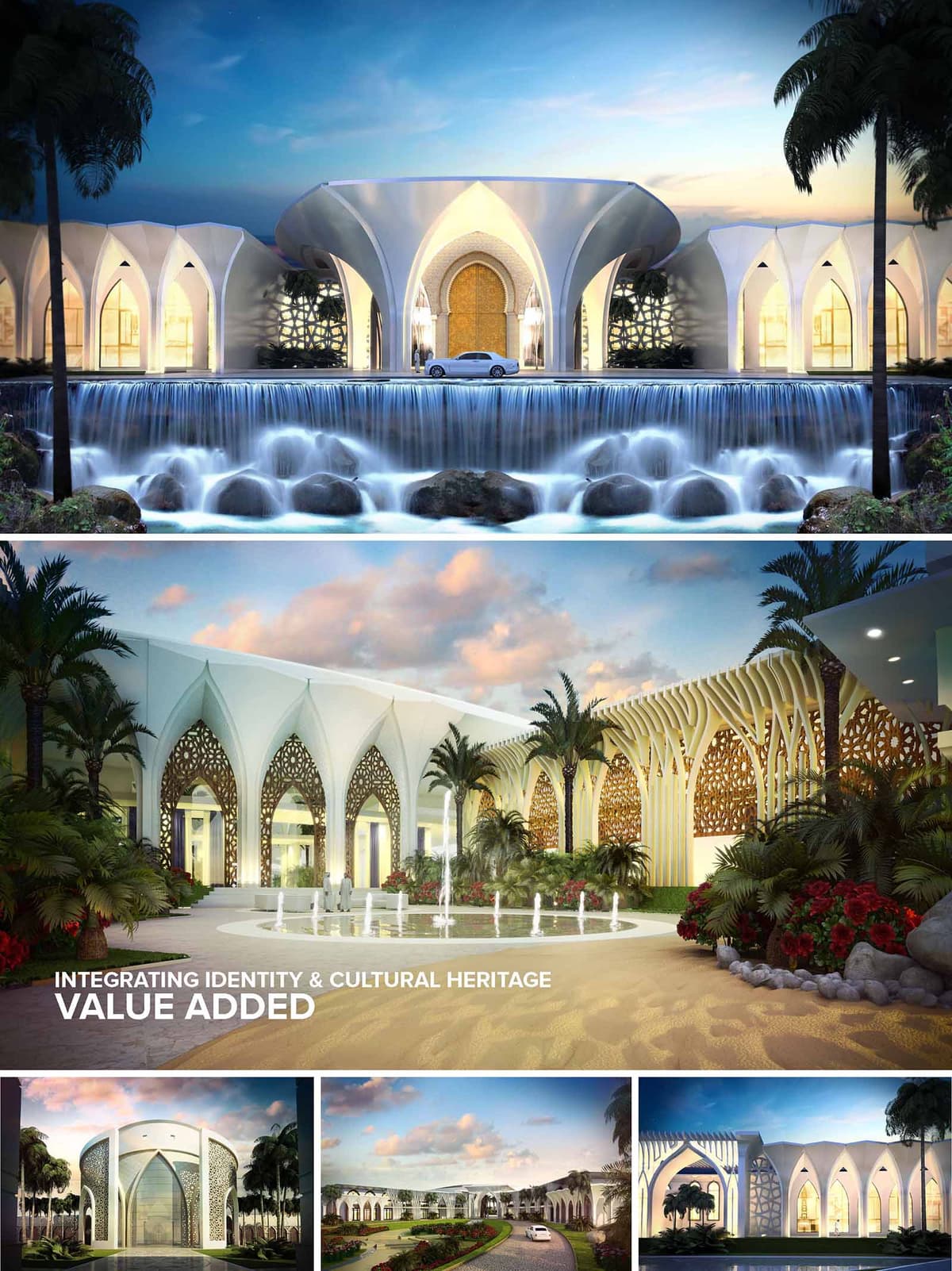

Al Rayyan Palace is conceived as a contemporary reinterpretation of the Qatari palace typology, fusing classical Islamic geometry with a sculptural, resort-like architectural language. The design organizes the residence around a ceremonial arrival axis, framed by a sequence of arches and water features that extend the landscape into the built form. Architecture, light and water are choreographed to announce a luxurious yet culturally rooted domestic environment. The palace functions as both private residence and representative space, allowing formal receptions to coexist with intimate family life while preserving privacy and hierarchy.
The architectural vocabulary is built on a repeated pointed-arch module, stretched vertically to create a series of elegant white “petals” that read as both columns and shells. These elements form a rhythmic arcade enclosing the main façades, while the central volume projects forward as a grand, double-height portal. The smooth, continuous roofline gently undulates, recalling desert dunes and creating a soft silhouette against the sky. Solid and void alternate through deep reveals, screens and glazed infills, resulting in a façade that is simultaneously monumental and permeable. At night, concealed lighting transforms the white shells into luminous lanterns, emphasizing the three-dimensional curvature of the envelope.
The palette is intentionally restrained to highlight form and light. Exterior surfaces employ high-performance white render or stone cladding, selected for its thermal reflectivity and timeless appearance. Large, gilded entrance doors and finely perforated metal mashrabiya panels introduce a warm golden accent that resonates with traditional craftsmanship. Glazing is generously used yet always recessed within arches or screened, mitigating glare while preserving transparency. The water features and lush planting provide rich blue and green counterpoints to the predominantly white architecture, creating a cool micro-oasis effect that reinforces the palace’s sense of exclusivity and serenity.
The arrival sequence is articulated through layered landscape experiences: a long approach drive framed by palm trees, a circular fountain forecourt, and a dramatic linear water cascade aligned with the main entrance. The elevated plinth of the palace allows water to fall in terraces, visually grounding the building while enhancing its ceremonial presence. Reflecting pools amplify the façade through mirrored images, doubling the perception of space and contributing to passive cooling. Dense planting with tropical and regional species softens the geometry, filters views, and forms a buffer between public arrival zones and private garden courts.
The design draws from Islamic architectural heritage through pointed arches, geometric tracery and layered thresholds while avoiding literal historicism. The structural rhythm of columns recalls the hypostyle hall, reinterpreted in a fluid, contemporary manner. Public reception spaces align along the main axis facing the primary water features, while private residential wings are discreetly set back, accessed through controlled circulation routes that respect local privacy norms. Transitional semi-open loggias mediate between interior and exterior, supporting social gatherings in shaded, naturally ventilated spaces that are integral to the region’s lifestyle.
Sustainability is embedded through climate-responsive form, material selection and landscape design. The deep arches and overhanging shells act as self-shading devices, reducing direct solar gain on glazed surfaces. High-reflectance façade finishes and insulated envelopes contribute to thermal comfort and lower cooling loads. Water bodies and dense planting assist microclimate regulation through evaporative cooling and shading, while the orientation of major openings promotes cross ventilation in transitional spaces. The use of screens and filtered daylight minimizes reliance on artificial lighting during the day. Provision for high-efficiency MEP systems, potential grey-water reuse for irrigation and integration of LED lighting further enhance the project’s environmental performance while maintaining the palace’s luxurious character.


Al Rayyan Palace is conceived as a contemporary reinterpretation of the Qatari palace typology, fusing classical Islamic geometry with a sculptural, resort-like architectural language. The design organizes the residence around a ceremonial arrival axis, framed by a sequence of arches and water features that extend the landscape into the built form. Architecture, light and water are choreographed to announce a luxurious yet culturally rooted domestic environment. The palace functions as both private residence and representative space, allowing formal receptions to coexist with intimate family life while preserving privacy and hierarchy.
The architectural vocabulary is built on a repeated pointed-arch module, stretched vertically to create a series of elegant white “petals” that read as both columns and shells. These elements form a rhythmic arcade enclosing the main façades, while the central volume projects forward as a grand, double-height portal. The smooth, continuous roofline gently undulates, recalling desert dunes and creating a soft silhouette against the sky. Solid and void alternate through deep reveals, screens and glazed infills, resulting in a façade that is simultaneously monumental and permeable. At night, concealed lighting transforms the white shells into luminous lanterns, emphasizing the three-dimensional curvature of the envelope.
The palette is intentionally restrained to highlight form and light. Exterior surfaces employ high-performance white render or stone cladding, selected for its thermal reflectivity and timeless appearance. Large, gilded entrance doors and finely perforated metal mashrabiya panels introduce a warm golden accent that resonates with traditional craftsmanship. Glazing is generously used yet always recessed within arches or screened, mitigating glare while preserving transparency. The water features and lush planting provide rich blue and green counterpoints to the predominantly white architecture, creating a cool micro-oasis effect that reinforces the palace’s sense of exclusivity and serenity.
The arrival sequence is articulated through layered landscape experiences: a long approach drive framed by palm trees, a circular fountain forecourt, and a dramatic linear water cascade aligned with the main entrance. The elevated plinth of the palace allows water to fall in terraces, visually grounding the building while enhancing its ceremonial presence. Reflecting pools amplify the façade through mirrored images, doubling the perception of space and contributing to passive cooling. Dense planting with tropical and regional species softens the geometry, filters views, and forms a buffer between public arrival zones and private garden courts.
The design draws from Islamic architectural heritage through pointed arches, geometric tracery and layered thresholds while avoiding literal historicism. The structural rhythm of columns recalls the hypostyle hall, reinterpreted in a fluid, contemporary manner. Public reception spaces align along the main axis facing the primary water features, while private residential wings are discreetly set back, accessed through controlled circulation routes that respect local privacy norms. Transitional semi-open loggias mediate between interior and exterior, supporting social gatherings in shaded, naturally ventilated spaces that are integral to the region’s lifestyle.
Sustainability is embedded through climate-responsive form, material selection and landscape design. The deep arches and overhanging shells act as self-shading devices, reducing direct solar gain on glazed surfaces. High-reflectance façade finishes and insulated envelopes contribute to thermal comfort and lower cooling loads. Water bodies and dense planting assist microclimate regulation through evaporative cooling and shading, while the orientation of major openings promotes cross ventilation in transitional spaces. The use of screens and filtered daylight minimizes reliance on artificial lighting during the day. Provision for high-efficiency MEP systems, potential grey-water reuse for irrigation and integration of LED lighting further enhance the project’s environmental performance while maintaining the palace’s luxurious character.
© 2021 by sanzpont [arquitectura] . Webpage by sanzpont [digital] . Innovative Digital Experiences
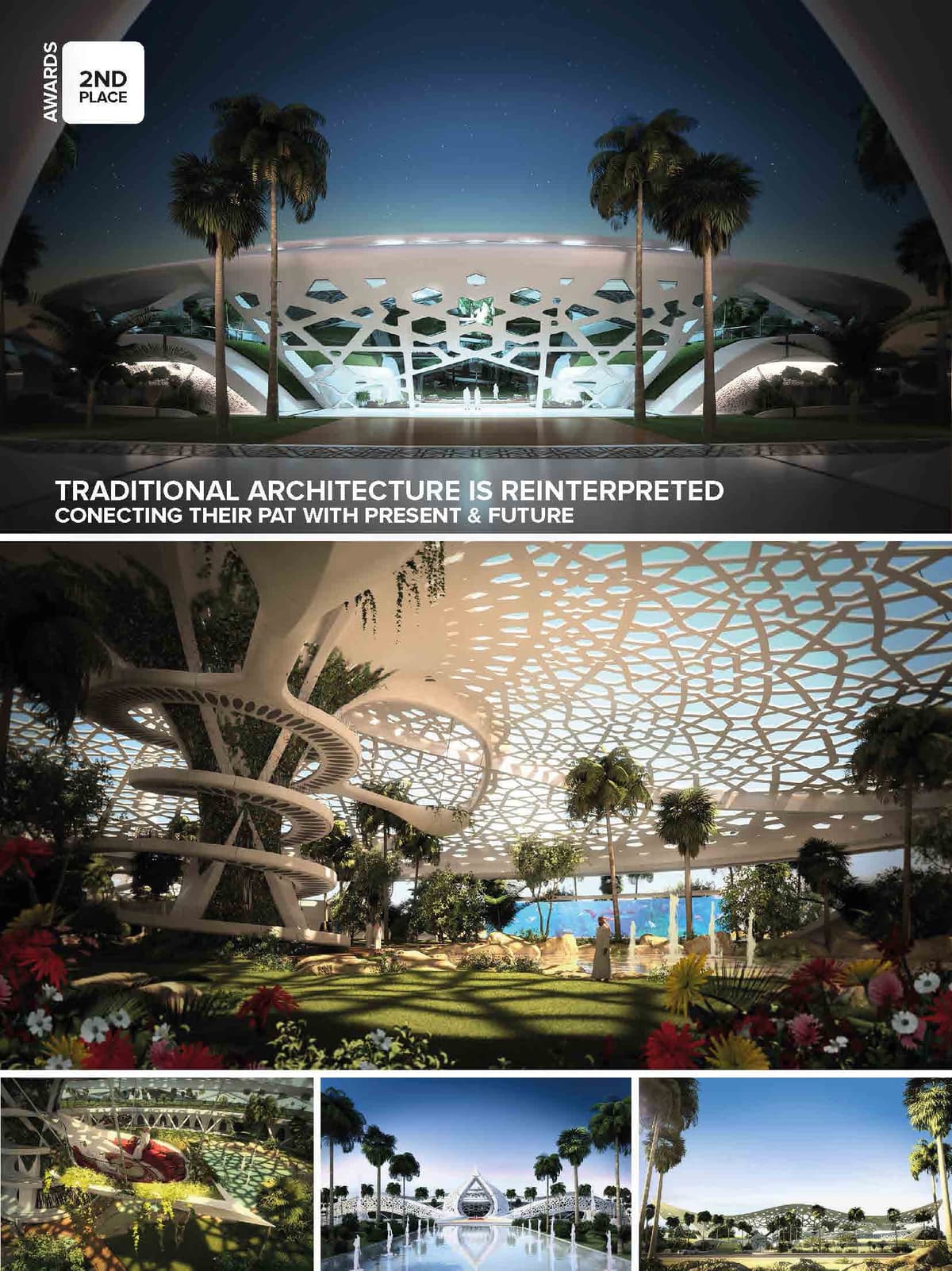

“An Oasis is a miracle of life in the desert.” sanzpont [arquitectura] has being awarded 3rd place in an international restricted competition for a VIP Palace in Qatar for its innovative and ecologic response to the project brief of this private residence: "The purpose of the competition was to stimulate innovative and creative ideas to create high end luxurious Palace to achieve relaxation and luxury for its VIP users."
This Palace reinvents the simple idea of creating luxury into something meaningful, creating life and nature through a self-sustainable botanical oasis in the desert. The microclimate needed for botanical species is created by a mist irrigation system located in the inner skin of the palace central dome. Water is obtained from an underground aquifer and sustainable desalinated by an electrodialysis system that is powered by solar renewable sources. Photovoltaic panels are integrated into the outer skin of the dome and building roofs, water is stored in the landscaping lakes featuring various thematic gardens and picnic areas.
“Architecture design should be integrated with its surrounding environment should reflect its culture in time, so we studied their historical typologies and architectural language to evolve it into innovative vanguard design plenty of cultural heritage.”
The heart of the palace is an oasis covered by a central dome, its unique design is inspired by the Sidra Tree, which is native to Qatar and is a symbol for perseverance, solidarity and determination.
Historically, this tree unifies people looking shade in the desert, meeting and talking bellow its spreading branches. These branches are symbolized with a leaf-shaped seating spaces hanging inside the Sidra Tree Dome, these seating spaces for calm and relaxation are called “Floating Majlis”.
Traditional Qatari architecture is reinterpreted connecting their past with present and future.
Sustainable Design. Photovoltaic Energy: The tensile skin incorporates Foldable Photovoltaic Solar Panels capturing energy from the sun to generate and supply electricity from a clean and sustainable energy. This makes the bridge self-sustainable.
Air-Cleaning Plants: To go beyond green, the design includes Plants that clean and purify the air, transforming the pollution of the city in pure oxygen. Plants and the Breathable Membrane make a greener environment and a clean pedestrian tunnel.
LED RGB Technology: Linear LED technology glow the structure of the bridge at night, creating art with light of low power consumption. This emphasizes the fluid and organic forms and creates different sensations.
INTERNATIONAL ARCHITECTURE AWARDS
• A’ Design Awards, Milán, Italy: Silver Medal - Certificate of Excellence in World Landscape & Planning Design : A Palace for Nature (2015)


INTERNATIONAL ARCHITECTURE AWARDS
• A’ Design Awards, Milán, Italy: Silver Medal - Certificate of Excellence in World Landscape & Planning Design : A Palace for Nature (2015)
“An Oasis is a miracle of life in the desert.” sanzpont [arquitectura] has being awarded 3rd place in an international restricted competition for a VIP Palace in Qatar for its innovative and ecologic response to the project brief of this private residence: "The purpose of the competition was to stimulate innovative and creative ideas to create high end luxurious Palace to achieve relaxation and luxury for its VIP users."
This Palace reinvents the simple idea of creating luxury into something meaningful, creating life and nature through a self-sustainable botanical oasis in the desert. The microclimate needed for botanical species is created by a mist irrigation system located in the inner skin of the palace central dome. Water is obtained from an underground aquifer and sustainable desalinated by an electrodialysis system that is powered by solar renewable sources. Photovoltaic panels are integrated into the outer skin of the dome and building roofs, water is stored in the landscaping lakes featuring various thematic gardens and picnic areas.
“Architecture design should be integrated with its surrounding environment should reflect its culture in time, so we studied their historical typologies and architectural language to evolve it into innovative vanguard design plenty of cultural heritage.”
The heart of the palace is an oasis covered by a central dome, its unique design is inspired by the Sidra Tree, which is native to Qatar and is a symbol for perseverance, solidarity and determination.
Historically, this tree unifies people looking shade in the desert, meeting and talking bellow its spreading branches. These branches are symbolized with a leaf-shaped seating spaces hanging inside the Sidra Tree Dome, these seating spaces for calm and relaxation are called “Floating Majlis”.
Traditional Qatari architecture is reinterpreted connecting their past with present and future.
Sustainable Design. Photovoltaic Energy: The tensile skin incorporates Foldable Photovoltaic Solar Panels capturing energy from the sun to generate and supply electricity from a clean and sustainable energy. This makes the bridge self-sustainable.
Air-Cleaning Plants: To go beyond green, the design includes Plants that clean and purify the air, transforming the pollution of the city in pure oxygen. Plants and the Breathable Membrane make a greener environment and a clean pedestrian tunnel.
LED RGB Technology: Linear LED technology glow the structure of the bridge at night, creating art with light of low power consumption. This emphasizes the fluid and organic forms and creates different sensations.
© 2021 by sanzpont [arquitectura] . Webpage by sanzpont [digital] . Innovative Digital Experiences
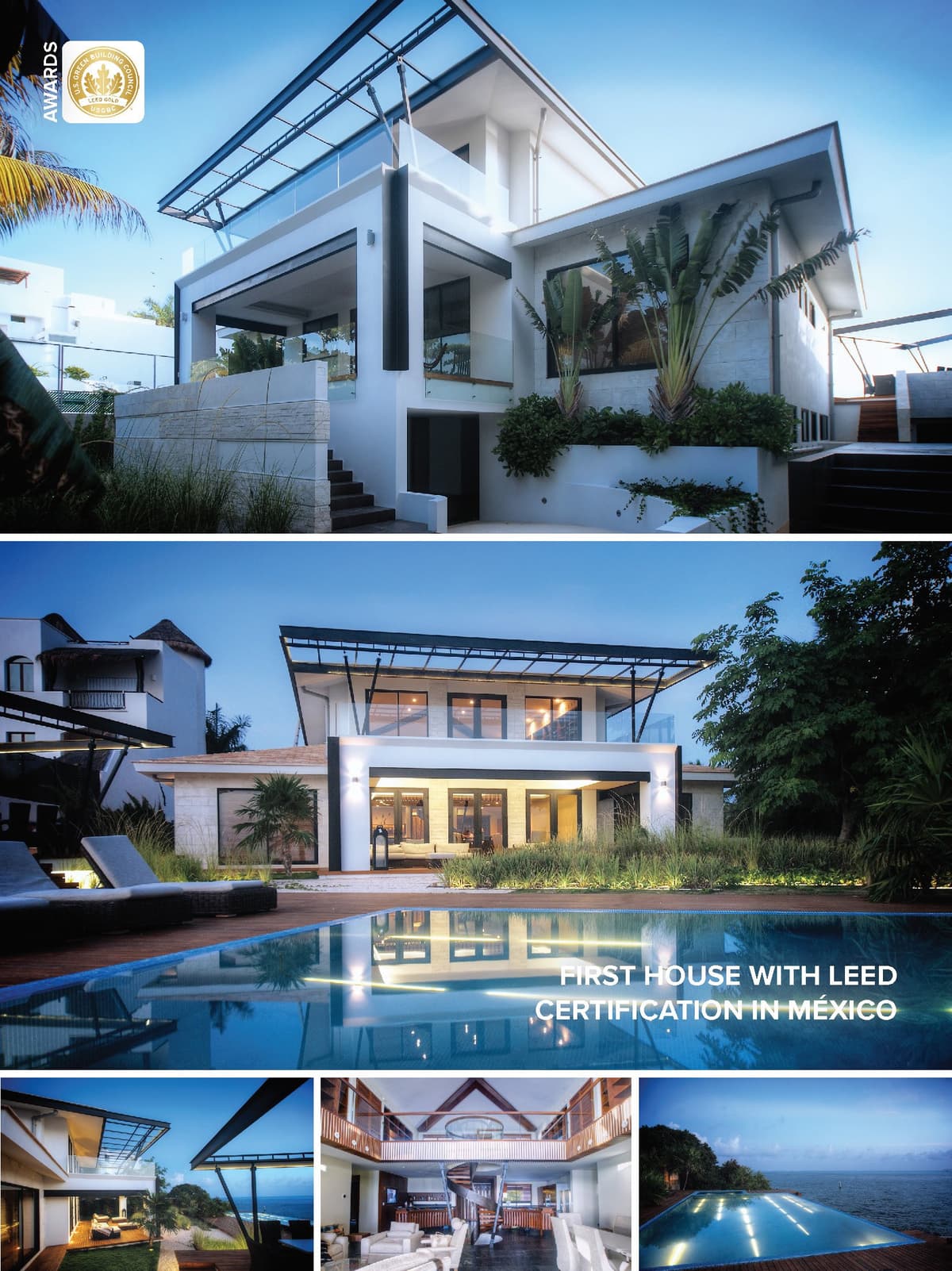

DESIGN CONCEPT
Contemporary Caribbean House. Casa SDLV is conceptualized as ecological house, used as a rest house, named in reference to the owner's initials; located on the island portion of Isla Mujeres Mexico, flanked by the sea and the lagoon, but was designed to take advantage of benefits provided by the Caribbean with efficient design and contemporary Caribbean character. The project began as a restoration of an old wooden house in disrepair , where the essence was kept and where the conceptual idea was to create a contemporary housing adapted to the elements of the Caribbean; the efficient use of its resources and aware of their natural environment.
PRIVILEGED VIEWS
The property is developed in an open and flexible space, with the purpose of organizing the spaces so they can open their visual to the Caribbean Sea. It has the basic architectural housing program maximizing views to the outside.
BIOCLIMATIC DESIGN
Energy – Efficient Concept. The house is designed to cover the needs of comfort with minimum energy expenditure; in a climate where the entire city uses the air conditioning, 365 days a year, this house is designed to reduce consumption. It is a proposal about how to live in the warm Caribbean, with a feeling of being in touch with nature in a cottage style.
LEED GOLD for Homes Certification: Sustainable design minimizing the carbon footprint
PASSIVE SOLAR DESIGN
Photovoltaic system on facades and sloping roofs resulting in optimum protection to reduce solar incidence and self-generation of energy.
RAINWATER REUSE
Capture system of rainwater for reuse in drip irrigation of green areas.
ENDEMIC VEGETATION
Endemic vegetation noninvasive and low-maintenance landscaping, and the minimum use of conventional pastures and wooded conservation and restoration of existing natural areas.
LOW THERMAL EMISSION MATERIALS
The use of certified wood (FSC) and reused as native finishing materials and furniture.
HEAT ISLAND EFFECT MITIGATION
Materials were applied with high solar reflectance index (SRI) to reduce the urban “heat island” effect, getting equally decreased surface temperature, which results in better thermal performance, reducing maintenance and power consumption (air conditioning).
SAVING & ENERGY GENERATION
LED lighting to reduce energy consumption and HVAC systems not harmful to the environment high efficiency. Photovoltaic pergolas are designed to generate much of the energy consumption.
First LEED certified housing in Mexico, for having materials with low thermal emission, permeable pavement, anticyclone windows, use of non-invasive vegetation, use of many recycled materials as well as rainwater harvesting through slabs.
A green building increases the productivity of the occupants, it has been designed for quality living spaces, the required amount of natural light, appropriate noise levels, thermal control, and adequate ventilation, among others. All these aspects are to improve the quality of life and health of users. Moreover a certified building reduces the negative effects that the construction could have on the environment, reduce greenhouse gas emissions to the environment, avoiding damage to the ozone layer and climate change, reduce waste sent to landfills preserving the natural environment, protecting ecosystems and biodiversity.
AWARDS & CERTIFICATIONS
• LEED GOLD for Homes
• First House with LEED for Homes certification in Mexico


AWARDS & CERTIFICATIONS
• LEED GOLD for Homes
• First House with LEED for Homes certification in Mexico
DESIGN CONCEPT
Contemporary Caribbean House. Casa SDLV is conceptualized as ecological house, used as a rest house, named in reference to the owner's initials; located on the island portion of Isla Mujeres Mexico, flanked by the sea and the lagoon, but was designed to take advantage of benefits provided by the Caribbean with efficient design and contemporary Caribbean character. The project began as a restoration of an old wooden house in disrepair , where the essence was kept and where the conceptual idea was to create a contemporary housing adapted to the elements of the Caribbean; the efficient use of its resources and aware of their natural environment.
PRIVILEGED VIEWS
The property is developed in an open and flexible space, with the purpose of organizing the spaces so they can open their visual to the Caribbean Sea. It has the basic architectural housing program maximizing views to the outside.
BIOCLIMATIC DESIGN
Energy – Efficient Concept. The house is designed to cover the needs of comfort with minimum energy expenditure; in a climate where the entire city uses the air conditioning, 365 days a year, this house is designed to reduce consumption. It is a proposal about how to live in the warm Caribbean, with a feeling of being in touch with nature in a cottage style.
LEED GOLD for Homes Certification: Sustainable design minimizing the carbon footprint
PASSIVE SOLAR DESIGN
Photovoltaic system on facades and sloping roofs resulting in optimum protection to reduce solar incidence and self-generation of energy.
RAINWATER REUSE
Capture system of rainwater for reuse in drip irrigation of green areas.
ENDEMIC VEGETATION
Endemic vegetation noninvasive and low-maintenance landscaping, and the minimum use of conventional pastures and wooded conservation and restoration of existing natural areas.
LOW THERMAL EMISSION MATERIALS
The use of certified wood (FSC) and reused as native finishing materials and furniture.
HEAT ISLAND EFFECT MITIGATION
Materials were applied with high solar reflectance index (SRI) to reduce the urban “heat island” effect, getting equally decreased surface temperature, which results in better thermal performance, reducing maintenance and power consumption (air conditioning).
SAVING & ENERGY GENERATION
LED lighting to reduce energy consumption and HVAC systems not harmful to the environment high efficiency. Photovoltaic pergolas are designed to generate much of the energy consumption.
First LEED certified housing in Mexico, for having materials with low thermal emission, permeable pavement, anticyclone windows, use of non-invasive vegetation, use of many recycled materials as well as rainwater harvesting through slabs.
A green building increases the productivity of the occupants, it has been designed for quality living spaces, the required amount of natural light, appropriate noise levels, thermal control, and adequate ventilation, among others. All these aspects are to improve the quality of life and health of users. Moreover a certified building reduces the negative effects that the construction could have on the environment, reduce greenhouse gas emissions to the environment, avoiding damage to the ozone layer and climate change, reduce waste sent to landfills preserving the natural environment, protecting ecosystems and biodiversity.
© 2021 by sanzpont [arquitectura] . Webpage by sanzpont [digital] . Innovative Digital Experiences
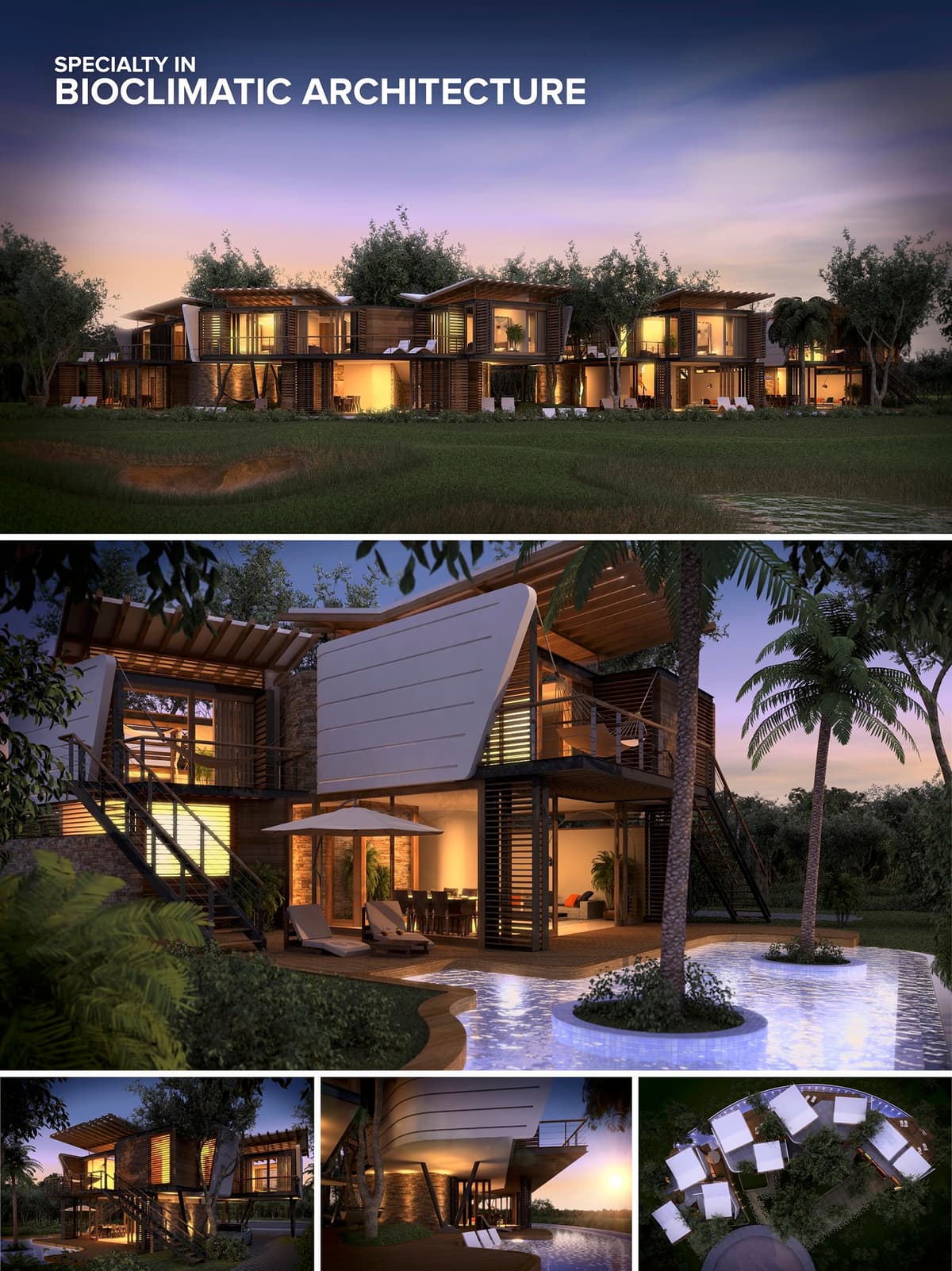

Design Concept: The main idea of the project was to integrate the house to the site respecting the existing trees to maximize the natural shade they provide and be more environmentally conscious. So the biggest challenge was to find the exact spot where to place the base of the house and the general form was developed dodging trees and integrating the design within an overall concept. So the site gives way to the House, while it coexists harmoniously. Four villas have been integrated in a natural and continuous space, where outdoor blends indoor spaces to achieve an atmosphere of relaxation and rest.
Respecting Existing Nature. The soul of this design is the respect of existing nature; by dodging trees the site gives way to the house.
Materials: In the choice of materials, the stone of the region was used to shape the foundations and walls of the ground floor, thus giving further strength visually, naturally integrates with the subsoil of the land. Recycled Timber is one of the main materials of the house; it gives warmth and a natural comfort.
Sustainable Design: Recycled Timber is also used to create shades, sliding and folding shutters that provide shade and control the passage of direct sunlight and heat to interior. The white walls upstairs, makes a "Reflective Shield" on the faces towards the sun and receive the skylight colors. The design of the roofs provides shade on the terraces at the same time that opens to make way for wind in and crosses to refresh all interior areas.
A Home to Relax: The interior spaces have been integrated with the surroundings through large outdoor terraces overlooking the golf course; exterior furnishings create an environment of relaxation and Caribbean peace.


Design Concept: The main idea of the project was to integrate the house to the site respecting the existing trees to maximize the natural shade they provide and be more environmentally conscious. So the biggest challenge was to find the exact spot where to place the base of the house and the general form was developed dodging trees and integrating the design within an overall concept. So the site gives way to the House, while it coexists harmoniously. Four villas have been integrated in a natural and continuous space, where outdoor blends indoor spaces to achieve an atmosphere of relaxation and rest.
Respecting Existing Nature. The soul of this design is the respect of existing nature; by dodging trees the site gives way to the house.
Materials: In the choice of materials, the stone of the region was used to shape the foundations and walls of the ground floor, thus giving further strength visually, naturally integrates with the subsoil of the land. Recycled Timber is one of the main materials of the house; it gives warmth and a natural comfort.
Sustainable Design: Recycled Timber is also used to create shades, sliding and folding shutters that provide shade and control the passage of direct sunlight and heat to interior. The white walls upstairs, makes a "Reflective Shield" on the faces towards the sun and receive the skylight colors. The design of the roofs provides shade on the terraces at the same time that opens to make way for wind in and crosses to refresh all interior areas.
A Home to Relax: The interior spaces have been integrated with the surroundings through large outdoor terraces overlooking the golf course; exterior furnishings create an environment of relaxation and Caribbean peace.
© 2021 by sanzpont [arquitectura] . Webpage by sanzpont [digital] . Innovative Digital Experiences
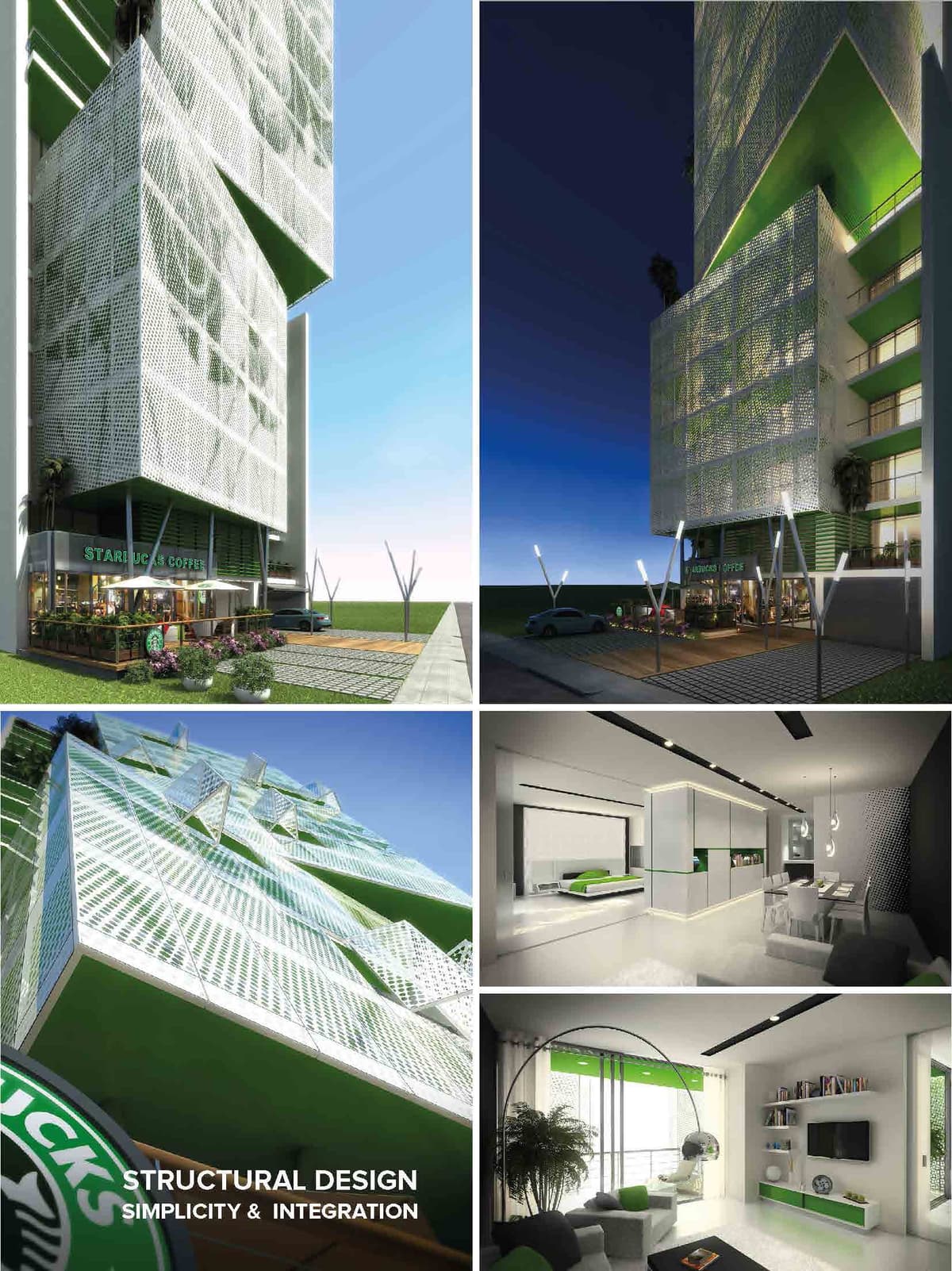

STRUCTURAL DESIGN
Simplicity of defined axes. An important factor in the building design was to have a simple structure, so from the beginning a plot of axes was defined that would jointly contemplate the underground parking garage and the vertical mass of housing.
URBAN INTEGRATION
Expansion of public space. To integrate the building with its urban fabric, there is a setback of the faade on the ground floor, thereby maximizing the public area by generating an access plaza and a terrace. With this gesture it is possible to have a spatial scale at the pedestrian level. Through a longitudinal design of the cafeteria, the public space is carried to the back of the land where the garden can be used for recreation and contemplation.
ARCHITECTURAL DISTRIBUTION
Responding to the functional needs. The building fully responds to the architectural program and the needs of use. The 30 lofts are flats that look directly toward the Golf Club. All the apartments have the same configuration and dimensions, the only variation is the size of the terraces, which is by facade design. The total built area per apartment is between 207 m2 and 217 m2, including terraces. The loft interior space is created by means of a unique and open space between kitchen, hall, dining room, living room, master bedroom and terraces, where the entire space revolves around a central bookcase. In case privacy is required in the main room, a large sliding panel isolates it from the rest of the space. The underground parking garage was resolved in half levels with a vehicular circulation around the vertical core with a total of 118 parking spaces.
CHANGEABLE FACADE
Depending on the time of year. The volumetric design of the main facade responds to the model based on the analysis of the site, and the micro-perforated graphic art integrates it with the green landscape. This glass facade has the ability to be opened in its entirety by means of folding windows on a pivoting mechanism, above all by thinking of the summer air circulation, easy maintenance and the ability to clean from the inside. This system of windows gives the building the ability to have a CHANGEABLE FACADE according to the climate- a living skin that is transformed at the user's will to achieve greater comfort in summer and winter. THE SKIN OF THE BUILDING: Graphic art and design according to its orientation. The skin of the building responds to the orientation of the facade. On the South facade the percentage of openings is lower and the windows are protected by sliding micro-perforated aluminum panels to avoid overheating in SUMMER while simultaneously allowing the wind to flow through for natural cross ventilation.
On the North facade, the skin of the building is totally glazed to make the most of natural light and depending on the cloudiness, to capture some solar radiation and slightly heat the interior space in WINTER. This skin is composed of: a. Glass to allow maximum natural light b. Micro-perforated vinyl that allows you to see from the inside to the outside, while generating privacy on the terraces. The art and graphic design of the vinyl simulates a vegetation-like skin that is integrated into the golf course, which is complemented by the green background of the balconies, providing the building with an artistic and avant-garde image c. Elements of pivoting, reinforced aluminum.
BIOCLIMATIC AND SUSTAINABILITY
The building adapts to the climate. The CLIMATIC ANALYSIS of the site tells us that Lima is a city with a moderate climate, practically without rainfall but with a very high level of atmospheric humidity. The average annual temperature is 18.5 to 19 ¡ C. The summer lasts from December to April, with an average temperature between 29 and 21 ¡ C. In winter, from June to September, the temperature ranges between 19 and 12 ¡ C. The natural conditions of the site generate a thermal inversion that causes an almost permanent cloudiness that makes the passage of direct solar radiation difficult. Even so, we believe it is important to take advantage of solar energy as much as possible, which varies depending on the degree of cloudiness of each day. The dominant wind comes from the South throughout the year.
In WINTER the windows remain closed and by means of the glazing of the terraces, you can also take advantage of these spaces during the day when it is cold. At night, you can close the window between the terrace and the room, leaving this space as an air chamber, improving the thermal insulation. In SUMMER natural cross ventilation is the most important bioclimatic technique, mainly because it is achieved in ALL living spaces and bedrooms, as can be seen in the architectural plan. This is achieved with the following elements:
1. Continuous open space through the kitchen, dining room, living room and terrace with direct air inlet and outlet on opposite sides. By means of the central recess in the rear facade of the building, the air is compressed and creates a Venturi effect that drives the air inwards. The front facing windows do the rest by means of negative pressure.
2. Air inlet into the basement over the entire width of the ground in the back.
3. Induction of natural air into the ventilation ducts by means of forced or convective ventilation. These ducts finish in the upper part of the building in bioclimatic air chimneys orienting the exit towards the negative pressure.
4. The south-facing bedrooms have windows in front of a direct wind entrance and the exit is by means of the vertical ventilation duct.
5. North-facing bedrooms are ventilated by means of the vertical ventilation duct and the air outlet is generated by negative pressure on the windows of the north facade.
UTILIZATION OF RENEWABLE ENERGY
For energy savings. Throughout the building design, the use and collection of renewable natural energy is considered to ensure energy savings. The wind is used to cool the spaces in the summer and depending on the cloudiness, the sun to heat them in winter through a bioclimatic design. In addition, the building has a THERMAL SOLAR COVER that captures as much as solar energy as possible, depending on the cloudiness, to support the thermal regulation of the pool so it does not depend totally on the boiler. Likewise, there are lights and energy saving equipment that reduce electricity consumption. The plant covers also provide thermal insulation to the building.


STRUCTURAL DESIGN
Simplicity of defined axes. An important factor in the building design was to have a simple structure, so from the beginning a plot of axes was defined that would jointly contemplate the underground parking garage and the vertical mass of housing.
URBAN INTEGRATION
Expansion of public space. To integrate the building with its urban fabric, there is a setback of the faade on the ground floor, thereby maximizing the public area by generating an access plaza and a terrace. With this gesture it is possible to have a spatial scale at the pedestrian level. Through a longitudinal design of the cafeteria, the public space is carried to the back of the land where the garden can be used for recreation and contemplation.
ARCHITECTURAL DISTRIBUTION
Responding to the functional needs. The building fully responds to the architectural program and the needs of use. The 30 lofts are flats that look directly toward the Golf Club. All the apartments have the same configuration and dimensions, the only variation is the size of the terraces, which is by facade design. The total built area per apartment is between 207 m2 and 217 m2, including terraces. The loft interior space is created by means of a unique and open space between kitchen, hall, dining room, living room, master bedroom and terraces, where the entire space revolves around a central bookcase. In case privacy is required in the main room, a large sliding panel isolates it from the rest of the space. The underground parking garage was resolved in half levels with a vehicular circulation around the vertical core with a total of 118 parking spaces.
CHANGEABLE FACADE
Depending on the time of year. The volumetric design of the main facade responds to the model based on the analysis of the site, and the micro-perforated graphic art integrates it with the green landscape. This glass facade has the ability to be opened in its entirety by means of folding windows on a pivoting mechanism, above all by thinking of the summer air circulation, easy maintenance and the ability to clean from the inside. This system of windows gives the building the ability to have a CHANGEABLE FACADE according to the climate- a living skin that is transformed at the user's will to achieve greater comfort in summer and winter. THE SKIN OF THE BUILDING: Graphic art and design according to its orientation. The skin of the building responds to the orientation of the facade. On the South facade the percentage of openings is lower and the windows are protected by sliding micro-perforated aluminum panels to avoid overheating in SUMMER while simultaneously allowing the wind to flow through for natural cross ventilation.
On the North facade, the skin of the building is totally glazed to make the most of natural light and depending on the cloudiness, to capture some solar radiation and slightly heat the interior space in WINTER. This skin is composed of: a. Glass to allow maximum natural light b. Micro-perforated vinyl that allows you to see from the inside to the outside, while generating privacy on the terraces. The art and graphic design of the vinyl simulates a vegetation-like skin that is integrated into the golf course, which is complemented by the green background of the balconies, providing the building with an artistic and avant-garde image c. Elements of pivoting, reinforced aluminum.
BIOCLIMATIC AND SUSTAINABILITY
The building adapts to the climate. The CLIMATIC ANALYSIS of the site tells us that Lima is a city with a moderate climate, practically without rainfall but with a very high level of atmospheric humidity. The average annual temperature is 18.5 to 19 ¡ C. The summer lasts from December to April, with an average temperature between 29 and 21 ¡ C. In winter, from June to September, the temperature ranges between 19 and 12 ¡ C. The natural conditions of the site generate a thermal inversion that causes an almost permanent cloudiness that makes the passage of direct solar radiation difficult. Even so, we believe it is important to take advantage of solar energy as much as possible, which varies depending on the degree of cloudiness of each day. The dominant wind comes from the South throughout the year.
In WINTER the windows remain closed and by means of the glazing of the terraces, you can also take advantage of these spaces during the day when it is cold. At night, you can close the window between the terrace and the room, leaving this space as an air chamber, improving the thermal insulation. In SUMMER natural cross ventilation is the most important bioclimatic technique, mainly because it is achieved in ALL living spaces and bedrooms, as can be seen in the architectural plan. This is achieved with the following elements:
1. Continuous open space through the kitchen, dining room, living room and terrace with direct air inlet and outlet on opposite sides. By means of the central recess in the rear facade of the building, the air is compressed and creates a Venturi effect that drives the air inwards. The front facing windows do the rest by means of negative pressure.
2. Air inlet into the basement over the entire width of the ground in the back.
3. Induction of natural air into the ventilation ducts by means of forced or convective ventilation. These ducts finish in the upper part of the building in bioclimatic air chimneys orienting the exit towards the negative pressure.
4. The south-facing bedrooms have windows in front of a direct wind entrance and the exit is by means of the vertical ventilation duct.
5. North-facing bedrooms are ventilated by means of the vertical ventilation duct and the air outlet is generated by negative pressure on the windows of the north facade.
UTILIZATION OF RENEWABLE ENERGY
For energy savings. Throughout the building design, the use and collection of renewable natural energy is considered to ensure energy savings. The wind is used to cool the spaces in the summer and depending on the cloudiness, the sun to heat them in winter through a bioclimatic design. In addition, the building has a THERMAL SOLAR COVER that captures as much as solar energy as possible, depending on the cloudiness, to support the thermal regulation of the pool so it does not depend totally on the boiler. Likewise, there are lights and energy saving equipment that reduce electricity consumption. The plant covers also provide thermal insulation to the building.
© 2021 by sanzpont [arquitectura] . Webpage by sanzpont [digital] . Innovative Digital Experiences
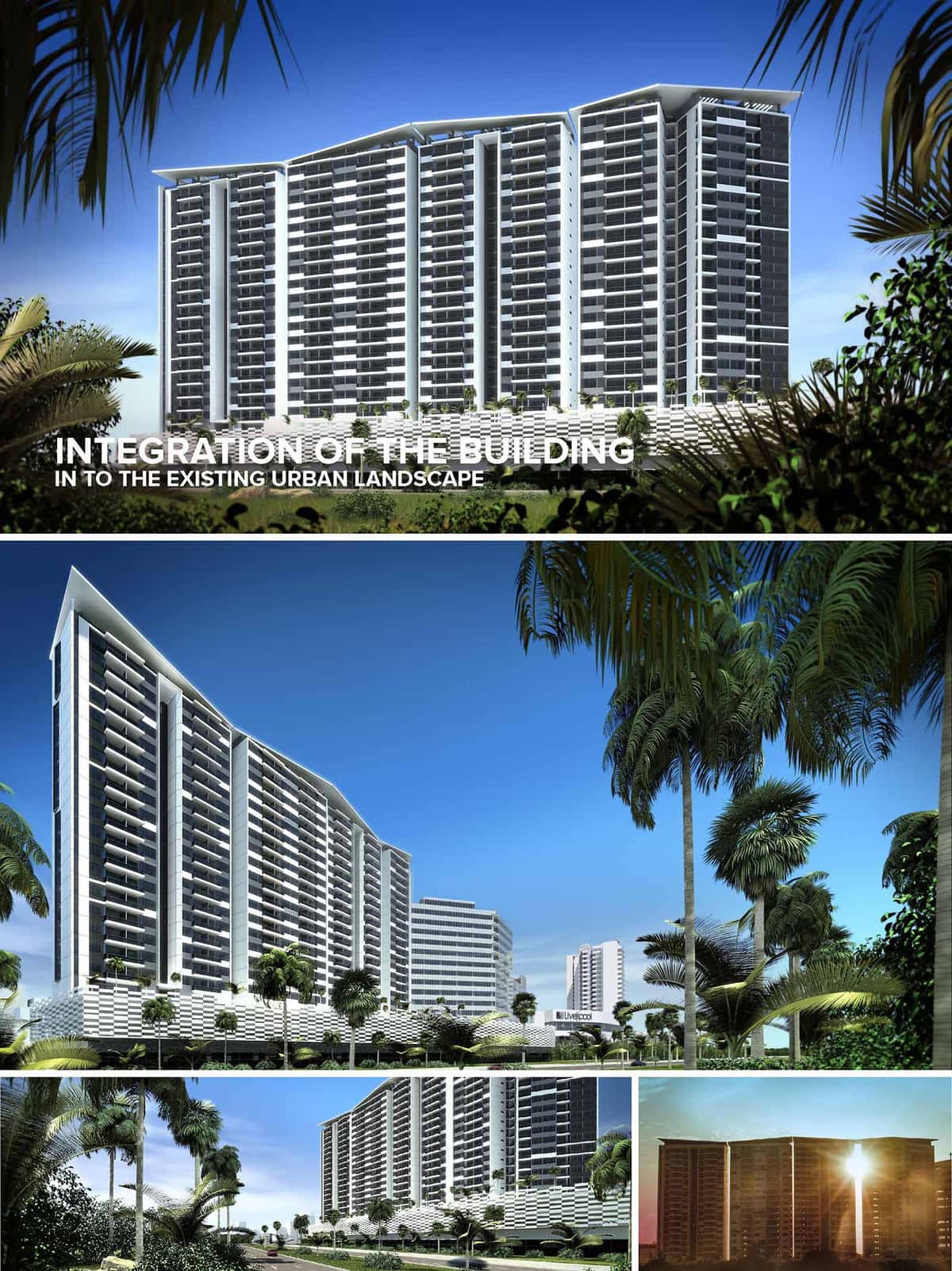
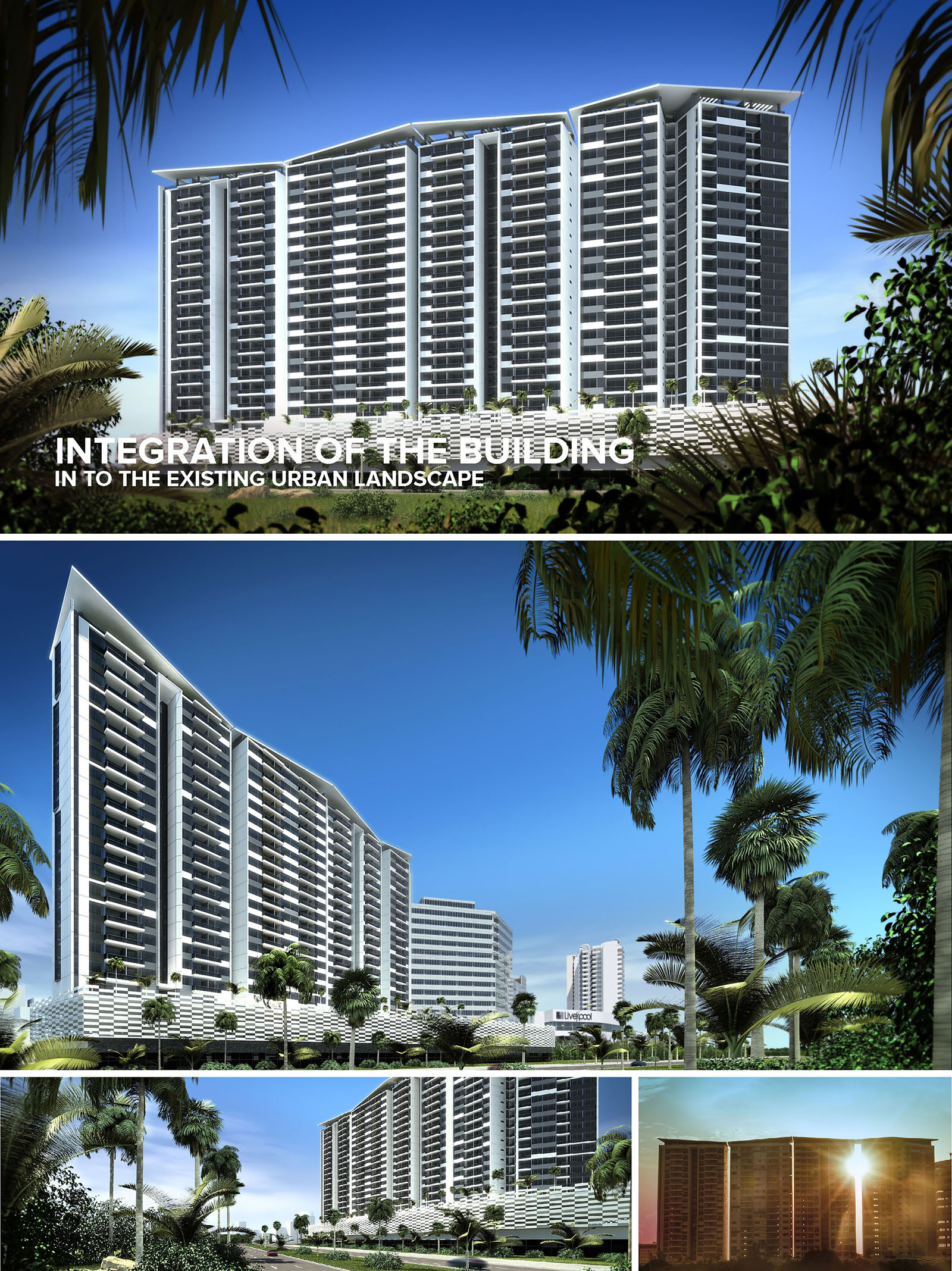
MALECON AMERICAS is conceived as a contemporary residential landmark that reinforces the urban skyline of Cancún while maintaining a strong connection with the coastal landscape. The volumetry is based on a sequence of slender towers joined by subtle inflections, creating a dynamic façade that responds to the movement of the sun and prevailing breezes. This configuration maximizes ocean-oriented views and cross-ventilation for the greatest number of units.
The architectural language is intentionally clean and orthogonal, emphasizing horizontality through continuous balconies and verticality through structural blades. The interplay of these elements produces a rhythm that visually lightens the mass of the building and expresses the modular nature of the residential typologies.
The project occupies a strategic front along an important urban corridor, acting as a transition between dense city fabric and the more open coastal landscape. The plinth aligns with the street grid, consolidating commercial and lobby functions and activating the public realm at ground level. Above this base, the residential volumes slightly withdraw, generating a clear separation between public, semi-public, and private domains.
Open landscaped setbacks and pedestrian promenades at the base connect to existing sidewalks and green areas, promoting permeability and walkability. The elevated platform accommodates parking and service areas, allowing the ground plane to remain visually open and planted, contributing to an improved microclimate along the avenue.
The towers are articulated through a faceted geometry, with subtle bends that orient the façades toward key views while reducing direct solar gain on the most exposed orientations. Vertical white frames and fins define the structural grid and provide shading to the balconies, while darker infill panels and glazing recede to emphasize depth and shadow.
At the podium, a textured horizontal banding creates a strong base condition and visually anchors the complex. This patterning introduces a human scale at street level and conceals parking ventilation through integrated perforations. The upper crown of the building is resolved with extended roof planes and recessed mechanical zones, giving a crisp, controlled silhouette against the sky.
The residential floors are organized on efficient double-loaded corridors that prioritize corner units and long, panoramic façades. Each apartment enjoys generous balconies, conceived as outdoor living rooms that expand the interior space and frame views of the city and coastline. Sliding glazed doors enable a fluid relationship between inside and outside, adapting to different climatic conditions.
Common amenities are strategically located at podium and intermediate levels to encourage social interaction among residents. These shared spaces, combined with visual continuity toward the surrounding greenery, build a resort-like living atmosphere while maintaining the privacy expected in an urban residence.
The material palette emphasizes durability and low maintenance, essential in the saline and humid environment of Cancún. Reinforced concrete structure, high-performance glazing, and aluminum balcony railings provide robustness and longevity. The predominant white and light gray tones reflect solar radiation and enhance thermal comfort, while darker accents mark the voids of terraces and recessed volumes.
Daylight plays a central role in the design. Large openings and continuous balcony fronts capture natural light throughout the day, while vertical fins, overhangs, and balcony slabs control glare and heat gain. Nighttime illumination highlights the vertical blades and the rhythmic balcony edges, turning the complex into a recognizable reference point along the urban waterfront.
The landscape design draws from the native coastal vegetation of the Yucatán Peninsula, using palms, shrubs, and groundcovers adapted to the local climate and low water consumption. Planting is concentrated around the base, terraces, and communal areas, forming green buffers that filter noise and improve air quality. Permeable surfaces and controlled drainage help manage stormwater, mitigating runoff during heavy tropical rains.
Passive design strategies are fundamental to the project’s sustainability approach. Building orientation and façade shaping reduce solar exposure on critical faces, while continuous balconies and shading elements minimize cooling loads. Cross-ventilation is encouraged through unit layout and operable windows, reducing dependence on mechanical systems. High-reflectance finishes, efficient lighting, and the potential integration of solar technologies on roof surfaces further contribute to lower operational energy demand and long-term environmental performance.
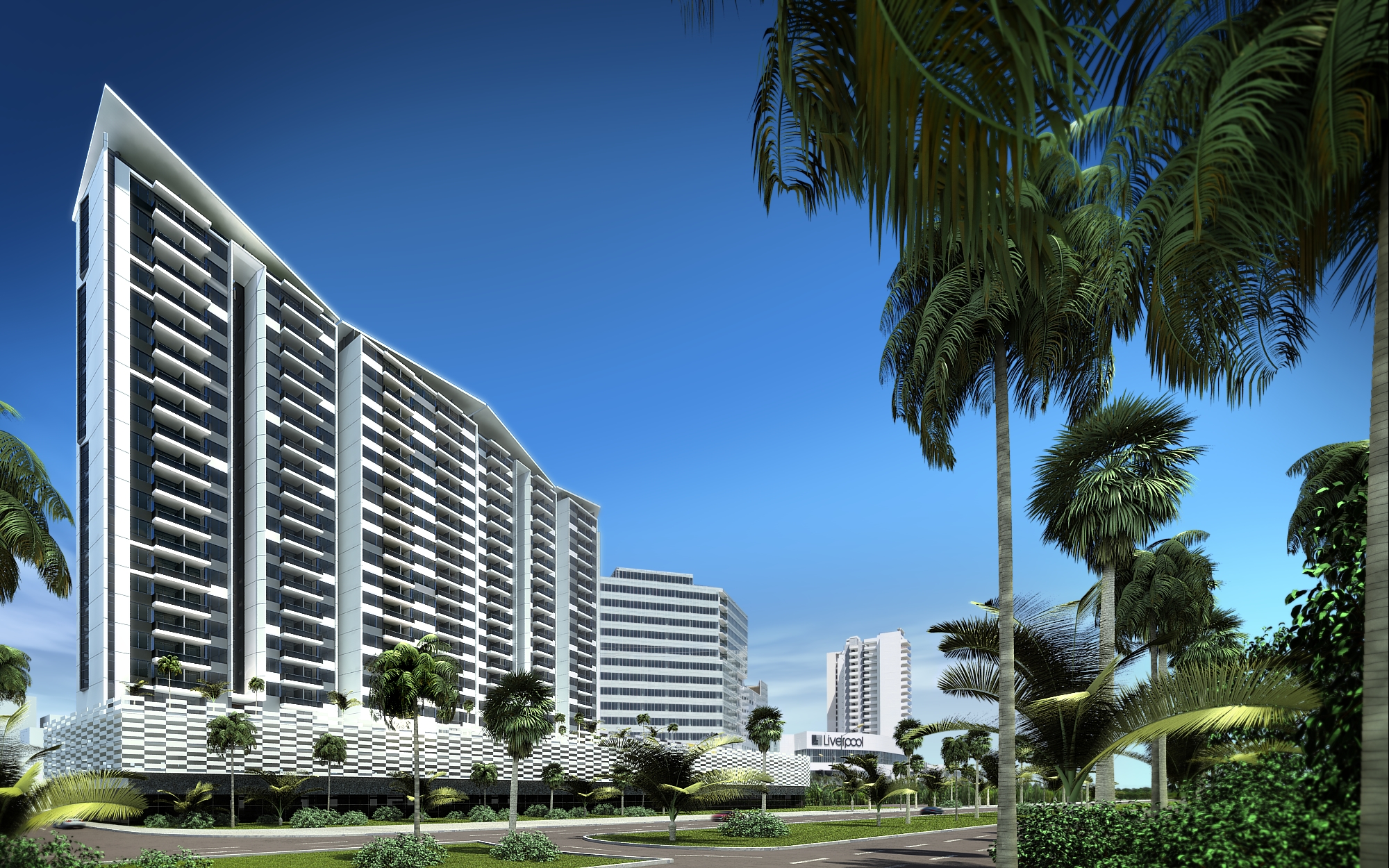
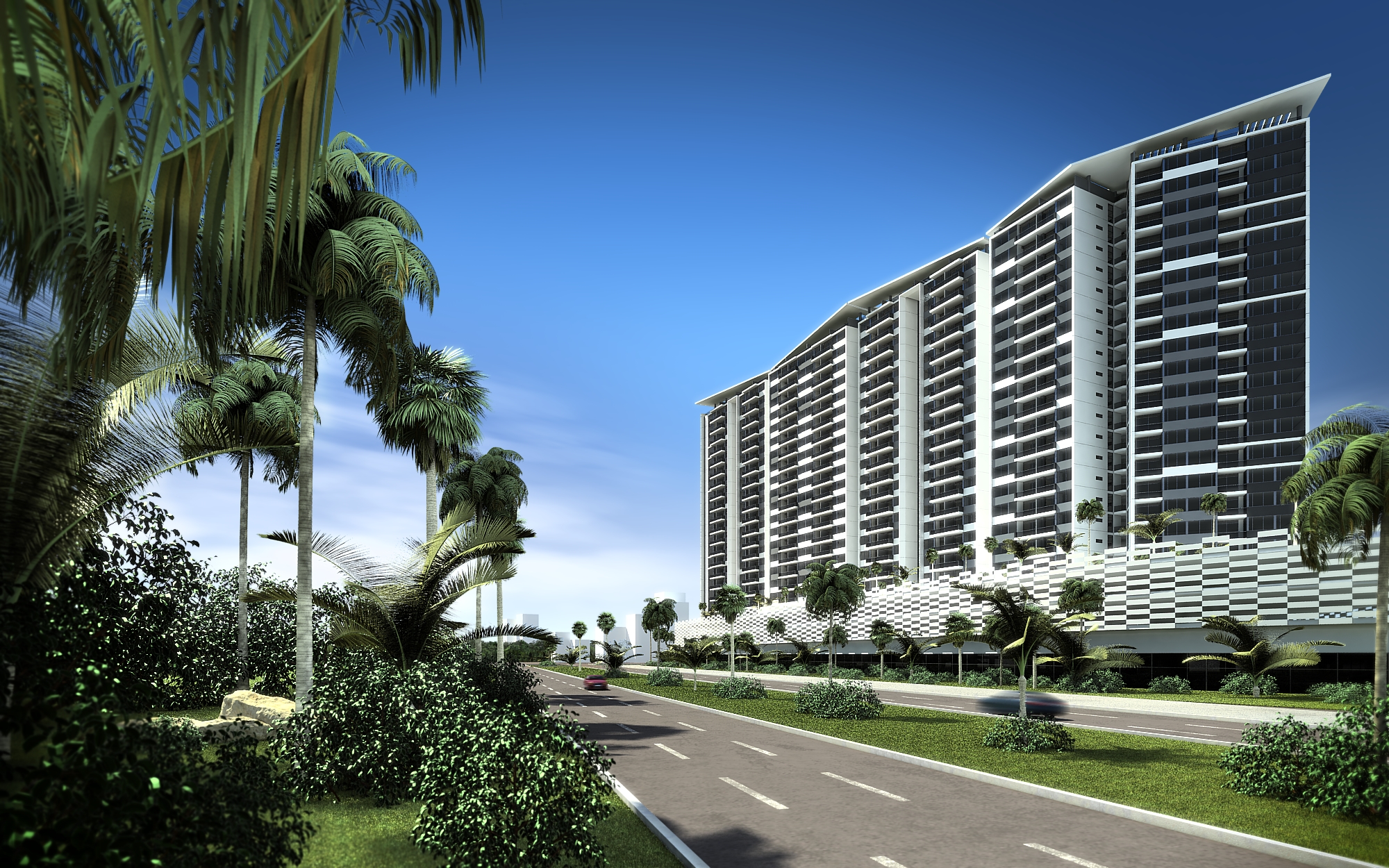
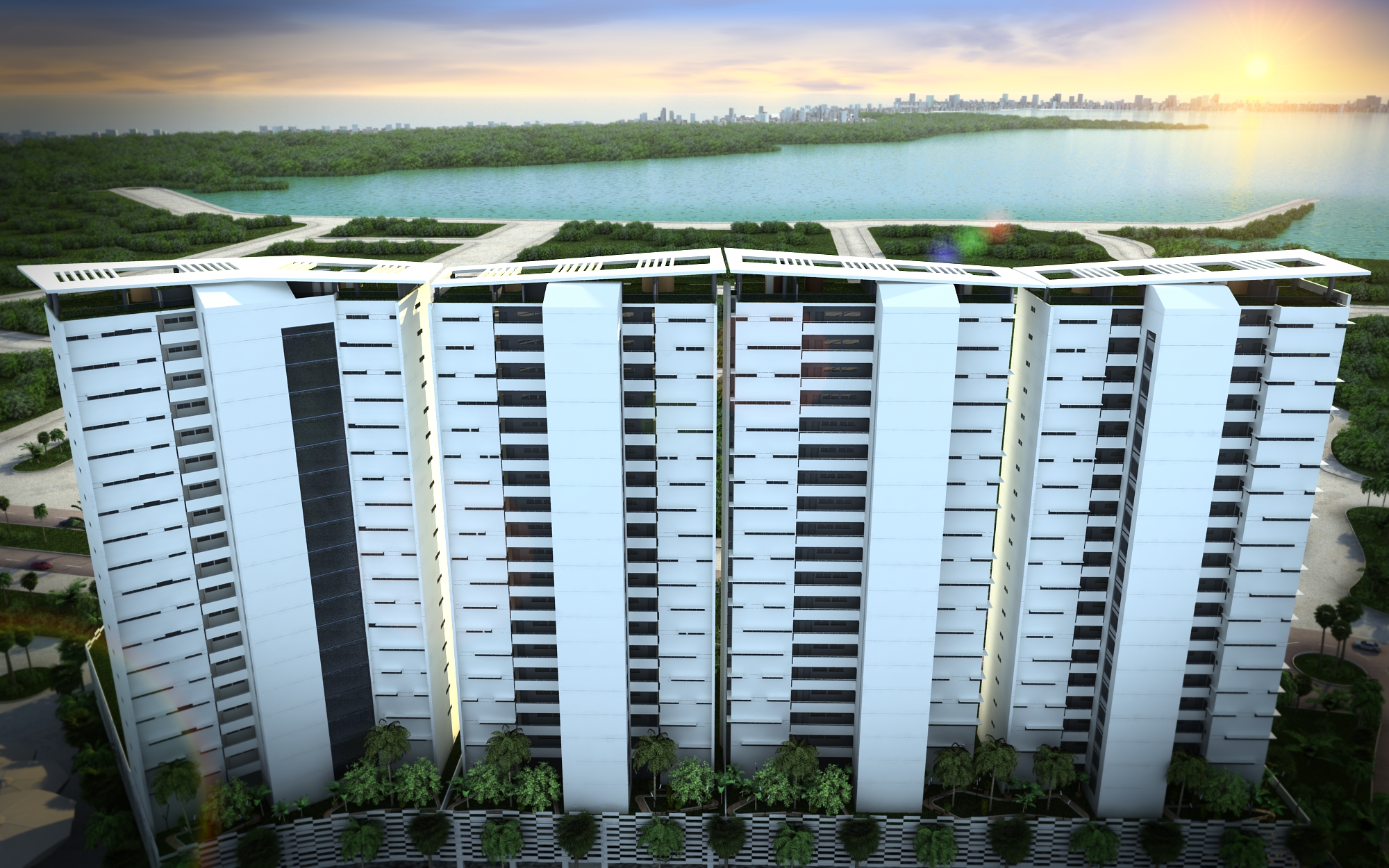
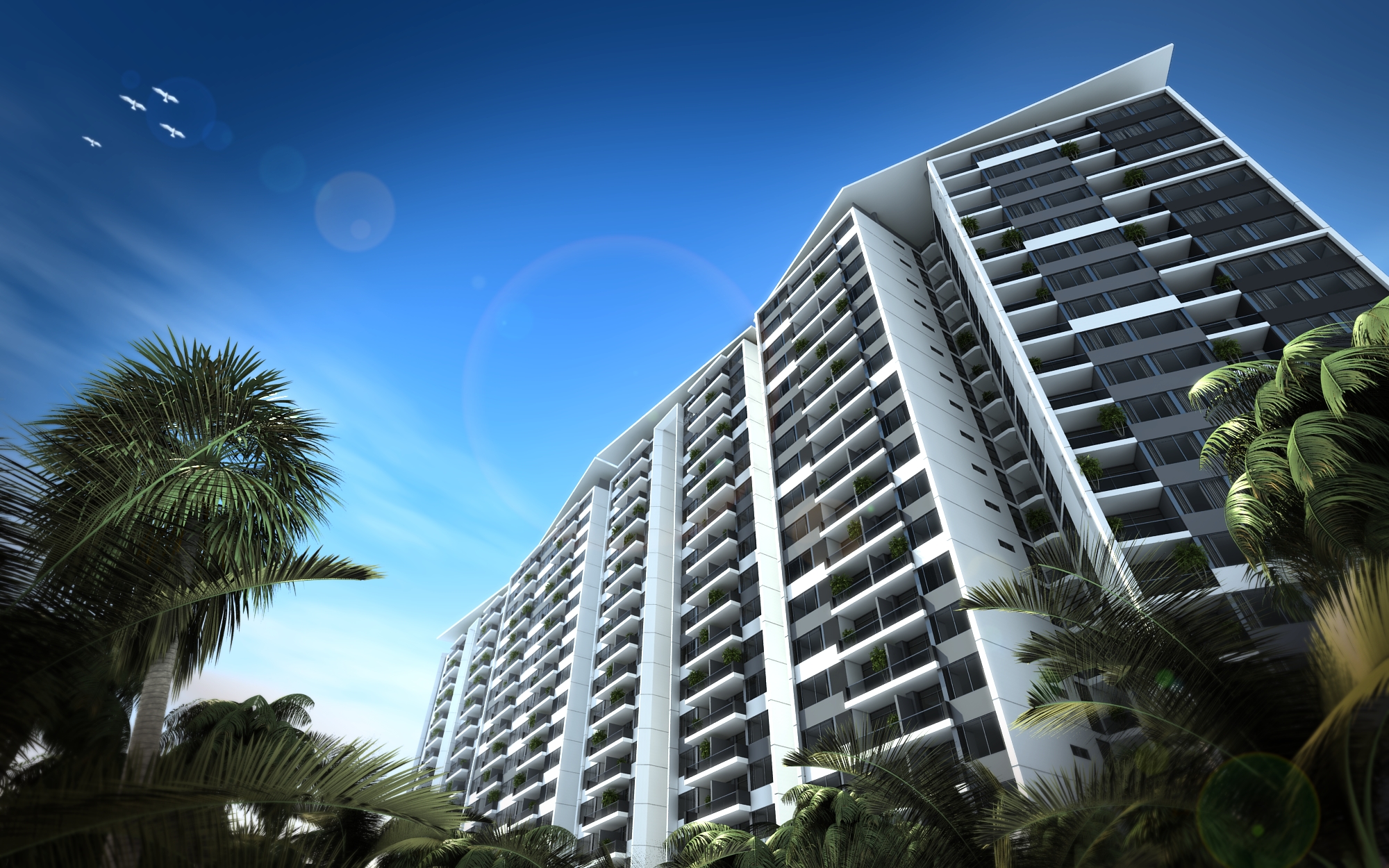
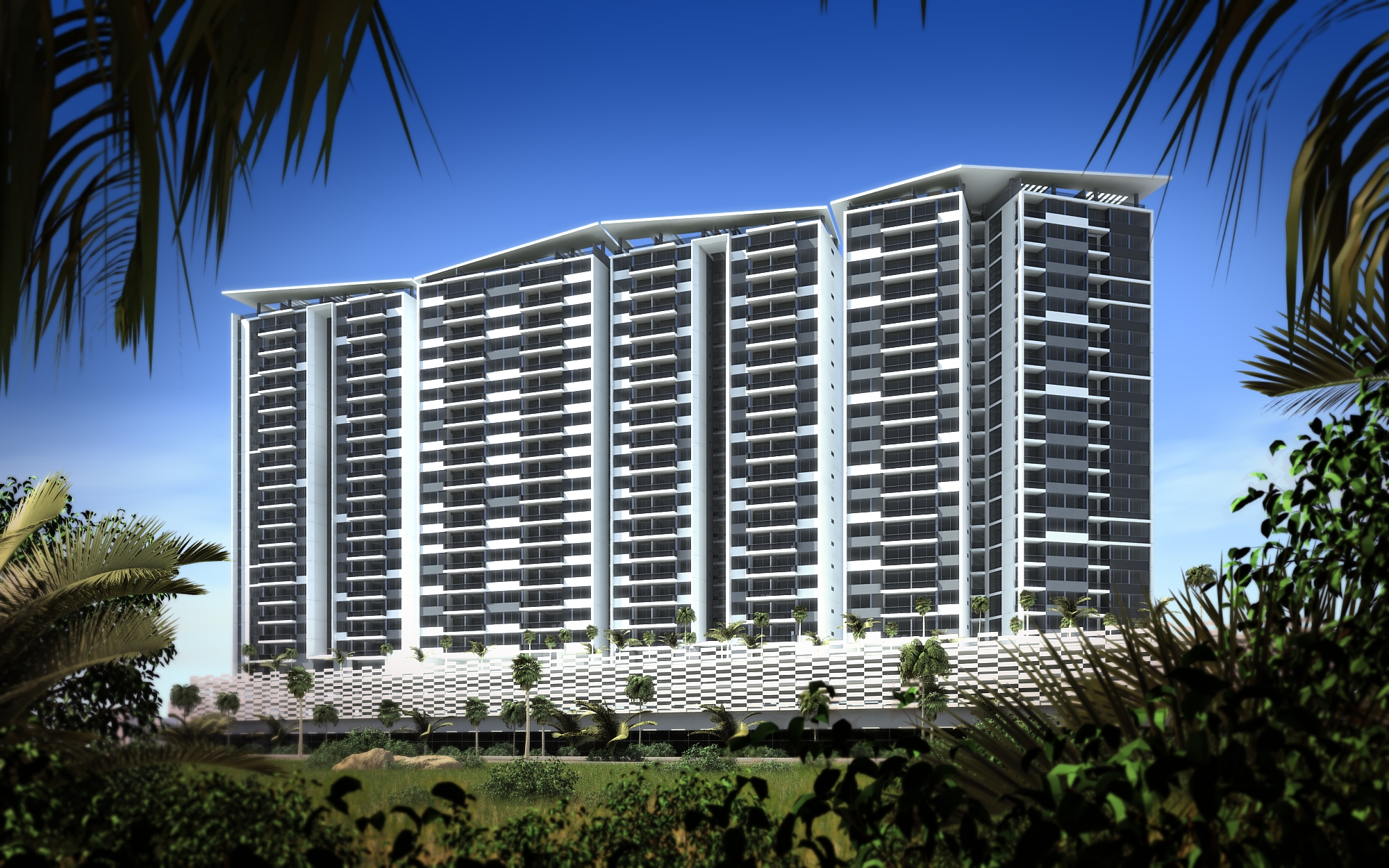
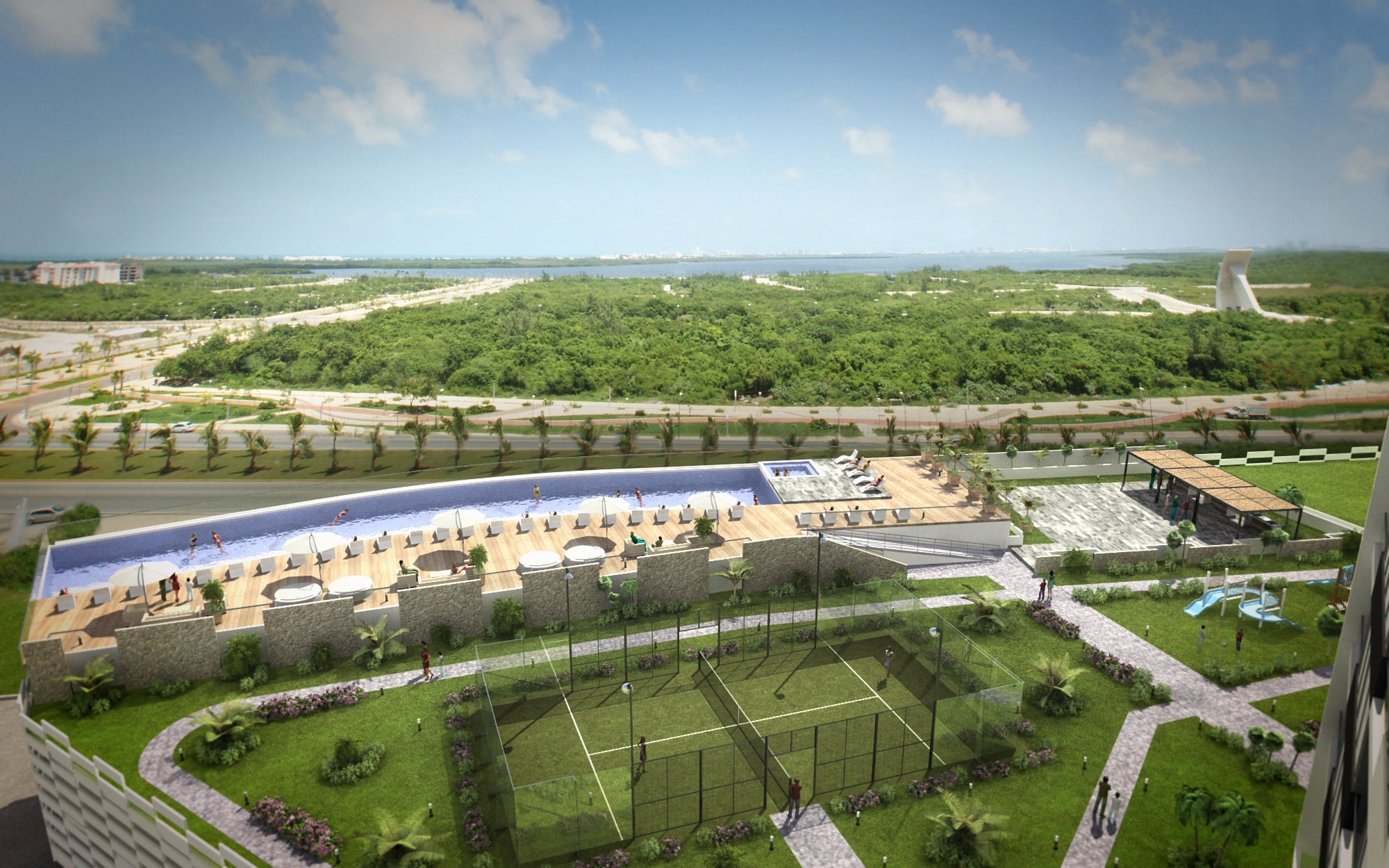

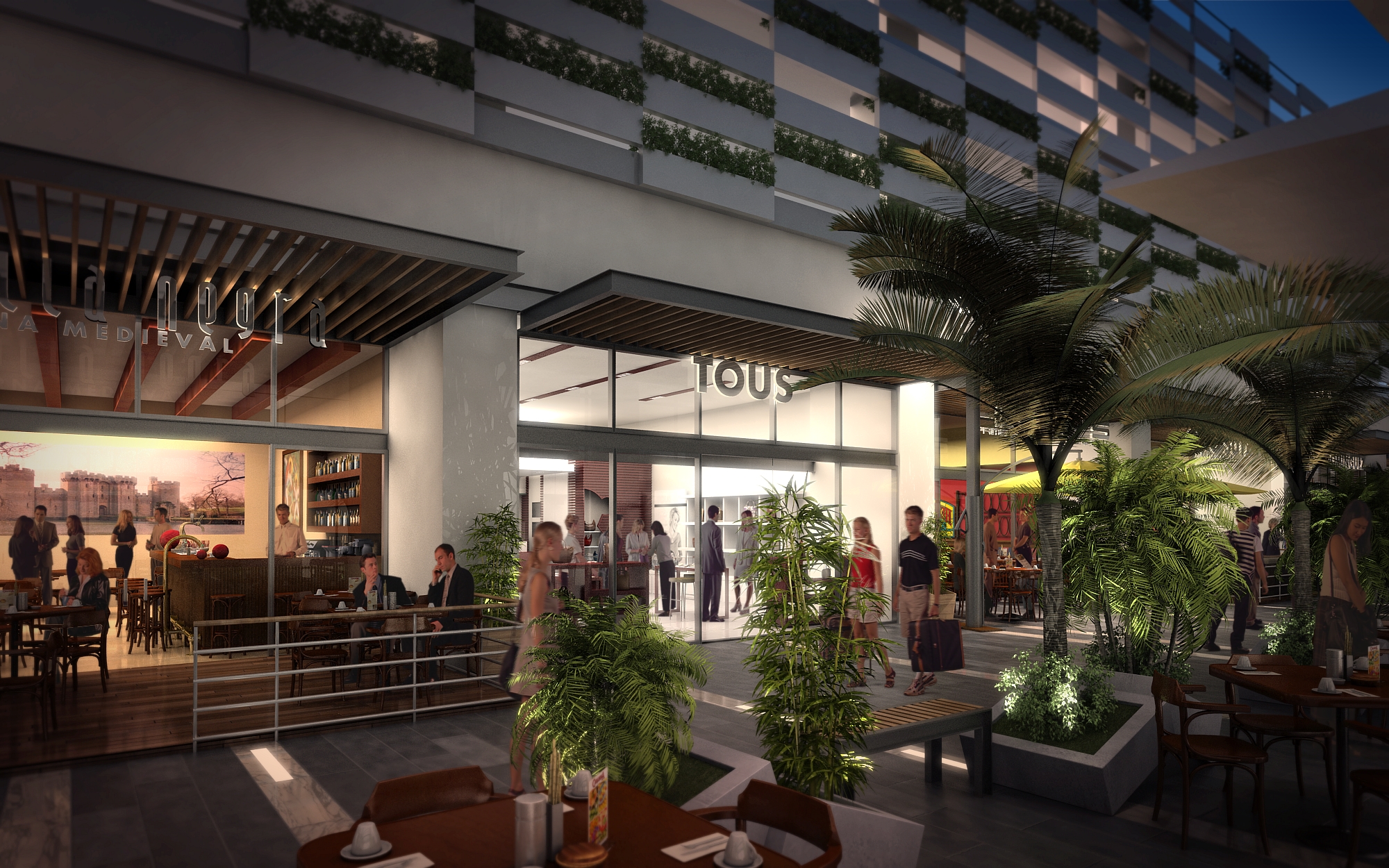
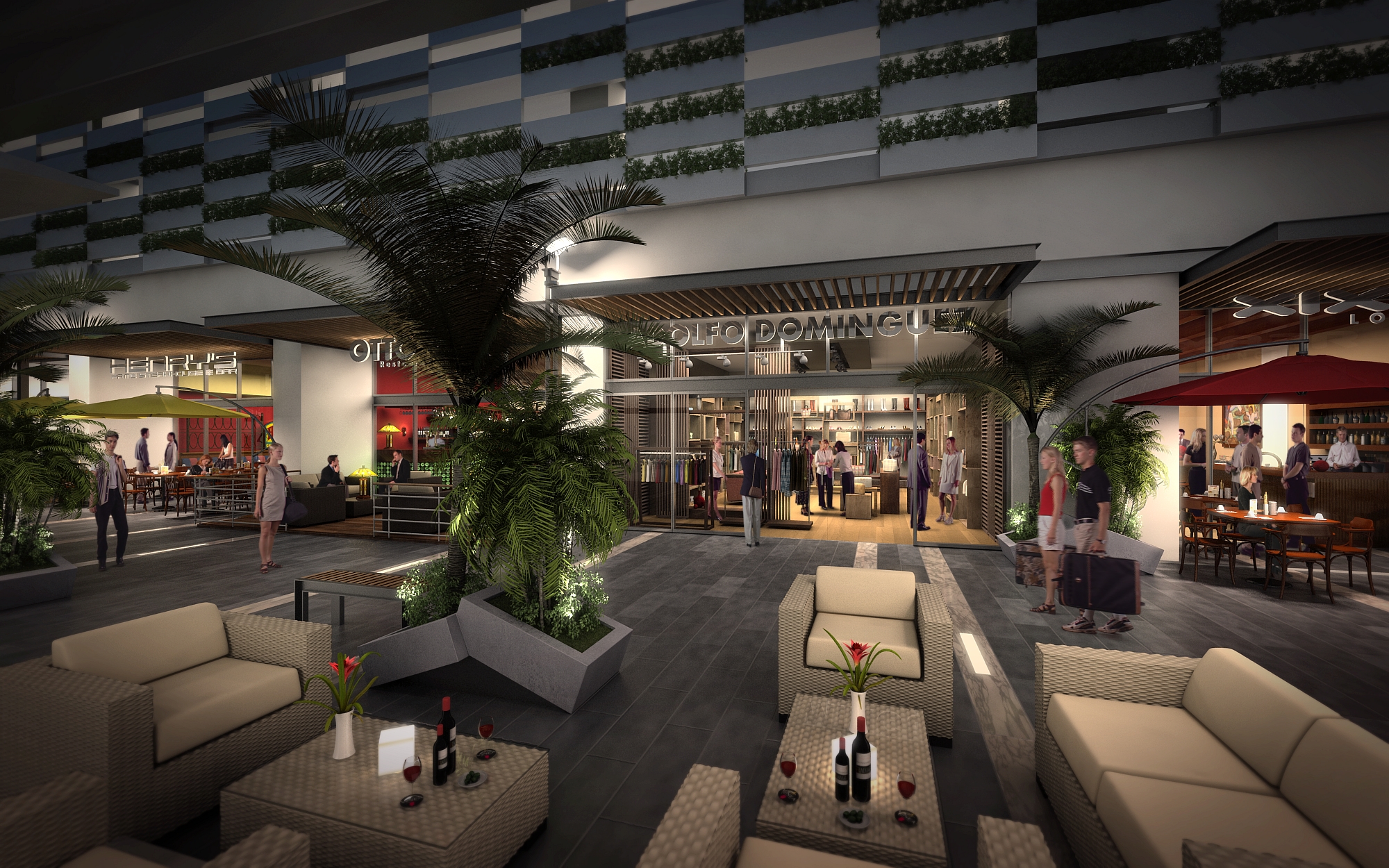
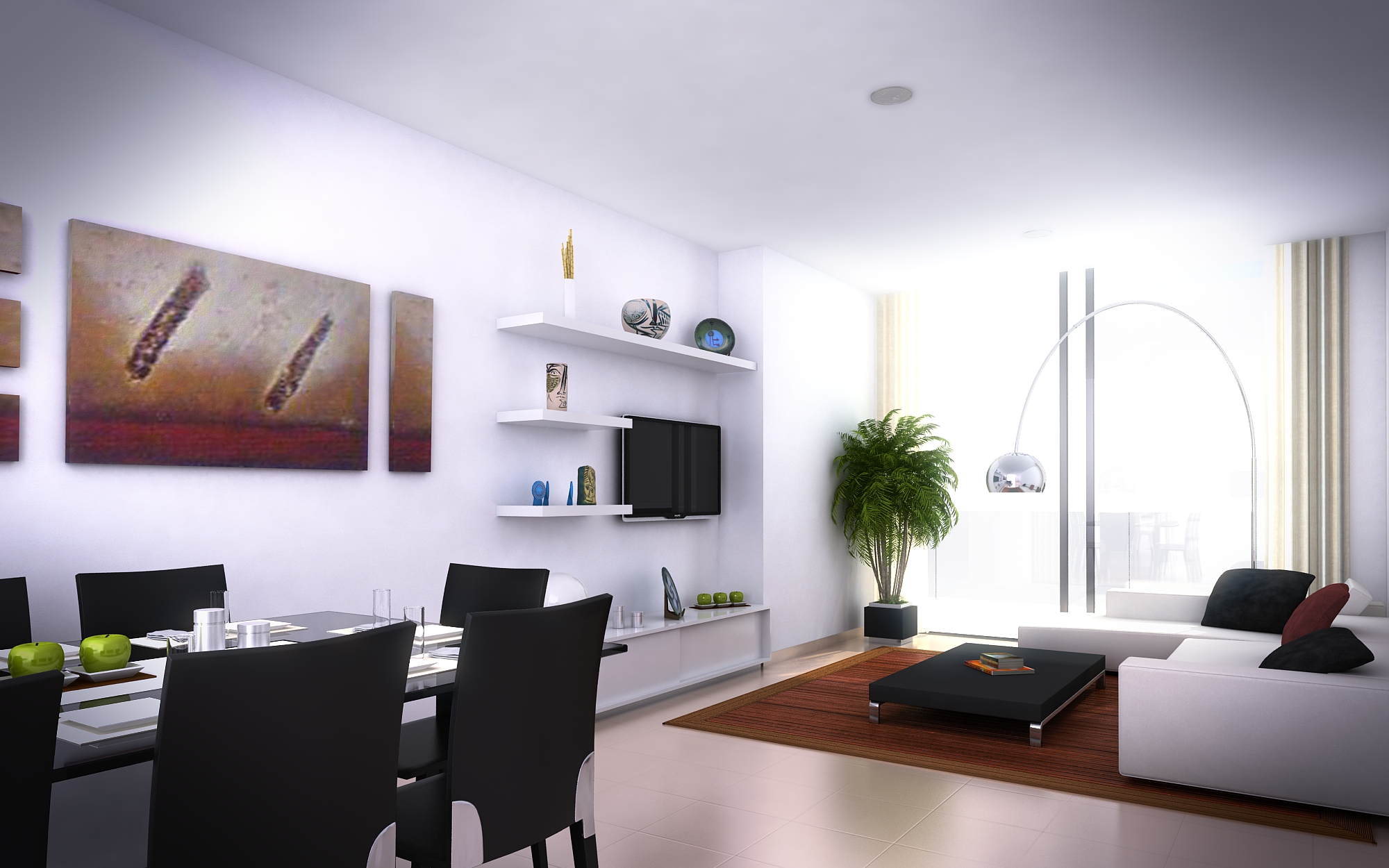
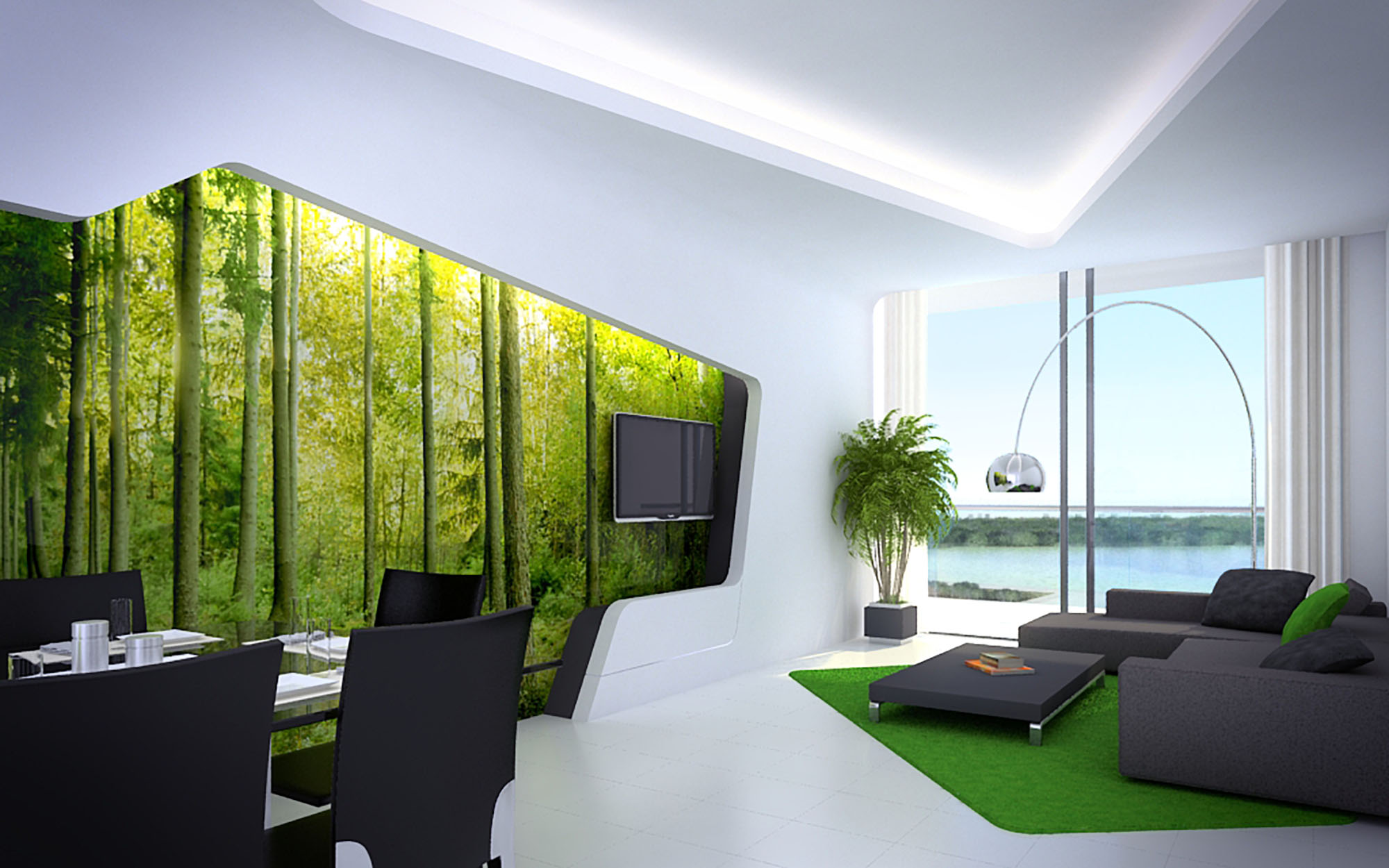
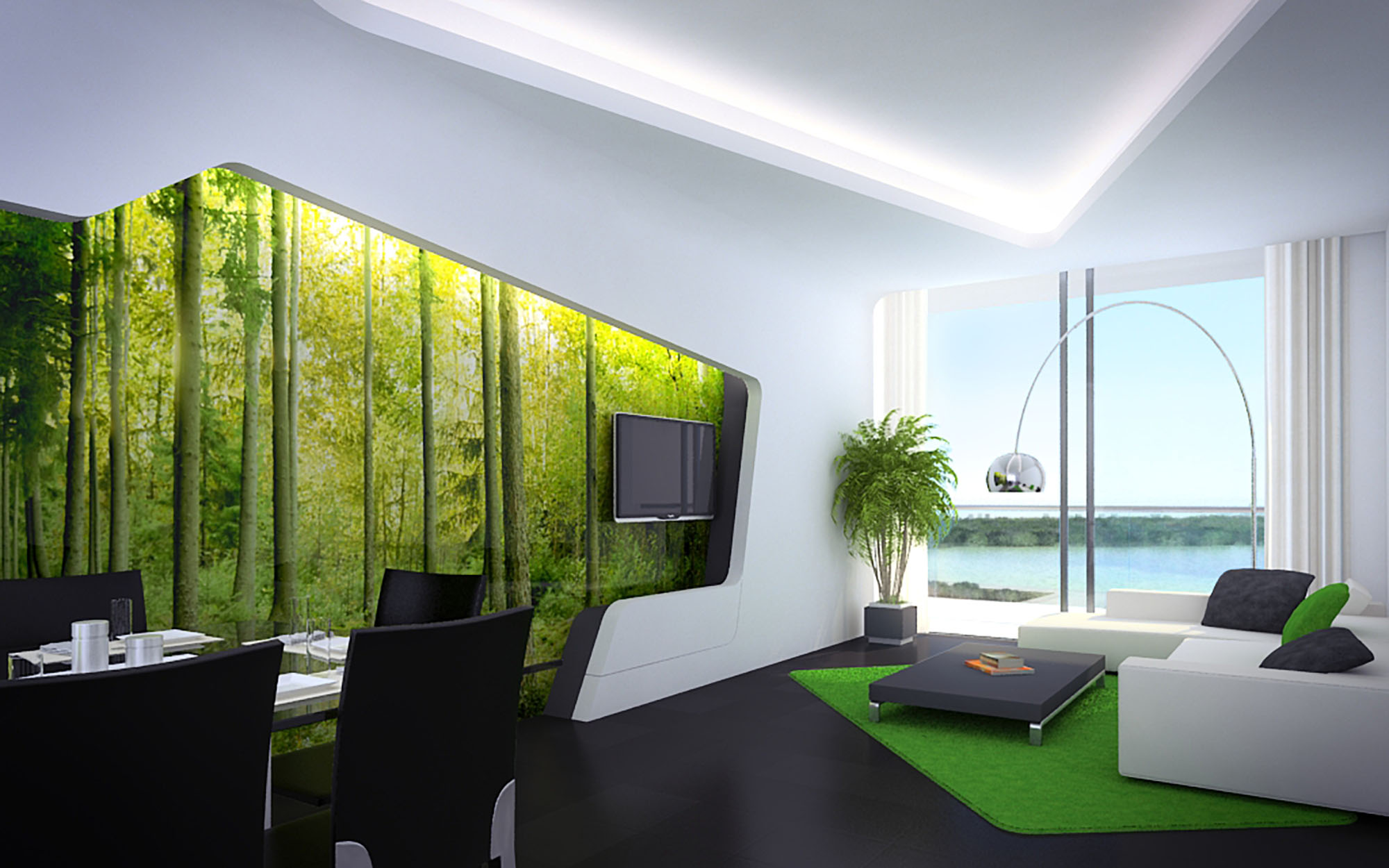
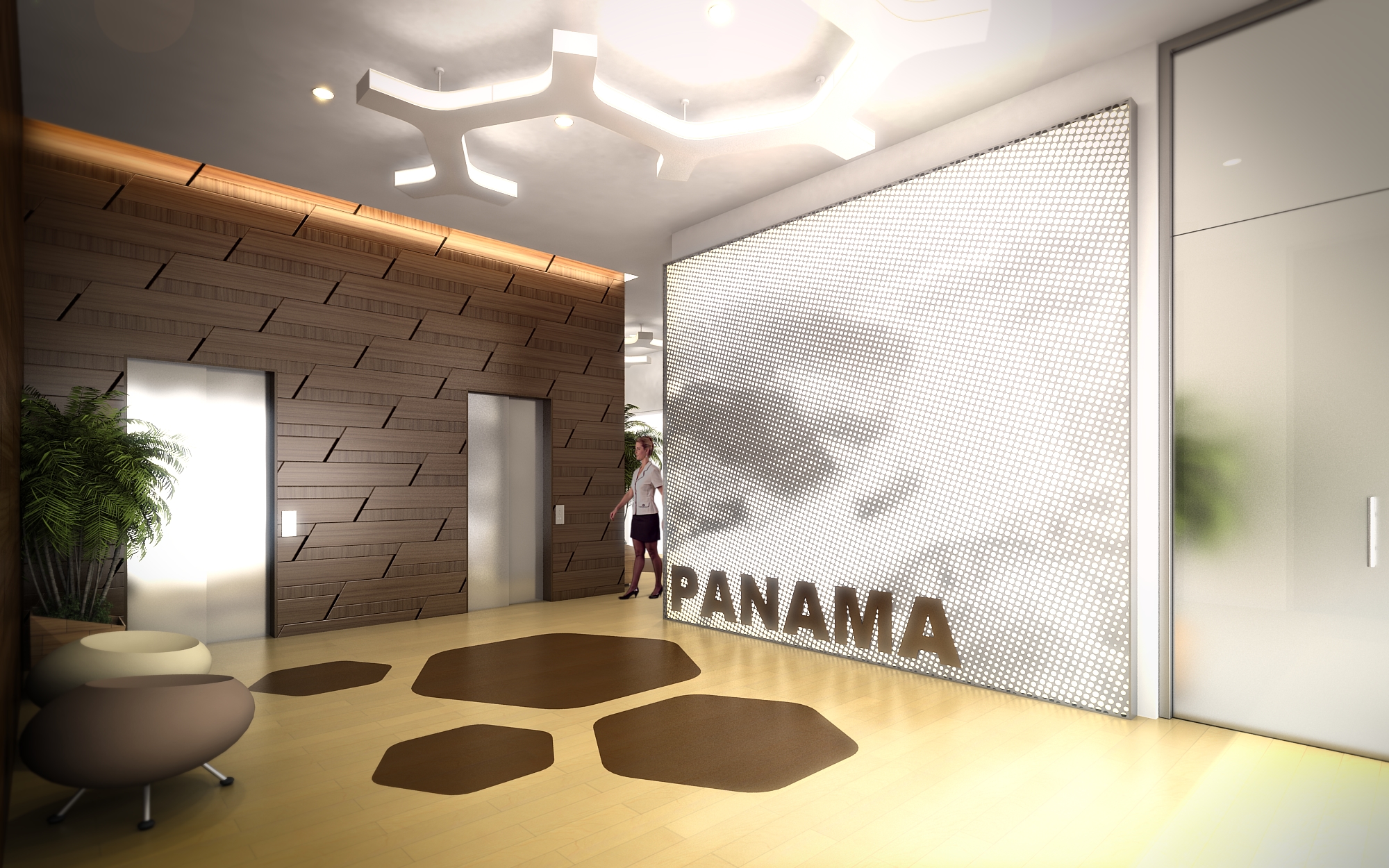

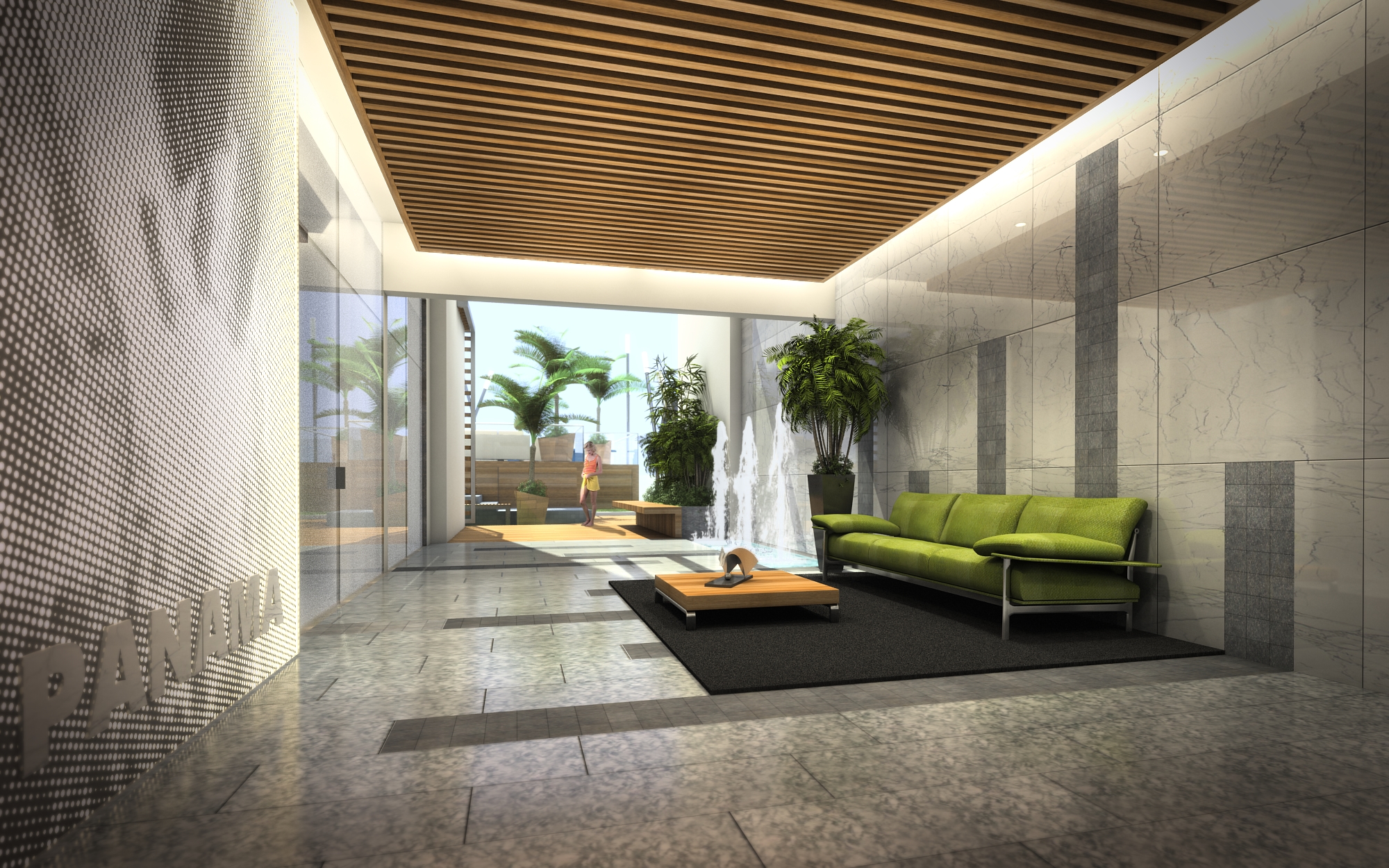

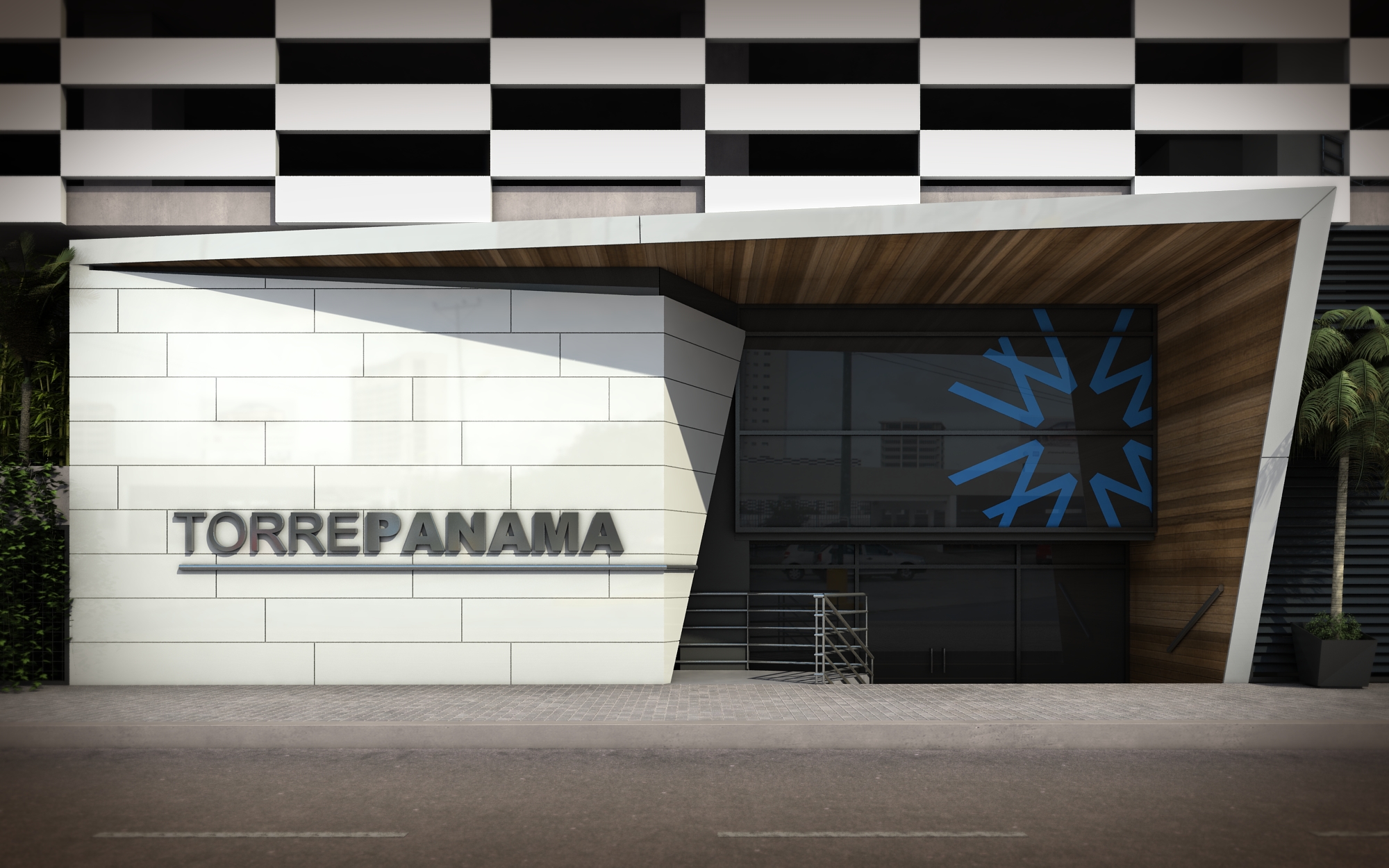
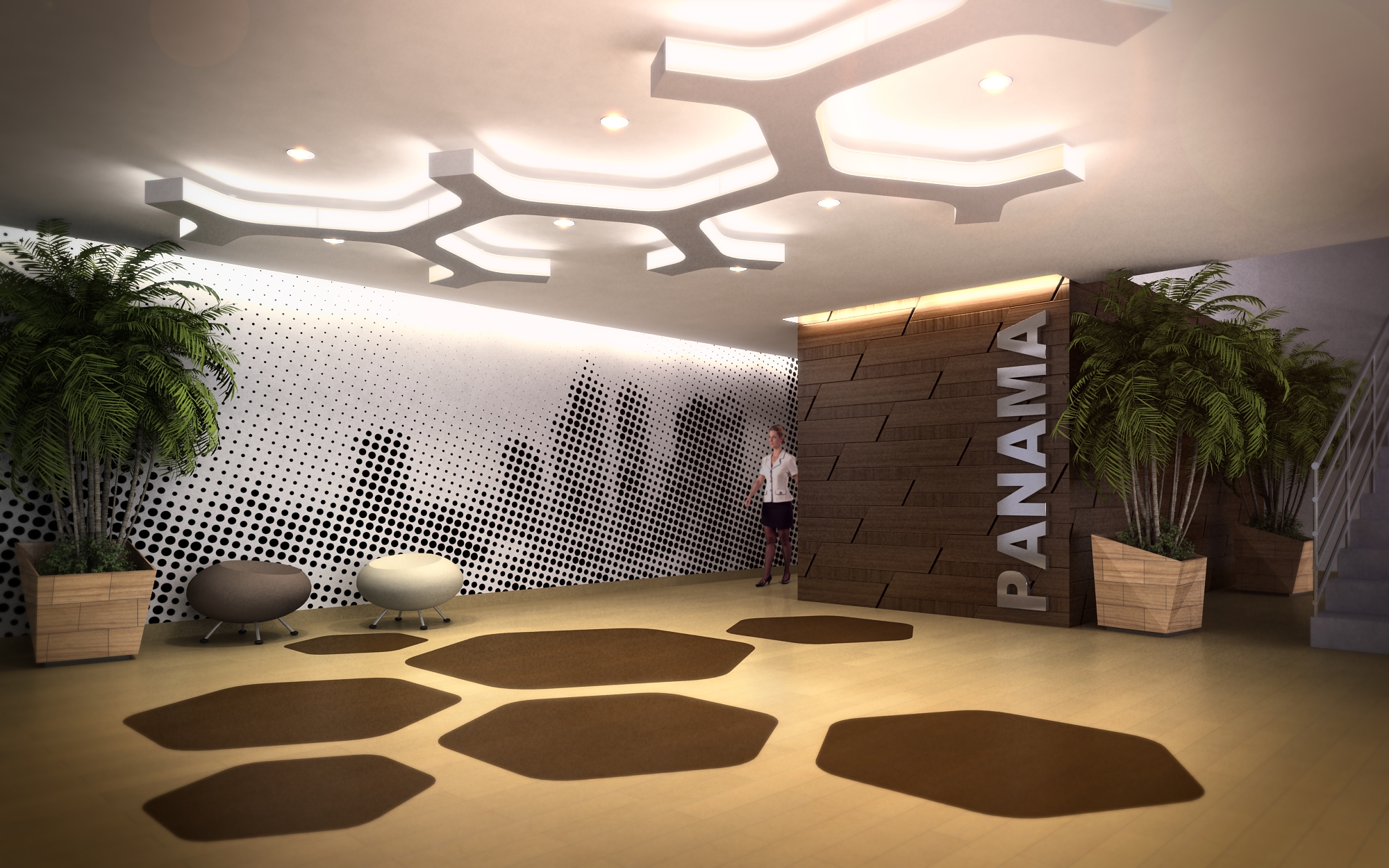

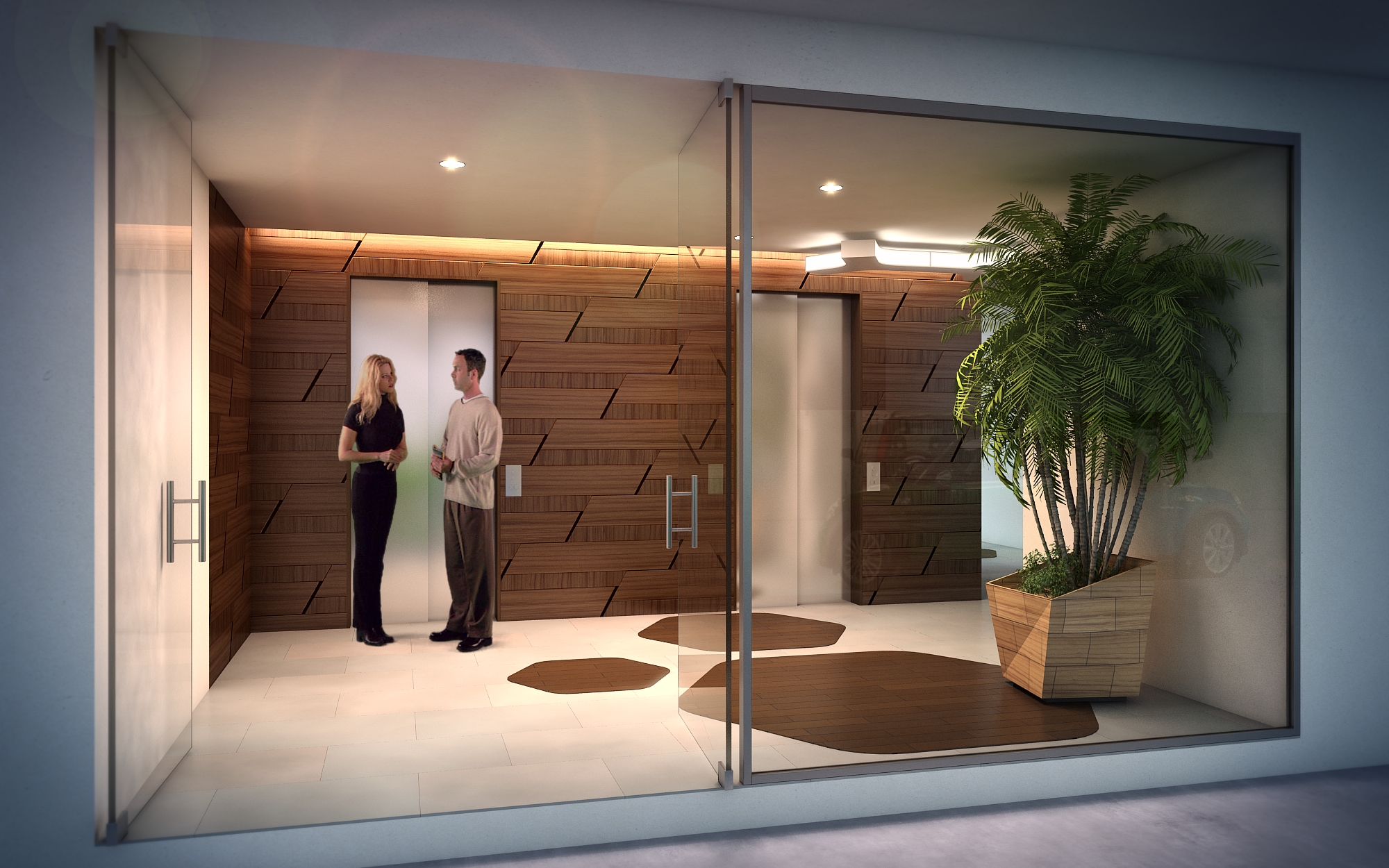
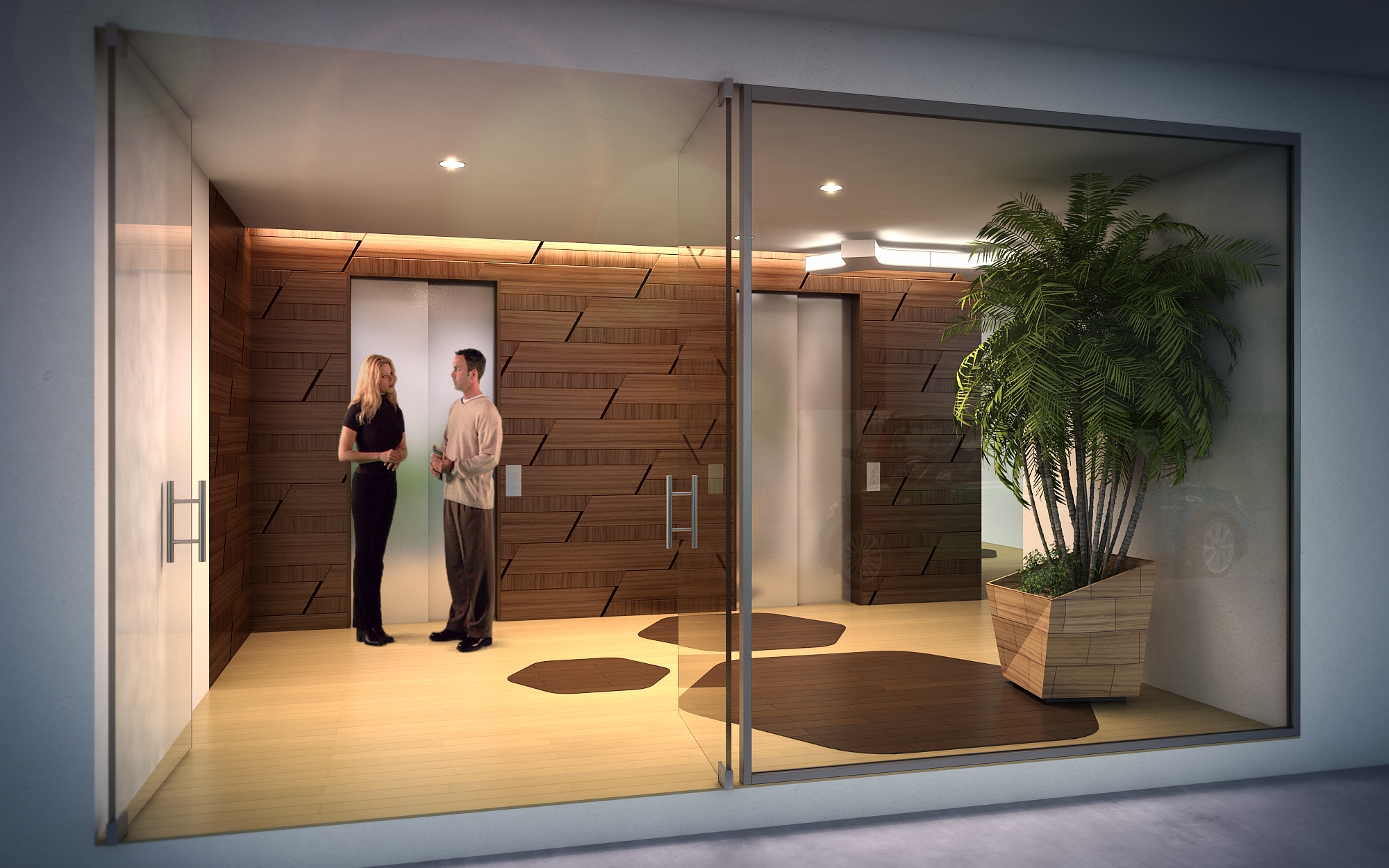

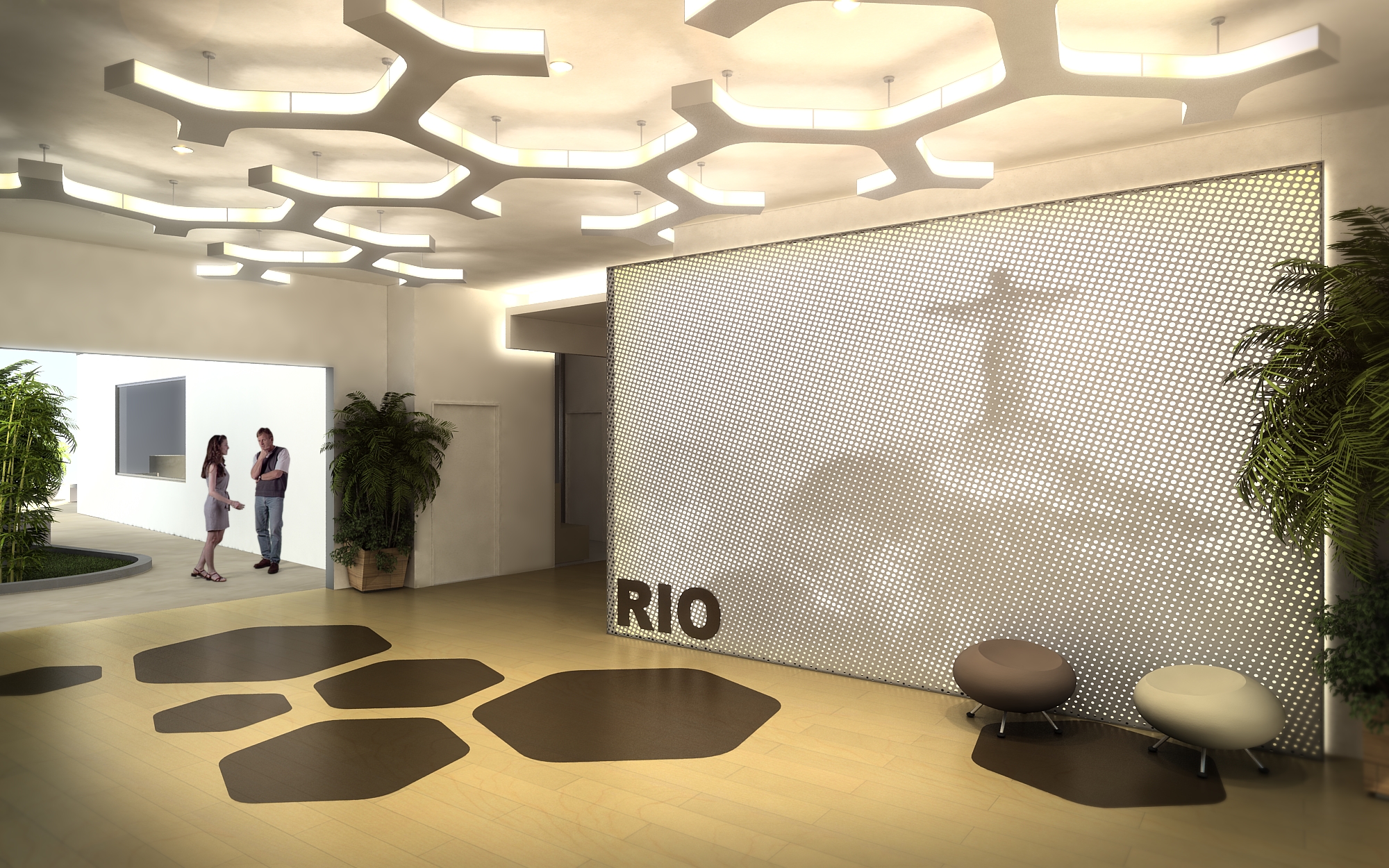
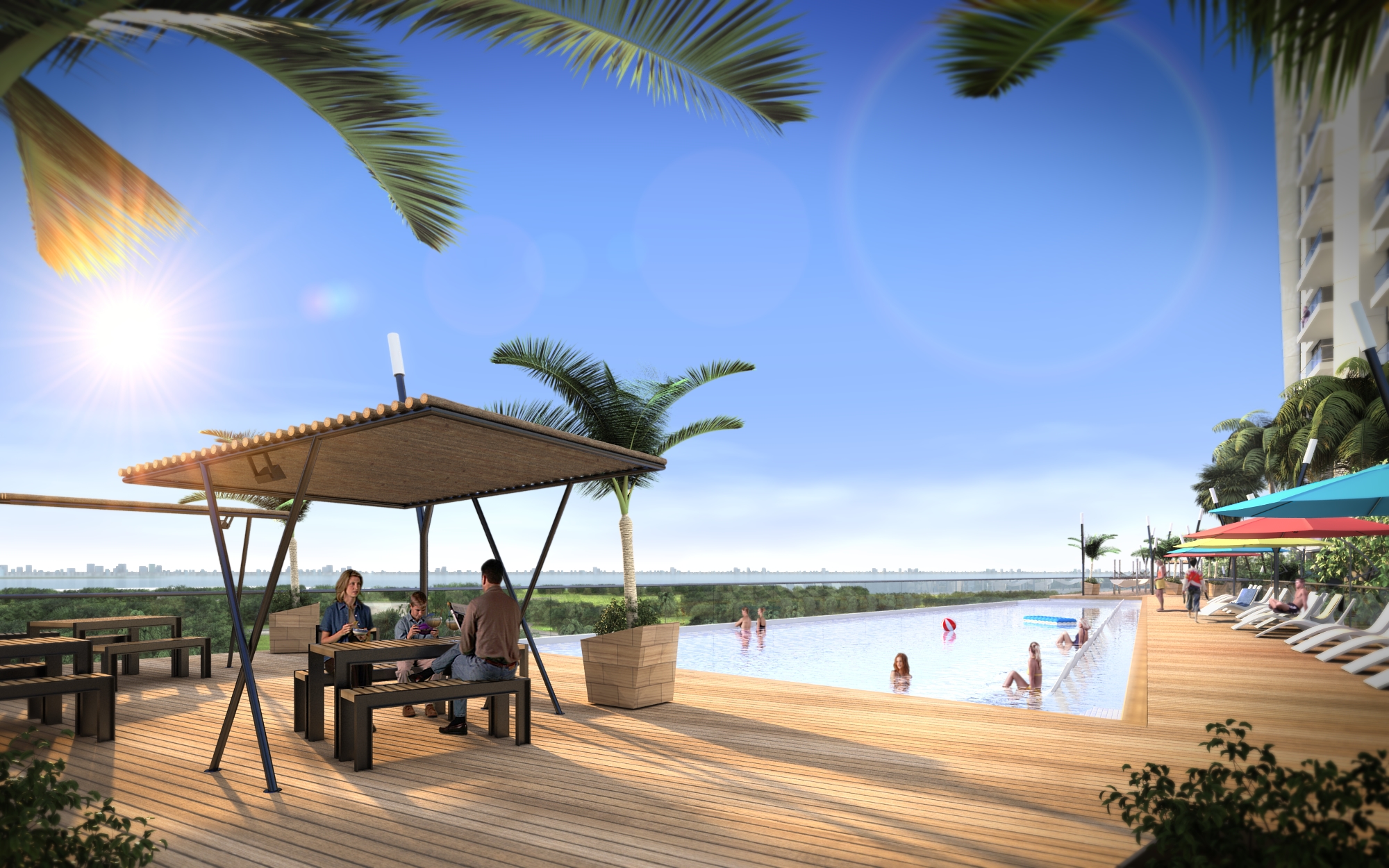
MALECON AMERICAS is conceived as a contemporary residential landmark that reinforces the urban skyline of Cancún while maintaining a strong connection with the coastal landscape. The volumetry is based on a sequence of slender towers joined by subtle inflections, creating a dynamic façade that responds to the movement of the sun and prevailing breezes. This configuration maximizes ocean-oriented views and cross-ventilation for the greatest number of units.
The architectural language is intentionally clean and orthogonal, emphasizing horizontality through continuous balconies and verticality through structural blades. The interplay of these elements produces a rhythm that visually lightens the mass of the building and expresses the modular nature of the residential typologies.
The project occupies a strategic front along an important urban corridor, acting as a transition between dense city fabric and the more open coastal landscape. The plinth aligns with the street grid, consolidating commercial and lobby functions and activating the public realm at ground level. Above this base, the residential volumes slightly withdraw, generating a clear separation between public, semi-public, and private domains.
Open landscaped setbacks and pedestrian promenades at the base connect to existing sidewalks and green areas, promoting permeability and walkability. The elevated platform accommodates parking and service areas, allowing the ground plane to remain visually open and planted, contributing to an improved microclimate along the avenue.
The towers are articulated through a faceted geometry, with subtle bends that orient the façades toward key views while reducing direct solar gain on the most exposed orientations. Vertical white frames and fins define the structural grid and provide shading to the balconies, while darker infill panels and glazing recede to emphasize depth and shadow.
At the podium, a textured horizontal banding creates a strong base condition and visually anchors the complex. This patterning introduces a human scale at street level and conceals parking ventilation through integrated perforations. The upper crown of the building is resolved with extended roof planes and recessed mechanical zones, giving a crisp, controlled silhouette against the sky.
The residential floors are organized on efficient double-loaded corridors that prioritize corner units and long, panoramic façades. Each apartment enjoys generous balconies, conceived as outdoor living rooms that expand the interior space and frame views of the city and coastline. Sliding glazed doors enable a fluid relationship between inside and outside, adapting to different climatic conditions.
Common amenities are strategically located at podium and intermediate levels to encourage social interaction among residents. These shared spaces, combined with visual continuity toward the surrounding greenery, build a resort-like living atmosphere while maintaining the privacy expected in an urban residence.
The material palette emphasizes durability and low maintenance, essential in the saline and humid environment of Cancún. Reinforced concrete structure, high-performance glazing, and aluminum balcony railings provide robustness and longevity. The predominant white and light gray tones reflect solar radiation and enhance thermal comfort, while darker accents mark the voids of terraces and recessed volumes.
Daylight plays a central role in the design. Large openings and continuous balcony fronts capture natural light throughout the day, while vertical fins, overhangs, and balcony slabs control glare and heat gain. Nighttime illumination highlights the vertical blades and the rhythmic balcony edges, turning the complex into a recognizable reference point along the urban waterfront.
The landscape design draws from the native coastal vegetation of the Yucatán Peninsula, using palms, shrubs, and groundcovers adapted to the local climate and low water consumption. Planting is concentrated around the base, terraces, and communal areas, forming green buffers that filter noise and improve air quality. Permeable surfaces and controlled drainage help manage stormwater, mitigating runoff during heavy tropical rains.
Passive design strategies are fundamental to the project’s sustainability approach. Building orientation and façade shaping reduce solar exposure on critical faces, while continuous balconies and shading elements minimize cooling loads. Cross-ventilation is encouraged through unit layout and operable windows, reducing dependence on mechanical systems. High-reflectance finishes, efficient lighting, and the potential integration of solar technologies on roof surfaces further contribute to lower operational energy demand and long-term environmental performance.
© 2021 by sanzpont [arquitectura] . Webpage by sanzpont [digital] . Innovative Digital Experiences
La participación del cliente y el co-diseño son el centro de nuestro enfoque, asegurando que cada proyecto refleje las necesidades y la visión únicas de quienes lo habitarán. Al involucrar activamente al cliente durante todo el proceso de diseño, fomentamos un entorno colaborativo donde las ideas florecen, dando lugar a espacios no solo funcionales, sino también profundamente personales.
Un proyecto no es solo el resultado: es disfrutar el camino junto al cliente.
Diseñar a medida el hogar de tus sueños es nuestra especialidad. Elaboramos meticulosamente cada diseño para alinearlo con tu estilo de vida, tu terreno y tus preferencias estéticas. Nuestro proceso es interactivo y centrado en el cliente, asegurando que cada espacio de tu hogar acompañe la vida cotidiana y refleje tu personalidad a la perfección.
El diseño sostenible y bioclimático se centra en la responsabilidad ambiental y la eficiencia energética. Al integrar elementos naturales y tecnologías innovadoras, estos diseños mejoran el confort, reducen el consumo energético y promueven un hogar más saludable, alineando los entornos residenciales contemporáneos con principios ecológicos.
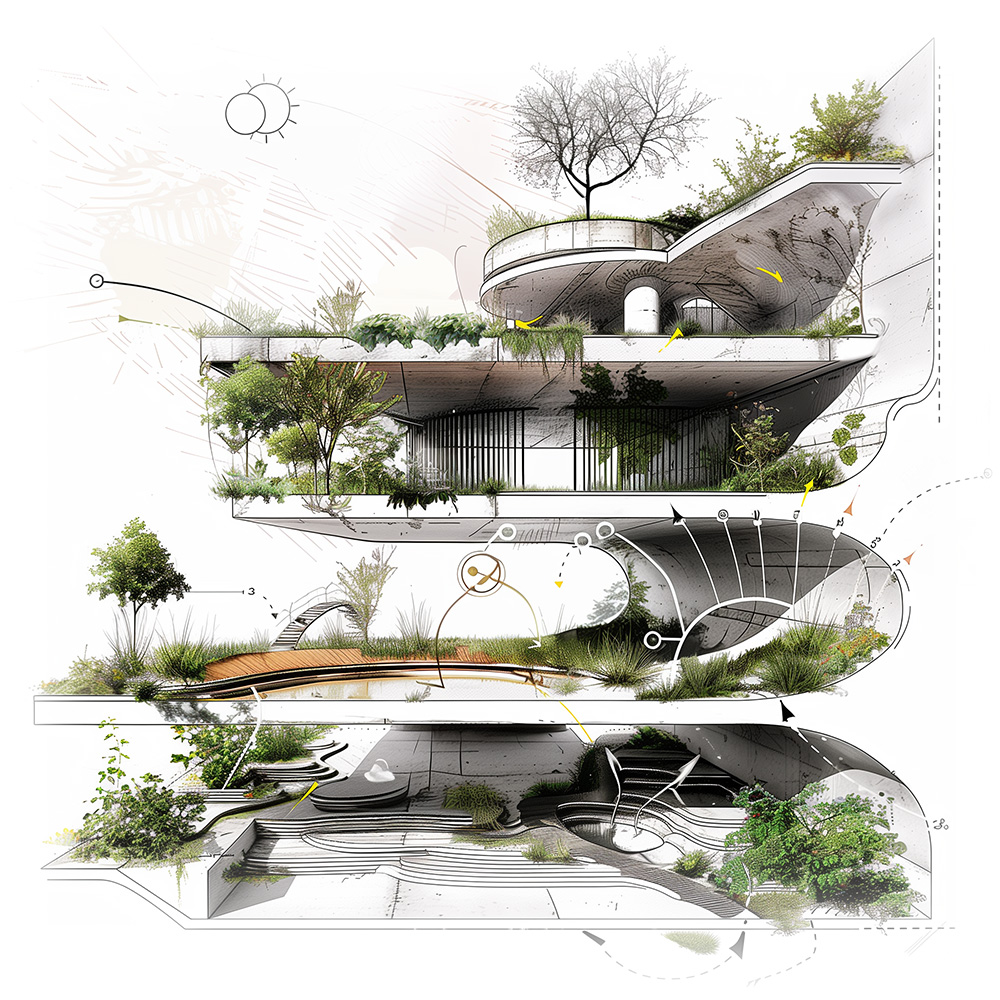
Nuestros diseños están centrados en el usuario: lógicos, funcionales y adaptados a las necesidades de quienes habitan los espacios que creamos. Priorizamos distribuciones intuitivas y soluciones inteligentes que mejoran la usabilidad y la eficiencia. Cada decisión de diseño nace de una comprensión profunda de la interacción del usuario y del flujo cotidiano, garantizando una funcionalidad óptima.
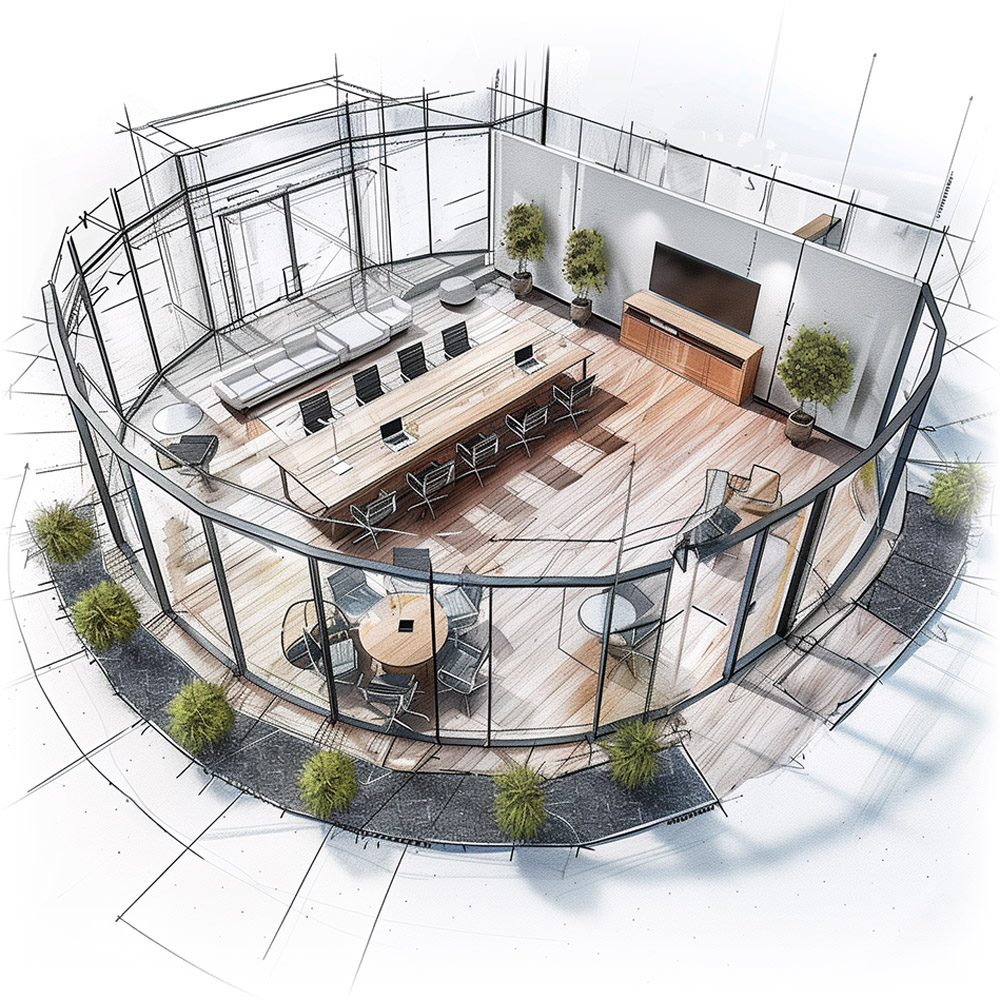
Nuestro flujo de trabajo BIM (Building Information Modeling) integra tecnología avanzada para optimizar y potenciar el proceso de diseño. Este método permite una planificación y ejecución precisas y eficientes, facilitando una mejor coordinación, gestión de costos y visualización del proyecto. Con BIM aseguramos un proceso constructivo fluido, colaborativo y de alta calidad.
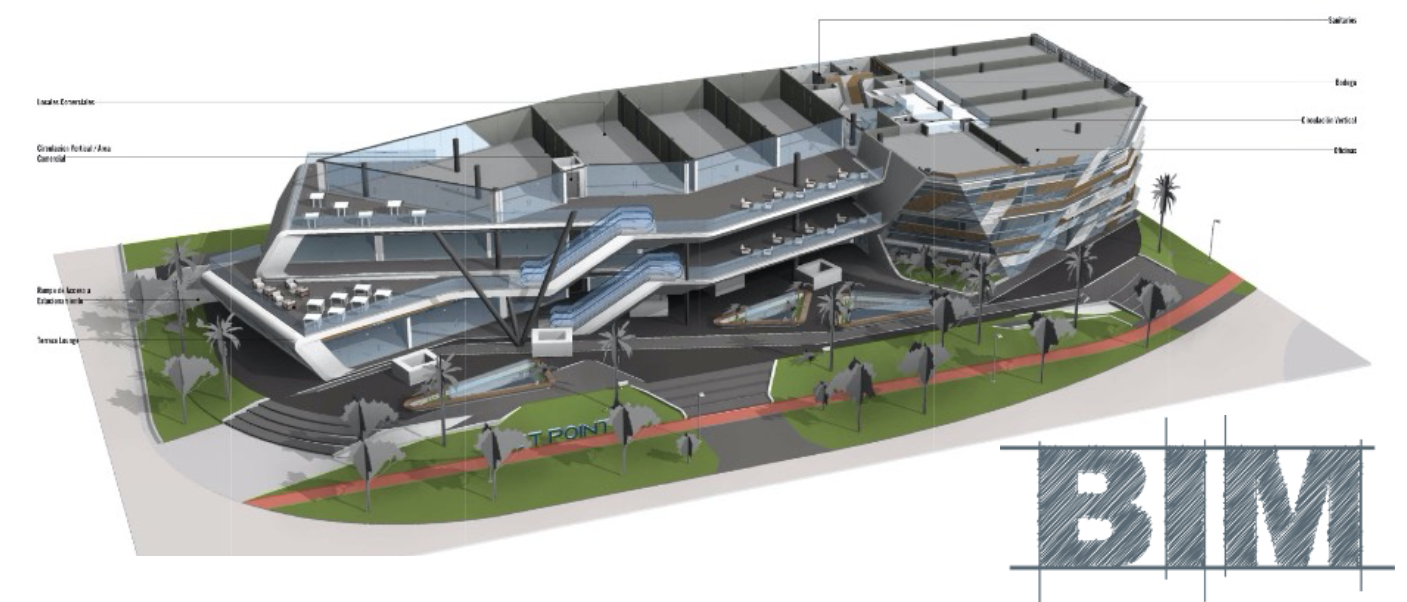
Nuestras visualizaciones interactivas dan vida a tu proyecto antes de que comience la construcción, ofreciendo una experiencia dinámica e inmersiva. Estas herramientas avanzadas te permiten explorar opciones y modificaciones de diseño en tiempo real, asegurando que el resultado final se alinee perfectamente con tu visión. Esta tecnología fomenta una comprensión y una implicación más profundas durante todo el proceso de diseño.

La visualización en Realidad Virtual (VR) te permite experimentar y afinar tu proyecto antes de construirlo, ofreciendo una percepción clara del espacio y del diseño. Esta capacidad en tiempo real garantiza precisión, ahorra tiempo y evita modificaciones costosas, mejorando la toma de decisiones y profundizando tu conexión con la visión final del proyecto.

En esencia, somos un colectivo de mentes creativas que empuja constantemente los límites del diseño y la innovación. Nuestro equipo desafía las convenciones y explora nuevas posibilidades para crear espacios no solo funcionales, sino también artísticamente inspiradores. Transformamos visiones en realidades, creando entornos que emocionan e inspiran.
Somos especialmente sensibles al presupuesto de cada proyecto, asegurando que nuestros diseños se ajusten a tus parámetros financieros sin comprometer la calidad ni la funcionalidad. Nuestro enfoque estratégico combina una planificación meticulosa con una gestión cuidadosa de los recursos, lo que nos permite entregar hogares excepcionales que respetan tu presupuesto y maximizan tu inversión.
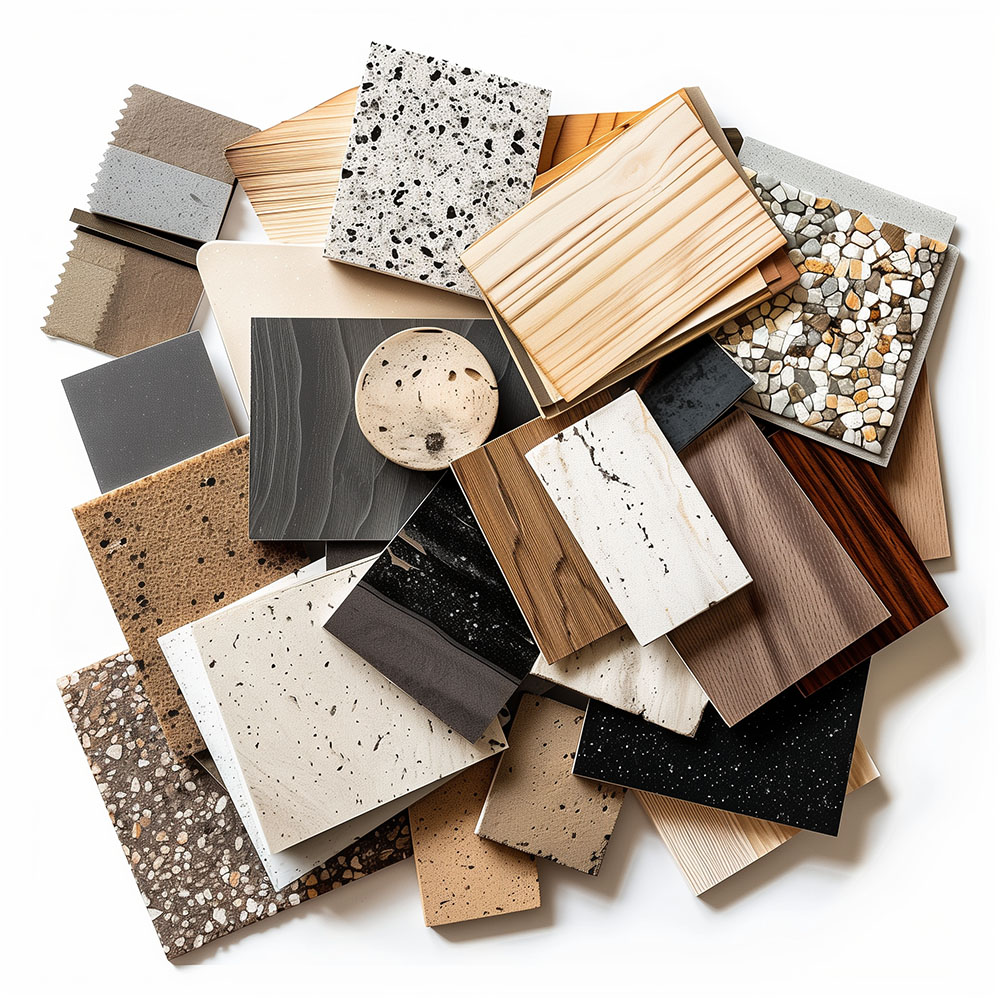
Nuestra experiencia en diseño internacional nos permite crear hogares excepcionales en cualquier parte del mundo. Con una perspectiva global y estrategias adaptables, ajustamos cada diseño a las culturas y entornos locales cumpliendo estándares universales de excelencia. Esté donde esté tu futuro hogar, podemos crear tu residencia ideal.
Priorizamos la colaboración local, trabajando en estrecho equipo con consultores de cada región para asegurar que nuestros diseños cumplan la normativa local y los estándares de la comunidad. Este enfoque enriquece nuestros proyectos con conocimiento y sensibilidad locales, garantizando que cada proyecto no solo cumpla la norma, sino que se integre plenamente en su contexto.
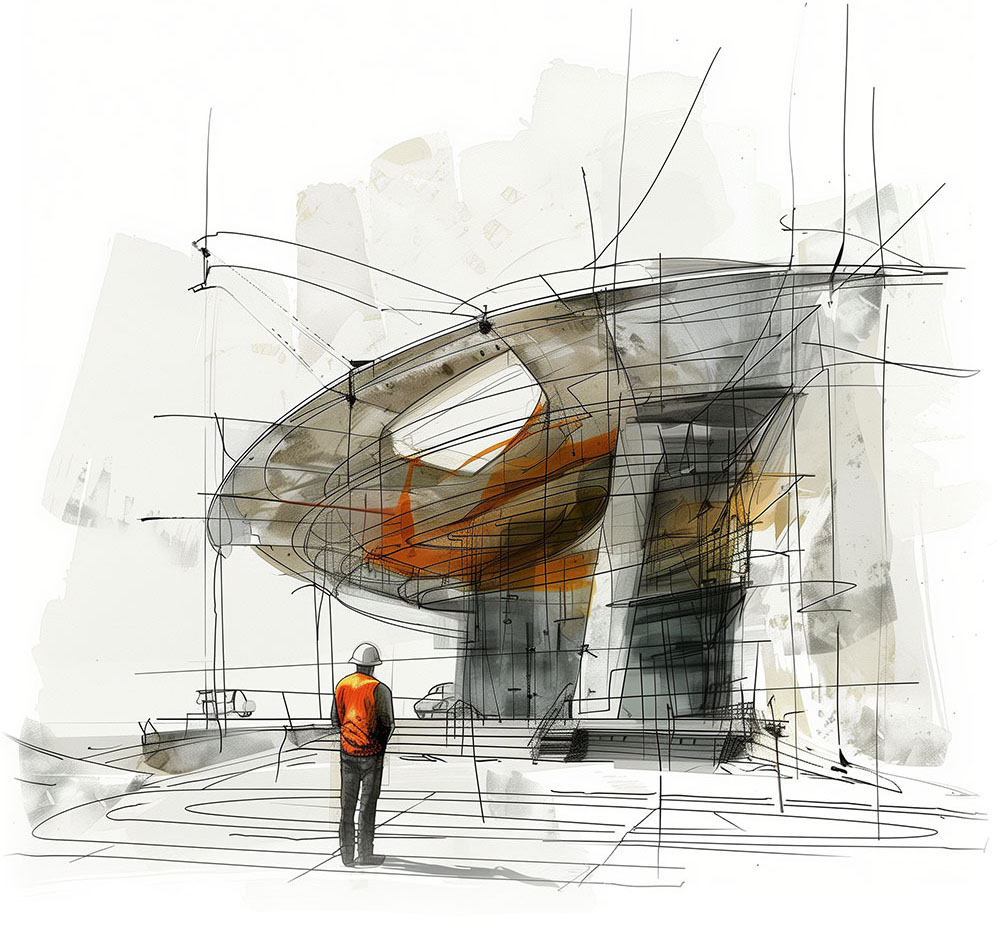


Nuestras oficinas están en Barcelona, Cancún, Chicago y Santo Domingo, pero gracias a la tecnología podemos desarrollar proyectos en cualquier parte del mundo.
Barcelona
Bac de Roda 136
08020, Barcelona
Spain
Madrid
Av. de Buendía 11
19005 Guadalajara (Madrid)
Spain
Chicago
373 Hazel Ave, Apt A1
60022, Glencoe, Illinois
United States