

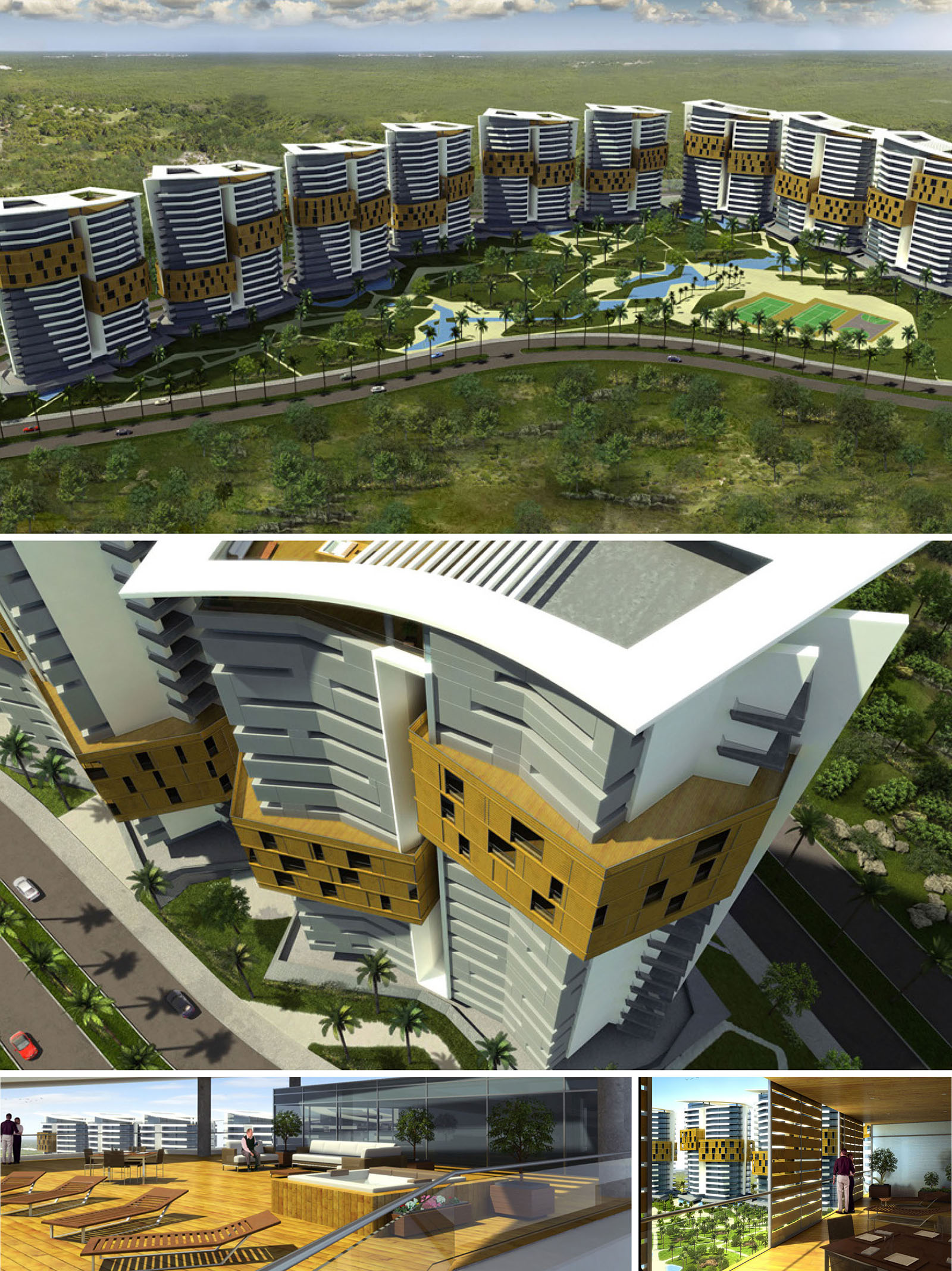
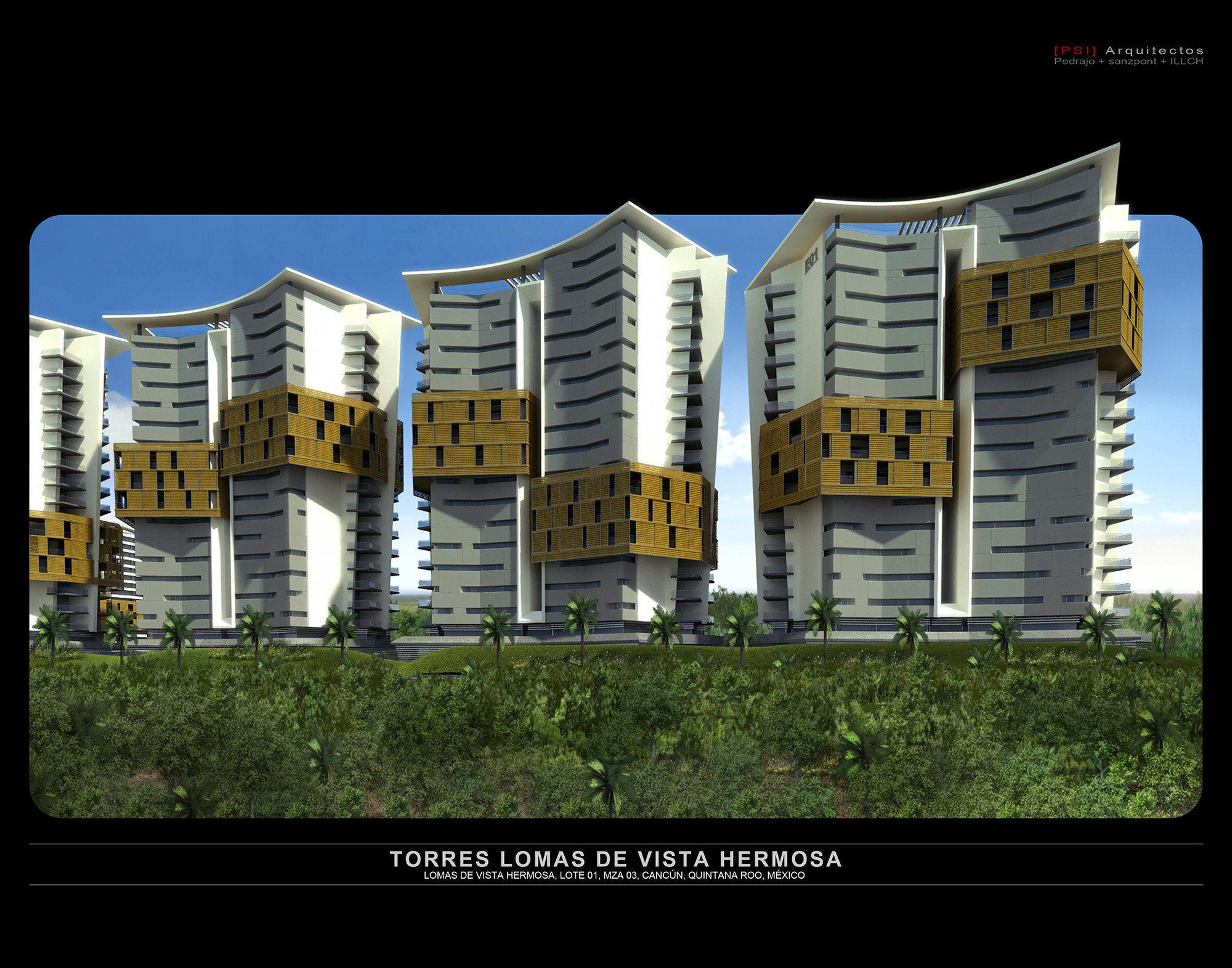
Lomas de Vista Hermosa is conceived as a contemporary residential enclave that embraces the tropical horizon of Cancún while generating a clear urban front towards the surrounding landscape. The masterplan arranges a sequence of slender towers in a gentle arc, framing a generous central park. This configuration produces a collective façade towards the city and, at the same time, opens the interior of the complex to natural light, ventilation and long-range views of the Mayan jungle.
The architectural language is based on the interplay of three elements: a white sculptural frame, recessed grey volumes with sinuous horizontal lines, and warm wooden bands that wrap the buildings at mid-height. Together, these components create a dynamic composition that emphasizes verticality while visually tying all towers into a unified, recognizable identity.
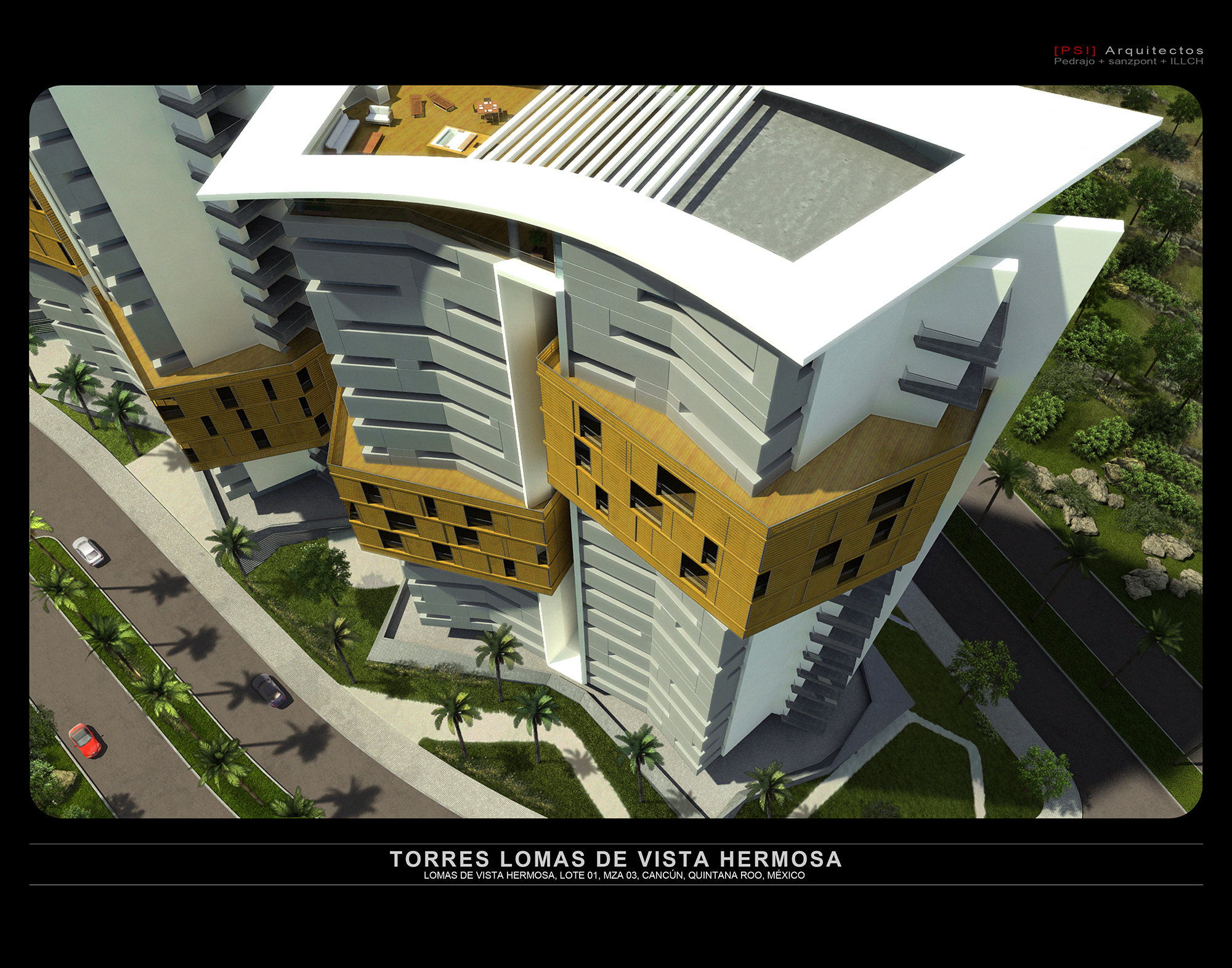
The towers are positioned along a curving access avenue, generating a continuous but permeable edge between the public road and the private interior landscape. Vehicular circulation is concentrated on the perimeter, allowing the heart of the complex to remain predominantly pedestrian and dedicated to recreation. This strategy enhances safety, acoustic comfort and a sense of community for residents.
The central garden acts as a shared living room at urban scale, integrating water features, a swimming zone, sports courts and shaded promenades under palm trees. The built mass is carefully staggered to avoid frontal collisions between façades, optimizing oblique views and ensuring that each unit enjoys visual connection either to the internal park or to the natural reserve beyond the site limits.
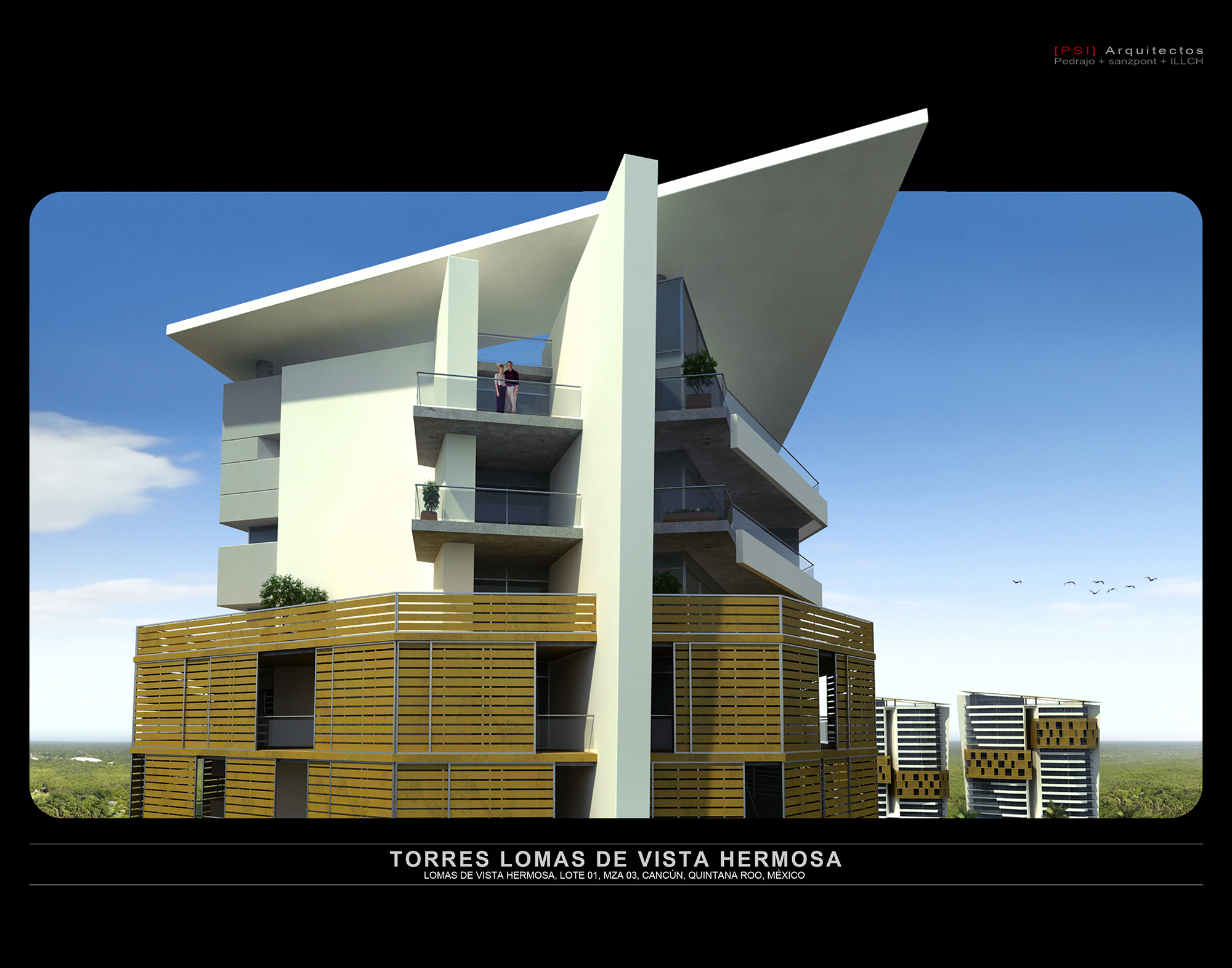
The towers are articulated as gently curving prisms, whose plans respond to both the arc of the masterplan and the desire to capture sea breezes. The façades combine horizontal balcony bands and recessed planes to create depth, shadows and a perception of lightness despite the height of the buildings. The white outer shell works as a continuous frame, emphasizing the silhouette against the sky and unifying the different towers.
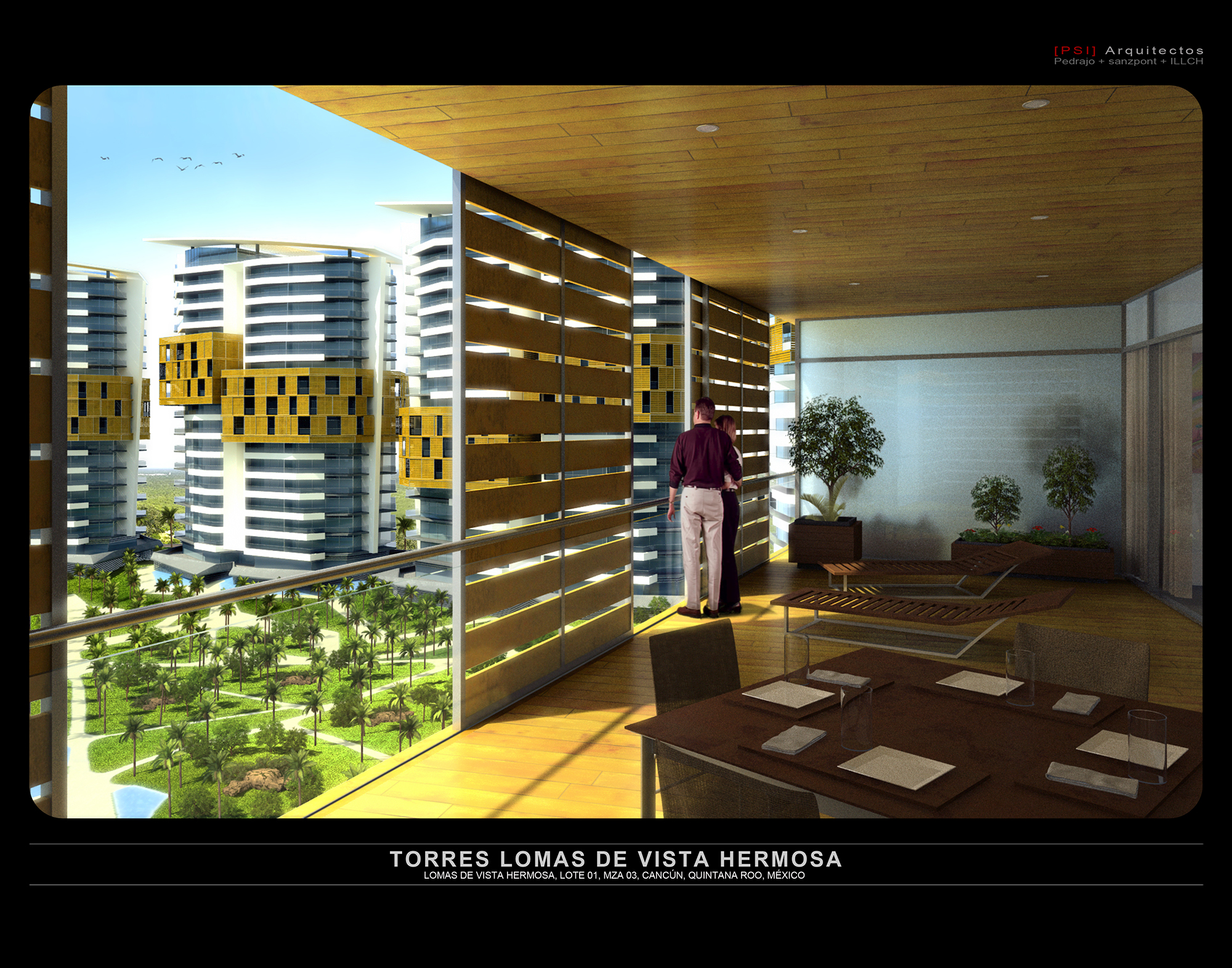
At mid-level, a continuous wooden volume crosses each tower like a habitable belt. This element houses terraces, double-height social spaces and private outdoor rooms. The pattern of openings in this band is intentionally irregular, evoking a contemporary reinterpretation of traditional wooden screens while providing privacy, solar protection and controlled transparency from the exterior to the interior.
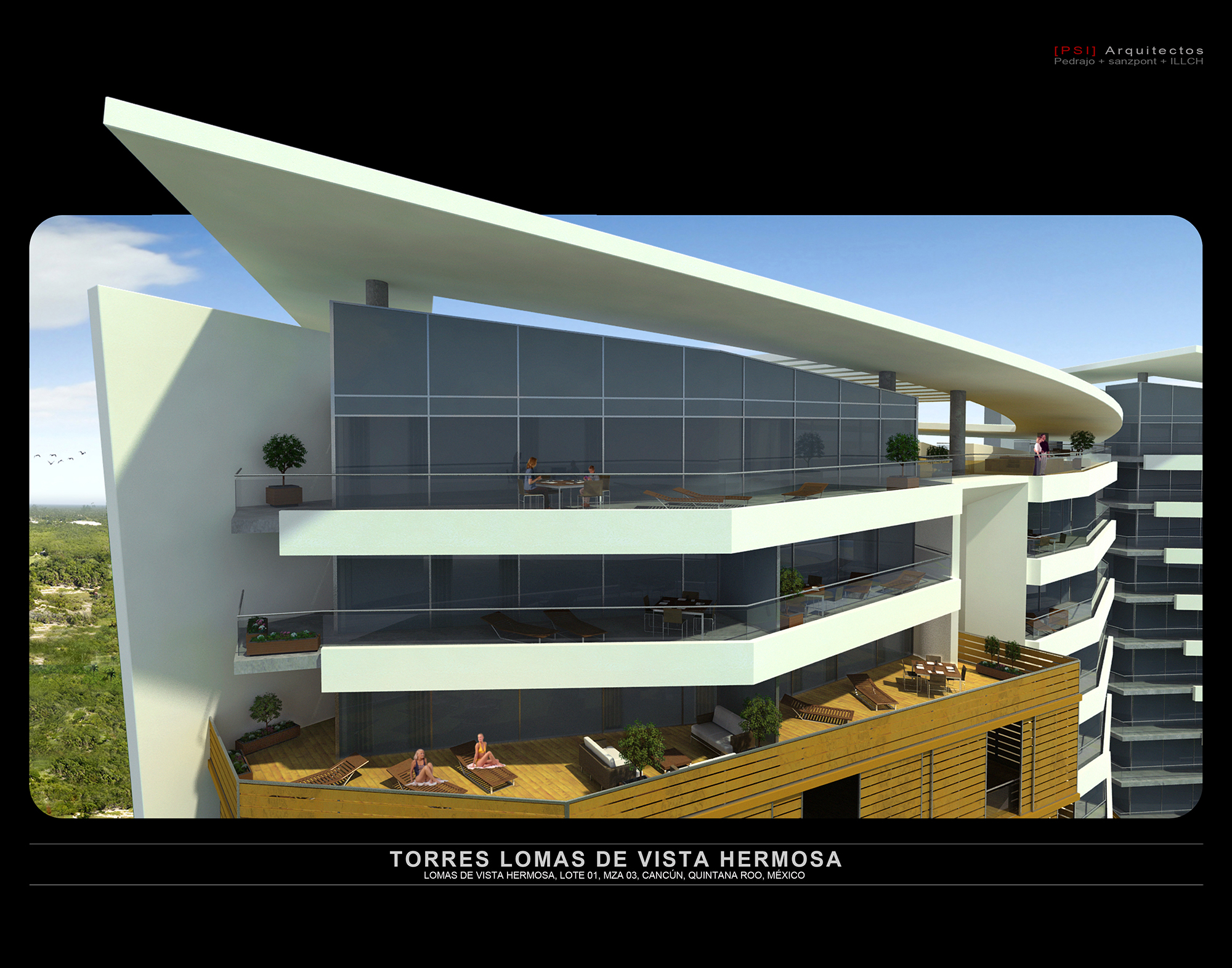
Residential units are organized to privilege corner living spaces and deep balconies, allowing residents to extend daily life outdoors. Large sliding glass panels blur the boundary between interior and exterior, creating cross-ventilation and maximizing natural light. The layout favors open-plan living-dining areas that visually connect to the landscape, with more private bedroom zones oriented towards quieter façades.
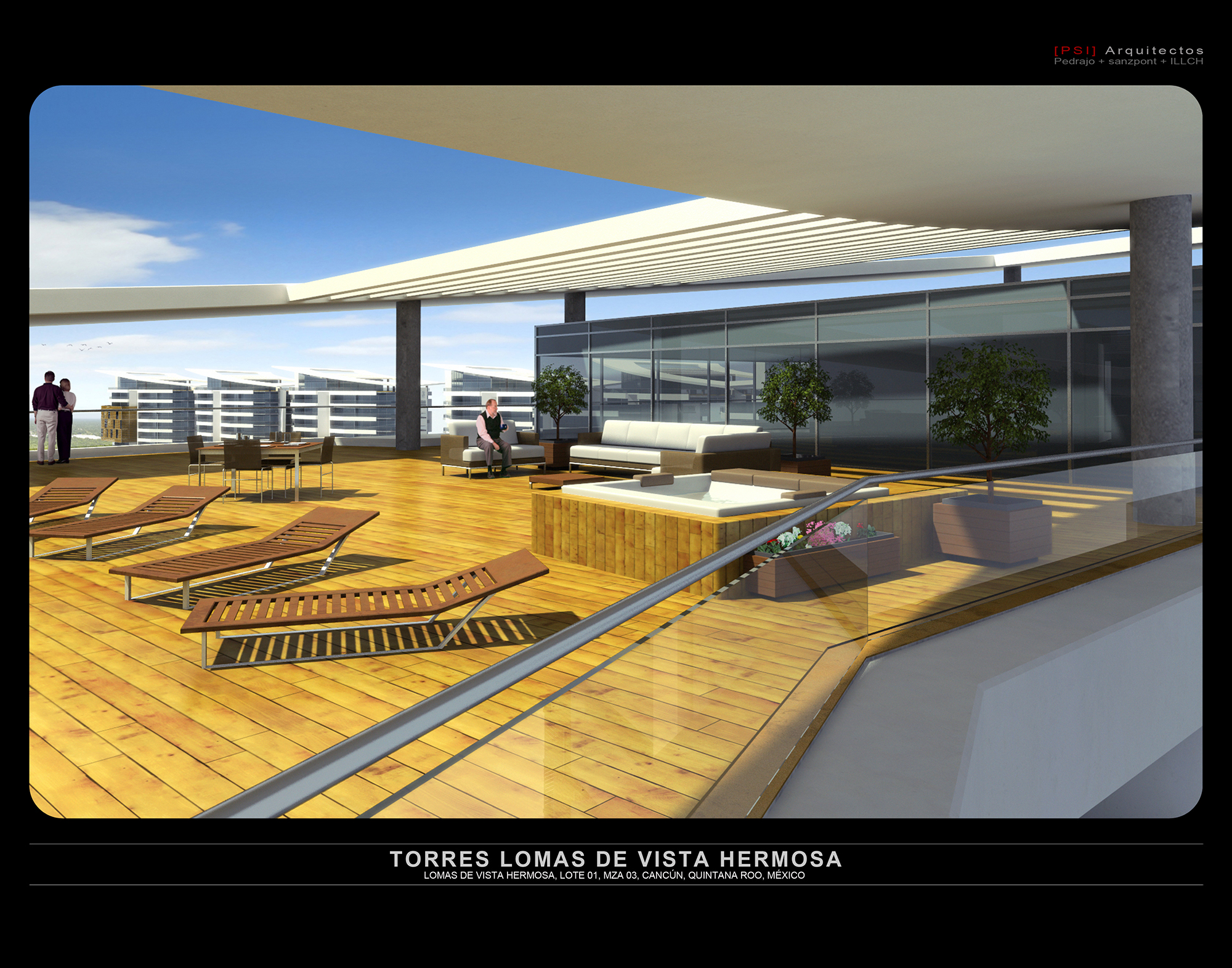
The roof levels of the towers incorporate communal terraces with solariums, lounge areas and jacuzzis, conceived as elevated observatories over the complex. On the ground floor, double-height lobbies and transparent façades maintain a visual continuity between the street, the internal garden and the interior circulation cores, reinforcing the idea of a vertical community integrated into its tropical environment.
The material palette is deliberately concise: white high-performance coatings to reflect solar radiation, grey elements to accentuate depth and shadow, and wood or wood-like cladding to introduce warmth and tactile quality. High-efficiency glazing, combined with generously cantilevered balconies and the wooden belt, provides effective solar control on the most exposed orientations, reducing cooling loads in Cancún’s warm climate.
Passive design strategies govern the project: tower orientation harnesses prevailing winds for natural cross-ventilation, while the arc-shaped disposition minimizes direct solar impact on large glass surfaces. The central green area acts as a microclimatic regulator, where vegetation, permeable surfaces and water features help mitigate the heat-island effect. Provision is made for rainwater collection for landscape irrigation, and the use of durable, low-maintenance materials contributes to long-term resource efficiency. Overall, the complex proposes a dense yet breathable residential model, aligned with sustainable growth in the Cancún region.
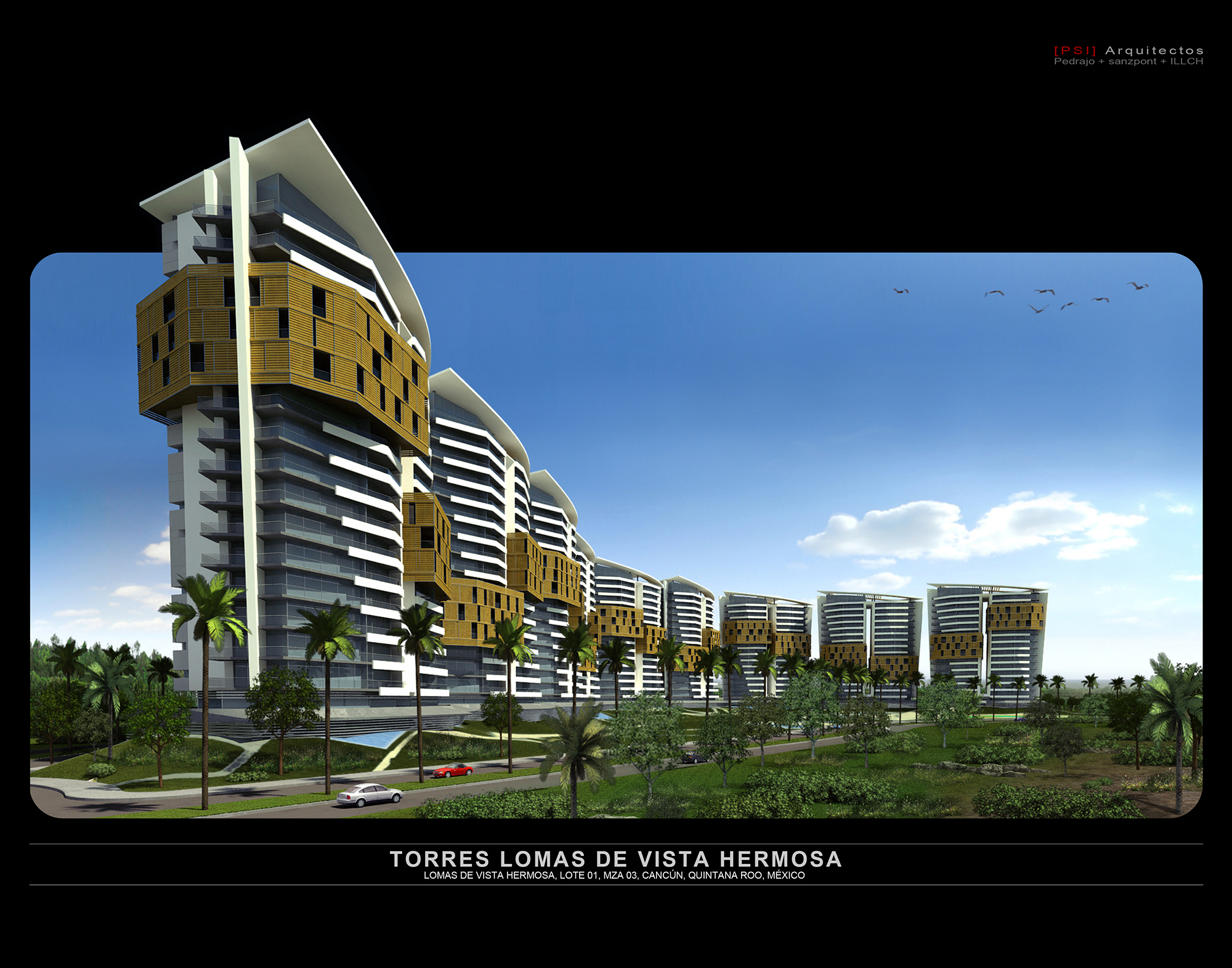
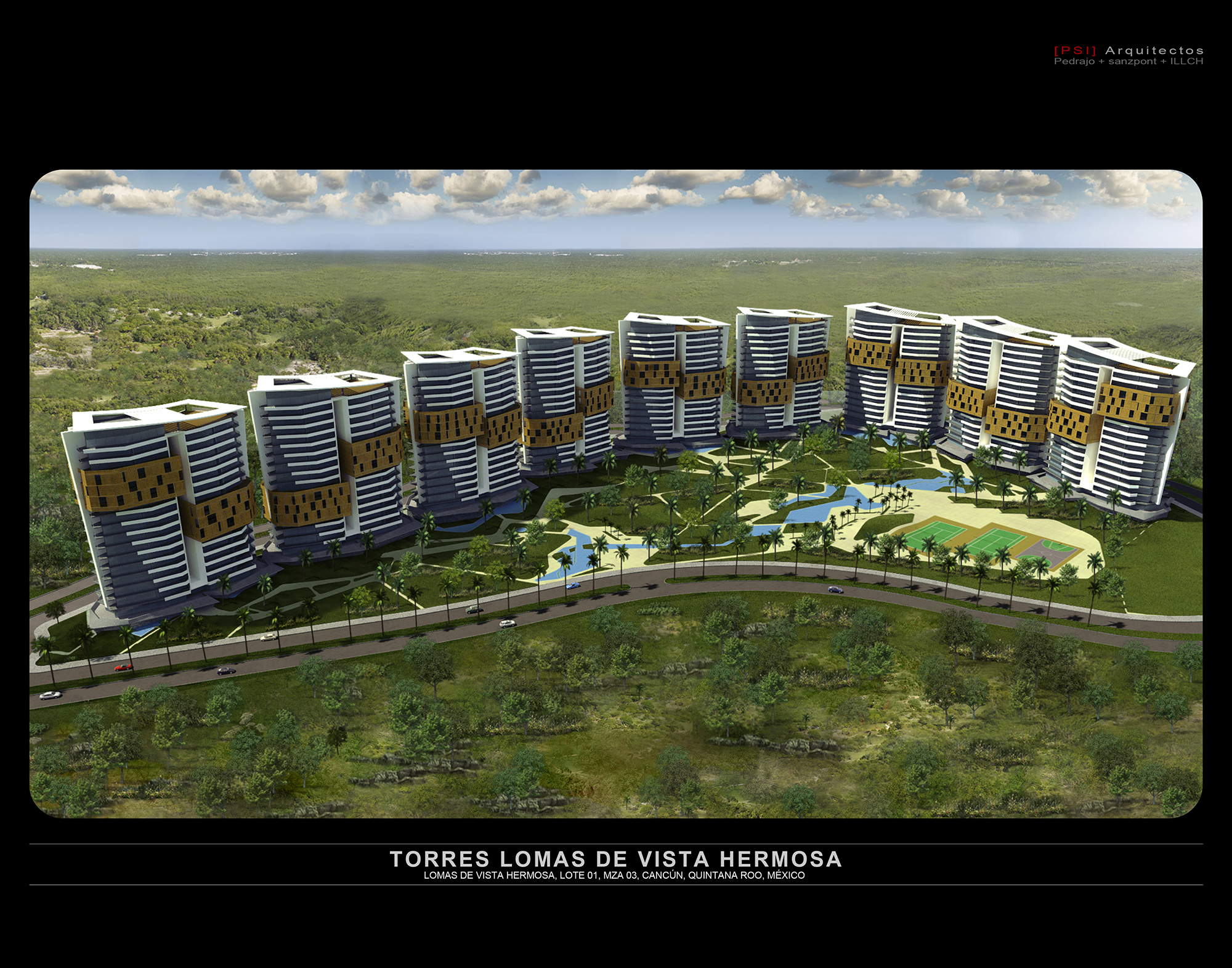
Lomas de Vista Hermosa is conceived as a contemporary residential enclave that embraces the tropical horizon of Cancún while generating a clear urban front towards the surrounding landscape. The masterplan arranges a sequence of slender towers in a gentle arc, framing a generous central park. This configuration produces a collective façade towards the city and, at the same time, opens the interior of the complex to natural light, ventilation and long-range views of the Mayan jungle.
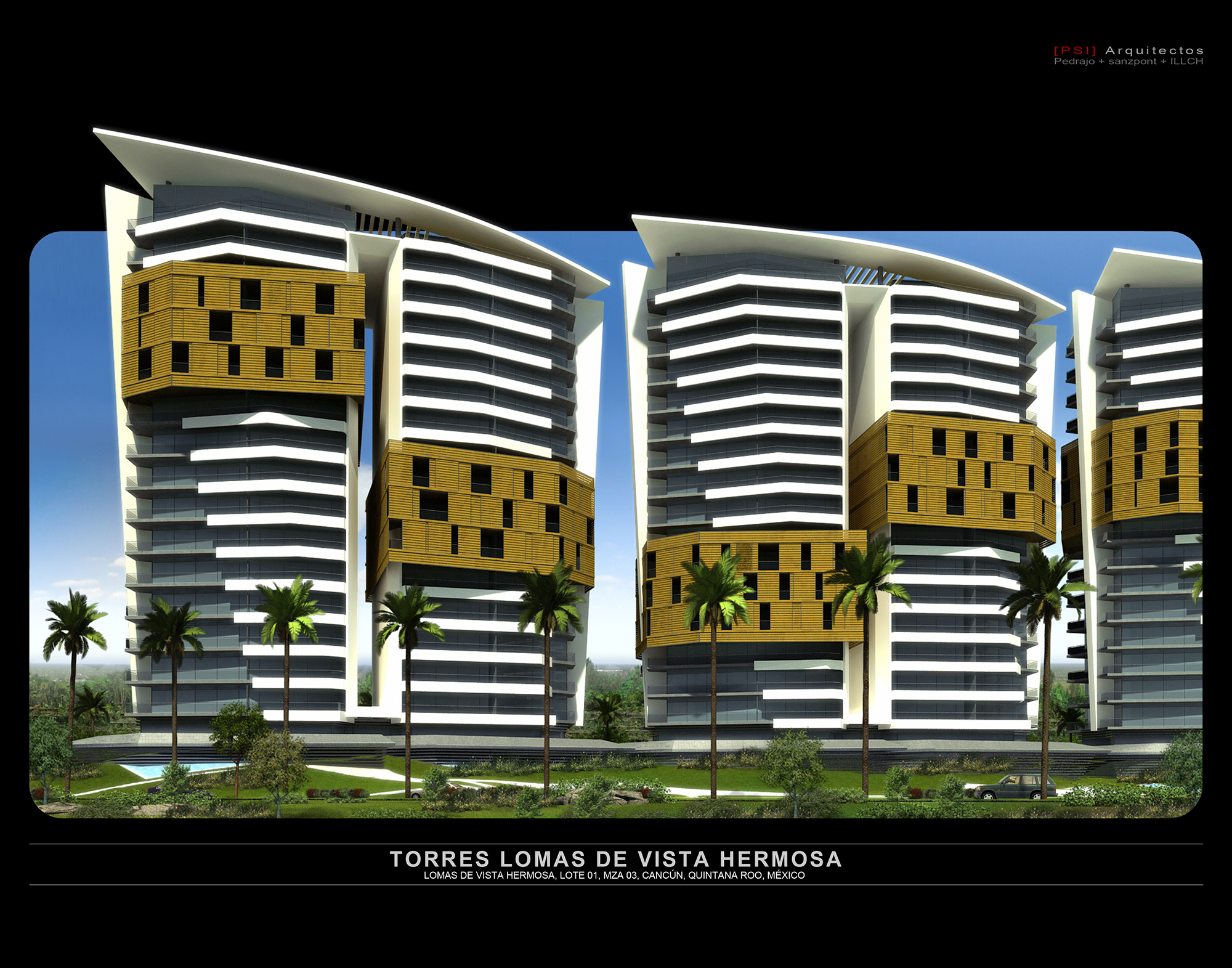
The architectural language is based on the interplay of three elements: a white sculptural frame, recessed grey volumes with sinuous horizontal lines, and warm wooden bands that wrap the buildings at mid-height. Together, these components create a dynamic composition that emphasizes verticality while visually tying all towers into a unified, recognizable identity.
The towers are positioned along a curving access avenue, generating a continuous but permeable edge between the public road and the private interior landscape. Vehicular circulation is concentrated on the perimeter, allowing the heart of the complex to remain predominantly pedestrian and dedicated to recreation. This strategy enhances safety, acoustic comfort and a sense of community for residents.
The central garden acts as a shared living room at urban scale, integrating water features, a swimming zone, sports courts and shaded promenades under palm trees. The built mass is carefully staggered to avoid frontal collisions between façades, optimizing oblique views and ensuring that each unit enjoys visual connection either to the internal park or to the natural reserve beyond the site limits.
The towers are articulated as gently curving prisms, whose plans respond to both the arc of the masterplan and the desire to capture sea breezes. The façades combine horizontal balcony bands and recessed planes to create depth, shadows and a perception of lightness despite the height of the buildings. The white outer shell works as a continuous frame, emphasizing the silhouette against the sky and unifying the different towers.
At mid-level, a continuous wooden volume crosses each tower like a habitable belt. This element houses terraces, double-height social spaces and private outdoor rooms. The pattern of openings in this band is intentionally irregular, evoking a contemporary reinterpretation of traditional wooden screens while providing privacy, solar protection and controlled transparency from the exterior to the interior.
Residential units are organized to privilege corner living spaces and deep balconies, allowing residents to extend daily life outdoors. Large sliding glass panels blur the boundary between interior and exterior, creating cross-ventilation and maximizing natural light. The layout favors open-plan living-dining areas that visually connect to the landscape, with more private bedroom zones oriented towards quieter façades.
The roof levels of the towers incorporate communal terraces with solariums, lounge areas and jacuzzis, conceived as elevated observatories over the complex. On the ground floor, double-height lobbies and transparent façades maintain a visual continuity between the street, the internal garden and the interior circulation cores, reinforcing the idea of a vertical community integrated into its tropical environment.
The material palette is deliberately concise: white high-performance coatings to reflect solar radiation, grey elements to accentuate depth and shadow, and wood or wood-like cladding to introduce warmth and tactile quality. High-efficiency glazing, combined with generously cantilevered balconies and the wooden belt, provides effective solar control on the most exposed orientations, reducing cooling loads in Cancún’s warm climate.
Passive design strategies govern the project: tower orientation harnesses prevailing winds for natural cross-ventilation, while the arc-shaped disposition minimizes direct solar impact on large glass surfaces. The central green area acts as a microclimatic regulator, where vegetation, permeable surfaces and water features help mitigate the heat-island effect. Provision is made for rainwater collection for landscape irrigation, and the use of durable, low-maintenance materials contributes to long-term resource efficiency. Overall, the complex proposes a dense yet breathable residential model, aligned with sustainable growth in the Cancún region.


Our offices are located in Barcelona, Cancún, Chicago and Santo Domingo, but thanks to technology we can do projects on all over the world.
Barcelona
Bac de Roda 136
08020, Barcelona
Spain
Madrid
Av. de Buendía 11
19005 Guadalajara (Madrid)
Spain
Chicago
373 Hazel Ave, Apt A1
60022, Glencoe, Illinois
United States