

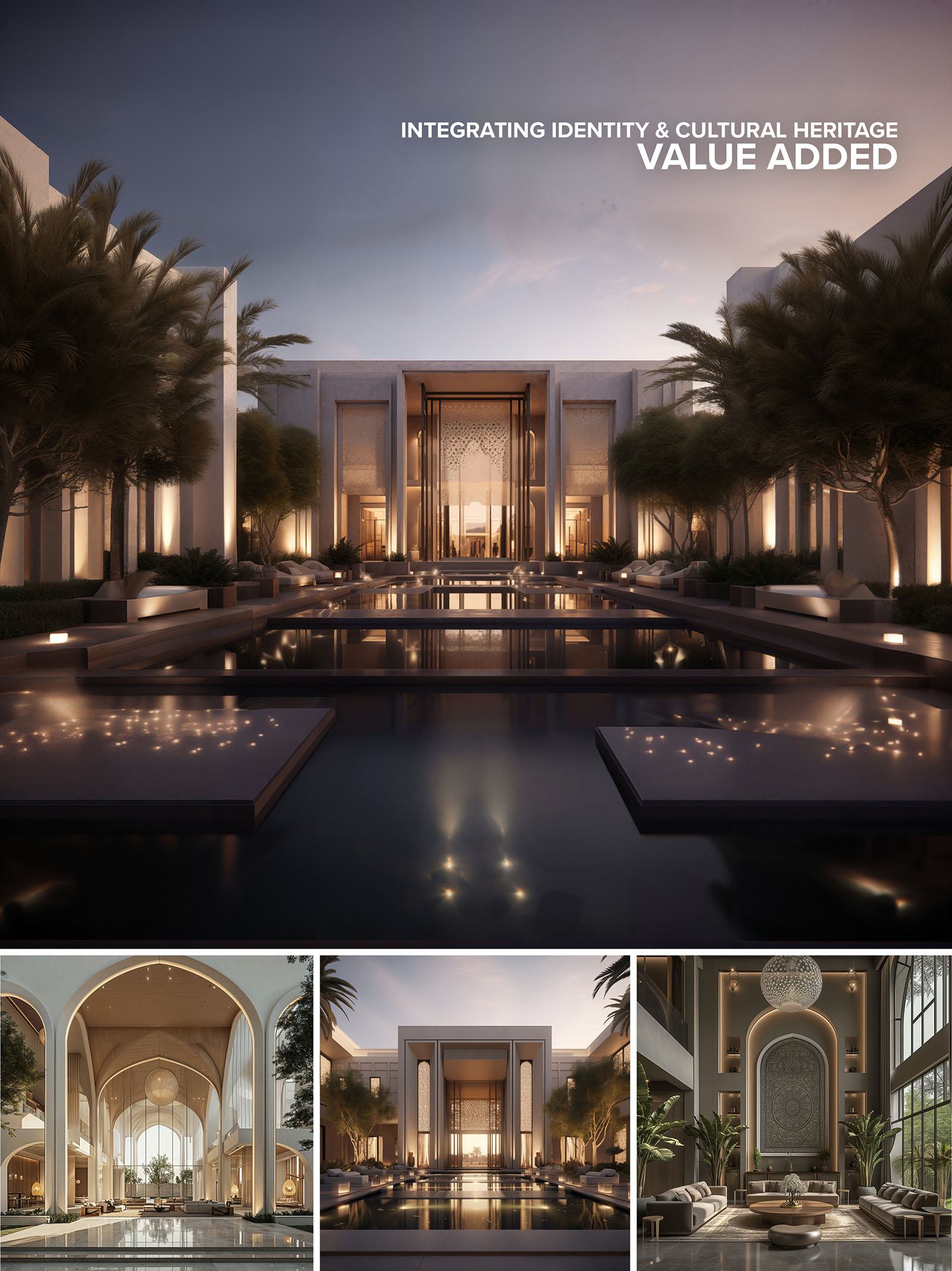
Qasr Al-Haya Palace is conceived as a contemporary interpretation of the desert palace, merging refined minimalism with the opulent spatial sequences of traditional Arab architecture. The design orchestrates a ceremonial journey from exterior to interior, using water, light, and shadow as primary compositional elements. A strong axial approach leads guests through layered thresholds, framing views and gradually revealing the richness of the inner world.
The architectural language is deliberately calm and monolithic on the outside, allowing the interiors and courtyards to express the emotional intensity of the palace life. Verticality, generous volumes, and finely worked details emphasize dignity and permanence, while soft, warm lighting underscores the palace’s residential and intimate vocation.
The palace is structured as a series of orthogonal volumes around a central water courtyard. Clean, rectilinear masses are articulated by deep reveals and tall portals, generating a rhythm of solids and voids. The main entrance façade is dominated by a grand propylaeum-like frame, within which a delicately perforated metal screen filters light and provides privacy. This large-scale mashrabiya becomes the symbolic “veil” of the palace.
Vertical pilasters and recessed bays create a sequence of shaded niches along the perimeter, reinforcing a sense of procession. The overall massing remains low and horizontal, echoing the horizon line of the desert landscape, while selective vertical accents—entrance portal, double-height arcades, and interior colonnades—mark important nodes in the spatial hierarchy.
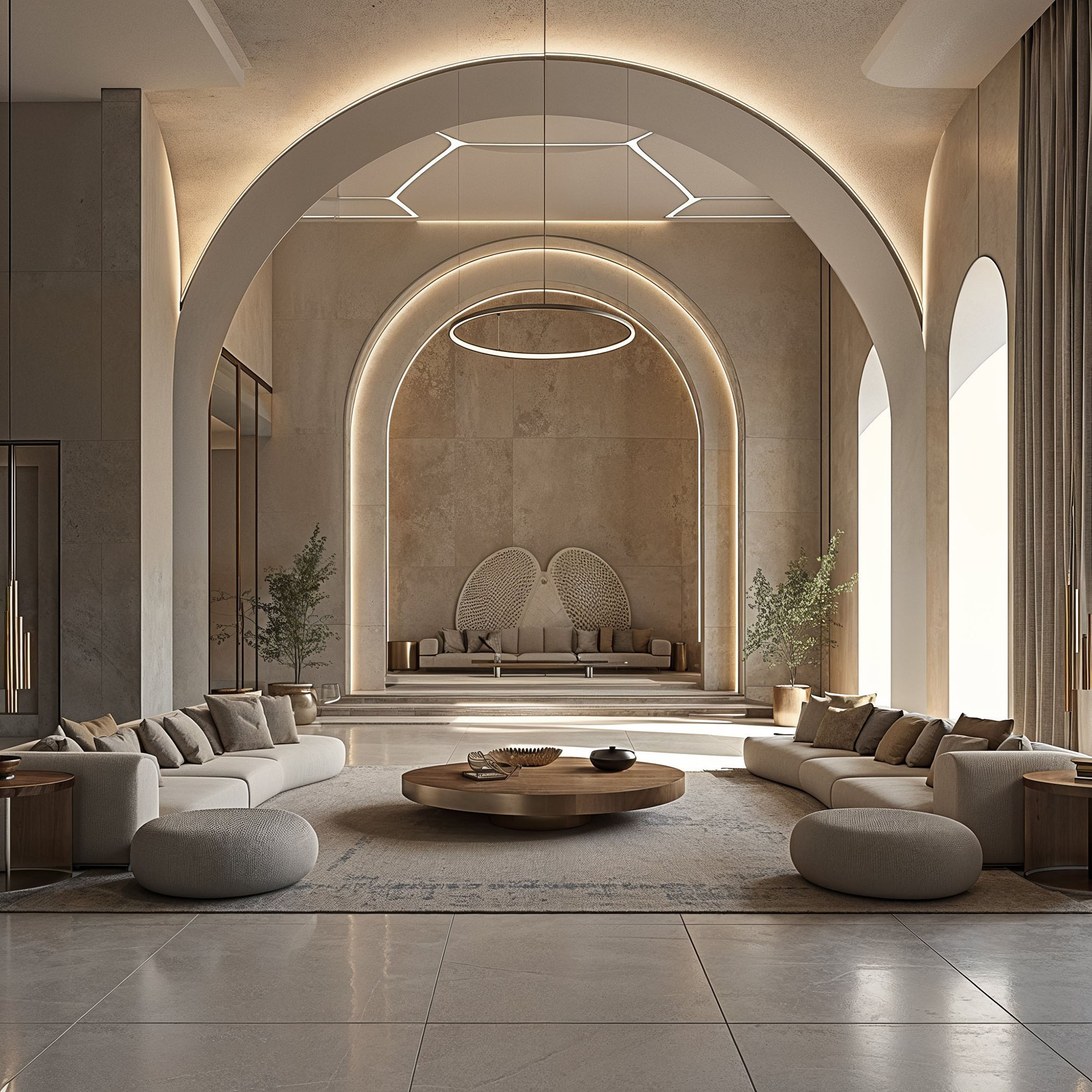
The interior spaces revolve around a monumental, double-height reception hall, defined by slender arches and a sweeping vaulted ceiling. Natural light enters through tall, glazed openings, softened by sheer layers and exterior shading devices. This creates a diffused, golden atmosphere that enhances the perception of height and depth. The hall connects visually to the central courtyard, dissolving the boundary between inside and outside.
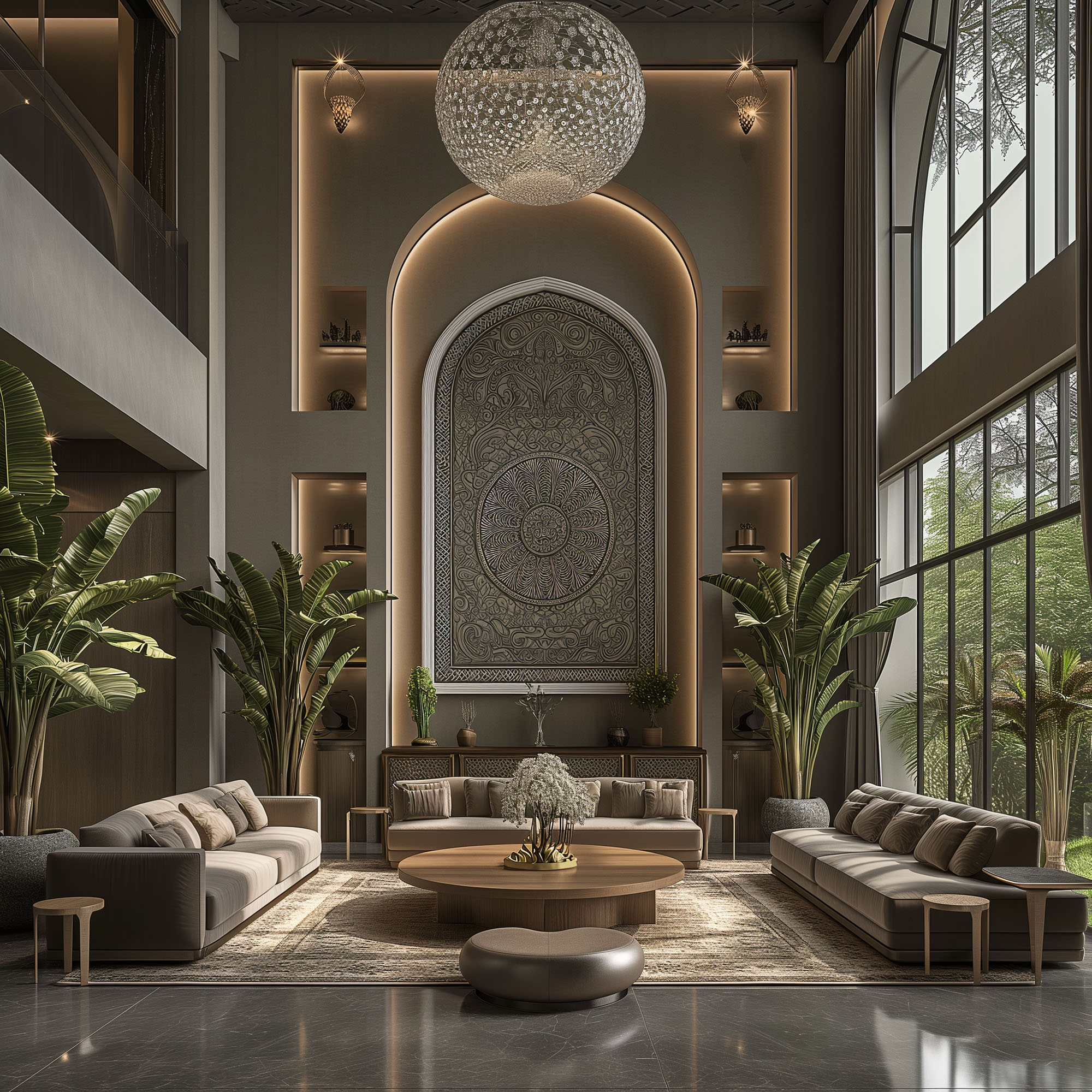
Key interior walls are treated as sculpted surfaces: recessed panels, carved geometric patterns, and large-scale ornamental medallions act as focal points. Furnishings are arranged in generous conversation clusters, combining low modular seating reminiscent of majlis typologies with contemporary pieces in neutral textiles. The palette favors warm stone, bronze accents, and soft fabrics, enriched by greenery that introduces a subtle biophilic dimension.
The material strategy balances durability, tactility, and understated luxury. External façades use light-toned stone or high-performance stucco, chosen for its thermal inertia and ability to reflect harsh sunlight. Fine metalwork in bronze or champagne anodized aluminum defines doors, screens, and balustrades, providing a delicate contrast to the solid masonry volumes.
Internally, large-format stone flooring, timber ceilings, and finely textured plaster surfaces create a cohesive, timeless backdrop. The chromatic palette remains in the spectrum of sands, creams, and warm greys, punctuated by metallic highlights and the deep greens of planting. Lighting is layered: concealed linear LEDs accentuate cornices and arches, while sculptural pendants and chandeliers articulate key vertical spaces and emphasize the palace’s ceremonial character.
The landscape design extends the architecture through a sequence of reflecting pools, planted terraces, and shaded seating platforms. Linear water features aligned with the central axis not only create a powerful visual perspective, but also assist in microclimate regulation through evaporative cooling. Strategically placed palms and drought-tolerant native species provide shade, reduce heat gain on hard surfaces, and minimize irrigation demand.
Sustainability is embedded through passive and active strategies: deep overhangs, colonnades, and screens mitigate solar exposure; high-performance glazing and insulated envelopes improve thermal performance; and the central courtyard acts as a climatic buffer, encouraging cross-ventilation. Water-efficient fixtures, greywater reuse for irrigation, and energy-efficient LED lighting systems contribute to reduced operational consumption, ensuring that the palace’s sense of grandeur is aligned with contemporary environmental responsibility.
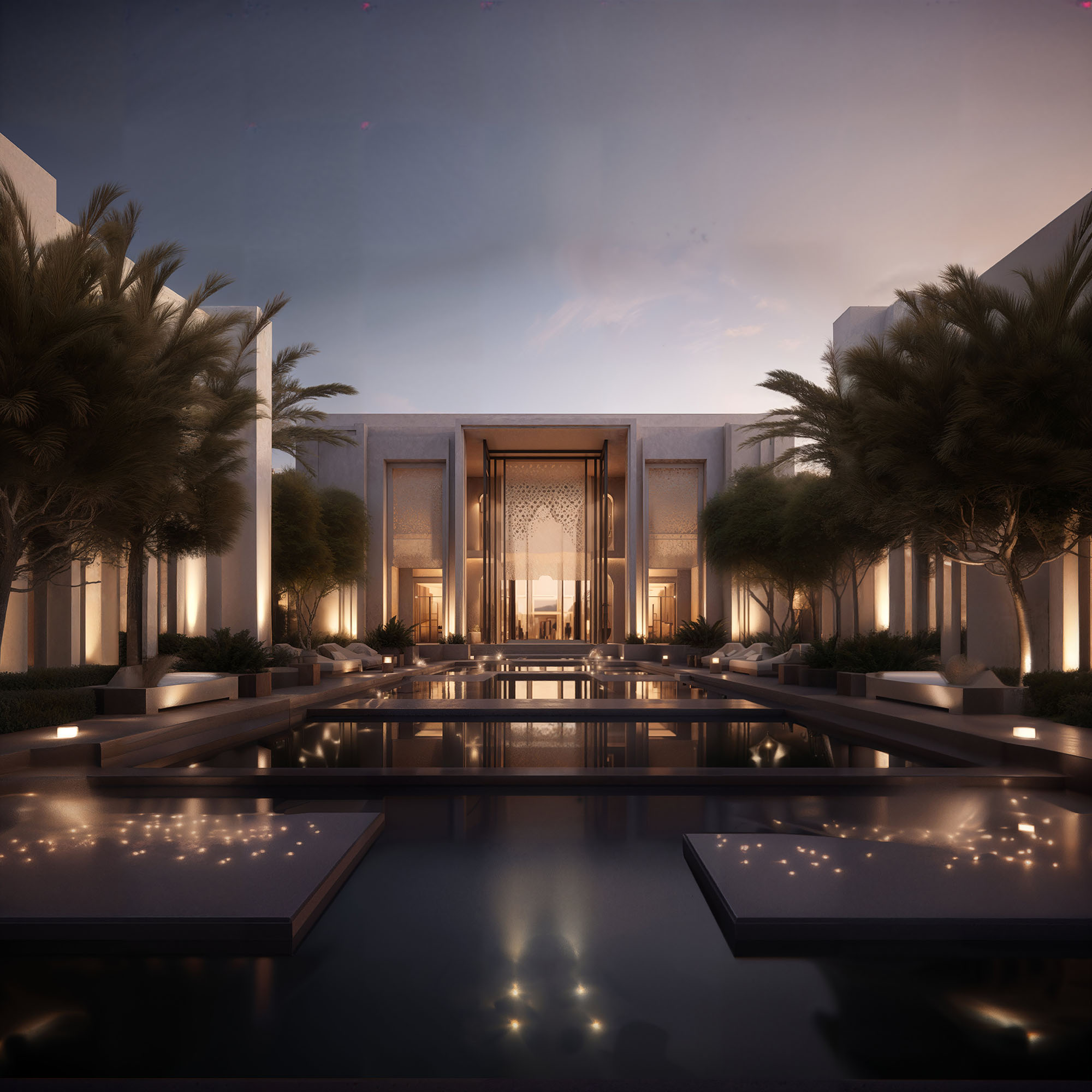
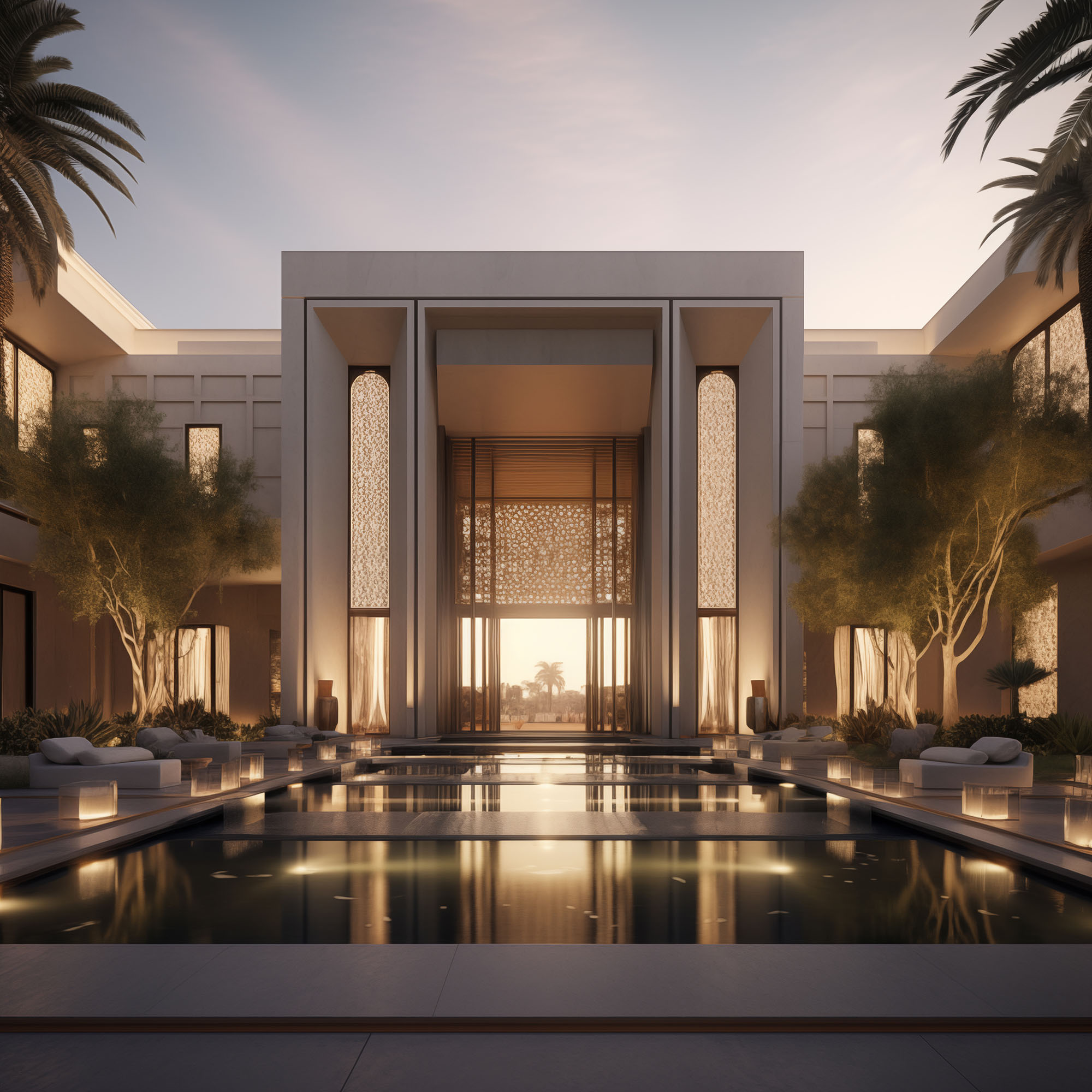

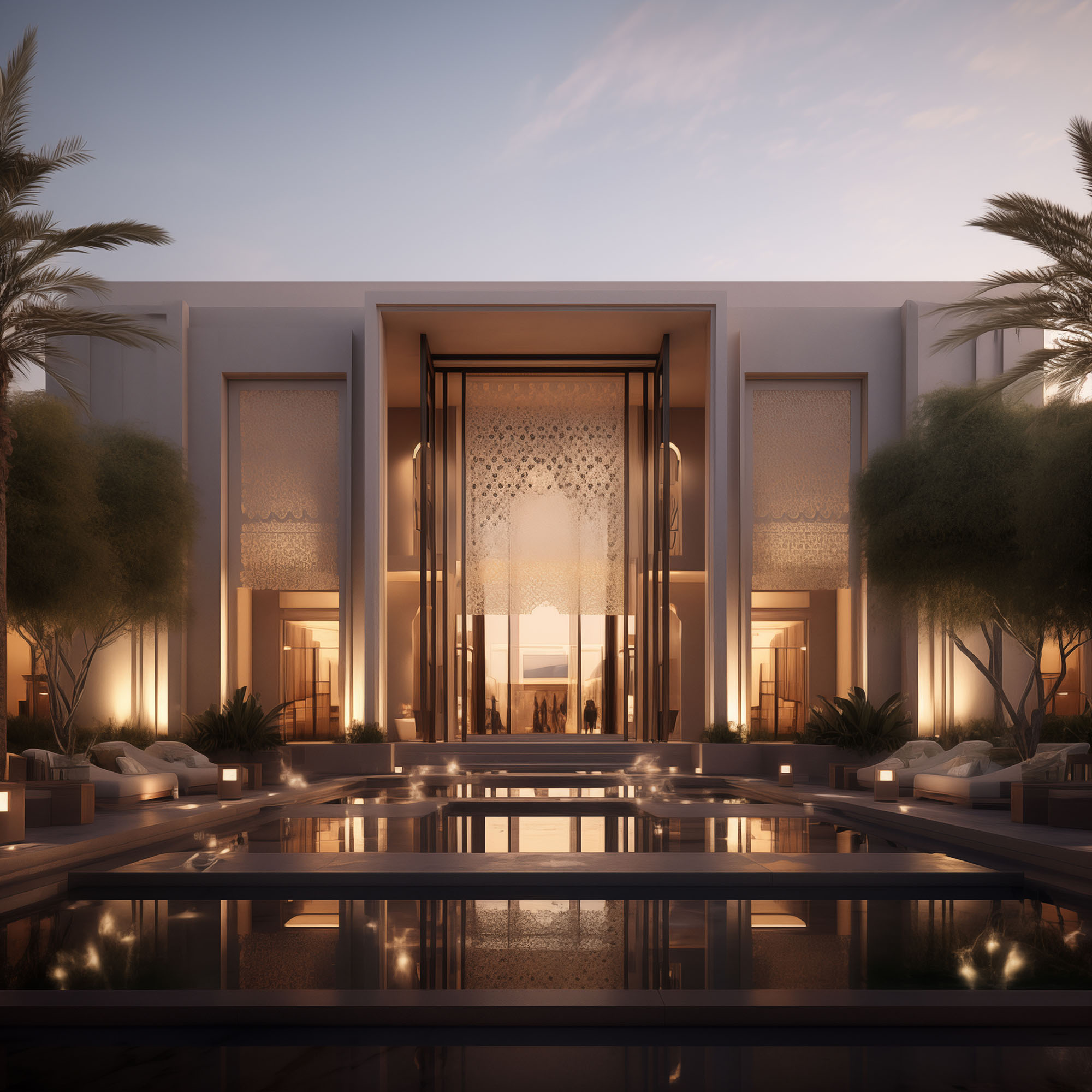
Qasr Al-Haya Palace is conceived as a contemporary interpretation of the desert palace, merging refined minimalism with the opulent spatial sequences of traditional Arab architecture. The design orchestrates a ceremonial journey from exterior to interior, using water, light, and shadow as primary compositional elements. A strong axial approach leads guests through layered thresholds, framing views and gradually revealing the richness of the inner world.
The architectural language is deliberately calm and monolithic on the outside, allowing the interiors and courtyards to express the emotional intensity of the palace life. Verticality, generous volumes, and finely worked details emphasize dignity and permanence, while soft, warm lighting underscores the palace’s residential and intimate vocation.
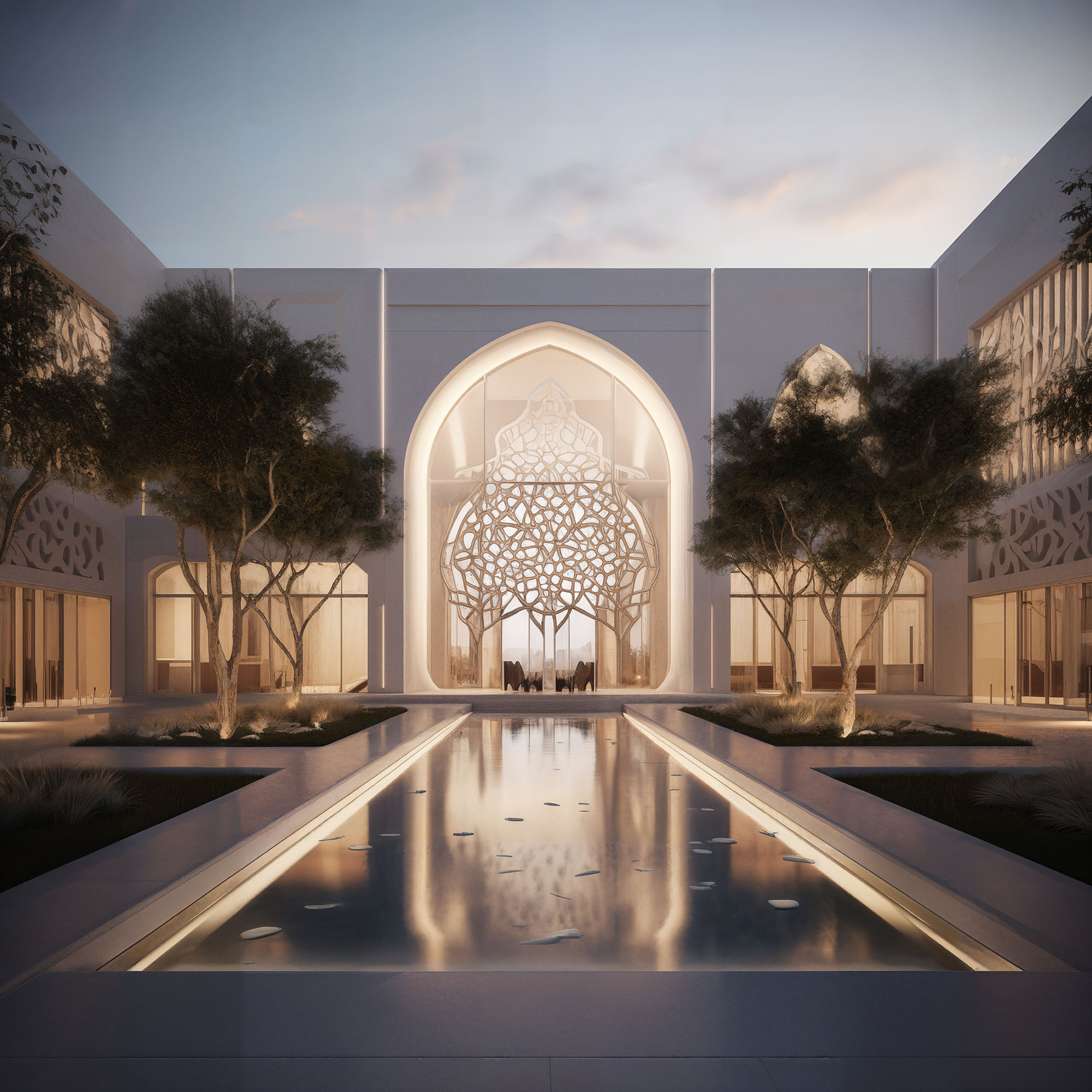
The palace is structured as a series of orthogonal volumes around a central water courtyard. Clean, rectilinear masses are articulated by deep reveals and tall portals, generating a rhythm of solids and voids. The main entrance façade is dominated by a grand propylaeum-like frame, within which a delicately perforated metal screen filters light and provides privacy. This large-scale mashrabiya becomes the symbolic “veil” of the palace.
Vertical pilasters and recessed bays create a sequence of shaded niches along the perimeter, reinforcing a sense of procession. The overall massing remains low and horizontal, echoing the horizon line of the desert landscape, while selective vertical accents—entrance portal, double-height arcades, and interior colonnades—mark important nodes in the spatial hierarchy.
The interior spaces revolve around a monumental, double-height reception hall, defined by slender arches and a sweeping vaulted ceiling. Natural light enters through tall, glazed openings, softened by sheer layers and exterior shading devices. This creates a diffused, golden atmosphere that enhances the perception of height and depth. The hall connects visually to the central courtyard, dissolving the boundary between inside and outside.
Key interior walls are treated as sculpted surfaces: recessed panels, carved geometric patterns, and large-scale ornamental medallions act as focal points. Furnishings are arranged in generous conversation clusters, combining low modular seating reminiscent of majlis typologies with contemporary pieces in neutral textiles. The palette favors warm stone, bronze accents, and soft fabrics, enriched by greenery that introduces a subtle biophilic dimension.
The material strategy balances durability, tactility, and understated luxury. External façades use light-toned stone or high-performance stucco, chosen for its thermal inertia and ability to reflect harsh sunlight. Fine metalwork in bronze or champagne anodized aluminum defines doors, screens, and balustrades, providing a delicate contrast to the solid masonry volumes.
Internally, large-format stone flooring, timber ceilings, and finely textured plaster surfaces create a cohesive, timeless backdrop. The chromatic palette remains in the spectrum of sands, creams, and warm greys, punctuated by metallic highlights and the deep greens of planting. Lighting is layered: concealed linear LEDs accentuate cornices and arches, while sculptural pendants and chandeliers articulate key vertical spaces and emphasize the palace’s ceremonial character.
The landscape design extends the architecture through a sequence of reflecting pools, planted terraces, and shaded seating platforms. Linear water features aligned with the central axis not only create a powerful visual perspective, but also assist in microclimate regulation through evaporative cooling. Strategically placed palms and drought-tolerant native species provide shade, reduce heat gain on hard surfaces, and minimize irrigation demand.
Sustainability is embedded through passive and active strategies: deep overhangs, colonnades, and screens mitigate solar exposure; high-performance glazing and insulated envelopes improve thermal performance; and the central courtyard acts as a climatic buffer, encouraging cross-ventilation. Water-efficient fixtures, greywater reuse for irrigation, and energy-efficient LED lighting systems contribute to reduced operational consumption, ensuring that the palace’s sense of grandeur is aligned with contemporary environmental responsibility.


Our offices are located in Barcelona, Cancún, Chicago and Santo Domingo, but thanks to technology we can do projects on all over the world.
Barcelona
Bac de Roda 136
08020, Barcelona
Spain
Madrid
Av. de Buendía 11
19005 Guadalajara (Madrid)
Spain
Chicago
373 Hazel Ave, Apt A1
60022, Glencoe, Illinois
United States