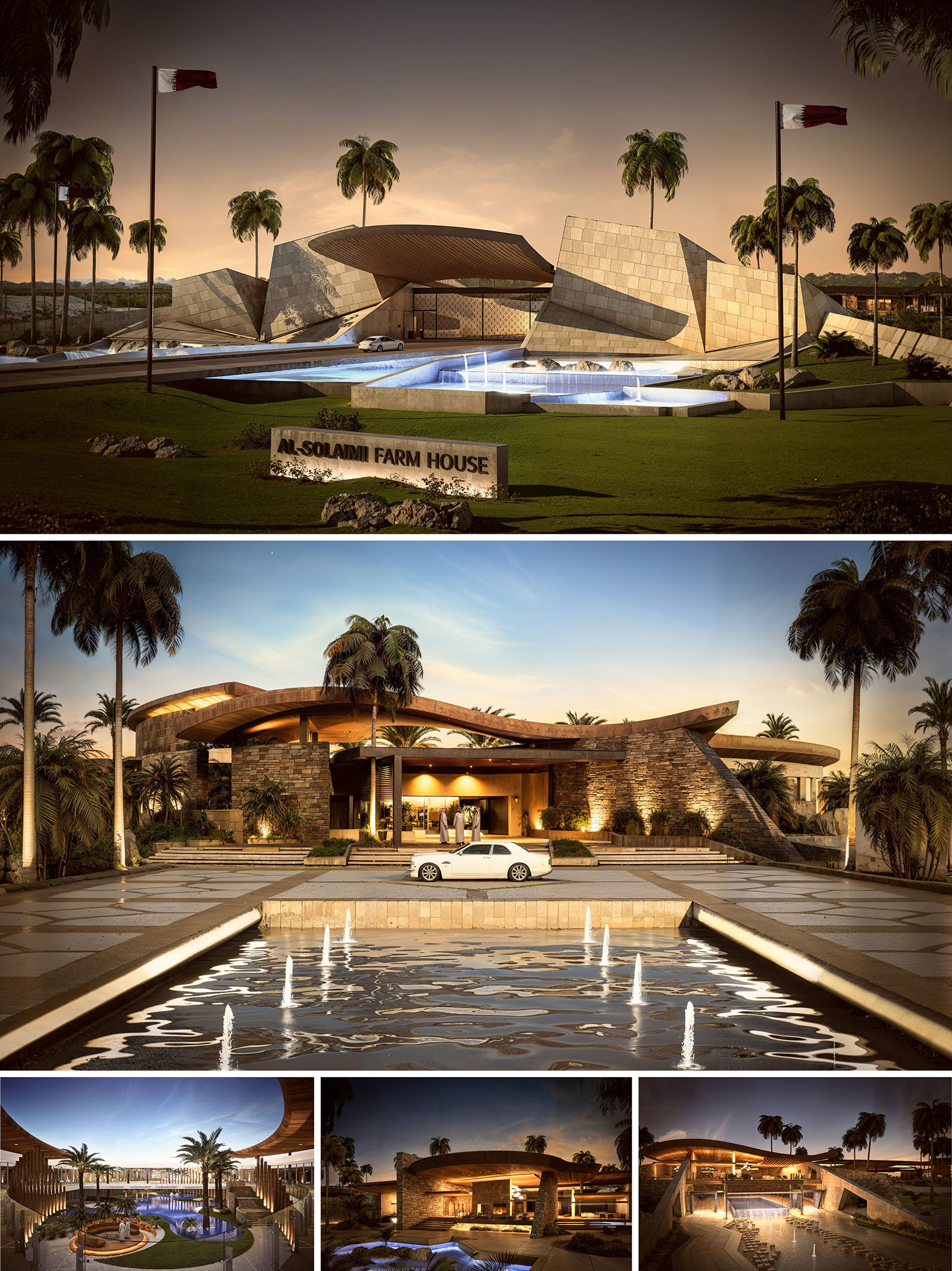




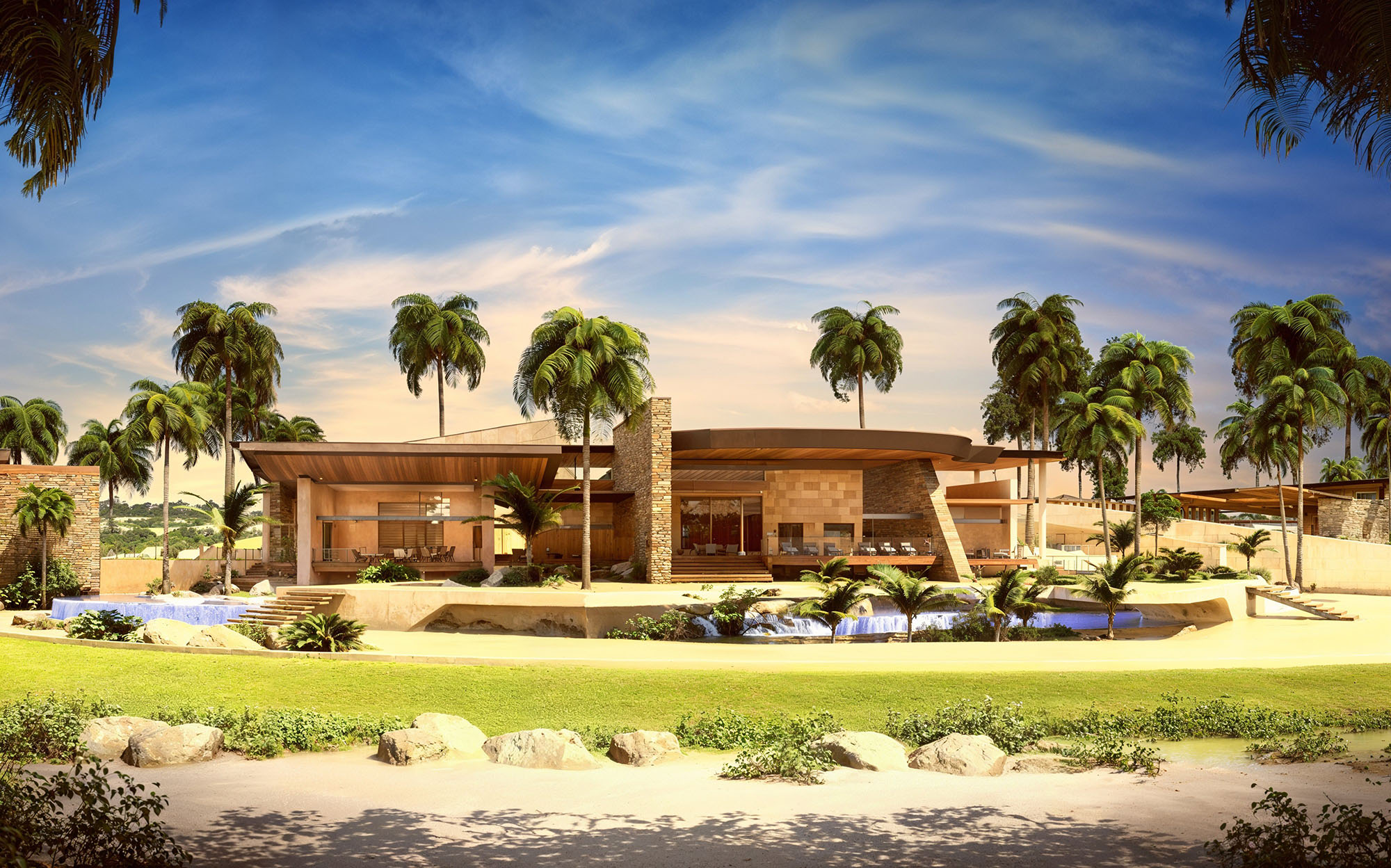
Al-Solaimi Farm House is conceived as a contemporary desert retreat that expresses both solidity and fluidity. The project translates the idea of “oasis” into architecture: protective stone masses sheltering generous, shaded voids animated by water and vegetation. The formal language moves between angular, tectonic planes at the entrance and soft, sweeping roofs around the main residence, reflecting the contrast between the harsh exterior landscape and the calm domestic interior. The farmhouse becomes a sculpted landmark within the agricultural setting, yet remains grounded in its rural function as a family gathering place.
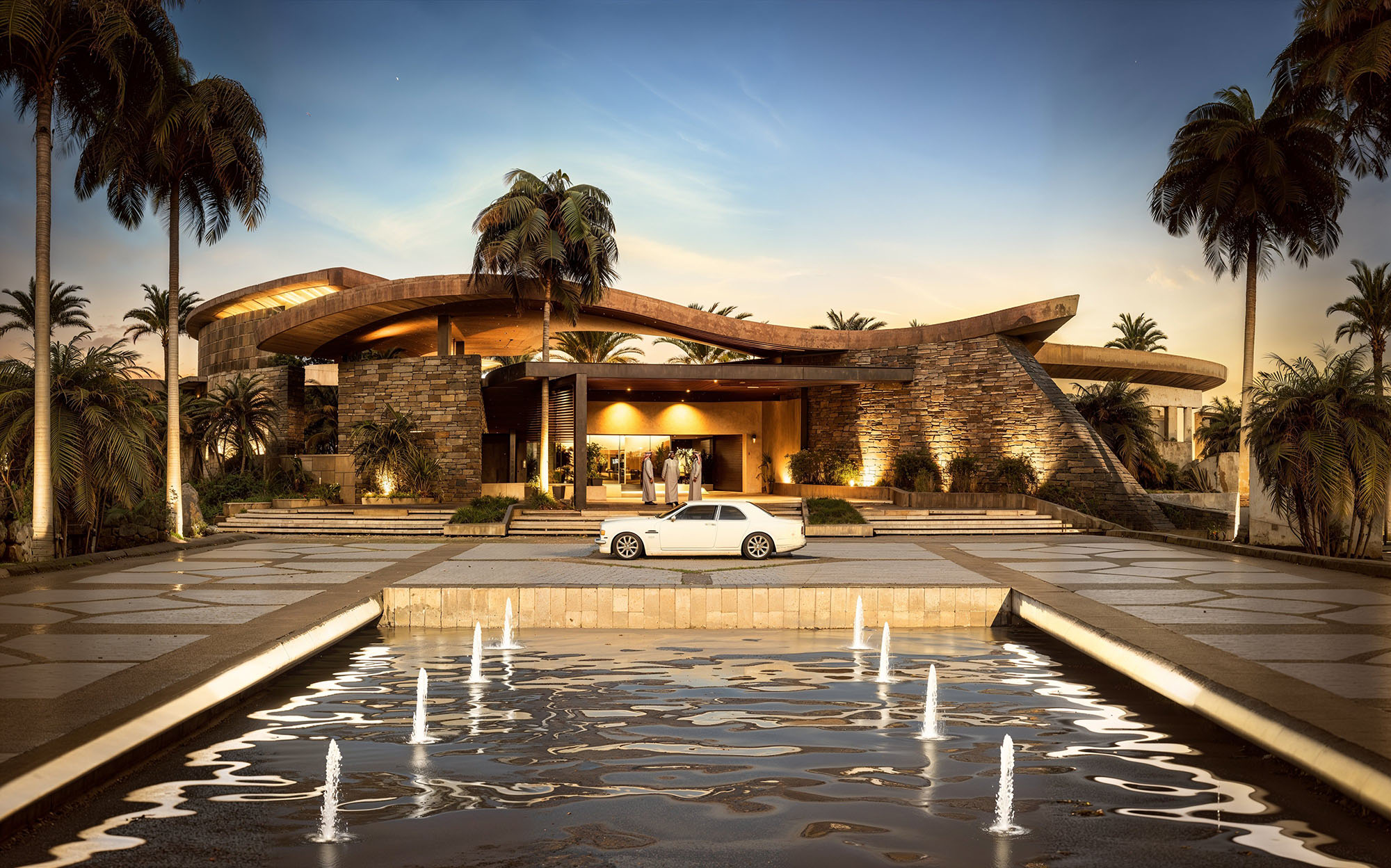
Located within a palm-fringed farm in Qatar, the house is oriented to capture prevailing breezes and to frame long views across the cultivated land. The approach sequence is axial and ceremonial, crossing water and greenery before reaching the main porte-cochère. Slightly elevating the built mass above the surrounding fields protects it from irrigation flows while giving a clear visual hierarchy between landscape and architecture. The palm trees act as vertical markers and as climatic devices, shading outdoor circulation and reinforcing the oasis imagery.
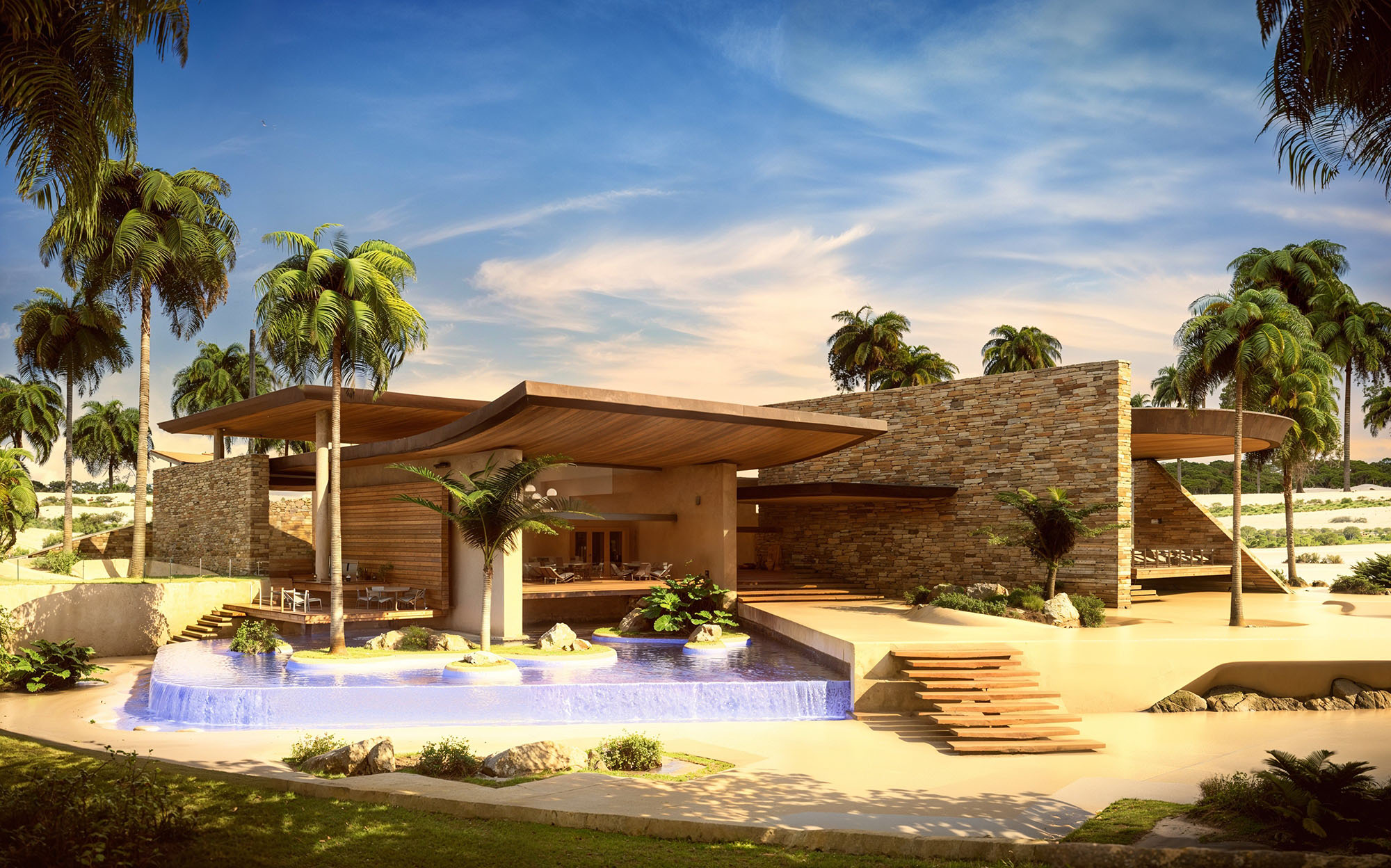
At the front, faceted stone and concrete walls create a dynamic, almost geological entrance composition, suggesting protective layers opening toward the interior. Moving deeper into the house, the geometry relaxes into broad, curving roofs that hover above stacked-stone walls. Warm-toned stone cladding, timber soffits and earth-colored renders are chosen to resonate with local materials while offering durability in the desert climate. The thick envelope, recessed glazing and pronounced overhangs work together to reduce solar gain, while the sculptural form gives the farmhouse a strong, recognizable identity.
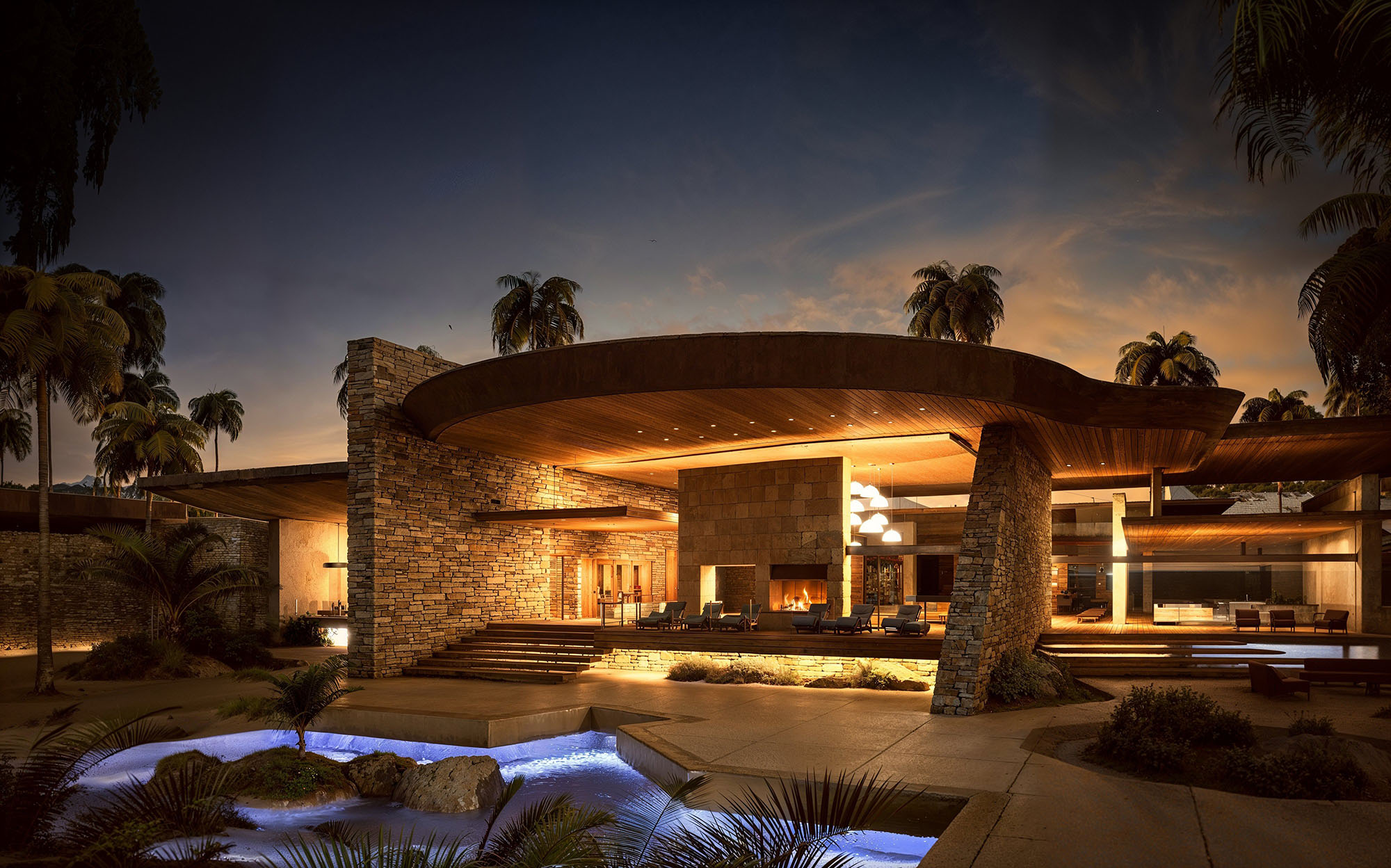
Water is a central design element, choreographing arrival and daily experience. Linear reflecting pools and shallow basins line the driveway, culminating in a larger water body in front of the entrance. Inside the compound, a central courtyard pool with integrated seating becomes the social heart, surrounded by soft landscaping and palms. These water elements cool the microclimate through evaporation, provide acoustic comfort, and visually link the various wings of the farmhouse. Hardscape patterns and stepped platforms manage level transitions while subtly guiding circulation.
The interiors are organized around open, interconnected social spaces that flow toward the courtyard and pool. Large glazed openings slide away to dissolve the boundary between inside and outside, turning terraces into extensions of the living areas. The main entrance lobby compresses the ceiling, then releases into double-height volumes under the sweeping roof, emphasizing the sense of arrival. Service spaces and private suites are discreetly embedded within the thicker stone masses, ensuring privacy and acoustic separation while maintaining direct visual connections to the landscape.
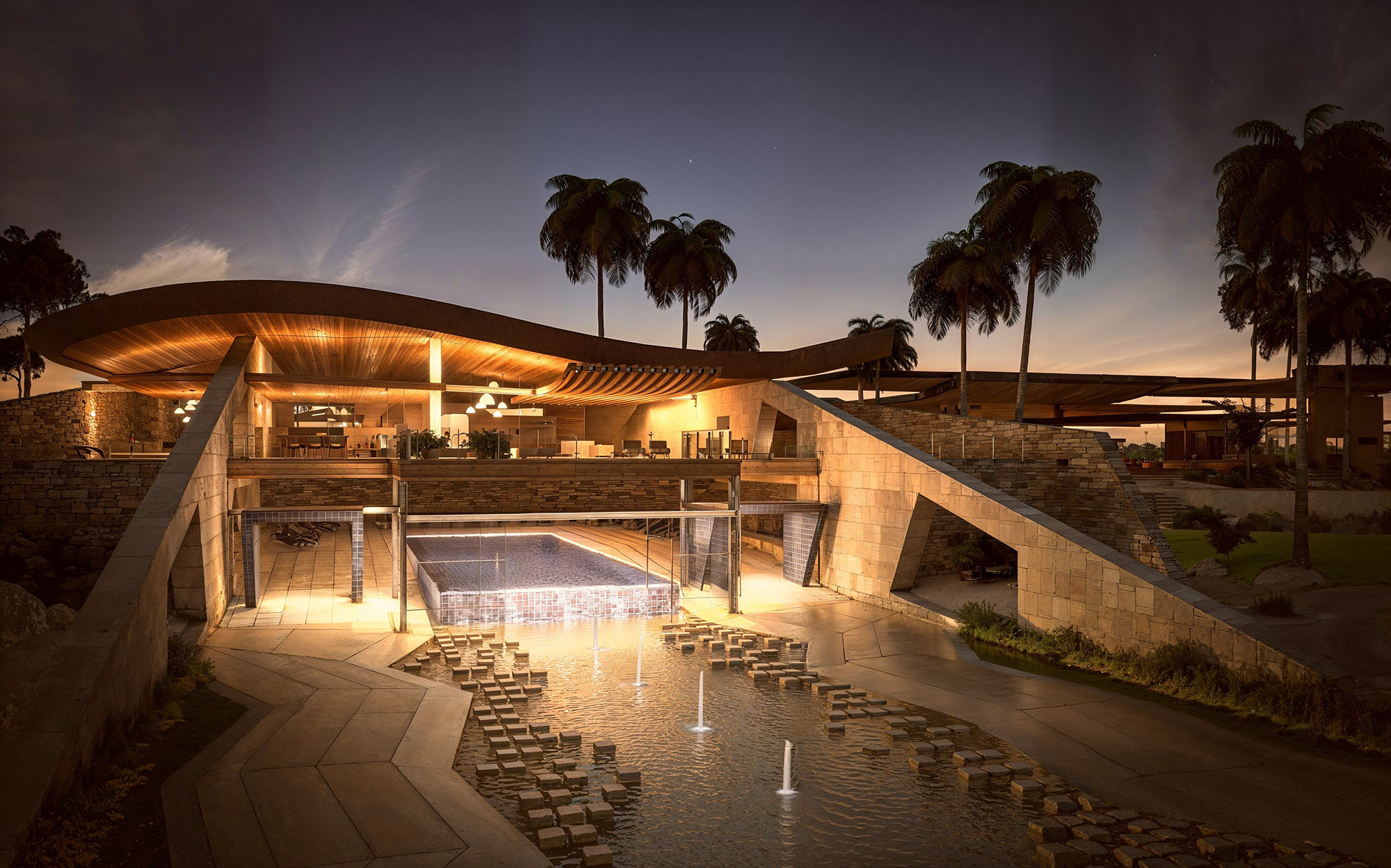
Artificial lighting is carefully integrated into the architecture, emphasizing the material texture and form. Warm, concealed linear lights wash stone walls and timber soffits, while recessed downlights define circulation paths. Exterior uplights highlight the vertical rhythm of palms and the sculptural roofs, giving the farmhouse a strong nocturnal presence without excessive glare. Water features are lit from within, creating reflections that animate adjacent ceilings and terraces, reinforcing the atmosphere of an inhabited oasis.
Sustainability is addressed through passive design and careful material selection rather than overt technological expression. Deep overhangs, shaded verandas and colonnades minimize direct solar exposure on glazing. The stone envelope provides thermal mass, moderating temperature fluctuations, while cross-ventilation paths are aligned with prevailing winds for natural cooling during milder months. Water bodies are strategically located to assist evaporative cooling in key outdoor living zones. Durable, low-maintenance finishes reduce lifecycle impacts, and the integration of landscaping with existing farm structures supports biodiversity and preserves the productive character of the land.
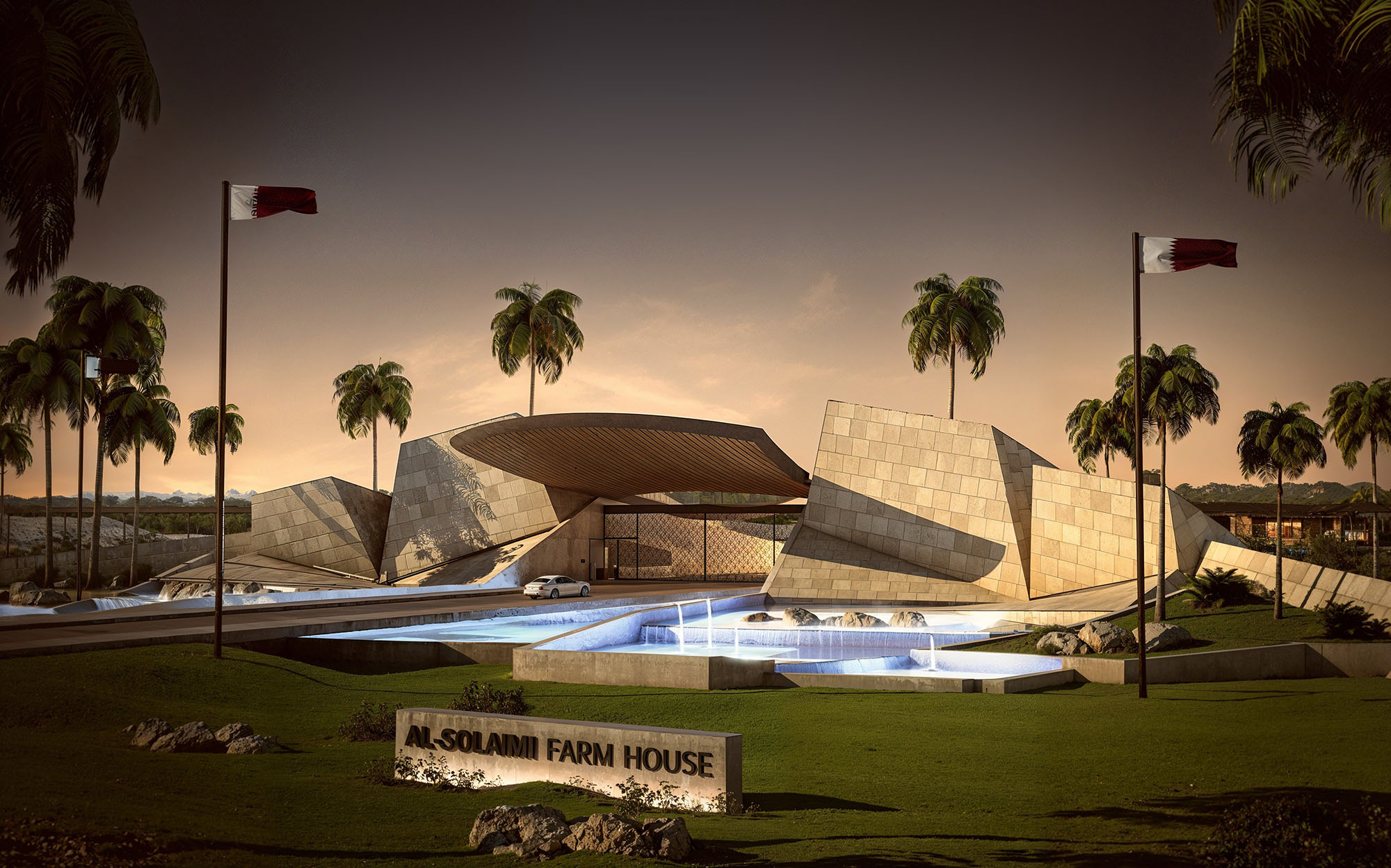
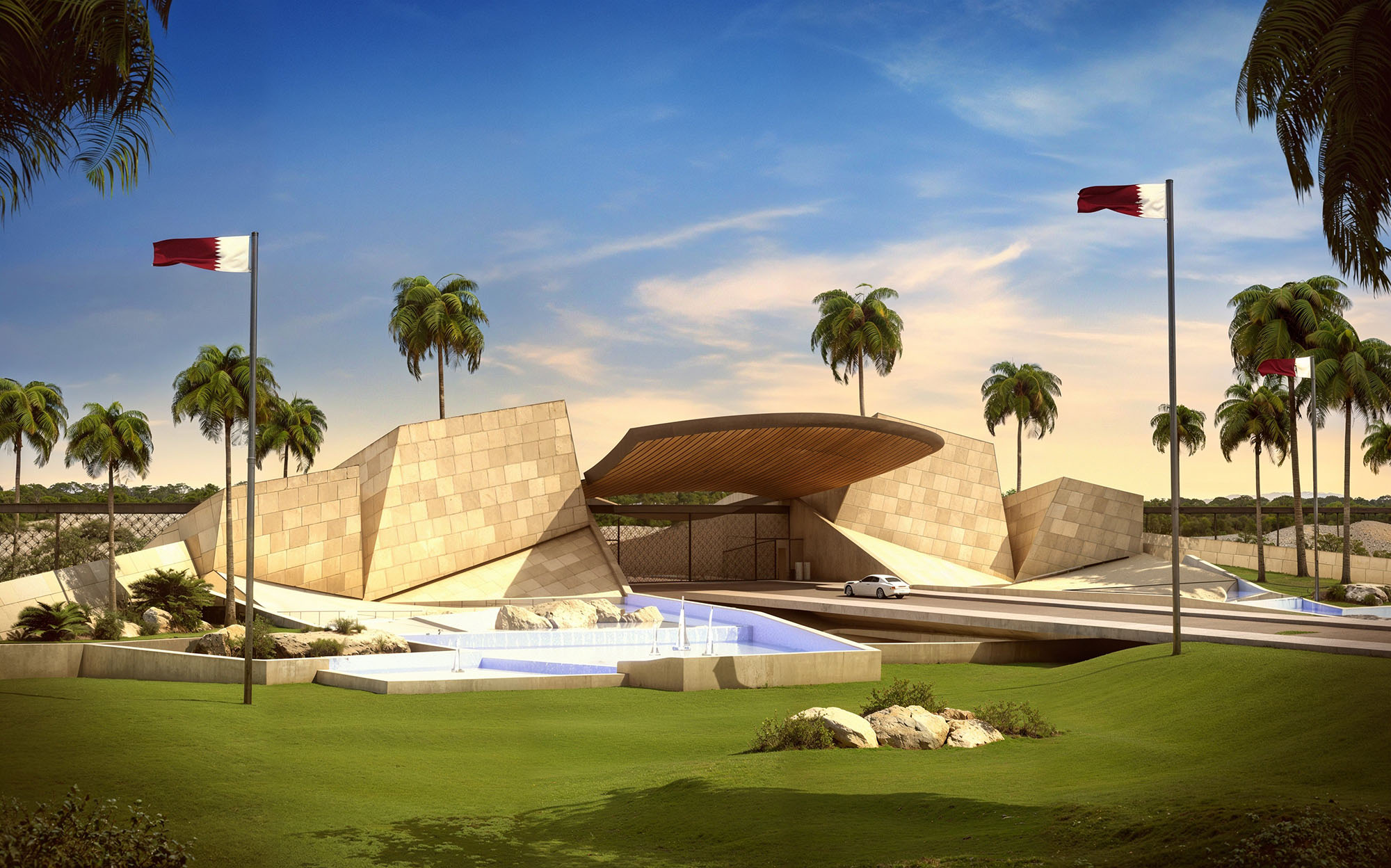
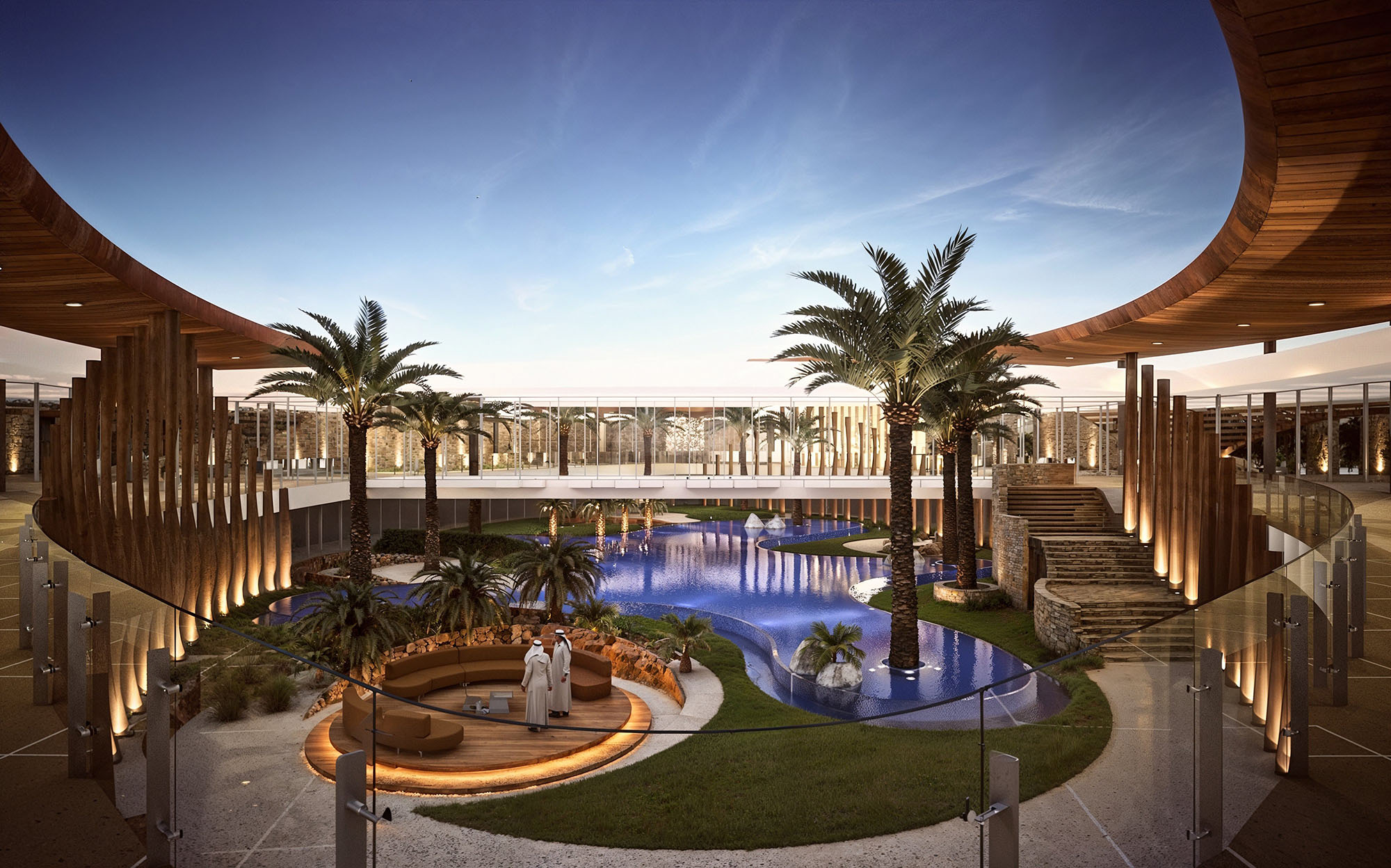
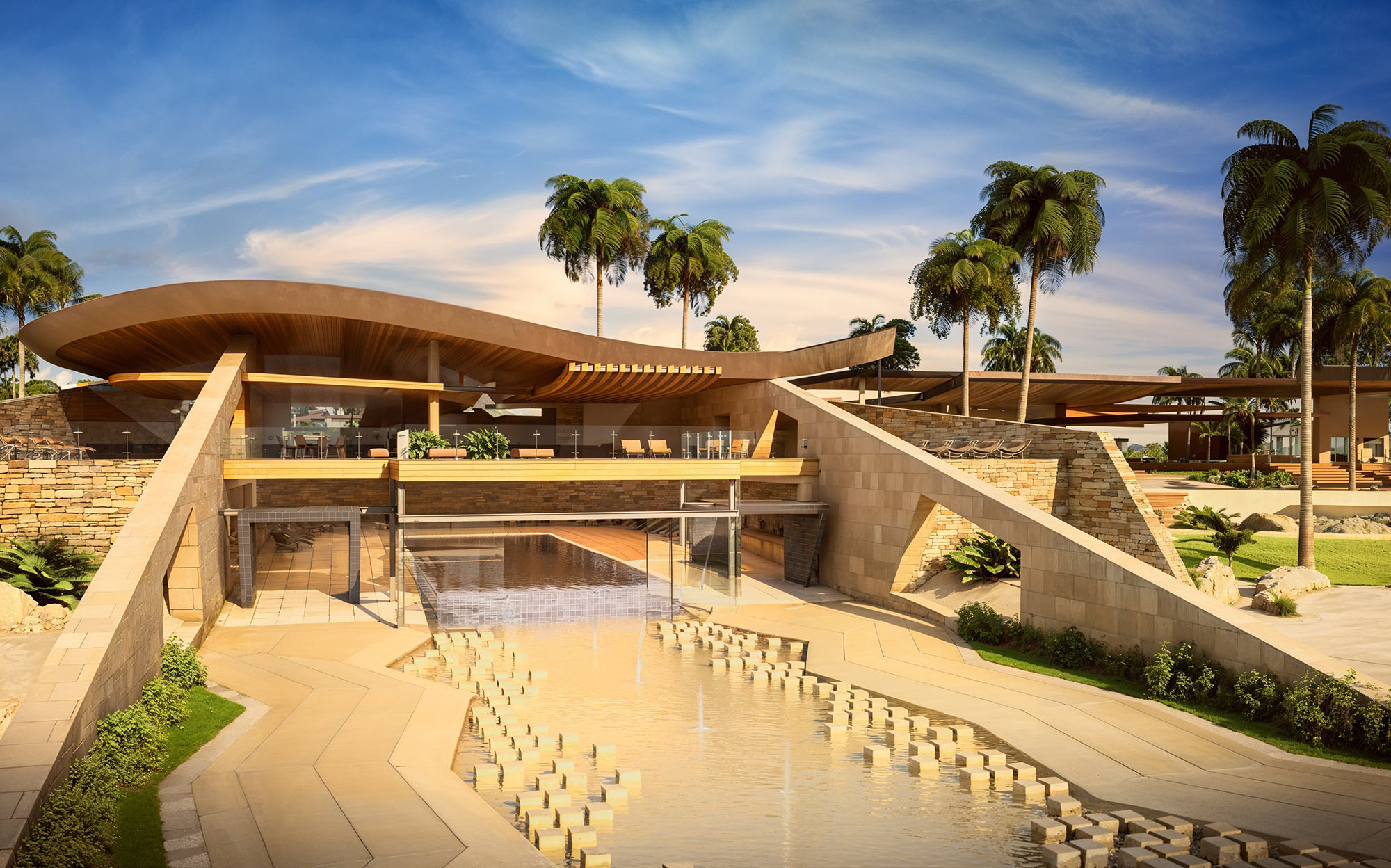
Al-Solaimi Farm House is conceived as a contemporary desert retreat that expresses both solidity and fluidity. The project translates the idea of “oasis” into architecture: protective stone masses sheltering generous, shaded voids animated by water and vegetation. The formal language moves between angular, tectonic planes at the entrance and soft, sweeping roofs around the main residence, reflecting the contrast between the harsh exterior landscape and the calm domestic interior. The farmhouse becomes a sculpted landmark within the agricultural setting, yet remains grounded in its rural function as a family gathering place.
Located within a palm-fringed farm in Qatar, the house is oriented to capture prevailing breezes and to frame long views across the cultivated land. The approach sequence is axial and ceremonial, crossing water and greenery before reaching the main porte-cochère. Slightly elevating the built mass above the surrounding fields protects it from irrigation flows while giving a clear visual hierarchy between landscape and architecture. The palm trees act as vertical markers and as climatic devices, shading outdoor circulation and reinforcing the oasis imagery.
At the front, faceted stone and concrete walls create a dynamic, almost geological entrance composition, suggesting protective layers opening toward the interior. Moving deeper into the house, the geometry relaxes into broad, curving roofs that hover above stacked-stone walls. Warm-toned stone cladding, timber soffits and earth-colored renders are chosen to resonate with local materials while offering durability in the desert climate. The thick envelope, recessed glazing and pronounced overhangs work together to reduce solar gain, while the sculptural form gives the farmhouse a strong, recognizable identity.
Water is a central design element, choreographing arrival and daily experience. Linear reflecting pools and shallow basins line the driveway, culminating in a larger water body in front of the entrance. Inside the compound, a central courtyard pool with integrated seating becomes the social heart, surrounded by soft landscaping and palms. These water elements cool the microclimate through evaporation, provide acoustic comfort, and visually link the various wings of the farmhouse. Hardscape patterns and stepped platforms manage level transitions while subtly guiding circulation.
The interiors are organized around open, interconnected social spaces that flow toward the courtyard and pool. Large glazed openings slide away to dissolve the boundary between inside and outside, turning terraces into extensions of the living areas. The main entrance lobby compresses the ceiling, then releases into double-height volumes under the sweeping roof, emphasizing the sense of arrival. Service spaces and private suites are discreetly embedded within the thicker stone masses, ensuring privacy and acoustic separation while maintaining direct visual connections to the landscape.
Artificial lighting is carefully integrated into the architecture, emphasizing the material texture and form. Warm, concealed linear lights wash stone walls and timber soffits, while recessed downlights define circulation paths. Exterior uplights highlight the vertical rhythm of palms and the sculptural roofs, giving the farmhouse a strong nocturnal presence without excessive glare. Water features are lit from within, creating reflections that animate adjacent ceilings and terraces, reinforcing the atmosphere of an inhabited oasis.
Sustainability is addressed through passive design and careful material selection rather than overt technological expression. Deep overhangs, shaded verandas and colonnades minimize direct solar exposure on glazing. The stone envelope provides thermal mass, moderating temperature fluctuations, while cross-ventilation paths are aligned with prevailing winds for natural cooling during milder months. Water bodies are strategically located to assist evaporative cooling in key outdoor living zones. Durable, low-maintenance finishes reduce lifecycle impacts, and the integration of landscaping with existing farm structures supports biodiversity and preserves the productive character of the land.
© 2021 by sanzpont [arquitectura] . Webpage by sanzpont [digital] . Innovative Digital Experiences
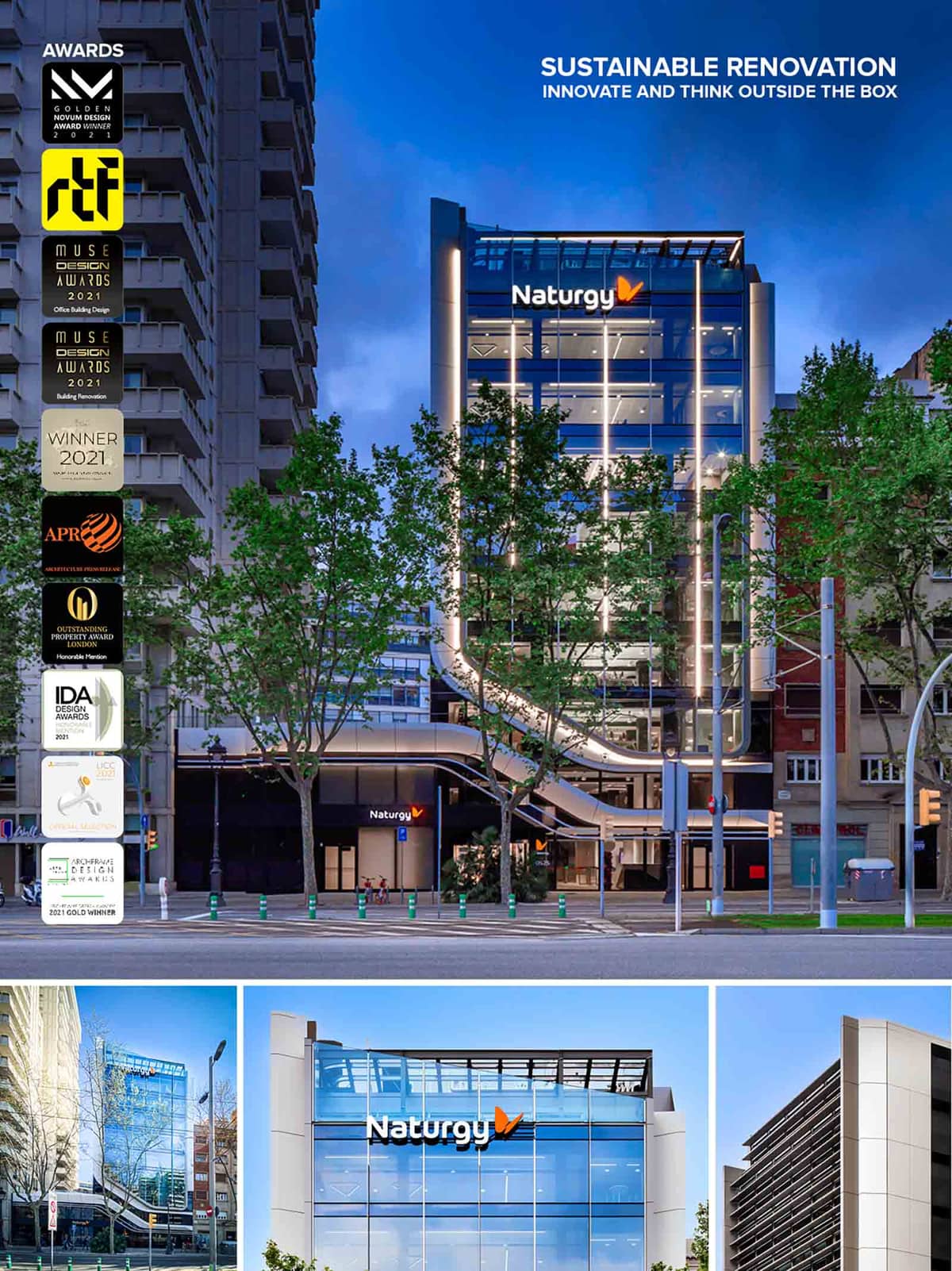

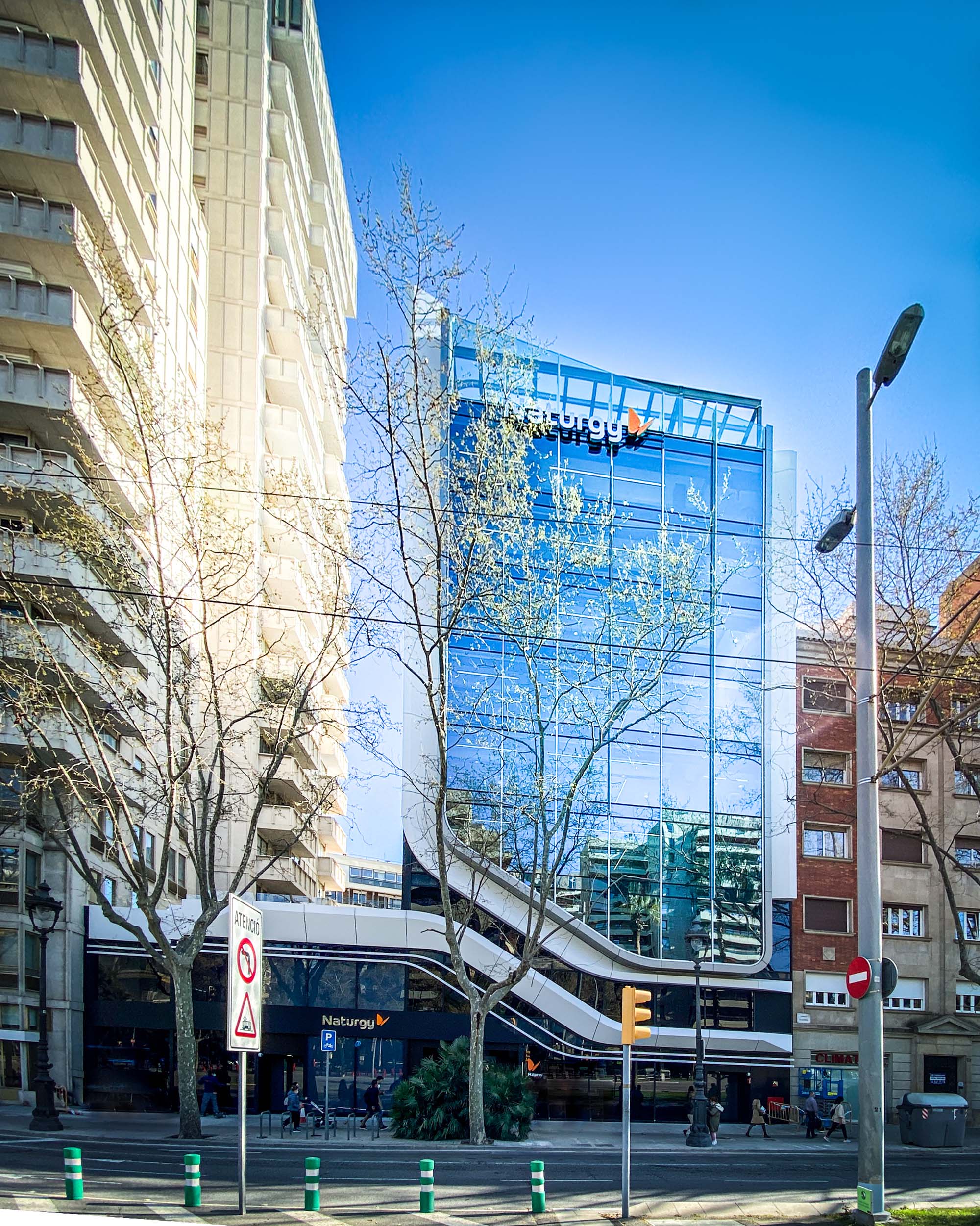
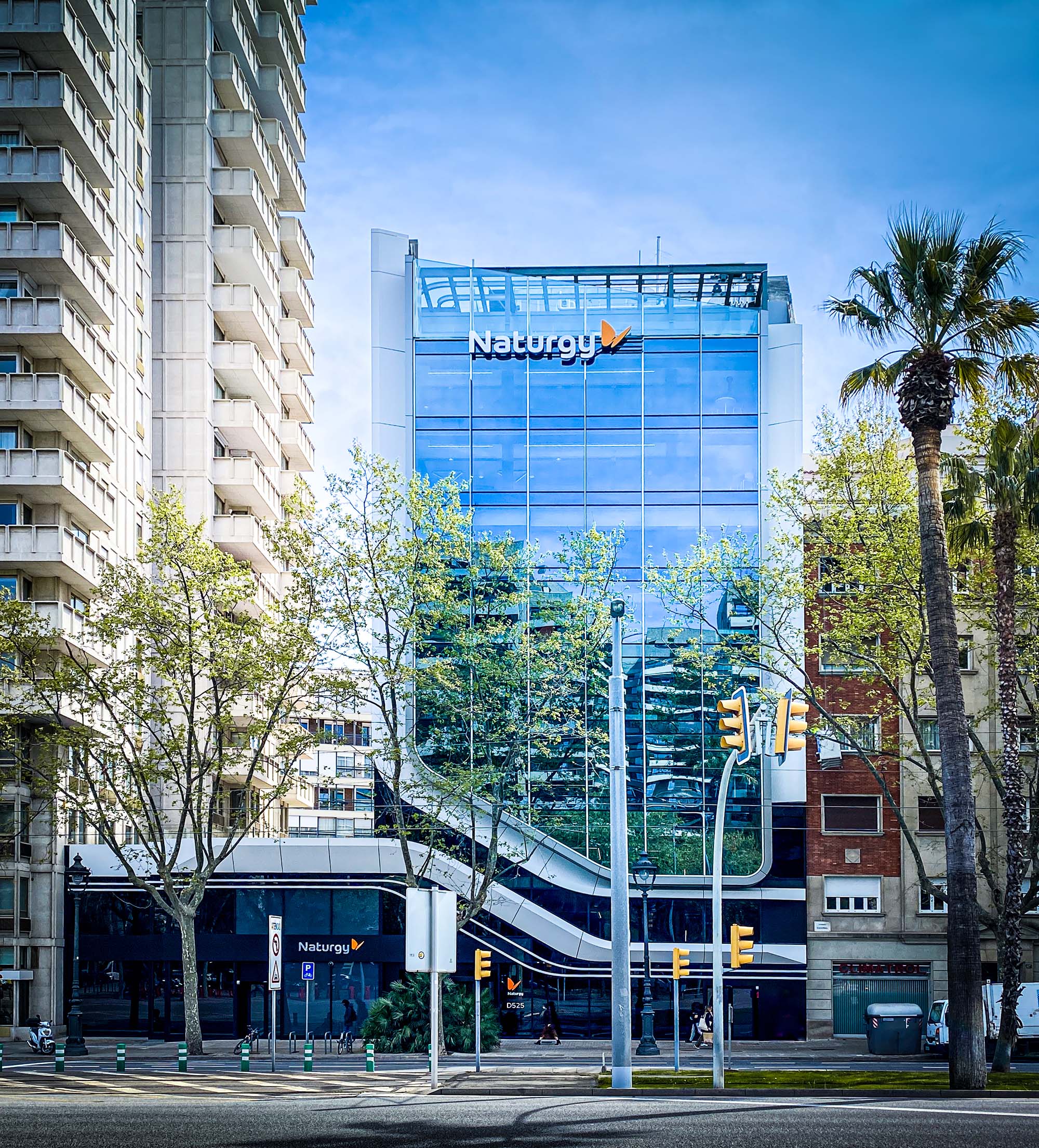
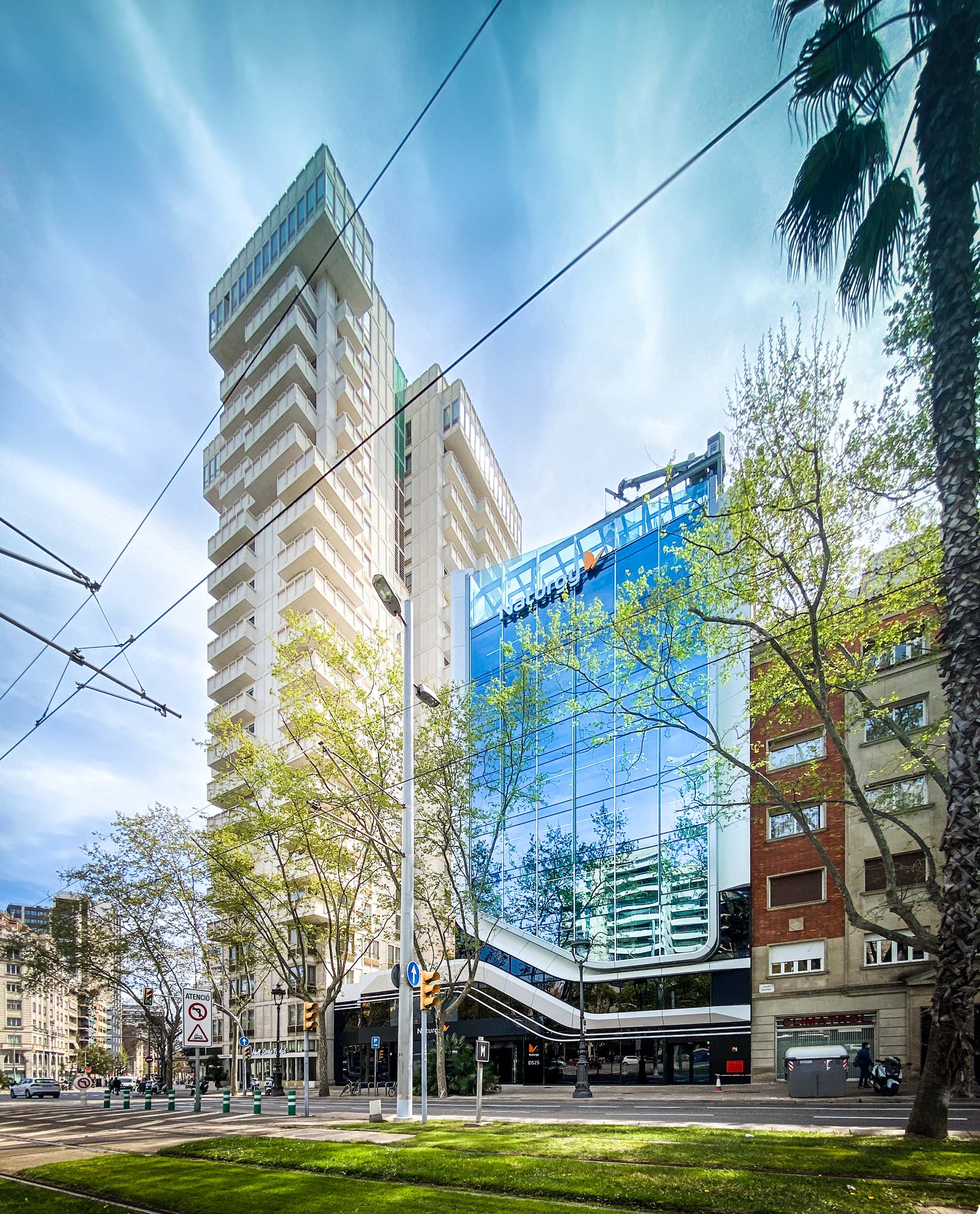
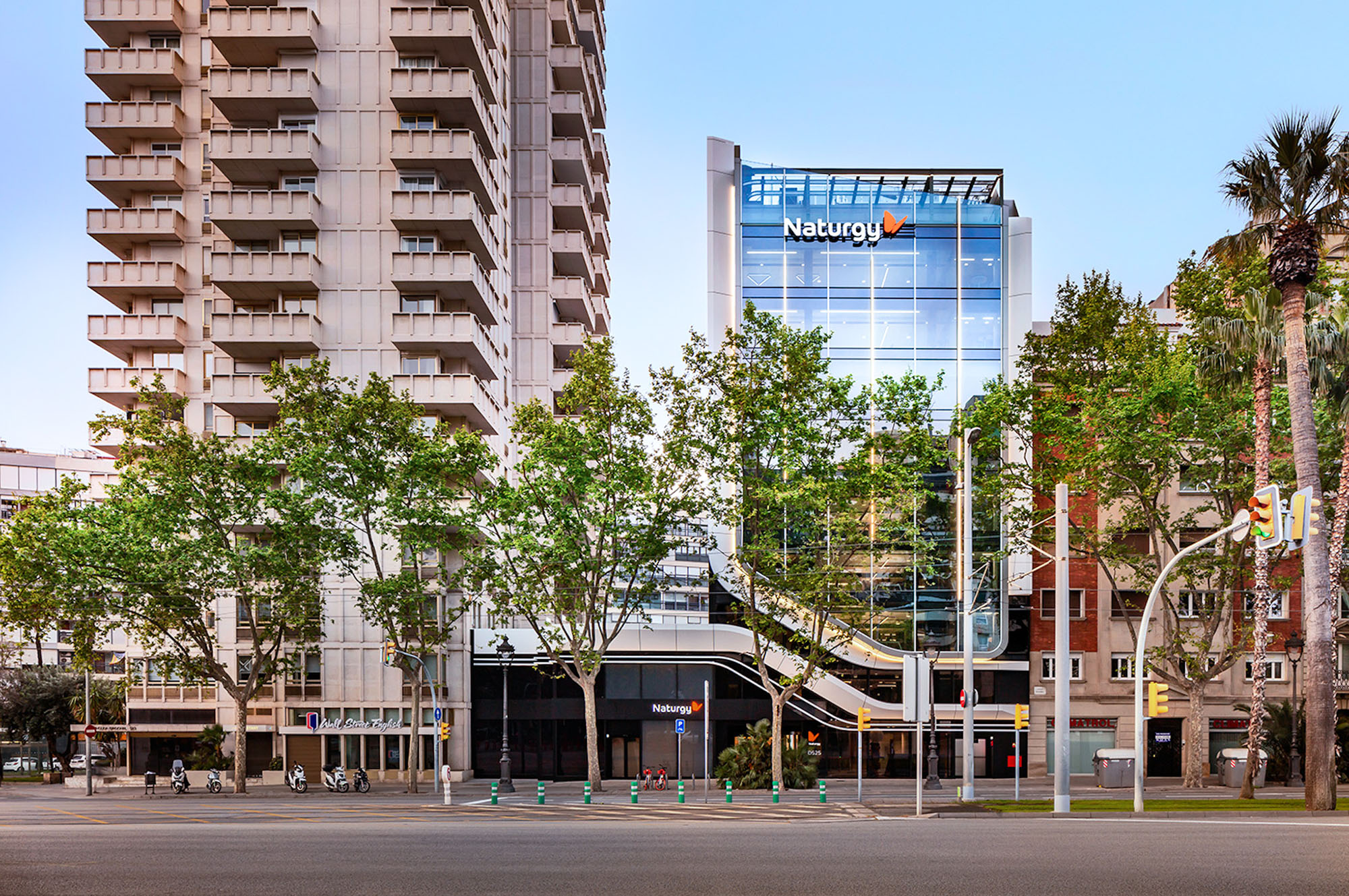
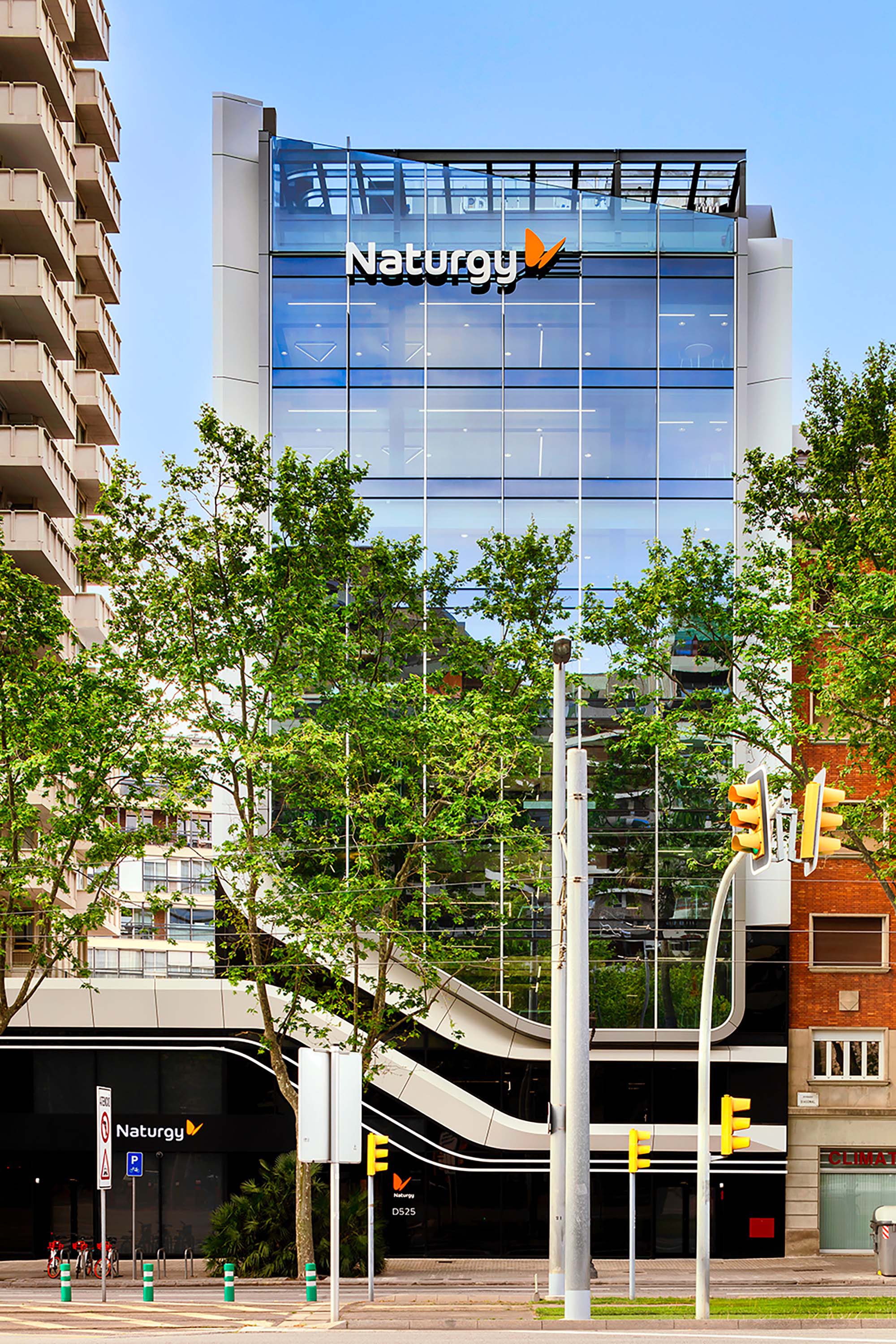
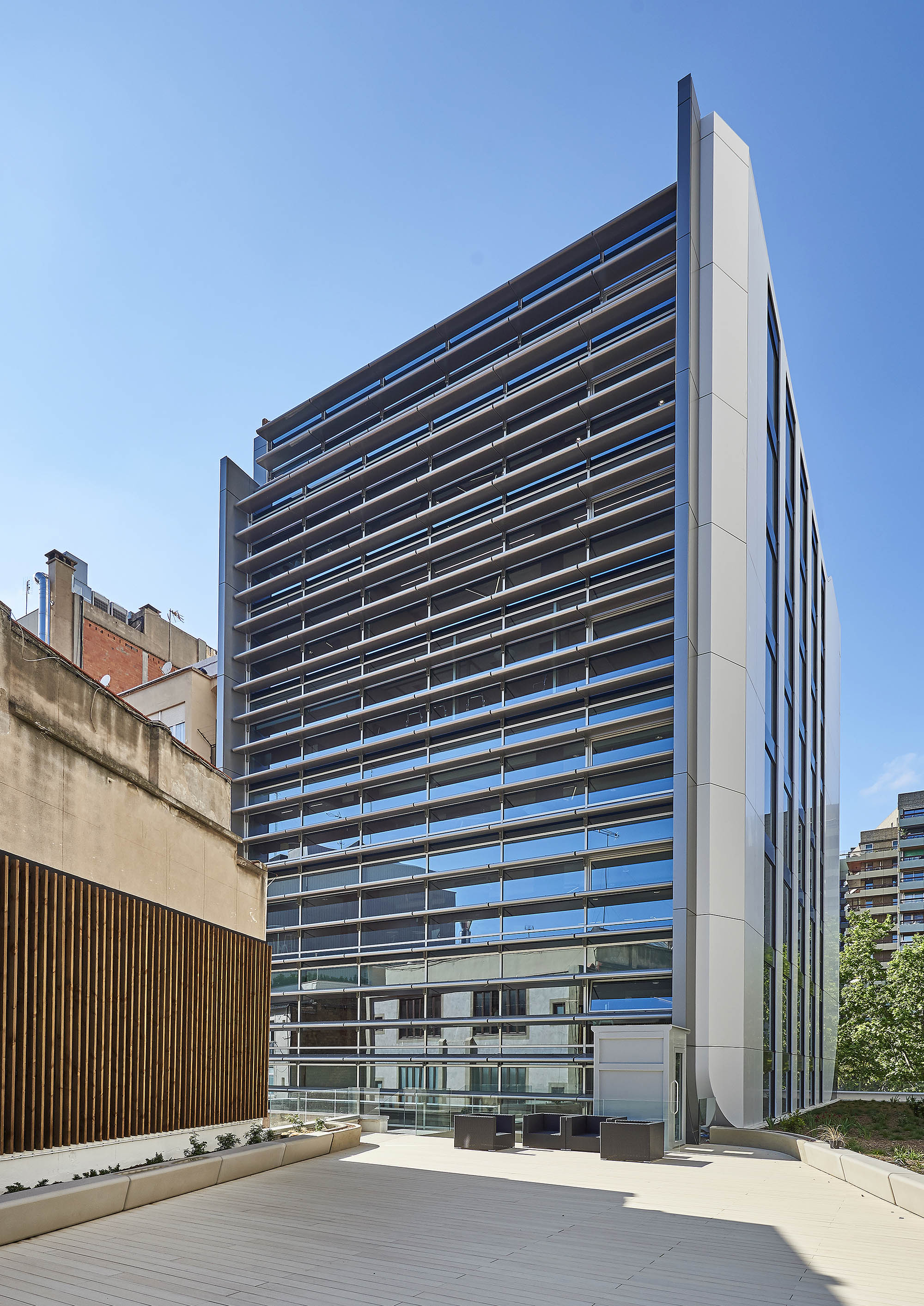
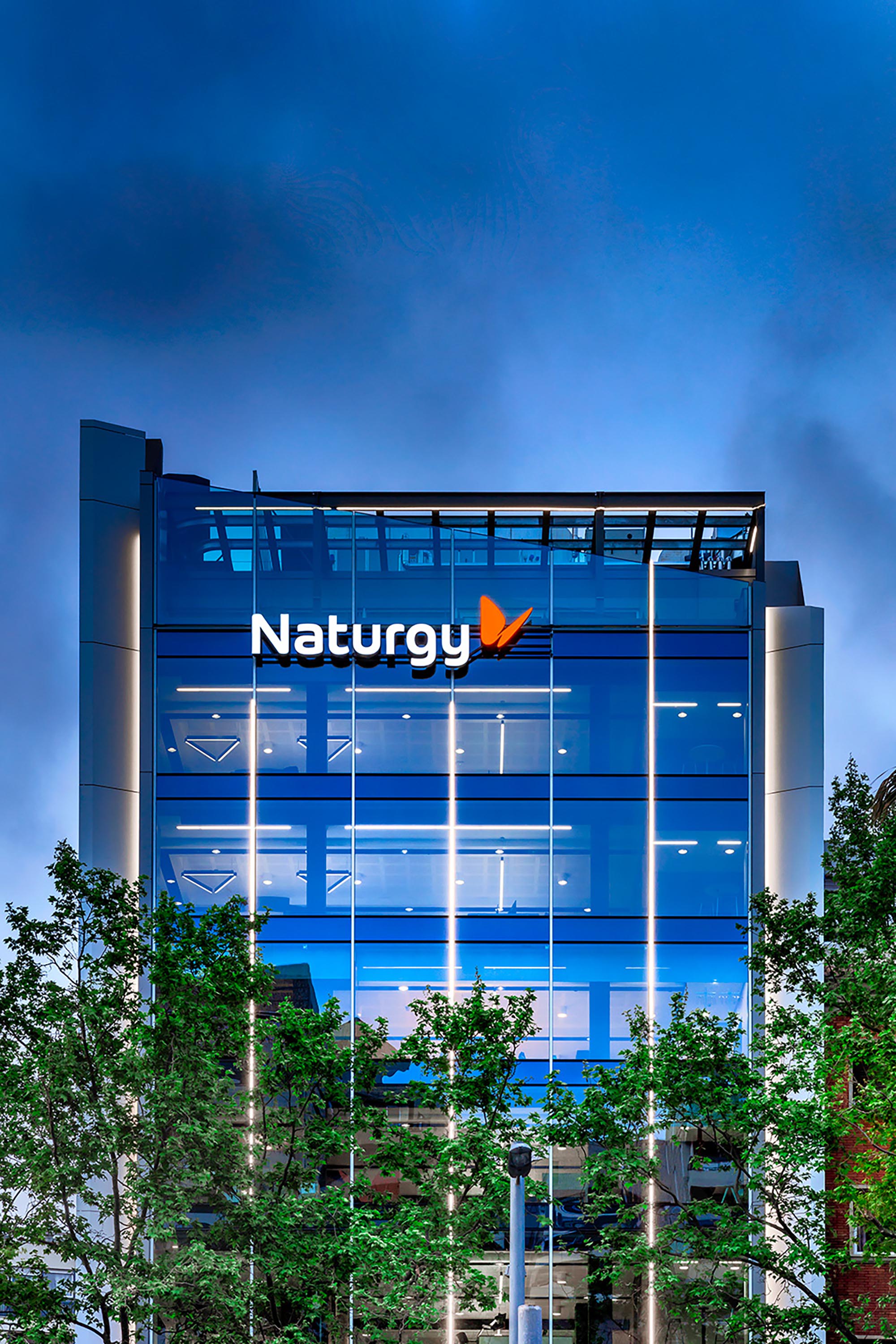
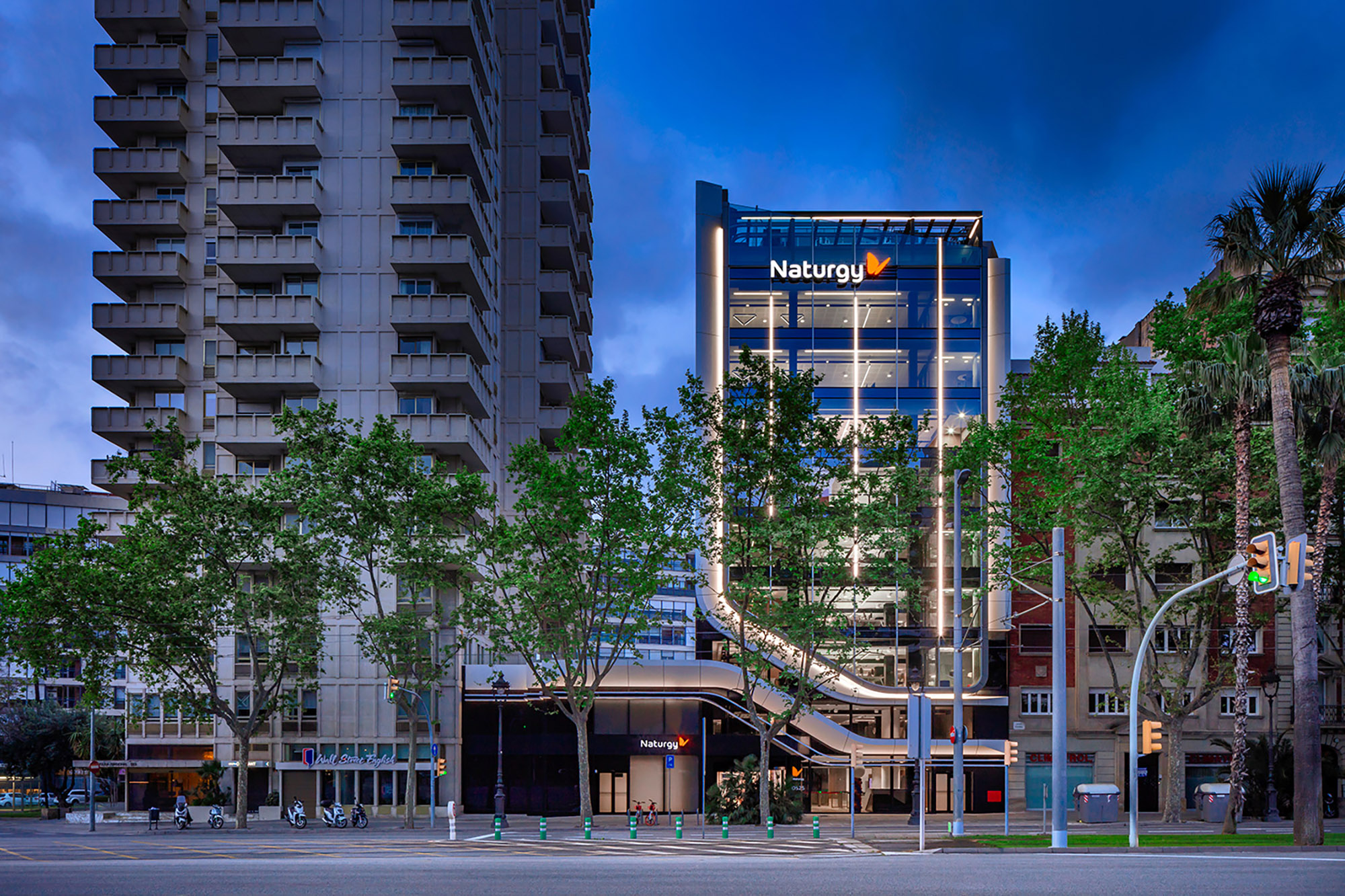
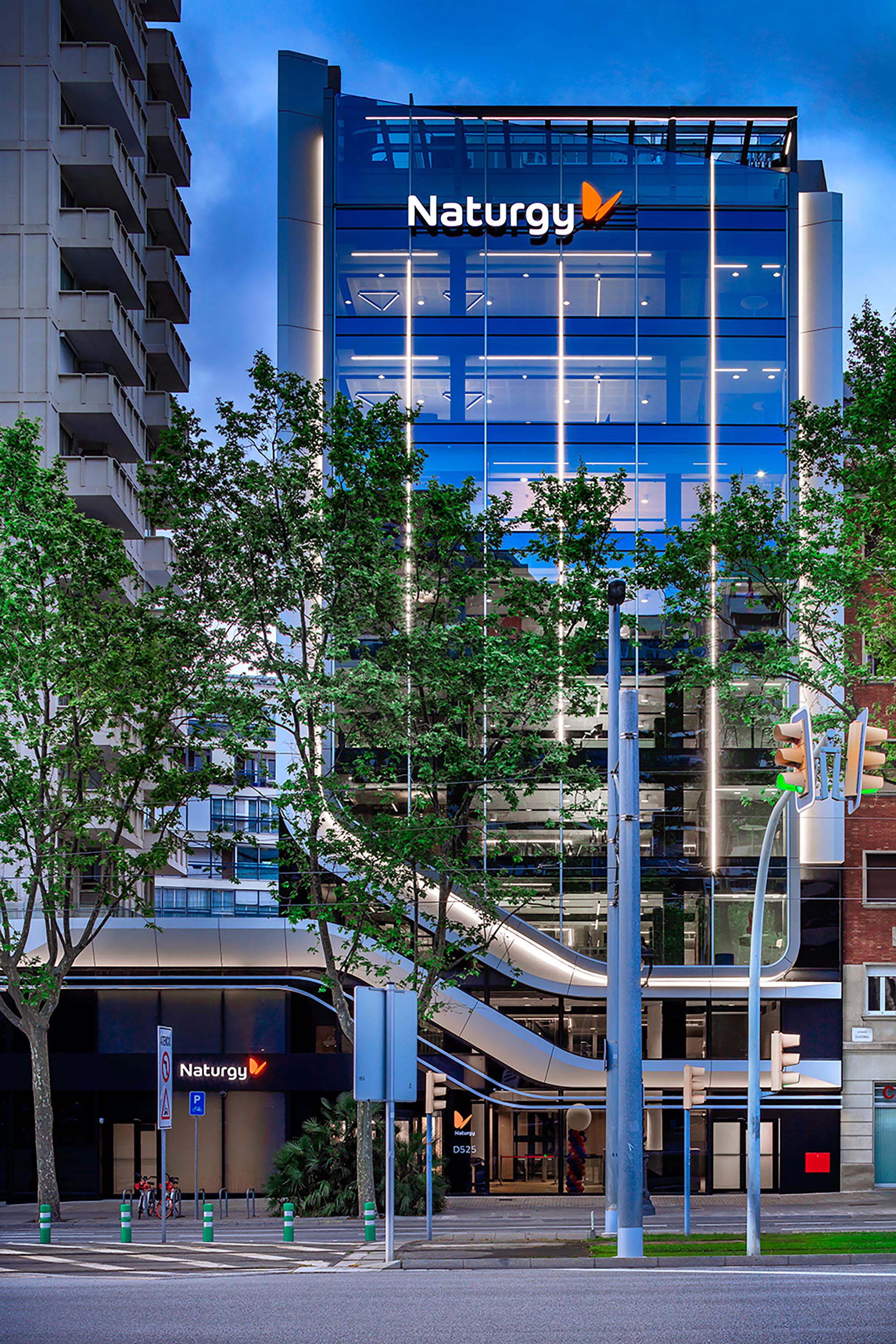
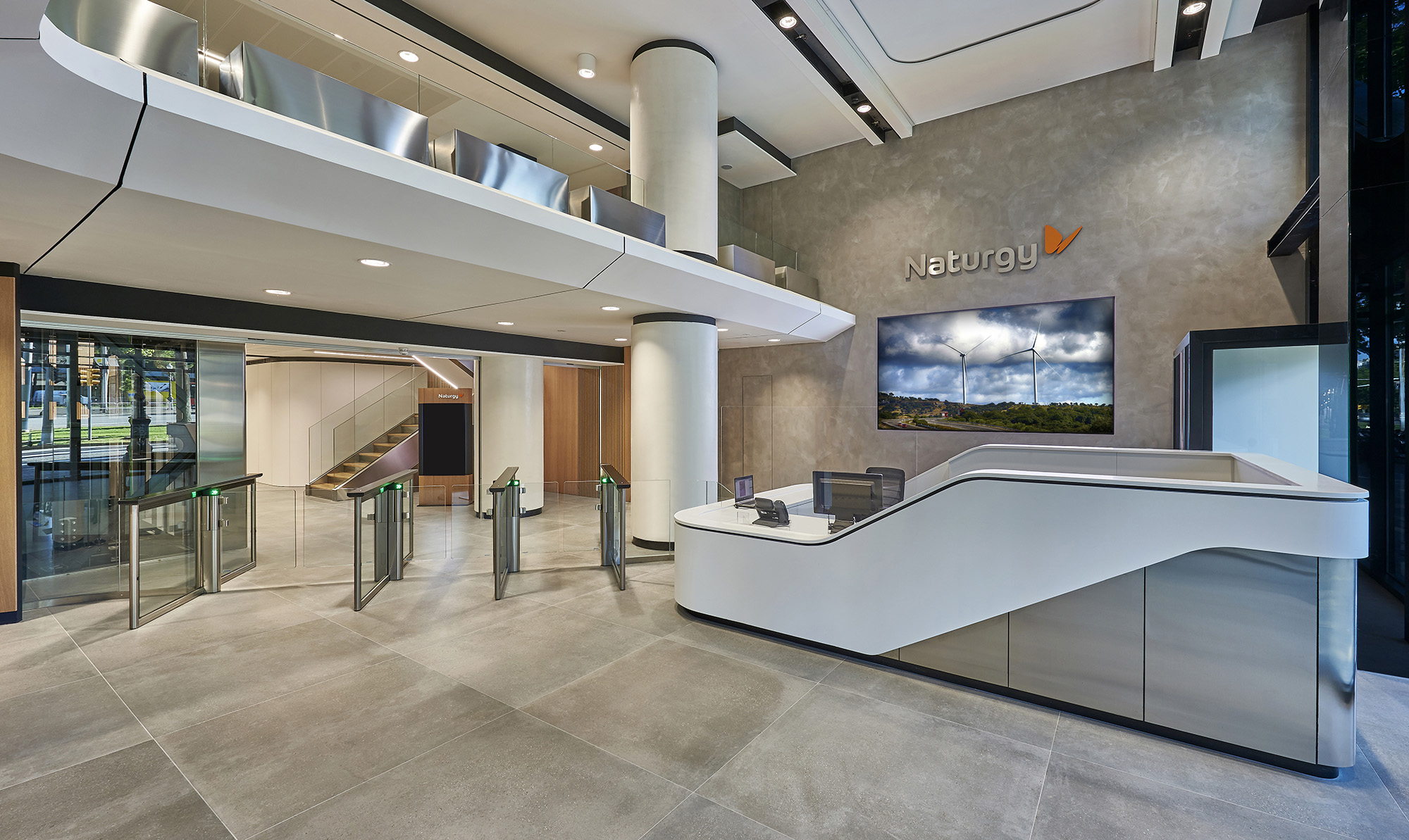
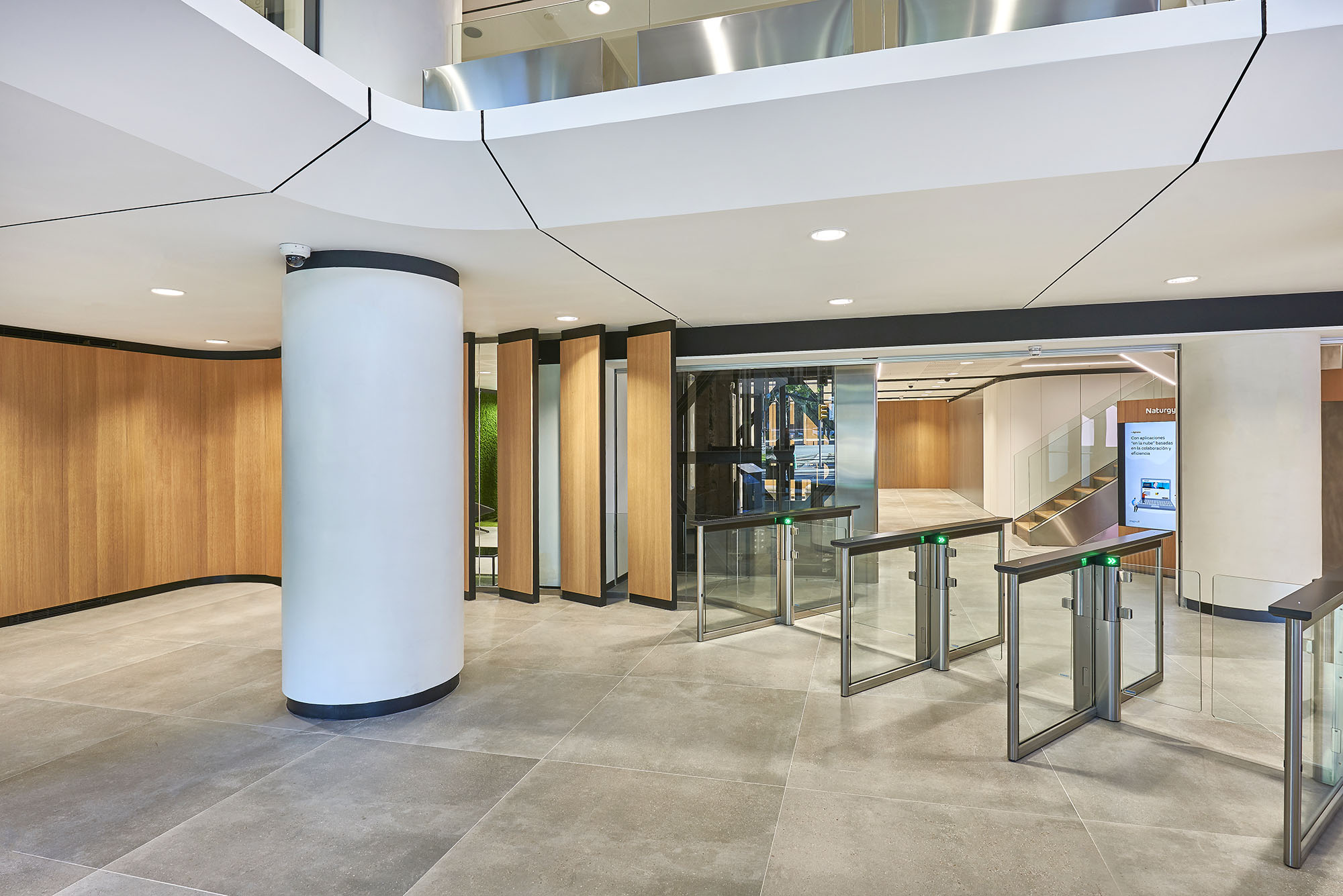
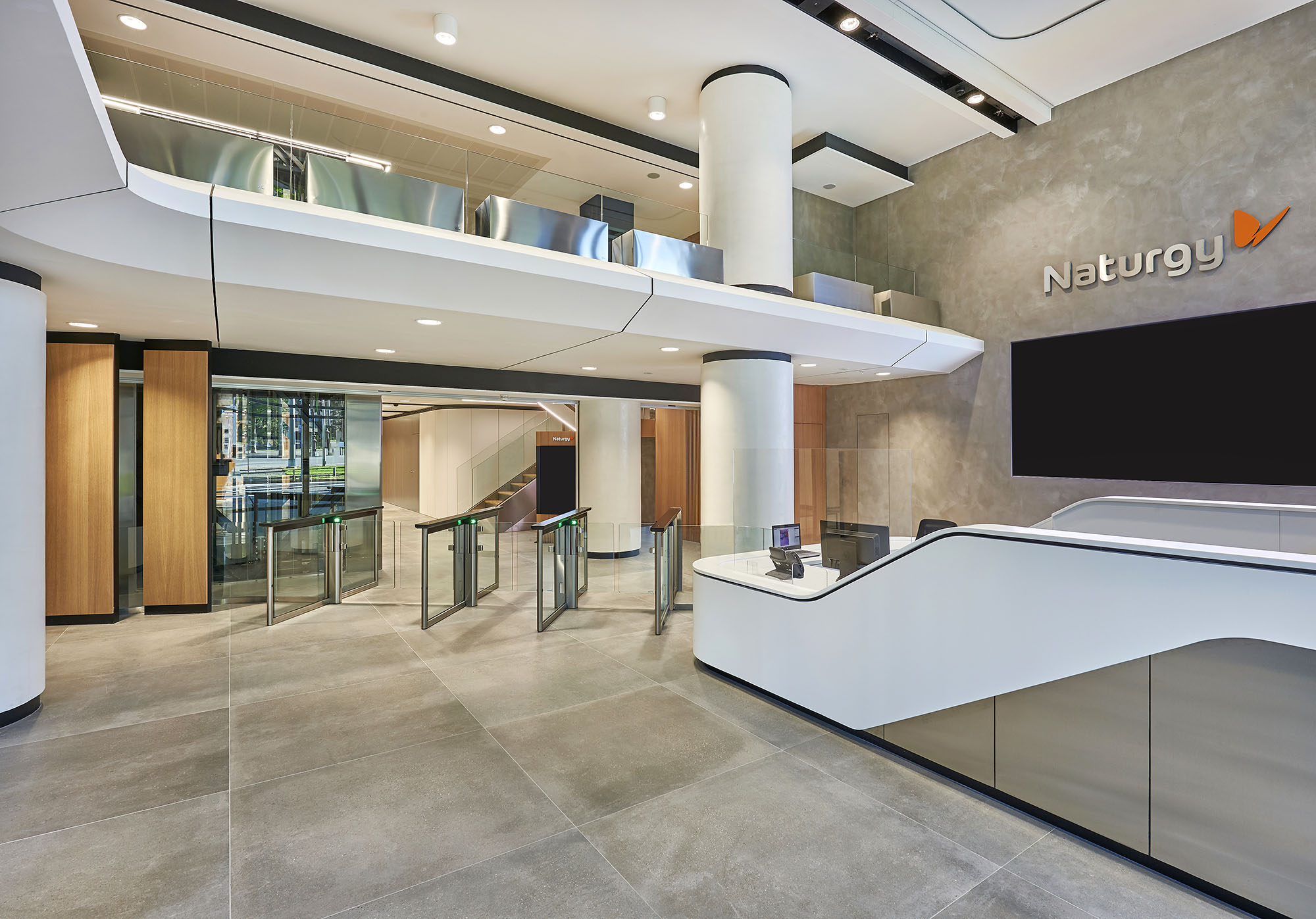
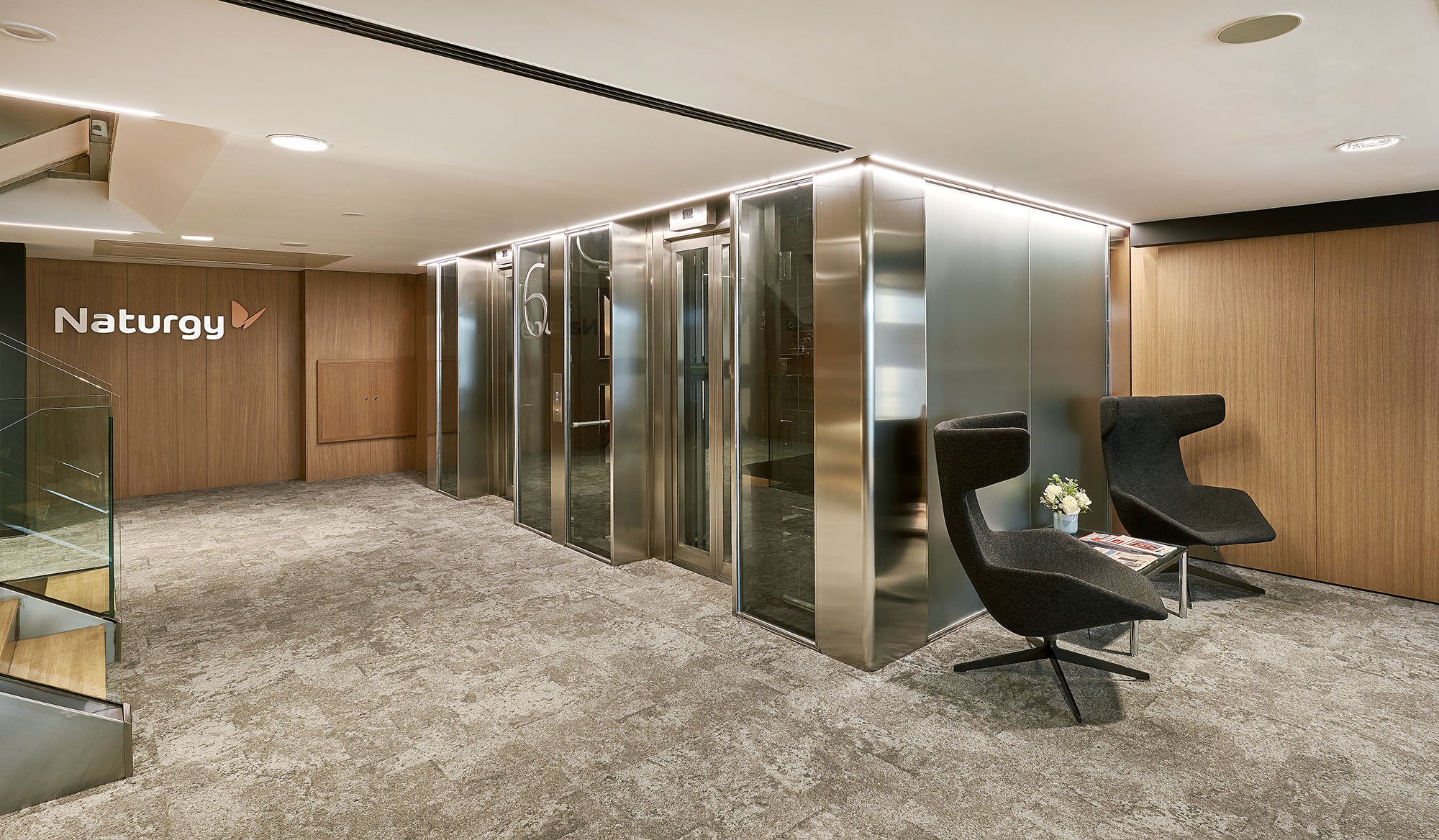
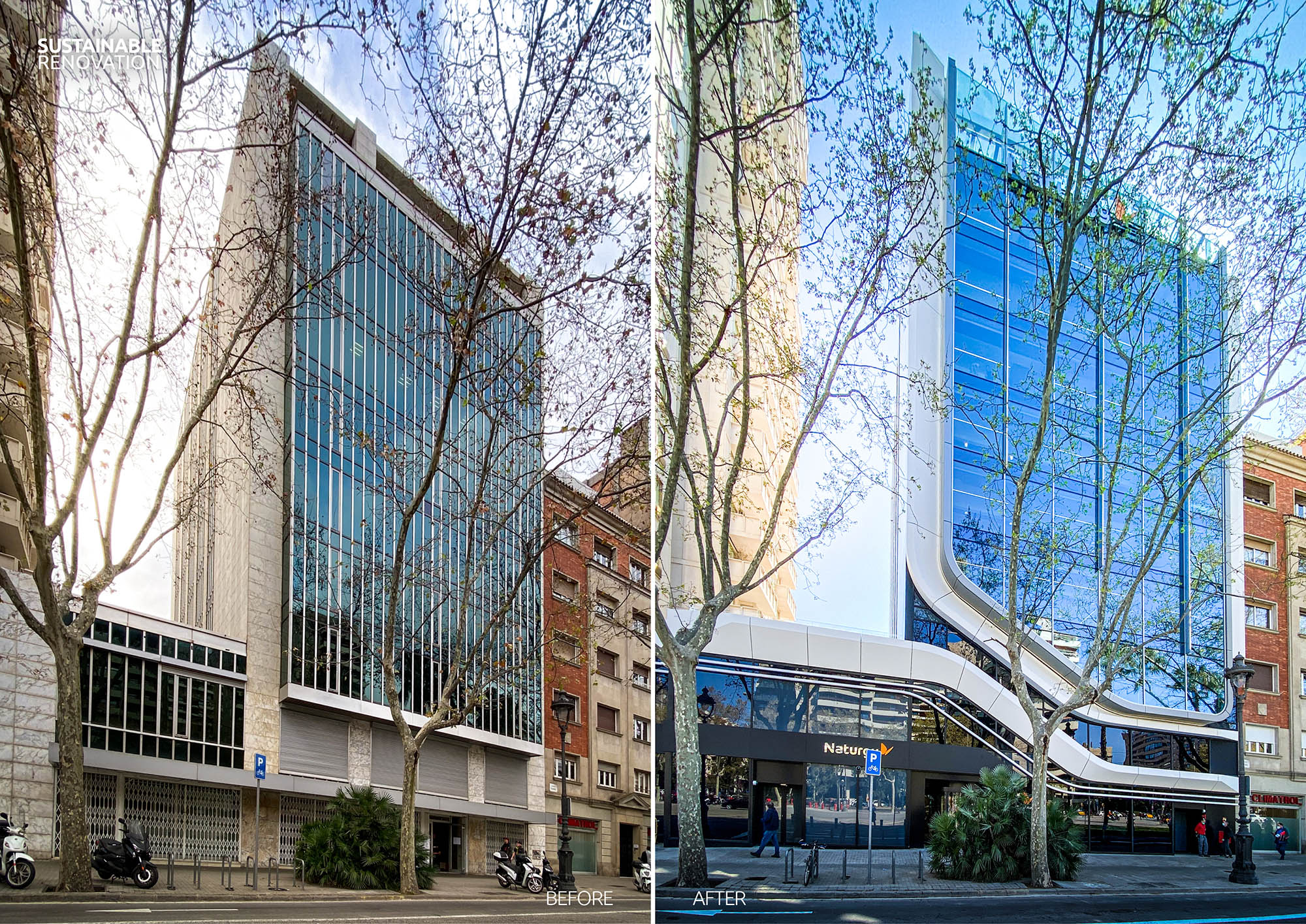
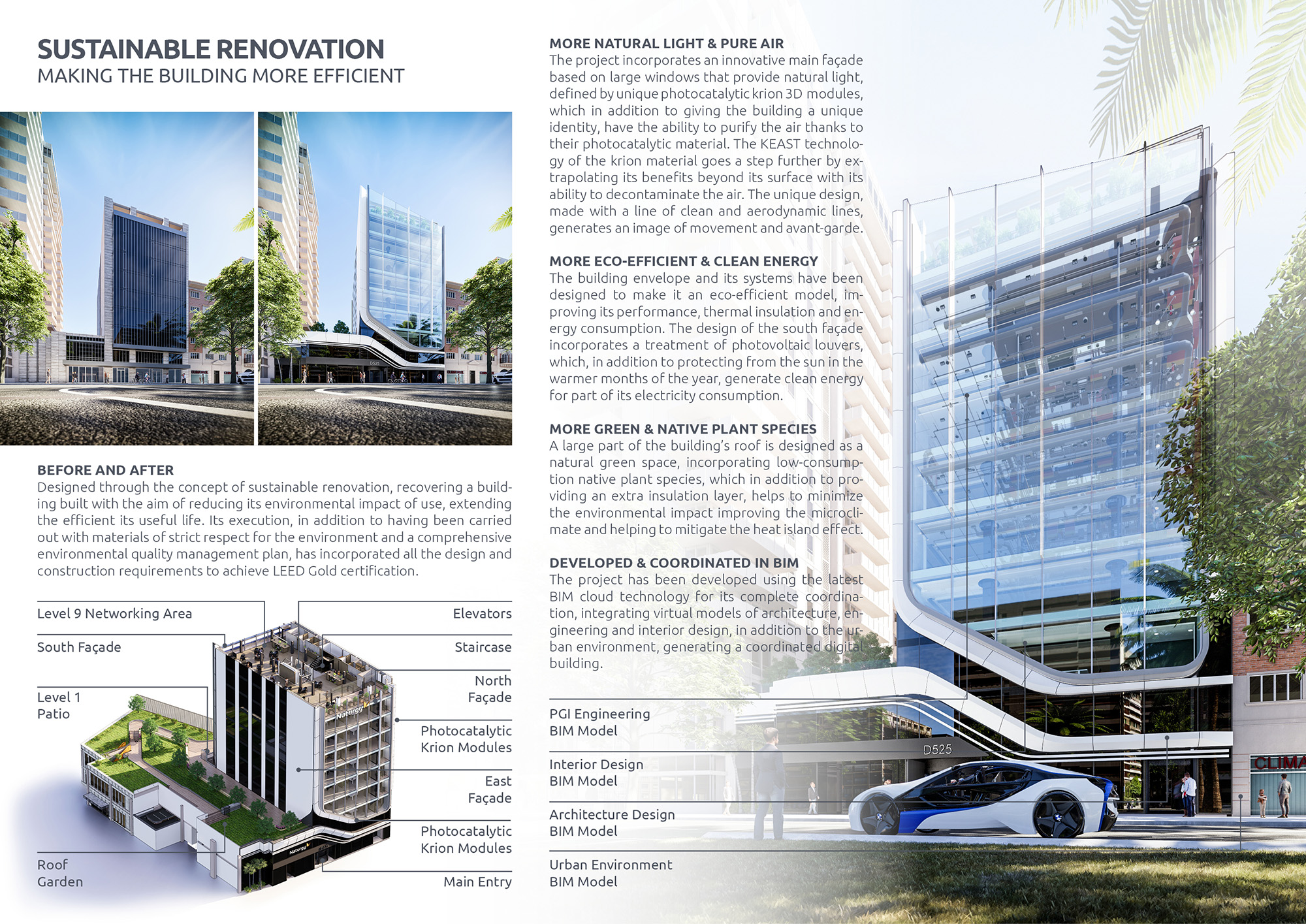
The building of the new headquarters of Naturgy group in Barcelona, a building property of Inmobiliaria Colonial, is located at Av. Diagonal 525. The project has been designed by Sanzpont Arquitectura through the concept of sustainable renovation, recovering a building built with the aim of reducing its environmental impact of use, extending the efficient its useful life. Its execution, in addition to having been carried out with materials of strict respect for the environment and a comprehensive environmental quality management plan, has incorporated all the design and construction requirements to achieve LEED Gold certification.
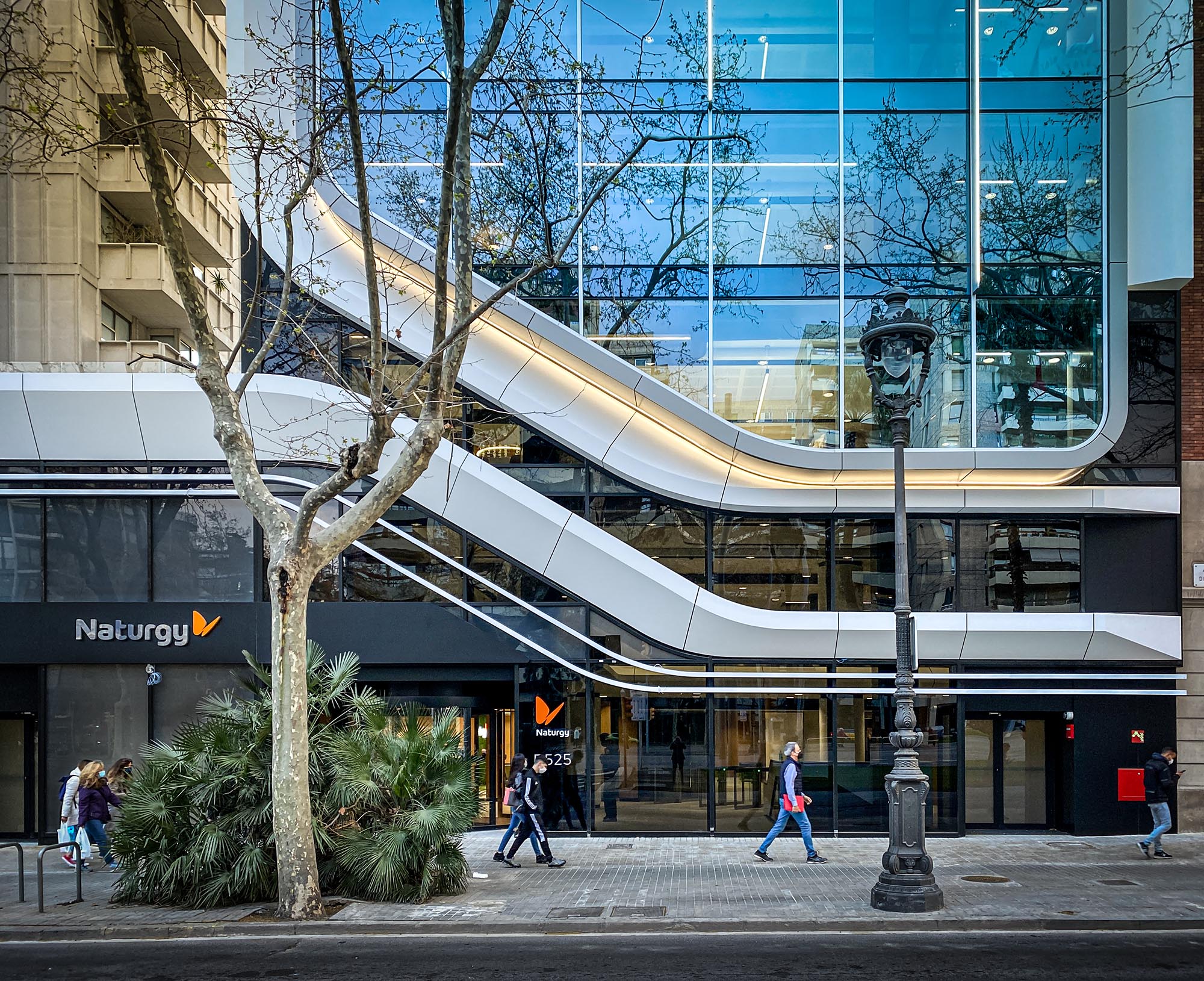
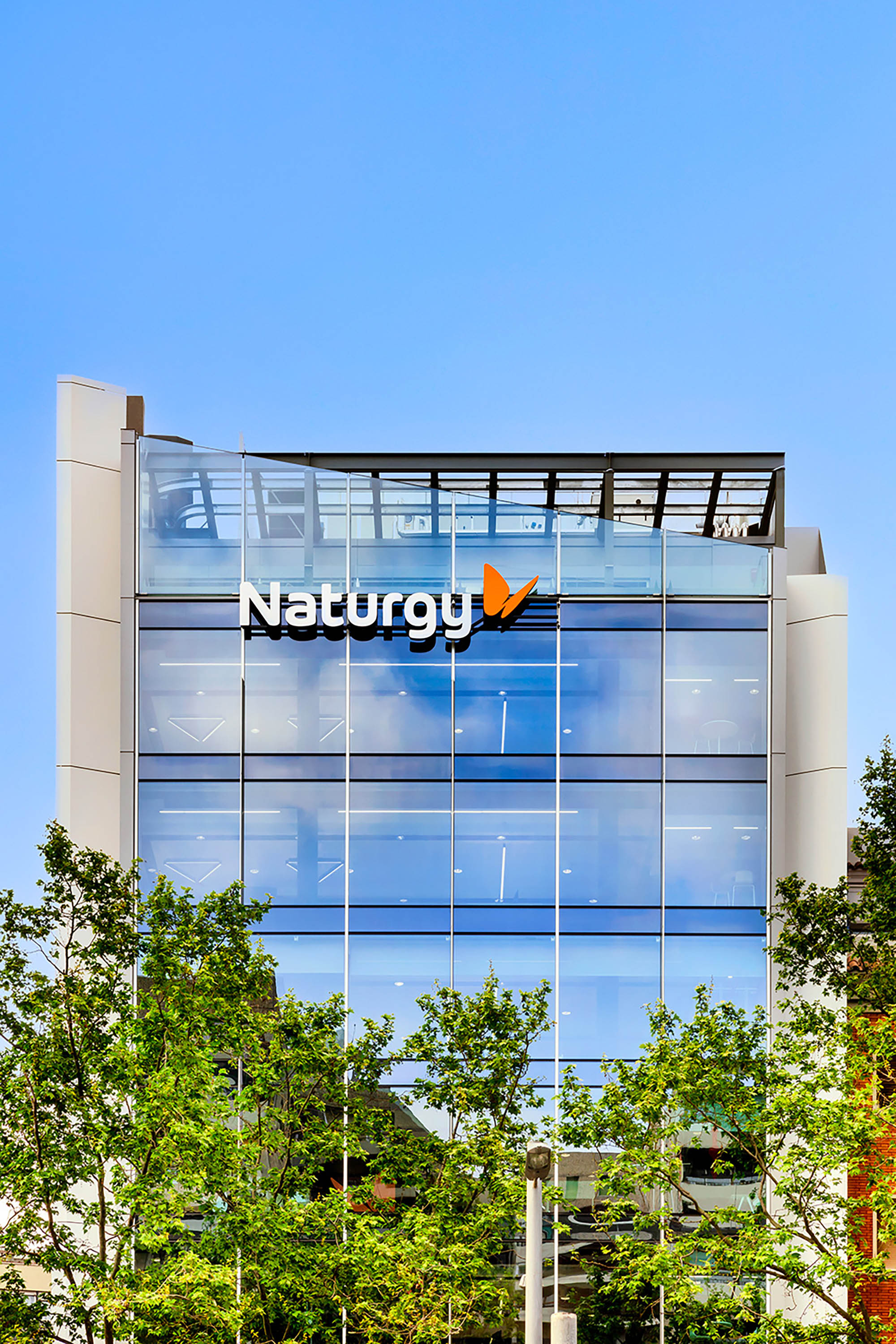
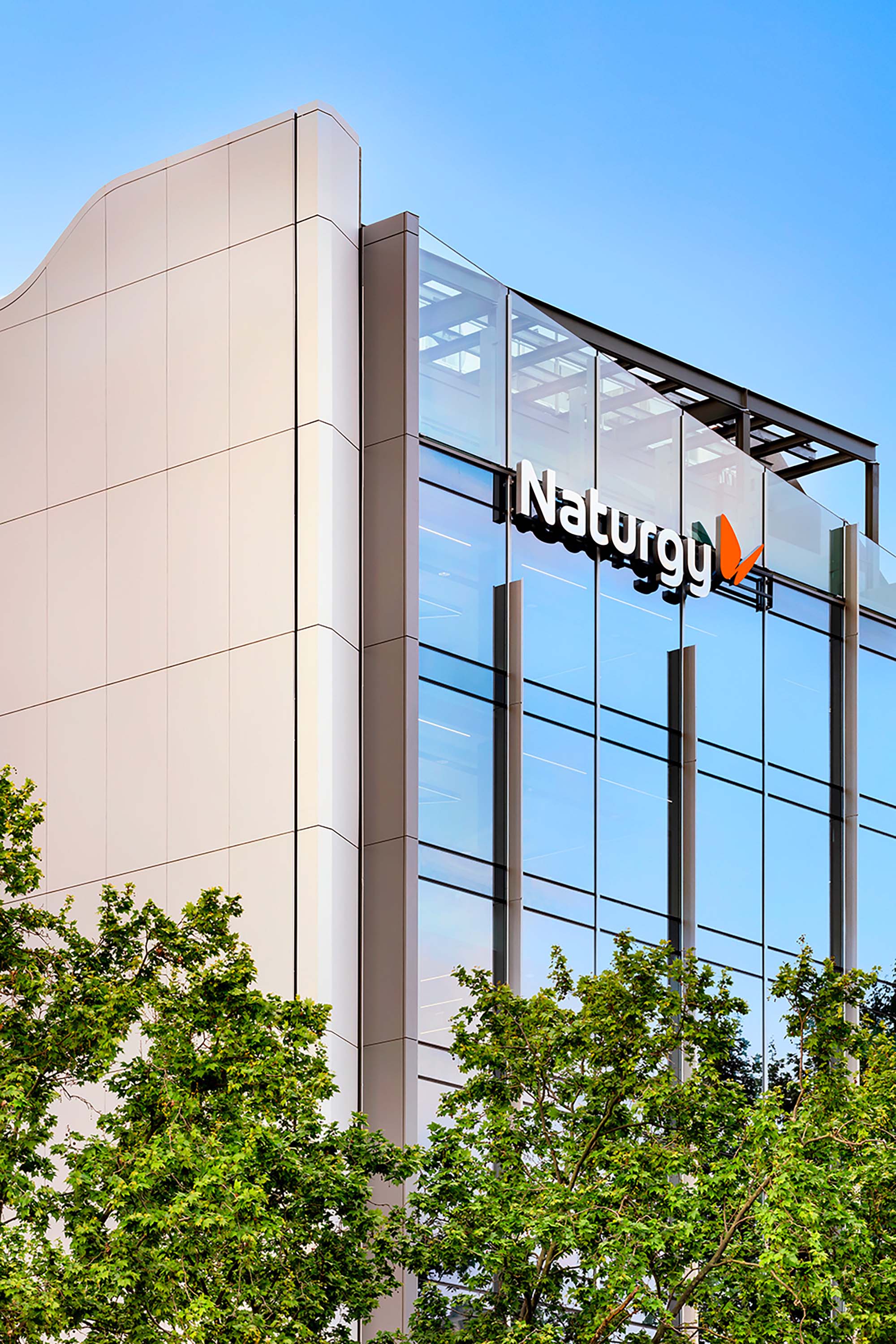
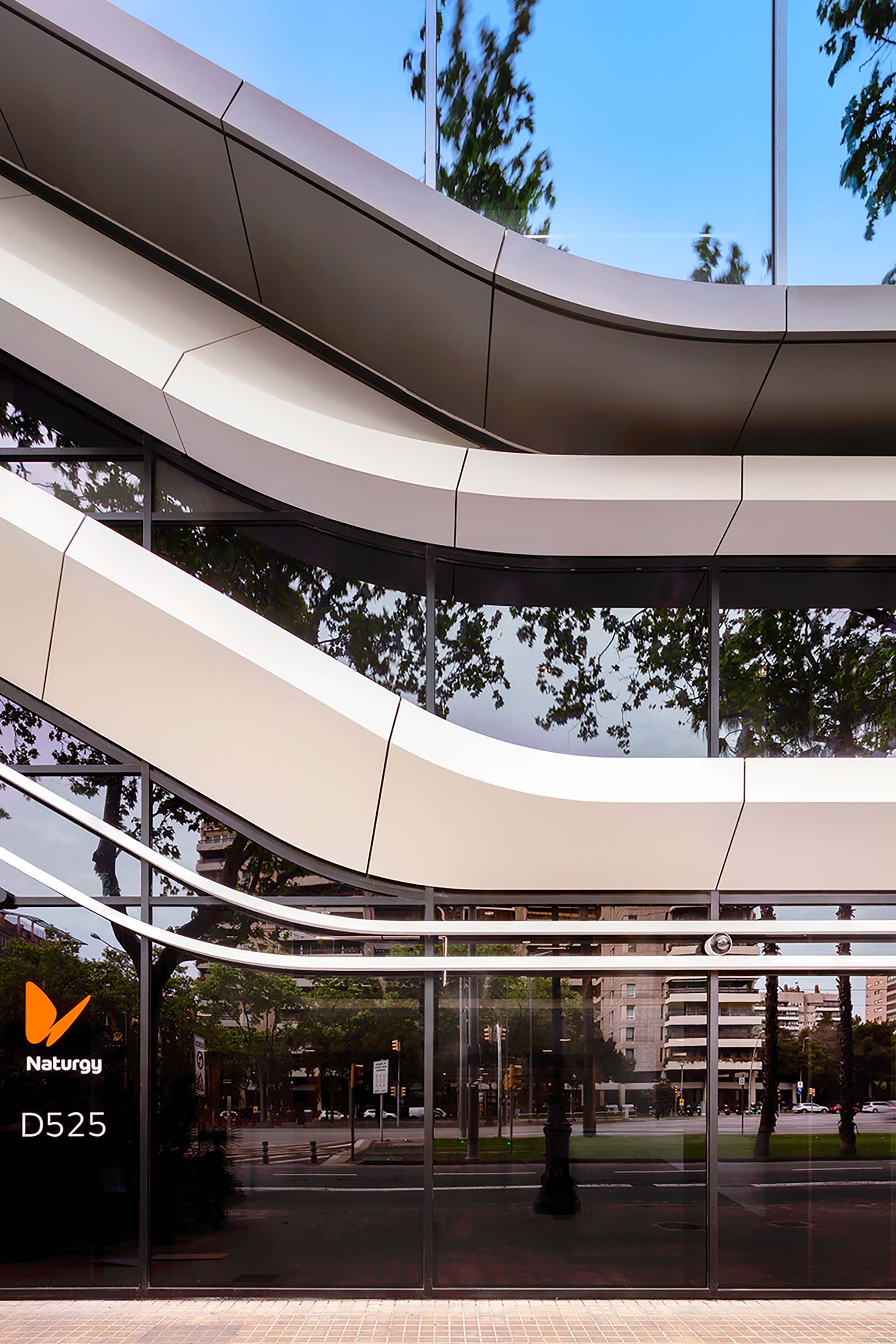
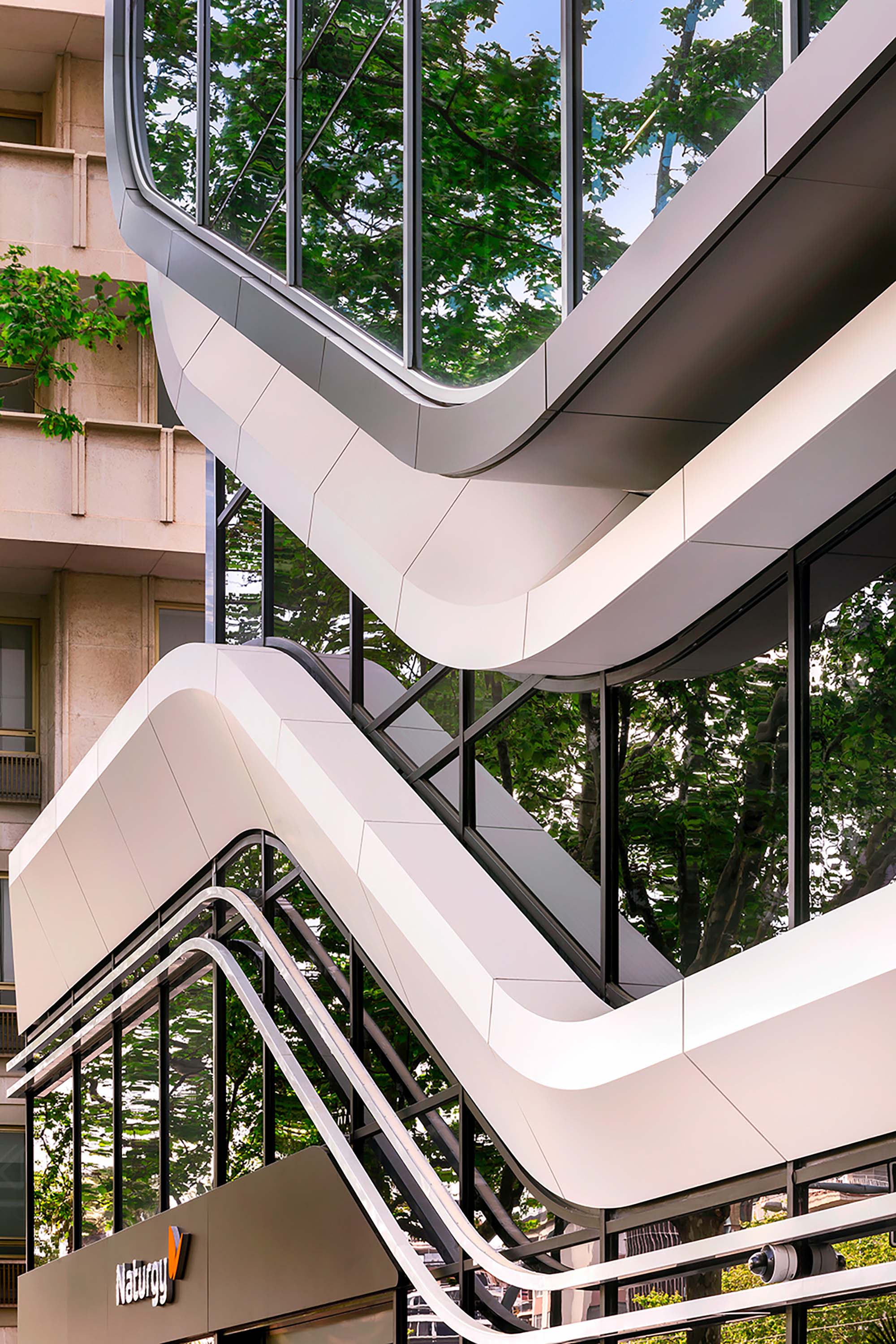
The project incorporates an innovative main façade based on large windows that provide natural light, defined by unique photocatalytic krion 3D modules, which in addition to giving the building a unique identity, have the ability to purify the air thanks to their photocatalytic material. The KEAST technology of the krion material goes a step further by extrapolating its benefits beyond its surface with its ability to decontaminate the air. The unique design, made with a line of clean and aerodynamic lines, generates an image of movement and avant-garde.
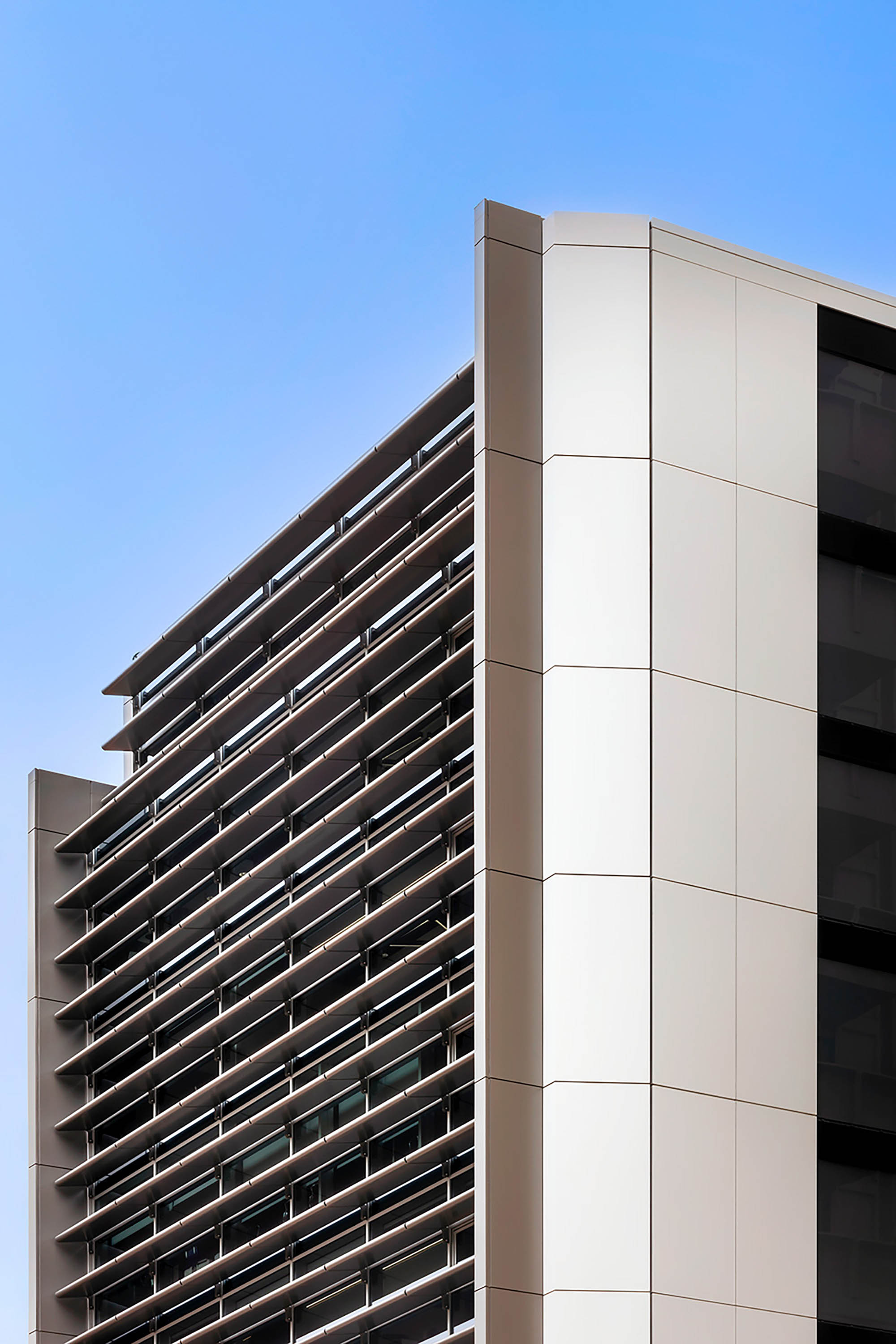
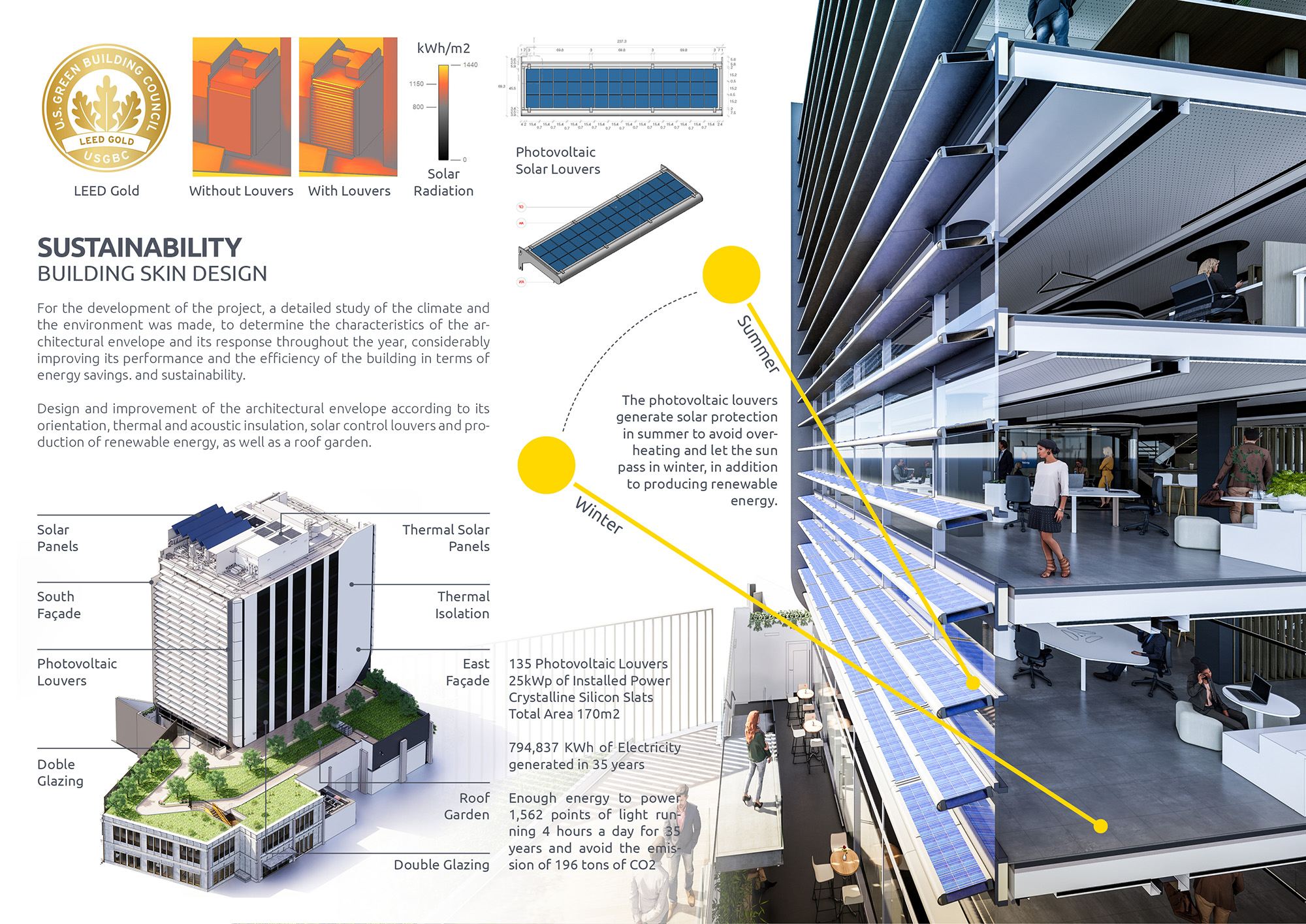
The building envelope and its systems have been designed to make it an eco-efficient model, improving its performance, thermal insulation and energy consumption. The design of the south façade incorporates a treatment of photovoltaic louvers, which, in addition to protecting from the sun in the warmer months of the year, generate clean energy for part of its electricity consumption.
A large part of the building’s roof is designed as a natural green space, incorporating low-consumption native plant species, which in addition to providing an extra insulation layer, helps to minimize the environmental impact improving the microclimate and helping to mitigate the heat island effect.
For the development of the project, a detailed study of the climate and the environment was made, to determine the characteristics of the architectural envelope and its response throughout the year, considerably improving its performance and the efficiency of the building in terms of energy savings. and sustainability. Design and improvement of the architectural envelope according to its orientation, thermal and acoustic insulation, solar control louvers and production of renewable energy, as well as a roof garden.
The project has been developed using the latest BIM cloud technology for its complete coordination, integrating virtual models of architecture, engineering and interior design, in addition to the urban environment, generating a coordinated digital building.
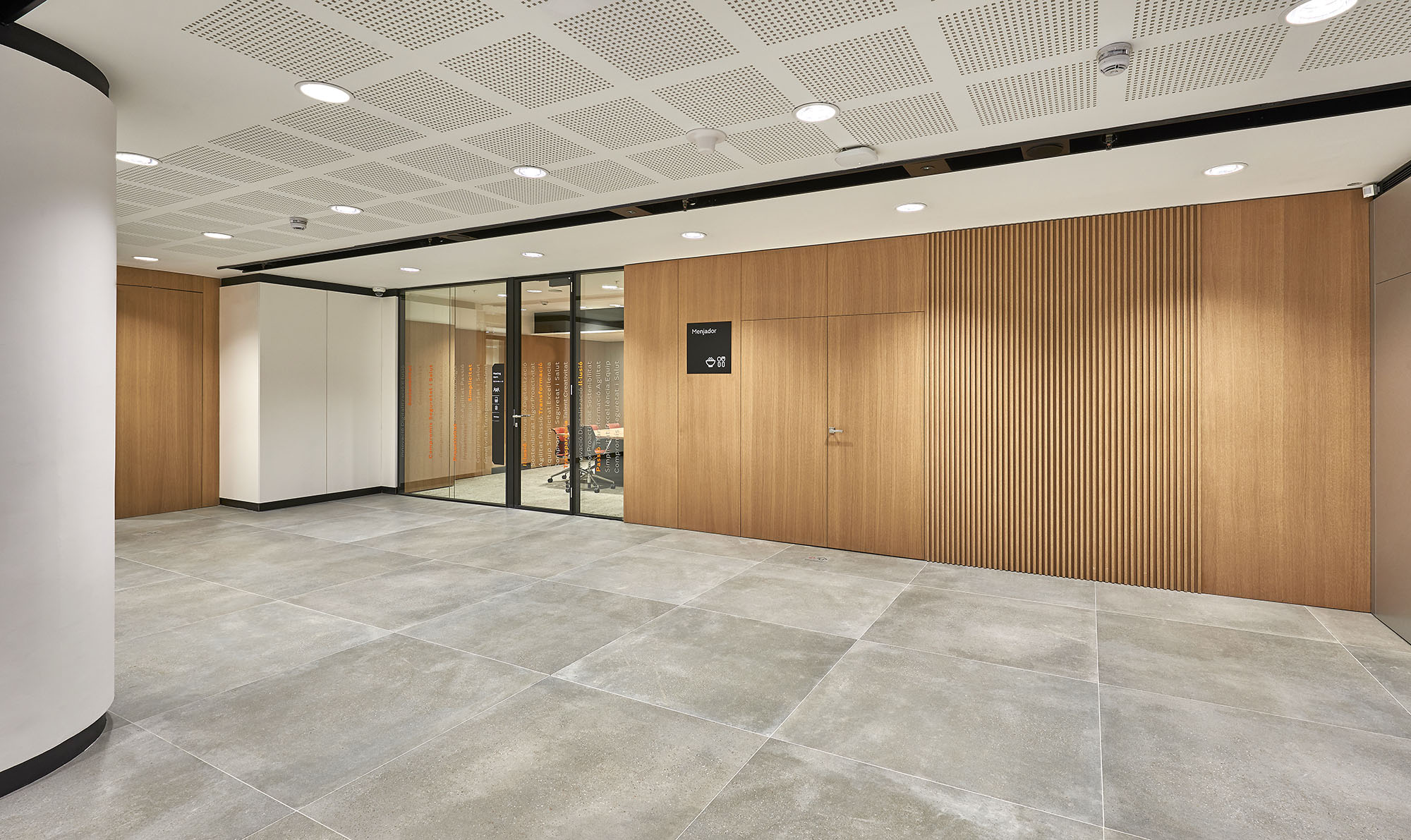
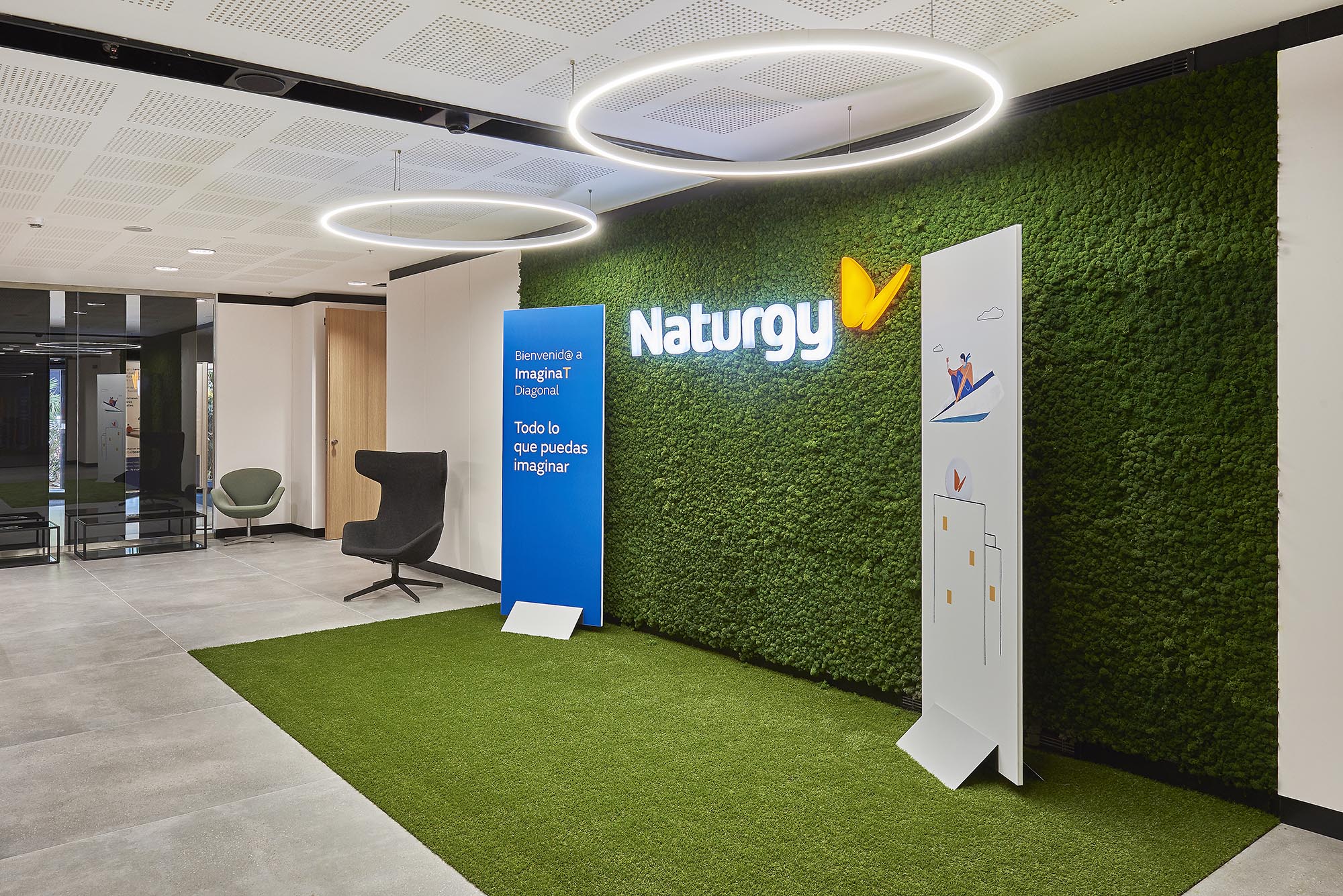
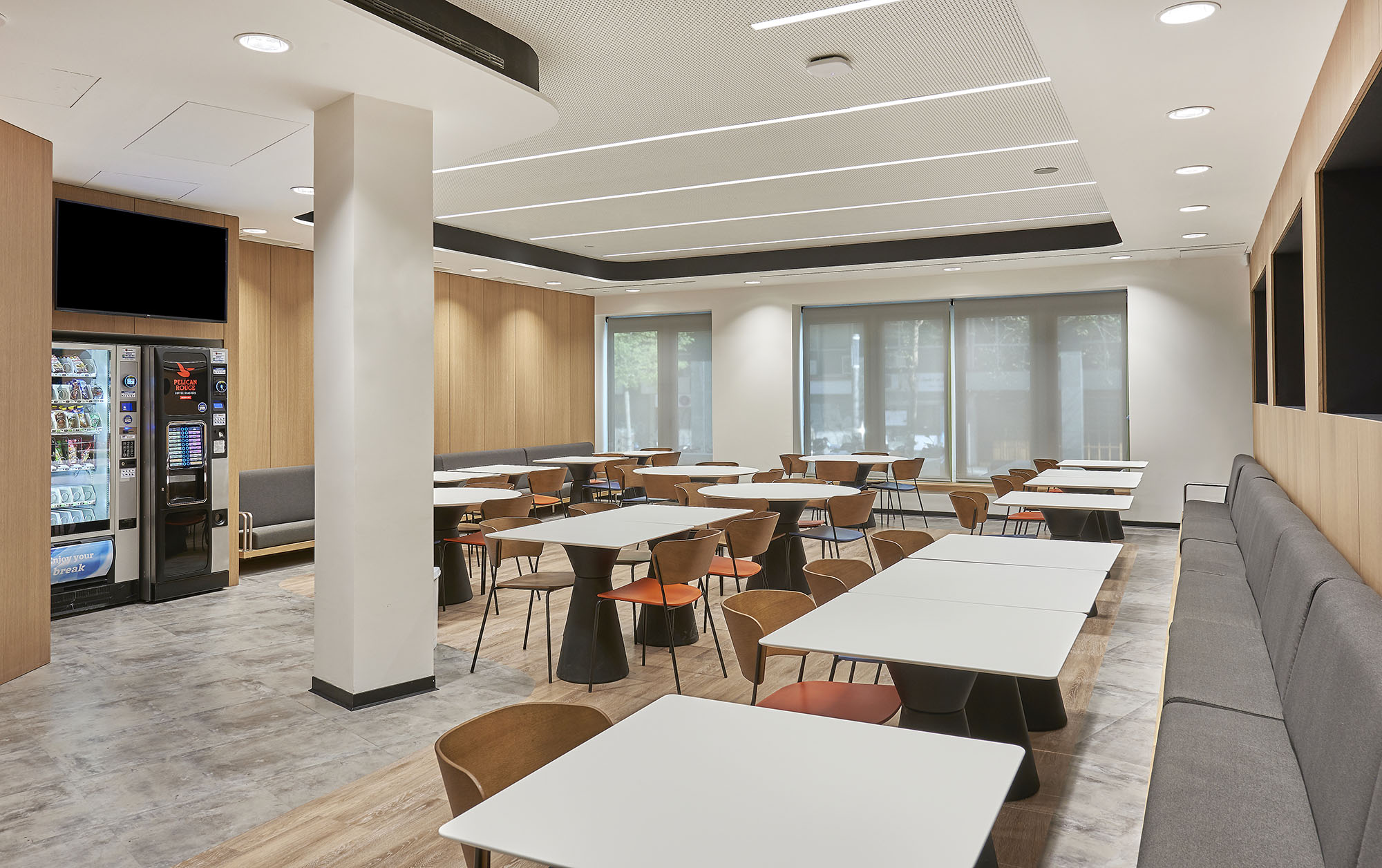
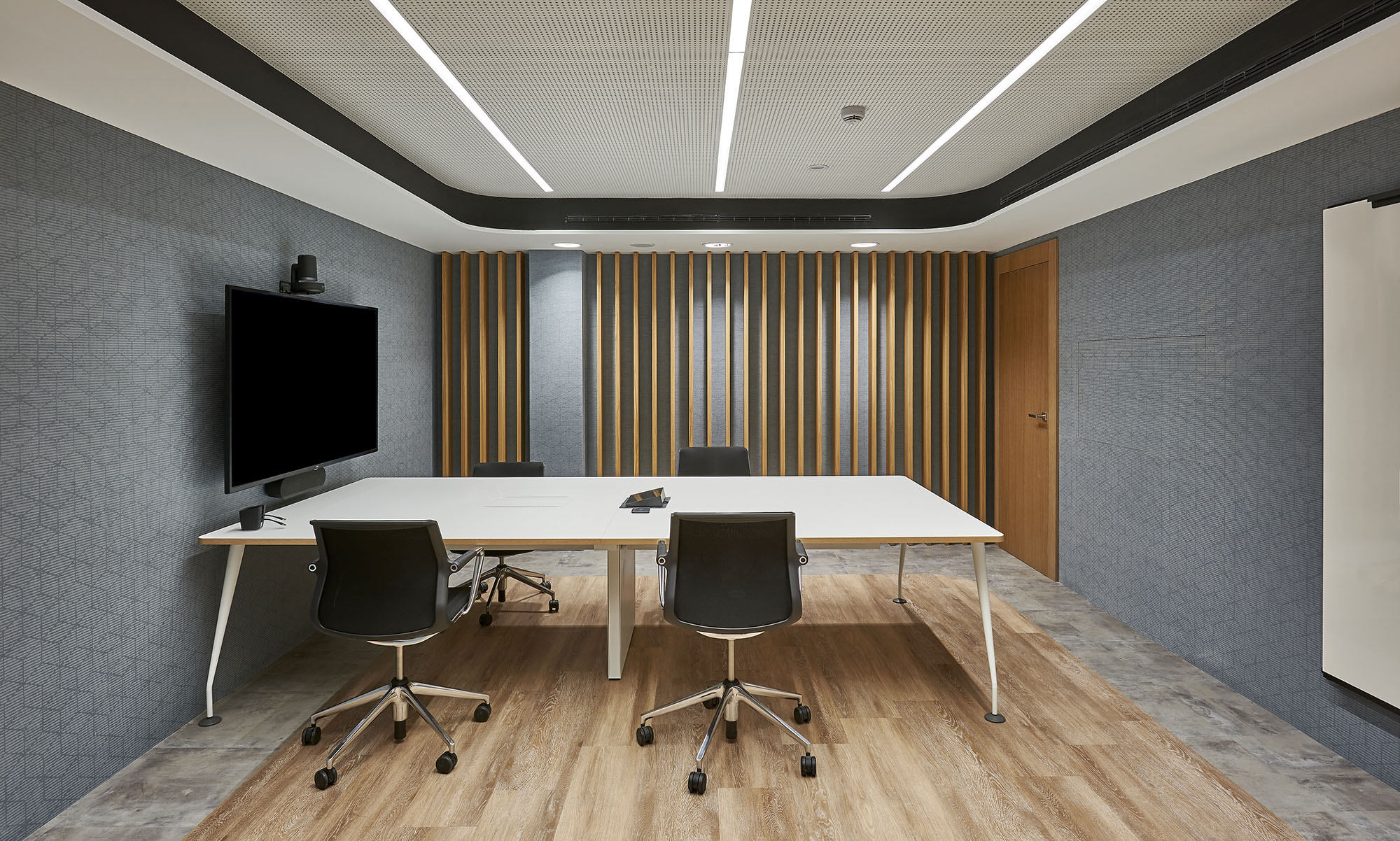
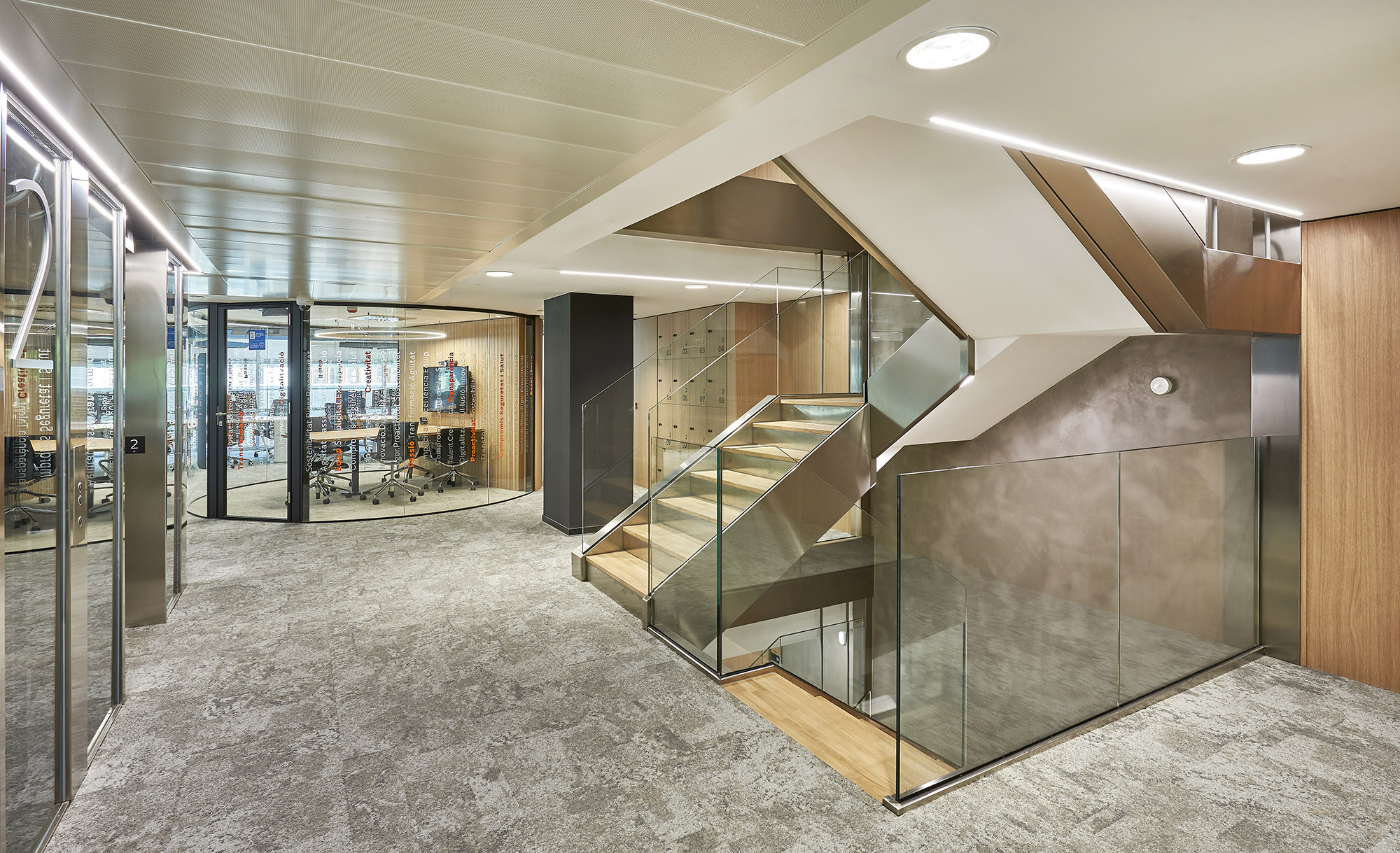
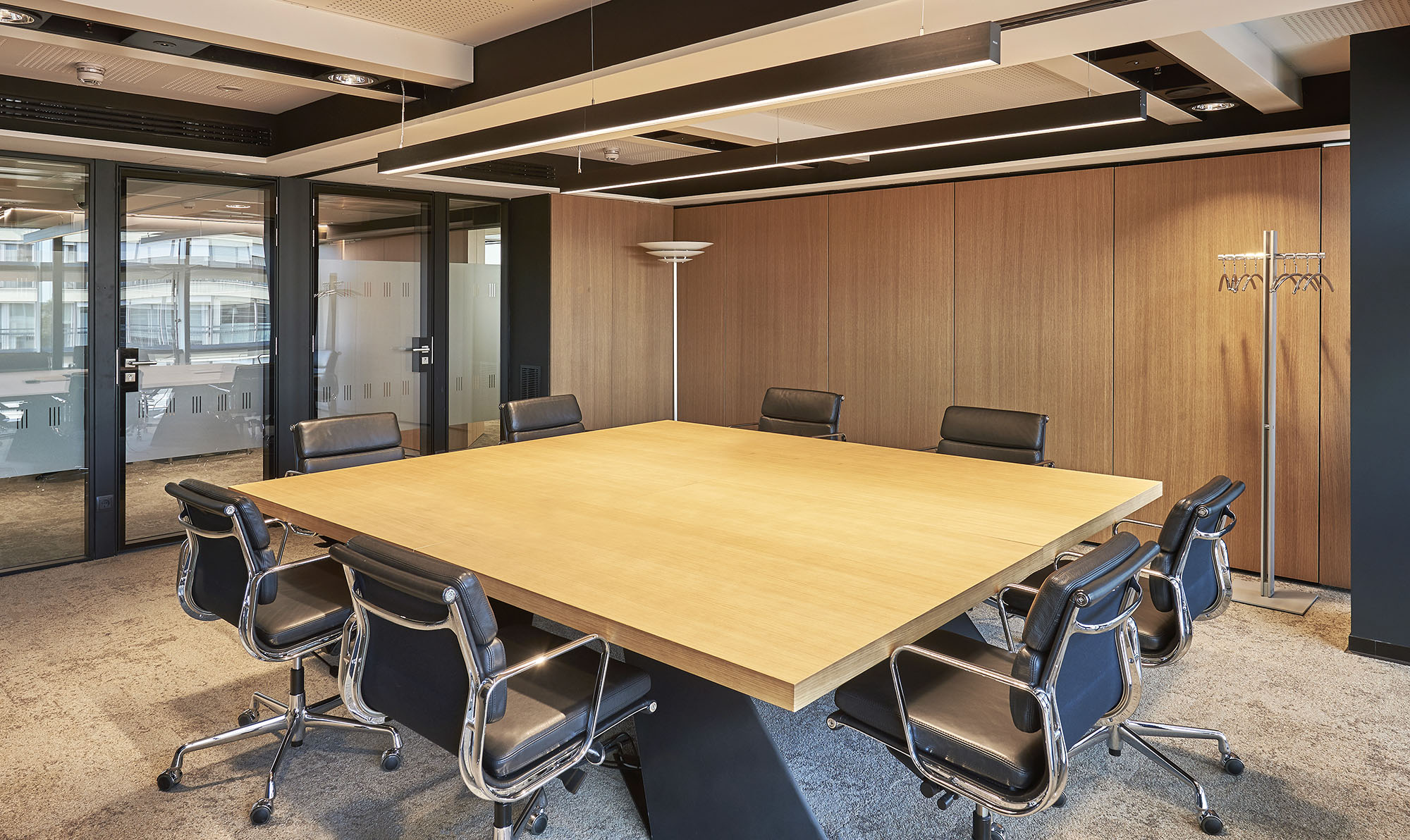
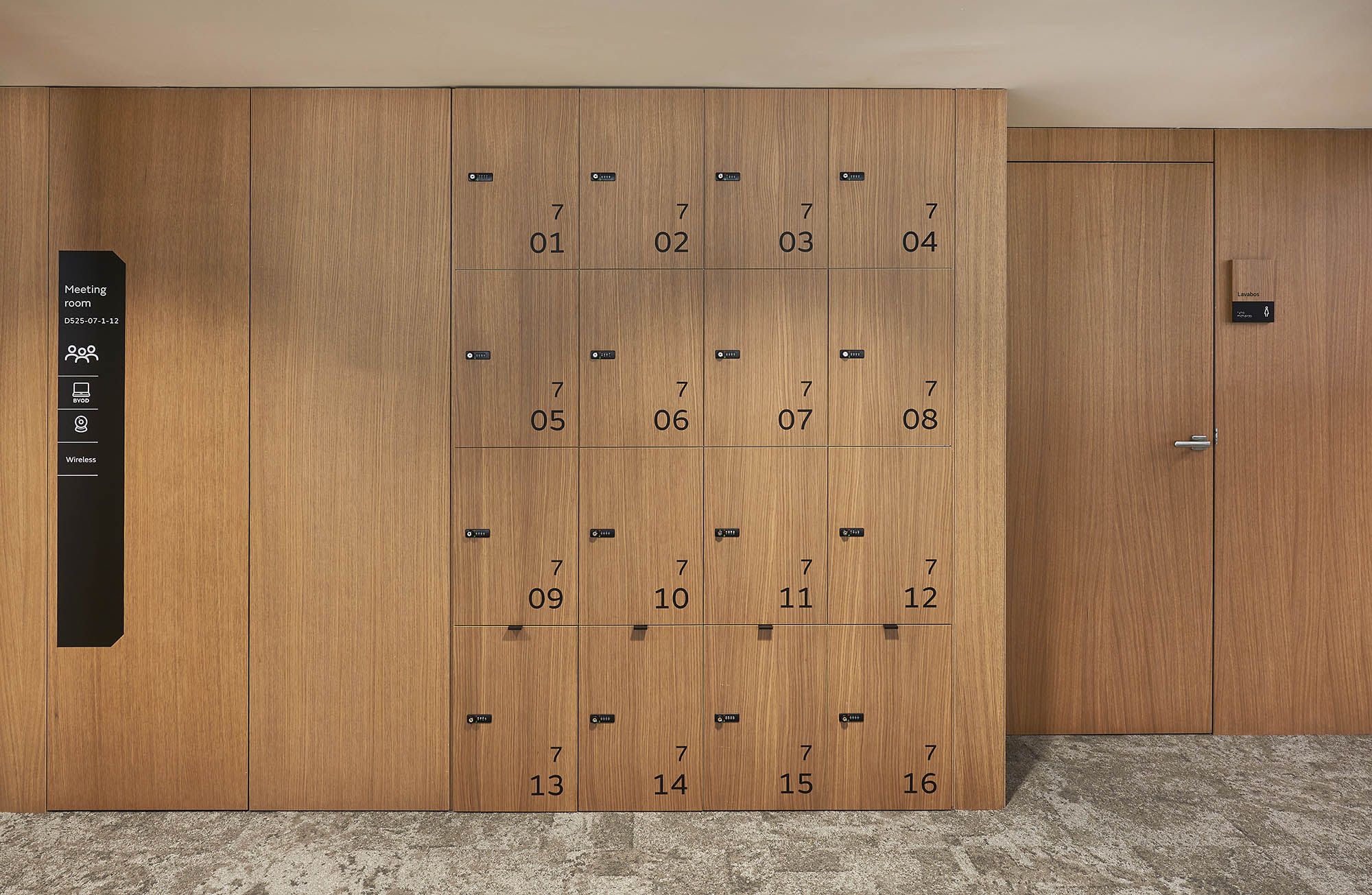
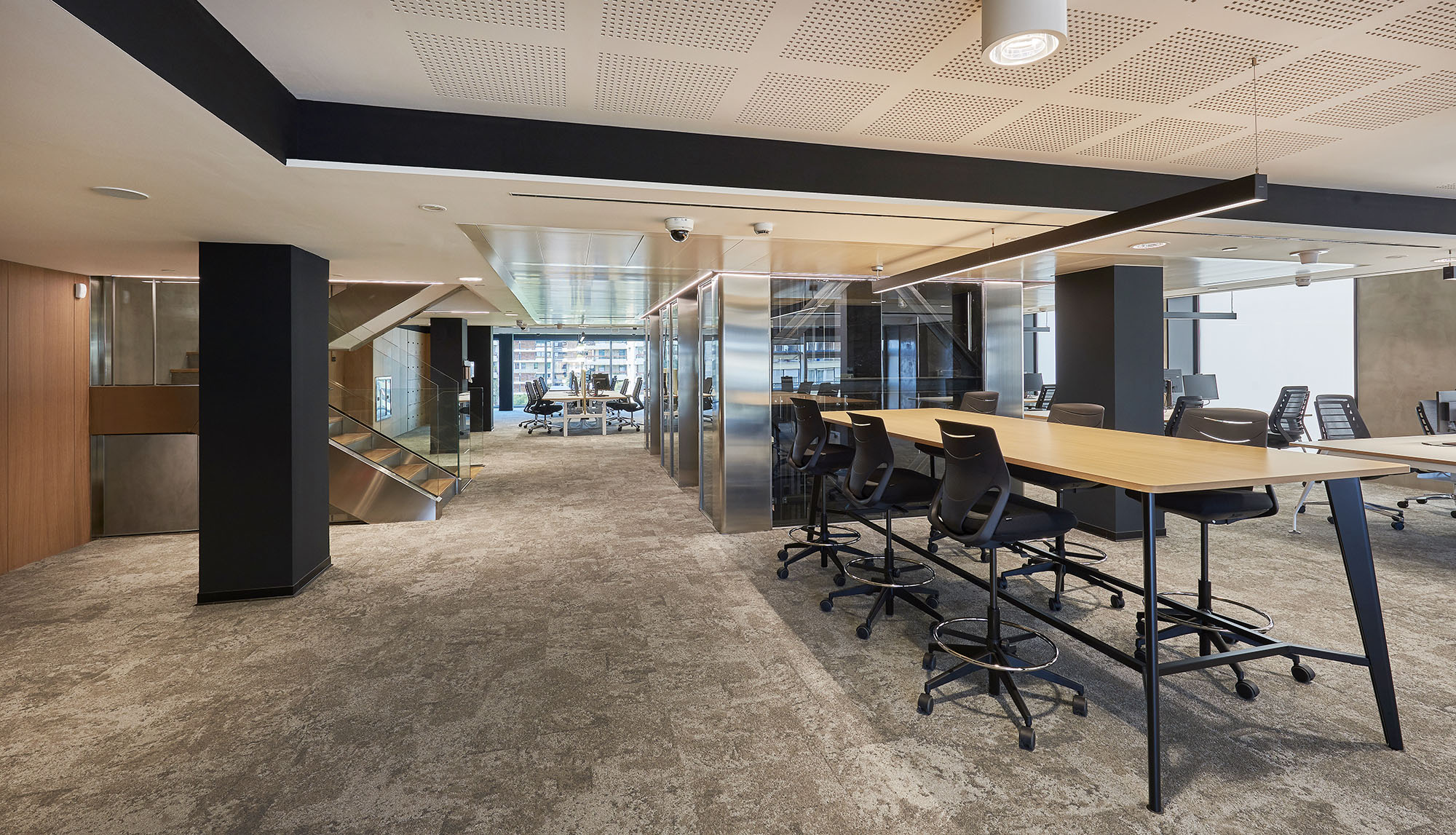
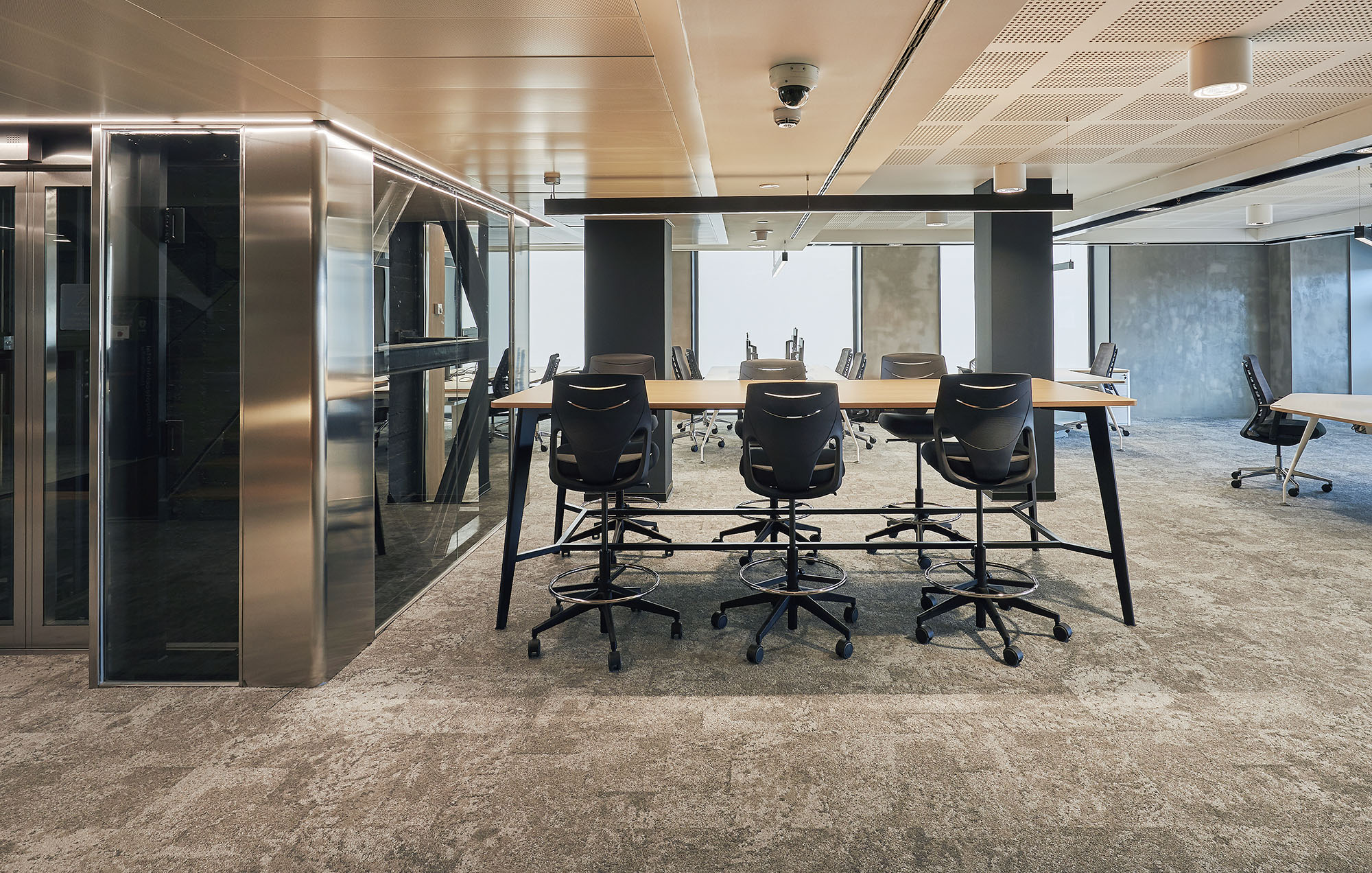
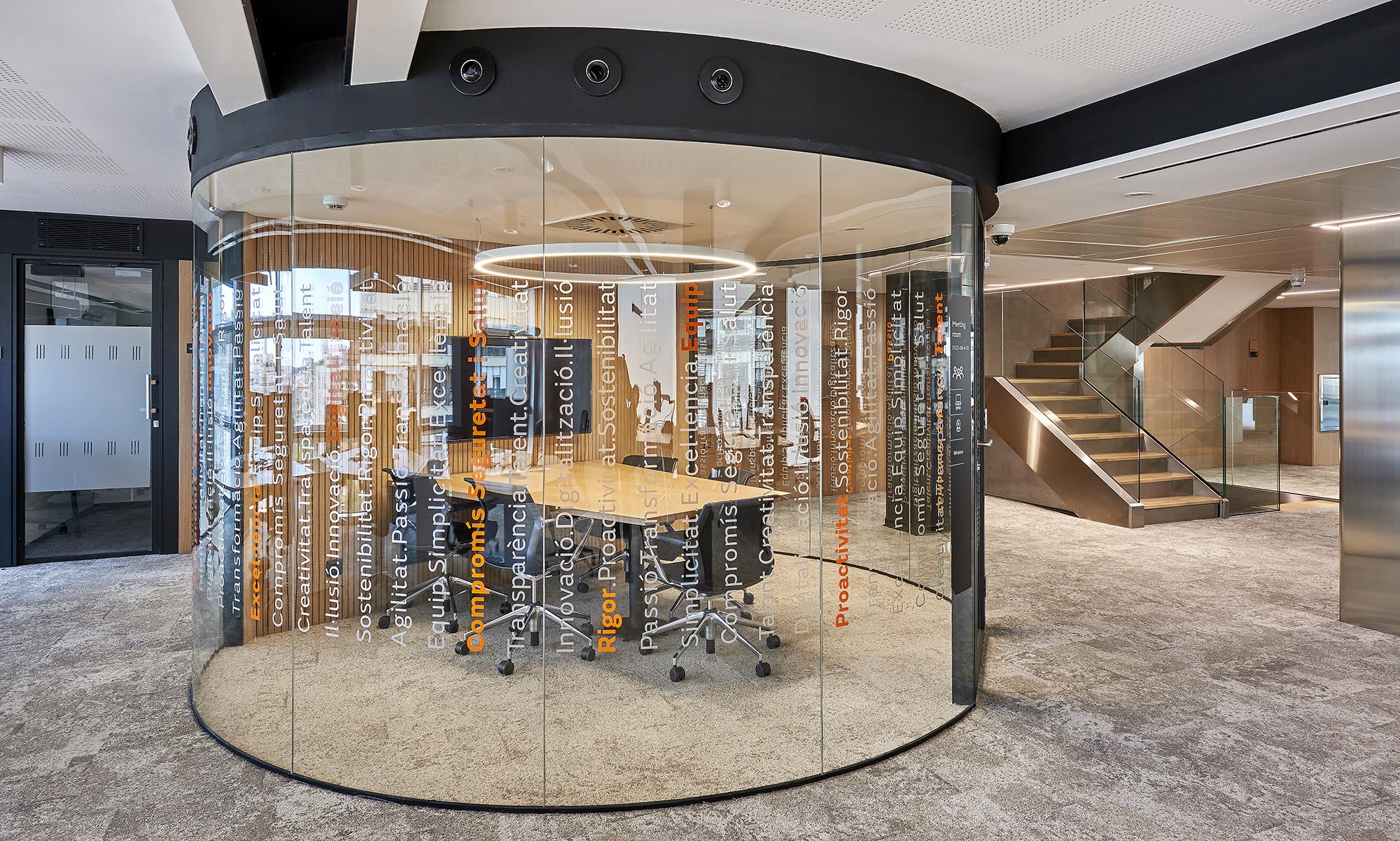
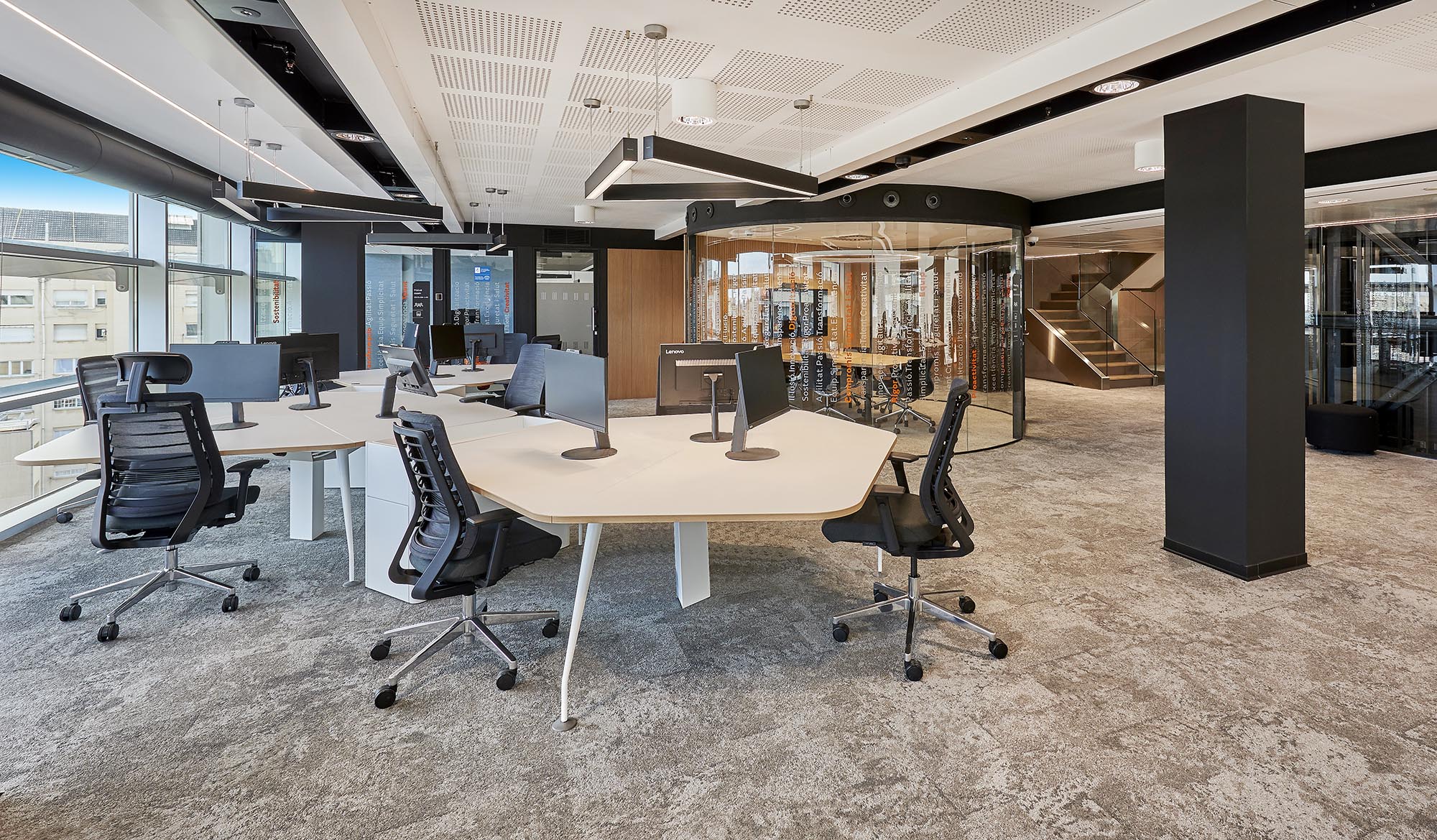
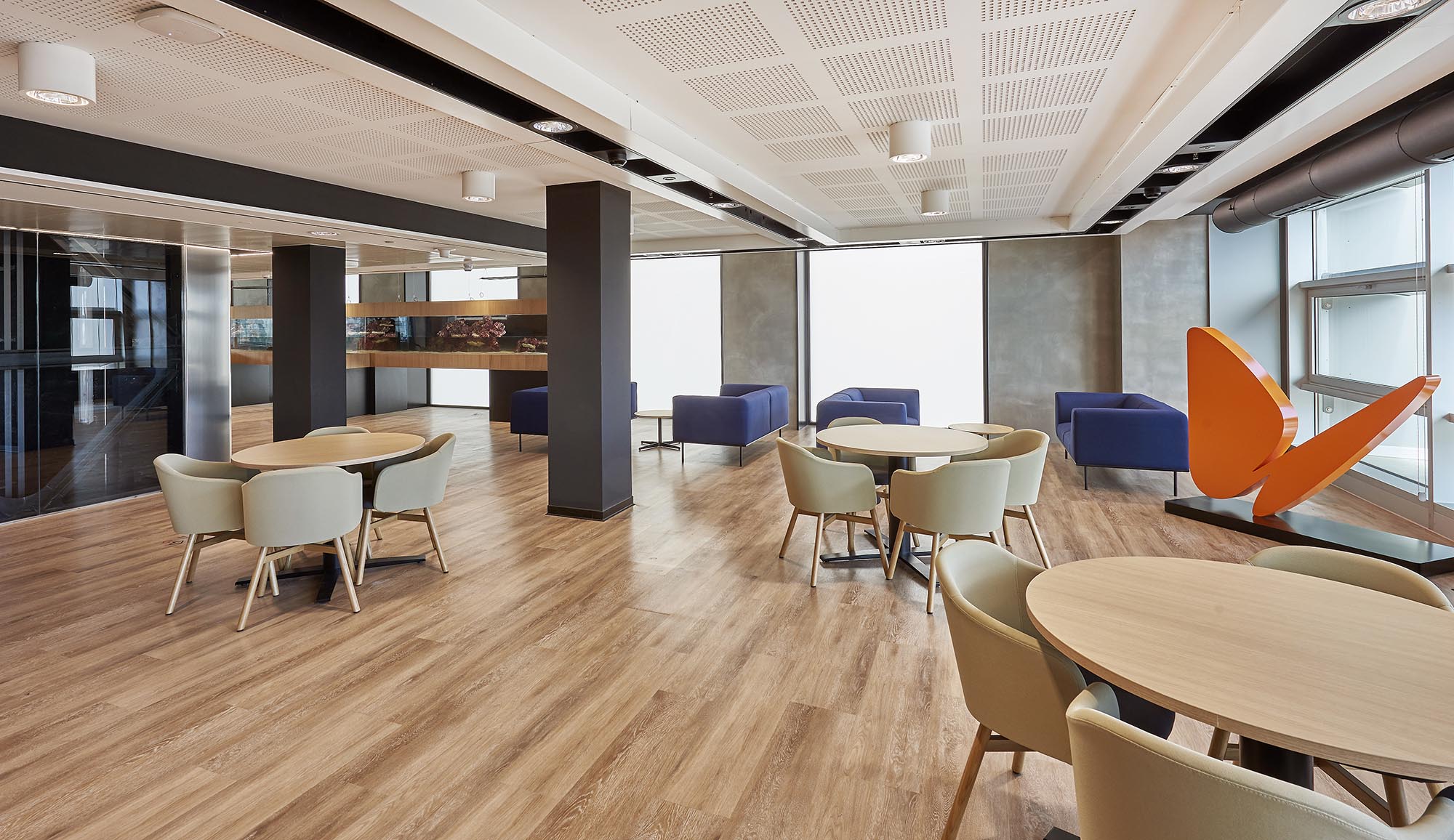
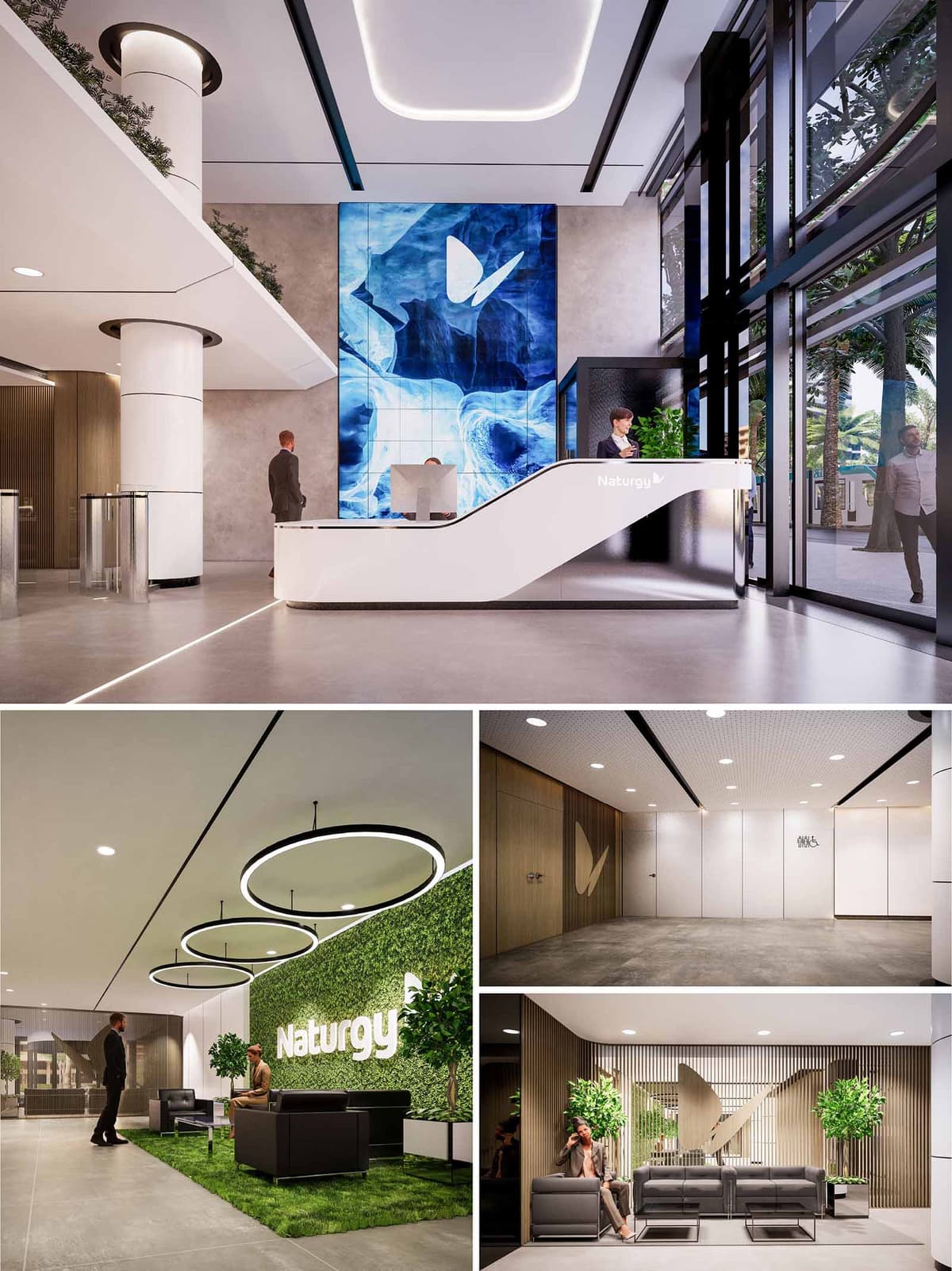
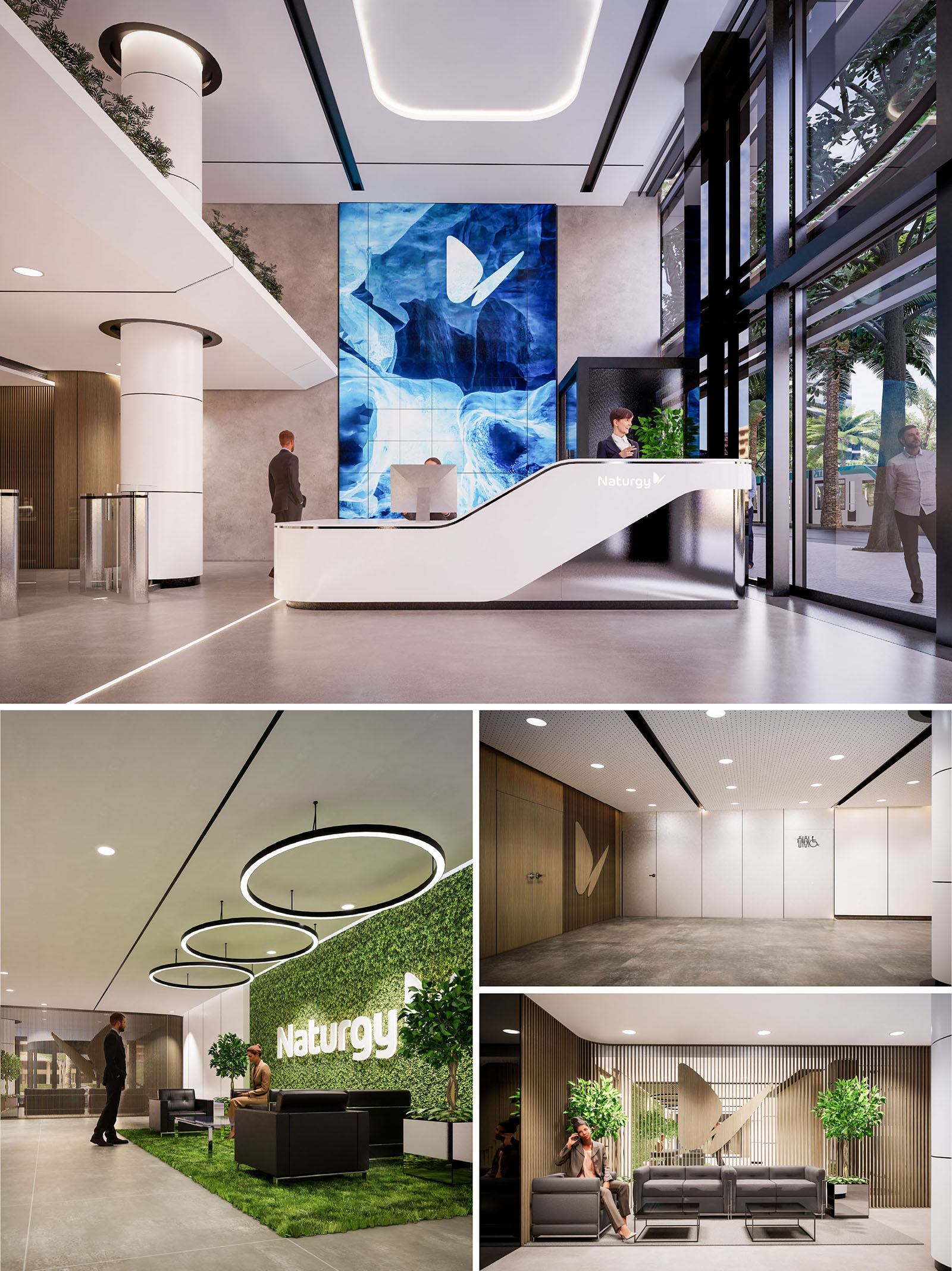
The original design and space planning concept implemented by CBRE and later developed by SANZPONT, is based on generating a clean and open space, with an open and continuous workspace that encourages collaboration and teamwork. Both team and managers coexist equally in the same space, where the jobs aerodynamic in such a way that they are exchanged according to the needs and work teams, offering persona lockers and formal and informal meeting rooms, as well as personal spaces to talk by phone.
THE STRUCTURAL CHALLENGE
Reinforcement with Carbon Fiber
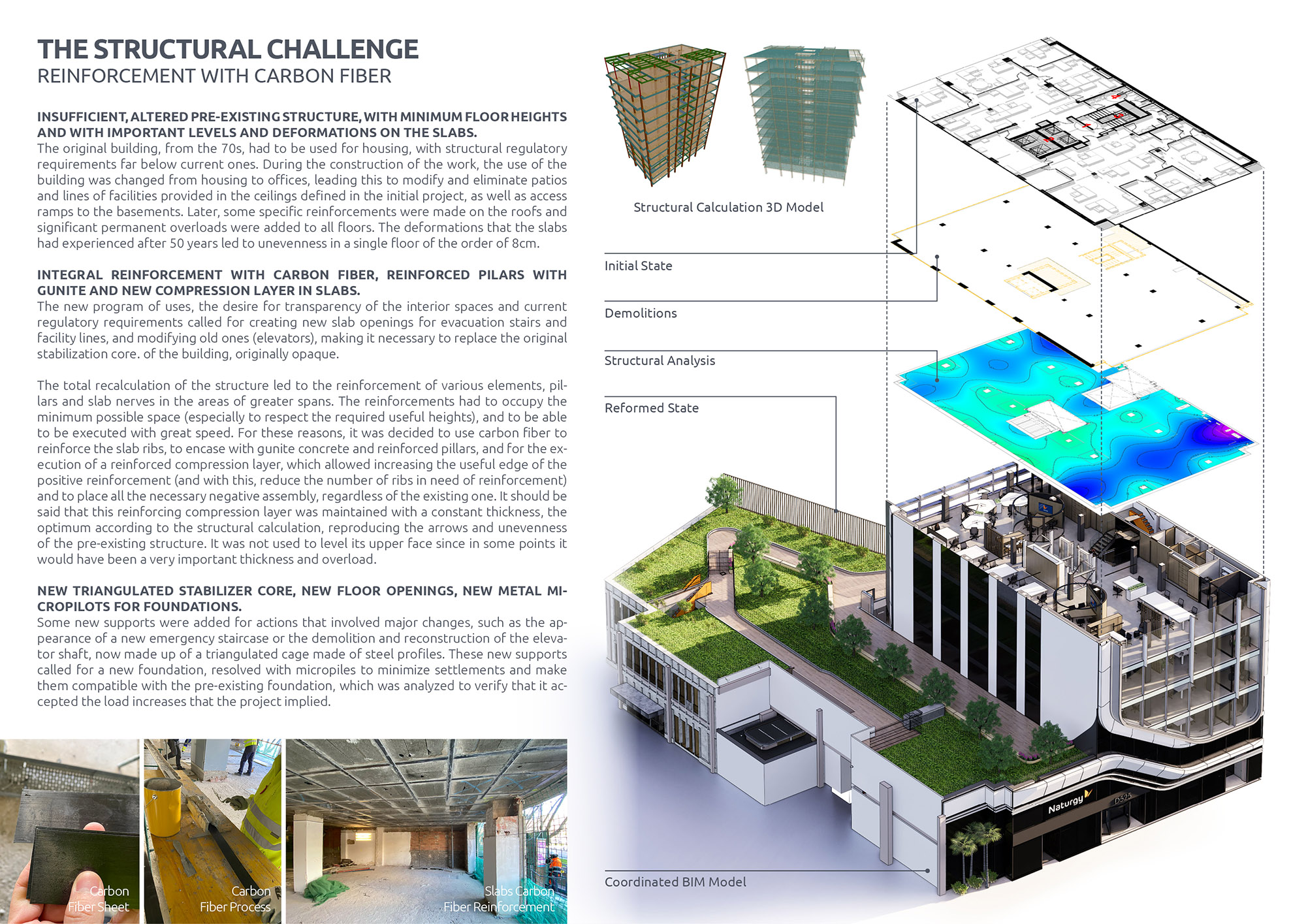
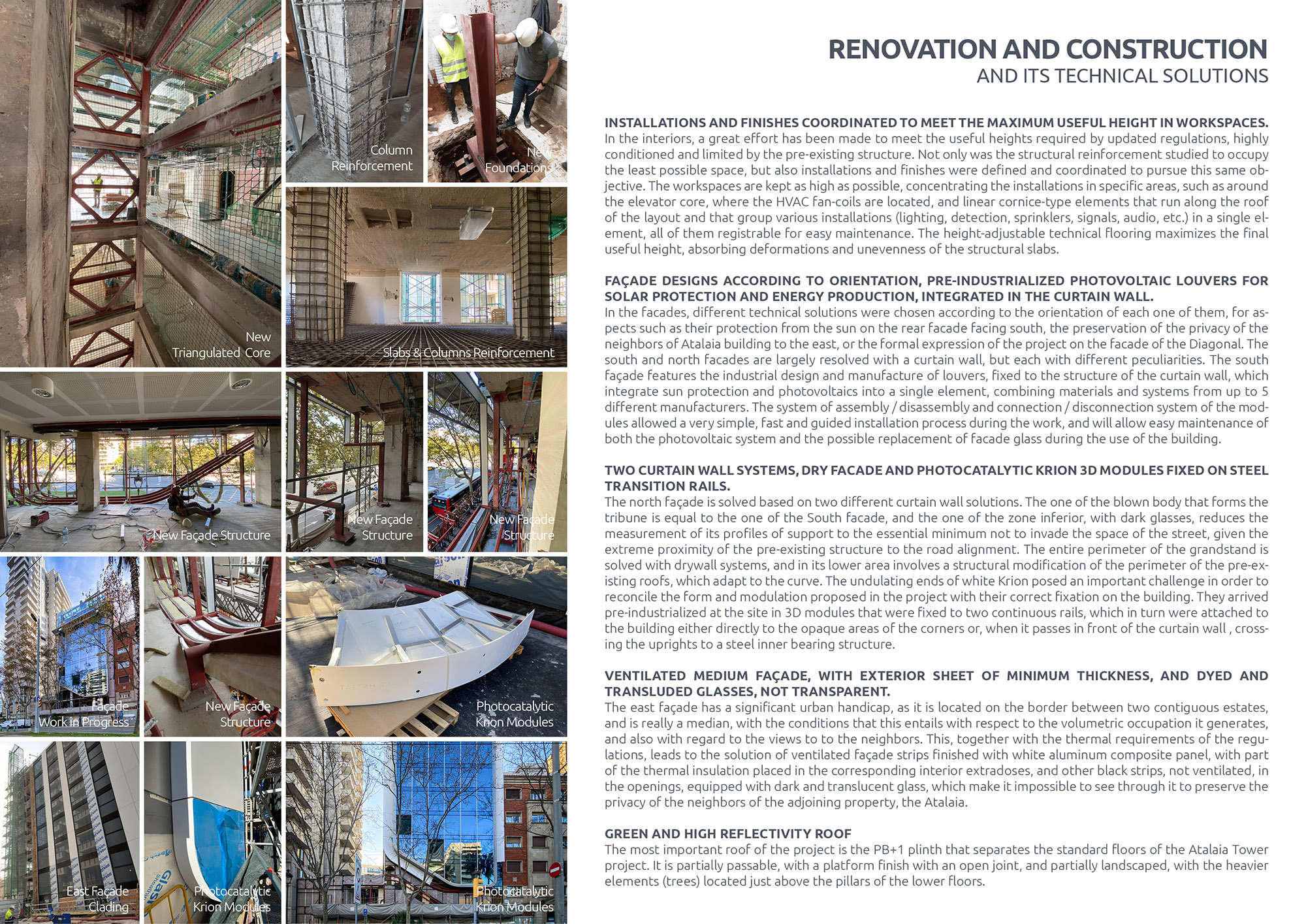
The original building, from the 70s, had to be used for housing, with structural regulatoryrequirements far below current ones. During the construction of the work, the use of thebuilding was changed from housing to offices, leading this to modify and eliminate patiosand lines of facilities provided in the ceilings defined in the initial project, as well as accessramps to the basements. Later, some specific reinforcements were made on the roofs andsignificant permanent overloads were added to all floors. The deformations that the slabshad experienced after 50 years led to unevenness in a single floor of the order of 8cm.
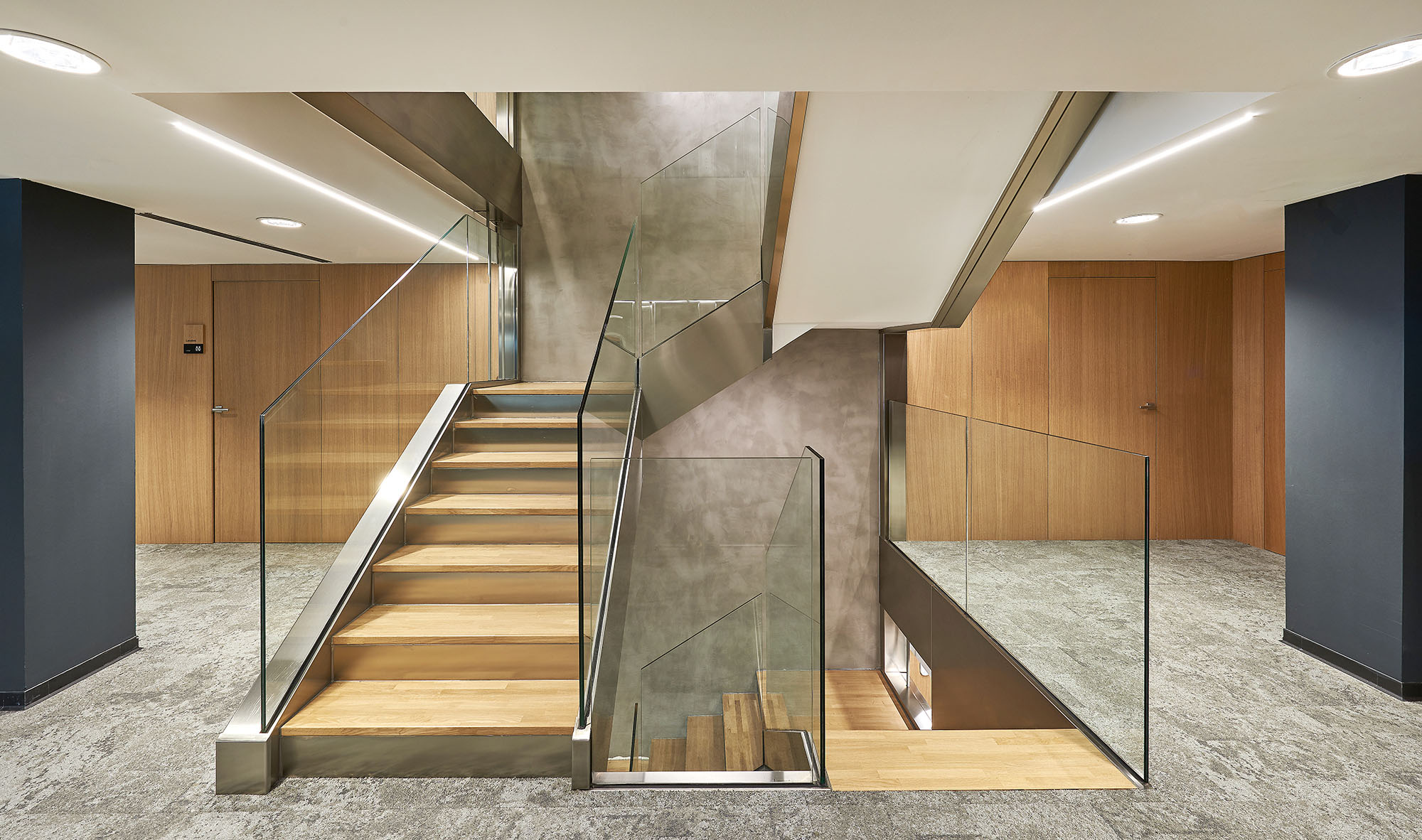
The new program of uses, the desire for transparency of the interior spaces and currentregulatory requirements called for creating new slab openings for evacuation stairs andfacility lines, and modifying old ones (elevators), making it necessary to replace the originalstabilization core. of the building, originally opaque.
The total recalculation of the structure led to the reinforcement of various elements, pil-lars and slab nerves in the areas of greater spans. The reinforcements had to occupy theminimum possible space (especially to respect the required useful heights), and to be ableto be executed with great speed. For these reasons, it was decided to use carbon fiber toreinforce the slab ribs, to encase with gunite concrete and reinforced pillars, and for the ex-ecution of a reinforced compression layer, which allowed increasing the useful edge of thepositive reinforcement (and with this, reduce the number of ribs in need of reinforcement)and to place all the necessary negative assembly, regardless of the existing one. It should besaid that this reinforcing compression layer was maintained with a constant thickness, theoptimum according to the structural calculation, reproducing the arrows and unevennessof the pre-existing structure. It was not used to level its upper face since in some points itwould have been a very important thickness and overload.
Some new supports were added for actions that involved major changes, such as the ap-pearance of a new emergency staircase or the demolition and reconstruction of the eleva-tor shaft, now made up of a triangulated cage made of steel profiles. These new supportscalled for a new foundation, resolved with micropiles to minimize settlements and makethem compatible with the pre-existing foundation, which was analyzed to verify that it ac-cepted the load increases that the project implied.
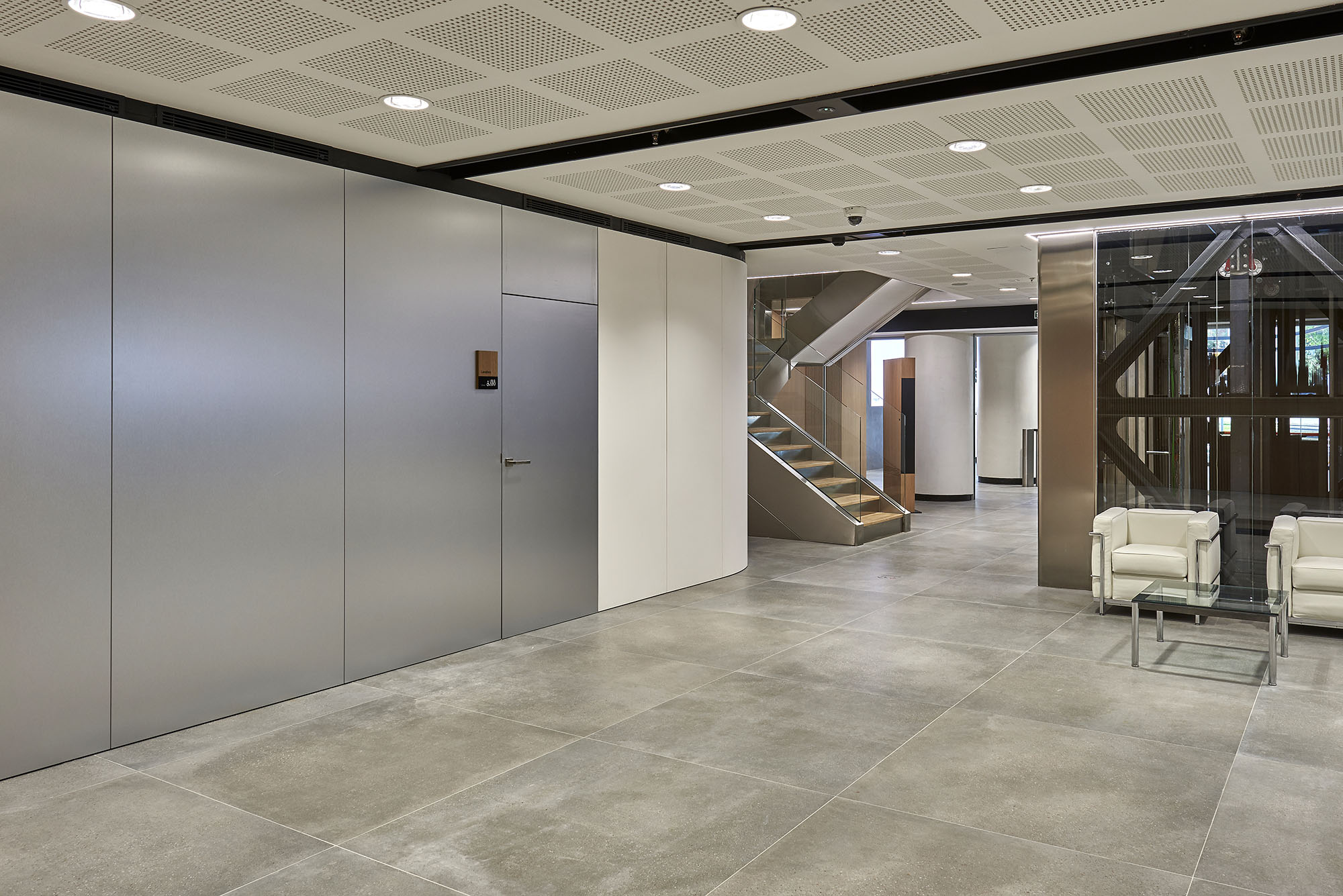
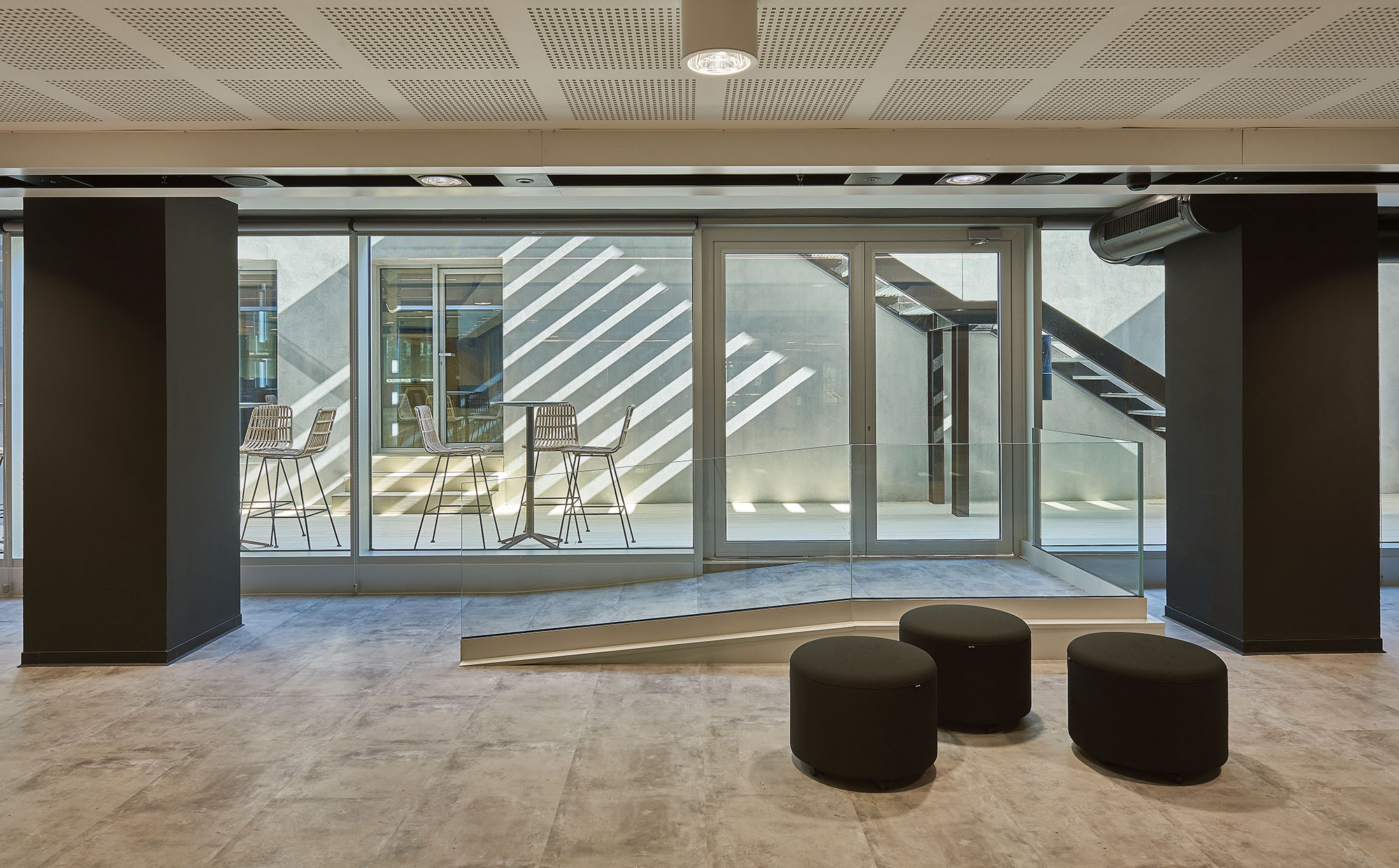
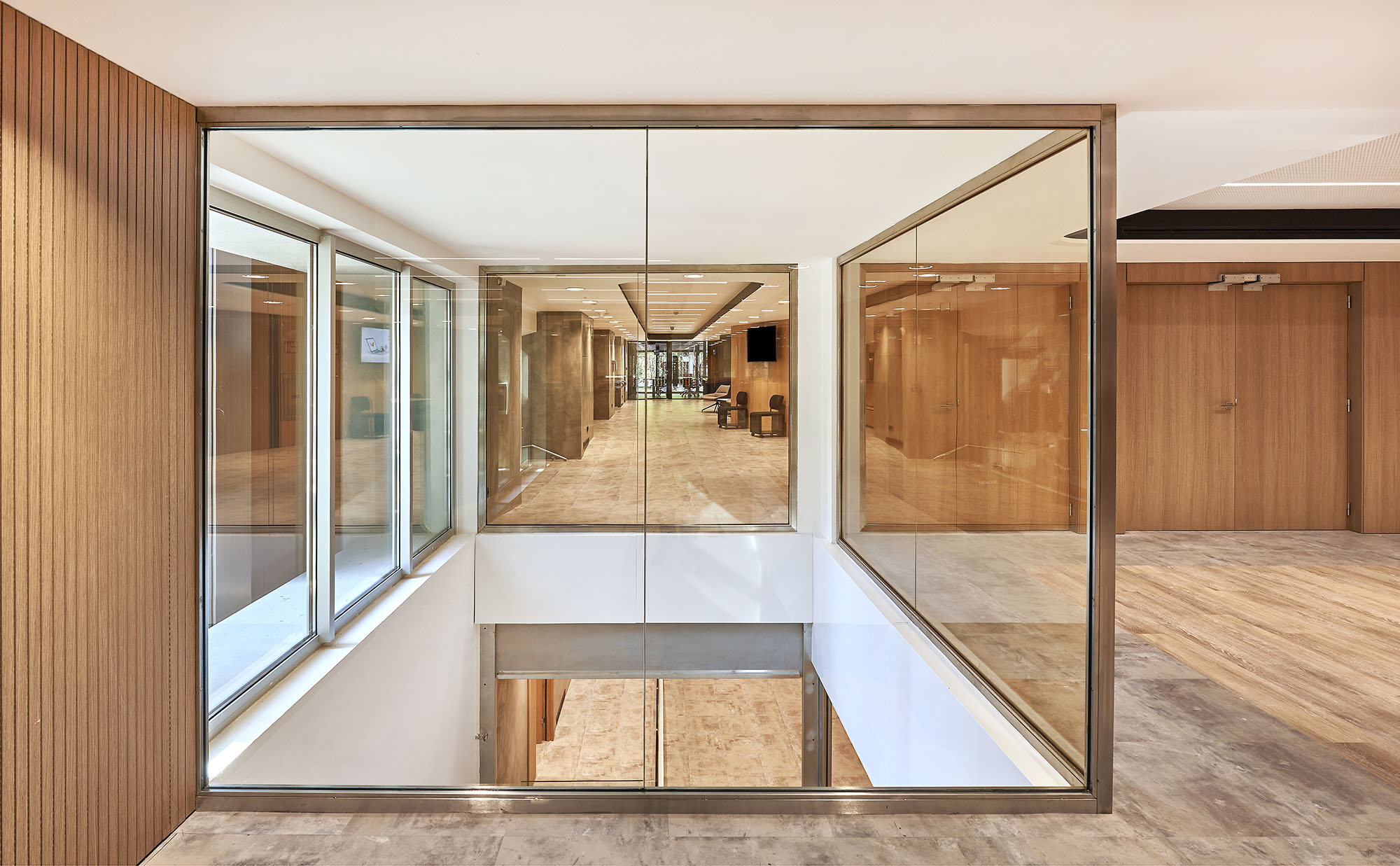
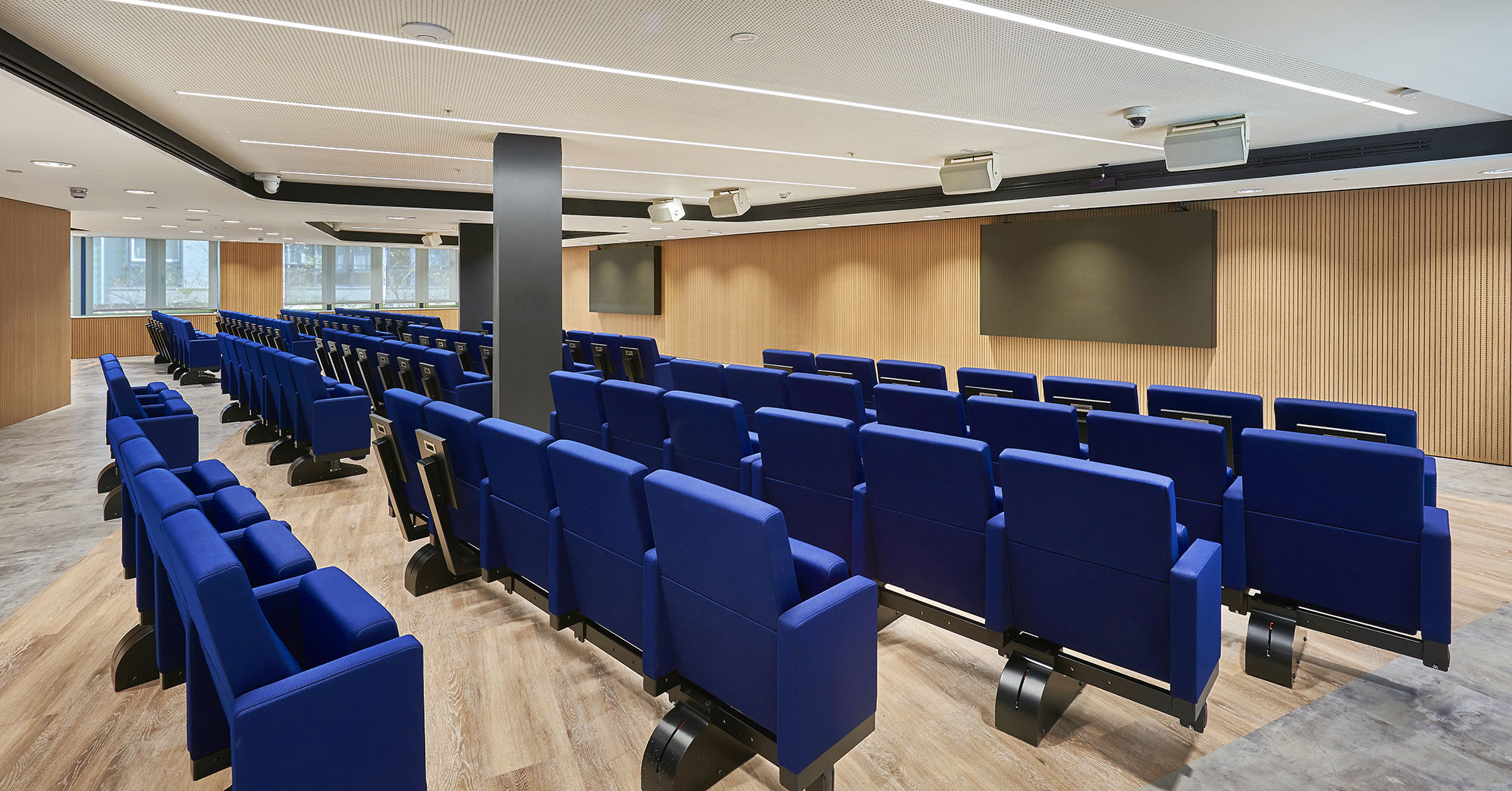
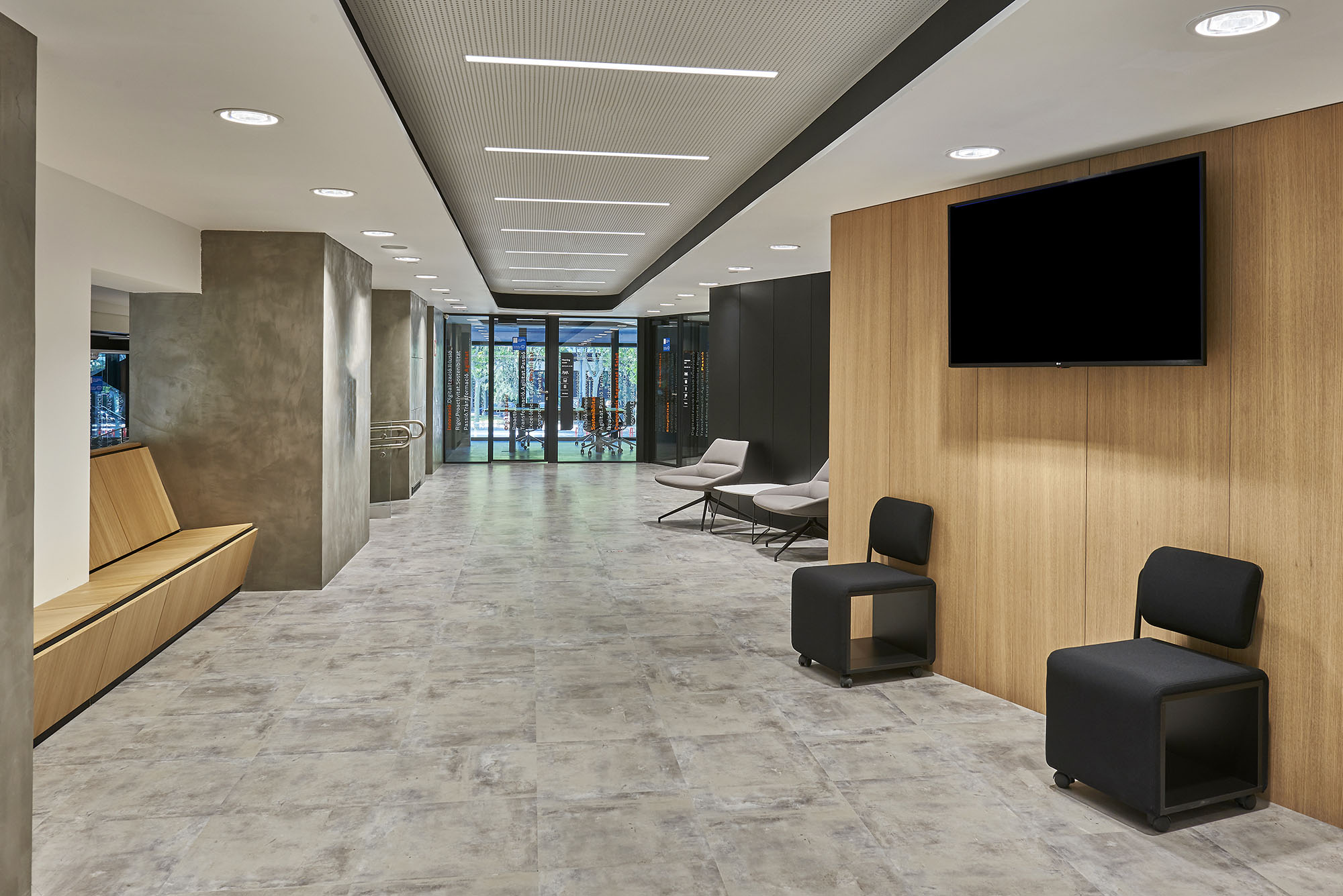
In the interiors, a great effort has been made to meet the useful heights required by updated regulations, highly conditioned and limited by the pre-existing structure. Not only was the structural reinforcement studied to occupy the least possible space, but also installations and finishes were defined and coordinated to pursue this same objective. The workspaces are kept as high as possible, concentrating the installations in specific areas, such as around the elevator core, where the HVAC fan-coils are located, and linear cornice-type elements that run along the roof of the layout and that group various installations (lighting, detection, sprinklers, signals, audio, etc.) in a single element, all of them registrable for easy maintenance. The height-adjustable technical flooring maximizes the final useful height, absorbing deformations and unevenness of the structural slabs.
In the facades, different technical solutions were chosen according to the orientation of each one of them, for aspects such as their protection from the sun on the rear facade facing south, the preservation of the privacy of the neighbours of Atalaya building to the east, or the formal expression of the project on the facade of the Diagonal. The south and north facades are largely resolved with a curtain wall, but each with different peculiarities. The south façade features the industrial design and manufacture of louvers, fixed to the structure of the curtain wall, which integrate sun protection and photovoltaics into a single element, combining materials and systems from up to 5different manufacturers. The system of assembly / disassembly and connection / disconnection system of the modules allowed a very simple, fast and guided installation process during the work, and will allow easy maintenance of both the photovoltaic system and the possible replacement of facade glass during the use of the building.
The north façade is solved based on two different curtain wall solutions. The one of the blown body that forms the tribune is equal to the one of the South facade, and the one of the zone inferior, with dark glasses, reduces the measurement of its profiles of support to the essential minimum not to invade the space of the street, given the extreme proximity of the pre-existing structure to the road alignment. The entire perimeter of the grandstand issolved with drywall systems, and in its lower area involves a structural modification of the perimeter of the pre-existing roofs, which adapt to the curve. The undulating ends of white Krion posed an important challenge in order to reconcile the form and modulation proposed in the project with their correct fixation on the building. They arrived pre-industrialized at the site in 3D modules that were fixed to two continuous rails, which in turn were attached to the building either directly to the opaque areas of the corners or, when it passes in front of the curtain wall , cross-ing the uprights to a steel inner bearing structure.
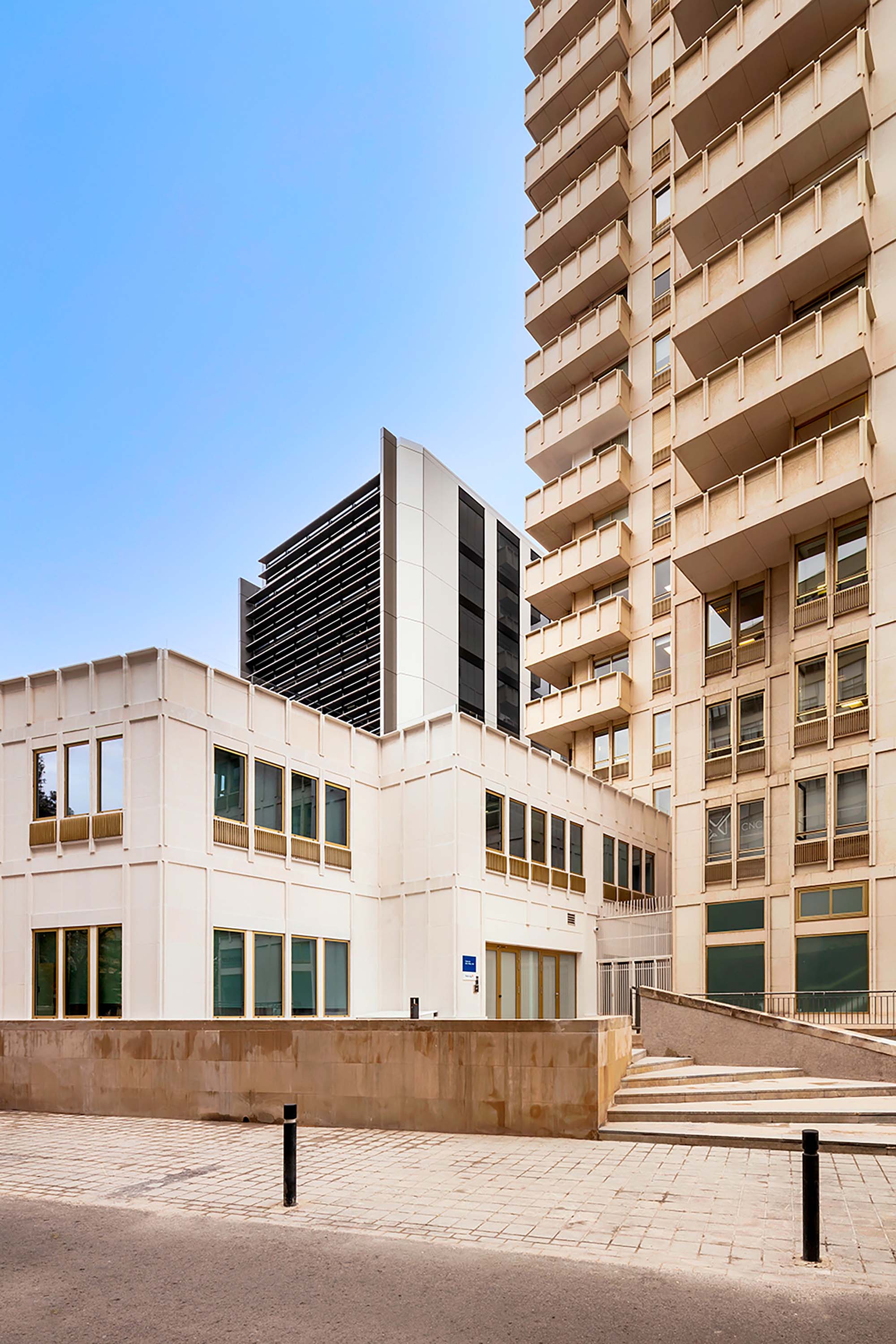
The east façade has a significant urban handicap, as it is located on the border between two contiguous estates, and is really a median, with the conditions that this entails with respect to the volumetric occupation it generates, and also with regard to the views to to the neighbours. This, together with the thermal requirements of the regulations, leads to the solution of ventilated façade strips finished with white aluminum composite panel, with part of the thermal insulation placed in the corresponding interior extradoses, and other black strips, not ventilated, in the openings, equipped with dark and translucent glass, which make it impossible to see through it to preserve the privacy of the neighbours of the adjoining property, the Atalaya.
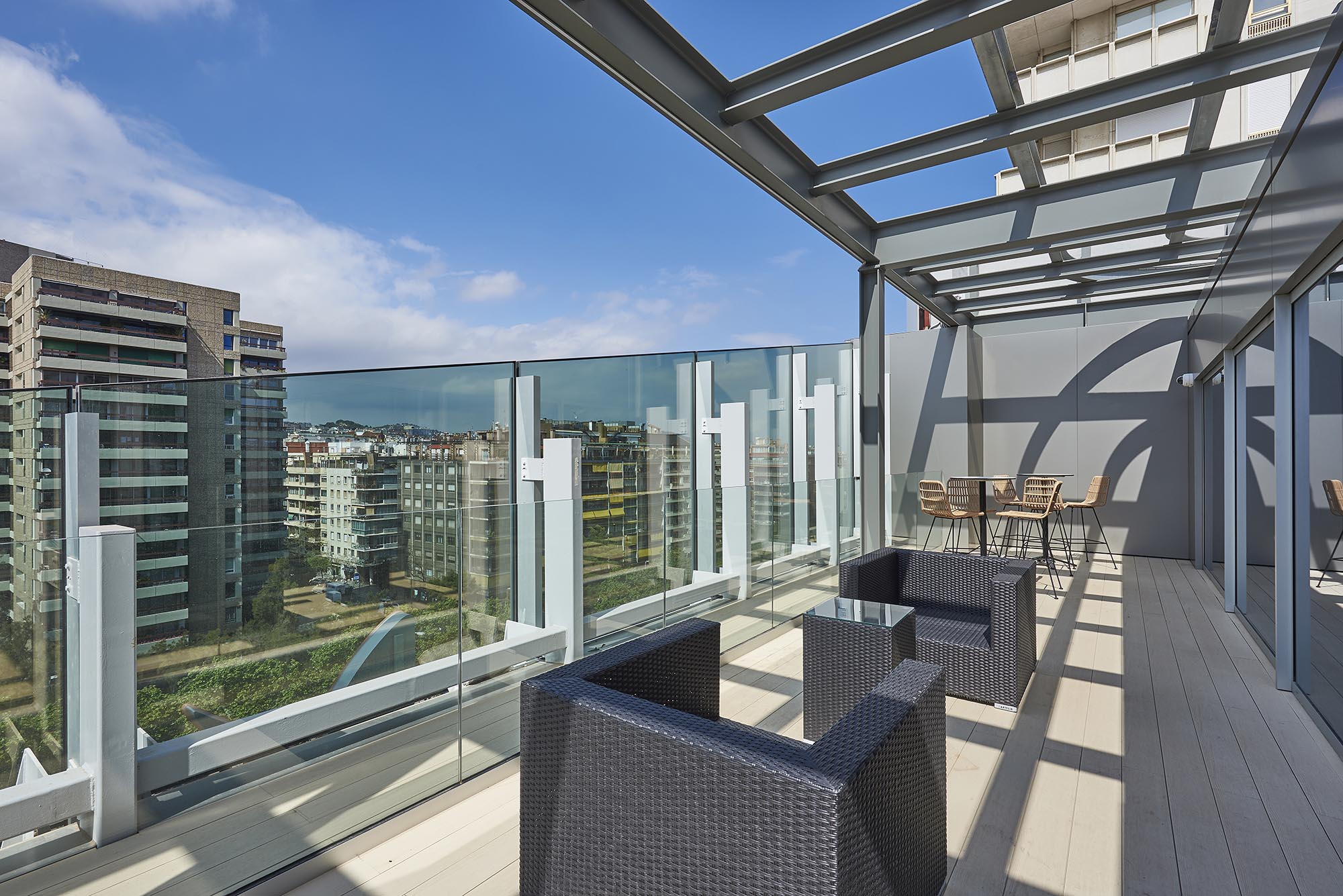
The most important roof of the project is the PB+1 plinth that separates the standard floors of the Atalaya Tower project. It is partially passable, with a platform finish with an open joint, and partially landscaped, with the heavier elements (trees) located just above the pillars of the lower floors.
Time Lapse Video by Voxel Studios (Courtesy of Colonial)
"Diagonal 525 office building, located within the Prime CBD area of Barcelona at the confluence with Avenida Sarriá, has a surface area of 5,800 m2 above ground and 1,200 m2 below ground, divided into a ground floor and nine floors. It has recently undergone a comprehensive refurbishment, resulting in one of the most emblematic office buildings in the central business hub of Barcelona, standing out for its high performance in terms of Sustainability."
- Inmobiliaria Colonial
PROJECT: D525 | Diagonal 525, Barcelona
CLIENT: Inmobiliaria Colonial & Naturgy Group
ARCHITECTURE DESIGN: sanzpont [arquitectura]
INTERIOR DESIGN: CBRE + sanzpont [arquitectura]
ARCHITECTS + CONSTRUCTION MANAGEMENT: Sergio Sanz, Victor Sanz, Oriol Vidal, Xevi Prat, Carles Campanyà, Guillem Armengol
STRUCTURAL DESIGN + CEM: Campanyà i Vinyeta Arquitectes
MEP DESIGN + LEED CONSULTANTS: PGI Engineering
PROJECT MANAGEMENT: Projects & Facilities Management
SECURITY & HEALTH: Tulpan Intermediació
GENERAL CONTRACTOR: OIC - Penta
MAIN CONTRACTORS: Suris (MEP), Garcia Faura (Façade), Butech (Krion)
PHOTOS: David Cardelús (Courtesy of Naturgy), Dani Rovira (Courtesy of Colonial), Sergio Sanz (Courtesy of Sanzpont)
TIME LAPSE: Voxel Studios
• A’ Design Awards, Milan, Italy : Silver Award - Certificate Of Excellence in Architecture, Building and Structure Design Category : D525 Barcelona (2022)
• APR Urban Design & Architecture Design Awards : Gold Award Winner : D525 Barcelona (2022)
• Archframe Design Awards : Gold Winner : D525 Barcelona (2022)
• The Chicago Athenaeum International Architecture Awards 2022, Chicago, USA : Honorable Mention : D525 Barcelona (2022)
• Golden Trezzini Awards 2021 : Special Mention in Best Implemented Project of Public Building or Facility Category : D525 Barcelona (2021)
• Architecture MasterPrize, Los Angeles, USA : Honorable Mention in Architectural Design / Restoration & Renovation : D525 Barcelona (2021)
• London International Creative Competition : Official Selection : D525 Barcelona (2021)
• IDA Design Awards, Los Angeles, USA : Honorable Mention - Architecture : D525 Barcelona (2021)
• Outstanding Property Award London : Honorable Mention : D525 Barcelona (2021)
• Global Future Design Awards 2021 : Third Award : D525 Barcelona (2021)
• TAC World Design Awards 2021 : Office Building Design (Built) Winner : D525 Barcelona (2021)
• Muse Design Awards, New York, USA : Gold Award Winner - Building Renovation : D525 Barcelona (2021)
• Muse Design Awards, New York, USA : Gold Award Winner - Office Building Design : D525 Barcelona (2021)
• Rethinking the Future Global Architecture Design Awards, New Delhi, India : First Award Winner - Office Building (Built) : D525 Barcelona (2021)
• Novum Design Awards, Helsinki, Finland: Golden Award in Architecture Design : D525 Barcelona (2021)
• A’ Design Awards, Milan, Italy : Silver Award - Certificate Of Excellence in Architecture, Building and Structure Design Category : D525 Barcelona (2022)
• APR Urban Design & Architecture Design Awards : Gold Award Winner : D525 Barcelona (2022)
• Archframe Design Awards : Gold Winner : D525 Barcelona (2022)
• The Chicago Athenaeum International Architecture Awards 2022, Chicago, USA : Honorable Mention : D525 Barcelona (2022)
• Golden Trezzini Awards 2021 : Special Mention in Best Implemented Project of Public Building or Facility Category : D525 Barcelona (2021)
• Architecture MasterPrize, Los Angeles, USA : Honorable Mention in Architectural Design / Restoration & Renovation : D525 Barcelona (2021)
• London International Creative Competition : Official Selection : D525 Barcelona (2021)
• IDA Design Awards, Los Angeles, USA : Honorable Mention - Architecture : D525 Barcelona (2021)
• Outstanding Property Award London : Honorable Mention : D525 Barcelona (2021)
• Global Future Design Awards 2021 : Third Award : D525 Barcelona (2021)
• TAC World Design Awards 2021 : Office Building Design (Built) Winner : D525 Barcelona (2021)
• Muse Design Awards, New York, USA : Gold Award Winner - Building Renovation : D525 Barcelona (2021)
• Muse Design Awards, New York, USA : Gold Award Winner - Office Building Design : D525 Barcelona (2021)
• Rethinking the Future Global Architecture Design Awards, New Delhi, India : First Award Winner - Office Building (Built) : D525 Barcelona (2021)
• Novum Design Awards, Helsinki, Finland: Golden Award in Architecture Design : D525 Barcelona (2021)
The building of the new headquarters of Naturgy group in Barcelona, a building property of Inmobiliaria Colonial, is located at Av. Diagonal 525. The project has been designed by Sanzpont Arquitectura through the concept of sustainable renovation, recovering a building built with the aim of reducing its environmental impact of use, extending the efficient its useful life. Its execution, in addition to having been carried out with materials of strict respect for the environment and a comprehensive environmental quality management plan, has incorporated all the design and construction requirements to achieve LEED Gold certification.
The project incorporates an innovative main façade based on large windows that provide natural light, defined by unique photocatalytic krion 3D modules, which in addition to giving the building a unique identity, have the ability to purify the air thanks to their photocatalytic material. The KEAST technology of the krion material goes a step further by extrapolating its benefits beyond its surface with its ability to decontaminate the air. The unique design, made with a line of clean and aerodynamic lines, generates an image of movement and avant-garde.
The building envelope and its systems have been designed to make it an eco-efficient model, improving its performance, thermal insulation and energy consumption. The design of the south façade incorporates a treatment of photovoltaic louvers, which, in addition to protecting from the sun in the warmer months of the year, generate clean energy for part of its electricity consumption.
A large part of the building’s roof is designed as a natural green space, incorporating low-consumption native plant species, which in addition to providing an extra insulation layer, helps to minimize the environmental impact improving the microclimate and helping to mitigate the heat island effect.
For the development of the project, a detailed study of the climate and the environment was made, to determine the characteristics of the architectural envelope and its response throughout the year, considerably improving its performance and the efficiency of the building in terms of energy savings. and sustainability. Design and improvement of the architectural envelope according to its orientation, thermal and acoustic insulation, solar control louvers and production of renewable energy, as well as a roof garden.
The project has been developed using the latest BIM cloud technology for its complete coordination, integrating virtual models of architecture, engineering and interior design, in addition to the urban environment, generating a coordinated digital building.
The original design and space planning concept implemented by CBRE and later developed by SANZPONT, is based on generating a clean and open space, with an open and continuous workspace that encourages collaboration and teamwork. Both team and managers coexist equally in the same space, where the jobs aerodynamic in such a way that they are exchanged according to the needs and work teams, offering persona lockers and formal and informal meeting rooms, as well as personal spaces to talk by phone.
THE STRUCTURAL CHALLENGE
Reinforcement with Carbon Fiber
The original building, from the 70s, had to be used for housing, with structural regulatoryrequirements far below current ones. During the construction of the work, the use of thebuilding was changed from housing to offices, leading this to modify and eliminate patiosand lines of facilities provided in the ceilings defined in the initial project, as well as accessramps to the basements. Later, some specific reinforcements were made on the roofs andsignificant permanent overloads were added to all floors. The deformations that the slabshad experienced after 50 years led to unevenness in a single floor of the order of 8cm.
The new program of uses, the desire for transparency of the interior spaces and currentregulatory requirements called for creating new slab openings for evacuation stairs andfacility lines, and modifying old ones (elevators), making it necessary to replace the originalstabilization core. of the building, originally opaque.
The total recalculation of the structure led to the reinforcement of various elements, pil-lars and slab nerves in the areas of greater spans. The reinforcements had to occupy theminimum possible space (especially to respect the required useful heights), and to be ableto be executed with great speed. For these reasons, it was decided to use carbon fiber toreinforce the slab ribs, to encase with gunite concrete and reinforced pillars, and for the ex-ecution of a reinforced compression layer, which allowed increasing the useful edge of thepositive reinforcement (and with this, reduce the number of ribs in need of reinforcement)and to place all the necessary negative assembly, regardless of the existing one. It should besaid that this reinforcing compression layer was maintained with a constant thickness, theoptimum according to the structural calculation, reproducing the arrows and unevennessof the pre-existing structure. It was not used to level its upper face since in some points itwould have been a very important thickness and overload.
Some new supports were added for actions that involved major changes, such as the ap-pearance of a new emergency staircase or the demolition and reconstruction of the eleva-tor shaft, now made up of a triangulated cage made of steel profiles. These new supportscalled for a new foundation, resolved with micropiles to minimize settlements and makethem compatible with the pre-existing foundation, which was analyzed to verify that it ac-cepted the load increases that the project implied.
In the interiors, a great effort has been made to meet the useful heights required by updated regulations, highly conditioned and limited by the pre-existing structure. Not only was the structural reinforcement studied to occupy the least possible space, but also installations and finishes were defined and coordinated to pursue this same objective. The workspaces are kept as high as possible, concentrating the installations in specific areas, such as around the elevator core, where the HVAC fan-coils are located, and linear cornice-type elements that run along the roof of the layout and that group various installations (lighting, detection, sprinklers, signals, audio, etc.) in a single element, all of them registrable for easy maintenance. The height-adjustable technical flooring maximizes the final useful height, absorbing deformations and unevenness of the structural slabs.
In the facades, different technical solutions were chosen according to the orientation of each one of them, for aspects such as their protection from the sun on the rear facade facing south, the preservation of the privacy of the neighbours of Atalaya building to the east, or the formal expression of the project on the facade of the Diagonal. The south and north facades are largely resolved with a curtain wall, but each with different peculiarities. The south façade features the industrial design and manufacture of louvers, fixed to the structure of the curtain wall, which integrate sun protection and photovoltaics into a single element, combining materials and systems from up to 5different manufacturers. The system of assembly / disassembly and connection / disconnection system of the modules allowed a very simple, fast and guided installation process during the work, and will allow easy maintenance of both the photovoltaic system and the possible replacement of facade glass during the use of the building.
The north façade is solved based on two different curtain wall solutions. The one of the blown body that forms the tribune is equal to the one of the South facade, and the one of the zone inferior, with dark glasses, reduces the measurement of its profiles of support to the essential minimum not to invade the space of the street, given the extreme proximity of the pre-existing structure to the road alignment. The entire perimeter of the grandstand issolved with drywall systems, and in its lower area involves a structural modification of the perimeter of the pre-existing roofs, which adapt to the curve. The undulating ends of white Krion posed an important challenge in order to reconcile the form and modulation proposed in the project with their correct fixation on the building. They arrived pre-industrialized at the site in 3D modules that were fixed to two continuous rails, which in turn were attached to the building either directly to the opaque areas of the corners or, when it passes in front of the curtain wall , cross-ing the uprights to a steel inner bearing structure.
The east façade has a significant urban handicap, as it is located on the border between two contiguous estates, and is really a median, with the conditions that this entails with respect to the volumetric occupation it generates, and also with regard to the views to to the neighbours. This, together with the thermal requirements of the regulations, leads to the solution of ventilated façade strips finished with white aluminum composite panel, with part of the thermal insulation placed in the corresponding interior extradoses, and other black strips, not ventilated, in the openings, equipped with dark and translucent glass, which make it impossible to see through it to preserve the privacy of the neighbours of the adjoining property, the Atalaya.
The most important roof of the project is the PB+1 plinth that separates the standard floors of the Atalaya Tower project. It is partially passable, with a platform finish with an open joint, and partially landscaped, with the heavier elements (trees) located just above the pillars of the lower floors.
Time Lapse Video by Voxel Studios (Courtesy of Colonial)
"Diagonal 525 office building, located within the Prime CBD area of Barcelona at the confluence with Avenida Sarriá, has a surface area of 5,800 m2 above ground and 1,200 m2 below ground, divided into a ground floor and nine floors. It has recently undergone a comprehensive refurbishment, resulting in one of the most emblematic office buildings in the central business hub of Barcelona, standing out for its high performance in terms of Sustainability."
- Inmobiliaria Colonial
PROJECT: D525 | Diagonal 525, Barcelona
CLIENT: Inmobiliaria Colonial & Naturgy Group
ARCHITECTURE DESIGN: sanzpont [arquitectura]
INTERIOR DESIGN: CBRE + sanzpont [arquitectura]
ARCHITECTS + CONSTRUCTION MANAGEMENT: Sergio Sanz, Victor Sanz, Oriol Vidal, Xevi Prat, Carles Campanyà, Guillem Armengol
STRUCTURAL DESIGN + CEM: Campanyà i Vinyeta Arquitectes
MEP DESIGN + LEED CONSULTANTS: PGI Engineering
PROJECT MANAGEMENT: Projects & Facilities Management
SECURITY & HEALTH: Tulpan Intermediació
GENERAL CONTRACTOR: OIC - Penta
MAIN CONTRACTORS: Suris (MEP), Garcia Faura (Façade), Butech (Krion)
PHOTOS: David Cardelús (Courtesy of Naturgy), Dani Rovira (Courtesy of Colonial), Sergio Sanz (Courtesy of Sanzpont)
TIME LAPSE: Voxel Studios
© 2021 by sanzpont [arquitectura] . Webpage by sanzpont [digital] . Innovative Digital Experiences
© 2021 by sanzpont [arquitectura] . Webpage by sanzpont [digital] . Innovative Digital Experiences
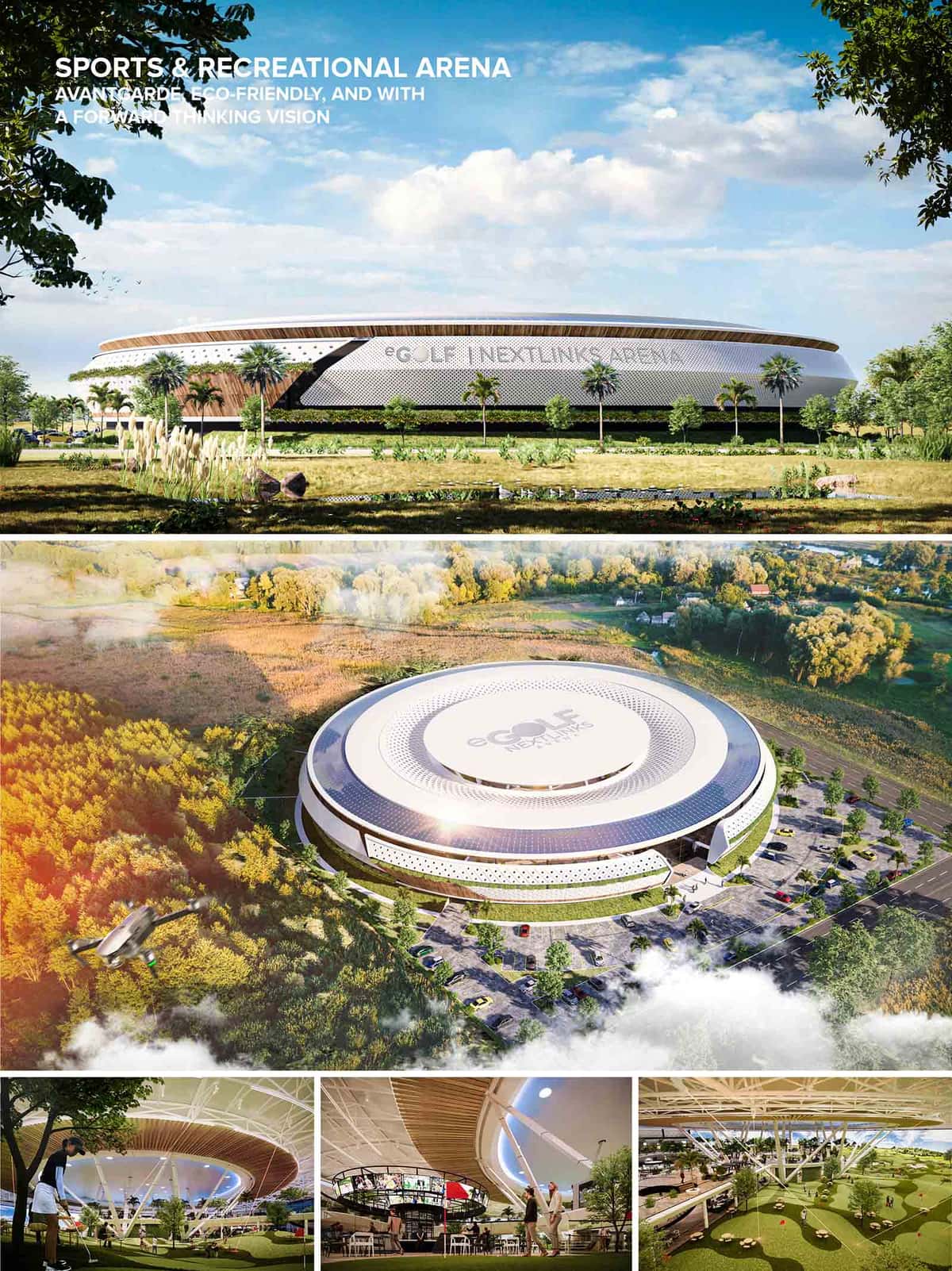

eGolf Arena is a new golf concept that unites sports and entertainment under one roof, creating a functional building full of leisure activities to enjoy with the family, with an iconic avant-garde image that inspires to play the sport with the latest in technology, and all based on the concept of sustainability and respect for the environment.
“Is a functional re-imagination of the brick and mortar standard established for driving range based entertainment, but more efficient in every way along with an iconic building design specification.”
- Dave Shultz, NextLinks
SPORTS & RECREATION ARENA
Sports & recreation arena with a forward thinking vision, where traditional game meets technology, focused on fun & entertainment. Made for young and old, for beginners and experts and for all those who want to have an excellent time involved in the world of golf. The design is conceived as an organic atmosphere, where the spaces flow with natural curves integrating with each other continuously, turning every space as social experience.
“We love so much the game of Golf, so we imagined how the next Play & Entertainment should look & feel like, envisioning almost a sacred place: GOLF Temple. Where technology and entertainment are combined to create a realistic and exciting next generation golfing experience.”
- sanzpont [arquitectura] + Pizá Golf + Nextlinks
GOLF ICONIC VENUE
The building's concept is inspired by the most recognized shape of the game: the golf ball. The round-shaped design welcomes all activities between its 2 floors and its double-height spaces, generating a unique experience that combines sport, technology, leisure and entertainment, learning, human connection, as well as gastronomy. The entrance gives you a spectacular welcoming, while the front desk makes you feel at home, the sports bar is located in a central strategic place, visible from any view, so that you can enjoy a welcome drink in connection with everything space. The gastronomy space gives you the opportunity to enjoy a variety of food experiences for all tastes, making a quiet but always in the same environment, giving you the feeling of playing while you eat. The private spaces are designed in the form of comfortable and pleasant amenities, and the lounge balconies are the perfect space to see and be seen. The use of nature is fundamental in the design, generating an indoor park venue that gives life to the environment.
“The game of Golf is immersed in nature while playing, so we wanted to bring as much of the natural environment Indoors, envisioning a park-venue”
- Victor & Sergio Sanz, sanzpont [arquitectura]
THE GOLF GAME EXPERIENCE
The arena is designed as a disruptive game changer experience, enjoying the amazing atmosphere while playing, making you feel like a pro at the center of the action, combining lights and technology as a part of incredible experience. Virtual games and hitting bays complement the technological experience, taking the sport we love to another level. The playing atrium is designed in a disruptive way, combining a double height space, RGB LED lasers, a topography and playing field grass according to the standards of the game. A space where in addition to feeling the quality of the game and technology, it allows you to have a good time with friends and family while you enjoy yourself, even spending quality time in the fire pit space.
“The strategy behind the design is to provide real shot values that can be as challenging or easy as the player wants. eGolf Arena can be played by an avid golfer or a non-golfer. This is what we strive for: Growing the game we love”
- Agustín Pizá, Pizá Golf
SUSTAINABLE DESIGN
An avant-garde and eco-friendly design, based on sustainability, the use of natural resources and the use of environmentally friendly materials. The use of photovoltaic panels on the roof, take advantage of solar energy to create clean energy, the openings of the building generate natural cross ventilation and the design of the roof, takes advantage of rainwater for its capture. The use of vegetation is fundamental in the design creating a microclimate that improves comfort and clean air.
“An important element of eGolf is sustainability: ecologically, socially and economically. The eGolf arena is designed and developed to bring forward all of the skills of traditional golf within its own uniquely majestic environment. How many new golfers will be inspired to play traditional golf after spending time in our venue?”
Magic is what happens at eGolf
- sanzpont [arquitectura] + Pizá Golf + Nextlinks
The team that has made this concept possible combines creativity and experience in its sector in an avant-garde way, uniting vertical building architecture, horizontal gaming architecture and entertainment technology, all with a cutting-edge and sustainability approach.
Architecture Design: sanzpont [arquitectura]
Golf Design: Pizá Golf
Technology Design: Nextlinks
ABOUT SANZPONT [ARQUITECTURA]
SANZPONT is an AWARD WINNING international architecture firm with offices in Barcelona, México and Chicago. Their main interest is creativity, design and a constant search for innovation. They strive to create connections between people and spaces, always prioritising sustainability and the environment. Having offices in three countries, Spain, México and the United States, Has allowed them to create an important network of professionals and companied that work with them to ensure the successful completion of their designs around the world.
ABOUT PIZÁ GOLF
Agustín Pizá is an AWARD WINNING GOLF COURSE ARCHITECT with a Masters in Golf Course Architecture from Edinburgh University in Scotland. Member of Golf European Institute and the American Society of Gold Course Architects. For more than two decades, Pizá has collaborated with legends of the game and world class golf developments. His designs are known for delivering quality, sustainability, aesthetics and strategic gold courses with its concepts WellnessGolf and GolfLounge.
ABOUT NEXTLINKS
NEXTLINKS provide spacious putting technology and gaming systems that entertain the masses at golf courses and beyond. They partner with preexisting entertainment and restaurant venues, as well as traditional golf destinations, to complement existing spaces with their proprietary technology-driven golf entertainment solutions. Re-purposing under-utilised space without need for brick and mortar construction is their specialty.
• Muse Design Awards, New York, USA : Platinum Award - Sports & Recreation : eGolf NextLinks Arena (2022)


• Muse Design Awards, New York, USA : Platinum Award - Sports & Recreation : eGolf NextLinks Arena (2022)
eGolf Arena is a new golf concept that unites sports and entertainment under one roof, creating a functional building full of leisure activities to enjoy with the family, with an iconic avant-garde image that inspires to play the sport with the latest in technology, and all based on the concept of sustainability and respect for the environment.
“Is a functional re-imagination of the brick and mortar standard established for driving range based entertainment, but more efficient in every way along with an iconic building design specification.”
- Dave Shultz, NextLinks
SPORTS & RECREATION ARENA
Sports & recreation arena with a forward thinking vision, where traditional game meets technology, focused on fun & entertainment. Made for young and old, for beginners and experts and for all those who want to have an excellent time involved in the world of golf. The design is conceived as an organic atmosphere, where the spaces flow with natural curves integrating with each other continuously, turning every space as social experience.
“We love so much the game of Golf, so we imagined how the next Play & Entertainment should look & feel like, envisioning almost a sacred place: GOLF Temple. Where technology and entertainment are combined to create a realistic and exciting next generation golfing experience.”
- sanzpont [arquitectura] + Pizá Golf + Nextlinks
GOLF ICONIC VENUE
The building's concept is inspired by the most recognized shape of the game: the golf ball. The round-shaped design welcomes all activities between its 2 floors and its double-height spaces, generating a unique experience that combines sport, technology, leisure and entertainment, learning, human connection, as well as gastronomy. The entrance gives you a spectacular welcoming, while the front desk makes you feel at home, the sports bar is located in a central strategic place, visible from any view, so that you can enjoy a welcome drink in connection with everything space. The gastronomy space gives you the opportunity to enjoy a variety of food experiences for all tastes, making a quiet but always in the same environment, giving you the feeling of playing while you eat. The private spaces are designed in the form of comfortable and pleasant amenities, and the lounge balconies are the perfect space to see and be seen. The use of nature is fundamental in the design, generating an indoor park venue that gives life to the environment.
“The game of Golf is immersed in nature while playing, so we wanted to bring as much of the natural environment Indoors, envisioning a park-venue”
- Victor & Sergio Sanz, sanzpont [arquitectura]
THE GOLF GAME EXPERIENCE
The arena is designed as a disruptive game changer experience, enjoying the amazing atmosphere while playing, making you feel like a pro at the center of the action, combining lights and technology as a part of incredible experience. Virtual games and hitting bays complement the technological experience, taking the sport we love to another level. The playing atrium is designed in a disruptive way, combining a double height space, RGB LED lasers, a topography and playing field grass according to the standards of the game. A space where in addition to feeling the quality of the game and technology, it allows you to have a good time with friends and family while you enjoy yourself, even spending quality time in the fire pit space.
“The strategy behind the design is to provide real shot values that can be as challenging or easy as the player wants. eGolf Arena can be played by an avid golfer or a non-golfer. This is what we strive for: Growing the game we love”
- Agustín Pizá, Pizá Golf
SUSTAINABLE DESIGN
An avant-garde and eco-friendly design, based on sustainability, the use of natural resources and the use of environmentally friendly materials. The use of photovoltaic panels on the roof, take advantage of solar energy to create clean energy, the openings of the building generate natural cross ventilation and the design of the roof, takes advantage of rainwater for its capture. The use of vegetation is fundamental in the design creating a microclimate that improves comfort and clean air.
“An important element of eGolf is sustainability: ecologically, socially and economically. The eGolf arena is designed and developed to bring forward all of the skills of traditional golf within its own uniquely majestic environment. How many new golfers will be inspired to play traditional golf after spending time in our venue?”
Magic is what happens at eGolf
- sanzpont [arquitectura] + Pizá Golf + Nextlinks
The team that has made this concept possible combines creativity and experience in its sector in an avant-garde way, uniting vertical building architecture, horizontal gaming architecture and entertainment technology, all with a cutting-edge and sustainability approach.
Architecture Design: sanzpont [arquitectura]
Golf Design: Pizá Golf
Technology Design: Nextlinks
ABOUT SANZPONT [ARQUITECTURA]
SANZPONT is an AWARD WINNING international architecture firm with offices in Barcelona, México and Chicago. Their main interest is creativity, design and a constant search for innovation. They strive to create connections between people and spaces, always prioritising sustainability and the environment. Having offices in three countries, Spain, México and the United States, Has allowed them to create an important network of professionals and companied that work with them to ensure the successful completion of their designs around the world.
ABOUT PIZÁ GOLF
Agustín Pizá is an AWARD WINNING GOLF COURSE ARCHITECT with a Masters in Golf Course Architecture from Edinburgh University in Scotland. Member of Golf European Institute and the American Society of Gold Course Architects. For more than two decades, Pizá has collaborated with legends of the game and world class golf developments. His designs are known for delivering quality, sustainability, aesthetics and strategic gold courses with its concepts WellnessGolf and GolfLounge.
ABOUT NEXTLINKS
NEXTLINKS provide spacious putting technology and gaming systems that entertain the masses at golf courses and beyond. They partner with preexisting entertainment and restaurant venues, as well as traditional golf destinations, to complement existing spaces with their proprietary technology-driven golf entertainment solutions. Re-purposing under-utilised space without need for brick and mortar construction is their specialty.
© 2021 by sanzpont [arquitectura] . Webpage by sanzpont [digital] . Innovative Digital Experiences
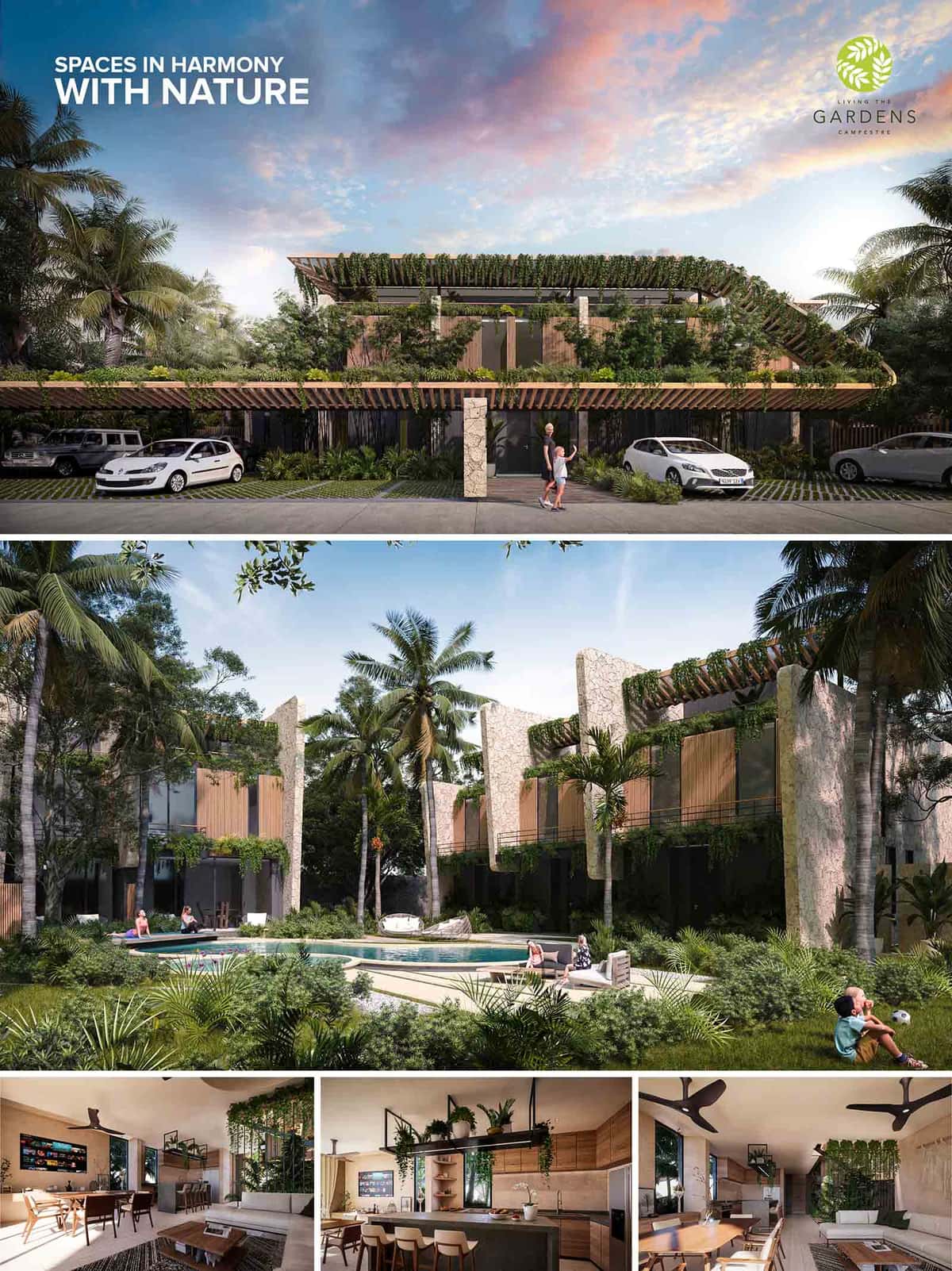

Living The Gardens development, is a complex of 9 villas in condominium regime, on a land of 2,373 m2 with a land use category H1C, the complex is located in the Residencial Campestre subdivision, Paseo del Mar street No. 64, in Cancun, Mexico. The villas are 3-level buildings, with a total of 216 to 275 m2 depending on the villa model.
The ground floor includes access, living room, dining room, kitchen, terrace, 1/2 bathroom and utility room, in addition to the vertical circulation integrated into an interior garden; with a total between 69 and 78 m2 depending on the villa model.
The first floor includes lobby and vertical circulation, master bedroom with bathroom, dressing room and balcony, as well as 2 secondary bedrooms with shared bathroom; with a total between 63 and 65 m2 depending on the villa model.
The roof floor includes lobby and vertical circulation, roof garden with pergola, outdoor kitchenette and flower boxes; with a total between 57 and 59 m2 depending on the villa model.
The complex, in addition to the park, has outdoor amenities, such as a pool, garden, children's area, picnic area, outdoor gym, yoga area, sun deck and pet area.
DEVELOPED AS
DIRSA
• APR Global Future Design Awards: Silver Award Winner : Living The Gardens (2022)
• APR Chinese Design Awards : Gold Award Winner : Living The Gardens (2022)
• A’ Design Awards, Milan, Italy : Iron Award - Certificate Of Excellence in Architecture, Building and Structure Design Category : Living The Gardens (2022)
• World Architecture Awards 10+5+X Honorary Members : Architecture - Designed Category, 40th Cycle : Living The Gardens (2022)
• Muse Design Awards, New York, USA : Platinum Award - Conceptual Design : Living The Gardens (2022)
• The Plan Awards, Bologna, Italy : Shortlisted in Future Housing : Living The Gardens (2022)
• London International Creative Competition : Shortlist : Living The Gardens (2021)


• APR Global Future Design Awards: Silver Award Winner : Living The Gardens (2022)
• APR Chinese Design Awards : Gold Award Winner : Living The Gardens (2022)
• A’ Design Awards, Milan, Italy : Iron Award - Certificate Of Excellence in Architecture, Building and Structure Design Category : Living The Gardens (2022)
• World Architecture Awards 10+5+X Honorary Members : Architecture - Designed Category, 40th Cycle : Living The Gardens (2022)
• Muse Design Awards, New York, USA : Platinum Award - Conceptual Design : Living The Gardens (2022)
• The Plan Awards, Bologna, Italy : Shortlisted in Future Housing : Living The Gardens (2022)
• London International Creative Competition : Shortlist : Living The Gardens (2021)
Living The Gardens development, is a complex of 9 villas in condominium regime, on a land of 2,373 m2 with a land use category H1C, the complex is located in the Residencial Campestre subdivision, Paseo del Mar street No. 64, in Cancun, Mexico. The villas are 3-level buildings, with a total of 216 to 275 m2 depending on the villa model.
The ground floor includes access, living room, dining room, kitchen, terrace, 1/2 bathroom and utility room, in addition to the vertical circulation integrated into an interior garden; with a total between 69 and 78 m2 depending on the villa model.
The first floor includes lobby and vertical circulation, master bedroom with bathroom, dressing room and balcony, as well as 2 secondary bedrooms with shared bathroom; with a total between 63 and 65 m2 depending on the villa model.
The roof floor includes lobby and vertical circulation, roof garden with pergola, outdoor kitchenette and flower boxes; with a total between 57 and 59 m2 depending on the villa model.
The complex, in addition to the park, has outdoor amenities, such as a pool, garden, children's area, picnic area, outdoor gym, yoga area, sun deck and pet area.
DEVELOPED AS
DIRSA
© 2021 by sanzpont [arquitectura] . Webpage by sanzpont [digital] . Innovative Digital Experiences
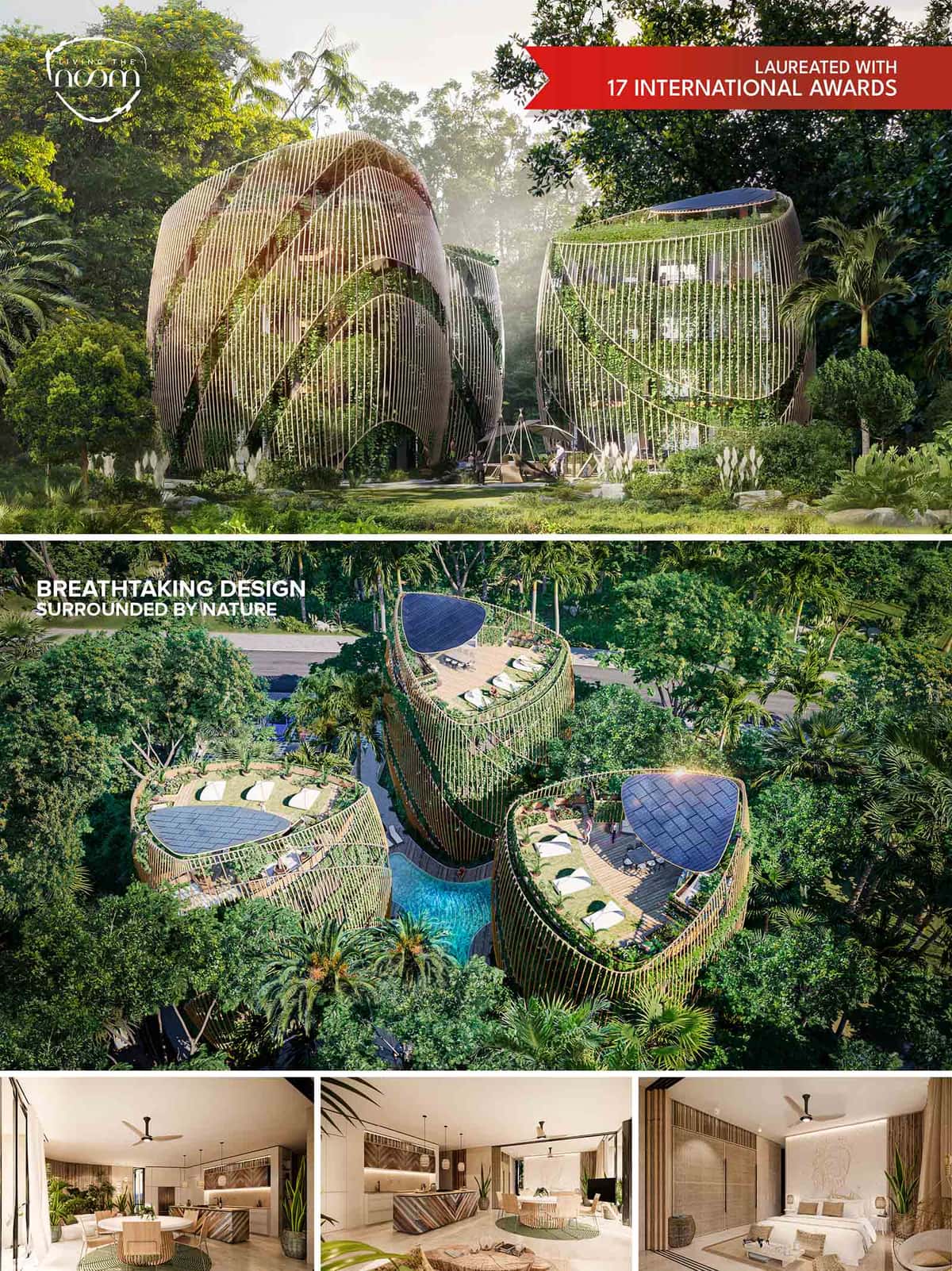

How would you like to live the rest of your life? We have asked ourselves the same question. Each one of us looks alike because we are human beings, but… we are truly different, we have different tastes, different needs… and above all a personality, each of us is “unique” in our own particular way. And this is where we have always asked ourselves: Why are all the homes for sale almost, all the same? Because almost all of them seem to be cut from the same mold? Do we all have the same personality? The same beliefs, or the same way of being? or the same tastes?
The reality is that on many occasions we let situations define us and we choose the least bad option.
IN HARMONY WITH THE SPIRIT
We are clear that living a full life, not only contemplates covering the basic physiological needs, also we must fill and satisfy the soul through stimuli that make us feel alive, we want to create a community that promotes Artistic Expression, invites to exercise, Yoga and Meditation, live with Nature every day at all times, promote a healthy diet, be designed for all family members through Pet Friendly spaces, but truly create a Community of people who share life with the same values.
Contact with nature transmits us tranquility, and provides us with a good dose of calm, and it can be the anti-stress oxygen that lowers the revolutions of the day, creating a bubble of peace that gives us mental health; with outdoor spaces for Exercise, Yoga and Meditation, as well as promoting healthy Eating through an Organic Garden and Hydroponic Cultivation.
PEACE “If you are sad, you are living in the past. Being anxious in some way means that you are living in the future. If you are at peace, you are living in the present ”Lao Tzu
We look for admirers of expressions, who through spaces surrounded by murals, installations, poetry and positive sentences written on the walls, floors and furniture, open us to experiment. We want to breathe art and expressions, and through workshops with local artists inspire us to create, to dream.
“Art is dreaming, it is living, it is feeling. Art sears your soul, moves you, transports you. It has a magical power in people if we open ourselves to experiment. And best of all, it invites us to express ourselves, to bring out the artist that we all carry inside ... Because art can be a great discovery. " Mercè López, The heART Ambassadors
We want to create a Pet Friendly community that provides a better life for all of our loved ones, because for many of us the love of our pets is as great as if they were our children.
Because it is difficult to live with people who do not share the same ideals and values, and society is very heterogeneous in ways of thinking, what is important for one may be trivial for others. We are convinced that in order to truly have a full life in society, community must be formed. The most important thing in real estate products should not be the business, but rather bring people who are like-minded closer to improving their quality of life, with tribal projects.
We care a lot about nature, we hate how people just eliminate and destroy everything in order to accommodate. Our duty should simply be to improve each place where we decide to build, we must simply coexist and have respect for the earth. That is the reason why we have decided to only occupy a maximum of 30% of the land, respecting the existing trees, in addition to providing even more green surface than we found, ultimately managing to increase the total green area by 130%.
The project promotes through passive and bioclimatic design the reduction of the use of resources, economic savings, with the aim of achieving a more sustainable and environmentally friendly housing product.
Passive design strategies are proposed to reduce energy consumption and increase the efficiency of the building, taking advantage of renewable energies for lighting, taking advantage of natural light, in addition to generating energy, through photovoltaic solar panels, located on the roof. Efficient installations are also very important, as well as the high-efficiency LED artificial lighting system.
1.- The interior spaces are illuminated throughout the day by natural lighting.
2.- Solar panels on the roof that generate energy.
3.- Cover with Thermal Insulation, to prevent thermal transmission.
4.- Natural green roof with grass as Thermal Insulation and social recreation area, in addition to cultivation area, for edible plants.
Natural lighting is achieved through the facades, where each unit has a single level taking advantage of 360 degrees of natural light. A bamboo and vegetation lattice is used to mitigate the overheating of the facades and to have a better control of the light and an adequate thermal environment in the interior spaces.
1.- All spaces have indirect natural light.
2.- The design of the house promotes natural ventilation to renew the indoor air and ensure an optimal level of comfort.
A more intelligent use of water is applied, both inside and outside the building, using technologies to reduce consumption, efficient installations, recycling water through the separation of gray water, then taking advantage of it for the irrigation of green areas, as well as its control and measurement.
The selection of responsible and local materials is proposed, in addition to minimizing the amount of waste in construction, as well as materials with recycled components and low environmental impact.
Although we know the human impact generated in nature by the settlement of people to live, we want to minimize it by preserving existing trees, also respecting natural life, trying to cohabit with squirrels, birds, iguanas and coatis that visit the land regularly, promoting a Low Ecological Footprint project
• LADI Awards, Latin American Real Estate Awards, Panamá : Best Disruptive Real State Product in Latin America : Living The Noom (2022)
• IDA Design Awards 2021 : Gold Medal : Living The Noom (2021)
• Global Future Design Awards 2021 : Winner : Living The Noom (2021)
• Golden Trezzini Awards 2021 : Best Project Residential : Living The Noom (2021)
• Tuvie Magazine : 2nd Best of the Best Design of the Year : Living The Noom (2021)
• The Architecture Community World Design Awards 2021 : Winner : Living The Noom (2021)
• Loop Design Awards : Architecture Concept Winner : Living The Noom (2021)
• The Plan Awards, Bologna, Italy : Honorable Mention in Future Housing : Living The Noom (2021)
• Top 20 A’ Architecture, Building And Structure Design Award, Milan, Italy: 2nd Best of the Best Design of the Year : Living The Noom (2020-2021)
• Novum Design Awards, Helsinki, Finland : Gold Award Winner : Living The Noom (2021)
• Architizer A+ Design Awards : 1st Place Jury Winner : Living The Noom (2021)
• Architizer A+ Design Awards : 1st Place Popular Choice Winner : Living The Noom (2021)
• APR Urban Design & Architecture Design Awards : 1st Place Winner : Living The Noom (2021)
• Rethinking The Future, New Delhi, India: Second Award - Housing (Upto 5 Floors) Concept : Living The Noom (2021)
• A’ Design Awards, Milan, Italy: Platinum Medal - Certificate Of Excellence in Architecture, Building and Structure Design Category: Living The Noom (2021)
• Muse Design Awards, New York, USA : Platinum Award - Conceptual Design of the Year : Living The Noom (2021)
• World Architecture Awards 10+5+X Honorary Members: Architecture - Designed Category, 36th Cycle : Living The Noom (2021)
sanzpont [arquitectura]
Pedrajo+Pedrajo Arquitectos
Grupo NX6


• LADI Awards, Latin American Real Estate Awards, Panamá : Best Disruptive Real State Product in Latin America : Living The Noom (2022)
• IDA Design Awards 2021 : Gold Medal : Living The Noom (2021)
• Global Future Design Awards 2021 : Winner : Living The Noom (2021)
• Golden Trezzini Awards 2021 : Best Project Residential : Living The Noom (2021)
• Tuvie Magazine : 2nd Best of the Best Design of the Year : Living The Noom (2021)
• The Architecture Community World Design Awards 2021 : Winner : Living The Noom (2021)
• Loop Design Awards : Architecture Concept Winner : Living The Noom (2021)
• The Plan Awards, Bologna, Italy : Honorable Mention in Future Housing : Living The Noom (2021)
• Top 20 A’ Architecture, Building And Structure Design Award, Milan, Italy: 2nd Best of the Best Design of the Year : Living The Noom (2020-2021)
• Novum Design Awards, Helsinki, Finland : Gold Award Winner : Living The Noom (2021)
• Architizer A+ Design Awards : 1st Place Jury Winner : Living The Noom (2021)
• Architizer A+ Design Awards : 1st Place Popular Choice Winner : Living The Noom (2021)
• APR Urban Design & Architecture Design Awards : 1st Place Winner : Living The Noom (2021)
• Rethinking The Future, New Delhi, India: Second Award - Housing (Upto 5 Floors) Concept : Living The Noom (2021)
• A’ Design Awards, Milan, Italy: Platinum Medal - Certificate Of Excellence in Architecture, Building and Structure Design Category: Living The Noom (2021)
• Muse Design Awards, New York, USA : Platinum Award - Conceptual Design of the Year : Living The Noom (2021)
• World Architecture Awards 10+5+X Honorary Members: Architecture - Designed Category, 36th Cycle : Living The Noom (2021)
sanzpont [arquitectura]
Pedrajo+Pedrajo Arquitectos
Grupo NX6
How would you like to live the rest of your life? We have asked ourselves the same question. Each one of us looks alike because we are human beings, but… we are truly different, we have different tastes, different needs… and above all a personality, each of us is “unique” in our own particular way. And this is where we have always asked ourselves: Why are all the homes for sale almost, all the same? Because almost all of them seem to be cut from the same mold? Do we all have the same personality? The same beliefs, or the same way of being? or the same tastes?
The reality is that on many occasions we let situations define us and we choose the least bad option.
IN HARMONY WITH THE SPIRIT
We are clear that living a full life, not only contemplates covering the basic physiological needs, also we must fill and satisfy the soul through stimuli that make us feel alive, we want to create a community that promotes Artistic Expression, invites to exercise, Yoga and Meditation, live with Nature every day at all times, promote a healthy diet, be designed for all family members through Pet Friendly spaces, but truly create a Community of people who share life with the same values.
Contact with nature transmits us tranquility, and provides us with a good dose of calm, and it can be the anti-stress oxygen that lowers the revolutions of the day, creating a bubble of peace that gives us mental health; with outdoor spaces for Exercise, Yoga and Meditation, as well as promoting healthy Eating through an Organic Garden and Hydroponic Cultivation.
PEACE “If you are sad, you are living in the past. Being anxious in some way means that you are living in the future. If you are at peace, you are living in the present ”Lao Tzu
We look for admirers of expressions, who through spaces surrounded by murals, installations, poetry and positive sentences written on the walls, floors and furniture, open us to experiment. We want to breathe art and expressions, and through workshops with local artists inspire us to create, to dream.
“Art is dreaming, it is living, it is feeling. Art sears your soul, moves you, transports you. It has a magical power in people if we open ourselves to experiment. And best of all, it invites us to express ourselves, to bring out the artist that we all carry inside ... Because art can be a great discovery. " Mercè López, The heART Ambassadors
We want to create a Pet Friendly community that provides a better life for all of our loved ones, because for many of us the love of our pets is as great as if they were our children.
Because it is difficult to live with people who do not share the same ideals and values, and society is very heterogeneous in ways of thinking, what is important for one may be trivial for others. We are convinced that in order to truly have a full life in society, community must be formed. The most important thing in real estate products should not be the business, but rather bring people who are like-minded closer to improving their quality of life, with tribal projects.
We care a lot about nature, we hate how people just eliminate and destroy everything in order to accommodate. Our duty should simply be to improve each place where we decide to build, we must simply coexist and have respect for the earth. That is the reason why we have decided to only occupy a maximum of 30% of the land, respecting the existing trees, in addition to providing even more green surface than we found, ultimately managing to increase the total green area by 130%.
The project promotes through passive and bioclimatic design the reduction of the use of resources, economic savings, with the aim of achieving a more sustainable and environmentally friendly housing product.
Passive design strategies are proposed to reduce energy consumption and increase the efficiency of the building, taking advantage of renewable energies for lighting, taking advantage of natural light, in addition to generating energy, through photovoltaic solar panels, located on the roof. Efficient installations are also very important, as well as the high-efficiency LED artificial lighting system.
1.- The interior spaces are illuminated throughout the day by natural lighting.
2.- Solar panels on the roof that generate energy.
3.- Cover with Thermal Insulation, to prevent thermal transmission.
4.- Natural green roof with grass as Thermal Insulation and social recreation area, in addition to cultivation area, for edible plants.
Natural lighting is achieved through the facades, where each unit has a single level taking advantage of 360 degrees of natural light. A bamboo and vegetation lattice is used to mitigate the overheating of the facades and to have a better control of the light and an adequate thermal environment in the interior spaces.
1.- All spaces have indirect natural light.
2.- The design of the house promotes natural ventilation to renew the indoor air and ensure an optimal level of comfort.
A more intelligent use of water is applied, both inside and outside the building, using technologies to reduce consumption, efficient installations, recycling water through the separation of gray water, then taking advantage of it for the irrigation of green areas, as well as its control and measurement.
The selection of responsible and local materials is proposed, in addition to minimizing the amount of waste in construction, as well as materials with recycled components and low environmental impact.
Although we know the human impact generated in nature by the settlement of people to live, we want to minimize it by preserving existing trees, also respecting natural life, trying to cohabit with squirrels, birds, iguanas and coatis that visit the land regularly, promoting a Low Ecological Footprint project
© 2021 by sanzpont [arquitectura] . Webpage by sanzpont [digital] . Innovative Digital Experiences
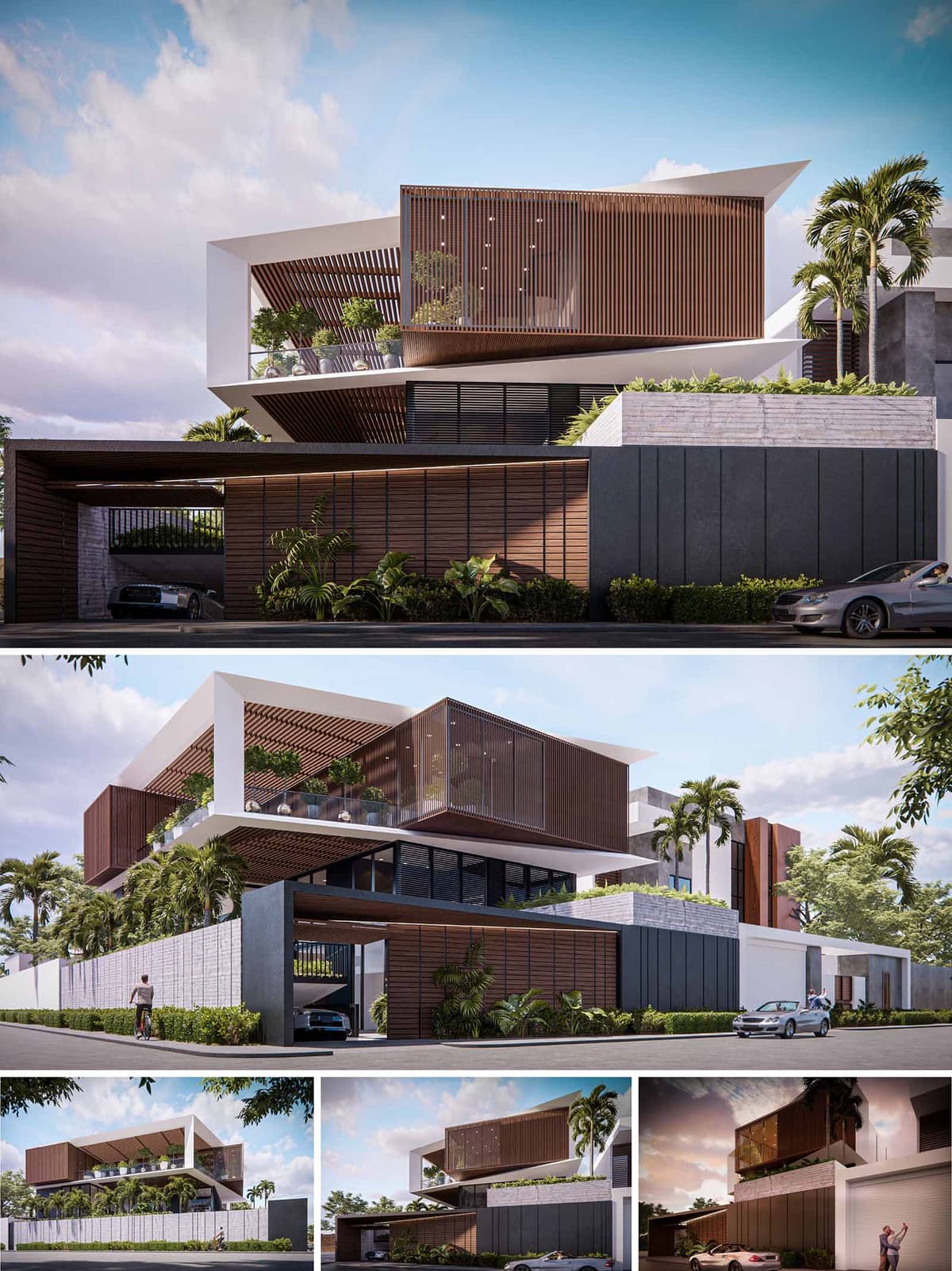

MA Villa is conceived as a contemporary reinterpretation of the traditional Riyadh courtyard house, combining strong geometric volumes with deep shaded terraces to ensure privacy and climatic comfort. The composition of interlocking white frames and warm timber screens generates a sense of floating masses, while the ground level remains visually permeable to connect the house with the street and garden. The villa is designed as an urban oasis, where architecture, vegetation and light orchestrate a calm domestic landscape.
The villa is located on a corner plot in a low-rise residential district of Riyadh, characterized by wide streets, generous setbacks and intense solar exposure. The design responds by presenting a controlled, almost introverted street frontage, while opening gradually towards internal patios and elevated gardens. The main vehicular access is emphasized by a deep, shaded porte-cochère, separating guest arrival from the more discreet family entrance and service access along the side.
The building is organized as stacked, offset volumes that create overhangs and double-height voids. A solid base anchors the project, above which the first-floor white frame projects outward, generating covered outdoor living areas. The upper volume, wrapped in vertical timber louvers, appears to float, producing a dynamic yet balanced composition. These shifts in massing are carefully calibrated to control views, produce shade, and articulate a hierarchy between public, semi-private and private zones of the villa.
The façade strategy contrasts three main materials: crisp white rendered frames, dark stone or composite panels at the base, and warm timber cladding and louvers at the upper levels. The vertical wooden fins reinterpret the regional mashrabiya, providing privacy and solar control while maintaining filtered outward views. Horizontal pergolas extend this language, casting patterned shadows over terraces and reinforcing the villa’s identity throughout the day. Glazing is recessed behind shading layers to reduce direct solar gain and glare.
Internally, living spaces are arranged around visual axes toward planted terraces and linear gardens. Large sliding glass panels allow the majlis and family living rooms to open fully to outdoor decks, transforming them into shaded semi-open salons during the cooler months. The offset slabs create double-height interfaces filled with greenery, so that upper-floor corridors and bedrooms overlook pockets of landscape rather than directly onto the street, enhancing privacy and spatial richness.
Landscape is woven into every level of the project: ground-floor planters soften the boundary wall, mid-level terraces accommodate container gardens and small trees, and the roofline is crowned with continuous planting beds. The front setback becomes a linear garden buffering the villa from the street, while the rear accommodates more intimate family outdoor areas. Climatically resilient species are selected for low water consumption, complemented by integrated planters along the carport and entrance, reinforcing the sense of arrival.
The architectural language directly supports environmental performance in Riyadh’s hot desert climate. Deep overhangs, recessed glazing and the timber louver system substantially reduce solar heat gain, decreasing cooling loads. The orientation prioritizes shaded facades and harnesses prevailing breezes through cross-ventilation where possible. High-performance glazing, insulated walls and light-colored external frames mitigate thermal absorption. Landscape irrigation is optimized through drip systems and drought-tolerant planting, while the extensive shading and greenery improve microclimate comfort for both indoor spaces and outdoor terraces.


MA Villa is conceived as a contemporary reinterpretation of the traditional Riyadh courtyard house, combining strong geometric volumes with deep shaded terraces to ensure privacy and climatic comfort. The composition of interlocking white frames and warm timber screens generates a sense of floating masses, while the ground level remains visually permeable to connect the house with the street and garden. The villa is designed as an urban oasis, where architecture, vegetation and light orchestrate a calm domestic landscape.
The villa is located on a corner plot in a low-rise residential district of Riyadh, characterized by wide streets, generous setbacks and intense solar exposure. The design responds by presenting a controlled, almost introverted street frontage, while opening gradually towards internal patios and elevated gardens. The main vehicular access is emphasized by a deep, shaded porte-cochère, separating guest arrival from the more discreet family entrance and service access along the side.
The building is organized as stacked, offset volumes that create overhangs and double-height voids. A solid base anchors the project, above which the first-floor white frame projects outward, generating covered outdoor living areas. The upper volume, wrapped in vertical timber louvers, appears to float, producing a dynamic yet balanced composition. These shifts in massing are carefully calibrated to control views, produce shade, and articulate a hierarchy between public, semi-private and private zones of the villa.
The façade strategy contrasts three main materials: crisp white rendered frames, dark stone or composite panels at the base, and warm timber cladding and louvers at the upper levels. The vertical wooden fins reinterpret the regional mashrabiya, providing privacy and solar control while maintaining filtered outward views. Horizontal pergolas extend this language, casting patterned shadows over terraces and reinforcing the villa’s identity throughout the day. Glazing is recessed behind shading layers to reduce direct solar gain and glare.
Internally, living spaces are arranged around visual axes toward planted terraces and linear gardens. Large sliding glass panels allow the majlis and family living rooms to open fully to outdoor decks, transforming them into shaded semi-open salons during the cooler months. The offset slabs create double-height interfaces filled with greenery, so that upper-floor corridors and bedrooms overlook pockets of landscape rather than directly onto the street, enhancing privacy and spatial richness.
Landscape is woven into every level of the project: ground-floor planters soften the boundary wall, mid-level terraces accommodate container gardens and small trees, and the roofline is crowned with continuous planting beds. The front setback becomes a linear garden buffering the villa from the street, while the rear accommodates more intimate family outdoor areas. Climatically resilient species are selected for low water consumption, complemented by integrated planters along the carport and entrance, reinforcing the sense of arrival.
The architectural language directly supports environmental performance in Riyadh’s hot desert climate. Deep overhangs, recessed glazing and the timber louver system substantially reduce solar heat gain, decreasing cooling loads. The orientation prioritizes shaded facades and harnesses prevailing breezes through cross-ventilation where possible. High-performance glazing, insulated walls and light-colored external frames mitigate thermal absorption. Landscape irrigation is optimized through drip systems and drought-tolerant planting, while the extensive shading and greenery improve microclimate comfort for both indoor spaces and outdoor terraces.
© 2021 by sanzpont [arquitectura] . Webpage by sanzpont [digital] . Innovative Digital Experiences
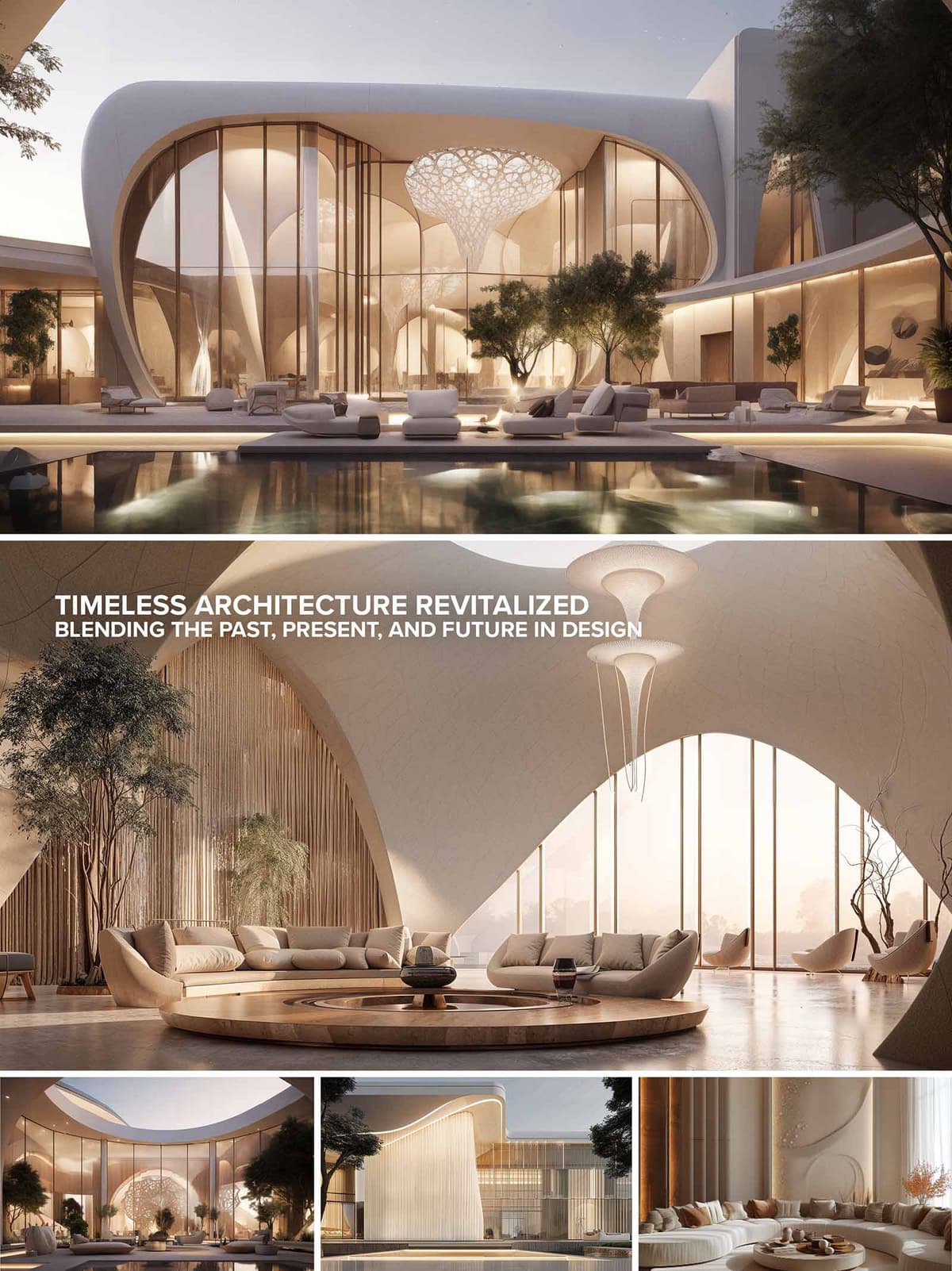

This palace embodies the pinnacle of sophisticated design, blending timeless architectural elements with modern innovations. The design concept revolves around creating an elegant yet sustainable environment that leverages natural light, ventilation, and cutting-edge materials. The palace features expansive spaces that seamlessly integrate indoor and outdoor living, emphasizing harmony with the natural surroundings.
The design exemplifies the fusion of luxury, elegance and sustainability, setting a new standard for high-end residential design. Through its thoughtful integration of natural light, ventilation, and sustainable practices, the palace not only provides an exquisite living experience but also demonstrates a commitment to environmental stewardship. The result is a timeless architectural masterpiece that offers both comfort and ecological responsibility.
The exterior is distinguished by its graceful curves and extensive use of glass, creating a transparent façade that blurs the lines between indoors and outdoors. The strategic placement of large windows follows the solar path, maximizing natural light while minimizing heat gain. Louvers and overhangs provide effective sun protection, ensuring comfort throughout the day. The exterior materials include reinforced concrete and high-performance glazing, ensuring durability and energy efficiency. Integrated landscaping, including mature trees and lush gardens, enhances the building’s organic aesthetic.
The interior design maintains the palace’s refined essence with spacious, light-filled rooms. The central living area features double-height ceilings adorned with custom sculptural light fixtures that mimic natural forms, such as blooming flowers, providing both illumination and visual interest. The layout promotes fluidity between spaces, with each area flowing seamlessly into the next.
The interior palette is dominated by natural, high-quality materials such as warm woods, polished stone, and rich textiles. The furnishings are designed for both comfort and elegance, featuring custom-made pieces that reflect the palace’s overall aesthetic. The color scheme consists of neutral tones, with accents of greenery and gold to enhance the refined feel.
Sustainability is a cornerstone of the palace’s design. The architecture incorporates advanced climate control systems and high-performance insulation, reducing energy consumption. Solar panels on the roof harness renewable energy, while efficient water systems, including rainwater harvesting, support conservation efforts. The design also emphasizes natural ventilation and lighting, significantly reducing reliance on artificial systems. Green spaces within and around the palace improve air quality and provide natural cooling.
The design strategically incorporates patios and courtyards to enhance natural sunlight and ventilation. These open spaces are thoughtfully placed to allow cross-ventilation, reducing the need for mechanical cooling. The patios serve as tranquil retreats, featuring water elements and native vegetation that create a serene ambiance while promoting environmental sustainability.
The landscape design mirrors the palace’s architectural elegance with a combination of formal and organic elements. Terraces, reflective pools, and lush gardens create a serene outdoor environment. The use of native plants ensures water efficiency and supports local biodiversity. The central courtyard, with its expansive water feature, acts as a focal point, offering a space for relaxation and reflection.
Lighting is meticulously planned to highlight the architectural features and enhance the palace’s sophisticated ambiance. Large windows and skylights are strategically positioned to maximize natural daylight, reducing the need for artificial lighting. At night, carefully placed LED fixtures illuminate the palace’s contours and materials, creating a captivating nighttime aesthetic while ensuring energy efficiency.


This palace embodies the pinnacle of sophisticated design, blending timeless architectural elements with modern innovations. The design concept revolves around creating an elegant yet sustainable environment that leverages natural light, ventilation, and cutting-edge materials. The palace features expansive spaces that seamlessly integrate indoor and outdoor living, emphasizing harmony with the natural surroundings.
The design exemplifies the fusion of luxury, elegance and sustainability, setting a new standard for high-end residential design. Through its thoughtful integration of natural light, ventilation, and sustainable practices, the palace not only provides an exquisite living experience but also demonstrates a commitment to environmental stewardship. The result is a timeless architectural masterpiece that offers both comfort and ecological responsibility.
The exterior is distinguished by its graceful curves and extensive use of glass, creating a transparent façade that blurs the lines between indoors and outdoors. The strategic placement of large windows follows the solar path, maximizing natural light while minimizing heat gain. Louvers and overhangs provide effective sun protection, ensuring comfort throughout the day. The exterior materials include reinforced concrete and high-performance glazing, ensuring durability and energy efficiency. Integrated landscaping, including mature trees and lush gardens, enhances the building’s organic aesthetic.
The interior design maintains the palace’s refined essence with spacious, light-filled rooms. The central living area features double-height ceilings adorned with custom sculptural light fixtures that mimic natural forms, such as blooming flowers, providing both illumination and visual interest. The layout promotes fluidity between spaces, with each area flowing seamlessly into the next.
The interior palette is dominated by natural, high-quality materials such as warm woods, polished stone, and rich textiles. The furnishings are designed for both comfort and elegance, featuring custom-made pieces that reflect the palace’s overall aesthetic. The color scheme consists of neutral tones, with accents of greenery and gold to enhance the refined feel.
Sustainability is a cornerstone of the palace’s design. The architecture incorporates advanced climate control systems and high-performance insulation, reducing energy consumption. Solar panels on the roof harness renewable energy, while efficient water systems, including rainwater harvesting, support conservation efforts. The design also emphasizes natural ventilation and lighting, significantly reducing reliance on artificial systems. Green spaces within and around the palace improve air quality and provide natural cooling.
The design strategically incorporates patios and courtyards to enhance natural sunlight and ventilation. These open spaces are thoughtfully placed to allow cross-ventilation, reducing the need for mechanical cooling. The patios serve as tranquil retreats, featuring water elements and native vegetation that create a serene ambiance while promoting environmental sustainability.
The landscape design mirrors the palace’s architectural elegance with a combination of formal and organic elements. Terraces, reflective pools, and lush gardens create a serene outdoor environment. The use of native plants ensures water efficiency and supports local biodiversity. The central courtyard, with its expansive water feature, acts as a focal point, offering a space for relaxation and reflection.
Lighting is meticulously planned to highlight the architectural features and enhance the palace’s sophisticated ambiance. Large windows and skylights are strategically positioned to maximize natural daylight, reducing the need for artificial lighting. At night, carefully placed LED fixtures illuminate the palace’s contours and materials, creating a captivating nighttime aesthetic while ensuring energy efficiency.
© 2021 by sanzpont [arquitectura] . Webpage by sanzpont [digital] . Innovative Digital Experiences
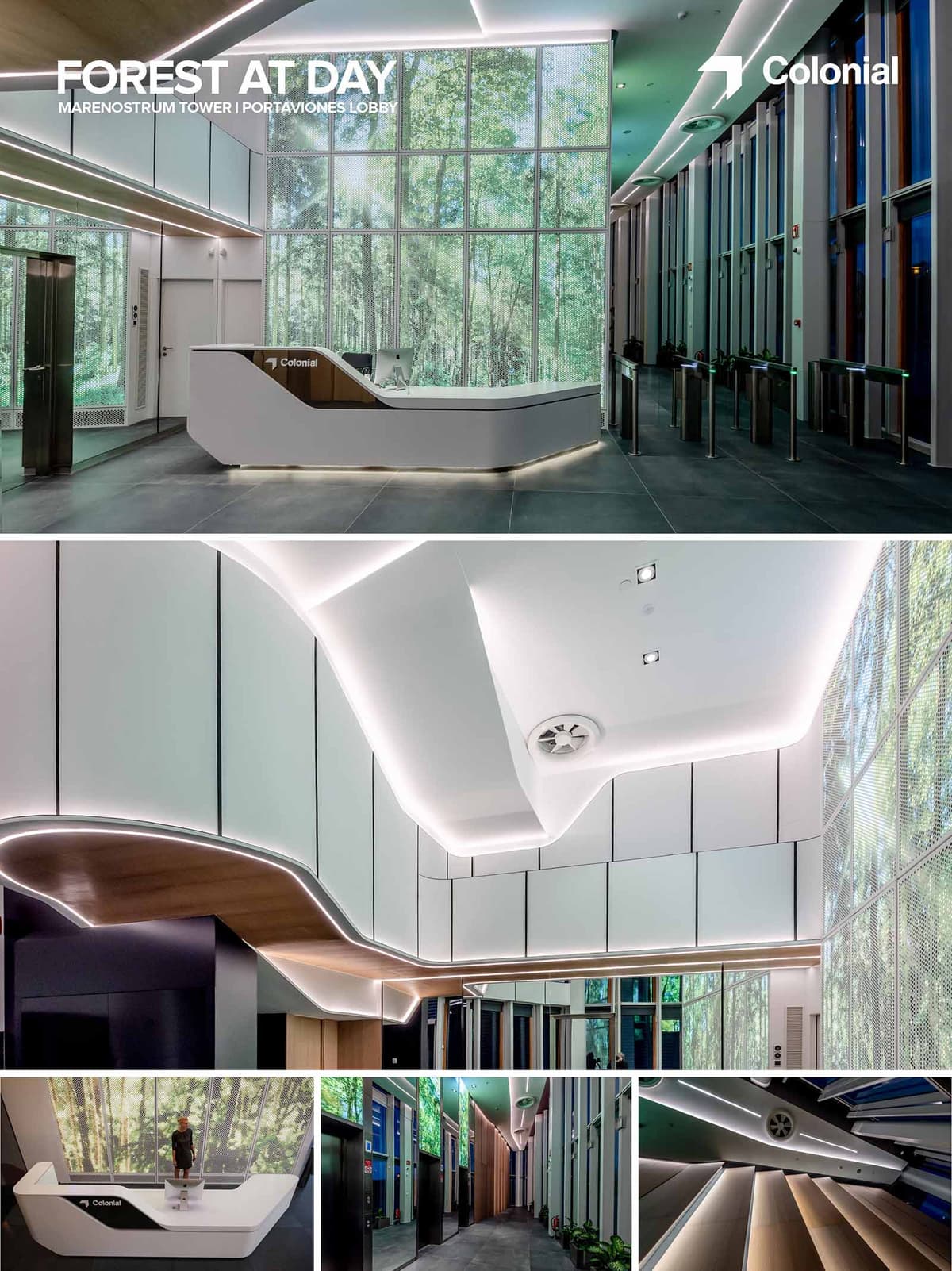

The lobby of TMN Portaviones in Barcelona is conceived as an urban clearing: a transitional space where the intensity of the city dissolves into the calm of a digital forest. The design merges high-tech corporate precision with biophilic immersion, using large-scale media façades and continuous light lines to evoke the experience of walking through a forest at daytime. Every gesture in plan, volume and lighting is oriented toward softening the threshold between exterior and interior, public street and corporate tower.
The project addresses the lobby not only as a reception, but as a spatial interface between users and building systems. Access control, wayfinding, security and branding are integrated into a single fluid landscape. Visual continuity and controlled reflections extend the perceived dimensions of the hall, amplifying the sense of openness while maintaining a clear functional hierarchy.
The lobby develops as a linear nave parallel to the façade, guiding visitors from the main entrance towards the elevator core. Turnstiles, reception desk and waiting areas are aligned along this axis, ensuring intuitive circulation and optimal visibility. The double-height volume at the entrance reinforces the sense of arrival, while the progressive narrowing of the space creates a subtle gradient from public to semi-private zones.
Vertical surfaces are articulated through tall glazed modules and backlit panels that rhythmically echo the trunks of a forest. The access-control line is positioned so as to maintain visual continuity across the entire hall, allowing guests and employees to share the same spatial experience while preserving security protocols.
The material palette balances technological rigor with warm tactility. Large-format stone or porcelain tiles in neutral grey form a robust and continuous floor, while white solid-surface elements sculpt the reception desk and ceiling volumes with sharp, precise edges. These monolithic elements are contrasted by warm timber soffits and cladding, which introduce a natural grain reminiscent of tree canopies and forest floors.
Joints, reveals and shadow gaps are carefully controlled to enhance the perception of floating planes. The reception counter integrates lighting and signage in a single folded volume, eliminating visual noise. Metal finishes on elevator doors and turnstiles are kept in a satin tone, reflecting light softly without generating glare, complementing the digital forest imagery instead of competing with it.
Lighting acts as the main narrative tool of the project. Continuous LED profiles trace the edges of ceilings and walls, describing sinuous lines that recall pathways of light filtering through foliage. Indirect illumination accentuates the sculptural ceiling geometry, avoiding harsh contrasts and promoting visual comfort in a space with extensive glass and reflective surfaces.
The key feature is the large-scale digital façade displaying high-resolution images of a forest in daylight. This media surface operates as an artificial horizon, bringing depth and movement into the lobby. Programmable content allows subtle variations in luminosity and color temperature throughout the day, aligning the interior ambience with circadian rhythms and reinforcing user well-being.
The chromatic palette is purposefully restrained: whites, greys and natural wood tones create a neutral, timeless backdrop. Against this quiet base, the green hues of the digital forest become the true protagonist, infusing the lobby with a vivid yet non-invasive presence. The overall effect is calming and legible, avoiding visual fatigue despite the intensity of the digital content.
Corporate identity is integrated with discretion. Logos and graphic elements appear as part of the architectural composition, embedded in the reception desk and media surfaces rather than superimposed. This approach reinforces a perception of the brand as technologically advanced yet respectful of the environment and user experience.
The project adopts sustainability as a design driver through both active and passive strategies. Extensive use of high-efficiency LEDs with digital control systems reduces energy consumption and allows adaptation of lighting levels to occupancy patterns and natural daylight. The digital forest content is calibrated to operate within low-brightness parameters, minimizing energy demand and light pollution while maintaining visual impact.
Biophilic design principles are central: large-scale natural imagery, warm natural materials and a balanced acoustic treatment collectively support user comfort and psychological well-being. Durable, low-maintenance finishes extend the life cycle of the lobby, reducing the need for replacements and associated embodied energy. Integration of ventilation diffusers within the ceiling geometry ensures uniform air distribution without visual clutter, reinforcing both environmental quality and the overall coherence of the space.


The lobby of TMN Portaviones in Barcelona is conceived as an urban clearing: a transitional space where the intensity of the city dissolves into the calm of a digital forest. The design merges high-tech corporate precision with biophilic immersion, using large-scale media façades and continuous light lines to evoke the experience of walking through a forest at daytime. Every gesture in plan, volume and lighting is oriented toward softening the threshold between exterior and interior, public street and corporate tower.
The project addresses the lobby not only as a reception, but as a spatial interface between users and building systems. Access control, wayfinding, security and branding are integrated into a single fluid landscape. Visual continuity and controlled reflections extend the perceived dimensions of the hall, amplifying the sense of openness while maintaining a clear functional hierarchy.
The lobby develops as a linear nave parallel to the façade, guiding visitors from the main entrance towards the elevator core. Turnstiles, reception desk and waiting areas are aligned along this axis, ensuring intuitive circulation and optimal visibility. The double-height volume at the entrance reinforces the sense of arrival, while the progressive narrowing of the space creates a subtle gradient from public to semi-private zones.
Vertical surfaces are articulated through tall glazed modules and backlit panels that rhythmically echo the trunks of a forest. The access-control line is positioned so as to maintain visual continuity across the entire hall, allowing guests and employees to share the same spatial experience while preserving security protocols.
The material palette balances technological rigor with warm tactility. Large-format stone or porcelain tiles in neutral grey form a robust and continuous floor, while white solid-surface elements sculpt the reception desk and ceiling volumes with sharp, precise edges. These monolithic elements are contrasted by warm timber soffits and cladding, which introduce a natural grain reminiscent of tree canopies and forest floors.
Joints, reveals and shadow gaps are carefully controlled to enhance the perception of floating planes. The reception counter integrates lighting and signage in a single folded volume, eliminating visual noise. Metal finishes on elevator doors and turnstiles are kept in a satin tone, reflecting light softly without generating glare, complementing the digital forest imagery instead of competing with it.
Lighting acts as the main narrative tool of the project. Continuous LED profiles trace the edges of ceilings and walls, describing sinuous lines that recall pathways of light filtering through foliage. Indirect illumination accentuates the sculptural ceiling geometry, avoiding harsh contrasts and promoting visual comfort in a space with extensive glass and reflective surfaces.
The key feature is the large-scale digital façade displaying high-resolution images of a forest in daylight. This media surface operates as an artificial horizon, bringing depth and movement into the lobby. Programmable content allows subtle variations in luminosity and color temperature throughout the day, aligning the interior ambience with circadian rhythms and reinforcing user well-being.
The chromatic palette is purposefully restrained: whites, greys and natural wood tones create a neutral, timeless backdrop. Against this quiet base, the green hues of the digital forest become the true protagonist, infusing the lobby with a vivid yet non-invasive presence. The overall effect is calming and legible, avoiding visual fatigue despite the intensity of the digital content.
Corporate identity is integrated with discretion. Logos and graphic elements appear as part of the architectural composition, embedded in the reception desk and media surfaces rather than superimposed. This approach reinforces a perception of the brand as technologically advanced yet respectful of the environment and user experience.
The project adopts sustainability as a design driver through both active and passive strategies. Extensive use of high-efficiency LEDs with digital control systems reduces energy consumption and allows adaptation of lighting levels to occupancy patterns and natural daylight. The digital forest content is calibrated to operate within low-brightness parameters, minimizing energy demand and light pollution while maintaining visual impact.
Biophilic design principles are central: large-scale natural imagery, warm natural materials and a balanced acoustic treatment collectively support user comfort and psychological well-being. Durable, low-maintenance finishes extend the life cycle of the lobby, reducing the need for replacements and associated embodied energy. Integration of ventilation diffusers within the ceiling geometry ensures uniform air distribution without visual clutter, reinforcing both environmental quality and the overall coherence of the space.
© 2021 by sanzpont [arquitectura] . Webpage by sanzpont [digital] . Innovative Digital Experiences
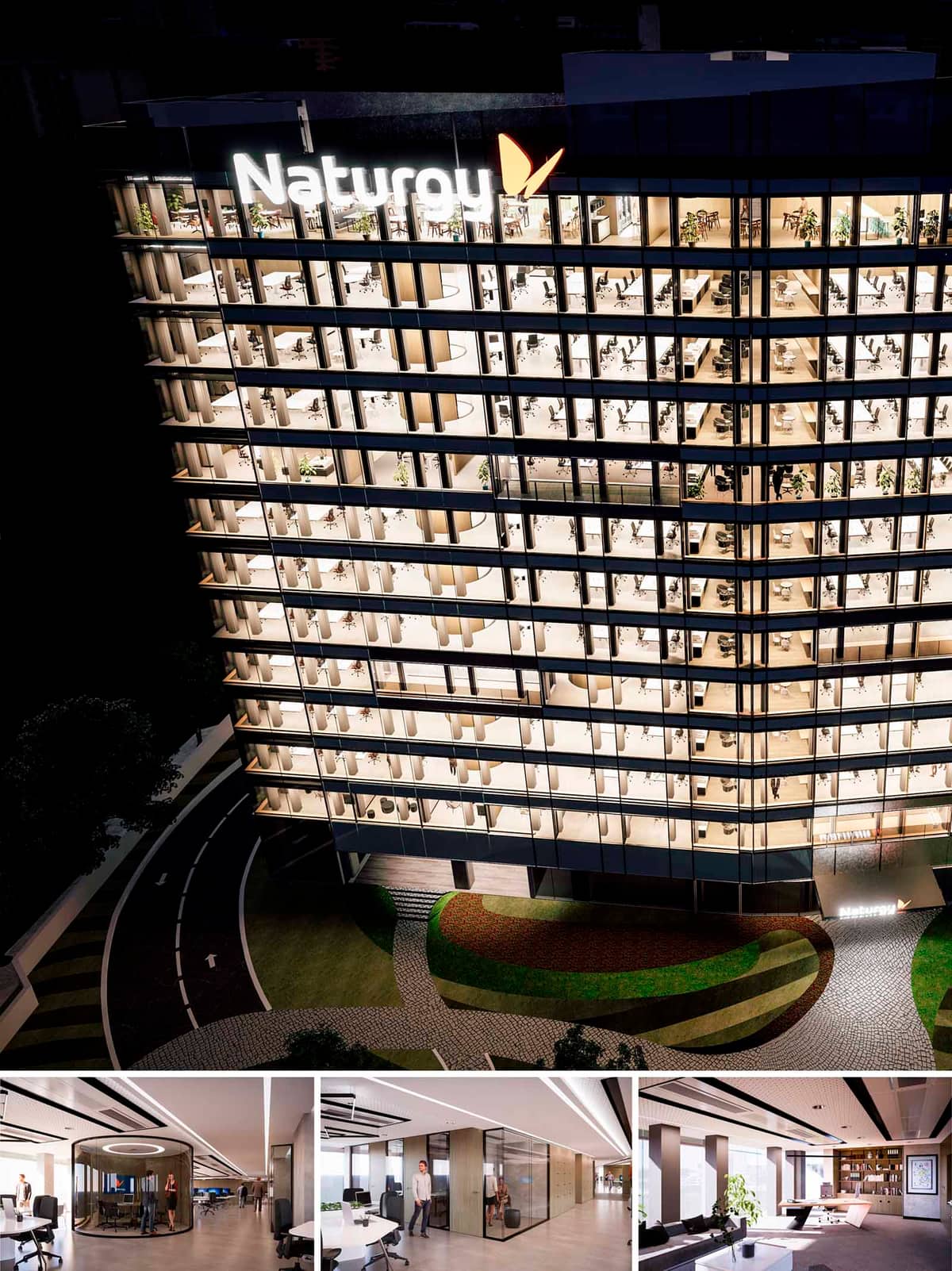

The AME38 project reinterprets the corporate tower as a luminous, permeable lantern in the Madrid skyline. The design proposes an open, layered workplace where transparency, flexibility and biophilia define the daily experience of users. The façade works as a continuous, rhythmical grid that reveals the interior life of the offices, emphasizing collaboration and movement rather than static, closed-off floors.
The architectural language is deliberately calm and neutral, allowing the corporate identity to appear through light, graphics and subtle color accents. Horizontal floor plates, slender vertical supports and large glass panes create a clean, contemporary image aligned with international corporate standards while remaining rooted in the Mediterranean light conditions of Madrid.
The base of the tower delicately lifts from the ground, generating a shaded, recessed entrance that marks the threshold between urban space and corporate interior. Curved vehicular access and pedestrian paths gently guide users towards the lobby, while landscaped bands of grass and paving create a soft transition from the street to the building.
Nighttime illumination transforms the tower into a visible urban reference, yet the lighting strategy is carefully modulated at lower levels to preserve comfort at the pedestrian scale. The ground floor is conceived as a semi-public interface that can accommodate reception, informal meeting areas and shared amenities, reinforcing the role of the building as a corporate hub open to visitors and collaborators.
Each office floor is designed as an open-plan platform organized around a central structural spine. Workstations are arranged in flexible clusters, optimizing daylight penetration from the fully glazed perimeter. The regular structural grid ensures efficient planning while allowing for future reconfiguration without major interventions.
Support spaces—meeting rooms, focus pods and service cores—are placed strategically to break the depth of the floor plate and generate clear circulation loops. The circular meeting capsule visible in the interior images exemplifies this approach: a freestanding, acoustically controlled volume that introduces a sculptural element within the open workspace while providing privacy for concentrated work or confidential conversations.
The interior palette is based on warm neutrals: light-toned flooring, white ceilings and timber accents on furniture and wall cladding. This restrained scheme highlights natural light and enhances visual continuity between different departments. Linear recessed lighting integrated into the ceiling system reinforces perspective and guides movement along the corridors.
Glass partitions are extensively used to separate meeting rooms and managerial offices, maintaining acoustic control without sacrificing visual openness. Soft furnishings, indoor plants and curated shelving systems in lounge areas bring domestic comfort into the corporate environment, encouraging informal interaction and longer, more pleasant stays in the workspace.
Sustainability criteria are integrated from the envelope to the interior fit-out. The fully glazed façade, while visually transparent, is understood as a high-performance skin with selective coatings, solar control and optimized insulation to reduce HVAC loads in Madrid’s climate. Floor-to-ceiling glazing maximizes natural daylight, decreasing reliance on artificial lighting during daytime hours.
Interior layouts favour cross-ventilation and visual connection to the exterior, supporting employee well-being. The use of durable, low-maintenance materials extends the life cycle of finishes, while modular furniture and demountable partitions allow floors to be adapted with minimal waste generation. Plant integration, access to light and the provision of diverse work settings—formal, informal, individual and collaborative—contribute to a healthier, more sustainable corporate culture for AME38.


The AME38 project reinterprets the corporate tower as a luminous, permeable lantern in the Madrid skyline. The design proposes an open, layered workplace where transparency, flexibility and biophilia define the daily experience of users. The façade works as a continuous, rhythmical grid that reveals the interior life of the offices, emphasizing collaboration and movement rather than static, closed-off floors.
The architectural language is deliberately calm and neutral, allowing the corporate identity to appear through light, graphics and subtle color accents. Horizontal floor plates, slender vertical supports and large glass panes create a clean, contemporary image aligned with international corporate standards while remaining rooted in the Mediterranean light conditions of Madrid.
The base of the tower delicately lifts from the ground, generating a shaded, recessed entrance that marks the threshold between urban space and corporate interior. Curved vehicular access and pedestrian paths gently guide users towards the lobby, while landscaped bands of grass and paving create a soft transition from the street to the building.
Nighttime illumination transforms the tower into a visible urban reference, yet the lighting strategy is carefully modulated at lower levels to preserve comfort at the pedestrian scale. The ground floor is conceived as a semi-public interface that can accommodate reception, informal meeting areas and shared amenities, reinforcing the role of the building as a corporate hub open to visitors and collaborators.
Each office floor is designed as an open-plan platform organized around a central structural spine. Workstations are arranged in flexible clusters, optimizing daylight penetration from the fully glazed perimeter. The regular structural grid ensures efficient planning while allowing for future reconfiguration without major interventions.
Support spaces—meeting rooms, focus pods and service cores—are placed strategically to break the depth of the floor plate and generate clear circulation loops. The circular meeting capsule visible in the interior images exemplifies this approach: a freestanding, acoustically controlled volume that introduces a sculptural element within the open workspace while providing privacy for concentrated work or confidential conversations.
The interior palette is based on warm neutrals: light-toned flooring, white ceilings and timber accents on furniture and wall cladding. This restrained scheme highlights natural light and enhances visual continuity between different departments. Linear recessed lighting integrated into the ceiling system reinforces perspective and guides movement along the corridors.
Glass partitions are extensively used to separate meeting rooms and managerial offices, maintaining acoustic control without sacrificing visual openness. Soft furnishings, indoor plants and curated shelving systems in lounge areas bring domestic comfort into the corporate environment, encouraging informal interaction and longer, more pleasant stays in the workspace.
Sustainability criteria are integrated from the envelope to the interior fit-out. The fully glazed façade, while visually transparent, is understood as a high-performance skin with selective coatings, solar control and optimized insulation to reduce HVAC loads in Madrid’s climate. Floor-to-ceiling glazing maximizes natural daylight, decreasing reliance on artificial lighting during daytime hours.
Interior layouts favour cross-ventilation and visual connection to the exterior, supporting employee well-being. The use of durable, low-maintenance materials extends the life cycle of finishes, while modular furniture and demountable partitions allow floors to be adapted with minimal waste generation. Plant integration, access to light and the provision of diverse work settings—formal, informal, individual and collaborative—contribute to a healthier, more sustainable corporate culture for AME38.
© 2021 by sanzpont [arquitectura] . Webpage by sanzpont [digital] . Innovative Digital Experiences


The Naturgy AME38 Auditorium is meticulously crafted to embody a sophisticated yet functional design ethos, tailored for corporate presentations and large-scale meetings. The concept revolves around creating an engaging environment that fosters communication and collaboration. The design leverages clean lines and integrated technology to create a modern and efficient space that promotes user comfort and interaction.
The auditorium is designed with a tiered seating layout to optimize sightlines and acoustics, ensuring that each attendee has an unobstructed view and can hear presentations without echo or distortion. The strategic placement of the stage and dual screens facilitates seamless presentations, catering to both in-person and remote audiences. The incorporation of adjustable lighting and acoustic panels enhances the adaptability of the space to various event types, from lectures to multimedia presentations.
A harmonious blend of natural wood and textile elements characterizes the material palette, promoting a sense of warmth and elegance. The wood paneling on the walls not only serves as an aesthetic feature but also enhances the room's acoustics. High-quality, durable carpeting in the seating areas provides comfort and noise reduction, while the blue upholstered chairs add a vibrant pop of color that contrasts effectively with the subdued tones of the wood and carpet.
Lighting plays a pivotal role in the design of the Naturgy AME38 Auditorium. The use of continuous LED strips embedded in the ceiling creates a futuristic and dynamic ambiance. These lighting elements are not only decorative but functional, offering various illumination levels to suit different types of events and presentations. The overall lighting scheme is designed to reduce eye strain and improve the audience's focus.
The design incorporates several sustainability features to minimize environmental impact while maximizing energy efficiency. LED lighting fixtures are used throughout the auditorium, significantly reducing power consumption compared to traditional lighting solutions. The choice of materials, such as sustainably sourced wood and recyclable carpet tiles, reflects a commitment to eco-friendly design principles. Additionally, the HVAC system is optimized for energy efficiency, featuring advanced filtration and ventilation mechanisms to ensure optimal air quality with minimal energy use.
The auditorium is equipped with state-of-the-art audiovisual technology, including high-resolution screens, digital interfaces, and wireless connectivity options that support a wide range of multimedia formats and remote conferencing tools. This integration ensures that the space is well-suited for today’s digital and global business environment, facilitating effective communication and collaboration across different platforms and locations.
In conclusion, the Naturgy AME38 Auditorium exemplifies a modern approach to corporate space design, blending aesthetic appeal with functional excellence and sustainability. Its thoughtful layout, material selection, and technological features make it a leading example of contemporary interior design in a corporate context.
The Naturgy AME38 Auditorium is meticulously crafted to embody a sophisticated yet functional design ethos, tailored for corporate presentations and large-scale meetings. The concept revolves around creating an engaging environment that fosters communication and collaboration. The design leverages clean lines and integrated technology to create a modern and efficient space that promotes user comfort and interaction.
The auditorium is designed with a tiered seating layout to optimize sightlines and acoustics, ensuring that each attendee has an unobstructed view and can hear presentations without echo or distortion. The strategic placement of the stage and dual screens facilitates seamless presentations, catering to both in-person and remote audiences. The incorporation of adjustable lighting and acoustic panels enhances the adaptability of the space to various event types, from lectures to multimedia presentations.
A harmonious blend of natural wood and textile elements characterizes the material palette, promoting a sense of warmth and elegance. The wood paneling on the walls not only serves as an aesthetic feature but also enhances the room's acoustics. High-quality, durable carpeting in the seating areas provides comfort and noise reduction, while the blue upholstered chairs add a vibrant pop of color that contrasts effectively with the subdued tones of the wood and carpet.
Lighting plays a pivotal role in the design of the Naturgy AME38 Auditorium. The use of continuous LED strips embedded in the ceiling creates a futuristic and dynamic ambiance. These lighting elements are not only decorative but functional, offering various illumination levels to suit different types of events and presentations. The overall lighting scheme is designed to reduce eye strain and improve the audience's focus.
The design incorporates several sustainability features to minimize environmental impact while maximizing energy efficiency. LED lighting fixtures are used throughout the auditorium, significantly reducing power consumption compared to traditional lighting solutions. The choice of materials, such as sustainably sourced wood and recyclable carpet tiles, reflects a commitment to eco-friendly design principles. Additionally, the HVAC system is optimized for energy efficiency, featuring advanced filtration and ventilation mechanisms to ensure optimal air quality with minimal energy use.
The auditorium is equipped with state-of-the-art audiovisual technology, including high-resolution screens, digital interfaces, and wireless connectivity options that support a wide range of multimedia formats and remote conferencing tools. This integration ensures that the space is well-suited for today’s digital and global business environment, facilitating effective communication and collaboration across different platforms and locations.
In conclusion, the Naturgy AME38 Auditorium exemplifies a modern approach to corporate space design, blending aesthetic appeal with functional excellence and sustainability. Its thoughtful layout, material selection, and technological features make it a leading example of contemporary interior design in a corporate context.
© 2021 by sanzpont [arquitectura] . Webpage by sanzpont [digital] . Innovative Digital Experiences
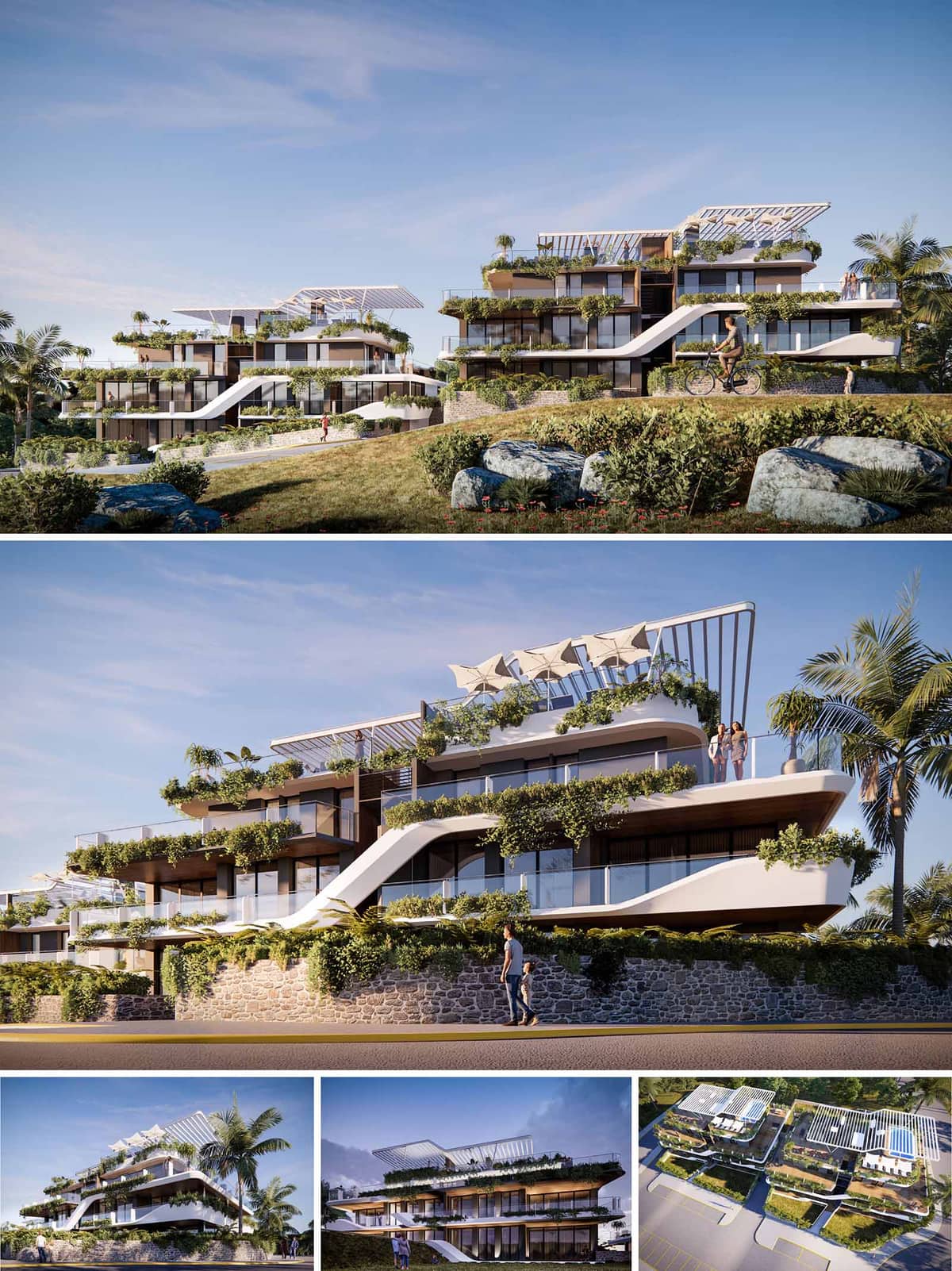

The project in Estepona is conceived as a terraced Mediterranean resort that dissolves the boundary between architecture and landscape. The buildings cascade gently along the natural slope, allowing each level to enjoy unobstructed sea views while creating a sequence of planted horizontal strata. The design prioritizes outdoor living, extending the domestic space onto generous balconies, roof gardens and intermediate terraces. Architecture here acts as a stepped topography in itself, offering multiple layers of shade, greenery and social interaction, tuned to the climate of the Costa del Sol.
The formal language combines fluid, white horizontal ribbons with more rectilinear glazed volumes. Continuous balconies wrap the façades, occasionally folding into sculptural exterior staircases that connect levels and activate the frontage. The upper roofs are crowned with light pergola structures and tensile shade elements, generating a distinctive skyline and controlling solar gain. Large floor-to-ceiling glazing reinforces the indoor–outdoor relationship, while the fragmented massing breaks down the apparent scale of the ensemble into smaller, human-scaled clusters.
A Mediterranean palette underpins the material strategy: smooth white render for the balcony ribbons, warm timber or wood-tone cladding around openings, and clear glass balustrades that maintain visual continuity to the horizon. The base of the building is anchored by a stone plinth in natural tones, linking the architecture to the terrain and providing textural contrast. The overall chromatic composition of whites, beiges and greens reflects the surrounding coastal landscape, with dark window frames adding depth and precision to the façade composition.
Vegetation is deployed as an essential architectural layer rather than a mere complement. Continuous planter bands along the balconies create a green edge to every level, softening the building contours and providing privacy filters between units. The ground plane is treated as a naturalized park with local shrubs, grasses and rocks that echo the existing topography. Roof terraces function as elevated gardens and community belvederes, reinforcing the perception of a building embedded within a lush hillside rather than an object placed on it.
Environmental performance is addressed through both passive and active measures. The deep balconies and pergolas provide effective solar shading, reducing cooling loads in the hot season while still admitting winter sun. Extensive greenery contributes to microclimatic comfort, evapotranspiration and improved air quality, while also offering additional insulation to the envelope. The roof structures can host photovoltaic panels aligned with the pergola geometry, optimizing solar capture without visual clutter. Water-efficient planting and potential rainwater harvesting support responsible irrigation, and the porosity of the layout encourages natural cross-ventilation through each dwelling.
The staggered configuration ensures that each apartment benefits from generous terraces oriented toward the views, with living spaces flowing directly onto outdoor rooms. Circulation is clearly expressed on the façades through external stairways and ramps, animating the elevations and facilitating intuitive wayfinding. Shared rooftop decks and intermediate communal terraces provide spaces for sunbathing, relaxation and social activities, always framed by greenery. Parking and service areas are discreetly placed at the perimeter, preserving the central landscape as a pedestrian-friendly environment.


The project in Estepona is conceived as a terraced Mediterranean resort that dissolves the boundary between architecture and landscape. The buildings cascade gently along the natural slope, allowing each level to enjoy unobstructed sea views while creating a sequence of planted horizontal strata. The design prioritizes outdoor living, extending the domestic space onto generous balconies, roof gardens and intermediate terraces. Architecture here acts as a stepped topography in itself, offering multiple layers of shade, greenery and social interaction, tuned to the climate of the Costa del Sol.
The formal language combines fluid, white horizontal ribbons with more rectilinear glazed volumes. Continuous balconies wrap the façades, occasionally folding into sculptural exterior staircases that connect levels and activate the frontage. The upper roofs are crowned with light pergola structures and tensile shade elements, generating a distinctive skyline and controlling solar gain. Large floor-to-ceiling glazing reinforces the indoor–outdoor relationship, while the fragmented massing breaks down the apparent scale of the ensemble into smaller, human-scaled clusters.
A Mediterranean palette underpins the material strategy: smooth white render for the balcony ribbons, warm timber or wood-tone cladding around openings, and clear glass balustrades that maintain visual continuity to the horizon. The base of the building is anchored by a stone plinth in natural tones, linking the architecture to the terrain and providing textural contrast. The overall chromatic composition of whites, beiges and greens reflects the surrounding coastal landscape, with dark window frames adding depth and precision to the façade composition.
Vegetation is deployed as an essential architectural layer rather than a mere complement. Continuous planter bands along the balconies create a green edge to every level, softening the building contours and providing privacy filters between units. The ground plane is treated as a naturalized park with local shrubs, grasses and rocks that echo the existing topography. Roof terraces function as elevated gardens and community belvederes, reinforcing the perception of a building embedded within a lush hillside rather than an object placed on it.
Environmental performance is addressed through both passive and active measures. The deep balconies and pergolas provide effective solar shading, reducing cooling loads in the hot season while still admitting winter sun. Extensive greenery contributes to microclimatic comfort, evapotranspiration and improved air quality, while also offering additional insulation to the envelope. The roof structures can host photovoltaic panels aligned with the pergola geometry, optimizing solar capture without visual clutter. Water-efficient planting and potential rainwater harvesting support responsible irrigation, and the porosity of the layout encourages natural cross-ventilation through each dwelling.
The staggered configuration ensures that each apartment benefits from generous terraces oriented toward the views, with living spaces flowing directly onto outdoor rooms. Circulation is clearly expressed on the façades through external stairways and ramps, animating the elevations and facilitating intuitive wayfinding. Shared rooftop decks and intermediate communal terraces provide spaces for sunbathing, relaxation and social activities, always framed by greenery. Parking and service areas are discreetly placed at the perimeter, preserving the central landscape as a pedestrian-friendly environment.
© 2021 by sanzpont [arquitectura] . Webpage by sanzpont [digital] . Innovative Digital Experiences
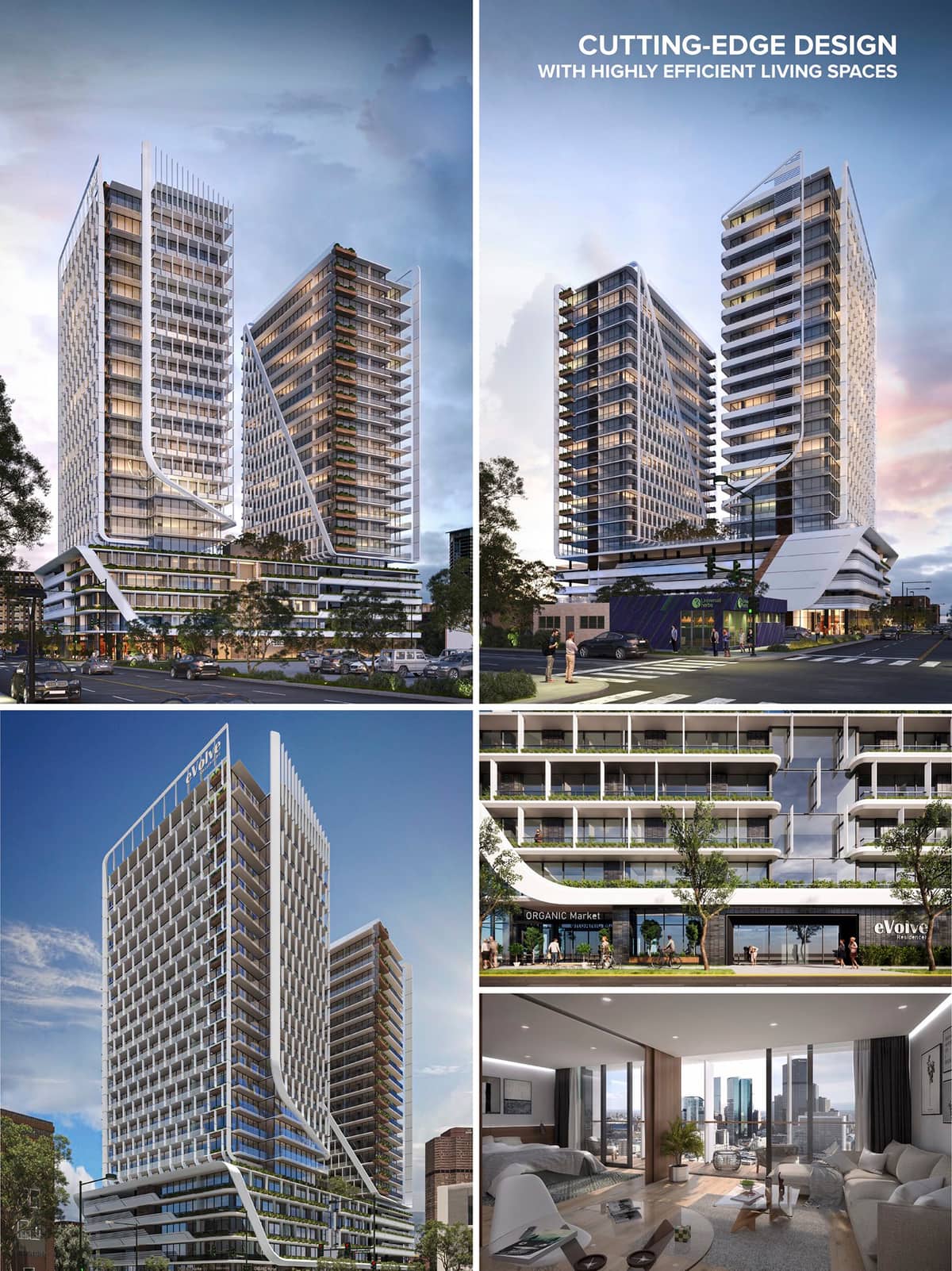

The architectural vision for this complex is an embodiment of fluid motion and human interaction, rendered through sweeping curves and modular forms. The structure's conceptual underpinning lies in fostering a symbiotic relationship between individuality and community. It employs a visual language that speaks to a rhythmic fluidity, juxtaposing the rectilinear rigidity of urban landscapes with organic shapes that allude to the ebb and flow of city life.
In its exterior, the building presents a facade that blends stark modern materials with dynamic design. The curvature, snaking its way up and around the towers, acts as a visual and functional connector, promoting a sense of continuity within the complex. Glass and steel dominate, arranged in a grid-like matrix that emphasizes verticality and order, while the infusion of wood elements disrupts this order, adding a touch of nature's unpredictability.
Balconies protrude from the facade in a regular pattern, offering residents their private outdoor sanctuaries and enhancing the facade's texture. These outdoor spaces serve not just for leisure but also as energy modulators, contributing to the building’s passive solar design by providing shade and reducing heat gain.
Material selection articulates a narrative of sustainability and aesthetic longevity. Glass, with its reflective and transparent qualities, facilitates an abundance of natural light within the interiors and acts as a mirror for the changing skies. Concrete and steel provide the necessary strength and durability, essential for high-density urban living. Timber elements introduce an organic touch, softening the modern edges with their inherent warmth.
The color palette is intentionally subdued, comprising mostly earth tones that visually anchor the building within its environment. These choices are not merely stylistic but also practical, aiming to reduce maintenance requirements and reflect the urban landscape’s hues.
Sustainability is woven into the very fabric of the complex. The building's design includes green roofs and living walls that serve to mitigate urban heat, filter pollutants, and reduce stormwater runoff. These features, combined with the strategic placement of balconies, improve the microclimate around the building, while also providing aesthetic green vistas for residents.
Communal spaces within the complex exude openness and connectivity. The ground floor merges seamlessly with the streetscape, inviting residents and the public into a shared experience. The ample use of glass here establishes a visual continuity with the outdoor environment. Upper-level common areas, including terraces and pool decks, offer a communal haven, fostering interactions among residents.
These spaces are adorned with minimalist, yet comfortable furniture, and interspersed with greenery, ensuring that the connection with nature is ever-present. The design of these areas indicates a clear intent to serve as social condensers, where organic interactions can flourish amidst the backdrop of city life.
In summary, this architectural endeavor is a celebration of modern living, where each design decision from macro to micro scale serves a dual purpose of utility and aesthetic. The complex stands as a testament to the possibilities of contemporary urban architecture - a space where community thrives within the embrace of sustainable design.


The architectural vision for this complex is an embodiment of fluid motion and human interaction, rendered through sweeping curves and modular forms. The structure's conceptual underpinning lies in fostering a symbiotic relationship between individuality and community. It employs a visual language that speaks to a rhythmic fluidity, juxtaposing the rectilinear rigidity of urban landscapes with organic shapes that allude to the ebb and flow of city life.
In its exterior, the building presents a facade that blends stark modern materials with dynamic design. The curvature, snaking its way up and around the towers, acts as a visual and functional connector, promoting a sense of continuity within the complex. Glass and steel dominate, arranged in a grid-like matrix that emphasizes verticality and order, while the infusion of wood elements disrupts this order, adding a touch of nature's unpredictability.
Balconies protrude from the facade in a regular pattern, offering residents their private outdoor sanctuaries and enhancing the facade's texture. These outdoor spaces serve not just for leisure but also as energy modulators, contributing to the building’s passive solar design by providing shade and reducing heat gain.
Material selection articulates a narrative of sustainability and aesthetic longevity. Glass, with its reflective and transparent qualities, facilitates an abundance of natural light within the interiors and acts as a mirror for the changing skies. Concrete and steel provide the necessary strength and durability, essential for high-density urban living. Timber elements introduce an organic touch, softening the modern edges with their inherent warmth.
The color palette is intentionally subdued, comprising mostly earth tones that visually anchor the building within its environment. These choices are not merely stylistic but also practical, aiming to reduce maintenance requirements and reflect the urban landscape’s hues.
Sustainability is woven into the very fabric of the complex. The building's design includes green roofs and living walls that serve to mitigate urban heat, filter pollutants, and reduce stormwater runoff. These features, combined with the strategic placement of balconies, improve the microclimate around the building, while also providing aesthetic green vistas for residents.
Communal spaces within the complex exude openness and connectivity. The ground floor merges seamlessly with the streetscape, inviting residents and the public into a shared experience. The ample use of glass here establishes a visual continuity with the outdoor environment. Upper-level common areas, including terraces and pool decks, offer a communal haven, fostering interactions among residents.
These spaces are adorned with minimalist, yet comfortable furniture, and interspersed with greenery, ensuring that the connection with nature is ever-present. The design of these areas indicates a clear intent to serve as social condensers, where organic interactions can flourish amidst the backdrop of city life.
In summary, this architectural endeavor is a celebration of modern living, where each design decision from macro to micro scale serves a dual purpose of utility and aesthetic. The complex stands as a testament to the possibilities of contemporary urban architecture - a space where community thrives within the embrace of sustainable design.
© 2021 by sanzpont [arquitectura] . Webpage by sanzpont [digital] . Innovative Digital Experiences
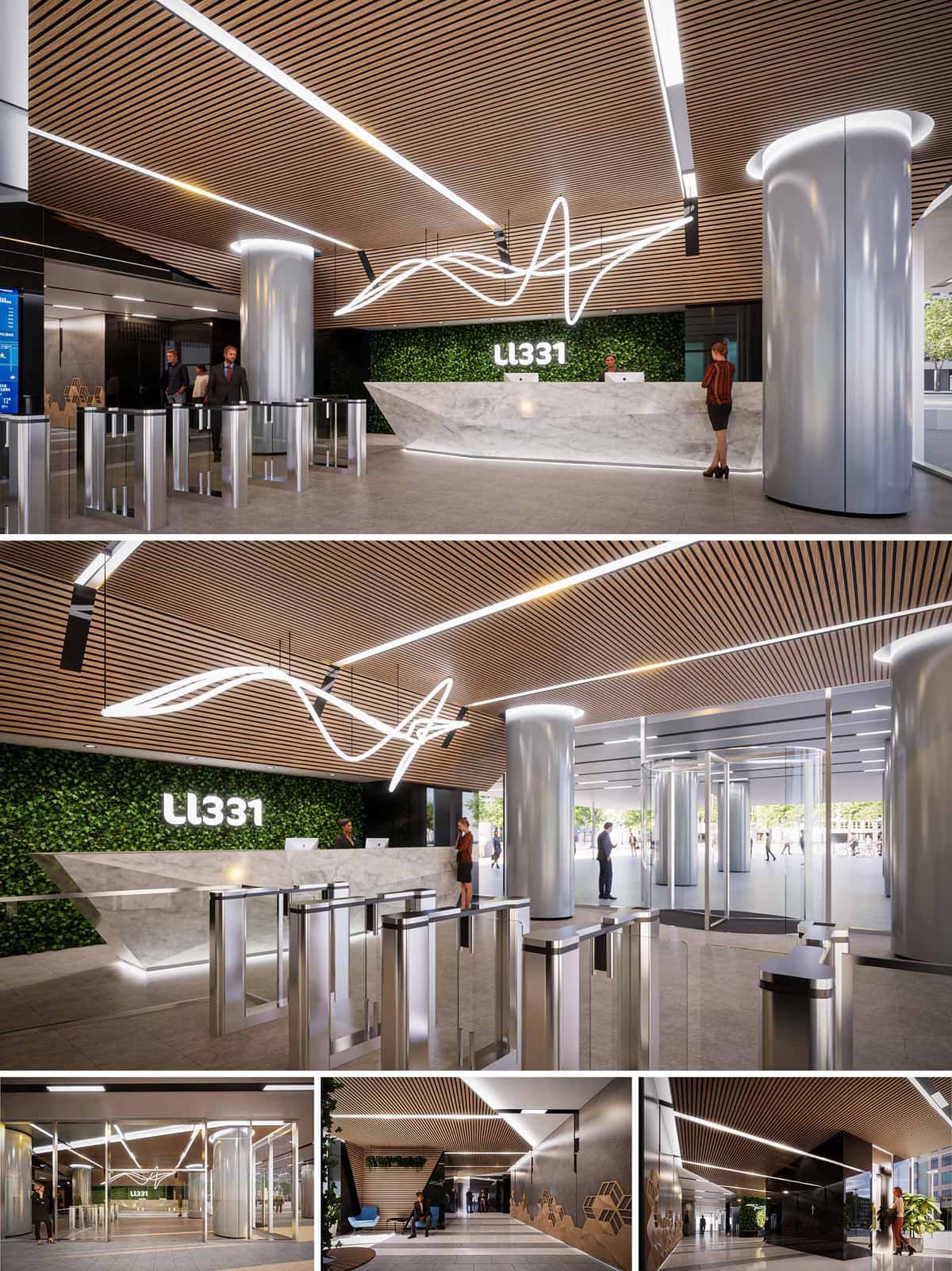

The LL331 Lobby in Barcelona is conceived as a contemporary corporate threshold that merges technology, material warmth and urban permeability. The design seeks to express the identity of a high-performance office building through a clear, sculptural composition of elements: a monolithic reception desk, luminous ceiling lines and cylindrical structural volumes. The lobby acts as a calibrated filter between city and workplace, orchestrating flows of people with an architecture that communicates precision, innovation and openness.
The spatial narrative is built around three layers: the urban front with its transparent revolving doors, the security and access-control core, and the reception and waiting areas framed by a green backdrop. These layers are visually unified by a continuous timber slatted ceiling and an expressive light sculpture that traces a dynamic trajectory above the central axis, evoking data flows or sound waves.
The layout prioritizes efficient circulation and intuitive wayfinding. A fully glazed entrance zone maximizes visual continuity with the street, inviting users into a generous vestibule before transitioning into the controlled lobby interior. The cylindrical cores operate as both structural and spatial anchors, subtly guiding visitor movement around them and framing direct lines of sight toward the reception desk.
The access-control gates are aligned orthogonally with the main facade, forming a clear, linear threshold that separates public and semi-public domains. Their positioning in front of the reception ensures supervision while preserving a sense of openness. Secondary waiting and informal meeting pockets are located to the sides, where circulation slows down and acoustic comfort increases.
The material palette combines tactile natural finishes with refined metallic and glass surfaces to balance warmth and corporate sophistication. The continuous timber slat ceiling introduces a domestic scale overhead, improving acoustics and visually elongating the space. Its linear geometry is echoed in the integrated lighting tracks, reinforcing depth and direction.
The reception desk is executed in a light grey stone with a faceted geometry, producing a crystalline, sculptural presence. Underlit plinths and recessed base details create a floating effect that reduces the perceived mass of the element. Brushed stainless steel in the access gates and column claddings adds a technical, precise character, while large-format porcelain or stone flooring ensures durability and easy maintenance.
Lighting plays a central role in articulating the brand identity of LL331. A custom, sinuous light sculpture suspended above the reception axis becomes the visual signature of the lobby, translating the company’s dynamism into a three-dimensional luminous gesture. Integrated linear luminaires in the ceiling slats and column crowns provide uniform ambient light without visual clutter.
Vertical surfaces are carefully illuminated to emphasize depth: the green wall behind the desk receives grazing light that accentuates texture, while the black glossy volumes at the perimeter reflect and multiply light, amplifying the perceived space. The LL331 logotype appears as a backlit element embedded within the green wall, clearly legible from the entrance and reinforcing orientation.
Sustainability is addressed through both visible and invisible strategies. The vertical green wall behind the reception contributes to improved indoor air quality, microclimatic regulation and acoustic absorption, while also introducing a biophilic component that softens the technological character of the lobby. Plant species are selected for low maintenance and adaptability to interior conditions.
Energy-efficient LED lighting, presence and daylight sensors reduce consumption by adapting levels to real occupancy and natural light. The high degree of facade transparency optimizes daylight penetration, decreasing reliance on artificial illumination during daytime. Durable, low-emission materials are specified for floors, wall claddings and sealants, supporting a healthy indoor environment and reducing life-cycle impacts. The overall design is conceived to age gracefully, minimizing the need for future replacements and associated resource use.


The LL331 Lobby in Barcelona is conceived as a contemporary corporate threshold that merges technology, material warmth and urban permeability. The design seeks to express the identity of a high-performance office building through a clear, sculptural composition of elements: a monolithic reception desk, luminous ceiling lines and cylindrical structural volumes. The lobby acts as a calibrated filter between city and workplace, orchestrating flows of people with an architecture that communicates precision, innovation and openness.
The spatial narrative is built around three layers: the urban front with its transparent revolving doors, the security and access-control core, and the reception and waiting areas framed by a green backdrop. These layers are visually unified by a continuous timber slatted ceiling and an expressive light sculpture that traces a dynamic trajectory above the central axis, evoking data flows or sound waves.
The layout prioritizes efficient circulation and intuitive wayfinding. A fully glazed entrance zone maximizes visual continuity with the street, inviting users into a generous vestibule before transitioning into the controlled lobby interior. The cylindrical cores operate as both structural and spatial anchors, subtly guiding visitor movement around them and framing direct lines of sight toward the reception desk.
The access-control gates are aligned orthogonally with the main facade, forming a clear, linear threshold that separates public and semi-public domains. Their positioning in front of the reception ensures supervision while preserving a sense of openness. Secondary waiting and informal meeting pockets are located to the sides, where circulation slows down and acoustic comfort increases.
The material palette combines tactile natural finishes with refined metallic and glass surfaces to balance warmth and corporate sophistication. The continuous timber slat ceiling introduces a domestic scale overhead, improving acoustics and visually elongating the space. Its linear geometry is echoed in the integrated lighting tracks, reinforcing depth and direction.
The reception desk is executed in a light grey stone with a faceted geometry, producing a crystalline, sculptural presence. Underlit plinths and recessed base details create a floating effect that reduces the perceived mass of the element. Brushed stainless steel in the access gates and column claddings adds a technical, precise character, while large-format porcelain or stone flooring ensures durability and easy maintenance.
Lighting plays a central role in articulating the brand identity of LL331. A custom, sinuous light sculpture suspended above the reception axis becomes the visual signature of the lobby, translating the company’s dynamism into a three-dimensional luminous gesture. Integrated linear luminaires in the ceiling slats and column crowns provide uniform ambient light without visual clutter.
Vertical surfaces are carefully illuminated to emphasize depth: the green wall behind the desk receives grazing light that accentuates texture, while the black glossy volumes at the perimeter reflect and multiply light, amplifying the perceived space. The LL331 logotype appears as a backlit element embedded within the green wall, clearly legible from the entrance and reinforcing orientation.
Sustainability is addressed through both visible and invisible strategies. The vertical green wall behind the reception contributes to improved indoor air quality, microclimatic regulation and acoustic absorption, while also introducing a biophilic component that softens the technological character of the lobby. Plant species are selected for low maintenance and adaptability to interior conditions.
Energy-efficient LED lighting, presence and daylight sensors reduce consumption by adapting levels to real occupancy and natural light. The high degree of facade transparency optimizes daylight penetration, decreasing reliance on artificial illumination during daytime. Durable, low-emission materials are specified for floors, wall claddings and sealants, supporting a healthy indoor environment and reducing life-cycle impacts. The overall design is conceived to age gracefully, minimizing the need for future replacements and associated resource use.
© 2021 by sanzpont [arquitectura] . Webpage by sanzpont [digital] . Innovative Digital Experiences
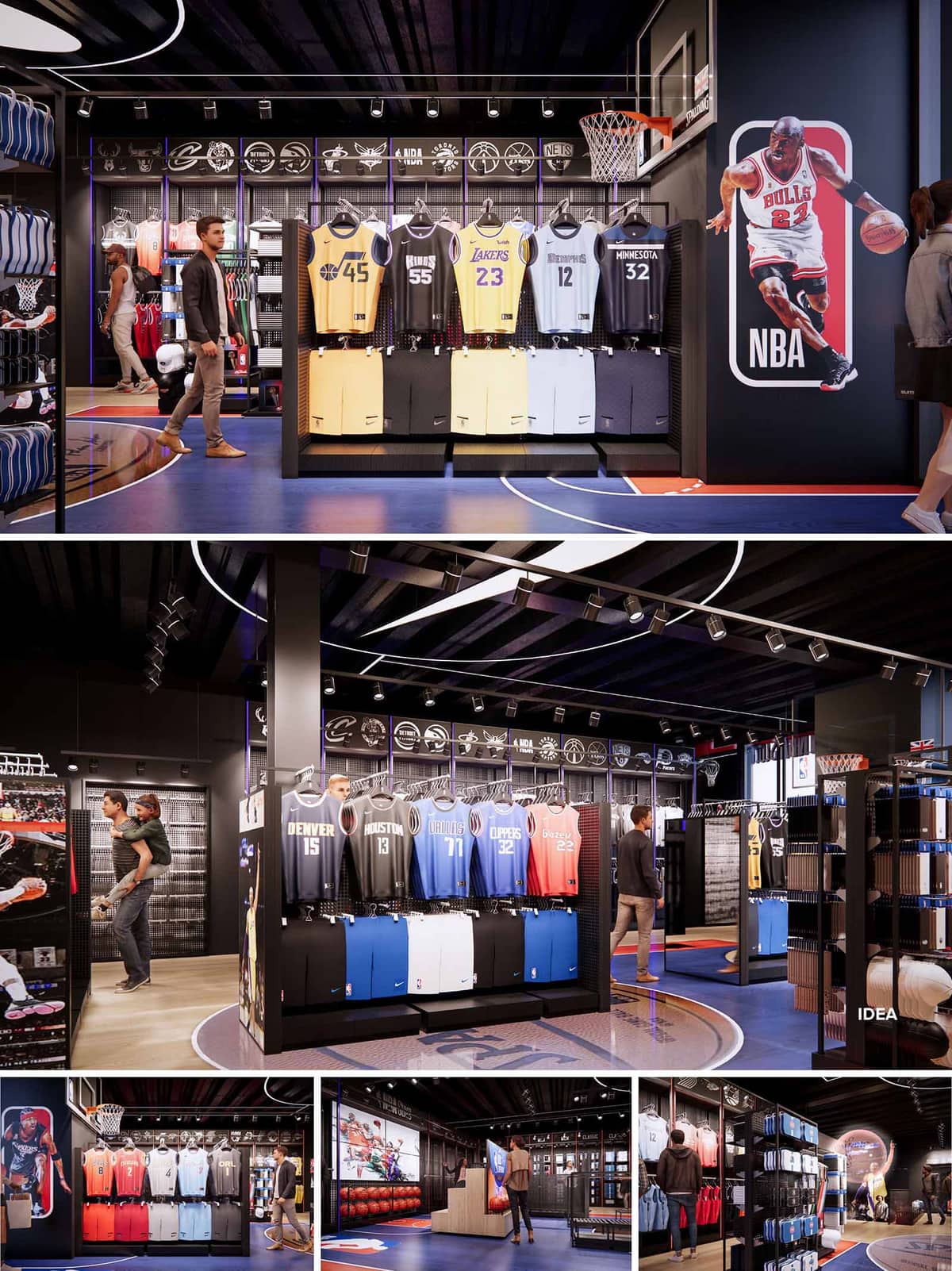

The design of the NBA Store in London translates the dynamism of a basketball arena into a retail interior, creating an immersive brand experience rather than a conventional shop. Spatial composition, lighting, graphics and materiality are orchestrated to evoke the sensation of stepping courtside, placing visitors at the center of the game. The store becomes an urban pavilion celebrating NBA culture, where circulation follows the logic of the court and product is displayed as if it were athletic equipment ready for play.
The concept is based on clarity of identity: every surface, from floor graphics to ceiling ribbons, communicates the language of basketball. Large-scale player imagery and league iconography act as architectural elements, visually “anchoring” zones and guiding customers across the space. The aim is to balance spectacle with legible merchandising, ensuring that emotional engagement supports rather than competes with retail performance.
The plan is organized around a central court-inspired axis that structures the main flow. A full-court graphic, integrated into the floor finish, subtly delineates primary routes and pause points. Perimeter walls are dedicated to team-specific collections, while freestanding gondolas articulate secondary paths and create smaller “pockets” for focused browsing. This hierarchy of open and more intimate areas supports both quick purchases and longer, exploratory visits.
Key sightlines are carefully controlled: on entry, the view terminates on a strong visual icon, typically a player graphic or illuminated logo wall. Circulation curves gently around the court lines, encouraging movement while avoiding visual clutter. High-demand categories such as jerseys and footwear occupy the most visible positions along this spine, with accessories and memorabilia layered deeper into the layout, encouraging progressive discovery.
The material palette juxtaposes dark, technical surfaces with vivid brand colors. Black ceilings, columns and metal fixtures create a neutral, almost theatrical background, allowing the saturated blues, reds and yellows of the NBA identity and team jerseys to stand out. Perforated metal panels and wire-mesh backdrops reference locker-room and arena railings, reinforcing the sports infrastructure aesthetic.
Flooring combines resilient sports-like finishes in blue and hardwood-effect areas, echoing the visual language of a professional court. This not only reinforces the concept but also provides robust performance for high-traffic retail environments. Linear LED strips and adjustable track lighting are deployed to model the space much like arena lighting, with accent beams focused on key merchandise walls and vertical graphic panels. Controlled contrast enhances product legibility while creating a sense of depth and drama.
Merchandising systems are designed as modular frames that can quickly adapt to changing collections, playoffs or special events. Jerseys are displayed frontally at eye level on continuous rails, creating a rhythmic backdrop of color blocks representing different teams. Below, integrated cabinetry provides concealed storage and a solid visual base, grounding the vertical display.
Overhead, a band of illuminated team logos runs along the perimeter, acting as a continuous frieze that orients visitors and celebrates league diversity. Large-scale player graphics and digital screens punctuate these sequences, enabling storytelling, highlights and campaign content. This layered branding strategy ensures that the environment remains fresh and responsive while maintaining a coherent architectural framework.
Sustainability is addressed through material selection, lighting strategy and long-term flexibility. Fixtures are predominantly metal and engineered board, chosen for durability, high recyclability and ease of reconfiguration, reducing the need for future fit-out waste. Finishes are specified with high abrasion resistance and, where possible, low-VOC coatings to promote healthier indoor air quality.
The lighting scheme relies on high-efficiency LED technology with controllable drivers, minimizing energy consumption while allowing scenes to adapt to daylight levels, events or promotional periods. Concentrating graphic expression in interchangeable panels and digital media reduces the environmental footprint associated with frequent rebranding. The robust, modular design extends the life cycle of the interior, supporting both sustainable operation and evolving retail narratives.


The design of the NBA Store in London translates the dynamism of a basketball arena into a retail interior, creating an immersive brand experience rather than a conventional shop. Spatial composition, lighting, graphics and materiality are orchestrated to evoke the sensation of stepping courtside, placing visitors at the center of the game. The store becomes an urban pavilion celebrating NBA culture, where circulation follows the logic of the court and product is displayed as if it were athletic equipment ready for play.
The concept is based on clarity of identity: every surface, from floor graphics to ceiling ribbons, communicates the language of basketball. Large-scale player imagery and league iconography act as architectural elements, visually “anchoring” zones and guiding customers across the space. The aim is to balance spectacle with legible merchandising, ensuring that emotional engagement supports rather than competes with retail performance.
The plan is organized around a central court-inspired axis that structures the main flow. A full-court graphic, integrated into the floor finish, subtly delineates primary routes and pause points. Perimeter walls are dedicated to team-specific collections, while freestanding gondolas articulate secondary paths and create smaller “pockets” for focused browsing. This hierarchy of open and more intimate areas supports both quick purchases and longer, exploratory visits.
Key sightlines are carefully controlled: on entry, the view terminates on a strong visual icon, typically a player graphic or illuminated logo wall. Circulation curves gently around the court lines, encouraging movement while avoiding visual clutter. High-demand categories such as jerseys and footwear occupy the most visible positions along this spine, with accessories and memorabilia layered deeper into the layout, encouraging progressive discovery.
The material palette juxtaposes dark, technical surfaces with vivid brand colors. Black ceilings, columns and metal fixtures create a neutral, almost theatrical background, allowing the saturated blues, reds and yellows of the NBA identity and team jerseys to stand out. Perforated metal panels and wire-mesh backdrops reference locker-room and arena railings, reinforcing the sports infrastructure aesthetic.
Flooring combines resilient sports-like finishes in blue and hardwood-effect areas, echoing the visual language of a professional court. This not only reinforces the concept but also provides robust performance for high-traffic retail environments. Linear LED strips and adjustable track lighting are deployed to model the space much like arena lighting, with accent beams focused on key merchandise walls and vertical graphic panels. Controlled contrast enhances product legibility while creating a sense of depth and drama.
Merchandising systems are designed as modular frames that can quickly adapt to changing collections, playoffs or special events. Jerseys are displayed frontally at eye level on continuous rails, creating a rhythmic backdrop of color blocks representing different teams. Below, integrated cabinetry provides concealed storage and a solid visual base, grounding the vertical display.
Overhead, a band of illuminated team logos runs along the perimeter, acting as a continuous frieze that orients visitors and celebrates league diversity. Large-scale player graphics and digital screens punctuate these sequences, enabling storytelling, highlights and campaign content. This layered branding strategy ensures that the environment remains fresh and responsive while maintaining a coherent architectural framework.
Sustainability is addressed through material selection, lighting strategy and long-term flexibility. Fixtures are predominantly metal and engineered board, chosen for durability, high recyclability and ease of reconfiguration, reducing the need for future fit-out waste. Finishes are specified with high abrasion resistance and, where possible, low-VOC coatings to promote healthier indoor air quality.
The lighting scheme relies on high-efficiency LED technology with controllable drivers, minimizing energy consumption while allowing scenes to adapt to daylight levels, events or promotional periods. Concentrating graphic expression in interchangeable panels and digital media reduces the environmental footprint associated with frequent rebranding. The robust, modular design extends the life cycle of the interior, supporting both sustainable operation and evolving retail narratives.
© 2021 by sanzpont [arquitectura] . Webpage by sanzpont [digital] . Innovative Digital Experiences
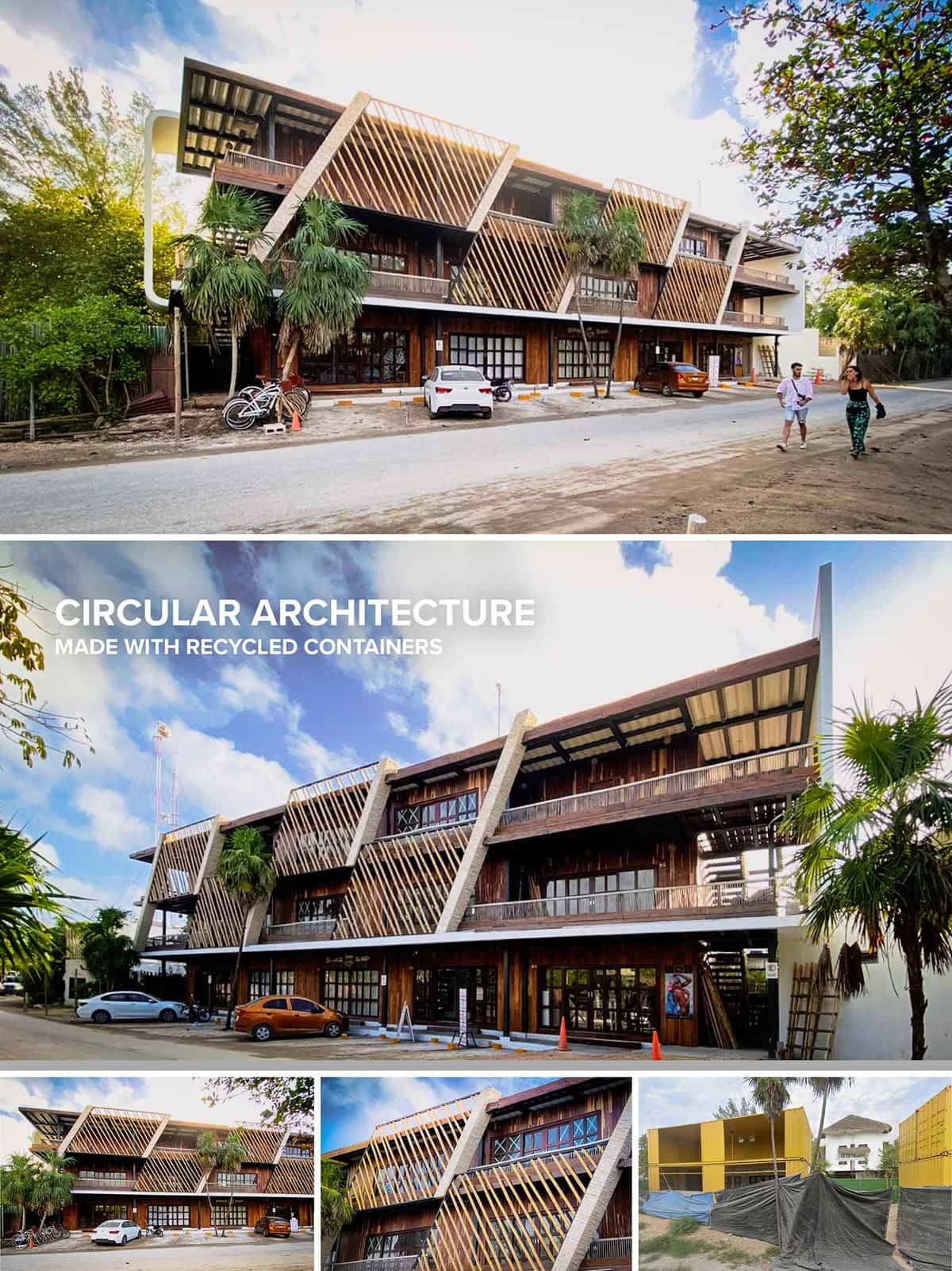

Tulum Plaza Sur is a contemporary commercial-hospitality hybrid development that embodies the ethos of circular architecture through the adaptive reuse of shipping containers. Located in the tropical context of Tulum, Mexico, this structure responds to both environmental and cultural contexts with a raw, honest material language and a bold structural rhythm. The design celebrates modularity and prefabrication. The recycled containers form the core volumetric units, arranged in a stacked linear configuration across three levels. The ground level houses commercial spaces, conceived as flexible retail modules that activate the street frontage, while the upper two levels accommodate hotel suites offering a balance of privacy and openness. The architectural concept was to create a low-impact, modular complex that could be constructed rapidly and disassembled or modified with minimal environmental footprint.
The building presents a rhythmic facade composed of exposed structural frames and diagonal wooden slats that function as sunbreakers. These slats are not only an aesthetic gesture, giving the elevation dynamic texture, but also perform an environmental role, reducing solar gain in Tulum’s hot climate. The material palette is anchored in its commitment to sustainability and regional expression. Corten-style steel elements echo the patina of time, while locally sourced tropical wood brings warmth and organic tactility. The containers themselves—painted and insulated—retain their industrial geometry but are softened with natural materials and shading devices. The slanted concrete fins reinforce the structural modularity while serving as expressive brise-soleils and lateral supports.
The exploded axonometric drawing reveals a clear and efficient modular assembly. Each floor is defined by a consistent container grid, which facilitates repetition in planning and construction. Circulation cores—staircases and access corridors—are positioned laterally and to the rear, maximizing usable frontage and natural ventilation for each unit. The retail level is fully glazed at street level, allowing visibility and openness, ideal for commercial interaction. Hotel suites above are provided with private balconies set behind the wooden lattice, ensuring both shade and filtered views. Overhangs and extended eaves on the top level provide additional passive cooling, vital in the tropical climate.
This project embodies key principles of circular architecture by reusing industrial materials—most notably shipping containers—thus reducing demand for new construction resources. The structure is highly modular, allowing for adaptability over time. Passive cooling techniques are employed through orientation, shading systems, cross-ventilation, and thermal insulation strategies applied to the metal containers. Rainwater harvesting systems and potential integration of solar panels (suggested by roof form and context) enhance environmental performance. Wood cladding is likely sourced from renewable forests, and minimal ground excavation respects the natural permeability of the site.
The axonometric breakdown clearly communicates a layered, prefabricated approach: base slab foundation, modular steel framework, infilled containers, and panelized façades. Each component is dimensionally coordinated for efficient assembly and future disassembly, reinforcing the circular concept. The open steel frame not only defines structural support but also allows for architectural expression through diagonal bracing and shading elements. This construction logic ensures minimal site disturbance and rapid on-site erection, making it an ideal strategy for developing areas with growing tourism demand but sensitive ecological surroundings.
DIRSA


Tulum Plaza Sur is a contemporary commercial-hospitality hybrid development that embodies the ethos of circular architecture through the adaptive reuse of shipping containers. Located in the tropical context of Tulum, Mexico, this structure responds to both environmental and cultural contexts with a raw, honest material language and a bold structural rhythm. The design celebrates modularity and prefabrication. The recycled containers form the core volumetric units, arranged in a stacked linear configuration across three levels. The ground level houses commercial spaces, conceived as flexible retail modules that activate the street frontage, while the upper two levels accommodate hotel suites offering a balance of privacy and openness. The architectural concept was to create a low-impact, modular complex that could be constructed rapidly and disassembled or modified with minimal environmental footprint.
The building presents a rhythmic facade composed of exposed structural frames and diagonal wooden slats that function as sunbreakers. These slats are not only an aesthetic gesture, giving the elevation dynamic texture, but also perform an environmental role, reducing solar gain in Tulum’s hot climate. The material palette is anchored in its commitment to sustainability and regional expression. Corten-style steel elements echo the patina of time, while locally sourced tropical wood brings warmth and organic tactility. The containers themselves—painted and insulated—retain their industrial geometry but are softened with natural materials and shading devices. The slanted concrete fins reinforce the structural modularity while serving as expressive brise-soleils and lateral supports.
The exploded axonometric drawing reveals a clear and efficient modular assembly. Each floor is defined by a consistent container grid, which facilitates repetition in planning and construction. Circulation cores—staircases and access corridors—are positioned laterally and to the rear, maximizing usable frontage and natural ventilation for each unit. The retail level is fully glazed at street level, allowing visibility and openness, ideal for commercial interaction. Hotel suites above are provided with private balconies set behind the wooden lattice, ensuring both shade and filtered views. Overhangs and extended eaves on the top level provide additional passive cooling, vital in the tropical climate.
This project embodies key principles of circular architecture by reusing industrial materials—most notably shipping containers—thus reducing demand for new construction resources. The structure is highly modular, allowing for adaptability over time. Passive cooling techniques are employed through orientation, shading systems, cross-ventilation, and thermal insulation strategies applied to the metal containers. Rainwater harvesting systems and potential integration of solar panels (suggested by roof form and context) enhance environmental performance. Wood cladding is likely sourced from renewable forests, and minimal ground excavation respects the natural permeability of the site.
The axonometric breakdown clearly communicates a layered, prefabricated approach: base slab foundation, modular steel framework, infilled containers, and panelized façades. Each component is dimensionally coordinated for efficient assembly and future disassembly, reinforcing the circular concept. The open steel frame not only defines structural support but also allows for architectural expression through diagonal bracing and shading elements. This construction logic ensures minimal site disturbance and rapid on-site erection, making it an ideal strategy for developing areas with growing tourism demand but sensitive ecological surroundings.
DIRSA
© 2021 by sanzpont [arquitectura] . Webpage by sanzpont [digital] . Innovative Digital Experiences
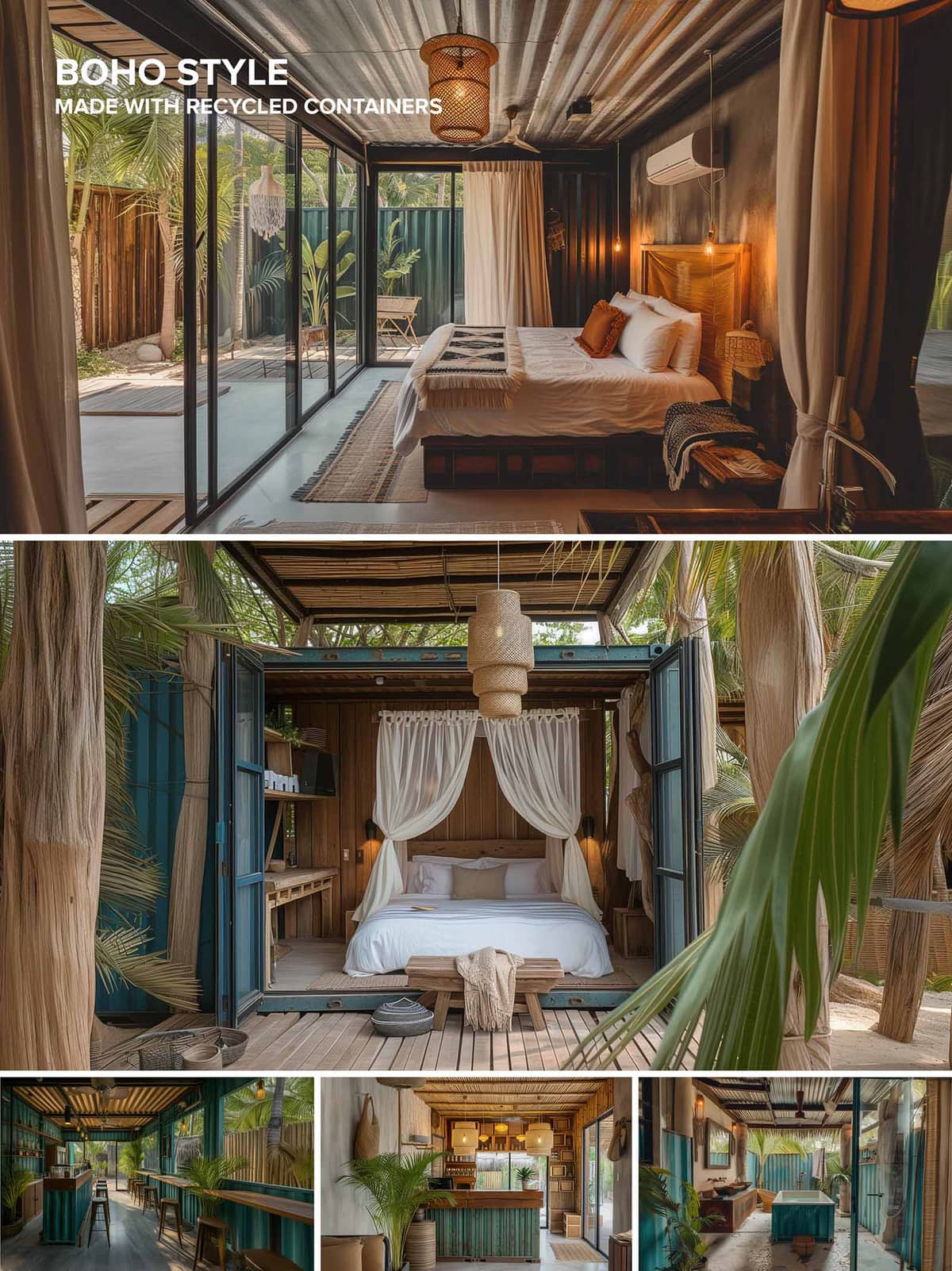

In this project I envisioned a refined yet expressive response to the site in Tulum, where the local climate, natural vegetation and resort‑tourist context demand both comfort and a sense of place. The concept centres on deploying recycled shipping containers as modular volumes, stacked and arranged to allow for generous glazing, shaded decks and cross‑ventilation. The interior adopts a “boho” aesthetic: woven textures, warm wood tones, rattan pendant lighting and natural fibre textiles create a relaxed but refined ambiance. In plan, the container modules are offset to frame views of the tropical vegetation and create interstitial terraces. Sustainability is embedded from the start—via reuse of structure, passive cooling strategies and incorporation of natural materials.
For the superstructure I utilised standard ISO shipping containers, allowing rapid assembly, structural clarity and reduced embodied energy. The façade treatment pairs the raw metal rhythm of the container walls with timber slatted sunscreens and deep aluminium glazing frames. Internally, the ceilings retain the corrugated metal form for visual authenticity but are clad in acoustic treatment and warm timber elsewhere for comfort. Floor finishes are large‑format porcelain tile in neutral beige tones; joinery is of sustainably harvested tropical hardwood (certified), while fabrics and carpets are in undyed cotton, jute and sisal. Exterior decks are of FSC‑certified hardwood planking. Large sliding glass doors open onto the decks, visually blending interior/exterior and maximising daylight and natural airflow.
Each suite occupies one or two container volumes. Upon entry, the bed zone is oriented to receive morning light from the shallow terrace, while sliding doors open to create a shaded outdoor lounge. Adjacent to the sleeping zone is an en‑suite wet‑room with rain shower and freestanding tub, separated by a translucent glass partition for light but also privacy. A compact kitchenette and bar area lie near the entrance for guest convenience. Circulation is minimal and linear, preserving usable volume. The deck zone extends the plan outwards, with room for lounge chairs and access to lush planted buffers that provide privacy from adjacent units. Structural stacking allows the upper level suites to cantilever slightly over the lower, creating covered outdoor zones below and a dynamic silhouette on the building exterior.
The colour palette leans into natural and subdued tones: sand (RAL 1015), clay (RAL 8004), olive‑green accents (RAL 6003) and charcoal for metal trims (RAL 7016). Lighting is warm (2700‑3000 K LED) and layered: ambient cove lighting above the timber headboard, pendant rattan lights by the bed, and recessed LED downlights in the wet‑room. On the exterior terraces, uplights highlight the palm trunks and planter edges, fostering a serene evening space. Textiles include off‑white linen curtains, terracotta linen cushions and jute rugs with geometric motifs. The overall ambience is calming but rich in texture, evoking tropical luxury without excess.
Sustainability was a foundational aspect of this project, guiding both design and construction choices from the earliest stages. By repurposing shipping containers as the primary building blocks, we significantly reduced the embodied carbon typically associated with new construction materials. The modularity of the containers also streamlined the build process, resulting in less on-site waste and reduced construction time. The orientation and layout of the suites were carefully calibrated to support passive cooling. Deep overhangs, operable full-height sliding doors, and strategically placed clerestory openings enhance cross-ventilation, allowing the spaces to remain comfortable without reliance on mechanical cooling. These passive design strategies are complemented by high-performance glazing, which minimizes heat gain while preserving generous daylight entry.
All timber used in the interior finishes and exterior decking is certified by the Forest Stewardship Council (FSC), ensuring sustainable forestry practices. Finishes throughout the space are selected for their low-VOC (volatile organic compound) content, contributing to healthy indoor air quality. Textiles and soft furnishings are made from natural fibres such as cotton, linen, and jute, aligning with both environmental and aesthetic intentions. Water conservation is addressed through a rainwater harvesting system integrated into the container roofs, supplying non-potable uses such as irrigation and toilet flushing. Additionally, greywater from sinks and showers is treated and reused for landscape watering, reducing freshwater consumption. The landscaping strategy emphasizes native and drought-tolerant vegetation, further minimizing water demand while supporting local biodiversity.
Energy efficiency is embedded through the use of LED lighting, smart occupancy sensors, and low-consumption appliances. The building is designed to be photovoltaic-ready, with provisions made for the future integration of solar panels across the upper-level canopy structures. This forward-thinking approach ensures adaptability to renewable energy systems as they become more feasible or desired. Overall, the sustainability strategy integrates architecture with climate responsiveness, material responsibility, and long-term ecological awareness, making this a model for low-impact, high-comfort hospitality design.
DIRSA


In this project I envisioned a refined yet expressive response to the site in Tulum, where the local climate, natural vegetation and resort‑tourist context demand both comfort and a sense of place. The concept centres on deploying recycled shipping containers as modular volumes, stacked and arranged to allow for generous glazing, shaded decks and cross‑ventilation. The interior adopts a “boho” aesthetic: woven textures, warm wood tones, rattan pendant lighting and natural fibre textiles create a relaxed but refined ambiance. In plan, the container modules are offset to frame views of the tropical vegetation and create interstitial terraces. Sustainability is embedded from the start—via reuse of structure, passive cooling strategies and incorporation of natural materials.
For the superstructure I utilised standard ISO shipping containers, allowing rapid assembly, structural clarity and reduced embodied energy. The façade treatment pairs the raw metal rhythm of the container walls with timber slatted sunscreens and deep aluminium glazing frames. Internally, the ceilings retain the corrugated metal form for visual authenticity but are clad in acoustic treatment and warm timber elsewhere for comfort. Floor finishes are large‑format porcelain tile in neutral beige tones; joinery is of sustainably harvested tropical hardwood (certified), while fabrics and carpets are in undyed cotton, jute and sisal. Exterior decks are of FSC‑certified hardwood planking. Large sliding glass doors open onto the decks, visually blending interior/exterior and maximising daylight and natural airflow.
Each suite occupies one or two container volumes. Upon entry, the bed zone is oriented to receive morning light from the shallow terrace, while sliding doors open to create a shaded outdoor lounge. Adjacent to the sleeping zone is an en‑suite wet‑room with rain shower and freestanding tub, separated by a translucent glass partition for light but also privacy. A compact kitchenette and bar area lie near the entrance for guest convenience. Circulation is minimal and linear, preserving usable volume. The deck zone extends the plan outwards, with room for lounge chairs and access to lush planted buffers that provide privacy from adjacent units. Structural stacking allows the upper level suites to cantilever slightly over the lower, creating covered outdoor zones below and a dynamic silhouette on the building exterior.
The colour palette leans into natural and subdued tones: sand (RAL 1015), clay (RAL 8004), olive‑green accents (RAL 6003) and charcoal for metal trims (RAL 7016). Lighting is warm (2700‑3000 K LED) and layered: ambient cove lighting above the timber headboard, pendant rattan lights by the bed, and recessed LED downlights in the wet‑room. On the exterior terraces, uplights highlight the palm trunks and planter edges, fostering a serene evening space. Textiles include off‑white linen curtains, terracotta linen cushions and jute rugs with geometric motifs. The overall ambience is calming but rich in texture, evoking tropical luxury without excess.
Sustainability was a foundational aspect of this project, guiding both design and construction choices from the earliest stages. By repurposing shipping containers as the primary building blocks, we significantly reduced the embodied carbon typically associated with new construction materials. The modularity of the containers also streamlined the build process, resulting in less on-site waste and reduced construction time. The orientation and layout of the suites were carefully calibrated to support passive cooling. Deep overhangs, operable full-height sliding doors, and strategically placed clerestory openings enhance cross-ventilation, allowing the spaces to remain comfortable without reliance on mechanical cooling. These passive design strategies are complemented by high-performance glazing, which minimizes heat gain while preserving generous daylight entry.
All timber used in the interior finishes and exterior decking is certified by the Forest Stewardship Council (FSC), ensuring sustainable forestry practices. Finishes throughout the space are selected for their low-VOC (volatile organic compound) content, contributing to healthy indoor air quality. Textiles and soft furnishings are made from natural fibres such as cotton, linen, and jute, aligning with both environmental and aesthetic intentions. Water conservation is addressed through a rainwater harvesting system integrated into the container roofs, supplying non-potable uses such as irrigation and toilet flushing. Additionally, greywater from sinks and showers is treated and reused for landscape watering, reducing freshwater consumption. The landscaping strategy emphasizes native and drought-tolerant vegetation, further minimizing water demand while supporting local biodiversity.
Energy efficiency is embedded through the use of LED lighting, smart occupancy sensors, and low-consumption appliances. The building is designed to be photovoltaic-ready, with provisions made for the future integration of solar panels across the upper-level canopy structures. This forward-thinking approach ensures adaptability to renewable energy systems as they become more feasible or desired. Overall, the sustainability strategy integrates architecture with climate responsiveness, material responsibility, and long-term ecological awareness, making this a model for low-impact, high-comfort hospitality design.
DIRSA
© 2021 by sanzpont [arquitectura] . Webpage by sanzpont [digital] . Innovative Digital Experiences
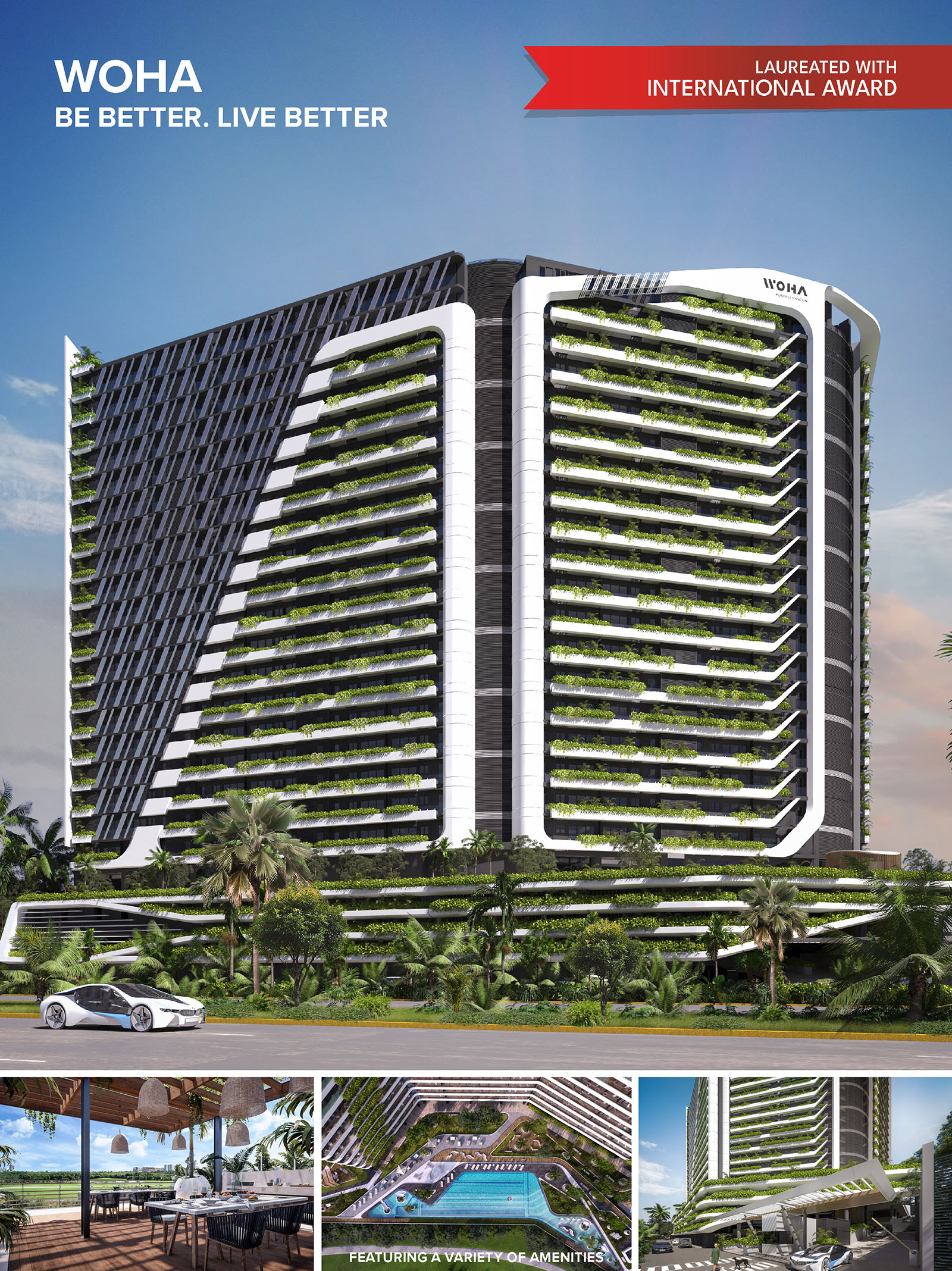
WOHA emerges as a high-rise residential development that redefines sustainable urban living in a tropical context. Rooted in three core design premises—functionality, universal sea views, and bioclimatic sustainability—the project synthesizes environmental consciousness with architectural elegance. Comprising 204 apartments distributed over 20 levels, including two subterranean parking levels and a roof-level energy zone, the tower promotes a lifestyle integrated with nature and wellness. The architecture embraces a modular approach to optimize spatial organization and user comfort, structured around a highly efficient 100 m² residential unit.
The massing of the tower is designed as an articulated, L-shaped volume that maximizes exposure to the Caribbean Sea, ensuring that every unit benefits from panoramic views. The tower is slightly tapered and sculpted to incorporate large horizontal terraces, which act as vegetated buffers. This strategy not only enhances the view corridors but also functions as passive solar protection. The form tilts dynamically, generating movement in the façade and emphasizing a vertical garden expression through continuous balcony planters.
At the heart of the architectural solution lies a highly rationalized floor plan. The 7.7m by 11m residential module avoids redundant circulation by removing internal corridors and enabling direct elevator access to each unit. The open-plan configuration promotes flow between kitchen, dining, and living spaces, orienting these social zones toward the sea. Conversely, service spaces and secondary bedrooms face the city side. The linear arrangement across a single bay ensures optimal cross-ventilation, vital for passive thermal regulation in tropical climates.
WOHA adopts a rigorous passive bioclimatic design tailored to the warm, sub-humid climate of the Caribbean. Continuous balconies double as sunshades and planting beds, reducing solar gain while contributing to urban biodiversity. Wind analysis determined optimal cross-ventilation strategies, while facade geometry and vertical greening support evaporative cooling and shading. During the warmer summer months—when natural ventilation becomes less effective—mechanical systems are discreetly integrated to maintain thermal comfort. The green terraces serve multiple environmental functions: mitigating the heat island effect, enhancing rainwater retention, and promoting the psychological benefits of biophilic design. The rooftop is designated for renewable energy generation, likely incorporating photovoltaic panels or wind turbines, signaling a move toward energy autonomy.
The architectural expression is defined by a restrained palette of high-performance materials: reflective glass, low-carbon concrete, and a façade system clad in a combination of white composite panels and dark louvers. The vegetated balconies punctuate the linear composition with lush greenery, transforming the building into a vertical garden. The interplay of white frames and green terraces conveys a clean, futuristic identity while maintaining a strong connection to the tropical landscape.
Beyond the residential component, WOHA provides an extensive range of shared amenities designed to foster a sense of community and wellness. These include rooftop lounges, an infinity-edge pool, outdoor dining terraces, and landscaped podium gardens. The amenities are seamlessly integrated with the architectural language of the project, ensuring continuity in form, material, and environmental performance.
WOHA is conceived not only as a residential project but as a catalyst for environmental awareness. By integrating energy-efficient systems, promoting resource reuse, and supporting low-impact lifestyles, it advocates for a conscious way of living. Its sustainable ethos is reinforced through waste recycling programs, water efficiency systems, and ecological landscaping, making it a benchmark for responsible design in coastal developments.
• The Architecture Community International Residential Architecture Awards 2022 : Winner : Woha (2022)


• The Architecture Community International Residential Architecture Awards 2022 : Winner : Woha (2022)
WOHA emerges as a high-rise residential development that redefines sustainable urban living in a tropical context. Rooted in three core design premises—functionality, universal sea views, and bioclimatic sustainability—the project synthesizes environmental consciousness with architectural elegance. Comprising 204 apartments distributed over 20 levels, including two subterranean parking levels and a roof-level energy zone, the tower promotes a lifestyle integrated with nature and wellness. The architecture embraces a modular approach to optimize spatial organization and user comfort, structured around a highly efficient 100 m² residential unit.
The massing of the tower is designed as an articulated, L-shaped volume that maximizes exposure to the Caribbean Sea, ensuring that every unit benefits from panoramic views. The tower is slightly tapered and sculpted to incorporate large horizontal terraces, which act as vegetated buffers. This strategy not only enhances the view corridors but also functions as passive solar protection. The form tilts dynamically, generating movement in the façade and emphasizing a vertical garden expression through continuous balcony planters.
At the heart of the architectural solution lies a highly rationalized floor plan. The 7.7m by 11m residential module avoids redundant circulation by removing internal corridors and enabling direct elevator access to each unit. The open-plan configuration promotes flow between kitchen, dining, and living spaces, orienting these social zones toward the sea. Conversely, service spaces and secondary bedrooms face the city side. The linear arrangement across a single bay ensures optimal cross-ventilation, vital for passive thermal regulation in tropical climates.
WOHA adopts a rigorous passive bioclimatic design tailored to the warm, sub-humid climate of the Caribbean. Continuous balconies double as sunshades and planting beds, reducing solar gain while contributing to urban biodiversity. Wind analysis determined optimal cross-ventilation strategies, while facade geometry and vertical greening support evaporative cooling and shading. During the warmer summer months—when natural ventilation becomes less effective—mechanical systems are discreetly integrated to maintain thermal comfort. The green terraces serve multiple environmental functions: mitigating the heat island effect, enhancing rainwater retention, and promoting the psychological benefits of biophilic design. The rooftop is designated for renewable energy generation, likely incorporating photovoltaic panels or wind turbines, signaling a move toward energy autonomy.
The architectural expression is defined by a restrained palette of high-performance materials: reflective glass, low-carbon concrete, and a façade system clad in a combination of white composite panels and dark louvers. The vegetated balconies punctuate the linear composition with lush greenery, transforming the building into a vertical garden. The interplay of white frames and green terraces conveys a clean, futuristic identity while maintaining a strong connection to the tropical landscape.
Beyond the residential component, WOHA provides an extensive range of shared amenities designed to foster a sense of community and wellness. These include rooftop lounges, an infinity-edge pool, outdoor dining terraces, and landscaped podium gardens. The amenities are seamlessly integrated with the architectural language of the project, ensuring continuity in form, material, and environmental performance.
WOHA is conceived not only as a residential project but as a catalyst for environmental awareness. By integrating energy-efficient systems, promoting resource reuse, and supporting low-impact lifestyles, it advocates for a conscious way of living. Its sustainable ethos is reinforced through waste recycling programs, water efficiency systems, and ecological landscaping, making it a benchmark for responsible design in coastal developments.
© 2021 by sanzpont [arquitectura] . Webpage by sanzpont [digital] . Innovative Digital Experiences
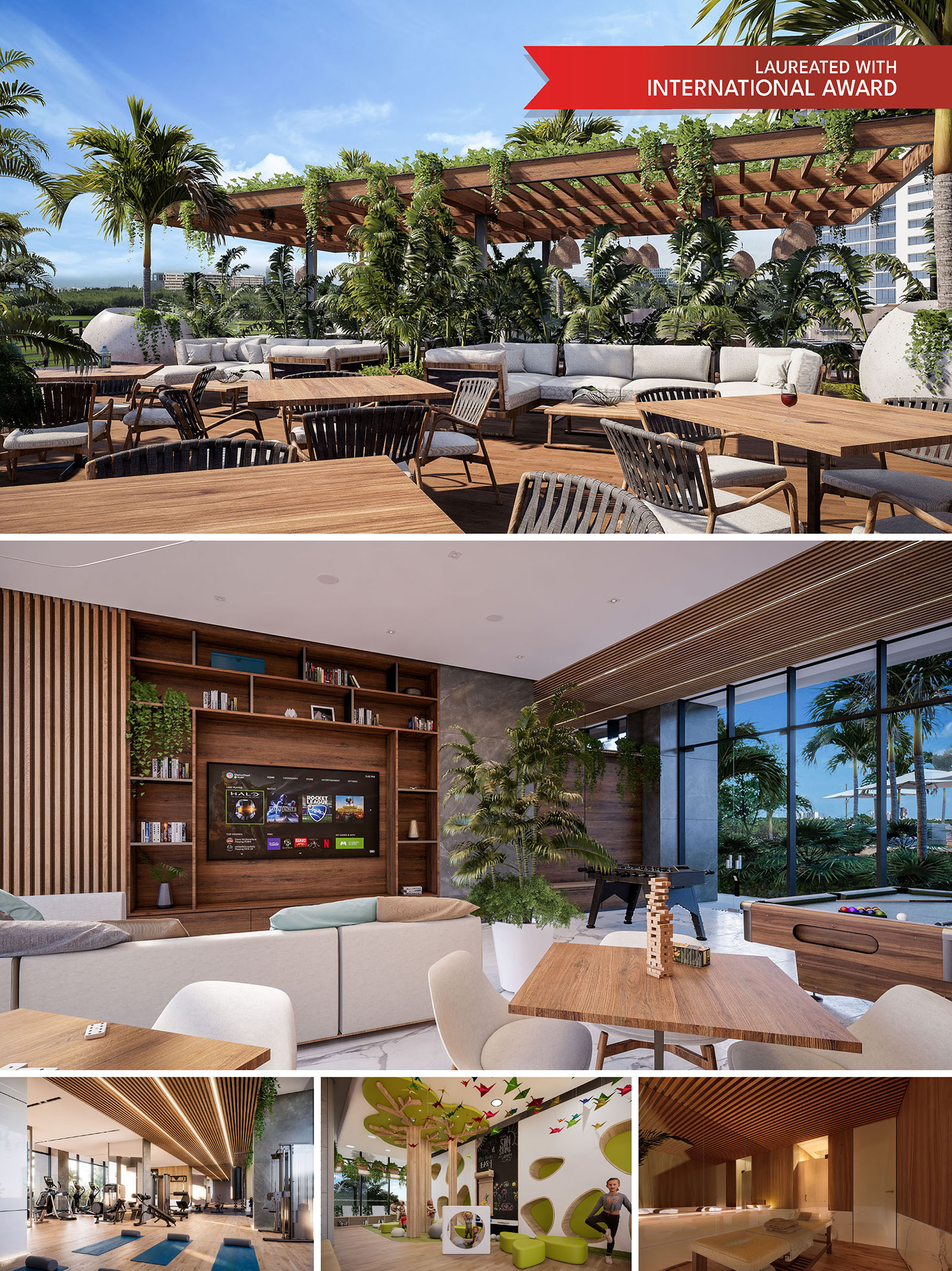
The amenities at WOHA are conceived as spatial extensions of the core residential philosophy: to live better by living in harmony with nature. The amenity areas are designed not only to serve the functional needs of residents but also to elevate their day-to-day experience through sensory, social, and wellness-focused programming. The architectural and interior language reflects tropical modernism, with a strong emphasis on biophilic integration, passive design strategies, and flexible use of space.
The crown of the amenity offering is the rooftop lounge—a lushly planted terrace shaded by a wood pergola structure. The design embraces an open-air concept that frames panoramic views while encouraging natural ventilation. Lightweight materials such as timber and woven fibers are used extensively in the furniture and ceiling treatments, reinforcing the connection to the natural surroundings. Cascading planters and integrated vegetation soften the edges of the structure, creating an immersive garden-like atmosphere. These terraces are designed as multifunctional spaces—supporting both daytime relaxation and evening social events.
At the heart of the amenity interiors is a double-height multipurpose lounge. This space combines a library, game zone, and digital entertainment hub, all articulated within a cohesive timber and stone palette. Custom millwork features integrated shelving and media units, paired with flexible seating configurations that promote community gathering and informal interaction. The use of large-format glass openings ensures a seamless dialogue with the landscaped exterior, while vertical planting and wooden ceiling baffles enhance acoustic comfort and natural aesthetics.
The gymnasium and wellness area are planned with precision to optimize daylight, spatial efficiency, and environmental control. Slatted timber ceilings with integrated lighting provide rhythm and warmth, while full-height glazing connects users to the lush outdoor vegetation. The gym accommodates a variety of physical activities—free weights, cardio, yoga—catering to different user profiles. The accompanying wellness suite, featuring a steam room and sauna, is articulated in warm wood tones and natural stone textures, offering a serene environment for relaxation and recovery.
WOHA also prioritizes younger residents through a highly curated indoor playroom. The space is defined by playful biomorphic elements—tree-like columns, climbing walls, and interactive installations—all rendered in soft, organic forms. A vibrant color palette, inspired by nature, creates a stimulating yet calming environment for children. The space is carefully designed to be safe, inclusive, and educational, encouraging cognitive and physical development through interaction and play.
Sustainability is a core value that transcends the entire amenity experience. Materials were selected for their low environmental impact, durability, and local sourcing. FSC-certified timber, low-VOC finishes, and recycled content furnishings are employed throughout. The extensive use of natural ventilation, daylighting strategies, and native vegetation significantly reduces the energy footprint of these communal areas. Indoor-outdoor transitions are seamless, reinforcing the idea of an architecture that breathes with its environment.
The amenity strategy at WOHA fosters a holistic lifestyle, enhancing residents' well-being across physical, mental, and social dimensions. Each space is crafted not merely as a utility but as an experience—encouraging interaction, contemplation, and community engagement. In doing so, WOHA positions itself not only as a residence but as a living system, thoughtfully aligned with the values of sustainability, health, and collective living.
• The Architecture Community International Residential Architecture Awards 2022 : Winner : Woha (2022)


• The Architecture Community International Residential Architecture Awards 2022 : Winner : Woha (2022)
The amenities at WOHA are conceived as spatial extensions of the core residential philosophy: to live better by living in harmony with nature. The amenity areas are designed not only to serve the functional needs of residents but also to elevate their day-to-day experience through sensory, social, and wellness-focused programming. The architectural and interior language reflects tropical modernism, with a strong emphasis on biophilic integration, passive design strategies, and flexible use of space.
The crown of the amenity offering is the rooftop lounge—a lushly planted terrace shaded by a wood pergola structure. The design embraces an open-air concept that frames panoramic views while encouraging natural ventilation. Lightweight materials such as timber and woven fibers are used extensively in the furniture and ceiling treatments, reinforcing the connection to the natural surroundings. Cascading planters and integrated vegetation soften the edges of the structure, creating an immersive garden-like atmosphere. These terraces are designed as multifunctional spaces—supporting both daytime relaxation and evening social events.
At the heart of the amenity interiors is a double-height multipurpose lounge. This space combines a library, game zone, and digital entertainment hub, all articulated within a cohesive timber and stone palette. Custom millwork features integrated shelving and media units, paired with flexible seating configurations that promote community gathering and informal interaction. The use of large-format glass openings ensures a seamless dialogue with the landscaped exterior, while vertical planting and wooden ceiling baffles enhance acoustic comfort and natural aesthetics.
The gymnasium and wellness area are planned with precision to optimize daylight, spatial efficiency, and environmental control. Slatted timber ceilings with integrated lighting provide rhythm and warmth, while full-height glazing connects users to the lush outdoor vegetation. The gym accommodates a variety of physical activities—free weights, cardio, yoga—catering to different user profiles. The accompanying wellness suite, featuring a steam room and sauna, is articulated in warm wood tones and natural stone textures, offering a serene environment for relaxation and recovery.
WOHA also prioritizes younger residents through a highly curated indoor playroom. The space is defined by playful biomorphic elements—tree-like columns, climbing walls, and interactive installations—all rendered in soft, organic forms. A vibrant color palette, inspired by nature, creates a stimulating yet calming environment for children. The space is carefully designed to be safe, inclusive, and educational, encouraging cognitive and physical development through interaction and play.
Sustainability is a core value that transcends the entire amenity experience. Materials were selected for their low environmental impact, durability, and local sourcing. FSC-certified timber, low-VOC finishes, and recycled content furnishings are employed throughout. The extensive use of natural ventilation, daylighting strategies, and native vegetation significantly reduces the energy footprint of these communal areas. Indoor-outdoor transitions are seamless, reinforcing the idea of an architecture that breathes with its environment.
The amenity strategy at WOHA fosters a holistic lifestyle, enhancing residents' well-being across physical, mental, and social dimensions. Each space is crafted not merely as a utility but as an experience—encouraging interaction, contemplation, and community engagement. In doing so, WOHA positions itself not only as a residence but as a living system, thoughtfully aligned with the values of sustainability, health, and collective living.
© 2021 by sanzpont [arquitectura] . Webpage by sanzpont [digital] . Innovative Digital Experiences
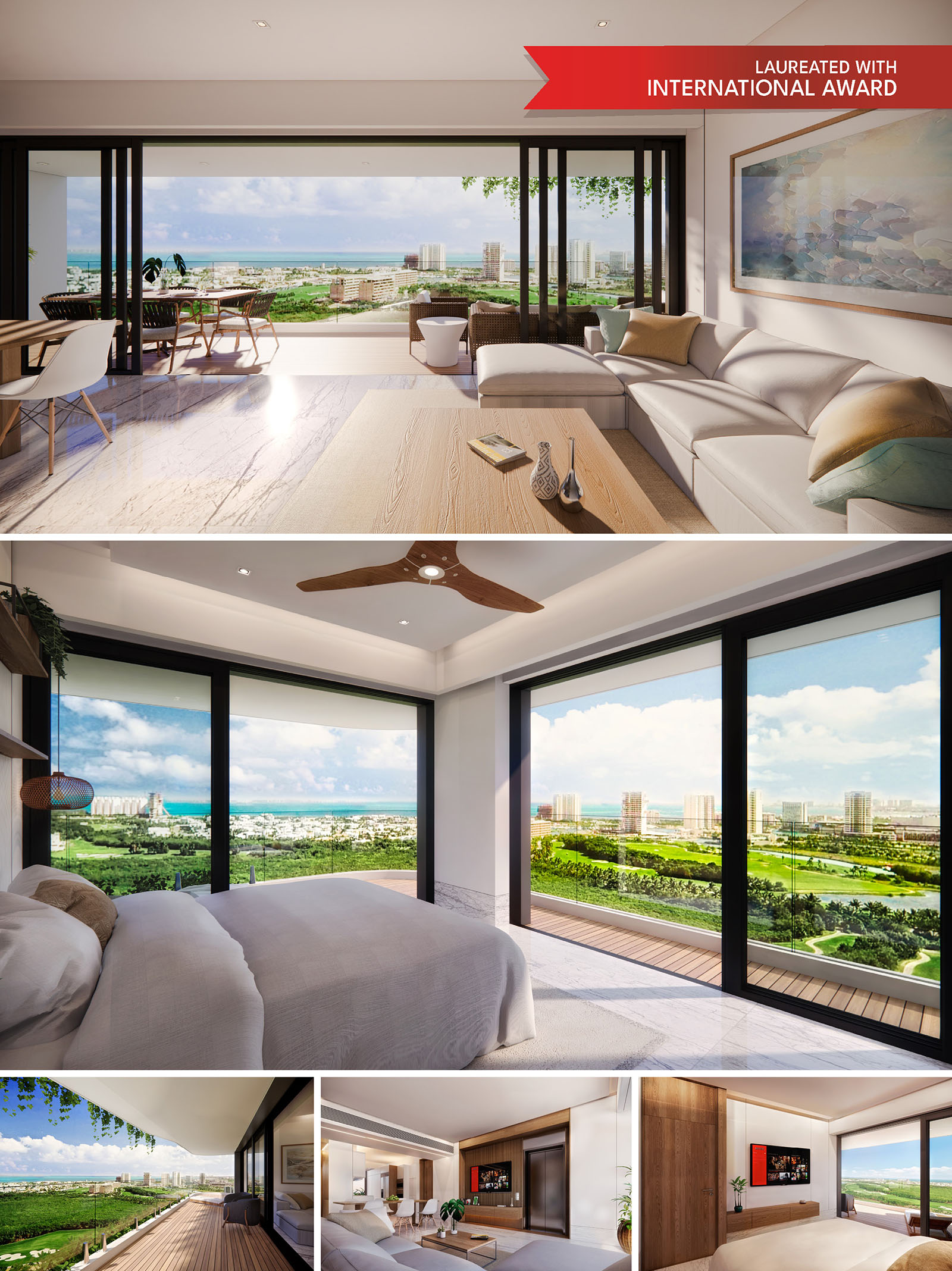
The apartment units at WOHA are envisioned as modern sanctuaries that harmonize architecture with the tropical environment. Based on a modular logic, each unit is designed to maximize spatial efficiency, natural illumination, and seamless visual connectivity to the Caribbean landscape. The concept focuses on comfort, functionality, and sustainability—providing residents with a refined lifestyle immersed in nature. Each apartment is a reflection of the project’s core values: livability, efficiency, and environmental consciousness.
Each 100 m² unit is organized within a 7.7m x 11m footprint, allowing for an exceptionally efficient use of space. The open-plan configuration strategically places the living, dining, and master bedroom areas facing the sea, while service spaces and secondary bedrooms are oriented toward the cityscape. This bi-directional orientation ensures that all interior spaces are naturally lit and well-ventilated. The absence of internal corridors enhances spatial clarity and flow, providing direct elevator access into the units—offering privacy and exclusivity. This eliminates shared hallways, reduces maintenance, and increases usable living area within each residence.
The interior material palette is warm, tactile, and rooted in natural textures. Floors are finished in polished stone with light veining, creating a luminous base that reflects the abundant natural light. Timber is used for built-in elements, ceiling treatments, and furnishings, imbuing the spaces with a sense of warmth and continuity. The combination of neutral tones and organic materials establishes a serene atmosphere that adapts effortlessly to the lush context visible through expansive openings. Large-format windows and floor-to-ceiling sliding glass doors dissolve the boundary between indoors and outdoors, inviting sea breezes and panoramic views into daily living. Finishes and detailing are kept minimal and refined, allowing the surrounding landscape to take visual precedence.
All units open onto generous private terraces that act as outdoor living rooms. These terraces are designed as continuous platforms wrapped with planter boxes that support native vegetation, providing privacy and sun protection while enhancing biodiversity. The uninterrupted sea views are the focal point of the residential experience, transforming every apartment into a front-row seat to the Caribbean. Outdoor dining and lounging areas extend the usability of the living spaces, encouraging a lifestyle that fully embraces the tropical climate. The terraces are an essential part of the project’s passive climate strategy, working as thermal buffers that reduce direct solar radiation on the glazed facades.
The apartment modules are carefully configured to promote cross ventilation, responding to the site's prevailing wind directions. This strategy ensures that interior spaces remain naturally cool for most of the year, minimizing the need for mechanical air conditioning. Ceiling fans, operable windows, and light-colored finishes complement the passive design strategies, contributing to thermal comfort and energy efficiency.
In line with WOHA’s sustainability ethos, the apartments incorporate resource-efficient features such as LED lighting, low-flow fixtures, and materials with low embodied energy. By designing each unit as an independent bioclimatic cell, the project minimizes energy consumption while maximizing comfort. The apartment design reflects a new way of urban living—conscious, efficient, and intimately connected to the environment. Through thoughtful spatial planning, integrated landscape, and responsive architecture, each unit at WOHA offers a refined and responsible residential experience.
• The Architecture Community International Residential Architecture Awards 2022 : Winner : Woha (2022)


• The Architecture Community International Residential Architecture Awards 2022 : Winner : Woha (2022)
The apartment units at WOHA are envisioned as modern sanctuaries that harmonize architecture with the tropical environment. Based on a modular logic, each unit is designed to maximize spatial efficiency, natural illumination, and seamless visual connectivity to the Caribbean landscape. The concept focuses on comfort, functionality, and sustainability—providing residents with a refined lifestyle immersed in nature. Each apartment is a reflection of the project’s core values: livability, efficiency, and environmental consciousness.
Each 100 m² unit is organized within a 7.7m x 11m footprint, allowing for an exceptionally efficient use of space. The open-plan configuration strategically places the living, dining, and master bedroom areas facing the sea, while service spaces and secondary bedrooms are oriented toward the cityscape. This bi-directional orientation ensures that all interior spaces are naturally lit and well-ventilated. The absence of internal corridors enhances spatial clarity and flow, providing direct elevator access into the units—offering privacy and exclusivity. This eliminates shared hallways, reduces maintenance, and increases usable living area within each residence.
The interior material palette is warm, tactile, and rooted in natural textures. Floors are finished in polished stone with light veining, creating a luminous base that reflects the abundant natural light. Timber is used for built-in elements, ceiling treatments, and furnishings, imbuing the spaces with a sense of warmth and continuity. The combination of neutral tones and organic materials establishes a serene atmosphere that adapts effortlessly to the lush context visible through expansive openings. Large-format windows and floor-to-ceiling sliding glass doors dissolve the boundary between indoors and outdoors, inviting sea breezes and panoramic views into daily living. Finishes and detailing are kept minimal and refined, allowing the surrounding landscape to take visual precedence.
All units open onto generous private terraces that act as outdoor living rooms. These terraces are designed as continuous platforms wrapped with planter boxes that support native vegetation, providing privacy and sun protection while enhancing biodiversity. The uninterrupted sea views are the focal point of the residential experience, transforming every apartment into a front-row seat to the Caribbean. Outdoor dining and lounging areas extend the usability of the living spaces, encouraging a lifestyle that fully embraces the tropical climate. The terraces are an essential part of the project’s passive climate strategy, working as thermal buffers that reduce direct solar radiation on the glazed facades.
The apartment modules are carefully configured to promote cross ventilation, responding to the site's prevailing wind directions. This strategy ensures that interior spaces remain naturally cool for most of the year, minimizing the need for mechanical air conditioning. Ceiling fans, operable windows, and light-colored finishes complement the passive design strategies, contributing to thermal comfort and energy efficiency.
In line with WOHA’s sustainability ethos, the apartments incorporate resource-efficient features such as LED lighting, low-flow fixtures, and materials with low embodied energy. By designing each unit as an independent bioclimatic cell, the project minimizes energy consumption while maximizing comfort. The apartment design reflects a new way of urban living—conscious, efficient, and intimately connected to the environment. Through thoughtful spatial planning, integrated landscape, and responsive architecture, each unit at WOHA offers a refined and responsible residential experience.
© 2021 by sanzpont [arquitectura] . Webpage by sanzpont [digital] . Innovative Digital Experiences
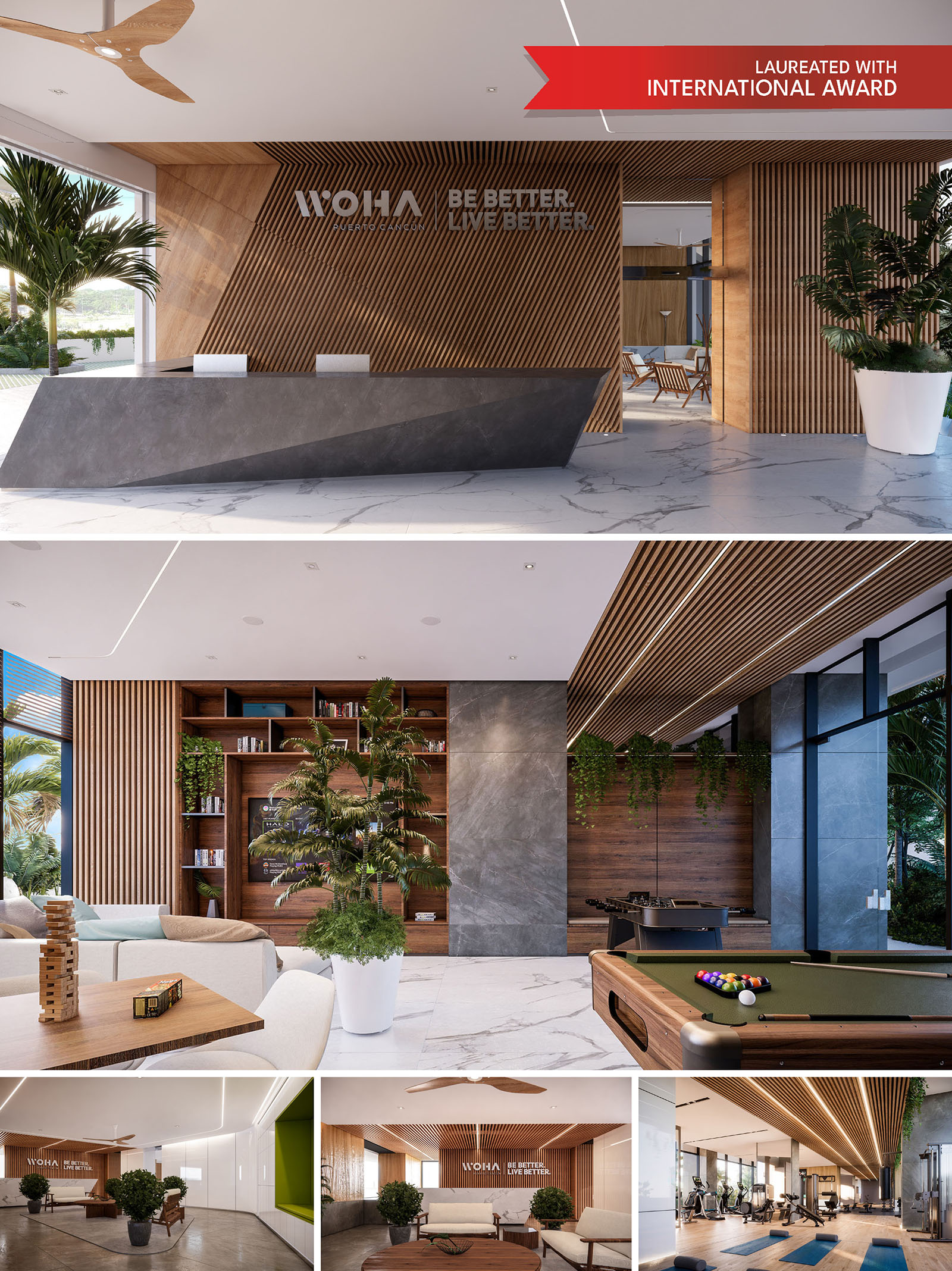
The lobby at WOHA serves as a threshold between urban life and the sanctuary of home, conceived as a spatial prologue to the sustainable living experience offered by the building. It is designed not simply as a reception area, but as an architectural statement—merging hospitality, wellness, and environmental consciousness into a singular, refined expression. The spatial composition emphasizes openness, natural materials, and a seamless integration with the tropical context of Puerto Cancún.
Upon entry, visitors are greeted by a double-height space that visually extends toward the lush landscape beyond. The reception desk is positioned as a sculptural anchor—a faceted monolith of dark stone that contrasts against the warm, vertical wooden slats behind it. Circulation paths are intuitively organized, guiding users toward social lounges, elevators, and landscaped courtyards. The layout ensures clear visual connectivity and efficient flow, eliminating clutter and prioritizing calm transitions. The spatial narrative is reinforced by the axial view from the reception desk to the exterior garden, underscoring the project's commitment to biophilic design and indoor-outdoor continuity.
The interior material palette combines contemporary finishes with natural warmth. Light marble-effect porcelain flooring extends across the lobby, offering both elegance and durability. Feature walls are clad in FSC-certified oak slats, providing rhythm, acoustic control, and texture. These vertical elements continue into the ceiling, visually unifying the space and emphasizing the height of the volume. Furniture pieces are crafted from solid wood and soft upholstery in neutral tones, arranged in informal clusters to foster interaction and relaxation. Potted tropical plants and integrated greenery enhance the ambiance, bringing nature into the heart of the building.
Expansive floor-to-ceiling glazing floods the lobby with daylight while framing views of the tropical landscaping outside. This design move reduces reliance on artificial lighting during the day and reinforces a connection to the natural setting. Overhead fans, strategically positioned, provide comfort in place of energy-intensive air conditioning during milder weather, aligning with passive ventilation strategies. The biophilic intent of the space is further emphasized by the inclusion of indoor planting niches and a curated selection of greenery placed at eye level—creating a living backdrop that evolves with the seasons.
Beyond its aesthetic function, the lobby is a multi-programmatic space. It includes a reading nook with integrated shelving, a business-style co-working corner with dedicated seating, and informal meeting areas. These inclusions ensure that the lobby is not just a transitory space but also a functional social hub where residents can work, relax, or engage with the community. The choice of materials and furnishings promotes acoustic comfort, visual softness, and thermal stability, creating an environment that is as serene as it is practical.
The lobby exemplifies WOHA’s sustainable ethos through its material choices, spatial efficiency, and environmental responsiveness. The use of locally sourced wood, energy-efficient lighting, and passive climate strategies such as solar orientation and natural ventilation all contribute to the project's reduced ecological footprint. By merging architecture and nature, the WOHA lobby becomes a place of encounter, reflection, and transition—elevating everyday experience while remaining deeply rooted in the principles of sustainable design.
• The Architecture Community International Residential Architecture Awards 2022 : Winner : Woha (2022)


• The Architecture Community International Residential Architecture Awards 2022 : Winner : Woha (2022)
The lobby at WOHA serves as a threshold between urban life and the sanctuary of home, conceived as a spatial prologue to the sustainable living experience offered by the building. It is designed not simply as a reception area, but as an architectural statement—merging hospitality, wellness, and environmental consciousness into a singular, refined expression. The spatial composition emphasizes openness, natural materials, and a seamless integration with the tropical context of Puerto Cancún.
Upon entry, visitors are greeted by a double-height space that visually extends toward the lush landscape beyond. The reception desk is positioned as a sculptural anchor—a faceted monolith of dark stone that contrasts against the warm, vertical wooden slats behind it. Circulation paths are intuitively organized, guiding users toward social lounges, elevators, and landscaped courtyards. The layout ensures clear visual connectivity and efficient flow, eliminating clutter and prioritizing calm transitions. The spatial narrative is reinforced by the axial view from the reception desk to the exterior garden, underscoring the project's commitment to biophilic design and indoor-outdoor continuity.
The interior material palette combines contemporary finishes with natural warmth. Light marble-effect porcelain flooring extends across the lobby, offering both elegance and durability. Feature walls are clad in FSC-certified oak slats, providing rhythm, acoustic control, and texture. These vertical elements continue into the ceiling, visually unifying the space and emphasizing the height of the volume. Furniture pieces are crafted from solid wood and soft upholstery in neutral tones, arranged in informal clusters to foster interaction and relaxation. Potted tropical plants and integrated greenery enhance the ambiance, bringing nature into the heart of the building.
Expansive floor-to-ceiling glazing floods the lobby with daylight while framing views of the tropical landscaping outside. This design move reduces reliance on artificial lighting during the day and reinforces a connection to the natural setting. Overhead fans, strategically positioned, provide comfort in place of energy-intensive air conditioning during milder weather, aligning with passive ventilation strategies. The biophilic intent of the space is further emphasized by the inclusion of indoor planting niches and a curated selection of greenery placed at eye level—creating a living backdrop that evolves with the seasons.
Beyond its aesthetic function, the lobby is a multi-programmatic space. It includes a reading nook with integrated shelving, a business-style co-working corner with dedicated seating, and informal meeting areas. These inclusions ensure that the lobby is not just a transitory space but also a functional social hub where residents can work, relax, or engage with the community. The choice of materials and furnishings promotes acoustic comfort, visual softness, and thermal stability, creating an environment that is as serene as it is practical.
The lobby exemplifies WOHA’s sustainable ethos through its material choices, spatial efficiency, and environmental responsiveness. The use of locally sourced wood, energy-efficient lighting, and passive climate strategies such as solar orientation and natural ventilation all contribute to the project's reduced ecological footprint. By merging architecture and nature, the WOHA lobby becomes a place of encounter, reflection, and transition—elevating everyday experience while remaining deeply rooted in the principles of sustainable design.
© 2021 by sanzpont [arquitectura] . Webpage by sanzpont [digital] . Innovative Digital Experiences


Our offices are located in Barcelona, Cancún, Chicago and Santo Domingo, but thanks to technology we can do projects on all over the world.
Barcelona
Bac de Roda 136
08020, Barcelona
Spain
Madrid
Av. de Buendía 11
19005 Guadalajara (Madrid)
Spain
Chicago
373 Hazel Ave, Apt A1
60022, Glencoe, Illinois
United States