

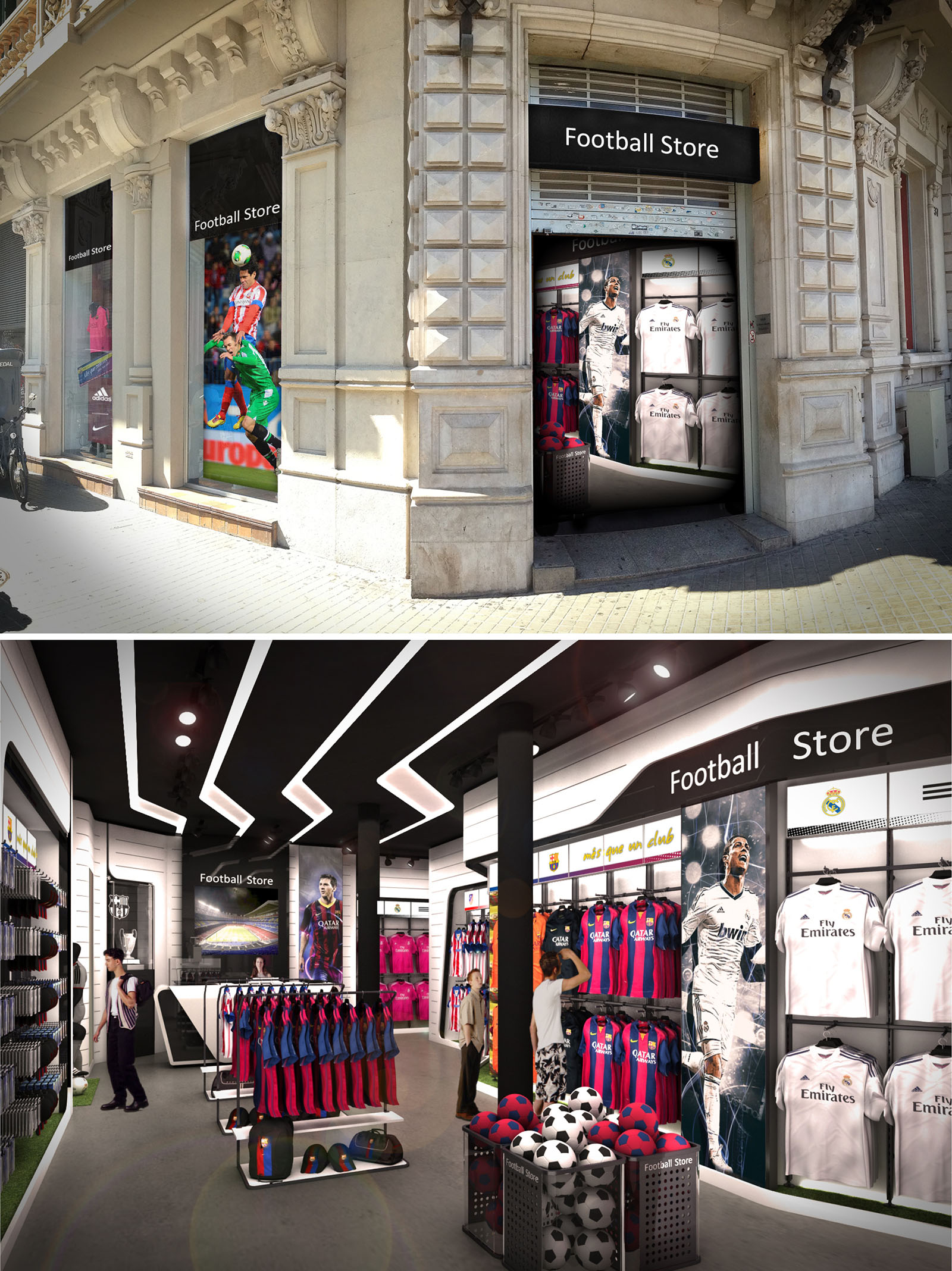
The Football Store in Mallorca is conceived as a contemporary sports pavilion embedded within a heritage urban façade. The design juxtaposes the solidity and ornamentation of the existing stone architecture with a dynamic, light-filled interior that celebrates movement, speed and team identity. The store becomes a stage for football culture, where jerseys, accessories and club imagery are presented as protagonists in a curated, immersive environment.
The concept is based on three guiding ideas: the stadium, the tunnel and the pitch. The façade graphics and entrance create the sense of arriving at a stadium gate; the elongated interior and ceiling slats evoke the players’ tunnel; and the product platforms and turf-lined elements suggest fragments of the pitch. This narrative guides the visitor from street to checkout through a fluid, legible spatial sequence.
The existing historic façade is preserved and framed as a stone proscenium around the new commercial insertion. Large-format glazing and printed graphics occupy the original openings, maintaining the rhythm of pilasters and cornices while activating the street with vivid football imagery. The neutral “Football Store” signage is contained within simple black bands, deliberately restrained to respect the architectural language of the building.
Backlit visuals featuring players in action act as visual beacons, enhancing visibility from a distance and drawing customers into the narrow entry. The transparent threshold allows a direct visual link to the interior merchandise, transforming the old portal into a contemporary display window without altering the protected stonework.
The interior is organized as a linear, single-level plan optimized for intuitive circulation. Perimeter walls host continuous merchandising systems, leaving a central, flexible spine for display gondolas and promotional islands. The entrance zone functions as a high-impact “hero area,” immediately showcasing key jerseys and seasonal collections to capture attention and guide movement deeper into the space.
Structural columns are integrated into the layout as visual anchors, wrapped with graphics or used as supports for shelving, avoiding visual clutter. The checkout counter is positioned at the back, encouraging customers to traverse the full length of the store, while maintaining clear sightlines for staff supervision and security. Circulation widths are calibrated for comfortable two-way traffic, even in peak tourist seasons.
The interior palette combines dark ceilings and flooring with bright, light-reflective wall surfaces to focus attention on the product. The black ceiling, articulated with white illuminated bands, creates a strong contrast that visually elongates the space and echoes the graphic lines of a stadium roof. Walls are finished in modular white cladding, allowing easy reconfiguration of shelving and graphics.
Track lighting and recessed downlights provide layered illumination, with accent spots targeting key merchandise and large graphics. LED technology is used extensively, ensuring low energy consumption and excellent color rendering for jerseys and branding. Touches of artificial turf, metallic mesh and perforated steel on fixtures subtly reference stadium materials, reinforcing the football narrative while offering robust, easy-to-maintain surfaces.
Product zoning is clearly legible: replica kits occupy prime wall positions at eye level, while accessories, balls and footwear are arranged on lower racks and freestanding displays. Large player portraits and club crests frame each zone, reinforcing team identity and aiding orientation within the store. This combination of graphic branding and organized display facilitates quick selection for focused fans while remaining inviting for casual visitors.
Central islands are deliberately kept low to preserve sightlines across the store, contributing to a sense of openness within a relatively compact footprint. The spatial rhythm between full-height wall graphics, illuminated signage bands and vertical columns generates a dynamic yet coherent environment that supports both browsing and fast transactional behavior typical of tourist-driven retail.
The design prioritizes adaptive reuse of the existing building envelope, minimizing structural intervention and honoring the embodied energy of the original masonry and decorative stonework. Internally, the use of modular display systems and standardized shelving profiles extends the lifecycle of fittings, enabling reconfiguration for new clubs, sponsors or merchandise without significant construction waste.
Energy-efficient LED lighting, coupled with targeted accenting rather than uniform over-illumination, reduces operational energy demand while creating a more engaging atmosphere. Durable materials such as powder-coated steel, high-pressure laminates and resilient floor finishes are specified to withstand high visitor turnover, limiting the need for frequent replacement. Where possible, graphics are printed on recyclable substrates, and fixture components are designed for disassembly, ensuring that the store can evolve over time while maintaining a responsible environmental footprint.
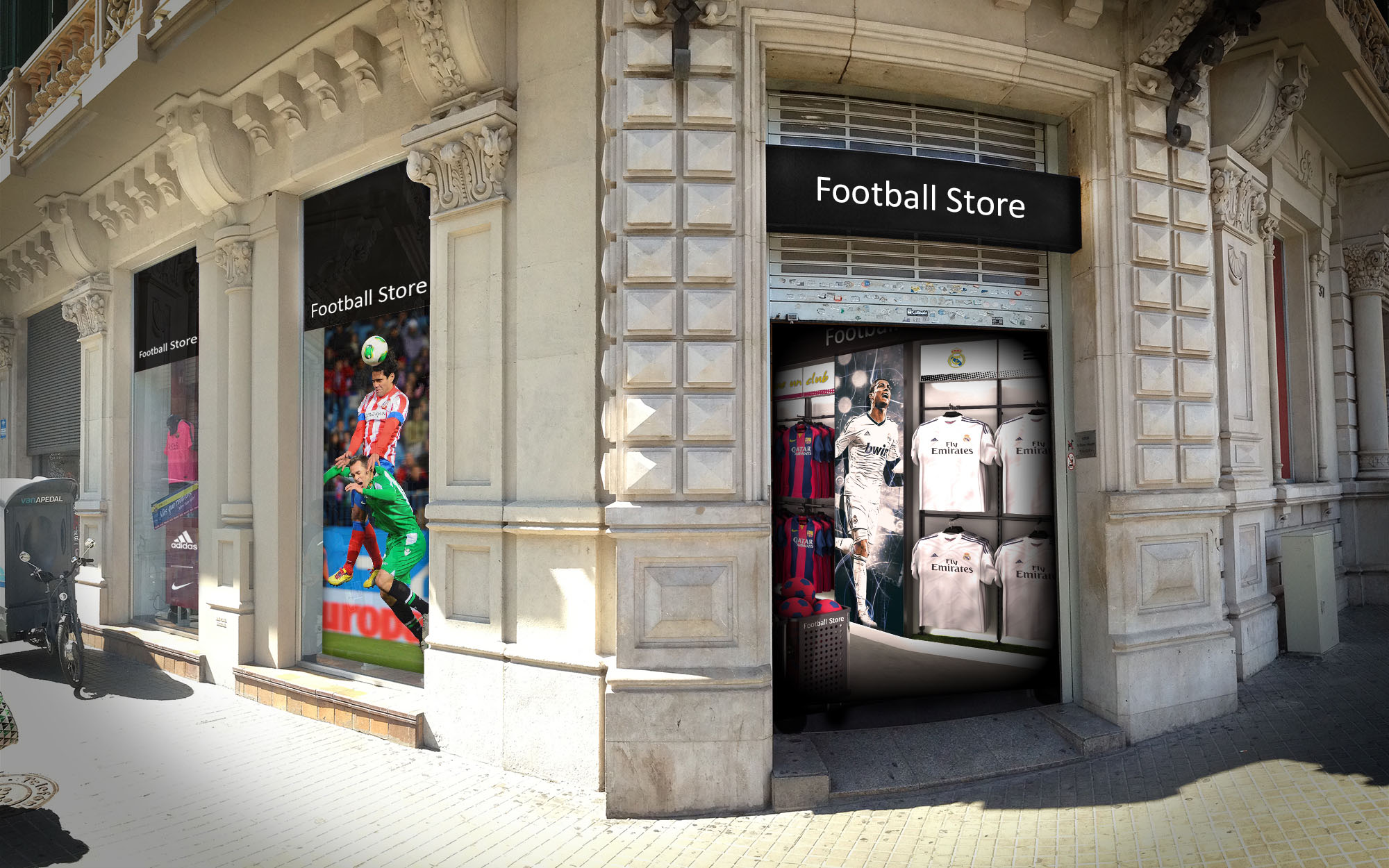
The Football Store in Mallorca is conceived as a contemporary sports pavilion embedded within a heritage urban façade. The design juxtaposes the solidity and ornamentation of the existing stone architecture with a dynamic, light-filled interior that celebrates movement, speed and team identity. The store becomes a stage for football culture, where jerseys, accessories and club imagery are presented as protagonists in a curated, immersive environment.
The concept is based on three guiding ideas: the stadium, the tunnel and the pitch. The façade graphics and entrance create the sense of arriving at a stadium gate; the elongated interior and ceiling slats evoke the players’ tunnel; and the product platforms and turf-lined elements suggest fragments of the pitch. This narrative guides the visitor from street to checkout through a fluid, legible spatial sequence.
The existing historic façade is preserved and framed as a stone proscenium around the new commercial insertion. Large-format glazing and printed graphics occupy the original openings, maintaining the rhythm of pilasters and cornices while activating the street with vivid football imagery. The neutral “Football Store” signage is contained within simple black bands, deliberately restrained to respect the architectural language of the building.
Backlit visuals featuring players in action act as visual beacons, enhancing visibility from a distance and drawing customers into the narrow entry. The transparent threshold allows a direct visual link to the interior merchandise, transforming the old portal into a contemporary display window without altering the protected stonework.
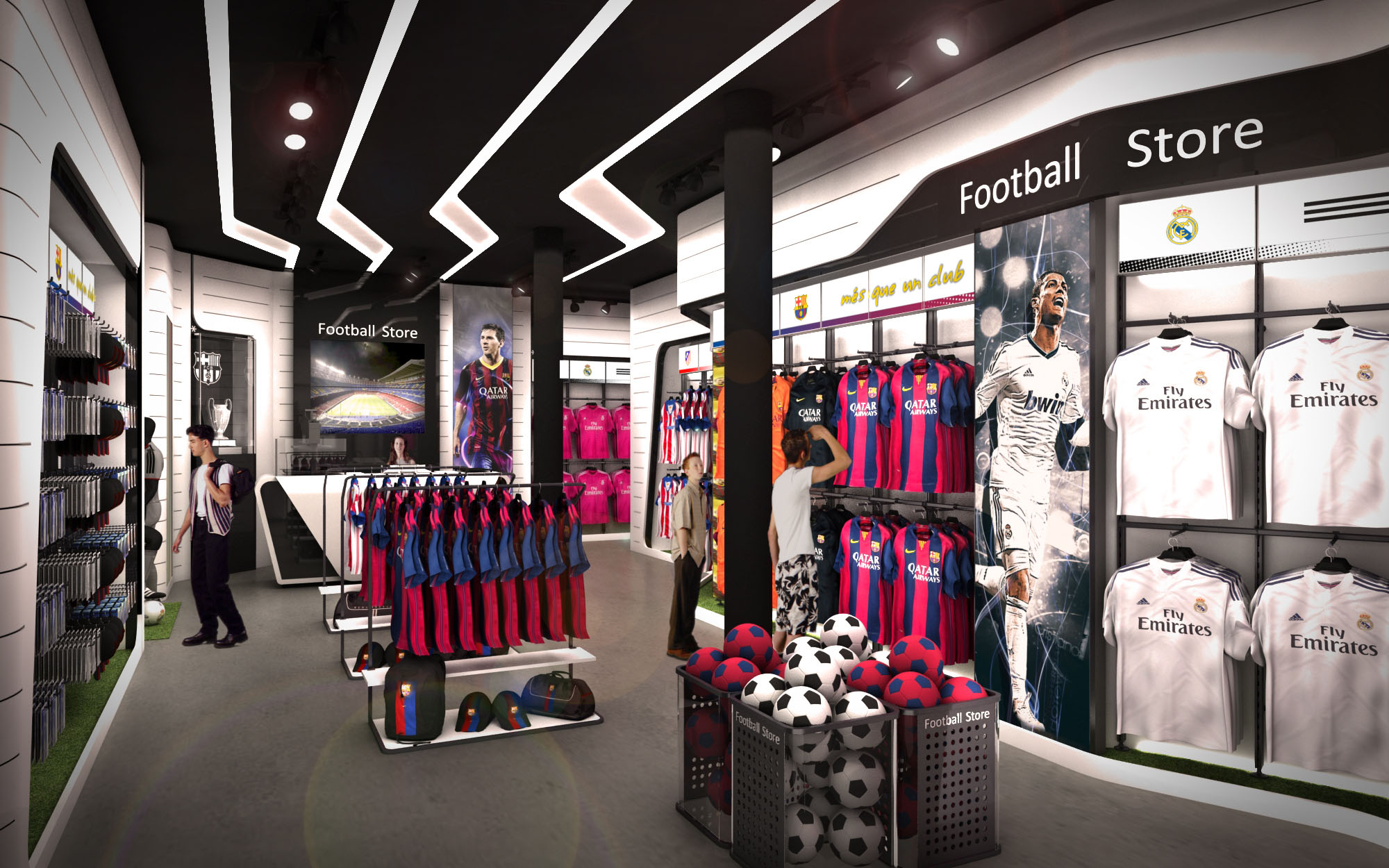
The interior is organized as a linear, single-level plan optimized for intuitive circulation. Perimeter walls host continuous merchandising systems, leaving a central, flexible spine for display gondolas and promotional islands. The entrance zone functions as a high-impact “hero area,” immediately showcasing key jerseys and seasonal collections to capture attention and guide movement deeper into the space.
Structural columns are integrated into the layout as visual anchors, wrapped with graphics or used as supports for shelving, avoiding visual clutter. The checkout counter is positioned at the back, encouraging customers to traverse the full length of the store, while maintaining clear sightlines for staff supervision and security. Circulation widths are calibrated for comfortable two-way traffic, even in peak tourist seasons.
The interior palette combines dark ceilings and flooring with bright, light-reflective wall surfaces to focus attention on the product. The black ceiling, articulated with white illuminated bands, creates a strong contrast that visually elongates the space and echoes the graphic lines of a stadium roof. Walls are finished in modular white cladding, allowing easy reconfiguration of shelving and graphics.
Track lighting and recessed downlights provide layered illumination, with accent spots targeting key merchandise and large graphics. LED technology is used extensively, ensuring low energy consumption and excellent color rendering for jerseys and branding. Touches of artificial turf, metallic mesh and perforated steel on fixtures subtly reference stadium materials, reinforcing the football narrative while offering robust, easy-to-maintain surfaces.
Product zoning is clearly legible: replica kits occupy prime wall positions at eye level, while accessories, balls and footwear are arranged on lower racks and freestanding displays. Large player portraits and club crests frame each zone, reinforcing team identity and aiding orientation within the store. This combination of graphic branding and organized display facilitates quick selection for focused fans while remaining inviting for casual visitors.
Central islands are deliberately kept low to preserve sightlines across the store, contributing to a sense of openness within a relatively compact footprint. The spatial rhythm between full-height wall graphics, illuminated signage bands and vertical columns generates a dynamic yet coherent environment that supports both browsing and fast transactional behavior typical of tourist-driven retail.
The design prioritizes adaptive reuse of the existing building envelope, minimizing structural intervention and honoring the embodied energy of the original masonry and decorative stonework. Internally, the use of modular display systems and standardized shelving profiles extends the lifecycle of fittings, enabling reconfiguration for new clubs, sponsors or merchandise without significant construction waste.
Energy-efficient LED lighting, coupled with targeted accenting rather than uniform over-illumination, reduces operational energy demand while creating a more engaging atmosphere. Durable materials such as powder-coated steel, high-pressure laminates and resilient floor finishes are specified to withstand high visitor turnover, limiting the need for frequent replacement. Where possible, graphics are printed on recyclable substrates, and fixture components are designed for disassembly, ensuring that the store can evolve over time while maintaining a responsible environmental footprint.


Our offices are located in Barcelona, Cancún, Chicago and Santo Domingo, but thanks to technology we can do projects on all over the world.
Barcelona
Bac de Roda 136
08020, Barcelona
Spain
Madrid
Av. de Buendía 11
19005 Guadalajara (Madrid)
Spain
Chicago
373 Hazel Ave, Apt A1
60022, Glencoe, Illinois
United States