

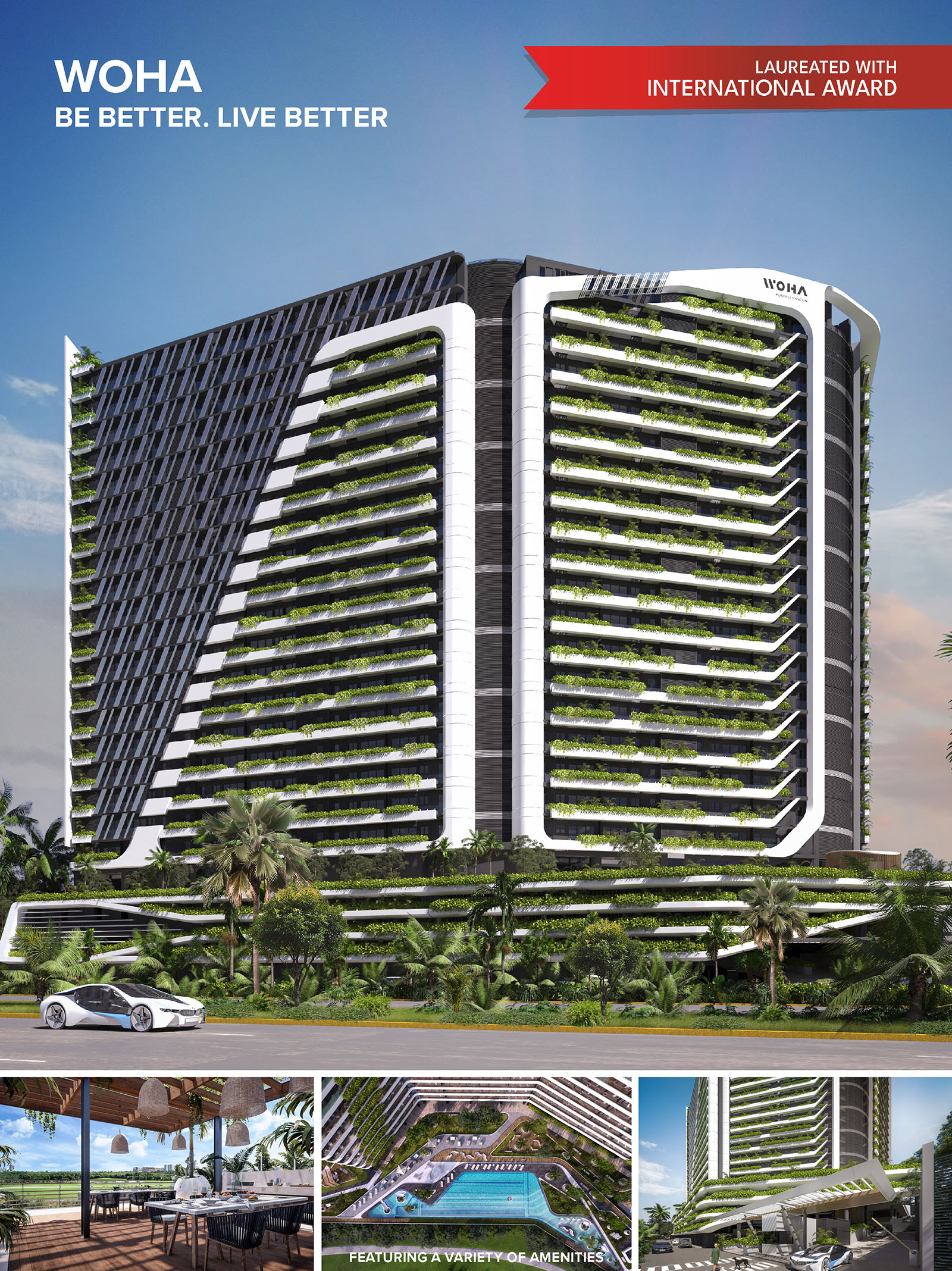
WOHA emerges as a high-rise residential development that redefines sustainable urban living in a tropical context. Rooted in three core design premises—functionality, universal sea views, and bioclimatic sustainability—the project synthesizes environmental consciousness with architectural elegance. Comprising 204 apartments distributed over 20 levels, including two subterranean parking levels and a roof-level energy zone, the tower promotes a lifestyle integrated with nature and wellness. The architecture embraces a modular approach to optimize spatial organization and user comfort, structured around a highly efficient 100 m² residential unit.
The massing of the tower is designed as an articulated, L-shaped volume that maximizes exposure to the Caribbean Sea, ensuring that every unit benefits from panoramic views. The tower is slightly tapered and sculpted to incorporate large horizontal terraces, which act as vegetated buffers. This strategy not only enhances the view corridors but also functions as passive solar protection. The form tilts dynamically, generating movement in the façade and emphasizing a vertical garden expression through continuous balcony planters.
At the heart of the architectural solution lies a highly rationalized floor plan. The 7.7m by 11m residential module avoids redundant circulation by removing internal corridors and enabling direct elevator access to each unit. The open-plan configuration promotes flow between kitchen, dining, and living spaces, orienting these social zones toward the sea. Conversely, service spaces and secondary bedrooms face the city side. The linear arrangement across a single bay ensures optimal cross-ventilation, vital for passive thermal regulation in tropical climates.
WOHA adopts a rigorous passive bioclimatic design tailored to the warm, sub-humid climate of the Caribbean. Continuous balconies double as sunshades and planting beds, reducing solar gain while contributing to urban biodiversity. Wind analysis determined optimal cross-ventilation strategies, while facade geometry and vertical greening support evaporative cooling and shading. During the warmer summer months—when natural ventilation becomes less effective—mechanical systems are discreetly integrated to maintain thermal comfort. The green terraces serve multiple environmental functions: mitigating the heat island effect, enhancing rainwater retention, and promoting the psychological benefits of biophilic design. The rooftop is designated for renewable energy generation, likely incorporating photovoltaic panels or wind turbines, signaling a move toward energy autonomy.
The architectural expression is defined by a restrained palette of high-performance materials: reflective glass, low-carbon concrete, and a façade system clad in a combination of white composite panels and dark louvers. The vegetated balconies punctuate the linear composition with lush greenery, transforming the building into a vertical garden. The interplay of white frames and green terraces conveys a clean, futuristic identity while maintaining a strong connection to the tropical landscape.
Beyond the residential component, WOHA provides an extensive range of shared amenities designed to foster a sense of community and wellness. These include rooftop lounges, an infinity-edge pool, outdoor dining terraces, and landscaped podium gardens. The amenities are seamlessly integrated with the architectural language of the project, ensuring continuity in form, material, and environmental performance.
WOHA is conceived not only as a residential project but as a catalyst for environmental awareness. By integrating energy-efficient systems, promoting resource reuse, and supporting low-impact lifestyles, it advocates for a conscious way of living. Its sustainable ethos is reinforced through waste recycling programs, water efficiency systems, and ecological landscaping, making it a benchmark for responsible design in coastal developments.
• The Architecture Community International Residential Architecture Awards 2022 : Winner : Woha (2022)


• The Architecture Community International Residential Architecture Awards 2022 : Winner : Woha (2022)
WOHA emerges as a high-rise residential development that redefines sustainable urban living in a tropical context. Rooted in three core design premises—functionality, universal sea views, and bioclimatic sustainability—the project synthesizes environmental consciousness with architectural elegance. Comprising 204 apartments distributed over 20 levels, including two subterranean parking levels and a roof-level energy zone, the tower promotes a lifestyle integrated with nature and wellness. The architecture embraces a modular approach to optimize spatial organization and user comfort, structured around a highly efficient 100 m² residential unit.
The massing of the tower is designed as an articulated, L-shaped volume that maximizes exposure to the Caribbean Sea, ensuring that every unit benefits from panoramic views. The tower is slightly tapered and sculpted to incorporate large horizontal terraces, which act as vegetated buffers. This strategy not only enhances the view corridors but also functions as passive solar protection. The form tilts dynamically, generating movement in the façade and emphasizing a vertical garden expression through continuous balcony planters.
At the heart of the architectural solution lies a highly rationalized floor plan. The 7.7m by 11m residential module avoids redundant circulation by removing internal corridors and enabling direct elevator access to each unit. The open-plan configuration promotes flow between kitchen, dining, and living spaces, orienting these social zones toward the sea. Conversely, service spaces and secondary bedrooms face the city side. The linear arrangement across a single bay ensures optimal cross-ventilation, vital for passive thermal regulation in tropical climates.
WOHA adopts a rigorous passive bioclimatic design tailored to the warm, sub-humid climate of the Caribbean. Continuous balconies double as sunshades and planting beds, reducing solar gain while contributing to urban biodiversity. Wind analysis determined optimal cross-ventilation strategies, while facade geometry and vertical greening support evaporative cooling and shading. During the warmer summer months—when natural ventilation becomes less effective—mechanical systems are discreetly integrated to maintain thermal comfort. The green terraces serve multiple environmental functions: mitigating the heat island effect, enhancing rainwater retention, and promoting the psychological benefits of biophilic design. The rooftop is designated for renewable energy generation, likely incorporating photovoltaic panels or wind turbines, signaling a move toward energy autonomy.
The architectural expression is defined by a restrained palette of high-performance materials: reflective glass, low-carbon concrete, and a façade system clad in a combination of white composite panels and dark louvers. The vegetated balconies punctuate the linear composition with lush greenery, transforming the building into a vertical garden. The interplay of white frames and green terraces conveys a clean, futuristic identity while maintaining a strong connection to the tropical landscape.
Beyond the residential component, WOHA provides an extensive range of shared amenities designed to foster a sense of community and wellness. These include rooftop lounges, an infinity-edge pool, outdoor dining terraces, and landscaped podium gardens. The amenities are seamlessly integrated with the architectural language of the project, ensuring continuity in form, material, and environmental performance.
WOHA is conceived not only as a residential project but as a catalyst for environmental awareness. By integrating energy-efficient systems, promoting resource reuse, and supporting low-impact lifestyles, it advocates for a conscious way of living. Its sustainable ethos is reinforced through waste recycling programs, water efficiency systems, and ecological landscaping, making it a benchmark for responsible design in coastal developments.


Nuestras oficinas están en Barcelona, Cancún, Chicago y Santo Domingo, pero gracias a la tecnología podemos desarrollar proyectos en cualquier parte del mundo.
Barcelona
Bac de Roda 136
08020, Barcelona
Spain
Madrid
Av. de Buendía 11
19005 Guadalajara (Madrid)
Spain
Chicago
373 Hazel Ave, Apt A1
60022, Glencoe, Illinois
United States