


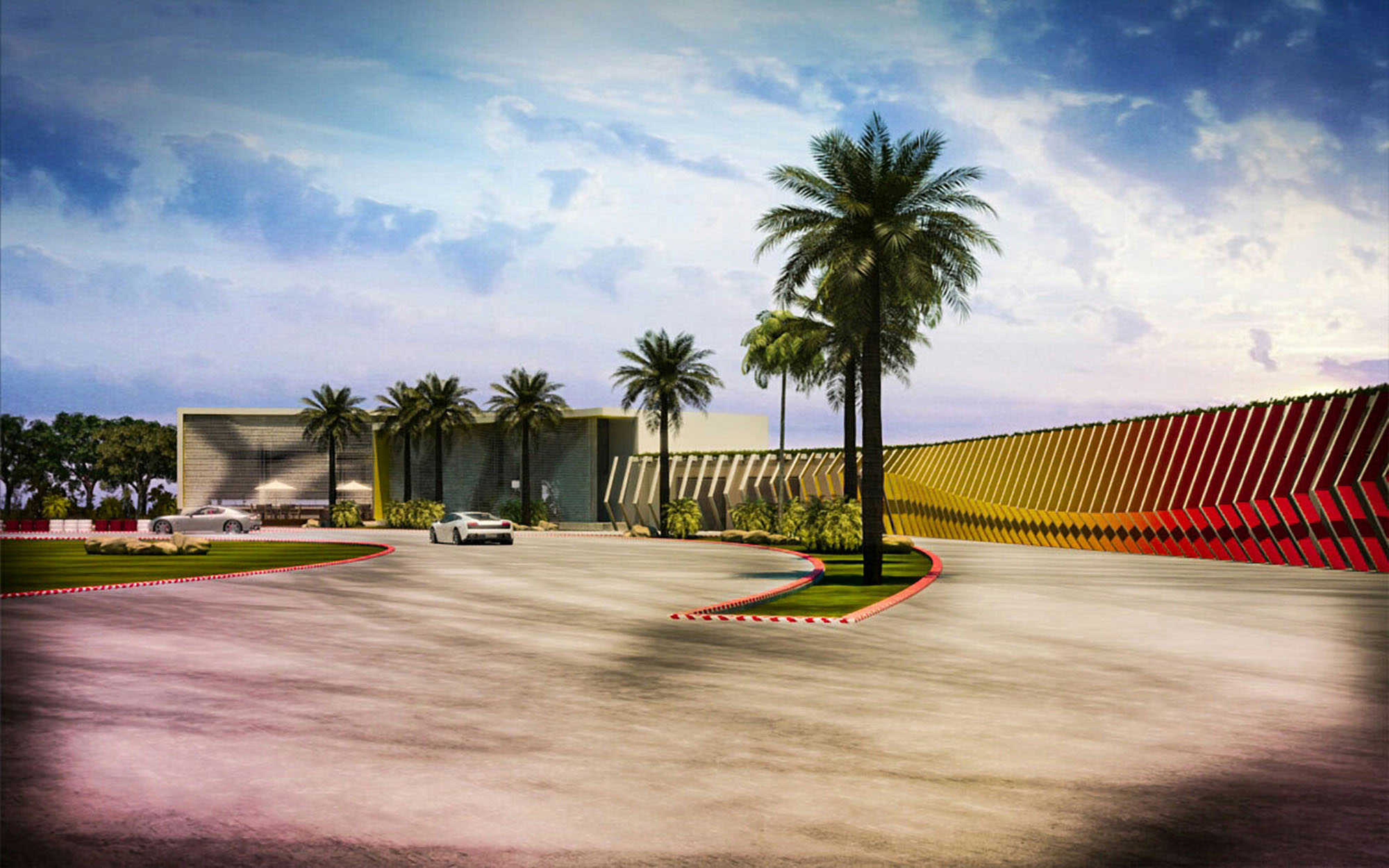
TECH GARAGE is conceived as a hybrid between a high-performance automotive facility and an urban leisure landscape, translating the dynamism of speed into a clear, linear architectural language. The complex operates as an extension of the city’s public realm, transforming a traditionally technical program into an accessible, experience-driven destination where cars, people and landscape coexist.
The design takes advantage of Cancún’s expansive horizon, composing long, low volumes that emphasize movement and perspective. The project’s geometry is guided by the logic of the racetrack: curves, acceleration lanes and visual vanishing points are echoed in the built forms, the circulation routes and the open spaces, creating a continuous spatial narrative from arrival to the most intimate technical areas.
The complex is organized as a sequence of exterior forecourts, green buffers and service bands aligned along the main access spine. This configuration creates a generous setback from the road that functions as a civic plaza and staging area, visually announcing the project while absorbing traffic flows associated with events and peak operation times.
The perimeter wall is treated not as a barrier but as a dynamic urban façade. Its articulated, inclined elements modulate transparency and opacity, allowing glimpses into the activity within while ensuring security and acoustic control toward the surrounding context. The wall thus becomes a linear landmark that reinforces orientation and identity along the access corridor.
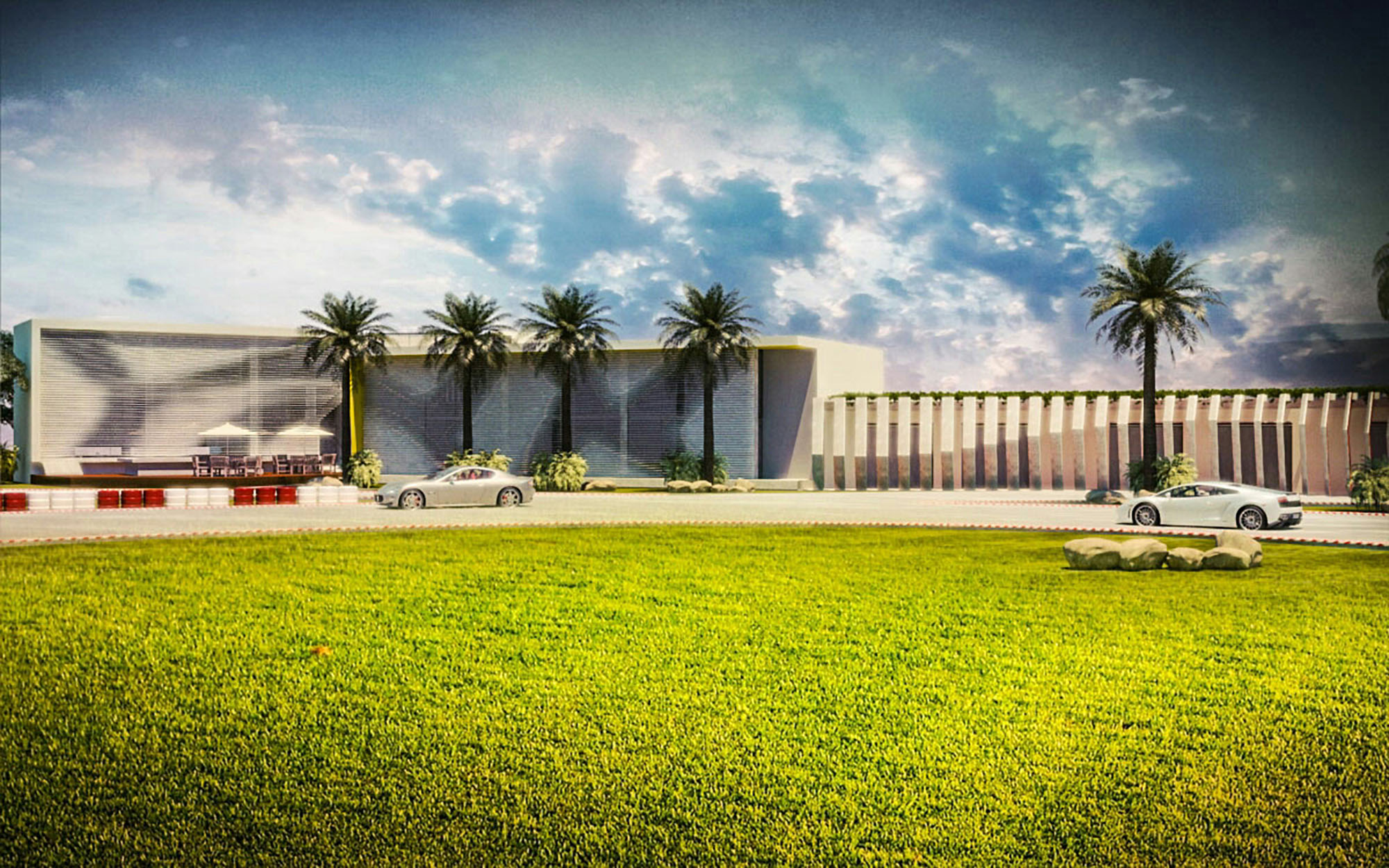
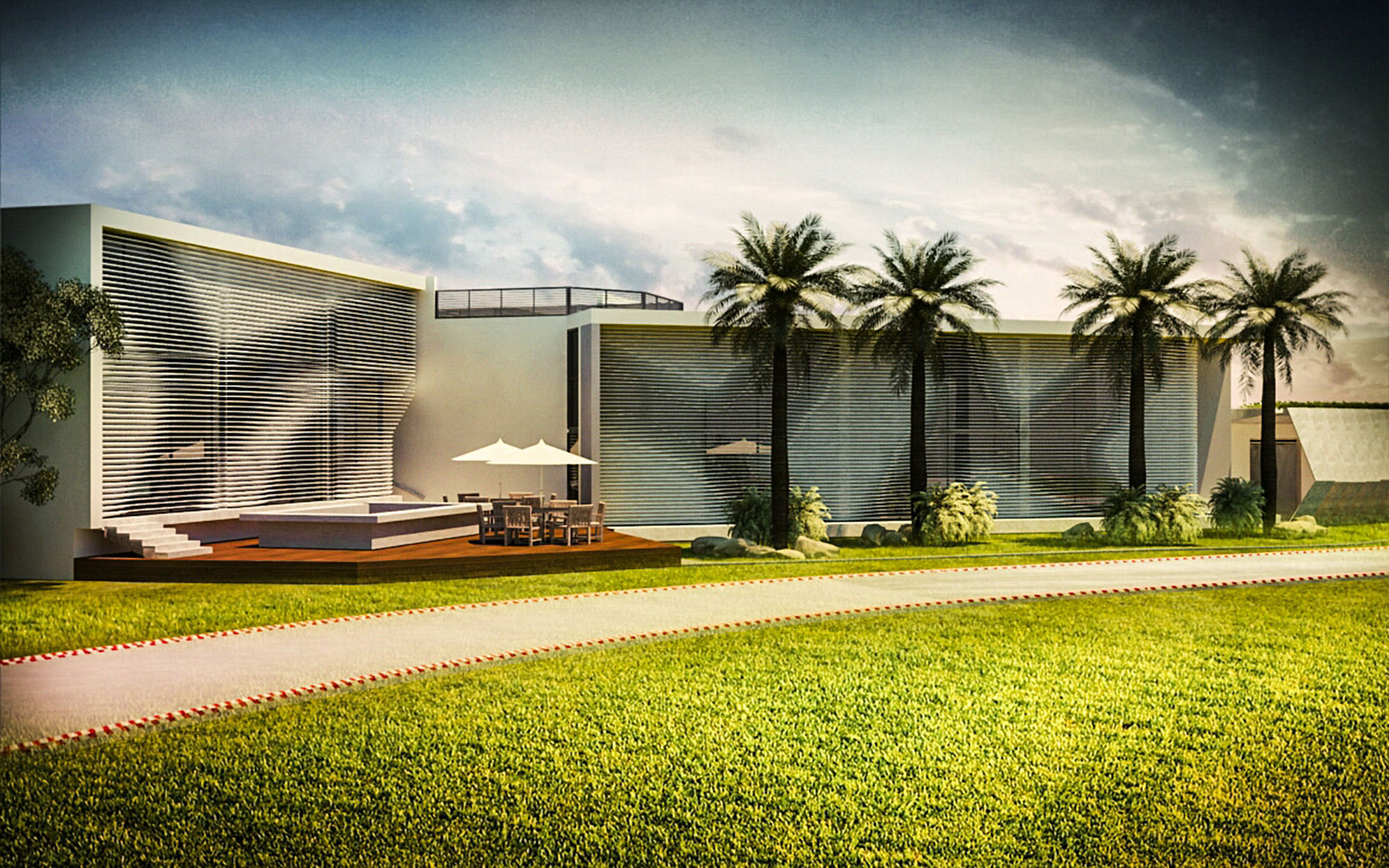
The main architectural volumes are resolved as clean, rectilinear prisms that host workshop bays, showrooms, support services and hospitality areas. These boxes are interspersed with deep porticos and shaded outdoor terraces that encourage interaction and visual continuity with the landscaped areas. Large car courts and maneuvering zones are seamlessly integrated, maintaining clear separation between pedestrian promenades and vehicular circulation for safety and comfort.
Programmatic elements are layered from public to private. The most open, visitor-oriented spaces occupy the front zone, with display areas and lounges extending towards the landscaped lawns. More technical and restricted functions are located deeper on the site, buffered by planting strips and the expressive perimeter structure, which also acts as a climatic filter for back-of-house operations.
The façades are characterized by large-format planes and a play of horizontality accentuated by deep eaves and shading fins. A combination of smooth, light-colored cladding and ribbed or perforated metal screens responds to the intense Caribbean sun, reducing heat gain while maintaining a contemporary, industrial aesthetic suitable for a technology and automotive-oriented program.
The rhythm of vertical elements along the enclosure wall introduces a sense of speed and vibration, as if the architecture itself were in motion. Transparent spans framed by slender structural members reveal selective interior views, while high-performance glazing minimizes glare. The color palette favors warm neutrals contrasted with strategic accents that can be associated with brand identity or racing graphics, emphasizing the project’s avant-garde character.
Landscape design is integral to the architectural composition, using palm alignments and low-maintenance tropical planting to define axes, soften edges and provide natural shading. Generous green surfaces counterbalance the extensive paved areas, contributing to microclimate regulation and offering flexible outdoor zones for events, exhibitions or informal gathering.
Sustainability strategies address both environmental performance and long-term operational efficiency. Building orientation and shading devices reduce solar gain, lowering cooling loads in Cancún’s humid climate. Reflective roof finishes and light-colored pavements mitigate heat island effects, while permeable zones and planted swales improve on-site stormwater management. The structural and envelope systems are conceived for durability and ease of maintenance, supporting adaptive reuse and future technological upgrades within the TECH GARAGE complex.
TECH GARAGE is conceived as a hybrid between a high-performance automotive facility and an urban leisure landscape, translating the dynamism of speed into a clear, linear architectural language. The complex operates as an extension of the city’s public realm, transforming a traditionally technical program into an accessible, experience-driven destination where cars, people and landscape coexist.
The design takes advantage of Cancún’s expansive horizon, composing long, low volumes that emphasize movement and perspective. The project’s geometry is guided by the logic of the racetrack: curves, acceleration lanes and visual vanishing points are echoed in the built forms, the circulation routes and the open spaces, creating a continuous spatial narrative from arrival to the most intimate technical areas.
The complex is organized as a sequence of exterior forecourts, green buffers and service bands aligned along the main access spine. This configuration creates a generous setback from the road that functions as a civic plaza and staging area, visually announcing the project while absorbing traffic flows associated with events and peak operation times.
The perimeter wall is treated not as a barrier but as a dynamic urban façade. Its articulated, inclined elements modulate transparency and opacity, allowing glimpses into the activity within while ensuring security and acoustic control toward the surrounding context. The wall thus becomes a linear landmark that reinforces orientation and identity along the access corridor.
The main architectural volumes are resolved as clean, rectilinear prisms that host workshop bays, showrooms, support services and hospitality areas. These boxes are interspersed with deep porticos and shaded outdoor terraces that encourage interaction and visual continuity with the landscaped areas. Large car courts and maneuvering zones are seamlessly integrated, maintaining clear separation between pedestrian promenades and vehicular circulation for safety and comfort.
Programmatic elements are layered from public to private. The most open, visitor-oriented spaces occupy the front zone, with display areas and lounges extending towards the landscaped lawns. More technical and restricted functions are located deeper on the site, buffered by planting strips and the expressive perimeter structure, which also acts as a climatic filter for back-of-house operations.
The façades are characterized by large-format planes and a play of horizontality accentuated by deep eaves and shading fins. A combination of smooth, light-colored cladding and ribbed or perforated metal screens responds to the intense Caribbean sun, reducing heat gain while maintaining a contemporary, industrial aesthetic suitable for a technology and automotive-oriented program.
The rhythm of vertical elements along the enclosure wall introduces a sense of speed and vibration, as if the architecture itself were in motion. Transparent spans framed by slender structural members reveal selective interior views, while high-performance glazing minimizes glare. The color palette favors warm neutrals contrasted with strategic accents that can be associated with brand identity or racing graphics, emphasizing the project’s avant-garde character.
Landscape design is integral to the architectural composition, using palm alignments and low-maintenance tropical planting to define axes, soften edges and provide natural shading. Generous green surfaces counterbalance the extensive paved areas, contributing to microclimate regulation and offering flexible outdoor zones for events, exhibitions or informal gathering.
Sustainability strategies address both environmental performance and long-term operational efficiency. Building orientation and shading devices reduce solar gain, lowering cooling loads in Cancún’s humid climate. Reflective roof finishes and light-colored pavements mitigate heat island effects, while permeable zones and planted swales improve on-site stormwater management. The structural and envelope systems are conceived for durability and ease of maintenance, supporting adaptive reuse and future technological upgrades within the TECH GARAGE complex.


Nuestras oficinas están en Barcelona, Cancún, Chicago y Santo Domingo, pero gracias a la tecnología podemos desarrollar proyectos en cualquier parte del mundo.
Barcelona
Bac de Roda 136
08020, Barcelona
Spain
Madrid
Av. de Buendía 11
19005 Guadalajara (Madrid)
Spain
Chicago
373 Hazel Ave, Apt A1
60022, Glencoe, Illinois
United States