

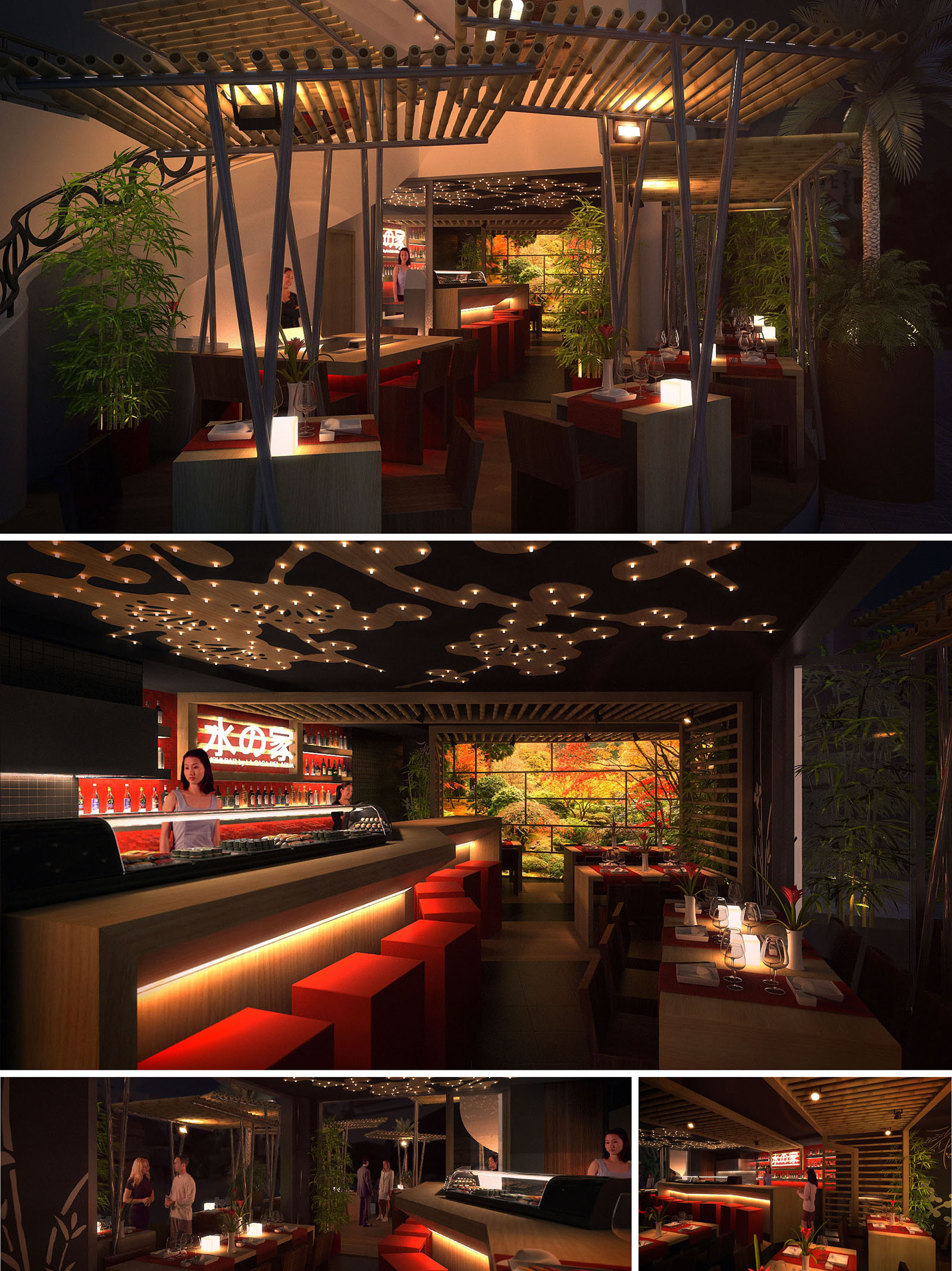
The Sushi Bar in Playa del Carmen is conceived as an immersive bridge between Japanese sensibility and Caribbean warmth. The design creates a dense, intimate atmosphere that contrasts the vibrant exterior of the Riviera Maya. A composition of bamboo, steel, and controlled lighting evokes a contemporary urban izakaya, while framed images of nature and live vegetation reconnect the interior to the tropical context. The space privileges elongated perspectives towards the sushi counter, emphasizing the ritual of preparation as a central spectacle.
The restaurant is organized around the idea of shelter under a lightweight canopy. Overhead structures and sculpted ceilings filter light like a forest cover, generating a sense of protection and privacy despite the compact footprint. Materials, textures, and colors are orchestrated to guide the guest from the exterior threshold into increasingly warm and intimate zones.
The layout is linear, with the sushi bar acting as a central spine that structures circulation. Bar seating in front of the chef allows direct interaction, while peripheral tables define semi-enclosed pockets for small groups. The route from entrance to bar is visually framed by vertical elements and plantings, subtly compressing and then expanding the space to increase spatial drama.
Custom furniture in rectilinear geometries optimizes the reduced area, integrating storage and lighting into bar and table plinths. Varied seating typologies—bar stools, two-seat and four-seat tables—accommodate different dining experiences without fragmenting the overall continuity. Strategic spacing between tables and the use of open slatted partitions maintain visual permeability while ensuring acoustic and visual comfort.
The material palette balances natural warmth with a contemporary edge. Light-toned woods and bamboo slats form the primary surfaces for ceilings and furniture, contrasted with dark flooring and wall planes to ground the space. Vertical metal supports, inclined and expressed, add a dynamic structural rhythm that recalls bamboo stalks while affirming the industrial character of the bar.
The chromatic strategy relies on a triad of black, natural wood, and a saturated red. Red is concentrated in stools, table linens, shelving, and selected wall details, referencing traditional Japanese aesthetics and signaling areas of interaction and energy. A luminous mural with autumnal tones at the back of the restaurant becomes a visual anchor, extending the perceived depth of the room and introducing a contemplative landscape element.
Lighting is the principal tool for defining the restaurant’s immersive atmosphere. A sculpted ceiling incorporates irregular perforations with recessed points of warm light, creating a starry, organic pattern that softens the otherwise orthogonal geometry. This ceiling becomes a visual signature, lowering the perceived height and enhancing intimacy.
Linear LED strips integrated under counters and bar edges provide a floating effect to the furniture, emphasizing horizontality and guiding circulation. Table lighting is intentionally low and warm, with accent luminaires highlighting vegetation and the mural. The overall lighting strategy minimizes glare and favors contrast, aligning with the nocturnal, lounge-like character appropriate to Playa del Carmen’s hospitality scene.
Vegetation is curated as an essential spatial device rather than mere decoration. Tall bamboo planters mark transitions between areas, soften corners, and provide vertical scale, reinforcing the Japanese inspiration while resonating with the local tropical flora. The natural motif of the backlit landscape panel extends this green presence visually even in the interior-most tables.
Textural balance is achieved by juxtaposing smooth lacquered surfaces at the bar with the tactile grain of wood and the fine pattern of wall tiles. This sensory layering contributes to a multi-dimensional experience, where guests perceive subtle changes in light reflection, temperature of materials, and acoustic absorption throughout the space.
The project incorporates sustainable criteria through material selection, energy efficiency, and passive design strategies adapted to the climate of Playa del Carmen. Preference is given to rapidly renewable resources such as bamboo and responsibly sourced woods, reducing environmental impact and reinforcing the conceptual link to nature. Modular furniture elements facilitate eventual reconfiguration or reuse, extending the life cycle of the interior fit-out.
LED technology predominates in the lighting system, significantly reducing energy consumption and heat gain—critical in a warm, humid environment. The layered lighting allows operation at low power levels during most of the service, while darker finishes help reduce the need for excessive illumination. Natural ventilation is supported by the semi-open character of the entrance zone and the use of permeable partitions, allowing cross-breezes when climatic conditions permit and decreasing reliance on mechanical cooling. In this way, the Sushi Bar responds both aesthetically and functionally to its Caribbean context while honoring the precision and restraint of Japanese design traditions.
The Sushi Bar in Playa del Carmen is conceived as an immersive bridge between Japanese sensibility and Caribbean warmth. The design creates a dense, intimate atmosphere that contrasts the vibrant exterior of the Riviera Maya. A composition of bamboo, steel, and controlled lighting evokes a contemporary urban izakaya, while framed images of nature and live vegetation reconnect the interior to the tropical context. The space privileges elongated perspectives towards the sushi counter, emphasizing the ritual of preparation as a central spectacle.
The restaurant is organized around the idea of shelter under a lightweight canopy. Overhead structures and sculpted ceilings filter light like a forest cover, generating a sense of protection and privacy despite the compact footprint. Materials, textures, and colors are orchestrated to guide the guest from the exterior threshold into increasingly warm and intimate zones.
The layout is linear, with the sushi bar acting as a central spine that structures circulation. Bar seating in front of the chef allows direct interaction, while peripheral tables define semi-enclosed pockets for small groups. The route from entrance to bar is visually framed by vertical elements and plantings, subtly compressing and then expanding the space to increase spatial drama.
Custom furniture in rectilinear geometries optimizes the reduced area, integrating storage and lighting into bar and table plinths. Varied seating typologies—bar stools, two-seat and four-seat tables—accommodate different dining experiences without fragmenting the overall continuity. Strategic spacing between tables and the use of open slatted partitions maintain visual permeability while ensuring acoustic and visual comfort.
The material palette balances natural warmth with a contemporary edge. Light-toned woods and bamboo slats form the primary surfaces for ceilings and furniture, contrasted with dark flooring and wall planes to ground the space. Vertical metal supports, inclined and expressed, add a dynamic structural rhythm that recalls bamboo stalks while affirming the industrial character of the bar.
The chromatic strategy relies on a triad of black, natural wood, and a saturated red. Red is concentrated in stools, table linens, shelving, and selected wall details, referencing traditional Japanese aesthetics and signaling areas of interaction and energy. A luminous mural with autumnal tones at the back of the restaurant becomes a visual anchor, extending the perceived depth of the room and introducing a contemplative landscape element.
Lighting is the principal tool for defining the restaurant’s immersive atmosphere. A sculpted ceiling incorporates irregular perforations with recessed points of warm light, creating a starry, organic pattern that softens the otherwise orthogonal geometry. This ceiling becomes a visual signature, lowering the perceived height and enhancing intimacy.
Linear LED strips integrated under counters and bar edges provide a floating effect to the furniture, emphasizing horizontality and guiding circulation. Table lighting is intentionally low and warm, with accent luminaires highlighting vegetation and the mural. The overall lighting strategy minimizes glare and favors contrast, aligning with the nocturnal, lounge-like character appropriate to Playa del Carmen’s hospitality scene.
Vegetation is curated as an essential spatial device rather than mere decoration. Tall bamboo planters mark transitions between areas, soften corners, and provide vertical scale, reinforcing the Japanese inspiration while resonating with the local tropical flora. The natural motif of the backlit landscape panel extends this green presence visually even in the interior-most tables.
Textural balance is achieved by juxtaposing smooth lacquered surfaces at the bar with the tactile grain of wood and the fine pattern of wall tiles. This sensory layering contributes to a multi-dimensional experience, where guests perceive subtle changes in light reflection, temperature of materials, and acoustic absorption throughout the space.
The project incorporates sustainable criteria through material selection, energy efficiency, and passive design strategies adapted to the climate of Playa del Carmen. Preference is given to rapidly renewable resources such as bamboo and responsibly sourced woods, reducing environmental impact and reinforcing the conceptual link to nature. Modular furniture elements facilitate eventual reconfiguration or reuse, extending the life cycle of the interior fit-out.
LED technology predominates in the lighting system, significantly reducing energy consumption and heat gain—critical in a warm, humid environment. The layered lighting allows operation at low power levels during most of the service, while darker finishes help reduce the need for excessive illumination. Natural ventilation is supported by the semi-open character of the entrance zone and the use of permeable partitions, allowing cross-breezes when climatic conditions permit and decreasing reliance on mechanical cooling. In this way, the Sushi Bar responds both aesthetically and functionally to its Caribbean context while honoring the precision and restraint of Japanese design traditions.


Nuestras oficinas están en Barcelona, Cancún, Chicago y Santo Domingo, pero gracias a la tecnología podemos desarrollar proyectos en cualquier parte del mundo.
Barcelona
Bac de Roda 136
08020, Barcelona
Spain
Madrid
Av. de Buendía 11
19005 Guadalajara (Madrid)
Spain
Chicago
373 Hazel Ave, Apt A1
60022, Glencoe, Illinois
United States