

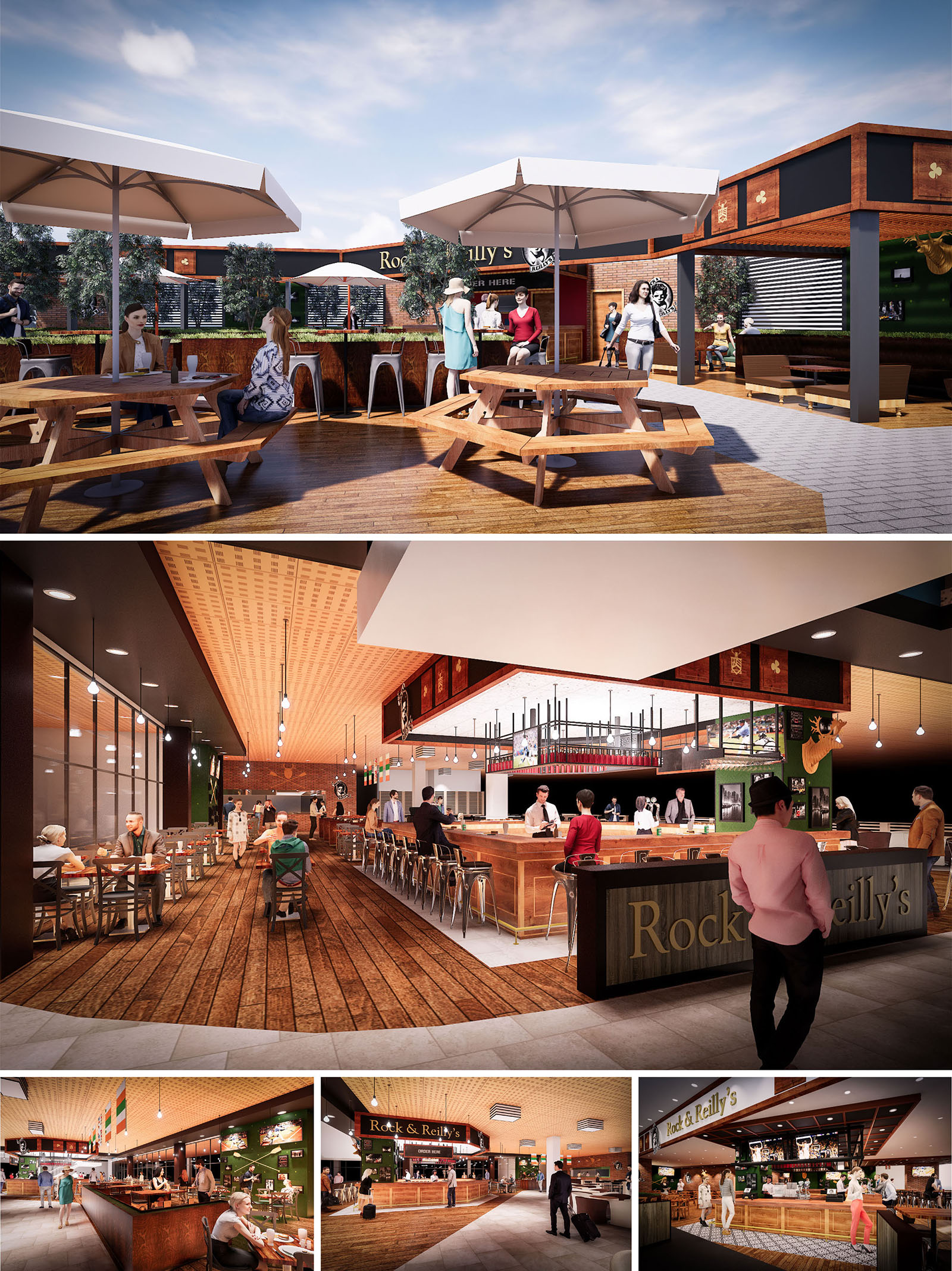
Rock & Reilly’s is conceived as a contemporary reinterpretation of the classic Irish pub, adapted to the dynamic context of Spanish airports. The design merges the warmth and informality of a neighborhood bar with the efficiency and clarity required in a high‑flux transit environment. Visual permeability, intuitive circulation and strong brand identity guide the entire proposal, both in the exterior terrace and in the interior dining and bar areas.
The architecture emphasizes a continuous wooden “carpet” that connects zones and directs passengers naturally towards the central bar. Above, a system of suspended canopies and framed signage creates a recognizable skyline within the terminal, consolidating the venue as a spatial landmark in the concourse while maintaining an open, inviting character.
The project is structured around a central horseshoe bar that organizes flows and anchors the different seating typologies. High stools around the bar cater to short‑stay users, while peripheral tables and lounge corners serve groups and longer dwell times. This gradation of densities provides flexibility throughout the day, from quick breakfasts to evening gatherings.
The outdoor terrace is configured as an extension of the interior, with circular picnic tables and large parasols, generating an informal beer‑garden atmosphere. Planters and low hedges define the edge without obstructing views, maintaining visual connection with the airport environment and signage while offering a sense of enclosure and comfort for guests.
Materiality is dominated by warm timber tones, dark metal accents and deep green surfaces, referencing traditional pub interiors while embracing a lighter, more contemporary language. The continuous wooden flooring and bar counter in solid or engineered wood evoke craftsmanship and durability, contrasted by industrial stools, exposed structures and suspended bottle racks.
Ceilings combine acoustic timber panels with blacked‑out technical bands, allowing lighting, sprinklers and ventilation to be integrated discreetly. Graphic elements, historic photographs and framed flags reinforce the narrative of the brand, adding texture and visual richness without saturating the space. The result is an atmosphere that feels both familiar and refreshed, appropriate for an international, multicultural user profile.
Lighting plays a strategic role in creating identity and hierarchy. Linear pendants and point luminaires above the bar emphasize it as the focal point, while softer, more uniform lighting over the dining areas ensures visual comfort and glare control for travelers. At night, the warm color temperature enhances the timber finishes, creating a cozy environment in contrast to the often neutral ambience of airport halls.
Branding is seamlessly integrated into the architecture: backlit logos, edge‑lit menu boards and a perimeter frieze of graphic panels form a continuous visual band. This approach avoids isolated signage, instead generating a coherent envelope that is clearly visible from different vantage points within the terminal and on the outdoor terrace.
The furniture selection balances robustness, ergonomics and rapid turnover needs. Metal‑framed stools and chairs with simple geometries ensure resistance to intensive use, while timber seats and tabletops bring tactile warmth. Circular picnic tables on the terrace encourage social interaction, while interior two‑ and four‑top configurations offer flexibility for individuals, couples and families.
The open service bar and partially visible preparation areas contribute to a transparent, engaging user experience. Passengers can quickly read the offer, order and be served without visual or physical barriers, optimizing dwell time and reducing perceived waiting.
Sustainability is addressed through material selection, energy efficiency and adaptability. Priority is given to certified woods, durable finishes and modular construction systems that facilitate installation in airport environments with minimal waste and potential for future reconfiguration or relocation. Many components, such as bar fronts, shelving and planters, are designed as prefabricated modules to reduce on‑site work and improve quality control.
The combination of generous natural light from the terminal façades with an efficient LED lighting scheme lowers energy demand while ensuring adequate illumination throughout the operating hours. Acoustic timber ceilings improve sound absorption, enhancing comfort in a typically noisy context and allowing background music and conversation levels to remain pleasant. The incorporation of vegetation in planters and hedges, especially on the terrace, contributes to microclimate regulation and introduces a biophilic dimension within the predominantly hardscape airport setting.
Rock & Reilly’s is conceived as a contemporary reinterpretation of the classic Irish pub, adapted to the dynamic context of Spanish airports. The design merges the warmth and informality of a neighborhood bar with the efficiency and clarity required in a high‑flux transit environment. Visual permeability, intuitive circulation and strong brand identity guide the entire proposal, both in the exterior terrace and in the interior dining and bar areas.
The architecture emphasizes a continuous wooden “carpet” that connects zones and directs passengers naturally towards the central bar. Above, a system of suspended canopies and framed signage creates a recognizable skyline within the terminal, consolidating the venue as a spatial landmark in the concourse while maintaining an open, inviting character.
The project is structured around a central horseshoe bar that organizes flows and anchors the different seating typologies. High stools around the bar cater to short‑stay users, while peripheral tables and lounge corners serve groups and longer dwell times. This gradation of densities provides flexibility throughout the day, from quick breakfasts to evening gatherings.
The outdoor terrace is configured as an extension of the interior, with circular picnic tables and large parasols, generating an informal beer‑garden atmosphere. Planters and low hedges define the edge without obstructing views, maintaining visual connection with the airport environment and signage while offering a sense of enclosure and comfort for guests.
Materiality is dominated by warm timber tones, dark metal accents and deep green surfaces, referencing traditional pub interiors while embracing a lighter, more contemporary language. The continuous wooden flooring and bar counter in solid or engineered wood evoke craftsmanship and durability, contrasted by industrial stools, exposed structures and suspended bottle racks.
Ceilings combine acoustic timber panels with blacked‑out technical bands, allowing lighting, sprinklers and ventilation to be integrated discreetly. Graphic elements, historic photographs and framed flags reinforce the narrative of the brand, adding texture and visual richness without saturating the space. The result is an atmosphere that feels both familiar and refreshed, appropriate for an international, multicultural user profile.
Lighting plays a strategic role in creating identity and hierarchy. Linear pendants and point luminaires above the bar emphasize it as the focal point, while softer, more uniform lighting over the dining areas ensures visual comfort and glare control for travelers. At night, the warm color temperature enhances the timber finishes, creating a cozy environment in contrast to the often neutral ambience of airport halls.
Branding is seamlessly integrated into the architecture: backlit logos, edge‑lit menu boards and a perimeter frieze of graphic panels form a continuous visual band. This approach avoids isolated signage, instead generating a coherent envelope that is clearly visible from different vantage points within the terminal and on the outdoor terrace.
The furniture selection balances robustness, ergonomics and rapid turnover needs. Metal‑framed stools and chairs with simple geometries ensure resistance to intensive use, while timber seats and tabletops bring tactile warmth. Circular picnic tables on the terrace encourage social interaction, while interior two‑ and four‑top configurations offer flexibility for individuals, couples and families.
The open service bar and partially visible preparation areas contribute to a transparent, engaging user experience. Passengers can quickly read the offer, order and be served without visual or physical barriers, optimizing dwell time and reducing perceived waiting.
Sustainability is addressed through material selection, energy efficiency and adaptability. Priority is given to certified woods, durable finishes and modular construction systems that facilitate installation in airport environments with minimal waste and potential for future reconfiguration or relocation. Many components, such as bar fronts, shelving and planters, are designed as prefabricated modules to reduce on‑site work and improve quality control.
The combination of generous natural light from the terminal façades with an efficient LED lighting scheme lowers energy demand while ensuring adequate illumination throughout the operating hours. Acoustic timber ceilings improve sound absorption, enhancing comfort in a typically noisy context and allowing background music and conversation levels to remain pleasant. The incorporation of vegetation in planters and hedges, especially on the terrace, contributes to microclimate regulation and introduces a biophilic dimension within the predominantly hardscape airport setting.


Nuestras oficinas están en Barcelona, Cancún, Chicago y Santo Domingo, pero gracias a la tecnología podemos desarrollar proyectos en cualquier parte del mundo.
Barcelona
Bac de Roda 136
08020, Barcelona
Spain
Madrid
Av. de Buendía 11
19005 Guadalajara (Madrid)
Spain
Chicago
373 Hazel Ave, Apt A1
60022, Glencoe, Illinois
United States