

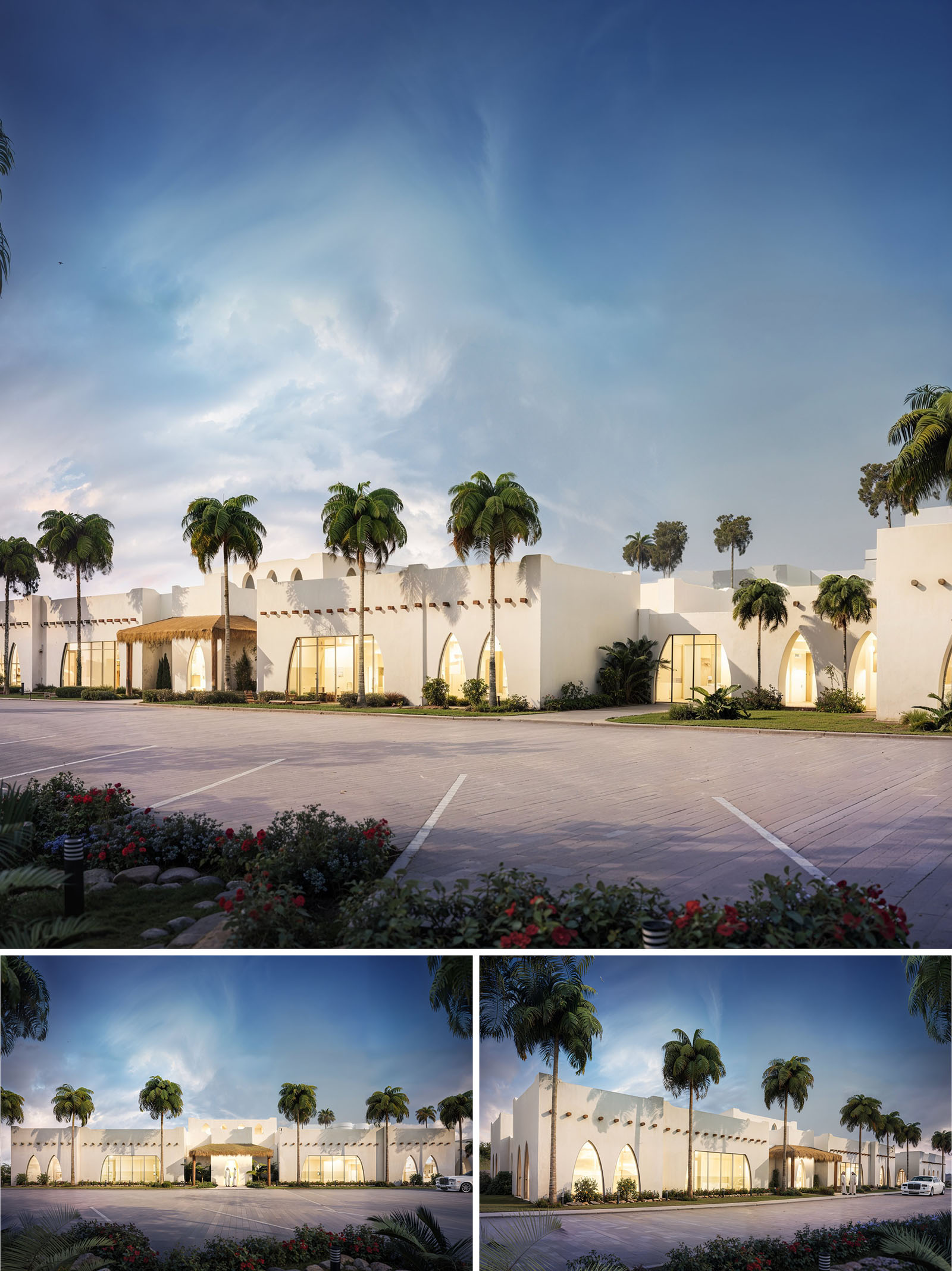
RAS Umm Leigi Beach Villa is conceived as a low-rise coastal retreat that fuses contemporary luxury with the quiet monumentality of vernacular Gulf architecture. The ensemble reads as a sculpted white village, stretching horizontally along the shoreline to maximize visual and physical connection with the sea. The architecture favors calm, continuous planes and softened edges that respond to the expansive desert-sky backdrop while creating a serene, resort-like ambience for residents and guests.
The concept celebrates thresholds: between inside and outside, light and shade, public arrival and intimate retreat. Repetitive arcades, deep reveals and carefully framed openings orchestrate these transitions, allowing the building to appear almost carved from a single, monolithic mass while remaining permeable and luminous at ground level. Palm trees and lush planting complete the image of an oasis, contrasting with the austere purity of the white volumes.
The architectural language is anchored in a restrained palette: white, planar walls, rhythmically punctured by tall, pointed-arch openings that reinterpret traditional Islamic and Qatari forms in a contemporary key. These arches, expressed as deep, vertical cuts in the façade, create a dynamic interplay of shadow and emphasize the building’s horizontality. The upper parapets are articulated with a crenellated profile and projecting timber-like elements, subtly recalling historic fortifications and wind towers without literal imitation.
Glazed curtain-wall panels are carefully recessed within the arches, reducing solar exposure while maintaining transparency. At the main entrance, the volume steps back to form a generous porch, highlighted by a warmer, textured canopy that marks the ceremonial drop-off. Nighttime illumination washes the façade, accentuating the sculptural qualities of the white surfaces and turning the sequence of arches into a luminous colonnade facing the parking forecourt.
The villa complex is organized as a linear bar parallel to the beach, with a strong arrival axis connecting the access road, parking zone and main entrance portico. This clear geometry ensures intuitive wayfinding and a dignified approach sequence, transitioning visitors from the urban edge to a protected, inward-looking oasis. The building’s relatively low height preserves human scale and maintains uninterrupted views toward the sea and the sky.
Primary functions are likely distributed along the façade line, with public and semi-public spaces occupying the more transparent front bays, while private suites and service zones nest behind a thicker, thermally insulated wall layer. Repetitive structural bays, expressed by the exterior arches, support flexible interior planning, allowing modular villa units or clusters of suites to be interconnected or separated according to functional needs and degrees of privacy.
The exterior is dominated by a smooth, high-reflectance plaster or stucco finish, optimized for the coastal context of Doha. This white skin reduces heat gain, reinforces the minimalist aesthetic and amplifies the changing tones of the sky throughout the day. Warm, low-iron glazing is used within the arch openings to maintain clarity while subtly filtering harsh daylight. The glass proportion is carefully balanced to ensure a sense of openness without compromising thermal comfort.
Soft, indirect lighting is integrated at the façade base and within the arch intrados, creating a layered night-time atmosphere. Light spills onto adjacent planting beds and walkways, emphasizing the interplay between architecture and landscape. The restrained palette of neutral walls, glass and natural textures from the entrance canopy and planting ensures that the setting feels both luxurious and timeless, avoiding visual clutter.
Landscape design plays a central role in environmental performance and user experience. Rows of mature palm trees align with the façade rhythm, providing vertical shading and helping to cool the microclimate through evapotranspiration. Low-height flowering shrubs and groundcovers define the parking edges, guiding movement while softening the hardscape. The generous setbacks between façade and driveways create buffer zones that reduce glare and reflected heat.
Sustainability strategies are embedded in the architectural form: compact building depth, limited height and continuous roof parapets support the integration of high-performance roof insulation and potential photovoltaic arrays. The deep façade recesses, pointed arches and recessed glazing significantly reduce direct solar gain while allowing ample daylight, lowering dependence on artificial lighting. Use of high-albedo exterior finishes, drought-tolerant planting and efficient irrigation systems is consistent with Qatar’s water and energy conservation priorities, aligning the luxury villa experience with responsible environmental stewardship.
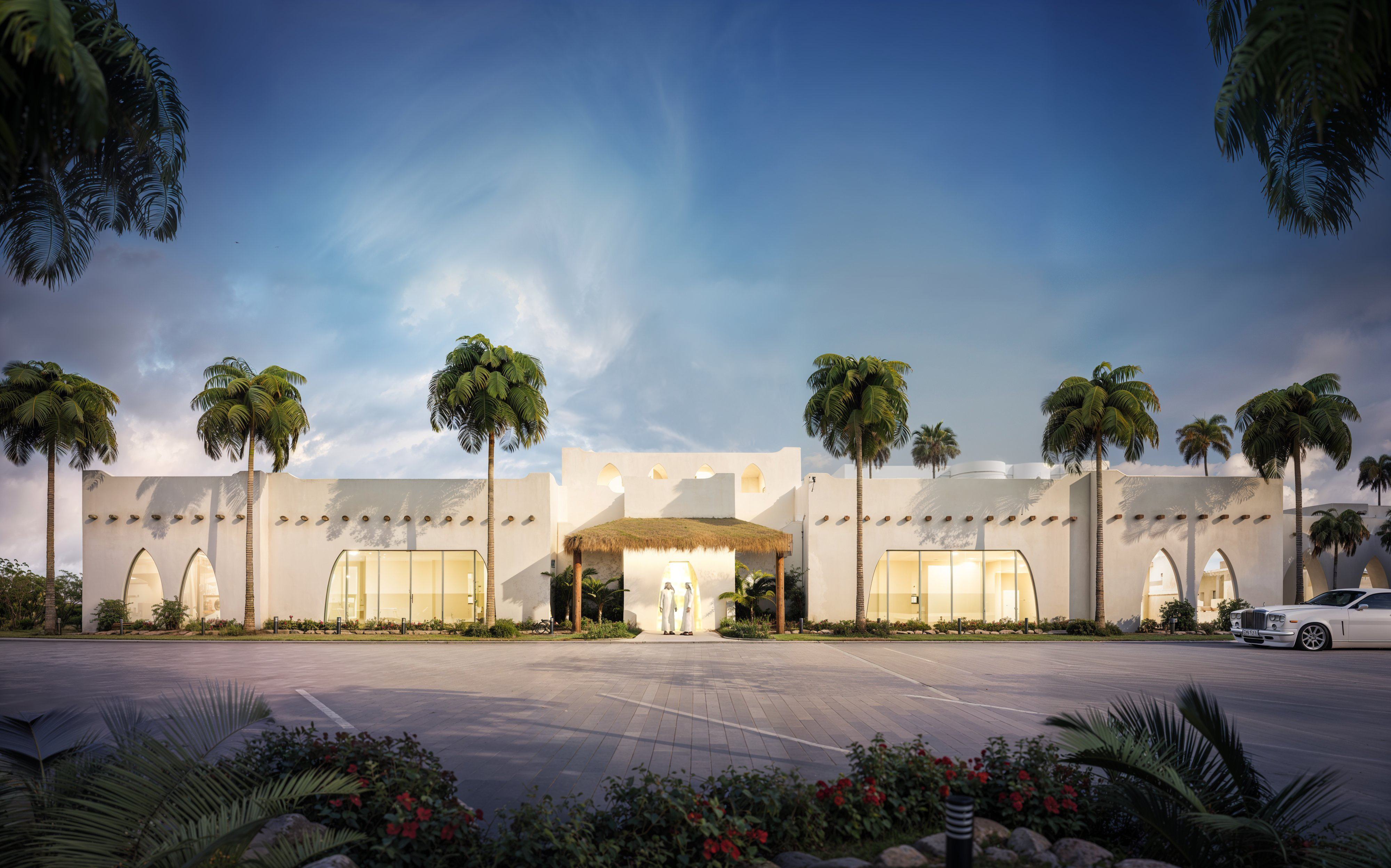
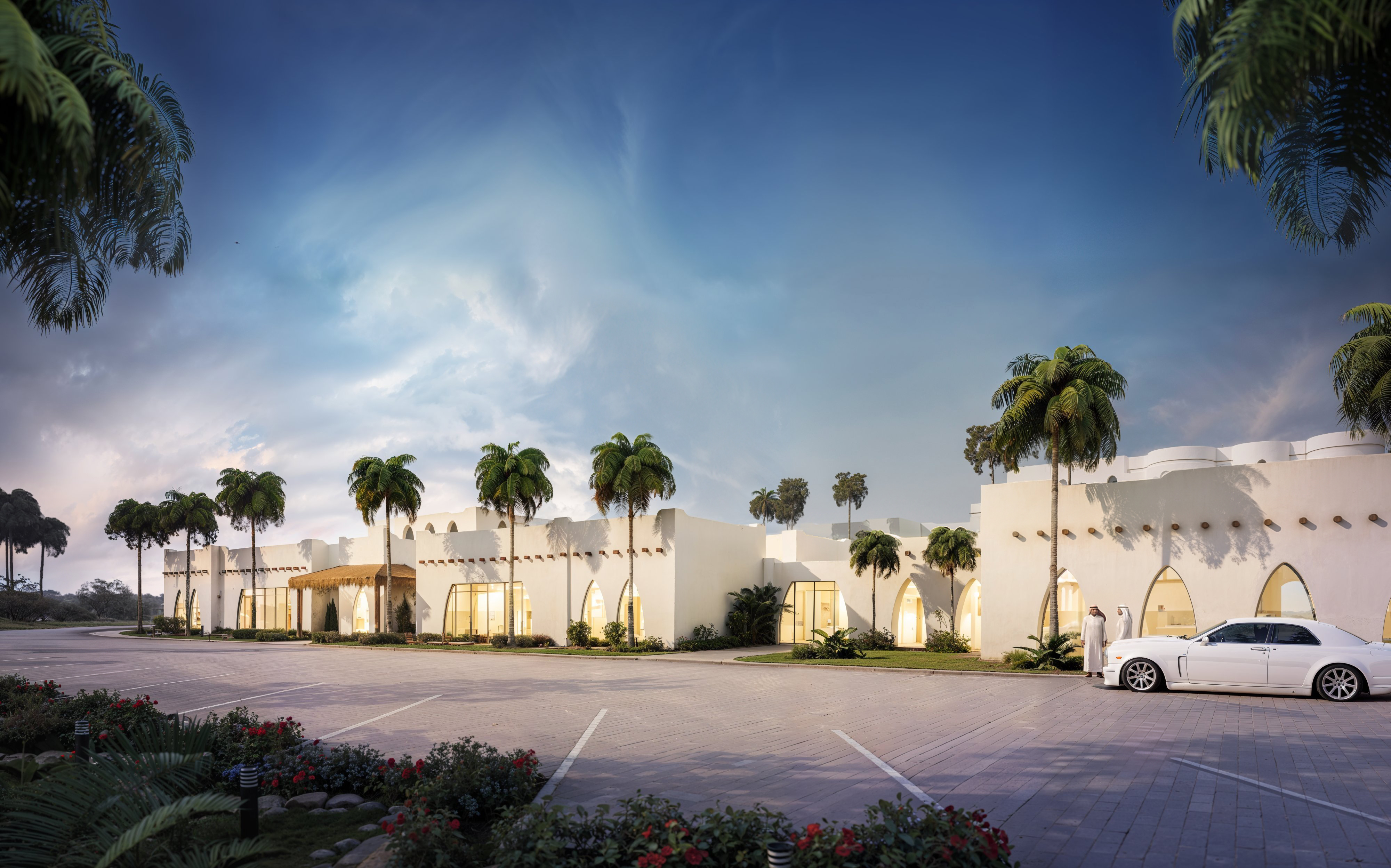
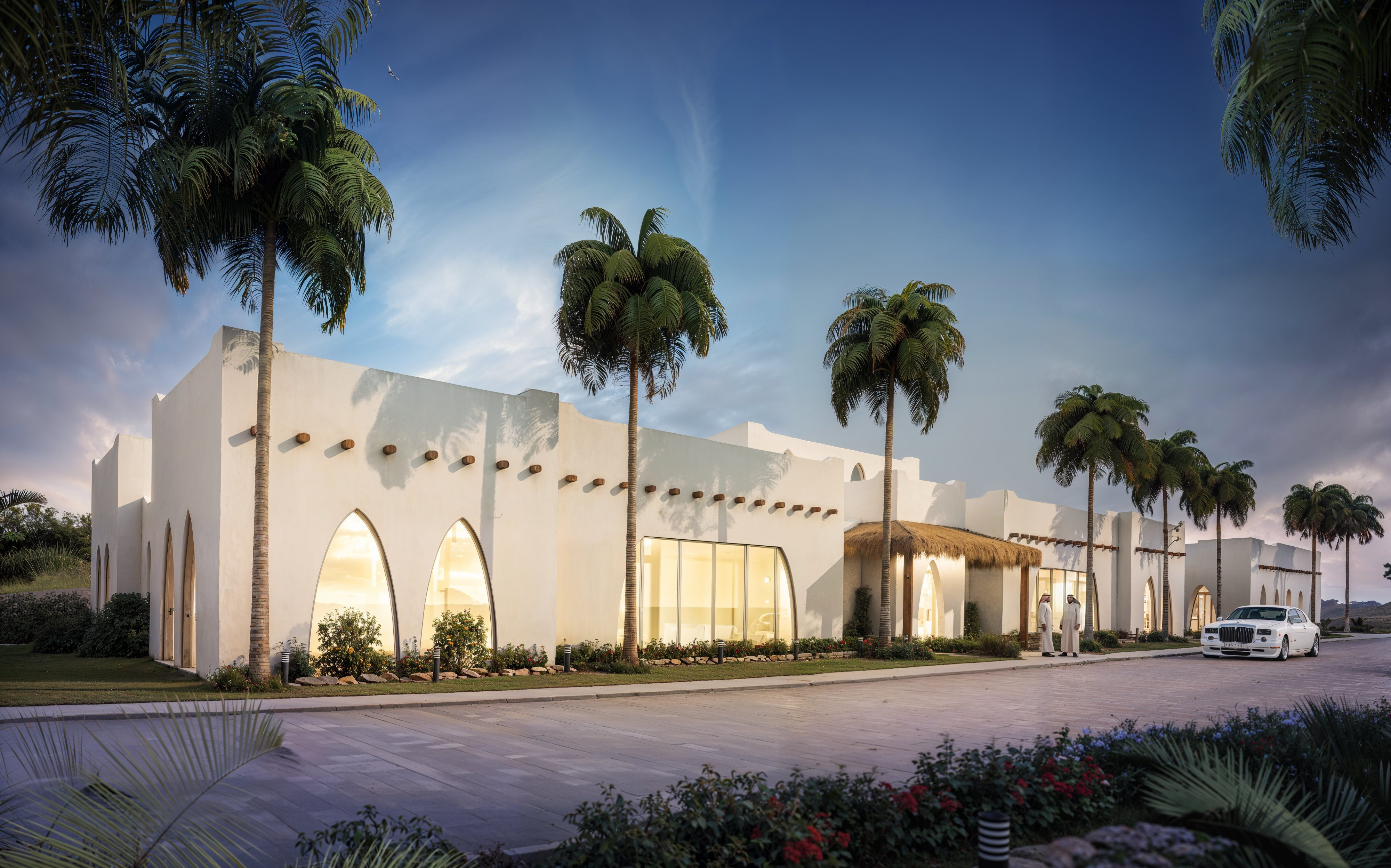
RAS Umm Leigi Beach Villa is conceived as a low-rise coastal retreat that fuses contemporary luxury with the quiet monumentality of vernacular Gulf architecture. The ensemble reads as a sculpted white village, stretching horizontally along the shoreline to maximize visual and physical connection with the sea. The architecture favors calm, continuous planes and softened edges that respond to the expansive desert-sky backdrop while creating a serene, resort-like ambience for residents and guests.
The concept celebrates thresholds: between inside and outside, light and shade, public arrival and intimate retreat. Repetitive arcades, deep reveals and carefully framed openings orchestrate these transitions, allowing the building to appear almost carved from a single, monolithic mass while remaining permeable and luminous at ground level. Palm trees and lush planting complete the image of an oasis, contrasting with the austere purity of the white volumes.
The architectural language is anchored in a restrained palette: white, planar walls, rhythmically punctured by tall, pointed-arch openings that reinterpret traditional Islamic and Qatari forms in a contemporary key. These arches, expressed as deep, vertical cuts in the façade, create a dynamic interplay of shadow and emphasize the building’s horizontality. The upper parapets are articulated with a crenellated profile and projecting timber-like elements, subtly recalling historic fortifications and wind towers without literal imitation.
Glazed curtain-wall panels are carefully recessed within the arches, reducing solar exposure while maintaining transparency. At the main entrance, the volume steps back to form a generous porch, highlighted by a warmer, textured canopy that marks the ceremonial drop-off. Nighttime illumination washes the façade, accentuating the sculptural qualities of the white surfaces and turning the sequence of arches into a luminous colonnade facing the parking forecourt.
The villa complex is organized as a linear bar parallel to the beach, with a strong arrival axis connecting the access road, parking zone and main entrance portico. This clear geometry ensures intuitive wayfinding and a dignified approach sequence, transitioning visitors from the urban edge to a protected, inward-looking oasis. The building’s relatively low height preserves human scale and maintains uninterrupted views toward the sea and the sky.
Primary functions are likely distributed along the façade line, with public and semi-public spaces occupying the more transparent front bays, while private suites and service zones nest behind a thicker, thermally insulated wall layer. Repetitive structural bays, expressed by the exterior arches, support flexible interior planning, allowing modular villa units or clusters of suites to be interconnected or separated according to functional needs and degrees of privacy.
The exterior is dominated by a smooth, high-reflectance plaster or stucco finish, optimized for the coastal context of Doha. This white skin reduces heat gain, reinforces the minimalist aesthetic and amplifies the changing tones of the sky throughout the day. Warm, low-iron glazing is used within the arch openings to maintain clarity while subtly filtering harsh daylight. The glass proportion is carefully balanced to ensure a sense of openness without compromising thermal comfort.
Soft, indirect lighting is integrated at the façade base and within the arch intrados, creating a layered night-time atmosphere. Light spills onto adjacent planting beds and walkways, emphasizing the interplay between architecture and landscape. The restrained palette of neutral walls, glass and natural textures from the entrance canopy and planting ensures that the setting feels both luxurious and timeless, avoiding visual clutter.
Landscape design plays a central role in environmental performance and user experience. Rows of mature palm trees align with the façade rhythm, providing vertical shading and helping to cool the microclimate through evapotranspiration. Low-height flowering shrubs and groundcovers define the parking edges, guiding movement while softening the hardscape. The generous setbacks between façade and driveways create buffer zones that reduce glare and reflected heat.
Sustainability strategies are embedded in the architectural form: compact building depth, limited height and continuous roof parapets support the integration of high-performance roof insulation and potential photovoltaic arrays. The deep façade recesses, pointed arches and recessed glazing significantly reduce direct solar gain while allowing ample daylight, lowering dependence on artificial lighting. Use of high-albedo exterior finishes, drought-tolerant planting and efficient irrigation systems is consistent with Qatar’s water and energy conservation priorities, aligning the luxury villa experience with responsible environmental stewardship.


Nuestras oficinas están en Barcelona, Cancún, Chicago y Santo Domingo, pero gracias a la tecnología podemos desarrollar proyectos en cualquier parte del mundo.
Barcelona
Bac de Roda 136
08020, Barcelona
Spain
Madrid
Av. de Buendía 11
19005 Guadalajara (Madrid)
Spain
Chicago
373 Hazel Ave, Apt A1
60022, Glencoe, Illinois
United States