

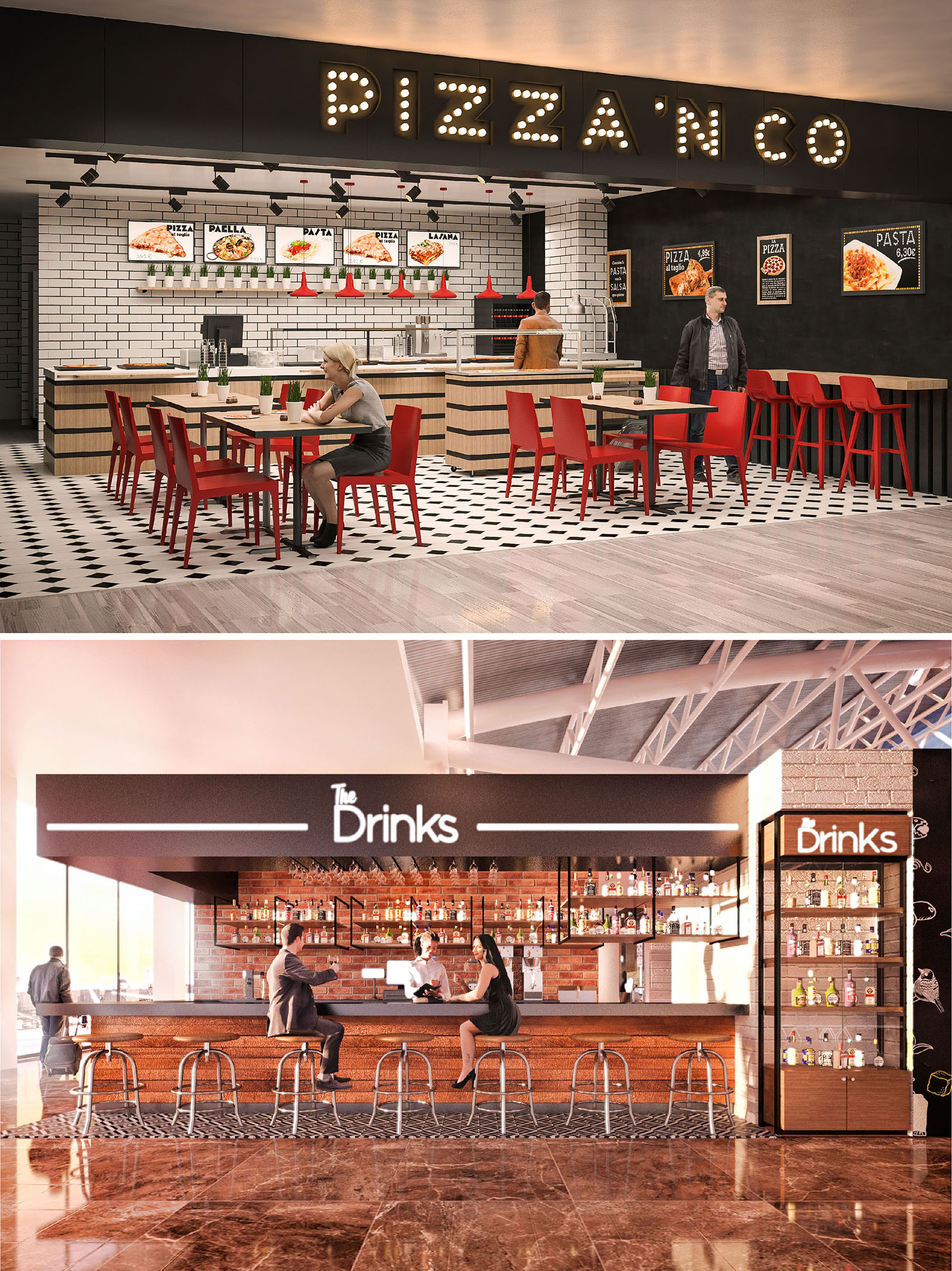
PIZZA’N CO is conceived as a fast-casual restaurant and bar format capable of replicating itself in airports and shopping centers in Mexico and Spain. The design strategy combines the clarity of a branded food court kiosk with the warmth of a neighborhood trattoria, using industrial and contemporary references. The space is divided into two complementary atmospheres: the vibrant pizzeria and the more intimate bar area, connected by a coherent material and graphic language that reinforces brand recognition at a distance.
The architectural concept is based on strong horizontal canopies and clear volumetric frames that define each unit without enclosing it. These frames act as urban “shopfronts” inside interior public spaces, making the offer legible from multiple angles and facilitating rapid orientation for transient users.
The layout prioritizes visibility of production and direct customer flow. In the pizzeria, the open counter and back-of-house line are fully exposed behind a continuous tiled backdrop, emphasizing transparency and speed of service. The sequence runs from menu reading, to ordering, to collection, minimizing cross-circulation and allowing staff to operate within a compact, ergonomic work triangle.
Dining is organized through a combination of loose tables and linear bar seating at the perimeter. This allows the brand to adapt to different footprints while keeping a clear zoning between circulation corridors and seated areas. In the bar, a central island counter works as an attracting core, allowing access on three sides and optimizing interaction between bartender and guests.
The material palette combines tactile finishes with easily maintainable surfaces. At PIZZA’N CO, white bevelled subway tiles with dark grout form a hygienic and luminous backdrop to the kitchen line, while blackboard-painted walls host illuminated menus and graphic elements. Blonde wood cladding wraps the service counters, introducing warmth and a human scale in contrast to the more industrial ceiling and lighting grid.
The chromatic identity is anchored in a triad of black, white, and a saturated red. Red chairs and stools inject energy and act as a visual anchor in high-traffic environments, while the monochrome floor pattern in mosaic tiles provides a classic, almost bistro-like reference. In the bar area, exposed red brick and warm-toned timber cabinetry build a more sophisticated, nocturnal mood, balanced by the dark canopy and linear LED accents.
Lighting is treated as both functional infrastructure and a key branding tool. At the pizzeria front, a marquee-style “PIZZA’N CO” sign with individual bulbs evokes cinema façades and draws attention from afar. Track-mounted spotlights over the counter ensure precise illumination of the food display and working surfaces, while pendant fixtures in brand red create a rhythm above the serving line.
In the bar, a continuous luminous band integrated into the canopy emphasizes the “The Drinks” logo and underlines the counter edge. Backlit bottle displays transform the rear wall into a dynamic, colorful plane, enhancing depth and ambiance. Overall, the scheme balances warm and neutral color temperatures to differentiate public seating, service counters, and circulation zones.
The furniture is intentionally simple, robust, and stackable where possible, allowing rapid reconfiguration and efficient maintenance. Metal-framed chairs with slim profiles maintain visual permeability across the dining area, preventing spatial congestion despite the compact footprint. Bar stools with tubular steel legs and timber seats echo the industrial language of the exposed structures above.
Edges, corners, and junctions are resolved with durable trims to withstand high occupancy and luggage impacts, particularly in airport contexts. The tabletops use high-pressure laminates with wood textures, balancing resistance to staining and scratching with a warm tactile perception. Menu boards, wall graphics, and bottle arrangements are designed as integral architectural components rather than add-ons, ensuring a cohesive brand narrative.
Given its multi-location rollout, the project emphasizes modularity and resource efficiency. Counter blocks, shelving units, and lighting tracks are conceived as standardized modules that can be prefabricated, transported flat, and installed with minimal site waste. This approach reduces construction time, energy consumption, and material offcuts in each venue.
Durable finishes such as ceramic tiles, brick, and metal structures minimize long-term replacement needs, contributing to life-cycle sustainability. LED lighting throughout dramatically reduces energy use and maintenance, while the open-front layout leverages existing ambient lighting from the host building. Where possible, locally sourced bricks, woods, and tiles are specified for each country, supporting regional economies and reducing transportation impacts while maintaining a consistent visual identity.
PIZZA’N CO is conceived as a fast-casual restaurant and bar format capable of replicating itself in airports and shopping centers in Mexico and Spain. The design strategy combines the clarity of a branded food court kiosk with the warmth of a neighborhood trattoria, using industrial and contemporary references. The space is divided into two complementary atmospheres: the vibrant pizzeria and the more intimate bar area, connected by a coherent material and graphic language that reinforces brand recognition at a distance.
The architectural concept is based on strong horizontal canopies and clear volumetric frames that define each unit without enclosing it. These frames act as urban “shopfronts” inside interior public spaces, making the offer legible from multiple angles and facilitating rapid orientation for transient users.
The layout prioritizes visibility of production and direct customer flow. In the pizzeria, the open counter and back-of-house line are fully exposed behind a continuous tiled backdrop, emphasizing transparency and speed of service. The sequence runs from menu reading, to ordering, to collection, minimizing cross-circulation and allowing staff to operate within a compact, ergonomic work triangle.
Dining is organized through a combination of loose tables and linear bar seating at the perimeter. This allows the brand to adapt to different footprints while keeping a clear zoning between circulation corridors and seated areas. In the bar, a central island counter works as an attracting core, allowing access on three sides and optimizing interaction between bartender and guests.
The material palette combines tactile finishes with easily maintainable surfaces. At PIZZA’N CO, white bevelled subway tiles with dark grout form a hygienic and luminous backdrop to the kitchen line, while blackboard-painted walls host illuminated menus and graphic elements. Blonde wood cladding wraps the service counters, introducing warmth and a human scale in contrast to the more industrial ceiling and lighting grid.
The chromatic identity is anchored in a triad of black, white, and a saturated red. Red chairs and stools inject energy and act as a visual anchor in high-traffic environments, while the monochrome floor pattern in mosaic tiles provides a classic, almost bistro-like reference. In the bar area, exposed red brick and warm-toned timber cabinetry build a more sophisticated, nocturnal mood, balanced by the dark canopy and linear LED accents.
Lighting is treated as both functional infrastructure and a key branding tool. At the pizzeria front, a marquee-style “PIZZA’N CO” sign with individual bulbs evokes cinema façades and draws attention from afar. Track-mounted spotlights over the counter ensure precise illumination of the food display and working surfaces, while pendant fixtures in brand red create a rhythm above the serving line.
In the bar, a continuous luminous band integrated into the canopy emphasizes the “The Drinks” logo and underlines the counter edge. Backlit bottle displays transform the rear wall into a dynamic, colorful plane, enhancing depth and ambiance. Overall, the scheme balances warm and neutral color temperatures to differentiate public seating, service counters, and circulation zones.
The furniture is intentionally simple, robust, and stackable where possible, allowing rapid reconfiguration and efficient maintenance. Metal-framed chairs with slim profiles maintain visual permeability across the dining area, preventing spatial congestion despite the compact footprint. Bar stools with tubular steel legs and timber seats echo the industrial language of the exposed structures above.
Edges, corners, and junctions are resolved with durable trims to withstand high occupancy and luggage impacts, particularly in airport contexts. The tabletops use high-pressure laminates with wood textures, balancing resistance to staining and scratching with a warm tactile perception. Menu boards, wall graphics, and bottle arrangements are designed as integral architectural components rather than add-ons, ensuring a cohesive brand narrative.
Given its multi-location rollout, the project emphasizes modularity and resource efficiency. Counter blocks, shelving units, and lighting tracks are conceived as standardized modules that can be prefabricated, transported flat, and installed with minimal site waste. This approach reduces construction time, energy consumption, and material offcuts in each venue.
Durable finishes such as ceramic tiles, brick, and metal structures minimize long-term replacement needs, contributing to life-cycle sustainability. LED lighting throughout dramatically reduces energy use and maintenance, while the open-front layout leverages existing ambient lighting from the host building. Where possible, locally sourced bricks, woods, and tiles are specified for each country, supporting regional economies and reducing transportation impacts while maintaining a consistent visual identity.


Nuestras oficinas están en Barcelona, Cancún, Chicago y Santo Domingo, pero gracias a la tecnología podemos desarrollar proyectos en cualquier parte del mundo.
Barcelona
Bac de Roda 136
08020, Barcelona
Spain
Madrid
Av. de Buendía 11
19005 Guadalajara (Madrid)
Spain
Chicago
373 Hazel Ave, Apt A1
60022, Glencoe, Illinois
United States