

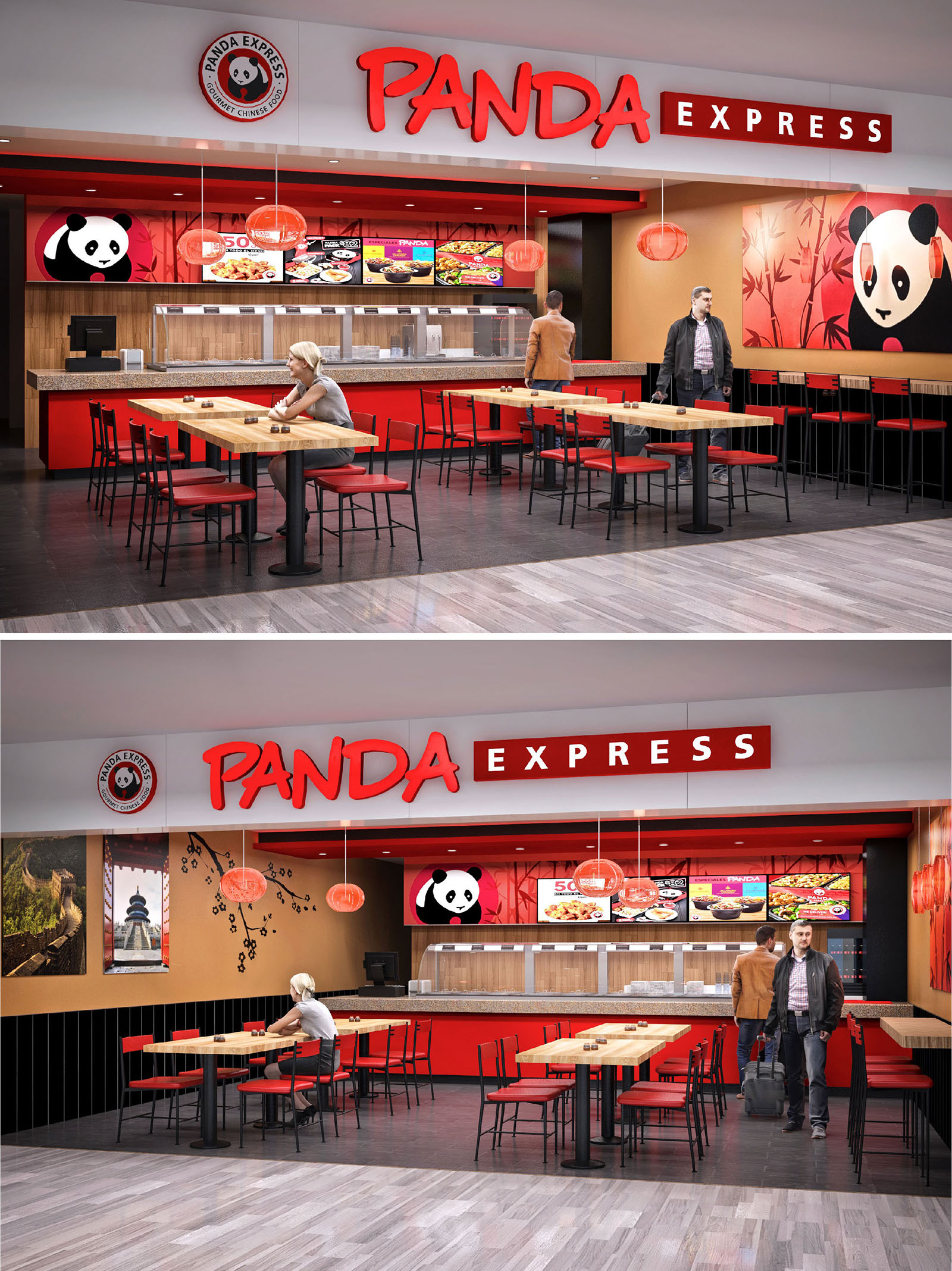
The Panda Express in Tijuana is conceived as an open and permeable food‑court pavilion that visually extends into the circulation areas of the mall. The concept combines the brand’s dynamic identity with a contemporary Asian‑inspired language, using clear geometric lines, strong chromatic contrasts and playful graphic elements. The restaurant front is treated as a continuous façade where logo, menu band and service counter form a single horizontal composition that immediately communicates function and access.
The design emphasizes transparency and legibility: from a distance, the guest can read the entire operation, from food display to seating. This visual continuity reinforces trust and accelerates decision making, an essential aspect in high‑flow commercial environments such as Tijuana’s shopping centers and transport hubs.
The layout is configured as a linear service counter at the back, with the dining area projected towards the public corridor. A central block of communal tables organizes the space, generating a clear axis between the mall circulation and the counter, while a perimeter bar along the side wall offers higher seating for quick stays. This dual seating strategy responds to both fast‑turnover users and customers who wish to remain longer.
Circulation is intuitive: entry is fully open, without doors or partitions, and the free plan allows multiple access points. The queueing zone is naturally defined by the alignment of the counter and the first row of tables, avoiding physical barriers. This ensures efficient flow at peak hours while maintaining visual spaciousness despite the compact footprint typical of food‑court premises.
The material palette combines warm wood tones, red lacquered surfaces and black accents, constructing a robust identity that is immediately recognizable. Natural‑look wood is used on tabletops, counter cladding and portions of the back wall, providing tactile warmth that balances the intensity of the corporate red. Black appears in chair structures, table bases and lower wall panels, grounding the composition and enhancing durability in high‑impact areas.
The ceiling and fascia are kept in light neutral tones to prevent chromatic saturation and to highlight the three‑dimensional “PANDA EXPRESS” signage. Large‑scale panda graphics and Asian‑inspired murals inject a playful narrative, while framed photographs of landscapes reference Chinese culture in a more subtle and architectural way. The continuous illuminated menu band functions as both lighting and wayfinding, reinforcing the brand while giving depth to the back wall.
Lighting strategy balances functional clarity at the counter with a warm, inviting ambience in the dining area. Linear concealed lighting above the menu and food line ensures accurate color rendering of dishes, a key factor in food presentation. In contrast, the dining zone incorporates suspended circular pendants with warm color temperature, visually lowering the perceived ceiling height and creating a more intimate scale within the open mall context.
Reflected light from the light‑colored ceiling and glossy red bands avoids harsh shadows, while the dark flooring absorbs glare, adding visual comfort. The result is a luminous environment that remains perceptible and attractive from a distance, yet comfortable for guests seated over longer periods.
The furniture is deliberately simple and robust, with slender metal frames and thin wood surfaces that convey lightness while optimizing resistance and ease of maintenance. Table dimensions are standardized to allow flexible grouping for couples or larger parties, responding to variable demand patterns. Chair geometry, with straight legs and minimal profiles, contributes to a clean visual field, ensuring that branding and food display remain protagonists.
Counter height and distance to the first row of tables are calibrated to facilitate both staff operation and customer comfort, leaving sufficient space for luggage or strollers, a frequent requirement in high‑traffic locations like Tijuana’s commercial nodes. Bar‑height seating along the mural wall offers an alternative for solo diners, maximizing capacity without congesting the central area.
Sustainability in this project is addressed through material selection, operational efficiency and long‑term durability. High‑resistance surfaces, such as composite countertops and dense laminates, reduce the need for frequent replacement and minimize waste over the lifecycle of the restaurant. Neutral flooring with high abrasion resistance ensures that the space maintains its appearance despite constant traffic, extending intervals between renovations.
LED lighting throughout the project significantly reduces energy consumption while providing precise color rendering indispensable for food service. The open frontage relies on the mall’s existing HVAC system, avoiding duplicated climate control equipment. The use of modular furniture and standardized components allows for easy repair, reuse or reconfiguration, supporting adaptable, resource‑conscious operation as the commercial context of Tijuana evolves.
The Panda Express in Tijuana is conceived as an open and permeable food‑court pavilion that visually extends into the circulation areas of the mall. The concept combines the brand’s dynamic identity with a contemporary Asian‑inspired language, using clear geometric lines, strong chromatic contrasts and playful graphic elements. The restaurant front is treated as a continuous façade where logo, menu band and service counter form a single horizontal composition that immediately communicates function and access.
The design emphasizes transparency and legibility: from a distance, the guest can read the entire operation, from food display to seating. This visual continuity reinforces trust and accelerates decision making, an essential aspect in high‑flow commercial environments such as Tijuana’s shopping centers and transport hubs.
The layout is configured as a linear service counter at the back, with the dining area projected towards the public corridor. A central block of communal tables organizes the space, generating a clear axis between the mall circulation and the counter, while a perimeter bar along the side wall offers higher seating for quick stays. This dual seating strategy responds to both fast‑turnover users and customers who wish to remain longer.
Circulation is intuitive: entry is fully open, without doors or partitions, and the free plan allows multiple access points. The queueing zone is naturally defined by the alignment of the counter and the first row of tables, avoiding physical barriers. This ensures efficient flow at peak hours while maintaining visual spaciousness despite the compact footprint typical of food‑court premises.
The material palette combines warm wood tones, red lacquered surfaces and black accents, constructing a robust identity that is immediately recognizable. Natural‑look wood is used on tabletops, counter cladding and portions of the back wall, providing tactile warmth that balances the intensity of the corporate red. Black appears in chair structures, table bases and lower wall panels, grounding the composition and enhancing durability in high‑impact areas.
The ceiling and fascia are kept in light neutral tones to prevent chromatic saturation and to highlight the three‑dimensional “PANDA EXPRESS” signage. Large‑scale panda graphics and Asian‑inspired murals inject a playful narrative, while framed photographs of landscapes reference Chinese culture in a more subtle and architectural way. The continuous illuminated menu band functions as both lighting and wayfinding, reinforcing the brand while giving depth to the back wall.
Lighting strategy balances functional clarity at the counter with a warm, inviting ambience in the dining area. Linear concealed lighting above the menu and food line ensures accurate color rendering of dishes, a key factor in food presentation. In contrast, the dining zone incorporates suspended circular pendants with warm color temperature, visually lowering the perceived ceiling height and creating a more intimate scale within the open mall context.
Reflected light from the light‑colored ceiling and glossy red bands avoids harsh shadows, while the dark flooring absorbs glare, adding visual comfort. The result is a luminous environment that remains perceptible and attractive from a distance, yet comfortable for guests seated over longer periods.
The furniture is deliberately simple and robust, with slender metal frames and thin wood surfaces that convey lightness while optimizing resistance and ease of maintenance. Table dimensions are standardized to allow flexible grouping for couples or larger parties, responding to variable demand patterns. Chair geometry, with straight legs and minimal profiles, contributes to a clean visual field, ensuring that branding and food display remain protagonists.
Counter height and distance to the first row of tables are calibrated to facilitate both staff operation and customer comfort, leaving sufficient space for luggage or strollers, a frequent requirement in high‑traffic locations like Tijuana’s commercial nodes. Bar‑height seating along the mural wall offers an alternative for solo diners, maximizing capacity without congesting the central area.
Sustainability in this project is addressed through material selection, operational efficiency and long‑term durability. High‑resistance surfaces, such as composite countertops and dense laminates, reduce the need for frequent replacement and minimize waste over the lifecycle of the restaurant. Neutral flooring with high abrasion resistance ensures that the space maintains its appearance despite constant traffic, extending intervals between renovations.
LED lighting throughout the project significantly reduces energy consumption while providing precise color rendering indispensable for food service. The open frontage relies on the mall’s existing HVAC system, avoiding duplicated climate control equipment. The use of modular furniture and standardized components allows for easy repair, reuse or reconfiguration, supporting adaptable, resource‑conscious operation as the commercial context of Tijuana evolves.


Nuestras oficinas están en Barcelona, Cancún, Chicago y Santo Domingo, pero gracias a la tecnología podemos desarrollar proyectos en cualquier parte del mundo.
Barcelona
Bac de Roda 136
08020, Barcelona
Spain
Madrid
Av. de Buendía 11
19005 Guadalajara (Madrid)
Spain
Chicago
373 Hazel Ave, Apt A1
60022, Glencoe, Illinois
United States