

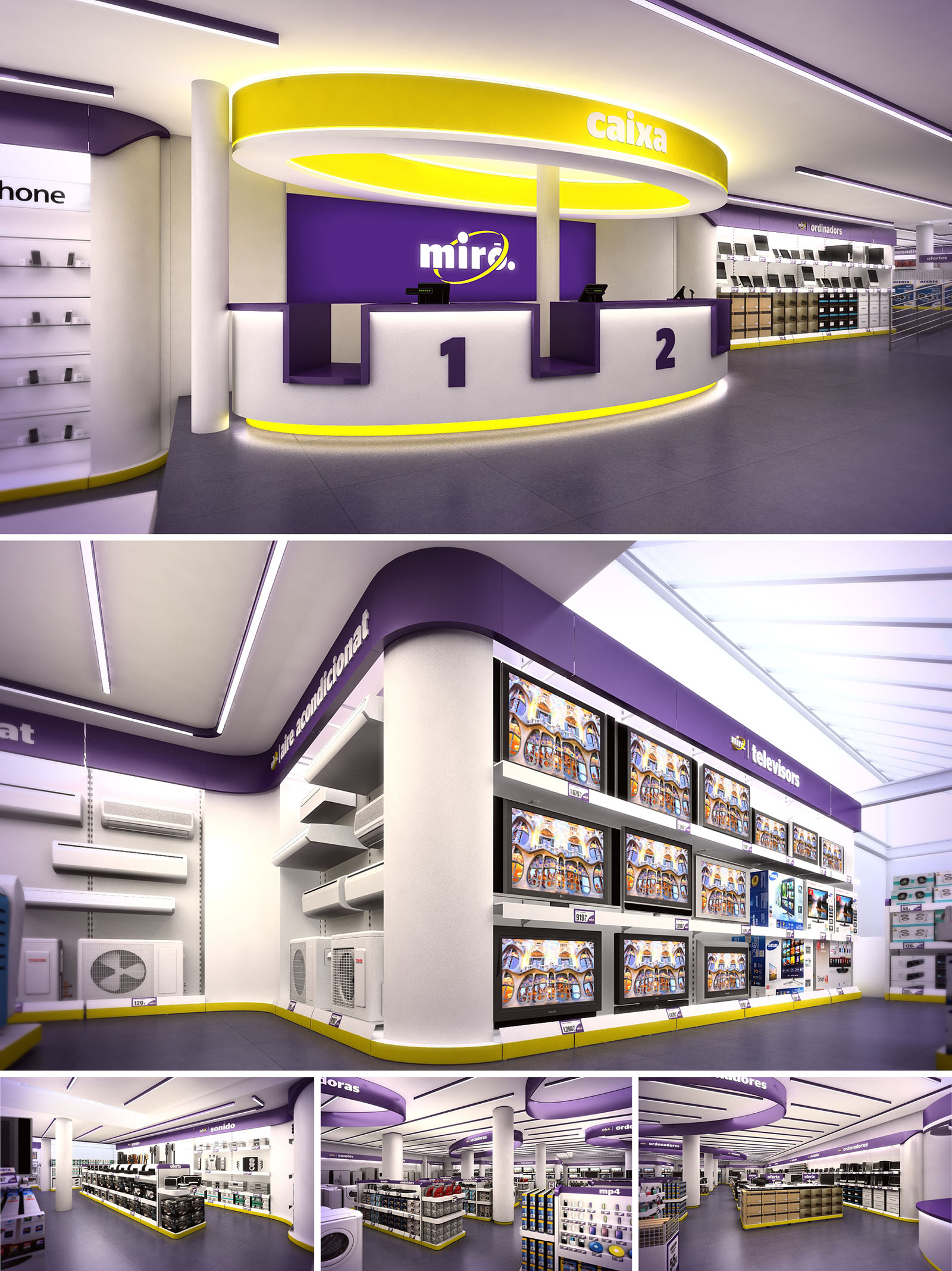
The MIRO retail project in Madrid is conceived as a contemporary, highly legible environment for consumer electronics, where architecture, graphics and lighting merge into a continuous brand experience. The design uses a clear chromatic code—white, purple and yellow—to articulate circulation, highlight product areas and reinforce corporate identity. Soft, fluid geometries organize the space, avoiding visual clutter and allowing customers to understand the store at a glance.
The layout is based on a sequence of rings and bands that guide movement from entrance to cashier and through specialized product zones. This creates a unified interior landscape where architecture acts as wayfinding. The goal is to generate an immersive, dynamic atmosphere that remains efficient and easy to navigate during peak hours.
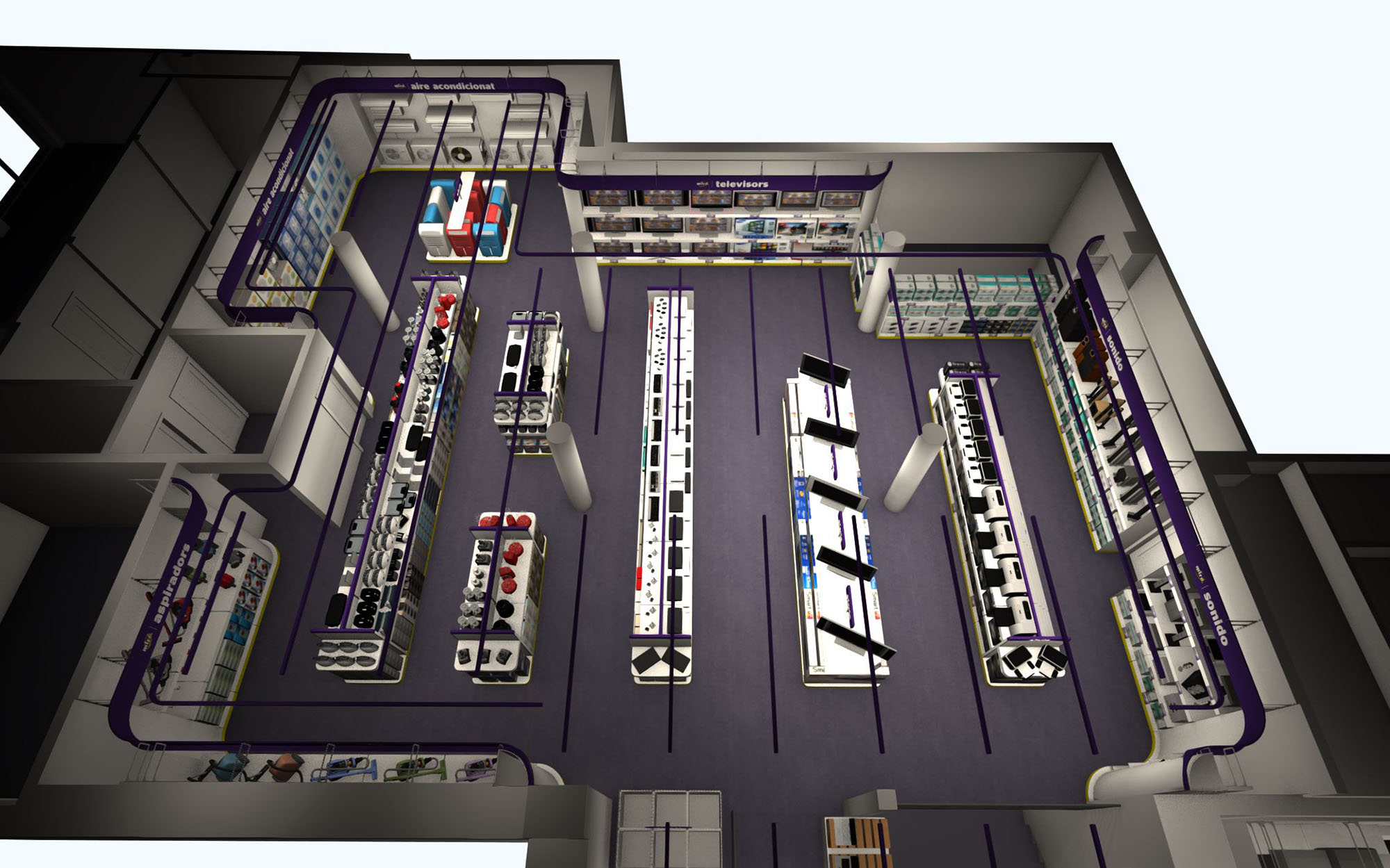
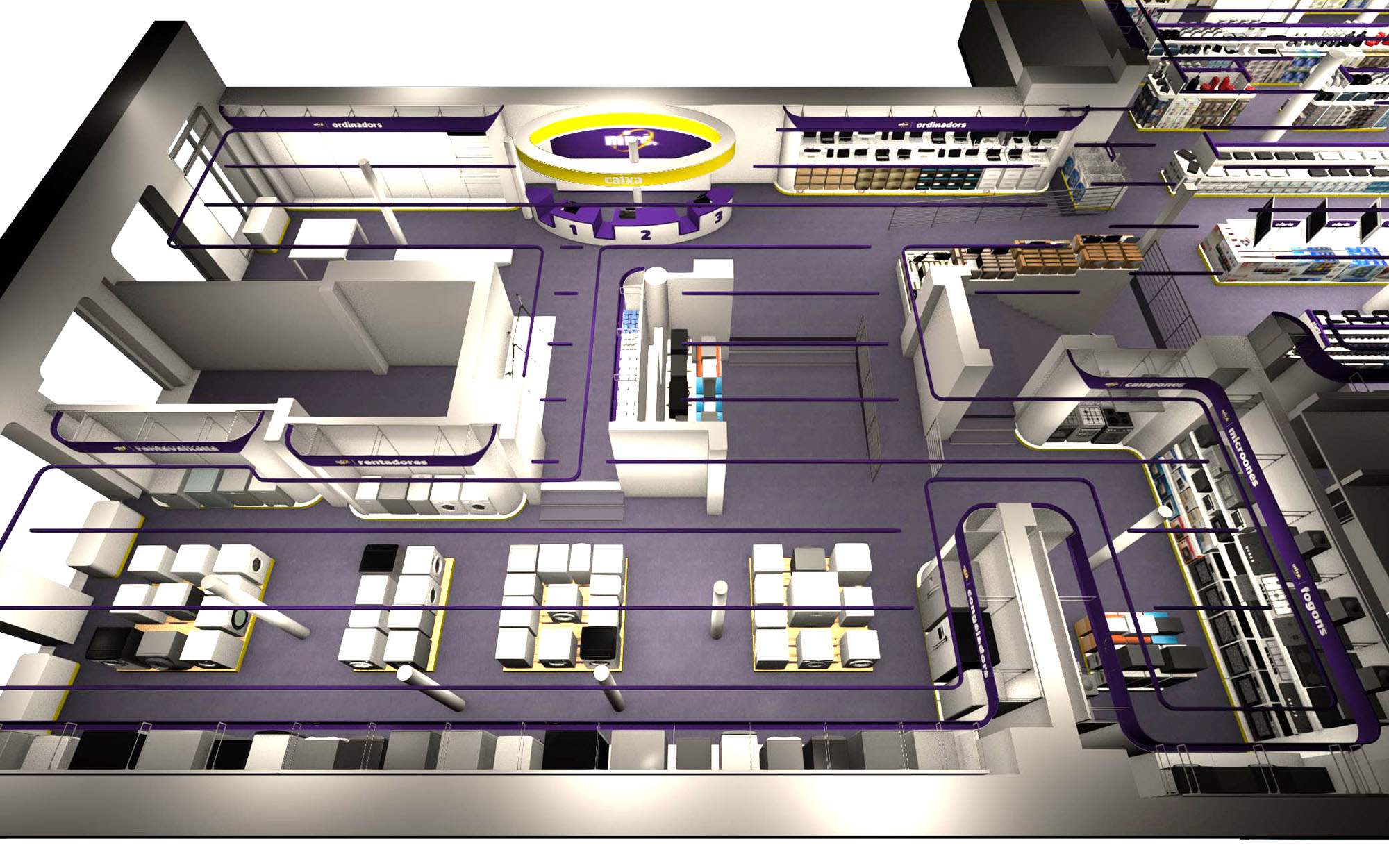
The store is structured around a central, open-plan sales floor with radial circulation. From the access, the main axis leads directly to the circular cashier hub, which functions as an orienting landmark visible from almost every point. Around this core, product islands and perimetral shelving define specialized sectors for televisions, air conditioning, small appliances and accessories.
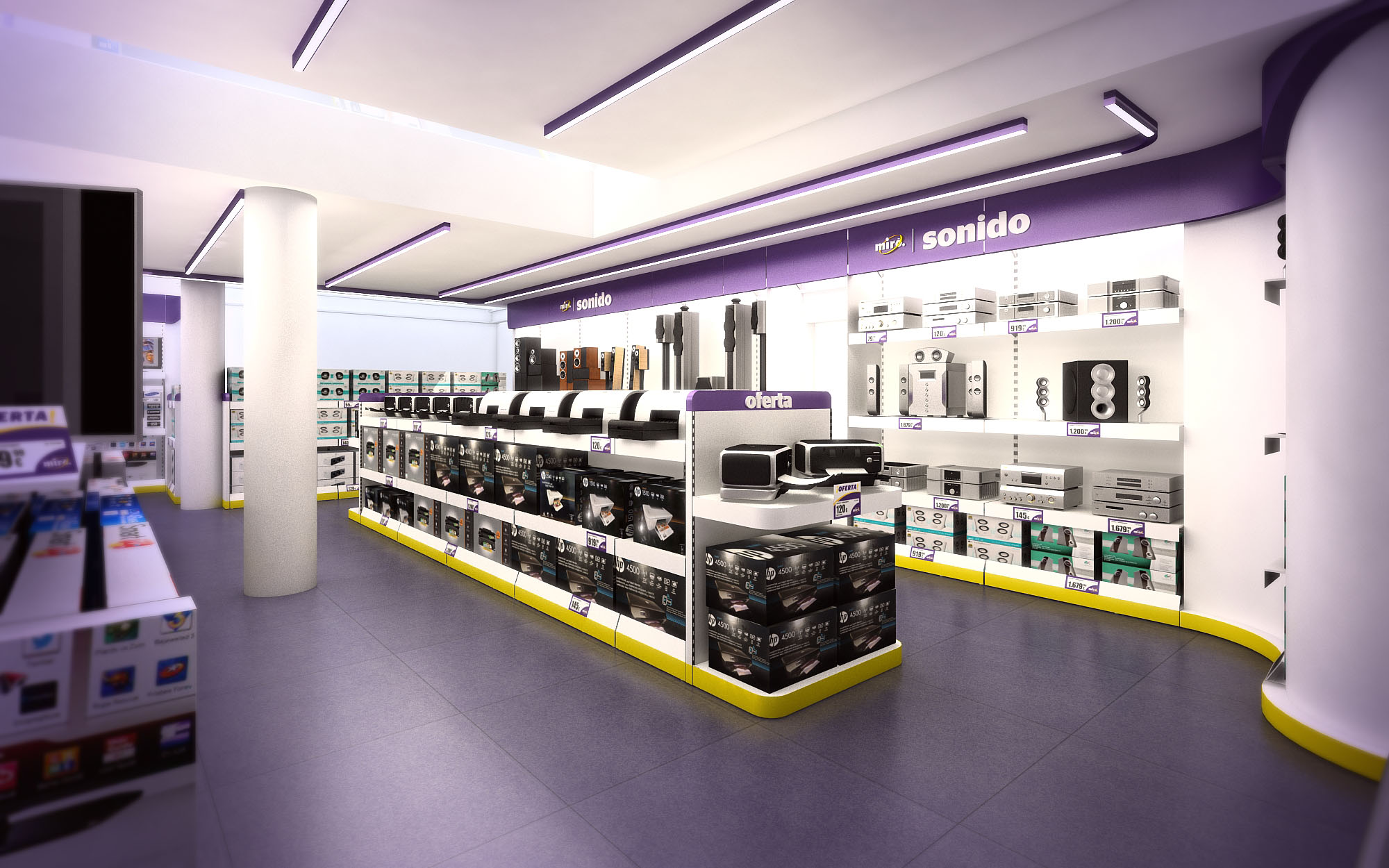
The circulation strategy is based on clear perimetral loops combined with transverse corridors. This allows alternative paths while gently directing customers through high-visibility product fronts. Generous aisle widths accommodate simultaneous browsing and trolley circulation, essential for an electronics retailer with bulky items. Structural columns are integrated within display islands, so that no element interrupts the visual field or pedestrian flow.
The project employs a reduced palette of durable, easy-maintenance materials. Continuous resin or large-format porcelain flooring in neutral grey provides a robust, seamless base that resists heavy traffic. Vertical surfaces combine lacquered MDF, high-pressure laminates and powder-coated metal shelving, ensuring dimensional stability and flexibility for future reconfiguration.
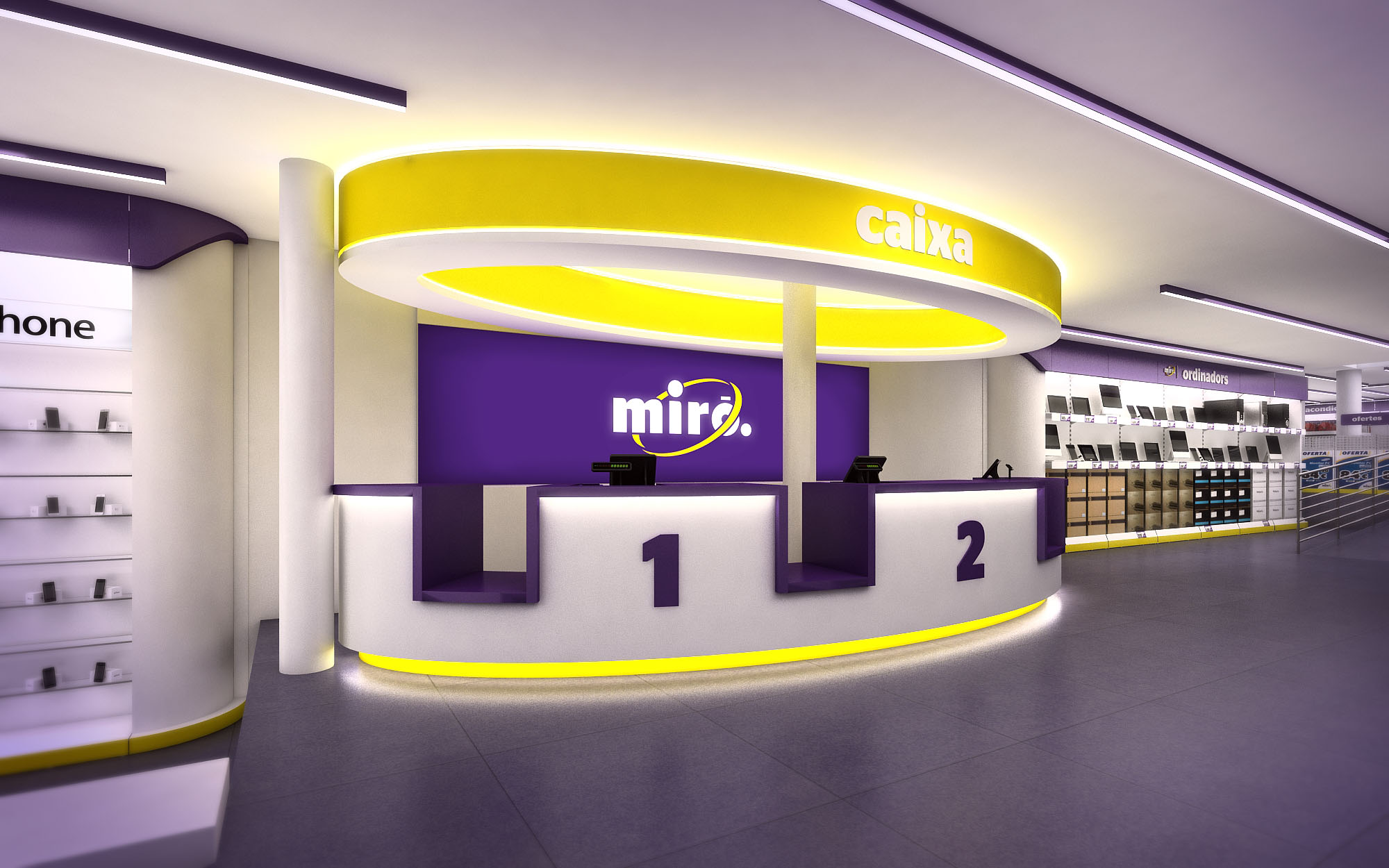
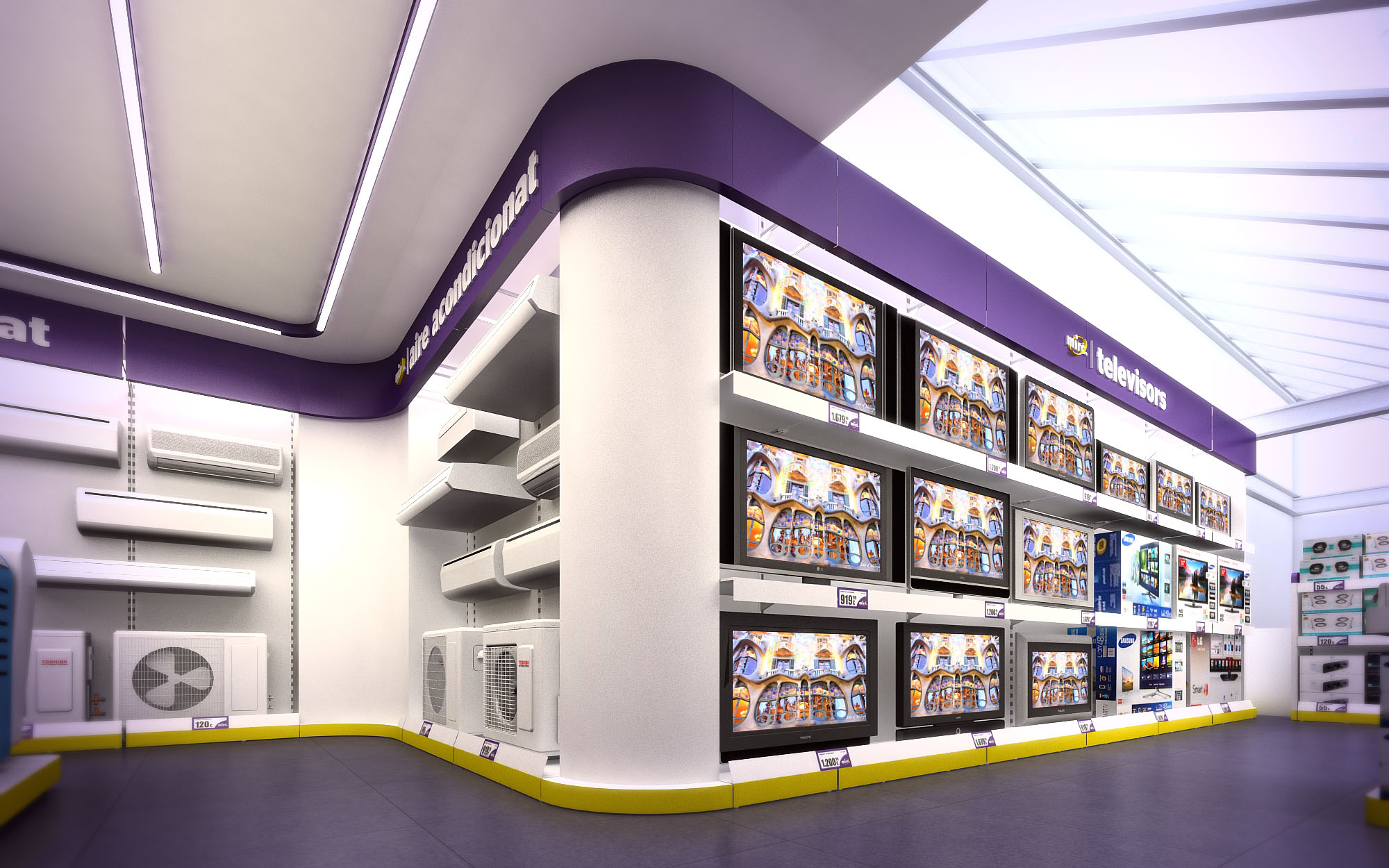
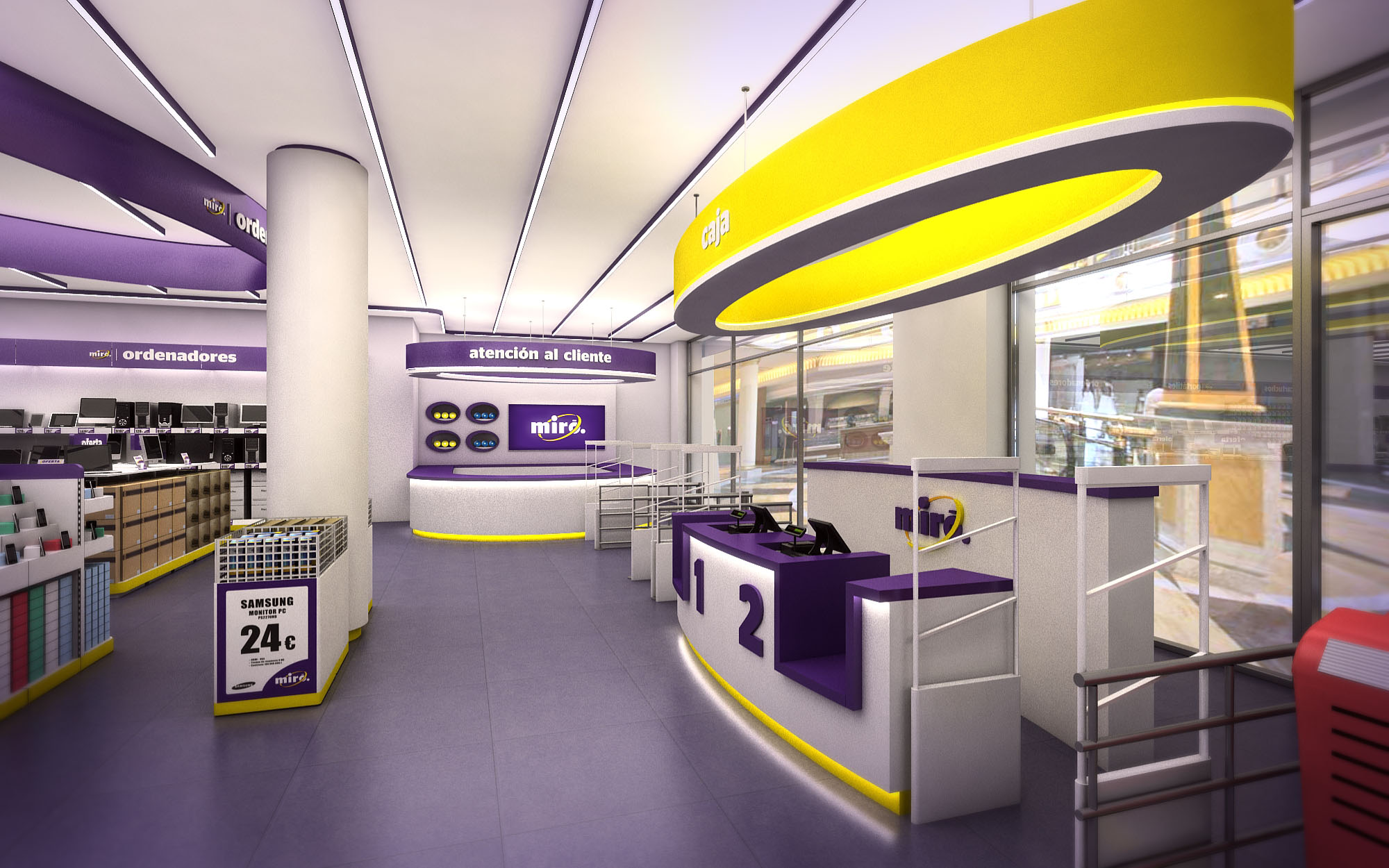
Color is used as an architectural tool rather than mere decoration. White dominates ceilings, walls and most fixtures, acting as a neutral backdrop that enhances product visibility. The corporate purple forms a continuous upper band that traces the perimeter, emphasizing horizontality and visually connecting distant areas. A vivid yellow line, at skirting and ceiling level, works as a dynamic accent that underlines the cashier ring and the base of shelving units, subtly guiding movement while reinforcing brand recall.
Lighting design prioritizes uniformity and product emphasis. Linear recessed luminaires in the ceiling generate a continuous, glare-free general illumination, ensuring accurate color rendering for electronic devices. The cashier canopy integrates concealed LED strips that wash the curved surfaces, intensifying the reading of the circular geometry and distinguishing the service zone.
Wall systems for televisions and air-conditioning units are conceived as illuminated façades. Integrated backlighting and targeted spotlights ensure that the product, rather than the support, becomes the protagonist. The modular shelving allows variable heights and configurations, facilitating regular updates of merchandising strategies without requiring structural interventions.
The cashier desk is the iconic element of the project: a continuous circular counter with differentiated service points clearly numbered and highlighted by the yellow luminous ring at floor level. This piece combines high-pressure laminate and solid surfaces to provide durability in intensive use areas. Generous recessed toe spaces and ergonomic counter heights improve staff comfort and service efficiency.
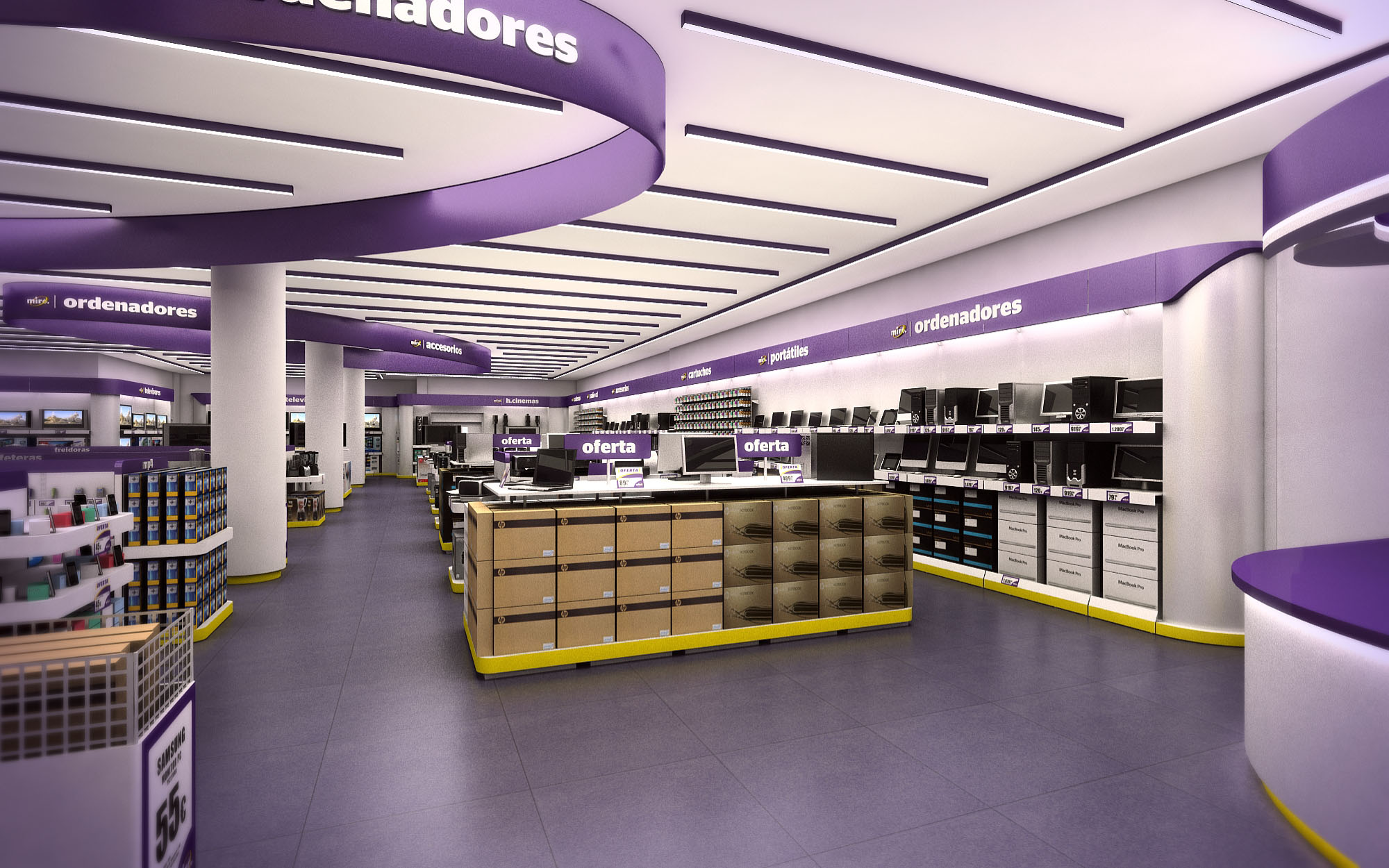
Graphic elements are fully integrated into the architecture. Signage bands align with the purple cornice, placing category names at a continuous, easily legible height. This avoids excessive vertical dispersion of logos and texts, resulting in a calm yet strongly branded environment. The overall experience is one of clarity and order, where customers can orient themselves quickly and products remain the main focus.
Sustainability criteria focus on energy performance, durability and adaptability. The lighting system is based on high-efficiency LED technology with optimized color temperature for retail, significantly reducing consumption compared to traditional solutions. The linear layout simplifies maintenance and allows partial dimming in low-traffic periods through programmable control systems.
Material selection favors long-lasting finishes and modular components, minimizing replacement cycles and waste. Shelving systems and display walls are fully reconfigurable, extending their lifecycle even if product typologies or store layout evolve. The neutral base palette reduces the need for frequent redecoration, while the use of non-porous, easily cleanable surfaces ensures hygienic conditions with minimal use of aggressive cleaning products. These strategies combine to create a retail space that is visually distinctive, operationally efficient and environmentally responsible.
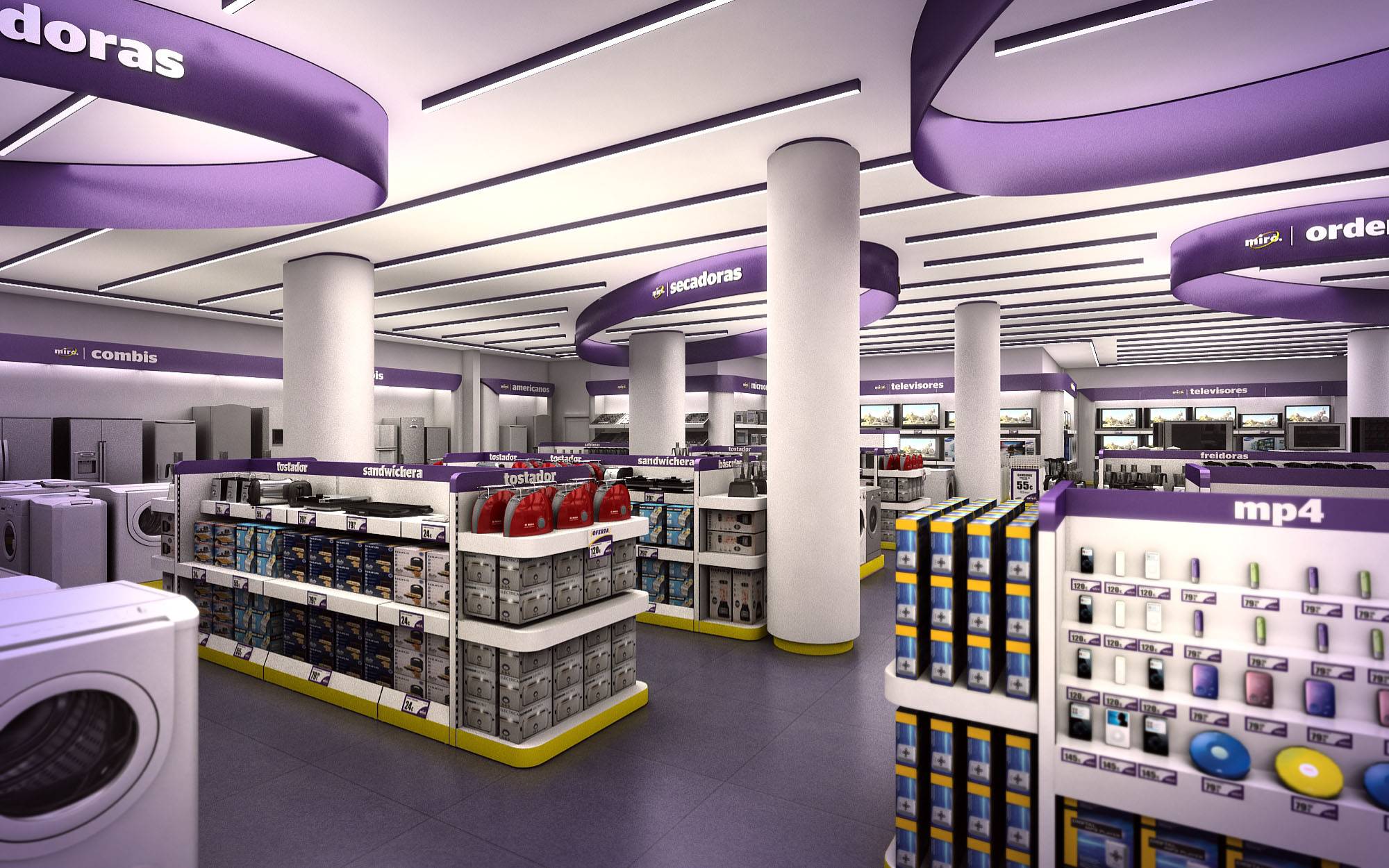
The MIRO retail project in Madrid is conceived as a contemporary, highly legible environment for consumer electronics, where architecture, graphics and lighting merge into a continuous brand experience. The design uses a clear chromatic code—white, purple and yellow—to articulate circulation, highlight product areas and reinforce corporate identity. Soft, fluid geometries organize the space, avoiding visual clutter and allowing customers to understand the store at a glance.
The layout is based on a sequence of rings and bands that guide movement from entrance to cashier and through specialized product zones. This creates a unified interior landscape where architecture acts as wayfinding. The goal is to generate an immersive, dynamic atmosphere that remains efficient and easy to navigate during peak hours.
The store is structured around a central, open-plan sales floor with radial circulation. From the access, the main axis leads directly to the circular cashier hub, which functions as an orienting landmark visible from almost every point. Around this core, product islands and perimetral shelving define specialized sectors for televisions, air conditioning, small appliances and accessories.
The circulation strategy is based on clear perimetral loops combined with transverse corridors. This allows alternative paths while gently directing customers through high-visibility product fronts. Generous aisle widths accommodate simultaneous browsing and trolley circulation, essential for an electronics retailer with bulky items. Structural columns are integrated within display islands, so that no element interrupts the visual field or pedestrian flow.
The project employs a reduced palette of durable, easy-maintenance materials. Continuous resin or large-format porcelain flooring in neutral grey provides a robust, seamless base that resists heavy traffic. Vertical surfaces combine lacquered MDF, high-pressure laminates and powder-coated metal shelving, ensuring dimensional stability and flexibility for future reconfiguration.
Color is used as an architectural tool rather than mere decoration. White dominates ceilings, walls and most fixtures, acting as a neutral backdrop that enhances product visibility. The corporate purple forms a continuous upper band that traces the perimeter, emphasizing horizontality and visually connecting distant areas. A vivid yellow line, at skirting and ceiling level, works as a dynamic accent that underlines the cashier ring and the base of shelving units, subtly guiding movement while reinforcing brand recall.
Lighting design prioritizes uniformity and product emphasis. Linear recessed luminaires in the ceiling generate a continuous, glare-free general illumination, ensuring accurate color rendering for electronic devices. The cashier canopy integrates concealed LED strips that wash the curved surfaces, intensifying the reading of the circular geometry and distinguishing the service zone.
Wall systems for televisions and air-conditioning units are conceived as illuminated façades. Integrated backlighting and targeted spotlights ensure that the product, rather than the support, becomes the protagonist. The modular shelving allows variable heights and configurations, facilitating regular updates of merchandising strategies without requiring structural interventions.
The cashier desk is the iconic element of the project: a continuous circular counter with differentiated service points clearly numbered and highlighted by the yellow luminous ring at floor level. This piece combines high-pressure laminate and solid surfaces to provide durability in intensive use areas. Generous recessed toe spaces and ergonomic counter heights improve staff comfort and service efficiency.
Graphic elements are fully integrated into the architecture. Signage bands align with the purple cornice, placing category names at a continuous, easily legible height. This avoids excessive vertical dispersion of logos and texts, resulting in a calm yet strongly branded environment. The overall experience is one of clarity and order, where customers can orient themselves quickly and products remain the main focus.
Sustainability criteria focus on energy performance, durability and adaptability. The lighting system is based on high-efficiency LED technology with optimized color temperature for retail, significantly reducing consumption compared to traditional solutions. The linear layout simplifies maintenance and allows partial dimming in low-traffic periods through programmable control systems.
Material selection favors long-lasting finishes and modular components, minimizing replacement cycles and waste. Shelving systems and display walls are fully reconfigurable, extending their lifecycle even if product typologies or store layout evolve. The neutral base palette reduces the need for frequent redecoration, while the use of non-porous, easily cleanable surfaces ensures hygienic conditions with minimal use of aggressive cleaning products. These strategies combine to create a retail space that is visually distinctive, operationally efficient and environmentally responsible.


Nuestras oficinas están en Barcelona, Cancún, Chicago y Santo Domingo, pero gracias a la tecnología podemos desarrollar proyectos en cualquier parte del mundo.
Barcelona
Bac de Roda 136
08020, Barcelona
Spain
Madrid
Av. de Buendía 11
19005 Guadalajara (Madrid)
Spain
Chicago
373 Hazel Ave, Apt A1
60022, Glencoe, Illinois
United States