

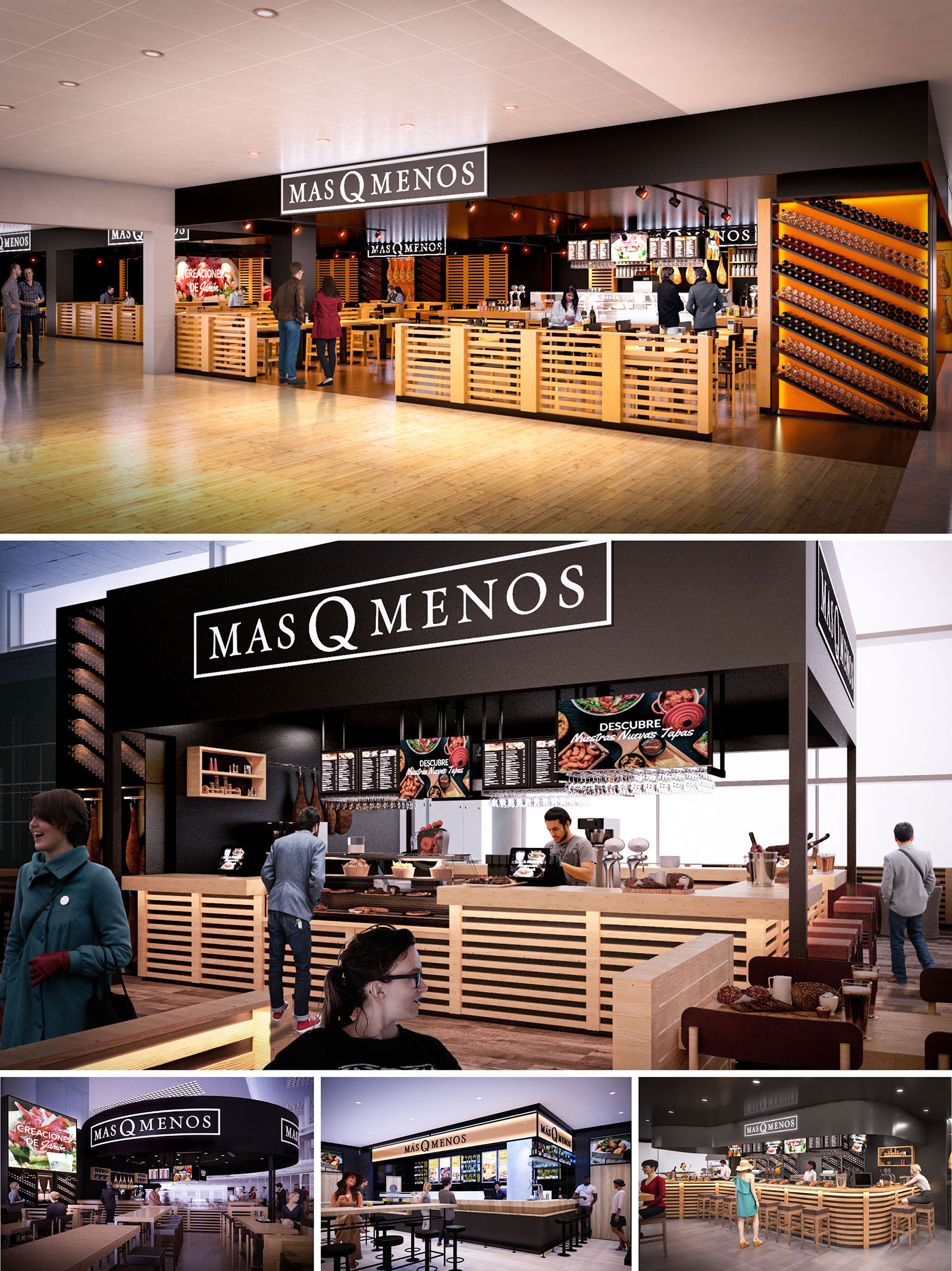
MAS Q MENOS is conceived as a contemporary reinterpretation of the traditional Spanish tapas bar, adapted to the dynamic context of airports in Barcelona, Palma de Mallorca, Málaga and Sevilla. The design translates the warmth of the classic bodega into an open, permeable space that invites transit passengers to pause, gather and taste. A strong, recognizable brand envelope in black and white contrasts with a luminous interior dominated by natural wood, highlighting the product as the main protagonist.
The architectural language is based on clarity and repetition: a simple, rectilinear volume frames the bar and dining areas, while a horizontal band of slatted timber creates a continuous base that unifies counters, perimeter enclosures and furniture. This modular strategy ensures identity and scalability, allowing each unit to adapt to different terminal geometries while maintaining a coherent visual code.
The layout is intentionally open, dissolving conventional façades to integrate seamlessly with the flow of the terminal. The bar island is positioned as a central nucleus, with service counters on multiple sides to optimize visibility and access. High stools along the bar perimeter encourage short stays and quick service, while linear communal tables in the foreground provide more relaxed seating for groups and solo travelers.
Circulation is organized radially around the bar, avoiding dead ends and allowing easy access from any direction. The low height of the timber enclosure keeps sightlines free across the concourse, increasing security perception and facilitating wayfinding. Strategic positioning of menu boards and illuminated signage ensures that the offer is legible from a distance, guiding passengers naturally toward the counter.
The project relies on a reduced and robust palette: natural-toned timber, matte black surfaces, and warm accent lighting. The extensive use of slatted wood provides texture, acoustic absorption and a tactile sense of craftsmanship that connects with Spanish gastronomic culture. The black structural frame and signage planes generate a clear graphic contrast, framing the bar like a contemporary proscenium.
Back walls and product displays introduce localized color through food imagery, wine bottles and hanging cured meats. These elements act as living ornaments, constantly renewed by daily operation. Flooring is resolved in wood or wood-effect surfaces to maintain continuity with the rest of the terminal while reinforcing the warm, domestic atmosphere within the commercial setting.
Lighting is a key tool to create an oasis within the airport environment. A combination of linear downlights and focused spotlights produces a warm, amber tone over the bar and tables, differentiating the restaurant from the cooler, more neutral lighting of the concourse. Illuminated shelves and bottle racks transform product into a visual landmark, while subtle under-counter lighting emphasizes the horizontality of the timber slats.
Branding is integrated architecturally rather than applied superficially. The black cornice band doubles as both structural frame and signage support, with the MAS Q MENOS logo centered on each façade. Digital menu boards are carefully aligned within this band, maintaining graphic order even with frequently changing content. The result is a consistent, legible identity that can be recognized instantly in different airports.
The interior choreography is designed for efficiency during peak passenger flows. Direct alignment between order points, preparation zones and delivery counters reduces waiting times and optimizes staff movement. Open kitchen elements showcase food preparation, reinforcing transparency and trust while animating the space visually.
Seating typologies respond to diverse dwell times: high counters for quick coffee or snacks, shared long tables for informal meals, and peripheral seating that allows for luggage maneuvering. Power outlets integrated in selected counters support contemporary traveler needs, turning the bar into both a gastronomic and functional stopover.
Sustainability is addressed through material choices, modular design and operational efficiency. The predominant use of certified timber reduces the environmental footprint and offers a renewable, low-embodied-energy finish. The slatted system is conceived as a kit of parts, allowing components to be dismantled, repaired or reused in future locations, minimizing waste throughout the life cycle of the brand.
Durable finishes suited to high-traffic airport environments are combined with LED lighting and high-efficiency kitchen equipment to reduce energy consumption. Open configurations maximize natural light from terminal façades, decreasing dependence on artificial lighting during the day. Together, these strategies create a resilient, comfortable and recognizable restaurant model that aligns with contemporary environmental and operational demands.
MAS Q MENOS is conceived as a contemporary reinterpretation of the traditional Spanish tapas bar, adapted to the dynamic context of airports in Barcelona, Palma de Mallorca, Málaga and Sevilla. The design translates the warmth of the classic bodega into an open, permeable space that invites transit passengers to pause, gather and taste. A strong, recognizable brand envelope in black and white contrasts with a luminous interior dominated by natural wood, highlighting the product as the main protagonist.
The architectural language is based on clarity and repetition: a simple, rectilinear volume frames the bar and dining areas, while a horizontal band of slatted timber creates a continuous base that unifies counters, perimeter enclosures and furniture. This modular strategy ensures identity and scalability, allowing each unit to adapt to different terminal geometries while maintaining a coherent visual code.
The layout is intentionally open, dissolving conventional façades to integrate seamlessly with the flow of the terminal. The bar island is positioned as a central nucleus, with service counters on multiple sides to optimize visibility and access. High stools along the bar perimeter encourage short stays and quick service, while linear communal tables in the foreground provide more relaxed seating for groups and solo travelers.
Circulation is organized radially around the bar, avoiding dead ends and allowing easy access from any direction. The low height of the timber enclosure keeps sightlines free across the concourse, increasing security perception and facilitating wayfinding. Strategic positioning of menu boards and illuminated signage ensures that the offer is legible from a distance, guiding passengers naturally toward the counter.
The project relies on a reduced and robust palette: natural-toned timber, matte black surfaces, and warm accent lighting. The extensive use of slatted wood provides texture, acoustic absorption and a tactile sense of craftsmanship that connects with Spanish gastronomic culture. The black structural frame and signage planes generate a clear graphic contrast, framing the bar like a contemporary proscenium.
Back walls and product displays introduce localized color through food imagery, wine bottles and hanging cured meats. These elements act as living ornaments, constantly renewed by daily operation. Flooring is resolved in wood or wood-effect surfaces to maintain continuity with the rest of the terminal while reinforcing the warm, domestic atmosphere within the commercial setting.
Lighting is a key tool to create an oasis within the airport environment. A combination of linear downlights and focused spotlights produces a warm, amber tone over the bar and tables, differentiating the restaurant from the cooler, more neutral lighting of the concourse. Illuminated shelves and bottle racks transform product into a visual landmark, while subtle under-counter lighting emphasizes the horizontality of the timber slats.
Branding is integrated architecturally rather than applied superficially. The black cornice band doubles as both structural frame and signage support, with the MAS Q MENOS logo centered on each façade. Digital menu boards are carefully aligned within this band, maintaining graphic order even with frequently changing content. The result is a consistent, legible identity that can be recognized instantly in different airports.
The interior choreography is designed for efficiency during peak passenger flows. Direct alignment between order points, preparation zones and delivery counters reduces waiting times and optimizes staff movement. Open kitchen elements showcase food preparation, reinforcing transparency and trust while animating the space visually.
Seating typologies respond to diverse dwell times: high counters for quick coffee or snacks, shared long tables for informal meals, and peripheral seating that allows for luggage maneuvering. Power outlets integrated in selected counters support contemporary traveler needs, turning the bar into both a gastronomic and functional stopover.
Sustainability is addressed through material choices, modular design and operational efficiency. The predominant use of certified timber reduces the environmental footprint and offers a renewable, low-embodied-energy finish. The slatted system is conceived as a kit of parts, allowing components to be dismantled, repaired or reused in future locations, minimizing waste throughout the life cycle of the brand.
Durable finishes suited to high-traffic airport environments are combined with LED lighting and high-efficiency kitchen equipment to reduce energy consumption. Open configurations maximize natural light from terminal façades, decreasing dependence on artificial lighting during the day. Together, these strategies create a resilient, comfortable and recognizable restaurant model that aligns with contemporary environmental and operational demands.


Nuestras oficinas están en Barcelona, Cancún, Chicago y Santo Domingo, pero gracias a la tecnología podemos desarrollar proyectos en cualquier parte del mundo.
Barcelona
Bac de Roda 136
08020, Barcelona
Spain
Madrid
Av. de Buendía 11
19005 Guadalajara (Madrid)
Spain
Chicago
373 Hazel Ave, Apt A1
60022, Glencoe, Illinois
United States