

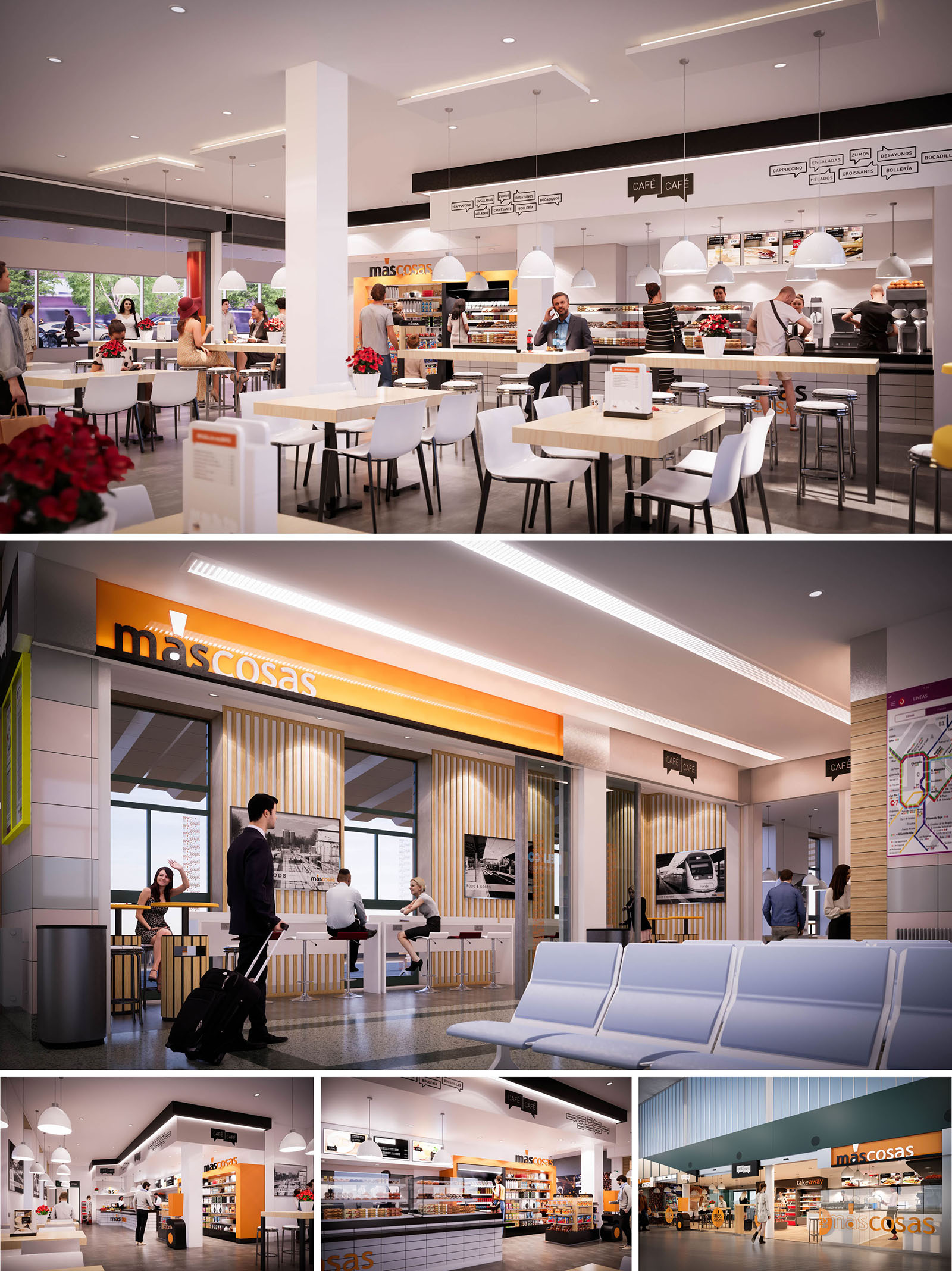
MAS COSAS is conceived as a recognizable, repeatable restaurant and retail concept for transport hubs across Spain. The design strategy combines the agility of a grab-and-go offer with the warmth of a neighborhood café, using a clear visual identity based on the orange brand band, light woods, and clean white surfaces. The spaces are planned to operate in high-traffic environments, offering intuitive navigation, quick orientation, and multiple modes of stay: from fast coffee stops to more leisurely meals.
The architecture works as an urban micro-foyer inside stations and terminals. Generous, open façades invite flows from the concourse, while the interior language emphasizes transparency and visual continuity. The project aims to be immediately legible from a distance, then gradually reveal more detail and comfort as users approach and enter.
The floor plan organizes three primary zones: frontal display and cashier line, central self-service and bar counters, and peripheral seating. The service counter is aligned longitudinally, allowing linear queuing and fast turnover during peak hours. Refrigerated displays and shelving form a low-height perimeter that maintains visual connection across the entire space.
Circulation is designed as a loop, avoiding dead ends and allowing passengers with luggage to move freely. Entry points are wide and unobstructed, aligning with main station pathways. Tall tables along façades provide short-stay seating for solo travelers, while grouped tables in the interior cater to families or small groups. Accessibility is prioritized with generous clearances between furniture and barrier-free access to counters.
The interior language is intentionally minimal and bright. Light-toned timber laminates, used in slatted wall panels and furniture, introduce warmth and tactility, counterbalancing the hard finishes typical of transport infrastructure. White solid surfaces and pale tabletops offer a clean, hygienic appearance and allow food products to remain the visual focus.
The flooring employs high-resistance materials with a neutral mid-gray tone that disguises wear and integrates with existing concourse surfaces. Vertical slat elements frame large windows and graphic panels, creating rhythmic façades and softly separating zones without visual closure. Metallic details, such as chromed stools and structural profiles, reference the technical world of rail and air travel while ensuring durability.
The MAS COSAS brand band, in a saturated orange, becomes the primary architectural sign. It wraps the shopfront and reappears on soffits and selected interior surfaces, reinforcing recognition across multiple locations. Signage is layered: large, backlit logotypes for long-distance visibility and smaller black-and-white pictograms and speech-bubble graphics at eye level for detailed menu communication.
Black linear elements and typographic bands hover above the counters, organizing information about coffee, snacks, and regional products. Integrated photographic panels depicting transport scenes create a direct link with the context of mobility and suggest a narrative of travel and pause.
Lighting is designed to balance functional clarity with a welcoming ambience. Continuous recessed LED lines in the ceiling guide the main circulation axes and emphasize the longitudinal geometry of the premises. Over the dining area, suspended dome-shaped pendants create a more intimate scale and define micro-zones within the open plan.
Illuminated shelving and counter front lighting highlight merchandise and ensure uniform luminance, avoiding high-contrast glare zones for travelers adapting from daylight concourses. The overall light temperature is kept in a neutral-warm range, enhancing the natural tones of wood and food while maintaining a contemporary aesthetic.
Sustainability is addressed through both material choice and operational design. Preference is given to durable finishes with low maintenance cycles, reducing the need for replacement in high-traffic environments. Where possible, wood-based elements rely on certified sources, and modular furniture systems allow reconfiguration and reuse across different locations.
LED lighting with high efficiency and smart zoning minimizes energy consumption, adapting levels to opening hours and natural light availability. Large glazed openings leverage existing daylight from terminal façades, reducing reliance on artificial lighting. The open layout enhances passive surveillance, improving safety and potentially lowering the need for additional security infrastructure.
MAS COSAS is conceived as a recognizable, repeatable restaurant and retail concept for transport hubs across Spain. The design strategy combines the agility of a grab-and-go offer with the warmth of a neighborhood café, using a clear visual identity based on the orange brand band, light woods, and clean white surfaces. The spaces are planned to operate in high-traffic environments, offering intuitive navigation, quick orientation, and multiple modes of stay: from fast coffee stops to more leisurely meals.
The architecture works as an urban micro-foyer inside stations and terminals. Generous, open façades invite flows from the concourse, while the interior language emphasizes transparency and visual continuity. The project aims to be immediately legible from a distance, then gradually reveal more detail and comfort as users approach and enter.
The floor plan organizes three primary zones: frontal display and cashier line, central self-service and bar counters, and peripheral seating. The service counter is aligned longitudinally, allowing linear queuing and fast turnover during peak hours. Refrigerated displays and shelving form a low-height perimeter that maintains visual connection across the entire space.
Circulation is designed as a loop, avoiding dead ends and allowing passengers with luggage to move freely. Entry points are wide and unobstructed, aligning with main station pathways. Tall tables along façades provide short-stay seating for solo travelers, while grouped tables in the interior cater to families or small groups. Accessibility is prioritized with generous clearances between furniture and barrier-free access to counters.
The interior language is intentionally minimal and bright. Light-toned timber laminates, used in slatted wall panels and furniture, introduce warmth and tactility, counterbalancing the hard finishes typical of transport infrastructure. White solid surfaces and pale tabletops offer a clean, hygienic appearance and allow food products to remain the visual focus.
The flooring employs high-resistance materials with a neutral mid-gray tone that disguises wear and integrates with existing concourse surfaces. Vertical slat elements frame large windows and graphic panels, creating rhythmic façades and softly separating zones without visual closure. Metallic details, such as chromed stools and structural profiles, reference the technical world of rail and air travel while ensuring durability.
The MAS COSAS brand band, in a saturated orange, becomes the primary architectural sign. It wraps the shopfront and reappears on soffits and selected interior surfaces, reinforcing recognition across multiple locations. Signage is layered: large, backlit logotypes for long-distance visibility and smaller black-and-white pictograms and speech-bubble graphics at eye level for detailed menu communication.
Black linear elements and typographic bands hover above the counters, organizing information about coffee, snacks, and regional products. Integrated photographic panels depicting transport scenes create a direct link with the context of mobility and suggest a narrative of travel and pause.
Lighting is designed to balance functional clarity with a welcoming ambience. Continuous recessed LED lines in the ceiling guide the main circulation axes and emphasize the longitudinal geometry of the premises. Over the dining area, suspended dome-shaped pendants create a more intimate scale and define micro-zones within the open plan.
Illuminated shelving and counter front lighting highlight merchandise and ensure uniform luminance, avoiding high-contrast glare zones for travelers adapting from daylight concourses. The overall light temperature is kept in a neutral-warm range, enhancing the natural tones of wood and food while maintaining a contemporary aesthetic.
Sustainability is addressed through both material choice and operational design. Preference is given to durable finishes with low maintenance cycles, reducing the need for replacement in high-traffic environments. Where possible, wood-based elements rely on certified sources, and modular furniture systems allow reconfiguration and reuse across different locations.
LED lighting with high efficiency and smart zoning minimizes energy consumption, adapting levels to opening hours and natural light availability. Large glazed openings leverage existing daylight from terminal façades, reducing reliance on artificial lighting. The open layout enhances passive surveillance, improving safety and potentially lowering the need for additional security infrastructure.


Nuestras oficinas están en Barcelona, Cancún, Chicago y Santo Domingo, pero gracias a la tecnología podemos desarrollar proyectos en cualquier parte del mundo.
Barcelona
Bac de Roda 136
08020, Barcelona
Spain
Madrid
Av. de Buendía 11
19005 Guadalajara (Madrid)
Spain
Chicago
373 Hazel Ave, Apt A1
60022, Glencoe, Illinois
United States