

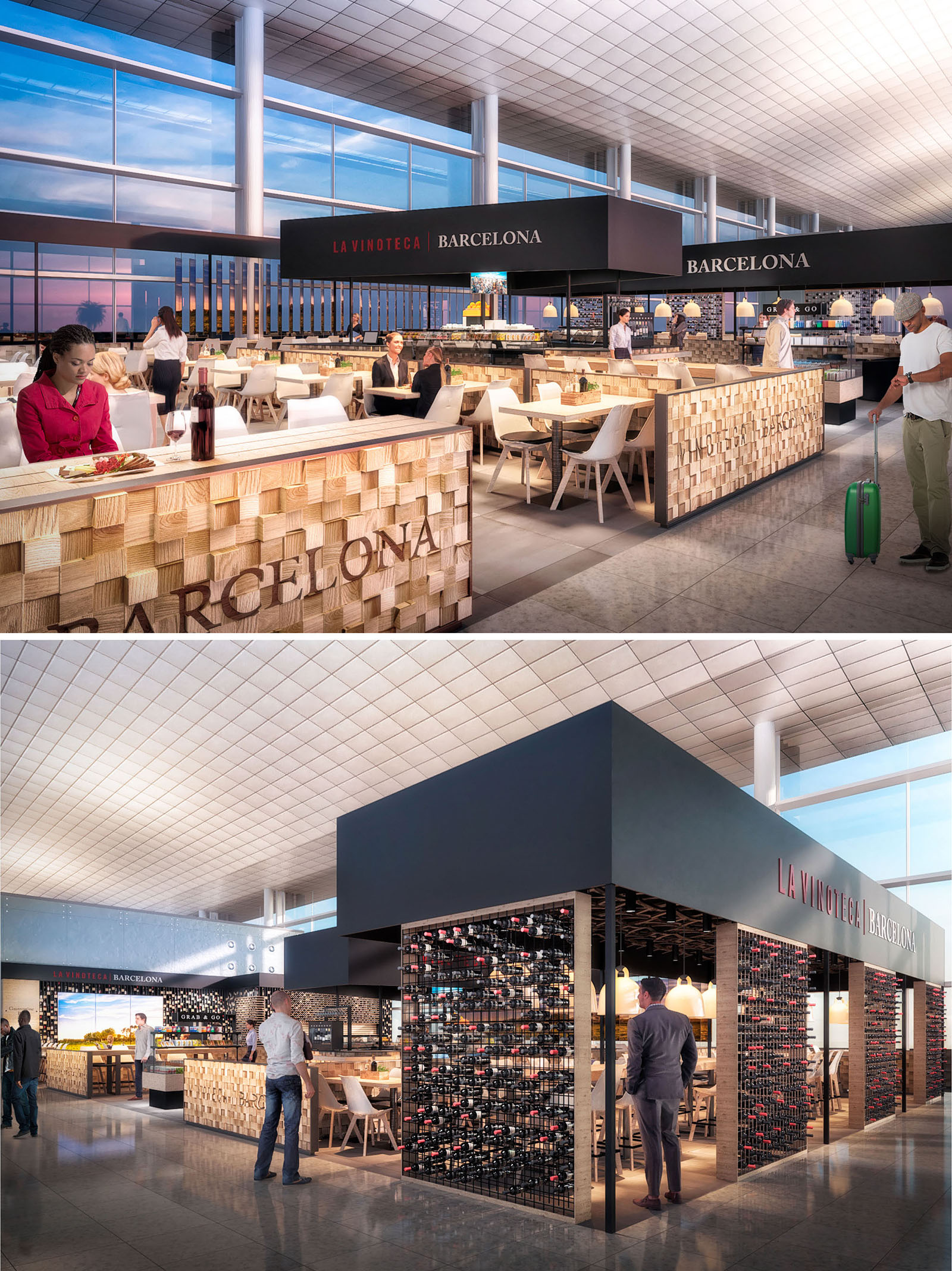
LA VINOTECA is conceived as an urban wine gallery embedded within the fluid dynamics of Barcelona’s airport. The project translates the atmosphere of a contemporary bodega into an open, permeable structure that responds to the transient nature of the terminal. The design organizes the space as a sequence of thresholds: from the surrounding concourse, through a permeable perimeter of wine racks, to a warm and intimate tasting core.
The architecture balances visibility and refuge. Generous openings invite passengers from all sides, while the central canopy and lowered lighting levels create a protective interior micro‑world. The language is deliberately simple and geometric, allowing the rich textures of wine bottles and timber to become the primary visual protagonists.
The project is laid out as an inscribed island within the terminal, without solid façades. A continuous perimeter counter defines the boundary between circulation and seating, operating as both reception and informal dining area. This edge condition frames the main dining field, which is articulated with flexible table groupings to accommodate solo travelers, couples, and larger groups.
At the heart of the scheme, a more enclosed bar and tasting zone sits directly beneath the dark volumetric canopy. This element compresses the height visually, creating intimacy under the expansive airport ceiling. Circulation is radial and intuitive: guests can enter from any side, orienting themselves immediately towards the bar as the spatial anchor, while service routes remain efficient and unobstructed behind the counters.
The material palette contrasts the cool, reflective surfaces of the terminal with warm, tactile finishes. The perimeter counters are clad in three‑dimensional timber blocks, creating a pixelated relief that catches the light and reinforces the crafted character of the place. This textured wood, in natural tones, is paired with light tabletops and neutral flooring, ensuring visual continuity with the existing concourse.
Above, a dark, monolithic canopy in charcoal grey delineates the venue in the vast open hall. The black steel wine racks, densely populated with bottles, form a dynamic chromatic mosaic of labels and glass, effectively becoming the restaurant’s graphic identity. The overall color scheme is deliberately restrained—wood, black, and soft whites—so that the wine itself supplies the chromatic richness.
Lighting design plays a key role in differentiating LA VINOTECA from the surrounding terminal. The large exterior glazing provides abundant natural light, which is filtered across the textured timber and bottle displays during the day. In contrast, a system of warm pendant lamps and integrated linear lighting under the canopy generates a more domestic, lounge‑like atmosphere, inviting longer dwell times.
Illuminance levels are carefully graded: brighter at the perimeter counters to signal openness and service activity, and slightly dimmed towards the central bar to emphasize the contemplative act of wine tasting. Reflections on the polished floor extend the luminance vertically, amplifying the perceived depth of the relatively compact footprint.
The furniture selection reinforces lightness and comfort. Timber chairs with upholstered seats and simple white tables echo the material logic of the counters while remaining easy to reconfigure. Detailing is intentionally clean, with concealed fixings and continuous edges to facilitate maintenance in the high‑traffic airport environment.
Branding is integrated architecturally rather than applied decoratively. The name “LA VINOTECA BARCELONA” appears in understated typographic bands on the canopy and counters, aligned with structural lines. The dense bottle walls act as a living logo, constantly changing as inventory rotates, and visually communicating the core focus on wine culture.
The design strategy addresses sustainability through material choices, efficient systems, and long‑life detailing. The predominant timber elements are specified from certified sources and conceived as modular cladding, allowing future disassembly or replacement of individual blocks without discarding entire assemblies. The steel wine racks are durable, recyclable, and dimensioned for standard bottle formats to minimize waste.
Energy performance is enhanced by relying on the terminal’s abundant daylight, reducing artificial lighting demand during daytime operation. Warm LED luminaires with high efficacy are used throughout, connected to dimming controls adapted to flight schedules and occupancy. The open configuration optimizes natural airflow from the terminal’s central HVAC, lowering the need for localized mechanical systems and reducing operational energy consumption while maintaining a comfortable, acoustically moderated interior environment.
LA VINOTECA is conceived as an urban wine gallery embedded within the fluid dynamics of Barcelona’s airport. The project translates the atmosphere of a contemporary bodega into an open, permeable structure that responds to the transient nature of the terminal. The design organizes the space as a sequence of thresholds: from the surrounding concourse, through a permeable perimeter of wine racks, to a warm and intimate tasting core.
The architecture balances visibility and refuge. Generous openings invite passengers from all sides, while the central canopy and lowered lighting levels create a protective interior micro‑world. The language is deliberately simple and geometric, allowing the rich textures of wine bottles and timber to become the primary visual protagonists.
The project is laid out as an inscribed island within the terminal, without solid façades. A continuous perimeter counter defines the boundary between circulation and seating, operating as both reception and informal dining area. This edge condition frames the main dining field, which is articulated with flexible table groupings to accommodate solo travelers, couples, and larger groups.
At the heart of the scheme, a more enclosed bar and tasting zone sits directly beneath the dark volumetric canopy. This element compresses the height visually, creating intimacy under the expansive airport ceiling. Circulation is radial and intuitive: guests can enter from any side, orienting themselves immediately towards the bar as the spatial anchor, while service routes remain efficient and unobstructed behind the counters.
The material palette contrasts the cool, reflective surfaces of the terminal with warm, tactile finishes. The perimeter counters are clad in three‑dimensional timber blocks, creating a pixelated relief that catches the light and reinforces the crafted character of the place. This textured wood, in natural tones, is paired with light tabletops and neutral flooring, ensuring visual continuity with the existing concourse.
Above, a dark, monolithic canopy in charcoal grey delineates the venue in the vast open hall. The black steel wine racks, densely populated with bottles, form a dynamic chromatic mosaic of labels and glass, effectively becoming the restaurant’s graphic identity. The overall color scheme is deliberately restrained—wood, black, and soft whites—so that the wine itself supplies the chromatic richness.
Lighting design plays a key role in differentiating LA VINOTECA from the surrounding terminal. The large exterior glazing provides abundant natural light, which is filtered across the textured timber and bottle displays during the day. In contrast, a system of warm pendant lamps and integrated linear lighting under the canopy generates a more domestic, lounge‑like atmosphere, inviting longer dwell times.
Illuminance levels are carefully graded: brighter at the perimeter counters to signal openness and service activity, and slightly dimmed towards the central bar to emphasize the contemplative act of wine tasting. Reflections on the polished floor extend the luminance vertically, amplifying the perceived depth of the relatively compact footprint.
The furniture selection reinforces lightness and comfort. Timber chairs with upholstered seats and simple white tables echo the material logic of the counters while remaining easy to reconfigure. Detailing is intentionally clean, with concealed fixings and continuous edges to facilitate maintenance in the high‑traffic airport environment.
Branding is integrated architecturally rather than applied decoratively. The name “LA VINOTECA BARCELONA” appears in understated typographic bands on the canopy and counters, aligned with structural lines. The dense bottle walls act as a living logo, constantly changing as inventory rotates, and visually communicating the core focus on wine culture.
The design strategy addresses sustainability through material choices, efficient systems, and long‑life detailing. The predominant timber elements are specified from certified sources and conceived as modular cladding, allowing future disassembly or replacement of individual blocks without discarding entire assemblies. The steel wine racks are durable, recyclable, and dimensioned for standard bottle formats to minimize waste.
Energy performance is enhanced by relying on the terminal’s abundant daylight, reducing artificial lighting demand during daytime operation. Warm LED luminaires with high efficacy are used throughout, connected to dimming controls adapted to flight schedules and occupancy. The open configuration optimizes natural airflow from the terminal’s central HVAC, lowering the need for localized mechanical systems and reducing operational energy consumption while maintaining a comfortable, acoustically moderated interior environment.


Nuestras oficinas están en Barcelona, Cancún, Chicago y Santo Domingo, pero gracias a la tecnología podemos desarrollar proyectos en cualquier parte del mundo.
Barcelona
Bac de Roda 136
08020, Barcelona
Spain
Madrid
Av. de Buendía 11
19005 Guadalajara (Madrid)
Spain
Chicago
373 Hazel Ave, Apt A1
60022, Glencoe, Illinois
United States