

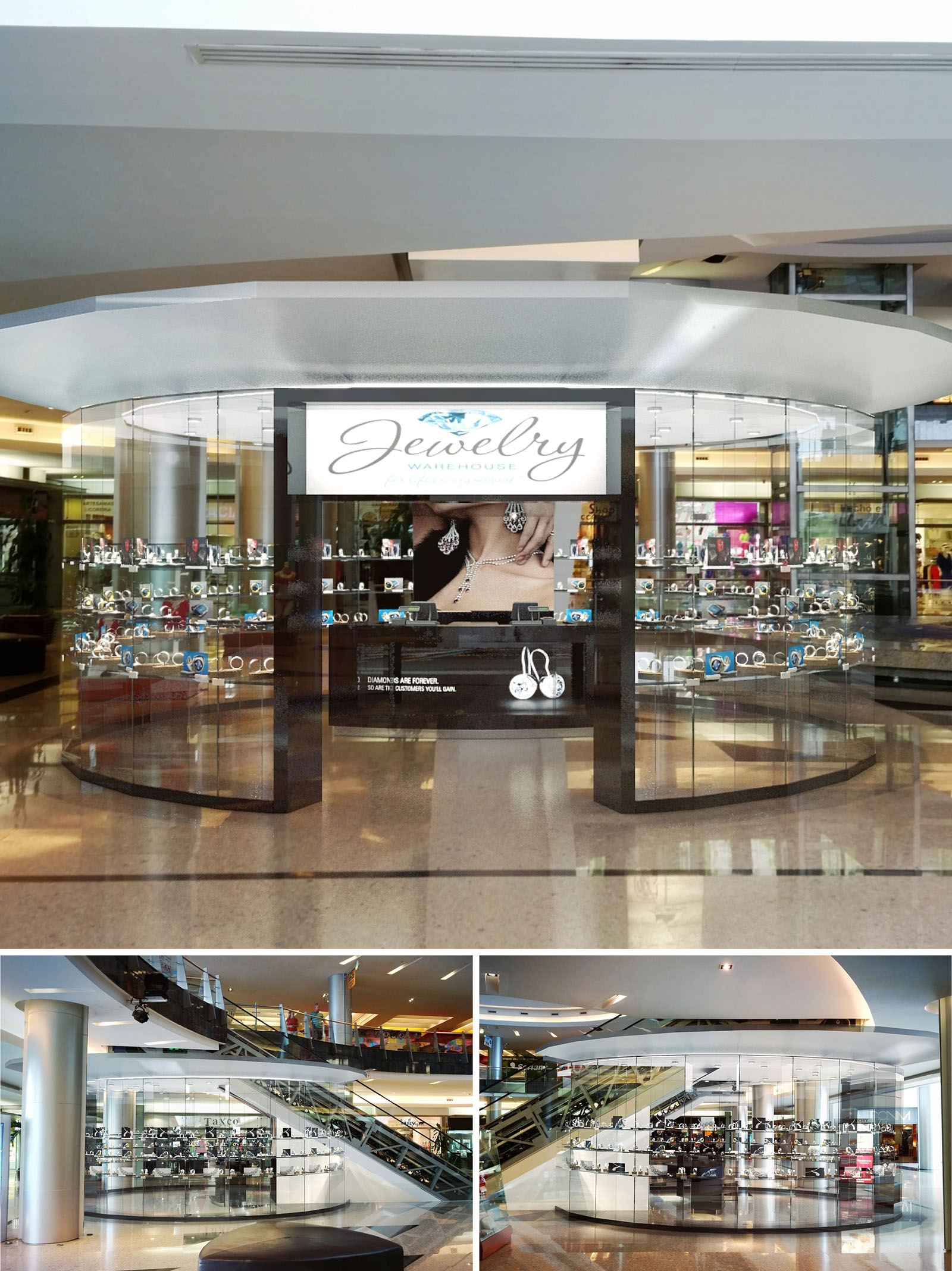
The Jewelry Warehouse kiosk is conceived as a luminous cylindrical pavilion that functions as a jewel itself within the circulation space of a shopping mall in Cancún. The design establishes a 360-degree visual relationship with the surroundings, using transparency and reflection to capture the attention of visitors from all directions. The kiosk dissolves the traditional boundary between interior and exterior, offering an open, walk-around object where display and architecture merge.
The concept relies on a minimal, almost dematerialized envelope so that the merchandise becomes the true protagonist. A restrained palette of glass, polished stone, and discreet metal profiles frames the jewelry with precision, evoking the clarity of a gemstone setting. The geometry is simple and legible, allowing the intense visual richness of the products to stand out without competition.
The kiosk occupies a circular footprint strategically placed near vertical circulation elements such as escalators, maximizing exposure to pedestrian flows on multiple levels. Access is controlled yet visually porous, with counters arranged in a ring that allows staff to manage the entire perimeter efficiently, while customers circulate freely around the external façade.
The interior is organized as a compact service core surrounded by display bands at different heights. Lower counters cater to close-up interaction and consultation, while higher shelving and vitrines target views from a distance and from the upper level of the mall. The circular plan eliminates blind corners and creates continuous visual surveillance, improving security and operational control.
Full-height curved glass panels define the enclosure, joined with minimal vertical mullions to create uninterrupted vistas and a seamless façade. The precision of the glass work, combined with subtle shadow joints at floor and ceiling, enhances the impression of a floating, transparent object. The base and framing elements employ dark, polished stone or high-pressure laminate, creating a strong horizontal datum and a refined contrast with the transparency above.
Display surfaces are rendered in neutral tones with integrated lighting tracks and concealed cable management. The finishes are selected for their resistance to high-traffic commercial environments—scratch-resistant glass, durable stone, and solvent-resistant coatings—while maintaining a high-end, polished aesthetic appropriate to luxury retail.
Lighting is conceived as the primary tool to animate the kiosk. Linear LED fixtures integrated in the shelves provide uniform, glare-free illumination that enhances the brilliance of metals and gemstones. Accent spotlights are calibrated to avoid harsh reflections on the curved glass while ensuring that key pieces receive higher luminance levels to guide the customer’s gaze.
The large central signage band, with backlit branding and imagery, acts as a visual anchor that orients visitors in the wider mall space. Below it, horizontal display lines are carefully aligned, creating a rhythmic composition of shelves and vitrines. This visual order supports flexible merchandising, allowing different product families to be grouped while maintaining a coherent, continuous presentation around the entire perimeter.
The kiosk responds to its Cancún context by embracing openness and brightness, taking advantage of the abundant ambient light in the mall while controlling glare through the use of frosted elements in the upper canopy. The circular form allows air circulation to flow naturally around the structure, preventing stagnant zones and contributing to user comfort in a warm, humid climate.
From a sustainability perspective, the project prioritizes long-life, low-maintenance materials such as tempered glass, stone, and aluminum profiles, reducing the need for frequent replacement. High-efficiency LED lighting minimizes energy consumption and heat gain, lowering cooling loads in the surrounding mall environment. Modular construction of display units facilitates disassembly, relocation, or reuse, extending the lifecycle of the kiosk and reducing waste associated with future remodeling or tenant changes.

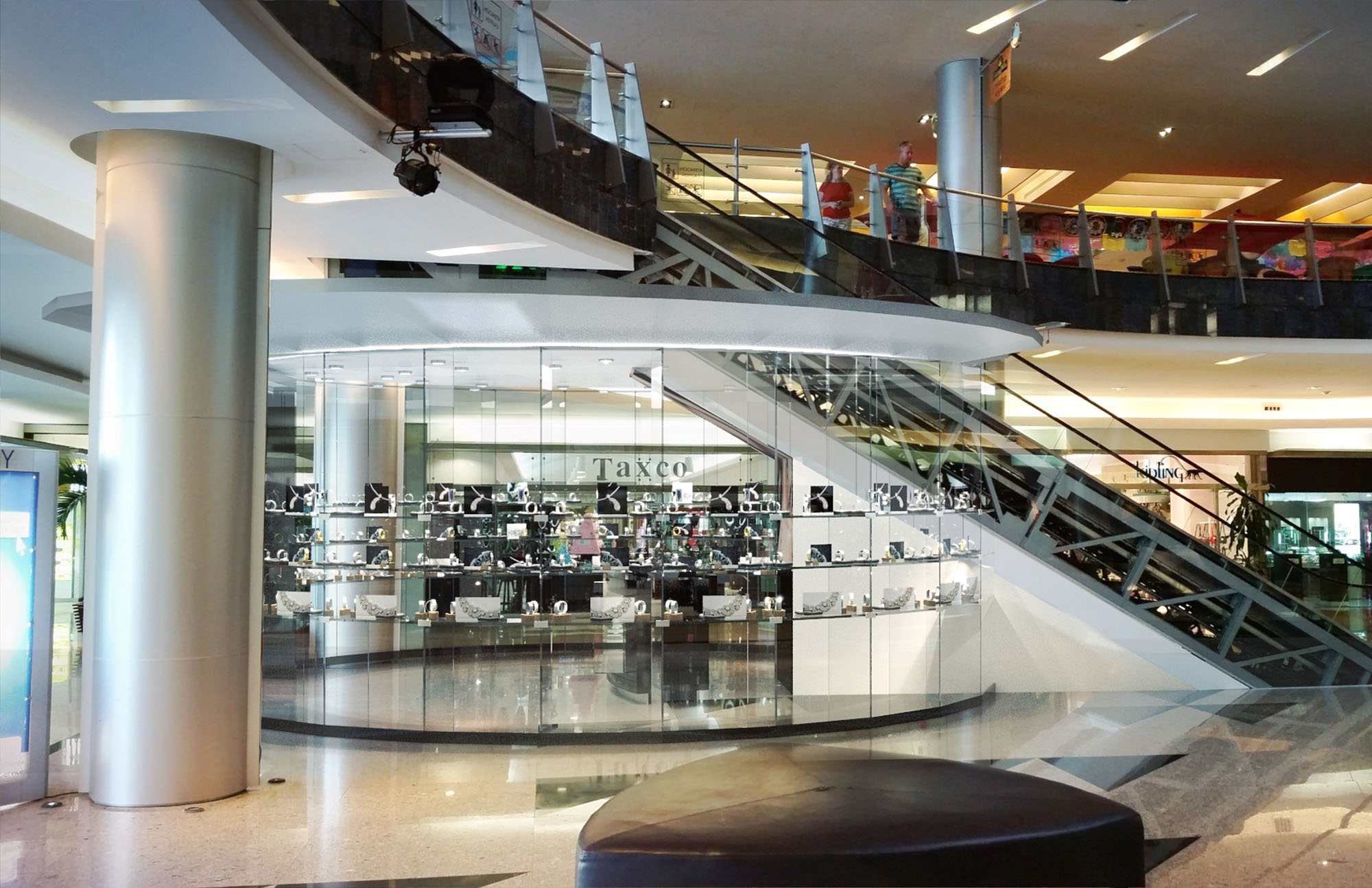
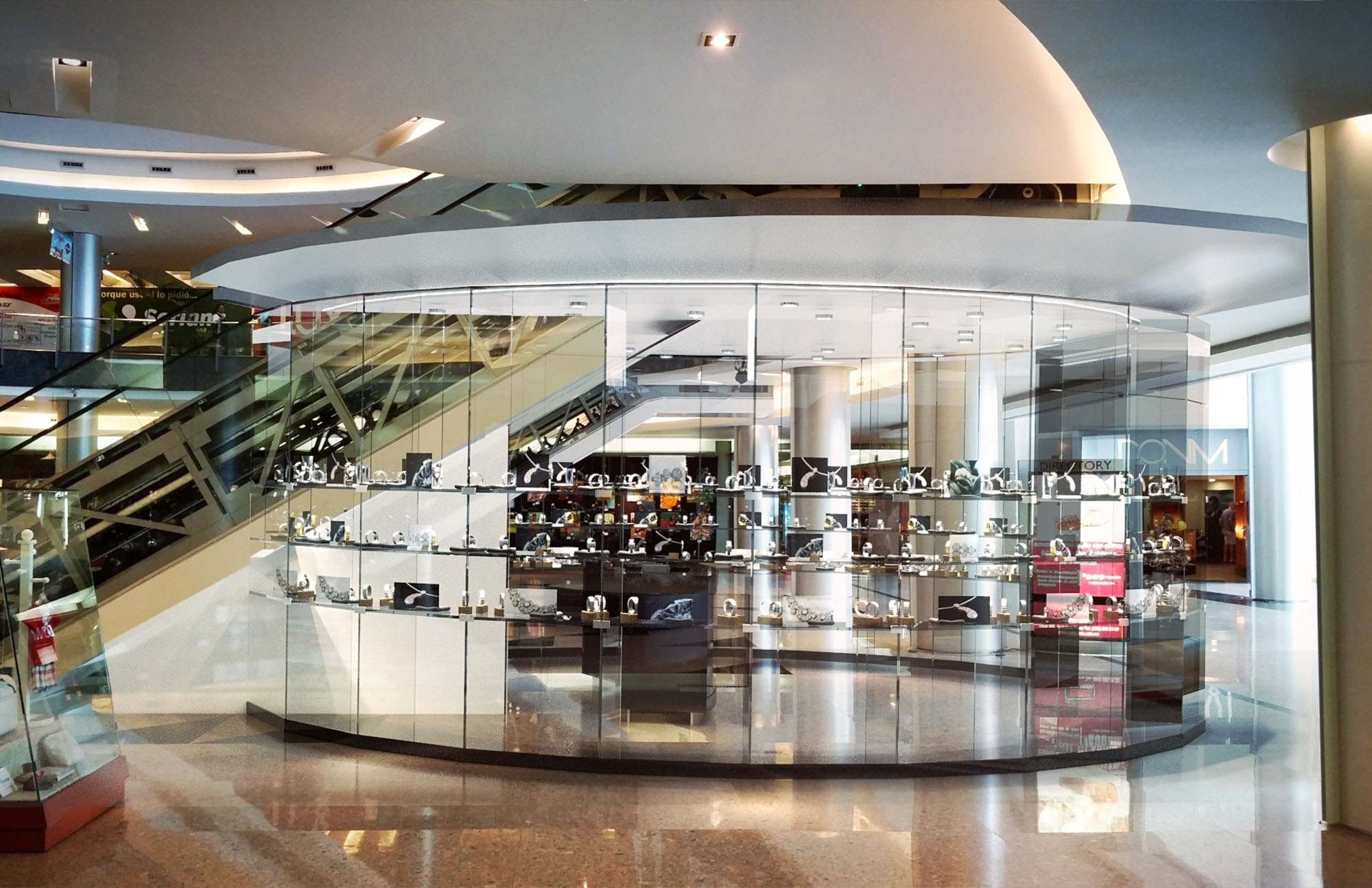
The Jewelry Warehouse kiosk is conceived as a luminous cylindrical pavilion that functions as a jewel itself within the circulation space of a shopping mall in Cancún. The design establishes a 360-degree visual relationship with the surroundings, using transparency and reflection to capture the attention of visitors from all directions. The kiosk dissolves the traditional boundary between interior and exterior, offering an open, walk-around object where display and architecture merge.
The concept relies on a minimal, almost dematerialized envelope so that the merchandise becomes the true protagonist. A restrained palette of glass, polished stone, and discreet metal profiles frames the jewelry with precision, evoking the clarity of a gemstone setting. The geometry is simple and legible, allowing the intense visual richness of the products to stand out without competition.
The kiosk occupies a circular footprint strategically placed near vertical circulation elements such as escalators, maximizing exposure to pedestrian flows on multiple levels. Access is controlled yet visually porous, with counters arranged in a ring that allows staff to manage the entire perimeter efficiently, while customers circulate freely around the external façade.
The interior is organized as a compact service core surrounded by display bands at different heights. Lower counters cater to close-up interaction and consultation, while higher shelving and vitrines target views from a distance and from the upper level of the mall. The circular plan eliminates blind corners and creates continuous visual surveillance, improving security and operational control.
Full-height curved glass panels define the enclosure, joined with minimal vertical mullions to create uninterrupted vistas and a seamless façade. The precision of the glass work, combined with subtle shadow joints at floor and ceiling, enhances the impression of a floating, transparent object. The base and framing elements employ dark, polished stone or high-pressure laminate, creating a strong horizontal datum and a refined contrast with the transparency above.
Display surfaces are rendered in neutral tones with integrated lighting tracks and concealed cable management. The finishes are selected for their resistance to high-traffic commercial environments—scratch-resistant glass, durable stone, and solvent-resistant coatings—while maintaining a high-end, polished aesthetic appropriate to luxury retail.
Lighting is conceived as the primary tool to animate the kiosk. Linear LED fixtures integrated in the shelves provide uniform, glare-free illumination that enhances the brilliance of metals and gemstones. Accent spotlights are calibrated to avoid harsh reflections on the curved glass while ensuring that key pieces receive higher luminance levels to guide the customer’s gaze.
The large central signage band, with backlit branding and imagery, acts as a visual anchor that orients visitors in the wider mall space. Below it, horizontal display lines are carefully aligned, creating a rhythmic composition of shelves and vitrines. This visual order supports flexible merchandising, allowing different product families to be grouped while maintaining a coherent, continuous presentation around the entire perimeter.
The kiosk responds to its Cancún context by embracing openness and brightness, taking advantage of the abundant ambient light in the mall while controlling glare through the use of frosted elements in the upper canopy. The circular form allows air circulation to flow naturally around the structure, preventing stagnant zones and contributing to user comfort in a warm, humid climate.
From a sustainability perspective, the project prioritizes long-life, low-maintenance materials such as tempered glass, stone, and aluminum profiles, reducing the need for frequent replacement. High-efficiency LED lighting minimizes energy consumption and heat gain, lowering cooling loads in the surrounding mall environment. Modular construction of display units facilitates disassembly, relocation, or reuse, extending the lifecycle of the kiosk and reducing waste associated with future remodeling or tenant changes.


Nuestras oficinas están en Barcelona, Cancún, Chicago y Santo Domingo, pero gracias a la tecnología podemos desarrollar proyectos en cualquier parte del mundo.
Barcelona
Bac de Roda 136
08020, Barcelona
Spain
Madrid
Av. de Buendía 11
19005 Guadalajara (Madrid)
Spain
Chicago
373 Hazel Ave, Apt A1
60022, Glencoe, Illinois
United States