

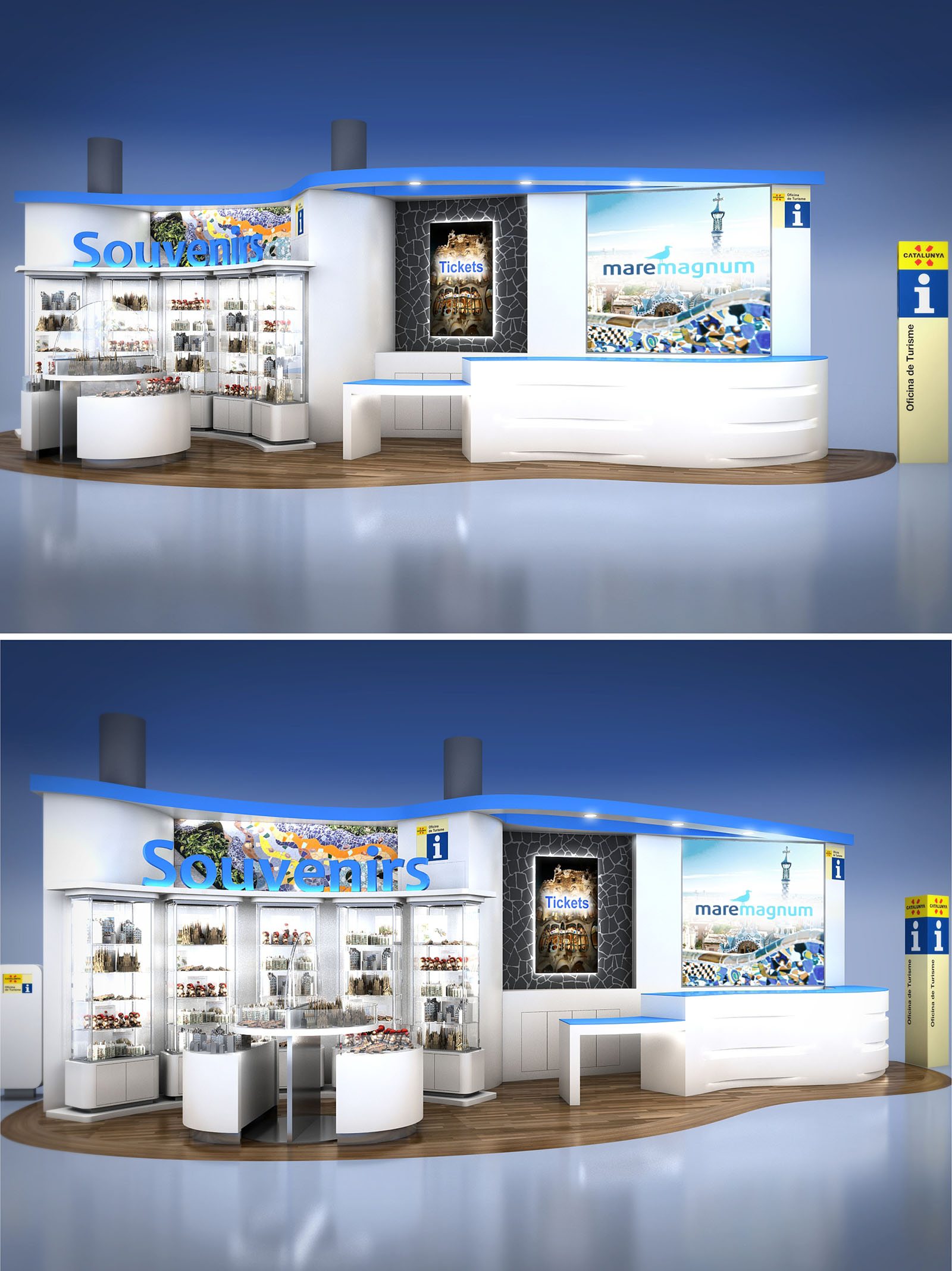
The Info Center Maremagnum is conceived as a fluid interface between the commercial dynamics of the mall and the touristic energy of Barcelona’s waterfront. The project merges information desk, ticketing and souvenir retail into a single, legible organism. A continuous blue canopy acts as a strong graphic horizon, evoking the sea and guiding visitors from afar, while the white volumetry beneath recalls the clarity of a nautical deck, emphasizing orientation, brightness and cleanliness.
The design prioritizes immediacy of reading: “Souvenirs”, “Tickets” and the tourist information icon are composed as large-scale environmental graphics, integrated into the architecture rather than applied signage. The result is a compact yet highly visible node that clarifies functions at a glance and encourages spontaneous approach from all directions of the circulation flow.
The plan is organized as a sequence of functional strips aligned along the main façade. To one side, a vertically accentuated souvenir area combines perimeter wall displays with central islands to create a dense yet orderly retail front. At the opposite side, the information and ticketing counter forms a generous, curved reception point that welcomes visitors frontally and obliquely, minimizing congestion during peak hours.
The circulation space between retail and counter remains unobstructed, allowing visitors to browse, queue and receive information without cross-interference. Service and storage are integrated into the lower cabinetry of the counter and behind the rear panels, enabling efficient restocking and discrete technical access. The result is an open-plan layout that supports both rapid transactional use and longer advisory interactions.
The architectural language is based on soft, continuous curves that recall the movement of waves and the fluidity of public flows inside the shopping center. The main counter and display bases adopt rounded edges, inviting contact and reducing visual hardness in the busy environment. This organic geometry is contrasted with strictly orthogonal glass cabinets, generating a controlled tension between softness and precision.
Material selection emphasizes luminosity and durability. High-gloss white solid surfaces and lacquered panels reflect light and give the unit a clean, contemporary character. Transparent glass showcases present merchandise as if floating, while integrated aluminum profiles and discreet shelving hardware maintain a minimal visual footprint. The background to the ticketing area incorporates a darker, textured panel reminiscent of basalt or stone, creating focal contrast and referencing the city’s material heritage.
Lighting is conceived as both functional infrastructure and branding tool. A continuous LED strip embedded in the blue canopy washes the front elevation, reinforcing the identity line and providing uniform ambient illumination. Additional spotlights within the soffit target the glass displays, ensuring merchandise is evenly lit without glare or excessive shadows.
Backlit graphic panels play a central role in orienting users: one panel emphasizes ticket sales, another promotes Maremagnum and the wider city experience. These elements transform the info point into a visual landmark within the mall, maintaining strong visibility even under changing natural and artificial lighting conditions.
Sustainability is addressed through compact footprint, efficient systems and durable materials. The entire unit is designed as a prefabricated, modular structure, reducing on-site construction time and waste. Components are dimensioned for easy disassembly, enabling future relocation or partial replacement without demolishing the whole installation.
Lighting is based on low-consumption LED technology with high efficiency and long life, minimizing energy use and maintenance. Glass showcases and light-colored surfaces maximize reflectance, reducing the need for high-intensity fixtures. Finishes prioritize robust, easily cleanable materials that extend service life in a high-traffic environment, while wood-effect flooring introduces warmth through a laminated or engineered surface that uses less natural timber than traditional solid wood. Collectively, these strategies create a visually striking yet resource-conscious intervention adapted to the maritime context of Barcelona.
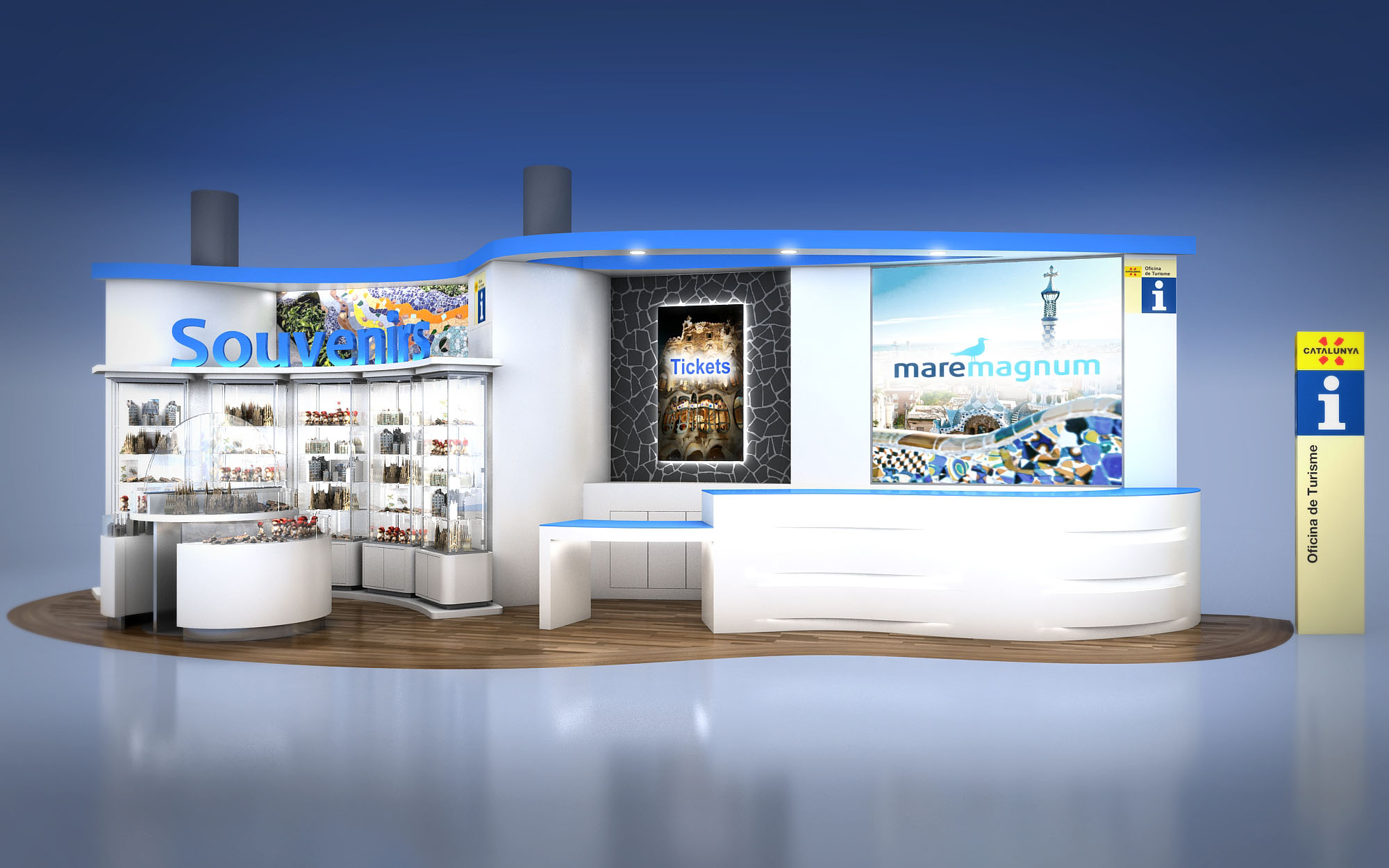
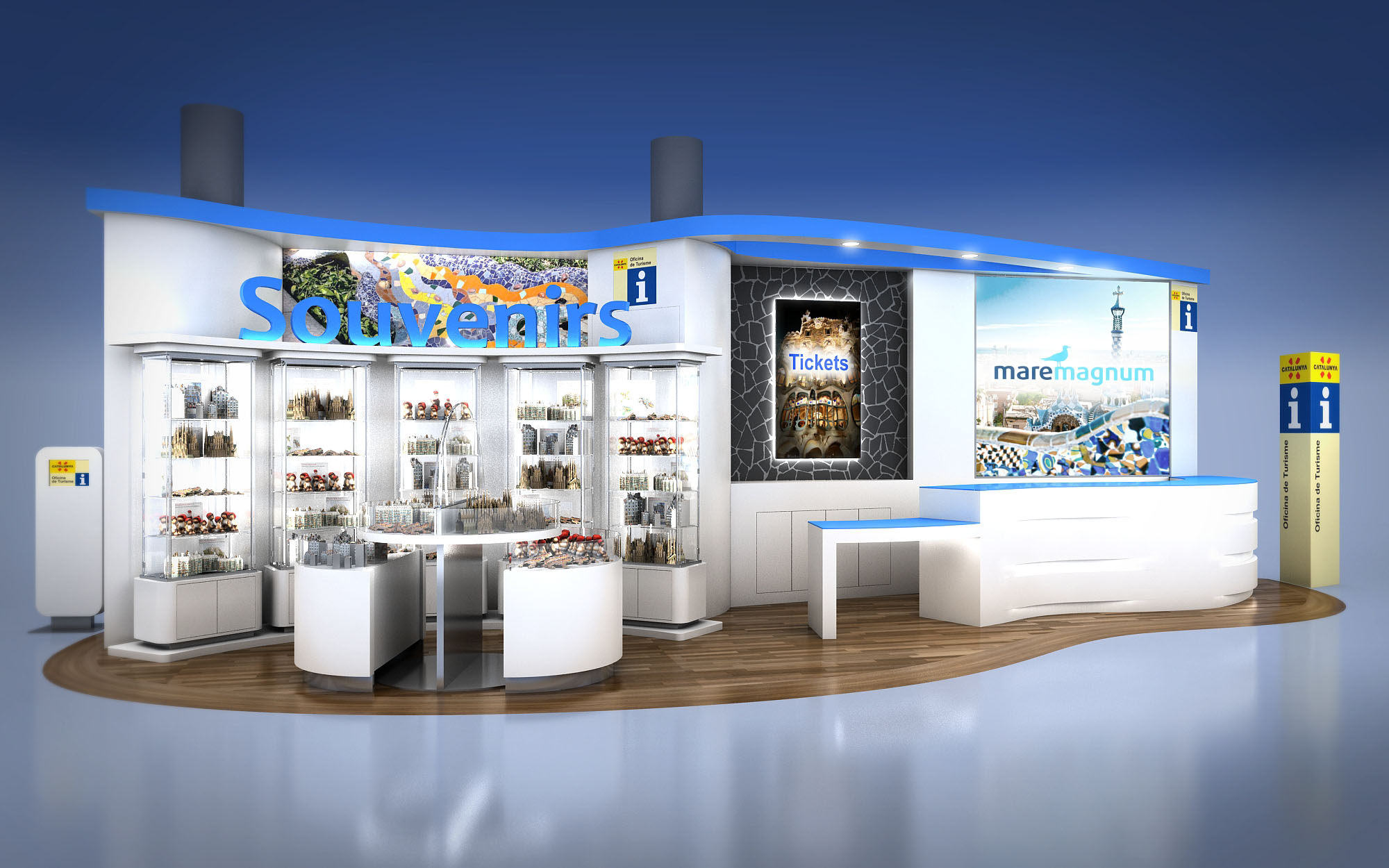
The Info Center Maremagnum is conceived as a fluid interface between the commercial dynamics of the mall and the touristic energy of Barcelona’s waterfront. The project merges information desk, ticketing and souvenir retail into a single, legible organism. A continuous blue canopy acts as a strong graphic horizon, evoking the sea and guiding visitors from afar, while the white volumetry beneath recalls the clarity of a nautical deck, emphasizing orientation, brightness and cleanliness.
The design prioritizes immediacy of reading: “Souvenirs”, “Tickets” and the tourist information icon are composed as large-scale environmental graphics, integrated into the architecture rather than applied signage. The result is a compact yet highly visible node that clarifies functions at a glance and encourages spontaneous approach from all directions of the circulation flow.
The plan is organized as a sequence of functional strips aligned along the main façade. To one side, a vertically accentuated souvenir area combines perimeter wall displays with central islands to create a dense yet orderly retail front. At the opposite side, the information and ticketing counter forms a generous, curved reception point that welcomes visitors frontally and obliquely, minimizing congestion during peak hours.
The circulation space between retail and counter remains unobstructed, allowing visitors to browse, queue and receive information without cross-interference. Service and storage are integrated into the lower cabinetry of the counter and behind the rear panels, enabling efficient restocking and discrete technical access. The result is an open-plan layout that supports both rapid transactional use and longer advisory interactions.
The architectural language is based on soft, continuous curves that recall the movement of waves and the fluidity of public flows inside the shopping center. The main counter and display bases adopt rounded edges, inviting contact and reducing visual hardness in the busy environment. This organic geometry is contrasted with strictly orthogonal glass cabinets, generating a controlled tension between softness and precision.
Material selection emphasizes luminosity and durability. High-gloss white solid surfaces and lacquered panels reflect light and give the unit a clean, contemporary character. Transparent glass showcases present merchandise as if floating, while integrated aluminum profiles and discreet shelving hardware maintain a minimal visual footprint. The background to the ticketing area incorporates a darker, textured panel reminiscent of basalt or stone, creating focal contrast and referencing the city’s material heritage.
Lighting is conceived as both functional infrastructure and branding tool. A continuous LED strip embedded in the blue canopy washes the front elevation, reinforcing the identity line and providing uniform ambient illumination. Additional spotlights within the soffit target the glass displays, ensuring merchandise is evenly lit without glare or excessive shadows.
Backlit graphic panels play a central role in orienting users: one panel emphasizes ticket sales, another promotes Maremagnum and the wider city experience. These elements transform the info point into a visual landmark within the mall, maintaining strong visibility even under changing natural and artificial lighting conditions.
Sustainability is addressed through compact footprint, efficient systems and durable materials. The entire unit is designed as a prefabricated, modular structure, reducing on-site construction time and waste. Components are dimensioned for easy disassembly, enabling future relocation or partial replacement without demolishing the whole installation.
Lighting is based on low-consumption LED technology with high efficiency and long life, minimizing energy use and maintenance. Glass showcases and light-colored surfaces maximize reflectance, reducing the need for high-intensity fixtures. Finishes prioritize robust, easily cleanable materials that extend service life in a high-traffic environment, while wood-effect flooring introduces warmth through a laminated or engineered surface that uses less natural timber than traditional solid wood. Collectively, these strategies create a visually striking yet resource-conscious intervention adapted to the maritime context of Barcelona.


Nuestras oficinas están en Barcelona, Cancún, Chicago y Santo Domingo, pero gracias a la tecnología podemos desarrollar proyectos en cualquier parte del mundo.
Barcelona
Bac de Roda 136
08020, Barcelona
Spain
Madrid
Av. de Buendía 11
19005 Guadalajara (Madrid)
Spain
Chicago
373 Hazel Ave, Apt A1
60022, Glencoe, Illinois
United States