

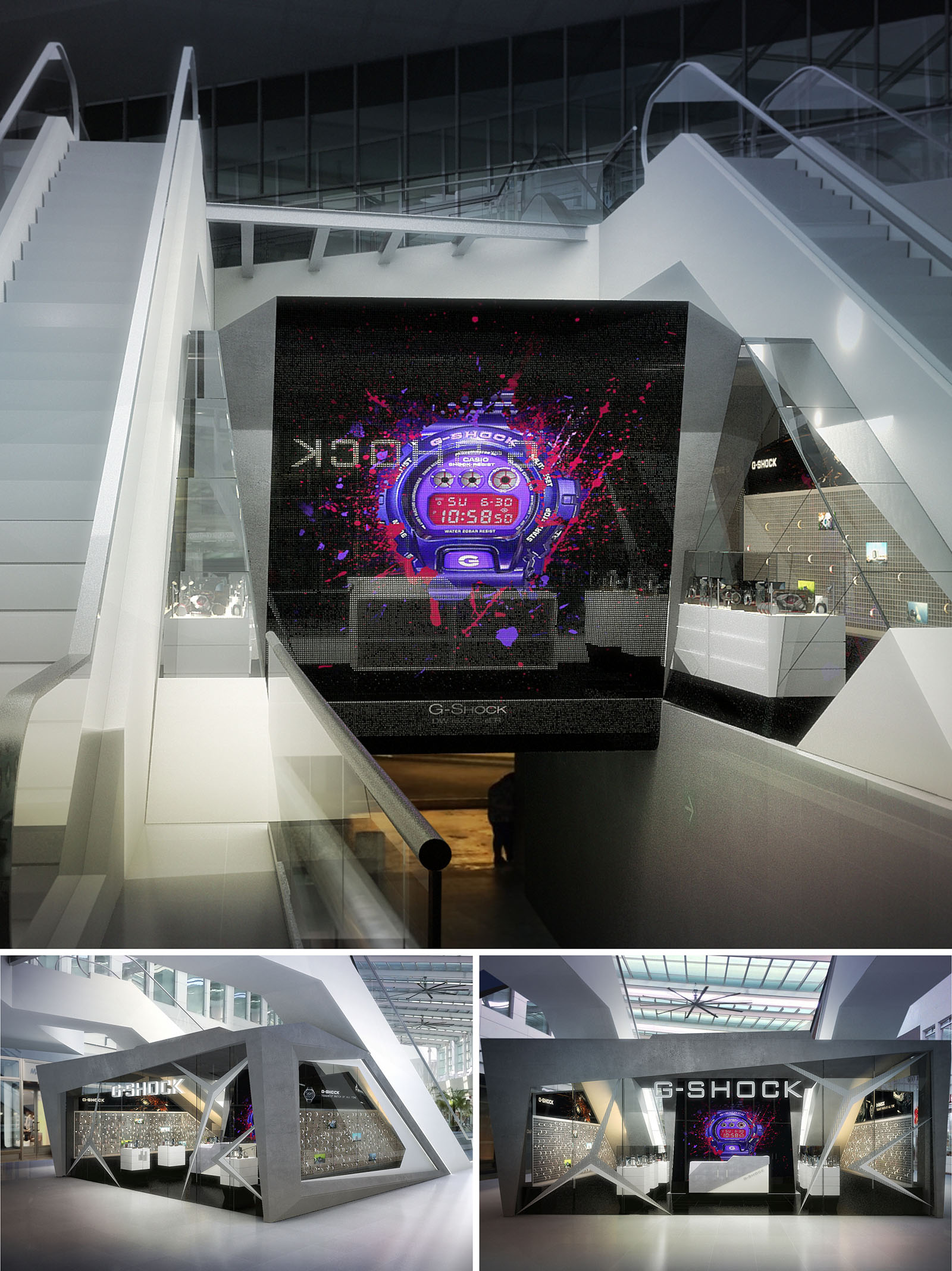
The G-SHOCK retail space in Cancún is conceived as an architectural translation of the brand’s core values: resistance, precision, and urban energy. The volume is designed as a faceted monolith, almost sculpted from a single block, echoing the robust geometry of the watches themselves. The kiosk-like structure sits as an autonomous object within the larger atrium, contrasting with the smooth circulation of the mall and becoming an immediate point of attraction.
The design prioritizes visual impact and clear brand recognition. A large digital screen integrated into the central façade acts as a dynamic canvas, communicating technology, color, and movement, while the angular cuts and sharp edges of the envelope recall mechanical parts and protective casings. The overall result is a hybrid between pavilion and product, where architecture behaves like an enlarged watch body.
The project is articulated as a compact, open-plan interior within a clearly defined external shell. Access is from the front façade, where a recessed central opening invites visitors into a controlled, immersive environment. Interior circulation is straightforward and linear, guiding the user along the main display wall and towards secondary showcases embedded in the side facades.
Display zones are strategically located along the perimeter, allowing the central space to remain visually free and flexible for customer interaction and product testing. The geometry of the exterior facets informs the interior layout, generating niches and angled planes that become integrated vitrines, podiums, and graphic supports. Seating elements near the entrance encourage short stays and personalized service, while preserving a clear view of the entire collection.
The external envelope operates as a three-dimensional brand statement. Faceted concrete-like surfaces and sharp chamfers create a sense of movement and resilience, mirroring the shock-resistant character of the watches. Large transparent planes are inserted as crystalline cuts, revealing the interior and framing curated views of the products.
The front façade is composed as a triptych: a central multimedia panel flanked by two angular display windows. This composition reinforces symmetry and focus on the main digital content, while the flanking showcases work as luminous beacons that attract passersby from oblique angles. The G-SHOCK logo is integrated in a bold, high-contrast manner above the entrance, ensuring immediate recognition at distance within the mall’s open atrium.
The material palette combines dark, matte surfaces with high-gloss and transparent elements to emphasize technological sophistication. The outer shell suggests a mineral, almost concrete texture, contrasted with polished metal trims and clear glass planes. Inside, neutral greys and blacks form a controlled backdrop that intensifies the chromatic accents of the watches and digital graphics.
Lighting is predominantly integrated and indirect, concealed within joints and edges of the faceted planes to accentuate the geometry and avoid glare. Linear LED strips wash the display walls, while focused projectors highlight key models and limited editions. The central screen introduces saturated color and dynamic light, creating an ever-changing focal point that energizes both the interior and the surrounding public space.
The design incorporates several measures to optimize environmental performance within the constraints of a retail kiosk. The compact footprint reduces material usage, while the faceted envelope allows for the strategic placement of insulated opaque panels, minimizing heat gain from the extensively glazed mall atrium. High-efficiency LED lighting with programmable controls lowers energy consumption and permits dimming scenarios according to natural daylight levels.
Durable finishes with high resistance to abrasion and impact extend lifecycle and reduce the need for replacement, in line with the brand’s durability ethos. Modular display components facilitate reconfiguration and reuse for future collections, decreasing waste. Where possible, local fabrication and sourcing in México limit transportation impacts, and the project’s demountable nature allows the structure to be relocated or adapted rather than discarded at the end of its use in this specific location.
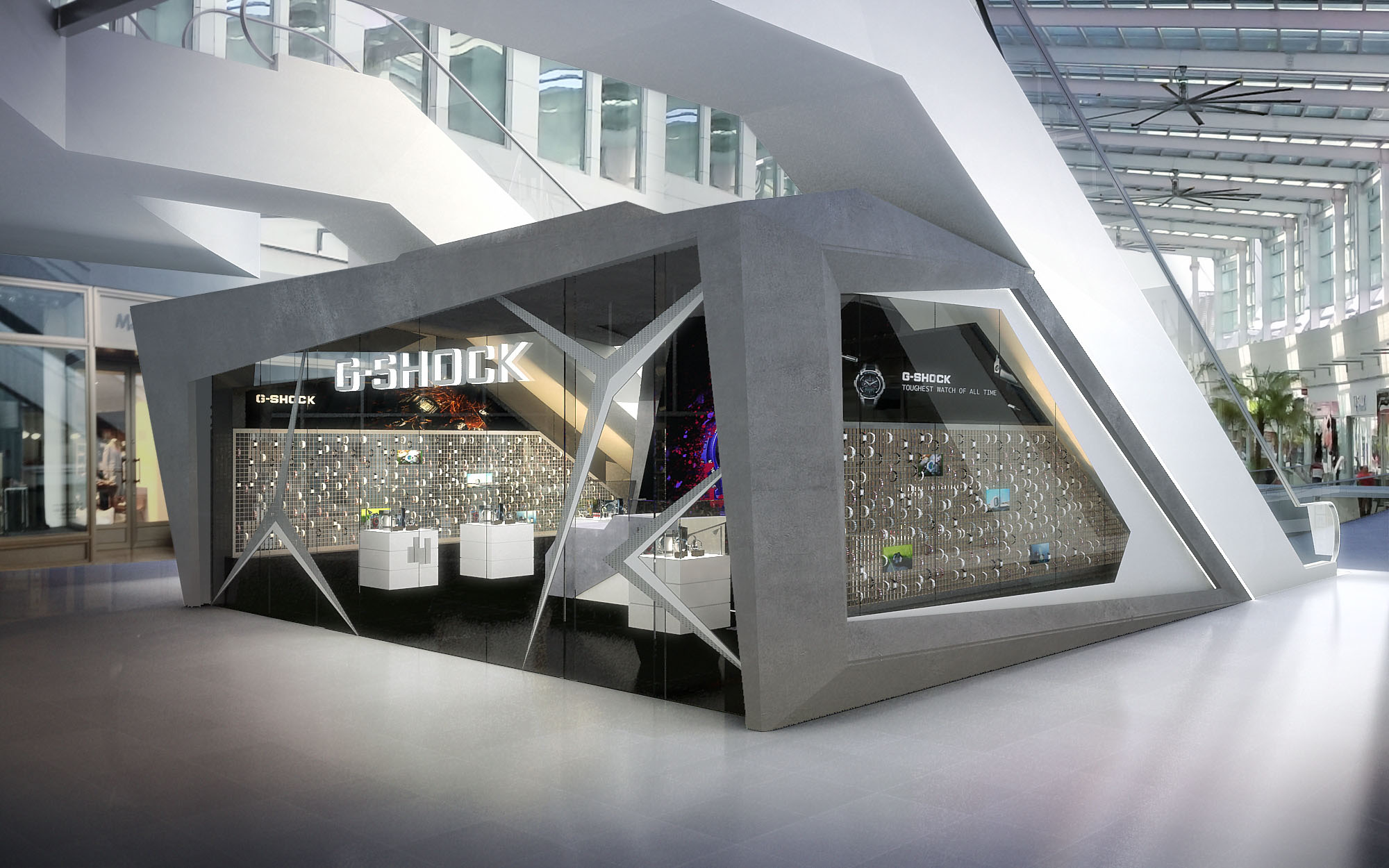
The G-SHOCK retail space in Cancún is conceived as an architectural translation of the brand’s core values: resistance, precision, and urban energy. The volume is designed as a faceted monolith, almost sculpted from a single block, echoing the robust geometry of the watches themselves. The kiosk-like structure sits as an autonomous object within the larger atrium, contrasting with the smooth circulation of the mall and becoming an immediate point of attraction.
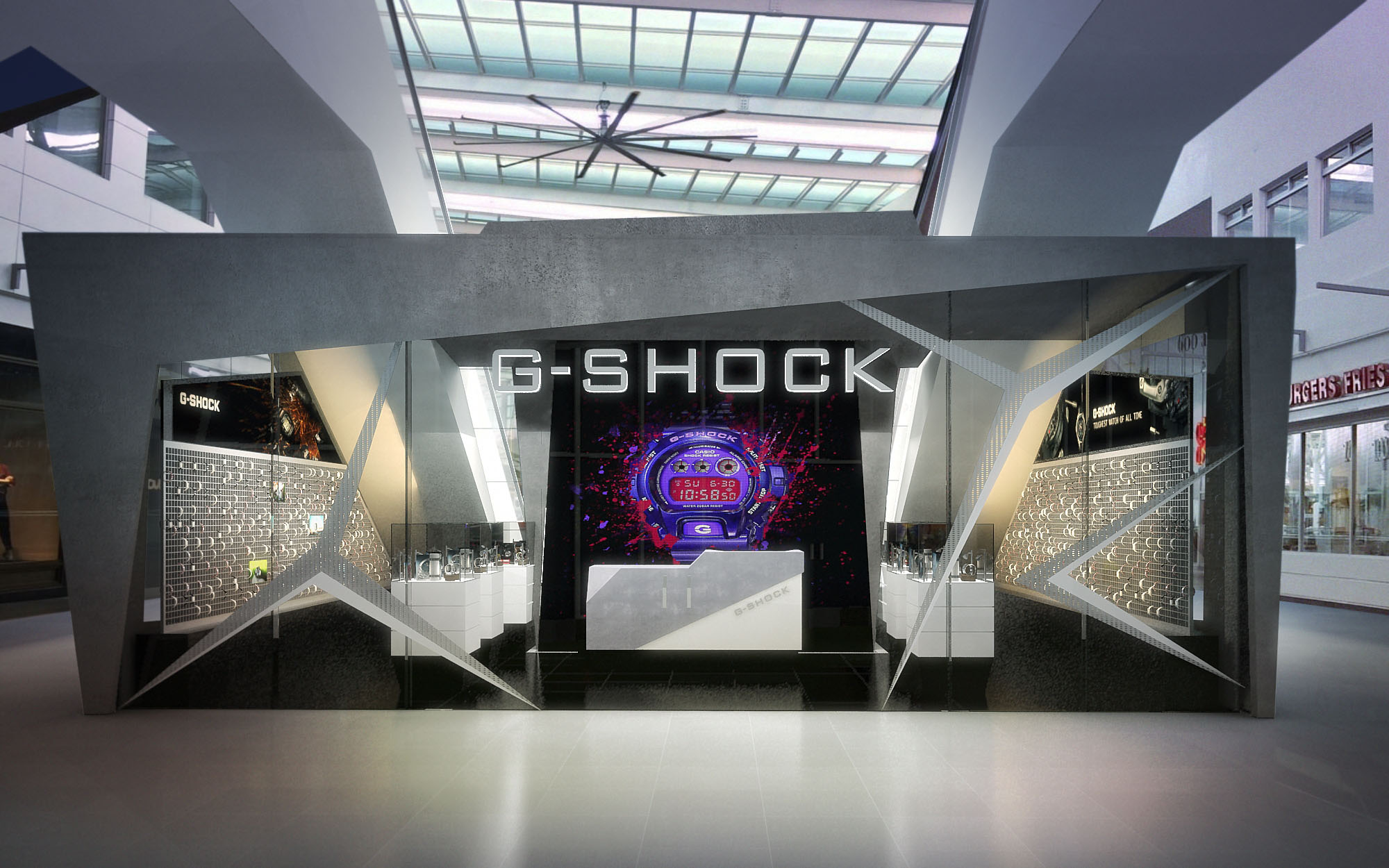
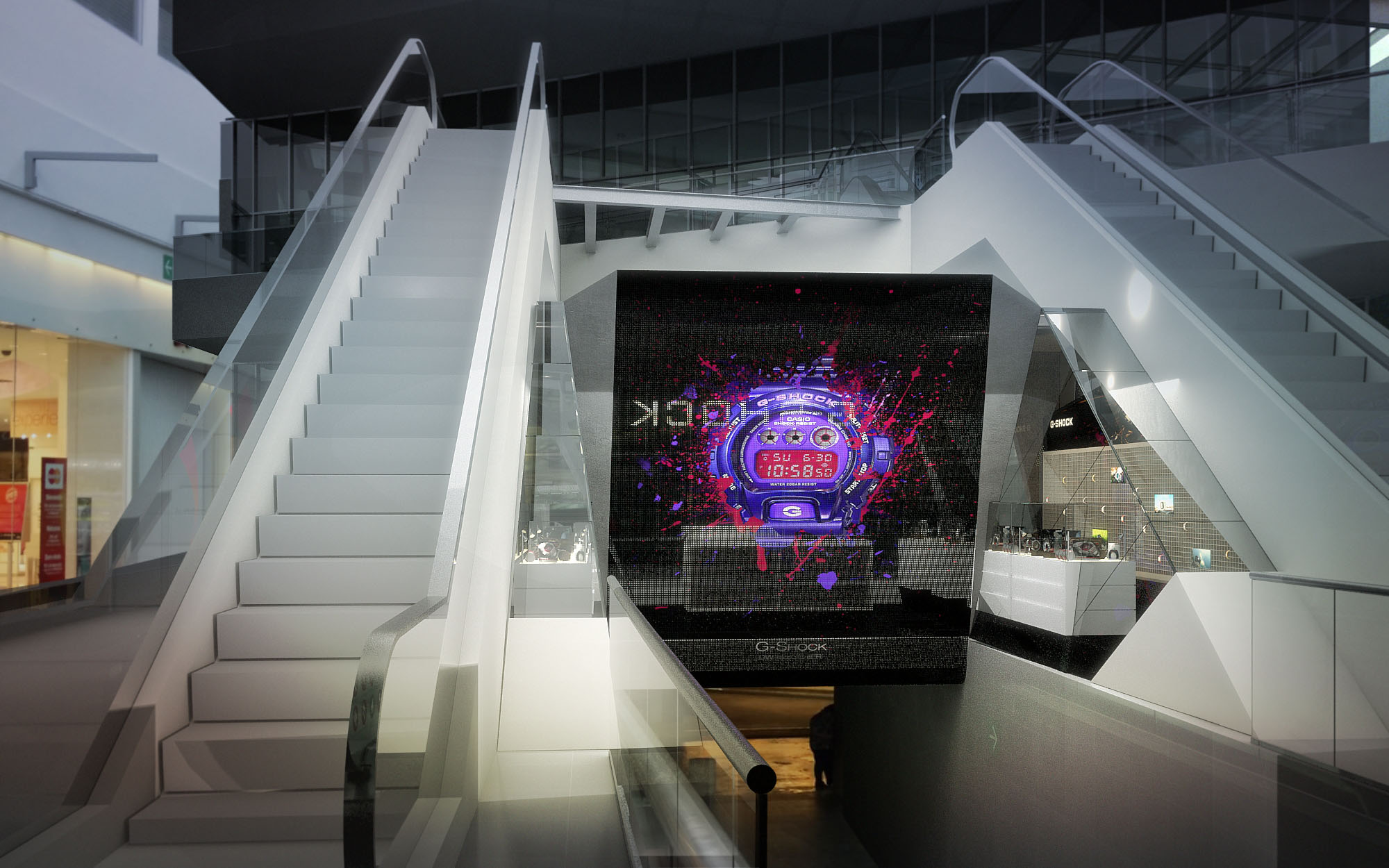
The design prioritizes visual impact and clear brand recognition. A large digital screen integrated into the central façade acts as a dynamic canvas, communicating technology, color, and movement, while the angular cuts and sharp edges of the envelope recall mechanical parts and protective casings. The overall result is a hybrid between pavilion and product, where architecture behaves like an enlarged watch body.
The project is articulated as a compact, open-plan interior within a clearly defined external shell. Access is from the front façade, where a recessed central opening invites visitors into a controlled, immersive environment. Interior circulation is straightforward and linear, guiding the user along the main display wall and towards secondary showcases embedded in the side facades.
Display zones are strategically located along the perimeter, allowing the central space to remain visually free and flexible for customer interaction and product testing. The geometry of the exterior facets informs the interior layout, generating niches and angled planes that become integrated vitrines, podiums, and graphic supports. Seating elements near the entrance encourage short stays and personalized service, while preserving a clear view of the entire collection.
The external envelope operates as a three-dimensional brand statement. Faceted concrete-like surfaces and sharp chamfers create a sense of movement and resilience, mirroring the shock-resistant character of the watches. Large transparent planes are inserted as crystalline cuts, revealing the interior and framing curated views of the products.
The front façade is composed as a triptych: a central multimedia panel flanked by two angular display windows. This composition reinforces symmetry and focus on the main digital content, while the flanking showcases work as luminous beacons that attract passersby from oblique angles. The G-SHOCK logo is integrated in a bold, high-contrast manner above the entrance, ensuring immediate recognition at distance within the mall’s open atrium.
The material palette combines dark, matte surfaces with high-gloss and transparent elements to emphasize technological sophistication. The outer shell suggests a mineral, almost concrete texture, contrasted with polished metal trims and clear glass planes. Inside, neutral greys and blacks form a controlled backdrop that intensifies the chromatic accents of the watches and digital graphics.
Lighting is predominantly integrated and indirect, concealed within joints and edges of the faceted planes to accentuate the geometry and avoid glare. Linear LED strips wash the display walls, while focused projectors highlight key models and limited editions. The central screen introduces saturated color and dynamic light, creating an ever-changing focal point that energizes both the interior and the surrounding public space.
The design incorporates several measures to optimize environmental performance within the constraints of a retail kiosk. The compact footprint reduces material usage, while the faceted envelope allows for the strategic placement of insulated opaque panels, minimizing heat gain from the extensively glazed mall atrium. High-efficiency LED lighting with programmable controls lowers energy consumption and permits dimming scenarios according to natural daylight levels.
Durable finishes with high resistance to abrasion and impact extend lifecycle and reduce the need for replacement, in line with the brand’s durability ethos. Modular display components facilitate reconfiguration and reuse for future collections, decreasing waste. Where possible, local fabrication and sourcing in México limit transportation impacts, and the project’s demountable nature allows the structure to be relocated or adapted rather than discarded at the end of its use in this specific location.


Nuestras oficinas están en Barcelona, Cancún, Chicago y Santo Domingo, pero gracias a la tecnología podemos desarrollar proyectos en cualquier parte del mundo.
Barcelona
Bac de Roda 136
08020, Barcelona
Spain
Madrid
Av. de Buendía 11
19005 Guadalajara (Madrid)
Spain
Chicago
373 Hazel Ave, Apt A1
60022, Glencoe, Illinois
United States