

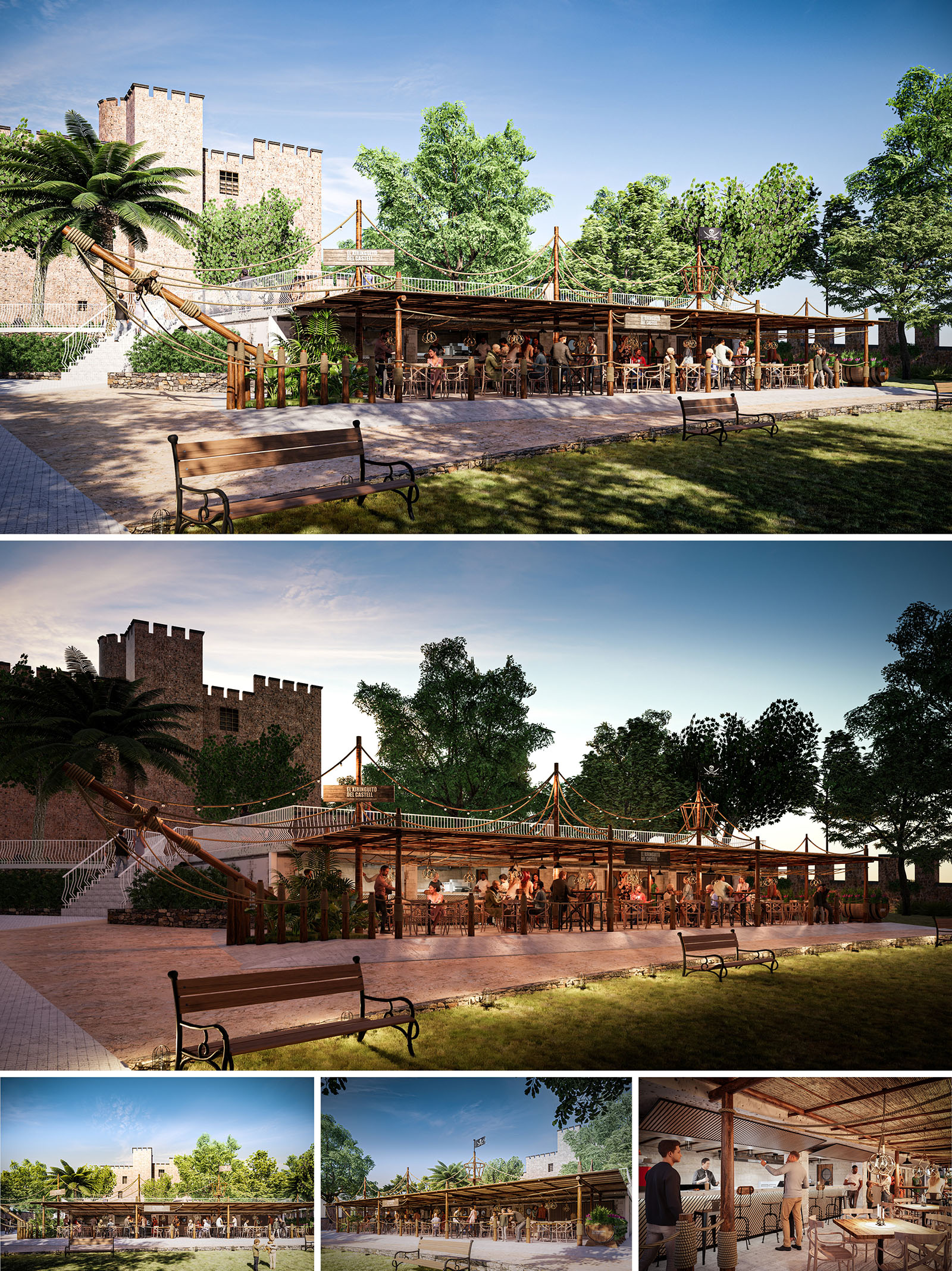
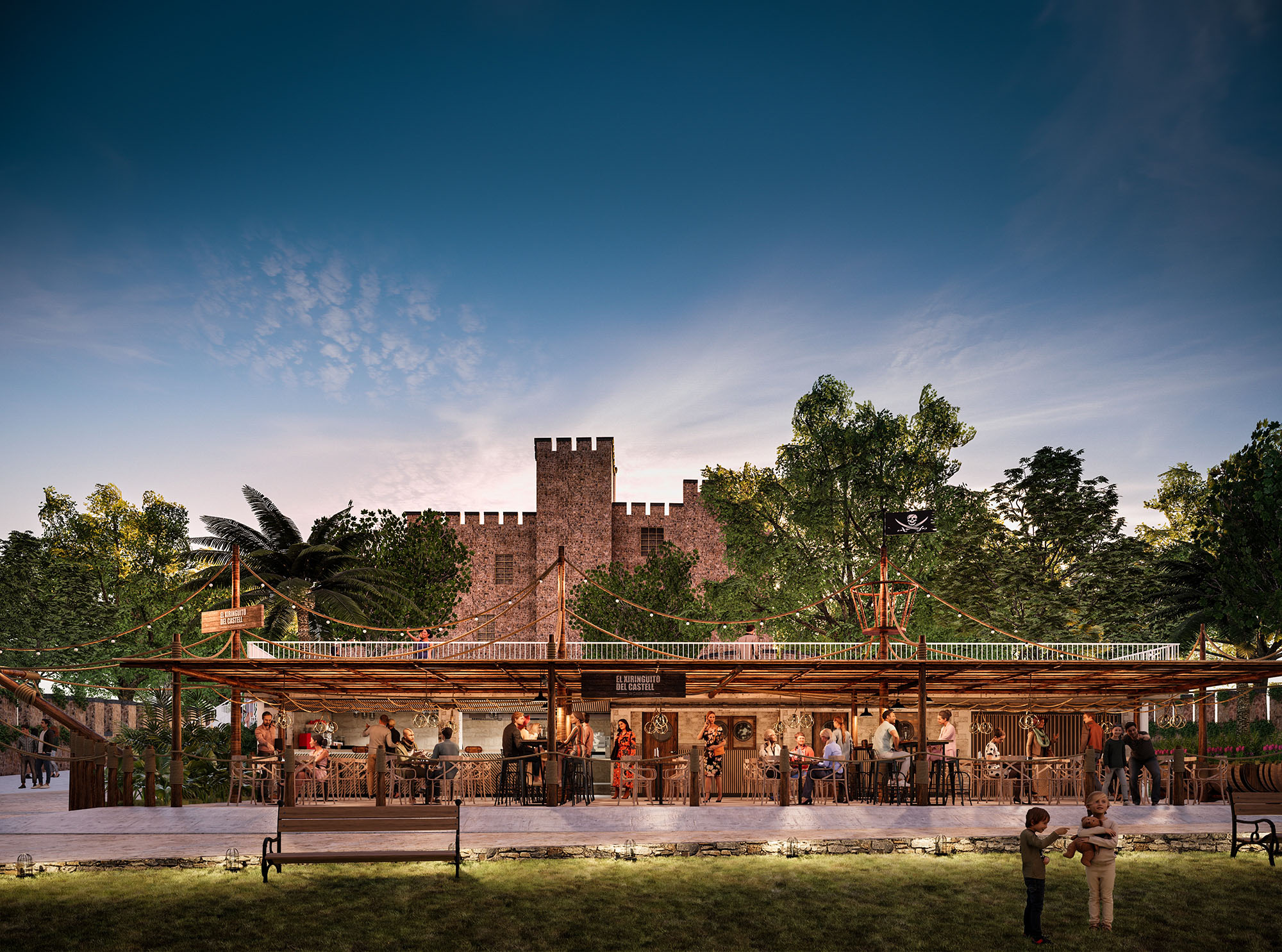
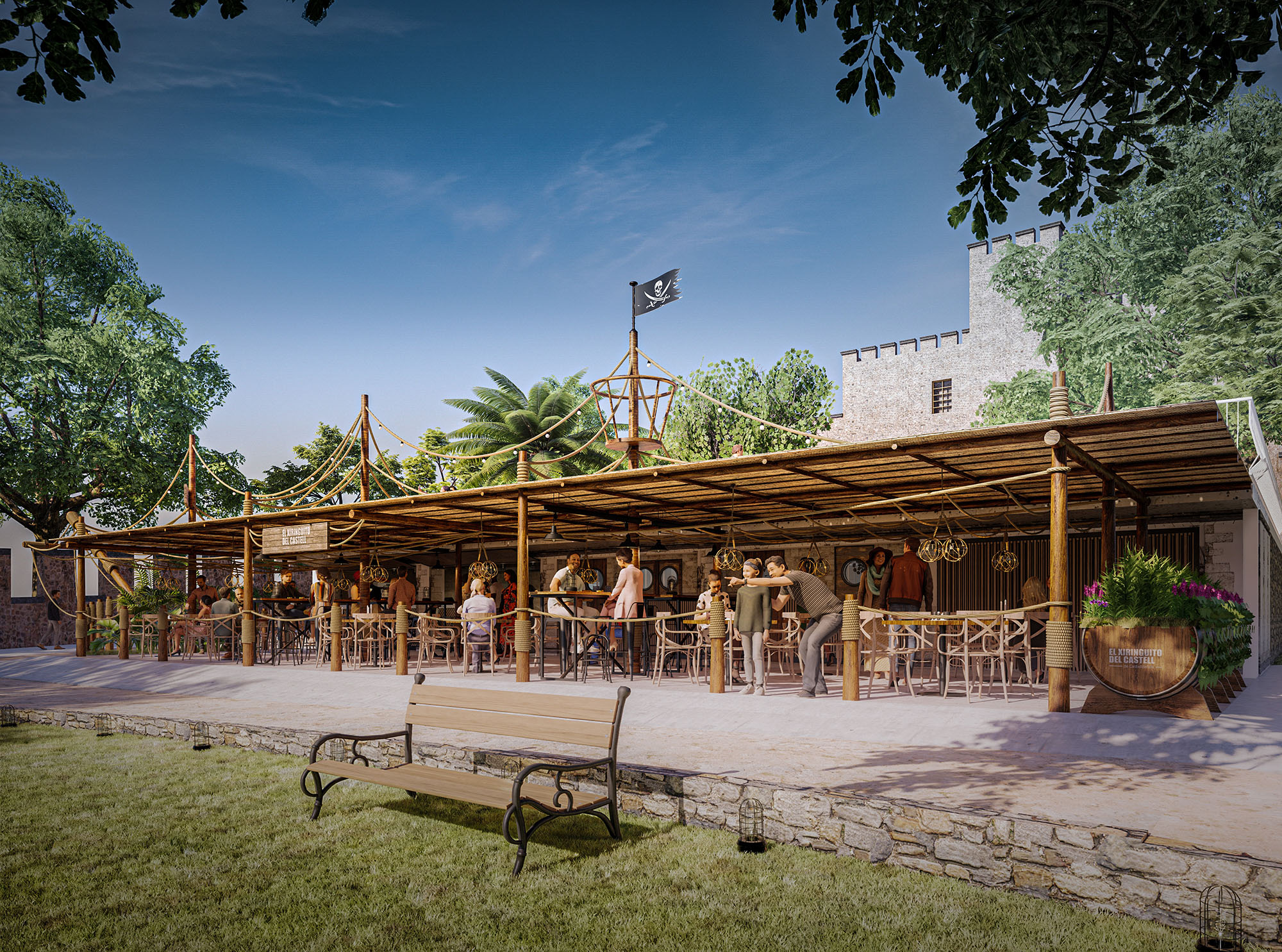
El Xiringuito del Castell is conceived as a temporary wooden structure that stages a dialogue between the medieval castle of Castelldefels and the informal, festive atmosphere of a Mediterranean beach bar. The project embraces the imagery of a historic ship moored at the foot of the fortress, using masts, ropes and sails as a narrative device that connects sea culture with the inland topography.
The architectural language is deliberately lightweight and reversible, designed to rest respectfully at the base of the stone walls without competing with the monument. Horizontal canopies, slender posts and textile elements form a low profile that frames views of the castle while sheltering an intense social life beneath. The result is an open-air living room for the town, where heritage, landscape and gastronomy converge.
The xiringuito occupies a linear platform parallel to the main garden promenade, acting as a permeable edge between the public park and the castle slope. The layout preserves existing circulation axes, allowing passersby to cross the terrace freely and to visually connect the square with the upper ramp leading to the monument.
The intervention follows the natural terracing of the terrain: the bar volume anchors itself against the retaining wall, while the main dining level projects towards the lawn as a broad, continuous terrace. This stepped configuration maintains low visual impact, ensuring that the castle towers remain the dominant skyline element. Soft night lighting integrated into the paving reinforces safety without producing glare on the heritage façades.
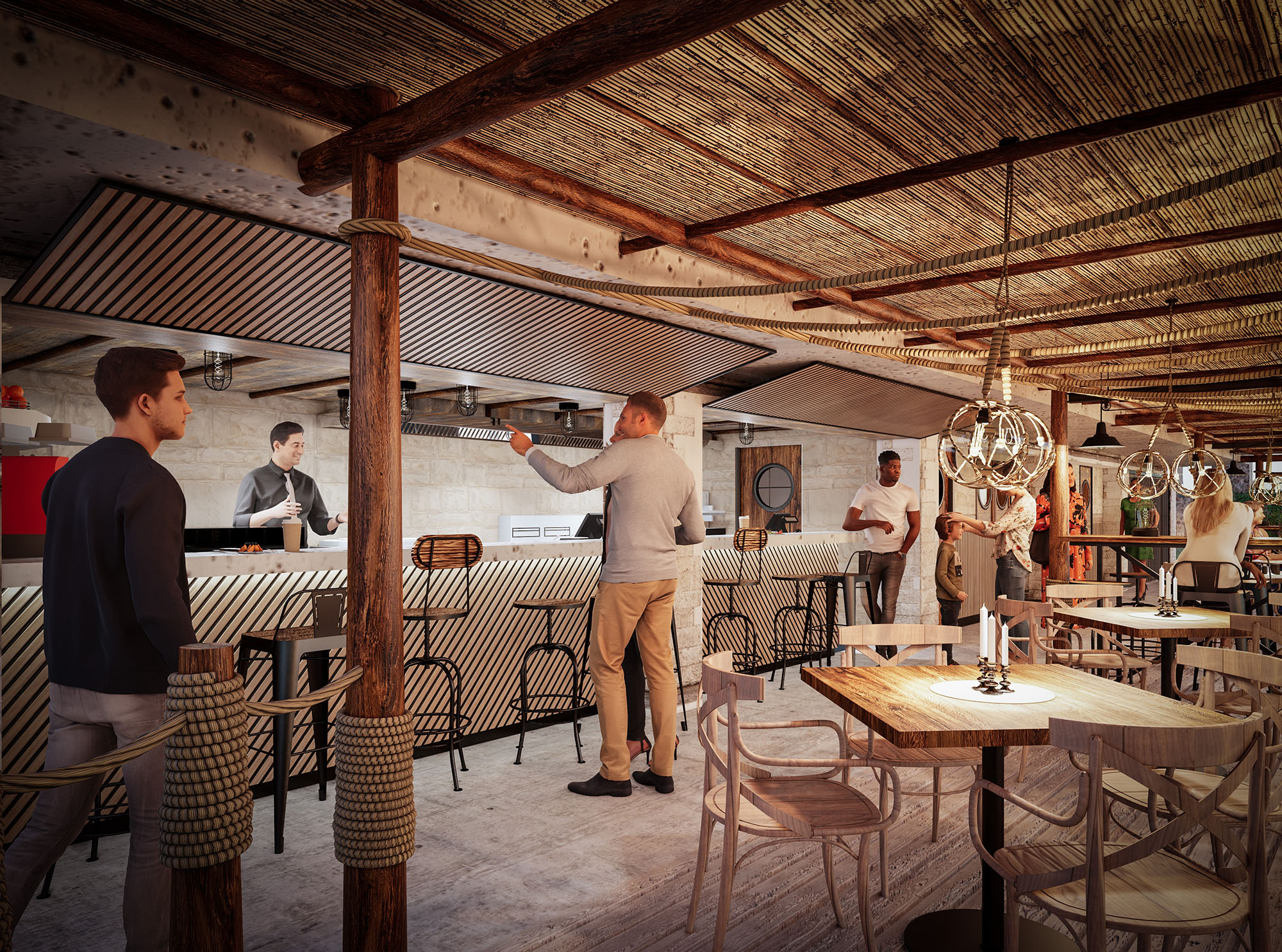
The spatial scheme is organized around a central linear bar that functions as both production core and social attractor. In front of it, an open dining area with flexible tables and high stools accommodates different group sizes and event formats. Circulation is clear and peripheral, enabling staff to move efficiently while guests enjoy unobstructed views of the garden and the stage-like bar.
Perimeter bays under the canopy house more intimate seating and standing areas, benefiting from the shade and the proximity to vegetation. The rear strip, leaning against the stone wall, integrates service spaces, storage and technical installations, all concealed behind a continuous cladding to maintain a unified façade. The rooftop deck, accessible via a light stair and rope railings, becomes a belvedere and symbolic “ship deck”, enhancing the experiential character of the venue.
The structural system is based on timber posts and beams, complemented by metal joints that guarantee durability while keeping all elements demountable. The roof uses light rafters and cane or reed latticework, creating a porous filter that modulates sunlight and generates dynamic shadows reminiscent of seaside pergolas.
Natural fibers, ropes and nautical hardware are used extensively, not only as decorative motifs but as functional elements for bracing, handrails and lighting supports. The chromatic palette is warm and earthy—browns, sands and off-whites—that harmonizes with the existing stone, the green canopy of trees and the ochre tones of the ground. At night, strings of small luminaires trace the “rigging” of the ship, reinforcing the festive but intimate atmosphere.
The interior bar counter combines textured plaster, ceramic tiling and timber to evoke traditional Mediterranean taverns while accommodating contemporary equipment. Open shelving and visible bottle displays contribute to an informal, approachable character. The furniture mix—wooden tables, director-style chairs and high stools—prioritizes comfort and adaptability, allowing rapid reconfiguration for concerts, talks or family gatherings.
The boundary between interior and exterior is intentionally blurred: there are no rigid façades, only a sequence of columns and low elements that maintain constant visual connectivity. Acoustic comfort is supported by the absorbent qualities of natural materials and the vegetation backdrop, creating an environment where conversation remains comfortable even at high occupancy.
Sustainability is approached through reversibility, material choice and passive environmental strategies. The entire system is conceived as a dry-assembled, demountable structure, minimizing ground intervention and allowing future re-use or reconfiguration with minimal waste. Foundations are lightweight and localized, reducing impact on the archaeological and landscape context.
The extensive use of certified timber, local stone and natural fiber coverings reduces embodied energy and facilitates end-of-life recycling. The open configuration maximizes cross-ventilation, while the deep overhangs and cane shading control solar gain, limiting the need for mechanical cooling. Low-consumption LED lighting, oriented downward and integrated into ropes and structural elements, cuts energy demand and respects the nocturnal environment. The project thus proposes a festive, seasonal facility that coexists responsibly with both the castle’s heritage and the surrounding ecosystem.
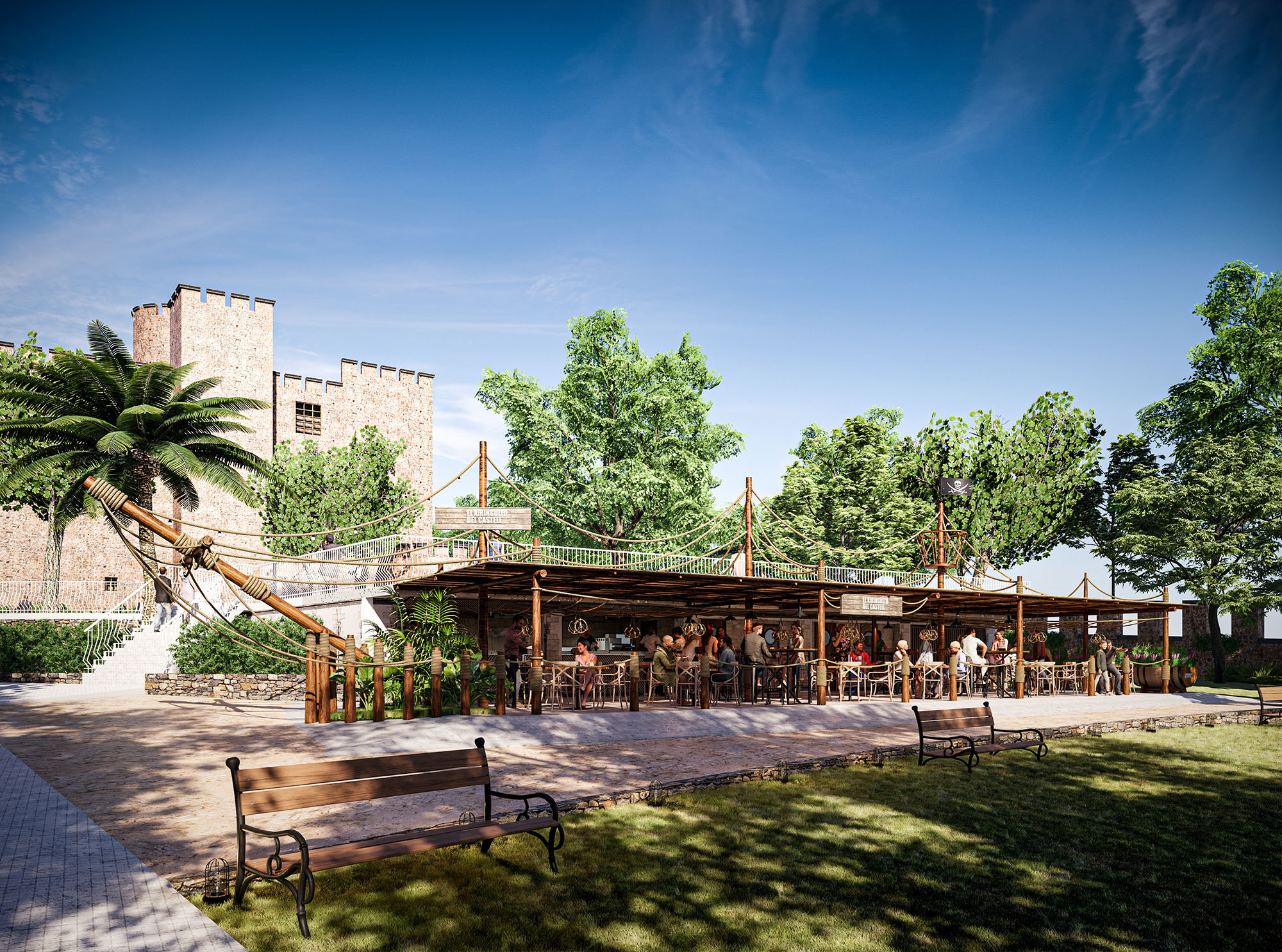
El Xiringuito del Castell is conceived as a temporary wooden structure that stages a dialogue between the medieval castle of Castelldefels and the informal, festive atmosphere of a Mediterranean beach bar. The project embraces the imagery of a historic ship moored at the foot of the fortress, using masts, ropes and sails as a narrative device that connects sea culture with the inland topography.
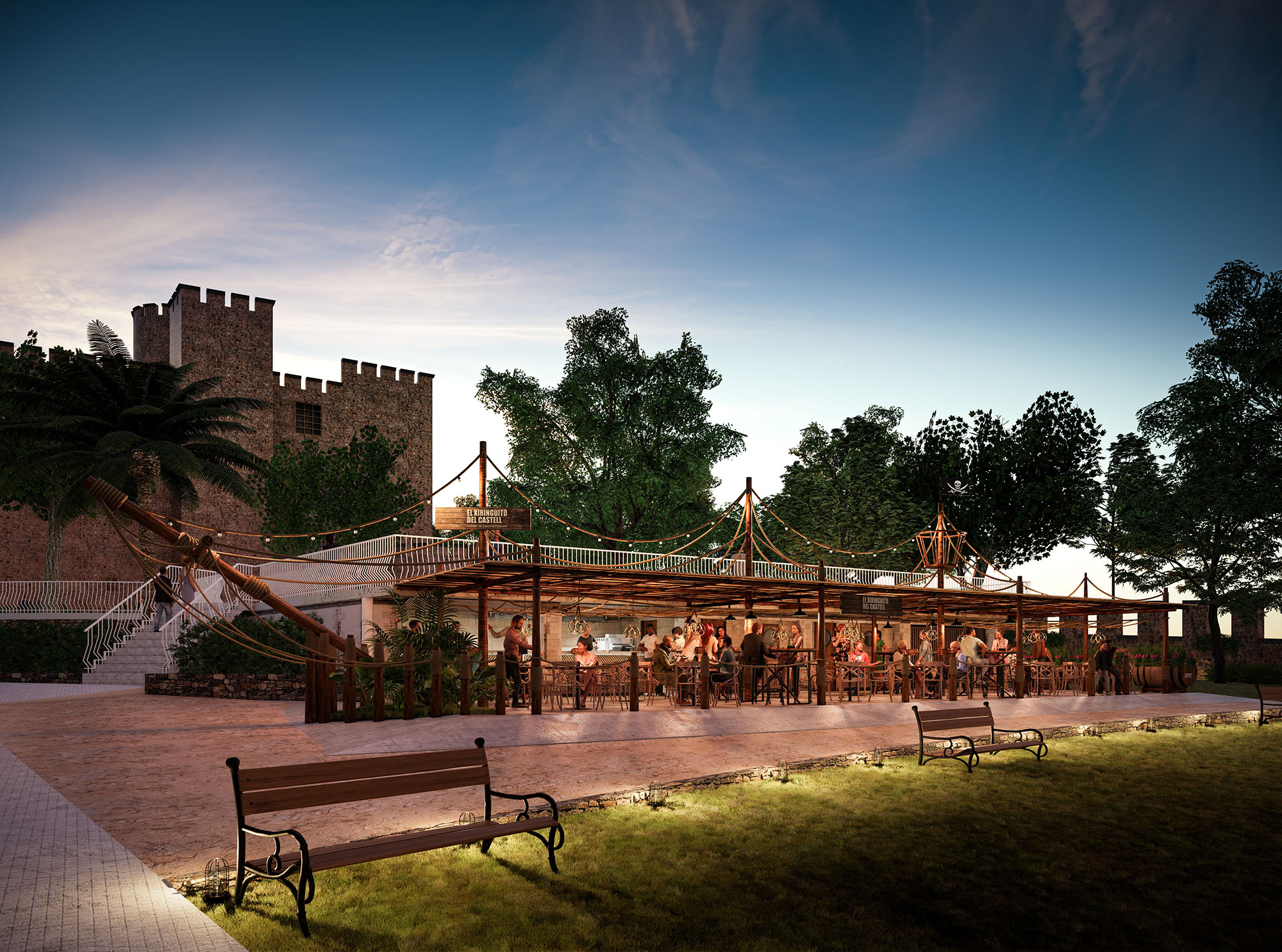
The architectural language is deliberately lightweight and reversible, designed to rest respectfully at the base of the stone walls without competing with the monument. Horizontal canopies, slender posts and textile elements form a low profile that frames views of the castle while sheltering an intense social life beneath. The result is an open-air living room for the town, where heritage, landscape and gastronomy converge.
The xiringuito occupies a linear platform parallel to the main garden promenade, acting as a permeable edge between the public park and the castle slope. The layout preserves existing circulation axes, allowing passersby to cross the terrace freely and to visually connect the square with the upper ramp leading to the monument.
The intervention follows the natural terracing of the terrain: the bar volume anchors itself against the retaining wall, while the main dining level projects towards the lawn as a broad, continuous terrace. This stepped configuration maintains low visual impact, ensuring that the castle towers remain the dominant skyline element. Soft night lighting integrated into the paving reinforces safety without producing glare on the heritage façades.
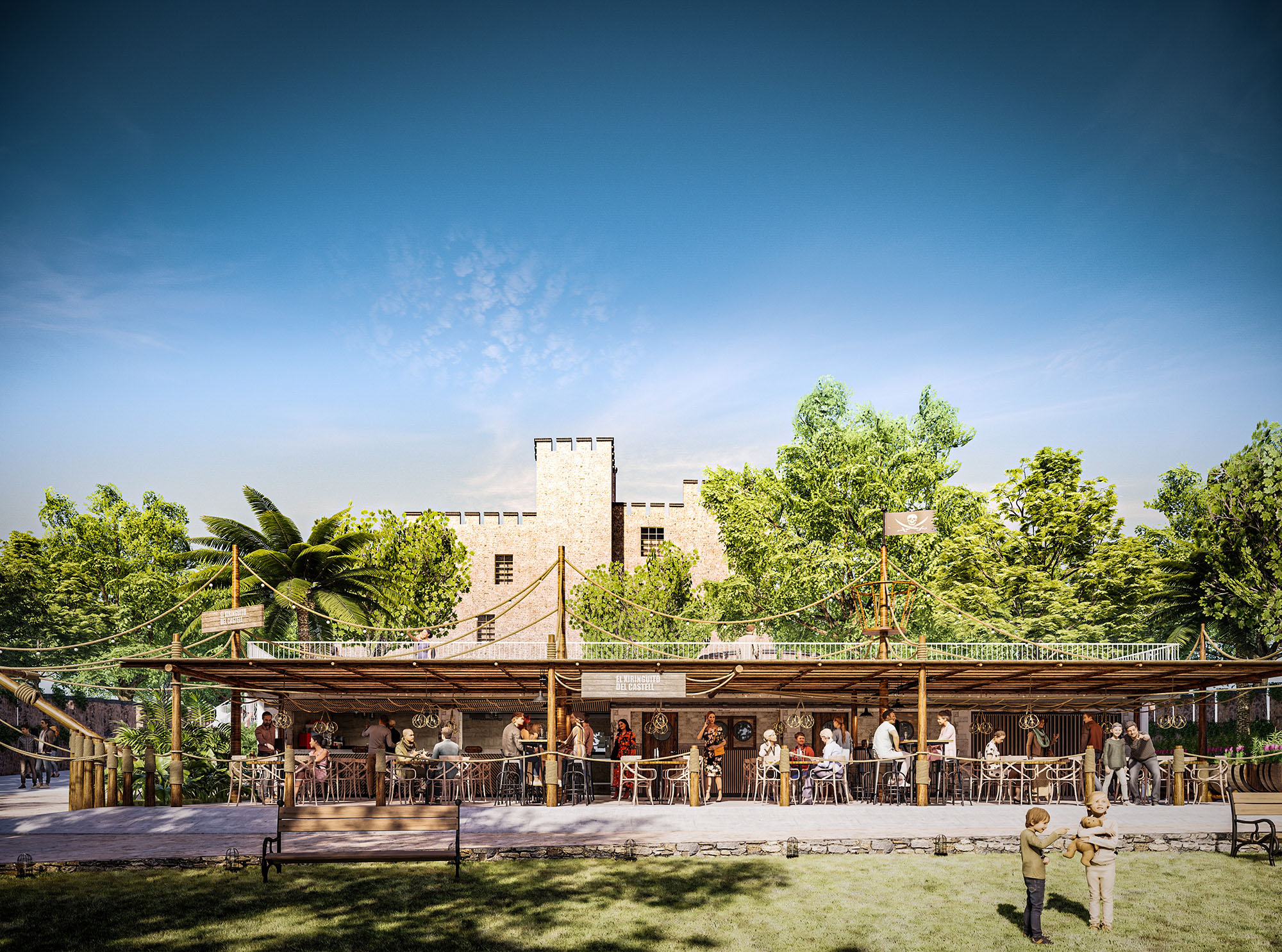
The spatial scheme is organized around a central linear bar that functions as both production core and social attractor. In front of it, an open dining area with flexible tables and high stools accommodates different group sizes and event formats. Circulation is clear and peripheral, enabling staff to move efficiently while guests enjoy unobstructed views of the garden and the stage-like bar.
Perimeter bays under the canopy house more intimate seating and standing areas, benefiting from the shade and the proximity to vegetation. The rear strip, leaning against the stone wall, integrates service spaces, storage and technical installations, all concealed behind a continuous cladding to maintain a unified façade. The rooftop deck, accessible via a light stair and rope railings, becomes a belvedere and symbolic “ship deck”, enhancing the experiential character of the venue.
The structural system is based on timber posts and beams, complemented by metal joints that guarantee durability while keeping all elements demountable. The roof uses light rafters and cane or reed latticework, creating a porous filter that modulates sunlight and generates dynamic shadows reminiscent of seaside pergolas.
Natural fibers, ropes and nautical hardware are used extensively, not only as decorative motifs but as functional elements for bracing, handrails and lighting supports. The chromatic palette is warm and earthy—browns, sands and off-whites—that harmonizes with the existing stone, the green canopy of trees and the ochre tones of the ground. At night, strings of small luminaires trace the “rigging” of the ship, reinforcing the festive but intimate atmosphere.
The interior bar counter combines textured plaster, ceramic tiling and timber to evoke traditional Mediterranean taverns while accommodating contemporary equipment. Open shelving and visible bottle displays contribute to an informal, approachable character. The furniture mix—wooden tables, director-style chairs and high stools—prioritizes comfort and adaptability, allowing rapid reconfiguration for concerts, talks or family gatherings.
The boundary between interior and exterior is intentionally blurred: there are no rigid façades, only a sequence of columns and low elements that maintain constant visual connectivity. Acoustic comfort is supported by the absorbent qualities of natural materials and the vegetation backdrop, creating an environment where conversation remains comfortable even at high occupancy.
Sustainability is approached through reversibility, material choice and passive environmental strategies. The entire system is conceived as a dry-assembled, demountable structure, minimizing ground intervention and allowing future re-use or reconfiguration with minimal waste. Foundations are lightweight and localized, reducing impact on the archaeological and landscape context.
The extensive use of certified timber, local stone and natural fiber coverings reduces embodied energy and facilitates end-of-life recycling. The open configuration maximizes cross-ventilation, while the deep overhangs and cane shading control solar gain, limiting the need for mechanical cooling. Low-consumption LED lighting, oriented downward and integrated into ropes and structural elements, cuts energy demand and respects the nocturnal environment. The project thus proposes a festive, seasonal facility that coexists responsibly with both the castle’s heritage and the surrounding ecosystem.


Nuestras oficinas están en Barcelona, Cancún, Chicago y Santo Domingo, pero gracias a la tecnología podemos desarrollar proyectos en cualquier parte del mundo.
Barcelona
Bac de Roda 136
08020, Barcelona
Spain
Madrid
Av. de Buendía 11
19005 Guadalajara (Madrid)
Spain
Chicago
373 Hazel Ave, Apt A1
60022, Glencoe, Illinois
United States