

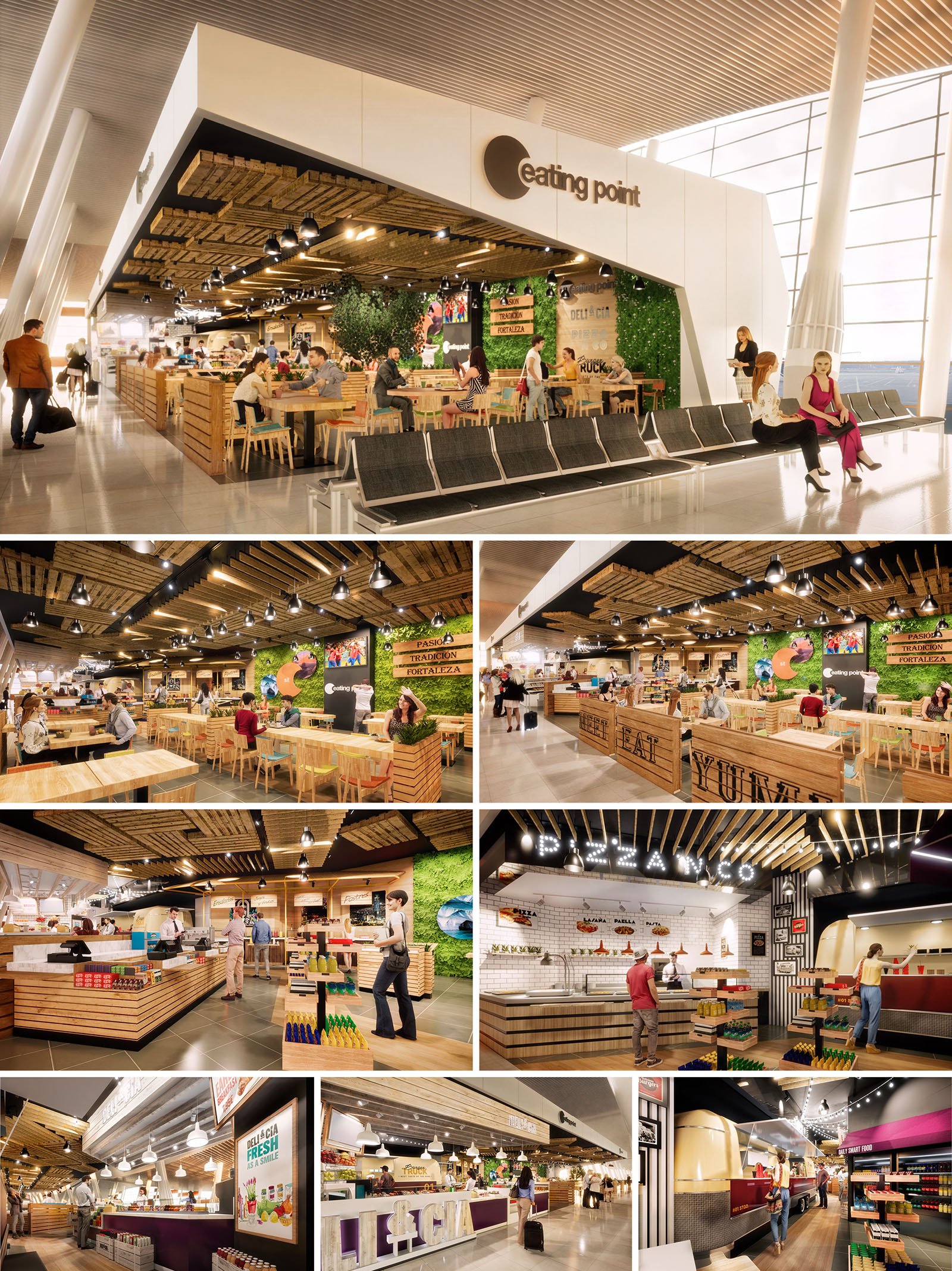
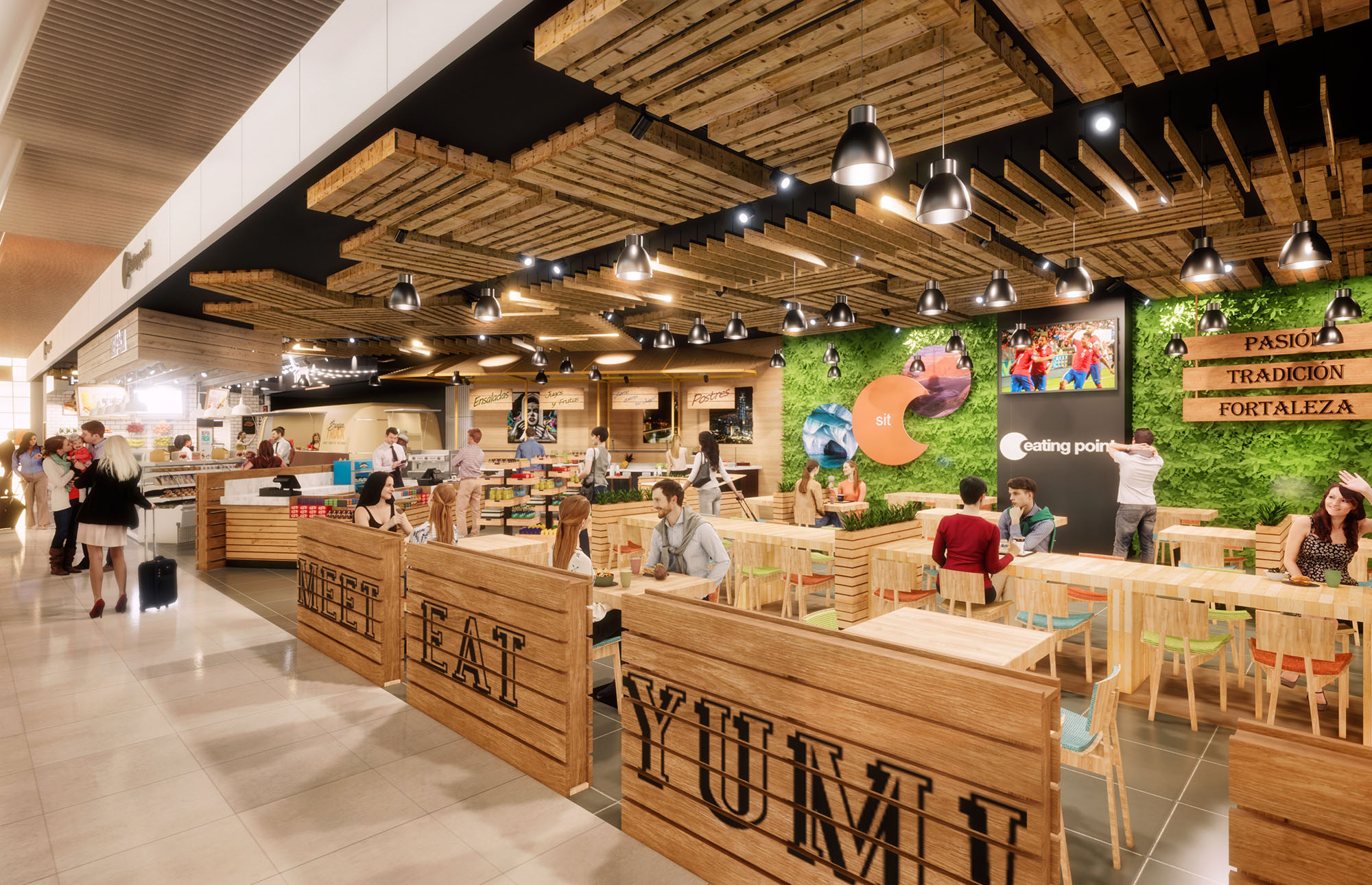
Eating Point is conceived as a contemporary food hall embedded within the fluid circulation of Santiago’s airport, acting as an urban plaza for travelers. The project dissolves the traditional boundary between concourse and restaurant, creating a porous threshold that invites passengers to enter, rest and eat without losing visual connection to the terminal. The design language combines market hall typologies with airport efficiency, resulting in a warm, vibrant destination that contrasts with the neutrality of the surrounding infrastructure.
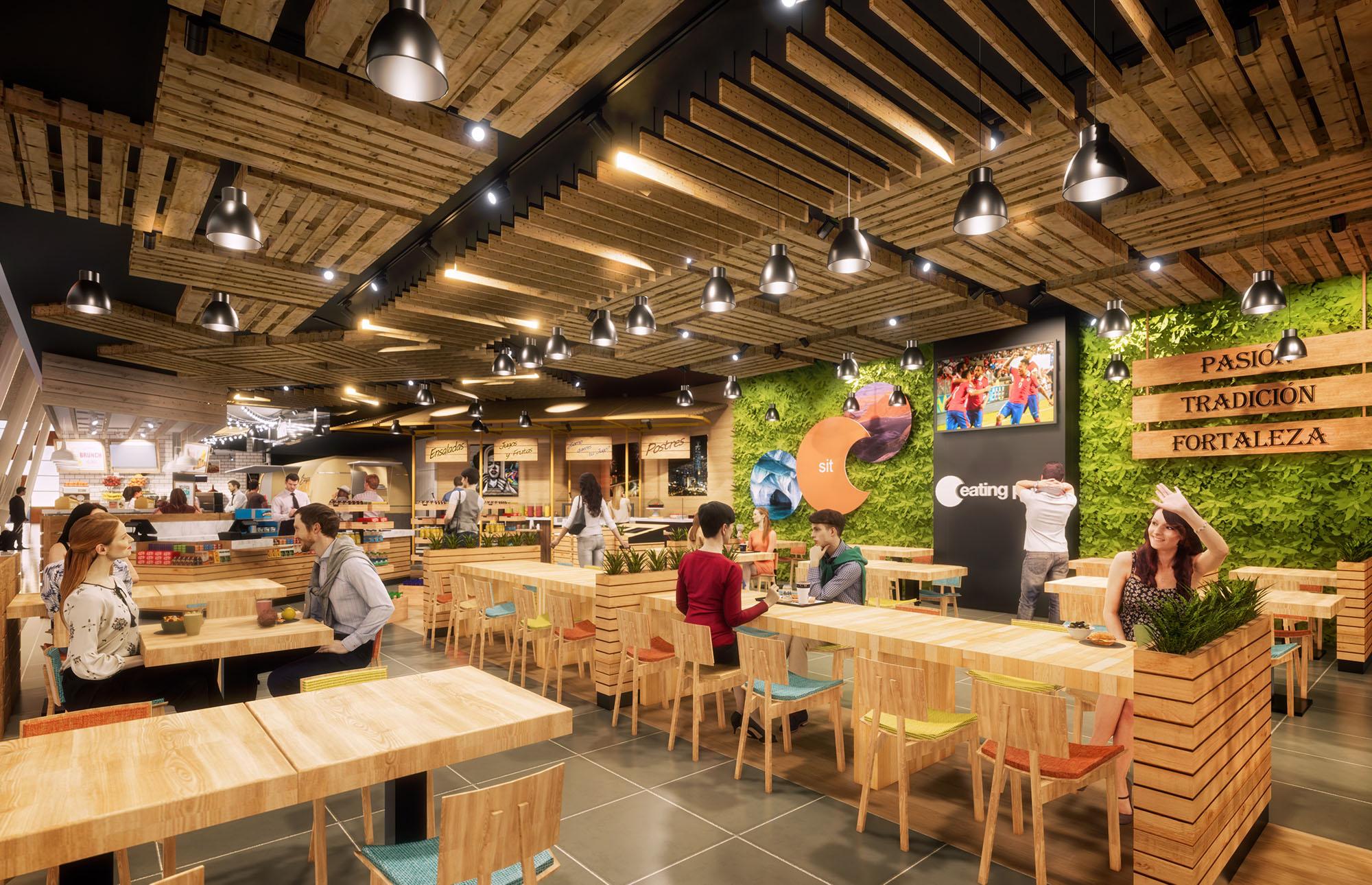
The overall composition is guided by a clear, floating frame that defines the perimeter and ceiling plane, while remaining visually light. Within this frame, a sequence of food stations, communal tables and intimate seating pockets is organized like stalls in a street market. Natural textures, graphic storytelling and carefully calibrated lighting transform the transient condition of travel into a more human, tactile experience.
The layout is radial and open, allowing multiple points of access from the concourse and ensuring unobstructed visual axes to the boarding gates. Central communal tables act as the spatial anchor, with individual brands and counters arranged around them as a ring of specialized kiosks. This configuration encourages cross-visibility between different offers and supports impulsive decision-making typical of airport users with limited time.
Circulation is structured through generous transversal aisles that avoid bottlenecks and allow for luggage movement. Low-height partitions, mostly in timber slats and planters, subtly define zones without blocking sightlines, supporting both wayfinding and security control. Peripheral bar counters activate the edges toward the terminal while maintaining a continuous façade of activity and light.
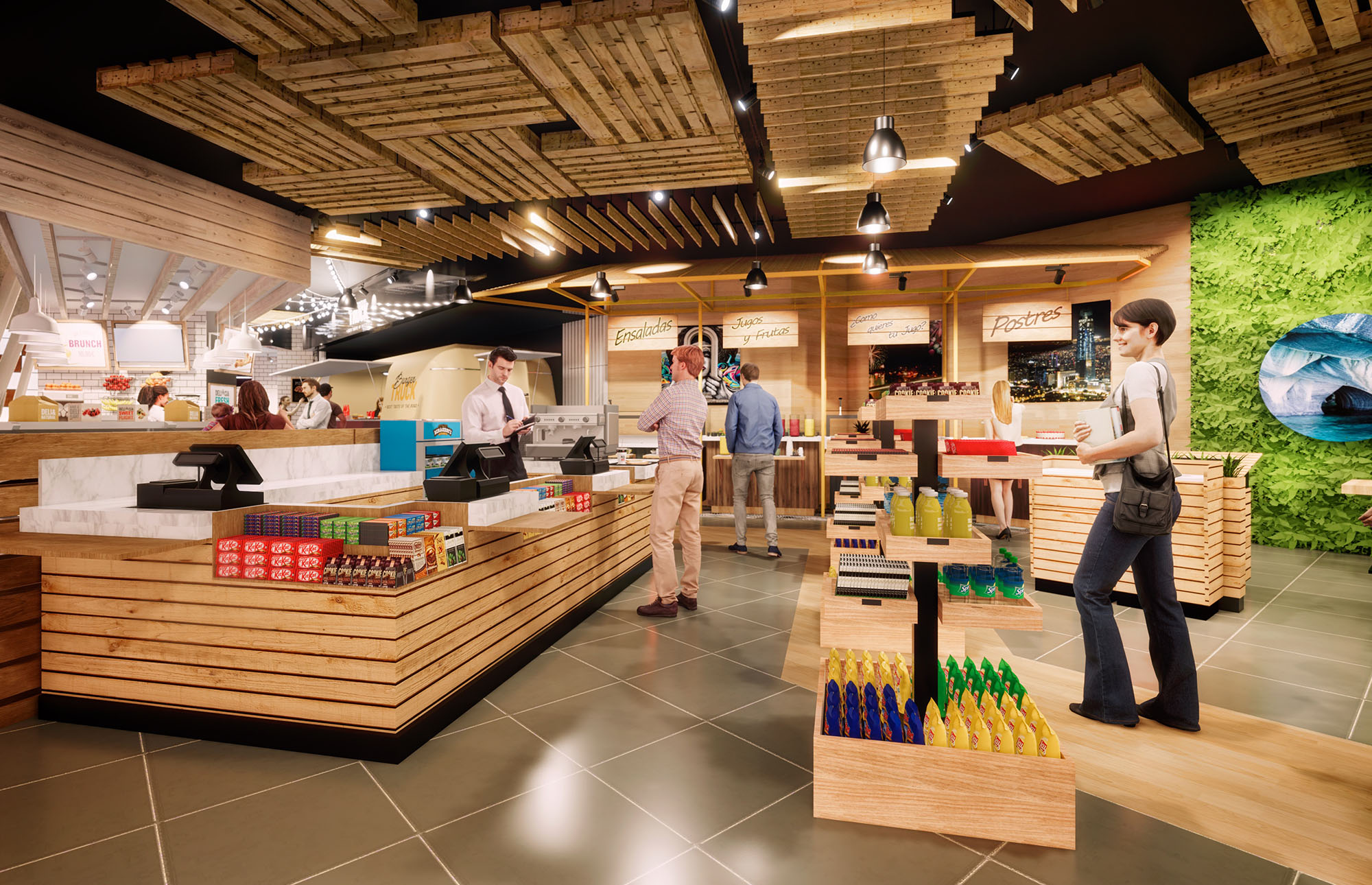
The material strategy juxtaposes the industrial character of the airport shell with a warm, crafted interior palette. The main elements are untreated or lightly stained pine slats, arranged horizontally in counters and vertically in screens, transmitting a sense of artisanal construction and flexibility. Timber is complemented by large-format porcelain floor tiles in neutral gray, ensuring durability and ease of maintenance under high traffic.
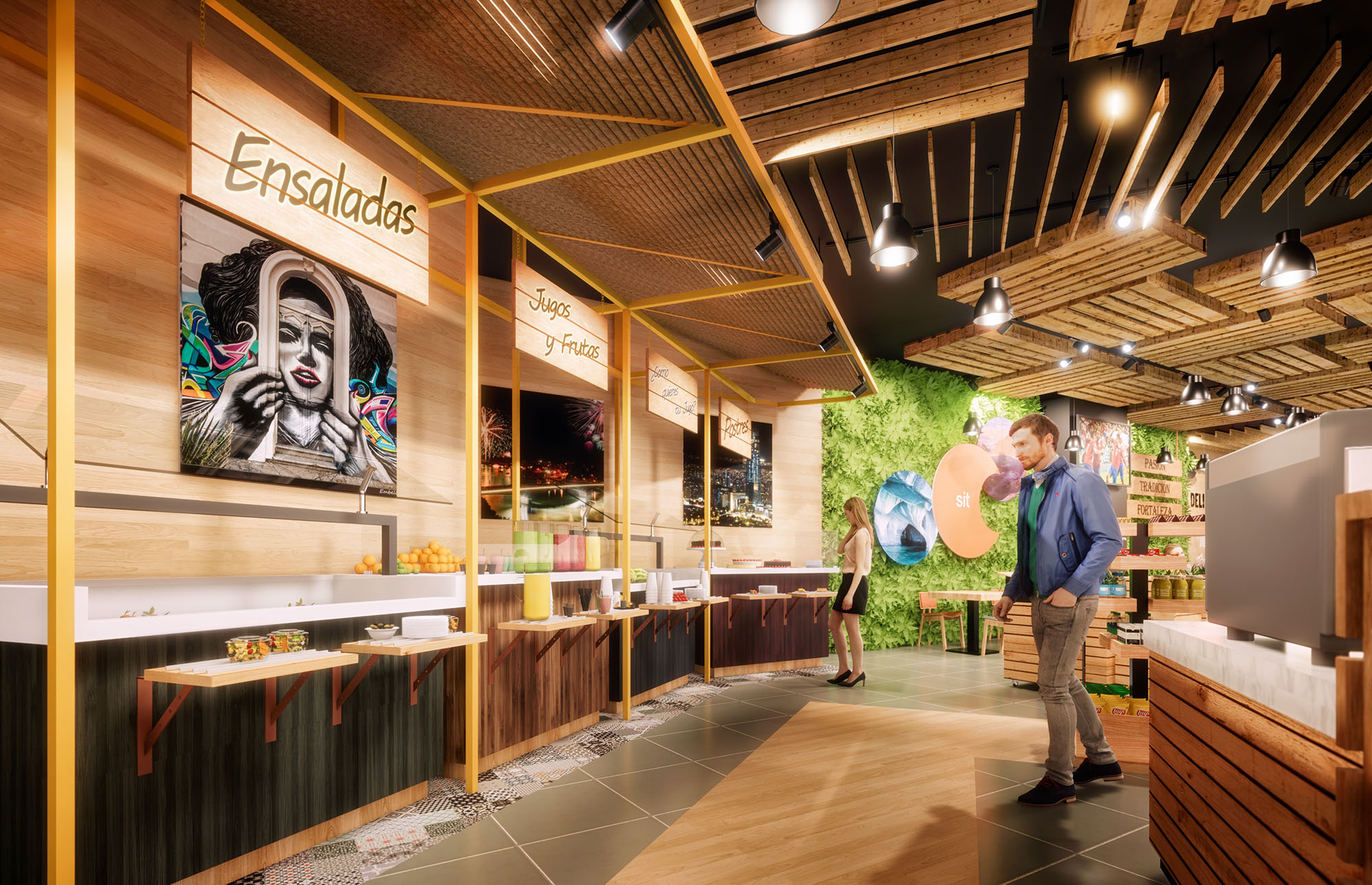
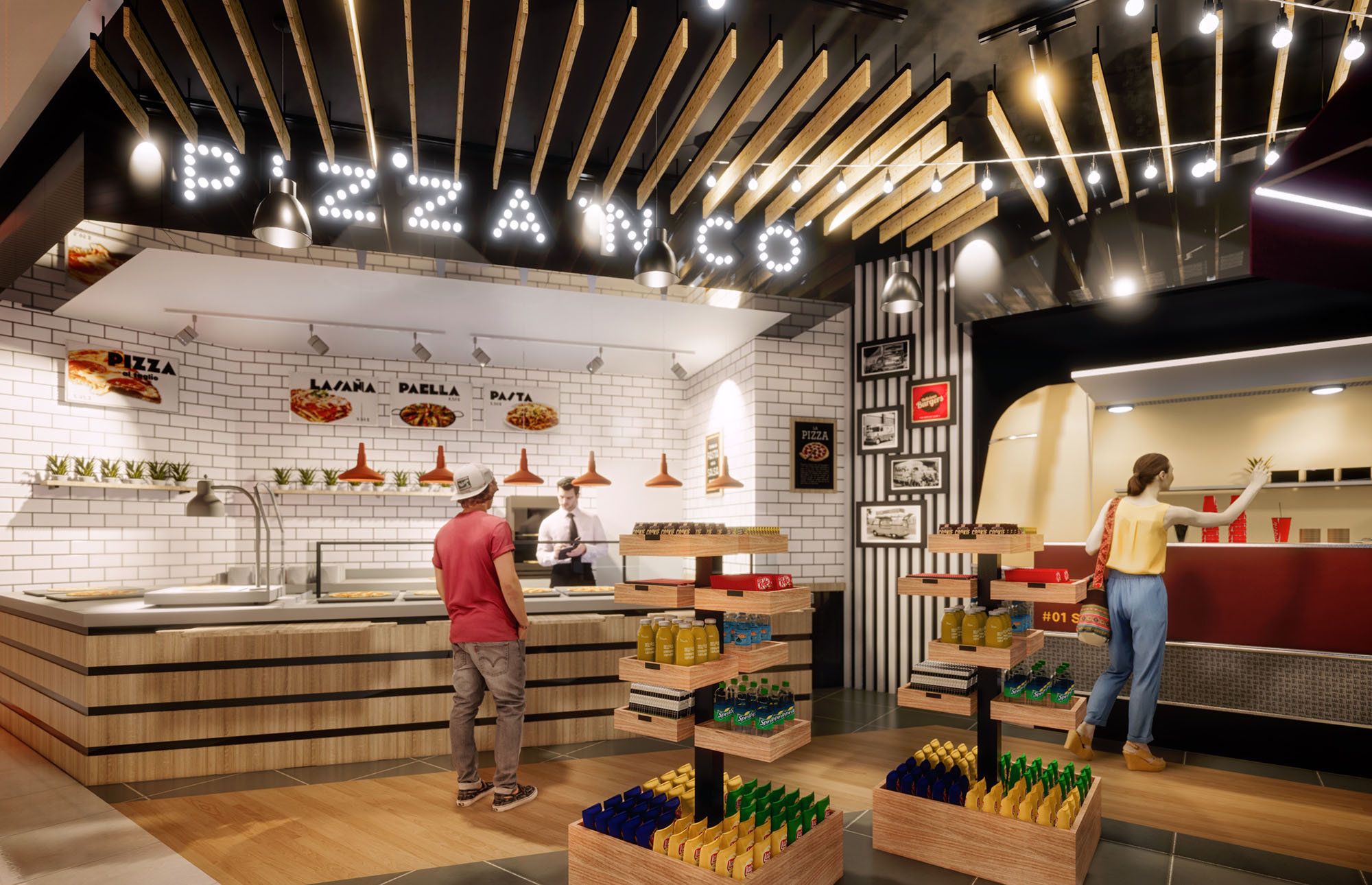
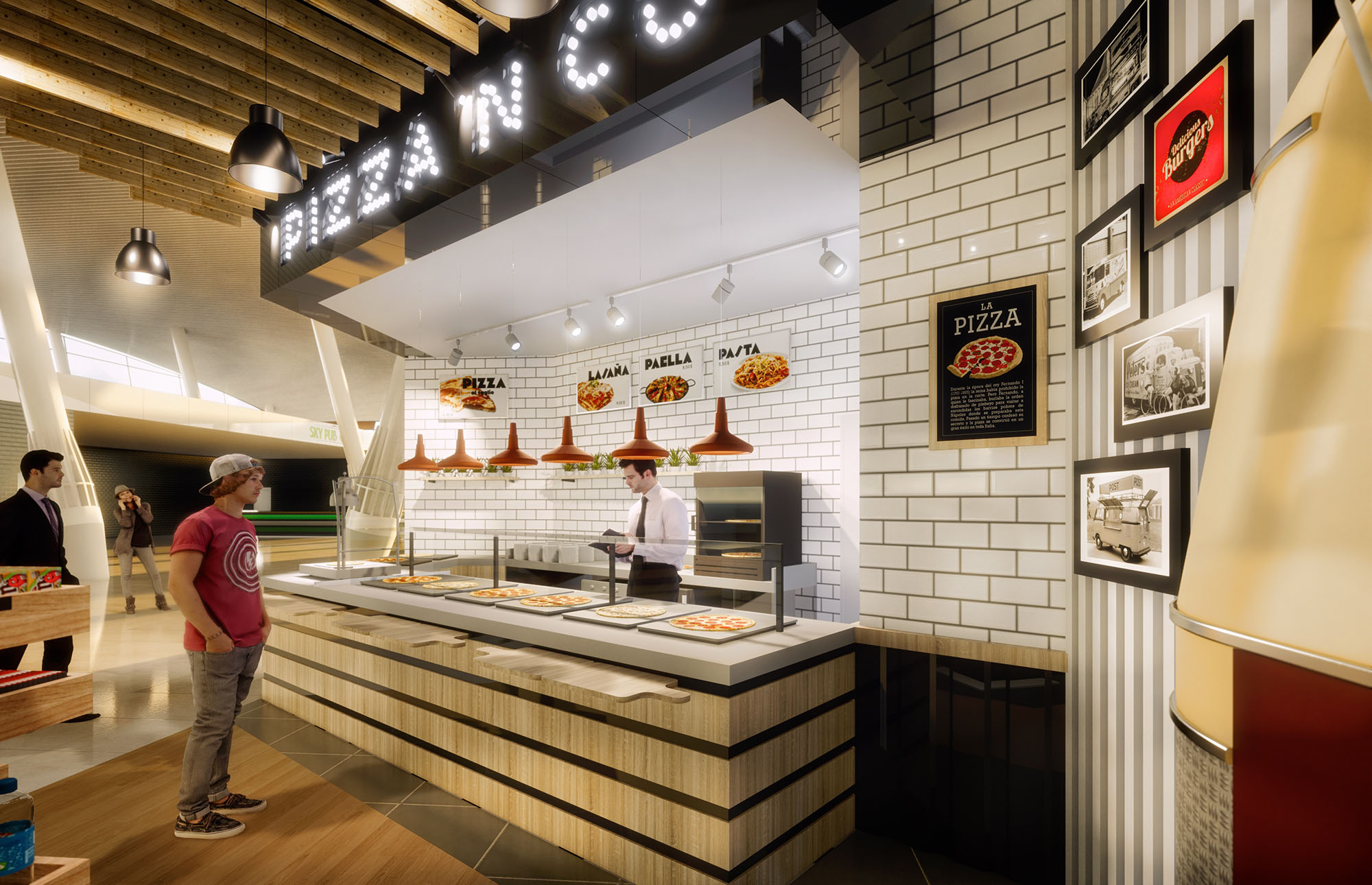
Color accents are introduced through vivid green vegetated walls, fresh produce graphics and brand-specific signage. White ceramic tiles at some food stations evoke traditional kitchens and reinforce the perception of hygiene. Black metal lighting tracks and fixtures add depth and visually compress the ceiling, creating a more intimate scale beneath the airport’s vast structural roof.
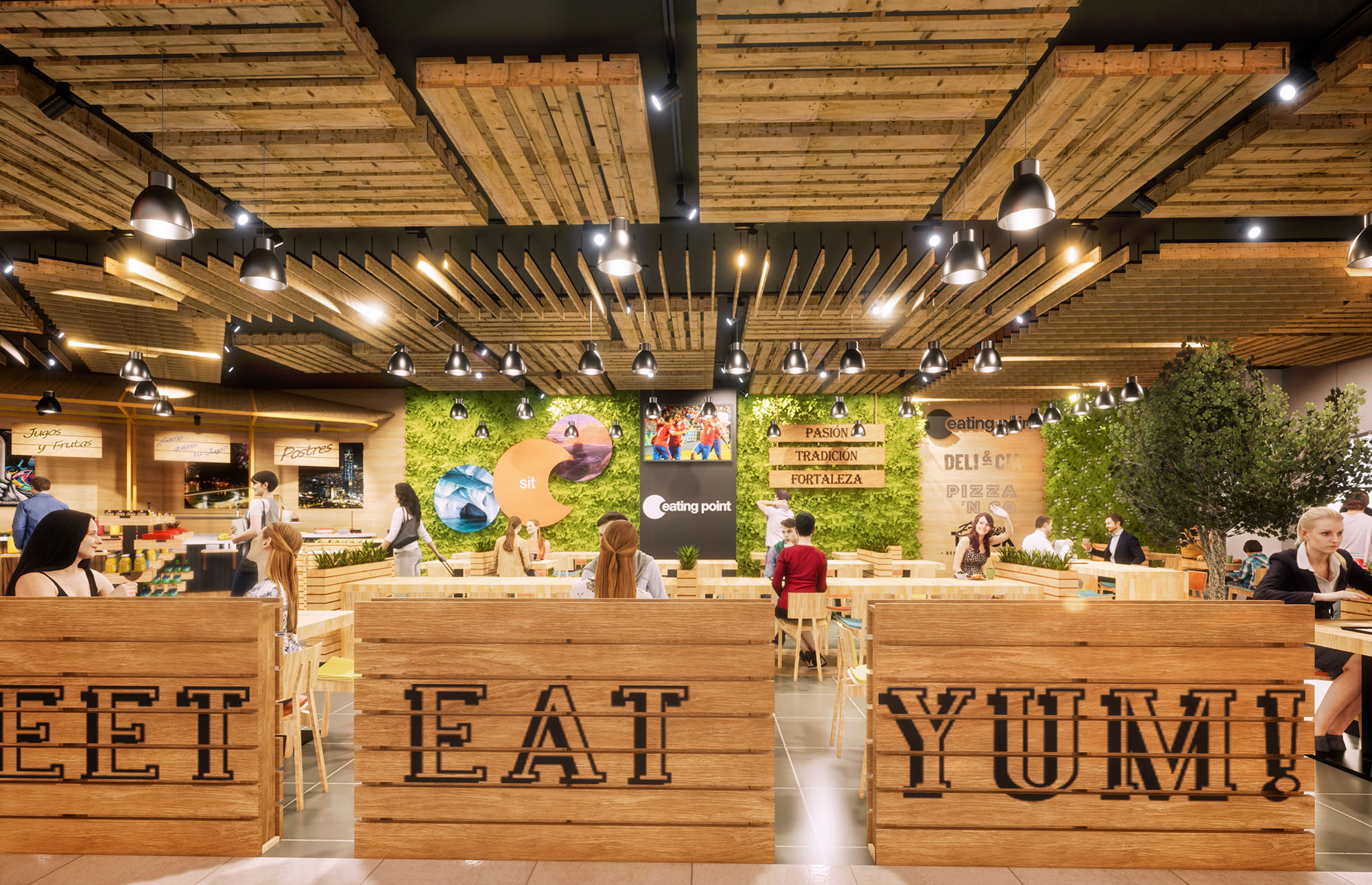
The ceiling is a key atmospheric device, composed of staggered timber palettes and slatted panels that float below the terminal soffit. This layer conceals technical installations, integrates acoustic absorption and visually unifies the diverse food concepts. The irregular geometry breaks the linearity of the concourse, generating a more informal and domestic ambiance.
Lighting is predominantly warm-white, delivered through suspended spotlights and integrated linear LEDs. Accent beams highlight counters, menus and vertical gardens, while softer diffuse light over seating enhances comfort and facial recognition. The contrast between the bright, cooler airport hall and the warmer interior reinforces Eating Point as a haven within the travel sequence.
Furniture is designed with robustness and modularity in mind. Solid wood tables of varying lengths support flexible occupancy, from solo travelers to large groups. High stools and bar-height counters accommodate quick consumption, while standard-height communal tables invite longer stays. Simple geometries and open bases facilitate cleaning and luggage placement.
Branding is integrated architecturally rather than applied superficially. Laser-cut lettering, crate-style graphics and illuminated signs are embedded into the timber structures, generating a cohesive visual narrative of freshness and craft. Product displays function both as merchandising and as spatial dividers, contributing to the sensation of an active market.
The project emphasizes low-impact materials and operational efficiency suitable for a 24/7 airport context. The extensive use of locally sourced softwood reduces embodied energy and supports regional forestry industries. Repetition of standardized timber modules minimizes waste during fabrication and allows future reconfiguration or recycling of components.
Vertical gardens and planted elements contribute to indoor air quality and psychological comfort, introducing biophilic cues in a predominantly artificial environment. LED lighting with high energy efficiency and zoning controls reduces consumption while enabling different scenes according to passenger flows and day–night cycles. The open, naturally ventilated interface with the concourse avoids additional enclosure systems, decreasing HVAC loads and reinforcing the sense of a shared, public interior landscape.
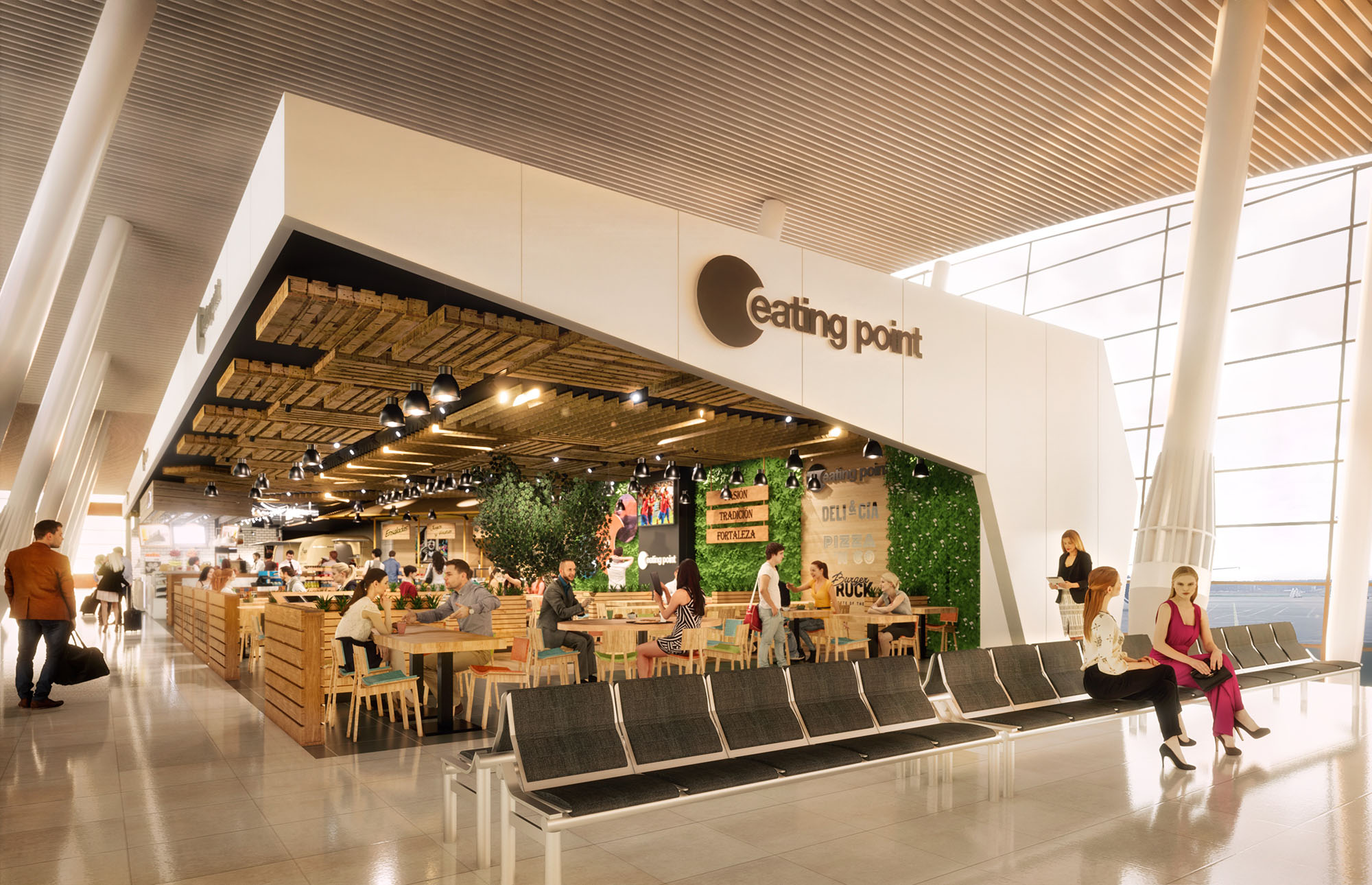
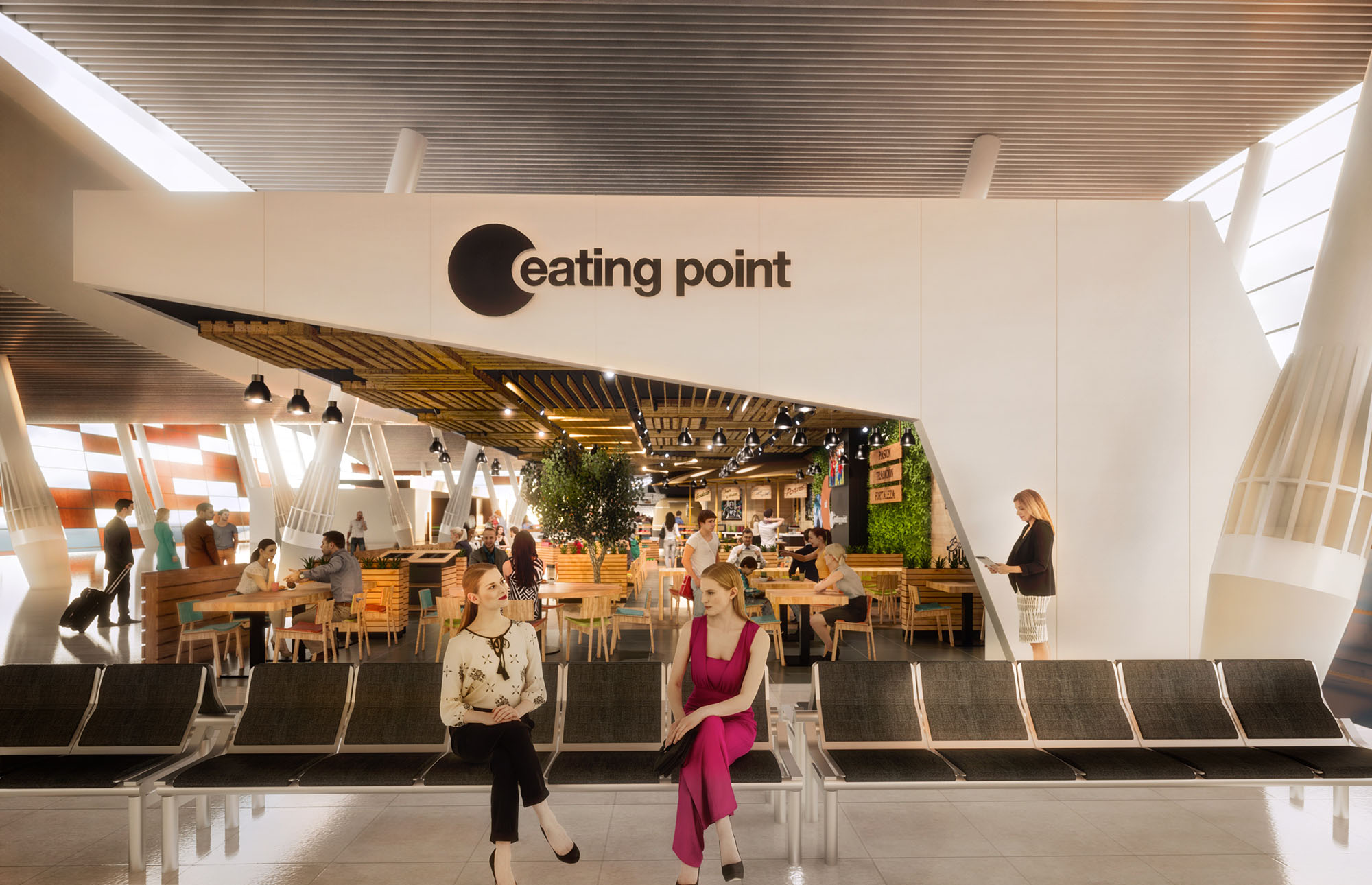
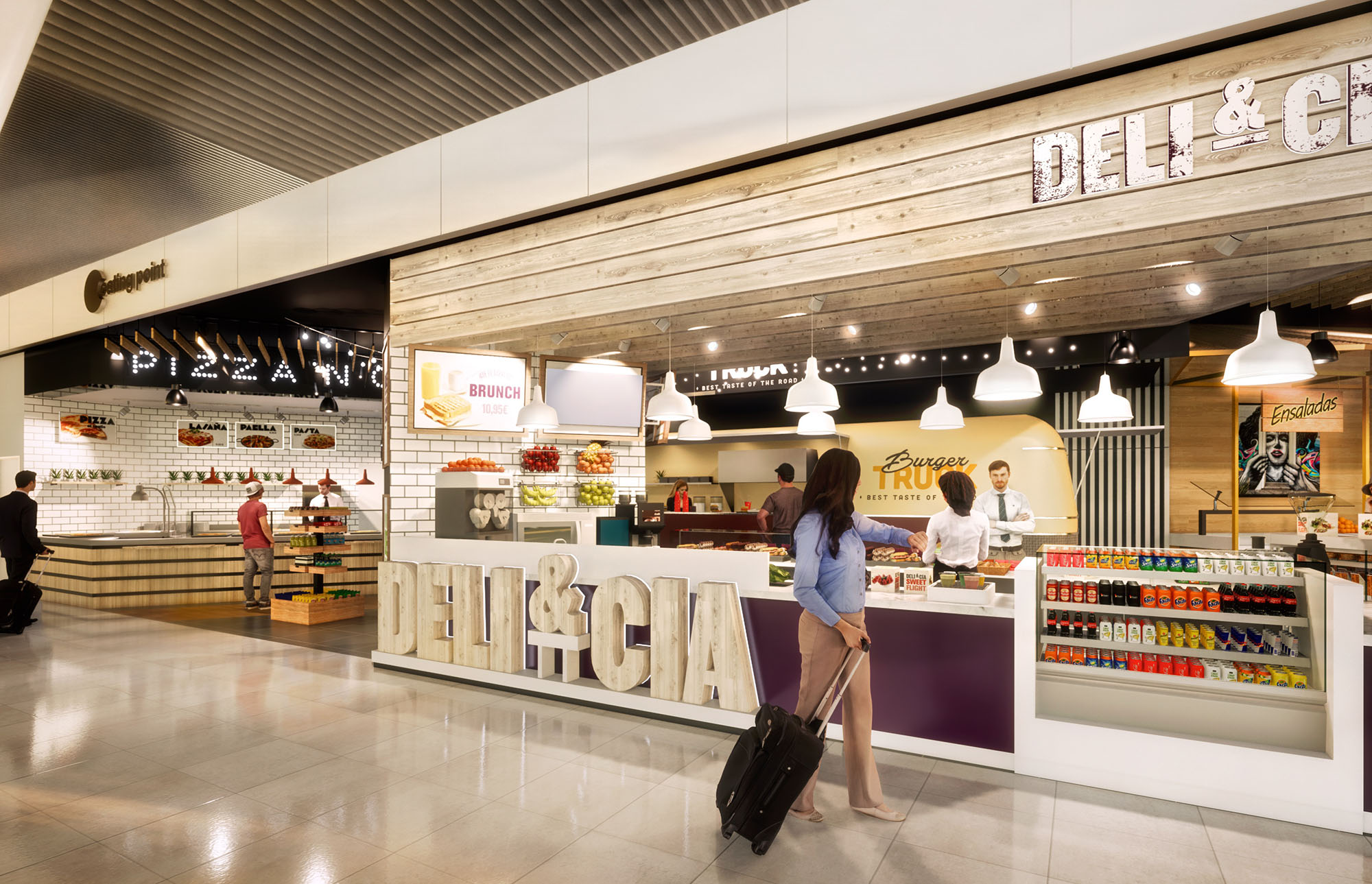
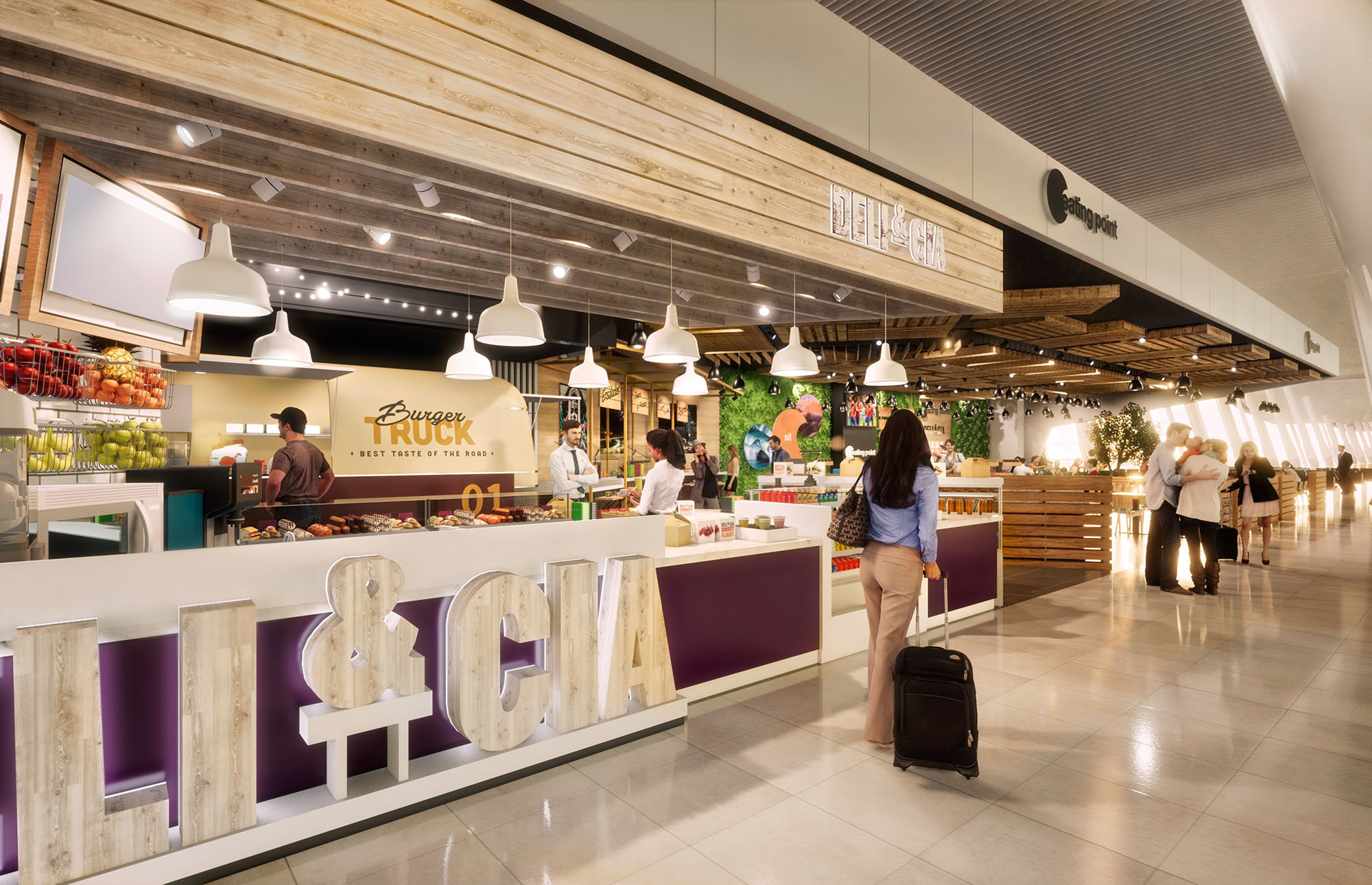
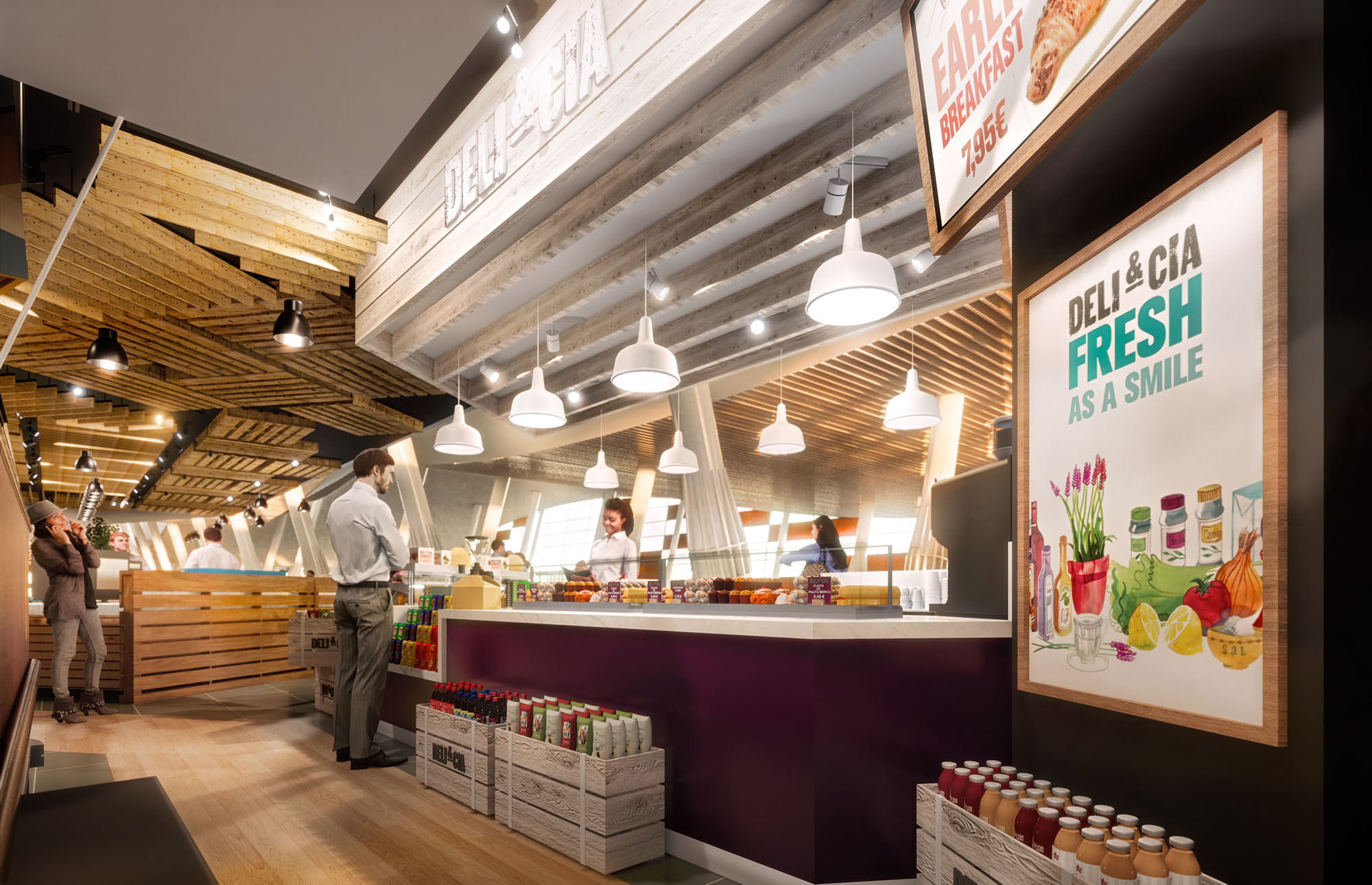
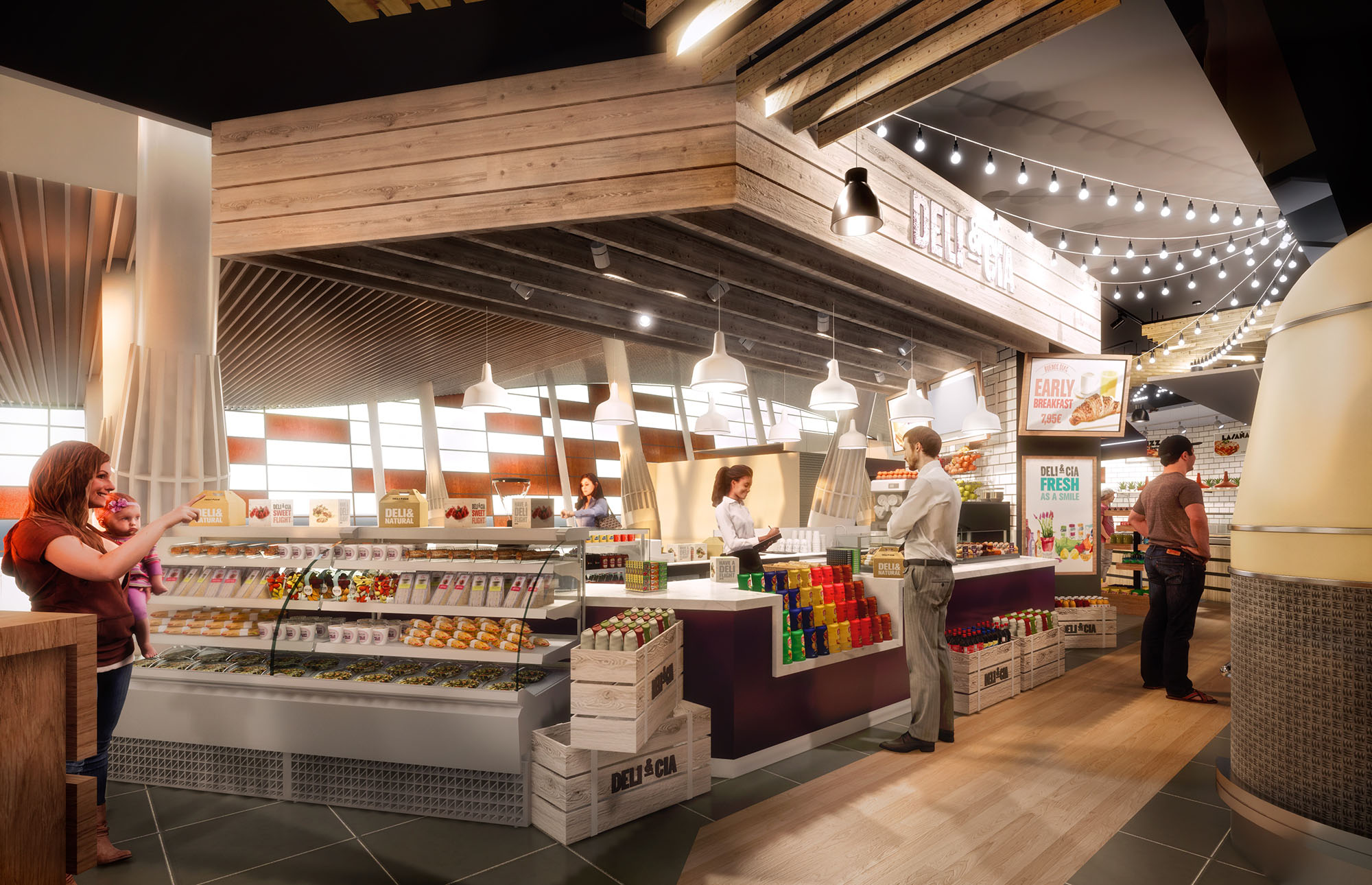
Eating Point is conceived as a contemporary food hall embedded within the fluid circulation of Santiago’s airport, acting as an urban plaza for travelers. The project dissolves the traditional boundary between concourse and restaurant, creating a porous threshold that invites passengers to enter, rest and eat without losing visual connection to the terminal. The design language combines market hall typologies with airport efficiency, resulting in a warm, vibrant destination that contrasts with the neutrality of the surrounding infrastructure.
The overall composition is guided by a clear, floating frame that defines the perimeter and ceiling plane, while remaining visually light. Within this frame, a sequence of food stations, communal tables and intimate seating pockets is organized like stalls in a street market. Natural textures, graphic storytelling and carefully calibrated lighting transform the transient condition of travel into a more human, tactile experience.
The layout is radial and open, allowing multiple points of access from the concourse and ensuring unobstructed visual axes to the boarding gates. Central communal tables act as the spatial anchor, with individual brands and counters arranged around them as a ring of specialized kiosks. This configuration encourages cross-visibility between different offers and supports impulsive decision-making typical of airport users with limited time.
Circulation is structured through generous transversal aisles that avoid bottlenecks and allow for luggage movement. Low-height partitions, mostly in timber slats and planters, subtly define zones without blocking sightlines, supporting both wayfinding and security control. Peripheral bar counters activate the edges toward the terminal while maintaining a continuous façade of activity and light.
The material strategy juxtaposes the industrial character of the airport shell with a warm, crafted interior palette. The main elements are untreated or lightly stained pine slats, arranged horizontally in counters and vertically in screens, transmitting a sense of artisanal construction and flexibility. Timber is complemented by large-format porcelain floor tiles in neutral gray, ensuring durability and ease of maintenance under high traffic.
Color accents are introduced through vivid green vegetated walls, fresh produce graphics and brand-specific signage. White ceramic tiles at some food stations evoke traditional kitchens and reinforce the perception of hygiene. Black metal lighting tracks and fixtures add depth and visually compress the ceiling, creating a more intimate scale beneath the airport’s vast structural roof.
The ceiling is a key atmospheric device, composed of staggered timber palettes and slatted panels that float below the terminal soffit. This layer conceals technical installations, integrates acoustic absorption and visually unifies the diverse food concepts. The irregular geometry breaks the linearity of the concourse, generating a more informal and domestic ambiance.
Lighting is predominantly warm-white, delivered through suspended spotlights and integrated linear LEDs. Accent beams highlight counters, menus and vertical gardens, while softer diffuse light over seating enhances comfort and facial recognition. The contrast between the bright, cooler airport hall and the warmer interior reinforces Eating Point as a haven within the travel sequence.
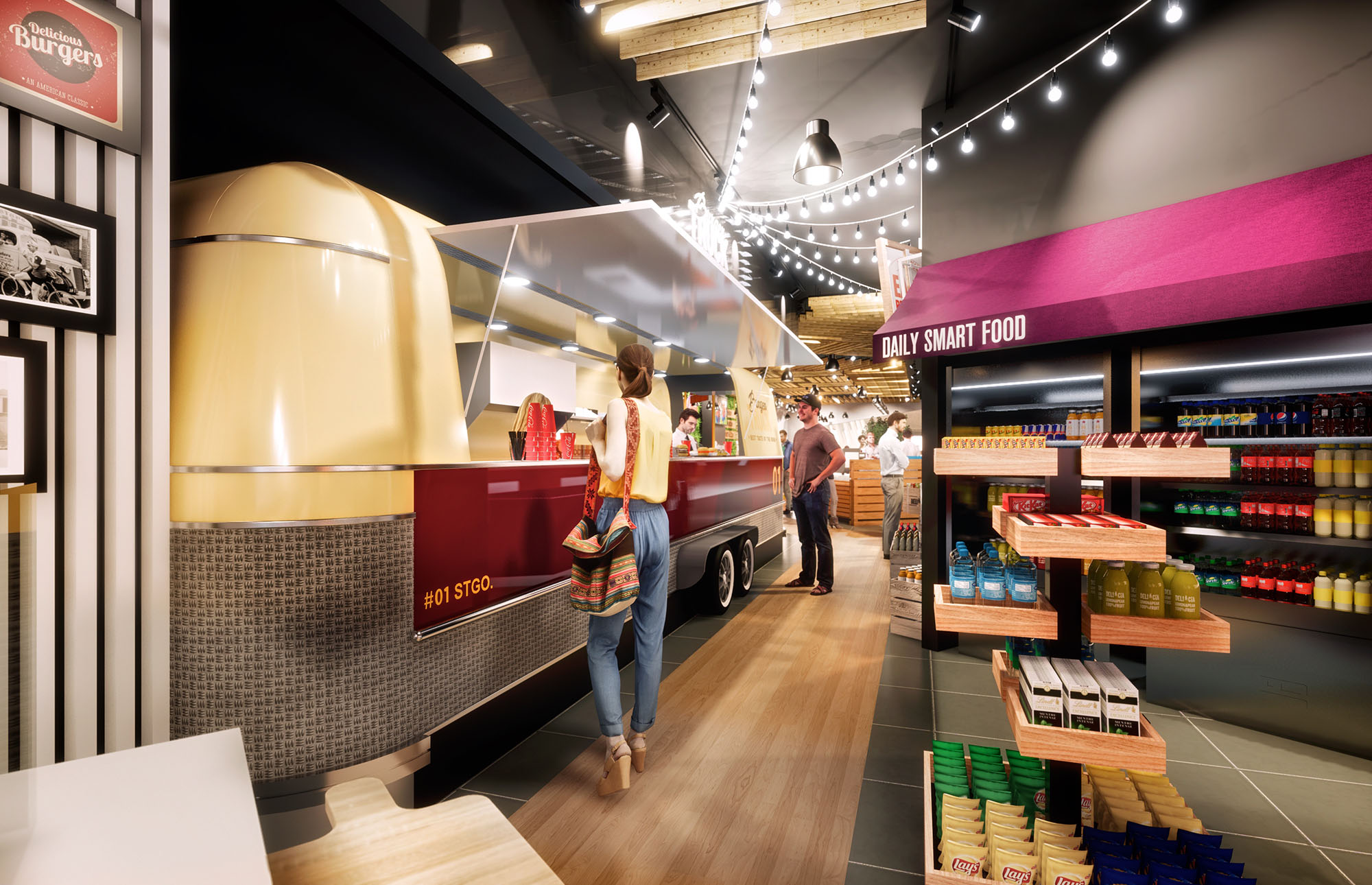
Furniture is designed with robustness and modularity in mind. Solid wood tables of varying lengths support flexible occupancy, from solo travelers to large groups. High stools and bar-height counters accommodate quick consumption, while standard-height communal tables invite longer stays. Simple geometries and open bases facilitate cleaning and luggage placement.
Branding is integrated architecturally rather than applied superficially. Laser-cut lettering, crate-style graphics and illuminated signs are embedded into the timber structures, generating a cohesive visual narrative of freshness and craft. Product displays function both as merchandising and as spatial dividers, contributing to the sensation of an active market.
The project emphasizes low-impact materials and operational efficiency suitable for a 24/7 airport context. The extensive use of locally sourced softwood reduces embodied energy and supports regional forestry industries. Repetition of standardized timber modules minimizes waste during fabrication and allows future reconfiguration or recycling of components.
Vertical gardens and planted elements contribute to indoor air quality and psychological comfort, introducing biophilic cues in a predominantly artificial environment. LED lighting with high energy efficiency and zoning controls reduces consumption while enabling different scenes according to passenger flows and day–night cycles. The open, naturally ventilated interface with the concourse avoids additional enclosure systems, decreasing HVAC loads and reinforcing the sense of a shared, public interior landscape.


Nuestras oficinas están en Barcelona, Cancún, Chicago y Santo Domingo, pero gracias a la tecnología podemos desarrollar proyectos en cualquier parte del mundo.
Barcelona
Bac de Roda 136
08020, Barcelona
Spain
Madrid
Av. de Buendía 11
19005 Guadalajara (Madrid)
Spain
Chicago
373 Hazel Ave, Apt A1
60022, Glencoe, Illinois
United States