

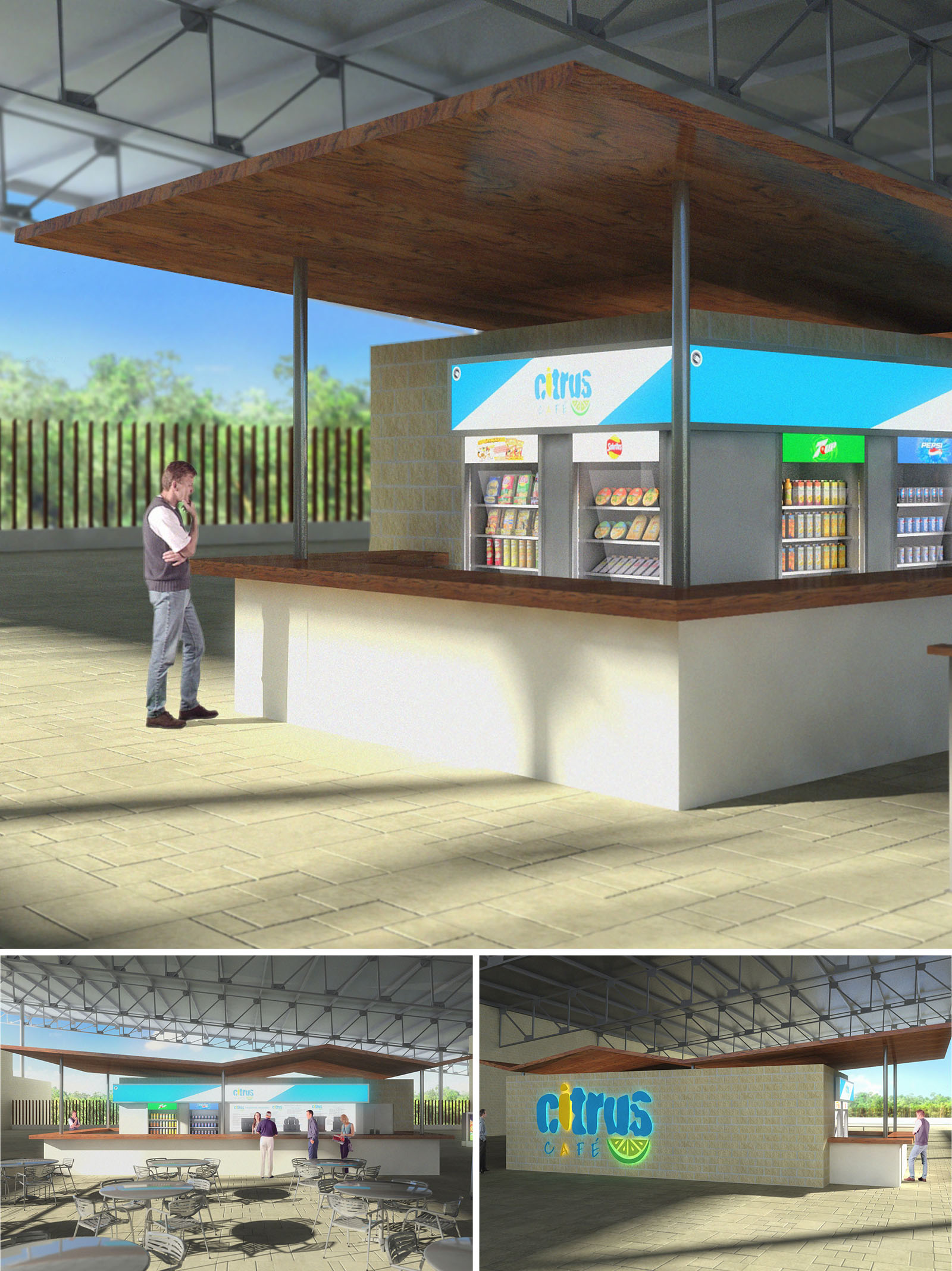
Citrus Café Albatros is conceived as a light, open-air pavilion that complements the tropical climate of Cancún while providing a vibrant and efficient food and beverage point. The design emphasizes horizontality, clean lines and an honest expression of structure, creating a contemporary kiosk that sits comfortably within a resort or campus environment. The café becomes both a functional node and a visual landmark, using branding, color and material contrast to guide users intuitively.
The concept draws on the freshness associated with citrus fruits: clarity, brightness and simplicity. This is translated into an architecture of few elements, where a floating wooden plane, a solid service bar and a continuous canopy define the space. The translucent, luminous signage band wraps the volume and reinforces the identity of the café, making it recognizable from a distance.
The café is organized as a central service core surrounded by a generous perimeter counter. This 360-degree layout optimizes service capacity and allows staff to address different flows of users, from quick takeaway customers to guests remaining in the adjacent seating area. The core houses refrigerated displays, snack shelves and preparation zones, kept compact to reduce circulation distances and improve operational efficiency.
The dining area extends outwards under a higher steel roof, with lightweight furniture arranged in a flexible grid that can adapt to different group sizes. Visual permeability is maintained in all directions, enhancing security and comfort. The surrounding vertical elements—such as the linear wooden fence and low masonry walls—frame the views toward the landscape without blocking natural ventilation.
The project combines three primary material families: warm wood, neutral masonry and light metal. The floating canopy and the countertop are finished in a rich wood tone that introduces warmth and tactility, offsetting the industrial character of the steel roof and structure. The service base is rendered in a light, almost white finish, reflecting sunlight and highlighting the cleanliness required in a food environment.
The color palette is anchored by the café’s branding band in turquoise and citrus green, which runs along the perimeter of the core and acts as a luminous frieze. This vivid element contrasts with the beige textured masonry wall, which adds depth and a sense of permanence. The overall result is a fresh, contemporary aesthetic that resonates with the beachside context of Cancún.
The kiosk is sheltered by a larger steel roof supported by a visible truss system, intentionally left exposed to communicate the constructive logic of the building. Beneath this, the thinner wooden canopy appears to float, supported by slender metal posts that minimize visual obstruction. This double-roof strategy creates intermediate shaded zones and allows hot air to rise and dissipate, improving thermal comfort without full enclosure.
Daylighting is the primary source of illumination during daytime, with the open perimeter maximizing cross-ventilation and reducing the need for mechanical cooling. At night, integrated linear lighting behind the signage panel and discreet under-counter fixtures provide uniform, glare-free light that enhances the café’s presence while maintaining energy efficiency.
The open-air configuration capitalizes on Cancún’s climate by prioritizing natural ventilation and shade over air-conditioned space, significantly reducing energy consumption. The elevated, lightweight roof system is designed to reflect solar radiation while allowing wind to circulate freely, mitigating heat gain on the occupied level. The high albedo flooring further reduces thermal absorption and contributes to user comfort.
Material selection favors durability in a coastal environment: treated wood, corrosion-resistant steel and masonry with low maintenance requirements ensure longevity and reduce the environmental impact of frequent replacements. The modular arrangement of equipment and furniture allows for phased upgrades and adaptation, extending the life cycle of the café. Together, these strategies anchor Citrus Café Albatros as a sustainable, context-sensitive intervention within its tropical setting.
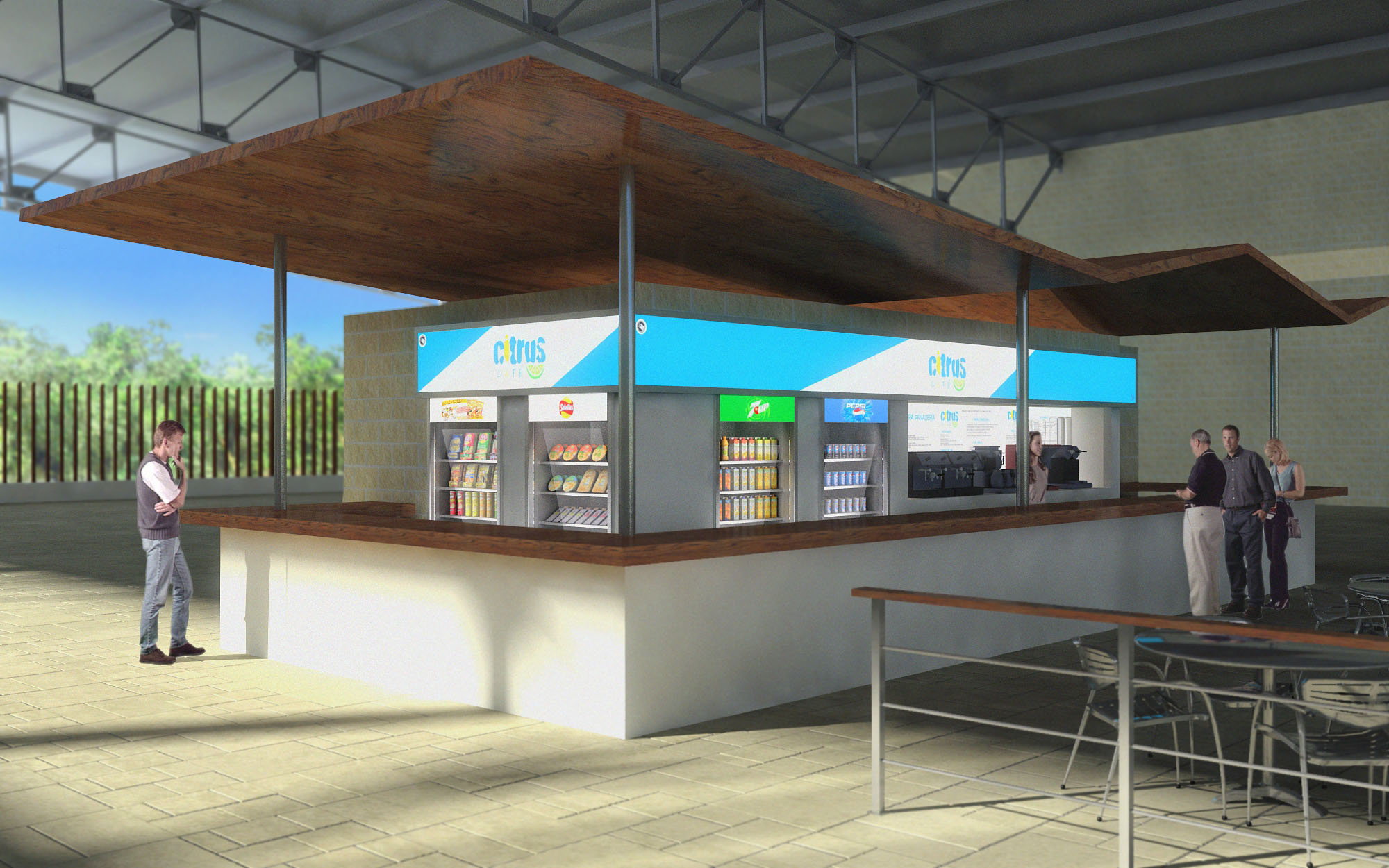
Citrus Café Albatros is conceived as a light, open-air pavilion that complements the tropical climate of Cancún while providing a vibrant and efficient food and beverage point. The design emphasizes horizontality, clean lines and an honest expression of structure, creating a contemporary kiosk that sits comfortably within a resort or campus environment. The café becomes both a functional node and a visual landmark, using branding, color and material contrast to guide users intuitively.
The concept draws on the freshness associated with citrus fruits: clarity, brightness and simplicity. This is translated into an architecture of few elements, where a floating wooden plane, a solid service bar and a continuous canopy define the space. The translucent, luminous signage band wraps the volume and reinforces the identity of the café, making it recognizable from a distance.
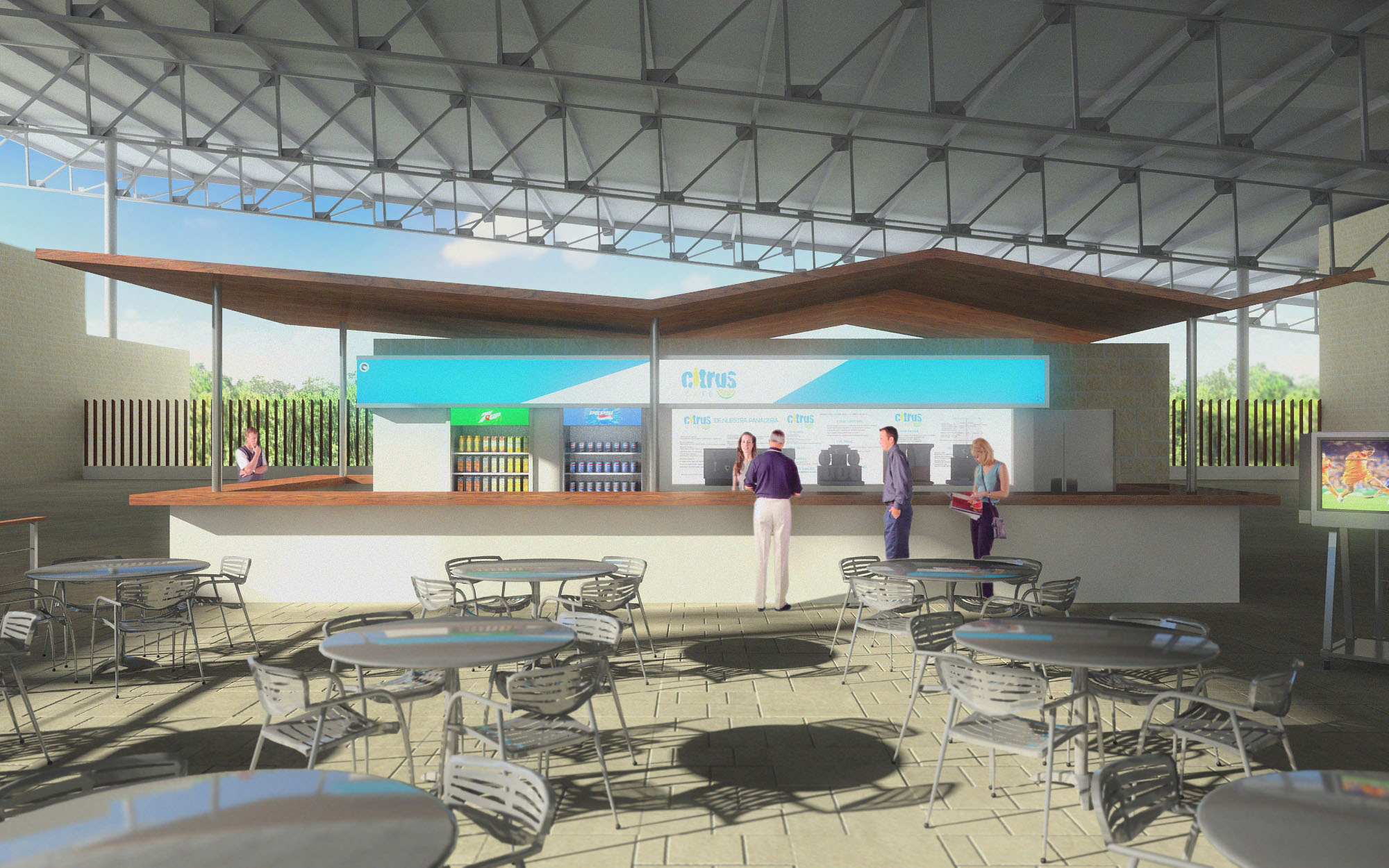
The café is organized as a central service core surrounded by a generous perimeter counter. This 360-degree layout optimizes service capacity and allows staff to address different flows of users, from quick takeaway customers to guests remaining in the adjacent seating area. The core houses refrigerated displays, snack shelves and preparation zones, kept compact to reduce circulation distances and improve operational efficiency.
The dining area extends outwards under a higher steel roof, with lightweight furniture arranged in a flexible grid that can adapt to different group sizes. Visual permeability is maintained in all directions, enhancing security and comfort. The surrounding vertical elements—such as the linear wooden fence and low masonry walls—frame the views toward the landscape without blocking natural ventilation.
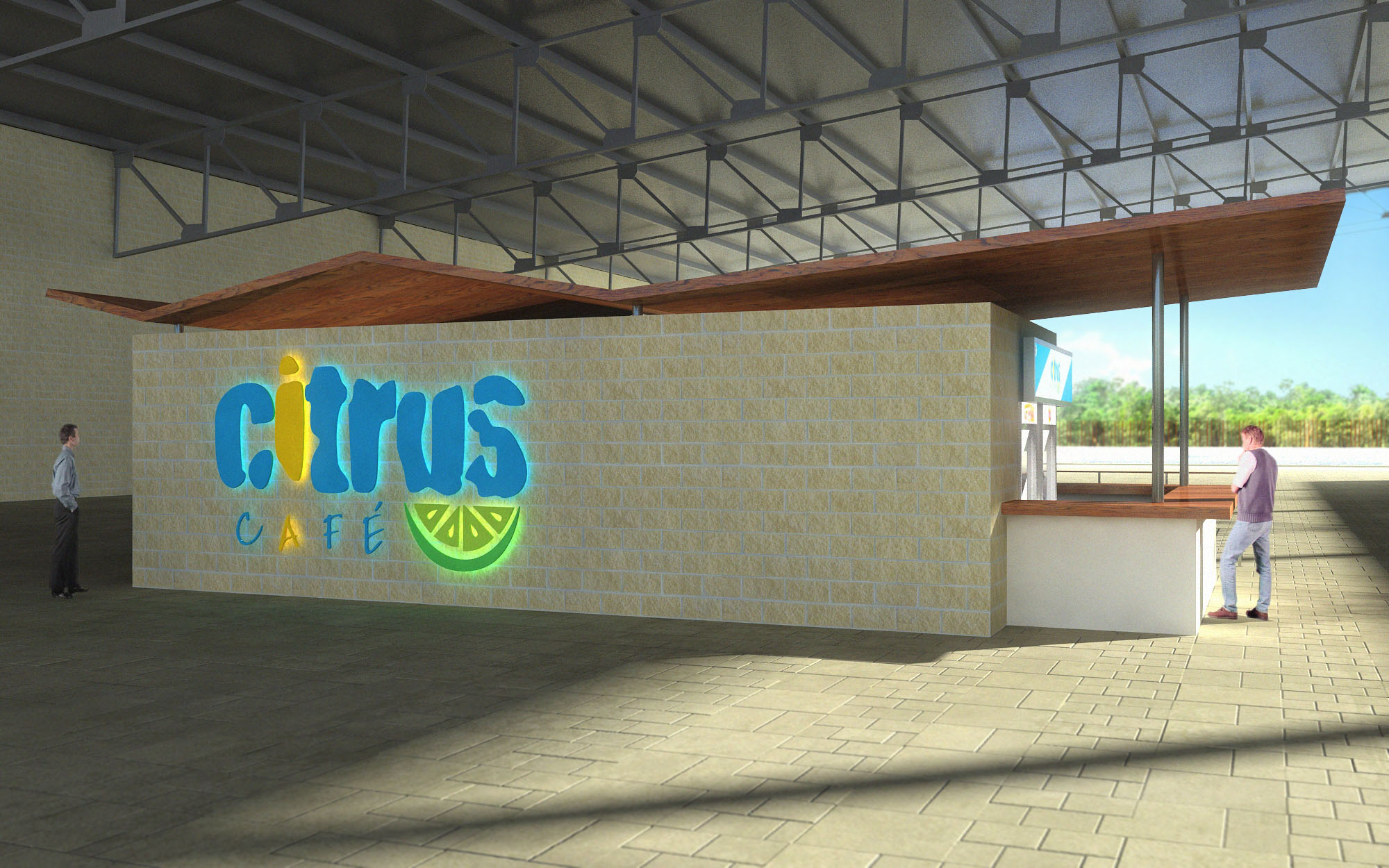
The project combines three primary material families: warm wood, neutral masonry and light metal. The floating canopy and the countertop are finished in a rich wood tone that introduces warmth and tactility, offsetting the industrial character of the steel roof and structure. The service base is rendered in a light, almost white finish, reflecting sunlight and highlighting the cleanliness required in a food environment.
The color palette is anchored by the café’s branding band in turquoise and citrus green, which runs along the perimeter of the core and acts as a luminous frieze. This vivid element contrasts with the beige textured masonry wall, which adds depth and a sense of permanence. The overall result is a fresh, contemporary aesthetic that resonates with the beachside context of Cancún.
The kiosk is sheltered by a larger steel roof supported by a visible truss system, intentionally left exposed to communicate the constructive logic of the building. Beneath this, the thinner wooden canopy appears to float, supported by slender metal posts that minimize visual obstruction. This double-roof strategy creates intermediate shaded zones and allows hot air to rise and dissipate, improving thermal comfort without full enclosure.
Daylighting is the primary source of illumination during daytime, with the open perimeter maximizing cross-ventilation and reducing the need for mechanical cooling. At night, integrated linear lighting behind the signage panel and discreet under-counter fixtures provide uniform, glare-free light that enhances the café’s presence while maintaining energy efficiency.
The open-air configuration capitalizes on Cancún’s climate by prioritizing natural ventilation and shade over air-conditioned space, significantly reducing energy consumption. The elevated, lightweight roof system is designed to reflect solar radiation while allowing wind to circulate freely, mitigating heat gain on the occupied level. The high albedo flooring further reduces thermal absorption and contributes to user comfort.
Material selection favors durability in a coastal environment: treated wood, corrosion-resistant steel and masonry with low maintenance requirements ensure longevity and reduce the environmental impact of frequent replacements. The modular arrangement of equipment and furniture allows for phased upgrades and adaptation, extending the life cycle of the café. Together, these strategies anchor Citrus Café Albatros as a sustainable, context-sensitive intervention within its tropical setting.


Nuestras oficinas están en Barcelona, Cancún, Chicago y Santo Domingo, pero gracias a la tecnología podemos desarrollar proyectos en cualquier parte del mundo.
Barcelona
Bac de Roda 136
08020, Barcelona
Spain
Madrid
Av. de Buendía 11
19005 Guadalajara (Madrid)
Spain
Chicago
373 Hazel Ave, Apt A1
60022, Glencoe, Illinois
United States