

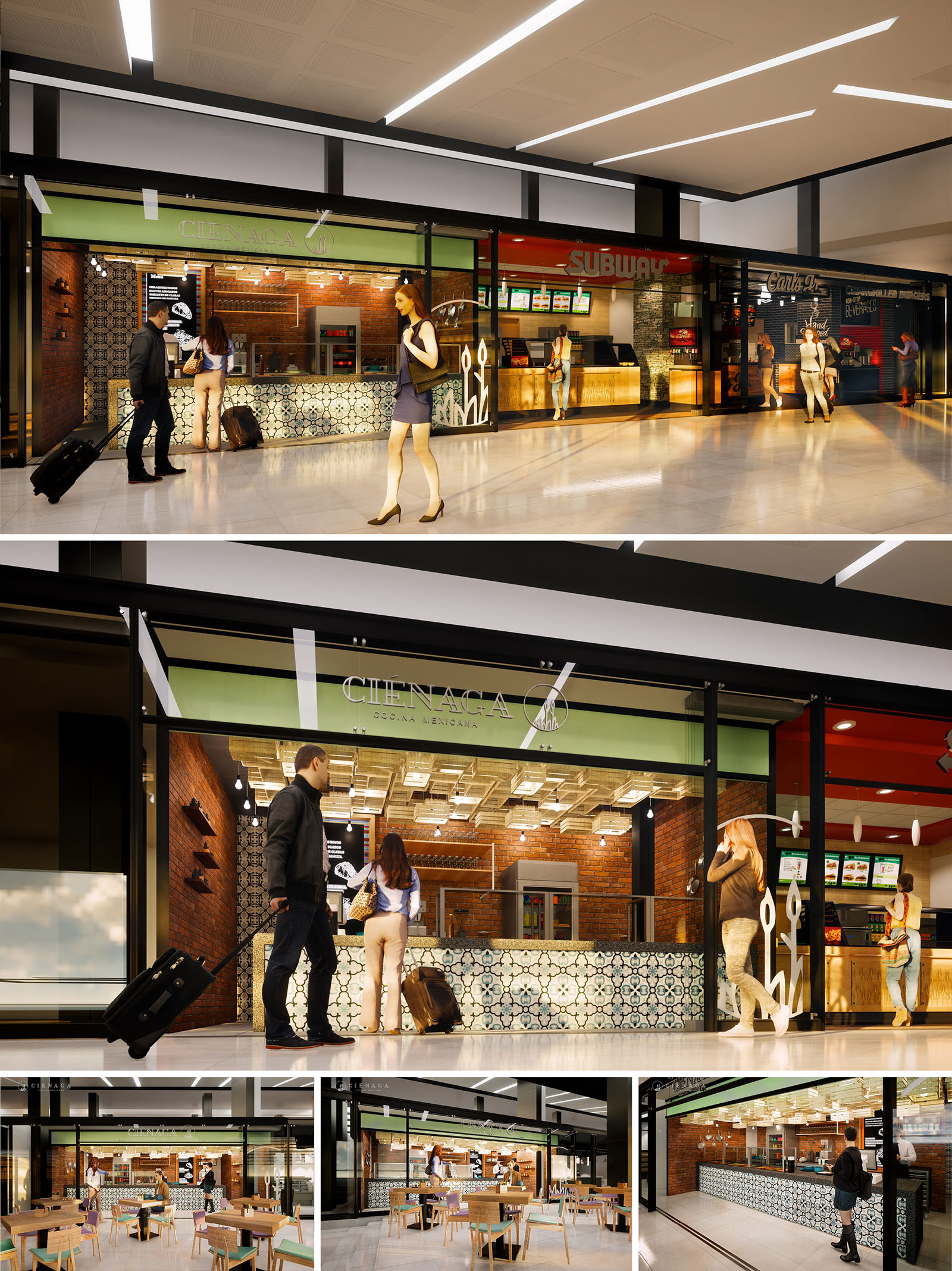
CIENAGA is conceived as a contemporary Mexican eatery embedded in a high-traffic commercial corridor, most likely an airport or shopping concourse. The project seeks to condense the atmosphere of a traditional mercado and the imagery of wetlands implied by its name into a compact, highly visible front. The design prioritizes openness and permeability, allowing the activity behind the counter and in the dining area to become part of the public space, encouraging spontaneous entry and fast circulation.
The architectural language balances industrial precision with handcrafted references. Clean steel frames and large glass panes set a neutral envelope, while patterned tiles, exposed brick, and warm lighting create a tactile and familiar environment. The result is a recognizable urban storefront that still expresses a strong local identity within an international context.
The façade operates as a transparent membrane between concourse and restaurant. A continuous glass front framed in dark metal profiles maximizes visual connection, turning the entire interior into a display. The upper band in green, hosting the CIENAGA logo and typography, functions as an urban canopy, visually anchoring the brand and providing contrast against the neutral mall finishes.
Sliding or retractable glass panels enable flexibility: during peak hours the front can be fully opened, eliminating barriers and allowing direct flow to the service counter and seating area. The graphic silhouettes of reeds on the glazing subtly evoke the “cienaga” landscape, creating an identifiable motif without overwhelming the clean composition.
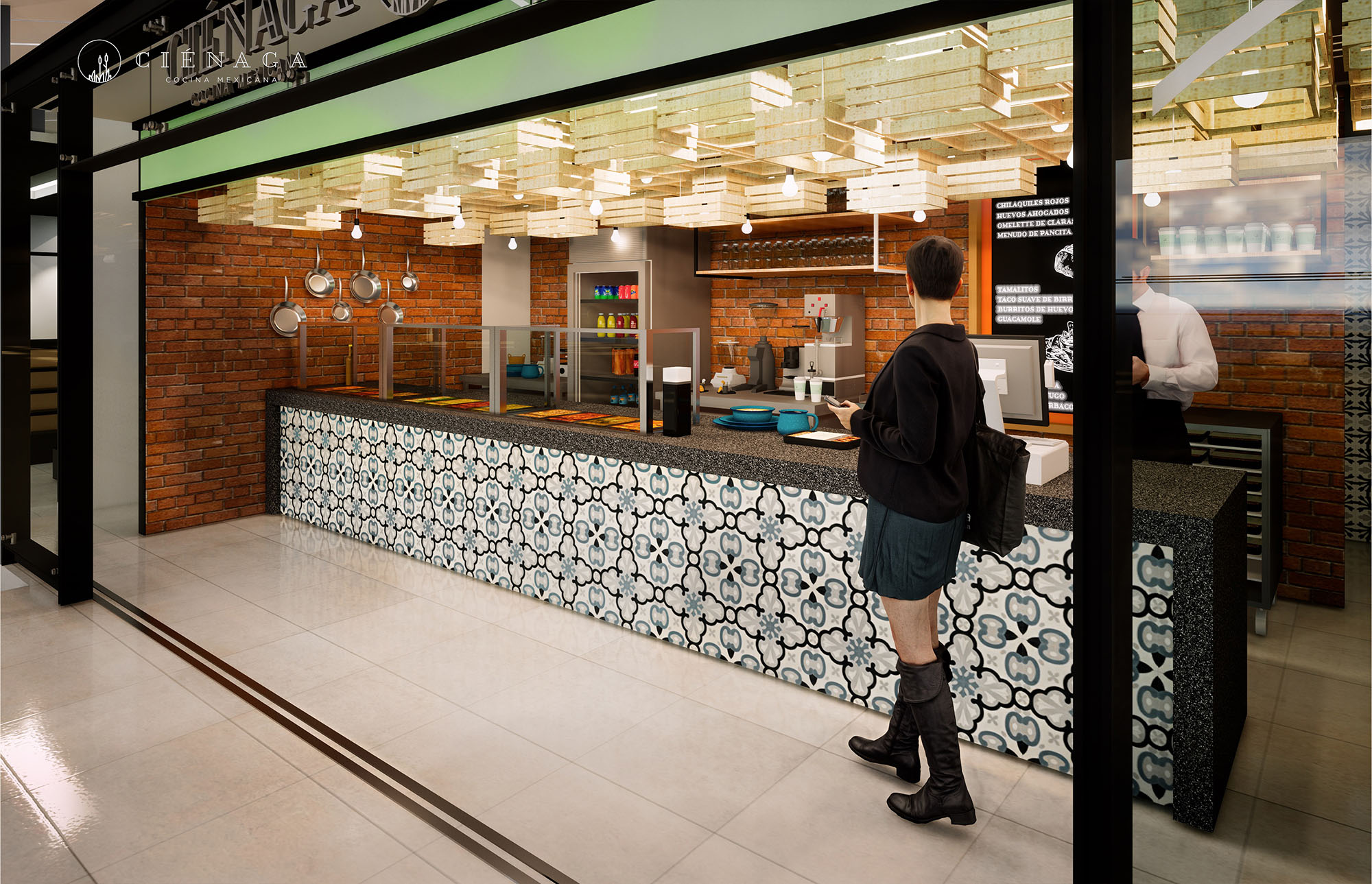
The layout is organized in a linear sequence parallel to the concourse. At the front, a generous serving counter runs almost the full width, clarifying the point of order and pick-up. Behind it, a compact production zone consolidates cooking, preparation, and storage, optimizing back-of-house efficiency within a constrained footprint.
The dining area is positioned directly in front of the stall, occupying the open space of the corridor with lightweight, movable tables and chairs. This semi-open configuration blurs the edge between collective mall circulation and the restaurant’s domain, encouraging short stays and easy reconfiguration according to demand. Clear sightlines across the entire width ensure that staff can visually control both the counter and seating area.
Material selection celebrates Mexican craft through a contemporary lens. The counter front is clad in hydraulic cement tiles with a repetitive geometric pattern in soft blues, blacks, and creams, functioning as the main decorative focal point. Exposed red brick walls bring warmth and texture, referencing traditional construction and providing a robust, low-maintenance surface.
The color palette combines earthy tones with the signature green band of the brand, reinforcing recognition from a distance. Overhead, a gridded ceiling with recessed and pendant luminaires produces a warm, even illumination that contrasts with the cooler, more neutral light of the mall. Track-mounted spotlights accentuate the counter and product display, enhancing depth and hierarchy within the small volume.
The furniture is deliberately simple and functional, with wood-finished tabletops and light-toned chairs that maintain visual continuity with the tiled counter and brick surfaces. The clean lines and minimal upholstery support quick turnover and easy cleaning, while still offering comfort for short to medium stays. Table distribution allows flexible arrangements for individuals, couples, and small groups, responding to the transient nature of airport or mall users.
Accessibility is embedded in the clear floor paths and generous approach to the counter, ensuring convenient movement for travelers with luggage and users with reduced mobility. The overall ambience promotes a sense of casual familiarity, encouraging passersby to stop for an intuitive and efficient dining experience.
Sustainability is addressed through durable, low-maintenance materials and an efficient lighting strategy. Brick and ceramic tiles offer long life cycles, resistance to heavy use, and reduced need for replacement, lowering the project’s long-term environmental impact. The prevalence of hard, non-porous finishes also minimizes cleaning products and water consumption.
Large glass surfaces harness existing ambient lighting from the mall, allowing artificial lighting levels to be calibrated rather than constantly at maximum intensity. The warm LED system reduces energy consumption and maintenance compared to traditional lamps. A compact back-of-house, with equipment concentrated along a single service wall, contributes to energy efficiency in ventilation and refrigeration, while the open dining area minimizes the need for dedicated air-conditioning volumes.
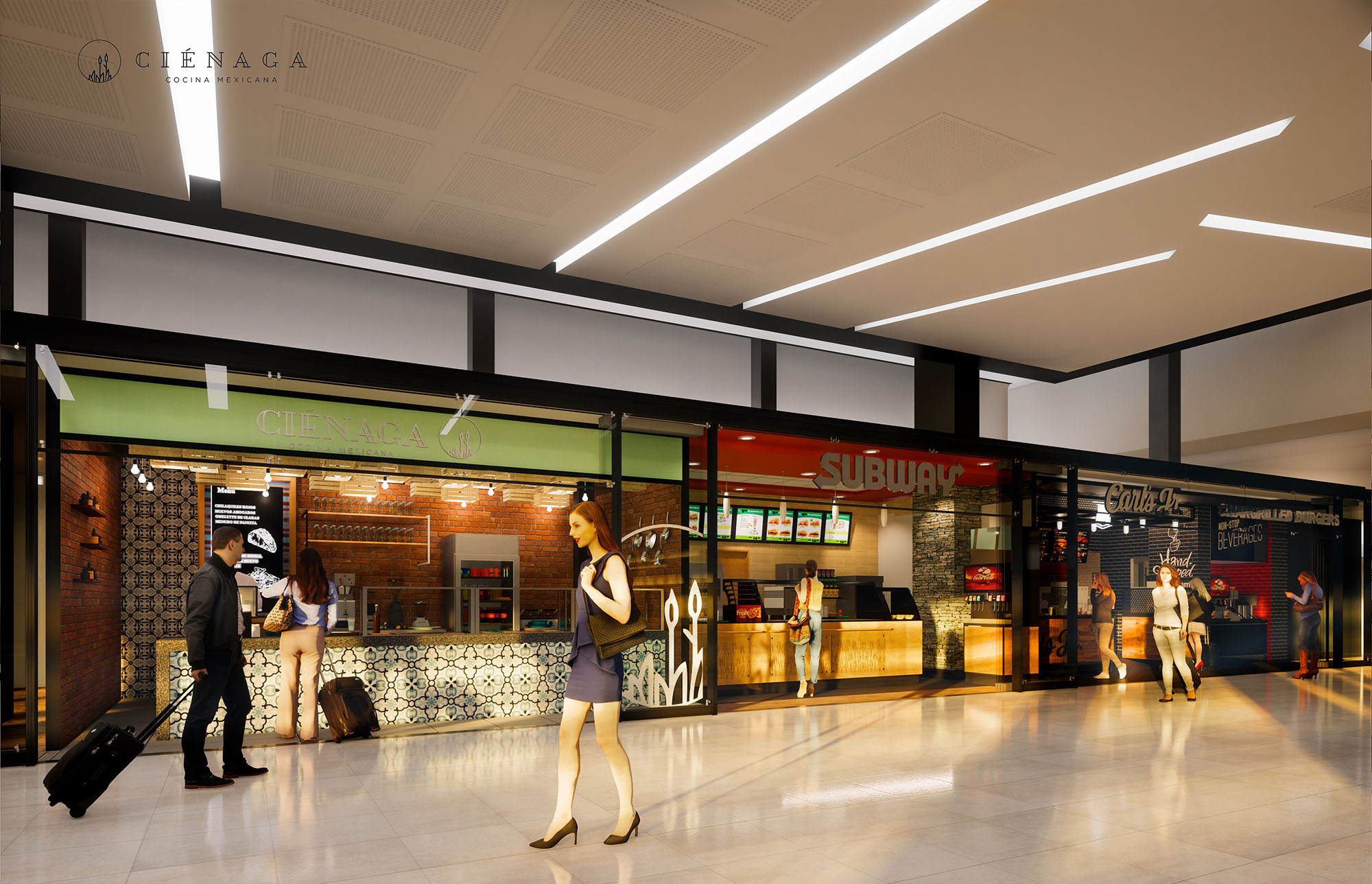

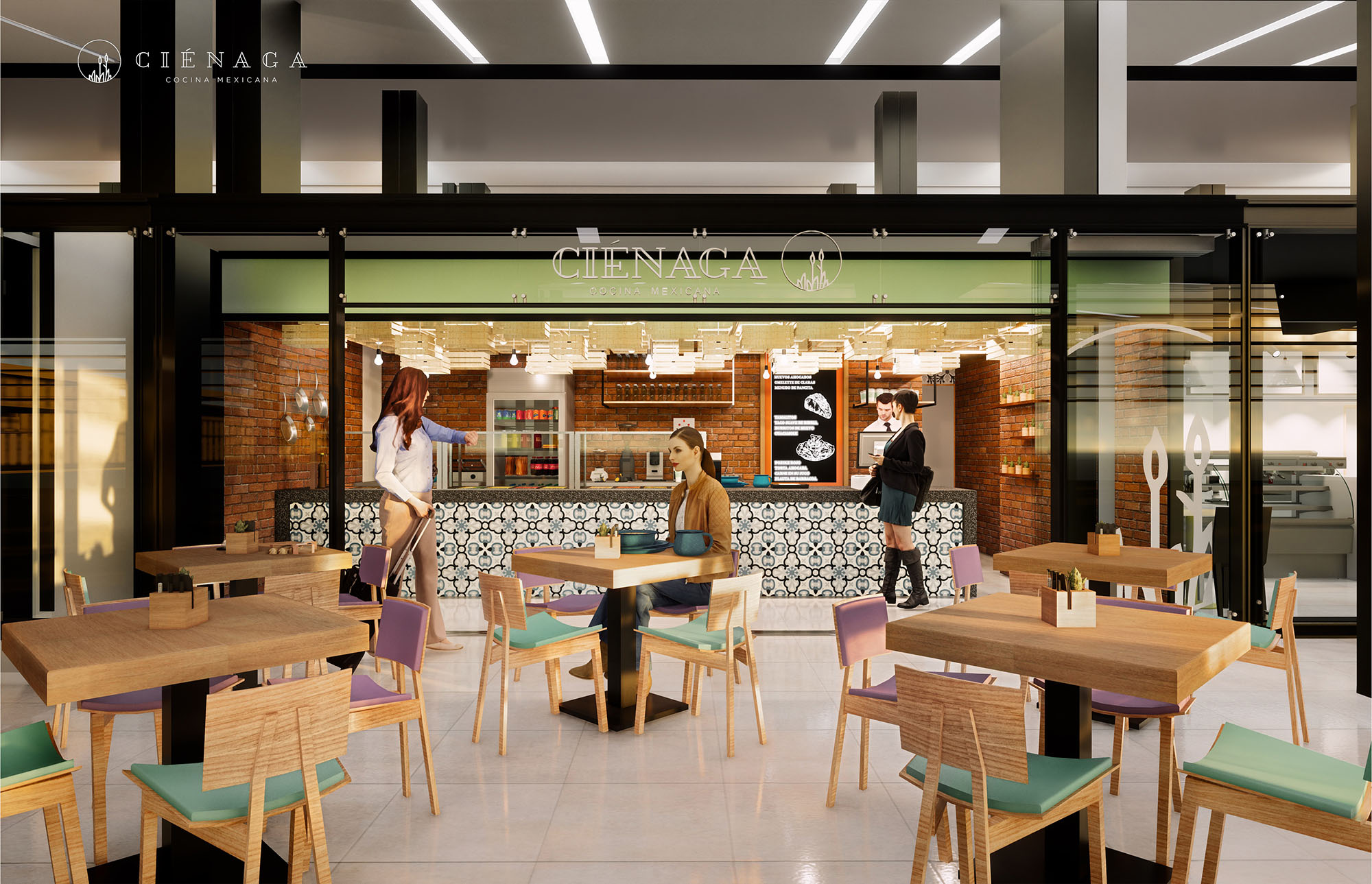
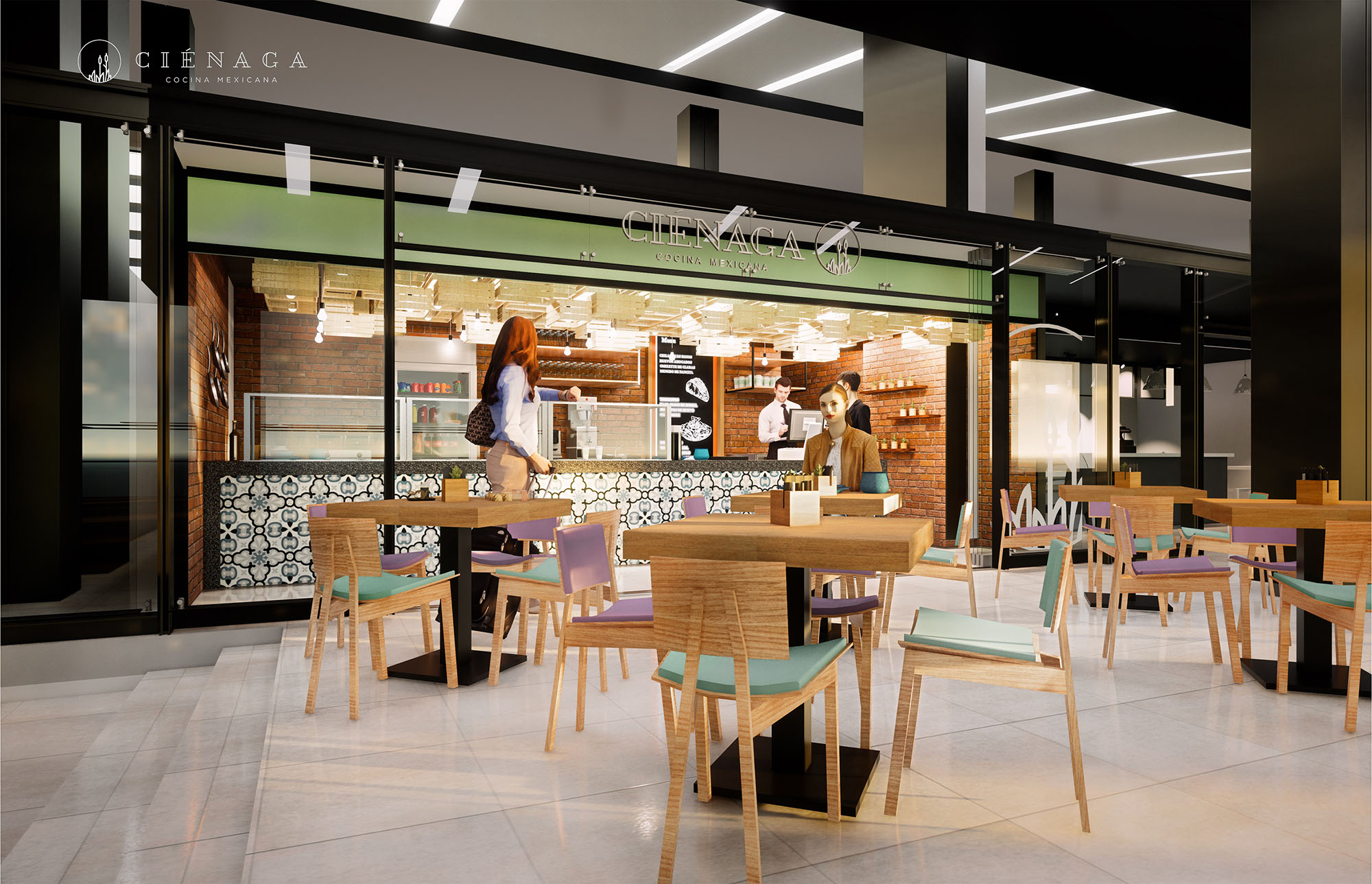
CIENAGA is conceived as a contemporary Mexican eatery embedded in a high-traffic commercial corridor, most likely an airport or shopping concourse. The project seeks to condense the atmosphere of a traditional mercado and the imagery of wetlands implied by its name into a compact, highly visible front. The design prioritizes openness and permeability, allowing the activity behind the counter and in the dining area to become part of the public space, encouraging spontaneous entry and fast circulation.
The architectural language balances industrial precision with handcrafted references. Clean steel frames and large glass panes set a neutral envelope, while patterned tiles, exposed brick, and warm lighting create a tactile and familiar environment. The result is a recognizable urban storefront that still expresses a strong local identity within an international context.
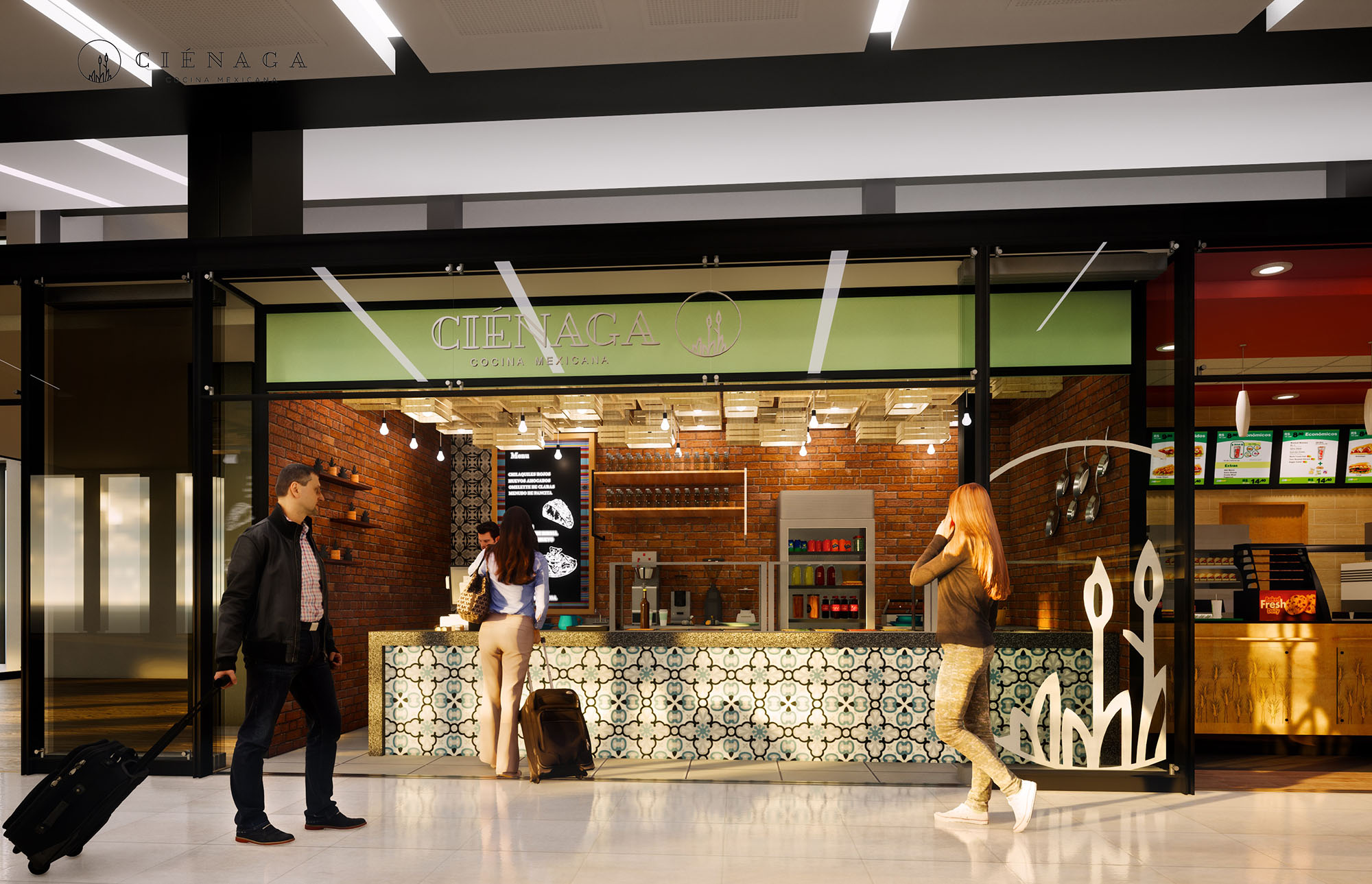
The façade operates as a transparent membrane between concourse and restaurant. A continuous glass front framed in dark metal profiles maximizes visual connection, turning the entire interior into a display. The upper band in green, hosting the CIENAGA logo and typography, functions as an urban canopy, visually anchoring the brand and providing contrast against the neutral mall finishes.
Sliding or retractable glass panels enable flexibility: during peak hours the front can be fully opened, eliminating barriers and allowing direct flow to the service counter and seating area. The graphic silhouettes of reeds on the glazing subtly evoke the “cienaga” landscape, creating an identifiable motif without overwhelming the clean composition.
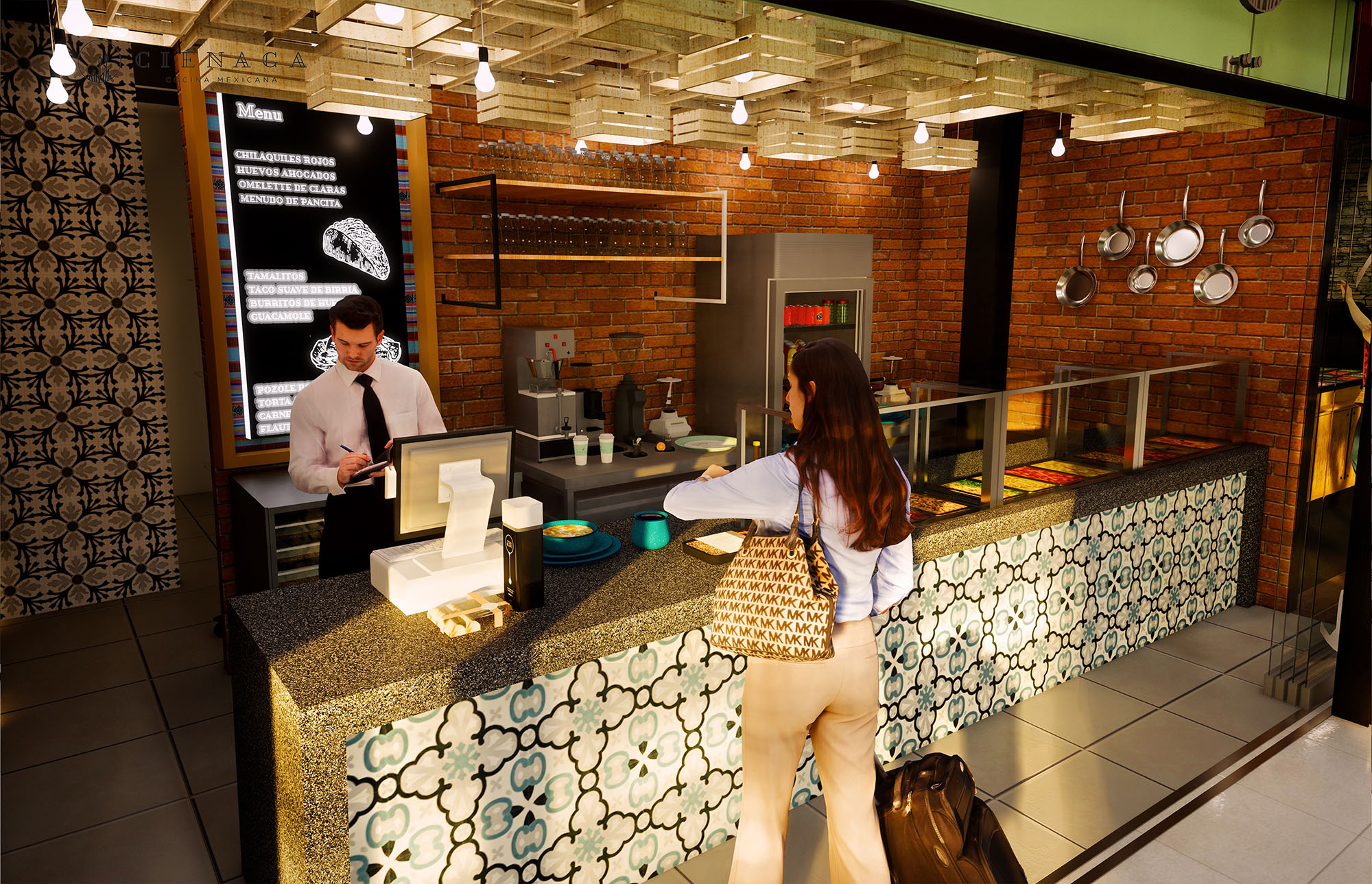
The layout is organized in a linear sequence parallel to the concourse. At the front, a generous serving counter runs almost the full width, clarifying the point of order and pick-up. Behind it, a compact production zone consolidates cooking, preparation, and storage, optimizing back-of-house efficiency within a constrained footprint.
The dining area is positioned directly in front of the stall, occupying the open space of the corridor with lightweight, movable tables and chairs. This semi-open configuration blurs the edge between collective mall circulation and the restaurant’s domain, encouraging short stays and easy reconfiguration according to demand. Clear sightlines across the entire width ensure that staff can visually control both the counter and seating area.
Material selection celebrates Mexican craft through a contemporary lens. The counter front is clad in hydraulic cement tiles with a repetitive geometric pattern in soft blues, blacks, and creams, functioning as the main decorative focal point. Exposed red brick walls bring warmth and texture, referencing traditional construction and providing a robust, low-maintenance surface.
The color palette combines earthy tones with the signature green band of the brand, reinforcing recognition from a distance. Overhead, a gridded ceiling with recessed and pendant luminaires produces a warm, even illumination that contrasts with the cooler, more neutral light of the mall. Track-mounted spotlights accentuate the counter and product display, enhancing depth and hierarchy within the small volume.
The furniture is deliberately simple and functional, with wood-finished tabletops and light-toned chairs that maintain visual continuity with the tiled counter and brick surfaces. The clean lines and minimal upholstery support quick turnover and easy cleaning, while still offering comfort for short to medium stays. Table distribution allows flexible arrangements for individuals, couples, and small groups, responding to the transient nature of airport or mall users.
Accessibility is embedded in the clear floor paths and generous approach to the counter, ensuring convenient movement for travelers with luggage and users with reduced mobility. The overall ambience promotes a sense of casual familiarity, encouraging passersby to stop for an intuitive and efficient dining experience.
Sustainability is addressed through durable, low-maintenance materials and an efficient lighting strategy. Brick and ceramic tiles offer long life cycles, resistance to heavy use, and reduced need for replacement, lowering the project’s long-term environmental impact. The prevalence of hard, non-porous finishes also minimizes cleaning products and water consumption.
Large glass surfaces harness existing ambient lighting from the mall, allowing artificial lighting levels to be calibrated rather than constantly at maximum intensity. The warm LED system reduces energy consumption and maintenance compared to traditional lamps. A compact back-of-house, with equipment concentrated along a single service wall, contributes to energy efficiency in ventilation and refrigeration, while the open dining area minimizes the need for dedicated air-conditioning volumes.


Nuestras oficinas están en Barcelona, Cancún, Chicago y Santo Domingo, pero gracias a la tecnología podemos desarrollar proyectos en cualquier parte del mundo.
Barcelona
Bac de Roda 136
08020, Barcelona
Spain
Madrid
Av. de Buendía 11
19005 Guadalajara (Madrid)
Spain
Chicago
373 Hazel Ave, Apt A1
60022, Glencoe, Illinois
United States