

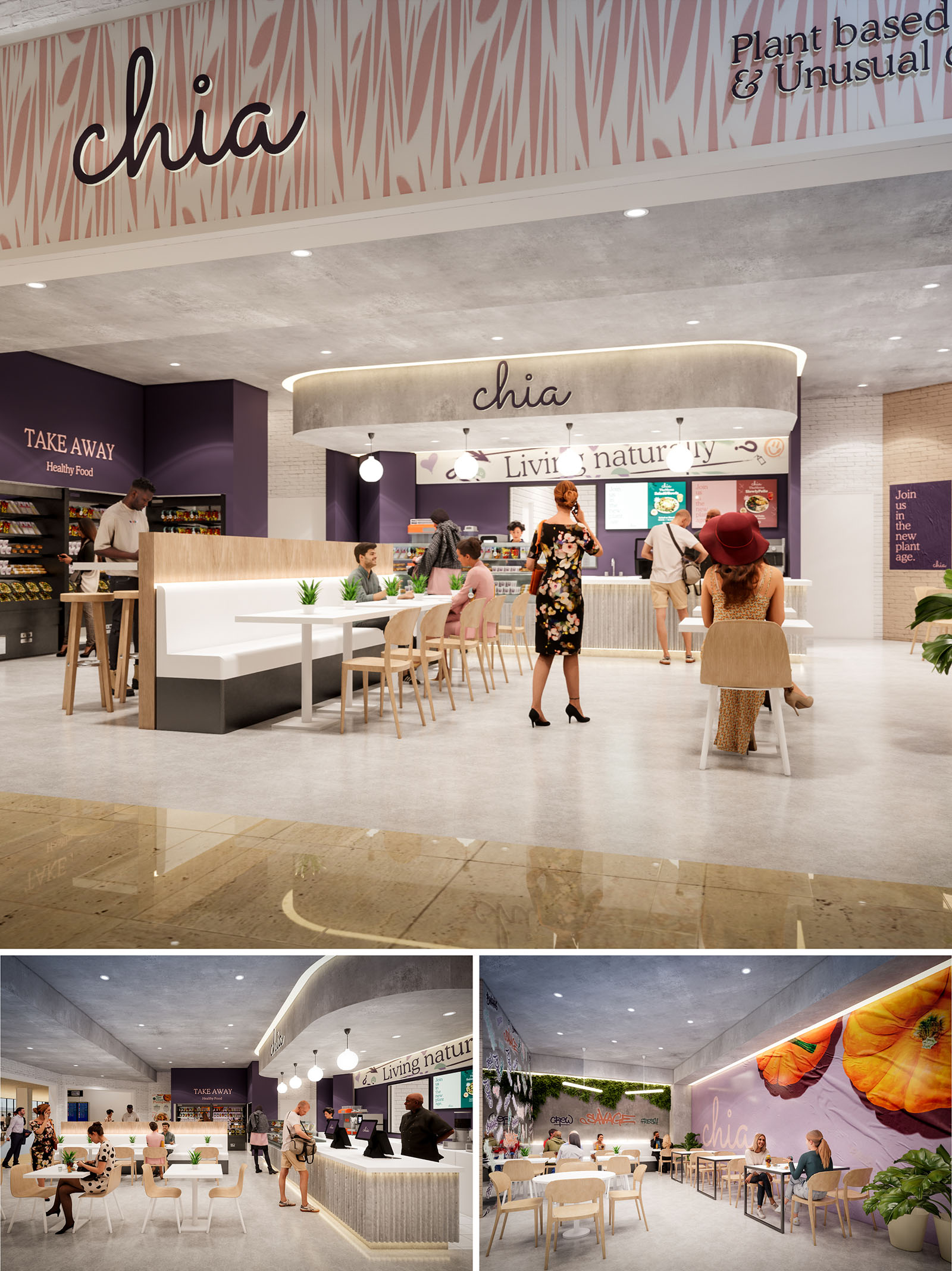
CHIA is conceived as an urban oasis dedicated to plant-based cuisine, translating the lightness and freshness of its menu into a spatial experience. The project articulates a clean, contemporary language, where soft geometries and warm minimalism convey accessibility and comfort while reinforcing the idea of conscious eating. The interior merges the immediacy of a takeaway venue with the calm of a slow-food café, blurring the boundary between commercial space and social hub.
The overall concept is structured around the notion of “living naturally,” expressed through a palette that combines earthy neutrals, botanical accents and a curated use of brand colors. Large-scale graphic walls, organic curves and integrated greenery communicate the narrative of plant-based gastronomy in a direct and memorable way, supporting the brand’s identity in every visual axis.
The layout is organized as a clear longitudinal sequence: entry, ordering counter, takeaway wall and seated dining area. This arrangement facilitates intuitive circulation, allowing customers to understand the service logic at first glance. The central service island, with its rounded canopy, operates as the main orientation element, anchoring the space visually and functionally.
To one side, a compact takeaway and retail strip addresses fast-flow users, with high tables for short stays. To the other, a more relaxed seating zone extends towards the back, framed by feature walls and soft lighting. Bench seating combined with loose chairs optimizes capacity while maintaining flexibility, enabling the restaurant to host different group sizes and rearrange configurations without architectural changes.
The material palette balances technical performance and tactile warmth. Continuous light-toned flooring, likely vinyl or microcement, ensures easy maintenance and seamless accessibility, while visually amplifying natural and artificial light. The ceiling retains an almost raw, concrete-like finish that introduces a subtle industrial layer, acting as a neutral background for the brand elements.
Vertical surfaces alternate between smooth painted walls in deep purple, warm nude tones and white brick textures. These create depth and rhythm, avoiding visual monotony. The service counter and central island feature ribbed or fluted cladding, adding fine-scale texture that catches grazing light. Wood finishes on chairs, tabletops and partial partitions soften the ambience, introducing a natural warmth consistent with the plant-based concept.
The furniture language is deliberately simple, with Scandinavian-inspired wooden chairs, light tabletops and integrated bench seating in neutral upholstery. This understated design allows food and brand graphics to remain the main protagonists, while ensuring ergonomic comfort and high turnover capability. The repetition of identical chair types contributes to visual coherence and facilitates stacking or replacement.
Lighting is layered: recessed downlights provide general illumination, while globe pendants over the counter and linear LED details along the canopy and baseboards generate a more intimate, atmospheric reading of the space. Large graphic murals with botanical and vegetable imagery become powerful focal points in the dining area, extending the gastronomic narrative and offering an immersive backdrop for guests.
Sustainability criteria are integrated both conceptually and technically. The plant-based culinary offer is supported by a design that prioritizes durability, low-maintenance surfaces and efficient lighting. The use of long-life LED fixtures, light-colored finishes to enhance reflectance and a compact service core all contribute to reduced energy demand. Where possible, wood elements are specified with FSC certification and low-VOC finishes to improve indoor air quality.
Biophilic strategies amplify user well-being: potted plants and green wall segments introduce natural textures, helping to establish a visual connection to nature in an otherwise interior mall environment. Generous aisle widths, clear signage and unobstructed views improve accessibility and comfort for all users. The result is a restaurant that not only communicates a sustainable lifestyle through its menu, but also materializes it spatially through responsible design decisions.
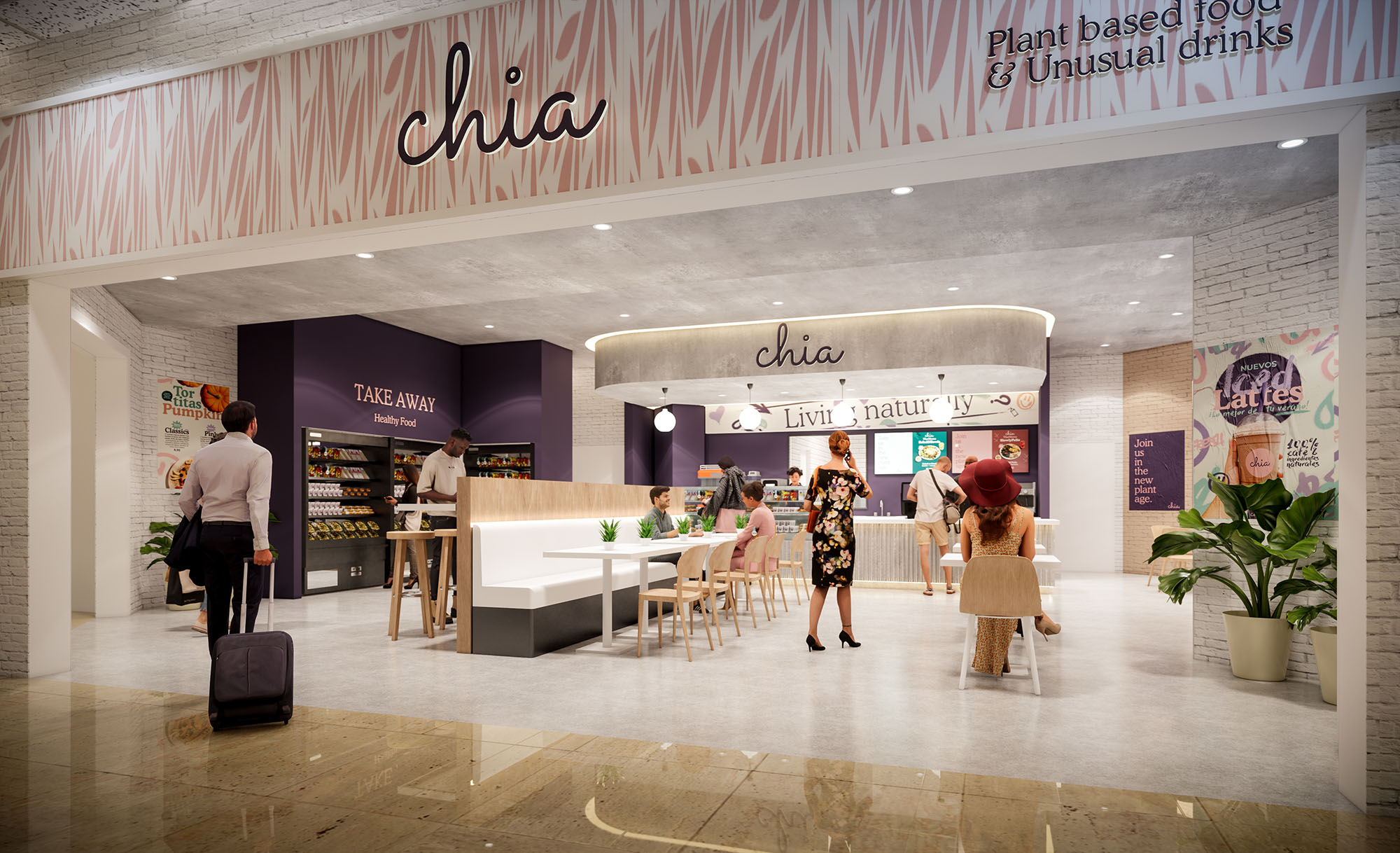
CHIA is conceived as an urban oasis dedicated to plant-based cuisine, translating the lightness and freshness of its menu into a spatial experience. The project articulates a clean, contemporary language, where soft geometries and warm minimalism convey accessibility and comfort while reinforcing the idea of conscious eating. The interior merges the immediacy of a takeaway venue with the calm of a slow-food café, blurring the boundary between commercial space and social hub.
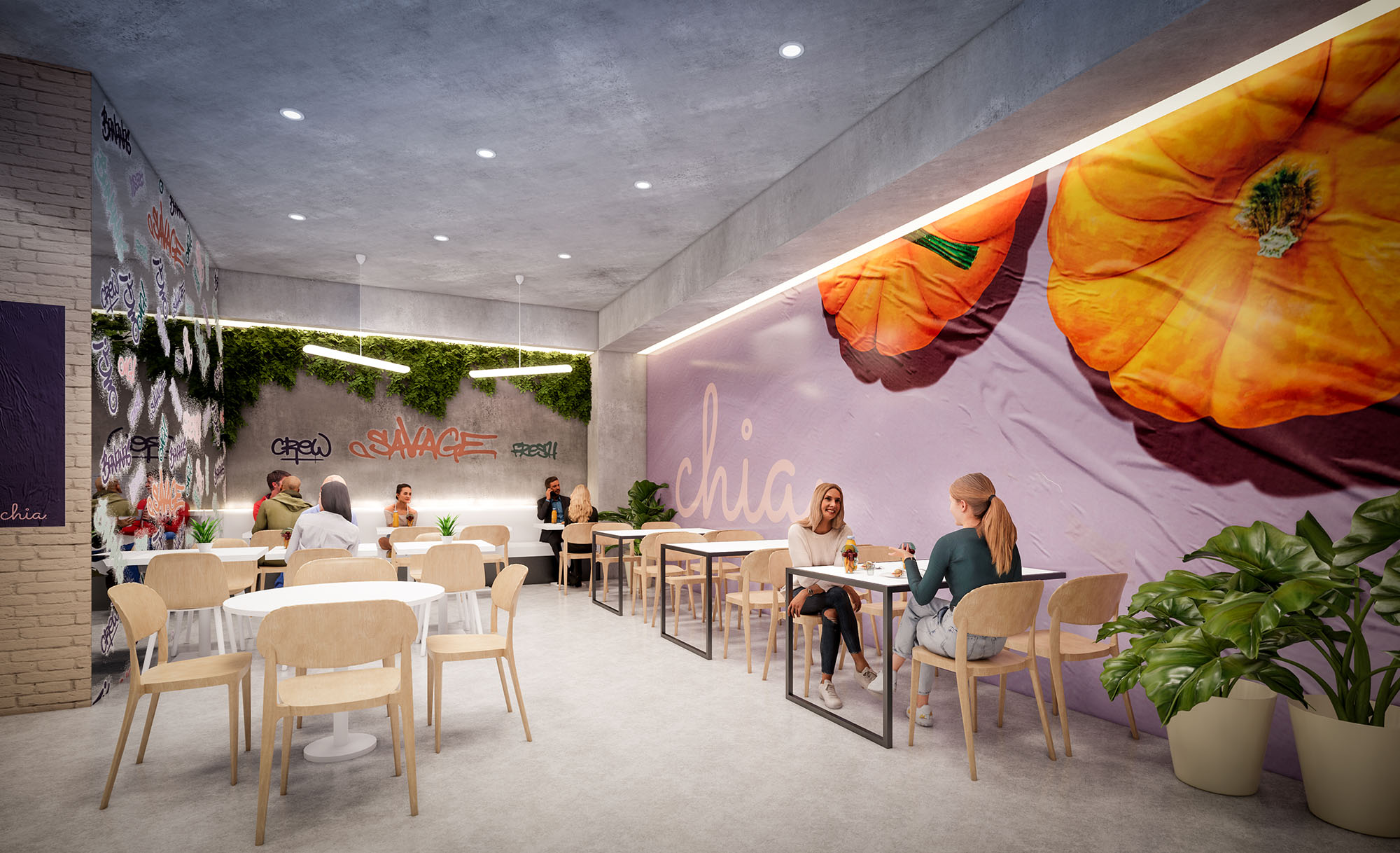
The overall concept is structured around the notion of “living naturally,” expressed through a palette that combines earthy neutrals, botanical accents and a curated use of brand colors. Large-scale graphic walls, organic curves and integrated greenery communicate the narrative of plant-based gastronomy in a direct and memorable way, supporting the brand’s identity in every visual axis.
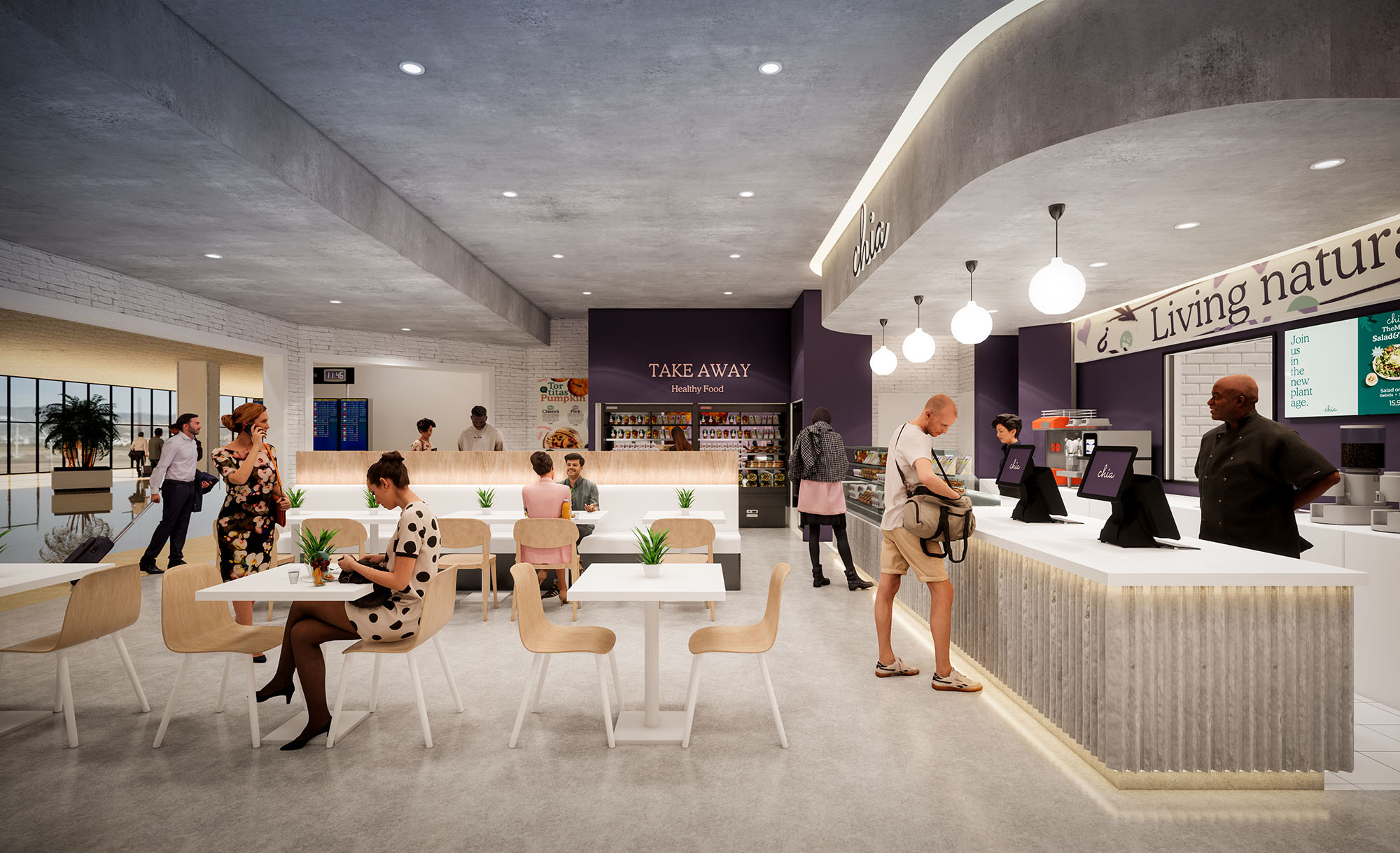
The layout is organized as a clear longitudinal sequence: entry, ordering counter, takeaway wall and seated dining area. This arrangement facilitates intuitive circulation, allowing customers to understand the service logic at first glance. The central service island, with its rounded canopy, operates as the main orientation element, anchoring the space visually and functionally.
To one side, a compact takeaway and retail strip addresses fast-flow users, with high tables for short stays. To the other, a more relaxed seating zone extends towards the back, framed by feature walls and soft lighting. Bench seating combined with loose chairs optimizes capacity while maintaining flexibility, enabling the restaurant to host different group sizes and rearrange configurations without architectural changes.
The material palette balances technical performance and tactile warmth. Continuous light-toned flooring, likely vinyl or microcement, ensures easy maintenance and seamless accessibility, while visually amplifying natural and artificial light. The ceiling retains an almost raw, concrete-like finish that introduces a subtle industrial layer, acting as a neutral background for the brand elements.
Vertical surfaces alternate between smooth painted walls in deep purple, warm nude tones and white brick textures. These create depth and rhythm, avoiding visual monotony. The service counter and central island feature ribbed or fluted cladding, adding fine-scale texture that catches grazing light. Wood finishes on chairs, tabletops and partial partitions soften the ambience, introducing a natural warmth consistent with the plant-based concept.
The furniture language is deliberately simple, with Scandinavian-inspired wooden chairs, light tabletops and integrated bench seating in neutral upholstery. This understated design allows food and brand graphics to remain the main protagonists, while ensuring ergonomic comfort and high turnover capability. The repetition of identical chair types contributes to visual coherence and facilitates stacking or replacement.
Lighting is layered: recessed downlights provide general illumination, while globe pendants over the counter and linear LED details along the canopy and baseboards generate a more intimate, atmospheric reading of the space. Large graphic murals with botanical and vegetable imagery become powerful focal points in the dining area, extending the gastronomic narrative and offering an immersive backdrop for guests.
Sustainability criteria are integrated both conceptually and technically. The plant-based culinary offer is supported by a design that prioritizes durability, low-maintenance surfaces and efficient lighting. The use of long-life LED fixtures, light-colored finishes to enhance reflectance and a compact service core all contribute to reduced energy demand. Where possible, wood elements are specified with FSC certification and low-VOC finishes to improve indoor air quality.
Biophilic strategies amplify user well-being: potted plants and green wall segments introduce natural textures, helping to establish a visual connection to nature in an otherwise interior mall environment. Generous aisle widths, clear signage and unobstructed views improve accessibility and comfort for all users. The result is a restaurant that not only communicates a sustainable lifestyle through its menu, but also materializes it spatially through responsible design decisions.


Nuestras oficinas están en Barcelona, Cancún, Chicago y Santo Domingo, pero gracias a la tecnología podemos desarrollar proyectos en cualquier parte del mundo.
Barcelona
Bac de Roda 136
08020, Barcelona
Spain
Madrid
Av. de Buendía 11
19005 Guadalajara (Madrid)
Spain
Chicago
373 Hazel Ave, Apt A1
60022, Glencoe, Illinois
United States