

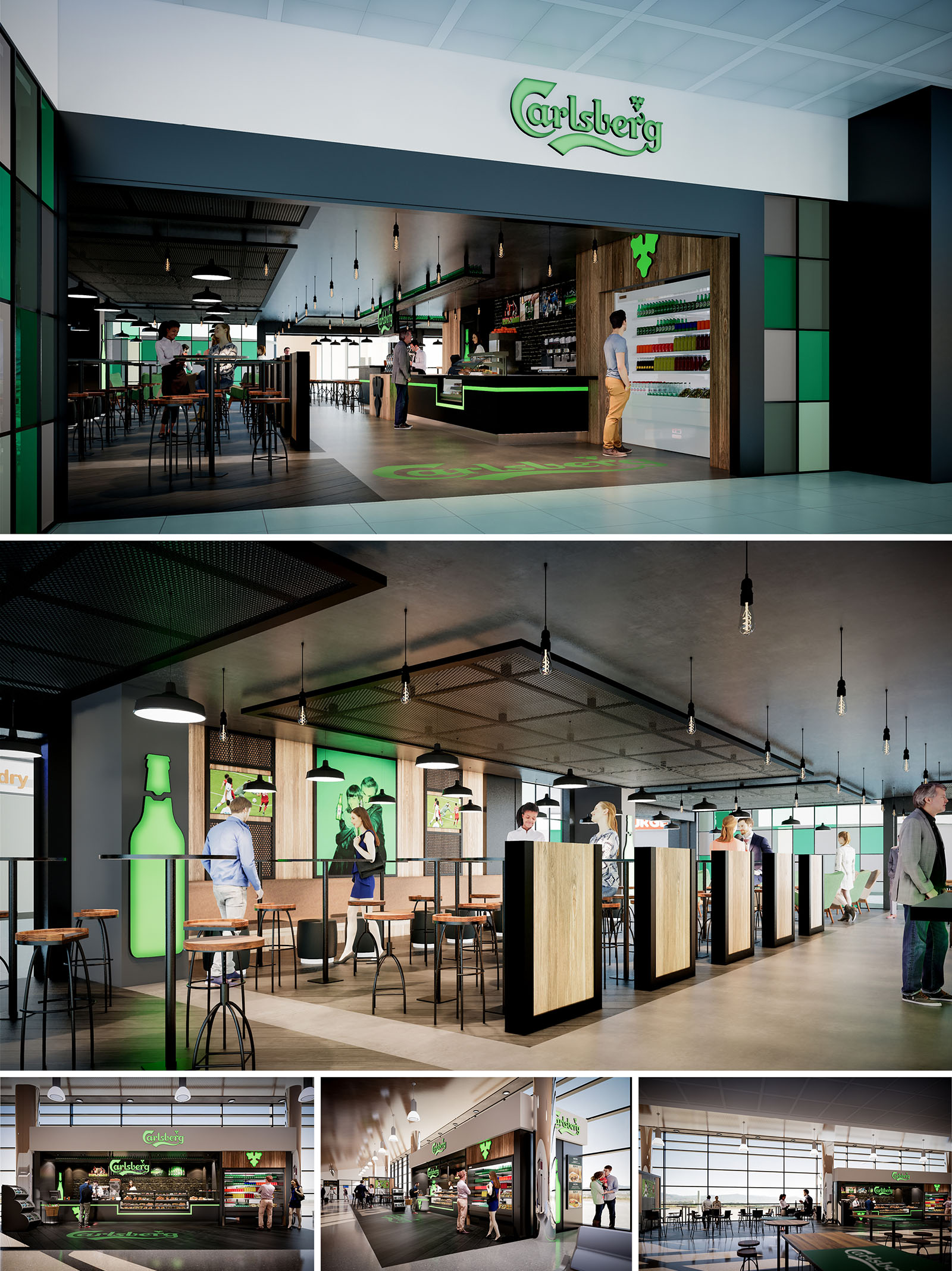
The Carlsberg project is conceived as a scalable brand environment for six restaurant units located in different Spanish cities. The design translates the brewery’s identity into a contemporary hospitality space, combining the atmosphere of an urban bar with the efficiency of a fast-service restaurant. A clear visual language based on green accents, dark frames and warm timber surfaces creates instant recognition in highly trafficked commercial contexts such as malls and transport hubs.
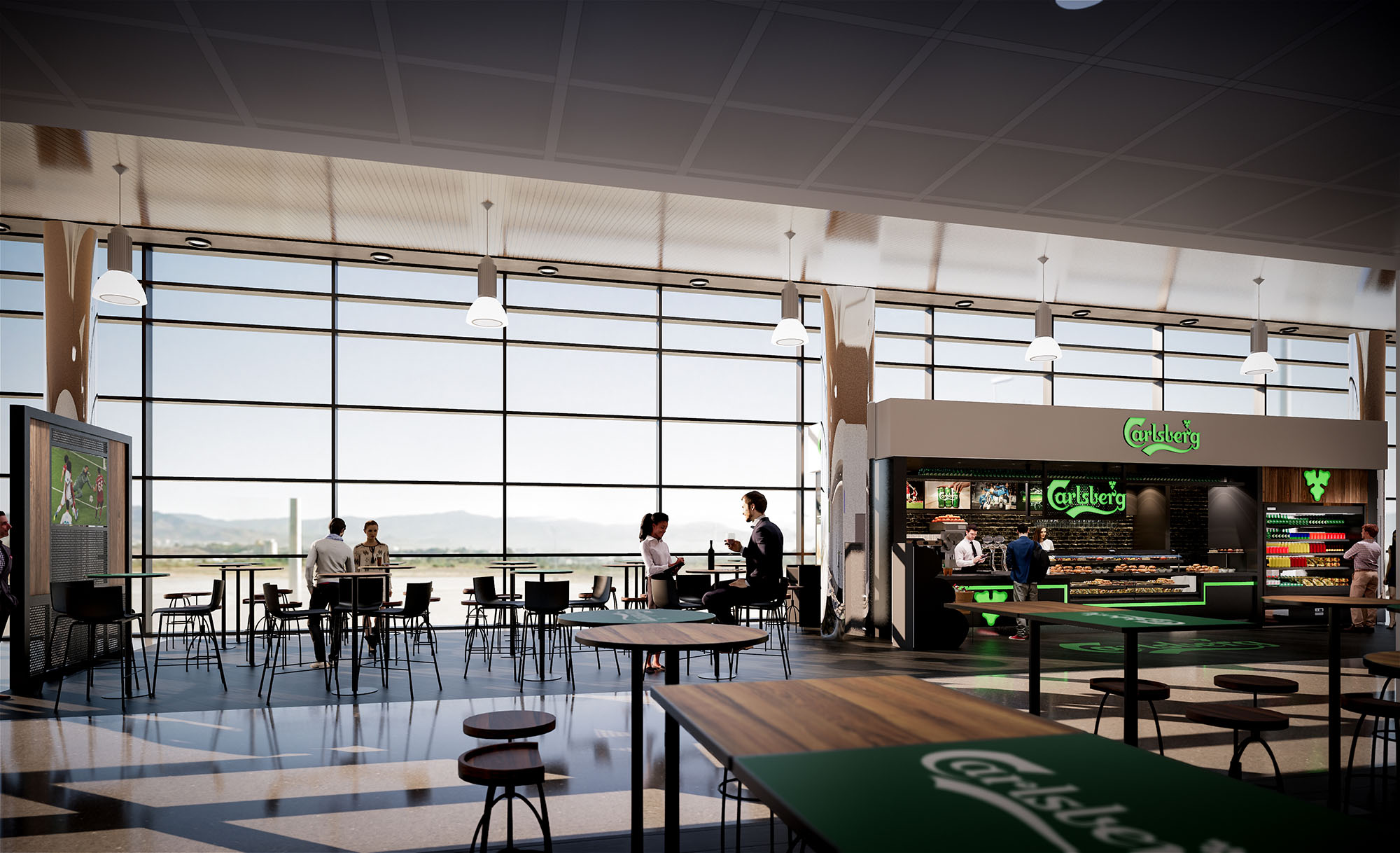
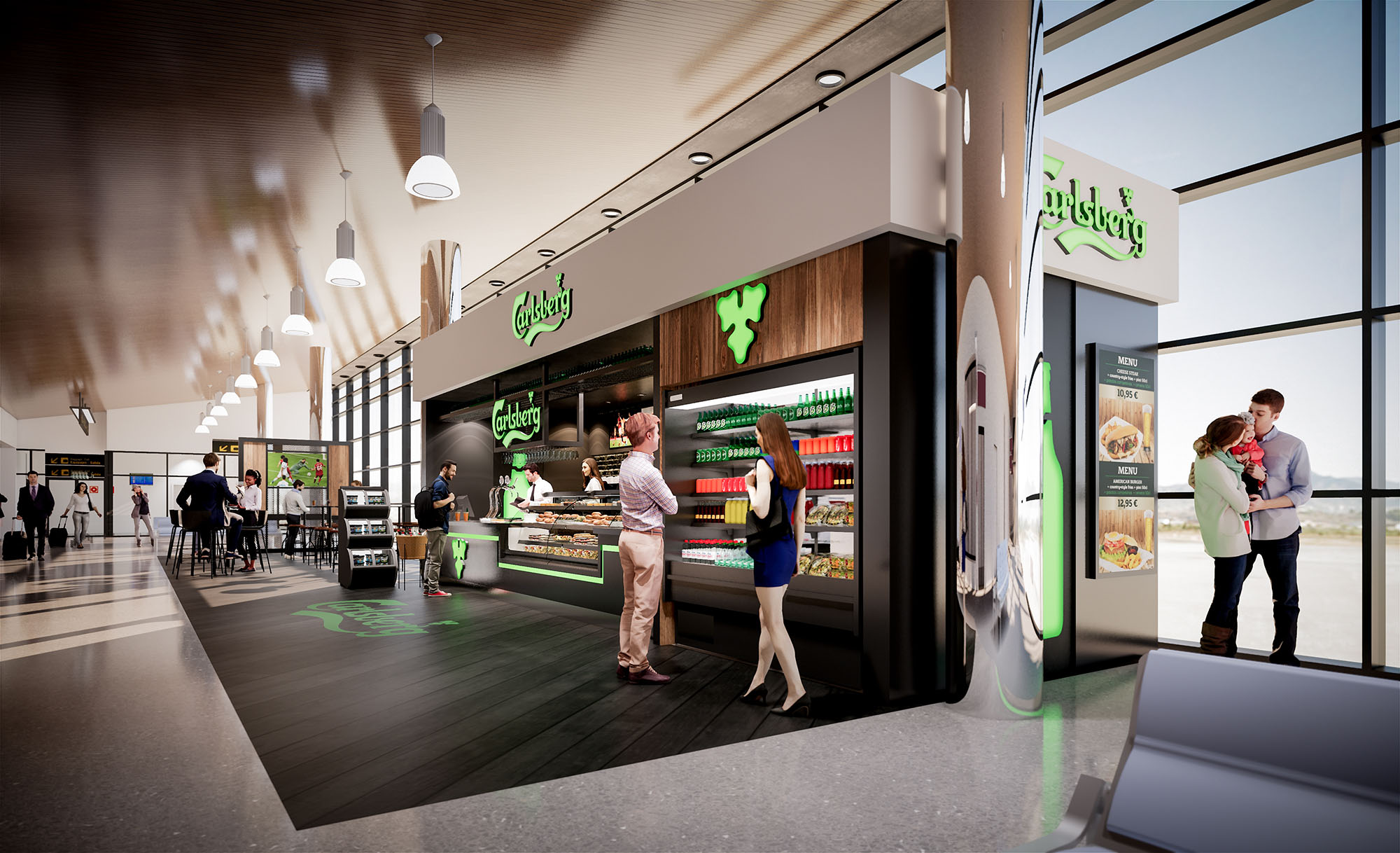
The interior architecture is organized as a permeable open-plan bar, where the threshold between corridor and restaurant becomes a fluid transition. Large openings, low partitions and transparent boundaries invite passers-by to visually access the space, while the branded canopy and ceiling interventions guide guests to the counter as the main focal point.
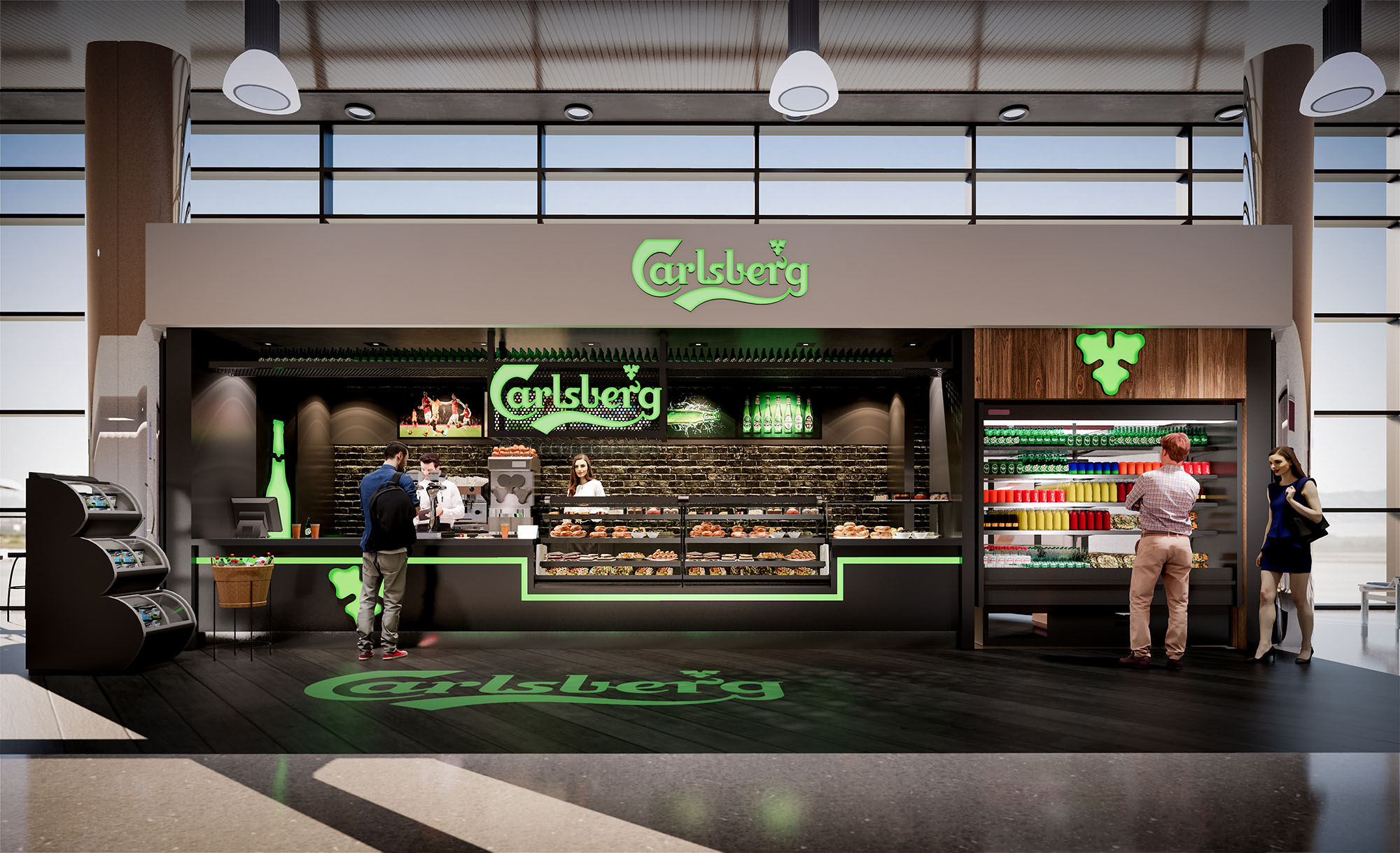
The layout prioritizes intuitive circulation around a central serving bar. The counter is aligned longitudinally, allowing simultaneous order, service and display of products, while maintaining clear visibility from the exterior. High tables and stools define a fast-consumption zone near the entrance, ideal for short stays and high turnover.
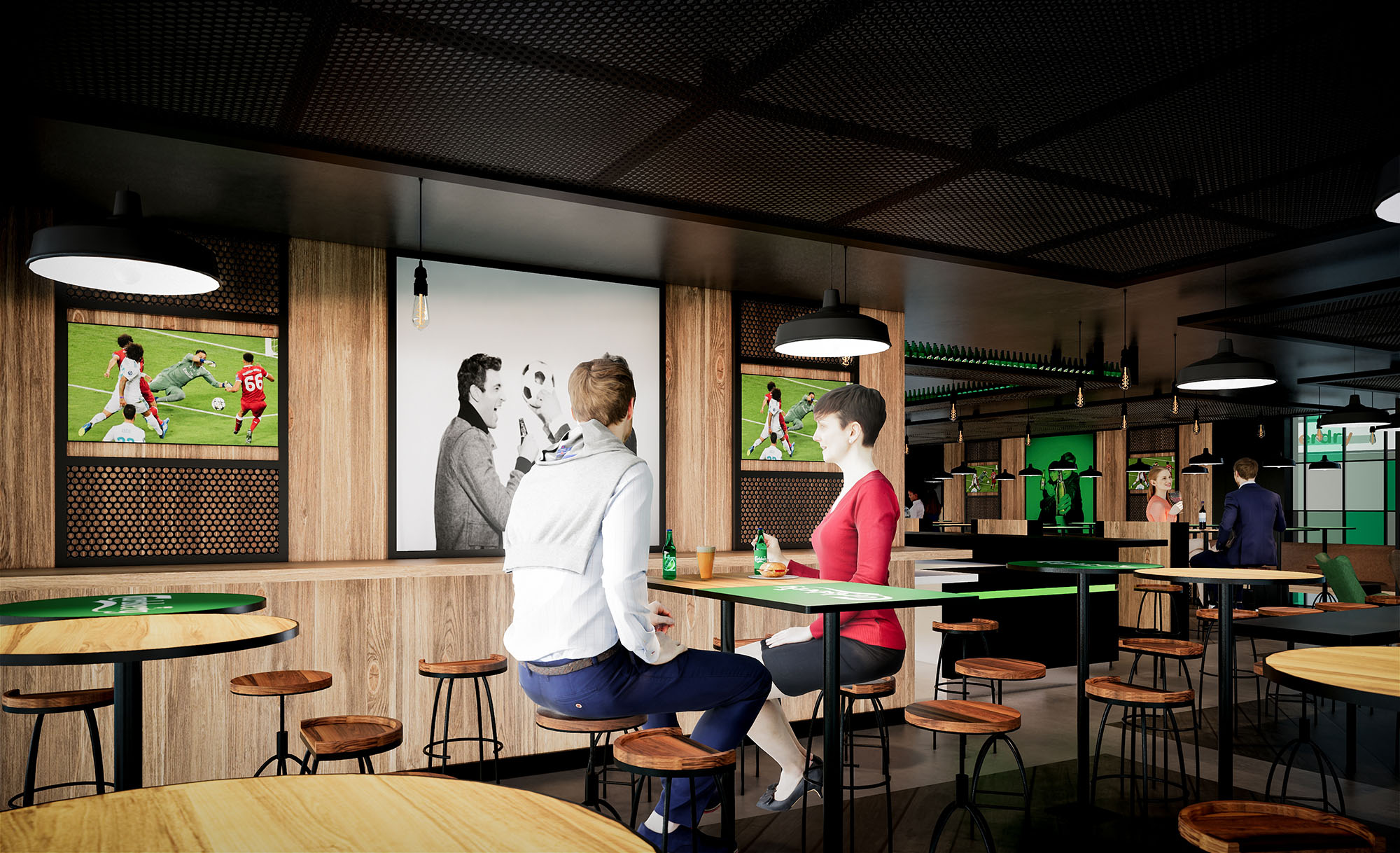
Further inside, semi-enclosed seating islands introduce a gradient of privacy. Vertical timber-clad screens frame individual standing tables, offering comfortable micro-spaces within the open hall. Circulation bands between these islands are kept generous to accommodate peak flows and easy staff movement, aligning with operational requirements of multiple locations.
The material palette combines industrial robustness with a warm, approachable character. Exposed concrete floors and dark metal structures evoke brewery and factory imagery, contrasted by oak-toned wood panels that soften the ambience. The front counter and perimeter cladding use durable laminates and composite panels to resist intensive use while remaining easy to maintain across all units.
Ceiling treatments alternate between smooth acoustic planes and perforated metal trays, integrating lighting, ventilation and acoustic control into a unified architectural element. This strategy allows each location to adapt to varying existing ceilings while preserving a consistent spatial identity.
Lighting is designed to articulate zones and reinforce the brand’s presence. A continuous linear fixture tracks the bar line, visually anchoring the service zone, while pendant luminaires over the high tables create intimate light pools within the otherwise open space. Exposed bulbs and black fittings recall industrial workshops, supporting the crafted-beer narrative.
Backlit graphic panels and the iconic green bottle silhouette act as luminous landmarks. These elements provide both orientation and ambiance, subtly adjusting brightness levels to maintain visual comfort and a warm color temperature suitable for extended social stays.
Brand integration is achieved through architectural means rather than mere signage. The Carlsberg green is embedded in floor inlays, counter detailing and vertical panels, creating a chromatic thread that unifies the six restaurants. Large-scale imagery, applied as framed lightboxes, brings human-scale storytelling to the walls without overwhelming the space.
The façade is conceived as an open frame around the bar interior: black profiles, translucent glass and modular colored panels form a recognizable gateway. This system allows each venue to adapt to different storefront widths while maintaining strict alignment with brand guidelines.
Sustainability is addressed through modular construction, durable materials and energy-conscious systems. Repetitive structural frames, standardized joinery details and prefabricated counter elements reduce waste and facilitate rapid installation in multiple locations. Where possible, timber components are specified from certified sources, and metal elements are designed for disassembly and future reuse.
LED lighting with dimming controls minimizes energy consumption, while the combination of natural daylight from large glazed fronts and targeted artificial lighting reduces the need for uniform high-intensity illumination. Finishes are selected for longevity and ease of maintenance, extending life cycles and lowering operational impact. The overall concept thereby creates a consistent, brand-driven environment that can adapt to varied shells while remaining efficient, robust and environmentally conscious.
LIST OF PROJECTS EXPERIENCE
Designed, Executed and/or Built Projects
SPAIN
1. Carlsberg - Asturias
2. Carlsberg - Asturias - L201A
3. Carlsberg - Ibiza - L230
4. Carlsberg - Mallorca - L13.01
5. Carlsberg - Murcia - L205B
6. Carlsberg - Tenerife Norte - L231B
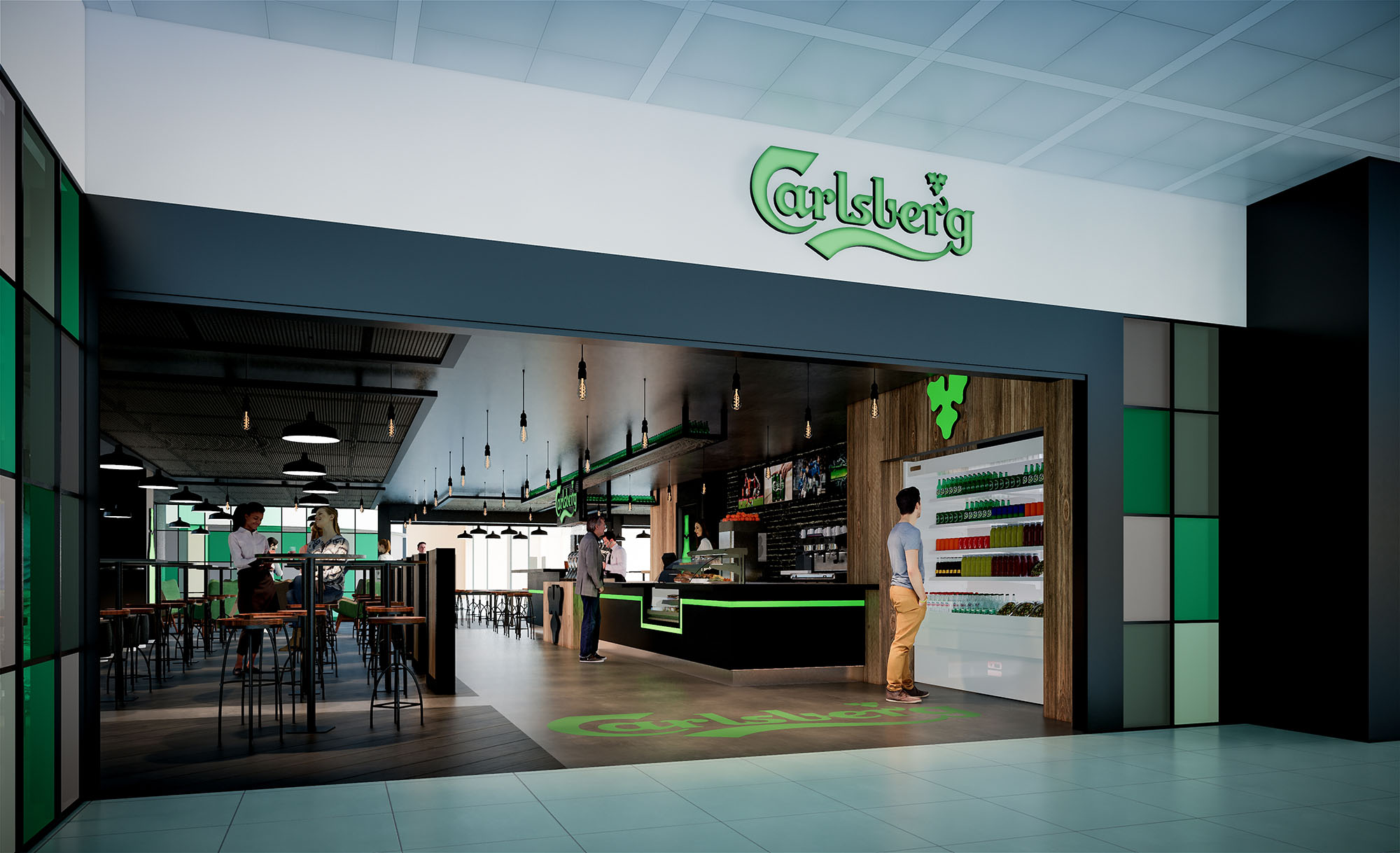
The Carlsberg project is conceived as a scalable brand environment for six restaurant units located in different Spanish cities. The design translates the brewery’s identity into a contemporary hospitality space, combining the atmosphere of an urban bar with the efficiency of a fast-service restaurant. A clear visual language based on green accents, dark frames and warm timber surfaces creates instant recognition in highly trafficked commercial contexts such as malls and transport hubs.
The interior architecture is organized as a permeable open-plan bar, where the threshold between corridor and restaurant becomes a fluid transition. Large openings, low partitions and transparent boundaries invite passers-by to visually access the space, while the branded canopy and ceiling interventions guide guests to the counter as the main focal point.
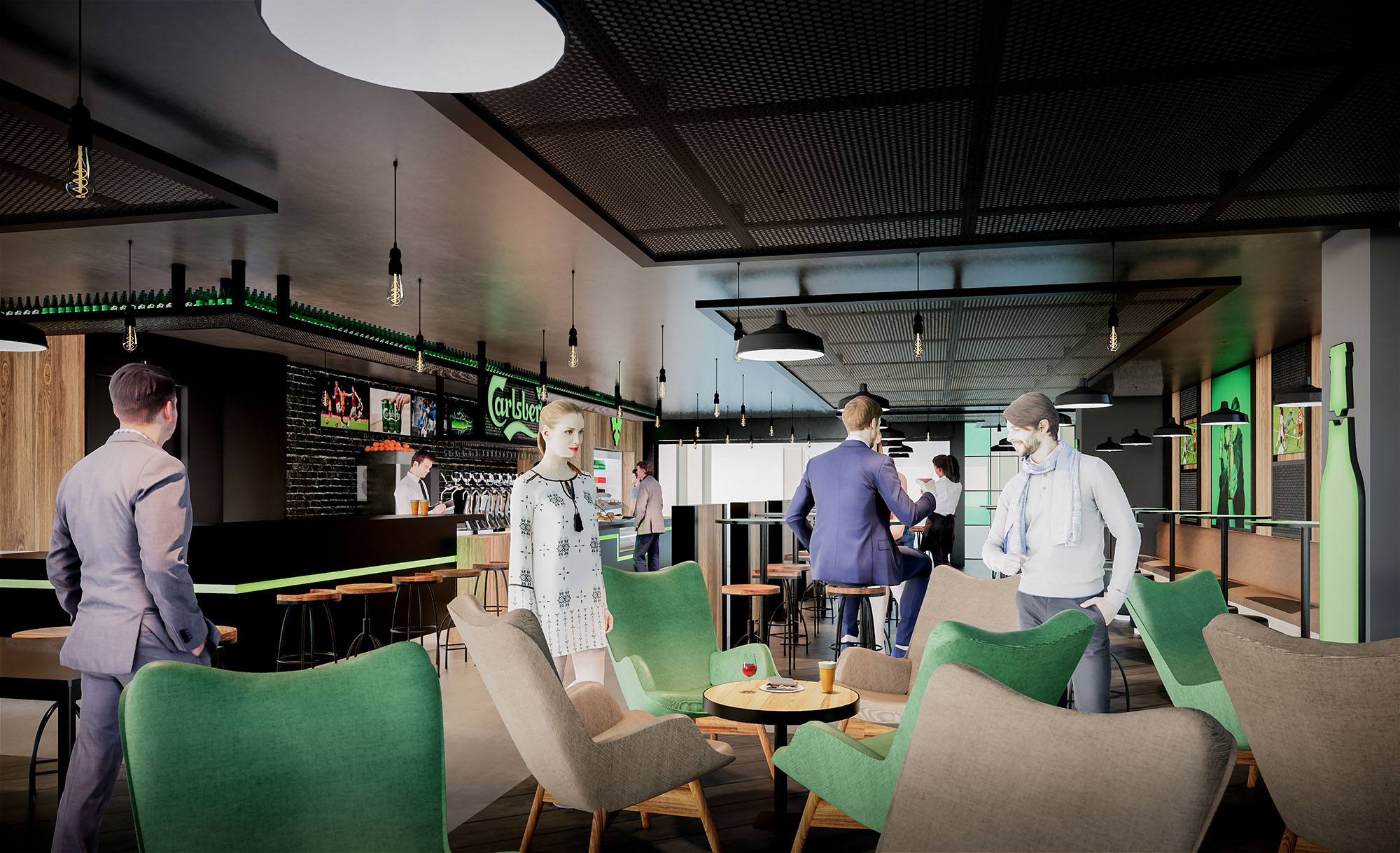
The layout prioritizes intuitive circulation around a central serving bar. The counter is aligned longitudinally, allowing simultaneous order, service and display of products, while maintaining clear visibility from the exterior. High tables and stools define a fast-consumption zone near the entrance, ideal for short stays and high turnover.
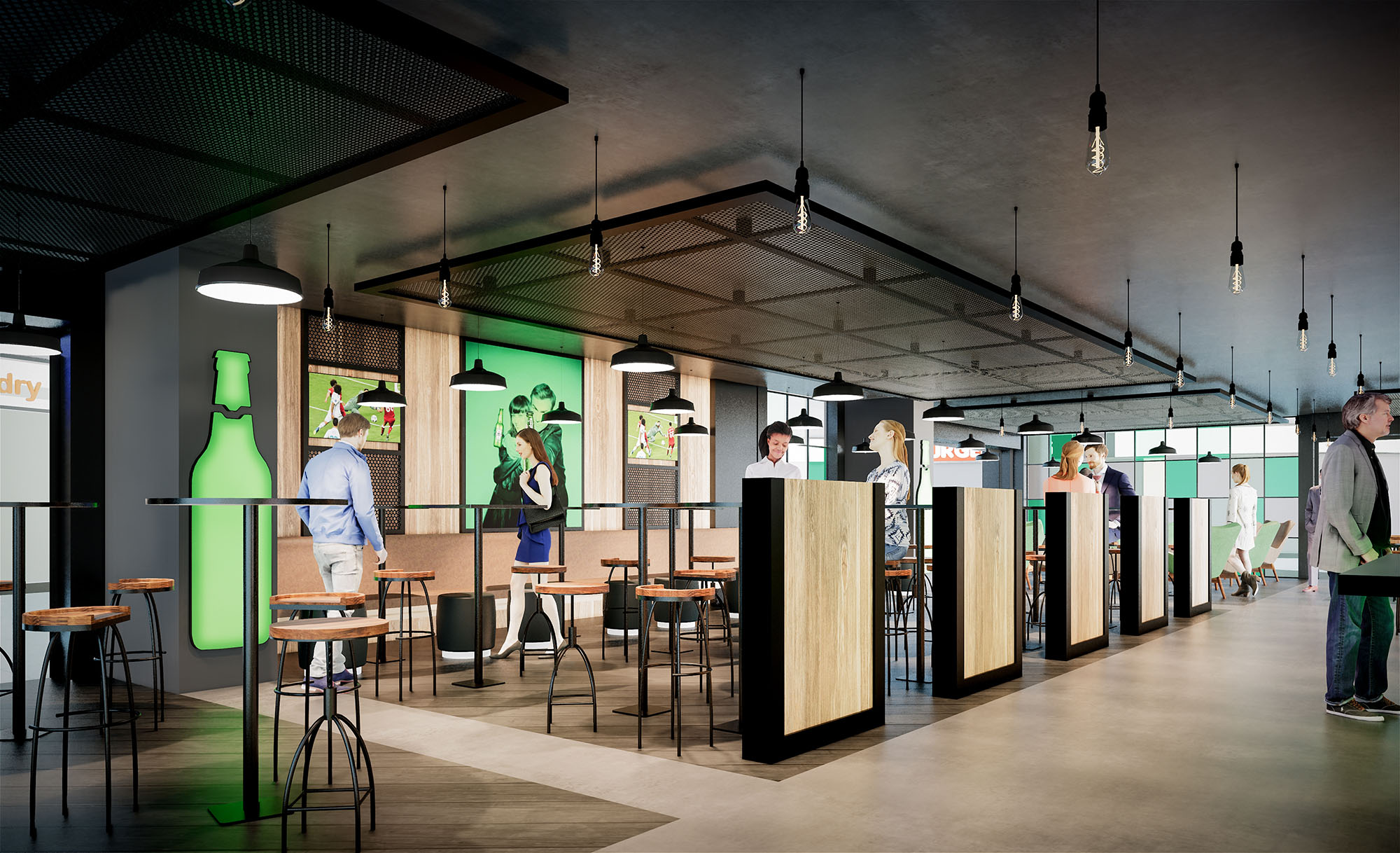
Further inside, semi-enclosed seating islands introduce a gradient of privacy. Vertical timber-clad screens frame individual standing tables, offering comfortable micro-spaces within the open hall. Circulation bands between these islands are kept generous to accommodate peak flows and easy staff movement, aligning with operational requirements of multiple locations.
The material palette combines industrial robustness with a warm, approachable character. Exposed concrete floors and dark metal structures evoke brewery and factory imagery, contrasted by oak-toned wood panels that soften the ambience. The front counter and perimeter cladding use durable laminates and composite panels to resist intensive use while remaining easy to maintain across all units.
Ceiling treatments alternate between smooth acoustic planes and perforated metal trays, integrating lighting, ventilation and acoustic control into a unified architectural element. This strategy allows each location to adapt to varying existing ceilings while preserving a consistent spatial identity.
Lighting is designed to articulate zones and reinforce the brand’s presence. A continuous linear fixture tracks the bar line, visually anchoring the service zone, while pendant luminaires over the high tables create intimate light pools within the otherwise open space. Exposed bulbs and black fittings recall industrial workshops, supporting the crafted-beer narrative.
Backlit graphic panels and the iconic green bottle silhouette act as luminous landmarks. These elements provide both orientation and ambiance, subtly adjusting brightness levels to maintain visual comfort and a warm color temperature suitable for extended social stays.
Brand integration is achieved through architectural means rather than mere signage. The Carlsberg green is embedded in floor inlays, counter detailing and vertical panels, creating a chromatic thread that unifies the six restaurants. Large-scale imagery, applied as framed lightboxes, brings human-scale storytelling to the walls without overwhelming the space.
The façade is conceived as an open frame around the bar interior: black profiles, translucent glass and modular colored panels form a recognizable gateway. This system allows each venue to adapt to different storefront widths while maintaining strict alignment with brand guidelines.
Sustainability is addressed through modular construction, durable materials and energy-conscious systems. Repetitive structural frames, standardized joinery details and prefabricated counter elements reduce waste and facilitate rapid installation in multiple locations. Where possible, timber components are specified from certified sources, and metal elements are designed for disassembly and future reuse.
LED lighting with dimming controls minimizes energy consumption, while the combination of natural daylight from large glazed fronts and targeted artificial lighting reduces the need for uniform high-intensity illumination. Finishes are selected for longevity and ease of maintenance, extending life cycles and lowering operational impact. The overall concept thereby creates a consistent, brand-driven environment that can adapt to varied shells while remaining efficient, robust and environmentally conscious.


Nuestras oficinas están en Barcelona, Cancún, Chicago y Santo Domingo, pero gracias a la tecnología podemos desarrollar proyectos en cualquier parte del mundo.
Barcelona
Bac de Roda 136
08020, Barcelona
Spain
Madrid
Av. de Buendía 11
19005 Guadalajara (Madrid)
Spain
Chicago
373 Hazel Ave, Apt A1
60022, Glencoe, Illinois
United States