

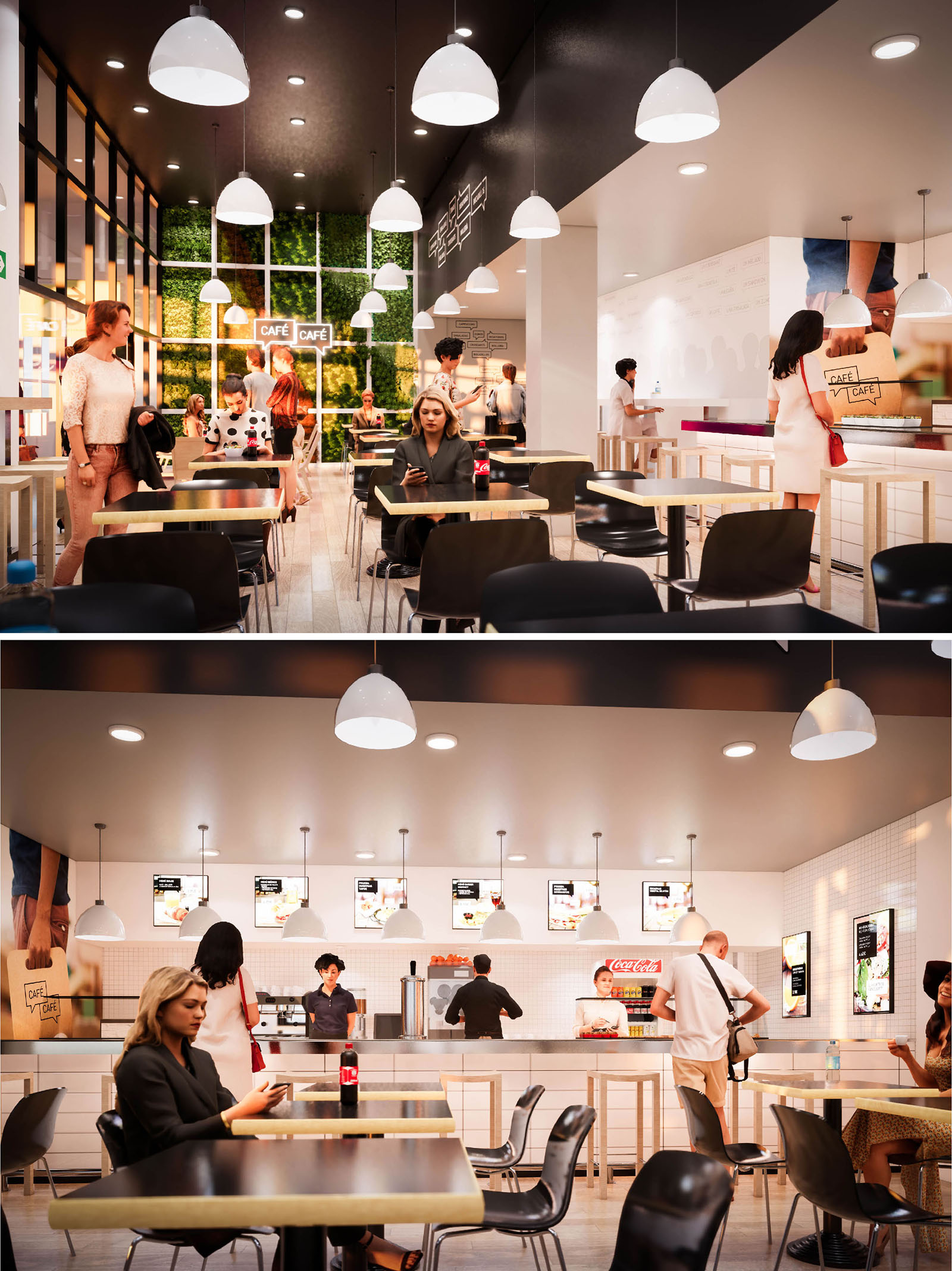
CAFE CAFE is conceived as a contemporary urban café chain that can be replicated in multiple locations while retaining a warm, human scale. The concept merges the clarity of a fast-service environment with the ambience of a comfortable neighborhood café. A restrained palette of materials and colors creates a recognizable brand identity, allowing each unit to adapt to its specific context without losing coherence.
The interior language balances efficiency and hospitality: clear circulation towards the counter, intuitive self-service dynamics and permeable seating zones that invite lingering. The design seeks to evoke an everyday ritual space, where light, vegetation and tactile finishes soften the highly functional program typical of high-turnover restaurants.
The floor plan is organized along a longitudinal axis that visually connects the entrance, the main seating area and the service counter. The access zone opens directly onto the dining space, minimizing visual barriers and enabling immediate orientation. The counter occupies the back wall as a continuous, linear element, consolidating ordering, pickup and display functions in a single gesture.
Seating is arranged in a modular grid of two- and four-top tables, allowing flexible reconfiguration for different groups and peak times. Perimeter bar-height seating along the serving front and windows offers an alternative for solo customers or short stays. Circulation aisles are deliberately generous, ensuring clear flows between tables and the counter, and complying with accessibility standards.
The material palette combines light-toned timber, white ceramic and matte black surfaces to articulate a clean yet warm atmosphere. Tabletops appear in black with a light wood edge, generating a sharp graphic contrast that reinforces the brand’s visual identity. The service counter and lower cabinetry use white finishes and subtle grooves, emphasizing horizontality and hygiene.
The walls are predominantly white, operating as a neutral canvas for illuminated menu boards and large-scale graphics. A key focal element is the vertical green wall that anchors one end of the space, introducing texture, depth and a strong biophilic component. This interplay of natural and synthetic materials produces a clear, legible environment that feels both contemporary and approachable.
Lighting strategy is based on layers. A continuous grid of recessed downlights provides uniform ambient illumination, ensuring operational clarity and comfort throughout the day. Suspended dome-shaped pendants define the main seating field and the counter line, lowering the perceived ceiling height and creating more intimate micro-environments within the larger volume.
The luminaires’ white finish blends with the ceiling, allowing the light itself to become the protagonist rather than the fixture. At the rear, the green wall is softly backlit, producing depth and a subtle gradient that draws visitors into the room. The overall effect is a balanced brightness suitable for quick service, while avoiding glare and excessive contrast.
Brand integration is handled through large photographic panels and discreet signage bearing the CAFE CAFE logo, always framed within the architectural geometry rather than superimposed. Digital menu screens are aligned in a strict horizontal band above the counter, reading as an integral extension of the wall plane.
The furniture follows a minimalist, robust aesthetic: lightweight black shell chairs and slim-profile tables with square tops emphasize modularity and quick reconfiguration. Bar stools at the counter and high tables add functional diversity while maintaining consistency in material and color. The repetition of these standard elements across locations ensures brand continuity and simplifies maintenance and replacement.
Sustainability is addressed through both material selection and operational strategies. The light-toned timber components are conceived to be specified from certified sources, while the predominance of neutral, durable surfaces extends the lifecycle of the interiors, reducing the need for frequent refurbishment. Modular furniture allows components to be reused or relocated between the different Spanish locations.
The lighting scheme is designed for LED technology, minimizing energy consumption and heat gain, which in turn reduces cooling loads. Large glazed surfaces at the façade harness natural light, decreasing the reliance on artificial lighting during daytime hours. The introduction of vertical greenery contributes to improved indoor environmental quality, providing acoustic absorption and a visual connection to nature. Together, these strategies craft a hospitality space that aligns operational efficiency with environmental responsibility across all eight establishments.
LIST OF PROJECTS EXPERIENCE
Designed, Executed and/or Built Projects
SPAIN
1. Café Café - RENFE - Granollers
2. Café Café - RENFE - Mataró
3. Café Café - RENFE - Plaza Catalunya
4. Café Café - RENFE - Valencia - L13656
5. Café Café - RENFE - Valencia - L13703
6. Café Café - RENFE - Vicálvaro
7. Café Café - RENFE - Vigo - L14472
8. Café Café - RENFE - Zaragoza
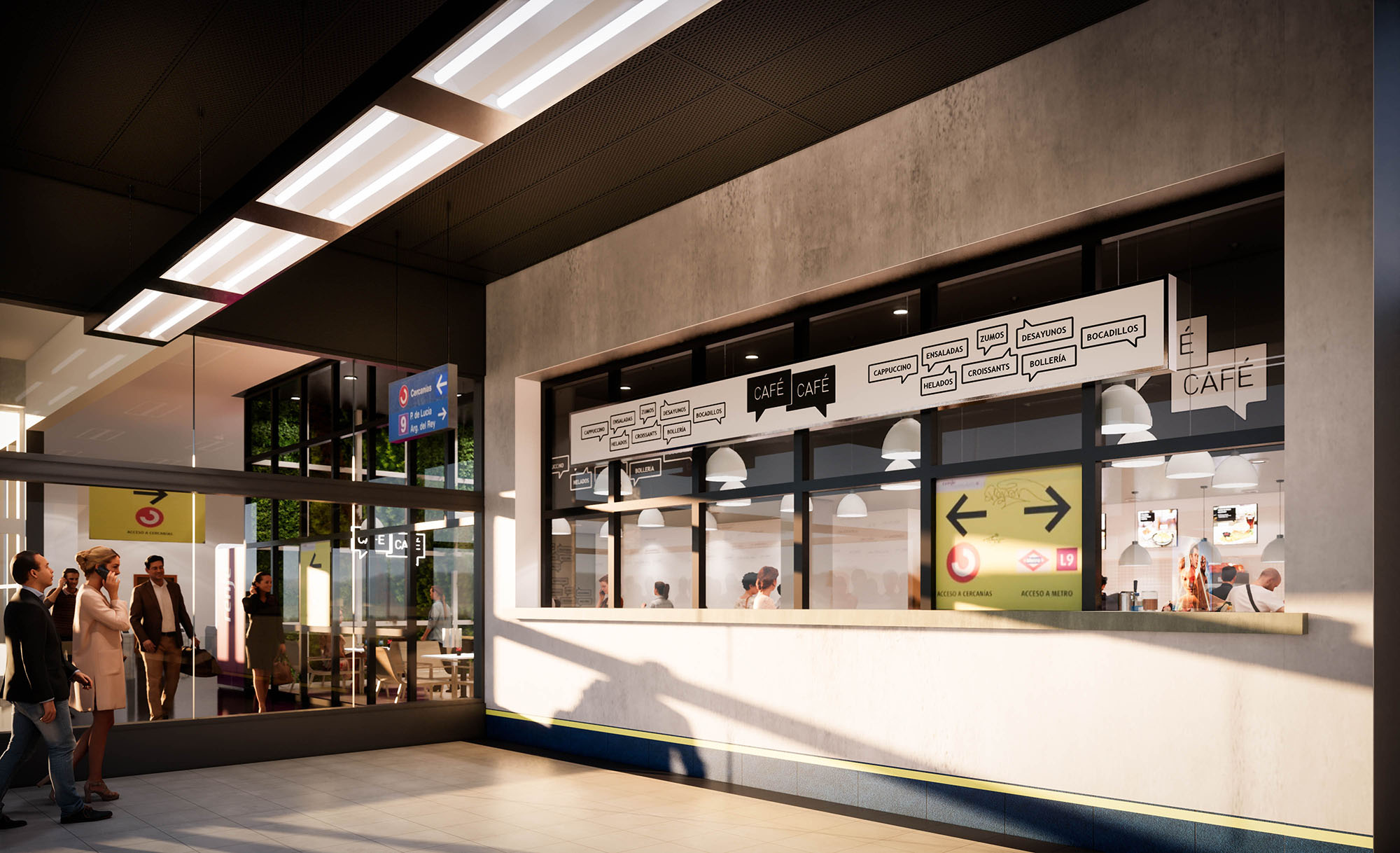
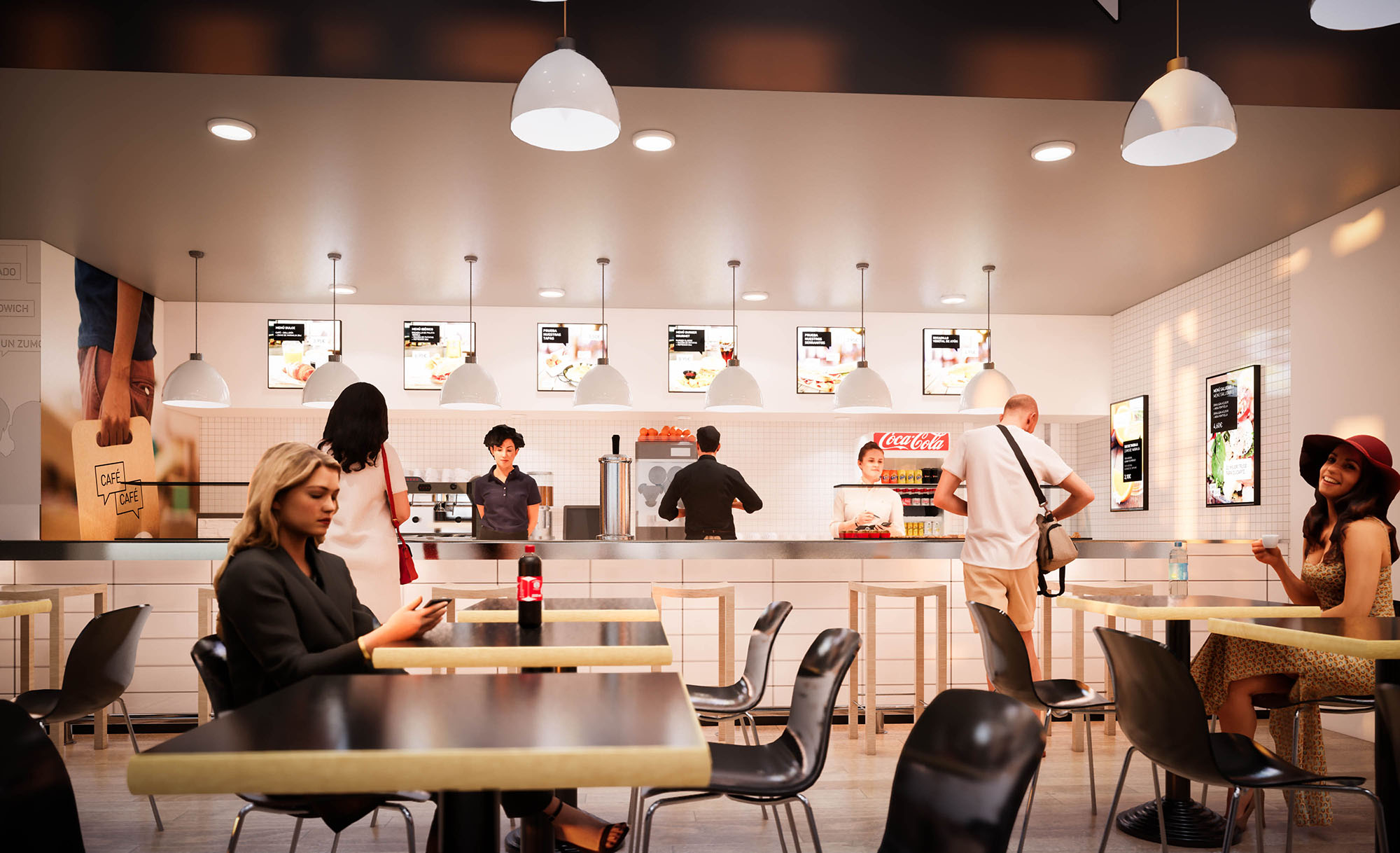
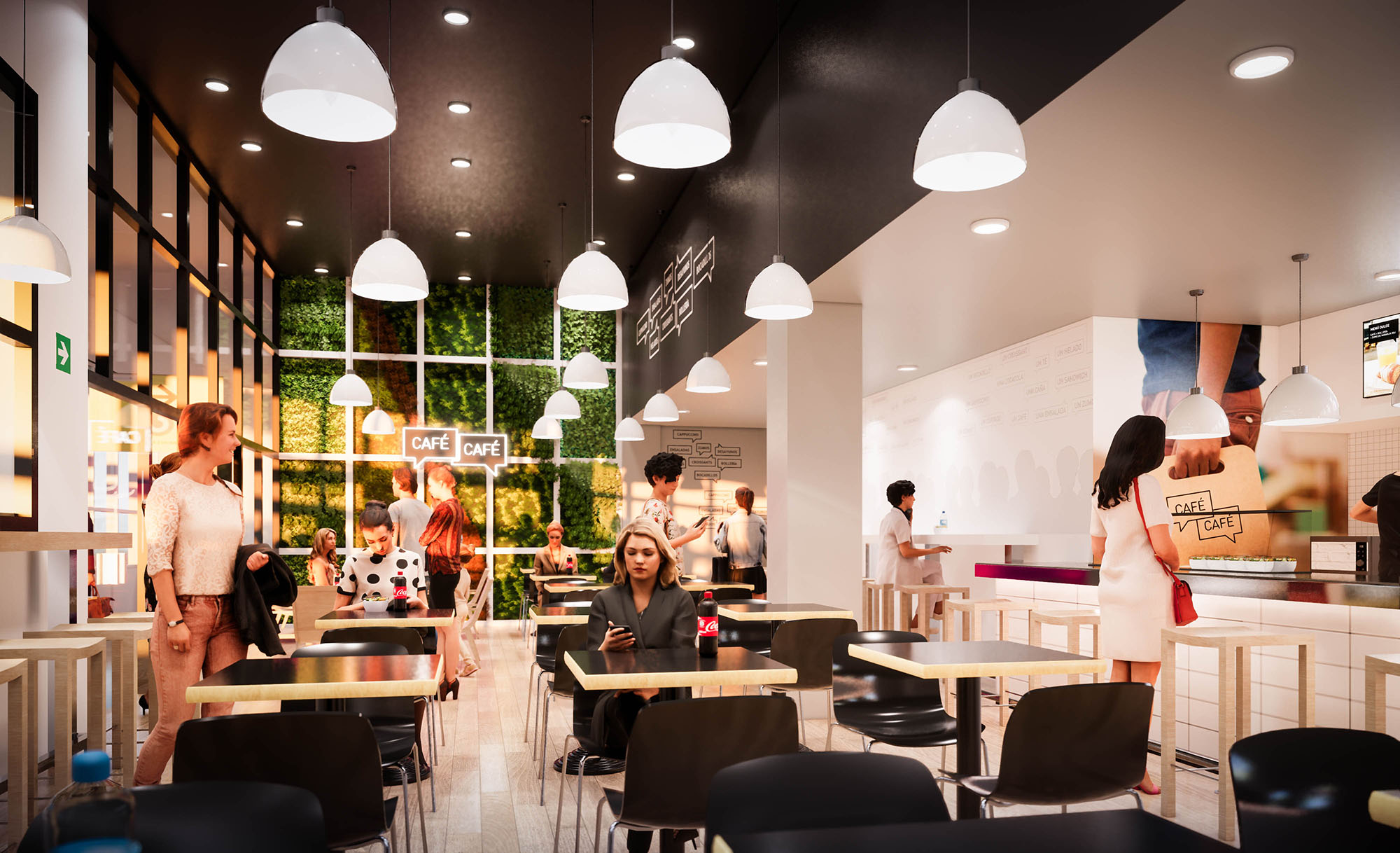
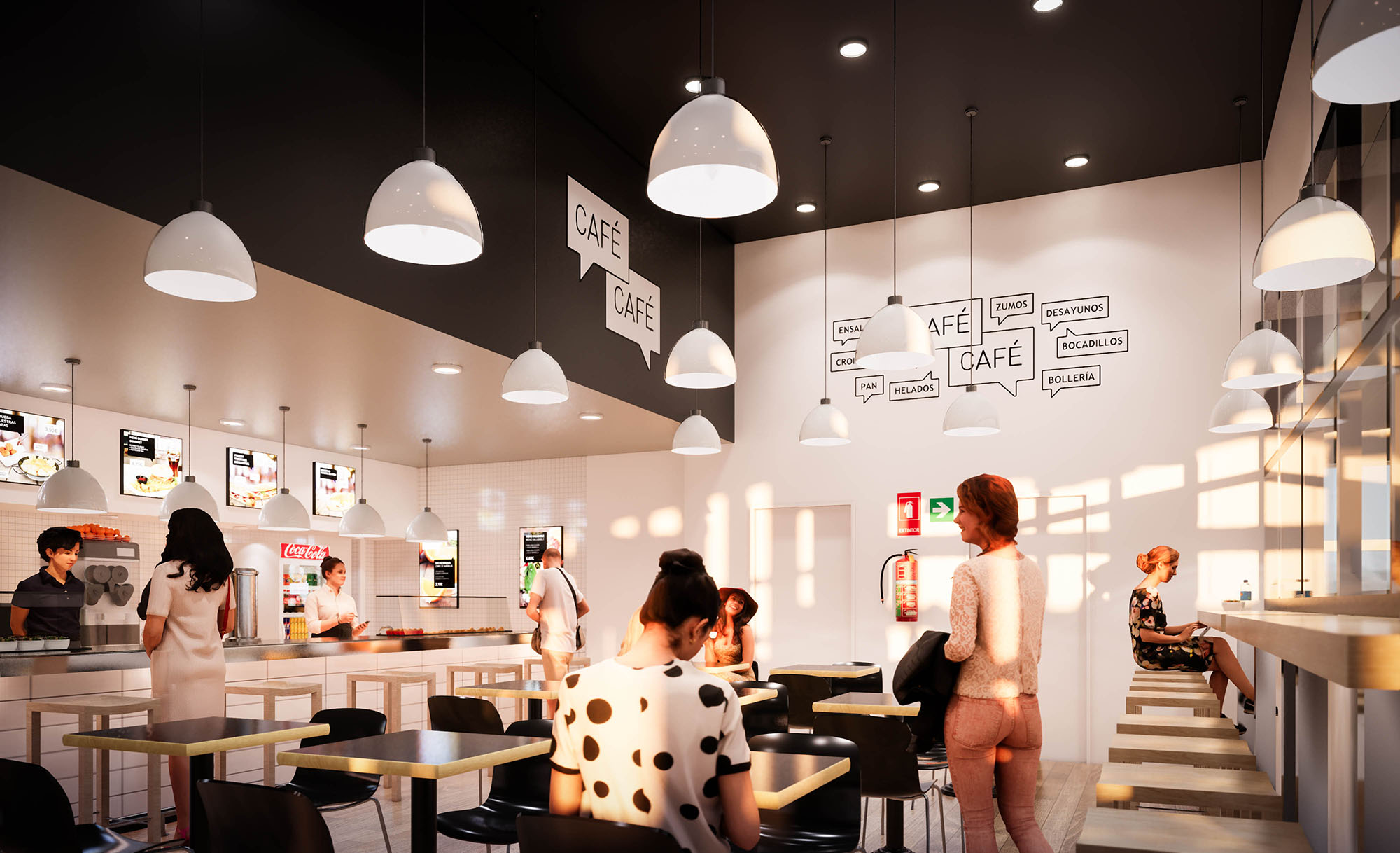
CAFE CAFE is conceived as a contemporary urban café chain that can be replicated in multiple locations while retaining a warm, human scale. The concept merges the clarity of a fast-service environment with the ambience of a comfortable neighborhood café. A restrained palette of materials and colors creates a recognizable brand identity, allowing each unit to adapt to its specific context without losing coherence.
The interior language balances efficiency and hospitality: clear circulation towards the counter, intuitive self-service dynamics and permeable seating zones that invite lingering. The design seeks to evoke an everyday ritual space, where light, vegetation and tactile finishes soften the highly functional program typical of high-turnover restaurants.
The floor plan is organized along a longitudinal axis that visually connects the entrance, the main seating area and the service counter. The access zone opens directly onto the dining space, minimizing visual barriers and enabling immediate orientation. The counter occupies the back wall as a continuous, linear element, consolidating ordering, pickup and display functions in a single gesture.
Seating is arranged in a modular grid of two- and four-top tables, allowing flexible reconfiguration for different groups and peak times. Perimeter bar-height seating along the serving front and windows offers an alternative for solo customers or short stays. Circulation aisles are deliberately generous, ensuring clear flows between tables and the counter, and complying with accessibility standards.
The material palette combines light-toned timber, white ceramic and matte black surfaces to articulate a clean yet warm atmosphere. Tabletops appear in black with a light wood edge, generating a sharp graphic contrast that reinforces the brand’s visual identity. The service counter and lower cabinetry use white finishes and subtle grooves, emphasizing horizontality and hygiene.
The walls are predominantly white, operating as a neutral canvas for illuminated menu boards and large-scale graphics. A key focal element is the vertical green wall that anchors one end of the space, introducing texture, depth and a strong biophilic component. This interplay of natural and synthetic materials produces a clear, legible environment that feels both contemporary and approachable.
Lighting strategy is based on layers. A continuous grid of recessed downlights provides uniform ambient illumination, ensuring operational clarity and comfort throughout the day. Suspended dome-shaped pendants define the main seating field and the counter line, lowering the perceived ceiling height and creating more intimate micro-environments within the larger volume.
The luminaires’ white finish blends with the ceiling, allowing the light itself to become the protagonist rather than the fixture. At the rear, the green wall is softly backlit, producing depth and a subtle gradient that draws visitors into the room. The overall effect is a balanced brightness suitable for quick service, while avoiding glare and excessive contrast.
Brand integration is handled through large photographic panels and discreet signage bearing the CAFE CAFE logo, always framed within the architectural geometry rather than superimposed. Digital menu screens are aligned in a strict horizontal band above the counter, reading as an integral extension of the wall plane.
The furniture follows a minimalist, robust aesthetic: lightweight black shell chairs and slim-profile tables with square tops emphasize modularity and quick reconfiguration. Bar stools at the counter and high tables add functional diversity while maintaining consistency in material and color. The repetition of these standard elements across locations ensures brand continuity and simplifies maintenance and replacement.
Sustainability is addressed through both material selection and operational strategies. The light-toned timber components are conceived to be specified from certified sources, while the predominance of neutral, durable surfaces extends the lifecycle of the interiors, reducing the need for frequent refurbishment. Modular furniture allows components to be reused or relocated between the different Spanish locations.
The lighting scheme is designed for LED technology, minimizing energy consumption and heat gain, which in turn reduces cooling loads. Large glazed surfaces at the façade harness natural light, decreasing the reliance on artificial lighting during daytime hours. The introduction of vertical greenery contributes to improved indoor environmental quality, providing acoustic absorption and a visual connection to nature. Together, these strategies craft a hospitality space that aligns operational efficiency with environmental responsibility across all eight establishments.


Nuestras oficinas están en Barcelona, Cancún, Chicago y Santo Domingo, pero gracias a la tecnología podemos desarrollar proyectos en cualquier parte del mundo.
Barcelona
Bac de Roda 136
08020, Barcelona
Spain
Madrid
Av. de Buendía 11
19005 Guadalajara (Madrid)
Spain
Chicago
373 Hazel Ave, Apt A1
60022, Glencoe, Illinois
United States