

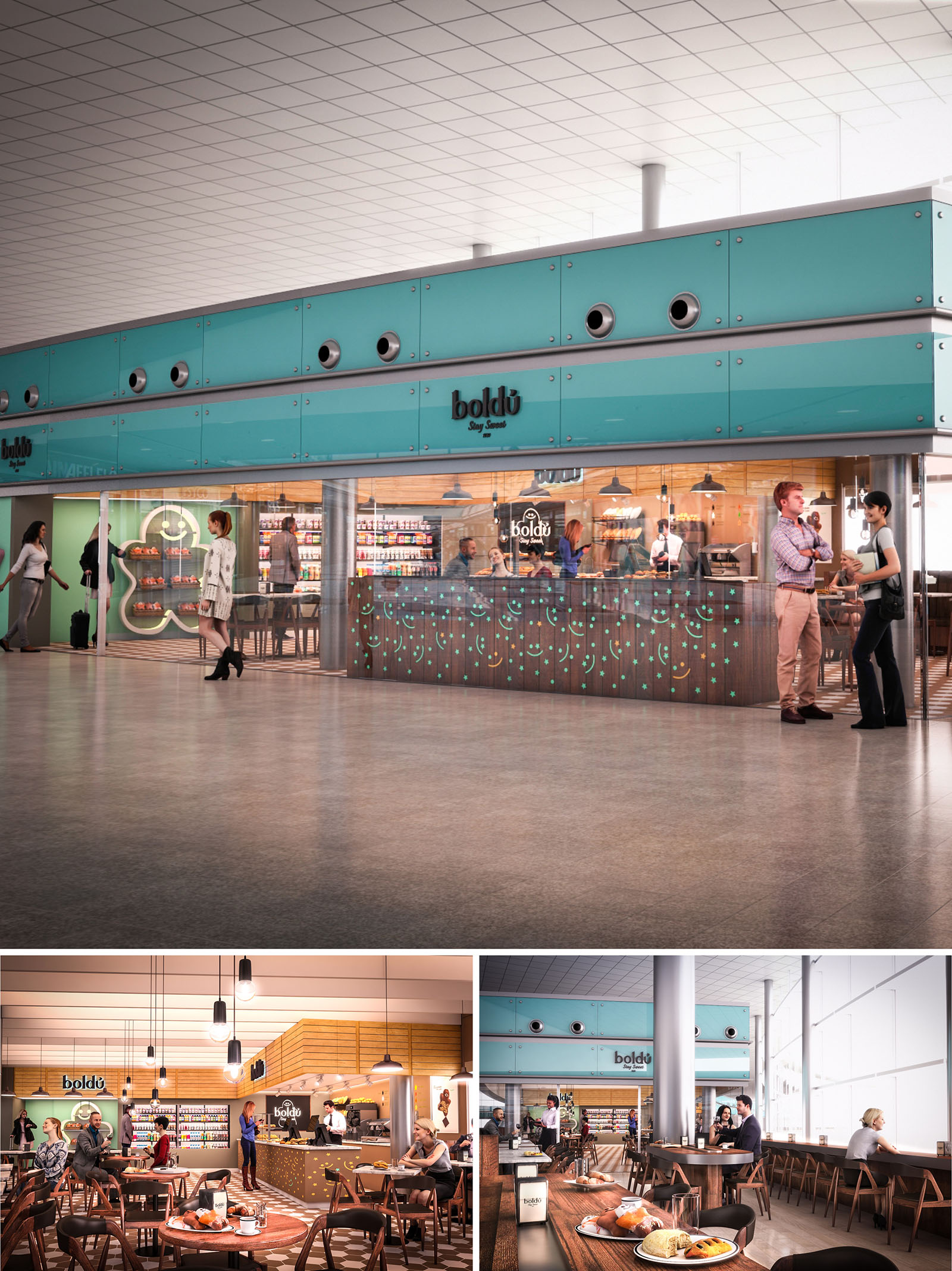
The BOLDU project in Barcelona is conceived as a contemporary pastry and coffee venue integrated into an airport terminal. The concept merges the clarity of transport architecture with the warmth of a neighborhood café, creating a recognizable urban “island” within the fluidity of the departures hall. The design emphasizes transparency, visibility, and an iconic turquoise fascia that operates as a long-distance landmark for travelers in transit.
The space is planned as an open, permeable volume where enclosure is suggested rather than imposed. Glass, light timber, and a refined industrial language define an atmosphere that is simultaneously efficient and welcoming, responding to the short dwell times and diverse user profiles of an airport environment.
The restaurant occupies a corner position along a main circulation axis, maximizing exposure on two fronts. The plan is organized around a central service core containing counter, back bar, and preparation area, with customer flows wrapping around it in a U-shaped movement. This configuration allows for clear differentiation between ordering, pickup, and seating while optimizing staff efficiency.
Perimeter seating lines the façade and opens directly to the terminal concourse, encouraging informal occupation by passersby. Loose tables populate the interior zone, allowing flexible reconfiguration for individuals, couples, or small groups. Long communal tables and bar-height counters address the needs of solo travelers, enabling quick stays without compromising comfort.
The external envelope is defined by a continuous band of turquoise cladding with circular perforations and porthole-like elements. This horizontal datum visually anchors the unit within the larger terminal while reinforcing the brand identity. The perimeter glazing below ensures full transparency, placing the product and activity on display and transforming the interior into a vibrant showcase.
Graphic elements—such as the illuminated pastry outline at the entrance and the dotted pattern on the counter facing—translate the brand’s playful character into spatial devices. These motifs are integrated into the architectural fabric rather than applied decoratively, ensuring coherence between signage, lighting, and enclosure.
The interior atmosphere is characterized by a balanced contrast between warm timber surfaces and cooler industrial finishes. Vertical wall cladding in light wood forms a continuous backdrop to the shelving and menu displays, giving depth and texture to the space. The service counter combines dark-toned panels with integrated turquoise points of light, generating a subtle, animated surface that remains legible from a distance.
Furniture is predominantly in dark wood with slender, tapered legs, creating a mid-century inspired profile that feels both familiar and contemporary. Pendant luminaires with simple cylindrical shades are suspended at varying heights, generating a human-scaled ceiling plane within the higher terminal volume and providing warm, localized pools of light over tables.
The lighting strategy combines ample natural daylight from the terminal’s glazed façade with a layered artificial system. Large windows along one side of the restaurant provide diffuse daylight, which is modulated by the warm timber interior to prevent glare and excessive contrast. This relationship between exterior brightness and interior materiality creates a comfortable visual transition for travelers entering from the concourse.
Artificial lighting is organized in three layers: ambient linear lighting integrated in ceiling and shelves, accent lighting at the counter to emphasize products, and decorative pendants over seating zones. The color temperature is unified in a warm-neutral range, ensuring faithful rendering of food while contributing to a relaxed, hospitable ambience.
Sustainability is addressed through efficient use of materials, natural light, and operational energy. The design relies on large glazed surfaces to minimize daytime artificial lighting, while high-efficiency LED fixtures with dimming controls adapt to variable passenger flows and daylight conditions, reducing energy consumption. The turquoise cladding elements are conceived as modular panels, facilitating maintenance, replacement, and potential future reuse.
Robust, long-lasting materials have been selected for high-traffic areas: compact surfaces for counters, treated timber for wall cladding, and durable flooring with high abrasion resistance. This extends the life cycle of the finishes and minimizes the need for frequent replacement. Furniture density and circulation routes are calculated to maintain fluid movement, reducing congestion and contributing to a calmer environment, which indirectly enhances user well-being and overall environmental quality within the terminal.
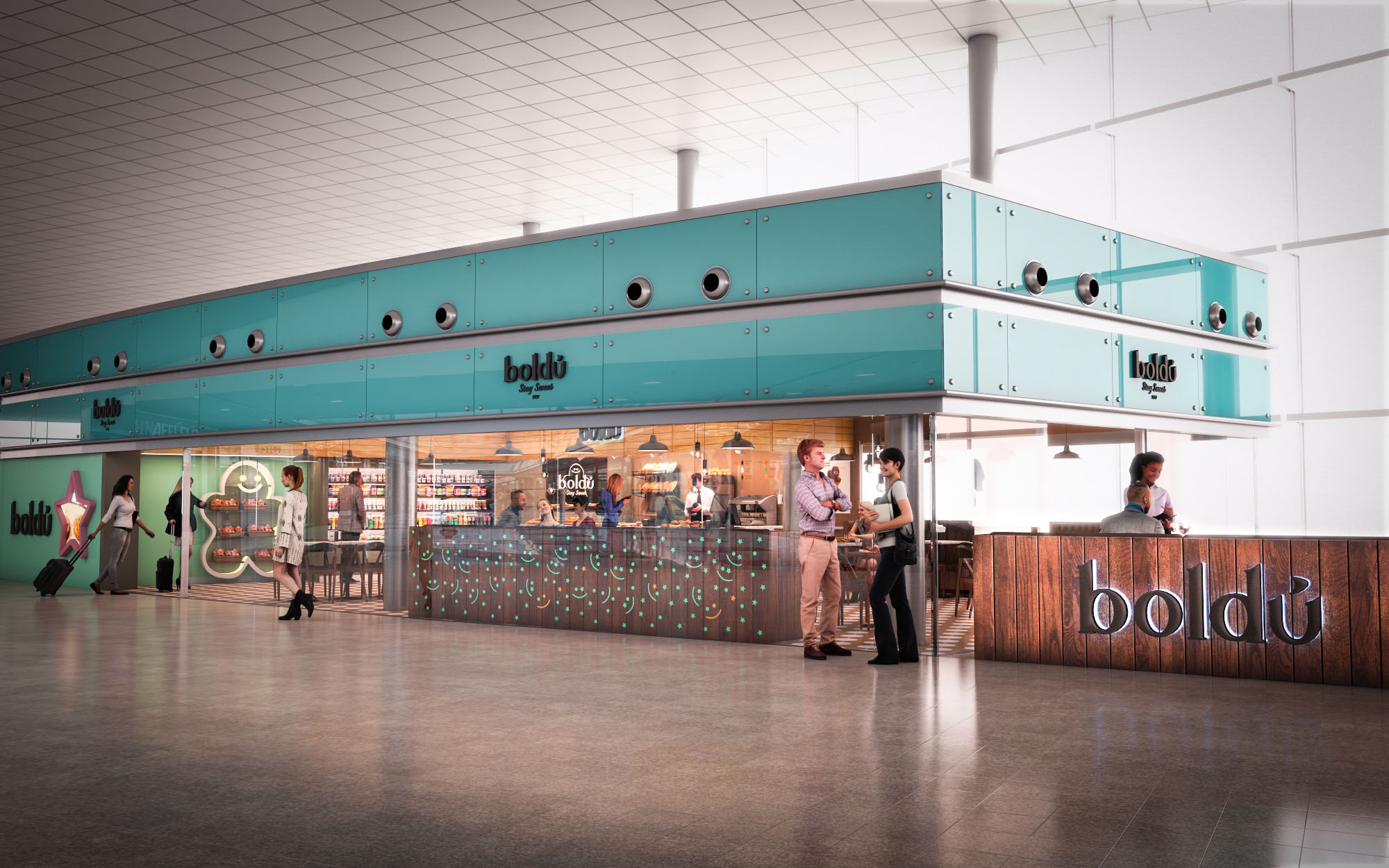
The BOLDU project in Barcelona is conceived as a contemporary pastry and coffee venue integrated into an airport terminal. The concept merges the clarity of transport architecture with the warmth of a neighborhood café, creating a recognizable urban “island” within the fluidity of the departures hall. The design emphasizes transparency, visibility, and an iconic turquoise fascia that operates as a long-distance landmark for travelers in transit.
The space is planned as an open, permeable volume where enclosure is suggested rather than imposed. Glass, light timber, and a refined industrial language define an atmosphere that is simultaneously efficient and welcoming, responding to the short dwell times and diverse user profiles of an airport environment.
The restaurant occupies a corner position along a main circulation axis, maximizing exposure on two fronts. The plan is organized around a central service core containing counter, back bar, and preparation area, with customer flows wrapping around it in a U-shaped movement. This configuration allows for clear differentiation between ordering, pickup, and seating while optimizing staff efficiency.
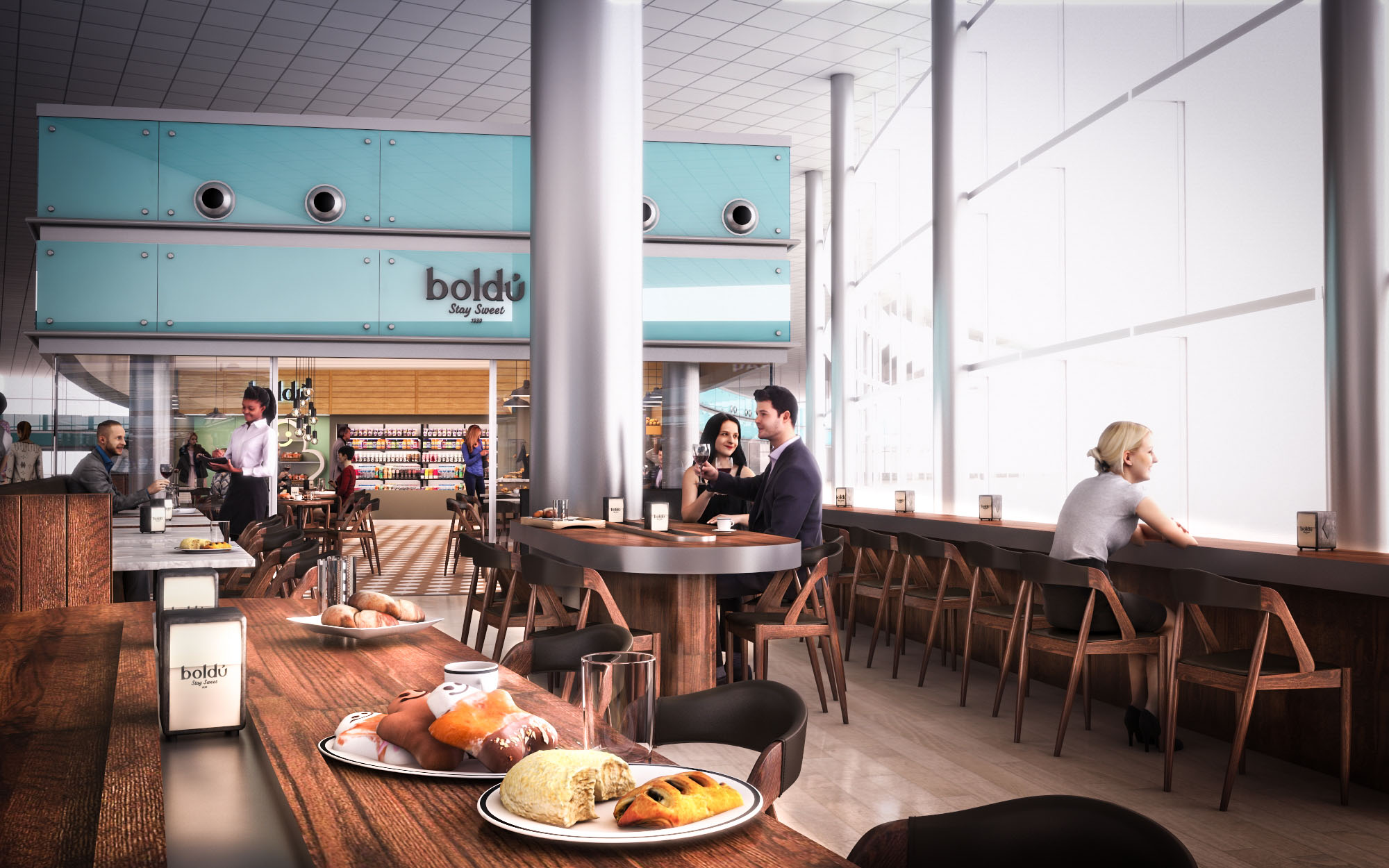
Perimeter seating lines the façade and opens directly to the terminal concourse, encouraging informal occupation by passersby. Loose tables populate the interior zone, allowing flexible reconfiguration for individuals, couples, or small groups. Long communal tables and bar-height counters address the needs of solo travelers, enabling quick stays without compromising comfort.
The external envelope is defined by a continuous band of turquoise cladding with circular perforations and porthole-like elements. This horizontal datum visually anchors the unit within the larger terminal while reinforcing the brand identity. The perimeter glazing below ensures full transparency, placing the product and activity on display and transforming the interior into a vibrant showcase.
Graphic elements—such as the illuminated pastry outline at the entrance and the dotted pattern on the counter facing—translate the brand’s playful character into spatial devices. These motifs are integrated into the architectural fabric rather than applied decoratively, ensuring coherence between signage, lighting, and enclosure.
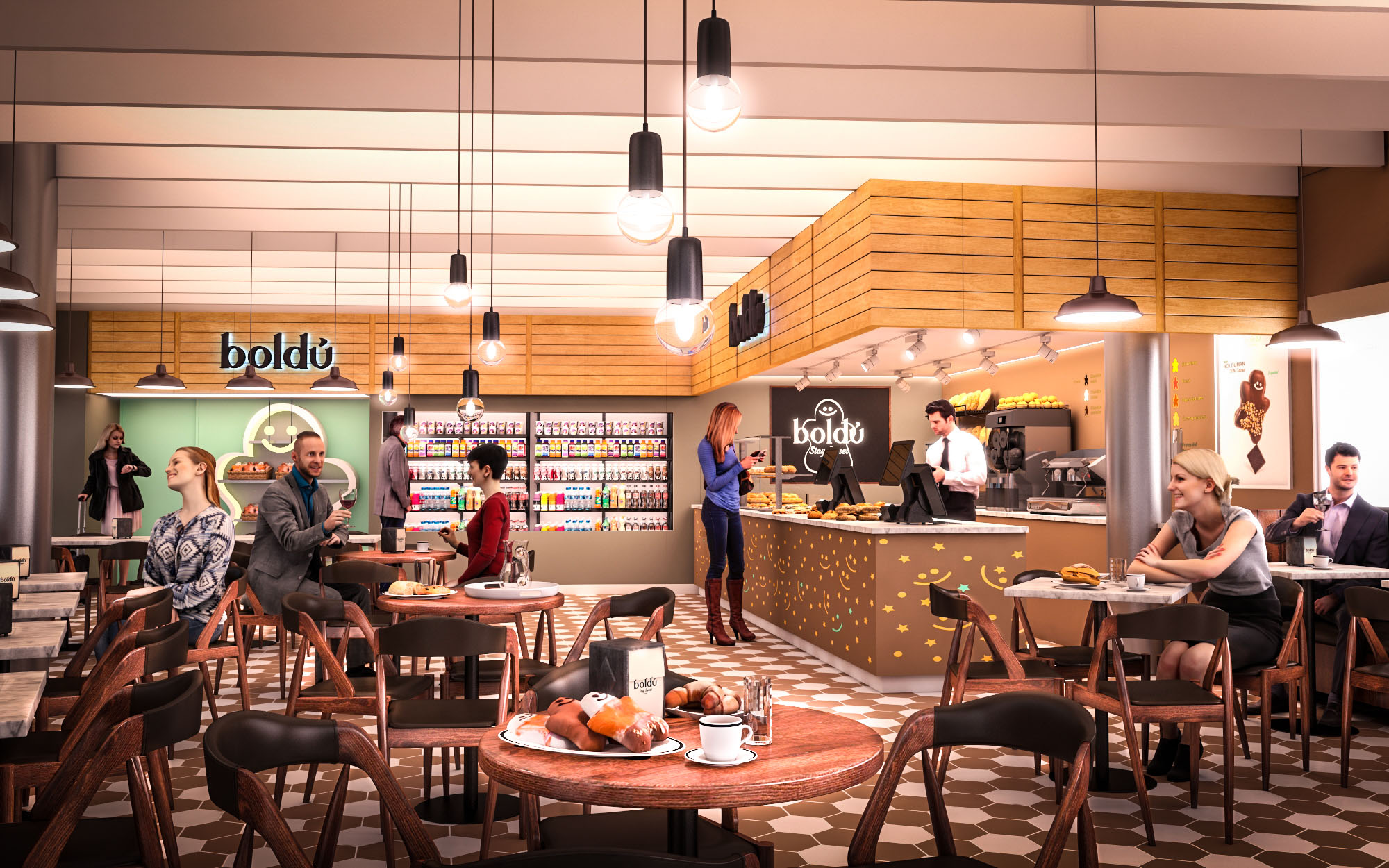
The interior atmosphere is characterized by a balanced contrast between warm timber surfaces and cooler industrial finishes. Vertical wall cladding in light wood forms a continuous backdrop to the shelving and menu displays, giving depth and texture to the space. The service counter combines dark-toned panels with integrated turquoise points of light, generating a subtle, animated surface that remains legible from a distance.
Furniture is predominantly in dark wood with slender, tapered legs, creating a mid-century inspired profile that feels both familiar and contemporary. Pendant luminaires with simple cylindrical shades are suspended at varying heights, generating a human-scaled ceiling plane within the higher terminal volume and providing warm, localized pools of light over tables.
The lighting strategy combines ample natural daylight from the terminal’s glazed façade with a layered artificial system. Large windows along one side of the restaurant provide diffuse daylight, which is modulated by the warm timber interior to prevent glare and excessive contrast. This relationship between exterior brightness and interior materiality creates a comfortable visual transition for travelers entering from the concourse.
Artificial lighting is organized in three layers: ambient linear lighting integrated in ceiling and shelves, accent lighting at the counter to emphasize products, and decorative pendants over seating zones. The color temperature is unified in a warm-neutral range, ensuring faithful rendering of food while contributing to a relaxed, hospitable ambience.
Sustainability is addressed through efficient use of materials, natural light, and operational energy. The design relies on large glazed surfaces to minimize daytime artificial lighting, while high-efficiency LED fixtures with dimming controls adapt to variable passenger flows and daylight conditions, reducing energy consumption. The turquoise cladding elements are conceived as modular panels, facilitating maintenance, replacement, and potential future reuse.
Robust, long-lasting materials have been selected for high-traffic areas: compact surfaces for counters, treated timber for wall cladding, and durable flooring with high abrasion resistance. This extends the life cycle of the finishes and minimizes the need for frequent replacement. Furniture density and circulation routes are calculated to maintain fluid movement, reducing congestion and contributing to a calmer environment, which indirectly enhances user well-being and overall environmental quality within the terminal.


Nuestras oficinas están en Barcelona, Cancún, Chicago y Santo Domingo, pero gracias a la tecnología podemos desarrollar proyectos en cualquier parte del mundo.
Barcelona
Bac de Roda 136
08020, Barcelona
Spain
Madrid
Av. de Buendía 11
19005 Guadalajara (Madrid)
Spain
Chicago
373 Hazel Ave, Apt A1
60022, Glencoe, Illinois
United States