

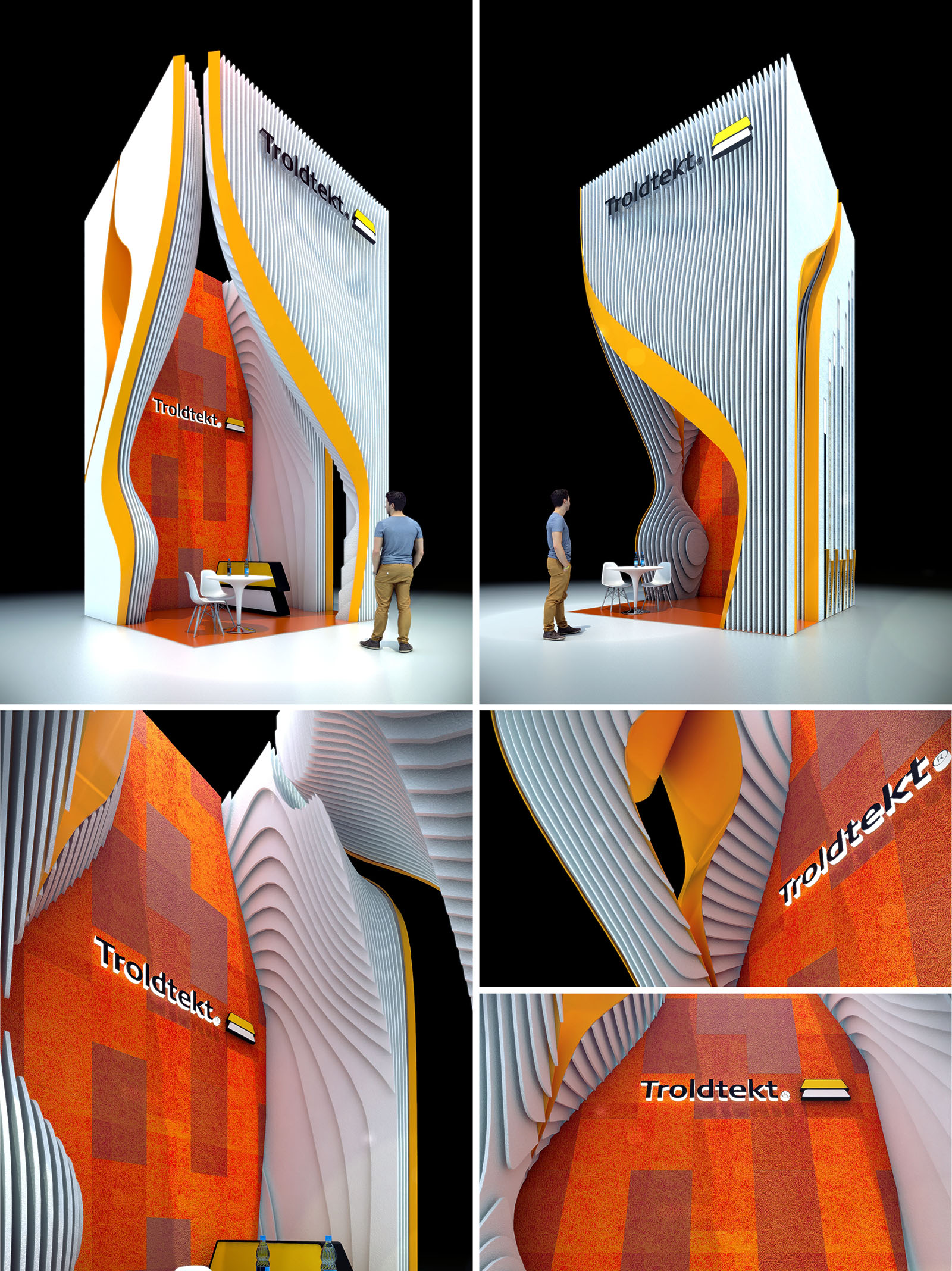
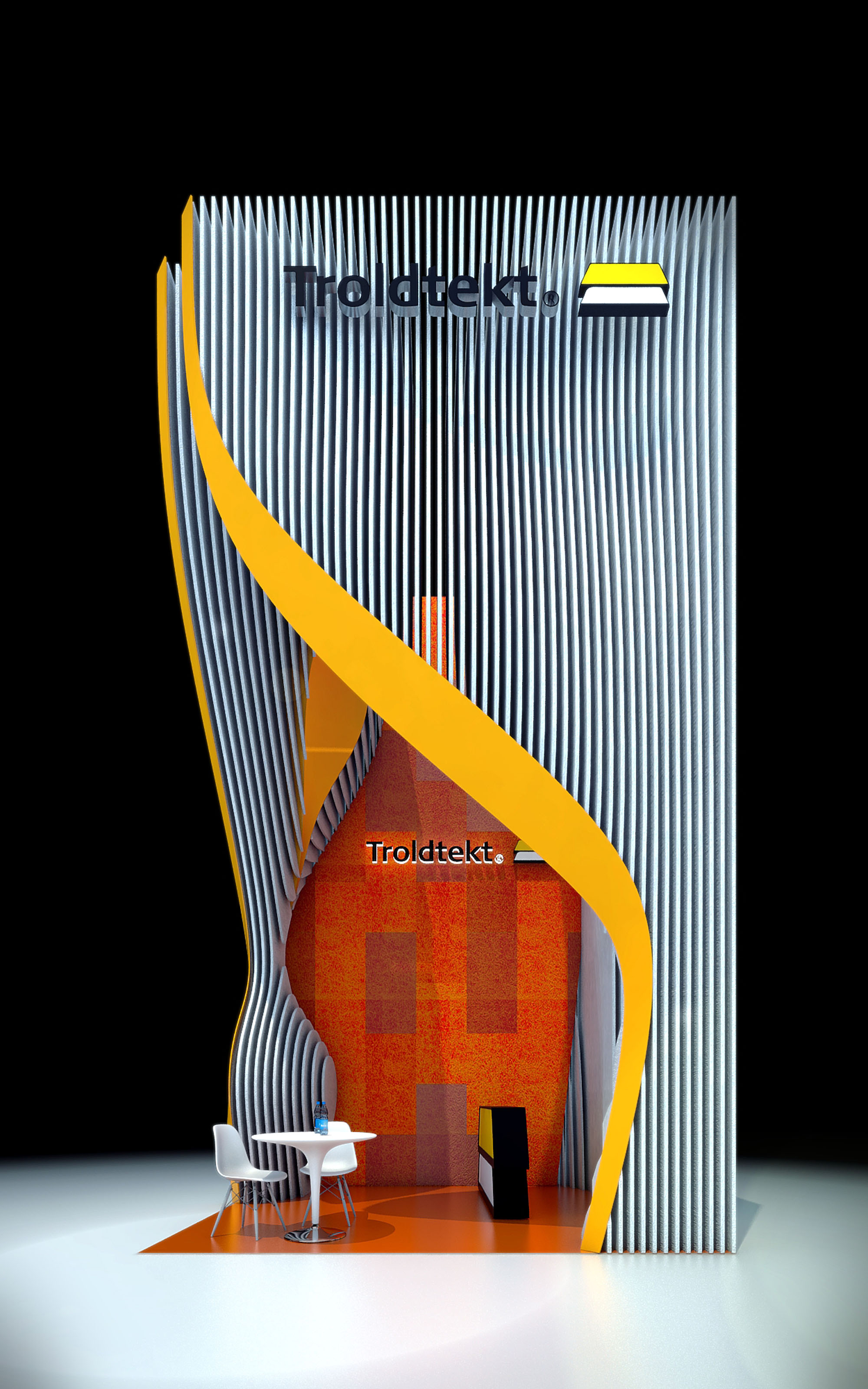
The Troldtekt Pavilion in Mexico City is conceived as a vertical urban landmark that expresses sound, movement and materiality within a compact exhibition footprint. The design translates acoustic waves into an architectural gesture, using layered surfaces that appear to ripple around a vivid central core. This sculptural envelope frames the brand as an immersive spatial experience rather than a conventional trade-fair stand.
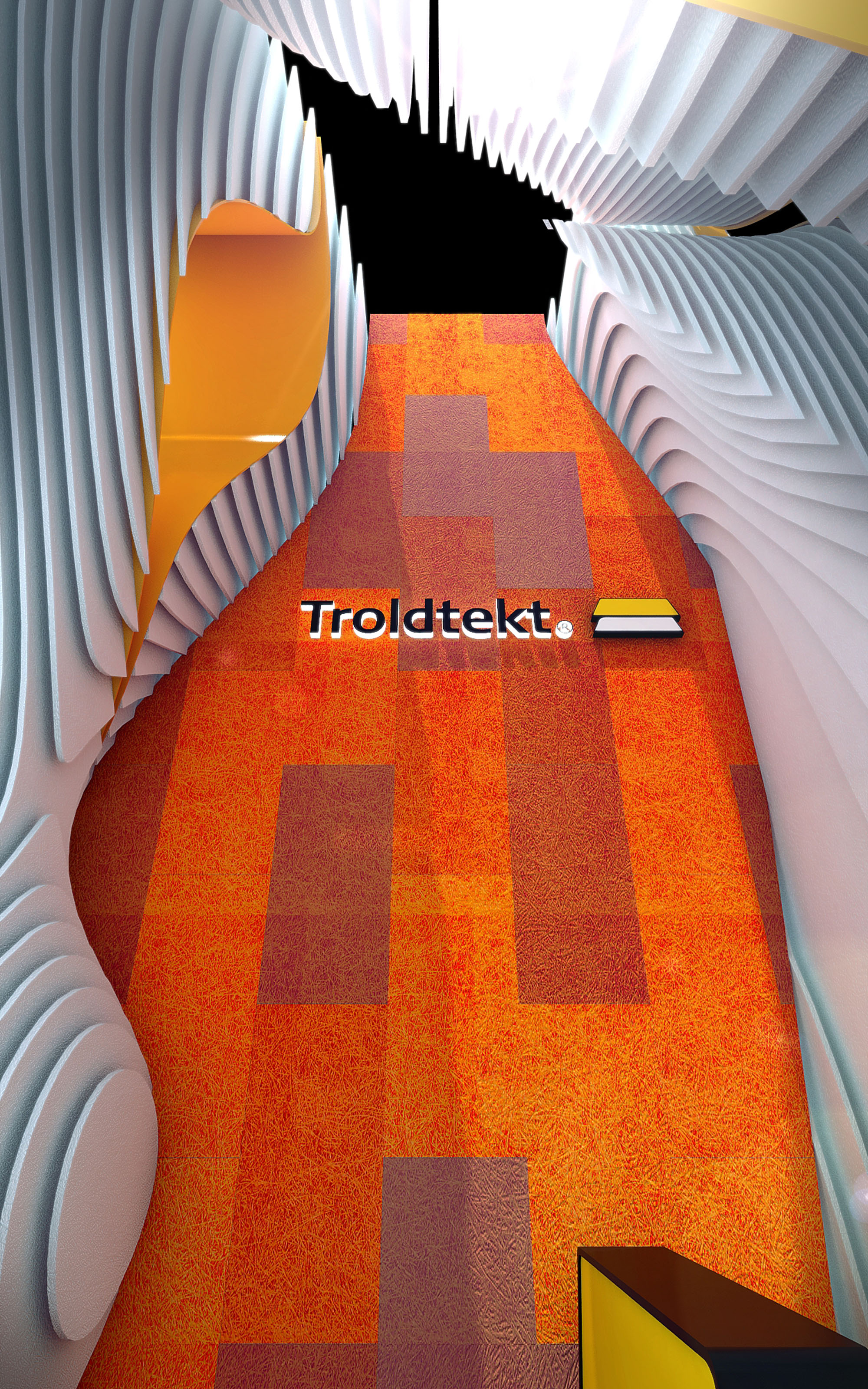
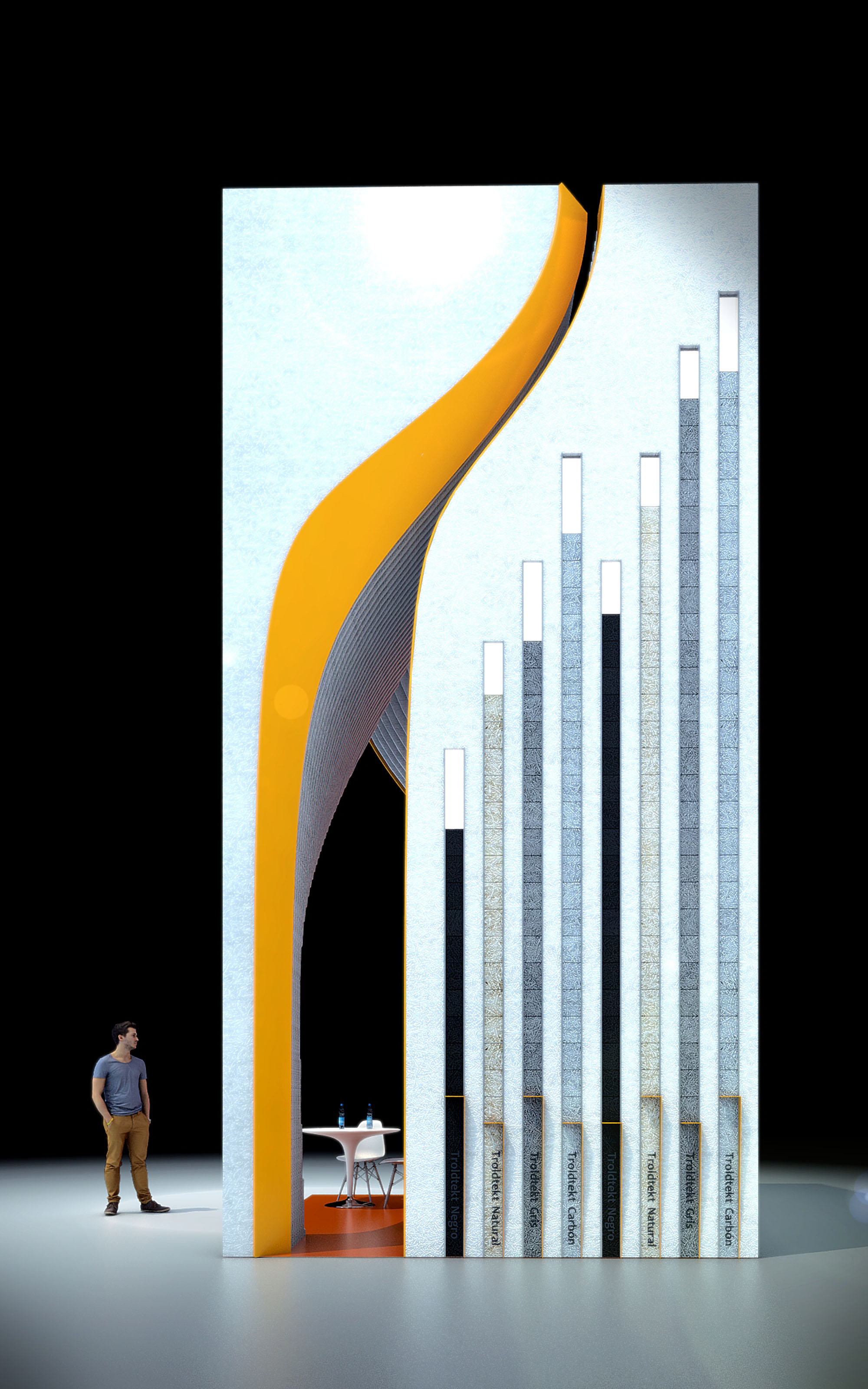
The pavilion works as a tall, narrow “urban canyon,” drawing visitors inward through a carved entrance. The void between the outer fins and the inner volume creates a sense of compression and release, enhancing the perception of height and transforming a small floor area into an expansive spatial sequence.
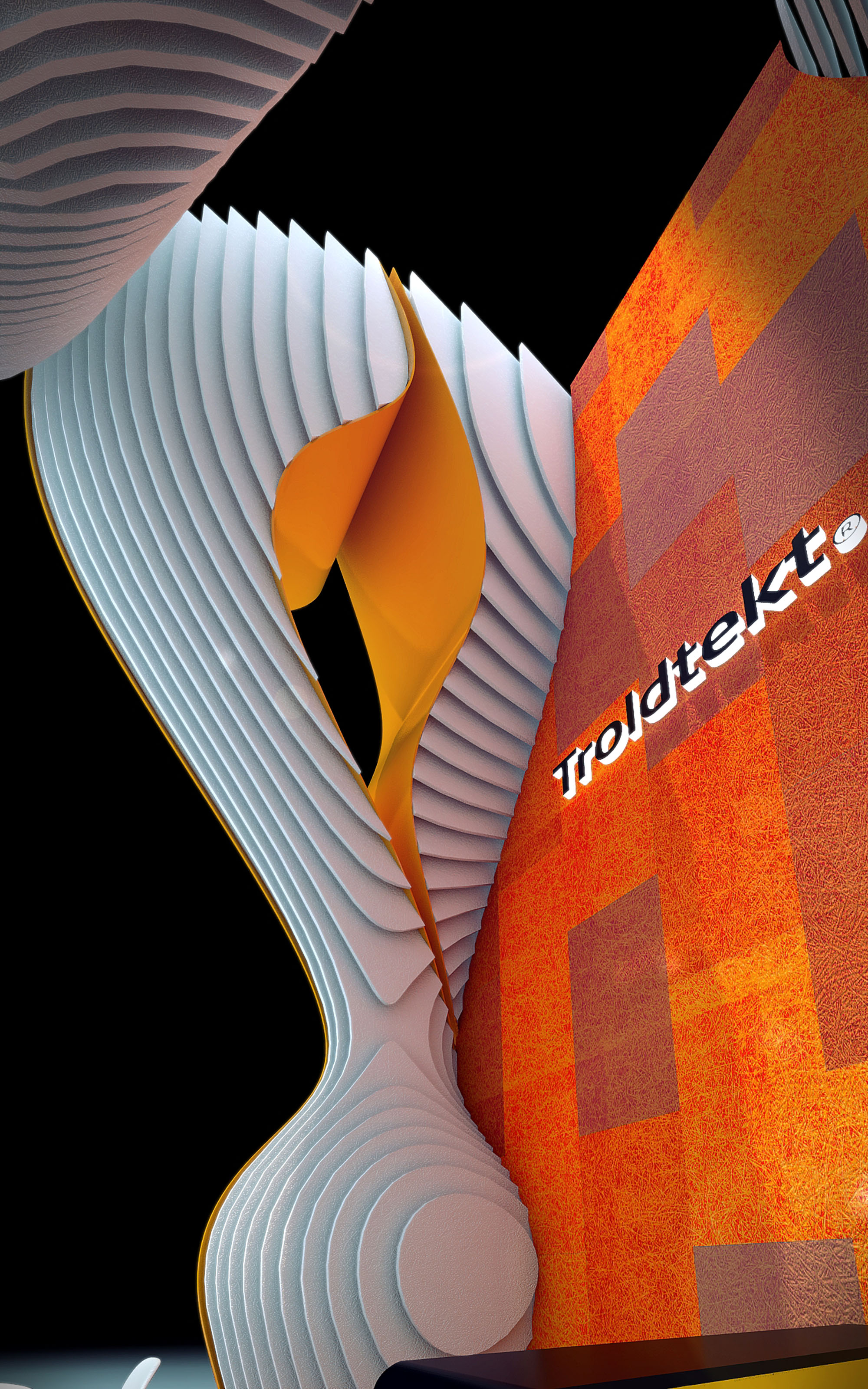
The overall geometry is defined by a series of vertical lamellae that rise continuously from floor to roof, forming an open shell. These fins are parametrically modulated to twist and peel away, generating a dynamic portal that visually guides visitors towards the interior. The interplay between straight edges and fluid curves establishes a strong contrast that is legible from a distance.
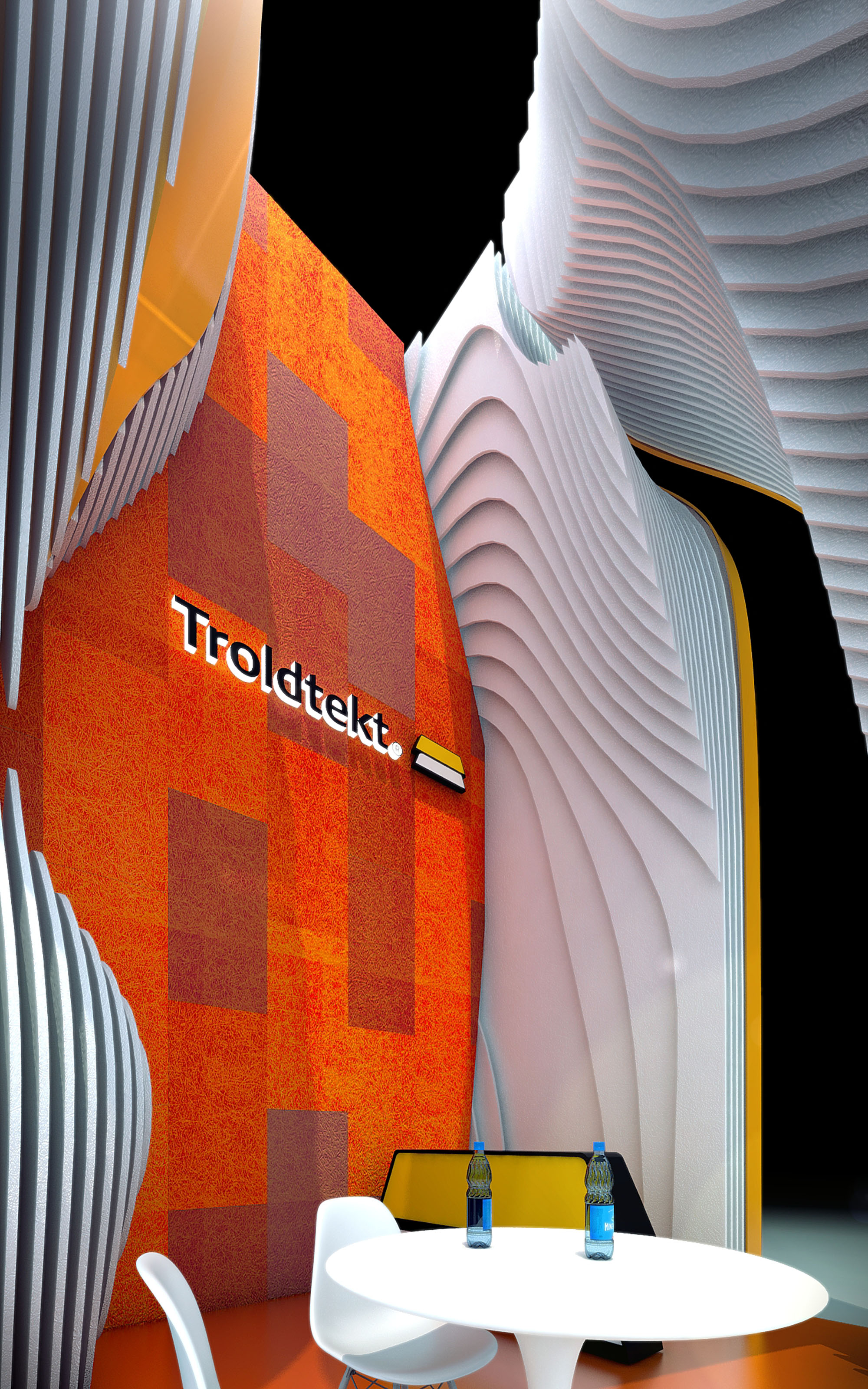
Inside, the space is organized as a single multifunctional chamber. The front zone accommodates reception and informal meetings, with a compact table and chairs positioned to benefit from the visual depth of the layered walls. The rear zone acts as a brand backdrop, using the Troldtekt surface as a large-scale exhibition wall and visual anchor.
The pavilion is structured around the expressive use of Troldtekt acoustic panels, showcased on the inner vertical plane in a warm orange palette. The textured surface, composed of subtle tonal variations, demonstrates the product’s capacity to form continuous, visually rich fields while optimizing sound absorption within a highly reflective fair environment.
The lamellae are conceived as lightweight framed elements with a smooth, neutral finish that contrasts with the tactile Troldtekt core. Their stepped profile acts as a three-dimensional acoustic baffle, diffusing sound and reducing reverberation. In this way, visitors experience the acoustic performance of the material through both hearing and touch.
The chromatic scheme relies on a triad of white, orange and a dark neutral background. The intense orange of the Troldtekt surface becomes the central visual identity, framed by a white shell that emphasizes brightness and clarity. A bold yellow-orange ribbon cuts through the fins, reinforcing the brand line and guiding the eye vertically.
The black void surrounding the pavilion, both in physical backdrop and visual communication, isolates the object and heightens its presence. The logo is integrated directly into the acoustic surface, ensuring that brand recognition is inseparable from the material experience.
The pavilion is designed as a dry-assembled system, allowing quick on-site installation and disassembly. Repetitive lamella modules can be CNC-cut from standardized boards, minimizing waste and simplifying logistics. The structural stability is achieved through hidden frames and base fixings, maintaining the visual lightness of the vertical fins.
The open front and top allow the pavilion to adapt to different exhibition halls and lighting conditions. The internal layout remains flexible, permitting alternative furniture arrangements or integration of digital displays without compromising the architectural character.
Sustainability is addressed primarily through material selection and reversibility. Troldtekt panels, based on wood wool and cement, provide a durable, low-emission acoustic solution that can be reused across multiple events. The modular lamellae are dimensioned to optimize sheet usage and facilitate reconfiguration for future pavilions.
The vertical, compact footprint reduces the stand’s physical impact while maximizing visibility, making efficient use of expensive exhibition floor area. The reliance on surface articulation and color, rather than heavy construction or integrated technology, reduces resource consumption and supports a circular approach where all elements can be dismantled, stored and re-employed in subsequent installations.
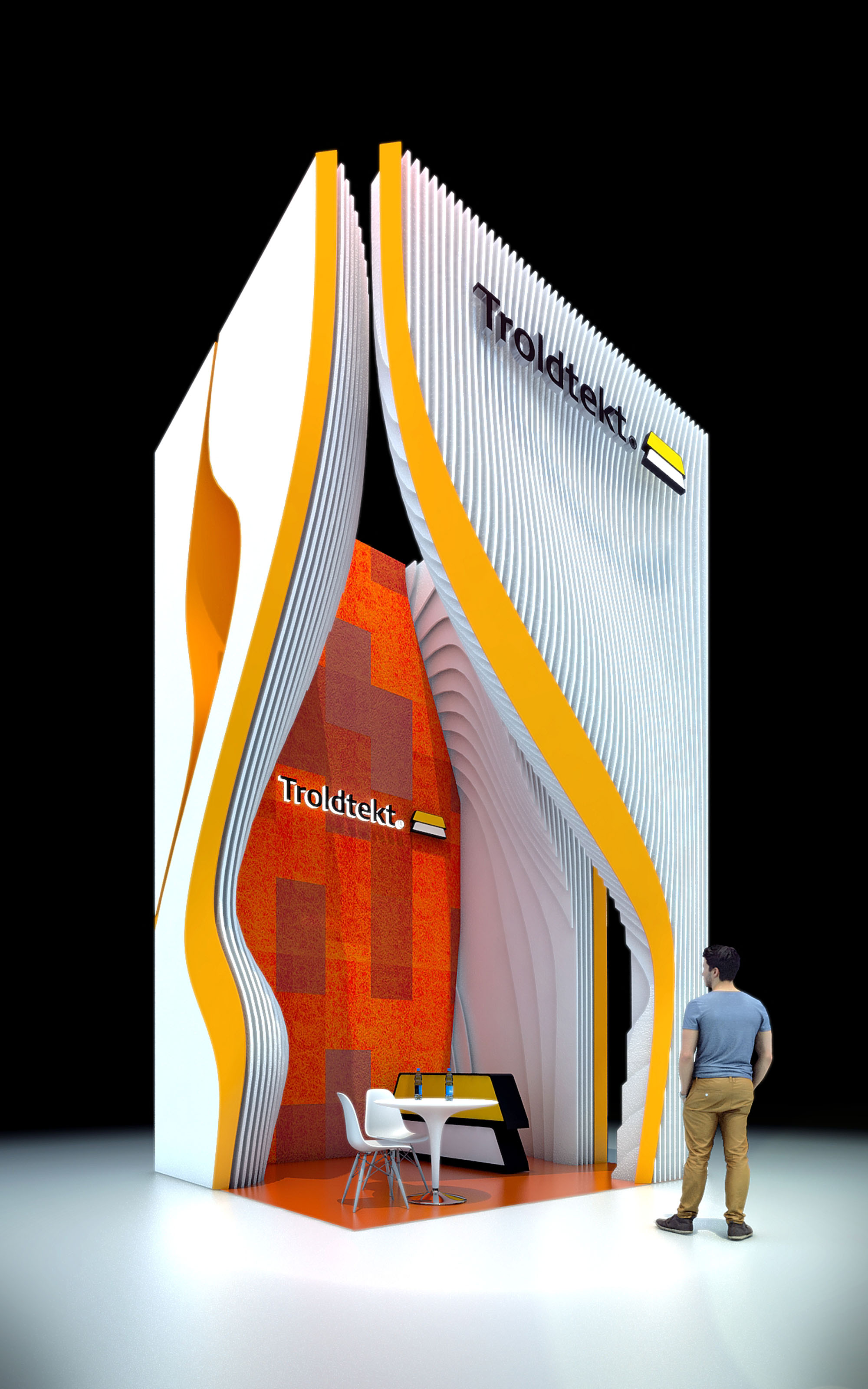
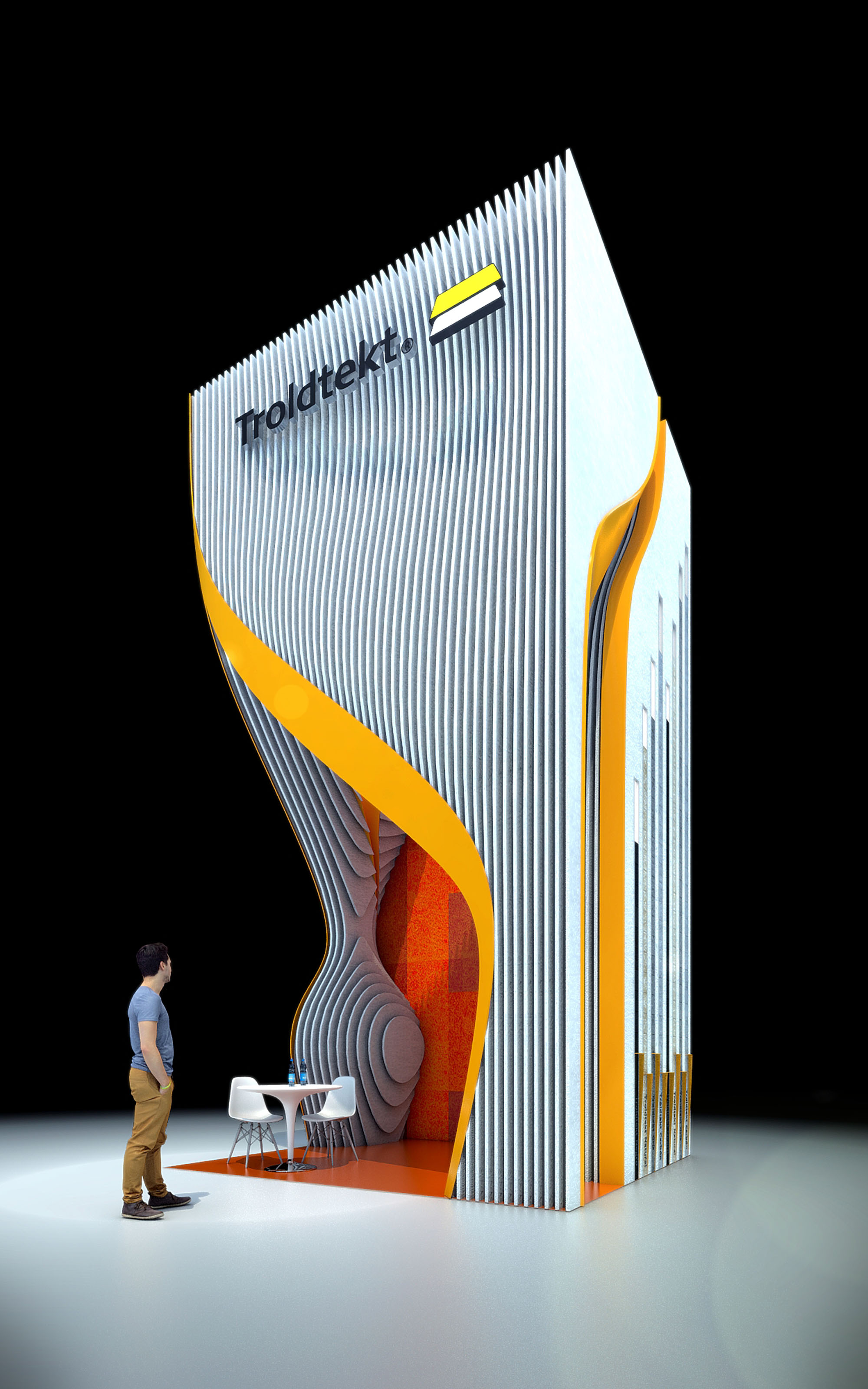
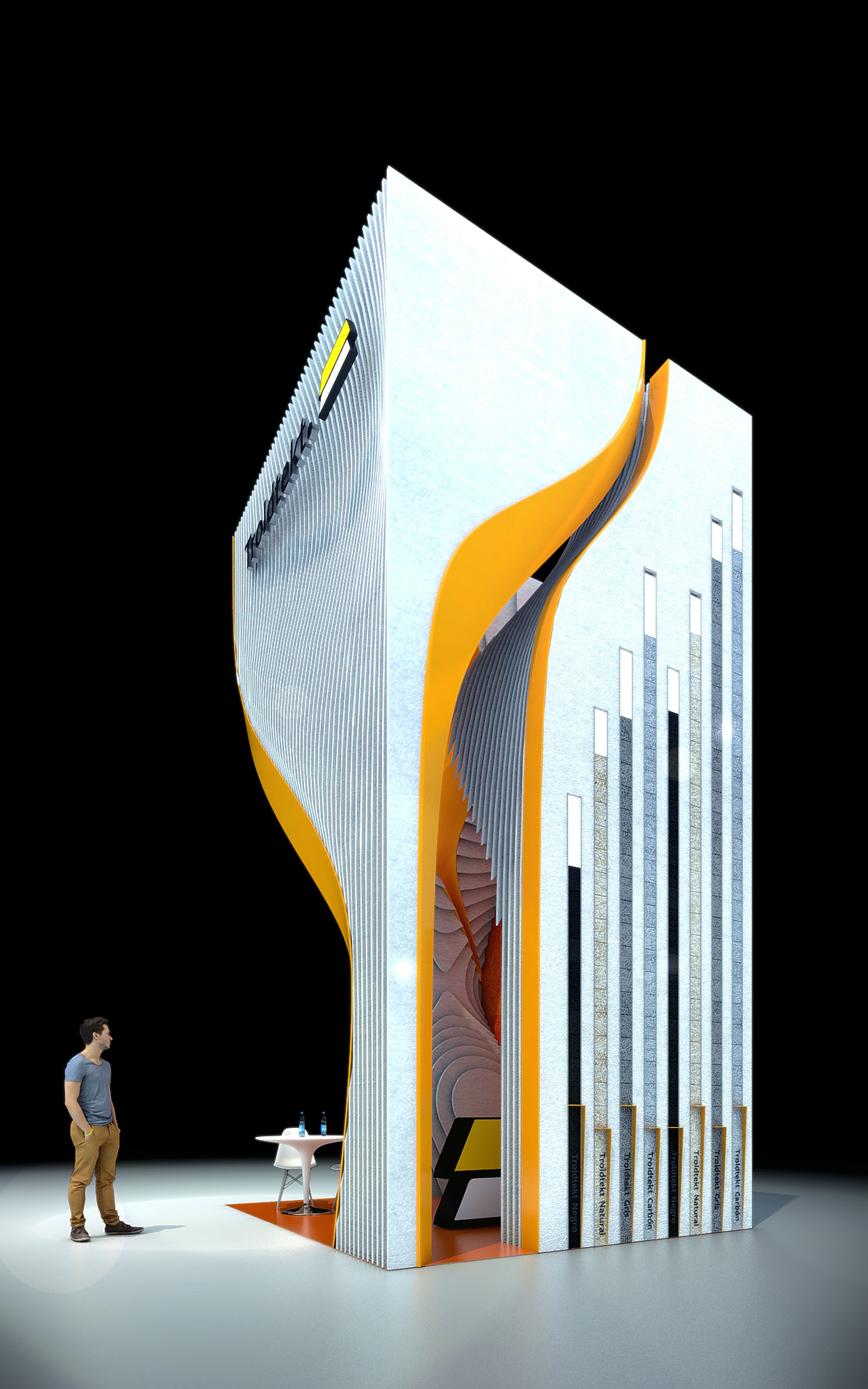
The Troldtekt Pavilion in Mexico City is conceived as a vertical urban landmark that expresses sound, movement and materiality within a compact exhibition footprint. The design translates acoustic waves into an architectural gesture, using layered surfaces that appear to ripple around a vivid central core. This sculptural envelope frames the brand as an immersive spatial experience rather than a conventional trade-fair stand.
The pavilion works as a tall, narrow “urban canyon,” drawing visitors inward through a carved entrance. The void between the outer fins and the inner volume creates a sense of compression and release, enhancing the perception of height and transforming a small floor area into an expansive spatial sequence.
The overall geometry is defined by a series of vertical lamellae that rise continuously from floor to roof, forming an open shell. These fins are parametrically modulated to twist and peel away, generating a dynamic portal that visually guides visitors towards the interior. The interplay between straight edges and fluid curves establishes a strong contrast that is legible from a distance.
Inside, the space is organized as a single multifunctional chamber. The front zone accommodates reception and informal meetings, with a compact table and chairs positioned to benefit from the visual depth of the layered walls. The rear zone acts as a brand backdrop, using the Troldtekt surface as a large-scale exhibition wall and visual anchor.
The pavilion is structured around the expressive use of Troldtekt acoustic panels, showcased on the inner vertical plane in a warm orange palette. The textured surface, composed of subtle tonal variations, demonstrates the product’s capacity to form continuous, visually rich fields while optimizing sound absorption within a highly reflective fair environment.
The lamellae are conceived as lightweight framed elements with a smooth, neutral finish that contrasts with the tactile Troldtekt core. Their stepped profile acts as a three-dimensional acoustic baffle, diffusing sound and reducing reverberation. In this way, visitors experience the acoustic performance of the material through both hearing and touch.
The chromatic scheme relies on a triad of white, orange and a dark neutral background. The intense orange of the Troldtekt surface becomes the central visual identity, framed by a white shell that emphasizes brightness and clarity. A bold yellow-orange ribbon cuts through the fins, reinforcing the brand line and guiding the eye vertically.
The black void surrounding the pavilion, both in physical backdrop and visual communication, isolates the object and heightens its presence. The logo is integrated directly into the acoustic surface, ensuring that brand recognition is inseparable from the material experience.
The pavilion is designed as a dry-assembled system, allowing quick on-site installation and disassembly. Repetitive lamella modules can be CNC-cut from standardized boards, minimizing waste and simplifying logistics. The structural stability is achieved through hidden frames and base fixings, maintaining the visual lightness of the vertical fins.
The open front and top allow the pavilion to adapt to different exhibition halls and lighting conditions. The internal layout remains flexible, permitting alternative furniture arrangements or integration of digital displays without compromising the architectural character.
Sustainability is addressed primarily through material selection and reversibility. Troldtekt panels, based on wood wool and cement, provide a durable, low-emission acoustic solution that can be reused across multiple events. The modular lamellae are dimensioned to optimize sheet usage and facilitate reconfiguration for future pavilions.
The vertical, compact footprint reduces the stand’s physical impact while maximizing visibility, making efficient use of expensive exhibition floor area. The reliance on surface articulation and color, rather than heavy construction or integrated technology, reduces resource consumption and supports a circular approach where all elements can be dismantled, stored and re-employed in subsequent installations.


Our offices are located in Barcelona, Cancún, Chicago and Santo Domingo, but thanks to technology we can do projects on all over the world.
Barcelona
Bac de Roda 136
08020, Barcelona
Spain
Madrid
Av. de Buendía 11
19005 Guadalajara (Madrid)
Spain
Chicago
373 Hazel Ave, Apt A1
60022, Glencoe, Illinois
United States