

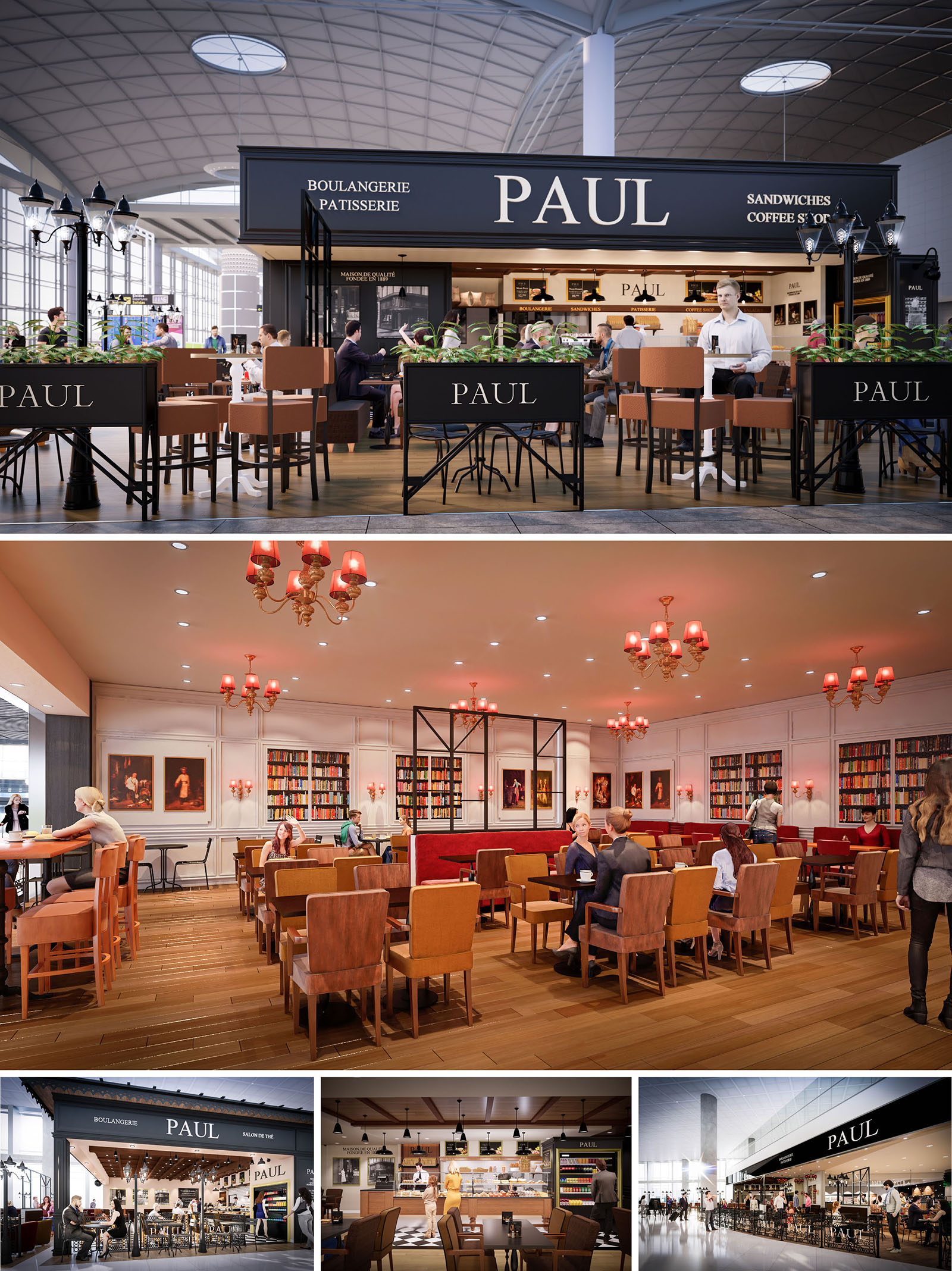
The PAUL spaces in Spain and Portugal interpret the traditional French boulangerie as a contemporary travel lounge. The concept juxtaposes an elegant, almost Parisian street façade with a warm, library-like interior, creating a recognizable identity across multiple transport hubs. The design aims to slow down the rhythm of passage, offering an atmosphere of cultivated calm within highly dynamic airport environments.
Clear brand visibility governs the architectural composition: a strong black cornice with bold typography frames the open café volume, while interior spaces are defined by refined paneling, curated artwork and bookshelves. This duality between open public plaza and intimate salon informs the spatial and material strategy.
The restaurant functions as an island pavilion within the concourse, with permeable edges that invite circulation from all sides. Planters and light metal screens delineate the seating boundary without creating a visual barrier, maintaining transparency to the terminal while defining a recognizable dining precinct. The main service counter is positioned centrally at the rear, anchoring the space and optimizing visibility of the product display.
Inside, the layout is organized in longitudinal bands: perimeter seating against walls and façades, central table clusters for flexible occupancy, and carefully aligned circulation aisles guaranteeing efficient service and comfortable movement with luggage. Different seating typologies—standard tables, banquettes and high tables—support both quick consumption and longer stays, maximising the operational capacity of relatively compact footprints.
The interior adopts a classic French brasserie language, reinterpreted with a contemporary clarity. Timber flooring with a warm tone sets a domestic base, complemented by paneled walls painted in a soft, light shade that enhances brightness. Built-in bookshelves and framed artworks provide depth and narrative, recalling a Parisian salon and reinforcing the brand’s cultural and artisanal positioning.
Upholstered banquettes in rich red fabric introduce a strong chromatic accent, contrasted with leather or faux-leather chairs in natural brown and camel hues. This palette mediates between the dark exterior branding and the luminous interior shell, creating a sophisticated yet approachable environment suited to a wide range of users and times of day.
The material strategy balances durability with tactile comfort. Solid or engineered timber floors, robust metal framing, and high-performance upholstery are specified for intensive airport use, while decorative elements such as chandeliers and sconces employ traditional forms in updated finishes. The counter area combines warm wood with black metal and glass, ensuring hygienic work surfaces and clear product visibility.
Lighting is layered: warm, low-level luminaires—classical chandeliers with red shades—create an intimate ambiance in the salon area, while recessed downlights deliver uniform functional illumination. At the façade, lantern-style fixtures and the illuminated signage band strengthen the street-like character and ensure legibility from a distance. Brand integration is architectural rather than merely graphic, with the PAUL identity embedded into cornices, planters and metalwork.
Sustainability is addressed through material selection, energy performance and operational planning. Preference is given to long-life, low-maintenance finishes that reduce replacement cycles, such as durable timber products, metal structures and high-resistance floor finishes. Where possible, regionally sourced materials and suppliers in Spain and Portugal support shorter transport chains and local economies.
LED lighting with warm color temperature minimizes energy consumption while maintaining the desired atmosphere. The open pavilion typology takes advantage of the terminal’s existing daylight and climate control, avoiding redundant enclosures and mechanical systems. Furniture is designed for modularity, allowing reconfiguration and reuse across different locations in the network, thereby extending product life and reducing waste over time.
The PAUL spaces in Spain and Portugal interpret the traditional French boulangerie as a contemporary travel lounge. The concept juxtaposes an elegant, almost Parisian street façade with a warm, library-like interior, creating a recognizable identity across multiple transport hubs. The design aims to slow down the rhythm of passage, offering an atmosphere of cultivated calm within highly dynamic airport environments.
Clear brand visibility governs the architectural composition: a strong black cornice with bold typography frames the open café volume, while interior spaces are defined by refined paneling, curated artwork and bookshelves. This duality between open public plaza and intimate salon informs the spatial and material strategy.
The restaurant functions as an island pavilion within the concourse, with permeable edges that invite circulation from all sides. Planters and light metal screens delineate the seating boundary without creating a visual barrier, maintaining transparency to the terminal while defining a recognizable dining precinct. The main service counter is positioned centrally at the rear, anchoring the space and optimizing visibility of the product display.
Inside, the layout is organized in longitudinal bands: perimeter seating against walls and façades, central table clusters for flexible occupancy, and carefully aligned circulation aisles guaranteeing efficient service and comfortable movement with luggage. Different seating typologies—standard tables, banquettes and high tables—support both quick consumption and longer stays, maximising the operational capacity of relatively compact footprints.
The interior adopts a classic French brasserie language, reinterpreted with a contemporary clarity. Timber flooring with a warm tone sets a domestic base, complemented by paneled walls painted in a soft, light shade that enhances brightness. Built-in bookshelves and framed artworks provide depth and narrative, recalling a Parisian salon and reinforcing the brand’s cultural and artisanal positioning.
Upholstered banquettes in rich red fabric introduce a strong chromatic accent, contrasted with leather or faux-leather chairs in natural brown and camel hues. This palette mediates between the dark exterior branding and the luminous interior shell, creating a sophisticated yet approachable environment suited to a wide range of users and times of day.
The material strategy balances durability with tactile comfort. Solid or engineered timber floors, robust metal framing, and high-performance upholstery are specified for intensive airport use, while decorative elements such as chandeliers and sconces employ traditional forms in updated finishes. The counter area combines warm wood with black metal and glass, ensuring hygienic work surfaces and clear product visibility.
Lighting is layered: warm, low-level luminaires—classical chandeliers with red shades—create an intimate ambiance in the salon area, while recessed downlights deliver uniform functional illumination. At the façade, lantern-style fixtures and the illuminated signage band strengthen the street-like character and ensure legibility from a distance. Brand integration is architectural rather than merely graphic, with the PAUL identity embedded into cornices, planters and metalwork.
Sustainability is addressed through material selection, energy performance and operational planning. Preference is given to long-life, low-maintenance finishes that reduce replacement cycles, such as durable timber products, metal structures and high-resistance floor finishes. Where possible, regionally sourced materials and suppliers in Spain and Portugal support shorter transport chains and local economies.
LED lighting with warm color temperature minimizes energy consumption while maintaining the desired atmosphere. The open pavilion typology takes advantage of the terminal’s existing daylight and climate control, avoiding redundant enclosures and mechanical systems. Furniture is designed for modularity, allowing reconfiguration and reuse across different locations in the network, thereby extending product life and reducing waste over time.


Our offices are located in Barcelona, Cancún, Chicago and Santo Domingo, but thanks to technology we can do projects on all over the world.
Barcelona
Bac de Roda 136
08020, Barcelona
Spain
Madrid
Av. de Buendía 11
19005 Guadalajara (Madrid)
Spain
Chicago
373 Hazel Ave, Apt A1
60022, Glencoe, Illinois
United States