

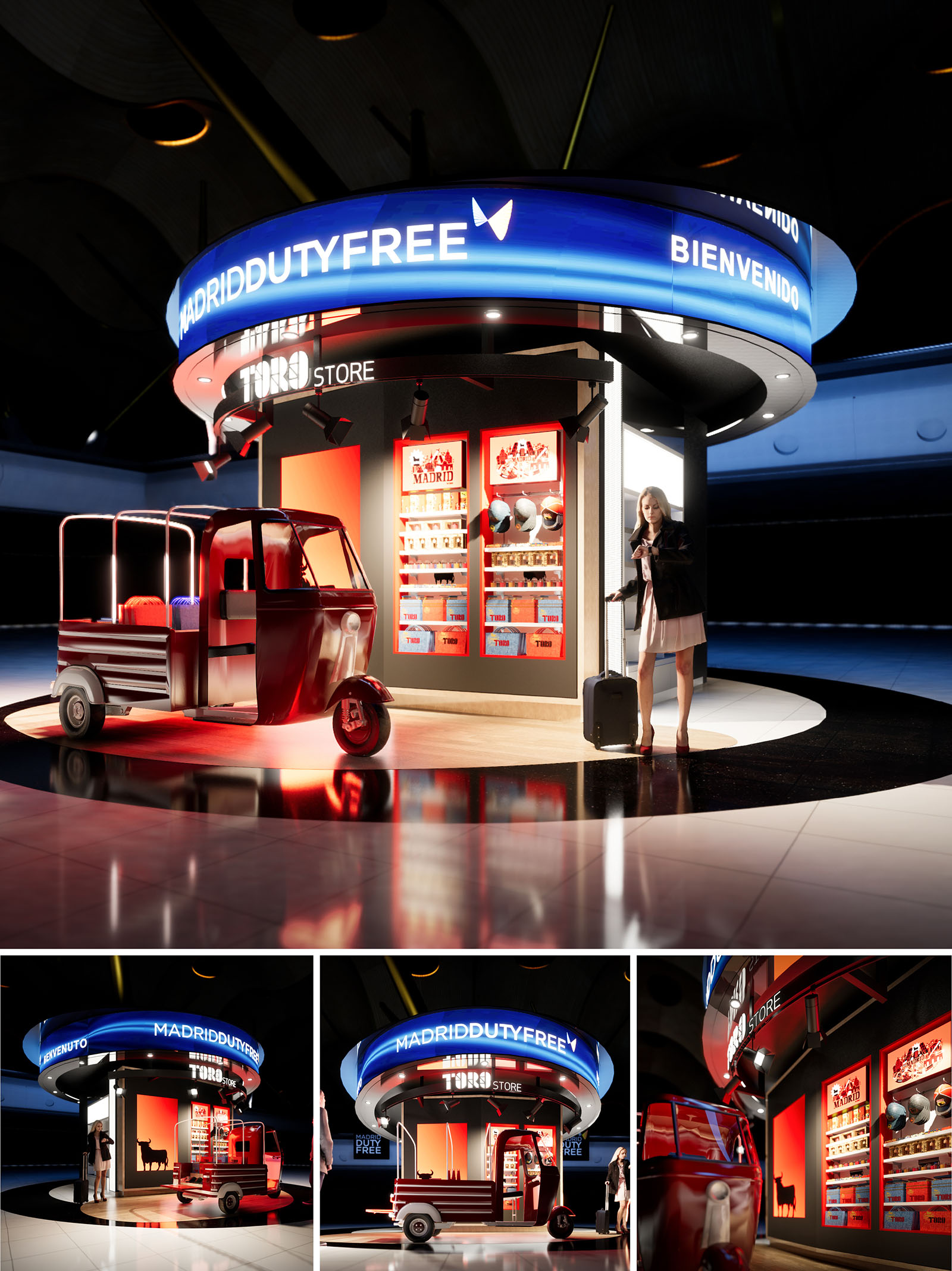
The OSBORNE kiosk is conceived as a compact brand pavilion within Madrid Airport, translating the iconic Toro identity into an immersive micro-architecture. The design uses the circle as its primary gesture, creating a 360º retail experience that welcomes passengers from all directions. The powerful contrast of deep black, intense red and illuminated graphics reinforces the character of the Spanish brand while remaining clearly legible in the busy duty free environment.
The stand operates as a hybrid between street-market stall and contemporary light installation. A retrofitted three‑wheeled vehicle anchors the composition, symbolizing mobility and travel, while the suspended luminous ring forms a recognizable landmark in the terminal. Together, these elements create a memorable threshold between airport infrastructure and local culture.
The kiosk is organized around a central cylindrical core that houses structure, services and storage. Around this core, the retail band is arranged radially, allowing continuous circulation and intuitive access from all sides. Passengers can approach, browse and exit in a fluid loop that avoids congestion, essential in high‑flow airport environments.
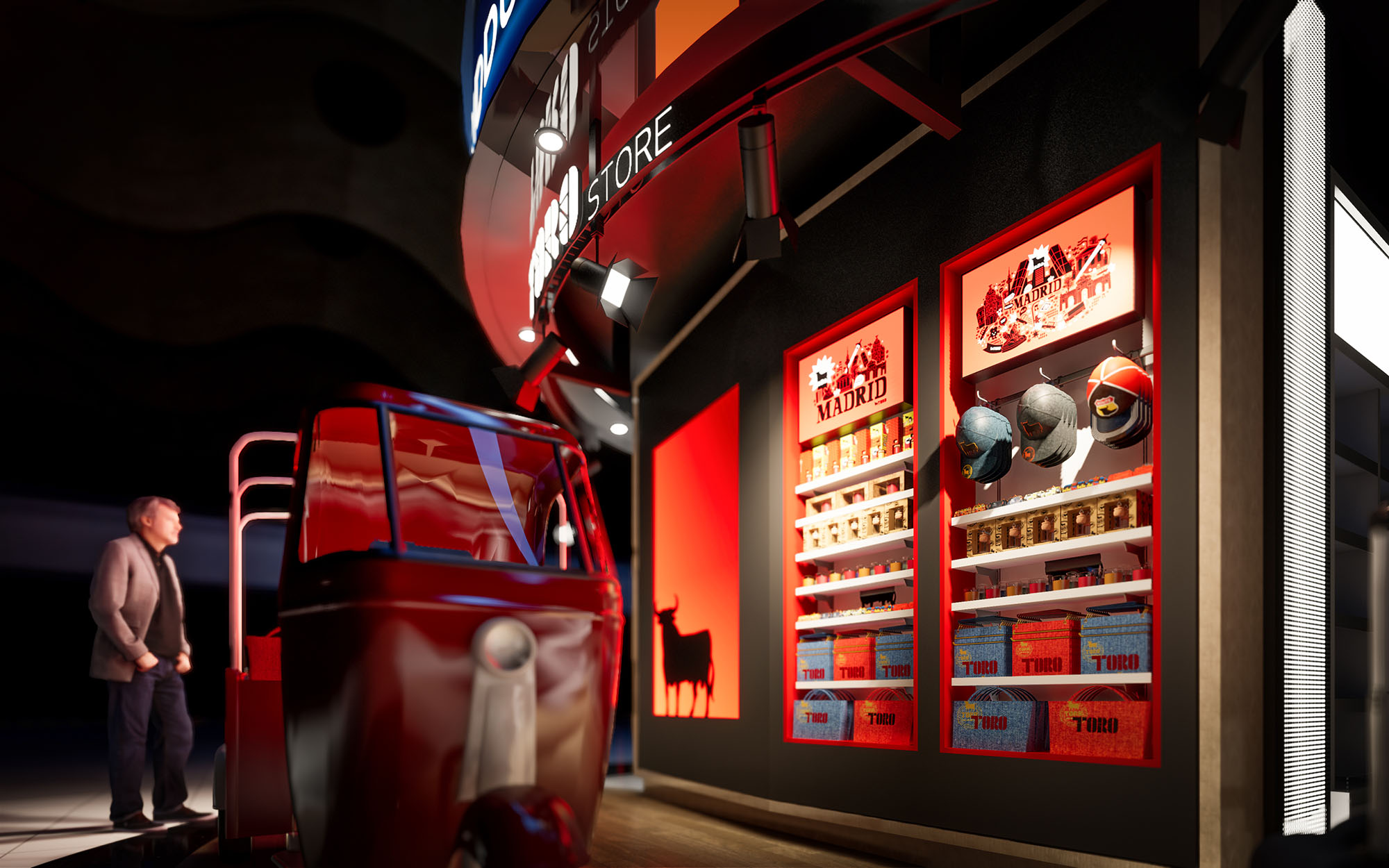
The vehicle is strategically positioned tangential to the kiosk, acting both as display and as spatial marker defining the main entry point. Its open platform offers flexible merchandising surfaces, while the surrounding glossy floor ring subtly guides movement and visually frames the intervention within the larger terminal hall.
The material palette combines high‑gloss metal, back‑painted glass and engineered panels to ensure durability, ease of maintenance and a premium finish. The base plinth is treated in dark reflective stone or porcelain, visually grounding the structure and amplifying the play of light and reflections from the illuminated signage above.
Lighting is layered to articulate different functions: a continuous LED crown with dynamic blue gradients signals the MADRID DUTY FREE identity at long distance; recessed downlights in the soffit provide general illumination; and adjustable projectors highlight products and graphic panels in red niches. The vehicle is accented with linear LEDs integrated under the chassis and roof, reinforcing its sculptural presence and creating a cinematic aura around the stand.
The façade is punctuated by vertical display modules framed in red, each acting as a showcase for key product lines and souvenirs associated with Madrid and the OSBORNE universe. Silhouettes of the Toro, city skylines and typographic compositions are used as backdrops, creating strong visual narratives without overwhelming the compact footprint.
Inside the shelving bays, warm white lighting with high color rendering enhances packaging tones and ensures product legibility. The consistent use of red as a volumetric element, rather than merely a graphic color, transforms brand identity into architectural form, turning each niche into a glowing display box embedded in a dark envelope.
The kiosk is conceived as a dry‑assembled system based on modular steel framing and prefabricated panels. This approach minimizes on‑site construction time and facilitates disassembly, relocation or partial reuse of components, an important consideration for constantly evolving airport layouts. Structural elements are dimensioned for reconfiguration, allowing future adaptation to new merchandising requirements.
All lighting is LED, with dimmable drivers and programmable scenes to reduce energy consumption during off‑peak hours. High‑efficiency power supplies and integrated cable management reduce material waste and simplify maintenance. Durable finishes, such as powder‑coated metals and compact laminates, extend lifecycle and limit replacement frequency. Wherever possible, substrates are specified with recycled content and low‑VOC adhesives, improving indoor air quality while aligning the retail intervention with broader sustainability goals for the terminal.
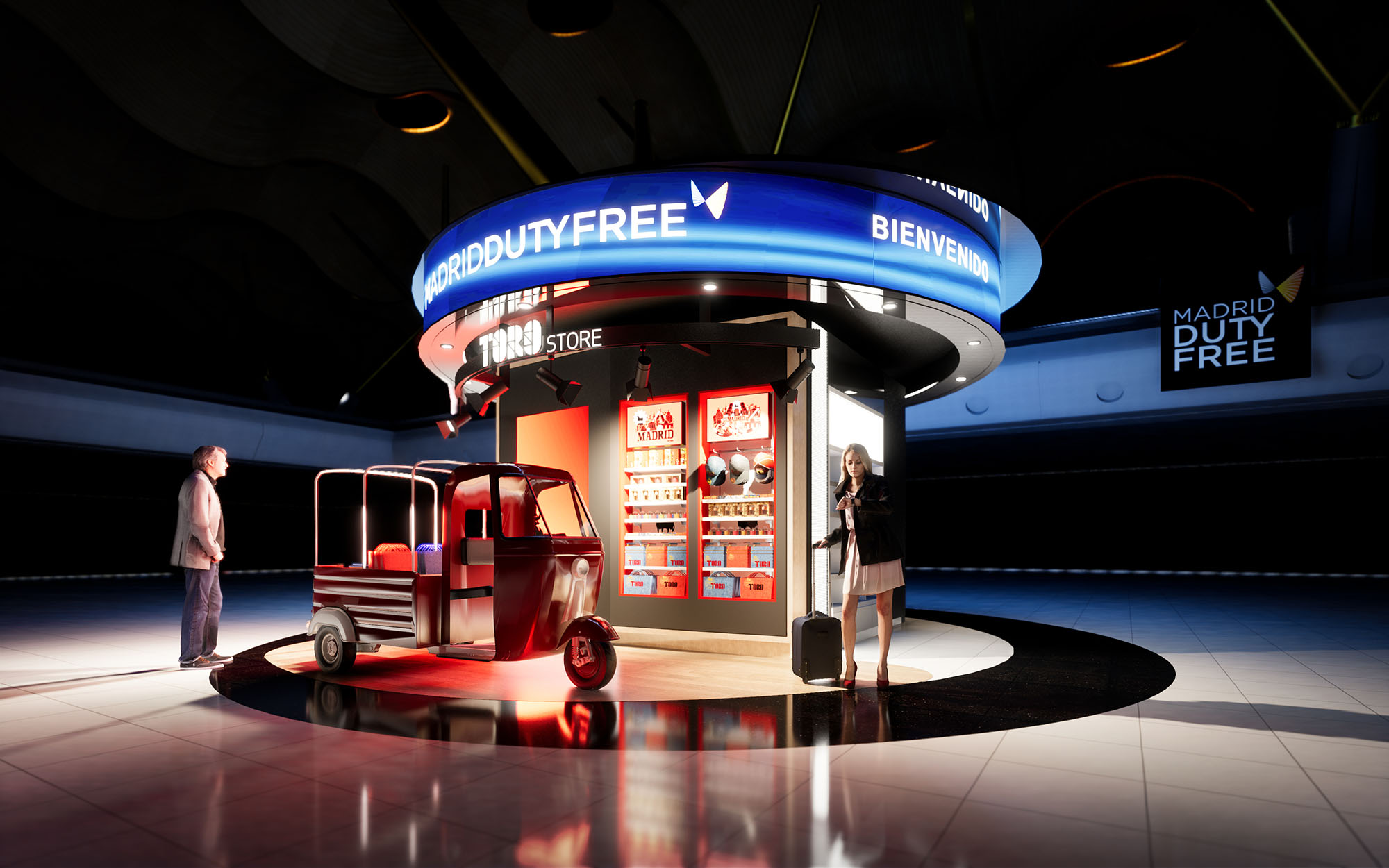
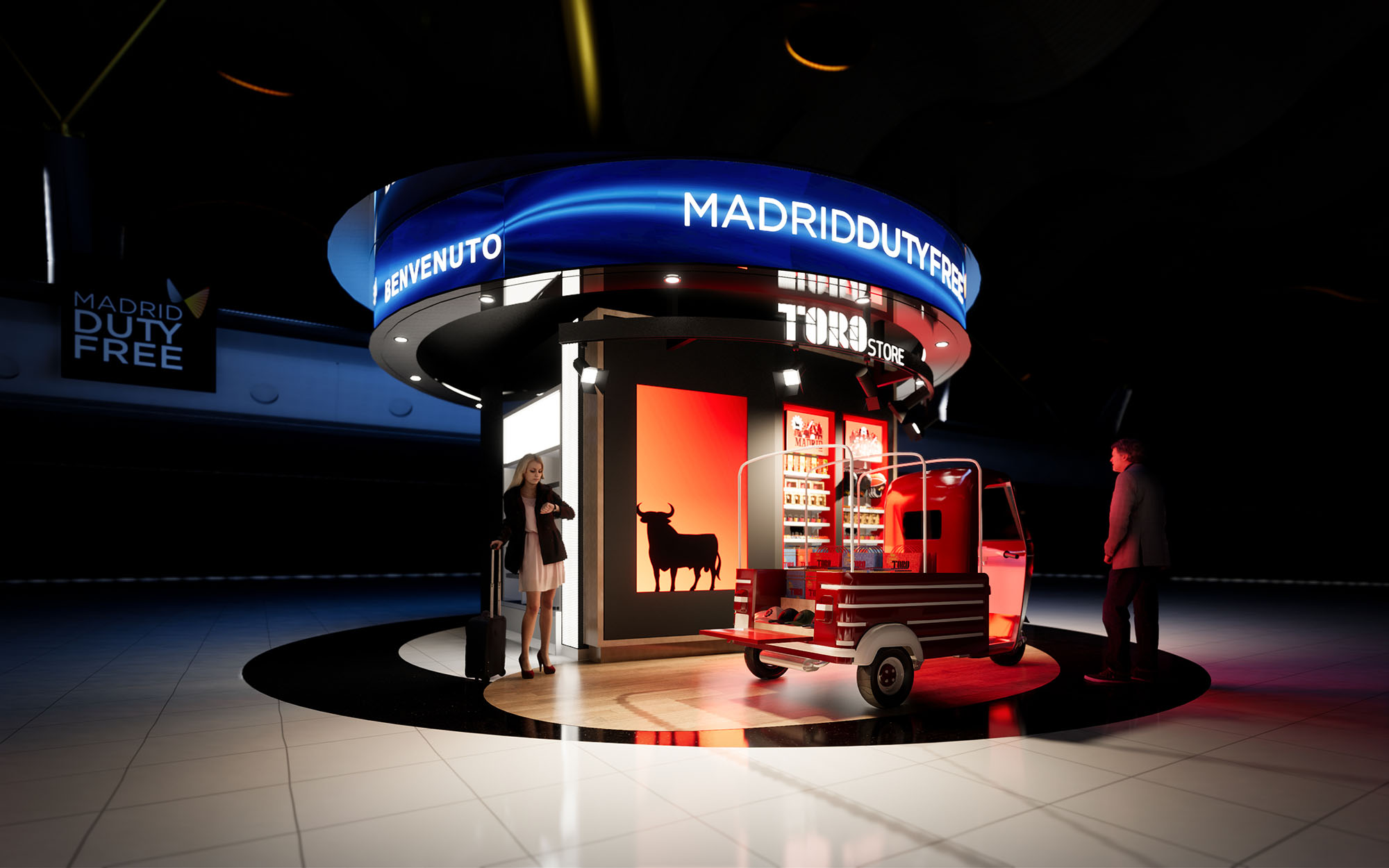
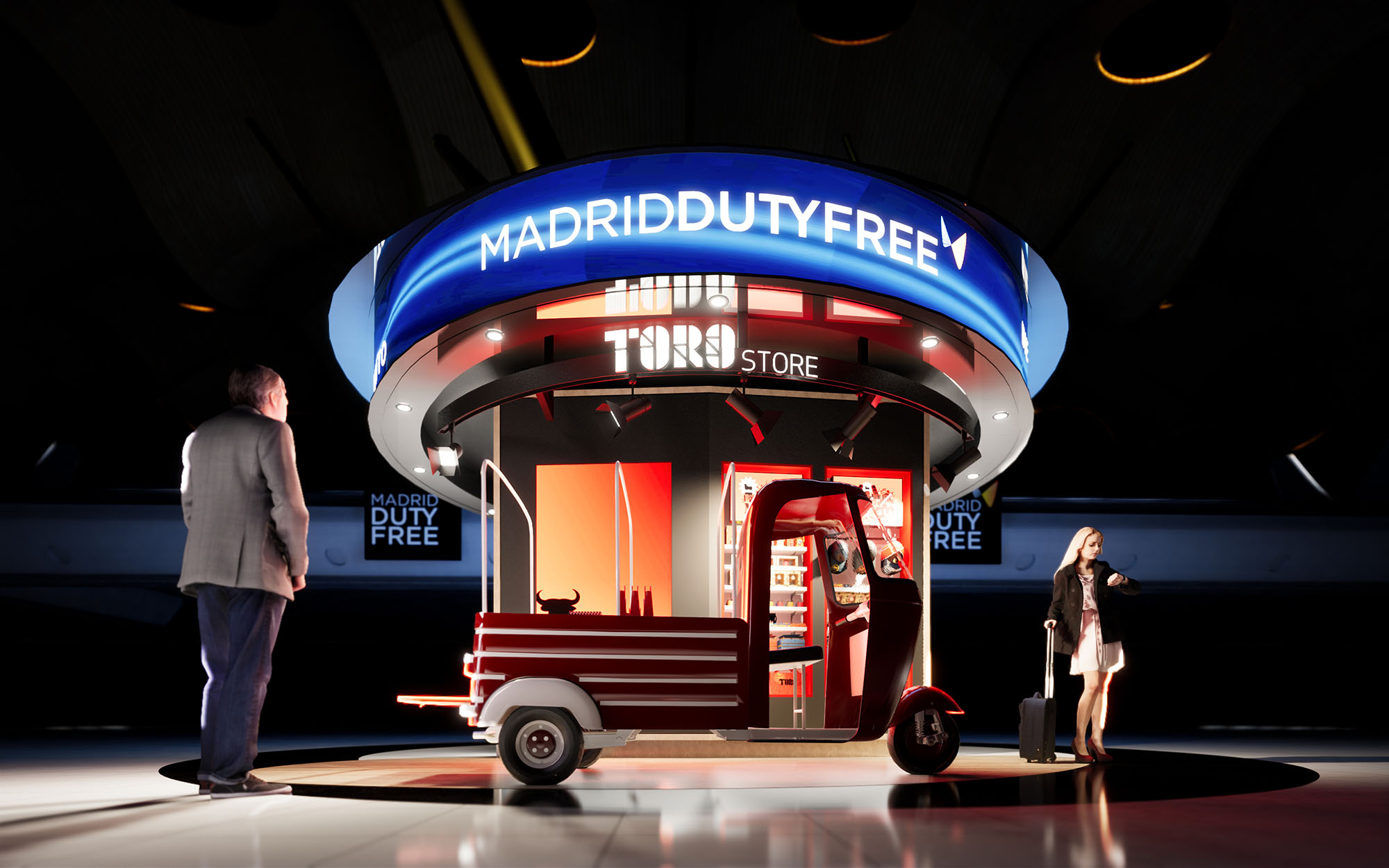
The OSBORNE kiosk is conceived as a compact brand pavilion within Madrid Airport, translating the iconic Toro identity into an immersive micro-architecture. The design uses the circle as its primary gesture, creating a 360º retail experience that welcomes passengers from all directions. The powerful contrast of deep black, intense red and illuminated graphics reinforces the character of the Spanish brand while remaining clearly legible in the busy duty free environment.
The stand operates as a hybrid between street-market stall and contemporary light installation. A retrofitted three‑wheeled vehicle anchors the composition, symbolizing mobility and travel, while the suspended luminous ring forms a recognizable landmark in the terminal. Together, these elements create a memorable threshold between airport infrastructure and local culture.
The kiosk is organized around a central cylindrical core that houses structure, services and storage. Around this core, the retail band is arranged radially, allowing continuous circulation and intuitive access from all sides. Passengers can approach, browse and exit in a fluid loop that avoids congestion, essential in high‑flow airport environments.
The vehicle is strategically positioned tangential to the kiosk, acting both as display and as spatial marker defining the main entry point. Its open platform offers flexible merchandising surfaces, while the surrounding glossy floor ring subtly guides movement and visually frames the intervention within the larger terminal hall.
The material palette combines high‑gloss metal, back‑painted glass and engineered panels to ensure durability, ease of maintenance and a premium finish. The base plinth is treated in dark reflective stone or porcelain, visually grounding the structure and amplifying the play of light and reflections from the illuminated signage above.
Lighting is layered to articulate different functions: a continuous LED crown with dynamic blue gradients signals the MADRID DUTY FREE identity at long distance; recessed downlights in the soffit provide general illumination; and adjustable projectors highlight products and graphic panels in red niches. The vehicle is accented with linear LEDs integrated under the chassis and roof, reinforcing its sculptural presence and creating a cinematic aura around the stand.
The façade is punctuated by vertical display modules framed in red, each acting as a showcase for key product lines and souvenirs associated with Madrid and the OSBORNE universe. Silhouettes of the Toro, city skylines and typographic compositions are used as backdrops, creating strong visual narratives without overwhelming the compact footprint.
Inside the shelving bays, warm white lighting with high color rendering enhances packaging tones and ensures product legibility. The consistent use of red as a volumetric element, rather than merely a graphic color, transforms brand identity into architectural form, turning each niche into a glowing display box embedded in a dark envelope.
The kiosk is conceived as a dry‑assembled system based on modular steel framing and prefabricated panels. This approach minimizes on‑site construction time and facilitates disassembly, relocation or partial reuse of components, an important consideration for constantly evolving airport layouts. Structural elements are dimensioned for reconfiguration, allowing future adaptation to new merchandising requirements.
All lighting is LED, with dimmable drivers and programmable scenes to reduce energy consumption during off‑peak hours. High‑efficiency power supplies and integrated cable management reduce material waste and simplify maintenance. Durable finishes, such as powder‑coated metals and compact laminates, extend lifecycle and limit replacement frequency. Wherever possible, substrates are specified with recycled content and low‑VOC adhesives, improving indoor air quality while aligning the retail intervention with broader sustainability goals for the terminal.


Our offices are located in Barcelona, Cancún, Chicago and Santo Domingo, but thanks to technology we can do projects on all over the world.
Barcelona
Bac de Roda 136
08020, Barcelona
Spain
Madrid
Av. de Buendía 11
19005 Guadalajara (Madrid)
Spain
Chicago
373 Hazel Ave, Apt A1
60022, Glencoe, Illinois
United States