

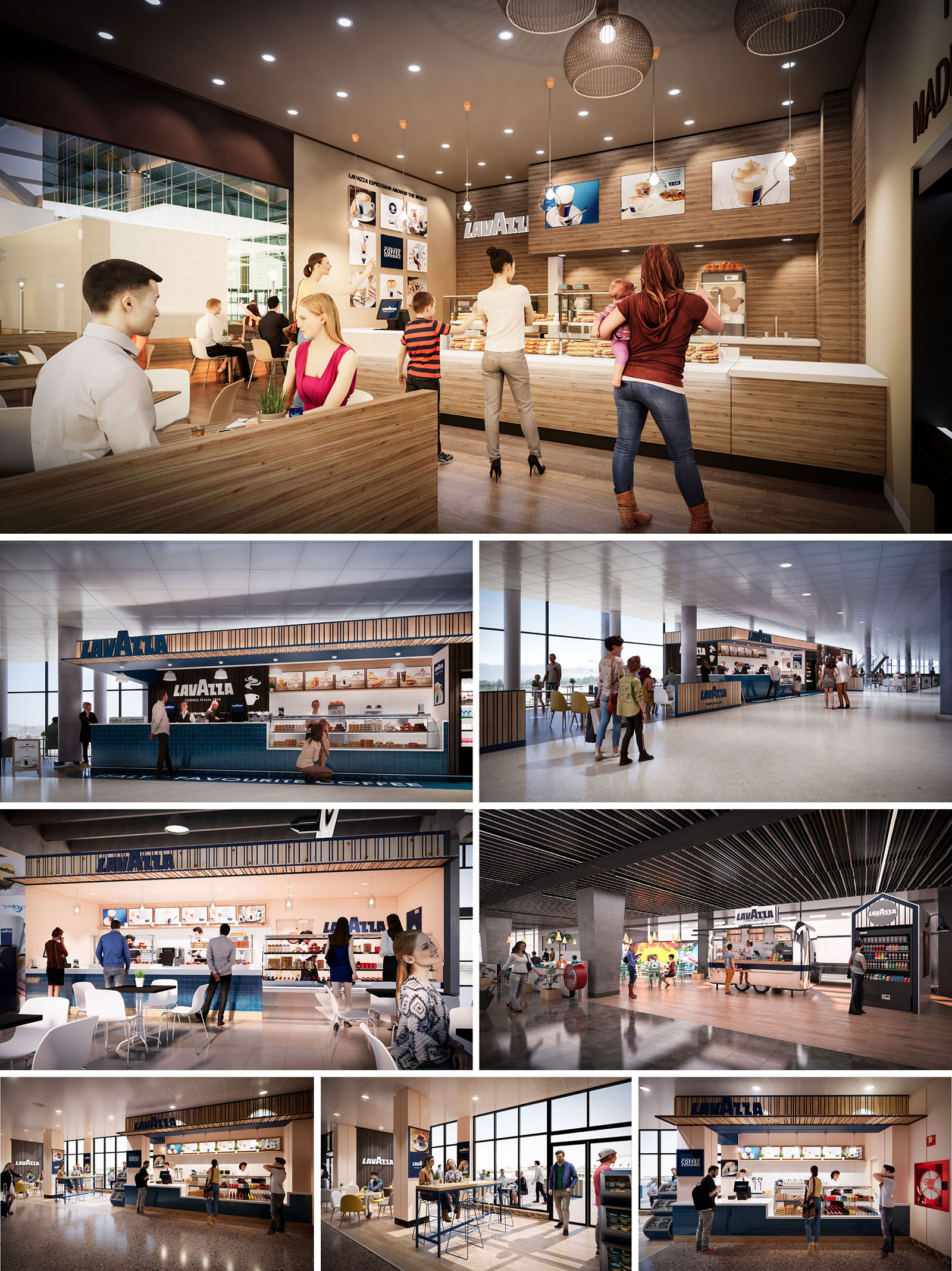
The Lavazza project in Spain is conceived as a scalable family of coffee spaces that can inhabit very different host environments while maintaining a clear and recognizable brand identity. The design language is based on a balance between Italian café tradition and contemporary airport and mall ergonomics, translating the ritual of coffee into a series of architecturally coherent kiosks, corners and full restaurants. Warm wood finishes, clean volumetry and the iconic blue brand color compose a common grammar that adapts in size and geometry according to the location.
Each unit acts as an urban micro‑landmark inside transit interiors, generating a sense of place in otherwise transient contexts. The modules are designed to be instantly legible from a distance, with a strong horizontal canopy line, illuminated signage and an open display of products that celebrates craftsmanship and freshness. The architecture frames the act of ordering and enjoying coffee as a fluid, informal experience, where circulation, visibility and comfort are carefully orchestrated.
The layouts are organized around a linear service counter that concentrates preparation, display and payment into a single, highly efficient strip. This counter operates as both a functional backbone and a visual stage, allowing customers to read the offer at a glance while staff work within a clear back‑of‑house logic. Geometry remains intentionally orthogonal to optimize modular furniture and refrigeration units, but is softened by rounded corners and setback plinths that ease movements around the bar.
Customer flow typically follows a frontal approach: entry from the circulation corridor, alignment along the counter, and dispersion towards different seating typologies. In larger locations, perimetral booth seating defines a protected inner zone, while high tables and freestanding islands mediate with surrounding public space. In kiosk versions, perimeter counters and stool lines transform the stand itself into a 360‑degree object, accessible from several sides and integrated with adjacent seating fields of the host building.
The material palette combines horizontally grained light wood laminates with neutral solid surfaces in white and cream, producing an atmosphere that is simultaneously warm and easy to maintain. Vertical slatted timber elements crown the façades and canopies, providing depth and a sense of crafted detail while concealing technical elements such as lighting tracks and signage fixings. Flooring is generally kept in robust porcelain or terrazzo‑like finishes selected according to each host building, ensuring continuity with existing circulation areas.
The brand’s deep blue operates as an accent, concentrated on front panels, under‑counter plinths and graphic bands, where it contrasts with the warm timber and the metallic frames of shelving systems. Black and dark grey elements, particularly in suspended ceiling grids and structural columns, provide a visual anchor, framing the lighter planes and contributing to a more architectural reading of what might otherwise be purely commercial furniture.
Lighting is based on a combination of diffuse ambient illumination from host spaces and focused, warm‑tone fixtures integrated into the Lavazza modules. Recessed downlights provide overall luminance, while linear LED strips under shelves and counter overhangs highlight products and emphasize horizontal lines. Decorative pendant lamps introduce a residential touch in seating zones, differentiating the café environment from the more generic public halls.
The color temperature is intentionally warm to enhance the appearance of coffee and baked goods, in contrast to the typically cooler lighting of transit environments. This duality generates a visual threshold: crossing into the Lavazza area means entering a more intimate, human‑scaled atmosphere, even when located in large open halls or airports.
Furniture solutions are standardized but flexible. Upholstered benches with high backs create acoustic buffers along perimeters, while loose chairs and small circular tables offer reconfigurable arrangements for different user groups. High communal tables with stools address short‑stay customers and solo travelers, encouraging social interaction without compromising circulation. All worktops and seating heights are calibrated to universal ergonomic standards, with accessible counter segments for users with reduced mobility.
Display units are designed as open shelving and refrigerated vitrines that align visually with the counter datum, ensuring a coherent horizon line. Storage is discreetly integrated below counters and within thicker wall panels, maintaining uncluttered customer areas and reinforcing the architectural clarity of the ensemble.
The system is conceived as a kit of parts, enabling rapid deployment in multiple Spanish locations with varying footprints and technical constraints. Structural independence of the kiosks minimizes interventions on host buildings, simplifying approvals and enabling future relocation or reconfiguration. Repetition of modules and details reduces manufacturing waste and ensures durability through tested, robust solutions.
Sustainability is addressed through material selection and technical integration. Preference is given to certified timber products, low‑VOC finishes and high‑efficiency LED lighting with programmable scenes to reduce energy consumption during off‑peak hours. Where possible, equipment with optimized energy ratings is specified, and the open layouts encourage natural light penetration from surrounding façades, reducing the need for artificial lighting during daytime. This approach balances brand consistency and operational efficiency with a responsible environmental footprint across the network of Lavazza spaces.
The Lavazza project in Spain is conceived as a scalable family of coffee spaces that can inhabit very different host environments while maintaining a clear and recognizable brand identity. The design language is based on a balance between Italian café tradition and contemporary airport and mall ergonomics, translating the ritual of coffee into a series of architecturally coherent kiosks, corners and full restaurants. Warm wood finishes, clean volumetry and the iconic blue brand color compose a common grammar that adapts in size and geometry according to the location.
Each unit acts as an urban micro‑landmark inside transit interiors, generating a sense of place in otherwise transient contexts. The modules are designed to be instantly legible from a distance, with a strong horizontal canopy line, illuminated signage and an open display of products that celebrates craftsmanship and freshness. The architecture frames the act of ordering and enjoying coffee as a fluid, informal experience, where circulation, visibility and comfort are carefully orchestrated.
The layouts are organized around a linear service counter that concentrates preparation, display and payment into a single, highly efficient strip. This counter operates as both a functional backbone and a visual stage, allowing customers to read the offer at a glance while staff work within a clear back‑of‑house logic. Geometry remains intentionally orthogonal to optimize modular furniture and refrigeration units, but is softened by rounded corners and setback plinths that ease movements around the bar.
Customer flow typically follows a frontal approach: entry from the circulation corridor, alignment along the counter, and dispersion towards different seating typologies. In larger locations, perimetral booth seating defines a protected inner zone, while high tables and freestanding islands mediate with surrounding public space. In kiosk versions, perimeter counters and stool lines transform the stand itself into a 360‑degree object, accessible from several sides and integrated with adjacent seating fields of the host building.
The material palette combines horizontally grained light wood laminates with neutral solid surfaces in white and cream, producing an atmosphere that is simultaneously warm and easy to maintain. Vertical slatted timber elements crown the façades and canopies, providing depth and a sense of crafted detail while concealing technical elements such as lighting tracks and signage fixings. Flooring is generally kept in robust porcelain or terrazzo‑like finishes selected according to each host building, ensuring continuity with existing circulation areas.
The brand’s deep blue operates as an accent, concentrated on front panels, under‑counter plinths and graphic bands, where it contrasts with the warm timber and the metallic frames of shelving systems. Black and dark grey elements, particularly in suspended ceiling grids and structural columns, provide a visual anchor, framing the lighter planes and contributing to a more architectural reading of what might otherwise be purely commercial furniture.
Lighting is based on a combination of diffuse ambient illumination from host spaces and focused, warm‑tone fixtures integrated into the Lavazza modules. Recessed downlights provide overall luminance, while linear LED strips under shelves and counter overhangs highlight products and emphasize horizontal lines. Decorative pendant lamps introduce a residential touch in seating zones, differentiating the café environment from the more generic public halls.
The color temperature is intentionally warm to enhance the appearance of coffee and baked goods, in contrast to the typically cooler lighting of transit environments. This duality generates a visual threshold: crossing into the Lavazza area means entering a more intimate, human‑scaled atmosphere, even when located in large open halls or airports.
Furniture solutions are standardized but flexible. Upholstered benches with high backs create acoustic buffers along perimeters, while loose chairs and small circular tables offer reconfigurable arrangements for different user groups. High communal tables with stools address short‑stay customers and solo travelers, encouraging social interaction without compromising circulation. All worktops and seating heights are calibrated to universal ergonomic standards, with accessible counter segments for users with reduced mobility.
Display units are designed as open shelving and refrigerated vitrines that align visually with the counter datum, ensuring a coherent horizon line. Storage is discreetly integrated below counters and within thicker wall panels, maintaining uncluttered customer areas and reinforcing the architectural clarity of the ensemble.
The system is conceived as a kit of parts, enabling rapid deployment in multiple Spanish locations with varying footprints and technical constraints. Structural independence of the kiosks minimizes interventions on host buildings, simplifying approvals and enabling future relocation or reconfiguration. Repetition of modules and details reduces manufacturing waste and ensures durability through tested, robust solutions.
Sustainability is addressed through material selection and technical integration. Preference is given to certified timber products, low‑VOC finishes and high‑efficiency LED lighting with programmable scenes to reduce energy consumption during off‑peak hours. Where possible, equipment with optimized energy ratings is specified, and the open layouts encourage natural light penetration from surrounding façades, reducing the need for artificial lighting during daytime. This approach balances brand consistency and operational efficiency with a responsible environmental footprint across the network of Lavazza spaces.


Our offices are located in Barcelona, Cancún, Chicago and Santo Domingo, but thanks to technology we can do projects on all over the world.
Barcelona
Bac de Roda 136
08020, Barcelona
Spain
Madrid
Av. de Buendía 11
19005 Guadalajara (Madrid)
Spain
Chicago
373 Hazel Ave, Apt A1
60022, Glencoe, Illinois
United States