

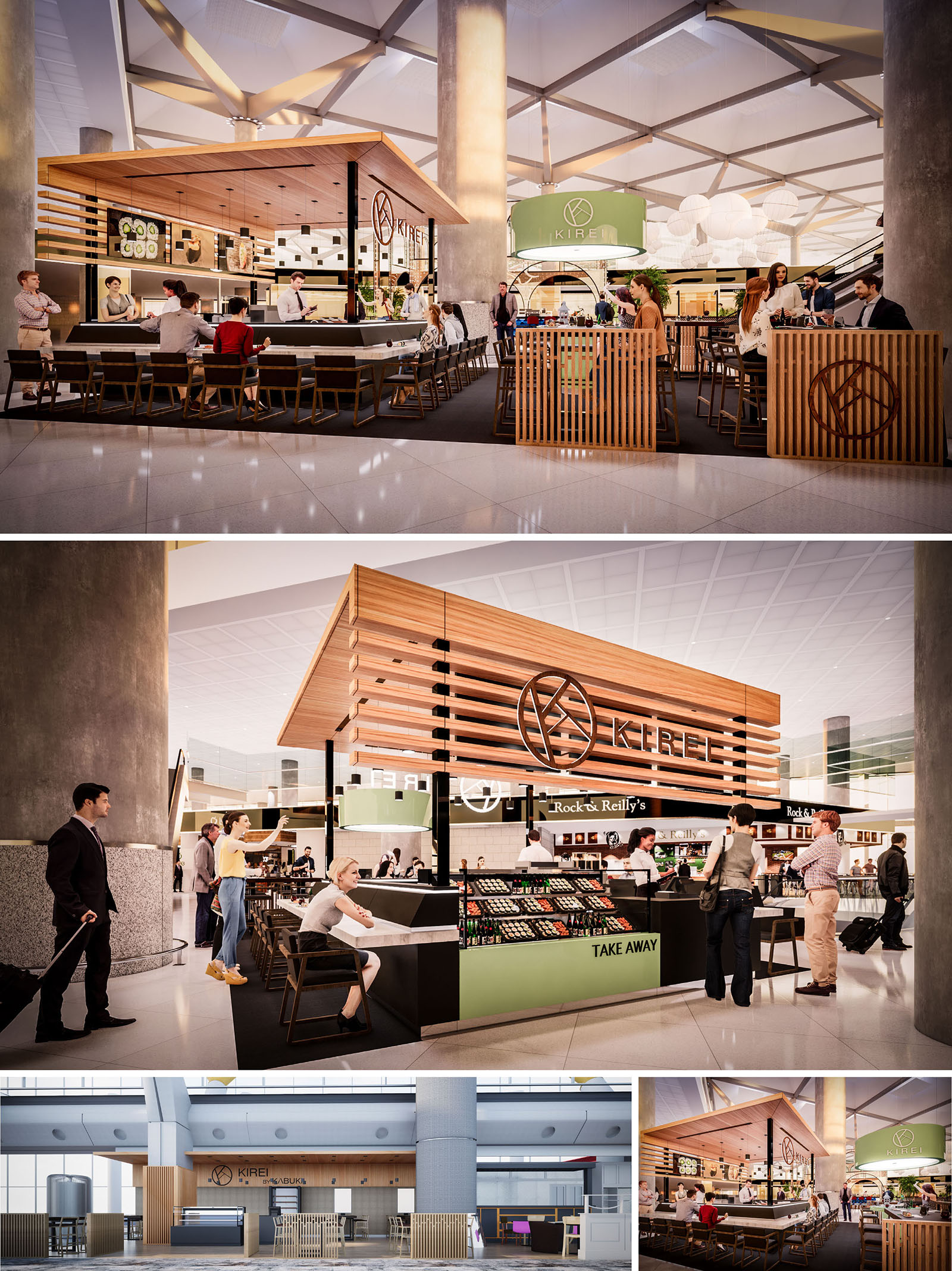
KIREI by Kabuki is conceived as an open urban pavilion within the airport terminal, translating the language of contemporary Japanese gastronomy into a compact, permeable architecture. The design creates a recognizable icon in the concourse while remaining visually light, allowing the flow of passengers to continue uninterrupted around and through the space. The restaurant blurs the boundary between bar, kitchen, and circulation, turning the act of preparation into a central stage visible from every angle.
The concept is based on the abstraction of the traditional Japanese teahouse and market stall, reinterpreted with clean lines, controlled proportions, and a warm material palette. The resulting volume is both sculptural and functional, working as a landmark that orients travelers and as an intimate destination for a short, high‑quality gastronomic pause.
The scheme is organized around a central U‑shaped sushi bar that acts as the core of the project. This bar concentrates the main preparation area and provides 360‑degree visibility, allowing passengers to sit on all sides and maximizing the number of linear seats within a reduced footprint. The perimeter circulation is fully open, guaranteeing fluid access from all directions in the terminal.
Different activity rings are defined: the innermost ring is the working bench for chefs; the intermediate ring is the bar counter for immediate consumption; and the outer ring integrates loose tables, high stools, and quick waiting areas for take‑away. A dedicated takeaway front opens towards the main flow of passengers, clearly signaled by the green base and integrated merchandise display, ensuring efficient service for travelers with limited time.
The architectural identity is built from a combination of warm timber, black metal framing, and light stone‑like surfaces. A floating roof in horizontal wooden slats crowns the pavilion, visually detached from the terminal ceiling and supported on slender black steel posts. This creates a sense of enclosure without blocking views or natural light, and emphasizes the brand logo, seamlessly integrated into the timber lattice.
The bar counter uses a robust, light‑toned solid surface for hygiene and durability, contrasted with darker kickplates to visually anchor the element. Vertical timber screens define thresholds and low partitions, providing a degree of privacy while maintaining transparency. All components are treated as prefabricated modules: the roof, bar, and screen systems can be assembled and disassembled with minimal intervention in the existing terminal structure, respecting airport operational constraints.
The interior atmosphere balances the efficiency of an airport environment with the calmness associated with Japanese aesthetics. Seating combines bar stools and simple timber chairs with upholstered touches, keeping ergonomics and rapid turnover in mind. The dark flooring island differentiates the restaurant from the surrounding concourse and visually “grounds” the pavilion, while reflecting light from the terminal to avoid a heavy appearance.
Lighting is layered: a continuous line of warm integrated LEDs under the timber canopy provides uniform ambient light, complemented by more focused lighting over the bar to highlight the freshness and color of the dishes. Reflected light from the pale ceiling and glossy floor contributes to a sense of openness, while the carefully controlled color temperature generates a comfortable contrast with the cooler, more technical light of the terminal.
Branding is synthesized into a few key architectural gestures rather than applied graphics. The circular KIREI emblem is carved into the main timber lattice and repeated on the entrance screens, transforming the logo into a three‑dimensional filter. Color is selectively used: the soft green of the take‑away counter and secondary signage evokes freshness and subtly recalls Japanese matcha tones, without overwhelming the neutral base palette.
Signage is integrated into structural elements and shelving, maintaining clean sightlines across the terminal. Product displays are modular and low in height to avoid creating visual barriers, ensuring that the pavilion reads as a continuous, accessible landscape within the larger public space.
Sustainability criteria informed the project from the outset, with a focus on material selection, modularity, and energy efficiency. Timber used in the canopy and screens is specified from certified sustainable sources, with finishes that maximize durability and allow for easy maintenance, extending the life cycle of the components. The modular metal structure is bolted rather than welded, facilitating disassembly, reuse, or relocation if terminal layouts evolve over time.
The open configuration reduces the need for dedicated mechanical systems by taking advantage of the terminal’s existing climate control and natural lighting. Warm‑white LED lighting with high efficiency and long service life minimizes energy consumption and maintenance interventions. Surfaces in contact with food are designed for easy cleaning, reducing the use of aggressive chemicals, while the compact layout optimizes back‑of‑house areas to limit waste in both space and operations. Together, these measures create a resilient, low‑impact restaurant model suited to high‑intensity airport environments.
KIREI by Kabuki is conceived as an open urban pavilion within the airport terminal, translating the language of contemporary Japanese gastronomy into a compact, permeable architecture. The design creates a recognizable icon in the concourse while remaining visually light, allowing the flow of passengers to continue uninterrupted around and through the space. The restaurant blurs the boundary between bar, kitchen, and circulation, turning the act of preparation into a central stage visible from every angle.
The concept is based on the abstraction of the traditional Japanese teahouse and market stall, reinterpreted with clean lines, controlled proportions, and a warm material palette. The resulting volume is both sculptural and functional, working as a landmark that orients travelers and as an intimate destination for a short, high‑quality gastronomic pause.
The scheme is organized around a central U‑shaped sushi bar that acts as the core of the project. This bar concentrates the main preparation area and provides 360‑degree visibility, allowing passengers to sit on all sides and maximizing the number of linear seats within a reduced footprint. The perimeter circulation is fully open, guaranteeing fluid access from all directions in the terminal.
Different activity rings are defined: the innermost ring is the working bench for chefs; the intermediate ring is the bar counter for immediate consumption; and the outer ring integrates loose tables, high stools, and quick waiting areas for take‑away. A dedicated takeaway front opens towards the main flow of passengers, clearly signaled by the green base and integrated merchandise display, ensuring efficient service for travelers with limited time.
The architectural identity is built from a combination of warm timber, black metal framing, and light stone‑like surfaces. A floating roof in horizontal wooden slats crowns the pavilion, visually detached from the terminal ceiling and supported on slender black steel posts. This creates a sense of enclosure without blocking views or natural light, and emphasizes the brand logo, seamlessly integrated into the timber lattice.
The bar counter uses a robust, light‑toned solid surface for hygiene and durability, contrasted with darker kickplates to visually anchor the element. Vertical timber screens define thresholds and low partitions, providing a degree of privacy while maintaining transparency. All components are treated as prefabricated modules: the roof, bar, and screen systems can be assembled and disassembled with minimal intervention in the existing terminal structure, respecting airport operational constraints.
The interior atmosphere balances the efficiency of an airport environment with the calmness associated with Japanese aesthetics. Seating combines bar stools and simple timber chairs with upholstered touches, keeping ergonomics and rapid turnover in mind. The dark flooring island differentiates the restaurant from the surrounding concourse and visually “grounds” the pavilion, while reflecting light from the terminal to avoid a heavy appearance.
Lighting is layered: a continuous line of warm integrated LEDs under the timber canopy provides uniform ambient light, complemented by more focused lighting over the bar to highlight the freshness and color of the dishes. Reflected light from the pale ceiling and glossy floor contributes to a sense of openness, while the carefully controlled color temperature generates a comfortable contrast with the cooler, more technical light of the terminal.
Branding is synthesized into a few key architectural gestures rather than applied graphics. The circular KIREI emblem is carved into the main timber lattice and repeated on the entrance screens, transforming the logo into a three‑dimensional filter. Color is selectively used: the soft green of the take‑away counter and secondary signage evokes freshness and subtly recalls Japanese matcha tones, without overwhelming the neutral base palette.
Signage is integrated into structural elements and shelving, maintaining clean sightlines across the terminal. Product displays are modular and low in height to avoid creating visual barriers, ensuring that the pavilion reads as a continuous, accessible landscape within the larger public space.
Sustainability criteria informed the project from the outset, with a focus on material selection, modularity, and energy efficiency. Timber used in the canopy and screens is specified from certified sustainable sources, with finishes that maximize durability and allow for easy maintenance, extending the life cycle of the components. The modular metal structure is bolted rather than welded, facilitating disassembly, reuse, or relocation if terminal layouts evolve over time.
The open configuration reduces the need for dedicated mechanical systems by taking advantage of the terminal’s existing climate control and natural lighting. Warm‑white LED lighting with high efficiency and long service life minimizes energy consumption and maintenance interventions. Surfaces in contact with food are designed for easy cleaning, reducing the use of aggressive chemicals, while the compact layout optimizes back‑of‑house areas to limit waste in both space and operations. Together, these measures create a resilient, low‑impact restaurant model suited to high‑intensity airport environments.


Our offices are located in Barcelona, Cancún, Chicago and Santo Domingo, but thanks to technology we can do projects on all over the world.
Barcelona
Bac de Roda 136
08020, Barcelona
Spain
Madrid
Av. de Buendía 11
19005 Guadalajara (Madrid)
Spain
Chicago
373 Hazel Ave, Apt A1
60022, Glencoe, Illinois
United States