

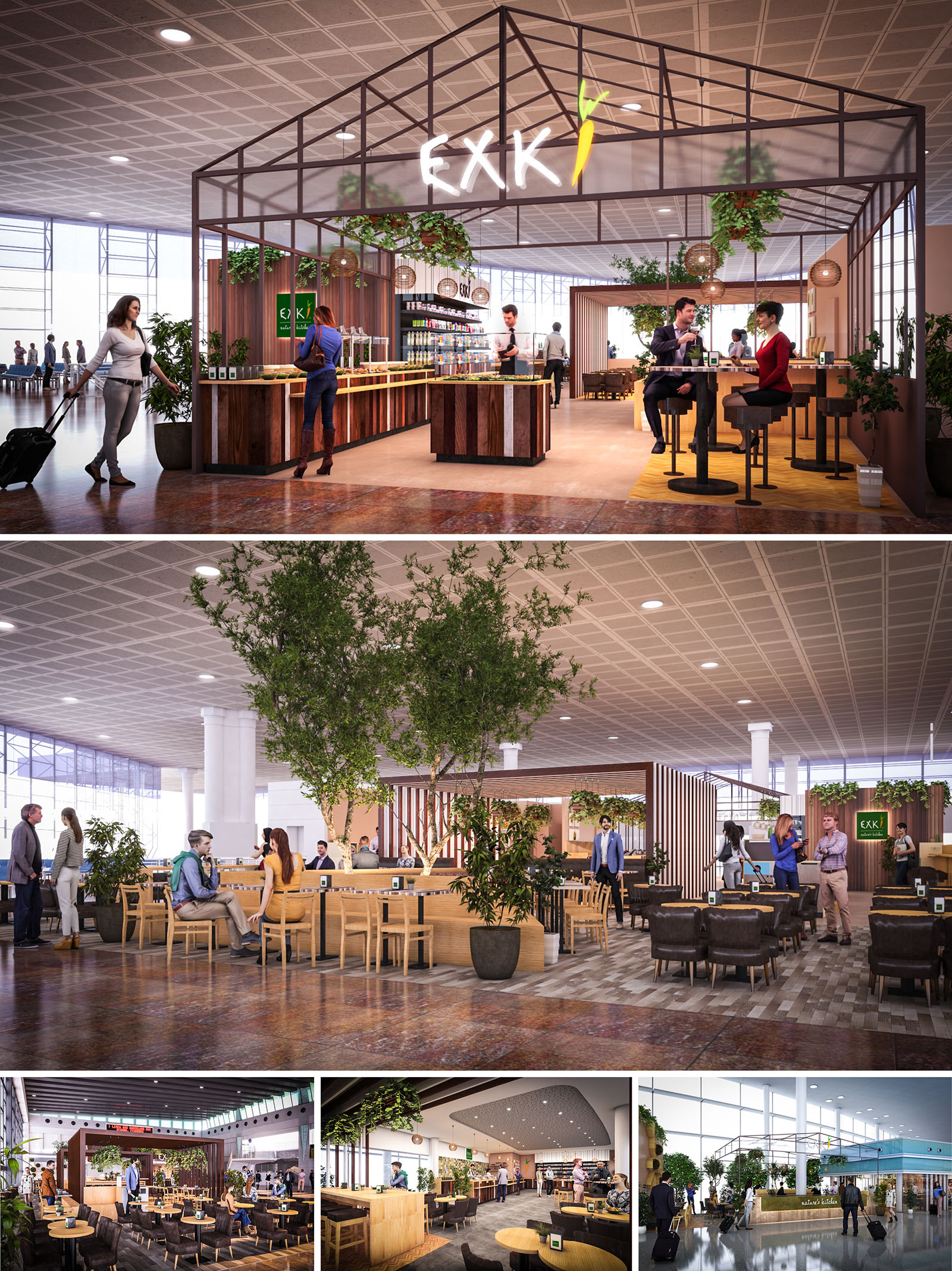
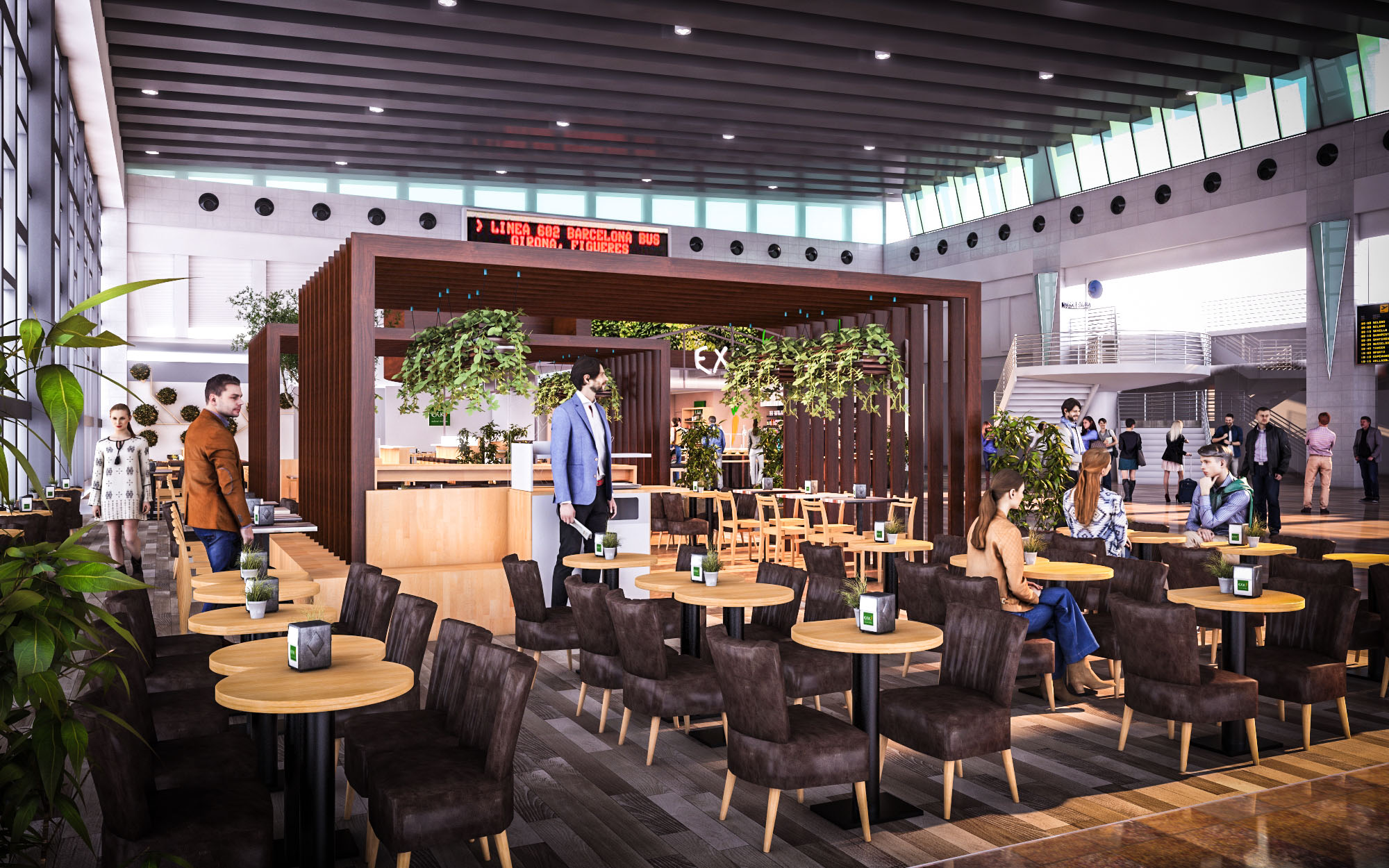
EXKI in Barcelona airport is conceived as a luminous urban greenhouse, a contemporary oasis that brings the language of nature and slow food into a hyper–transit environment. The project translates the brand’s healthy and seasonal philosophy into spatial form, using a light steel “house” structure, abundant planting and warm timber surfaces to create a recognisable and welcoming landmark within the terminal’s open hall.
The design intentionally contrasts with the surrounding large-scale infrastructure. While the terminal is defined by long sightlines and industrial ceilings, EXKI introduces a more domestic scale through the pitched canopy, layered seating typologies and carefully framed views. This creates a legible gateway for passengers: a clear threshold between circulation and pause.
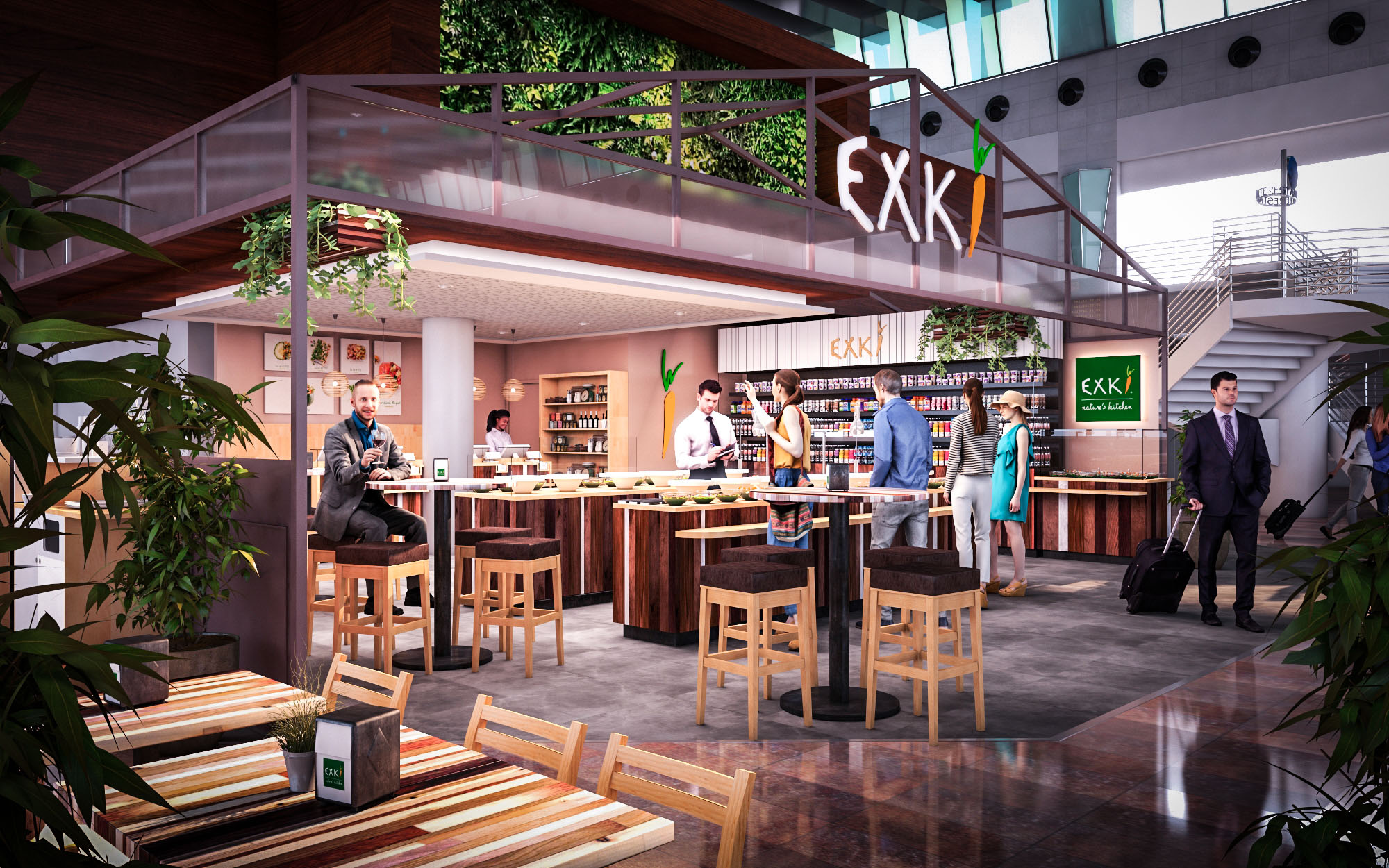
The layout is organised around a central service spine that houses the counter, food display, beverage stations and back-of-house support. This linear core aligns with passenger flows, allowing intuitive access from multiple directions and minimising congestion at peak times. The open edges of the structure ensure full visual permeability, reinforcing the sense of a “public living room” within the airport.
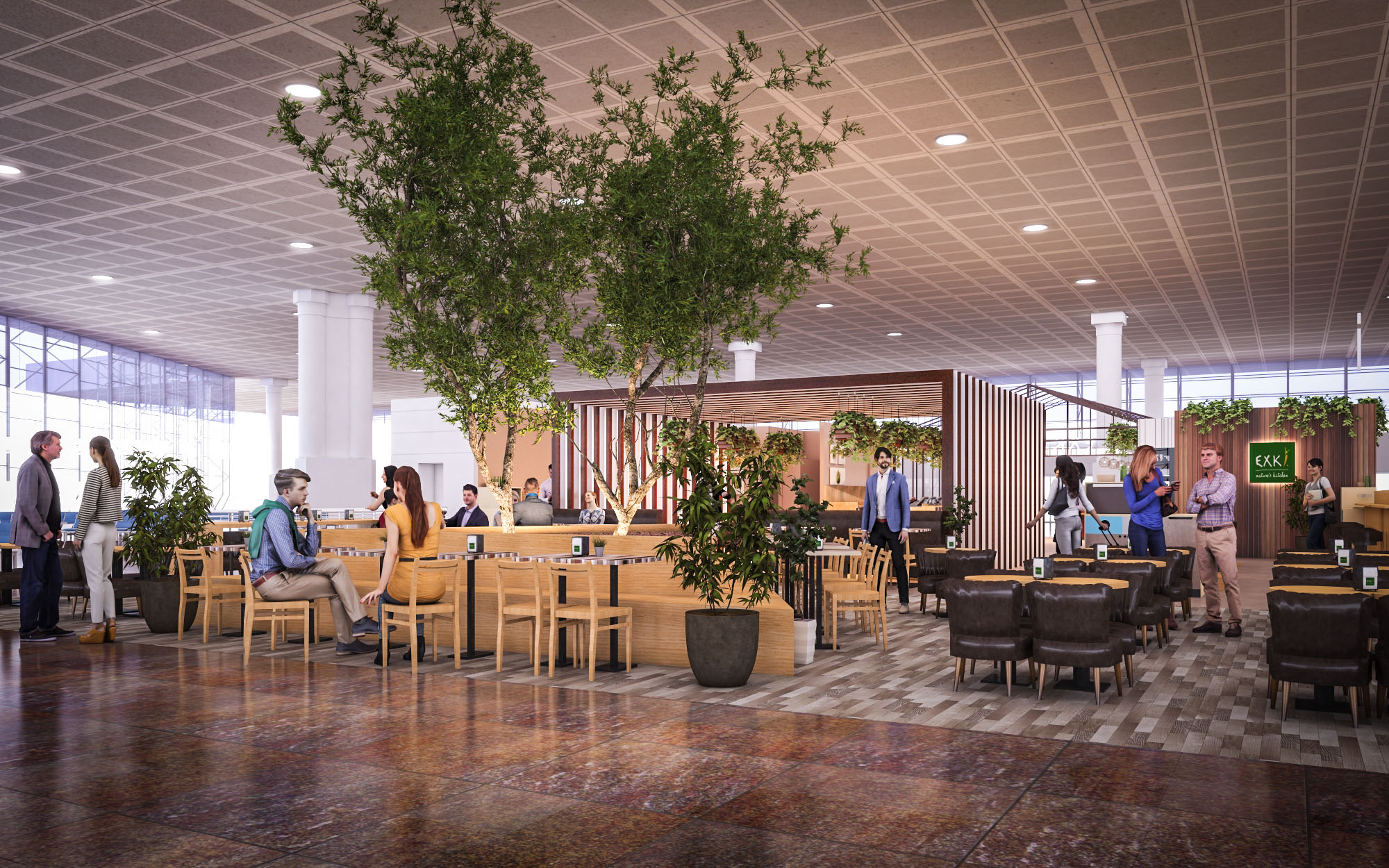
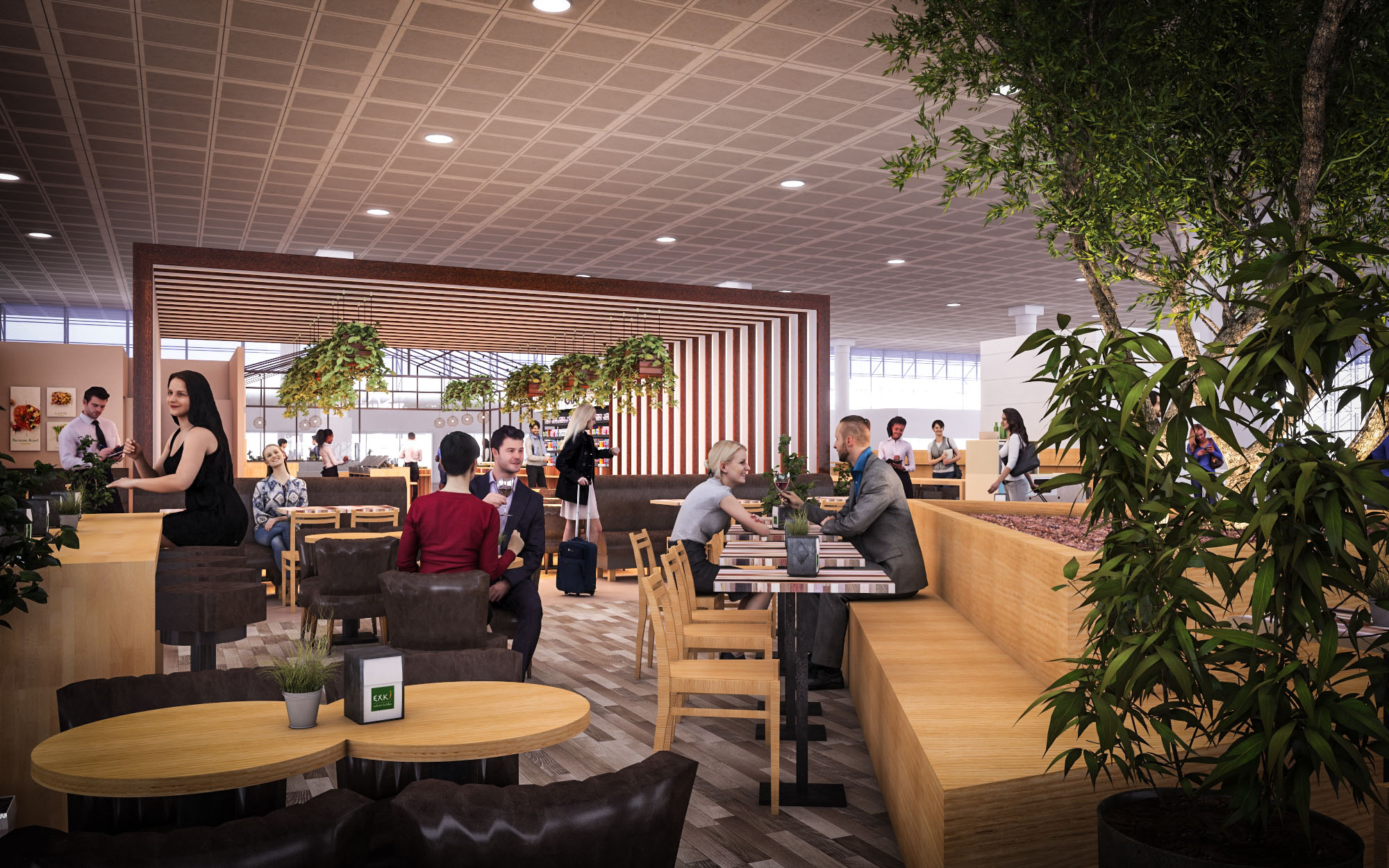
Seating is zoned to accommodate different dwell times. High stools at the perimeter encourage short stays and solo travellers, enabling quick consumption while maintaining visual connection to departure gates. Deeper into the space, communal benches and standard-height tables are arranged in islands that form micro-environments of varying privacy. Soft lounge seating completes the ensemble, catering to longer layovers and informal meetings.
The most distinctive architectural element is the lightweight metal frame evoking a greenhouse silhouette. This dematerialised “roof” does not touch the existing ceiling but hovers beneath it, creating a secondary scale and giving the restaurant a clear identity without enclosing it. The frame integrates signage, pendant lighting and hanging plants, unifying technical and decorative components in a single system.
The material palette is intentionally warm and tactile: vertically composed timber slats, solid wood furnishings and natural fibre lamp shades. Variations of wood tones—ranging from pale oak to richer, reclaimed hues—introduce rhythm and texture along the counters and partitions. Large-format flooring articulates the dining zone, subtly differentiating it from the terminal’s circulation surfaces while remaining fully accessible for luggage and service carts.
The interior atmosphere seeks to soften the typical airport experience through an abundance of greenery and carefully tuned lighting. Trees planted in generous containers rise through the seating islands, providing vertical articulation and partial screening between tables. Lower planters and hanging vegetation extend this green layer across the structure, reinforcing the notion of an indoor garden.
Furniture is deliberately simple and robust, with clean lines and ergonomic proportions. Wooden chairs and benches are paired with neutral upholstery, while darker lounge armchairs add depth and contrast. Tables are dimensioned to support both dining and laptop use, anticipating contemporary passenger needs. Integrated power outlets and discreet table markers for digital ordering support a seamless, technology-friendly user experience.
Brand presence is expressed through calibrated interventions rather than overpowering graphics. The EXKI logo is suspended prominently in the greenhouse frame, backlit to ensure visibility across the terminal. The brand’s characteristic green is introduced on key vertical elements—menu totems, back wall panels and subtle signage—acting as visual anchors within the predominantly timber and neutral environment.
Product display is treated as an architectural layer: refrigerated cabinets and open shelving form a transparent backdrop to the counter, allowing colourful fresh ingredients and packaged items to become part of the interior composition. This reinforces the narrative of freshness and transparency, with preparation areas partially visible to passengers.
Sustainability is addressed through both material choices and operational strategies. Timber elements favour certified and, where feasible, reclaimed sources, reducing embodied carbon while enhancing the aesthetic of authenticity. The modular steel frame is conceived as a demountable system, facilitating future relocation or reconfiguration in line with circular design principles common to airport fit-outs.
Extensive planting contributes to improved indoor environmental quality, helping to psychologically mitigate the stress of travel and introducing biophilic benefits. LED lighting with high energy efficiency is carefully layered—ambient, accent and task—to minimise glare on glass façades and optimise power consumption. Finishes are selected for durability and ease of maintenance, ensuring a long life-cycle with reduced replacement and cleaning needs. Collectively, these decisions align the restaurant’s physical environment with the ethos of responsible, healthy eating that defines the EXKI brand.
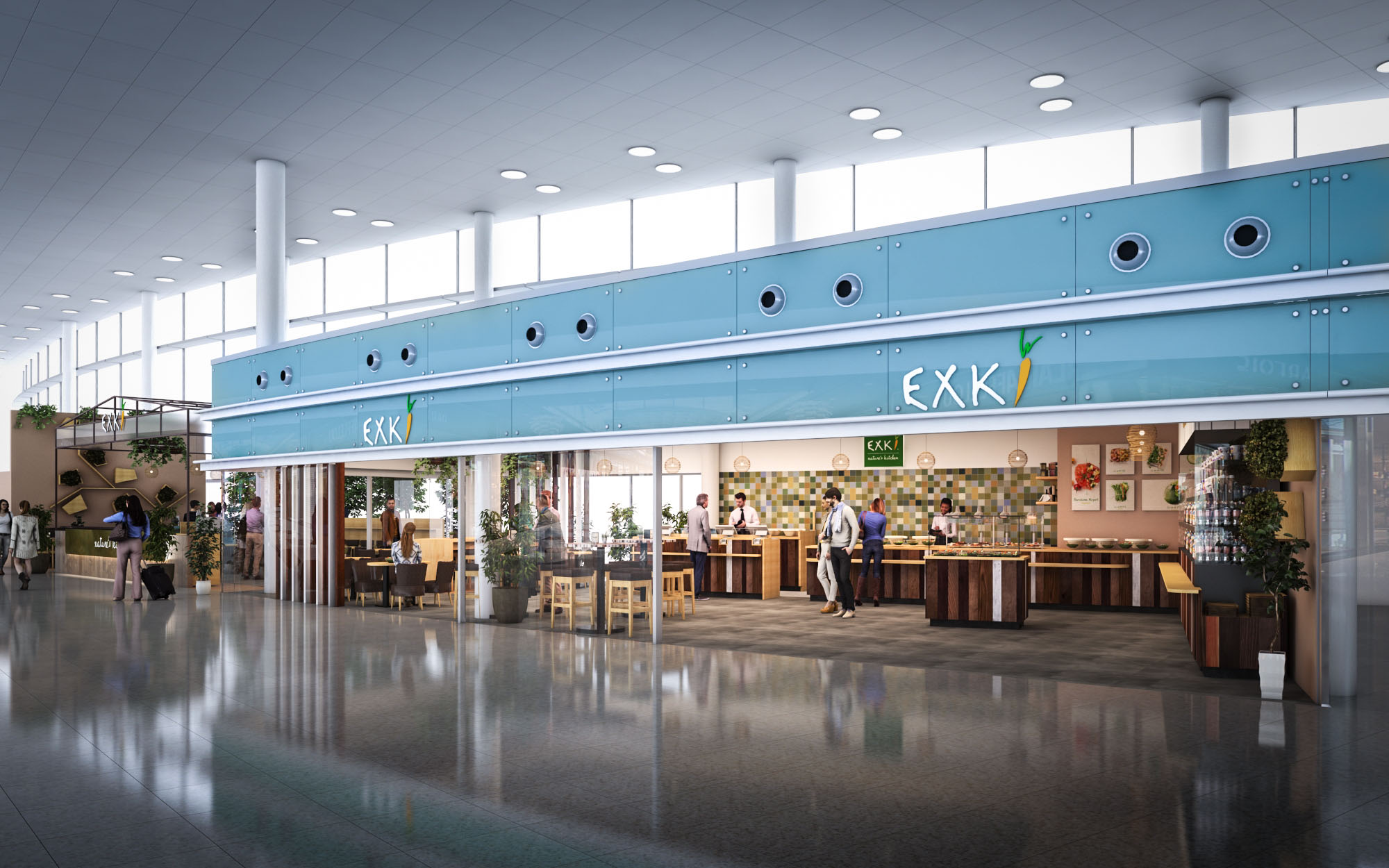
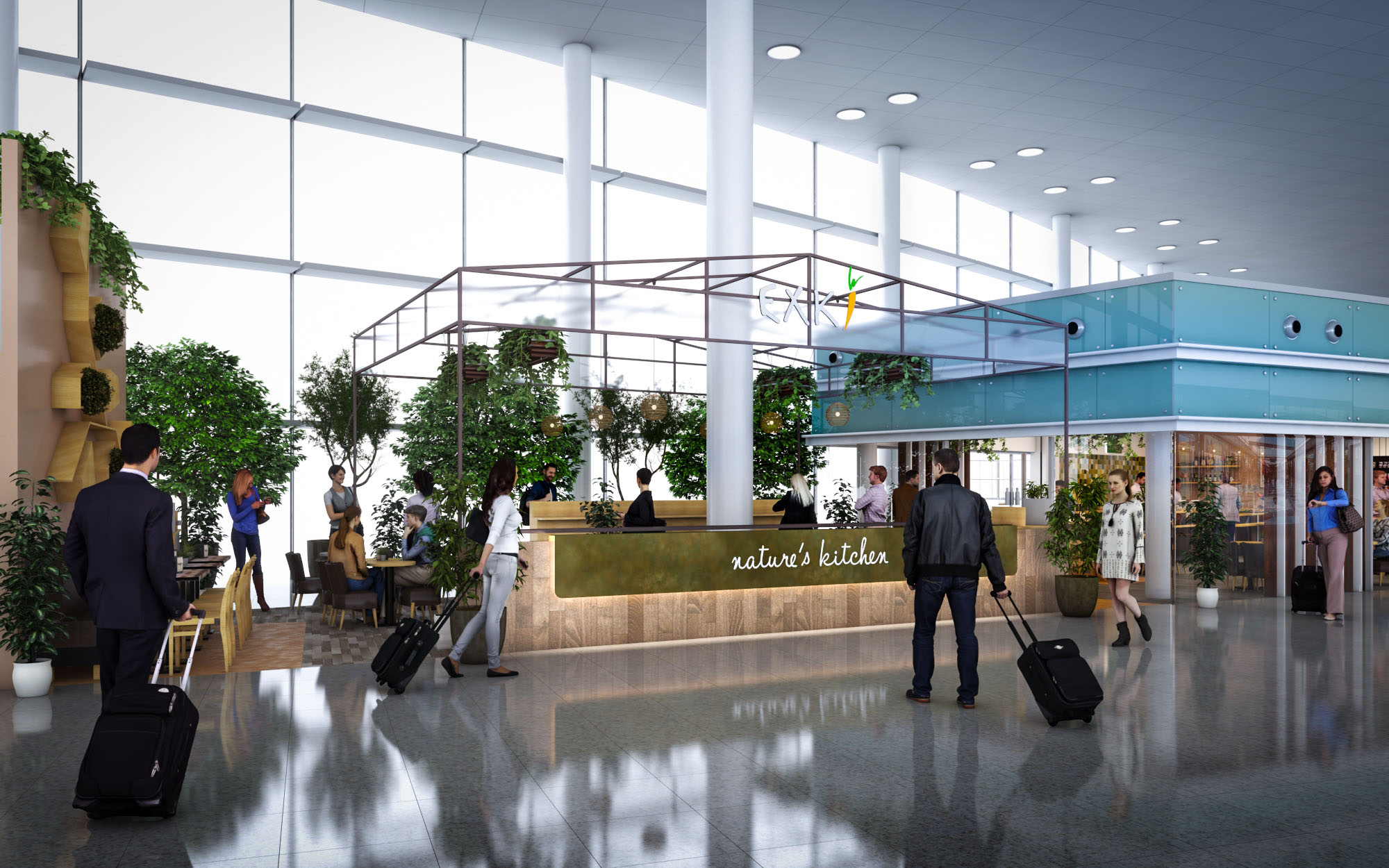

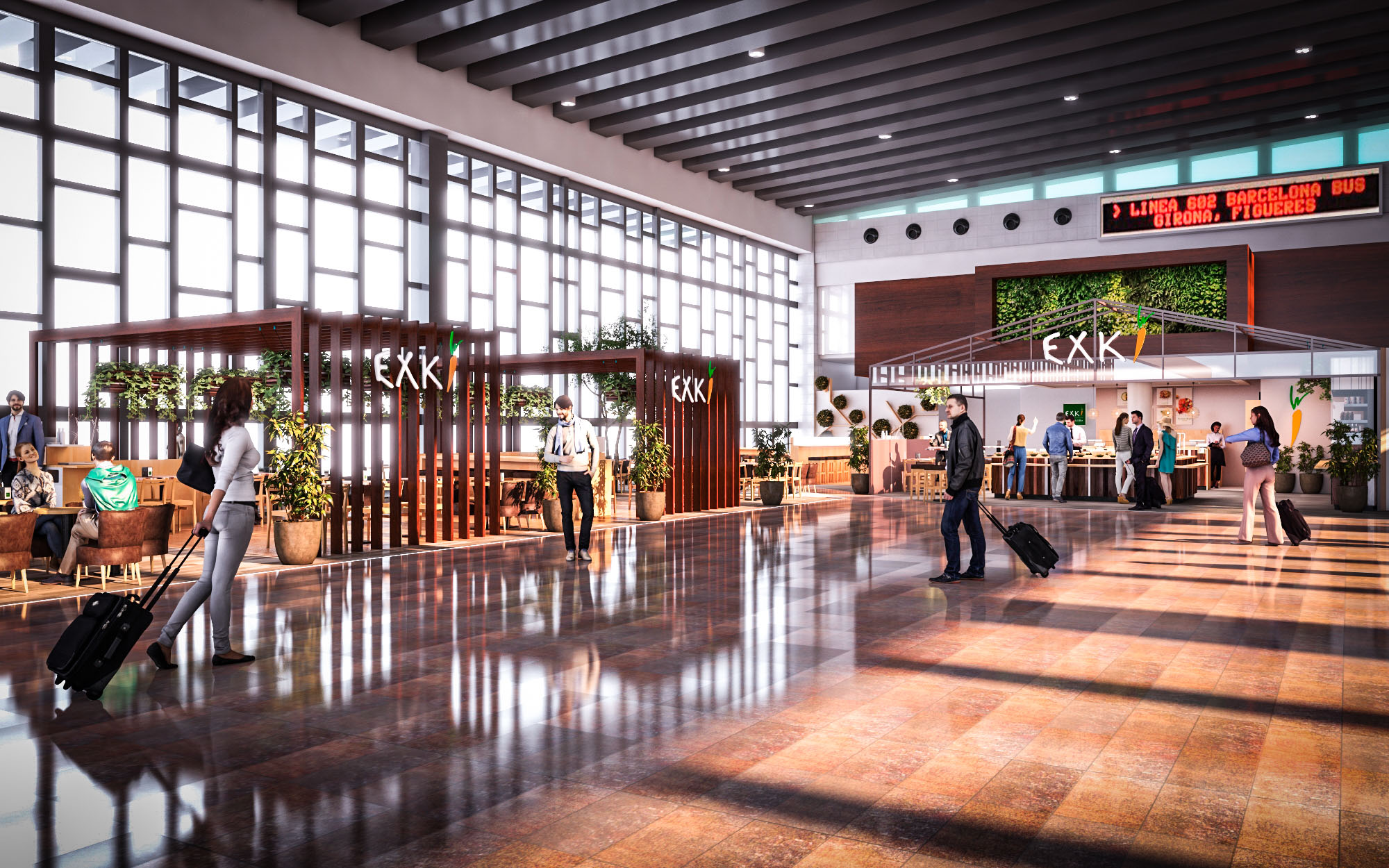
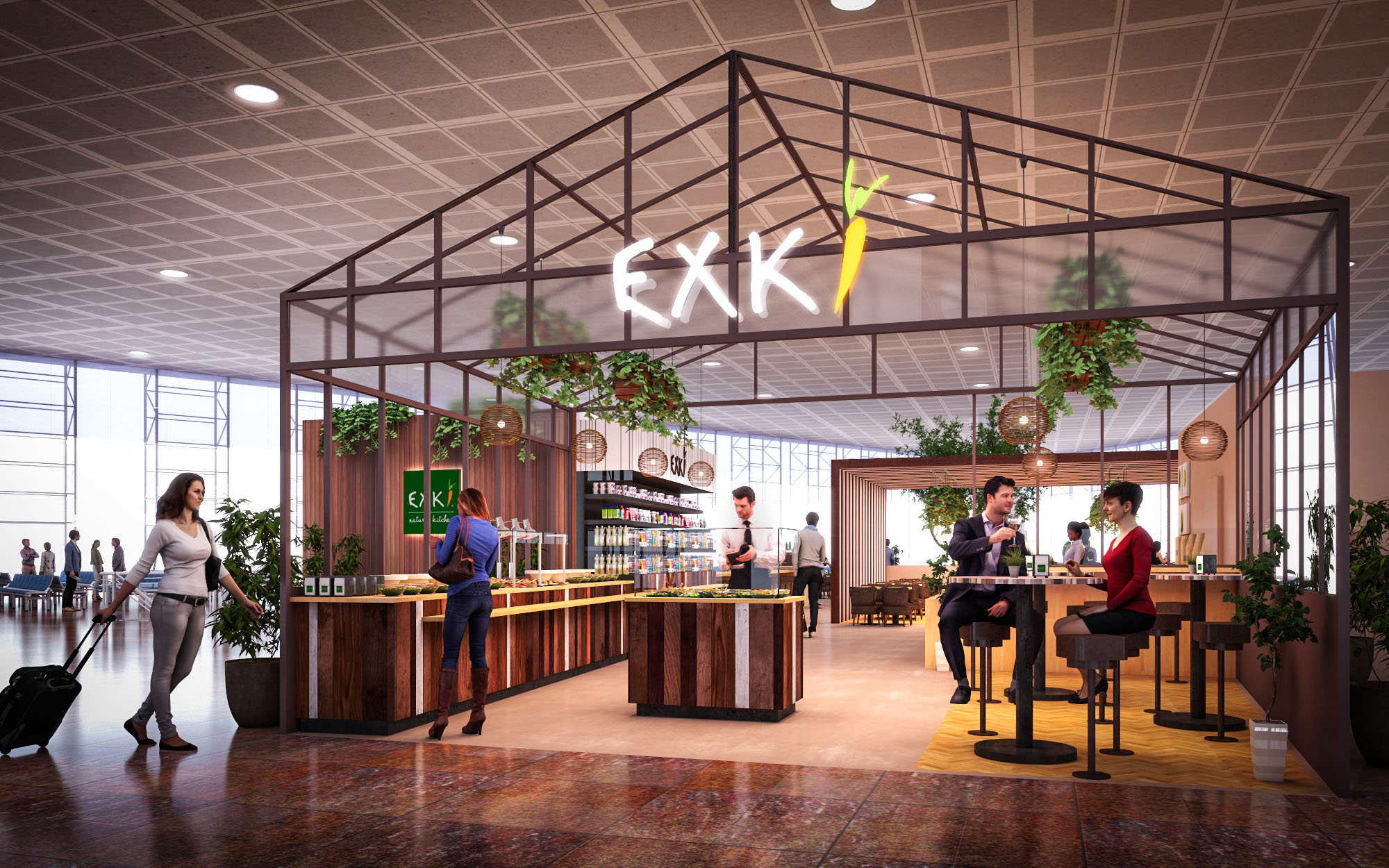
EXKI in Barcelona airport is conceived as a luminous urban greenhouse, a contemporary oasis that brings the language of nature and slow food into a hyper–transit environment. The project translates the brand’s healthy and seasonal philosophy into spatial form, using a light steel “house” structure, abundant planting and warm timber surfaces to create a recognisable and welcoming landmark within the terminal’s open hall.
The design intentionally contrasts with the surrounding large-scale infrastructure. While the terminal is defined by long sightlines and industrial ceilings, EXKI introduces a more domestic scale through the pitched canopy, layered seating typologies and carefully framed views. This creates a legible gateway for passengers: a clear threshold between circulation and pause.
The layout is organised around a central service spine that houses the counter, food display, beverage stations and back-of-house support. This linear core aligns with passenger flows, allowing intuitive access from multiple directions and minimising congestion at peak times. The open edges of the structure ensure full visual permeability, reinforcing the sense of a “public living room” within the airport.
Seating is zoned to accommodate different dwell times. High stools at the perimeter encourage short stays and solo travellers, enabling quick consumption while maintaining visual connection to departure gates. Deeper into the space, communal benches and standard-height tables are arranged in islands that form micro-environments of varying privacy. Soft lounge seating completes the ensemble, catering to longer layovers and informal meetings.
The most distinctive architectural element is the lightweight metal frame evoking a greenhouse silhouette. This dematerialised “roof” does not touch the existing ceiling but hovers beneath it, creating a secondary scale and giving the restaurant a clear identity without enclosing it. The frame integrates signage, pendant lighting and hanging plants, unifying technical and decorative components in a single system.
The material palette is intentionally warm and tactile: vertically composed timber slats, solid wood furnishings and natural fibre lamp shades. Variations of wood tones—ranging from pale oak to richer, reclaimed hues—introduce rhythm and texture along the counters and partitions. Large-format flooring articulates the dining zone, subtly differentiating it from the terminal’s circulation surfaces while remaining fully accessible for luggage and service carts.
The interior atmosphere seeks to soften the typical airport experience through an abundance of greenery and carefully tuned lighting. Trees planted in generous containers rise through the seating islands, providing vertical articulation and partial screening between tables. Lower planters and hanging vegetation extend this green layer across the structure, reinforcing the notion of an indoor garden.
Furniture is deliberately simple and robust, with clean lines and ergonomic proportions. Wooden chairs and benches are paired with neutral upholstery, while darker lounge armchairs add depth and contrast. Tables are dimensioned to support both dining and laptop use, anticipating contemporary passenger needs. Integrated power outlets and discreet table markers for digital ordering support a seamless, technology-friendly user experience.
Brand presence is expressed through calibrated interventions rather than overpowering graphics. The EXKI logo is suspended prominently in the greenhouse frame, backlit to ensure visibility across the terminal. The brand’s characteristic green is introduced on key vertical elements—menu totems, back wall panels and subtle signage—acting as visual anchors within the predominantly timber and neutral environment.
Product display is treated as an architectural layer: refrigerated cabinets and open shelving form a transparent backdrop to the counter, allowing colourful fresh ingredients and packaged items to become part of the interior composition. This reinforces the narrative of freshness and transparency, with preparation areas partially visible to passengers.
Sustainability is addressed through both material choices and operational strategies. Timber elements favour certified and, where feasible, reclaimed sources, reducing embodied carbon while enhancing the aesthetic of authenticity. The modular steel frame is conceived as a demountable system, facilitating future relocation or reconfiguration in line with circular design principles common to airport fit-outs.
Extensive planting contributes to improved indoor environmental quality, helping to psychologically mitigate the stress of travel and introducing biophilic benefits. LED lighting with high energy efficiency is carefully layered—ambient, accent and task—to minimise glare on glass façades and optimise power consumption. Finishes are selected for durability and ease of maintenance, ensuring a long life-cycle with reduced replacement and cleaning needs. Collectively, these decisions align the restaurant’s physical environment with the ethos of responsible, healthy eating that defines the EXKI brand.


Our offices are located in Barcelona, Cancún, Chicago and Santo Domingo, but thanks to technology we can do projects on all over the world.
Barcelona
Bac de Roda 136
08020, Barcelona
Spain
Madrid
Av. de Buendía 11
19005 Guadalajara (Madrid)
Spain
Chicago
373 Hazel Ave, Apt A1
60022, Glencoe, Illinois
United States