

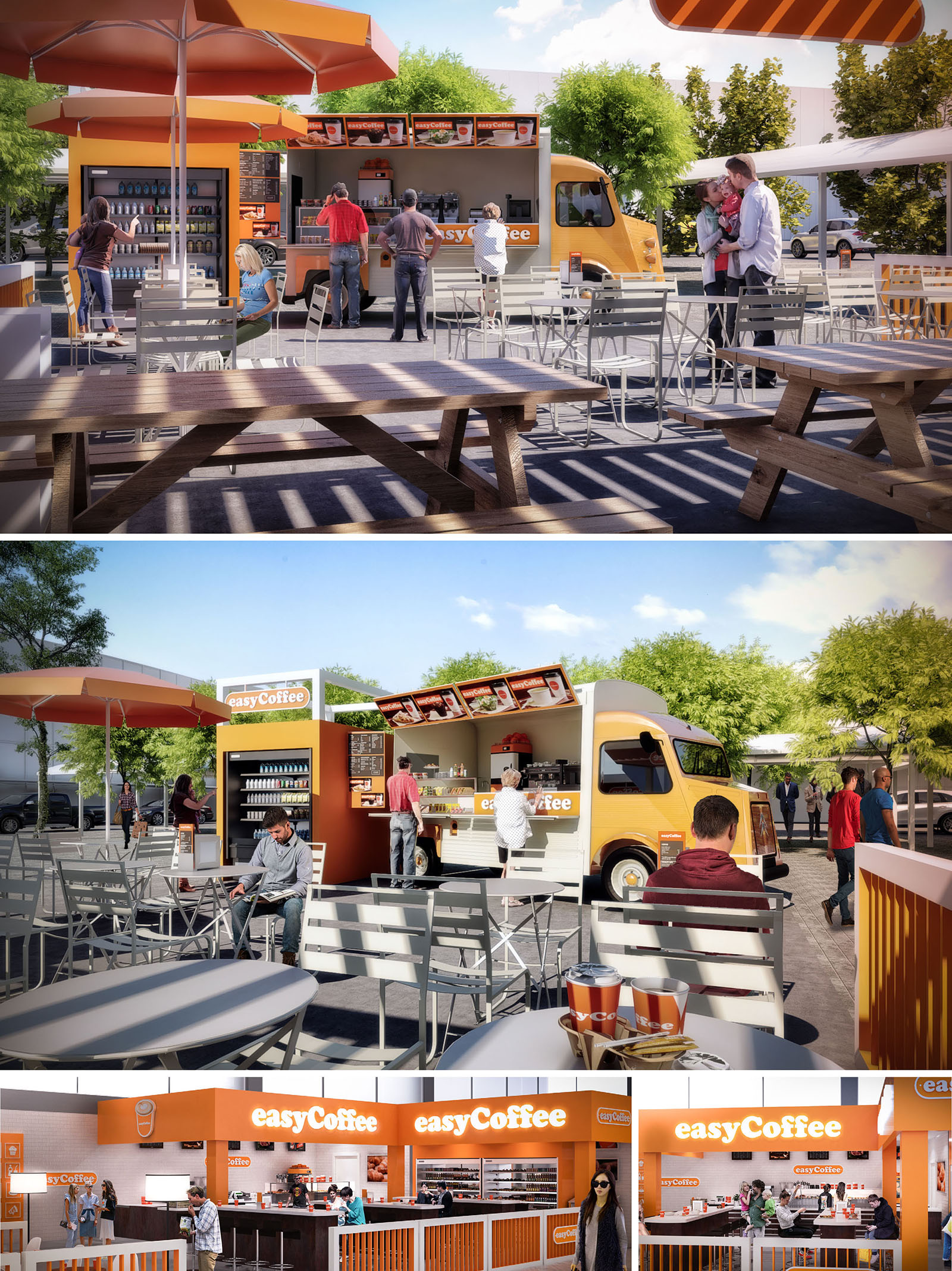
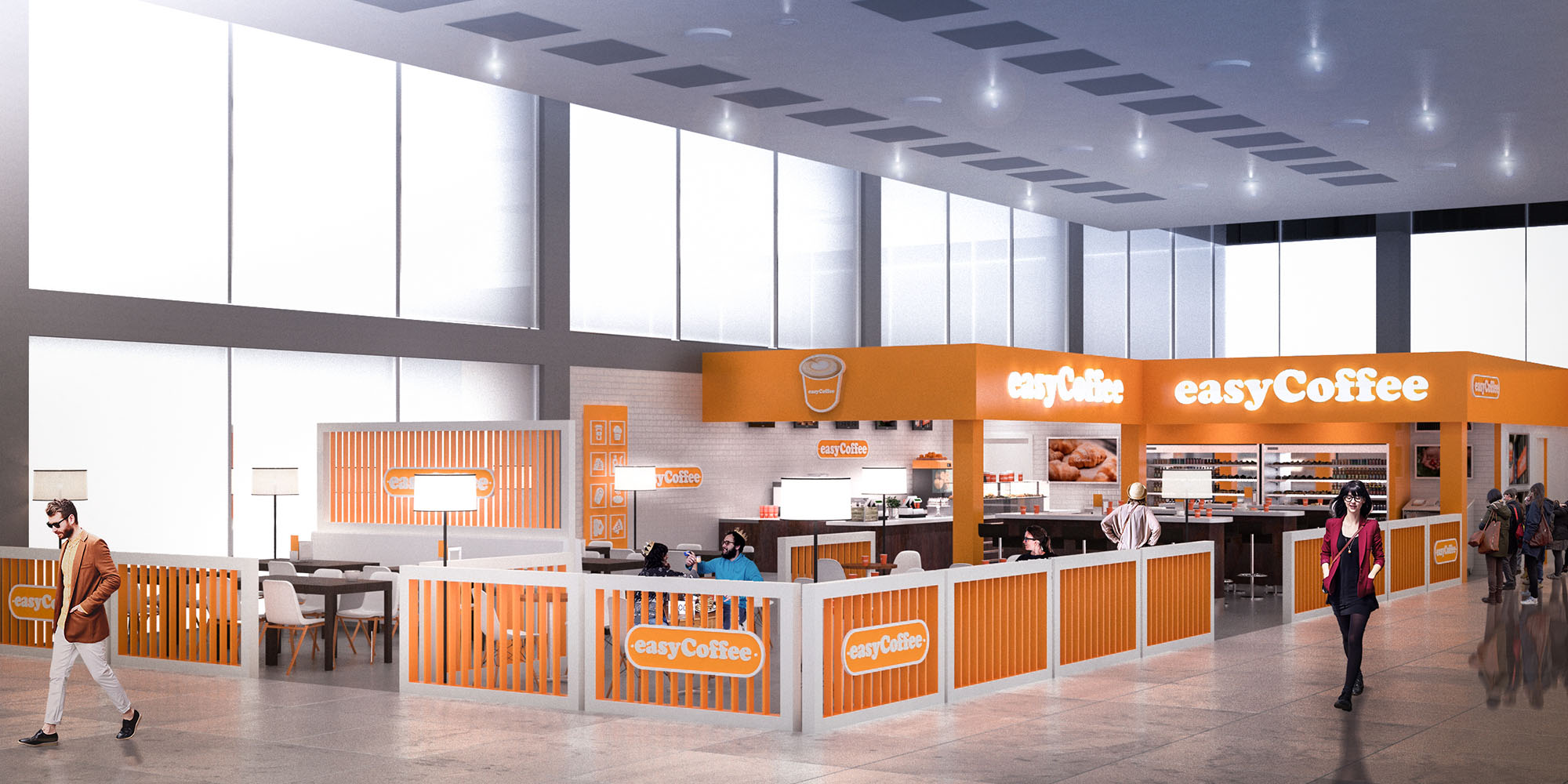
Easy Coffee is conceived as a highly legible, urban coffee platform that operates between mobility and permanence. The design creates a recognizable identity through a compact food truck, auxiliary modules, and a semi-open seating area that together function as a small plaza. The concept emphasizes speed and clarity of service while maintaining a warm and approachable atmosphere, echoing Mediterranean street culture in a contemporary commercial language.
The visual strategy is based on a strong chromatic code—orange, white, and warm wood tones—that ensures immediate brand recognition in the public realm. The architecture dissolves the boundary between interior and exterior, treating the truck façade and the surrounding furniture as a single, continuous service landscape.
The project occupies an outdoor forecourt, organized as a flexible micro-urban grid. The coffee truck anchors one edge of the space, acting as a linear bar from which all circulations radiate. In front of it, a generous clear zone allows queue formation without obstructing surrounding pedestrian flows, while seating is distributed peripherally to preserve visual permeability.
Different table typologies—standard café tables, higher bar tables, and large picnic benches—generate zones for short stops, informal meetings, and longer stays. The layout prioritizes diagonal visual connections so that the Easy Coffee brand and product display are visible from all approach directions, reinforcing wayfinding in the open-air environment.
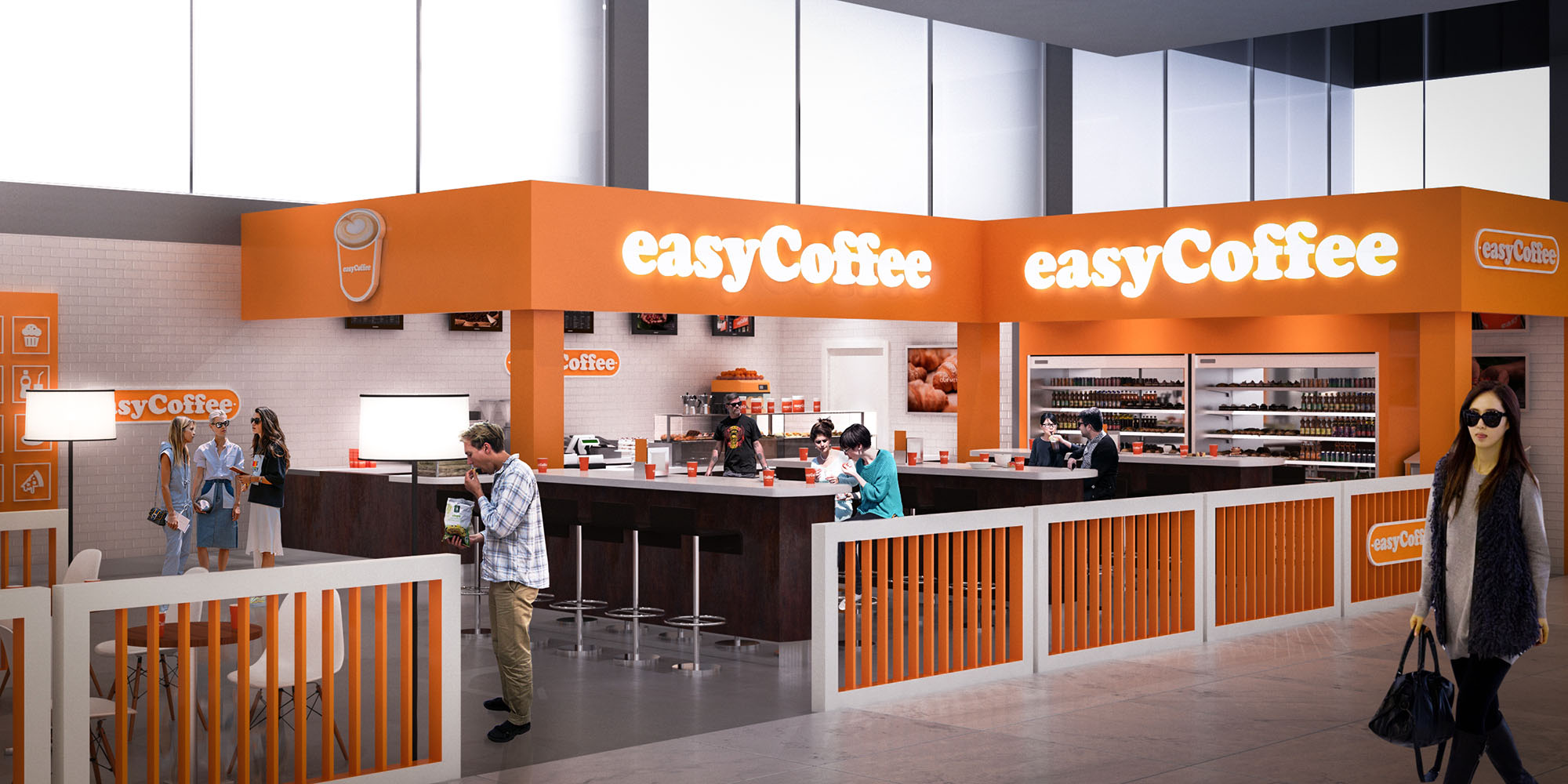
The architectural composition is deliberately simple: a retrofitted truck with an articulated serving façade, a vertical service module for refrigerated products, and shaded seating islands. These elements are arranged to read as a single volumetric ensemble, with aligned cornice heights and a continuous color palette.
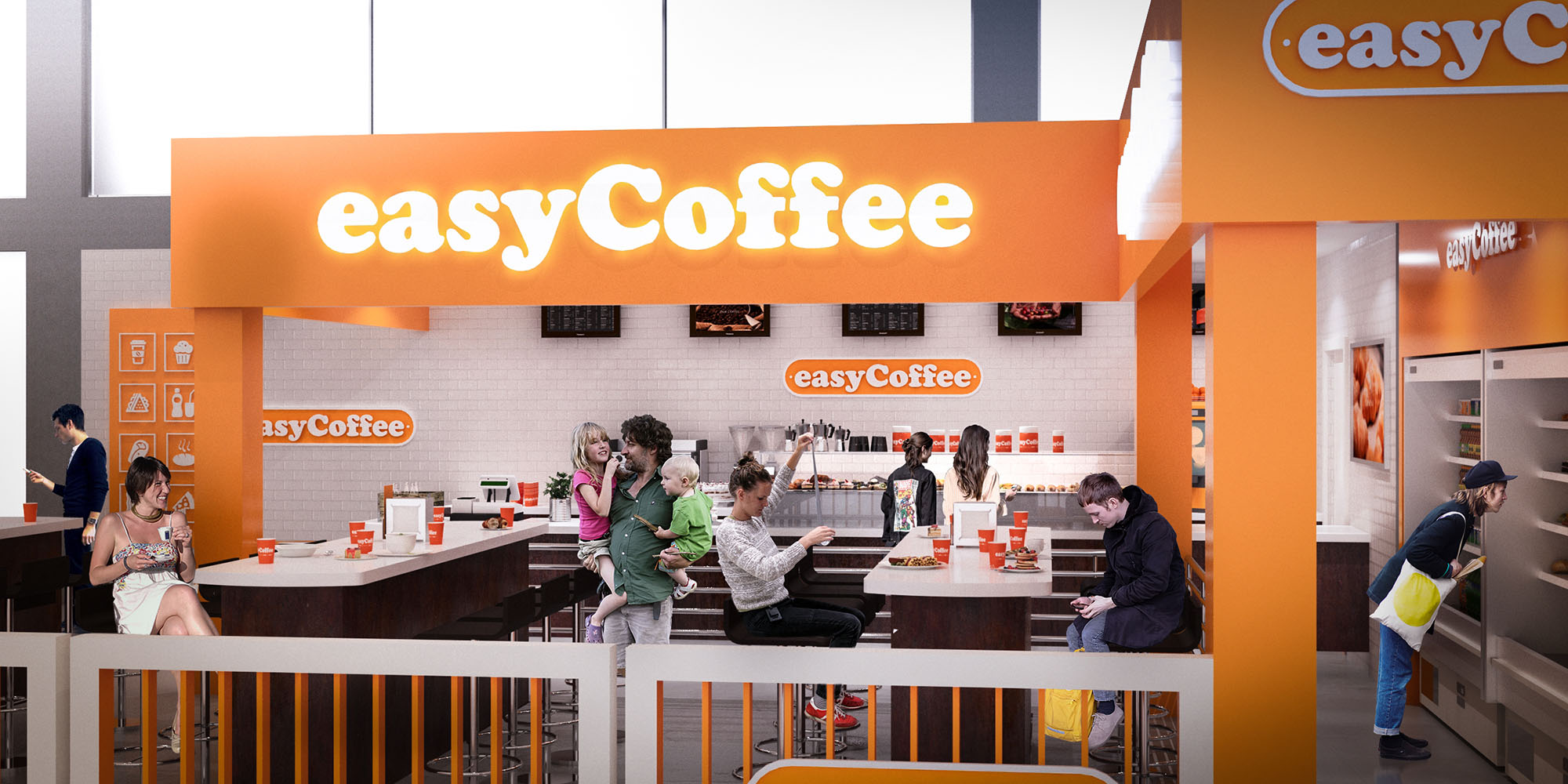
The truck façade opens upwards via canopies that double as signage bands, integrating menu boards and lighting. The adjacent vertical module acts as an outdoor backbar, framing bottled drinks and packaged items in a rational grid. Brand identity is not applied superficially but embedded in the structure—through the orange soffits, the perimeter railings, and the consistent typography that wraps both mobile and fixed components.
Materials are selected for resistance, easy maintenance, and visual coherence. Exterior furniture uses powder-coated metal in a light neutral tone, minimizing heat absorption while providing a calm background for the more saturated brand colors. Tabletops combine metallic structures with durable composite or laminated surfaces, suitable for intensive outdoor use.
Warm-toned woods, particularly in the picnic benches and selective vertical cladding, introduce a tactile counterpoint to the industrial steel and aluminum of the truck. The color scheme pivots around a vivid orange paired with white and soft grey, communicating dynamism without visual noise. Integrated LED lighting in the awnings and under the signage guarantees even illumination of the counters and menu boards, ensuring legibility during early mornings and evenings while controlling energy consumption.
The serving front is designed as a linear, ergonomic workflow: ordering, payment, and product delivery occur along a single façade, minimizing cross-movements for staff. Counter heights and the position of equipment are optimized for quick interaction, while the open hatch visually exposes the preparation process, increasing trust and perceived quality.
Seating is intentionally lightweight and movable, encouraging users to configure the space according to group size and sun conditions. Large parasols provide shade and create an intermediate microclimate, while the alternating high and low seating invites both solitary users with laptops and families with children. The consistent visual language between the outdoor truck area and the interior bar area allows an intuitive transition for users encountering the brand in different contexts.
Sustainability is addressed primarily through modularity, energy efficiency, and material choice. The mobile truck format reduces the need for heavy permanent construction, limiting embodied carbon and allowing the installation to adapt to changing urban dynamics. Prefabricated components for the bar modules and furniture simplify future relocation, repair, or replacement.
Energy consumption is minimized through LED lighting, compact equipment layout, and the strategic use of natural shade from trees combined with parasols, which helps reduce cooling demands inside the truck. Durable, recyclable metals dominate the material palette, decreasing long-term waste. The open-air configuration reduces reliance on mechanical ventilation, while the clear, standardized design supports potential incorporation of waste-sorting points and reusable cup systems in line with Barcelona’s environmental objectives.
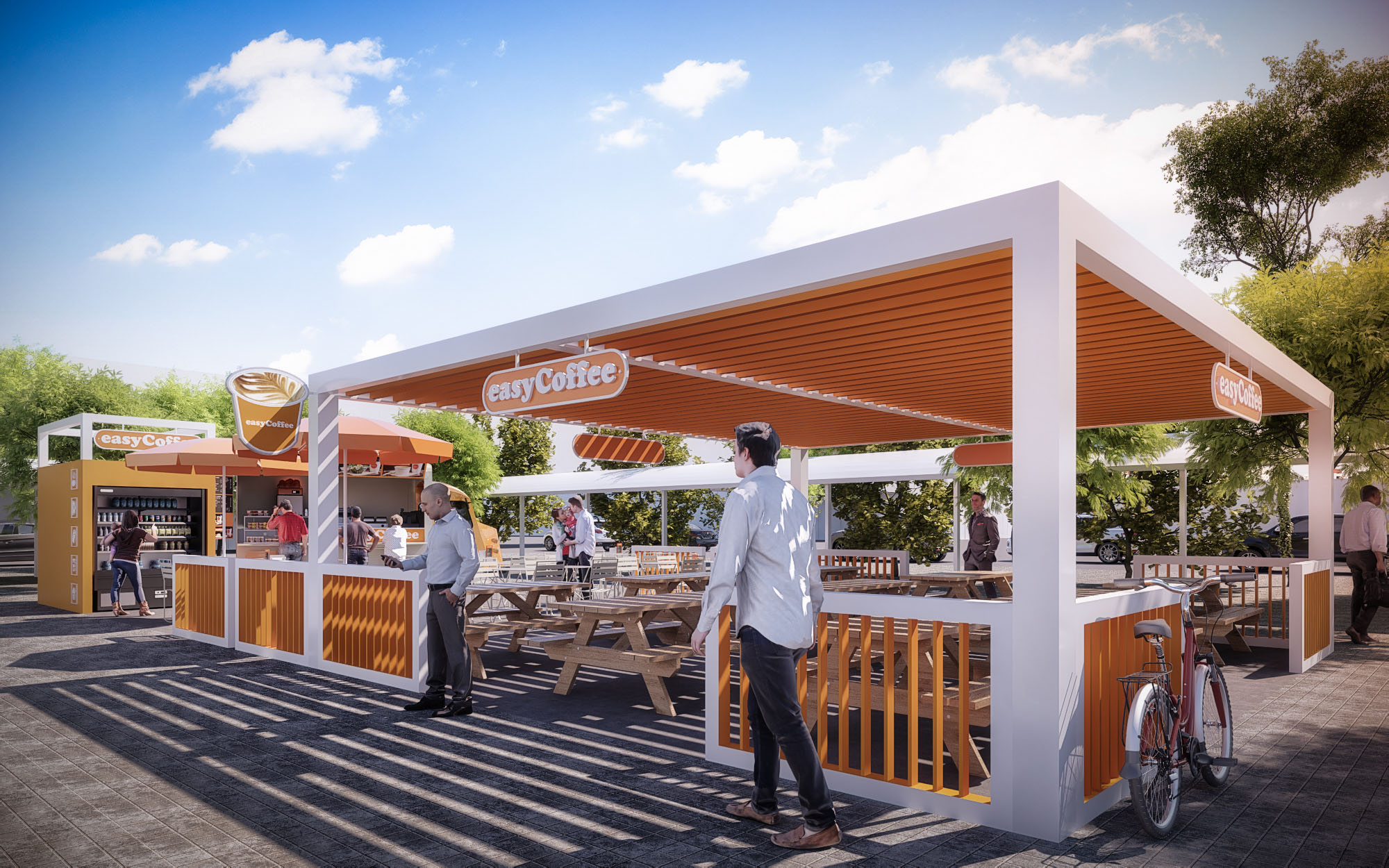
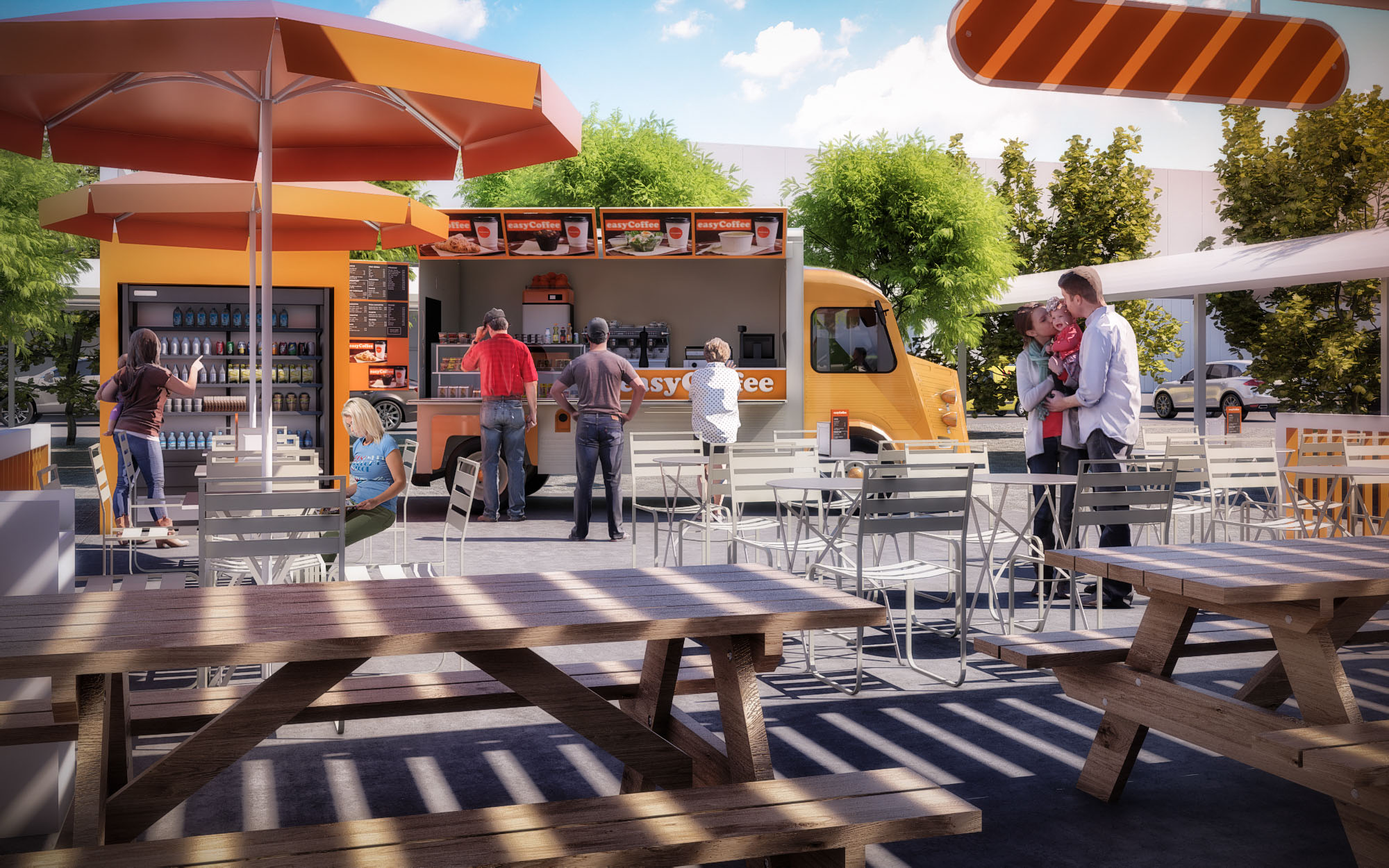
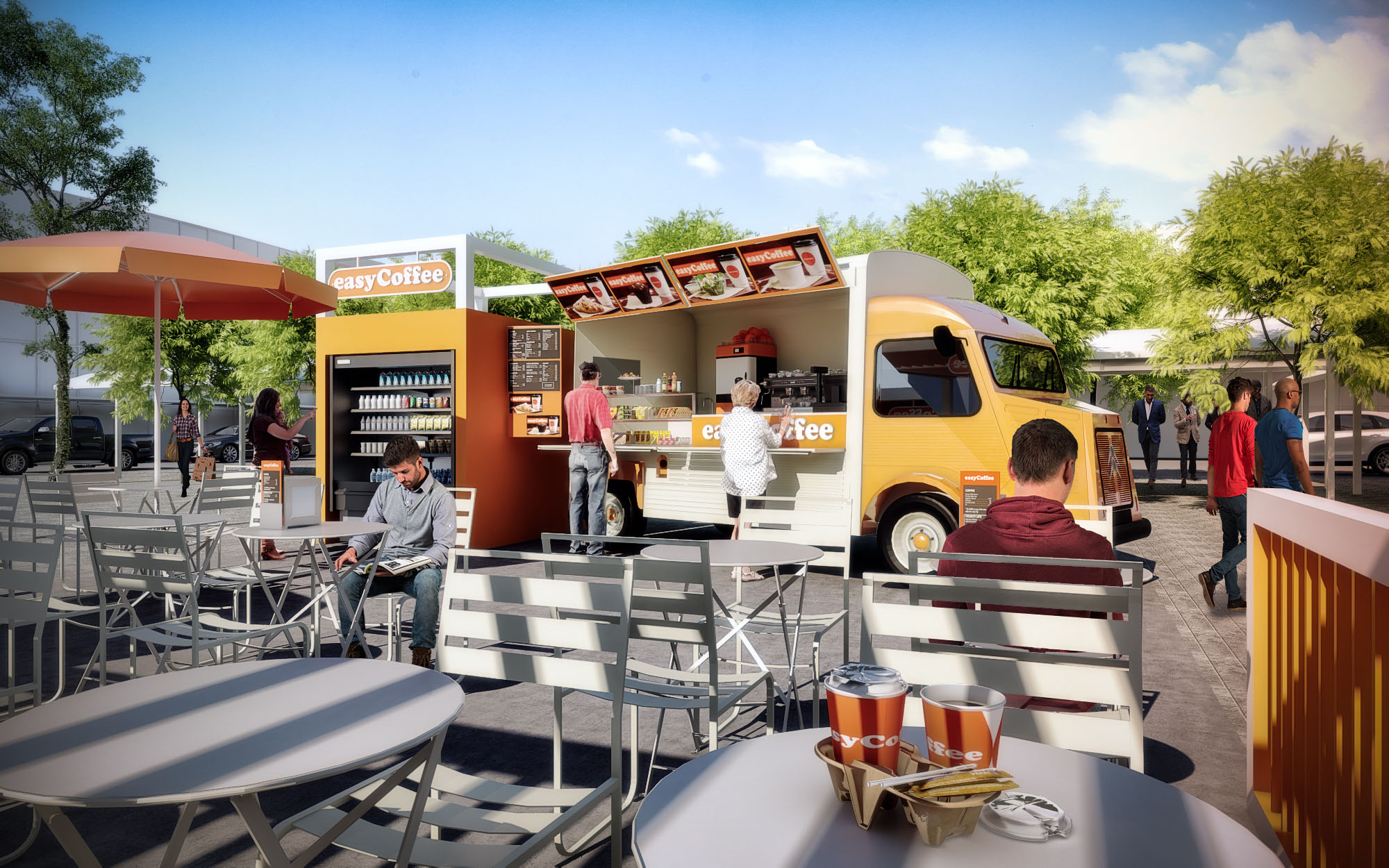
Easy Coffee is conceived as a highly legible, urban coffee platform that operates between mobility and permanence. The design creates a recognizable identity through a compact food truck, auxiliary modules, and a semi-open seating area that together function as a small plaza. The concept emphasizes speed and clarity of service while maintaining a warm and approachable atmosphere, echoing Mediterranean street culture in a contemporary commercial language.
The visual strategy is based on a strong chromatic code—orange, white, and warm wood tones—that ensures immediate brand recognition in the public realm. The architecture dissolves the boundary between interior and exterior, treating the truck façade and the surrounding furniture as a single, continuous service landscape.
The project occupies an outdoor forecourt, organized as a flexible micro-urban grid. The coffee truck anchors one edge of the space, acting as a linear bar from which all circulations radiate. In front of it, a generous clear zone allows queue formation without obstructing surrounding pedestrian flows, while seating is distributed peripherally to preserve visual permeability.
Different table typologies—standard café tables, higher bar tables, and large picnic benches—generate zones for short stops, informal meetings, and longer stays. The layout prioritizes diagonal visual connections so that the Easy Coffee brand and product display are visible from all approach directions, reinforcing wayfinding in the open-air environment.
The architectural composition is deliberately simple: a retrofitted truck with an articulated serving façade, a vertical service module for refrigerated products, and shaded seating islands. These elements are arranged to read as a single volumetric ensemble, with aligned cornice heights and a continuous color palette.
The truck façade opens upwards via canopies that double as signage bands, integrating menu boards and lighting. The adjacent vertical module acts as an outdoor backbar, framing bottled drinks and packaged items in a rational grid. Brand identity is not applied superficially but embedded in the structure—through the orange soffits, the perimeter railings, and the consistent typography that wraps both mobile and fixed components.
Materials are selected for resistance, easy maintenance, and visual coherence. Exterior furniture uses powder-coated metal in a light neutral tone, minimizing heat absorption while providing a calm background for the more saturated brand colors. Tabletops combine metallic structures with durable composite or laminated surfaces, suitable for intensive outdoor use.
Warm-toned woods, particularly in the picnic benches and selective vertical cladding, introduce a tactile counterpoint to the industrial steel and aluminum of the truck. The color scheme pivots around a vivid orange paired with white and soft grey, communicating dynamism without visual noise. Integrated LED lighting in the awnings and under the signage guarantees even illumination of the counters and menu boards, ensuring legibility during early mornings and evenings while controlling energy consumption.
The serving front is designed as a linear, ergonomic workflow: ordering, payment, and product delivery occur along a single façade, minimizing cross-movements for staff. Counter heights and the position of equipment are optimized for quick interaction, while the open hatch visually exposes the preparation process, increasing trust and perceived quality.
Seating is intentionally lightweight and movable, encouraging users to configure the space according to group size and sun conditions. Large parasols provide shade and create an intermediate microclimate, while the alternating high and low seating invites both solitary users with laptops and families with children. The consistent visual language between the outdoor truck area and the interior bar area allows an intuitive transition for users encountering the brand in different contexts.
Sustainability is addressed primarily through modularity, energy efficiency, and material choice. The mobile truck format reduces the need for heavy permanent construction, limiting embodied carbon and allowing the installation to adapt to changing urban dynamics. Prefabricated components for the bar modules and furniture simplify future relocation, repair, or replacement.
Energy consumption is minimized through LED lighting, compact equipment layout, and the strategic use of natural shade from trees combined with parasols, which helps reduce cooling demands inside the truck. Durable, recyclable metals dominate the material palette, decreasing long-term waste. The open-air configuration reduces reliance on mechanical ventilation, while the clear, standardized design supports potential incorporation of waste-sorting points and reusable cup systems in line with Barcelona’s environmental objectives.


Our offices are located in Barcelona, Cancún, Chicago and Santo Domingo, but thanks to technology we can do projects on all over the world.
Barcelona
Bac de Roda 136
08020, Barcelona
Spain
Madrid
Av. de Buendía 11
19005 Guadalajara (Madrid)
Spain
Chicago
373 Hazel Ave, Apt A1
60022, Glencoe, Illinois
United States