

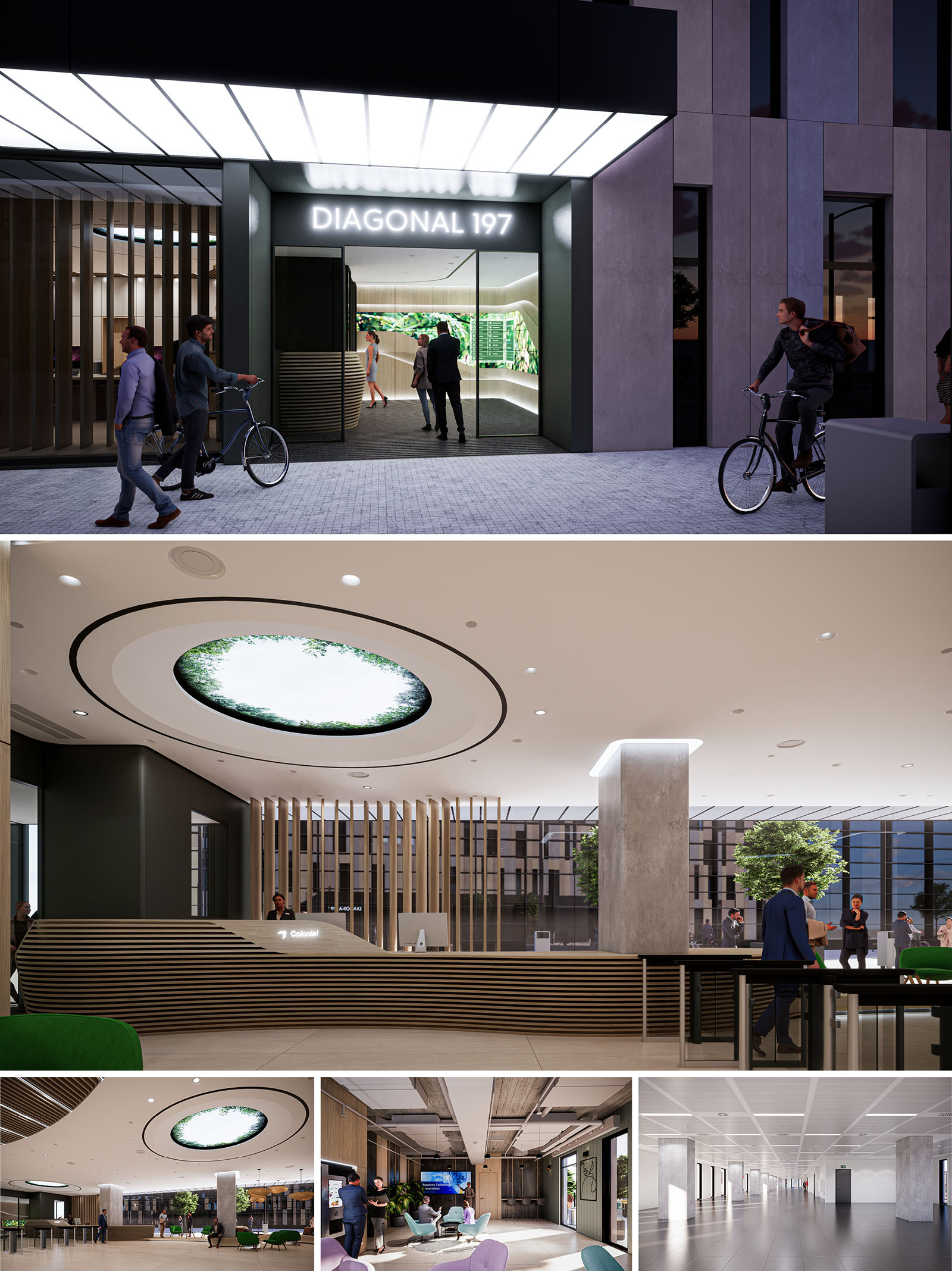
The D197 project redefines a corporate building in Barcelona as an open, permeable and contemporary workplace. The design concept is based on three key ideas: visibility towards the city, fluidity of circulation and incorporation of biophilic elements as a generator of well-being. The access, lobby and workspaces are conceived as a continuous spatial sequence where reception, informal meeting and circulation overlap, dissolving the traditional thresholds of a corporate building.
The architecture seeks a sober and timeless image, while the interior design introduces warmth and material richness. Neutral envelopes act as a backdrop for sculptural elements such as the curved reception desk, the vertical wooden slats and the large luminous oculus, which become identity milestones of the project and articulate the user experience from the street to the workspace.
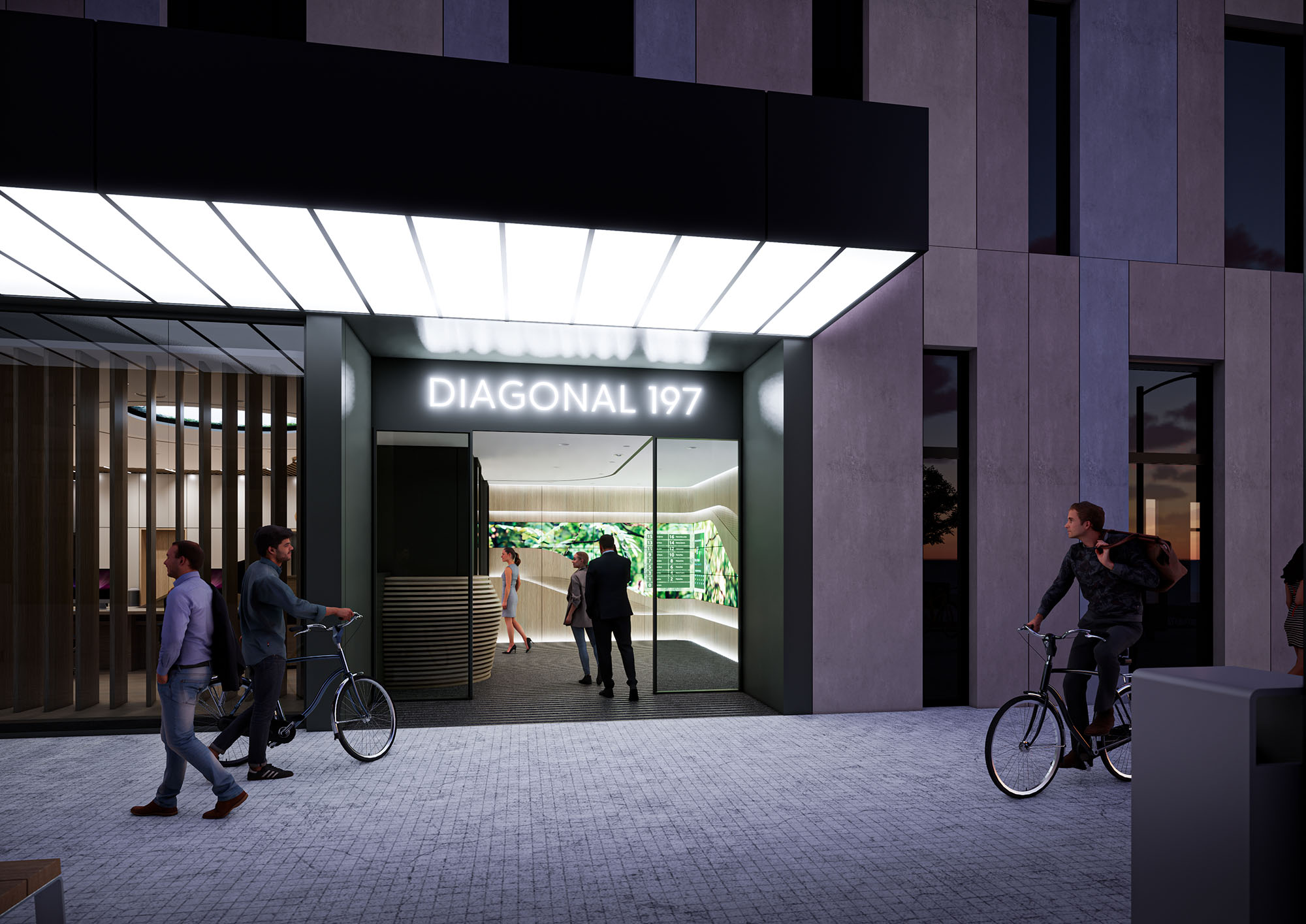
The entrance on Diagonal is configured as a deep, illuminated porch that acts as a transition between the public sidewalk and the interior lobby. A generous canopy of diffuse light emphasizes the access and improves nighttime safety, while the clear and legible signage “Diagonal 197” strengthens the urban identity of the building. Large transparent panes visually connect the interior green wall with the exterior, projecting the image of an active and open ground floor.
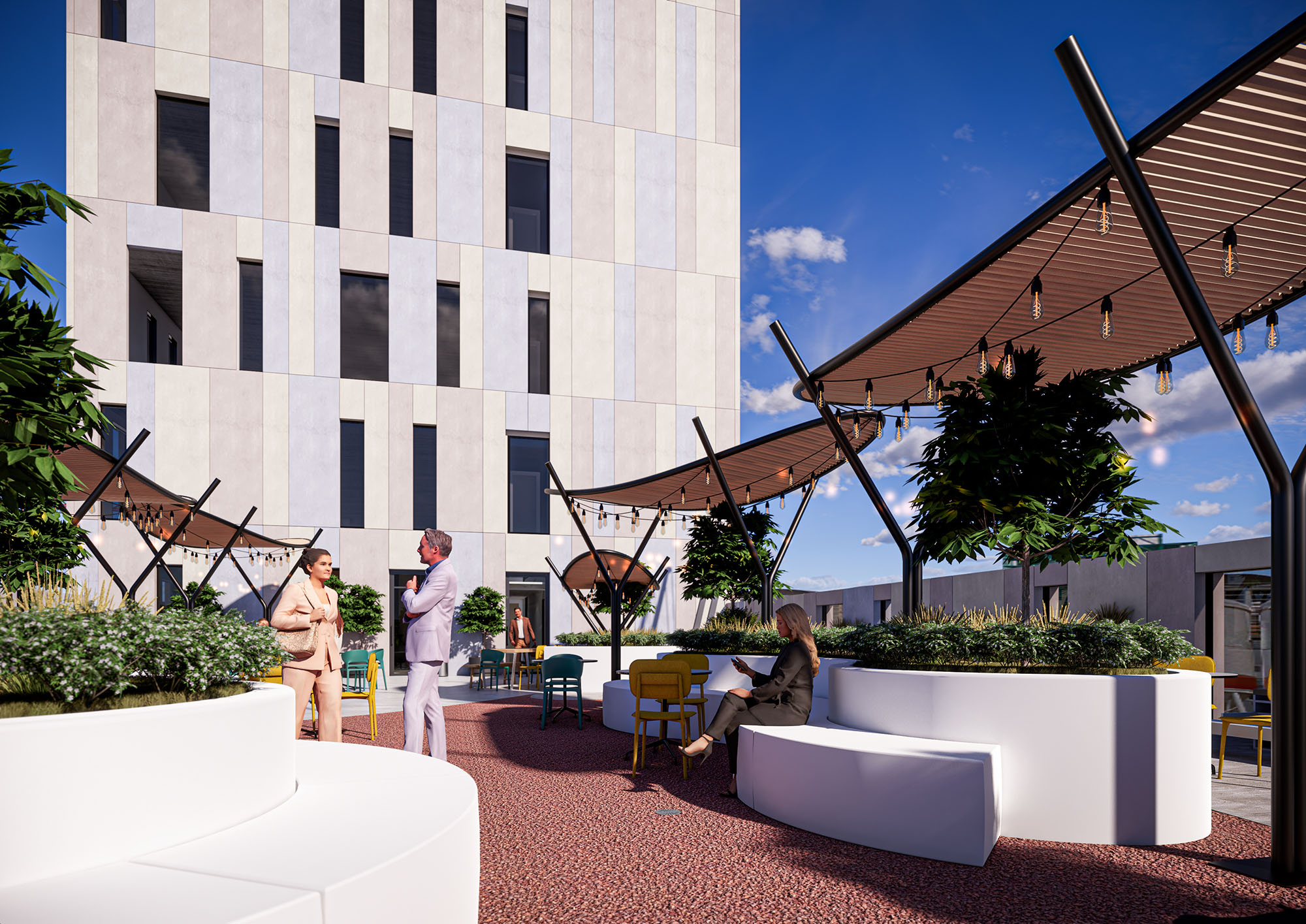
The façade of vertical stone or composite panels provides rhythm and scale, aligning with the avenue’s corporate context. The ground floor setback generates a semi-public filter space where pedestrians and cyclists coexist, favoring soft mobility and encouraging access by bicycle, in line with sustainable mobility strategies in Barcelona.
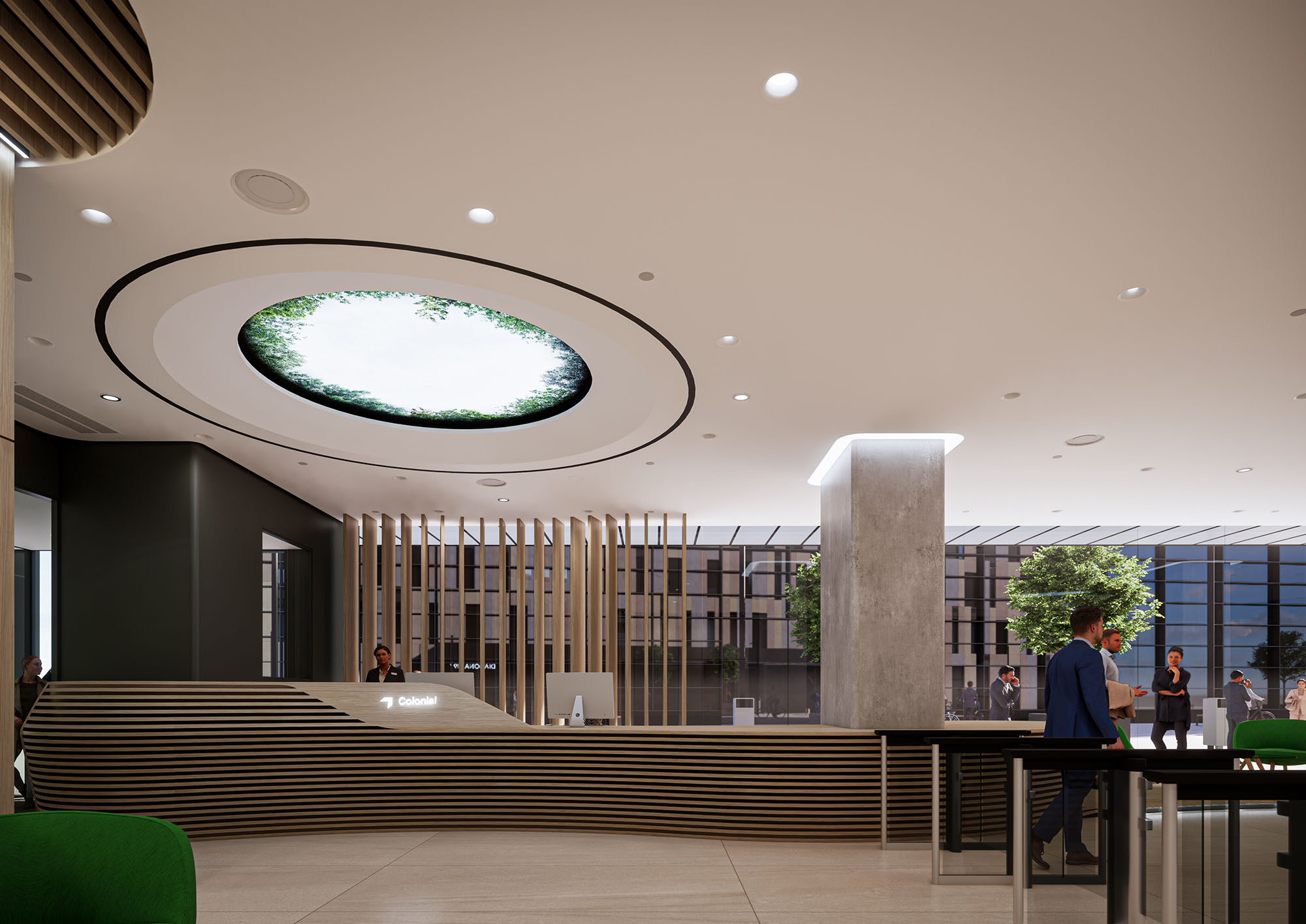
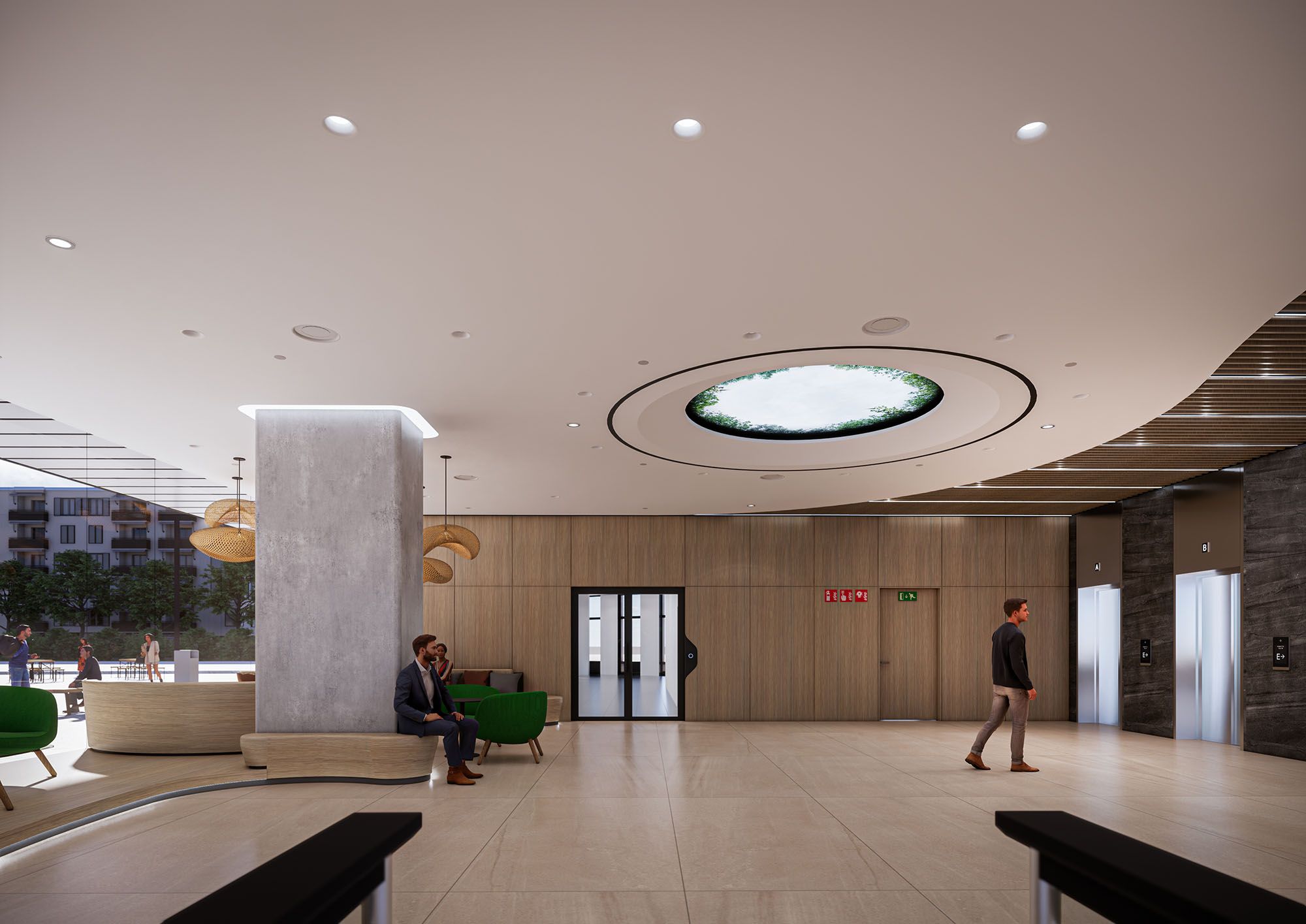
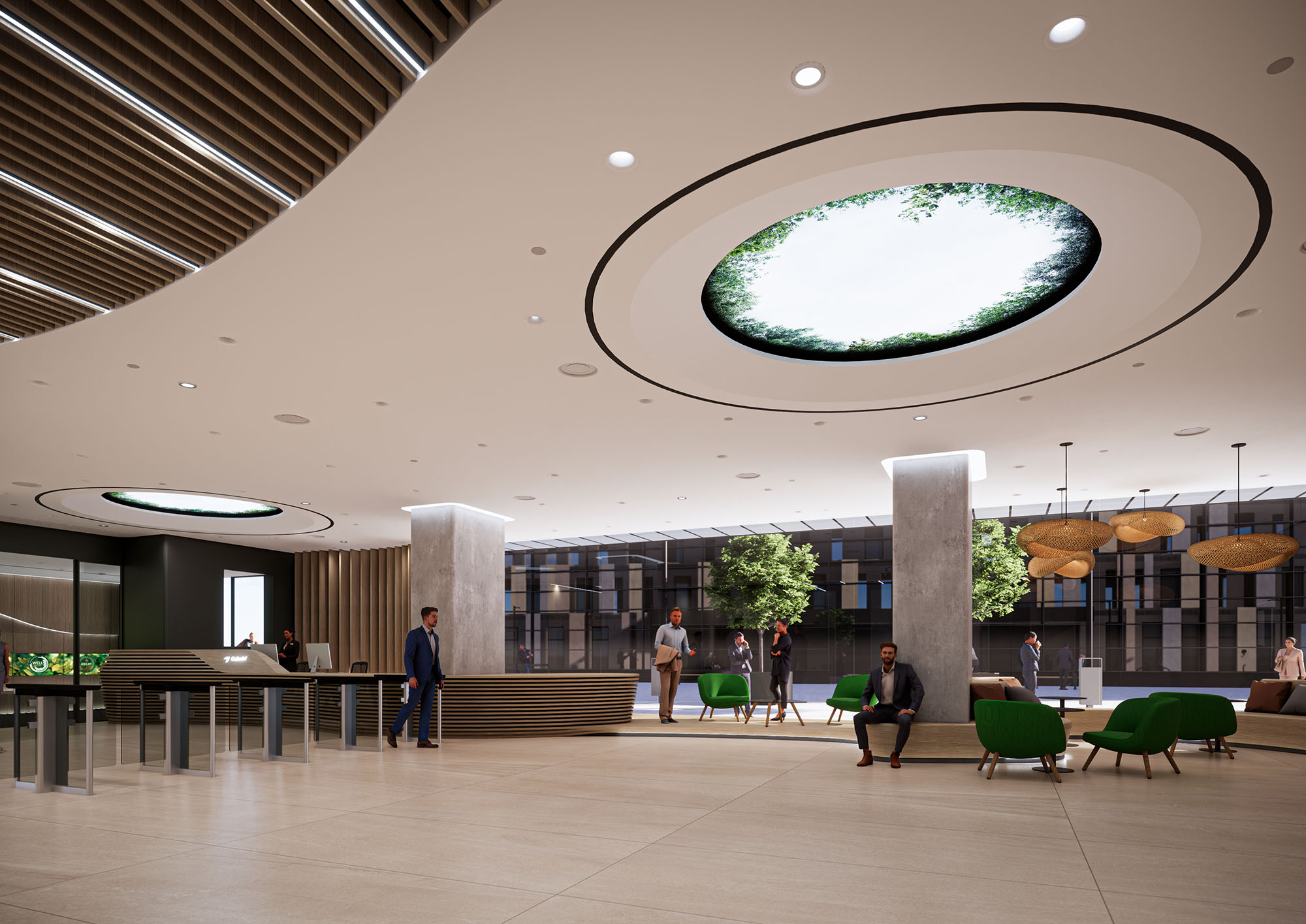
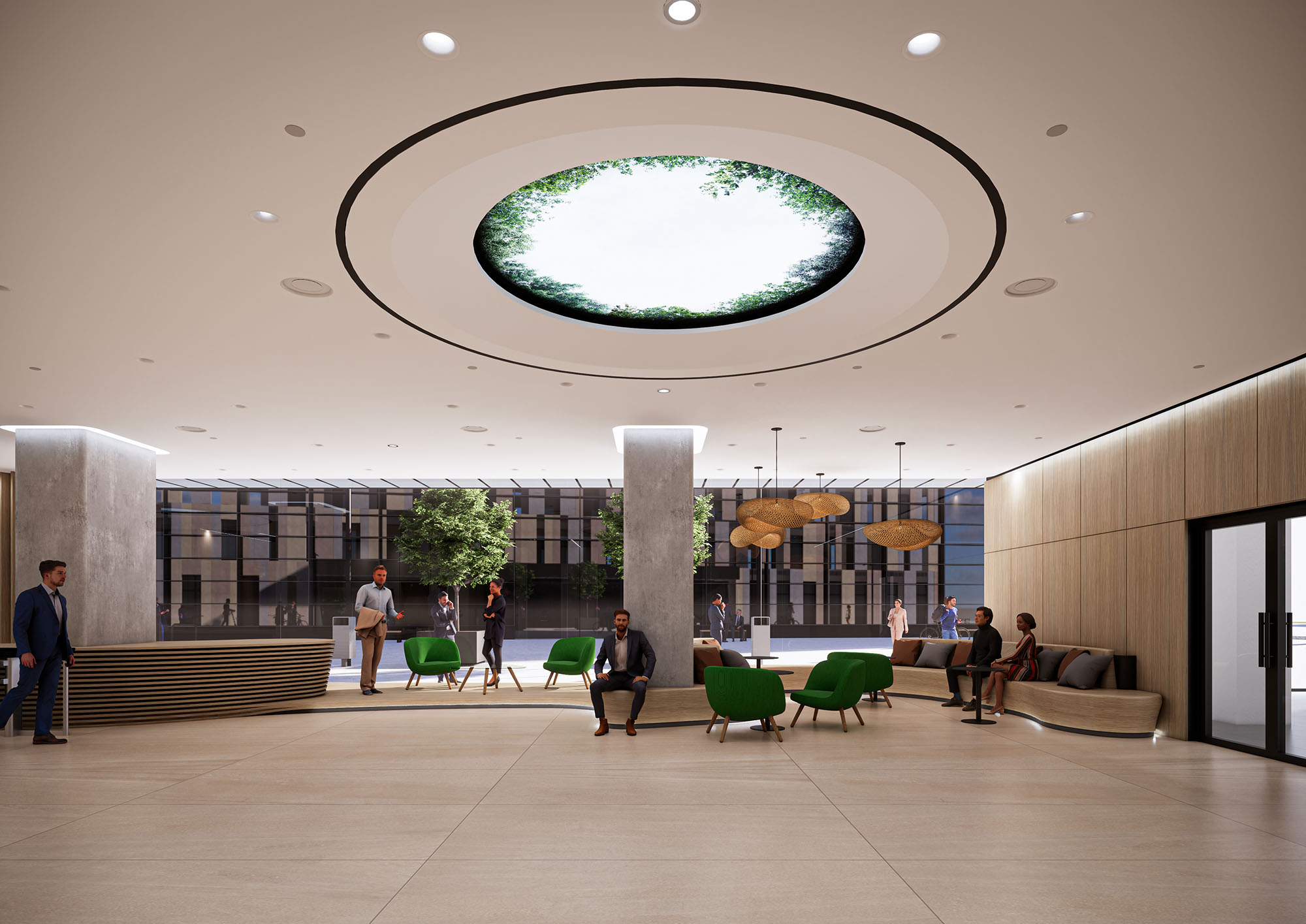
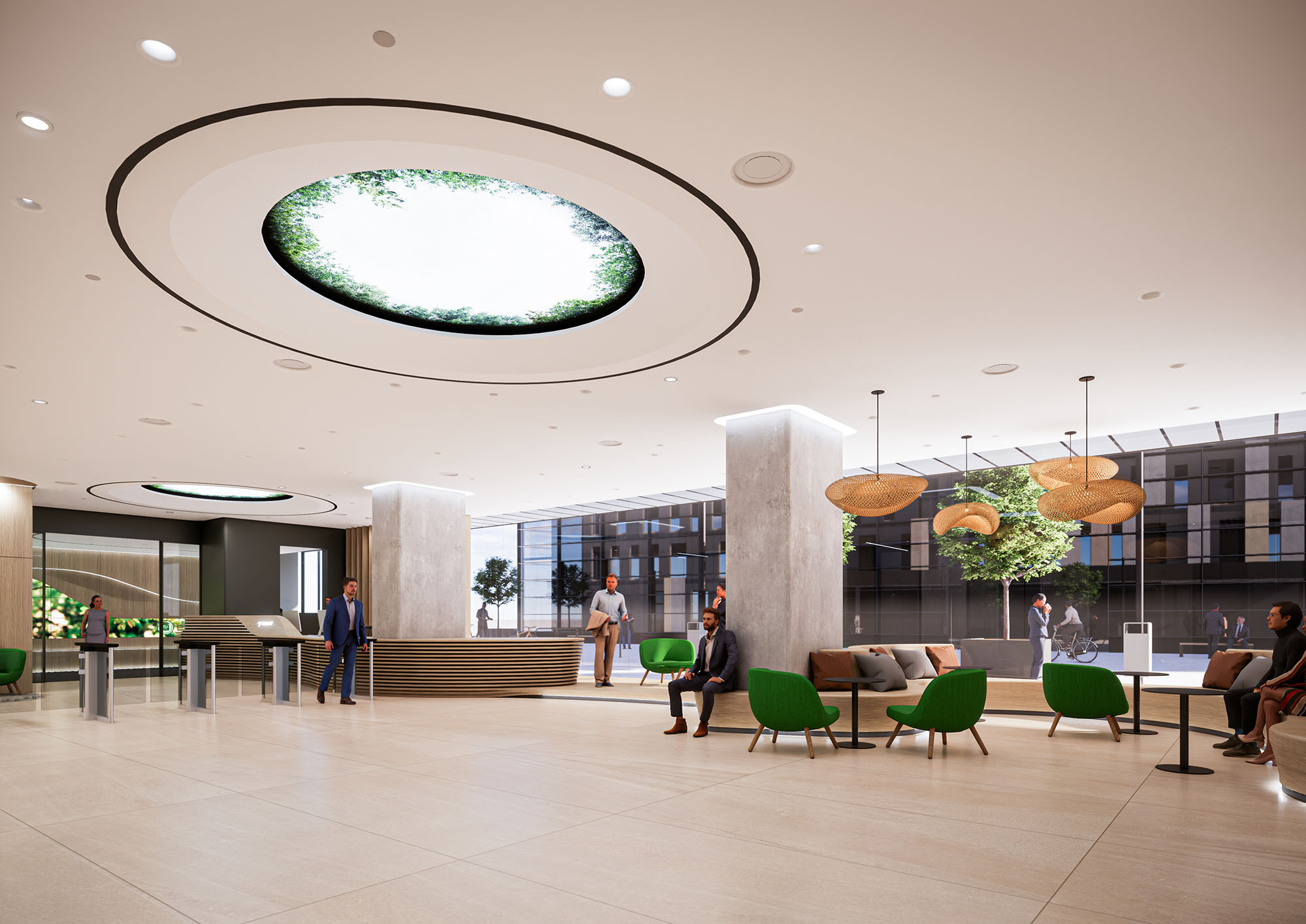
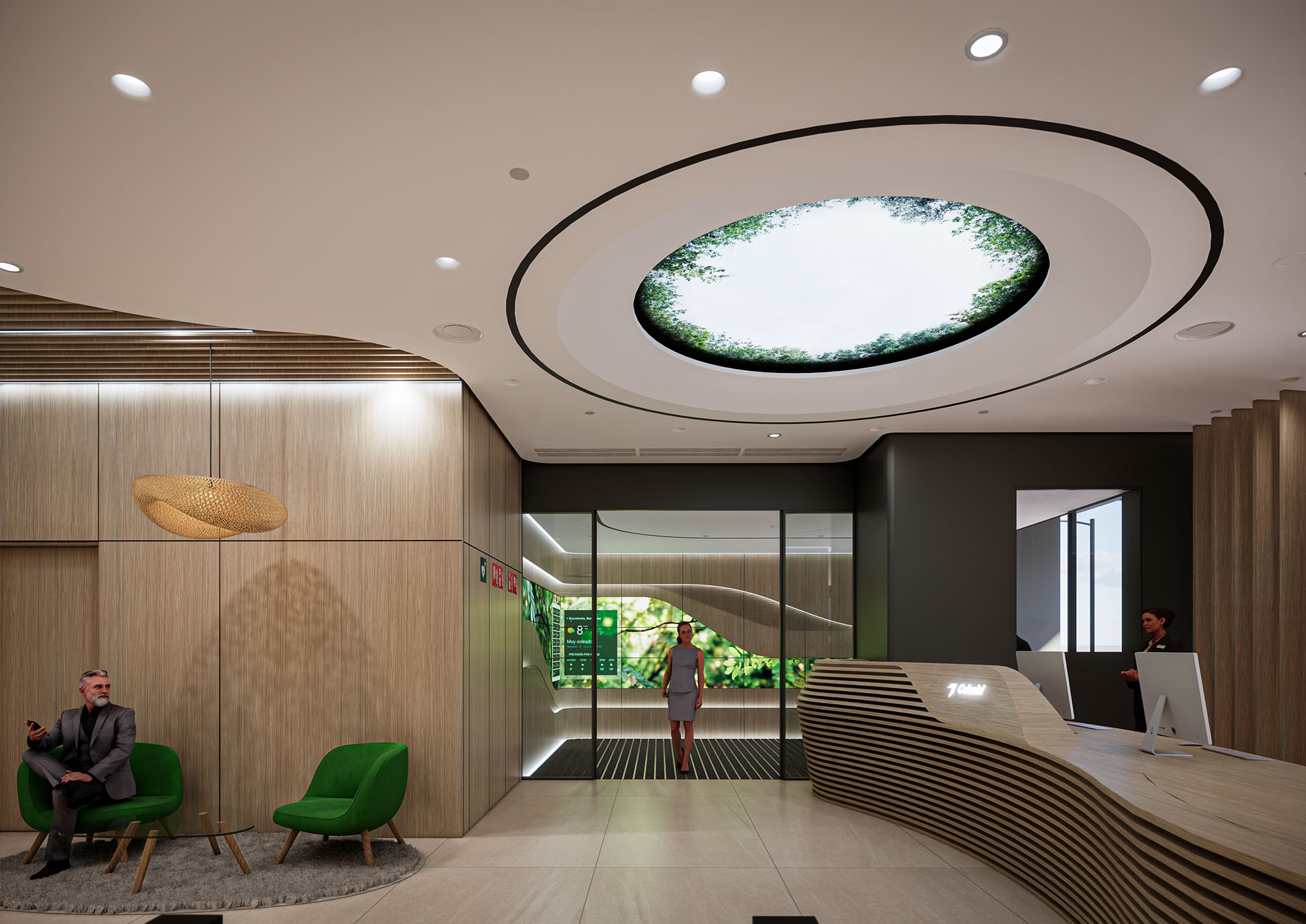
The lobby is conceived as a large, flexible and representative space. A suspended circular oculus integrates a digital or backlit image of tree canopies, bringing an abstract fragment of nature to the interior and reinforcing biophilic design. This element, combined with indirect perimeter lighting, produces a calm and homogeneous illumination suitable for reception and waiting uses.
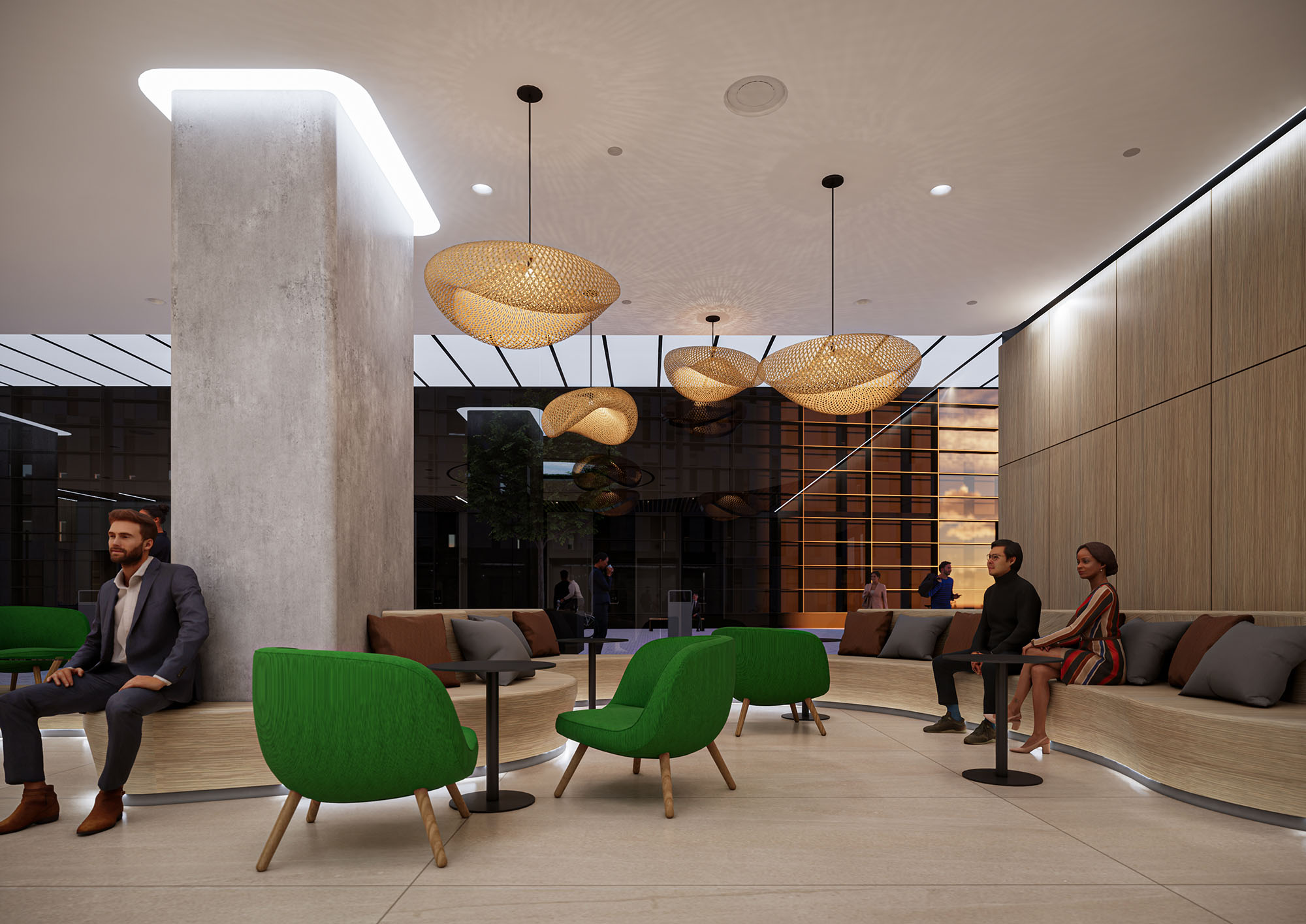
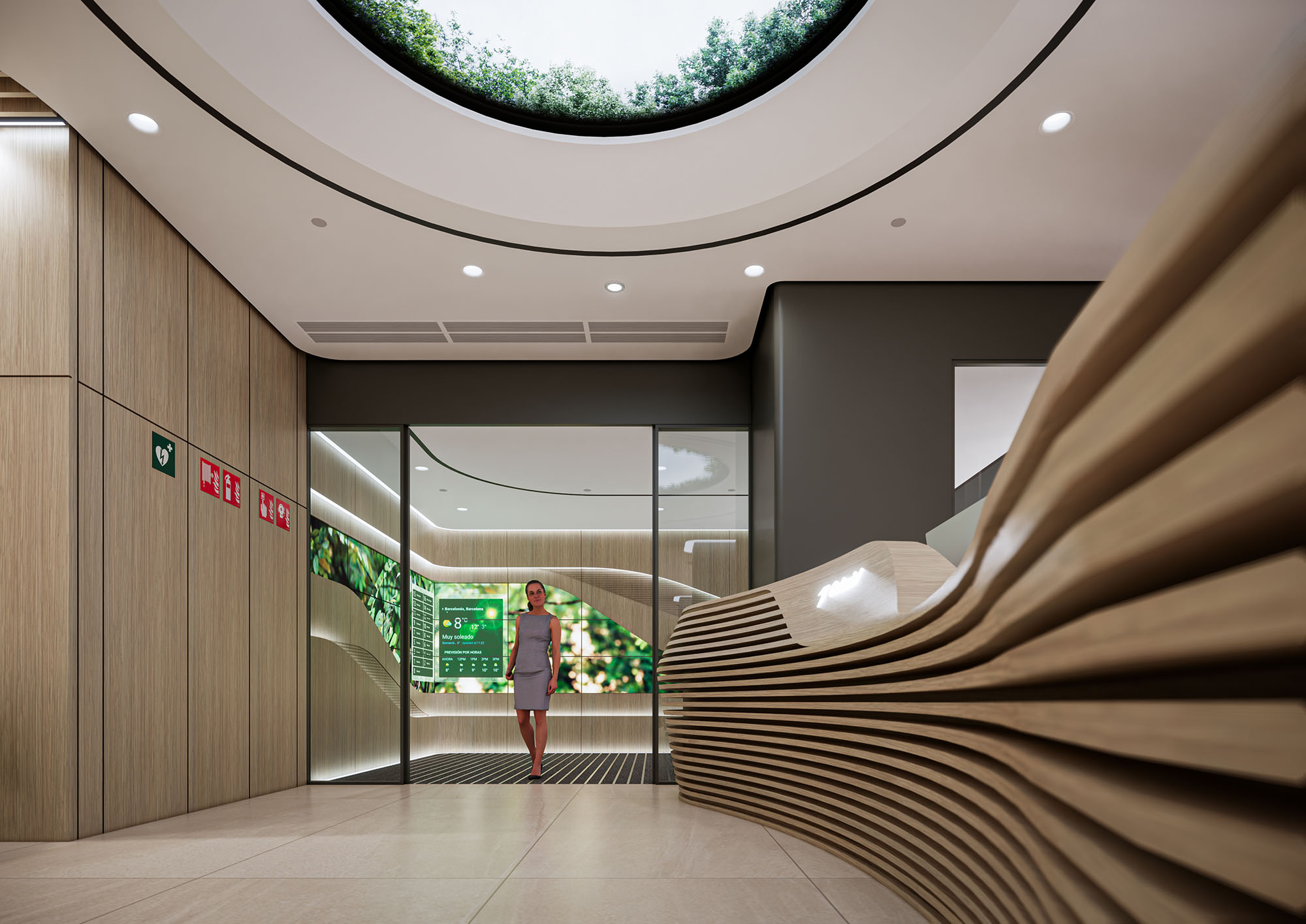
The reception desk is a continuous sculptural volume formed by horizontal wooden slats, whose sinuous geometry accompanies the main circulation and softens the perception of scale. Behind it, a screen of vertical slats filters the view towards the courtyard and offers a sense of depth without losing visual continuity. The material palette in the lobby alternates warm wood, exposed concrete and neutral surfaces, generating a balanced dialogue between corporate sobriety and domestic comfort.
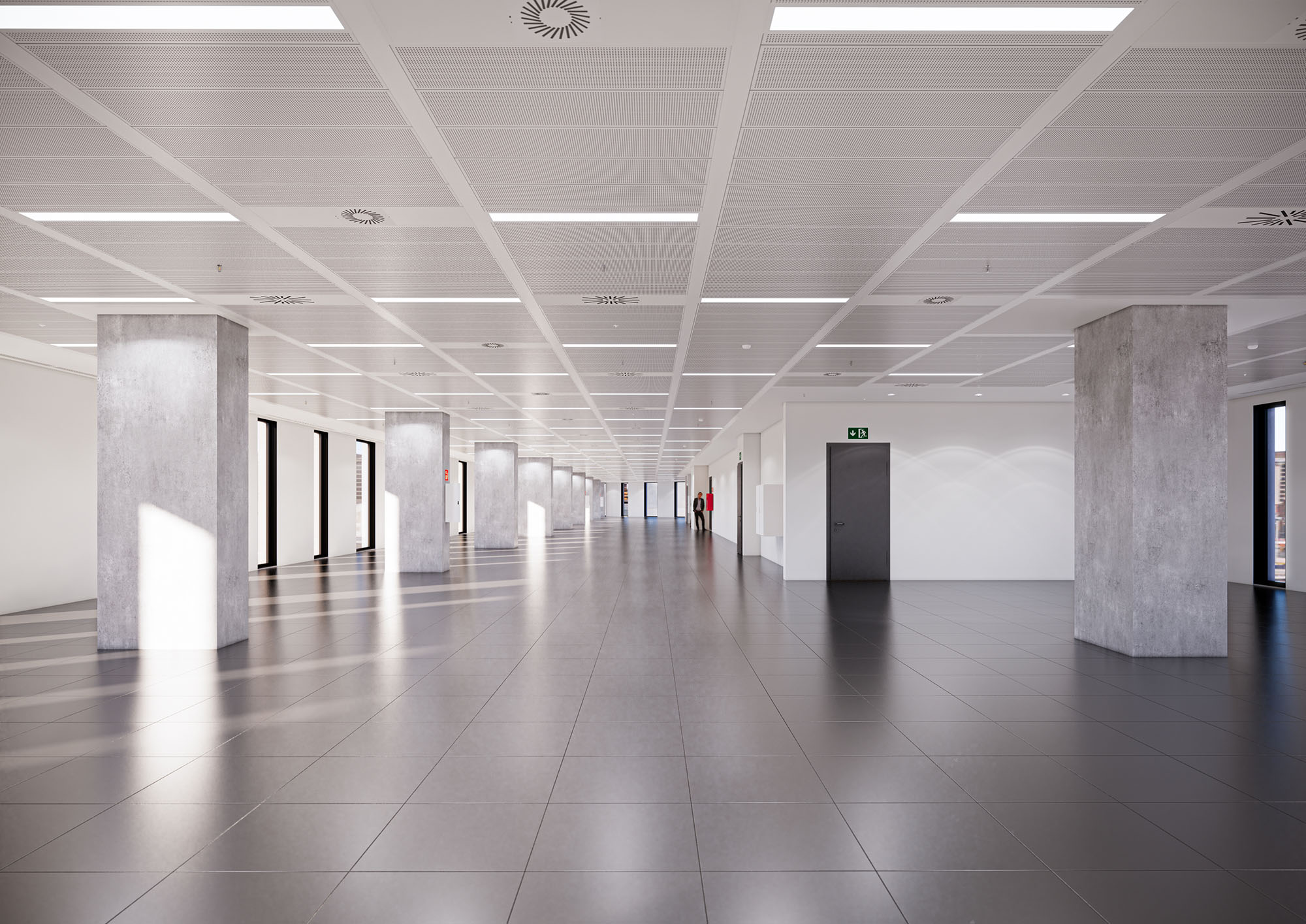
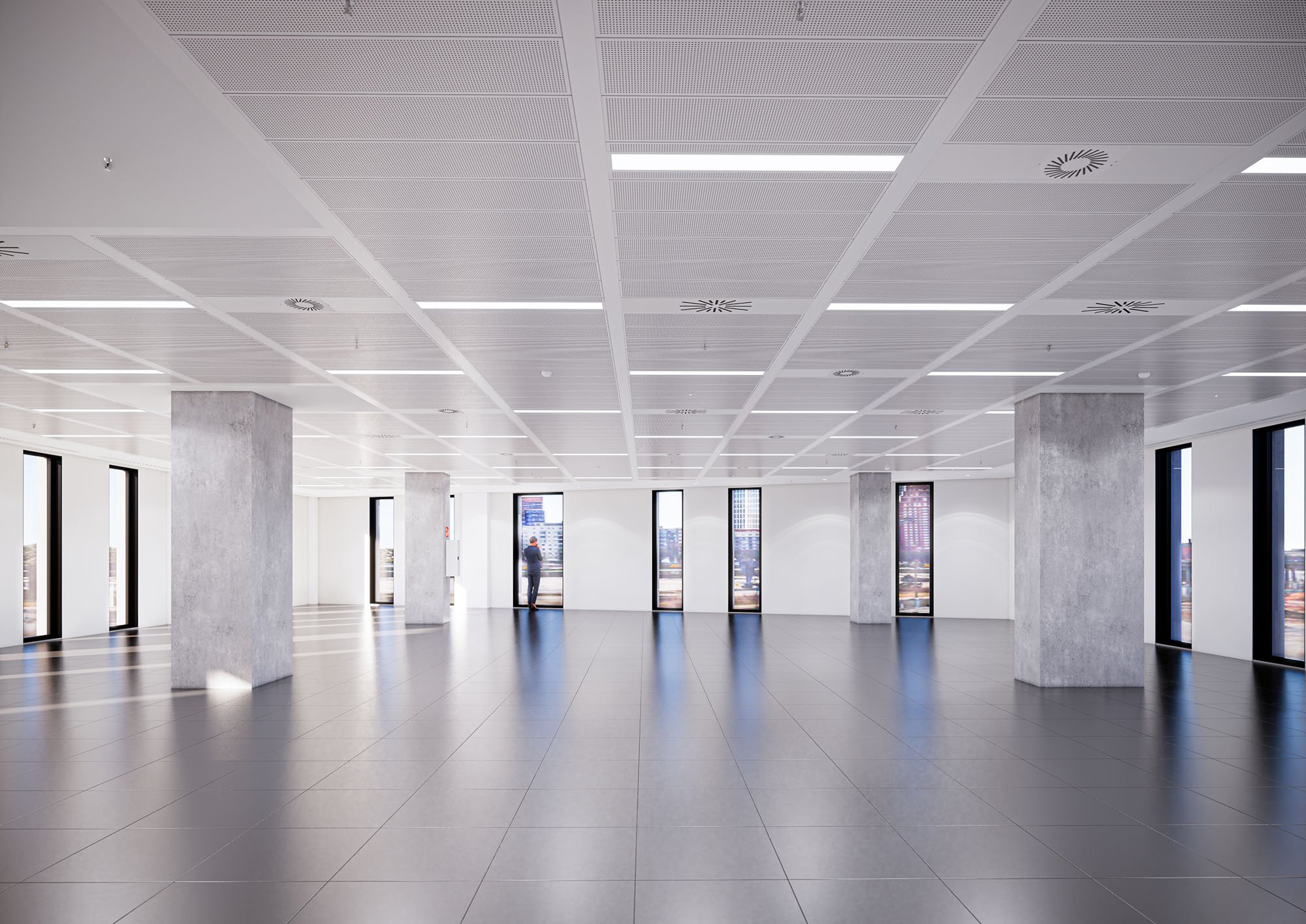
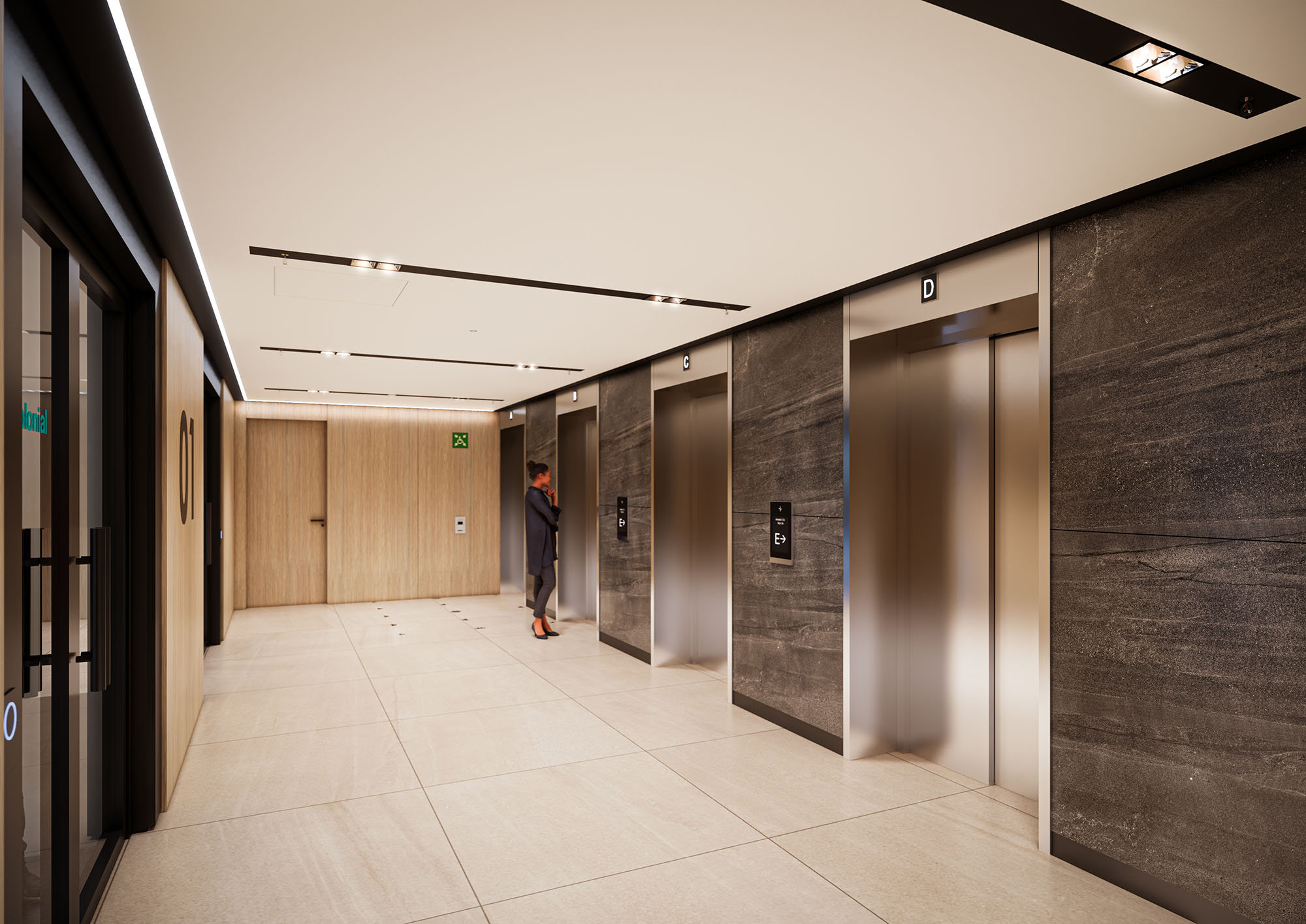
The upper floors are designed as open-plan plates with a highly regular structural grid, which facilitates flexible partitioning and future reconfiguration of uses. Continuous ceilings with integrated linear lighting and technical grids allow an efficient distribution of HVAC, sprinklers and acoustic panels. The large perimeter glazing ensures abundant natural light and panoramic views, improving user comfort and reducing the need for artificial lighting during daytime hours.
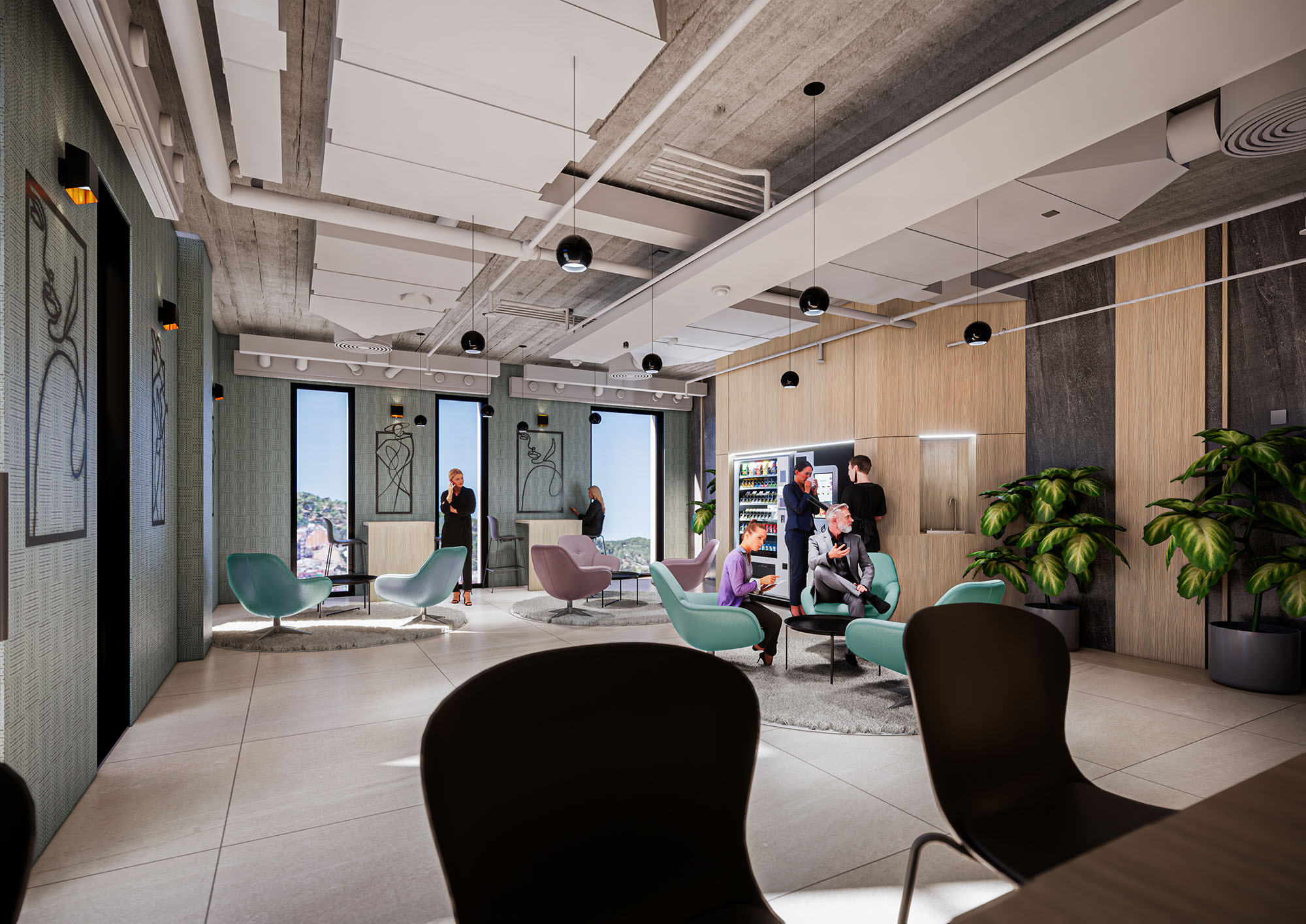
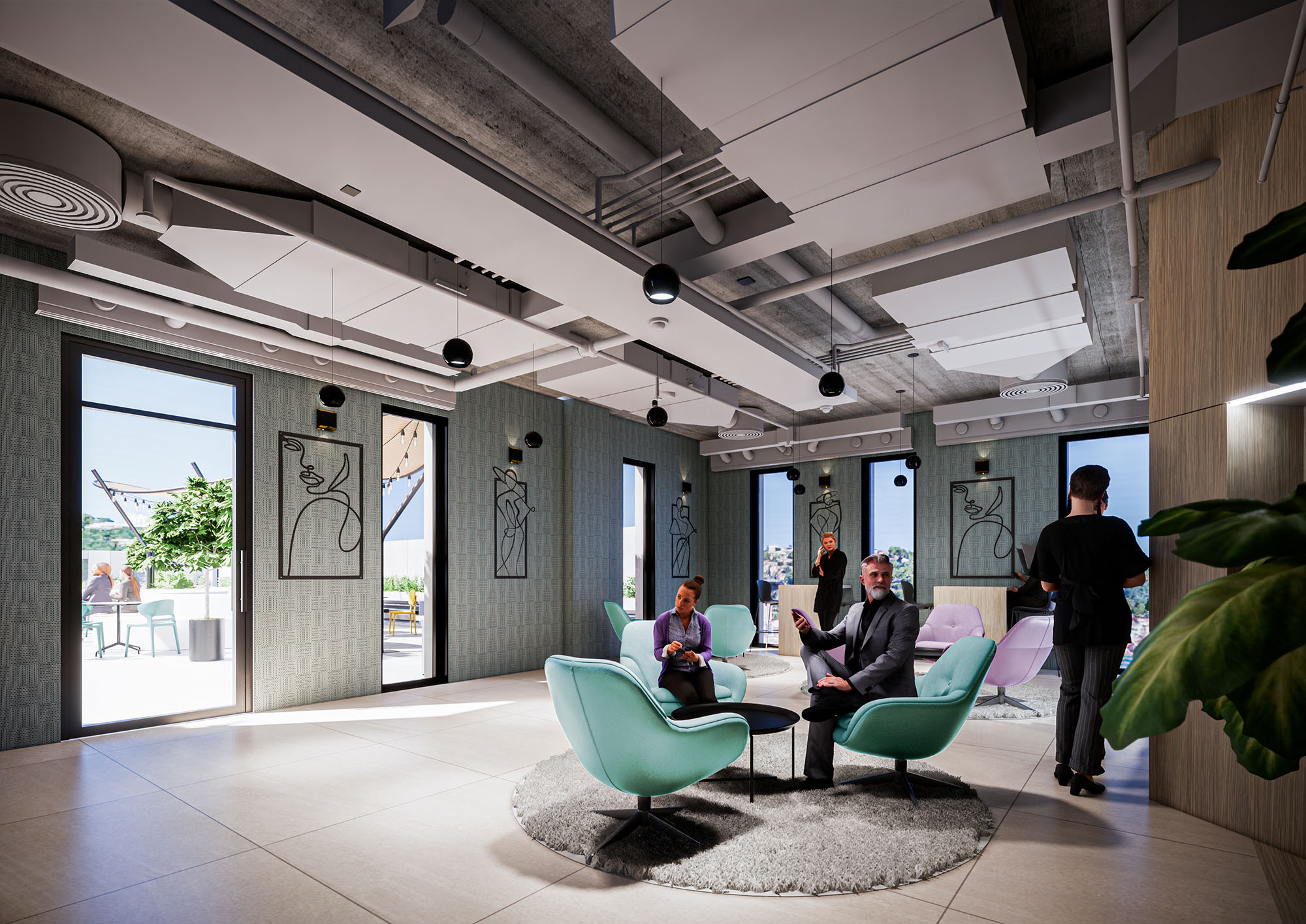
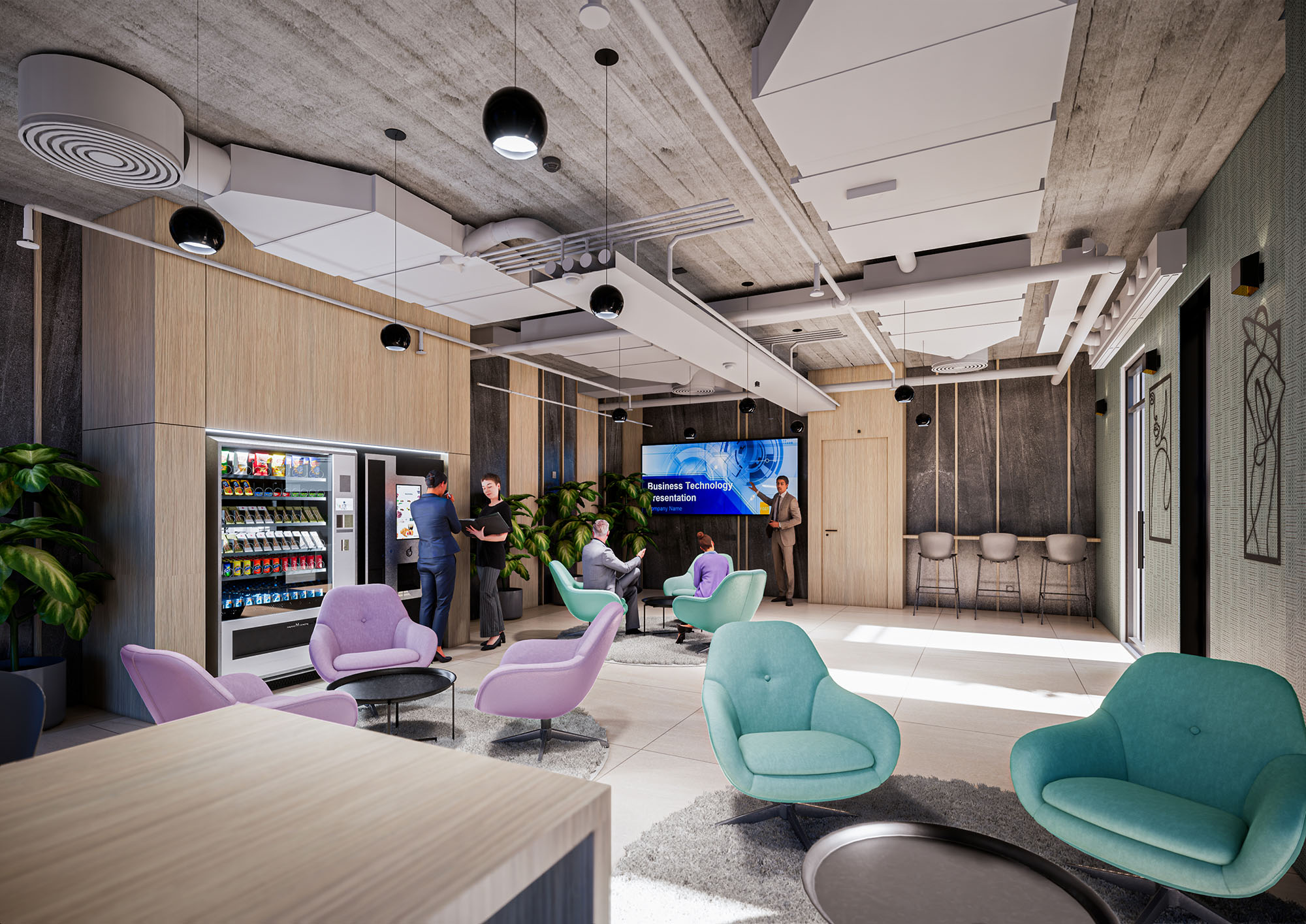
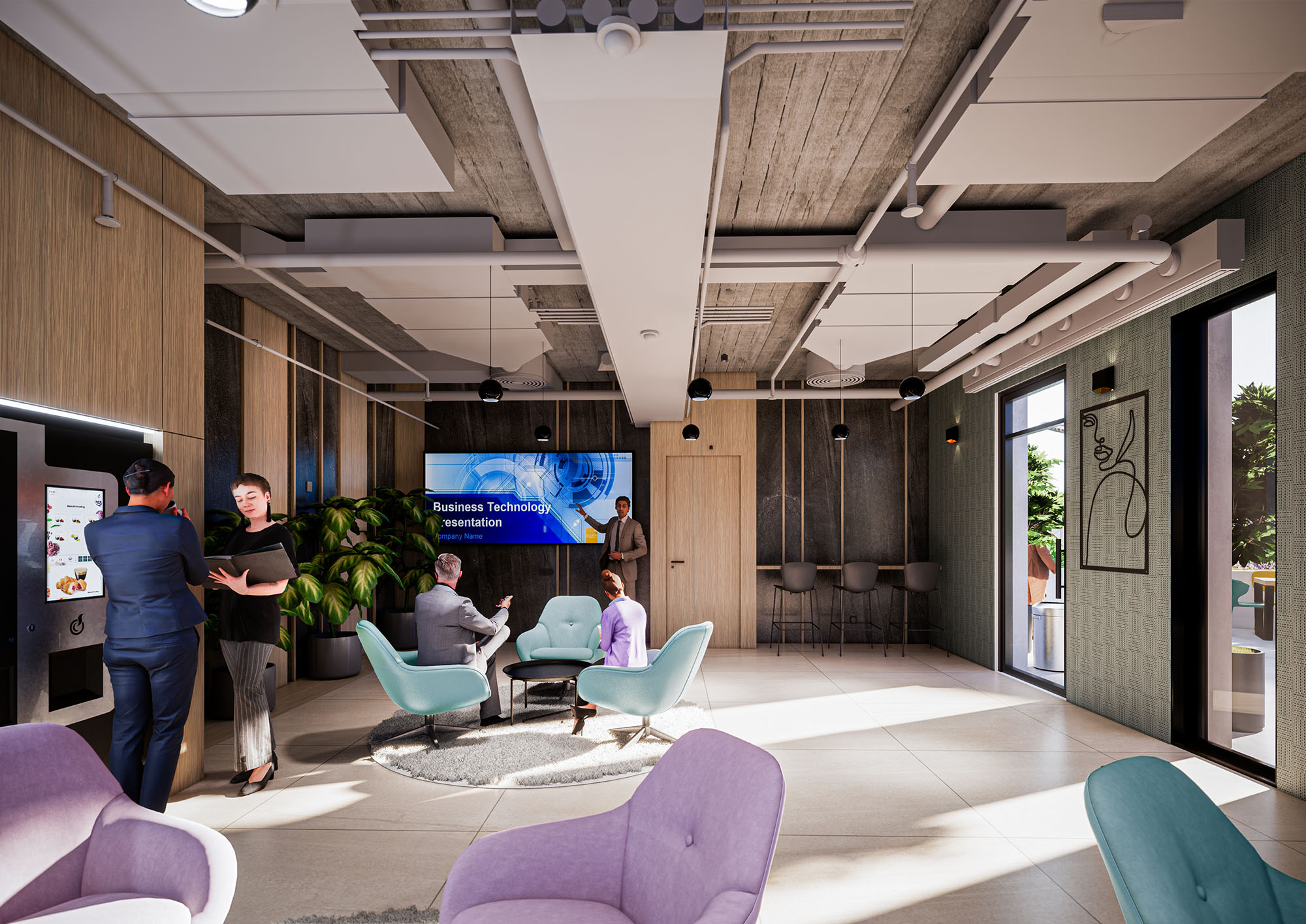
Common areas and collaboration hubs are located near the façades and vertical cores, promoting chance encounters and interdisciplinary exchanges. Finishes in these zones become more informal, incorporating visible installations, textured ceilings and varied seating typologies that support agile work, short meetings and relaxed breaks within the same floor.
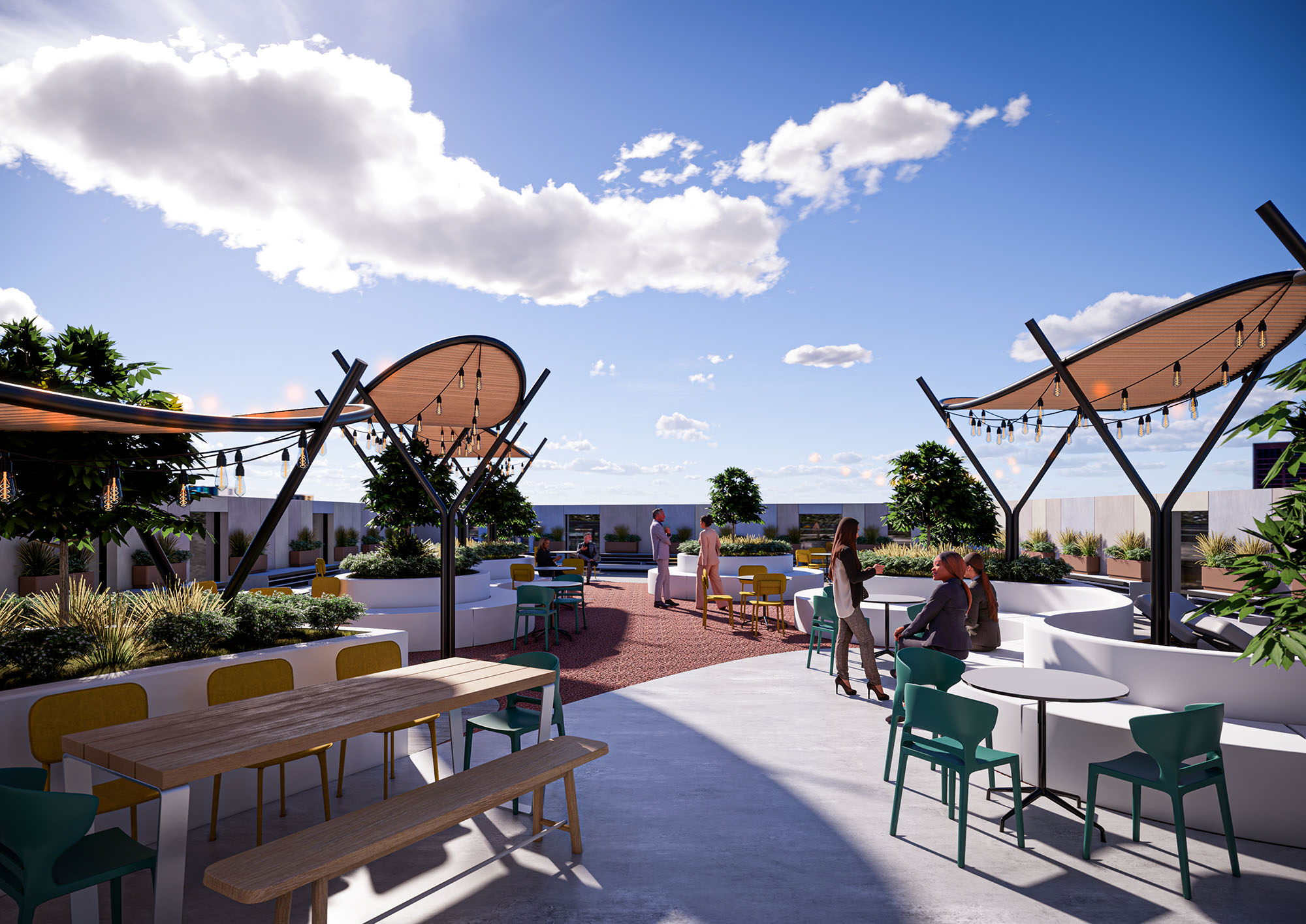
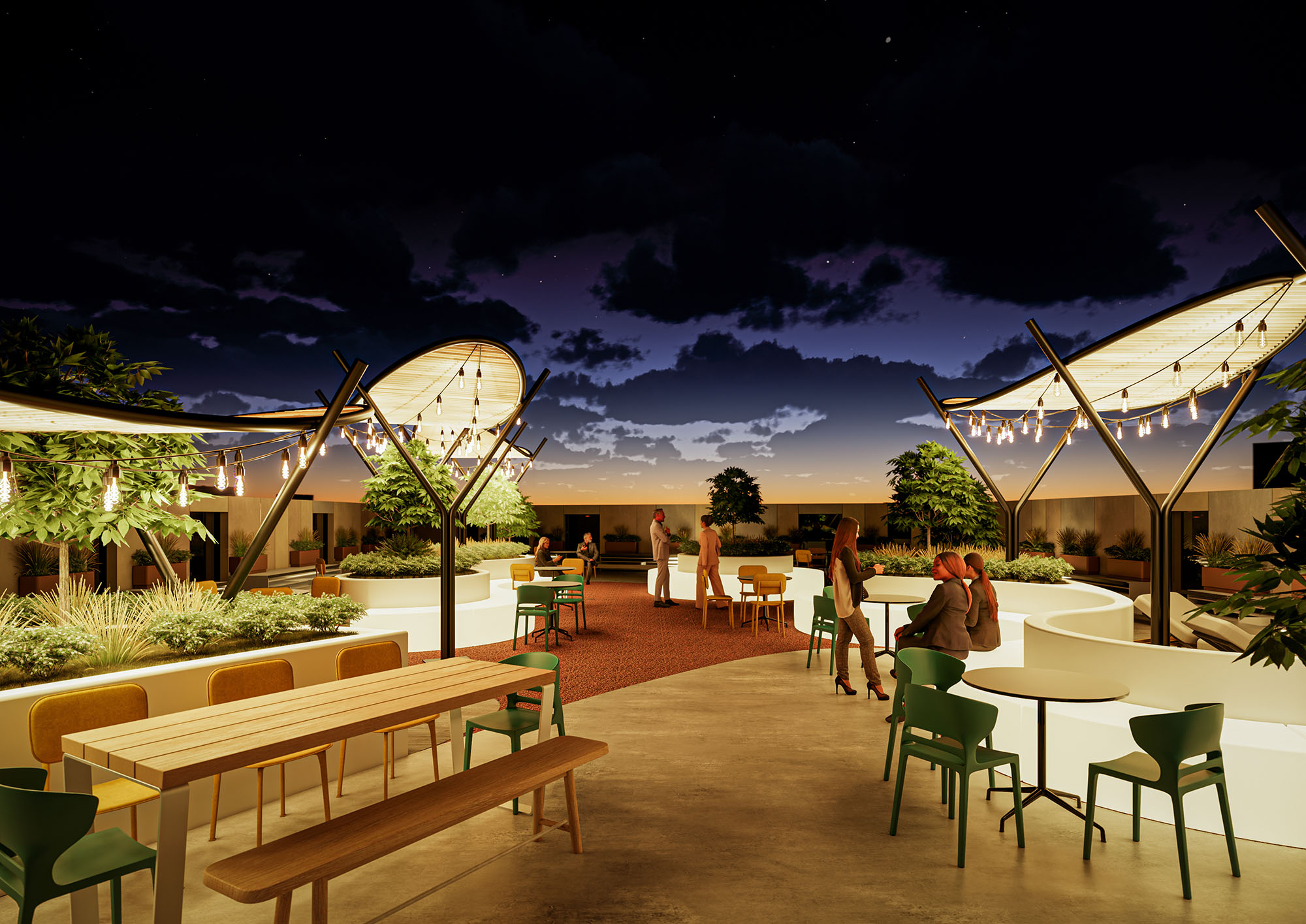
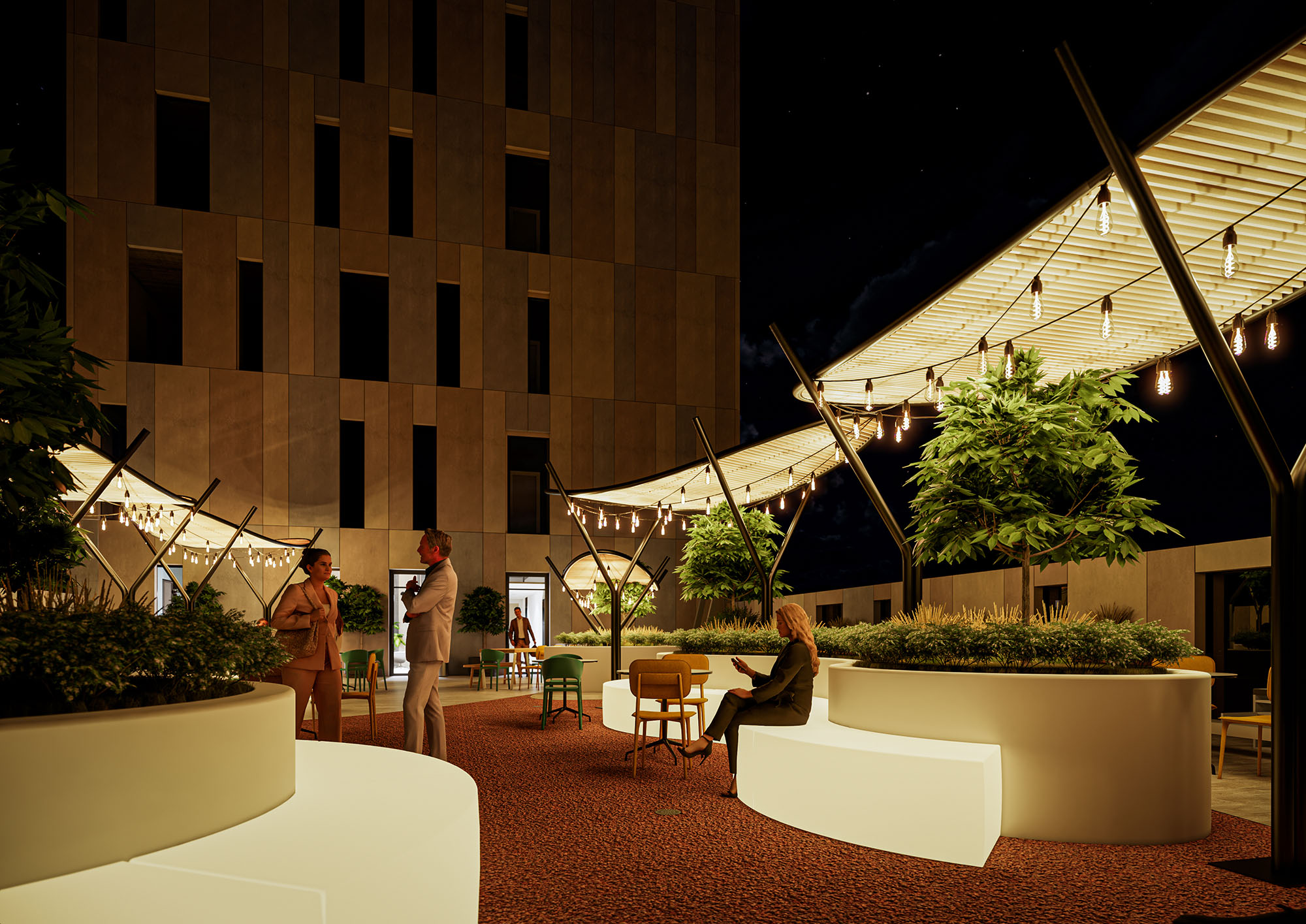
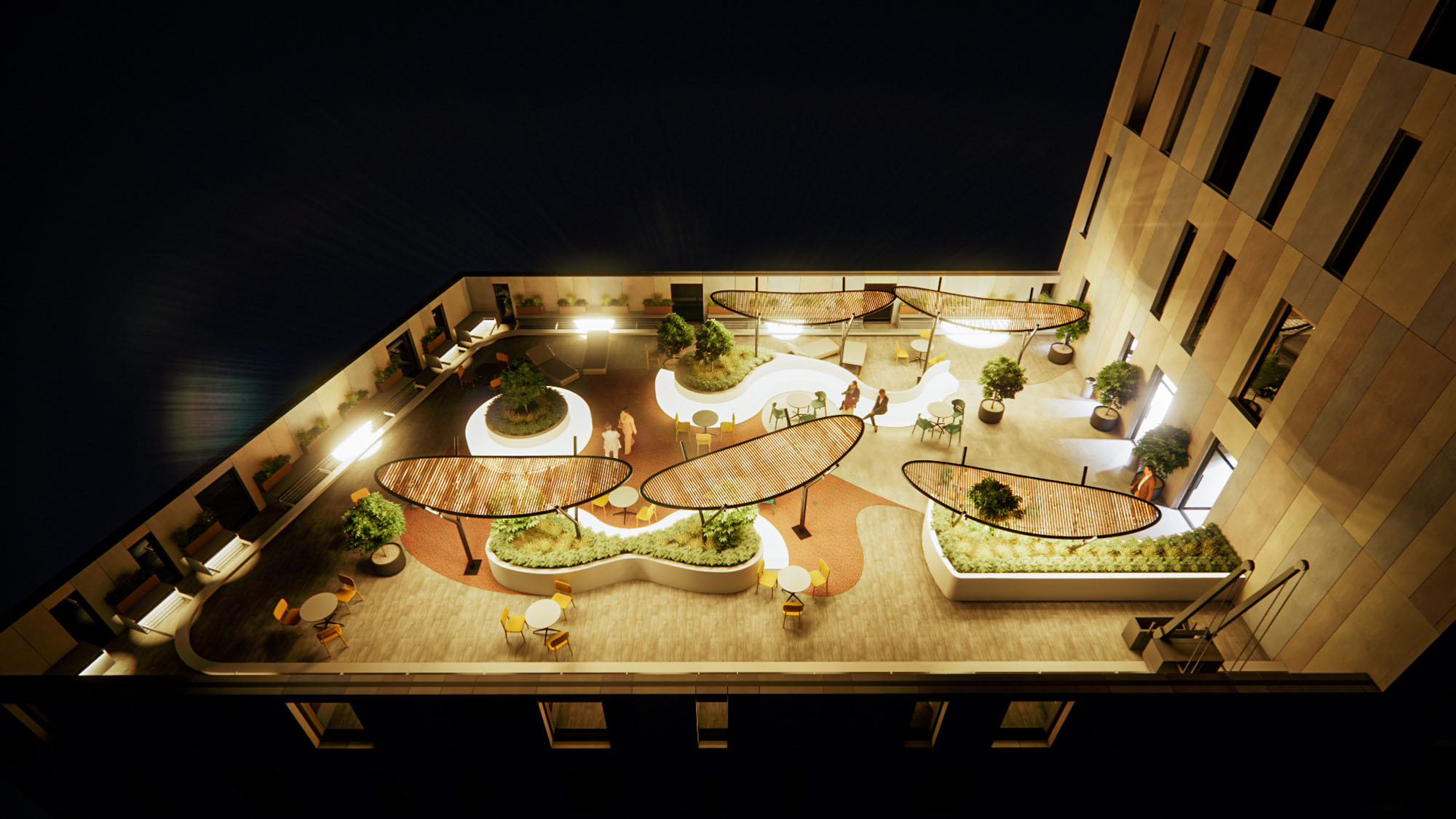
The project prioritizes durable and low-maintenance materials, such as ceramic or composite cladding on the façade, high-resistance flooring and FSC-certified wood for interior elements. The strategic integration of greenery in the access and interior courtyard improves microclimatic conditions, favors air quality and provides visual relief in a dense urban environment. The biophilic resources, together with the generous ceiling heights, contribute to psychological comfort and occupant well-being.
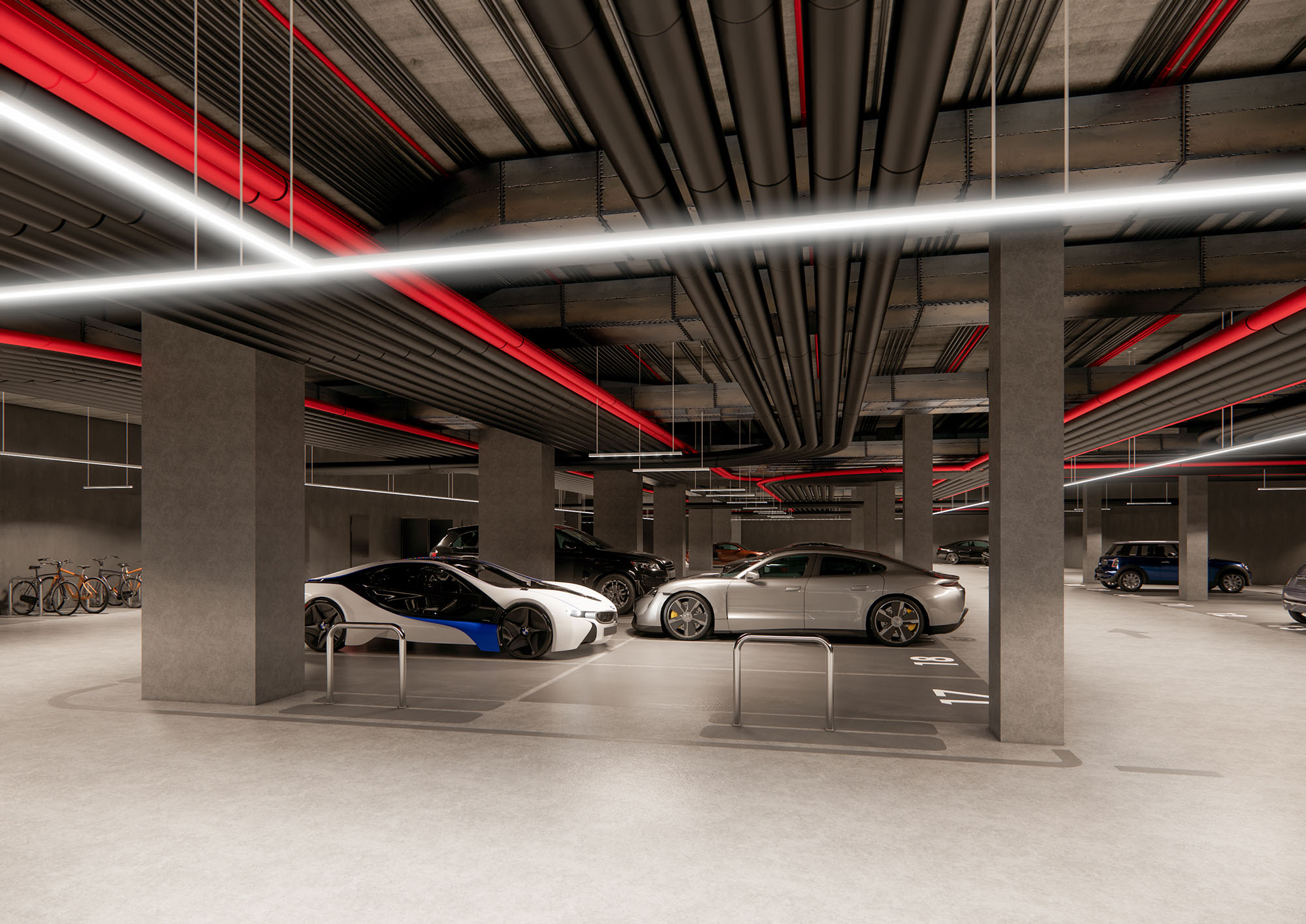
From an environmental standpoint, the building envelope is optimized to control solar gain, while the deep plan is compensated by atriums and transparent partitions that favor daylight penetration. LED lighting with presence and daylight sensors, efficient HVAC systems and the possibility of natural ventilation in certain areas help reduce energy consumption. The design also contemplates bicycle parking and facilities to encourage sustainable mobility, reinforcing the building’s commitment to a responsible and contemporary corporate architecture.


The D197 project redefines a corporate building in Barcelona as an open, permeable and contemporary workplace. The design concept is based on three key ideas: visibility towards the city, fluidity of circulation and incorporation of biophilic elements as a generator of well-being. The access, lobby and workspaces are conceived as a continuous spatial sequence where reception, informal meeting and circulation overlap, dissolving the traditional thresholds of a corporate building.
The architecture seeks a sober and timeless image, while the interior design introduces warmth and material richness. Neutral envelopes act as a backdrop for sculptural elements such as the curved reception desk, the vertical wooden slats and the large luminous oculus, which become identity milestones of the project and articulate the user experience from the street to the workspace.
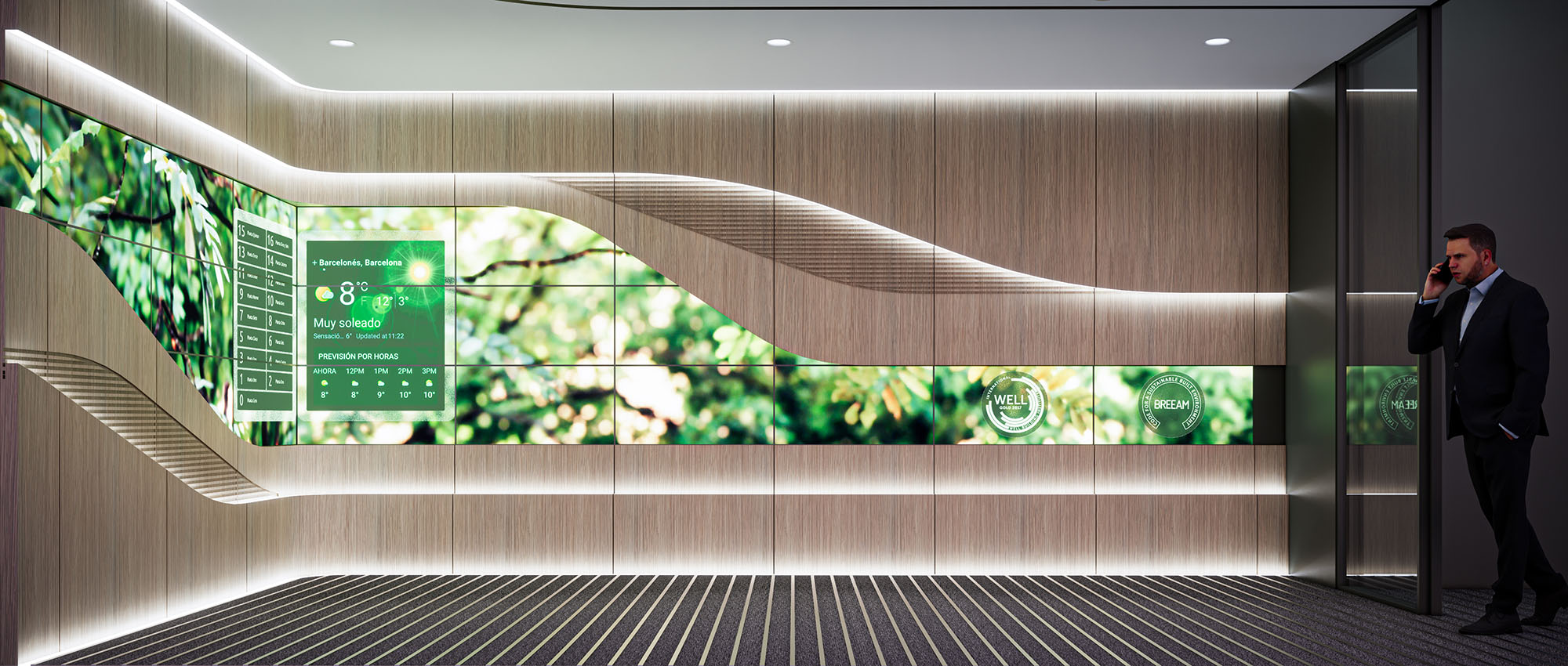
The entrance on Diagonal is configured as a deep, illuminated porch that acts as a transition between the public sidewalk and the interior lobby. A generous canopy of diffuse light emphasizes the access and improves nighttime safety, while the clear and legible signage “Diagonal 197” strengthens the urban identity of the building. Large transparent panes visually connect the interior green wall with the exterior, projecting the image of an active and open ground floor.
The façade of vertical stone or composite panels provides rhythm and scale, aligning with the avenue’s corporate context. The ground floor setback generates a semi-public filter space where pedestrians and cyclists coexist, favoring soft mobility and encouraging access by bicycle, in line with sustainable mobility strategies in Barcelona.
The lobby is conceived as a large, flexible and representative space. A suspended circular oculus integrates a digital or backlit image of tree canopies, bringing an abstract fragment of nature to the interior and reinforcing biophilic design. This element, combined with indirect perimeter lighting, produces a calm and homogeneous illumination suitable for reception and waiting uses.
The reception desk is a continuous sculptural volume formed by horizontal wooden slats, whose sinuous geometry accompanies the main circulation and softens the perception of scale. Behind it, a screen of vertical slats filters the view towards the courtyard and offers a sense of depth without losing visual continuity. The material palette in the lobby alternates warm wood, exposed concrete and neutral surfaces, generating a balanced dialogue between corporate sobriety and domestic comfort.
The upper floors are designed as open-plan plates with a highly regular structural grid, which facilitates flexible partitioning and future reconfiguration of uses. Continuous ceilings with integrated linear lighting and technical grids allow an efficient distribution of HVAC, sprinklers and acoustic panels. The large perimeter glazing ensures abundant natural light and panoramic views, improving user comfort and reducing the need for artificial lighting during daytime hours.
Common areas and collaboration hubs are located near the façades and vertical cores, promoting chance encounters and interdisciplinary exchanges. Finishes in these zones become more informal, incorporating visible installations, textured ceilings and varied seating typologies that support agile work, short meetings and relaxed breaks within the same floor.
The project prioritizes durable and low-maintenance materials, such as ceramic or composite cladding on the façade, high-resistance flooring and FSC-certified wood for interior elements. The strategic integration of greenery in the access and interior courtyard improves microclimatic conditions, favors air quality and provides visual relief in a dense urban environment. The biophilic resources, together with the generous ceiling heights, contribute to psychological comfort and occupant well-being.
From an environmental standpoint, the building envelope is optimized to control solar gain, while the deep plan is compensated by atriums and transparent partitions that favor daylight penetration. LED lighting with presence and daylight sensors, efficient HVAC systems and the possibility of natural ventilation in certain areas help reduce energy consumption. The design also contemplates bicycle parking and facilities to encourage sustainable mobility, reinforcing the building’s commitment to a responsible and contemporary corporate architecture.


Our offices are located in Barcelona, Cancún, Chicago and Santo Domingo, but thanks to technology we can do projects on all over the world.
Barcelona
Bac de Roda 136
08020, Barcelona
Spain
Madrid
Av. de Buendía 11
19005 Guadalajara (Madrid)
Spain
Chicago
373 Hazel Ave, Apt A1
60022, Glencoe, Illinois
United States