

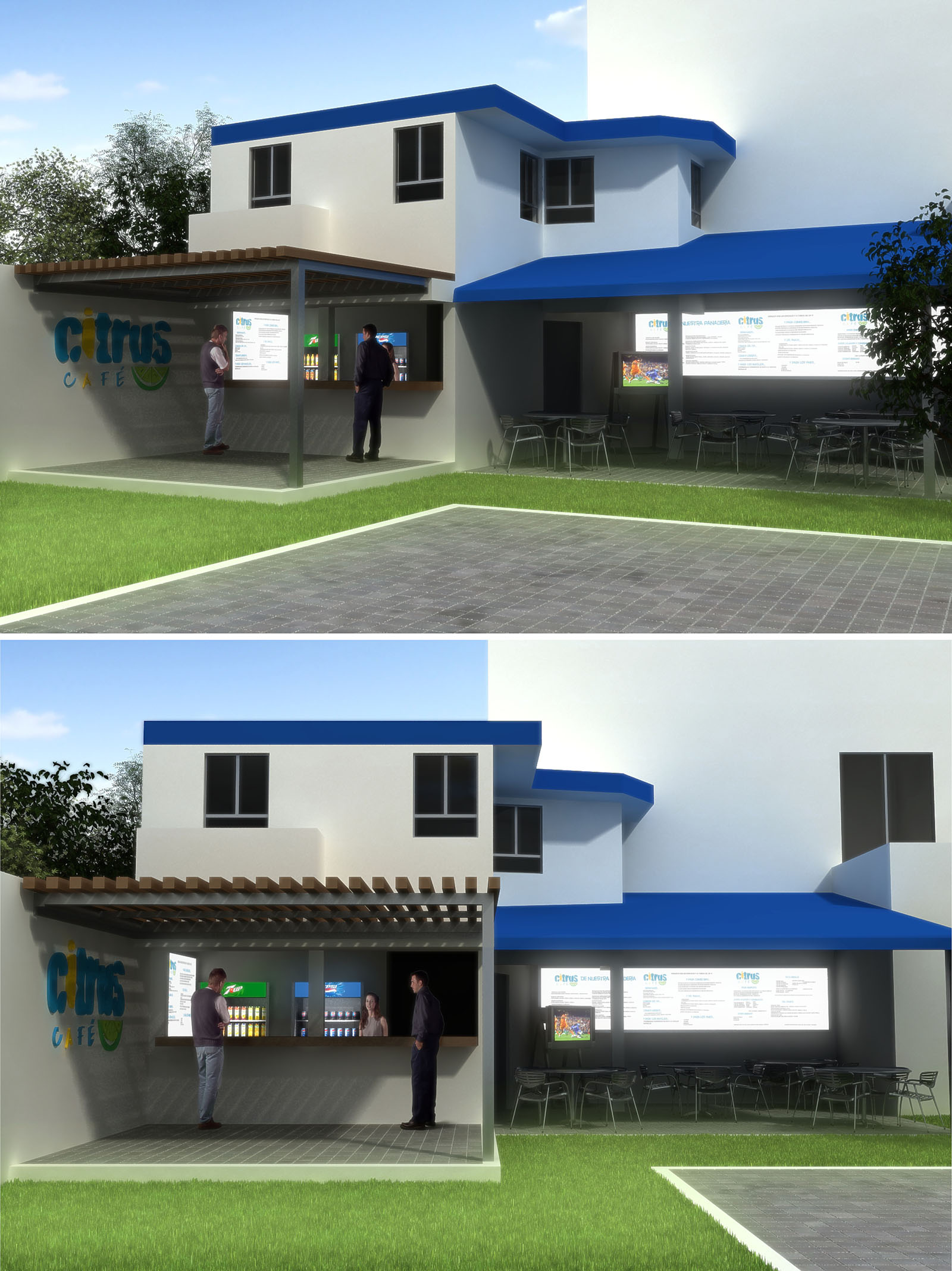
Citrus Café UNID is conceived as a fresh and casual campus meeting point, where a compact service core opens fluidly to the exterior. The architectural language is clean and geometric, using simple volumes in white with vibrant blue accents to echo the coastal character of Cancún while reinforcing the café’s youthful brand identity. The intervention focuses on the ground floor, attaching a light, open pavilion to the existing building to create a shaded transition between interior and exterior.
The project prioritizes legibility and user orientation: the counter, logo wall and menu boards are clearly visible from the main circulation axes, inviting spontaneous use by students and staff. The overall composition frames a semi‑outdoor plaza that operates as an informal social hub, blurring the boundary between café, campus and garden.
The layout is organized around a linear serving counter that functions as the project’s spine. Customers approach from the lawn and paved walkway, read the vertical menu near the logo wall, move along the counter to place and collect orders, and then flow naturally towards the covered seating area or the open garden. This sequential arrangement minimizes cross‑traffic and simplifies service logistics.
The existing building provides the solid background mass, while the new pavilion projects forward as a lightweight porch structure. The covered terrace to the right extends the café into an outdoor dining room with visual continuity to the service area. Door and window openings at ground level maintain direct connections to interior back‑of‑house and storage spaces, ensuring efficient operation with minimal circulation overlap between staff and users.
The primary envelope is resolved in painted masonry, chosen for durability and ease of maintenance in a humid, coastal climate. Smooth white walls reflect sunlight, reducing thermal gain, while the intense blue fascia lines emphasize the horizontal planes of the roofs and visually unify new and existing volumes.
The pavilion roof is supported by a light steel structure, expressed through slender columns and beams that allow maximum transparency. A pergola of closely spaced wooden or wood‑look slats creates a rhythmic soffit, generating dappled shade at the counter zone. Floor finishes in the service zone employ non‑slip ceramic or concrete tiles, resistant to heavy traffic and easy to clean, while the surrounding lawn softens the edges of the paved areas and anchors the café within the campus landscape.
The interior experience is intentionally simple and functional, allowing the brand graphics of Citrus Café to become the main visual focus. The logo wall at the left of the pavilion acts as a landmark, combining large‑scale signage with a neutral background to enhance color contrast and visibility. Behind the counter, linear refrigerators and illuminated menu bands organize the product display in a clear, modular system.
The adjacent seating area is furnished with lightweight metal and plastic chairs and tables, suitable for outdoor use and easy rearrangement. Lighting is integrated into the pergola and under the blue canopy to maintain comfortable brightness at night while highlighting the serving front and menu boards, reinforcing the café’s identity after dark.
In response to Cancún’s warm, humid climate, the design leverages passive strategies to reduce energy demand. The semi‑open pavilion eliminates the need for mechanical cooling in the main customer zone, relying on natural cross‑ventilation and shaded surfaces to maintain comfort. The pergola and deep blue canopy generate protective overhangs that minimize direct solar incidence on glazing and occupied areas.
Light exterior colors and the extensive use of outdoor seating decrease reliance on artificial lighting and air conditioning, particularly during daytime. The clear separation between conditioned interior support spaces and naturally ventilated customer areas allows targeted, efficient HVAC use. The project also anticipates the integration of LED lighting, low‑flow plumbing fixtures and, where feasible, the collection of roof runoff for landscape irrigation, promoting responsible resource consumption within the university campus context.
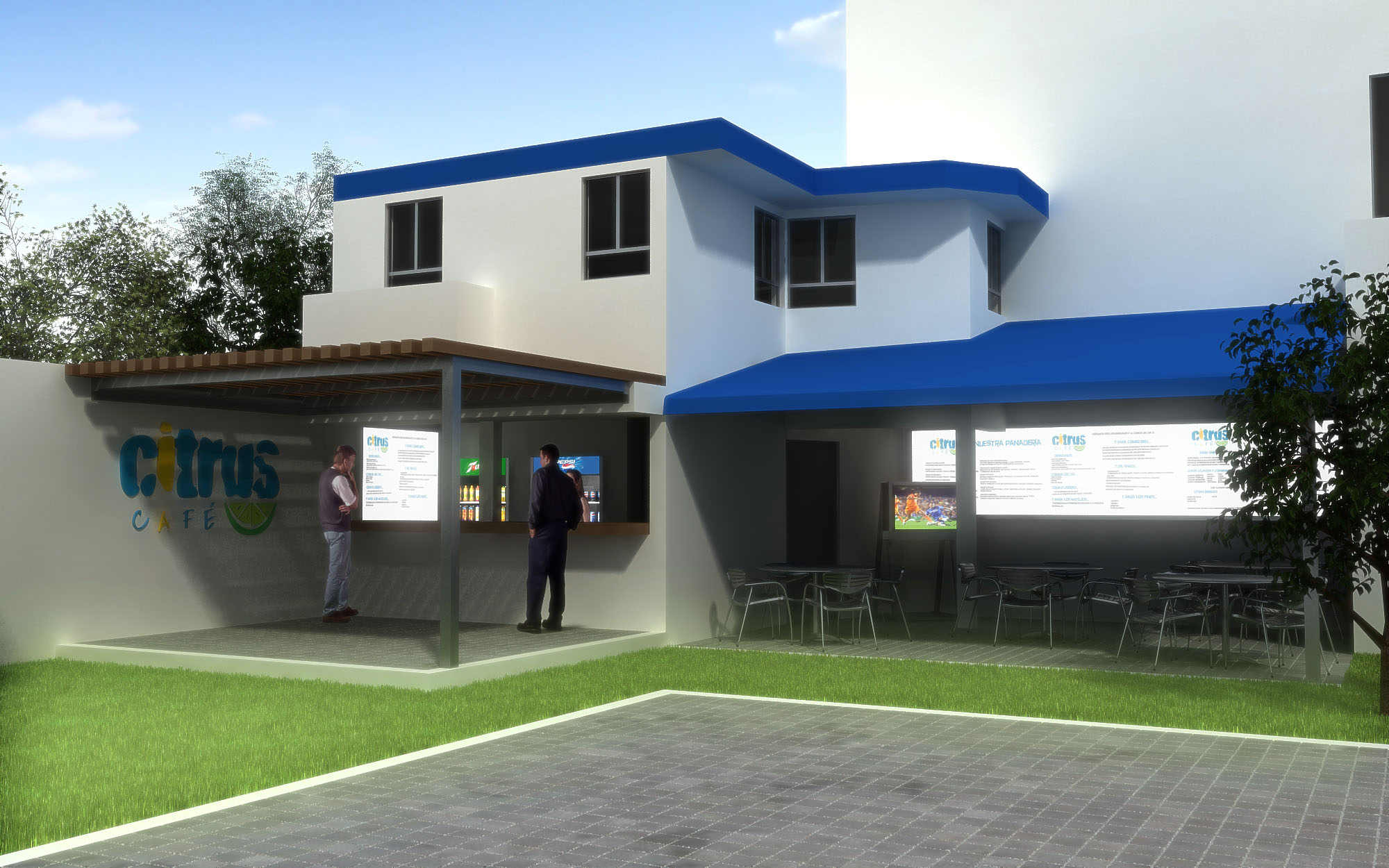
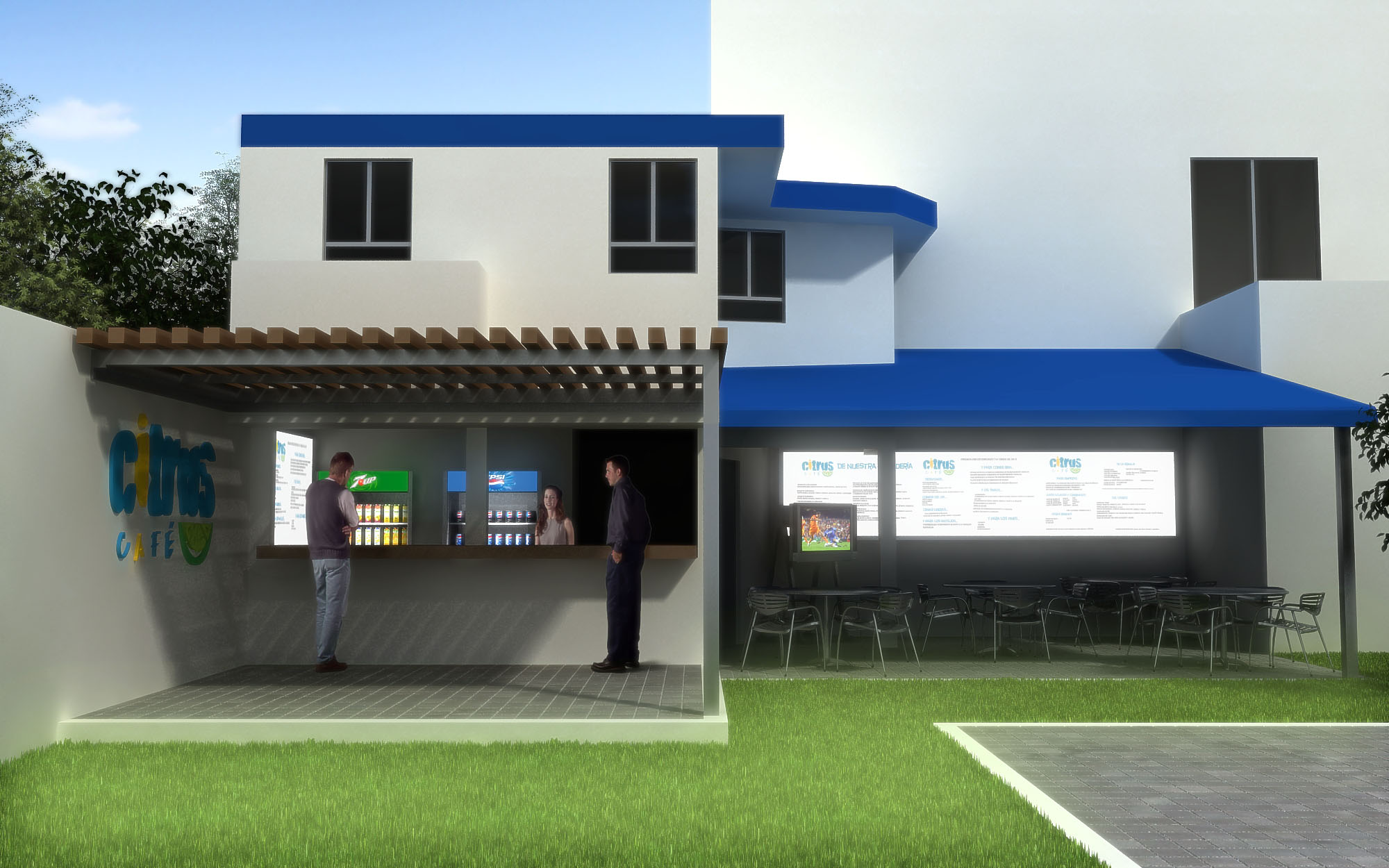
Citrus Café UNID is conceived as a fresh and casual campus meeting point, where a compact service core opens fluidly to the exterior. The architectural language is clean and geometric, using simple volumes in white with vibrant blue accents to echo the coastal character of Cancún while reinforcing the café’s youthful brand identity. The intervention focuses on the ground floor, attaching a light, open pavilion to the existing building to create a shaded transition between interior and exterior.
The project prioritizes legibility and user orientation: the counter, logo wall and menu boards are clearly visible from the main circulation axes, inviting spontaneous use by students and staff. The overall composition frames a semi‑outdoor plaza that operates as an informal social hub, blurring the boundary between café, campus and garden.
The layout is organized around a linear serving counter that functions as the project’s spine. Customers approach from the lawn and paved walkway, read the vertical menu near the logo wall, move along the counter to place and collect orders, and then flow naturally towards the covered seating area or the open garden. This sequential arrangement minimizes cross‑traffic and simplifies service logistics.
The existing building provides the solid background mass, while the new pavilion projects forward as a lightweight porch structure. The covered terrace to the right extends the café into an outdoor dining room with visual continuity to the service area. Door and window openings at ground level maintain direct connections to interior back‑of‑house and storage spaces, ensuring efficient operation with minimal circulation overlap between staff and users.
The primary envelope is resolved in painted masonry, chosen for durability and ease of maintenance in a humid, coastal climate. Smooth white walls reflect sunlight, reducing thermal gain, while the intense blue fascia lines emphasize the horizontal planes of the roofs and visually unify new and existing volumes.
The pavilion roof is supported by a light steel structure, expressed through slender columns and beams that allow maximum transparency. A pergola of closely spaced wooden or wood‑look slats creates a rhythmic soffit, generating dappled shade at the counter zone. Floor finishes in the service zone employ non‑slip ceramic or concrete tiles, resistant to heavy traffic and easy to clean, while the surrounding lawn softens the edges of the paved areas and anchors the café within the campus landscape.
The interior experience is intentionally simple and functional, allowing the brand graphics of Citrus Café to become the main visual focus. The logo wall at the left of the pavilion acts as a landmark, combining large‑scale signage with a neutral background to enhance color contrast and visibility. Behind the counter, linear refrigerators and illuminated menu bands organize the product display in a clear, modular system.
The adjacent seating area is furnished with lightweight metal and plastic chairs and tables, suitable for outdoor use and easy rearrangement. Lighting is integrated into the pergola and under the blue canopy to maintain comfortable brightness at night while highlighting the serving front and menu boards, reinforcing the café’s identity after dark.
In response to Cancún’s warm, humid climate, the design leverages passive strategies to reduce energy demand. The semi‑open pavilion eliminates the need for mechanical cooling in the main customer zone, relying on natural cross‑ventilation and shaded surfaces to maintain comfort. The pergola and deep blue canopy generate protective overhangs that minimize direct solar incidence on glazing and occupied areas.
Light exterior colors and the extensive use of outdoor seating decrease reliance on artificial lighting and air conditioning, particularly during daytime. The clear separation between conditioned interior support spaces and naturally ventilated customer areas allows targeted, efficient HVAC use. The project also anticipates the integration of LED lighting, low‑flow plumbing fixtures and, where feasible, the collection of roof runoff for landscape irrigation, promoting responsible resource consumption within the university campus context.


Our offices are located in Barcelona, Cancún, Chicago and Santo Domingo, but thanks to technology we can do projects on all over the world.
Barcelona
Bac de Roda 136
08020, Barcelona
Spain
Madrid
Av. de Buendía 11
19005 Guadalajara (Madrid)
Spain
Chicago
373 Hazel Ave, Apt A1
60022, Glencoe, Illinois
United States