

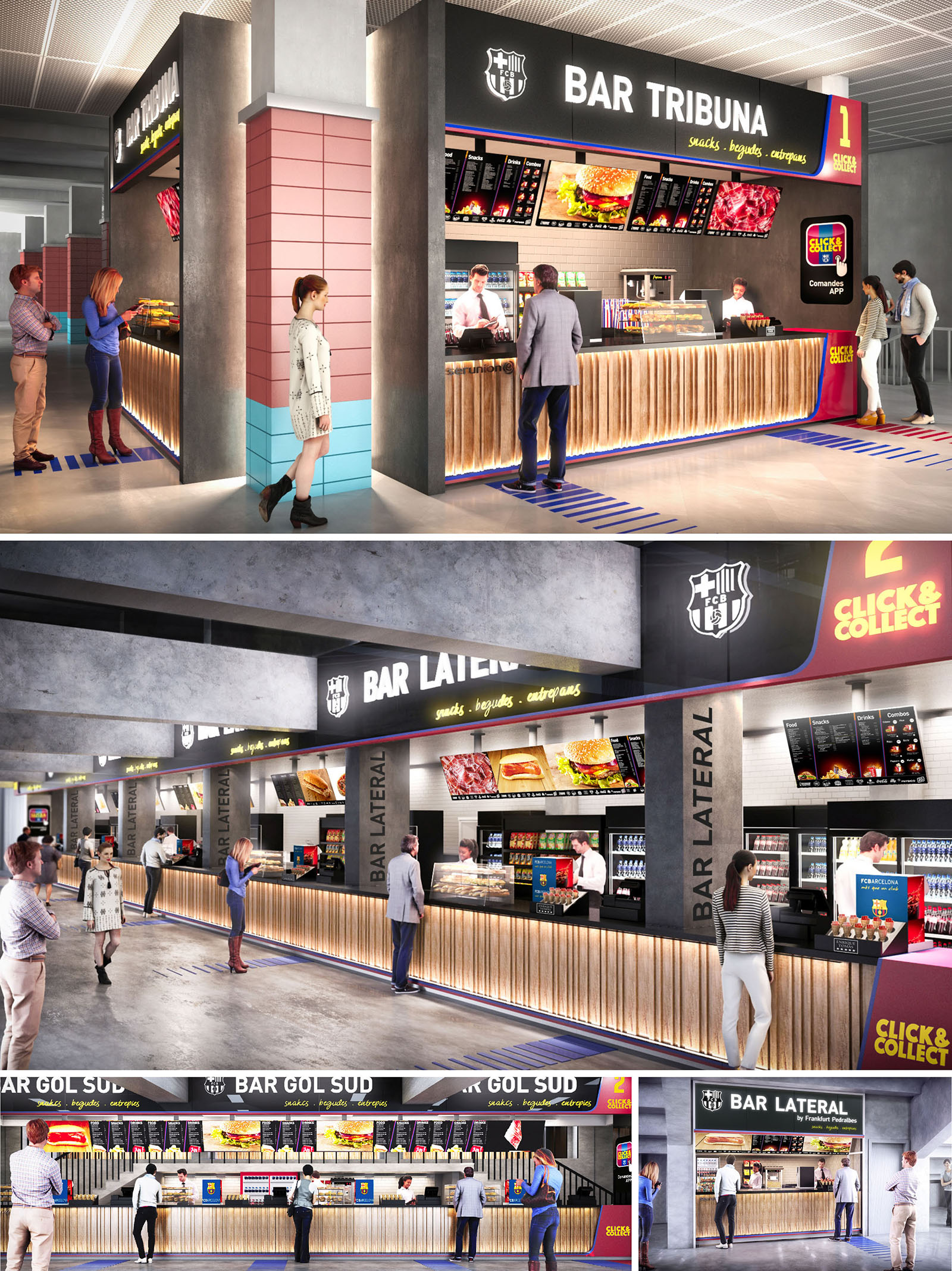
The kiosk system at Camp Nou is conceived as a continuous gastronomic boulevard that integrates with the stadium’s circulation areas, transforming waiting and transit spaces into an active food and beverage experience. The design emphasizes clarity of use, speed of service, and strong brand presence, aligning the match-day ritual with a contemporary hospitality environment. Each bar—Tribuna, Lateral and Gol Sud—is visually unified yet differentiated through graphic and chromatic cues, creating a legible wayfinding system inside the concourse.
The architecture works as a robust infrastructural backdrop while the frontal planes, signage, and lighting provide the emotional and commercial layer. The kiosks are treated as elongated urban façades: a rhythm of vertical slats, structural piers, and illuminated bands organizes the long counters into recognizable modules, ensuring that the experience remains coherent even at peak crowd densities.
The layout prioritizes linearity and visibility. Long continuous counters run parallel to the circulation corridors, allowing multiple service points and minimizing cross-traffic. Customers queue along clearly defined lanes on the floor, while the open counter front enables intuitive reading of product offerings and available pick-up areas. Structural columns are absorbed into the composition of the kiosk fronts, becoming wayfinding anchors instead of obstacles.
Each kiosk integrates dedicated zones for ordering, payment, and “click & collect” digital pick-up, reducing congestion and supporting omnichannel service. The counters are set at a height that balances ergonomic comfort for both staff and users, with generous overhangs to protect equipment and merchandise. Back-of-house storage and refrigeration are compact and aligned along the rear wall, ensuring that staff workflow is short, direct, and efficient.
The material palette contrasts the raw character of the existing stadium structure with warm, tactile finishes at the customer interface. Exposed concrete beams and columns frame a front layer of vertical wooden slats, whose natural tone softens the environment and provides a domestic touch in a highly infrastructural context. These slats are subtly backlit at the base, generating a floating effect and visually lightening the long counter volumes.
Ceiling lighting is uniform and technical, while accent lighting focuses on the menu boards, branding panels, and product displays. LED strips trace the lower edge of the counters and the upper cornices, reinforcing horizontality and guiding visitors along the kiosk line. The use of durable laminates, metal profiles, and easy-to-clean solid surfaces at worktops ensures resistance to intensive use and simplifies maintenance, critical in a high-traffic stadium environment.
Color is employed as a functional and emotional tool. The dominant neutral base of concrete grey and natural wood is contrasted with the club’s signature palette: deep blues, reds, and accent yellows. These colors appear in fascia bands, click & collect modules, floor graphics, and column cladding, ensuring immediate association with the club identity while aiding orientation across different bars and service areas.
Large-scale typography and illuminated logos on the fascia define each kiosk as a distinct destination, while menu boards combine imagery and clear typographic hierarchy to facilitate rapid decision-making. Floor markings in club colors organize the queues and subtly choreograph movement. The combination of architecture, environmental graphics, and digital displays turns the kiosks into immersive brand devices without compromising legibility or operational clarity.
The kiosk modules are conceived as repeatable and adaptable units that can be extended or reconfigured according to event requirements. Service equipment is organized in standardized bays, allowing future technological upgrades or changes in product offering with minimal intervention on the architectural envelope. Wide, obstruction-free front zones accommodate fluctuating crowd volumes, from regular league matches to major international events.
Sustainability is supported through several strategies: the extensive use of LED lighting with dimming capabilities reduces energy consumption; durable and low-maintenance materials extend the life cycle of finishes; and the modular construction facilitates off-site fabrication and potential reuse of elements. Where possible, finishes favor certified wood products and recyclable metal components. The efficient spatial layout, which minimizes back-of-house circulation and optimizes refrigeration clustering, also contributes to lowering operational energy demand and overall environmental impact.
The kiosk system at Camp Nou is conceived as a continuous gastronomic boulevard that integrates with the stadium’s circulation areas, transforming waiting and transit spaces into an active food and beverage experience. The design emphasizes clarity of use, speed of service, and strong brand presence, aligning the match-day ritual with a contemporary hospitality environment. Each bar—Tribuna, Lateral and Gol Sud—is visually unified yet differentiated through graphic and chromatic cues, creating a legible wayfinding system inside the concourse.
The architecture works as a robust infrastructural backdrop while the frontal planes, signage, and lighting provide the emotional and commercial layer. The kiosks are treated as elongated urban façades: a rhythm of vertical slats, structural piers, and illuminated bands organizes the long counters into recognizable modules, ensuring that the experience remains coherent even at peak crowd densities.
The layout prioritizes linearity and visibility. Long continuous counters run parallel to the circulation corridors, allowing multiple service points and minimizing cross-traffic. Customers queue along clearly defined lanes on the floor, while the open counter front enables intuitive reading of product offerings and available pick-up areas. Structural columns are absorbed into the composition of the kiosk fronts, becoming wayfinding anchors instead of obstacles.
Each kiosk integrates dedicated zones for ordering, payment, and “click & collect” digital pick-up, reducing congestion and supporting omnichannel service. The counters are set at a height that balances ergonomic comfort for both staff and users, with generous overhangs to protect equipment and merchandise. Back-of-house storage and refrigeration are compact and aligned along the rear wall, ensuring that staff workflow is short, direct, and efficient.
The material palette contrasts the raw character of the existing stadium structure with warm, tactile finishes at the customer interface. Exposed concrete beams and columns frame a front layer of vertical wooden slats, whose natural tone softens the environment and provides a domestic touch in a highly infrastructural context. These slats are subtly backlit at the base, generating a floating effect and visually lightening the long counter volumes.
Ceiling lighting is uniform and technical, while accent lighting focuses on the menu boards, branding panels, and product displays. LED strips trace the lower edge of the counters and the upper cornices, reinforcing horizontality and guiding visitors along the kiosk line. The use of durable laminates, metal profiles, and easy-to-clean solid surfaces at worktops ensures resistance to intensive use and simplifies maintenance, critical in a high-traffic stadium environment.
Color is employed as a functional and emotional tool. The dominant neutral base of concrete grey and natural wood is contrasted with the club’s signature palette: deep blues, reds, and accent yellows. These colors appear in fascia bands, click & collect modules, floor graphics, and column cladding, ensuring immediate association with the club identity while aiding orientation across different bars and service areas.
Large-scale typography and illuminated logos on the fascia define each kiosk as a distinct destination, while menu boards combine imagery and clear typographic hierarchy to facilitate rapid decision-making. Floor markings in club colors organize the queues and subtly choreograph movement. The combination of architecture, environmental graphics, and digital displays turns the kiosks into immersive brand devices without compromising legibility or operational clarity.
The kiosk modules are conceived as repeatable and adaptable units that can be extended or reconfigured according to event requirements. Service equipment is organized in standardized bays, allowing future technological upgrades or changes in product offering with minimal intervention on the architectural envelope. Wide, obstruction-free front zones accommodate fluctuating crowd volumes, from regular league matches to major international events.
Sustainability is supported through several strategies: the extensive use of LED lighting with dimming capabilities reduces energy consumption; durable and low-maintenance materials extend the life cycle of finishes; and the modular construction facilitates off-site fabrication and potential reuse of elements. Where possible, finishes favor certified wood products and recyclable metal components. The efficient spatial layout, which minimizes back-of-house circulation and optimizes refrigeration clustering, also contributes to lowering operational energy demand and overall environmental impact.


Our offices are located in Barcelona, Cancún, Chicago and Santo Domingo, but thanks to technology we can do projects on all over the world.
Barcelona
Bac de Roda 136
08020, Barcelona
Spain
Madrid
Av. de Buendía 11
19005 Guadalajara (Madrid)
Spain
Chicago
373 Hazel Ave, Apt A1
60022, Glencoe, Illinois
United States