

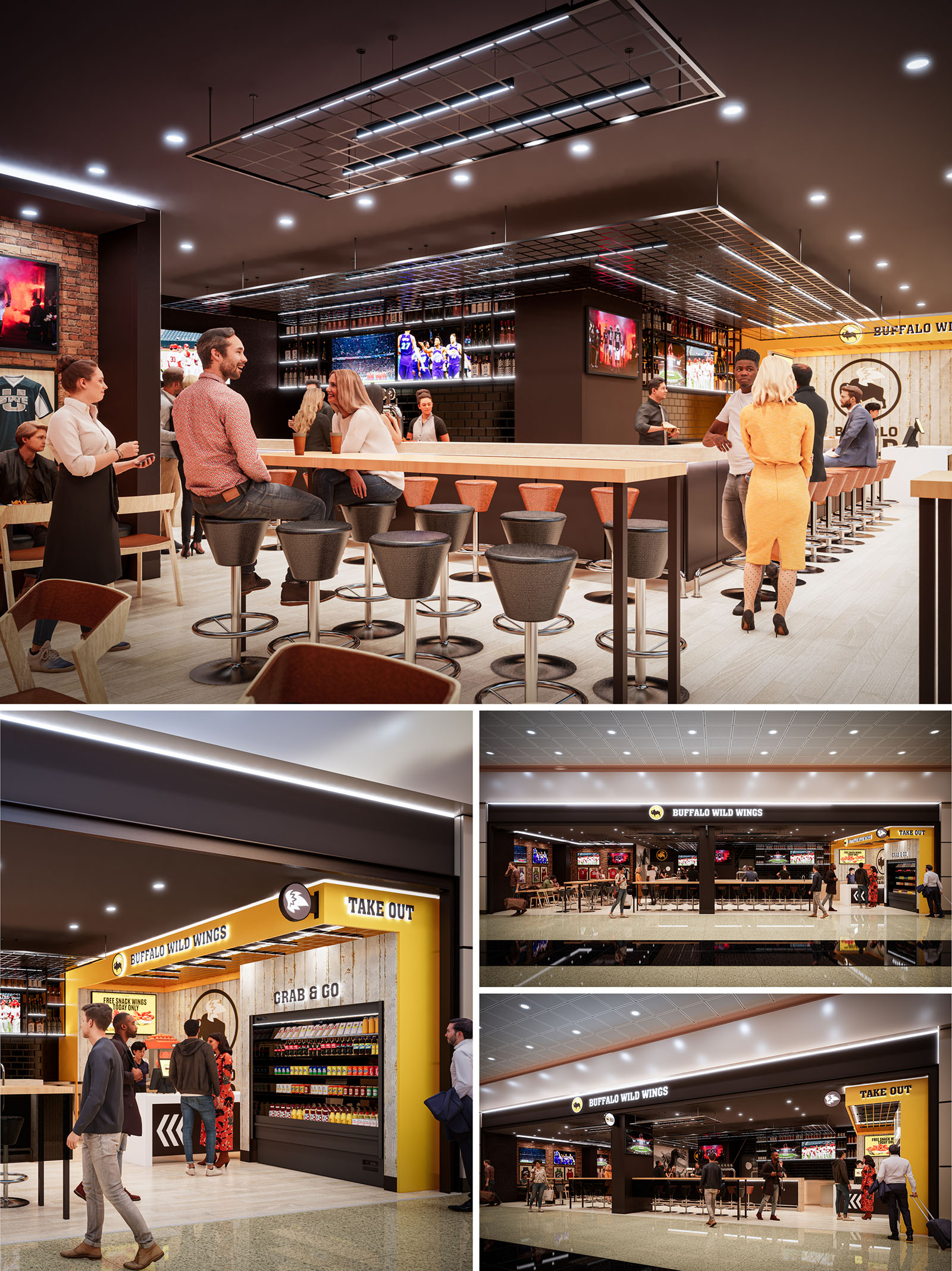
The Buffalo Wild Wings in Salt Lake City is conceived as an open, highly visible sports bar that blends the informality of a fan arena with the clarity of a contemporary retail frontage. The design creates a porous boundary between the mall concourse and the interior bar, using large structural openings and minimal glazing to visually extend the public realm into the restaurant. The concept emphasizes immersion in live sports, expressed through a panoramic arrangement of digital screens and a continuous bar core that becomes the architectural centerpiece.
The overall atmosphere combines industrial references—exposed grid ceilings, brick textures, black tile—with a warm, hospitality-driven palette. The brand’s yellow and black identity is integrated architecturally as volumetric frames, illuminated bands, and wayfinding elements rather than surface graphics alone, generating a cohesive and instantly recognizable environment.
The plan is structured around a central horseshoe bar that organizes circulation and sightlines. High stools and counter seating define the primary social zone, with peripheral tables offering more intimate dining while still maintaining direct views toward screens. This zoning ensures a gradient from active bar energy at the core to more relaxed seating toward the perimeter.
The frontage is articulated in three main programmatic bands: the main bar and dining area in the center, a take-out/“grab & go” component on one side, and an additional entry and merchandise or feature zone on the opposite side. This tripartite façade allows the concept to address both quick-service and full-service users simultaneously, optimizing throughput in a high-traffic mall context.
The material palette combines warm, light-toned timber flooring and countertops with dark metal bases and structural frames, creating a balanced contrast between hospitality and robustness. Brick cladding and black ceramic tiles add textural depth and reference the brand’s sports-bar heritage, while smooth gypsum surfaces and clean-edged millwork maintain a contemporary character.
Color is anchored by the brand yellow, strategically used as a spatial accent around the take-out portal and in linear bands along the soffits. Neutral greys, blacks, and natural wood tones dominate the interior, allowing digital screens and branded graphics to become dynamic focal points. Lighting is predominantly recessed LED downlights, complemented by linear fixtures integrated within an exposed metal grid ceiling. This grid not only organizes lighting and services but also establishes a strong visual datum that unifies the entire interior.
Toward the mall concourse, the restaurant presents a clear, horizontally articulated façade. The central open bay reveals the bar and live sports screens, functioning as an animated billboard that continually advertises the atmosphere inside. Flanking portals for “Buffalo Wild Wings” and “Take Out” are framed by illuminated yellow bands, enhancing legibility from a distance and guiding customer flow.
The grab-and-go zone is treated almost like a retail kiosk, with highly ordered shelving and clear product visibility. This dual identity—sports bar and fast-service node—responds to diverse user needs, from travelers seeking a quick purchase to groups looking for a full dining and viewing experience. Wayfinding is intuitive, relying on bold typography, color-coded thresholds, and directional graphics on the floor and walls.
The project integrates several pragmatic sustainability measures within the constraints of a mall environment. High-efficiency LED lighting is used exclusively, with tight beam control and dimmable circuits to reduce energy consumption while adapting to varying levels of occupancy and event intensity. The exposed ceiling grid simplifies access to mechanical and electrical systems, facilitating maintenance and future upgrades without extensive demolition.
Durable finishes—such as porcelain or high-performance vinyl flooring, glazed ceramic tiles, and metal-framed furniture—are selected for longevity in a high-traffic context, lowering replacement cycles and embodied impacts. Where possible, furniture and millwork utilize engineered wood products and veneers to optimize material use. The compact kitchen and bar back-of-house layout reduces unnecessary circulation, improving operational efficiency and indirectly decreasing energy use associated with food service equipment and refrigeration.
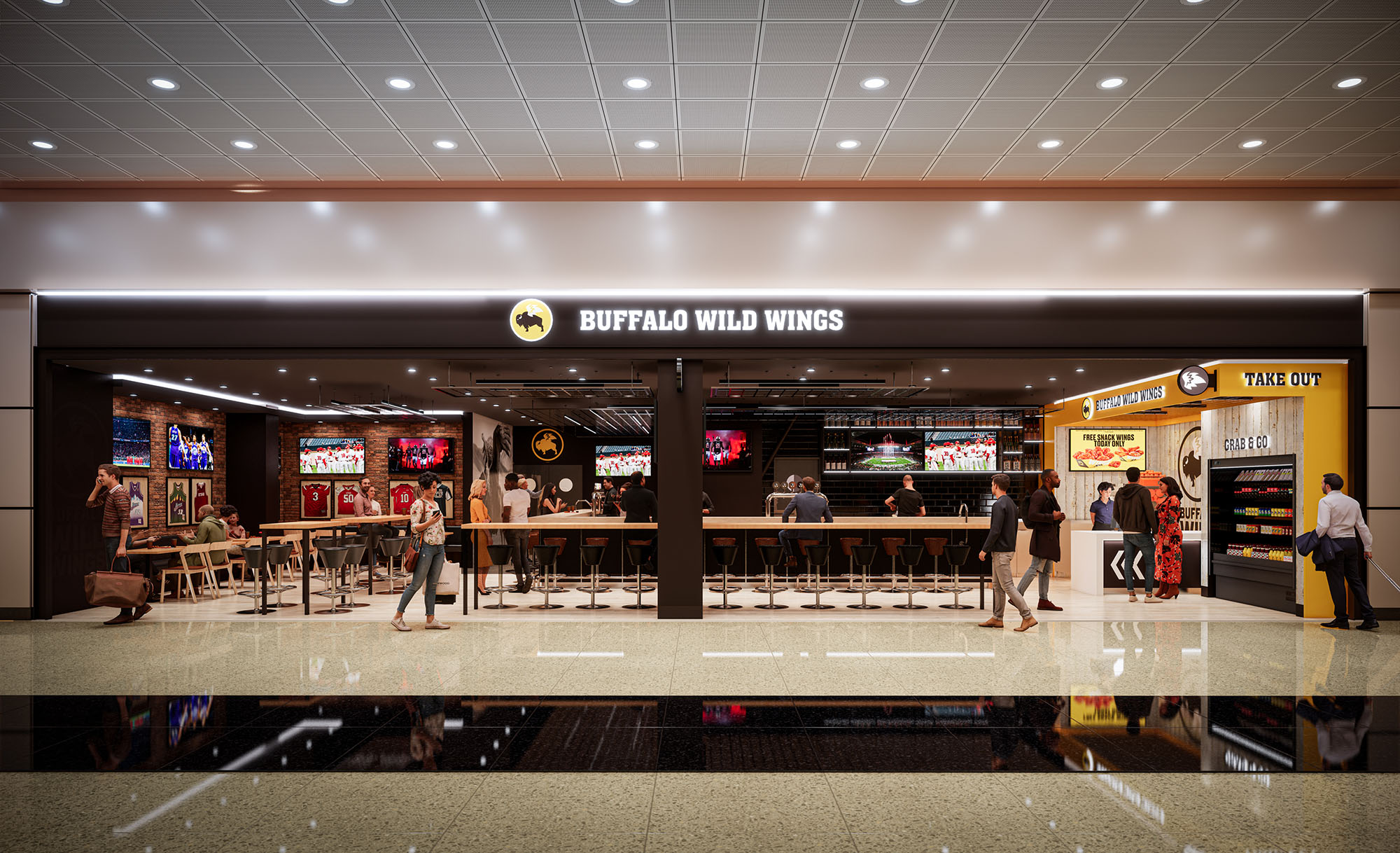
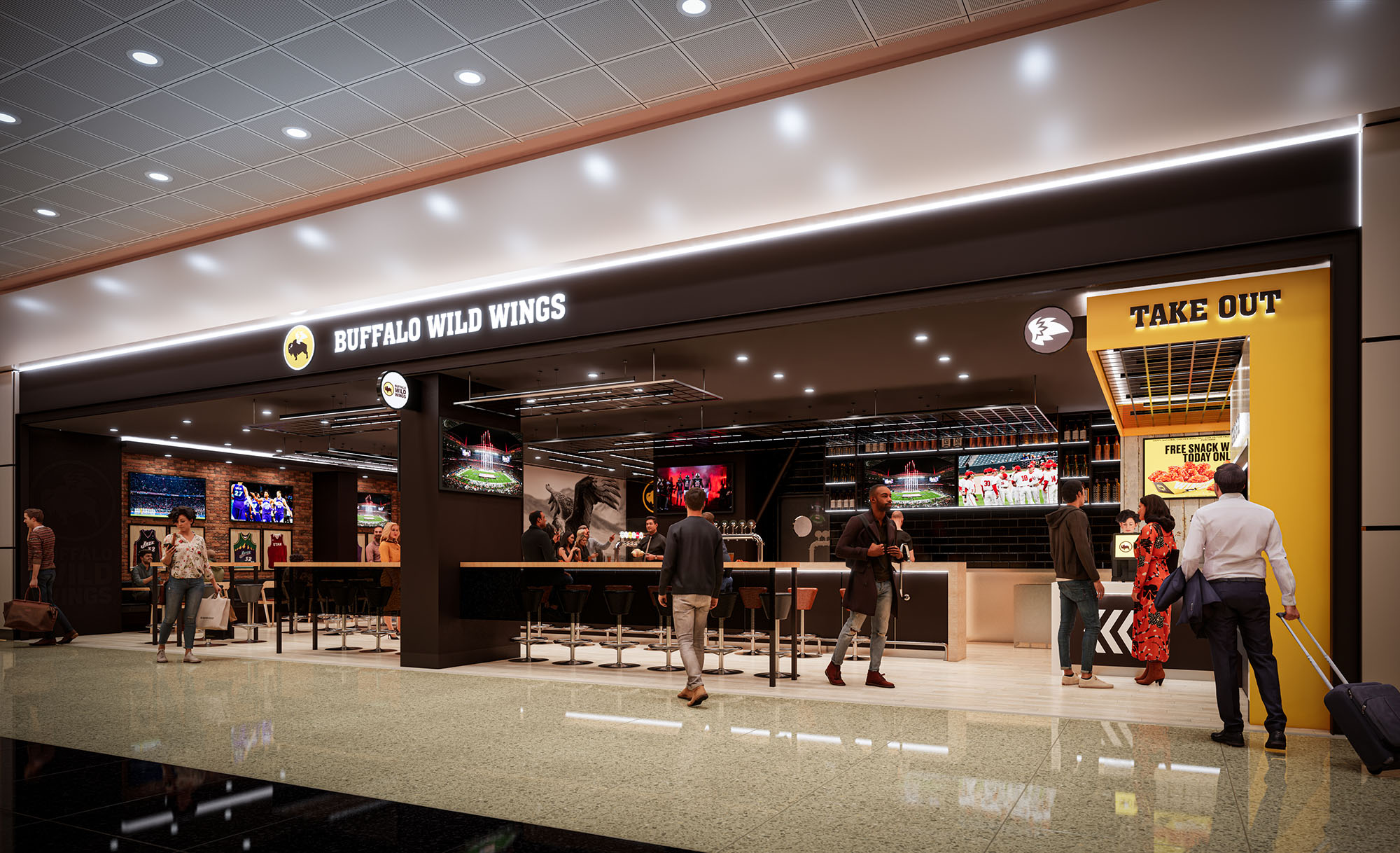
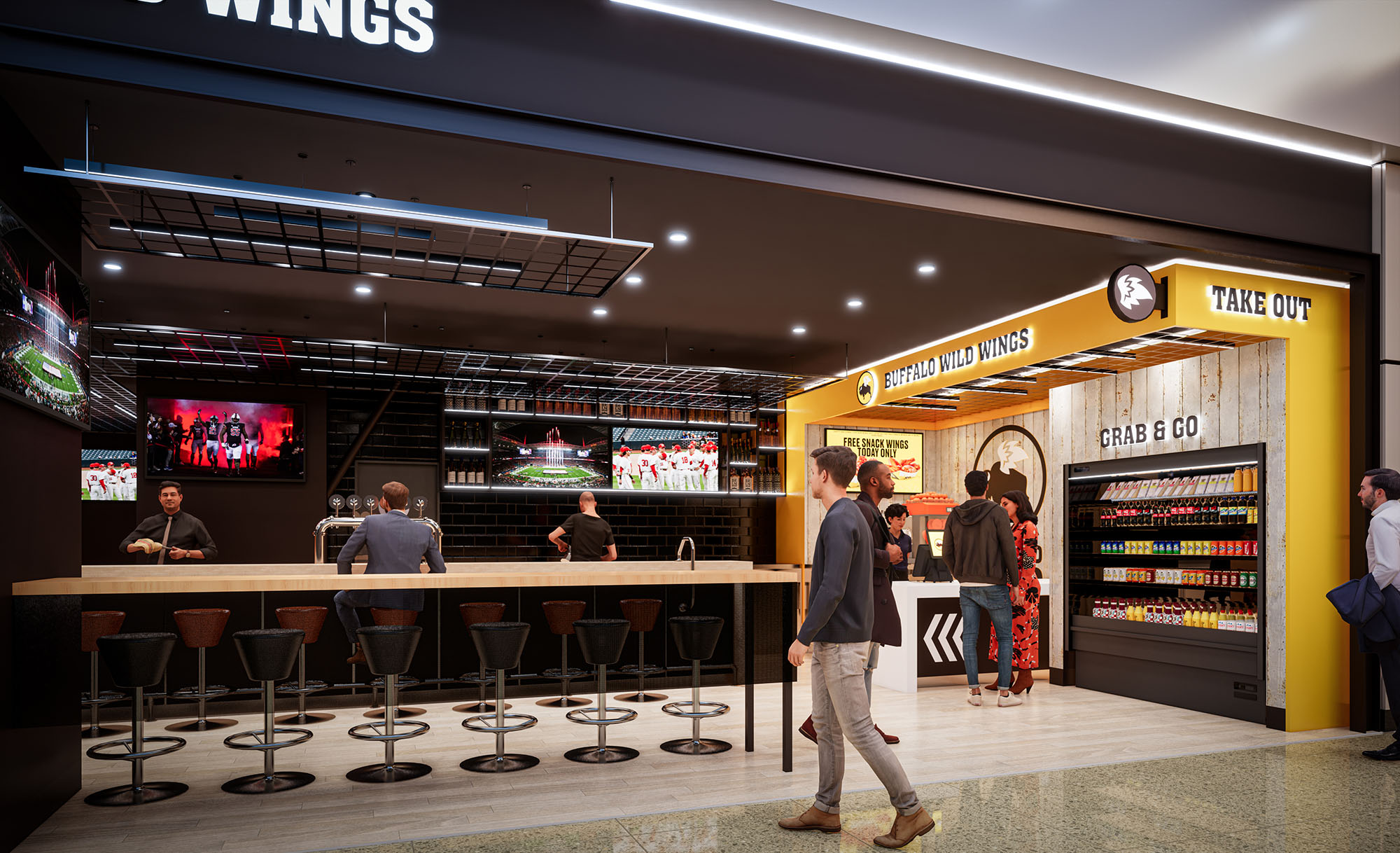
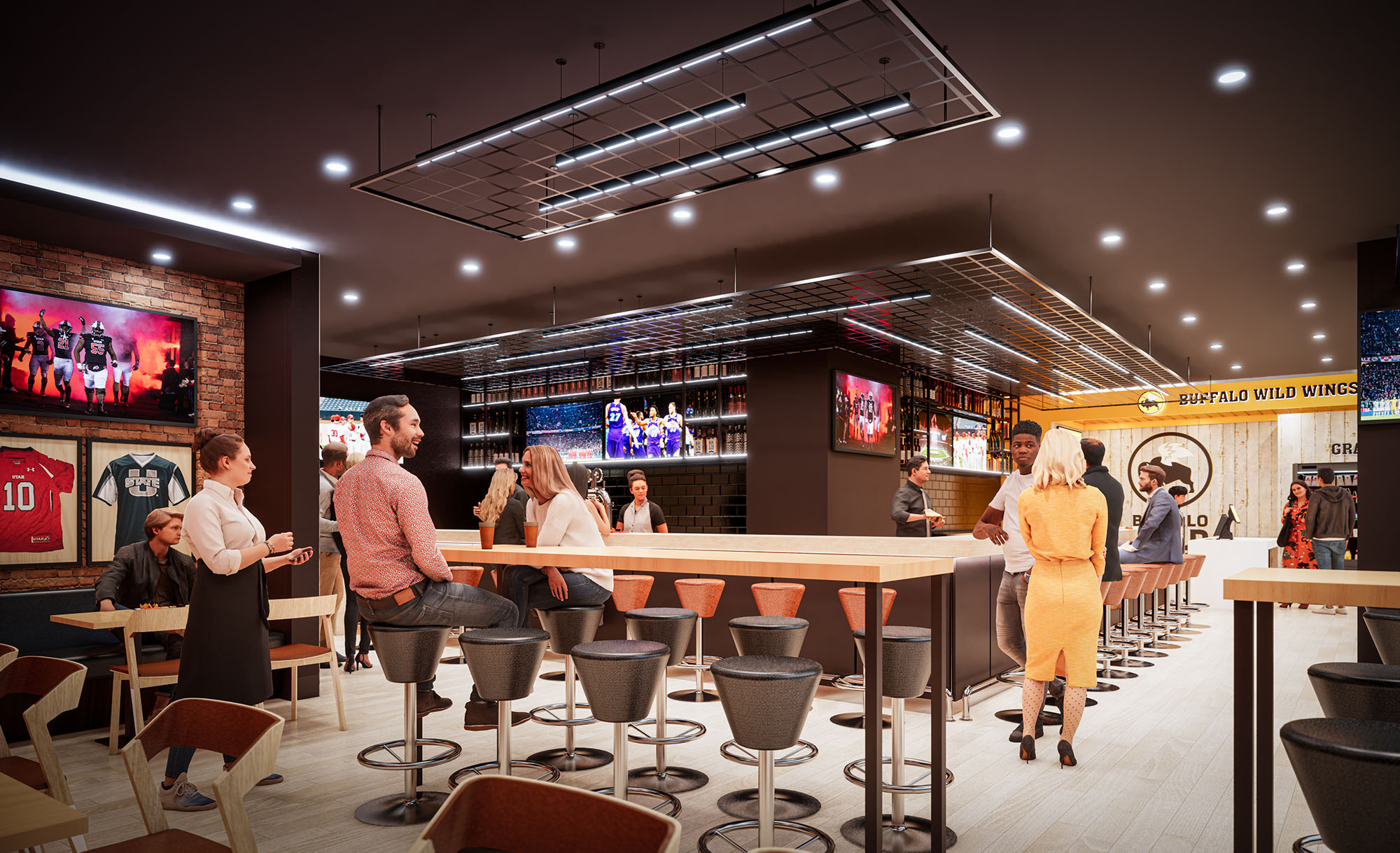
The Buffalo Wild Wings in Salt Lake City is conceived as an open, highly visible sports bar that blends the informality of a fan arena with the clarity of a contemporary retail frontage. The design creates a porous boundary between the mall concourse and the interior bar, using large structural openings and minimal glazing to visually extend the public realm into the restaurant. The concept emphasizes immersion in live sports, expressed through a panoramic arrangement of digital screens and a continuous bar core that becomes the architectural centerpiece.
The overall atmosphere combines industrial references—exposed grid ceilings, brick textures, black tile—with a warm, hospitality-driven palette. The brand’s yellow and black identity is integrated architecturally as volumetric frames, illuminated bands, and wayfinding elements rather than surface graphics alone, generating a cohesive and instantly recognizable environment.
The plan is structured around a central horseshoe bar that organizes circulation and sightlines. High stools and counter seating define the primary social zone, with peripheral tables offering more intimate dining while still maintaining direct views toward screens. This zoning ensures a gradient from active bar energy at the core to more relaxed seating toward the perimeter.
The frontage is articulated in three main programmatic bands: the main bar and dining area in the center, a take-out/“grab & go” component on one side, and an additional entry and merchandise or feature zone on the opposite side. This tripartite façade allows the concept to address both quick-service and full-service users simultaneously, optimizing throughput in a high-traffic mall context.
The material palette combines warm, light-toned timber flooring and countertops with dark metal bases and structural frames, creating a balanced contrast between hospitality and robustness. Brick cladding and black ceramic tiles add textural depth and reference the brand’s sports-bar heritage, while smooth gypsum surfaces and clean-edged millwork maintain a contemporary character.
Color is anchored by the brand yellow, strategically used as a spatial accent around the take-out portal and in linear bands along the soffits. Neutral greys, blacks, and natural wood tones dominate the interior, allowing digital screens and branded graphics to become dynamic focal points. Lighting is predominantly recessed LED downlights, complemented by linear fixtures integrated within an exposed metal grid ceiling. This grid not only organizes lighting and services but also establishes a strong visual datum that unifies the entire interior.
Toward the mall concourse, the restaurant presents a clear, horizontally articulated façade. The central open bay reveals the bar and live sports screens, functioning as an animated billboard that continually advertises the atmosphere inside. Flanking portals for “Buffalo Wild Wings” and “Take Out” are framed by illuminated yellow bands, enhancing legibility from a distance and guiding customer flow.
The grab-and-go zone is treated almost like a retail kiosk, with highly ordered shelving and clear product visibility. This dual identity—sports bar and fast-service node—responds to diverse user needs, from travelers seeking a quick purchase to groups looking for a full dining and viewing experience. Wayfinding is intuitive, relying on bold typography, color-coded thresholds, and directional graphics on the floor and walls.
The project integrates several pragmatic sustainability measures within the constraints of a mall environment. High-efficiency LED lighting is used exclusively, with tight beam control and dimmable circuits to reduce energy consumption while adapting to varying levels of occupancy and event intensity. The exposed ceiling grid simplifies access to mechanical and electrical systems, facilitating maintenance and future upgrades without extensive demolition.
Durable finishes—such as porcelain or high-performance vinyl flooring, glazed ceramic tiles, and metal-framed furniture—are selected for longevity in a high-traffic context, lowering replacement cycles and embodied impacts. Where possible, furniture and millwork utilize engineered wood products and veneers to optimize material use. The compact kitchen and bar back-of-house layout reduces unnecessary circulation, improving operational efficiency and indirectly decreasing energy use associated with food service equipment and refrigeration.


Our offices are located in Barcelona, Cancún, Chicago and Santo Domingo, but thanks to technology we can do projects on all over the world.
Barcelona
Bac de Roda 136
08020, Barcelona
Spain
Madrid
Av. de Buendía 11
19005 Guadalajara (Madrid)
Spain
Chicago
373 Hazel Ave, Apt A1
60022, Glencoe, Illinois
United States