

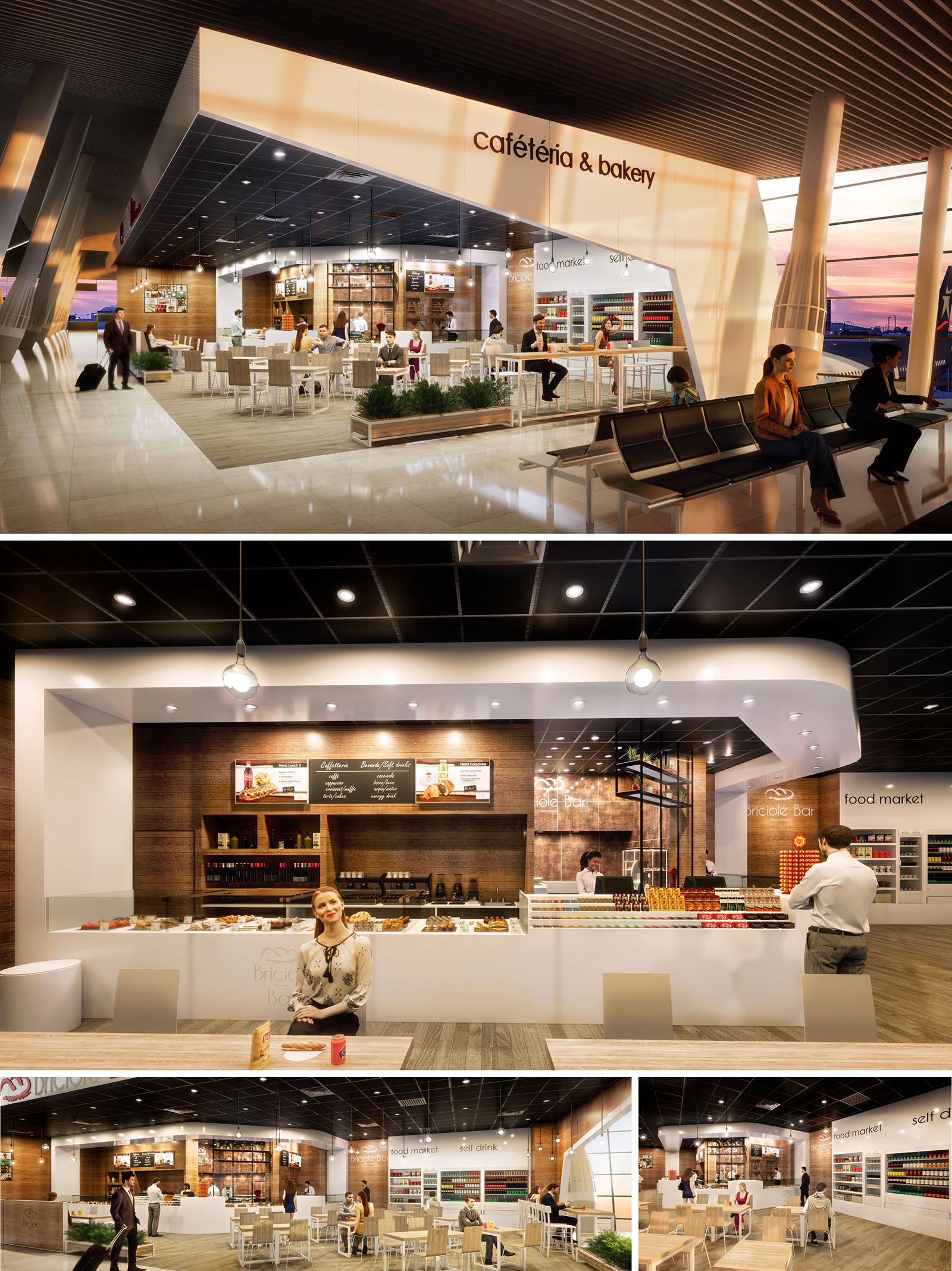
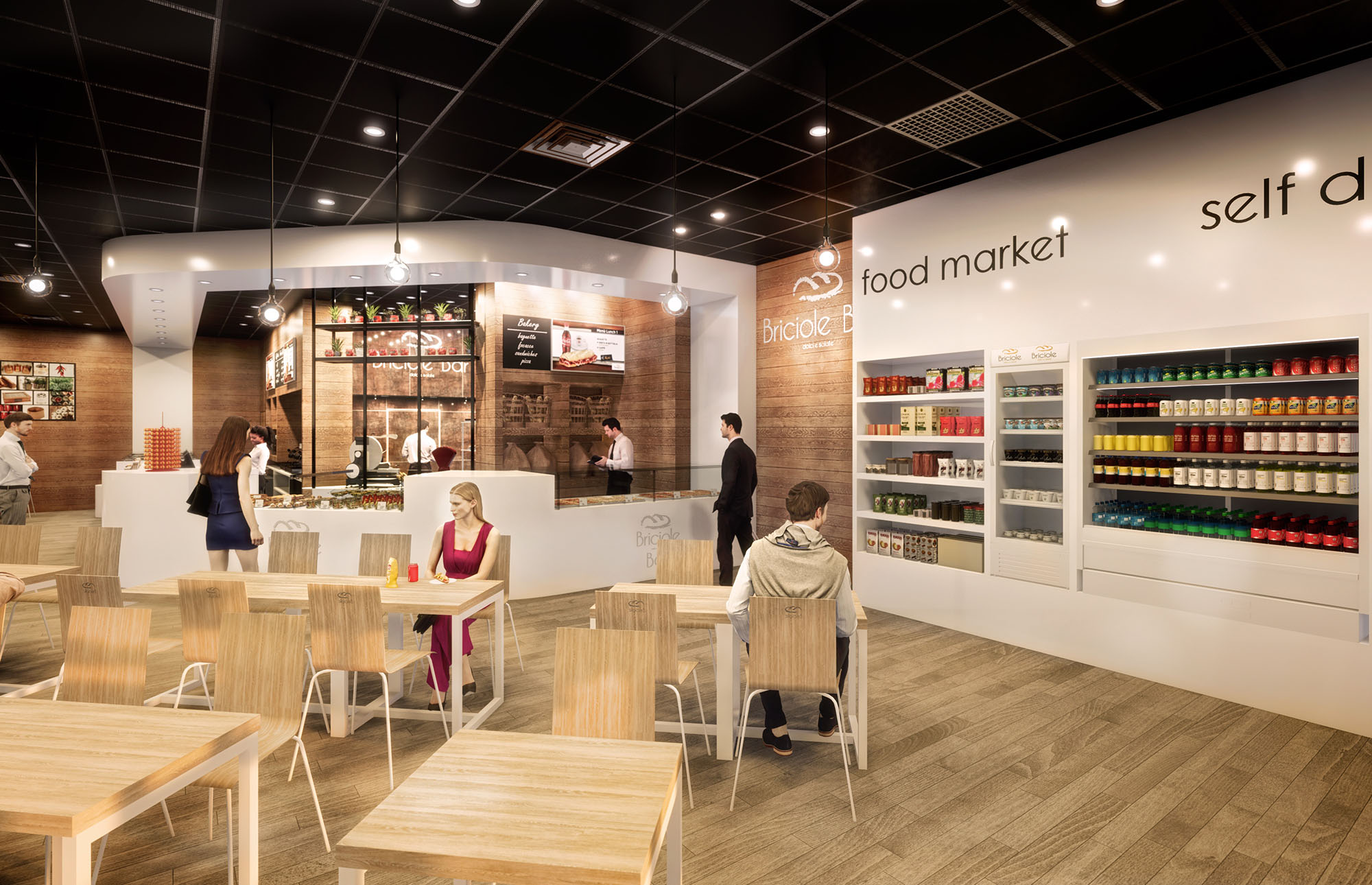
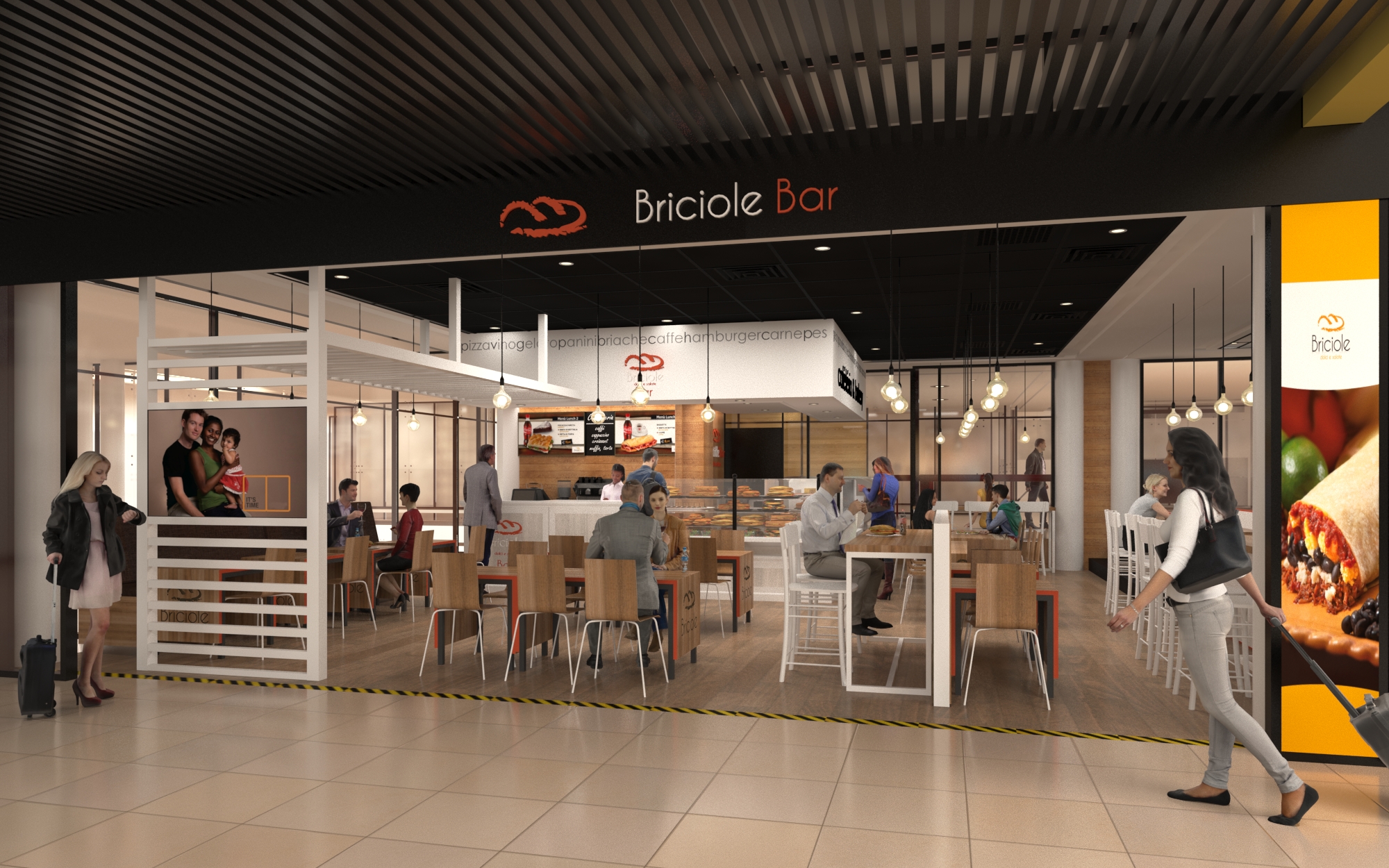
Briciole is conceived as an open and luminous café-bakery and food market that dissolves the traditional limits between airport concourse and restaurant. The project organizes a compact service core wrapped by a generous, permeable seating perimeter, encouraging intuitive access from multiple directions. The design language combines the warmth of a neighborhood bakery with the efficiency and clarity required in an airport environment, using a restrained palette and clean geometries to communicate order and calm within a busy terminal.
The space works as an interior “urban plaza,” where the architectural envelope frames views toward the airside while the central counter operates as an active, social focal point. Visual connection, transparency, and legible circulation are prioritized so that passengers with limited time can immediately understand the offer and flow through the space with ease.
The plan is structured around a linear bar that concentrates preparation, display, and payment, allowing all operational functions to remain visible but controlled. Behind the main counter, a continuous backdrop of shelving and menu boards forms a functional wall that organizes storage and information. Adjacent to this, a self-service food market creates a secondary axis, enhancing flexibility for different user profiles and levels of dwell time.
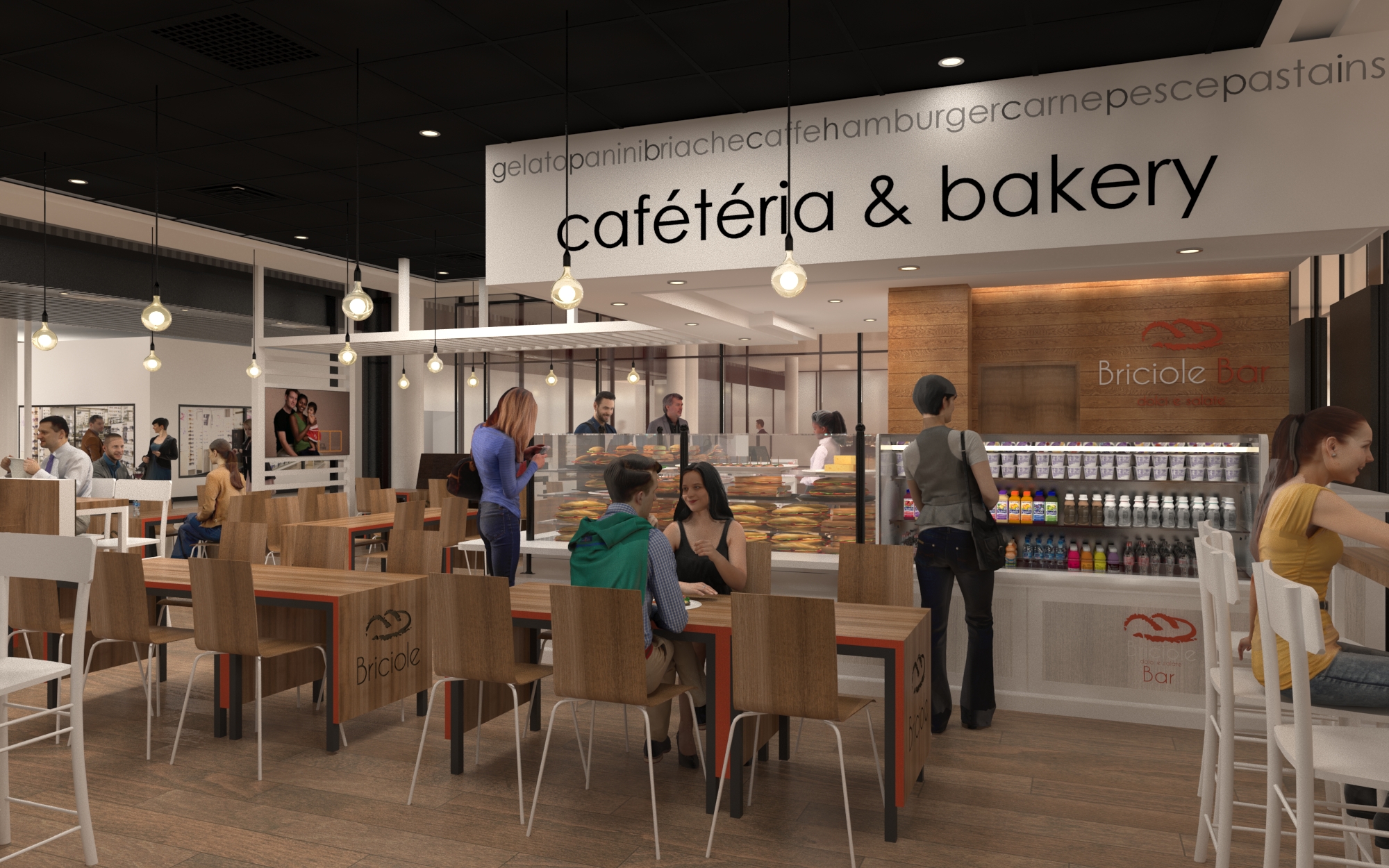
Seating is distributed in layers: higher stools along the perimeter and bar-height tables close to the concourse edge, standard-height tables occupying the central dining field, and a green buffer that subtly separates the café from the waiting area benches. This gradation of heights enhances visibility across the space, optimizes passenger wayfinding, and ensures that the commercial façade remains visually active from a distance.
The material palette balances tactile warmth with durability. Horizontal surfaces in light-toned engineered wood evoke the atmosphere of a domestic dining table while remaining resistant to intensive use. Vertical planes alternate between white solid surfaces and wood laminates, creating a rhythm that frames the product displays and highlights the baked goods as the main visual protagonist.
Lighting is layered to support both ambience and functional clarity. A luminous white canopy wraps the counter and extends toward the concourse, acting as a beacon visible from afar. Recessed downlights in the dark suspended ceiling generate contrast, focusing light on merchandise and work zones, while pendant fixtures above key points of sale bring a more human scale. The interplay between warm light over wood and cooler light on white planes reinforces zoning and guides the user journey.
The interior identity is defined by a precise use of branding and typography integrated into the architecture. The “cafetéria & bakery” signage is embedded within the luminous fascia, avoiding additional elements that might clutter the concourse. Inside, menu boards and graphic panels are framed within the wooden backdrop, reading as part of the wall composition rather than applied decoration.
Neutral furniture in light beige and white allows the chromatic emphasis to fall on the products: pastries, beverages, and packaged goods create a natural, ever-changing color layer. Transparent enclosures and minimal framing keep sightlines open, reinforcing the idea of an accessible, contemporary marketplace rather than an enclosed restaurant.
Sustainability is addressed through both material selection and operational strategy. The predominant use of engineered wood and laminates reduces reliance on solid timber while offering longevity and easy maintenance in a high-traffic context, minimizing the need for frequent replacement. Surfaces are chosen for their cleanability, supporting hygiene with limited use of aggressive chemicals.
The compact service core optimizes back-of-house circulation and reduces unnecessary conditioned volume. High-efficiency LED lighting, controlled in zones, lowers energy demand and allows adaptation to different levels of natural light from the terminal façade. Open boundaries eliminate the need for additional partitions and mechanical separation, encouraging passive air movement and shared climate control with the main terminal, thereby reducing overall environmental impact while maintaining user comfort.
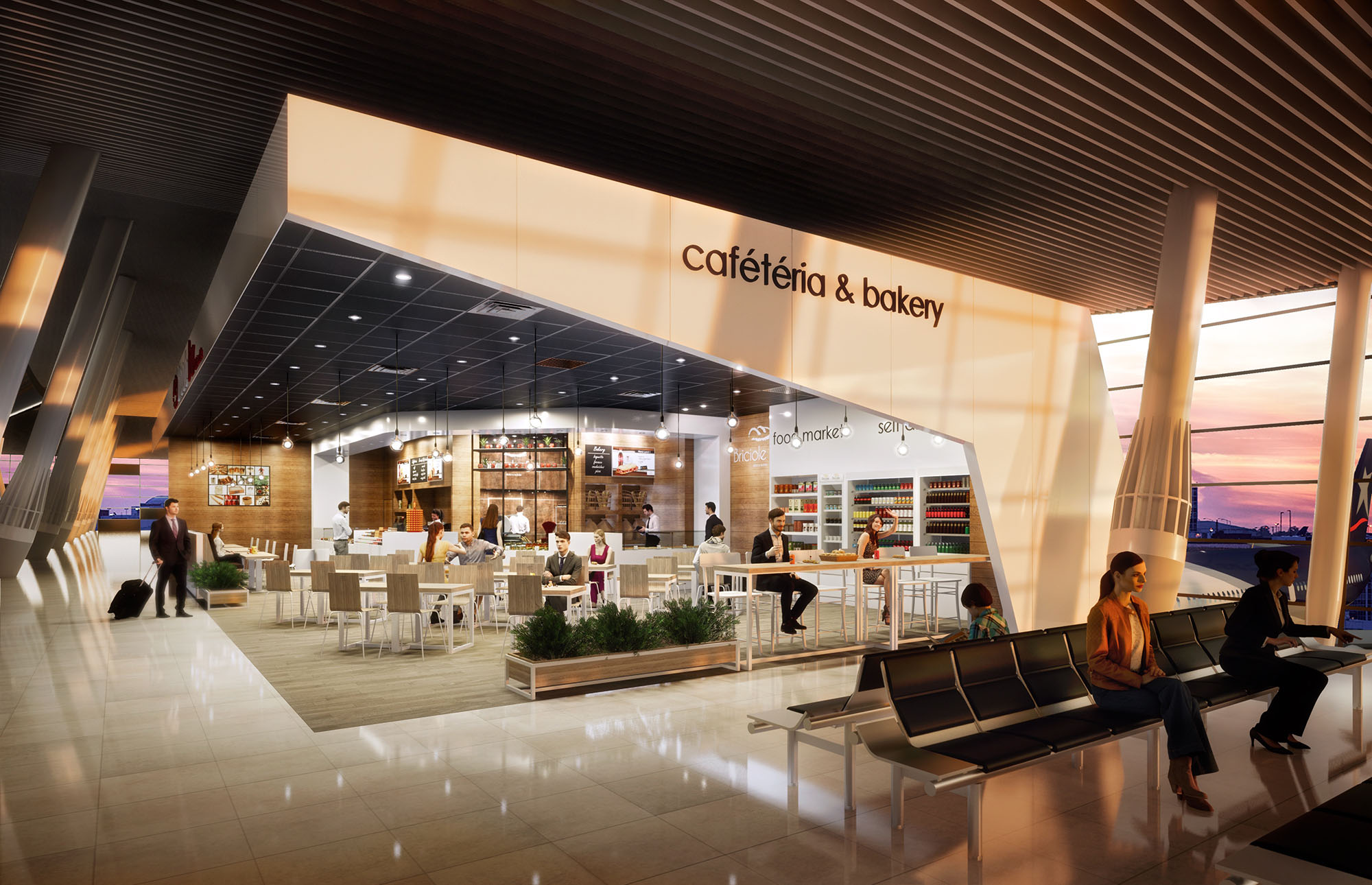
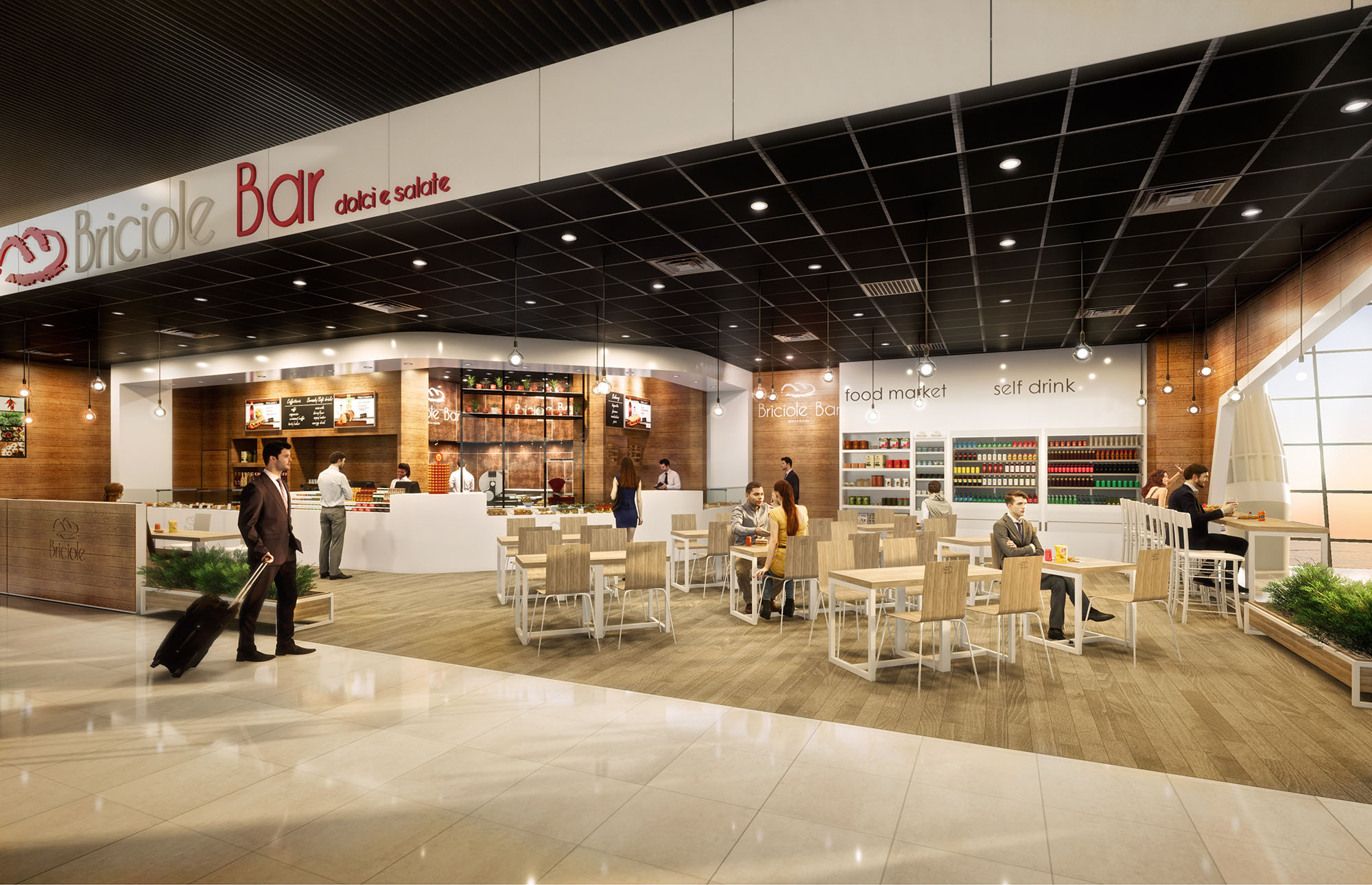
Briciole is conceived as an open and luminous café-bakery and food market that dissolves the traditional limits between airport concourse and restaurant. The project organizes a compact service core wrapped by a generous, permeable seating perimeter, encouraging intuitive access from multiple directions. The design language combines the warmth of a neighborhood bakery with the efficiency and clarity required in an airport environment, using a restrained palette and clean geometries to communicate order and calm within a busy terminal.
The space works as an interior “urban plaza,” where the architectural envelope frames views toward the airside while the central counter operates as an active, social focal point. Visual connection, transparency, and legible circulation are prioritized so that passengers with limited time can immediately understand the offer and flow through the space with ease.
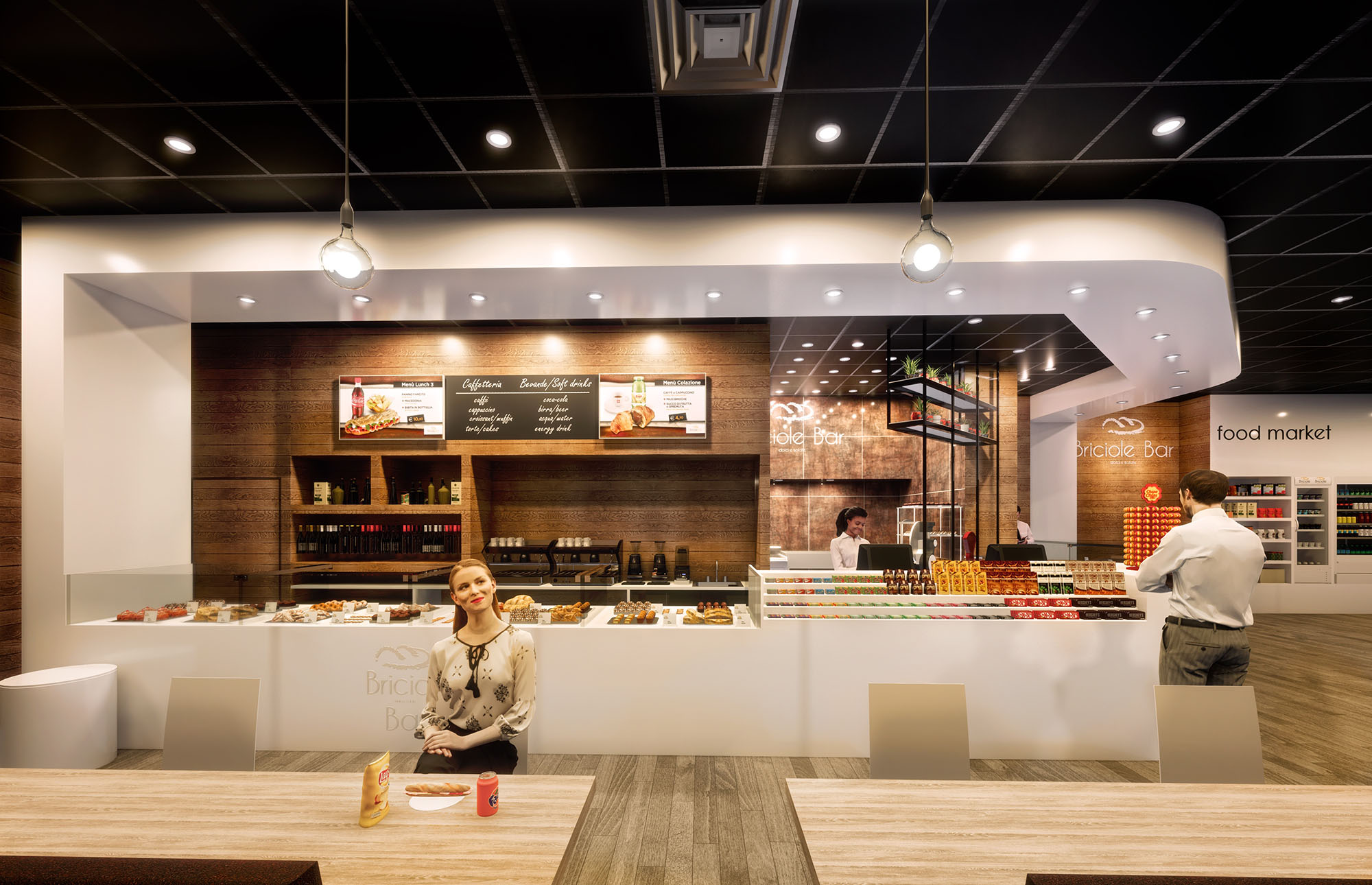
The plan is structured around a linear bar that concentrates preparation, display, and payment, allowing all operational functions to remain visible but controlled. Behind the main counter, a continuous backdrop of shelving and menu boards forms a functional wall that organizes storage and information. Adjacent to this, a self-service food market creates a secondary axis, enhancing flexibility for different user profiles and levels of dwell time.
Seating is distributed in layers: higher stools along the perimeter and bar-height tables close to the concourse edge, standard-height tables occupying the central dining field, and a green buffer that subtly separates the café from the waiting area benches. This gradation of heights enhances visibility across the space, optimizes passenger wayfinding, and ensures that the commercial façade remains visually active from a distance.
The material palette balances tactile warmth with durability. Horizontal surfaces in light-toned engineered wood evoke the atmosphere of a domestic dining table while remaining resistant to intensive use. Vertical planes alternate between white solid surfaces and wood laminates, creating a rhythm that frames the product displays and highlights the baked goods as the main visual protagonist.
Lighting is layered to support both ambience and functional clarity. A luminous white canopy wraps the counter and extends toward the concourse, acting as a beacon visible from afar. Recessed downlights in the dark suspended ceiling generate contrast, focusing light on merchandise and work zones, while pendant fixtures above key points of sale bring a more human scale. The interplay between warm light over wood and cooler light on white planes reinforces zoning and guides the user journey.
The interior identity is defined by a precise use of branding and typography integrated into the architecture. The “cafetéria & bakery” signage is embedded within the luminous fascia, avoiding additional elements that might clutter the concourse. Inside, menu boards and graphic panels are framed within the wooden backdrop, reading as part of the wall composition rather than applied decoration.
Neutral furniture in light beige and white allows the chromatic emphasis to fall on the products: pastries, beverages, and packaged goods create a natural, ever-changing color layer. Transparent enclosures and minimal framing keep sightlines open, reinforcing the idea of an accessible, contemporary marketplace rather than an enclosed restaurant.
Sustainability is addressed through both material selection and operational strategy. The predominant use of engineered wood and laminates reduces reliance on solid timber while offering longevity and easy maintenance in a high-traffic context, minimizing the need for frequent replacement. Surfaces are chosen for their cleanability, supporting hygiene with limited use of aggressive chemicals.
The compact service core optimizes back-of-house circulation and reduces unnecessary conditioned volume. High-efficiency LED lighting, controlled in zones, lowers energy demand and allows adaptation to different levels of natural light from the terminal façade. Open boundaries eliminate the need for additional partitions and mechanical separation, encouraging passive air movement and shared climate control with the main terminal, thereby reducing overall environmental impact while maintaining user comfort.


Our offices are located in Barcelona, Cancún, Chicago and Santo Domingo, but thanks to technology we can do projects on all over the world.
Barcelona
Bac de Roda 136
08020, Barcelona
Spain
Madrid
Av. de Buendía 11
19005 Guadalajara (Madrid)
Spain
Chicago
373 Hazel Ave, Apt A1
60022, Glencoe, Illinois
United States