

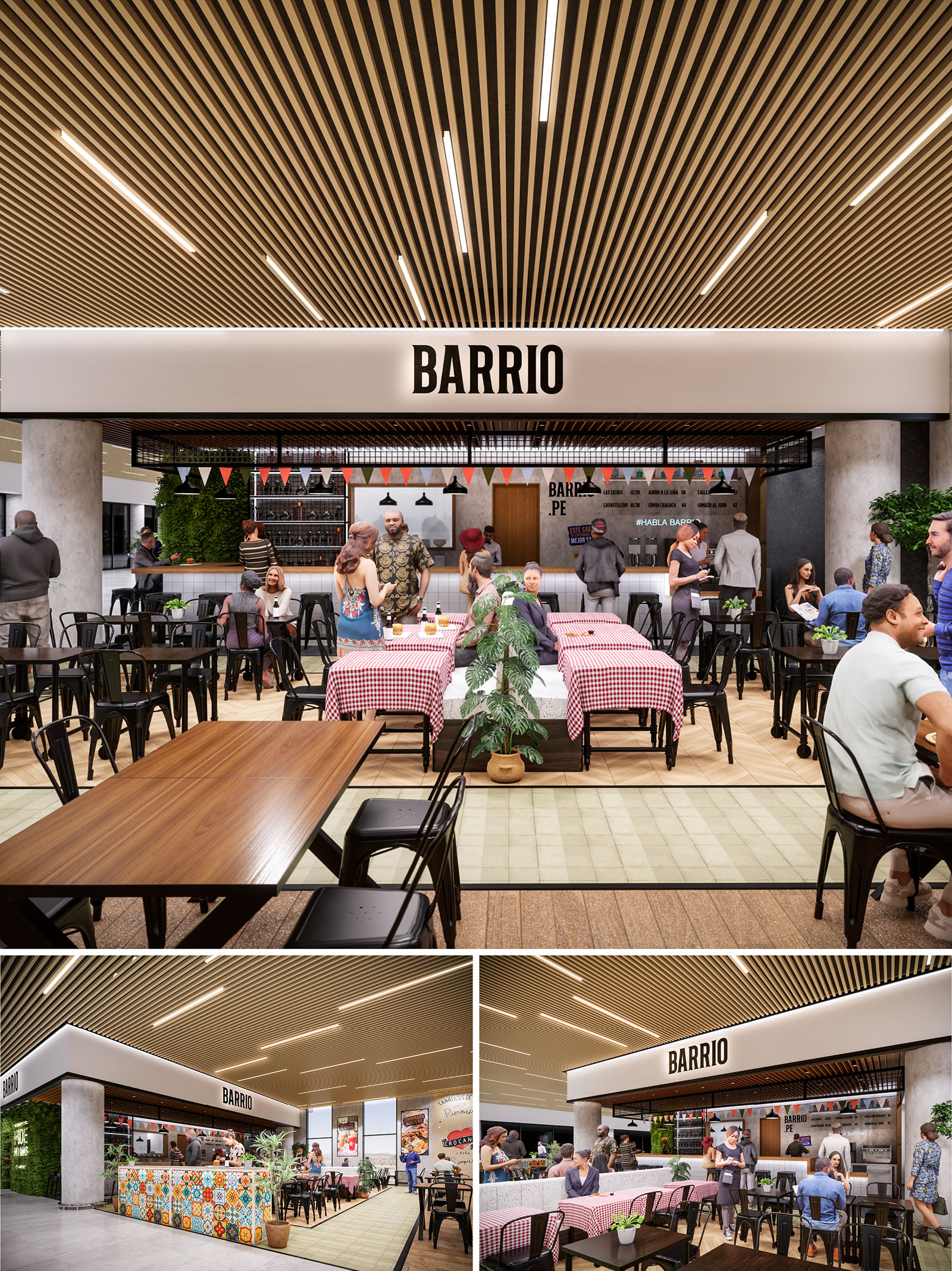
BARRIO is conceived as an open, informal urban dining space that evokes the atmosphere of a traditional Lima neighborhood within the controlled environment of a shopping mall. The project merges the spontaneity of street food and local markets with a clear, contemporary architectural language. The design prioritizes visual permeability, a festive character, and a sense of collective table, making the food court stall read as a small plaza rather than a closed restaurant.
The architectural strategy is based on a simple rectilinear volume that frames the service core and defines a generous frontal terrace. This terrace operates as an extension of the public circulation, dissolving boundaries between passerby and diner, and inviting users to approach the counter, share long tables, and participate in the social dynamic of the “barrio.”
The layout is structured around a central bar–kitchen front that concentrates service, bar seating, and visual activity. Behind this line, the production area is organized in a compact, efficient strip, ensuring direct contact between staff and customers while keeping back-of-house functions discreetly integrated. The frontal bar anchors the space, allowing for linear circulation and clear orientation from any point in the mall corridor.
The dining area extends on both sides of a central axis, articulated by long communal tables covered with checkered tablecloths and complemented by smaller perimeter tables for more intimate groups. This arrangement fosters flexibility, accommodating varied group sizes while maintaining high density. The layout favors diagonal views across the entire premises, reinforcing the sense of a lively, continuous interior street.
The material palette balances warm, familiar finishes with robust, low-maintenance surfaces. A suspended ceiling of linear wooden slats provides warmth, acoustical absorption, and a strong visual identity, contrasting with the neutral envelope of the mall. The floor combines wood-look surfaces with pale ceramic tiles that visually define the restaurant’s footprint without the need for physical barriers.
The counter volume introduces a key chromatic accent through patterned tiles inspired by Peruvian vernacular façades and markets. These multicolored pieces create a direct cultural reference while resisting wear in a high-traffic zone. Black metal chairs and table bases add an industrial note, ensuring durability and visual coherence with the pendant luminaires and shelving structure.
Lighting is designed to reinforce the ceiling’s linear rhythm and to create a warm, welcoming ambience. Integrated linear fixtures between wooden slats provide homogeneous ambient light, suitable for the mall’s extended operating hours. Over the bar and central tables, black pendant lamps generate more intimate light cones, focusing attention on the food and encouraging longer stays.
Additional decorative elements, such as small festival pennant strings, introduce a festive, temporary quality reminiscent of neighborhood celebrations. This layered lighting strategy ensures visual comfort, highlights key areas, and accentuates textures and colors throughout the project.
The BARRIO brand is integrated architecturally through a bold, monochrome fascia that runs along the perimeter of the stall. The logo, centered and backlit, reads clearly from a distance, functioning as a horizontal urban sign. This white band contrasts with the wood ceiling and the colorful tile, reinforcing a clean, legible identity.
Inside, graphic applications on walls complement the physical architecture, referencing local slang and neighborhood culture. These graphics are applied over a neutral backdrop, avoiding visual saturation while maintaining a strong narrative link to Lima’s everyday life.
Strategic use of vegetation softens the hard surfaces and introduces a biophilic component essential in an interior mall environment. Potted plants define micro-borders between circulation and dining areas, while a vertical green wall near the bar functions as a living backdrop, improving air quality perception and adding visual freshness.
Sustainability criteria inform the selection of materials and systems. The predominance of wood and metal allows for high durability and potential recyclability at the end of the project’s life cycle. LED lighting minimizes energy consumption, and the open layout relies on the mall’s existing HVAC systems, reducing the need for additional mechanical equipment. Furniture with stackable metal frames optimizes maintenance and facilitates reconfiguration, prolonging the useful life of the space and supporting an adaptable, resource-conscious operation.
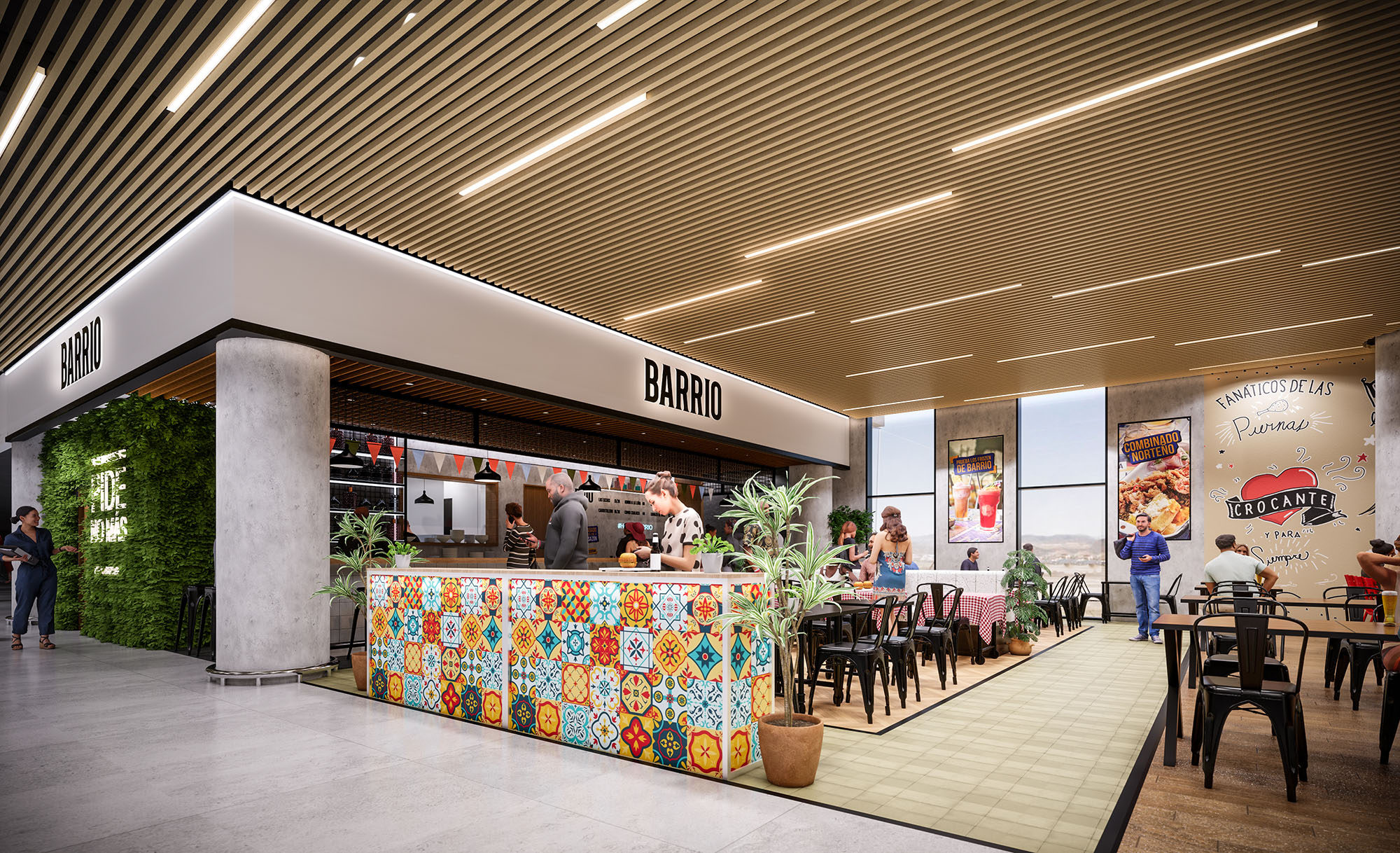
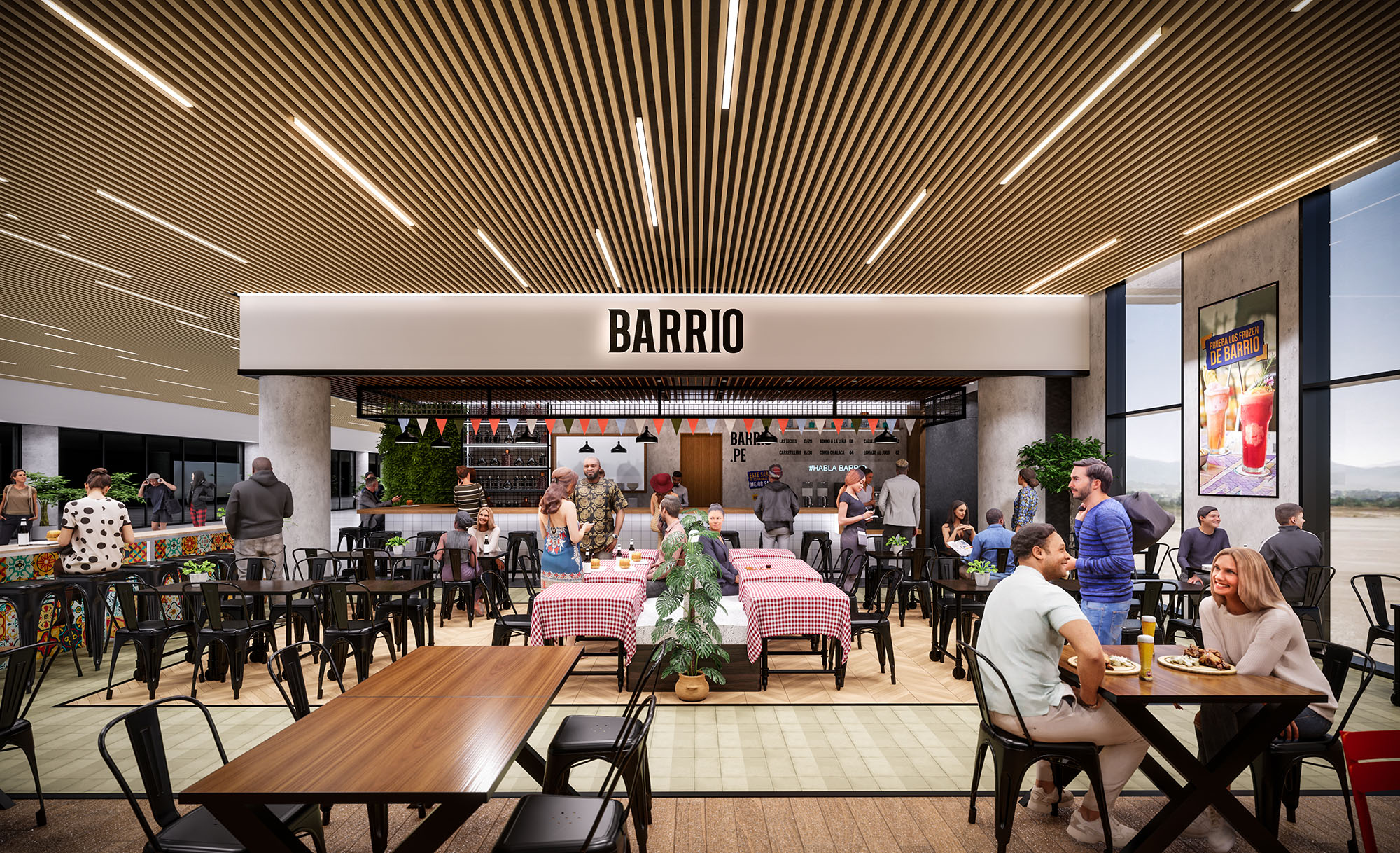
BARRIO is conceived as an open, informal urban dining space that evokes the atmosphere of a traditional Lima neighborhood within the controlled environment of a shopping mall. The project merges the spontaneity of street food and local markets with a clear, contemporary architectural language. The design prioritizes visual permeability, a festive character, and a sense of collective table, making the food court stall read as a small plaza rather than a closed restaurant.
The architectural strategy is based on a simple rectilinear volume that frames the service core and defines a generous frontal terrace. This terrace operates as an extension of the public circulation, dissolving boundaries between passerby and diner, and inviting users to approach the counter, share long tables, and participate in the social dynamic of the “barrio.”
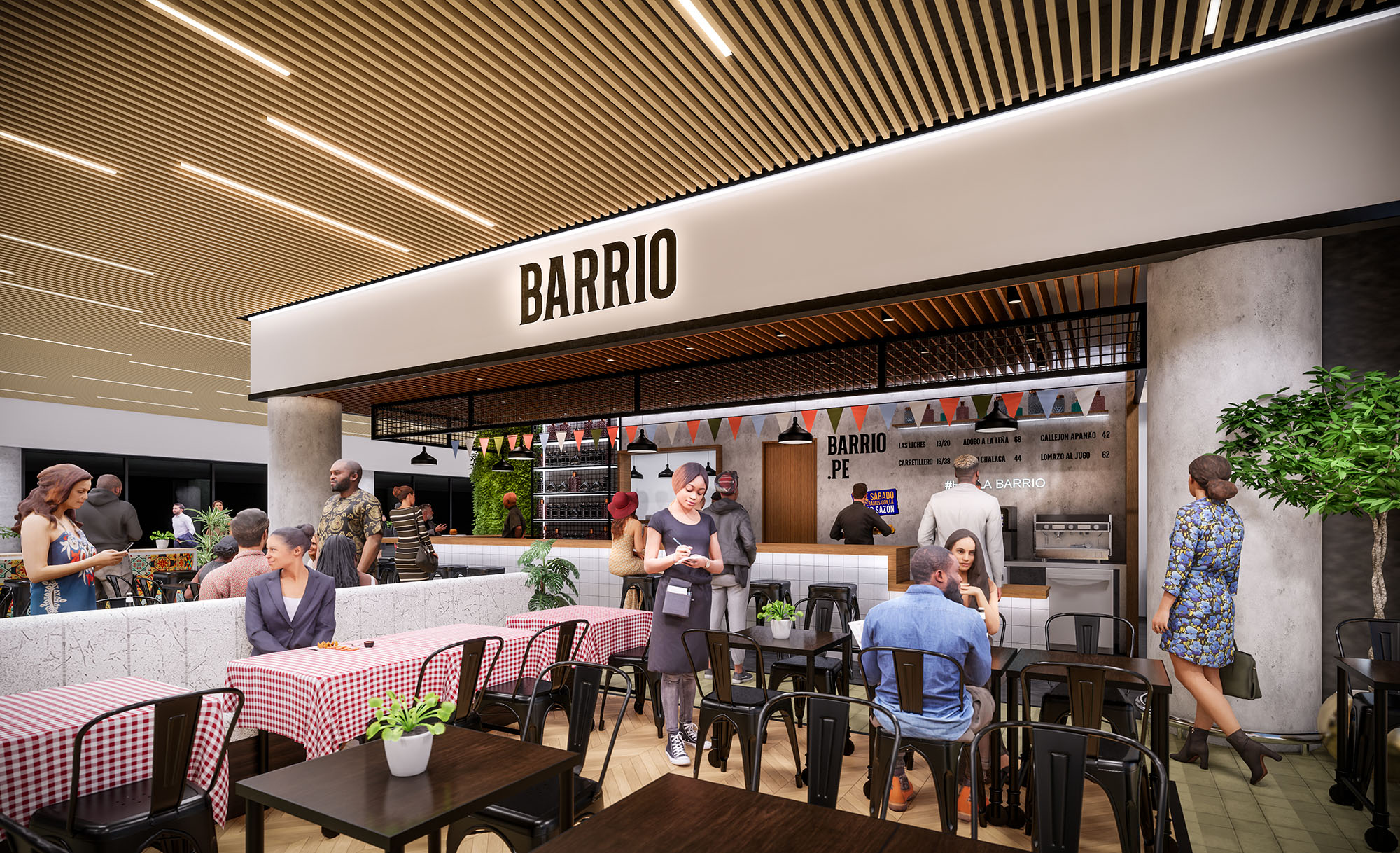
The layout is structured around a central bar–kitchen front that concentrates service, bar seating, and visual activity. Behind this line, the production area is organized in a compact, efficient strip, ensuring direct contact between staff and customers while keeping back-of-house functions discreetly integrated. The frontal bar anchors the space, allowing for linear circulation and clear orientation from any point in the mall corridor.
The dining area extends on both sides of a central axis, articulated by long communal tables covered with checkered tablecloths and complemented by smaller perimeter tables for more intimate groups. This arrangement fosters flexibility, accommodating varied group sizes while maintaining high density. The layout favors diagonal views across the entire premises, reinforcing the sense of a lively, continuous interior street.
The material palette balances warm, familiar finishes with robust, low-maintenance surfaces. A suspended ceiling of linear wooden slats provides warmth, acoustical absorption, and a strong visual identity, contrasting with the neutral envelope of the mall. The floor combines wood-look surfaces with pale ceramic tiles that visually define the restaurant’s footprint without the need for physical barriers.
The counter volume introduces a key chromatic accent through patterned tiles inspired by Peruvian vernacular façades and markets. These multicolored pieces create a direct cultural reference while resisting wear in a high-traffic zone. Black metal chairs and table bases add an industrial note, ensuring durability and visual coherence with the pendant luminaires and shelving structure.
Lighting is designed to reinforce the ceiling’s linear rhythm and to create a warm, welcoming ambience. Integrated linear fixtures between wooden slats provide homogeneous ambient light, suitable for the mall’s extended operating hours. Over the bar and central tables, black pendant lamps generate more intimate light cones, focusing attention on the food and encouraging longer stays.
Additional decorative elements, such as small festival pennant strings, introduce a festive, temporary quality reminiscent of neighborhood celebrations. This layered lighting strategy ensures visual comfort, highlights key areas, and accentuates textures and colors throughout the project.
The BARRIO brand is integrated architecturally through a bold, monochrome fascia that runs along the perimeter of the stall. The logo, centered and backlit, reads clearly from a distance, functioning as a horizontal urban sign. This white band contrasts with the wood ceiling and the colorful tile, reinforcing a clean, legible identity.
Inside, graphic applications on walls complement the physical architecture, referencing local slang and neighborhood culture. These graphics are applied over a neutral backdrop, avoiding visual saturation while maintaining a strong narrative link to Lima’s everyday life.
Strategic use of vegetation softens the hard surfaces and introduces a biophilic component essential in an interior mall environment. Potted plants define micro-borders between circulation and dining areas, while a vertical green wall near the bar functions as a living backdrop, improving air quality perception and adding visual freshness.
Sustainability criteria inform the selection of materials and systems. The predominance of wood and metal allows for high durability and potential recyclability at the end of the project’s life cycle. LED lighting minimizes energy consumption, and the open layout relies on the mall’s existing HVAC systems, reducing the need for additional mechanical equipment. Furniture with stackable metal frames optimizes maintenance and facilitates reconfiguration, prolonging the useful life of the space and supporting an adaptable, resource-conscious operation.


Our offices are located in Barcelona, Cancún, Chicago and Santo Domingo, but thanks to technology we can do projects on all over the world.
Barcelona
Bac de Roda 136
08020, Barcelona
Spain
Madrid
Av. de Buendía 11
19005 Guadalajara (Madrid)
Spain
Chicago
373 Hazel Ave, Apt A1
60022, Glencoe, Illinois
United States