

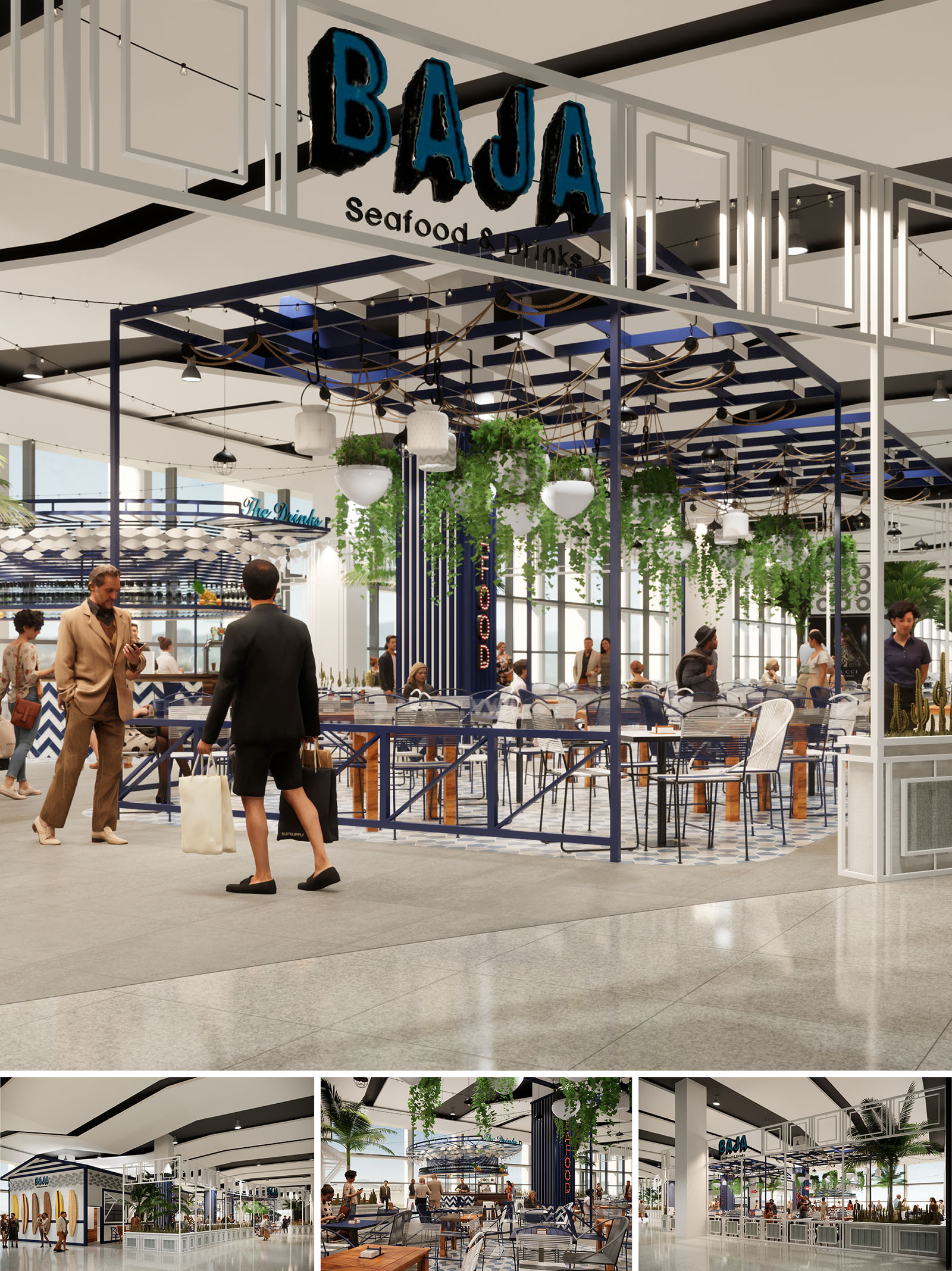
The concept for Baja Seafood & Drinks translates the relaxed coastal character of Los Cabos into a contemporary open-terrace restaurant inside a commercial environment. The design recreates the experience of an outdoor marina pavilion, using a light steel framework, hanging greenery and nautical details to define a permeable architectural envelope without closing off the visual continuity of the mall. The space is conceived as a social pier: a place where flows converge, people pause, and gastronomy becomes the central attraction.
The project draws from the chromatic and textural language of the Baja California seafront: deep ocean blues, crisp whites and warm wood accents. These elements are orchestrated to evoke freshness and informality while maintaining a clear, graphic identity that is easily perceived from a distance and supports strong brand recognition.
The restaurant occupies a corner plot within the shopping center, working as an island accessible from all sides. A metal perimeter railing with diagonal braces subtly demarcates the dining area while preserving full transparency to adjacent corridors. This low boundary frames a raised platform that functions as a stage for the dining experience, enhancing visibility of the interior activity.
Central circulation is organized on an axial layout that directs guests from the main signage element at the entrance towards the bar and food counter at the back. Seating clusters alternate between two- and four-top tables, with higher communal tables near the perimeter to activate the edge and encourage interaction with the passing public. The plan ensures clear paths for staff movement and service, separating guest flows from operational routes without resorting to solid partitions.
A lightweight steel pergola system defines the overhead plane, painted in a deep navy blue that anchors the composition. This structure carries an arrangement of suspended luminaires, string lights and hanging planters, generating a rhythmic ceiling landscape that visually lowers the scale and creates a more intimate atmosphere within the large mall volume. The beams are aligned with floor patterns to reinforce directional cues and segmentation of areas.
Lighting is layered: functional downlighting from integrated fixtures is complemented by warmer decorative pendants and festoon lights, evoking evening ambience at a seaside promenade. This combination allows flexible scene-setting depending on time of day and commercial needs while optimizing energy consumption through zoning and dimming controls.
The palette is intentionally concise to convey a clear, memorable identity. Blue and white dominate the vertical and horizontal surfaces, expressed through painted steel, ceramic tiles and printed graphics. Chevron and wave-inspired patterns on cladding and bar fronts reference maritime motifs without resorting to literal decoration, maintaining a contemporary aesthetic.
Seating combines metal frames with light finishes and wood-toned stools that introduce warmth into the predominantly cool palette. Transparent and perforated chair backs keep visual mass low, contributing to the sense of openness. The main “BAJA” signage employs bold typography and a textured, hand-painted effect that suggests artisanal character aligned with fresh, local seafood.
The interior atmosphere aims to evoke an outdoor terrace protected by shade structures. Natural light from the mall’s glazing enters unobstructed, while the overhead pergola and greenery filter and soften the brightness. Hanging plants and isolated palms provide vertical softness and a biophilic component that contrasts with the precise geometry of the metal framework.
Acoustic comfort is enhanced by the combination of plants, furniture upholstery and people density, helping to diffuse sound in an otherwise hard-surfaced mall environment. Visual permeability in all directions encourages spontaneous visits, while clearly readable zones—bar, dining, waiting—facilitate intuitive wayfinding and reduce the need for signage within the interior.
The project integrates sustainability primarily through material selection, efficient systems and long-term flexibility. Metal structures and railings are designed for modular assembly and potential reconfiguration, extending the life cycle of the components and minimizing waste in future adaptations. Finishes prioritize durable, low-maintenance surfaces suitable for high-traffic hospitality use, reducing replacement frequency.
LED lighting throughout, combined with programmable controls, significantly lowers energy consumption compared with conventional restaurant setups. The open design maximizes the use of existing mall climate control and daylight, reducing the need for additional mechanical equipment. Botanical elements not only improve perceived air quality and user well-being but are specified from species adapted to indoor environments in the local climate, limiting irrigation and maintenance demands. The project thereby aligns a strong, site-specific coastal identity with responsible, resource-conscious operation.
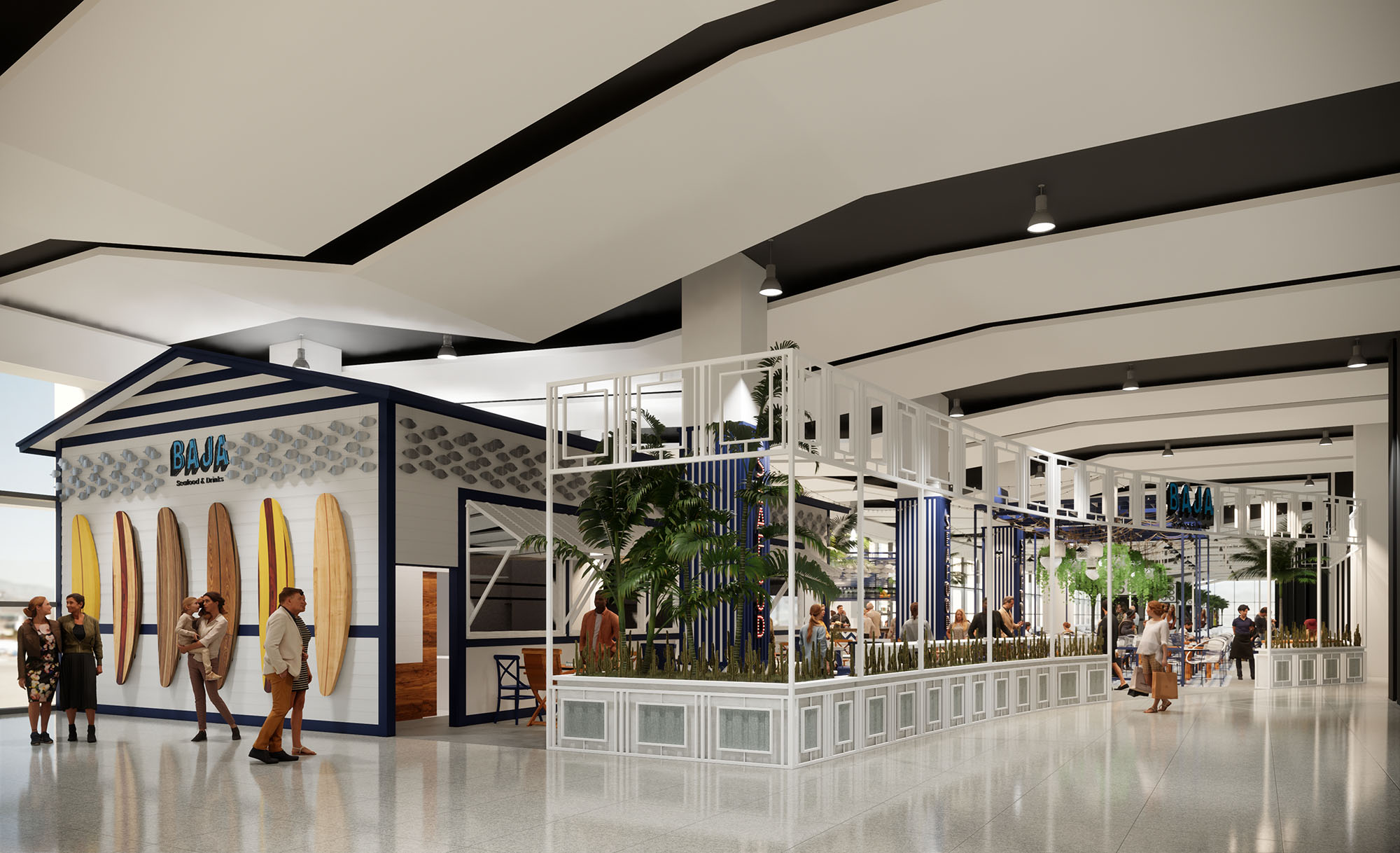
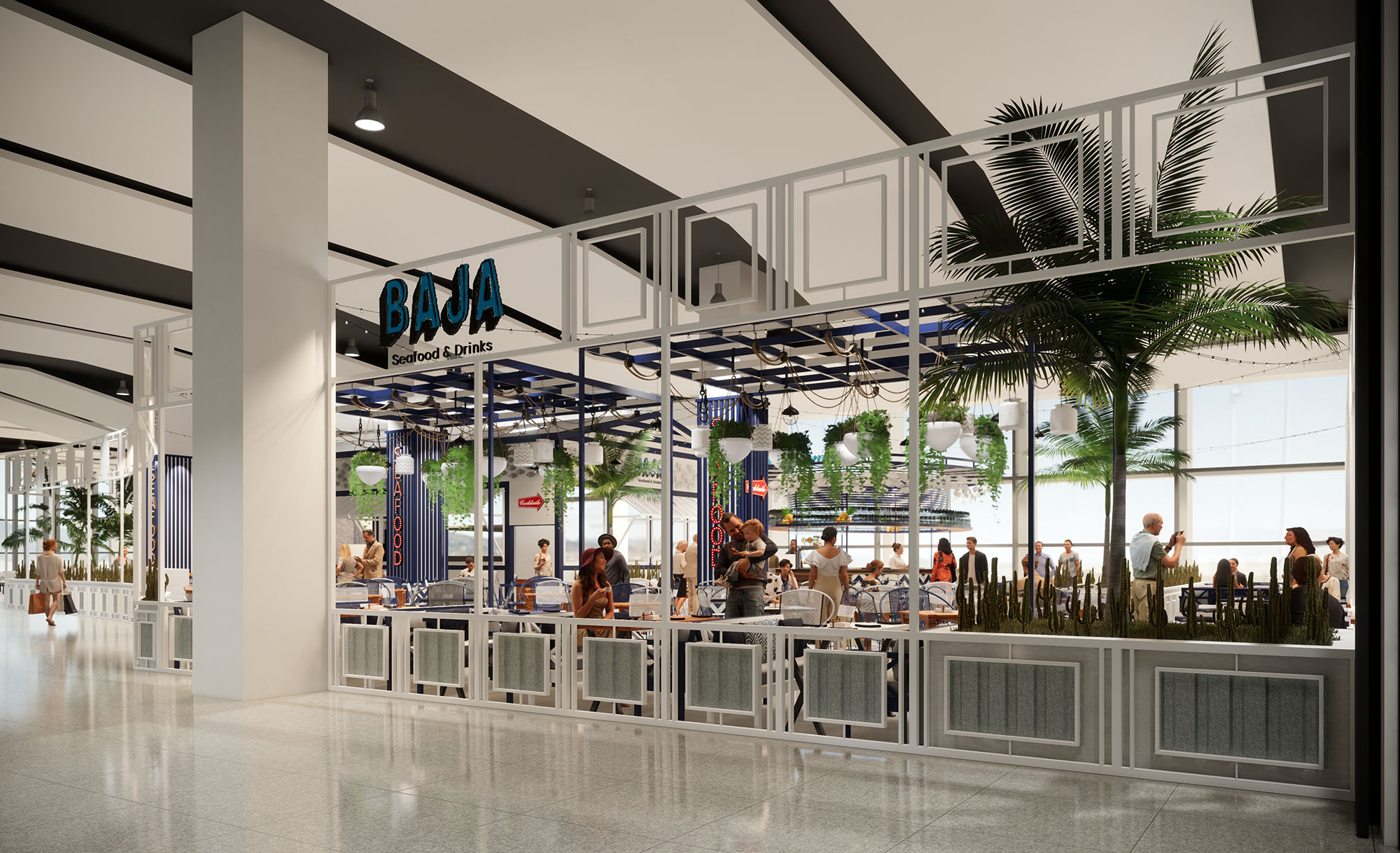
The concept for Baja Seafood & Drinks translates the relaxed coastal character of Los Cabos into a contemporary open-terrace restaurant inside a commercial environment. The design recreates the experience of an outdoor marina pavilion, using a light steel framework, hanging greenery and nautical details to define a permeable architectural envelope without closing off the visual continuity of the mall. The space is conceived as a social pier: a place where flows converge, people pause, and gastronomy becomes the central attraction.
The project draws from the chromatic and textural language of the Baja California seafront: deep ocean blues, crisp whites and warm wood accents. These elements are orchestrated to evoke freshness and informality while maintaining a clear, graphic identity that is easily perceived from a distance and supports strong brand recognition.
The restaurant occupies a corner plot within the shopping center, working as an island accessible from all sides. A metal perimeter railing with diagonal braces subtly demarcates the dining area while preserving full transparency to adjacent corridors. This low boundary frames a raised platform that functions as a stage for the dining experience, enhancing visibility of the interior activity.
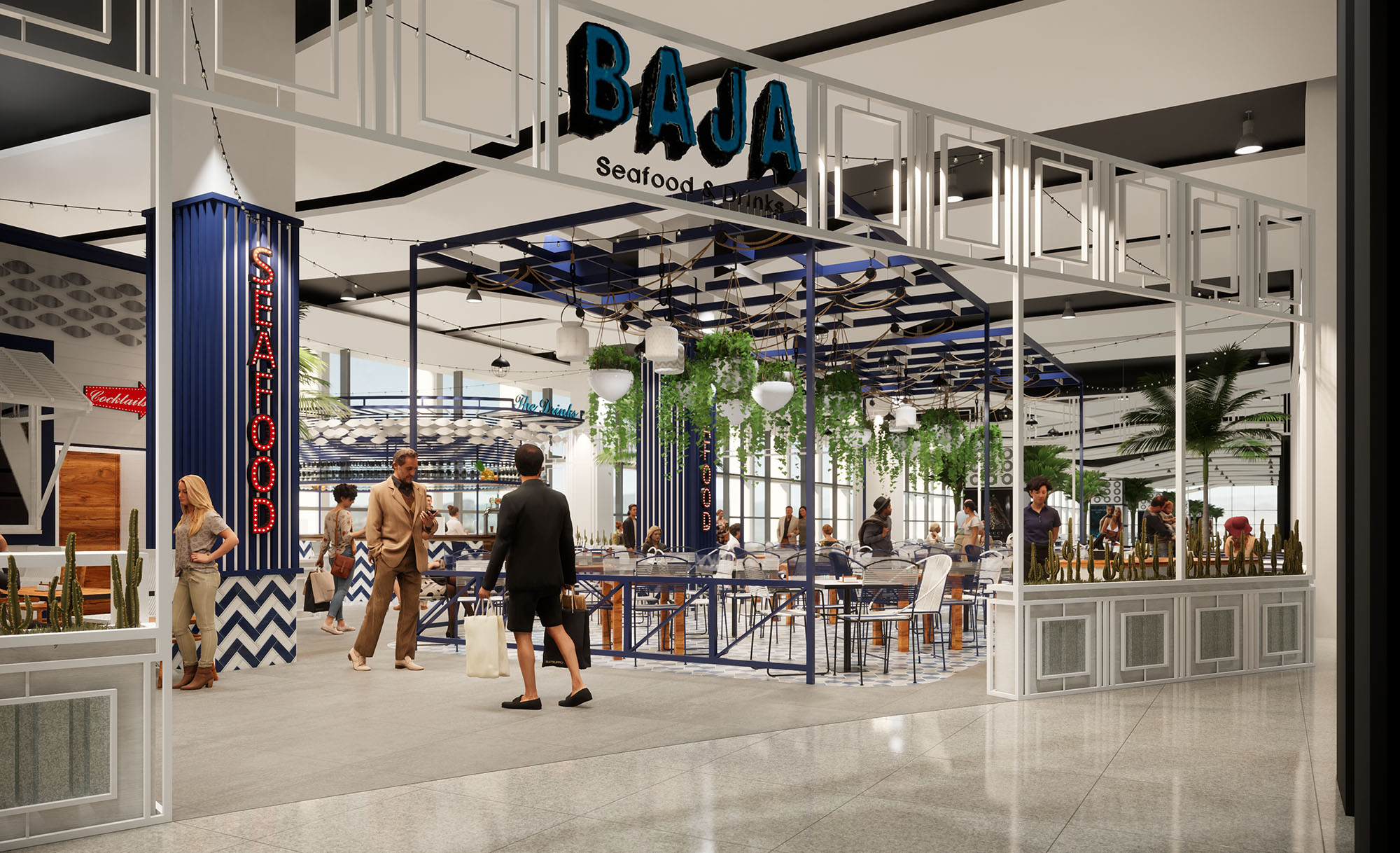
Central circulation is organized on an axial layout that directs guests from the main signage element at the entrance towards the bar and food counter at the back. Seating clusters alternate between two- and four-top tables, with higher communal tables near the perimeter to activate the edge and encourage interaction with the passing public. The plan ensures clear paths for staff movement and service, separating guest flows from operational routes without resorting to solid partitions.
A lightweight steel pergola system defines the overhead plane, painted in a deep navy blue that anchors the composition. This structure carries an arrangement of suspended luminaires, string lights and hanging planters, generating a rhythmic ceiling landscape that visually lowers the scale and creates a more intimate atmosphere within the large mall volume. The beams are aligned with floor patterns to reinforce directional cues and segmentation of areas.
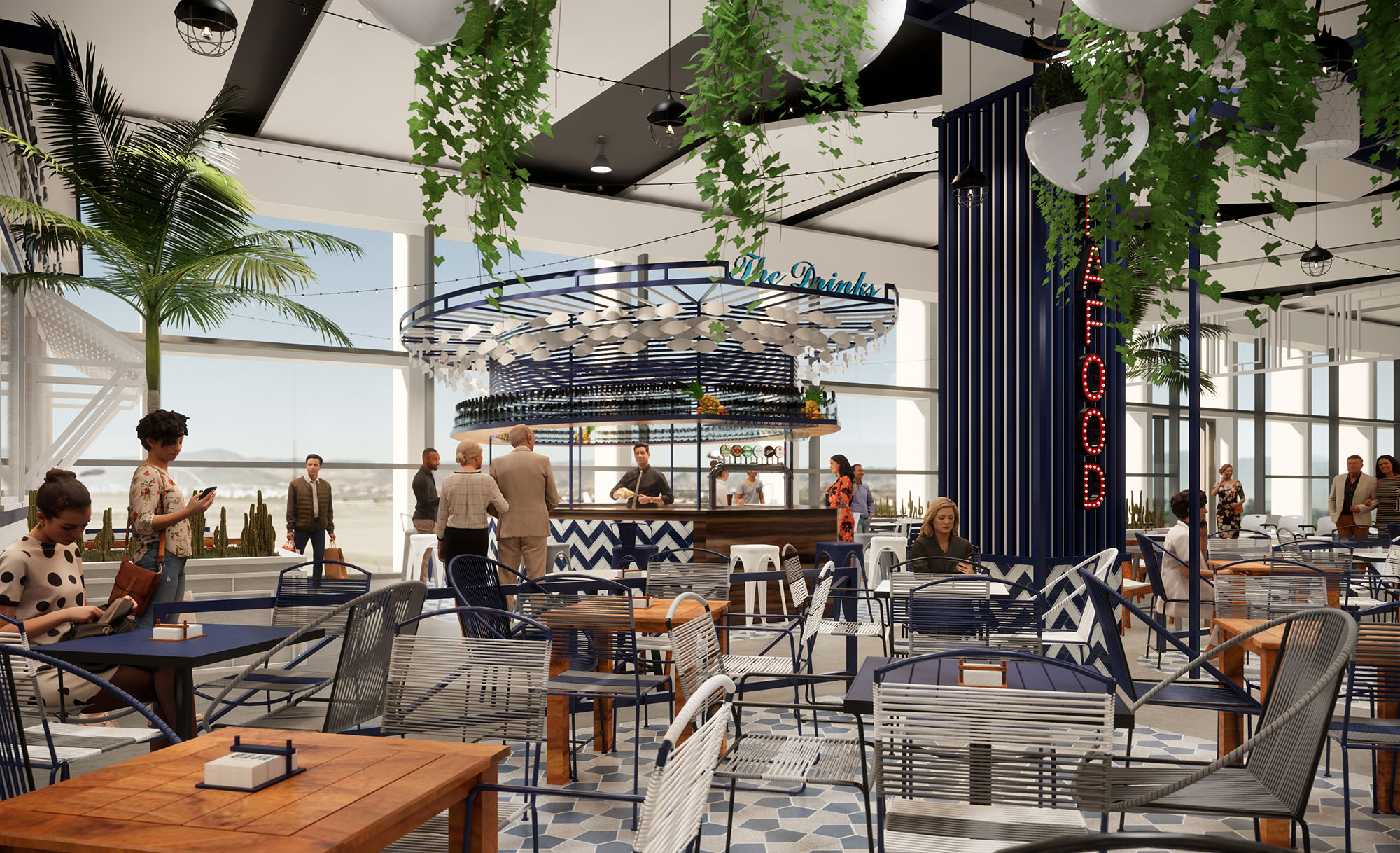
Lighting is layered: functional downlighting from integrated fixtures is complemented by warmer decorative pendants and festoon lights, evoking evening ambience at a seaside promenade. This combination allows flexible scene-setting depending on time of day and commercial needs while optimizing energy consumption through zoning and dimming controls.
The palette is intentionally concise to convey a clear, memorable identity. Blue and white dominate the vertical and horizontal surfaces, expressed through painted steel, ceramic tiles and printed graphics. Chevron and wave-inspired patterns on cladding and bar fronts reference maritime motifs without resorting to literal decoration, maintaining a contemporary aesthetic.
Seating combines metal frames with light finishes and wood-toned stools that introduce warmth into the predominantly cool palette. Transparent and perforated chair backs keep visual mass low, contributing to the sense of openness. The main “BAJA” signage employs bold typography and a textured, hand-painted effect that suggests artisanal character aligned with fresh, local seafood.
The interior atmosphere aims to evoke an outdoor terrace protected by shade structures. Natural light from the mall’s glazing enters unobstructed, while the overhead pergola and greenery filter and soften the brightness. Hanging plants and isolated palms provide vertical softness and a biophilic component that contrasts with the precise geometry of the metal framework.
Acoustic comfort is enhanced by the combination of plants, furniture upholstery and people density, helping to diffuse sound in an otherwise hard-surfaced mall environment. Visual permeability in all directions encourages spontaneous visits, while clearly readable zones—bar, dining, waiting—facilitate intuitive wayfinding and reduce the need for signage within the interior.
The project integrates sustainability primarily through material selection, efficient systems and long-term flexibility. Metal structures and railings are designed for modular assembly and potential reconfiguration, extending the life cycle of the components and minimizing waste in future adaptations. Finishes prioritize durable, low-maintenance surfaces suitable for high-traffic hospitality use, reducing replacement frequency.
LED lighting throughout, combined with programmable controls, significantly lowers energy consumption compared with conventional restaurant setups. The open design maximizes the use of existing mall climate control and daylight, reducing the need for additional mechanical equipment. Botanical elements not only improve perceived air quality and user well-being but are specified from species adapted to indoor environments in the local climate, limiting irrigation and maintenance demands. The project thereby aligns a strong, site-specific coastal identity with responsible, resource-conscious operation.


Our offices are located in Barcelona, Cancún, Chicago and Santo Domingo, but thanks to technology we can do projects on all over the world.
Barcelona
Bac de Roda 136
08020, Barcelona
Spain
Madrid
Av. de Buendía 11
19005 Guadalajara (Madrid)
Spain
Chicago
373 Hazel Ave, Apt A1
60022, Glencoe, Illinois
United States