

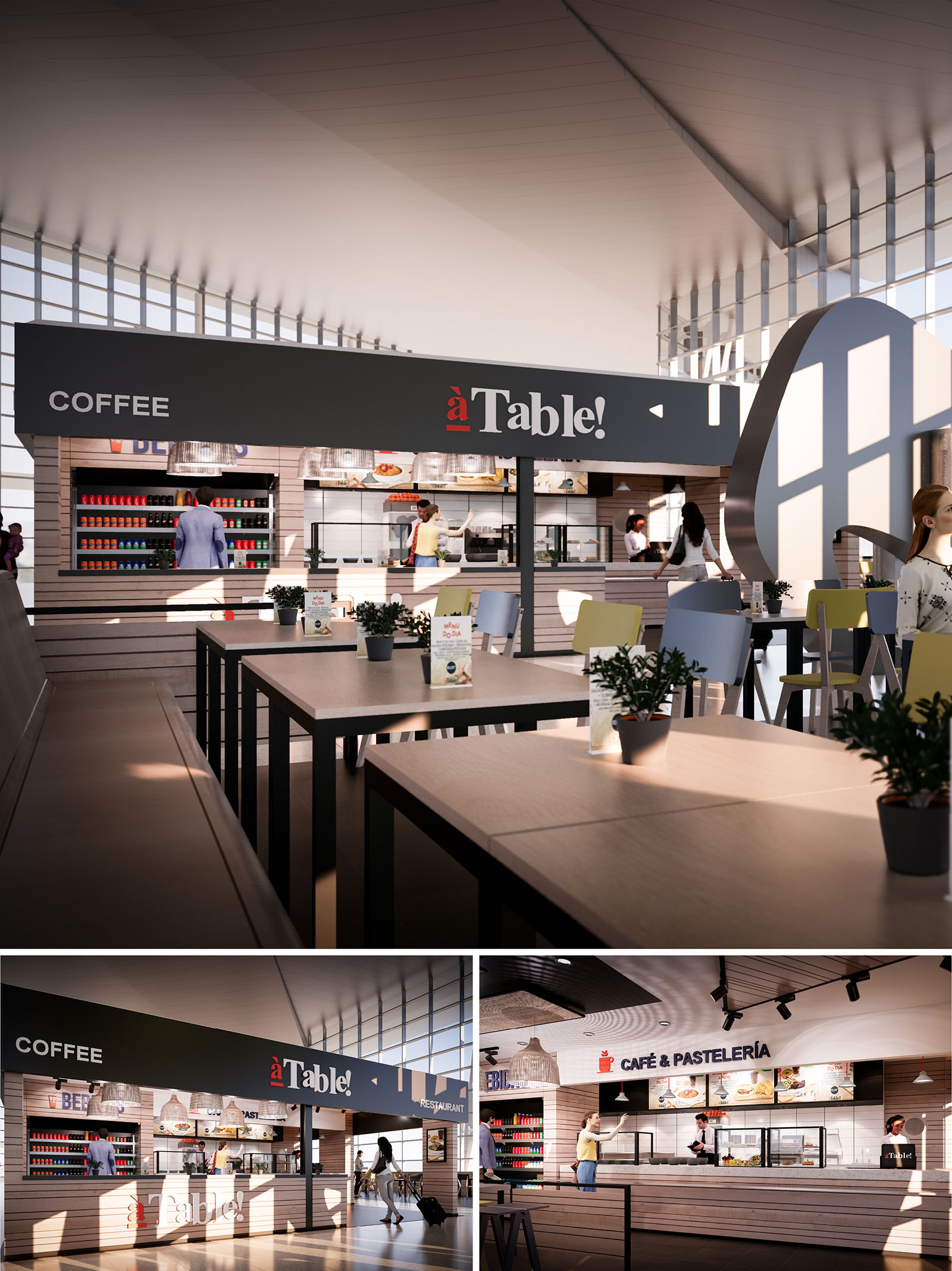
The “À Table” project is conceived as a contemporary food hall island within the dynamic context of Oporto’s airport. The design seeks to create a clear and recognizable identity in a high‑flow environment by using an iconic horizontal canopy and a strong graphic language. The architectural gesture is deliberately simple: a linear bar that organizes service, display and circulation, framed by a dark overhead band that acts as both sign and shelter.
The space balances efficiency and comfort, combining the rationality required for fast service with the warmth of a café atmosphere. The open layout promotes transparency between preparation areas and customers, reinforcing trust and visual connection with the food offer. The concept aims to be intuitively legible from a distance, guiding travelers quickly towards coffee, pastry and restaurant functions.
The project occupies a central island configuration, accessible from multiple sides, maximizing visibility within the terminal. The serving counter runs longitudinally, with self‑service and assisted service segments articulated along a continuous front. This linear strategy allows clear zoning of uses—coffee, pastry, hot meals—while preserving a single, unified image.
Customer seating radiates out from the counter in a gradient of densities. High tables closer to the service line support short stays, while standard tables and bench seating on the perimeter cater to longer meals. Circulation paths remain unobstructed, ensuring fluid movement of passengers with luggage. Vertical elements are minimized so that sight lines across the terminal remain open, preserving the spacious character of the existing architecture.
The material palette combines warm wood finishes with precise, graphic surfaces. Horizontal planes such as counters, cladding and tabletops use light-toned wood laminates that bring tactile warmth and a domestic sensibility, contrasting with the more technical environment of the airport. This wooden base is organized in horizontal slats, emphasizing continuity and reinforcing the linear geometry of the island.
The suspended fascia in dark grey acts as a visual anchor. It frames the brand name “À Table!” in high contrast white and red lettering, making the identity legible from long distances. Behind the counter, refrigerated displays and product shelving use neutral backgrounds that allow the color of packaged goods and menu imagery to stand out. Seating introduces soft accent tones—muted yellows and blues—to subtly energize the dining area without overwhelming the calm, natural base.
The lighting strategy leverages the abundant natural light of the terminal’s glazed façades. Daylight washes the seating area and counter fronts, creating shifting patterns of shadow across the slatted wood surfaces and enhancing their texture. The design ensures that fixtures remain visually light so as not to compete with the architecture of the terminal roof.
Artificial lighting is layered for clarity and comfort. Track-mounted spotlights highlight the food displays and menu boards, ensuring excellent legibility and color rendering. Over the counter, woven pendant luminaires introduce a softer, more domestic register, differentiating the dining zone from the surrounding concourses. Tabletop illumination is deliberately understated, avoiding glare while creating a warm, welcoming ambience suitable for both early-morning coffee and late-evening meals.
Furniture is designed to be robust, modular and easy to reconfigure according to operational needs. Tables adopt a simple rectangular geometry in laminated wood with fine, dark metal legs, which echo the structural language of the canopy above. This visual continuity between ceiling and floor elements reinforces the coherence of the concept while maintaining a light physical footprint.
Chairs and benches prioritize ergonomics and durability, using molded shells and metal frames suitable for intensive use. The presence of small potted plants on tables introduces a biophilic note, softening the perception of an otherwise highly functional travel environment. Menu holders and tabletop communication elements are carefully dimensioned to maintain visual order and to avoid clutter, supporting an intuitive user journey from approach, to ordering, to seating.
Sustainability is addressed through both material selection and operational efficiency. The predominant use of wood-based laminates and slatted cladding allows for components to be prefabricated, reducing on-site waste and facilitating disassembly or replacement over time. Furniture and counters are conceived as modular systems, enabling future reconfiguration without full demolition, extending the life cycle of the fit-out.
The design capitalizes on existing terminal daylight to minimize reliance on artificial lighting during daytime operation. High-efficiency LED fixtures, controlled in zones, allow light levels to be adjusted according to occupancy and natural light availability, reducing energy consumption. Finishes are chosen for durability and ease of maintenance, decreasing the need for frequent replacement. Where possible, recyclable components and low-VOC surface treatments are specified, contributing to better indoor environmental quality for staff and travelers alike.
LIST OF PROJECTS EXPERIENCE
Designed, Executed and/or Built Projects
PORTUGAL
1. A Table - Oporto - Tierra Check In
2. A Table - Oporto - Aire No Schengen
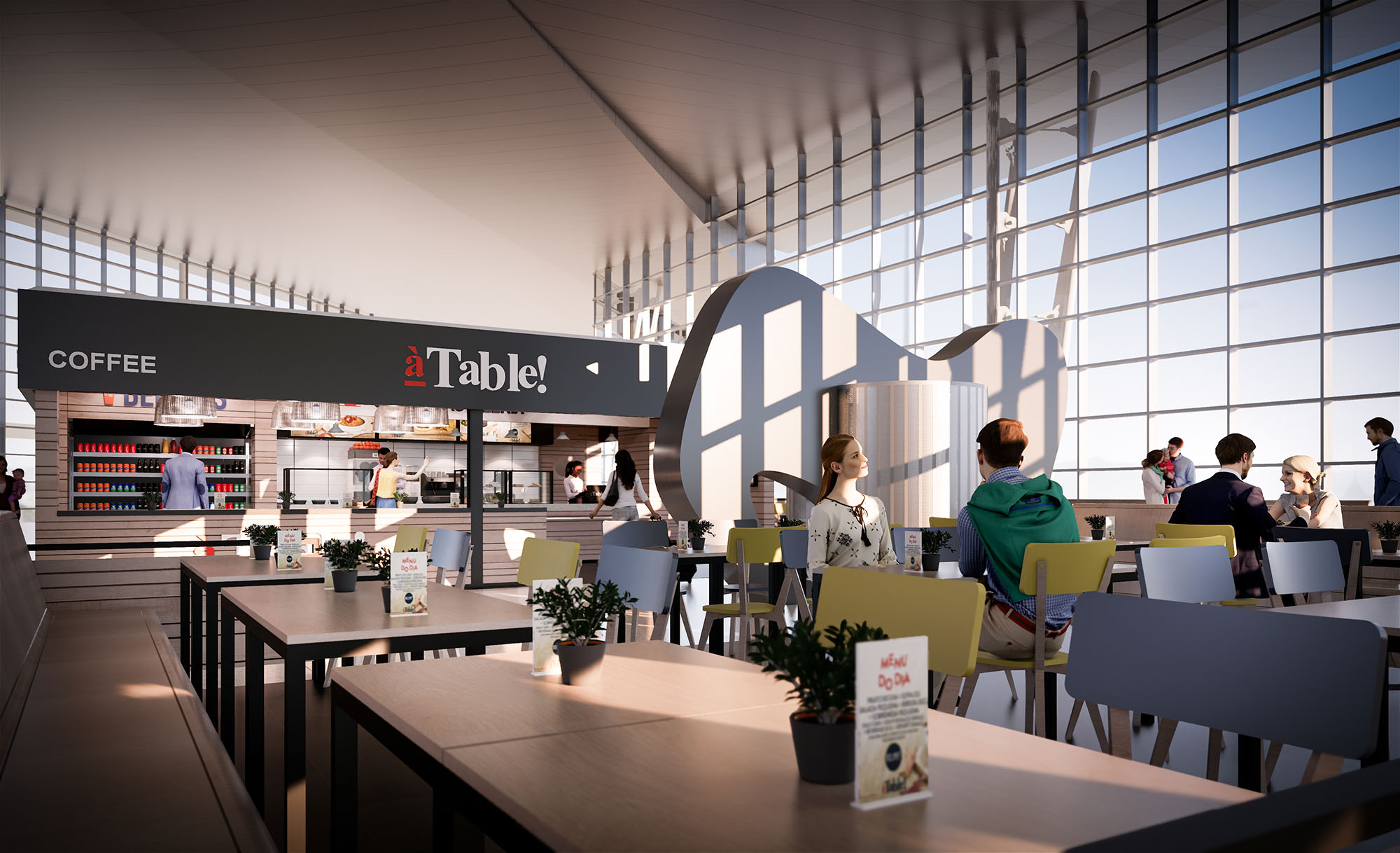
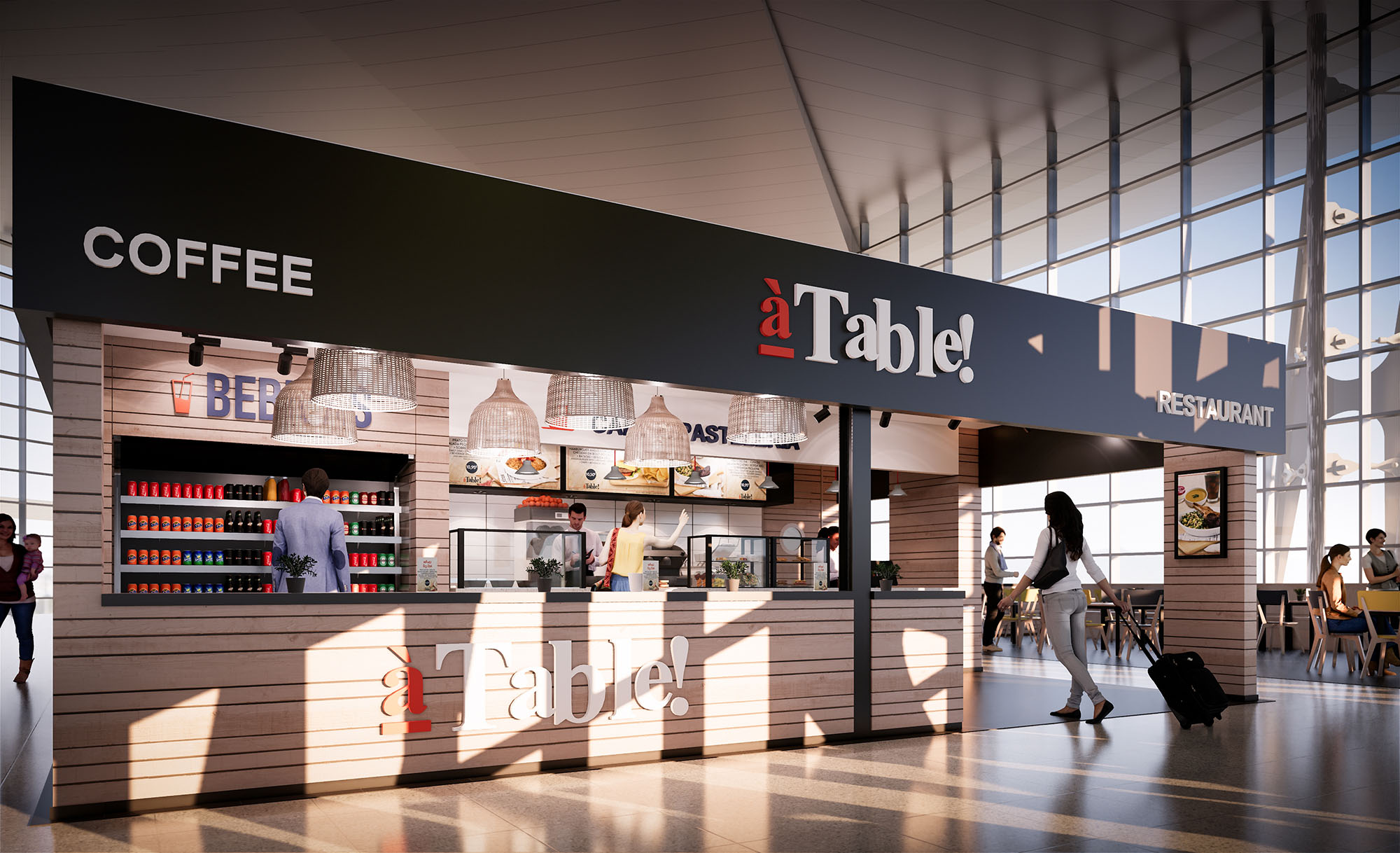
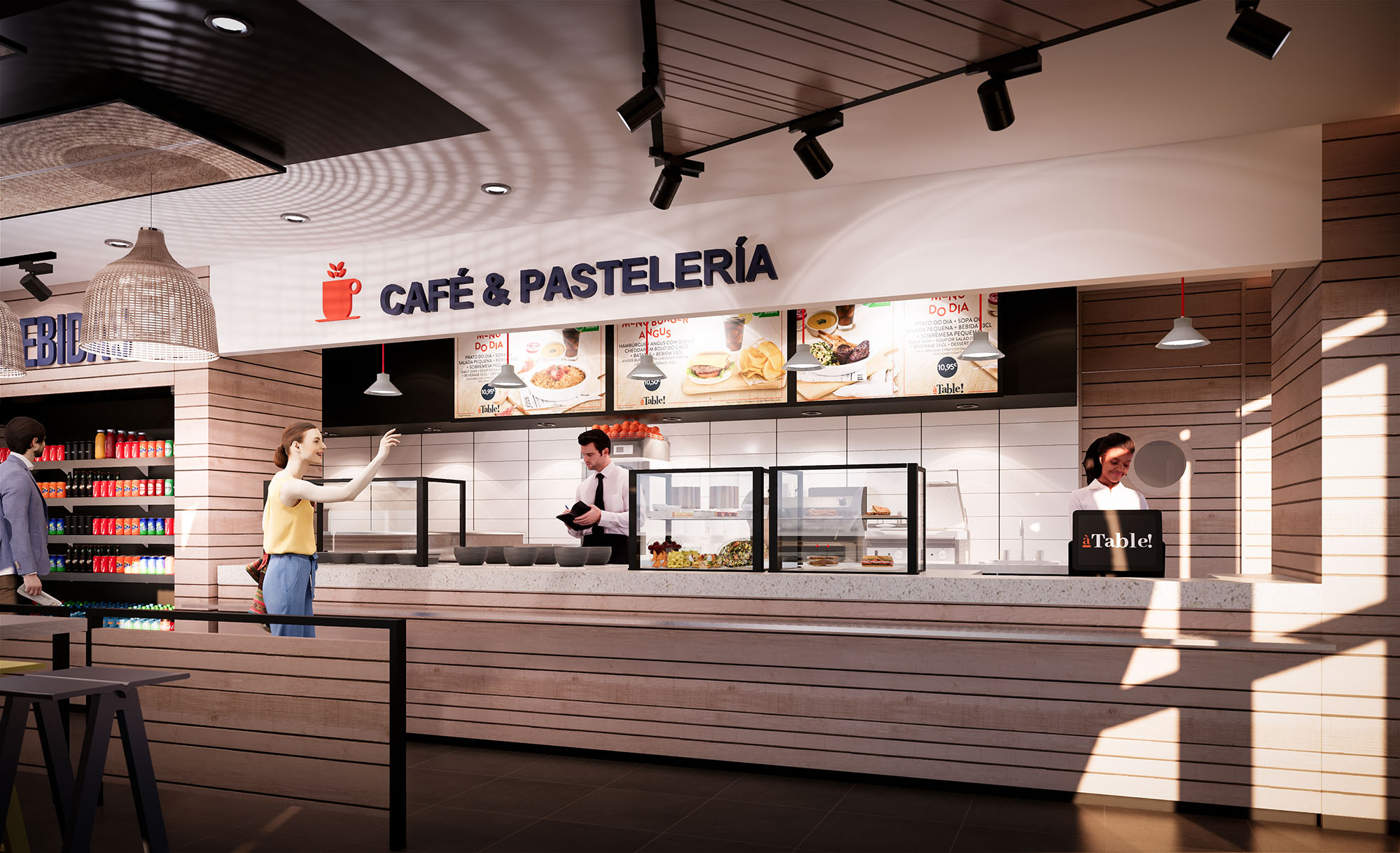
The “À Table” project is conceived as a contemporary food hall island within the dynamic context of Oporto’s airport. The design seeks to create a clear and recognizable identity in a high‑flow environment by using an iconic horizontal canopy and a strong graphic language. The architectural gesture is deliberately simple: a linear bar that organizes service, display and circulation, framed by a dark overhead band that acts as both sign and shelter.
The space balances efficiency and comfort, combining the rationality required for fast service with the warmth of a café atmosphere. The open layout promotes transparency between preparation areas and customers, reinforcing trust and visual connection with the food offer. The concept aims to be intuitively legible from a distance, guiding travelers quickly towards coffee, pastry and restaurant functions.
The project occupies a central island configuration, accessible from multiple sides, maximizing visibility within the terminal. The serving counter runs longitudinally, with self‑service and assisted service segments articulated along a continuous front. This linear strategy allows clear zoning of uses—coffee, pastry, hot meals—while preserving a single, unified image.
Customer seating radiates out from the counter in a gradient of densities. High tables closer to the service line support short stays, while standard tables and bench seating on the perimeter cater to longer meals. Circulation paths remain unobstructed, ensuring fluid movement of passengers with luggage. Vertical elements are minimized so that sight lines across the terminal remain open, preserving the spacious character of the existing architecture.
The material palette combines warm wood finishes with precise, graphic surfaces. Horizontal planes such as counters, cladding and tabletops use light-toned wood laminates that bring tactile warmth and a domestic sensibility, contrasting with the more technical environment of the airport. This wooden base is organized in horizontal slats, emphasizing continuity and reinforcing the linear geometry of the island.
The suspended fascia in dark grey acts as a visual anchor. It frames the brand name “À Table!” in high contrast white and red lettering, making the identity legible from long distances. Behind the counter, refrigerated displays and product shelving use neutral backgrounds that allow the color of packaged goods and menu imagery to stand out. Seating introduces soft accent tones—muted yellows and blues—to subtly energize the dining area without overwhelming the calm, natural base.
The lighting strategy leverages the abundant natural light of the terminal’s glazed façades. Daylight washes the seating area and counter fronts, creating shifting patterns of shadow across the slatted wood surfaces and enhancing their texture. The design ensures that fixtures remain visually light so as not to compete with the architecture of the terminal roof.
Artificial lighting is layered for clarity and comfort. Track-mounted spotlights highlight the food displays and menu boards, ensuring excellent legibility and color rendering. Over the counter, woven pendant luminaires introduce a softer, more domestic register, differentiating the dining zone from the surrounding concourses. Tabletop illumination is deliberately understated, avoiding glare while creating a warm, welcoming ambience suitable for both early-morning coffee and late-evening meals.
Furniture is designed to be robust, modular and easy to reconfigure according to operational needs. Tables adopt a simple rectangular geometry in laminated wood with fine, dark metal legs, which echo the structural language of the canopy above. This visual continuity between ceiling and floor elements reinforces the coherence of the concept while maintaining a light physical footprint.
Chairs and benches prioritize ergonomics and durability, using molded shells and metal frames suitable for intensive use. The presence of small potted plants on tables introduces a biophilic note, softening the perception of an otherwise highly functional travel environment. Menu holders and tabletop communication elements are carefully dimensioned to maintain visual order and to avoid clutter, supporting an intuitive user journey from approach, to ordering, to seating.
Sustainability is addressed through both material selection and operational efficiency. The predominant use of wood-based laminates and slatted cladding allows for components to be prefabricated, reducing on-site waste and facilitating disassembly or replacement over time. Furniture and counters are conceived as modular systems, enabling future reconfiguration without full demolition, extending the life cycle of the fit-out.
The design capitalizes on existing terminal daylight to minimize reliance on artificial lighting during daytime operation. High-efficiency LED fixtures, controlled in zones, allow light levels to be adjusted according to occupancy and natural light availability, reducing energy consumption. Finishes are chosen for durability and ease of maintenance, decreasing the need for frequent replacement. Where possible, recyclable components and low-VOC surface treatments are specified, contributing to better indoor environmental quality for staff and travelers alike.


Our offices are located in Barcelona, Cancún, Chicago and Santo Domingo, but thanks to technology we can do projects on all over the world.
Barcelona
Bac de Roda 136
08020, Barcelona
Spain
Madrid
Av. de Buendía 11
19005 Guadalajara (Madrid)
Spain
Chicago
373 Hazel Ave, Apt A1
60022, Glencoe, Illinois
United States